Chapter #09
Cutaneous Anthrax
1
Introduction
 Cutaneous anthrax is the most common form
of anthrax infection, and it is also considered to be the least
dangerous. Infection usually develops from 1 to 7 days after
exposure.
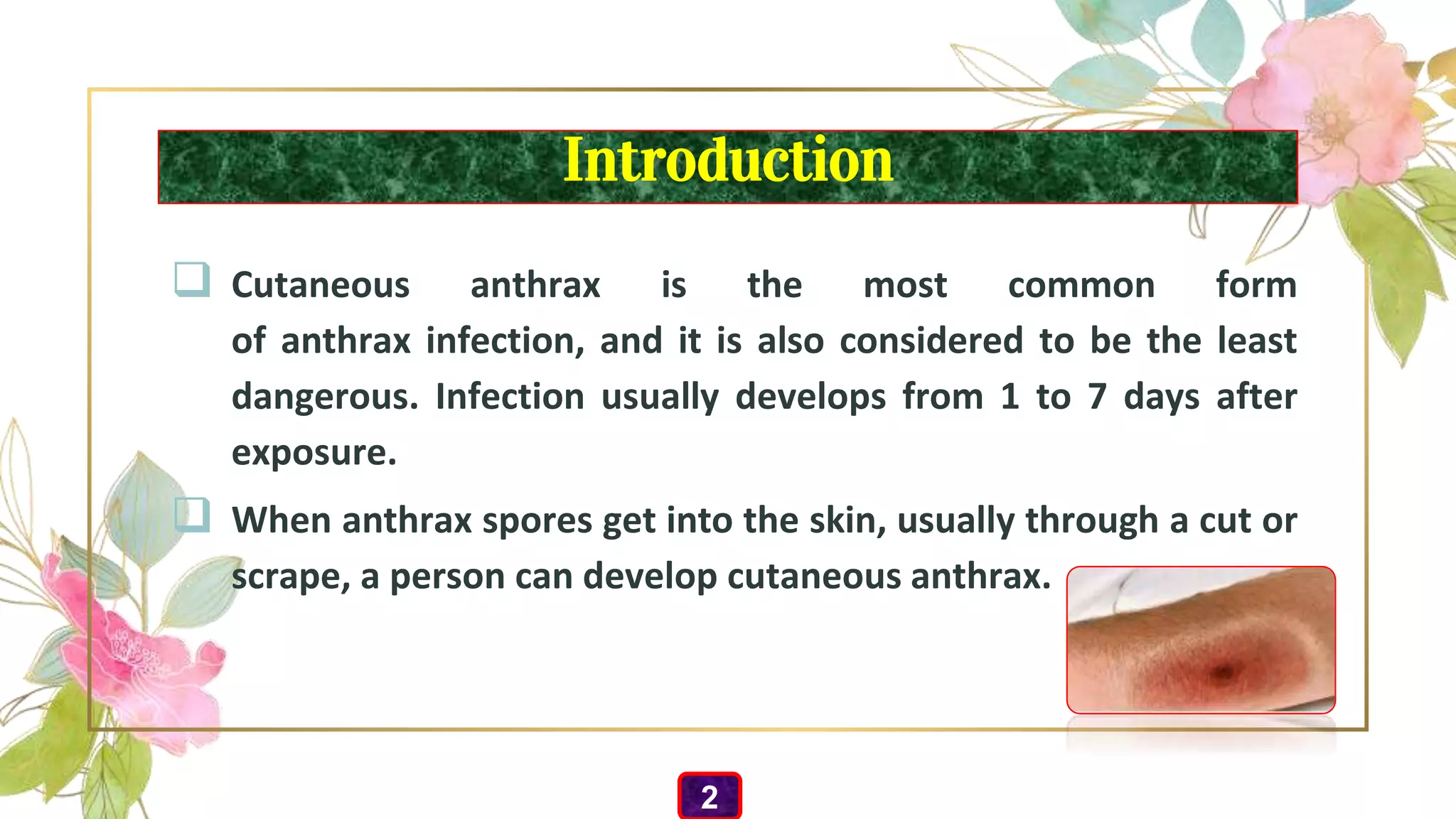
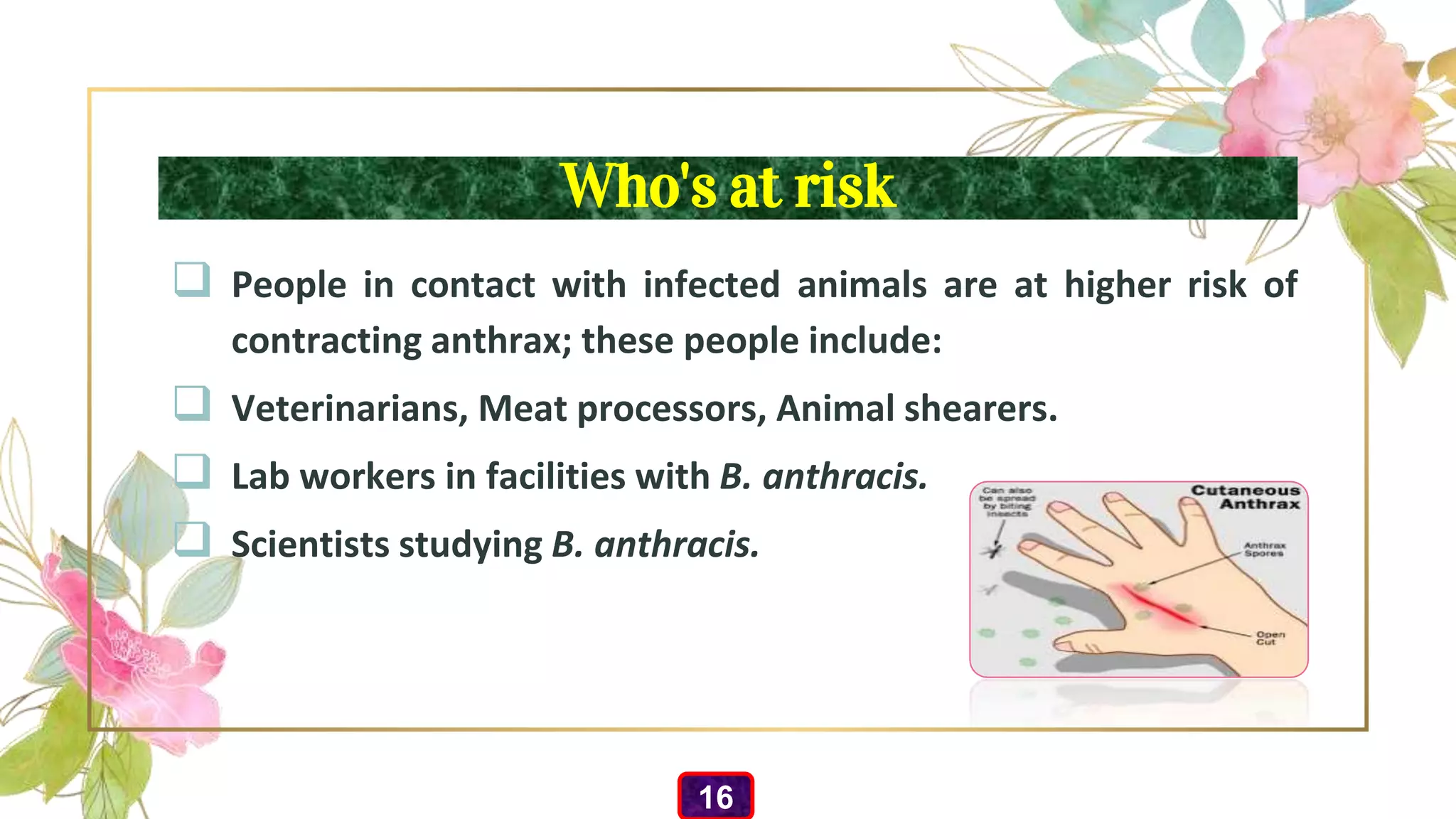
 When anthrax spores get into the skin, usually through a cut or
scrape, a person can develop cutaneous anthrax.
2
History
 The first clinical descriptions of cutaneous
anthrax were given by Maret in 1752 and Fournier in
1769.
 Before this, anthrax had only been described
through historical accounts. Scientist Robert Koch
studied Bacillus anthracis, the bacterium that
causes anthrax.
3
Causative Agent
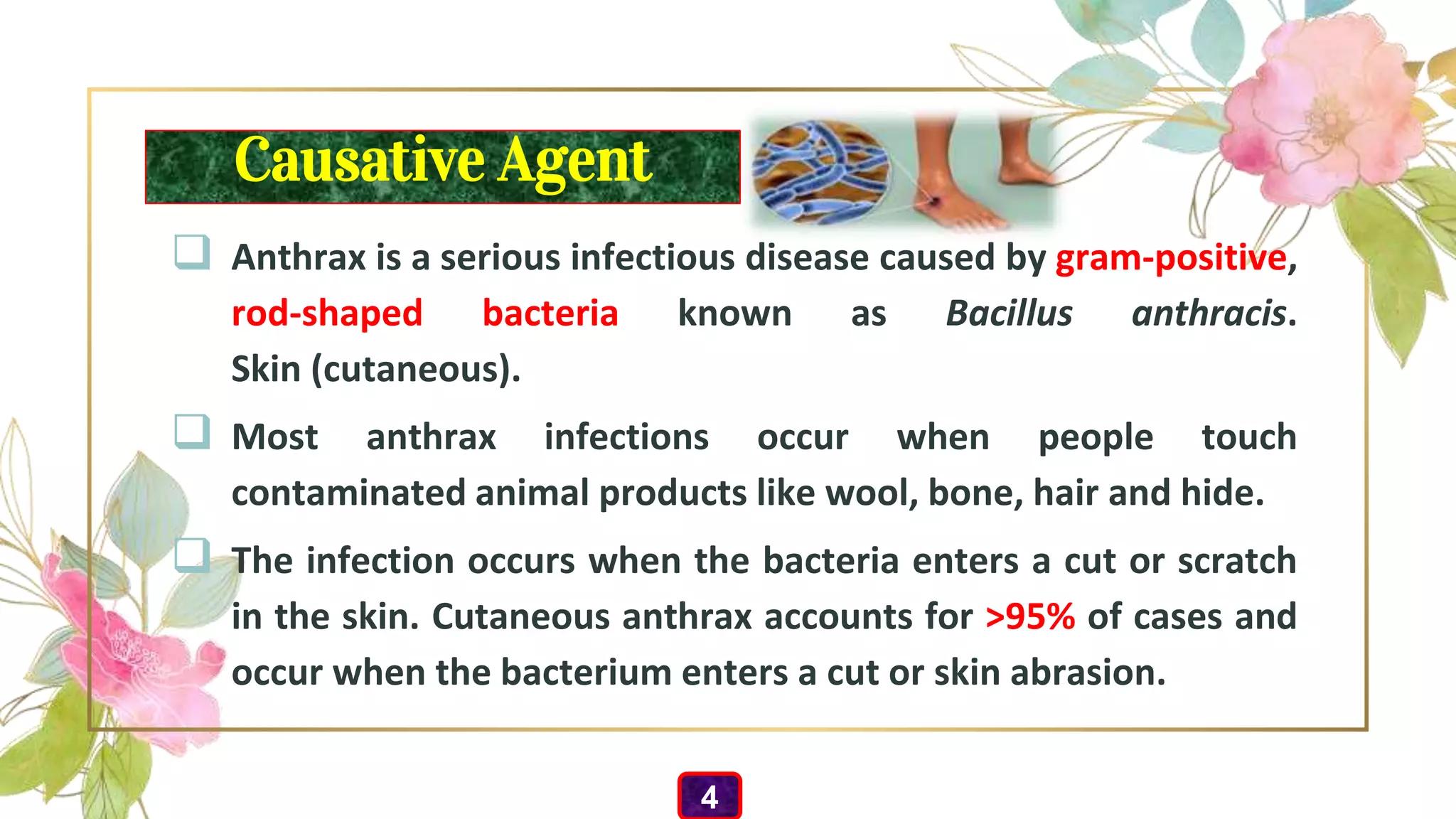
 Anthrax is a serious infectious disease caused by gram-positive,
rod-shaped bacteria known as Bacillus anthracis.
Skin (cutaneous).
 Most anthrax infections occur when people touch
contaminated animal products like wool, bone, hair and hide.
 The infection occurs when the bacteria enters a cut or scratch
in the skin. Cutaneous anthrax accounts for >95% of cases and
occur when the bacterium enters a cut or skin abrasion.
4
Epidemiology
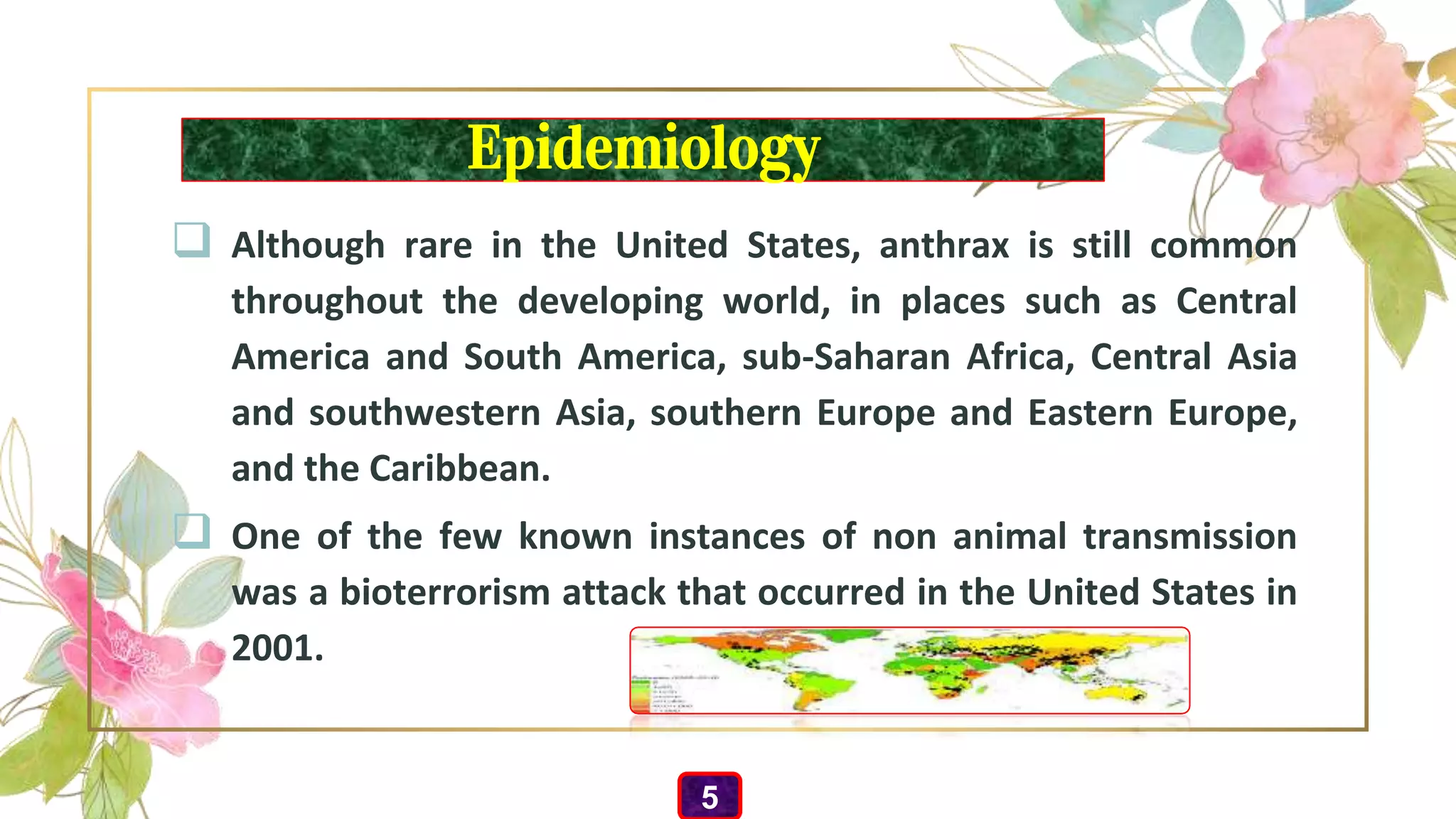
 Although rare in the United States, anthrax is still common
throughout the developing world, in places such as Central
America and South America, sub-Saharan Africa, Central Asia
and southwestern Asia, southern Europe and Eastern Europe,
and the Caribbean.
 One of the few known instances of non animal transmission
was a bioterrorism attack that occurred in the United States in
2001.
5
Signs and symptoms
 A group of small blisters or bumps that may itch.
 Swelling can occur around the sore, fever, malaise, headache.
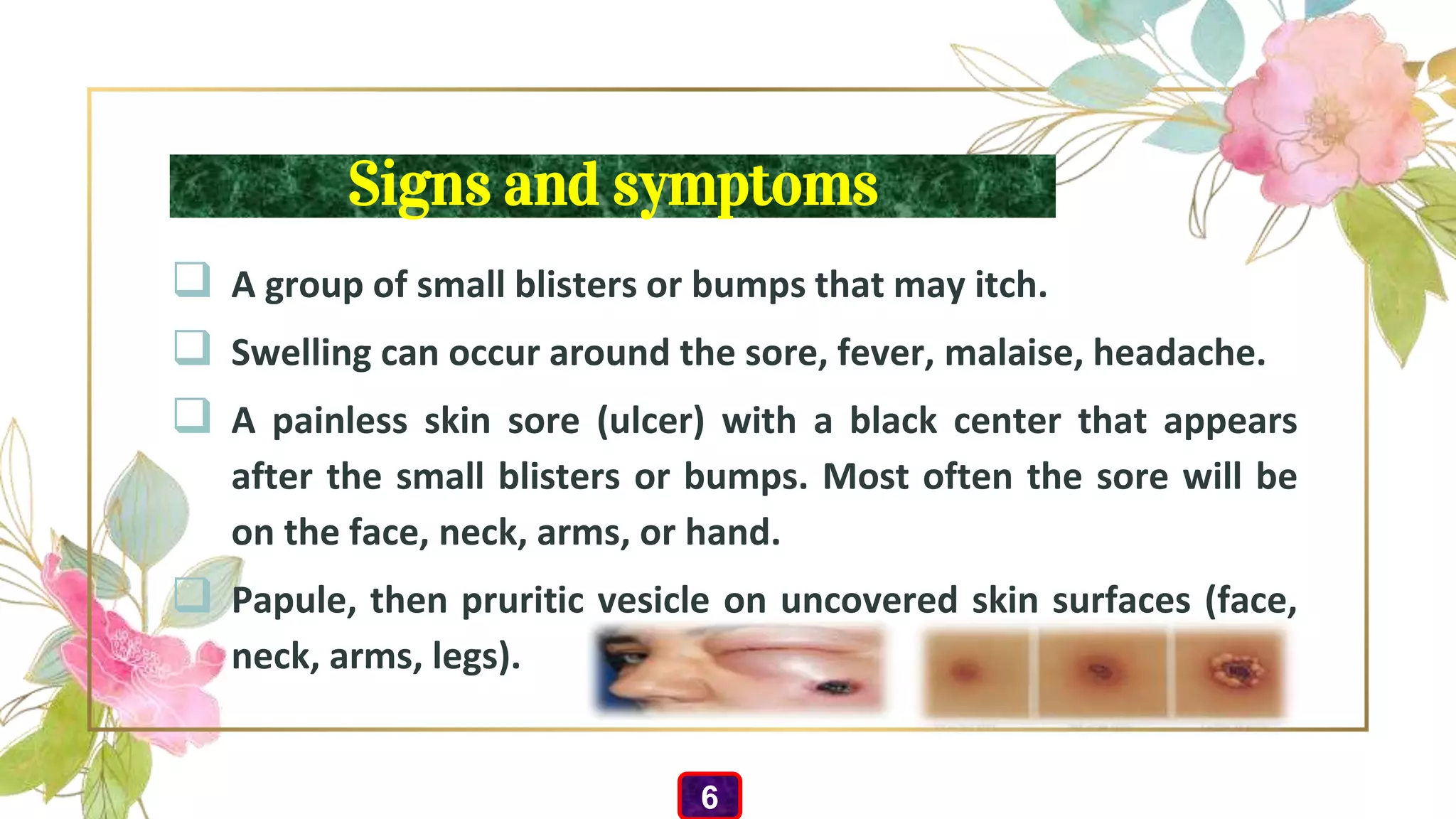
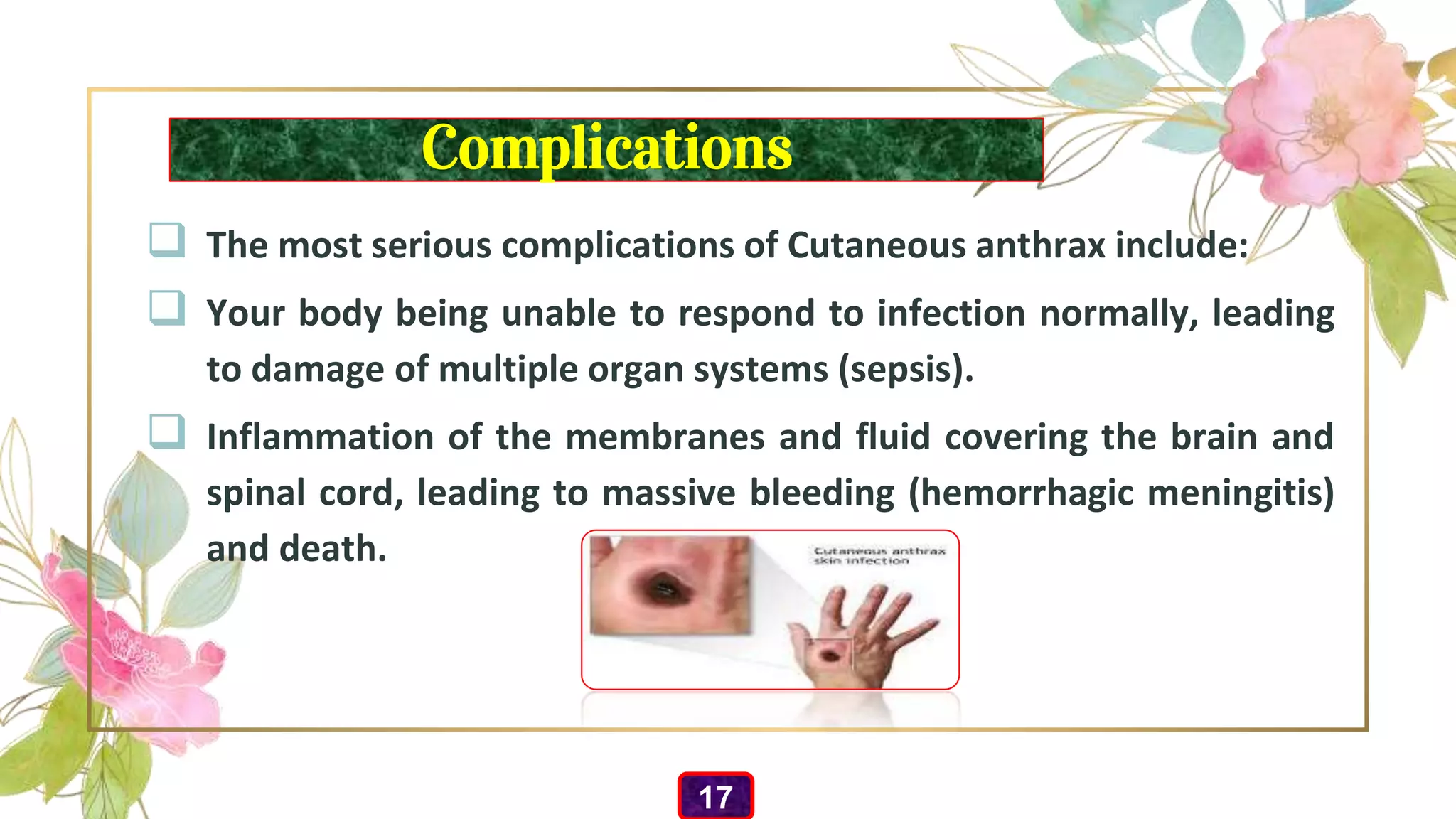
 A painless skin sore (ulcer) with a black center that appears
after the small blisters or bumps. Most often the sore will be
on the face, neck, arms, or hand.
 Papule, then pruritic vesicle on uncovered skin surfaces (face,
neck, arms, legs).
6
Pathogenesis
 Humans are relatively resistant to cutaneous invasion by B
anthracis, but the organisms may gain access through
microscopic or gross breaks in the skin. In cutaneous anthrax,
a malignant pustule develops at the infection site. This pustule
is a central area of coagulation necrosis (ulcer) surrounded by
a rim of vesicles filled with bloody or clear fluid. A black eschar
forms at the ulcer site. Extensive edema surrounds the lesion.
7
CONT…
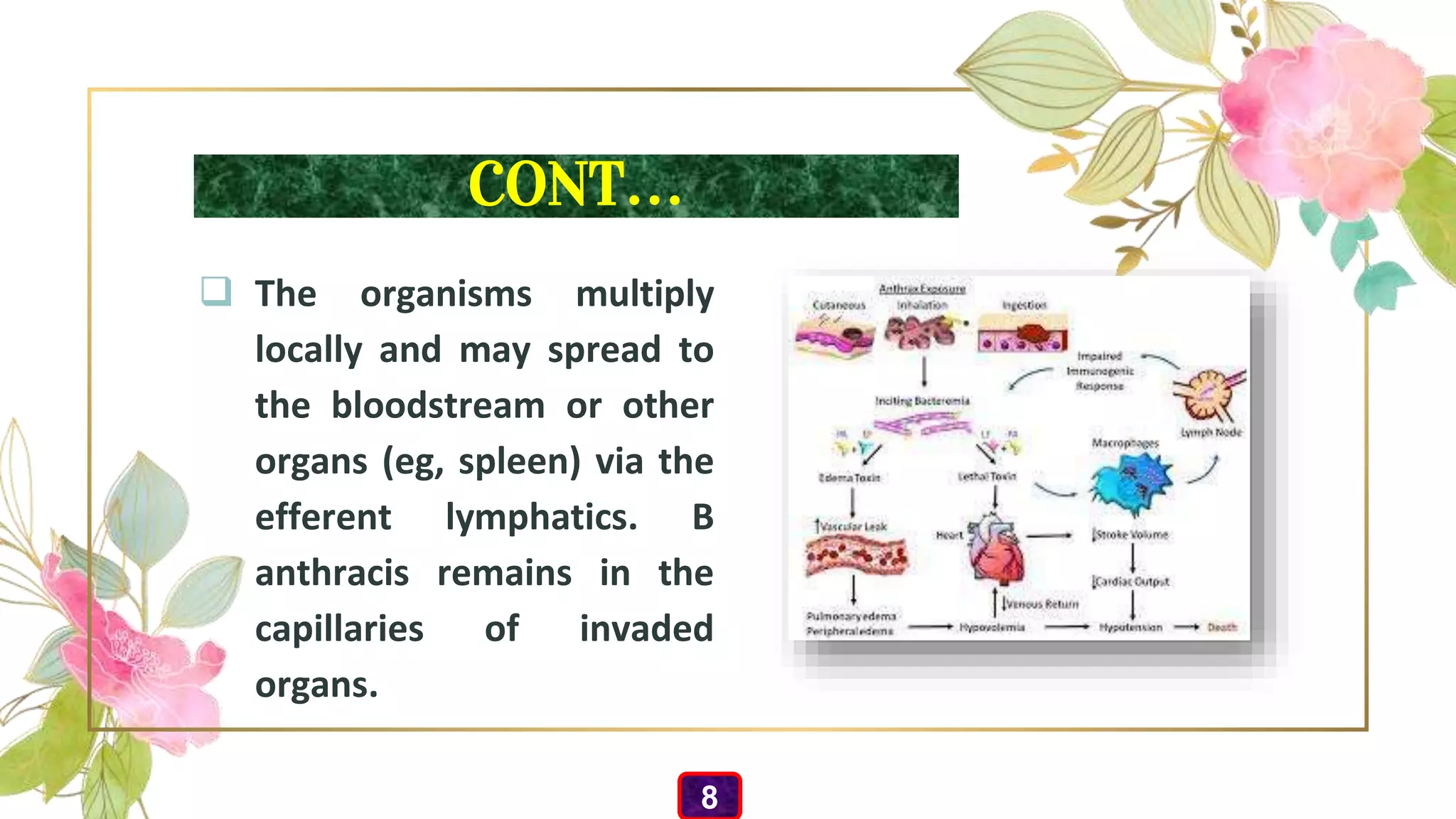
 The organisms multiply
locally and may spread to
the bloodstream or other
organs (eg, spleen) via the
efferent lymphatics. B
anthracis remains in the
capillaries of invaded
organs.
8
Transmission
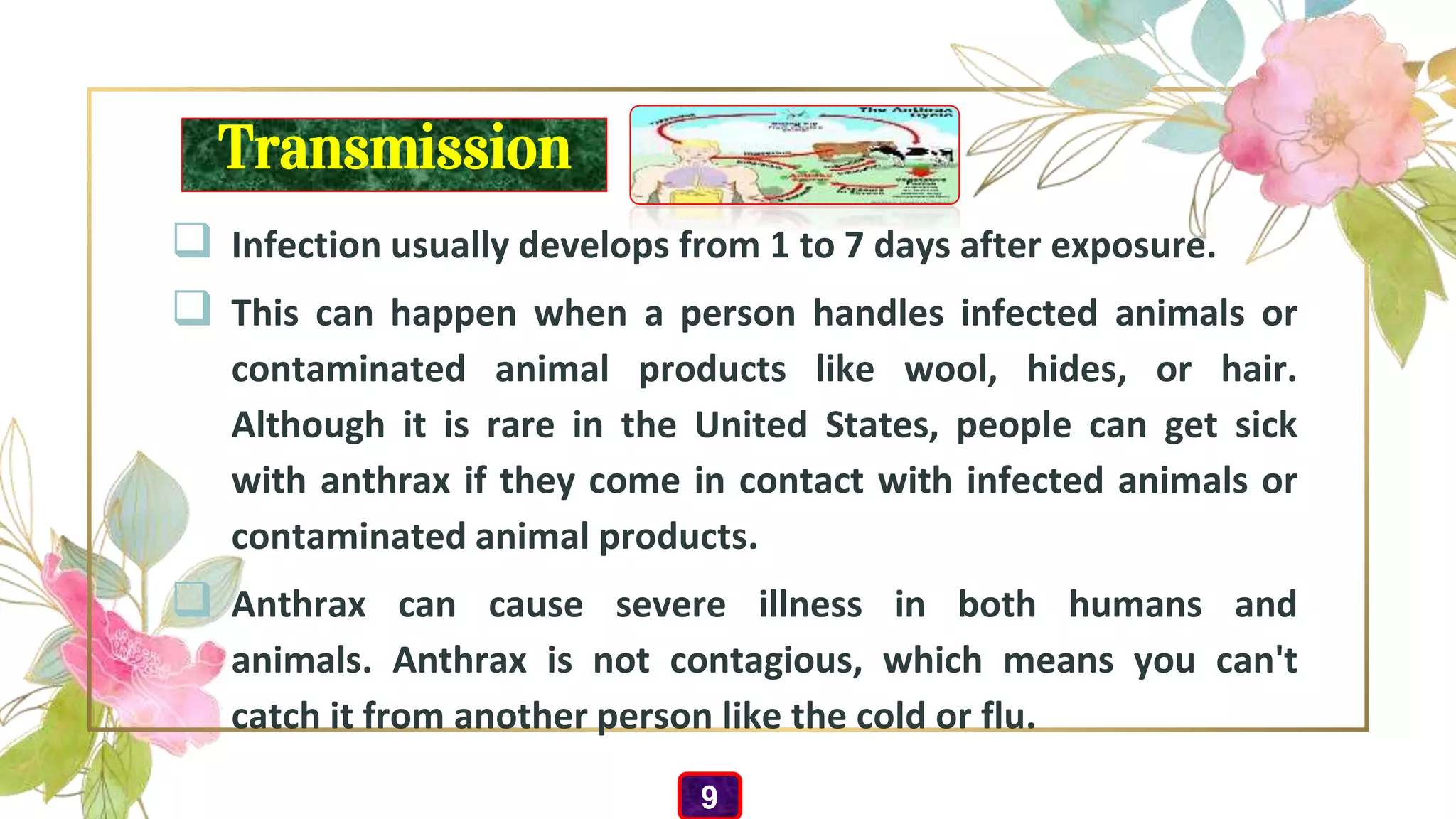
 Infection usually develops from 1 to 7 days after exposure.
 This can happen when a person handles infected animals or
contaminated animal products like wool, hides, or hair.
Although it is rare in the United States, people can get sick
with anthrax if they come in contact with infected animals or
contaminated animal products.
 Anthrax can cause severe illness in both humans and
animals. Anthrax is not contagious, which means you can't
catch it from another person like the cold or flu.
9
Lab diagnosis
 Chest X-ray or computerized tomography (CT) scan. The only
ways to confirm an anthrax diagnosis are:
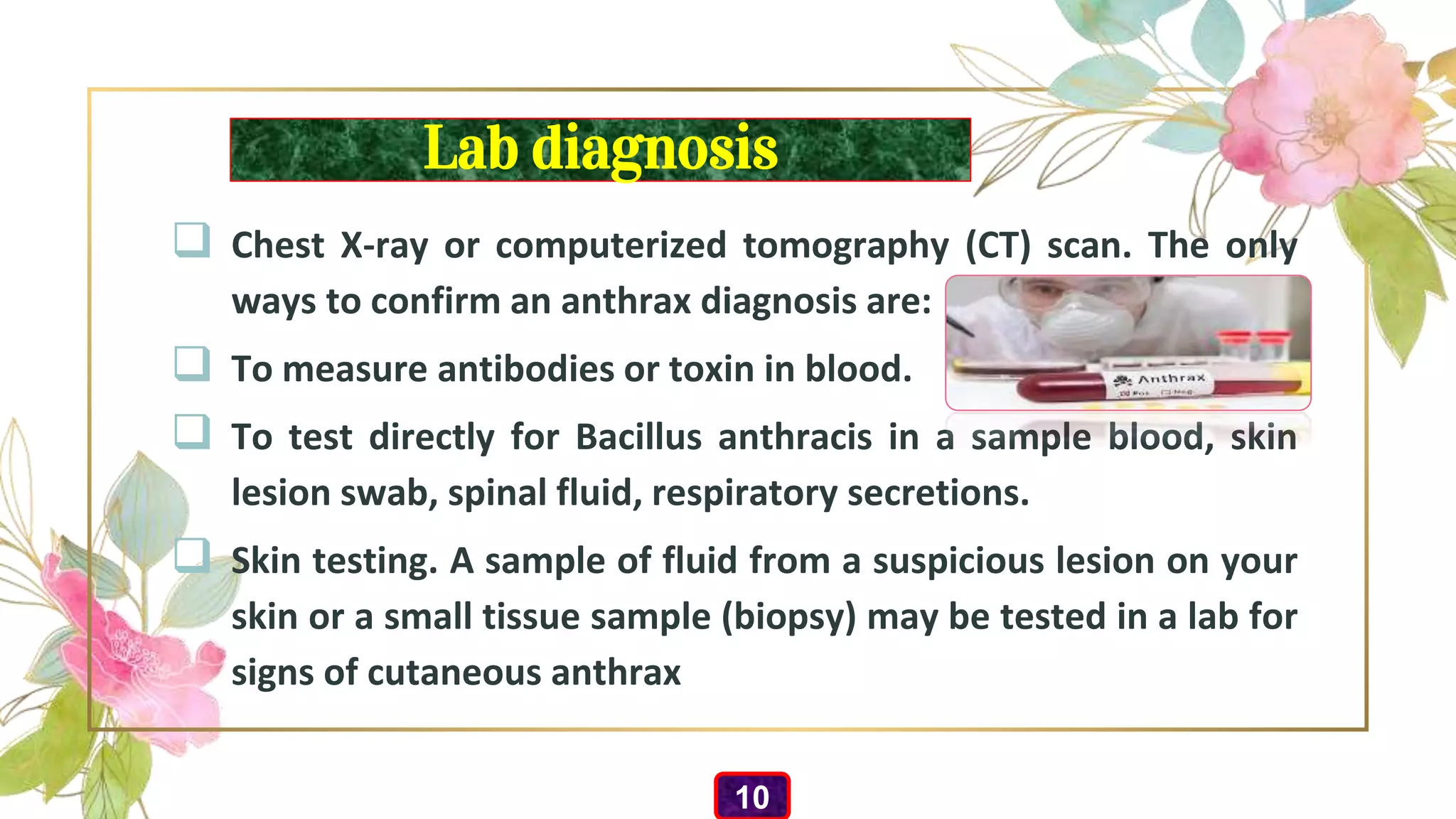
 To measure antibodies or toxin in blood.
 To test directly for Bacillus anthracis in a sample blood, skin
lesion swab, spinal fluid, respiratory secretions.
 Skin testing. A sample of fluid from a suspicious lesion on your
skin or a small tissue sample (biopsy) may be tested in a lab for
signs of cutaneous anthrax
10
Prevention
 You can reduce your risk of anthrax by having the anthrax
vaccine. To reduce environmental contamination, carcasses
of animals that die of anthrax should be burned or buried at
least 6 feet deep. In addition, bedding, soil, and other
materials contaminated with body fluids should also be burned
or buried.
 In some cases, treatment with monoclonal antibodies
raxibacumab and obiltoxaximab.
11
Avoiding infected animals
 If you live or travel in a country where anthrax is common and
herd animals aren't routinely vaccinated, avoid contact with
livestock and animal skins as much as possible. Also avoid
eating meat that hasn't been properly cooked.
 Even in developed countries, it's important to handle any dead
animal with care and to take precautions when working with
or processing imported hides, fur or wool.
12
Anthrax vaccine
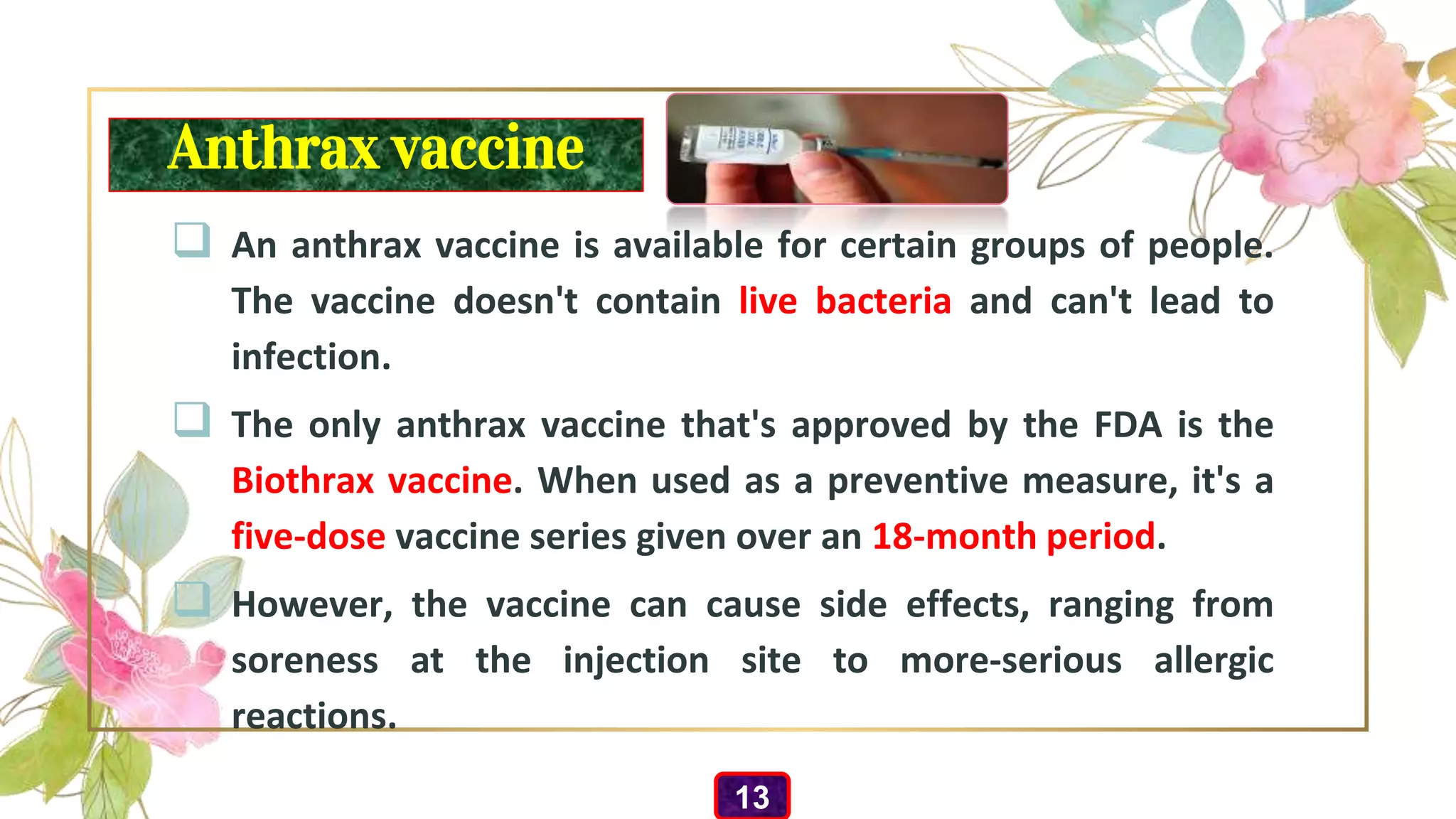
 An anthrax vaccine is available for certain groups of people.
The vaccine doesn't contain live bacteria and can't lead to
infection.
 The only anthrax vaccine that's approved by the FDA is the
Biothrax vaccine. When used as a preventive measure, it's a
five-dose vaccine series given over an 18-month period.
 However, the vaccine can cause side effects, ranging from
soreness at the injection site to more-serious allergic
reactions.
13
Treatment
 They are given by IV (intravenously). Antibiotics are usually taken for
60 days because it can take spores that long to germinate. Cutaneous
anthrax is treated with antibiotics taken by mouth, usually for 7 to 10
days. Doxycycline and ciprofloxacin are most often used.
 Ciprofloxacin IV infusion over 60 minutes Children: 10 mg/kg ever
hours Adults:400mg every 8 hours.Clindamycin IV infusion over 30
minutes Children 1month and over: 10 to 13 mg/kg every 8
hours (max. 2700 mg daily)Adults: 900 mg every 8 hours.
14
Risk factors
 To contract anthrax, you must come in direct contact with anthrax
spores. This is more likely if you:
 Are in the military and deployed to an area with a high risk of
exposure to anthrax. Inject illegal drugs, such as heroin.
 Work with anthrax in a laboratory setting.
 Handle animal skins, furs or wool from areas with a high incidence
of anthrax.
 Work in veterinary medicine, especially if you deal with livestock.
15
Who's at risk
 People in contact with infected animals are at higher risk of
contracting anthrax; these people include:
 Veterinarians, Meat processors, Animal shearers.
 Lab workers in facilities with B. anthracis.
 Scientists studying B. anthracis.
16
Complications
 The most serious complications of Cutaneous anthrax include:
 Your body being unable to respond to infection normally, leading
to damage of multiple organ systems (sepsis).
 Inflammation of the membranes and fluid covering the brain and
spinal cord, leading to massive bleeding (hemorrhagic meningitis)
and death.
17
18

Cutaneous anthrax presentation

  • 1.
  • 2.
    Introduction  Cutaneous anthraxis the most common form of anthrax infection, and it is also considered to be the least dangerous. Infection usually develops from 1 to 7 days after exposure.  When anthrax spores get into the skin, usually through a cut or scrape, a person can develop cutaneous anthrax. 2
  • 3.
    History  The firstclinical descriptions of cutaneous anthrax were given by Maret in 1752 and Fournier in 1769.  Before this, anthrax had only been described through historical accounts. Scientist Robert Koch studied Bacillus anthracis, the bacterium that causes anthrax. 3
  • 4.
    Causative Agent  Anthraxis a serious infectious disease caused by gram-positive, rod-shaped bacteria known as Bacillus anthracis. Skin (cutaneous).  Most anthrax infections occur when people touch contaminated animal products like wool, bone, hair and hide.  The infection occurs when the bacteria enters a cut or scratch in the skin. Cutaneous anthrax accounts for >95% of cases and occur when the bacterium enters a cut or skin abrasion. 4
  • 5.
    Epidemiology  Although rarein the United States, anthrax is still common throughout the developing world, in places such as Central America and South America, sub-Saharan Africa, Central Asia and southwestern Asia, southern Europe and Eastern Europe, and the Caribbean.  One of the few known instances of non animal transmission was a bioterrorism attack that occurred in the United States in 2001. 5
  • 6.
    Signs and symptoms A group of small blisters or bumps that may itch.  Swelling can occur around the sore, fever, malaise, headache.  A painless skin sore (ulcer) with a black center that appears after the small blisters or bumps. Most often the sore will be on the face, neck, arms, or hand.  Papule, then pruritic vesicle on uncovered skin surfaces (face, neck, arms, legs). 6
  • 7.
    Pathogenesis  Humans arerelatively resistant to cutaneous invasion by B anthracis, but the organisms may gain access through microscopic or gross breaks in the skin. In cutaneous anthrax, a malignant pustule develops at the infection site. This pustule is a central area of coagulation necrosis (ulcer) surrounded by a rim of vesicles filled with bloody or clear fluid. A black eschar forms at the ulcer site. Extensive edema surrounds the lesion. 7
  • 8.
    CONT…  The organismsmultiply locally and may spread to the bloodstream or other organs (eg, spleen) via the efferent lymphatics. B anthracis remains in the capillaries of invaded organs. 8
  • 9.
    Transmission  Infection usuallydevelops from 1 to 7 days after exposure.  This can happen when a person handles infected animals or contaminated animal products like wool, hides, or hair. Although it is rare in the United States, people can get sick with anthrax if they come in contact with infected animals or contaminated animal products.  Anthrax can cause severe illness in both humans and animals. Anthrax is not contagious, which means you can't catch it from another person like the cold or flu. 9
  • 10.
    Lab diagnosis  ChestX-ray or computerized tomography (CT) scan. The only ways to confirm an anthrax diagnosis are:  To measure antibodies or toxin in blood.  To test directly for Bacillus anthracis in a sample blood, skin lesion swab, spinal fluid, respiratory secretions.  Skin testing. A sample of fluid from a suspicious lesion on your skin or a small tissue sample (biopsy) may be tested in a lab for signs of cutaneous anthrax 10
  • 11.
    Prevention  You canreduce your risk of anthrax by having the anthrax vaccine. To reduce environmental contamination, carcasses of animals that die of anthrax should be burned or buried at least 6 feet deep. In addition, bedding, soil, and other materials contaminated with body fluids should also be burned or buried.  In some cases, treatment with monoclonal antibodies raxibacumab and obiltoxaximab. 11
  • 12.
    Avoiding infected animals If you live or travel in a country where anthrax is common and herd animals aren't routinely vaccinated, avoid contact with livestock and animal skins as much as possible. Also avoid eating meat that hasn't been properly cooked.  Even in developed countries, it's important to handle any dead animal with care and to take precautions when working with or processing imported hides, fur or wool. 12
  • 13.
    Anthrax vaccine  Ananthrax vaccine is available for certain groups of people. The vaccine doesn't contain live bacteria and can't lead to infection.  The only anthrax vaccine that's approved by the FDA is the Biothrax vaccine. When used as a preventive measure, it's a five-dose vaccine series given over an 18-month period.  However, the vaccine can cause side effects, ranging from soreness at the injection site to more-serious allergic reactions. 13
  • 14.
    Treatment  They aregiven by IV (intravenously). Antibiotics are usually taken for 60 days because it can take spores that long to germinate. Cutaneous anthrax is treated with antibiotics taken by mouth, usually for 7 to 10 days. Doxycycline and ciprofloxacin are most often used.  Ciprofloxacin IV infusion over 60 minutes Children: 10 mg/kg ever hours Adults:400mg every 8 hours.Clindamycin IV infusion over 30 minutes Children 1month and over: 10 to 13 mg/kg every 8 hours (max. 2700 mg daily)Adults: 900 mg every 8 hours. 14
  • 15.
    Risk factors  Tocontract anthrax, you must come in direct contact with anthrax spores. This is more likely if you:  Are in the military and deployed to an area with a high risk of exposure to anthrax. Inject illegal drugs, such as heroin.  Work with anthrax in a laboratory setting.  Handle animal skins, furs or wool from areas with a high incidence of anthrax.  Work in veterinary medicine, especially if you deal with livestock. 15
  • 16.
    Who's at risk People in contact with infected animals are at higher risk of contracting anthrax; these people include:  Veterinarians, Meat processors, Animal shearers.  Lab workers in facilities with B. anthracis.  Scientists studying B. anthracis. 16
  • 17.
    Complications  The mostserious complications of Cutaneous anthrax include:  Your body being unable to respond to infection normally, leading to damage of multiple organ systems (sepsis).  Inflammation of the membranes and fluid covering the brain and spinal cord, leading to massive bleeding (hemorrhagic meningitis) and death. 17
  • 18.