Customized xLearning
Environment
Anabela Mesquita
CICE –ISCAP / IPP, Portugal
Algoritmi RC, Portugal
sarmento@iscap.ipp.pt
Fernando Moreira
UPT, IJP, DEGI, Portugal
IEETA, UA, Aveiro, Portugal
fmoreira@upt.pt
Paula Peres
CICE – ISCAP /IPP, Portugal
pperes@iscap.ipp.pt
15/11/2016 1Anabela Mesquita, Paula Peres, Fernando Moreira
Agenda
• Introduction
• Background
• Some assumptions
• Model proposed
• Conclusions and next steps
15/11/2016 2Anabela Mesquita, Paula Peres, Fernando Moreira
Introduction
15/11/2016 3
Changes
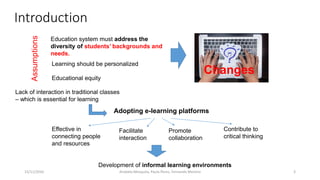
Education system must address the
diversity of students’ backgrounds and
needs.
Educational equity
Learning should be personalized
Lack of interaction in traditional classes
– which is essential for learning
Assumptions
Adopting e-learning platforms
Effective in
connecting people
and resources
Facilitate
interaction
Promote
collaboration
Contribute to
critical thinking
Development of informal learning environments
Anabela Mesquita, Paula Peres, Fernando Moreira
Introduction
15/11/2016 4
Platforms designed for elearning, open source or commercial - more
focused on the design of the needs of institutional progress or
activities concerning teaching and learning.
Personal Learning Environment - approach to integrate different practices and
resources to address individual learning needs - more flexible and aims to
focus on the needs of students.
Still relies on what teachers make at students’
disposal and not empower student to create his /
her own environment
Anabela Mesquita, Paula Peres, Fernando Moreira
Introduction
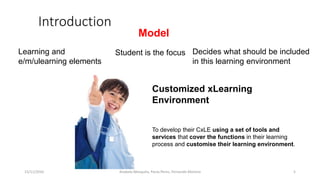
Model
To develop their CxLE using a set of tools and
services that cover the functions in their learning
process and customise their learning environment.
Learning and
e/m/ulearning elements
Student is the focus Decides what should be included
in this learning environment
Customized xLearning
Environment
15/11/2016 Anabela Mesquita, Paula Peres, Fernando Moreira 5
15/11/2016 Anabela Mesquita, Paula Peres, Fernando Moreira 6
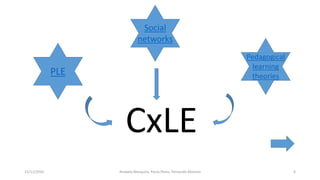
CxLE
PLE
Social
networks
Pedagogical
learning
theories
Background (1)
• Personal Learning Environments (PLE)
• “conceptual and technological frameworks that help
learners take control of and manage their own learning”.
• Providing support for learners to:
• Set their own learning goals
• Manage their learning (learning outcomes and processes)
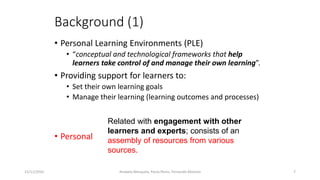
• Personal
15/11/2016 7
Related with engagement with other
learners and experts; consists of an
assembly of resources from various
sources.
Anabela Mesquita, Paula Peres, Fernando Moreira
Background (1)
• PLE characteristics
• Support – environment planned to help students to design and
manage their learning environment;
• Educational component – all the resources that are available in
the learning environment;
• Social – environment developed take into consideration the
need to engage with other (knowledge is something that is
socially constructed);
• Technological component – design of the tools used. All
components should be tailored, student-centered and driven.
15/11/2016 8Anabela Mesquita, Paula Peres, Fernando Moreira
Background (2)
• Social network
• “… a web service that allow individuals to (1) construct a public profile within
a bounded system, (2) articulate a list of other users with whom they share a
connection, and (3) view and traverse their list of connections and those made
by others within the system.”
• Social network can be:
• Horizontal - used for more general purposes; diverse users; address a wide
range of topics; reduced specialization; less privacy, public – lot of users and
information; no filter
• Vertical - highly segmented user base, addressing specific topics in depth,
high degree of specialization, generally more private and closed.
15/11/2016 9Anabela Mesquita, Paula Peres, Fernando Moreira
Background (3)
• Pedagogical Learning Theories
• Constructivism - all new knowledge and learning is based on
previous knowledge and past learning.
• Main principles:
• 1) learning and understanding comes from interaction with the
environment;
• 2) learners encounter cognitive conflict which in turn stimulates
learning;
• 3) new knowledge develops through social interaction
15/11/2016 10Anabela Mesquita, Paula Peres, Fernando Moreira
Background (3)
• Pedagogical Learning Theories
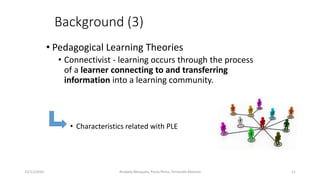
• Connectivist - learning occurs through the process
of a learner connecting to and transferring
information into a learning community.
• Characteristics related with PLE
15/11/2016 11Anabela Mesquita, Paula Peres, Fernando Moreira
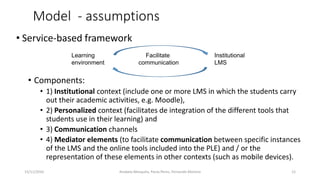
Model - assumptions
• Service-based framework
• Components:
• 1) Institutional context (include one or more LMS in which the students carry
out their academic activities, e.g. Moodle),
• 2) Personalized context (facilitates de integration of the different tools that
students use in their learning) and
• 3) Communication channels
• 4) Mediator elements (to facilitate communication between specific instances
of the LMS and the online tools included into the PLE) and / or the
representation of these elements in other contexts (such as mobile devices).
15/11/2016 12
Learning
environment
Institutional
LMS
Facilitate
communication
Anabela Mesquita, Paula Peres, Fernando Moreira
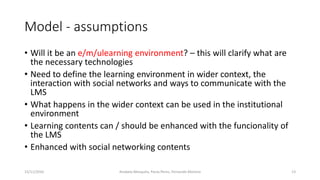
Model - assumptions
• Will it be an e/m/ulearning environment? – this will clarify what are
the necessary technologies
• Need to define the learning environment in wider context, the
interaction with social networks and ways to communicate with the
LMS
• What happens in the wider context can be used in the institutional
environment
• Learning contents can / should be enhanced with the funcionality of
the LMS
• Enhanced with social networking contents
15/11/2016 13Anabela Mesquita, Paula Peres, Fernando Moreira
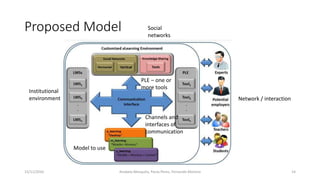
Proposed Model
15/11/2016 14
Institutional
environment
PLE – one or
more tools
Social
networks
Channels and
interfaces of
communication
Model to use
Anabela Mesquita, Paula Peres, Fernando Moreira
Network / interaction
Conclusions and next steps
• CxLE
• Technological developments are bringing more and more
functionalities to this learning environment while learning theories
support and are the basis for the conceptual principles of these
environments.
• Student is the center of all the learning process
• Learning does not occur only in the classroom
• LMS should also take into consideration informal learning, valuing
and assessing it.
• Other people should be involved in the process – external experts,
potential employers
15/11/2016 15Anabela Mesquita, Paula Peres, Fernando Moreira
• Next step
• Test this customized xlearning environment by implementing it
as proof of concept
• Propose an integration of all the learning space - formal and
informal - in the LMS
• Involve other key players in the learning environment
15/11/2016 16Anabela Mesquita, Paula Peres, Fernando Moreira
Thank you
15/11/2016 17Anabela Mesquita, Paula Peres, Fernando Moreira

Customized xLearning Environment

  • 1.
    Customized xLearning Environment Anabela Mesquita CICE–ISCAP / IPP, Portugal Algoritmi RC, Portugal sarmento@iscap.ipp.pt Fernando Moreira UPT, IJP, DEGI, Portugal IEETA, UA, Aveiro, Portugal fmoreira@upt.pt Paula Peres CICE – ISCAP /IPP, Portugal pperes@iscap.ipp.pt 15/11/2016 1Anabela Mesquita, Paula Peres, Fernando Moreira
  • 2.
    Agenda • Introduction • Background •Some assumptions • Model proposed • Conclusions and next steps 15/11/2016 2Anabela Mesquita, Paula Peres, Fernando Moreira
  • 3.
    Introduction 15/11/2016 3 Changes Education systemmust address the diversity of students’ backgrounds and needs. Educational equity Learning should be personalized Lack of interaction in traditional classes – which is essential for learning Assumptions Adopting e-learning platforms Effective in connecting people and resources Facilitate interaction Promote collaboration Contribute to critical thinking Development of informal learning environments Anabela Mesquita, Paula Peres, Fernando Moreira
  • 4.
    Introduction 15/11/2016 4 Platforms designedfor elearning, open source or commercial - more focused on the design of the needs of institutional progress or activities concerning teaching and learning. Personal Learning Environment - approach to integrate different practices and resources to address individual learning needs - more flexible and aims to focus on the needs of students. Still relies on what teachers make at students’ disposal and not empower student to create his / her own environment Anabela Mesquita, Paula Peres, Fernando Moreira
  • 5.
    Introduction Model To develop theirCxLE using a set of tools and services that cover the functions in their learning process and customise their learning environment. Learning and e/m/ulearning elements Student is the focus Decides what should be included in this learning environment Customized xLearning Environment 15/11/2016 Anabela Mesquita, Paula Peres, Fernando Moreira 5
  • 6.
    15/11/2016 Anabela Mesquita,Paula Peres, Fernando Moreira 6 CxLE PLE Social networks Pedagogical learning theories
  • 7.
    Background (1) • PersonalLearning Environments (PLE) • “conceptual and technological frameworks that help learners take control of and manage their own learning”. • Providing support for learners to: • Set their own learning goals • Manage their learning (learning outcomes and processes) • Personal 15/11/2016 7 Related with engagement with other learners and experts; consists of an assembly of resources from various sources. Anabela Mesquita, Paula Peres, Fernando Moreira
  • 8.
    Background (1) • PLEcharacteristics • Support – environment planned to help students to design and manage their learning environment; • Educational component – all the resources that are available in the learning environment; • Social – environment developed take into consideration the need to engage with other (knowledge is something that is socially constructed); • Technological component – design of the tools used. All components should be tailored, student-centered and driven. 15/11/2016 8Anabela Mesquita, Paula Peres, Fernando Moreira
  • 9.
    Background (2) • Socialnetwork • “… a web service that allow individuals to (1) construct a public profile within a bounded system, (2) articulate a list of other users with whom they share a connection, and (3) view and traverse their list of connections and those made by others within the system.” • Social network can be: • Horizontal - used for more general purposes; diverse users; address a wide range of topics; reduced specialization; less privacy, public – lot of users and information; no filter • Vertical - highly segmented user base, addressing specific topics in depth, high degree of specialization, generally more private and closed. 15/11/2016 9Anabela Mesquita, Paula Peres, Fernando Moreira
  • 10.
    Background (3) • PedagogicalLearning Theories • Constructivism - all new knowledge and learning is based on previous knowledge and past learning. • Main principles: • 1) learning and understanding comes from interaction with the environment; • 2) learners encounter cognitive conflict which in turn stimulates learning; • 3) new knowledge develops through social interaction 15/11/2016 10Anabela Mesquita, Paula Peres, Fernando Moreira
  • 11.
    Background (3) • PedagogicalLearning Theories • Connectivist - learning occurs through the process of a learner connecting to and transferring information into a learning community. • Characteristics related with PLE 15/11/2016 11Anabela Mesquita, Paula Peres, Fernando Moreira
  • 12.
    Model - assumptions •Service-based framework • Components: • 1) Institutional context (include one or more LMS in which the students carry out their academic activities, e.g. Moodle), • 2) Personalized context (facilitates de integration of the different tools that students use in their learning) and • 3) Communication channels • 4) Mediator elements (to facilitate communication between specific instances of the LMS and the online tools included into the PLE) and / or the representation of these elements in other contexts (such as mobile devices). 15/11/2016 12 Learning environment Institutional LMS Facilitate communication Anabela Mesquita, Paula Peres, Fernando Moreira
  • 13.
    Model - assumptions •Will it be an e/m/ulearning environment? – this will clarify what are the necessary technologies • Need to define the learning environment in wider context, the interaction with social networks and ways to communicate with the LMS • What happens in the wider context can be used in the institutional environment • Learning contents can / should be enhanced with the funcionality of the LMS • Enhanced with social networking contents 15/11/2016 13Anabela Mesquita, Paula Peres, Fernando Moreira
  • 14.
    Proposed Model 15/11/2016 14 Institutional environment PLE– one or more tools Social networks Channels and interfaces of communication Model to use Anabela Mesquita, Paula Peres, Fernando Moreira Network / interaction
  • 15.
    Conclusions and nextsteps • CxLE • Technological developments are bringing more and more functionalities to this learning environment while learning theories support and are the basis for the conceptual principles of these environments. • Student is the center of all the learning process • Learning does not occur only in the classroom • LMS should also take into consideration informal learning, valuing and assessing it. • Other people should be involved in the process – external experts, potential employers 15/11/2016 15Anabela Mesquita, Paula Peres, Fernando Moreira
  • 16.
    • Next step •Test this customized xlearning environment by implementing it as proof of concept • Propose an integration of all the learning space - formal and informal - in the LMS • Involve other key players in the learning environment 15/11/2016 16Anabela Mesquita, Paula Peres, Fernando Moreira
  • 17.
    Thank you 15/11/2016 17AnabelaMesquita, Paula Peres, Fernando Moreira

Editor's Notes

  • #16 The next step will be the testing of this customized learning environment in order to see if it works, and propose an integration of all the learning space - formal and informal - in the LMS and introducing knowledge management applied to learning repositories to the personalized management of the teaching-learning process of the student lifelong, resulting in Personalized Lifelong Learning Space (PL2S).
  • #17 The next step will be the testing of this customized learning environment in order to see if it works, and propose an integration of all the learning space - formal and informal - in the LMS and introducing knowledge management applied to learning repositories to the personalized management of the teaching-learning process of the student lifelong, resulting in Personalized Lifelong Learning Space (PL2S).