



Perceptions and Realities
Behind Students’
Personal Learning Environments

Paz Prendes & Linda Castañeda
GITE - University of Murcia
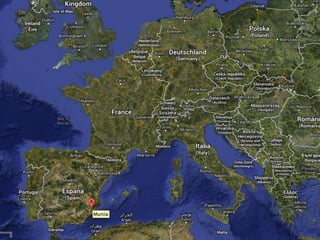
Spain
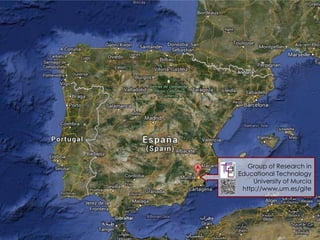
Group of Research in
Educational Technology
University of Murcia
http://www.um.es/gite
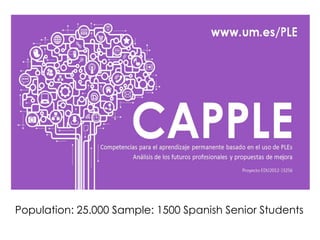
Population: 25.000 Sample: 1500 Spanish Senior Students
The description and the prospective
analysis, both technically and
functional, of personal learning
environments (PLEs) of the Spanish future
professionals in all areas of knowledge.

CAPPLE Project
http://www.um.es/ple/?lang=en
Personal Learning
Environment
PLE -2001 NIMLE Project
(Northem Ireland -JISC founded)
Technological term
Evolution of LMS
Enphasizing on Technologies
Web 2.0
PL
Personal Learning

ENVIRONMENT
Just about the

environment?

where” the CRUCIAL question?

Is “
A NEW approach
for understanding

the learning process
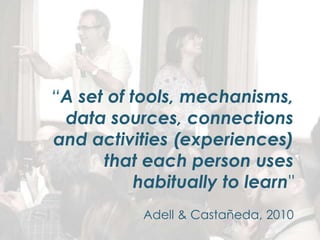
“A set of tools, mechanisms,
data sources, connections
and activities (experiences)
that each person uses
habitually to learn"
Adell & Castañeda, 2010
P

E

Personal LEARNING
Environment
We already got it?… so What else?
PLE is the environment in
which we learn using efficiently
the available technologies
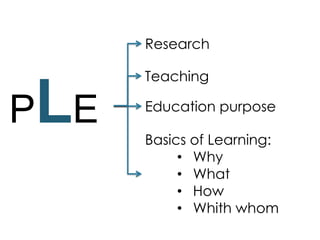
Research

PLE

Teaching
Education purpose
Basics of Learning:
• Why
• What
• How
• Whith whom
Perceptions and Realities
Behind Students’
Personal Learning Environments

Paz Prendes & Linda Castañeda
GITE - University of Murcia
Spain
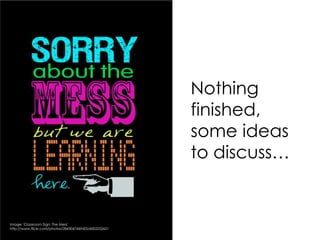
Nothing
finished,
some ideas
to discuss…

Image: 'Classroom Sign: The Mess'
http://www.flickr.com/photos/28430474@N05/6002252651
Defining PLE
“A set of tools, mechanisms,
data sources, connections
and activities (experiences)
that each person uses
habitually to learn"
Adell & Castañeda, 2010
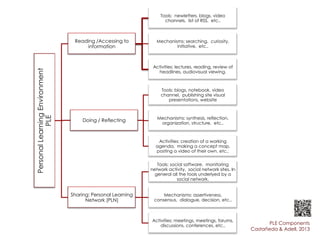
Tools: newletters, blogs, video
channels, list of RSS, etc..

Personal Learning Environment
PLE

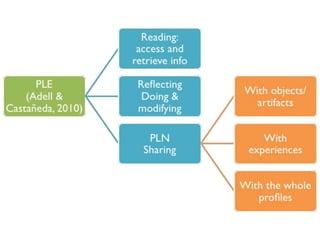
Reading /Accessing to
information

Mechanisms: searching, curiosity,
initiative, etc..

Activities: lectures, reading, review of
headlines, audiovisual viewing.

Tools: blogs, notebook, video
channel, publishing site visual
presentations, website

Doing / Reflecting

Mechanisms: synthesis, reflection,
organization, structure, etc..

Activities: creation of a working
agenda, making a concept map,
posting a video of their own, etc..
Tools: social software, monitoring
network activity, social network sites. In
general all the tools underlyed by a
social network.

Sharing: Personal Learning
Network (PLN)

Mechanisms: assertiveness,
consensus, dialogue, decision, etc..

Activities: meetings, meetings, forums,
discussions, conferences, etc..

PLE Components
Castañeda & Adell, 2013
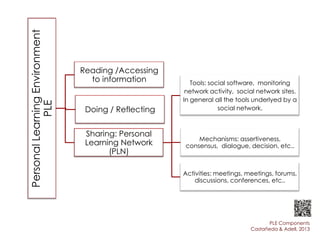
Personal Learning Environment
PLE

Reading /Accessing
to information

Doing / Reflecting
Sharing: Personal
Learning Network
(PLN)

Tools: social software, monitoring
network activity, social network sites.
In general all the tools underlyed by a
social network.

Mechanisms: assertiveness,
consensus, dialogue, decision, etc..

Activities: meetings, meetings, forums,
discussions, conferences, etc..

PLE Components
Castañeda & Adell, 2013
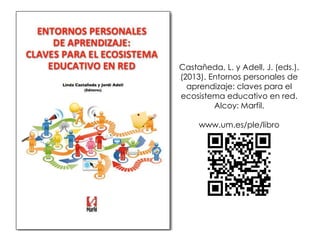
Castañeda, L. y Adell, J. (eds.).
(2013). Entornos personales de
aprendizaje: claves para el
ecosistema educativo en red.
Alcoy: Marfil.
www.um.es/ple/libro
First approach
iCamp Project

PLEs in Action
www.icamp.eu

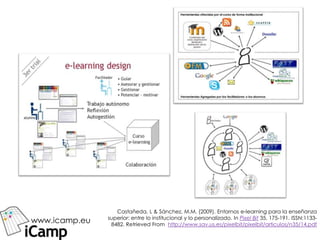
Castañeda, L & Sánchez, M.M. (2009). Entornos e-learning para la enseñanza
superior: entre lo institucional y lo personalizado. In Pixel Bit 35, 175-191. ISSN:11338482. Retrieved From http://www.sav.us.es/pixelbit/pixelbit/articulos/n35/14.pdf
Patchworking PLEs

PLEs in Action
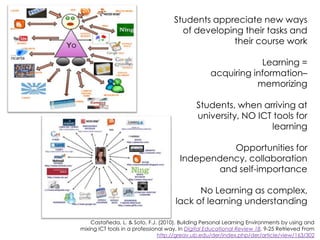
Students appreciate new ways
of developing their tasks and
their course work

Learning =
acquiring information–
memorizing
Students, when arriving at
university, NO ICT tools for
learning
Opportunities for
Independency, collaboration
and self-importance
No Learning as complex,
lack of learning understanding
Castañeda, L. & Soto, F.J. (2010). Building Personal Learning Environments by using and
mixing ICT tools in a professional way. In Digital Educational Review 18, 9-25 Retrieved From
http://greav.ub.edu/der/index.php/der/article/view/163/302
PLN as the core of PLE
Looking at twitter

PLEs in Action
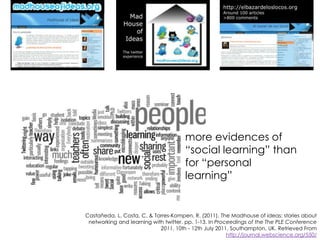
more evidences of
“social learning” than
for “personal
learning”

Castañeda, L. Costa, C. & Torres-Kompen, R. (2011). The Madhouse of ideas: stories about
networking and learning with twitter. pp. 1-13. In Proceedings of the The PLE Conference
2011, 10th - 12th July 2011, Southampton, UK. Retrieved From
http://journal.webscience.org/550/
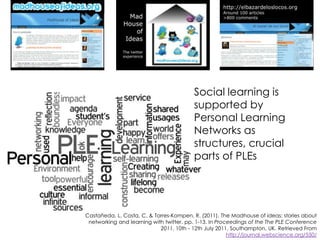
Social learning is
supported by
Personal Learning
Networks as
structures, crucial
parts of PLEs

Castañeda, L. Costa, C. & Torres-Kompen, R. (2011). The Madhouse of ideas: stories about
networking and learning with twitter. pp. 1-13. In Proceedings of the The PLE Conference
2011, 10th - 12th July 2011, Southampton, UK. Retrieved From
http://journal.webscience.org/550/
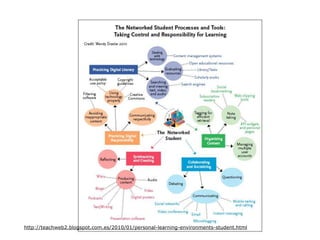
Learning processes Behind PLEs

PLEs in Action
http://teachweb2.blogspot.com.es/2010/01/personal-learning-environments-student.html
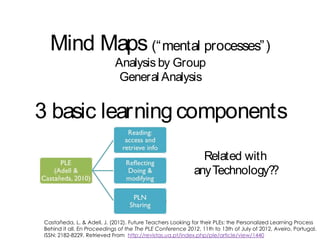
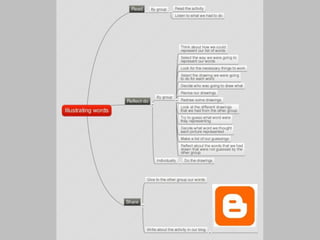
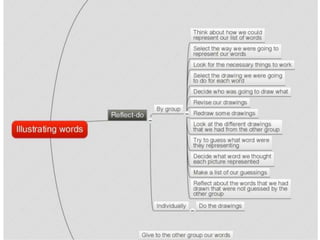
Mind Maps (“mental processes”)
Analysis by Group
General Analysis

3 basic learning components
Related with
any Technology?
?

Castañeda, L. & Adell, J. (2012). Future Teachers Looking for their PLEs: the Personalized Learning Process
Behind it all. En Proceedings of the The PLE Conference 2012, 11th to 13th of July of 2012, Aveiro, Portugal.
ISSN: 2182-8229. Retrieved From http://revistas.ua.pt/index.php/ple/article/view/1440
General Analys

3 basic learning co
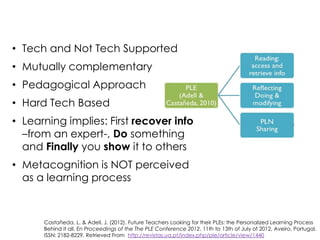
• Tech and Not Tech Supported
• Mutually complementary
• Pedagogical Approach
• Hard Tech Based

• Learning implies: First recover info
–from an expert-, Do something
and Finally you show it to others
• Metacognition is NOT perceived
as a learning process

Castañeda, L. & Adell, J. (2012). Future Teachers Looking for their PLEs: the Personalized Learning Process
Behind it all. En Proceedings of the The PLE Conference 2012, 11th to 13th of July of 2012, Aveiro, Portugal.
ISSN: 2182-8229. Retrieved From http://revistas.ua.pt/index.php/ple/article/view/1440
Nowadays…

PLEs in Action
PLEs in Action
The description and the prospective
analysis, both technically and
functional, of personal learning
environments (PLEs) of the Spanish future
professionals in all areas of knowledge.

CAPPLE Project
http://www.um.es/ple/?lang=en
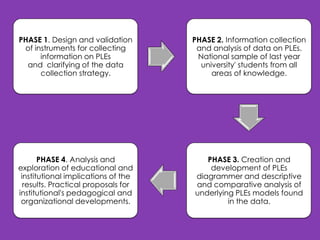
PHASE 1. Design and validation
of instruments for collecting
information on PLEs
and clarifying of the data
collection strategy.

PHASE 2. Information collection
and analysis of data on PLEs.
National sample of last year
university' students from all
areas of knowledge.

PHASE 4. Analysis and
exploration of educational and
institutional implications of the
results. Practical proposals for
institutional's pedagogical and
organizational developments.

PHASE 3. Creation and
development of PLEs
diagrammer and descriptive
and comparative analysis of
underlying PLEs models found
in the data.
Personal Learning
Environment
If the PLE involve learning to learn
with technology, integrate PLEs in
education would contribute to
develop essential skills in a complex
and changing world as ours…
Castañeda & Adell, 2013
Perceptions and Realities
Behind Students’
Personal Learning Environments

Paz Prendes & Linda Castañeda
GITE - University of Murcia
Spain

Linda Castañeda

<lindacq@um.es>
Grupo de Investigación de
Tecnología Educativa
Universidad de Murcia
<http://www.lindacastaneda.com>
Twitter, Flickr, youtube, slideshare: lindacq

PLE-Centered Education: The Next Boundary. Perceptions and Realities Behind Students Personal Learning Environments

  • 1.
    Perceptions and Realities BehindStudents’ Personal Learning Environments Paz Prendes & Linda Castañeda GITE - University of Murcia Spain
  • 3.
    Group of Researchin Educational Technology University of Murcia http://www.um.es/gite
  • 4.
    Population: 25.000 Sample:1500 Spanish Senior Students
  • 5.
    The description andthe prospective analysis, both technically and functional, of personal learning environments (PLEs) of the Spanish future professionals in all areas of knowledge. CAPPLE Project http://www.um.es/ple/?lang=en
  • 6.
  • 7.
    PLE -2001 NIMLEProject (Northem Ireland -JISC founded) Technological term Evolution of LMS Enphasizing on Technologies Web 2.0
  • 9.
  • 10.
    Just about the environment? where”the CRUCIAL question? Is “
  • 11.
    A NEW approach forunderstanding the learning process
  • 12.
    “A set oftools, mechanisms, data sources, connections and activities (experiences) that each person uses habitually to learn" Adell & Castañeda, 2010
  • 13.
  • 14.
    We already gotit?… so What else?
  • 15.
    PLE is theenvironment in which we learn using efficiently the available technologies
  • 16.
    Research PLE Teaching Education purpose Basics ofLearning: • Why • What • How • Whith whom
  • 17.
    Perceptions and Realities BehindStudents’ Personal Learning Environments Paz Prendes & Linda Castañeda GITE - University of Murcia Spain
  • 18.
    Nothing finished, some ideas to discuss… Image:'Classroom Sign: The Mess' http://www.flickr.com/photos/28430474@N05/6002252651
  • 19.
  • 20.
    “A set oftools, mechanisms, data sources, connections and activities (experiences) that each person uses habitually to learn" Adell & Castañeda, 2010
  • 22.
    Tools: newletters, blogs,video channels, list of RSS, etc.. Personal Learning Environment PLE Reading /Accessing to information Mechanisms: searching, curiosity, initiative, etc.. Activities: lectures, reading, review of headlines, audiovisual viewing. Tools: blogs, notebook, video channel, publishing site visual presentations, website Doing / Reflecting Mechanisms: synthesis, reflection, organization, structure, etc.. Activities: creation of a working agenda, making a concept map, posting a video of their own, etc.. Tools: social software, monitoring network activity, social network sites. In general all the tools underlyed by a social network. Sharing: Personal Learning Network (PLN) Mechanisms: assertiveness, consensus, dialogue, decision, etc.. Activities: meetings, meetings, forums, discussions, conferences, etc.. PLE Components Castañeda & Adell, 2013
  • 23.
    Personal Learning Environment PLE Reading/Accessing to information Doing / Reflecting Sharing: Personal Learning Network (PLN) Tools: social software, monitoring network activity, social network sites. In general all the tools underlyed by a social network. Mechanisms: assertiveness, consensus, dialogue, decision, etc.. Activities: meetings, meetings, forums, discussions, conferences, etc.. PLE Components Castañeda & Adell, 2013
  • 24.
    Castañeda, L. yAdell, J. (eds.). (2013). Entornos personales de aprendizaje: claves para el ecosistema educativo en red. Alcoy: Marfil. www.um.es/ple/libro
  • 25.
  • 26.
    www.icamp.eu Castañeda, L &Sánchez, M.M. (2009). Entornos e-learning para la enseñanza superior: entre lo institucional y lo personalizado. In Pixel Bit 35, 175-191. ISSN:11338482. Retrieved From http://www.sav.us.es/pixelbit/pixelbit/articulos/n35/14.pdf
  • 27.
  • 28.
    Students appreciate newways of developing their tasks and their course work Learning = acquiring information– memorizing Students, when arriving at university, NO ICT tools for learning Opportunities for Independency, collaboration and self-importance No Learning as complex, lack of learning understanding Castañeda, L. & Soto, F.J. (2010). Building Personal Learning Environments by using and mixing ICT tools in a professional way. In Digital Educational Review 18, 9-25 Retrieved From http://greav.ub.edu/der/index.php/der/article/view/163/302
  • 29.
    PLN as thecore of PLE Looking at twitter PLEs in Action
  • 30.
    more evidences of “sociallearning” than for “personal learning” Castañeda, L. Costa, C. & Torres-Kompen, R. (2011). The Madhouse of ideas: stories about networking and learning with twitter. pp. 1-13. In Proceedings of the The PLE Conference 2011, 10th - 12th July 2011, Southampton, UK. Retrieved From http://journal.webscience.org/550/
  • 31.
    Social learning is supportedby Personal Learning Networks as structures, crucial parts of PLEs Castañeda, L. Costa, C. & Torres-Kompen, R. (2011). The Madhouse of ideas: stories about networking and learning with twitter. pp. 1-13. In Proceedings of the The PLE Conference 2011, 10th - 12th July 2011, Southampton, UK. Retrieved From http://journal.webscience.org/550/
  • 32.
    Learning processes BehindPLEs PLEs in Action
  • 33.
  • 34.
    Mind Maps (“mentalprocesses”) Analysis by Group General Analysis 3 basic learning components Related with any Technology? ? Castañeda, L. & Adell, J. (2012). Future Teachers Looking for their PLEs: the Personalized Learning Process Behind it all. En Proceedings of the The PLE Conference 2012, 11th to 13th of July of 2012, Aveiro, Portugal. ISSN: 2182-8229. Retrieved From http://revistas.ua.pt/index.php/ple/article/view/1440
  • 37.
    General Analys 3 basiclearning co • Tech and Not Tech Supported • Mutually complementary • Pedagogical Approach • Hard Tech Based • Learning implies: First recover info –from an expert-, Do something and Finally you show it to others • Metacognition is NOT perceived as a learning process Castañeda, L. & Adell, J. (2012). Future Teachers Looking for their PLEs: the Personalized Learning Process Behind it all. En Proceedings of the The PLE Conference 2012, 11th to 13th of July of 2012, Aveiro, Portugal. ISSN: 2182-8229. Retrieved From http://revistas.ua.pt/index.php/ple/article/view/1440
  • 38.
  • 39.
  • 40.
    The description andthe prospective analysis, both technically and functional, of personal learning environments (PLEs) of the Spanish future professionals in all areas of knowledge. CAPPLE Project http://www.um.es/ple/?lang=en
  • 41.
    PHASE 1. Designand validation of instruments for collecting information on PLEs and clarifying of the data collection strategy. PHASE 2. Information collection and analysis of data on PLEs. National sample of last year university' students from all areas of knowledge. PHASE 4. Analysis and exploration of educational and institutional implications of the results. Practical proposals for institutional's pedagogical and organizational developments. PHASE 3. Creation and development of PLEs diagrammer and descriptive and comparative analysis of underlying PLEs models found in the data.
  • 42.
  • 43.
    If the PLEinvolve learning to learn with technology, integrate PLEs in education would contribute to develop essential skills in a complex and changing world as ours… Castañeda & Adell, 2013
  • 44.
    Perceptions and Realities BehindStudents’ Personal Learning Environments Paz Prendes & Linda Castañeda GITE - University of Murcia Spain Linda Castañeda <lindacq@um.es> Grupo de Investigación de Tecnología Educativa Universidad de Murcia <http://www.lindacastaneda.com> Twitter, Flickr, youtube, slideshare: lindacq