Customer Relationship Management
Customers form the Core part of any business. Embattled companies are slouching toward the realisation that without customers, products don’t sell and revenues don’t materialise. The infrastructure that enables the delineation of and increase in customer value, and the correct means by which to motivate valuable customers to remain loyal – indeed, to buy again. Cost of Acquiring Customer
Thoroughly understand customers’ needs  – even before they know themselves. Decreasing customer churn by increasing customer satisfaction Motivating customers to initiate revenue  - generating contracts with organisations. Increasing the likelihood of the right response by a given customer or customer segment. To use technology to improve customer service and enable a greater degree of customer differentiation in order to deliver unique customer interactions. Organisations need to attract customers  – both old and new – through more personalised communications Representation of set of Legitimate CRM business objectives from clients current in the throes of CRM program.
Customer Satisfaction Buying decisions based on judgments formed about the value of marketing offers Customer expectations based on past buying experiences Today’s most successful companies raising expectations and delivering performance to match Customer Acquisition to Customer Loyalty
Customer satisfaction measures how well a customer’s expectations are met  Customer loyalty measures how likely customers are to return and their willingness to perform partner shipping activities for the organization  Customer satisfaction is a requisite for loyalty Customer Satisfaction vs.  Customer Loyalty
Creating, maintaining, and enhancing strong relationships with customers  Basic Reactive Accountable Proactive Partnership Relationship Marketing
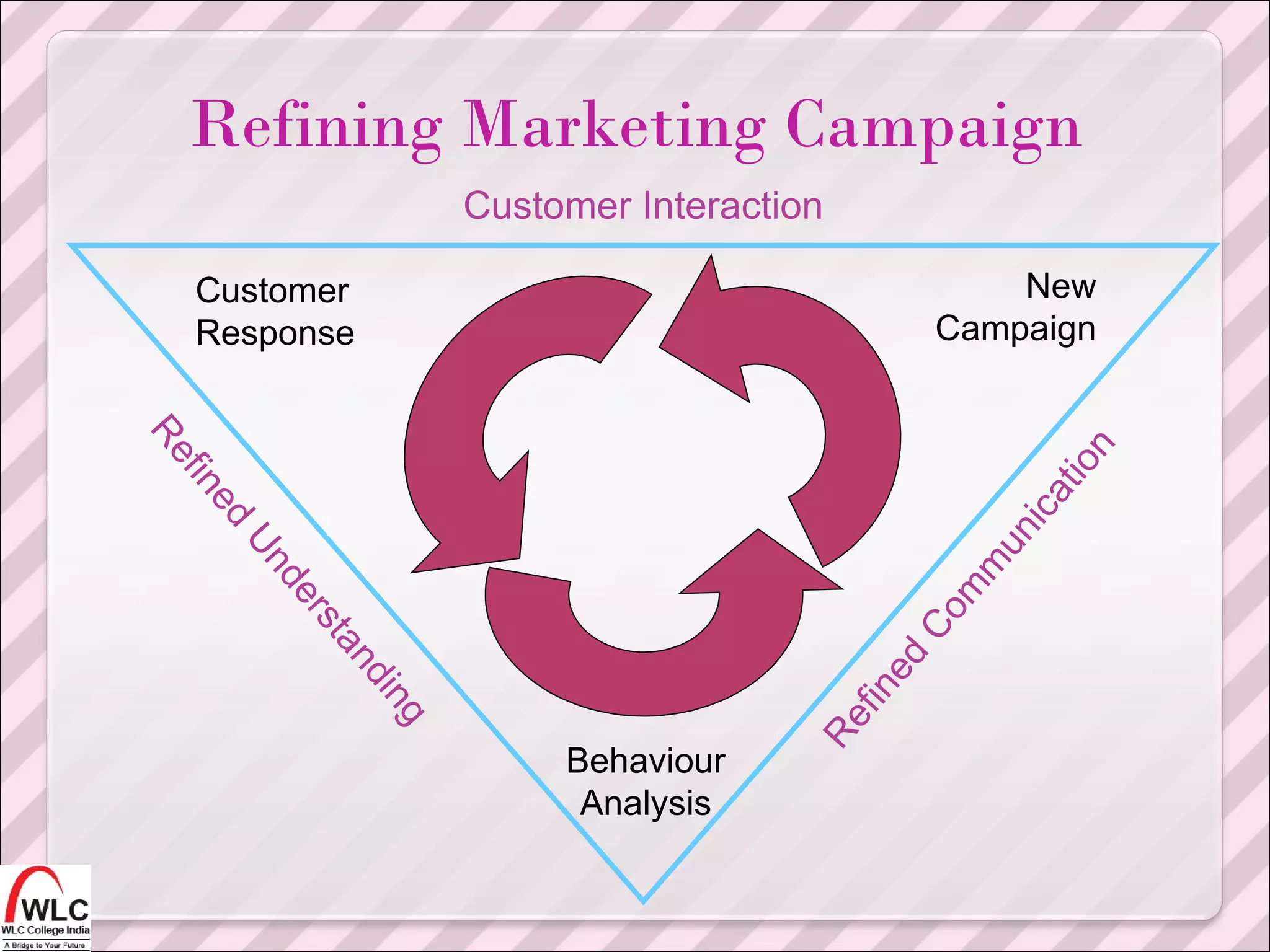
Customer Response New Campaign Behaviour Analysis Refined Understanding Refined Communication Customer Interaction Refining Marketing Campaign
Continued patronage  Reduced marketing costs Decreased price sensitivity  Partnership activities  Benefits of Customer Loyalty
Companies must define and measure retention rate Company must identify causes of customer defection and determine which can be reduced or eliminated Reducing customer defections by only 5 percent can result in improved profits of over 25 percent  Cost of Lost Customer
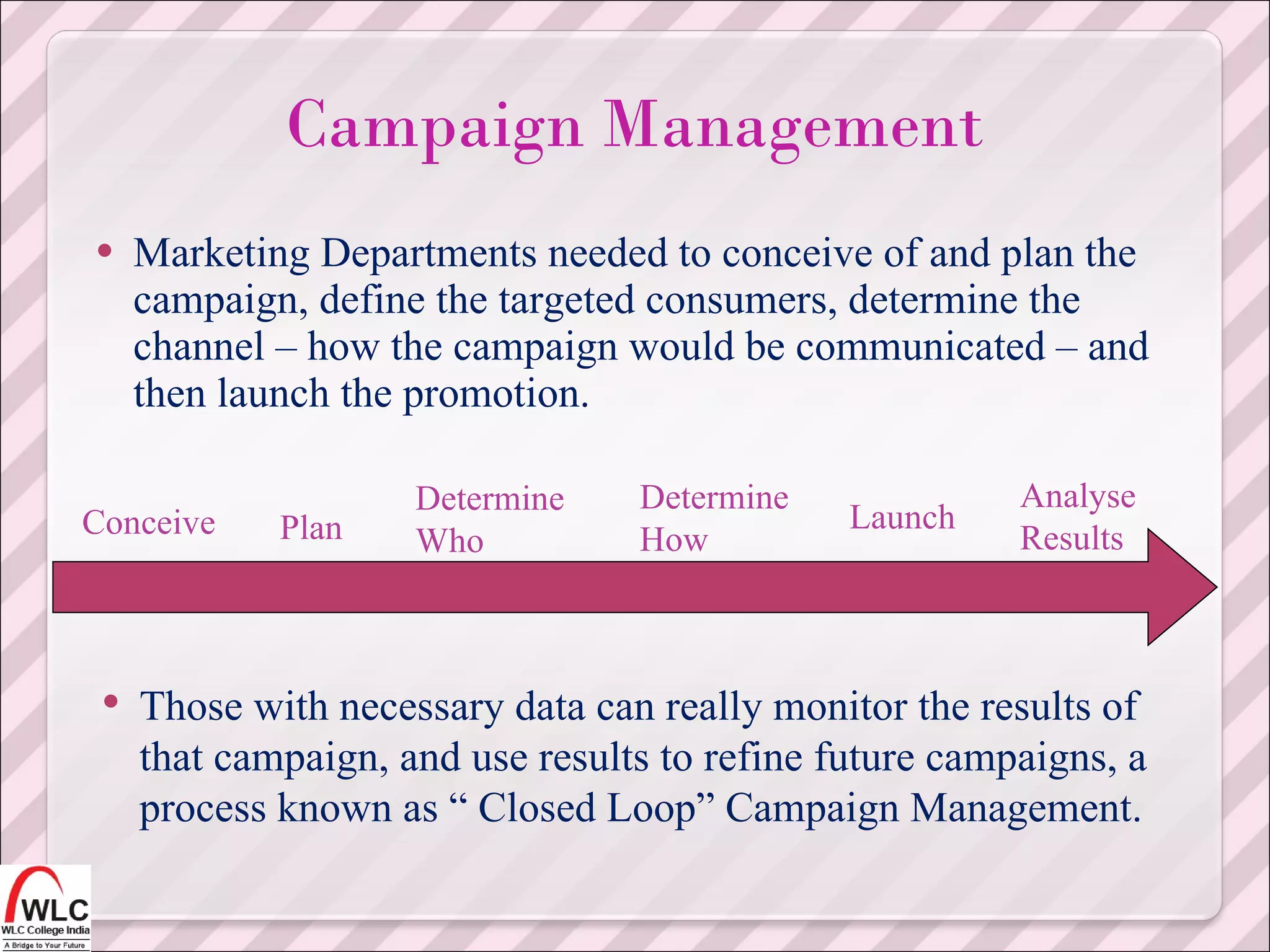
Marketing Departments needed to conceive of and plan the campaign, define the targeted consumers, determine the channel – how the campaign would be communicated – and then launch the promotion. Conceive Plan Determine Who Determine How Launch Analyse Results Those with necessary data can really monitor the results of that campaign, and use results to refine future campaigns, a process known as “ Closed Loop” Campaign Management. Campaign Management
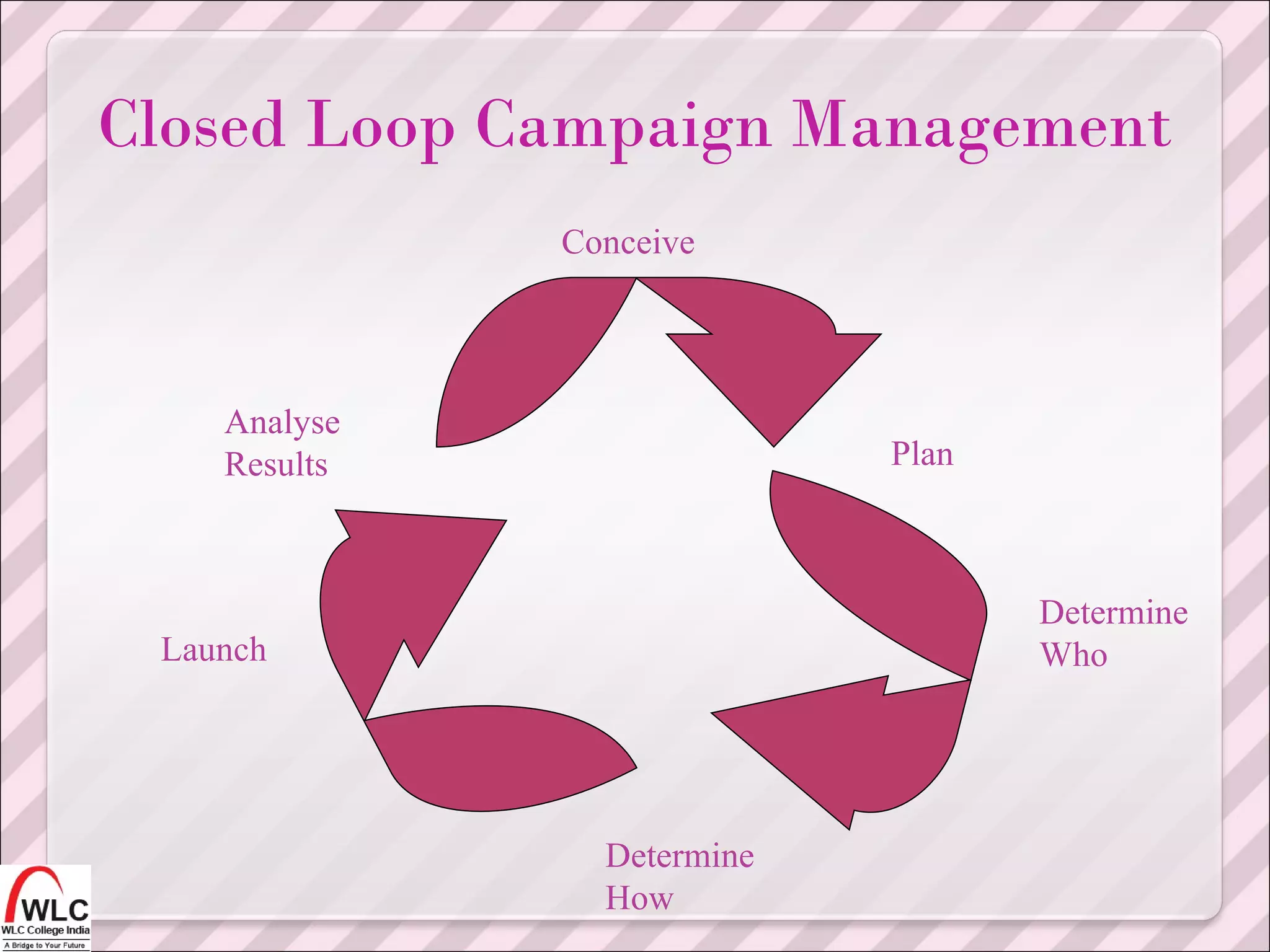
Conceive Plan Determine Who Determine How Launch Analyse Results Closed Loop Campaign Management
Cross Selling and Up-Selling  Cross selling  is the act of selling a product or service to a customer as a result of another purchase. Eg.  Customers buying products for others at the same time they are buying for themselves. Up-selling  is where companies frantically look for opportunities to up-sell, or motivate their existing customers to trade up to more profitable products. Eg.  Upgrading an existing customer about some comparatively superior tariff / plan for Telecom Service Providers.  CRM Marketing Initiatives
The more customers leave, the greater the loss of revenue, loss of the initial acquisition investment, and loss of a stable market base for selling new products. Reducing Customer defections by even a fraction has been proven to increase profits exponentially. Working on designing marketing campaigns to bump low-value customers to a higher value band rather than allowing them to churn by default. Customer Retention
This helps Marketing Departments determine what customers are likely to do in future. Behaviour Prediction uses historical Customer behaviour to foresee future behaviours. The analysis includes: Propensity-to-buy Analysis  – Understanding which products a particular customer is likely to purchase. Next sequential purchase  – Predicting what product or service a customer is likely to buy next. Product Affinity Analysis  – Understanding which products will be purchased with other products. (Market Basket Analysis) Price elasticity modeling and dynamic Pricing  – Determining the optimal price for a given product often for a given customer or customer segment. Behavior Prediction
Reduce costs of marketing Improve accuracy and relevancy of recommendations customer satisfaction Increase conversion rate, i.e., Turn browsers into buyers customer retention and frequency order size customer response competitiveness through differentiation profitability, ROI Goals of eCRM
Inexpensive Instant results Encourages interaction Drives Ticket Sales Revenue Drives Membership Revenue Decreases Marketing Costs Email Marketing Benefits
Ranges from niche tools to large-scale enterprise applications More comprehensive CRM packages have: Partner relationship management (PRM) modules Enhances collaboration between company and selling partners Employee relationship management (ERM) modules Deals with employee issues closely related to CRM, e.g. setting objectives, employee performance management Typically include tools for sales, customer service, and marketing eCRM Software
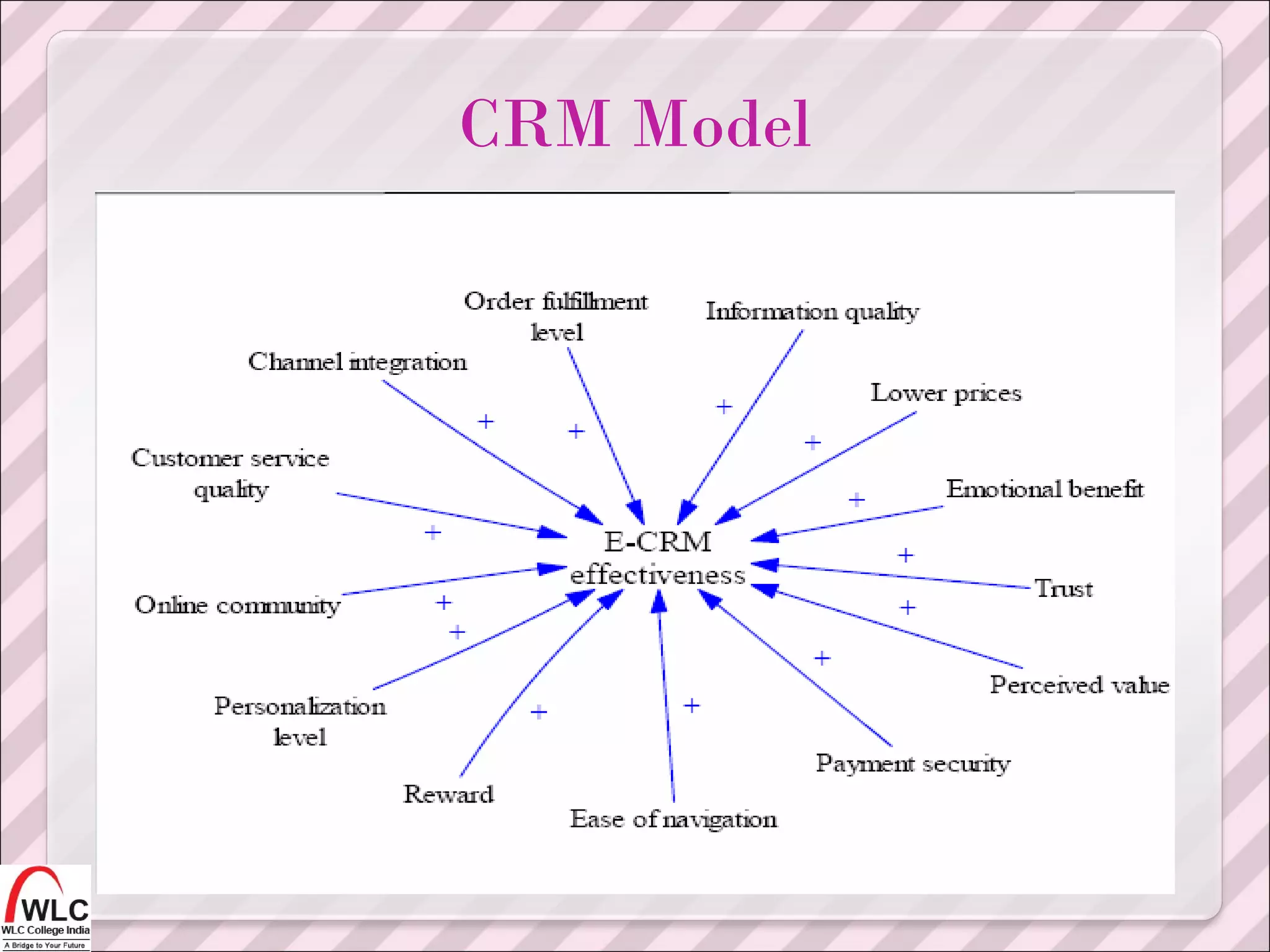
CRM Model
Electronic Channels  – New electronic channels such as the web and personalised e-Messaging have become the medium for fast, interactive and economic communication . Enterprise  – Through e CRM a company gains the means to touch and shape a customers experience through sales, Services and corner offices. Empowerment  – e CRM strategies must be structured to accommodate consumers who have the power to decide when and how to communicate with the company. Economics  – An e CRM strategy ideally should concentrate on customer economics, which drives Asset allocation decisions. Six E’s of eCRM
Evaluation  – Understanding customer economics relies on a company’s ability to attribute customer behaviour to market programs, evaluate customer interactions along various customer touch point channel and compare anticipated ROI against actual returns through customer analytic reporting. External Information  – e CRM solution should be able to gain and leverage information from such sources as third party information networks and web page profiler application. Six E’s of eCRM (Contd.)
CRM is essentially a business strategy of acquiring and maintaining the “right” customers over the long-term. Within this framework, a number of channels exist for interacting with customers. One of this channels is “electronic” – and has been labelled “ecommerce” or “e-business”. The electronic channel does not replace the sales force, the call center, or even the fax. It is simply another extension, albeit a powerful new one, to the customer. The thrust of e CRM is not what an organisation is doing on the Web but how fully an organisation ties its on-line channel back to its traditional channels, or customer touch-points. CRM vs. eCRM

Session 1 2 Cost Of Acquiring Customers

  • 1.
  • 2.
    Customers form theCore part of any business. Embattled companies are slouching toward the realisation that without customers, products don’t sell and revenues don’t materialise. The infrastructure that enables the delineation of and increase in customer value, and the correct means by which to motivate valuable customers to remain loyal – indeed, to buy again. Cost of Acquiring Customer
  • 3.
    Thoroughly understand customers’needs – even before they know themselves. Decreasing customer churn by increasing customer satisfaction Motivating customers to initiate revenue - generating contracts with organisations. Increasing the likelihood of the right response by a given customer or customer segment. To use technology to improve customer service and enable a greater degree of customer differentiation in order to deliver unique customer interactions. Organisations need to attract customers – both old and new – through more personalised communications Representation of set of Legitimate CRM business objectives from clients current in the throes of CRM program.
  • 4.
    Customer Satisfaction Buyingdecisions based on judgments formed about the value of marketing offers Customer expectations based on past buying experiences Today’s most successful companies raising expectations and delivering performance to match Customer Acquisition to Customer Loyalty
  • 5.
    Customer satisfaction measureshow well a customer’s expectations are met Customer loyalty measures how likely customers are to return and their willingness to perform partner shipping activities for the organization Customer satisfaction is a requisite for loyalty Customer Satisfaction vs. Customer Loyalty
  • 6.
    Creating, maintaining, andenhancing strong relationships with customers Basic Reactive Accountable Proactive Partnership Relationship Marketing
  • 7.
    Customer Response NewCampaign Behaviour Analysis Refined Understanding Refined Communication Customer Interaction Refining Marketing Campaign
  • 8.
    Continued patronage Reduced marketing costs Decreased price sensitivity Partnership activities Benefits of Customer Loyalty
  • 9.
    Companies must defineand measure retention rate Company must identify causes of customer defection and determine which can be reduced or eliminated Reducing customer defections by only 5 percent can result in improved profits of over 25 percent Cost of Lost Customer
  • 10.
    Marketing Departments neededto conceive of and plan the campaign, define the targeted consumers, determine the channel – how the campaign would be communicated – and then launch the promotion. Conceive Plan Determine Who Determine How Launch Analyse Results Those with necessary data can really monitor the results of that campaign, and use results to refine future campaigns, a process known as “ Closed Loop” Campaign Management. Campaign Management
  • 11.
    Conceive Plan DetermineWho Determine How Launch Analyse Results Closed Loop Campaign Management
  • 12.
    Cross Selling andUp-Selling Cross selling is the act of selling a product or service to a customer as a result of another purchase. Eg. Customers buying products for others at the same time they are buying for themselves. Up-selling is where companies frantically look for opportunities to up-sell, or motivate their existing customers to trade up to more profitable products. Eg. Upgrading an existing customer about some comparatively superior tariff / plan for Telecom Service Providers. CRM Marketing Initiatives
  • 13.
    The more customersleave, the greater the loss of revenue, loss of the initial acquisition investment, and loss of a stable market base for selling new products. Reducing Customer defections by even a fraction has been proven to increase profits exponentially. Working on designing marketing campaigns to bump low-value customers to a higher value band rather than allowing them to churn by default. Customer Retention
  • 14.
    This helps MarketingDepartments determine what customers are likely to do in future. Behaviour Prediction uses historical Customer behaviour to foresee future behaviours. The analysis includes: Propensity-to-buy Analysis – Understanding which products a particular customer is likely to purchase. Next sequential purchase – Predicting what product or service a customer is likely to buy next. Product Affinity Analysis – Understanding which products will be purchased with other products. (Market Basket Analysis) Price elasticity modeling and dynamic Pricing – Determining the optimal price for a given product often for a given customer or customer segment. Behavior Prediction
  • 15.
    Reduce costs ofmarketing Improve accuracy and relevancy of recommendations customer satisfaction Increase conversion rate, i.e., Turn browsers into buyers customer retention and frequency order size customer response competitiveness through differentiation profitability, ROI Goals of eCRM
  • 16.
    Inexpensive Instant resultsEncourages interaction Drives Ticket Sales Revenue Drives Membership Revenue Decreases Marketing Costs Email Marketing Benefits
  • 17.
    Ranges from nichetools to large-scale enterprise applications More comprehensive CRM packages have: Partner relationship management (PRM) modules Enhances collaboration between company and selling partners Employee relationship management (ERM) modules Deals with employee issues closely related to CRM, e.g. setting objectives, employee performance management Typically include tools for sales, customer service, and marketing eCRM Software
  • 18.
  • 19.
    Electronic Channels – New electronic channels such as the web and personalised e-Messaging have become the medium for fast, interactive and economic communication . Enterprise – Through e CRM a company gains the means to touch and shape a customers experience through sales, Services and corner offices. Empowerment – e CRM strategies must be structured to accommodate consumers who have the power to decide when and how to communicate with the company. Economics – An e CRM strategy ideally should concentrate on customer economics, which drives Asset allocation decisions. Six E’s of eCRM
  • 20.
    Evaluation –Understanding customer economics relies on a company’s ability to attribute customer behaviour to market programs, evaluate customer interactions along various customer touch point channel and compare anticipated ROI against actual returns through customer analytic reporting. External Information – e CRM solution should be able to gain and leverage information from such sources as third party information networks and web page profiler application. Six E’s of eCRM (Contd.)
  • 21.
    CRM is essentiallya business strategy of acquiring and maintaining the “right” customers over the long-term. Within this framework, a number of channels exist for interacting with customers. One of this channels is “electronic” – and has been labelled “ecommerce” or “e-business”. The electronic channel does not replace the sales force, the call center, or even the fax. It is simply another extension, albeit a powerful new one, to the customer. The thrust of e CRM is not what an organisation is doing on the Web but how fully an organisation ties its on-line channel back to its traditional channels, or customer touch-points. CRM vs. eCRM