Dr. Byram Anand
Associate professor
Pondicherry university Karaikal campus
Karaikal –Pondicherry
Customer Relationship Management
Unit-I
CRM concepts - Acquiring customers, - Customer loyalty and optimizing customer relationships - CRM defined - success factors, the three levels of Service/ Sales Profiling - Service Level Agreements (SLAs), creating and managing effective SLAs.
• Customer Relationship Management (CRM) is to create a
competitive advantage by being the best at understanding,
communicating, delivering, and developing existing customer
relationships, in addition to creating and keeping new
customers.
• Merchants and traders have been practicing customer
relationship for centuries. Their business was built on trust
• They paid personal attention to their customers, knew details
regarding their customers tastes and preferences, and had a
personal rapport with most of them.
• These relationship oriented practices have changed due to
industrial revolution.. Businesses adopted mass production,
mass communication and mass distribution to achieve
economics of scale.
The post-industrial era saw the re-emergence of relationship practices.
(a)A). Rapid advances in technology
(b)Intensive competition in most markets
(c)Growing importance of the service sector, and
(d)Adoption of total quality management programs
,
• Technological Advancement: information, communication and production technologies have helped marketers come
closer to their customers. Firms operating in diverse sectors ranging from packaged goods to services started using
these technologies to know their customers, learn more about them, and then build stronger bonds with them through
frequent interactions.
• Technology enabled marketers overcome several long felt shortcomings of mass marketing. Some of these included:
➢ Inefficiencies of mass marketing: 1980s and early 1990s witnessed some of the most radical business
transformations that resulted in cost reductions in almost all functional departments except marketing.
Manufacturing and related operations costs were reduced through business process reengineering, human
resource costs were reduced through outsourcing, restructuring and layoffs, financial costs were reduced
through financial reengineering but marketing costs kept increasing due to increased competition and product
parity in virtually every industry.
➢ Lack of fast, effective and interactive models of customer contact, feedback and information.
• Lack of consolidated information about customer interactions, purchase behavior and future potential
• Intensive Competition: Marketers have now started focusing on the lifetime value of customers.
They are moving away from just trying to sell their products to understanding, customers needs
and wants and then satisfying their needs. This has led to a relationship orientation which creates
opportunities to cross sell products and services over the lifetime of the customer.
• Growing Importance of the Service Sector: . One of the characteristics of the service industries is
the direct interaction between the marketer and the buyer. In services, the provider is usually
involved in the production as well as delivery directly.
• For example, professional service providers like a doctor or consultant are directly involved
in production as well as delivery of their services. Similarly, the customers are directly involved in
production in the purchase and consumption of these services.
• These direct contacts create opportunities for better understanding, a better appreciation of
needs as well as constraints and emotional bonding all of which facilitate relationship building.
• Adoption of Total Quality Management (TQM) Programs: Total quality management
programs help companies offer quality products and services to customers at the lowest prices.
To enable this value proposition, organizations needed to work closely with their customers,
intermediaries as well as suppliers thus fostering close working relationships with members of
the marketing system.
• Companies such as Intel, Xerox, and Toyota formed partnering relationships with suppliers
and customers to practice TQM.
• A competitive advantage is sustainable only when it is not easily replicated. One such
sustainable competitive advantage is the relationship that a firm develops with its customers.
•
Schools of Thought on CRM
• The relationship marketing is supported by the growing
research interest in different facets of this concept.
• The initial approaches to CRM can be broadly classified as:
1. The Anglo-Australia Approach,
2. The Nordic Approach, and
3. The North American Approach.
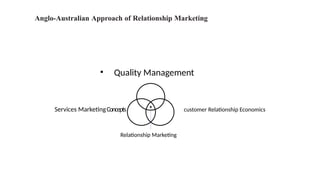
1. The Anglo-Australian approach integrated the contemporary theories of quality management
services marketing and customer relationship economics to explain the emergence of relationship
marketing
Anglo-Australian Approach of Relationship Marketing
• Quality Management
Services MarketingConcepts customer Relationship Economics
Relationship Marketing
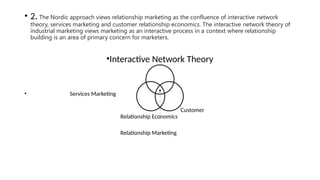
• 2. The Nordic approach views relationship marketing as the confluence of interactive network
theory, services marketing and customer relationship economics. The interactive network theory of
industrial marketing views marketing as an interactive process in a context where relationship
building is an area of primary concern for marketers.
•Interactive Network Theory
• Services Marketing
Customer
Relationship Economics
Relationship Marketing
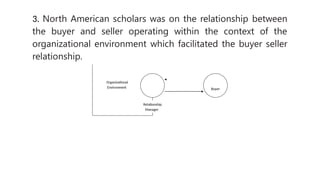
3. North American scholars was on the relationship between
the buyer and seller operating within the context of the
organizational environment which facilitated the buyer seller
relationship.
Organisational
Environment Buyer
Relationship
Manager
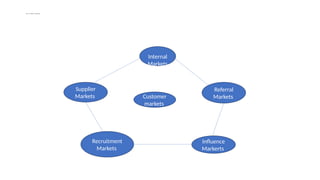
The Six Markets Framework
Internal
Markets
Referral
Markets
Influence
Markerts
Recruitment
Markets
Supplier
Markets Customer
markets
• The six markets are as follows
1. Customer markets – existing and prospective customers as well as
intermediaries.
2. Referral markets – existing customers who recommend to other prospects, and
referral sources or ‘multipliers’ such as doctors who refer patients to a hospital
or a consultant who recommends a specific IT solution,
3. Influence markets – government, consumer groups, business press and
financial analysts.
4. Recruitment markets – for attracting the right employees to the organization,
5. Supplier markets – suppliers of raw materials, components, services, etc., and
6. Internal markets - the organization including internal departments and staff.
Defining CRM
• in marketing literature, the terms customer relationship management and
relationship marketing have been used interchangeable to reflect a variety of
themes and perspectives
• Another view point is to consider CRM only as customer retention in which a
variety of after marketing tactics are used for customer bonding or staying in
touch after the sale is done.
• Jackson applied the individual account concept in industrial market to
suggest markets CRM to mean, marketing oriented toward strong, lasting
relationship with individual accounts
•
• McKenna offered a more strategic view by putting the customer first and
shifting the role of marketing from manipulating the customer (telling & selling)
to genuine customer involvement (communicating & sharing the knowledge).
• Shift in Focus ( See Diagram next slide)
Traditional Marketing Focus
Place
Promotion
Price
Product
Provider
Parity
Customer
Consideration
and
Potential
Purchase
Benefits of CRM
• Customers are Profitable over a period of time: that a customer becomes
more profitable with time because the initial acquisition cost exceeds
gross margin while the retention costs are much lower. When an
organization retains the customer, it gets a larger share of the customers
wallet at a higher profit-one percent increase in sale to existing customer
increase profits by 17 per cent while the same amount of sale to new
customer increased profit by only 3 per cent.
• This huge different is explained by the fact that for most companies the
cost of acquiring the customer is very high. It costs six to eight times more
to sell to a new customer than to sell to an existing one
• Customer Probability is Skewed :The implication of such a skew in
customer profitability and revenue contribution are startling for
organizations, which use to conventionally treat ‘all customers are equal’.
Competitors have to just lure these top customers and the organization
would face serious problems. It also highlights the fact that one has to
adopt different strategies for different customer groups:
Marketing Benefits of CRM
• CRM will gradually reduce organization’s dependence on periodic surveys to gather data. Collection of
data related to buying and consumption behavior will be an ongoing process.
• Customized promotions-based customer preferences and purchase patterns will substantially reduce the
wasteful expenditure of mass communication and even direct mailing. As a customized promotion are
more focused and are based on a deeper insight of existing customers, they have a greater chance of
conversion to sales.
• Service Benefits of CRM:
• Research findings conducted across industries as a part of a Technical Assistance Research Project
(TARP) indicate that:
➢ 95 per cent of the customers do not bother to complain, the just take their business else where.
➢ Most loyal customers take time to complain. This enables the product / service provider to
improve and ensure that such mistake do not recur.
➢ A typical dissatisfied customer will tell an average of 14 others about a bad experience while she
will tell only six about a satisfying experience with an organization.
➢ 70 per cent of customers who complain will do business with a company again if it quickly takes
care of a service problem.
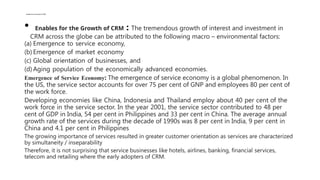
Enables for the Growth of CRM
• Enables for the Growth of CRM : The tremendous growth of interest and investment in
CRM across the globe can be attributed to the following macro – environmental factors:
(a) Emergence to service economy,
(b) Emergence of market economy
(c) Global orientation of businesses, and
(d) Aging population of the economically advanced economies.
Emergence of Service Economy: The emergence of service economy is a global phenomenon. In
the US, the service sector accounts for over 75 per cent of GNP and employees 80 per cent of
the work force.
Developing economies like China, Indonesia and Thailand employ about 40 per cent of the
work force in the service sector. In the year 2001, the service sector contributed to 48 per
cent of GDP in India, 54 per cent in Philippines and 33 per cent in China. The average annual
growth rate of the services during the decade of 1990s was 8 per cent in India, 9 per cent in
China and 4.1 per cent in Philippines
The growing importance of services resulted in greater customer orientation as services are characterized
by simultaneity / inseparability
Therefore, it is not surprising that service businesses like hotels, airlines, banking, financial services,
telecom and retailing where the early adopters of CRM.
Emergence of Market Economy
• the shift towards service, there is a global emergence of the market economy. The power is more
to the market as compare to the controlled economy. Market regulation was in place all over the
world including the US, Europe, USSR, China and India. The 1990s witnessed acceleration in the
deregulation of many large industries including banking, telecommunications, broadcasting and
airlines across the world
•market – orientation firms operating intensely competitive market now takes decision
that was once controlled by the government. The focus have shifted from capacity creation
under control to the markets. Market – oriented economy necessitated a customer focus and
boosted the importance of CRM.
• Global Orientation of Businesses
•National boundaries are giving way to either a borderless world or atleast a regional
world resulting in the emergence of trading blocks like North American Free Trade
• Agreement (NAFTA), European Union and the Association of South – East Asian Nations
(ASEAN). The abolishment of the General Agreement on Tariffs and Trade (GATT). And the
emergence of World Trade Organization (WTO) helped create a global orientation for business
establishment.
Aging Population in Economically Developed Countries
• The economically advanced nations are witnessing an aging of
their population. In 2000, 12.6 per cent of the US population
was 65 years of age or older. The comparative figures for
Sweden and Japan were 17.2 per cent and 17 per cent of their
respective population .
• This trend is visible in most part of Europe, except in Ireland.
Aging of population has been attributed to the combined
effects of a slow down in birth rate and an increased in life
expectancy.
• While an aging population creates new opportunities for
wellness, financial wellbeing, safety and security and recreation
it has also slowed the markets for traditional goods and services
designed for a younger population
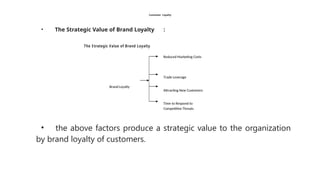
Customer Loyalty
• The Strategic Value of Brand Loyalty :
• the above factors produce a strategic value to the organization
by brand loyalty of customers.
The Strategic Value of Brand Loyalty
Reduced Marketing Costs
Trade Leverage
Brand Loyalty
Attracting New Customers
Time to Respond to
Competitive Threats
• Reduced Marketing Cost
• Trade Leverage
• Attracting New Customers
• Time to Respond to the Competitive Threats
• Strategies to Build and Maintain Loyalty
• Customer Relationship Management (CRM)
•The customer relationship management model, with its customer-centric focus, places the
customers needs first.
• IT involves three fundamental steps:
1. Understanding customer completely
2. Aligning organizational capability in order to better deliver what its customers may perceive as
high value.
3. Facilitating the information available both inside and outside the organization.
• Following are the advantages of it over traditional loyalty building methods:
•
➢ Reduce advertising cost
➢ Makes it easier to target specific customers by focusing on their needs
➢ Allows organizations to complete for customers based on service, but not on price
➢ Prevents over spending on low-value clients or under spending on high-values ones.
•In India the CRM model is widely used in manufacturing and service organizations as a
brand loyalty tool.
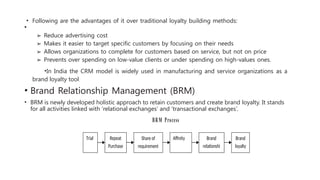
• Brand Relationship Management (BRM)
• BRM is newly developed holistic approach to retain customers and create brand loyalty. It stands
for all activities linked with ‘relational exchanges’ and ‘transactional exchanges’.
BRM Process
Trial Repeat
Purchase
Share of
requirement
Affinity Brand
relationshi
Brand
loyalty
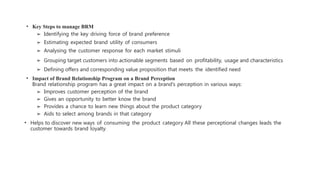
• Key Steps to manage BRM
➢ Identifying the key driving force of brand preference
➢ Estimating expected brand utility of consumers
➢ Analysing the customer response for each market stimuli
➢ Grouping target customers into actionable segments based on profitability, usage and characteristics
➢ Defining offers and corresponding value proposition that meets the identified need
• Impact of Brand Relationship Program on a Brand Perception
Brand relationship program has a great impact on a brand’s perception in various ways:
➢ Improves customer perception of the brand
➢ Gives an opportunity to better know the brand
➢ Provides a chance to learn new things about the product category
➢ Aids to select among brands in that category
• Helps to discover new ways of consuming the product category All these perceptional changes leads the
customer towards brand loyalty.
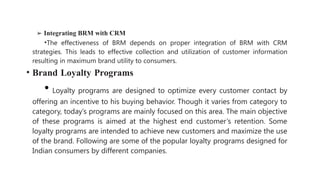
➢ Integrating BRM with CRM
•The effectiveness of BRM depends on proper integration of BRM with CRM
strategies. This leads to effective collection and utilization of customer information
resulting in maximum brand utility to consumers.
• Brand Loyalty Programs
• Loyalty programs are designed to optimize every customer contact by
offering an incentive to his buying behavior. Though it varies from category to
category, today’s programs are mainly focused on this area. The main objective
of these programs is aimed at the highest end customer’s retention. Some
loyalty programs are intended to achieve new customers and maximize the use
of the brand. Following are some of the popular loyalty programs designed for
Indian consumers by different companies.
A.Indian Club (From Tata Indica)
B.First Citizen Club (From Shopper’s Stop)
C.Book Reward Programs (From Crossword)
D.Taj Inner Circle Card (From Taj Hotels)
E.Jet Privilege Program (From Jet Airways)
F. Mobile Industry (From BPL & Orange)
G. Other Programs:
a) Rebate Program: Awards gift certificates on reaching a spending threshold. The reward can
motivate incremental purchases or increase in store traffic.
b) Partnership Program: Rewards are given to partner company’s customers with an expectation
that they may likely become customer in future.
c) Affinity Program: It offers additional information, value added benefits to suit specific
customer life styles. This helps customer to know more about the latest products and to build
long lasting relationships.
Measurement of Brand Loyalty
• for loyalty measurements is different at each level of loyalty as the degree of loyalty
and nature of relationship changes. In the bottom levels loyalty is not recognizable.
• Loyalty measurement at this level is in terms of sales turnover, product’s profit
margins, price attractiveness and price sensitivity. These are the major factors for
purchase and repurchase behavior of customers at these levels.
• At the middle level, loyalty is measured through satisfaction level. Total spending on
brand, liking – which is scaled in variety of ways like respect, friendship, trust etc, and the
reasons attributed.
• Another important measurement for customers commitment is their involvement in
spreading good word of mouth and number of people to whom they refer the brand.
• Measurement tools include structured questionnaire (both closed-end, open – end),
likert scale, semantic differential scale, attitude rating scales, projective techniques and
indepth interviews.
The Ladder of Loyalty
6
5
4
3
2
1
Partner
Advocate
Supporter
Client
Customer
Prospect
CRM Success Factors and Levels of Services
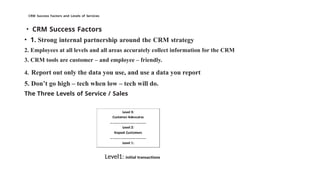
• CRM Success Factors
• 1. Strong internal partnership around the CRM strategy
2. Employees at all levels and all areas accurately collect information for the CRM
3. CRM tools are customer – and employee – friendly.
4. Report out only the data you use, and use a data you report
5. Don’t go high – tech when low – tech will do.
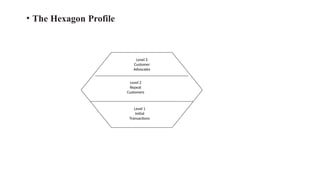
The Three Levels of Service / Sales
Level1: initial transactions
The Shape of your Custom Service/ Sales Profile
• 1.The Pyramid Profile
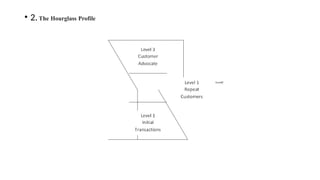
• 2.The Hourglass Profile
• 3. The Hexagon Profile
1. The Pyramid Profile
• 2.The Hourglass Profile
Level2
• The Hexagon Profile
Level 3
Customer
Advocates
Level 2
Repeat
Customers
Level 1
Initial
Transactions
Pitfalls of the Customer Service / Sales Profile
• 1. Focusing on the Top
2. Focusing on the Front Door
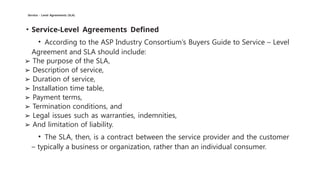
Service - Level Agreements (SLA)
• Service-Level Agreements Defined
• According to the ASP Industry Consortium’s Buyers Guide to Service – Level
Agreement and SLA should include:
➢ The purpose of the SLA,
➢ Description of service,
➢ Duration of service,
➢ Installation time table,
➢ Payment terms,
➢ Termination conditions, and
➢ Legal issues such as warranties, indemnities,
➢ And limitation of liability.
• The SLA, then, is a contract between the service provider and the customer
– typically a business or organization, rather than an individual consumer.
• Three Keys to Effective SLAs
•Whether you’re the service provider or the customer a well thought out and
clearly executed SLA can strengthen your relationship by setting reasonable
expectation, clear
•
measures of performance, and rewards when performance is excellence or
remuneration if it falls short.
• Creating an SLA
There are six steps to the SLA process map.
• Using SLAs to support Internal Customer Relationship
• Used with an internal customer relationship, SLAs can help you achieve two of the CRM
success factors listed in chapter 1.
1. Builds strong internal partnerships around the CRM strategy
2. Employees at all levels and all areas accurately correct information for the CRM system.
• Making SLAs Work
• Ideally, service – level agreement are a way to ensure that a performance enhances customer
relationship. But SLAs aren’t a substitute for the ongoing, day – today work of uncovering what a
customer expect and need, and searching for new ways to provide it to them.
•
• Service – level agreement don’t work when:
•
➢ Compliance to the “letter of the law” in the agreement means more than serving the customer.
➢ Customer needs an expectation change, but his SLA doesn’t.
➢ Penalties are ignored or seen as a “cost of doing business”
➢ Superiors performance isn’t recognized and acknowledge in a meaningful way.
• Make sure that your formal and informal SLAs don’t fall into one of these performance traps.

customer relationship management in business

  • 1.
    Dr. Byram Anand Associateprofessor Pondicherry university Karaikal campus Karaikal –Pondicherry
  • 2.
  • 3.
    Unit-I CRM concepts -Acquiring customers, - Customer loyalty and optimizing customer relationships - CRM defined - success factors, the three levels of Service/ Sales Profiling - Service Level Agreements (SLAs), creating and managing effective SLAs.
  • 4.
    • Customer RelationshipManagement (CRM) is to create a competitive advantage by being the best at understanding, communicating, delivering, and developing existing customer relationships, in addition to creating and keeping new customers. • Merchants and traders have been practicing customer relationship for centuries. Their business was built on trust • They paid personal attention to their customers, knew details regarding their customers tastes and preferences, and had a personal rapport with most of them.
  • 5.
    • These relationshiporiented practices have changed due to industrial revolution.. Businesses adopted mass production, mass communication and mass distribution to achieve economics of scale.
  • 6.
    The post-industrial erasaw the re-emergence of relationship practices. (a)A). Rapid advances in technology (b)Intensive competition in most markets (c)Growing importance of the service sector, and (d)Adoption of total quality management programs ,
  • 8.
    • Technological Advancement:information, communication and production technologies have helped marketers come closer to their customers. Firms operating in diverse sectors ranging from packaged goods to services started using these technologies to know their customers, learn more about them, and then build stronger bonds with them through frequent interactions. • Technology enabled marketers overcome several long felt shortcomings of mass marketing. Some of these included: ➢ Inefficiencies of mass marketing: 1980s and early 1990s witnessed some of the most radical business transformations that resulted in cost reductions in almost all functional departments except marketing. Manufacturing and related operations costs were reduced through business process reengineering, human resource costs were reduced through outsourcing, restructuring and layoffs, financial costs were reduced through financial reengineering but marketing costs kept increasing due to increased competition and product parity in virtually every industry. ➢ Lack of fast, effective and interactive models of customer contact, feedback and information. • Lack of consolidated information about customer interactions, purchase behavior and future potential • Intensive Competition: Marketers have now started focusing on the lifetime value of customers. They are moving away from just trying to sell their products to understanding, customers needs and wants and then satisfying their needs. This has led to a relationship orientation which creates opportunities to cross sell products and services over the lifetime of the customer.
  • 9.
    • Growing Importanceof the Service Sector: . One of the characteristics of the service industries is the direct interaction between the marketer and the buyer. In services, the provider is usually involved in the production as well as delivery directly. • For example, professional service providers like a doctor or consultant are directly involved in production as well as delivery of their services. Similarly, the customers are directly involved in production in the purchase and consumption of these services. • These direct contacts create opportunities for better understanding, a better appreciation of needs as well as constraints and emotional bonding all of which facilitate relationship building. • Adoption of Total Quality Management (TQM) Programs: Total quality management programs help companies offer quality products and services to customers at the lowest prices. To enable this value proposition, organizations needed to work closely with their customers, intermediaries as well as suppliers thus fostering close working relationships with members of the marketing system. • Companies such as Intel, Xerox, and Toyota formed partnering relationships with suppliers and customers to practice TQM. • A competitive advantage is sustainable only when it is not easily replicated. One such sustainable competitive advantage is the relationship that a firm develops with its customers. •
  • 10.
    Schools of Thoughton CRM • The relationship marketing is supported by the growing research interest in different facets of this concept. • The initial approaches to CRM can be broadly classified as: 1. The Anglo-Australia Approach, 2. The Nordic Approach, and 3. The North American Approach. 1. The Anglo-Australian approach integrated the contemporary theories of quality management services marketing and customer relationship economics to explain the emergence of relationship marketing
  • 11.
    Anglo-Australian Approach ofRelationship Marketing • Quality Management Services MarketingConcepts customer Relationship Economics Relationship Marketing
  • 12.
    • 2. TheNordic approach views relationship marketing as the confluence of interactive network theory, services marketing and customer relationship economics. The interactive network theory of industrial marketing views marketing as an interactive process in a context where relationship building is an area of primary concern for marketers. •Interactive Network Theory • Services Marketing Customer Relationship Economics Relationship Marketing
  • 13.
    3. North Americanscholars was on the relationship between the buyer and seller operating within the context of the organizational environment which facilitated the buyer seller relationship. Organisational Environment Buyer Relationship Manager
  • 14.
    The Six MarketsFramework Internal Markets Referral Markets Influence Markerts Recruitment Markets Supplier Markets Customer markets
  • 15.
    • The sixmarkets are as follows 1. Customer markets – existing and prospective customers as well as intermediaries. 2. Referral markets – existing customers who recommend to other prospects, and referral sources or ‘multipliers’ such as doctors who refer patients to a hospital or a consultant who recommends a specific IT solution, 3. Influence markets – government, consumer groups, business press and financial analysts. 4. Recruitment markets – for attracting the right employees to the organization, 5. Supplier markets – suppliers of raw materials, components, services, etc., and 6. Internal markets - the organization including internal departments and staff.
  • 16.
    Defining CRM • inmarketing literature, the terms customer relationship management and relationship marketing have been used interchangeable to reflect a variety of themes and perspectives • Another view point is to consider CRM only as customer retention in which a variety of after marketing tactics are used for customer bonding or staying in touch after the sale is done. • Jackson applied the individual account concept in industrial market to suggest markets CRM to mean, marketing oriented toward strong, lasting relationship with individual accounts • • McKenna offered a more strategic view by putting the customer first and shifting the role of marketing from manipulating the customer (telling & selling) to genuine customer involvement (communicating & sharing the knowledge). • Shift in Focus ( See Diagram next slide)
  • 17.
  • 18.
    Benefits of CRM •Customers are Profitable over a period of time: that a customer becomes more profitable with time because the initial acquisition cost exceeds gross margin while the retention costs are much lower. When an organization retains the customer, it gets a larger share of the customers wallet at a higher profit-one percent increase in sale to existing customer increase profits by 17 per cent while the same amount of sale to new customer increased profit by only 3 per cent. • This huge different is explained by the fact that for most companies the cost of acquiring the customer is very high. It costs six to eight times more to sell to a new customer than to sell to an existing one • Customer Probability is Skewed :The implication of such a skew in customer profitability and revenue contribution are startling for organizations, which use to conventionally treat ‘all customers are equal’. Competitors have to just lure these top customers and the organization would face serious problems. It also highlights the fact that one has to adopt different strategies for different customer groups:
  • 19.
    Marketing Benefits ofCRM • CRM will gradually reduce organization’s dependence on periodic surveys to gather data. Collection of data related to buying and consumption behavior will be an ongoing process. • Customized promotions-based customer preferences and purchase patterns will substantially reduce the wasteful expenditure of mass communication and even direct mailing. As a customized promotion are more focused and are based on a deeper insight of existing customers, they have a greater chance of conversion to sales. • Service Benefits of CRM: • Research findings conducted across industries as a part of a Technical Assistance Research Project (TARP) indicate that: ➢ 95 per cent of the customers do not bother to complain, the just take their business else where. ➢ Most loyal customers take time to complain. This enables the product / service provider to improve and ensure that such mistake do not recur. ➢ A typical dissatisfied customer will tell an average of 14 others about a bad experience while she will tell only six about a satisfying experience with an organization. ➢ 70 per cent of customers who complain will do business with a company again if it quickly takes care of a service problem.
  • 20.
    Enables for theGrowth of CRM • Enables for the Growth of CRM : The tremendous growth of interest and investment in CRM across the globe can be attributed to the following macro – environmental factors: (a) Emergence to service economy, (b) Emergence of market economy (c) Global orientation of businesses, and (d) Aging population of the economically advanced economies. Emergence of Service Economy: The emergence of service economy is a global phenomenon. In the US, the service sector accounts for over 75 per cent of GNP and employees 80 per cent of the work force. Developing economies like China, Indonesia and Thailand employ about 40 per cent of the work force in the service sector. In the year 2001, the service sector contributed to 48 per cent of GDP in India, 54 per cent in Philippines and 33 per cent in China. The average annual growth rate of the services during the decade of 1990s was 8 per cent in India, 9 per cent in China and 4.1 per cent in Philippines The growing importance of services resulted in greater customer orientation as services are characterized by simultaneity / inseparability Therefore, it is not surprising that service businesses like hotels, airlines, banking, financial services, telecom and retailing where the early adopters of CRM.
  • 21.
    Emergence of MarketEconomy • the shift towards service, there is a global emergence of the market economy. The power is more to the market as compare to the controlled economy. Market regulation was in place all over the world including the US, Europe, USSR, China and India. The 1990s witnessed acceleration in the deregulation of many large industries including banking, telecommunications, broadcasting and airlines across the world •market – orientation firms operating intensely competitive market now takes decision that was once controlled by the government. The focus have shifted from capacity creation under control to the markets. Market – oriented economy necessitated a customer focus and boosted the importance of CRM. • Global Orientation of Businesses •National boundaries are giving way to either a borderless world or atleast a regional world resulting in the emergence of trading blocks like North American Free Trade • Agreement (NAFTA), European Union and the Association of South – East Asian Nations (ASEAN). The abolishment of the General Agreement on Tariffs and Trade (GATT). And the emergence of World Trade Organization (WTO) helped create a global orientation for business establishment.
  • 22.
    Aging Population inEconomically Developed Countries • The economically advanced nations are witnessing an aging of their population. In 2000, 12.6 per cent of the US population was 65 years of age or older. The comparative figures for Sweden and Japan were 17.2 per cent and 17 per cent of their respective population . • This trend is visible in most part of Europe, except in Ireland. Aging of population has been attributed to the combined effects of a slow down in birth rate and an increased in life expectancy. • While an aging population creates new opportunities for wellness, financial wellbeing, safety and security and recreation it has also slowed the markets for traditional goods and services designed for a younger population
  • 23.
    Customer Loyalty • TheStrategic Value of Brand Loyalty : • the above factors produce a strategic value to the organization by brand loyalty of customers. The Strategic Value of Brand Loyalty Reduced Marketing Costs Trade Leverage Brand Loyalty Attracting New Customers Time to Respond to Competitive Threats
  • 24.
    • Reduced MarketingCost • Trade Leverage • Attracting New Customers • Time to Respond to the Competitive Threats • Strategies to Build and Maintain Loyalty • Customer Relationship Management (CRM) •The customer relationship management model, with its customer-centric focus, places the customers needs first. • IT involves three fundamental steps: 1. Understanding customer completely 2. Aligning organizational capability in order to better deliver what its customers may perceive as high value. 3. Facilitating the information available both inside and outside the organization.
  • 25.
    • Following arethe advantages of it over traditional loyalty building methods: • ➢ Reduce advertising cost ➢ Makes it easier to target specific customers by focusing on their needs ➢ Allows organizations to complete for customers based on service, but not on price ➢ Prevents over spending on low-value clients or under spending on high-values ones. •In India the CRM model is widely used in manufacturing and service organizations as a brand loyalty tool. • Brand Relationship Management (BRM) • BRM is newly developed holistic approach to retain customers and create brand loyalty. It stands for all activities linked with ‘relational exchanges’ and ‘transactional exchanges’. BRM Process Trial Repeat Purchase Share of requirement Affinity Brand relationshi Brand loyalty
  • 26.
    • Key Stepsto manage BRM ➢ Identifying the key driving force of brand preference ➢ Estimating expected brand utility of consumers ➢ Analysing the customer response for each market stimuli ➢ Grouping target customers into actionable segments based on profitability, usage and characteristics ➢ Defining offers and corresponding value proposition that meets the identified need • Impact of Brand Relationship Program on a Brand Perception Brand relationship program has a great impact on a brand’s perception in various ways: ➢ Improves customer perception of the brand ➢ Gives an opportunity to better know the brand ➢ Provides a chance to learn new things about the product category ➢ Aids to select among brands in that category • Helps to discover new ways of consuming the product category All these perceptional changes leads the customer towards brand loyalty.
  • 27.
    ➢ Integrating BRMwith CRM •The effectiveness of BRM depends on proper integration of BRM with CRM strategies. This leads to effective collection and utilization of customer information resulting in maximum brand utility to consumers. • Brand Loyalty Programs • Loyalty programs are designed to optimize every customer contact by offering an incentive to his buying behavior. Though it varies from category to category, today’s programs are mainly focused on this area. The main objective of these programs is aimed at the highest end customer’s retention. Some loyalty programs are intended to achieve new customers and maximize the use of the brand. Following are some of the popular loyalty programs designed for Indian consumers by different companies.
  • 28.
    A.Indian Club (FromTata Indica) B.First Citizen Club (From Shopper’s Stop) C.Book Reward Programs (From Crossword) D.Taj Inner Circle Card (From Taj Hotels) E.Jet Privilege Program (From Jet Airways) F. Mobile Industry (From BPL & Orange) G. Other Programs: a) Rebate Program: Awards gift certificates on reaching a spending threshold. The reward can motivate incremental purchases or increase in store traffic. b) Partnership Program: Rewards are given to partner company’s customers with an expectation that they may likely become customer in future. c) Affinity Program: It offers additional information, value added benefits to suit specific customer life styles. This helps customer to know more about the latest products and to build long lasting relationships.
  • 29.
    Measurement of BrandLoyalty • for loyalty measurements is different at each level of loyalty as the degree of loyalty and nature of relationship changes. In the bottom levels loyalty is not recognizable. • Loyalty measurement at this level is in terms of sales turnover, product’s profit margins, price attractiveness and price sensitivity. These are the major factors for purchase and repurchase behavior of customers at these levels. • At the middle level, loyalty is measured through satisfaction level. Total spending on brand, liking – which is scaled in variety of ways like respect, friendship, trust etc, and the reasons attributed. • Another important measurement for customers commitment is their involvement in spreading good word of mouth and number of people to whom they refer the brand. • Measurement tools include structured questionnaire (both closed-end, open – end), likert scale, semantic differential scale, attitude rating scales, projective techniques and indepth interviews.
  • 30.
    The Ladder ofLoyalty 6 5 4 3 2 1 Partner Advocate Supporter Client Customer Prospect
  • 31.
    CRM Success Factorsand Levels of Services • CRM Success Factors • 1. Strong internal partnership around the CRM strategy 2. Employees at all levels and all areas accurately collect information for the CRM 3. CRM tools are customer – and employee – friendly. 4. Report out only the data you use, and use a data you report 5. Don’t go high – tech when low – tech will do. The Three Levels of Service / Sales Level1: initial transactions
  • 32.
    The Shape ofyour Custom Service/ Sales Profile • 1.The Pyramid Profile • 2.The Hourglass Profile • 3. The Hexagon Profile 1. The Pyramid Profile
  • 33.
    • 2.The HourglassProfile Level2
  • 34.
    • The HexagonProfile Level 3 Customer Advocates Level 2 Repeat Customers Level 1 Initial Transactions
  • 35.
    Pitfalls of theCustomer Service / Sales Profile • 1. Focusing on the Top 2. Focusing on the Front Door
  • 36.
    Service - LevelAgreements (SLA) • Service-Level Agreements Defined • According to the ASP Industry Consortium’s Buyers Guide to Service – Level Agreement and SLA should include: ➢ The purpose of the SLA, ➢ Description of service, ➢ Duration of service, ➢ Installation time table, ➢ Payment terms, ➢ Termination conditions, and ➢ Legal issues such as warranties, indemnities, ➢ And limitation of liability. • The SLA, then, is a contract between the service provider and the customer – typically a business or organization, rather than an individual consumer.
  • 37.
    • Three Keysto Effective SLAs •Whether you’re the service provider or the customer a well thought out and clearly executed SLA can strengthen your relationship by setting reasonable expectation, clear • measures of performance, and rewards when performance is excellence or remuneration if it falls short. • Creating an SLA There are six steps to the SLA process map. • Using SLAs to support Internal Customer Relationship
  • 38.
    • Using SLAsto support Internal Customer Relationship • Used with an internal customer relationship, SLAs can help you achieve two of the CRM success factors listed in chapter 1. 1. Builds strong internal partnerships around the CRM strategy 2. Employees at all levels and all areas accurately correct information for the CRM system. • Making SLAs Work • Ideally, service – level agreement are a way to ensure that a performance enhances customer relationship. But SLAs aren’t a substitute for the ongoing, day – today work of uncovering what a customer expect and need, and searching for new ways to provide it to them. • • Service – level agreement don’t work when: • ➢ Compliance to the “letter of the law” in the agreement means more than serving the customer. ➢ Customer needs an expectation change, but his SLA doesn’t. ➢ Penalties are ignored or seen as a “cost of doing business” ➢ Superiors performance isn’t recognized and acknowledge in a meaningful way. • Make sure that your formal and informal SLAs don’t fall into one of these performance traps.