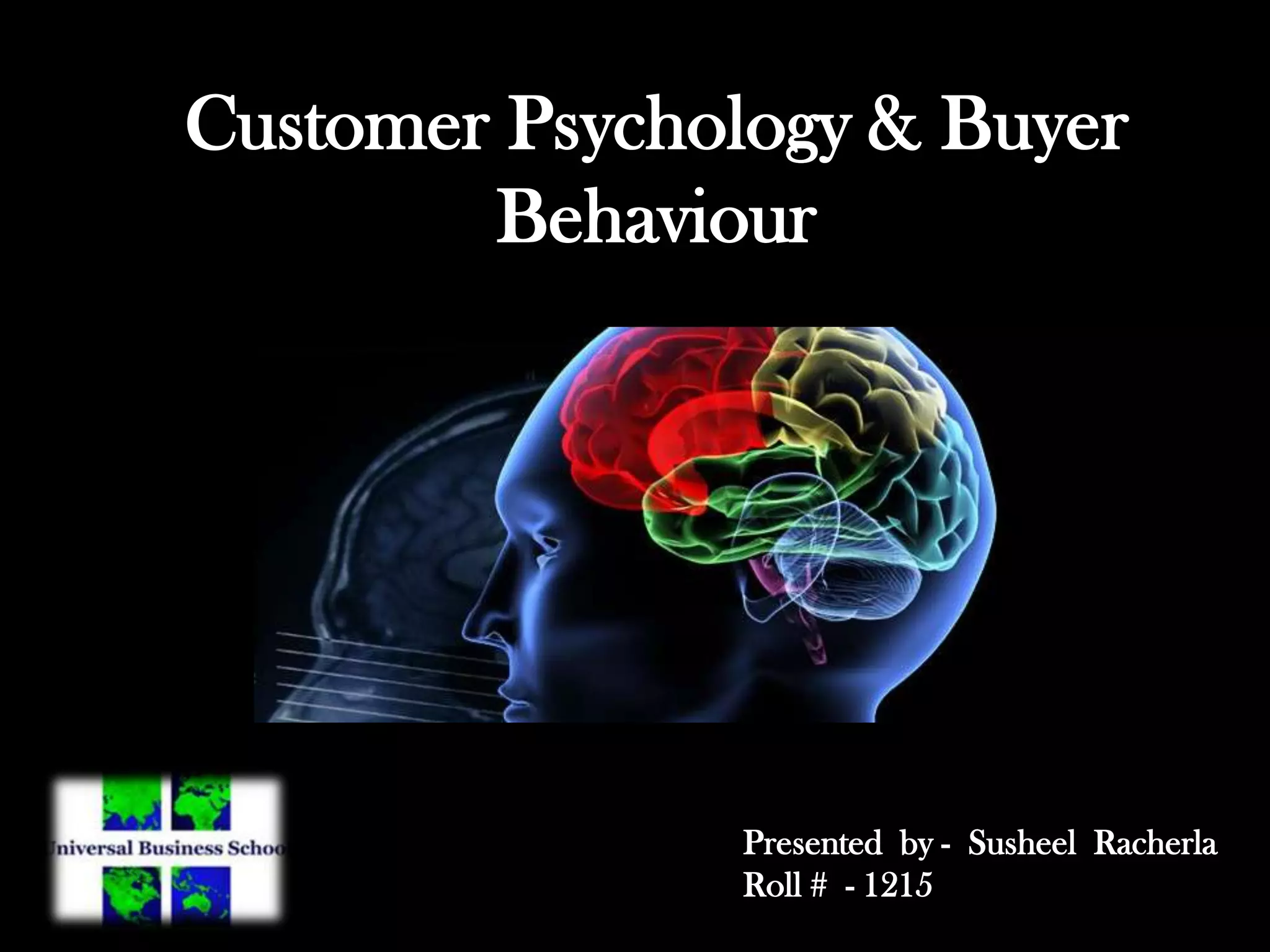
Customer Psychology & Buyer
Behaviour
Presented by - Susheel Racherla
Roll # - 1215
Understanding Customer Buyer Behaviour
Why is it Important ????
It helps to understand the target Market & its Buying Behaviour.
It is more complex than it appears.
Individuals are not predictable, groups are.
3 key questions before any IMC can be carried out
1 Who is the buyer ???
(target market profiles and decision-making
units)?
2 Why do they buy (or not buy) a particular brand or
product?
3 How, when and where do they buy?
Why buy a burger?
Pavlov’s dog effect.
McDonald’s logo acts as a stimulus to customers to
remind them of food and arouse feelings of hunger.
Maslows Need effect
A teenage burger buyer prefers McDonald’s because friends
hang out there and it feels nice to be in with the in-crowd.
Choice is often influenced
By familiarity with the brand or sometimes
the level of trust in a brand name.
Front-of-mind
Awareness.
Who is the customer?
Many organizations do not know who their customers are.
Companies spend a lot of time and effort constantly researching
and analyzing exactly who is their target market (in great detail)
Who knows you’re a dog online? (25 y male, 21 f)
Guy from new york girl frm miami, meet at JFK……..
50% British companies do not know who their customers are?
Decision-making units
Several individuals are
involved in any one person’s
decision of purchasing a
product
(Eg: Choice of a Family Car)
Why do they buy?
Customers do not even know the real reasons they buy
Some reasons are rational, and some are emotional
The split between the two is called the emotional–rational
dichotomy (Clash)
UK customers
Are prepared to pay 800 per cent more for the ‘The Real thing’
A 2-litre bottle of Coca-Cola 1.2 pounds while on same shelf Asda
will sell for .15 pounds.
Coca-Cola’s ‘core concept is product engagement
Customers prefer Coca-Cola despite High Price
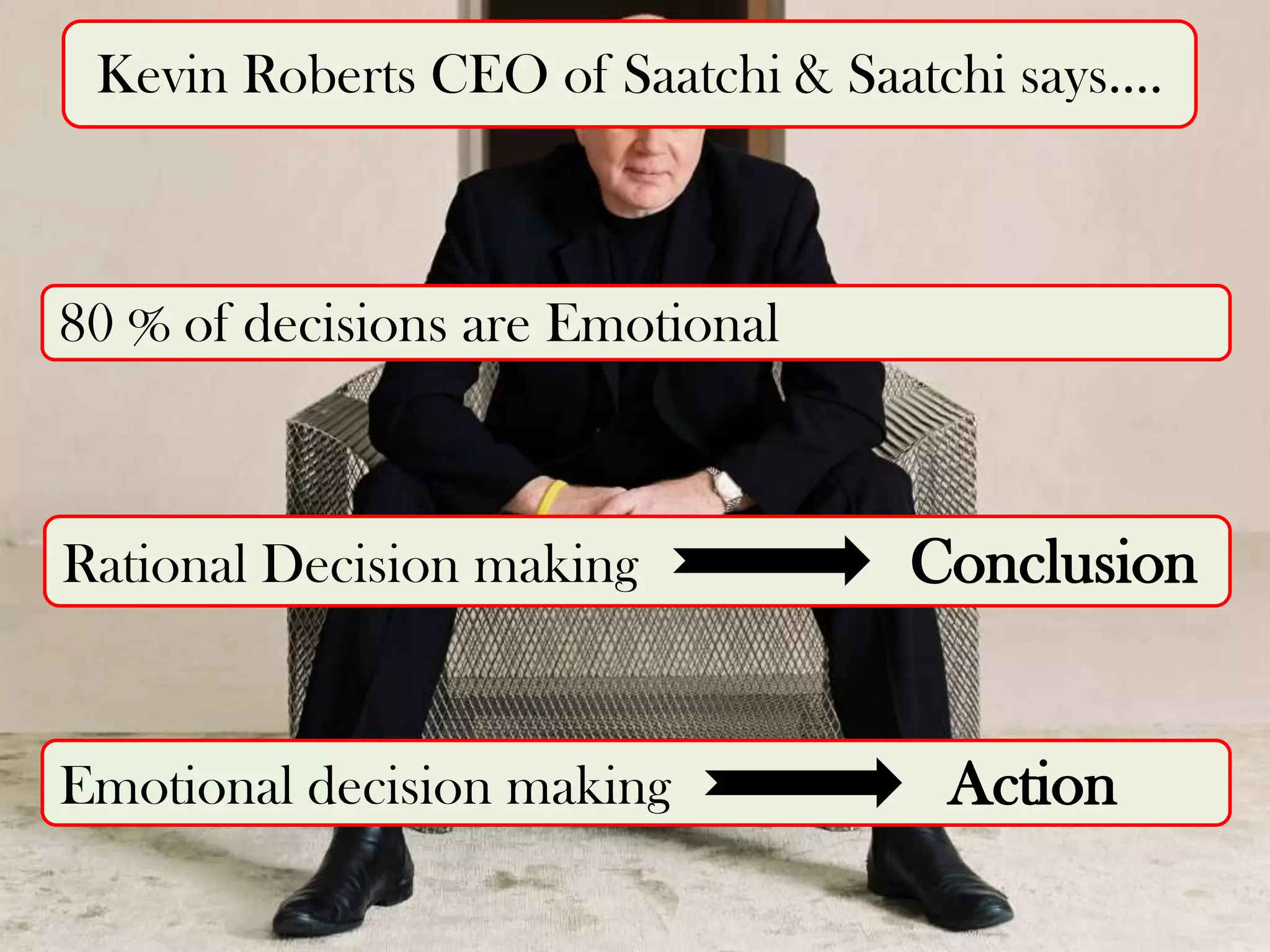
Kevin Roberts CEO of Saatchi & Saatchi says….
80 % of decisions are Emotional
Rational Decision making Conclusion
Emotional decision making Action
There’s an Emotional
connection through the
packaging, advertising
and through your
memory that you make
Americans may buy iPod - to listen to their
favourite music without being disturbed by others
Japanese buy iPods to listen to their favourite
music without disturbing others.
Customers Buy
the same product for different reasons.
Sigmund Freud
Suggested that the mind was like an iceberg
The tip represents the conscious part of the
mind while the greater submerged part is the
unconscious.
Even long-forgotten childhood experiences
can affect Buying behaviour
Penn (4 big ideas in brain science)
Unconscious mind accounts for most of what we think, feel & do.
Conscious reasoning may account for only a small part of our ‘thinking.
Emotion precedes our conscious feelings and works in tandem with
rational thinking to help us make (better) decisions.
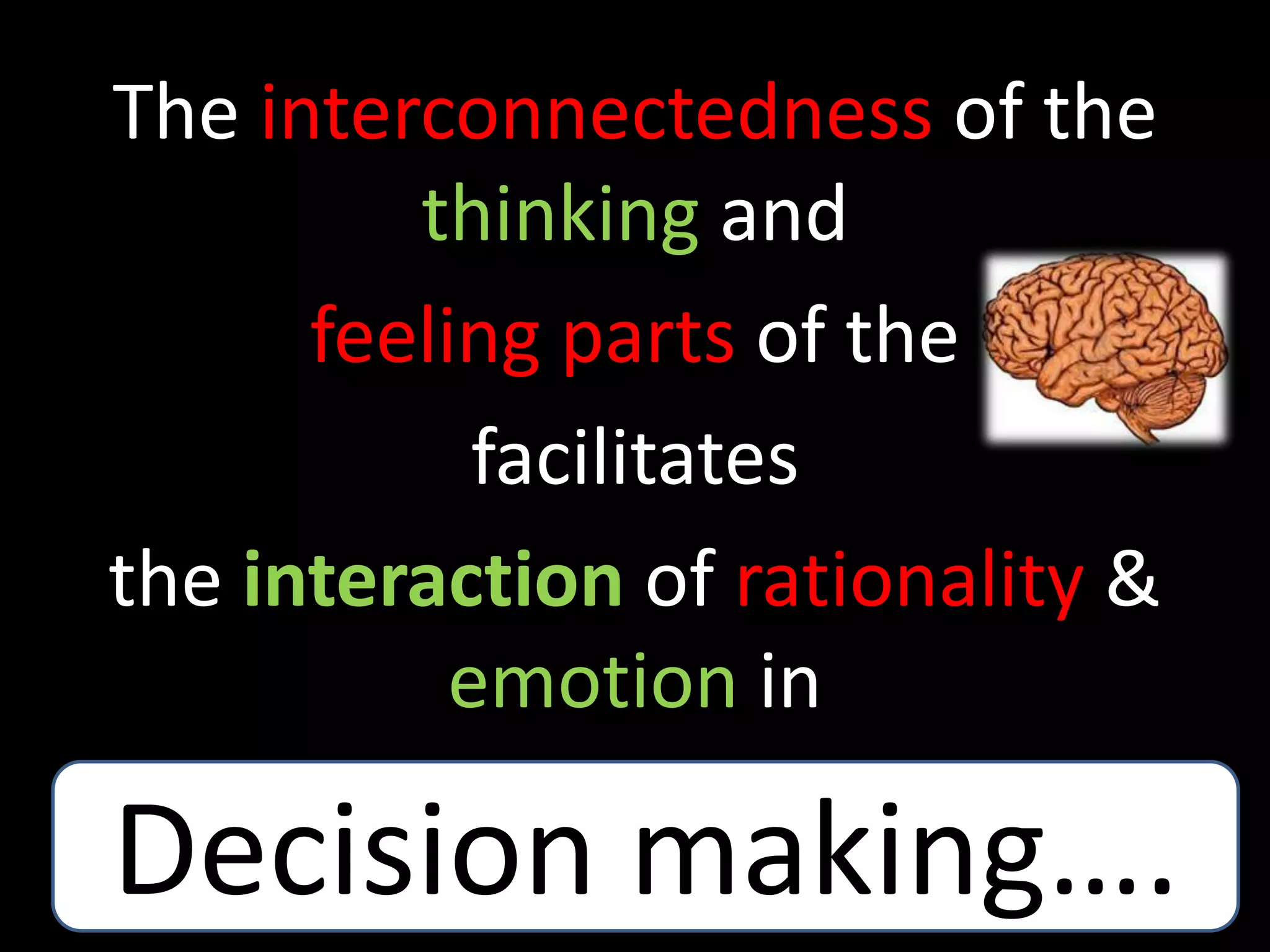
The interconnectedness of the
thinking and
feeling parts of the
facilitates
the interaction of rationality &
emotion in
Decision making….
Marketers have to
know their customers
better than the
customers know
themselves.
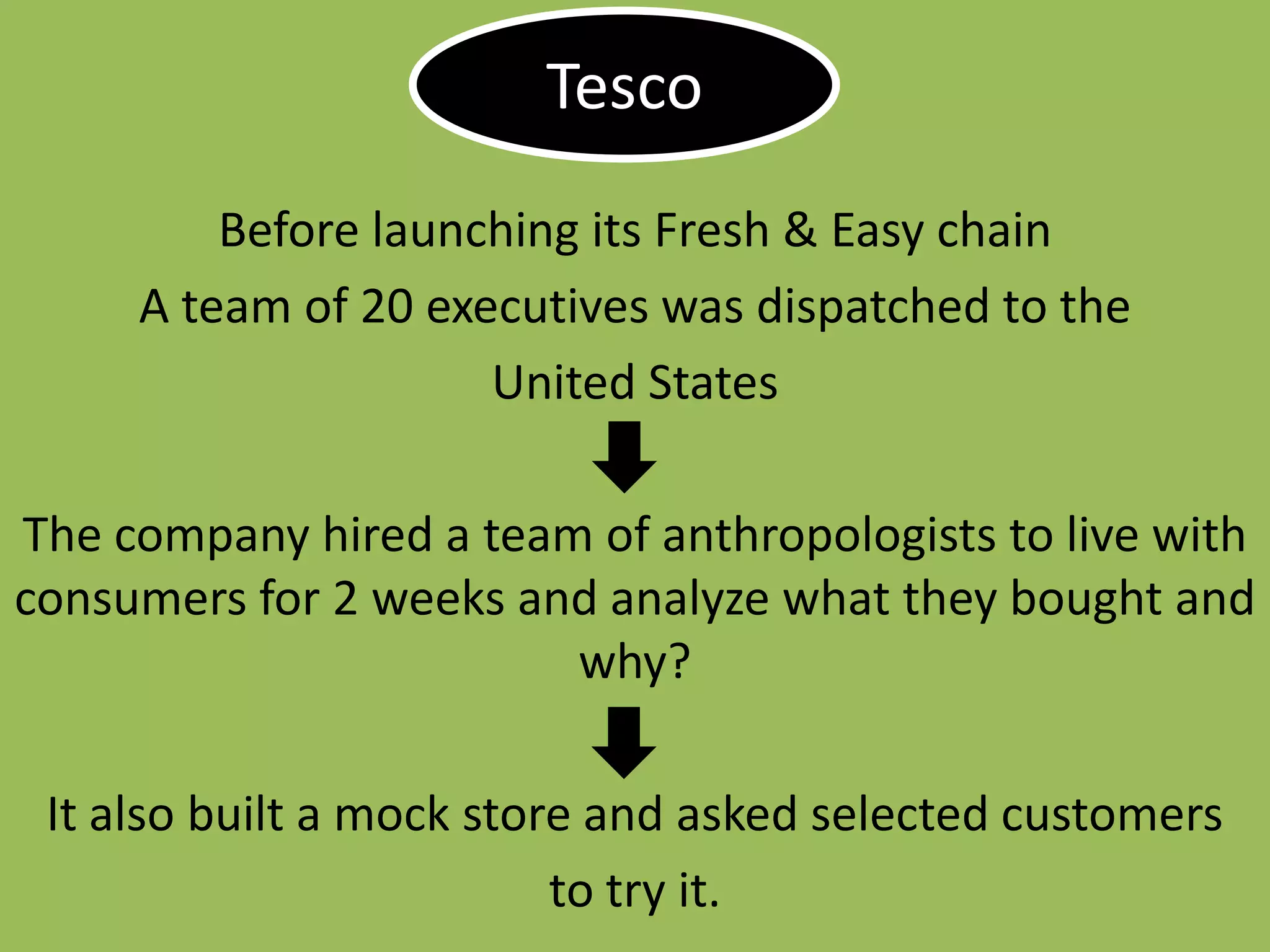
Before launching its Fresh & Easy chain
A team of 20 executives was dispatched to the
United States
The company hired a team of anthropologists to live with
consumers for 2 weeks and analyze what they bought and
why?
It also built a mock store and asked selected customers
to try it.
Tesco
Tesco discovered that US
consumers
were less bothered by the
selection of
wines on offer,
but wanted better-quality
meat than UK consumers.
What customers are buying & not buying?
Young mothers bought fewer baby products in its
stores because they trusted pharmacies more.
So Tesco launched Baby Club to provide expert
advice and targeted coupons.
Survey at Tesco (UK)
Results
Its share of baby product
sales
in the UK grew from 16% to
24% over 3 years.
New task buying - The organization has no
experience of the product or service and is buying it
for the first time.
Modified rebuy - Situation is where the industrial
buyer has some experience of the product or
service.
Straight rebuy - is where the buyer, or purchasing
department, buys on a regular basis.
How do they buy?
Surprisingly many customers trust a website
more than a person.
People trust well-known and well-respected
brands
In the UK, several major brands score higher
in trust than the church and the police.
Trust is increasingly important.
Well managed brands are trusted as long as their
promise is never broken.
How does it feel when a website remembers your
name?
And when it remembers your preferences?
It seems customers are happy to have unconscious
relationships with brands.
Trust
Relationship
What is it called when people visit to the website
again & again?
Remember, the 2nd visit is the start of the
Relationship.
Buying Process for High Involvement
Purchase
Attitudes towards high/low involvement
purchases
Attitudes towards low-involvement brands
can be formed after the brand experience.
In high-involvement purchases attitudes are formed
after awareness but before any purchasing behavior
actually occurs.
Relief purchases
require a more of a
rational approach
Reward purchases is
more of a
emotional approach.
Marketers need to
understand their customers
buying process, whether
online, offline or a mixture
of both.
Response Hierarchy Model
Black-box models
Messages and images are not always perceived in
the manner intended by the advertiser.
Perception is selective & biased by Motivation.
We see what we want to see.
Colour affects our perception
(Red is a colour that makes food smell better.)
Perception
Simple test on Perception
Smokers can you recall exactly what the health
warning says on the side of their packet of
cigarettes?
Very Few will be able to tell you the exact words.
Smokers screen out messages or stimuli that may
cause dis-comfort, tension or cognitive dissonance
It causes discomfort every time a cigarette is taken,
since the box will give the smokers an unpleasant
message.
In order to reduce this tension, the smokers have
two options:
1) Change behaviour (stop smoking)
2) Screen out the message and continue the
behaviour (smoking).
Humans are conditioned by music
High tempo music in fast food restaurants
encourages faster knife and fork activity, leading to
quicker table turnover.
Customers buy more expensive wines in a retail
environment playing classical music rather than
pop music.
Younger shoppers spend more time in a retail
environment playing loud music
Shoppers aged 50 and over spend more in an
environment with quiet background music.
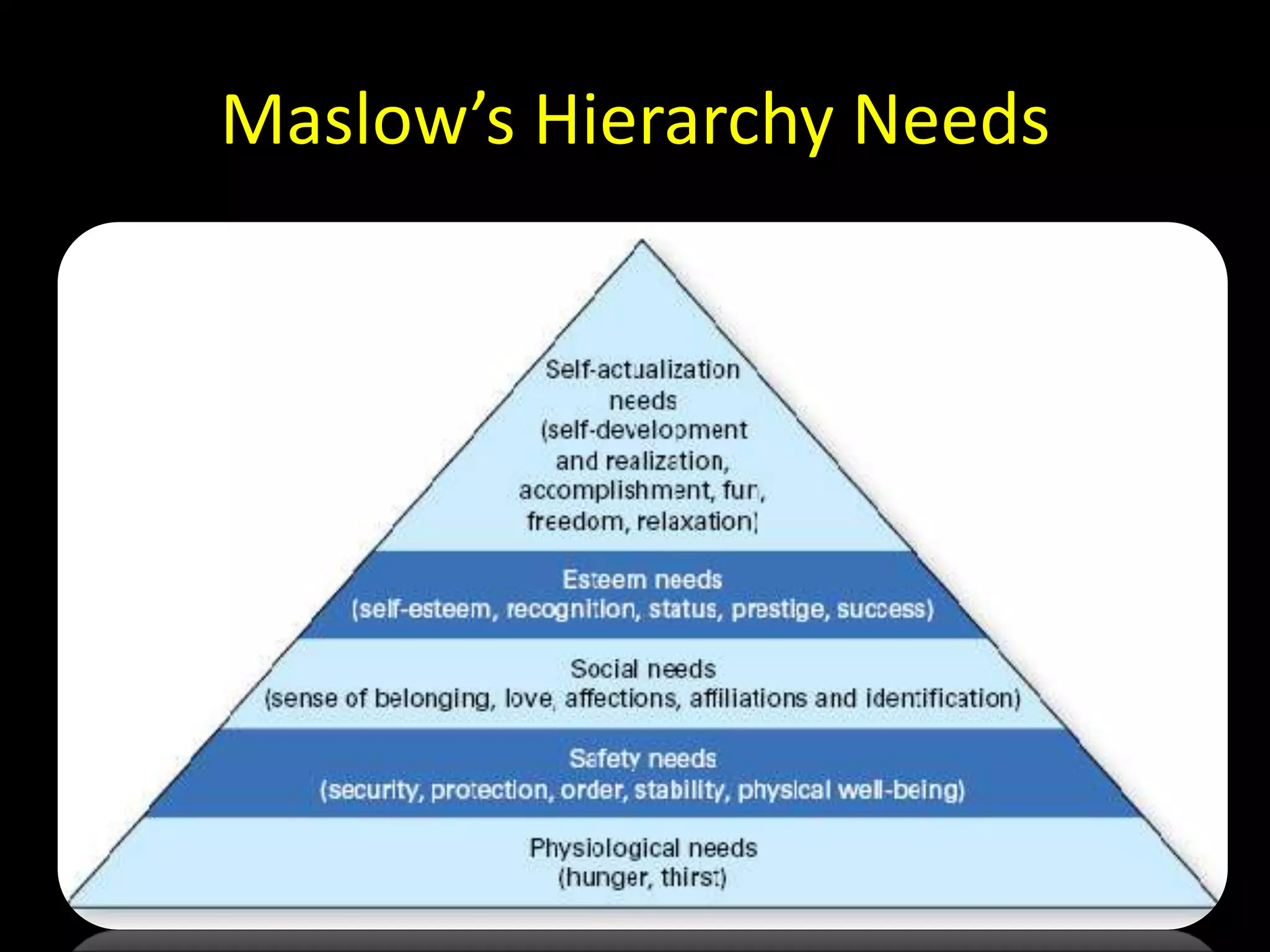
Maslow’s Hierarchy Needs
Which communications tools do what??
Conclusion
Buying behaviour is complex.
There are many different approaches to buying models.
Marketers need a continual feed of information on
customer behaviour..
Emotional influences in decision making are still dominant
in B2C and exist in B2B markets
Marketers must understand how the
intervening
psychological variables influence buyer
behaviour.
Customer psychology & buyer behaviour

Customer psychology & buyer behaviour

  • 1.
    Customer Psychology &Buyer Behaviour Presented by - Susheel Racherla Roll # - 1215
  • 2.
    Understanding Customer BuyerBehaviour Why is it Important ???? It helps to understand the target Market & its Buying Behaviour. It is more complex than it appears. Individuals are not predictable, groups are.
  • 3.
    3 key questionsbefore any IMC can be carried out 1 Who is the buyer ??? (target market profiles and decision-making units)? 2 Why do they buy (or not buy) a particular brand or product? 3 How, when and where do they buy?
  • 4.
    Why buy aburger? Pavlov’s dog effect. McDonald’s logo acts as a stimulus to customers to remind them of food and arouse feelings of hunger. Maslows Need effect A teenage burger buyer prefers McDonald’s because friends hang out there and it feels nice to be in with the in-crowd.
  • 5.
    Choice is ofteninfluenced By familiarity with the brand or sometimes the level of trust in a brand name. Front-of-mind Awareness.
  • 6.
    Who is thecustomer? Many organizations do not know who their customers are. Companies spend a lot of time and effort constantly researching and analyzing exactly who is their target market (in great detail) Who knows you’re a dog online? (25 y male, 21 f) Guy from new york girl frm miami, meet at JFK…….. 50% British companies do not know who their customers are?
  • 7.
    Decision-making units Several individualsare involved in any one person’s decision of purchasing a product (Eg: Choice of a Family Car)
  • 8.
    Why do theybuy? Customers do not even know the real reasons they buy Some reasons are rational, and some are emotional The split between the two is called the emotional–rational dichotomy (Clash)
  • 9.
    UK customers Are preparedto pay 800 per cent more for the ‘The Real thing’ A 2-litre bottle of Coca-Cola 1.2 pounds while on same shelf Asda will sell for .15 pounds. Coca-Cola’s ‘core concept is product engagement Customers prefer Coca-Cola despite High Price
  • 10.
    Kevin Roberts CEOof Saatchi & Saatchi says…. 80 % of decisions are Emotional Rational Decision making Conclusion Emotional decision making Action
  • 11.
    There’s an Emotional connectionthrough the packaging, advertising and through your memory that you make
  • 12.
    Americans may buyiPod - to listen to their favourite music without being disturbed by others Japanese buy iPods to listen to their favourite music without disturbing others. Customers Buy the same product for different reasons.
  • 13.
    Sigmund Freud Suggested thatthe mind was like an iceberg The tip represents the conscious part of the mind while the greater submerged part is the unconscious. Even long-forgotten childhood experiences can affect Buying behaviour
  • 14.
    Penn (4 bigideas in brain science) Unconscious mind accounts for most of what we think, feel & do. Conscious reasoning may account for only a small part of our ‘thinking. Emotion precedes our conscious feelings and works in tandem with rational thinking to help us make (better) decisions.
  • 15.
    The interconnectedness ofthe thinking and feeling parts of the facilitates the interaction of rationality & emotion in Decision making….
  • 16.
    Marketers have to knowtheir customers better than the customers know themselves.
  • 17.
    Before launching itsFresh & Easy chain A team of 20 executives was dispatched to the United States The company hired a team of anthropologists to live with consumers for 2 weeks and analyze what they bought and why? It also built a mock store and asked selected customers to try it. Tesco
  • 18.
    Tesco discovered thatUS consumers were less bothered by the selection of wines on offer, but wanted better-quality meat than UK consumers.
  • 19.
    What customers arebuying & not buying? Young mothers bought fewer baby products in its stores because they trusted pharmacies more. So Tesco launched Baby Club to provide expert advice and targeted coupons. Survey at Tesco (UK)
  • 20.
    Results Its share ofbaby product sales in the UK grew from 16% to 24% over 3 years.
  • 21.
    New task buying- The organization has no experience of the product or service and is buying it for the first time. Modified rebuy - Situation is where the industrial buyer has some experience of the product or service. Straight rebuy - is where the buyer, or purchasing department, buys on a regular basis. How do they buy?
  • 22.
    Surprisingly many customerstrust a website more than a person. People trust well-known and well-respected brands In the UK, several major brands score higher in trust than the church and the police. Trust is increasingly important.
  • 23.
    Well managed brandsare trusted as long as their promise is never broken. How does it feel when a website remembers your name? And when it remembers your preferences? It seems customers are happy to have unconscious relationships with brands. Trust
  • 24.
    Relationship What is itcalled when people visit to the website again & again? Remember, the 2nd visit is the start of the Relationship.
  • 25.
    Buying Process forHigh Involvement Purchase
  • 26.
    Attitudes towards high/lowinvolvement purchases Attitudes towards low-involvement brands can be formed after the brand experience. In high-involvement purchases attitudes are formed after awareness but before any purchasing behavior actually occurs.
  • 27.
    Relief purchases require amore of a rational approach Reward purchases is more of a emotional approach.
  • 28.
    Marketers need to understandtheir customers buying process, whether online, offline or a mixture of both.
  • 29.
  • 30.
  • 31.
    Messages and imagesare not always perceived in the manner intended by the advertiser. Perception is selective & biased by Motivation. We see what we want to see. Colour affects our perception (Red is a colour that makes food smell better.) Perception
  • 32.
    Simple test onPerception Smokers can you recall exactly what the health warning says on the side of their packet of cigarettes? Very Few will be able to tell you the exact words. Smokers screen out messages or stimuli that may cause dis-comfort, tension or cognitive dissonance
  • 33.
    It causes discomfortevery time a cigarette is taken, since the box will give the smokers an unpleasant message. In order to reduce this tension, the smokers have two options: 1) Change behaviour (stop smoking) 2) Screen out the message and continue the behaviour (smoking).
  • 34.
    Humans are conditionedby music High tempo music in fast food restaurants encourages faster knife and fork activity, leading to quicker table turnover. Customers buy more expensive wines in a retail environment playing classical music rather than pop music.
  • 35.
    Younger shoppers spendmore time in a retail environment playing loud music Shoppers aged 50 and over spend more in an environment with quiet background music.
  • 36.
  • 37.
  • 38.
    Conclusion Buying behaviour iscomplex. There are many different approaches to buying models. Marketers need a continual feed of information on customer behaviour.. Emotional influences in decision making are still dominant in B2C and exist in B2B markets
  • 39.
    Marketers must understandhow the intervening psychological variables influence buyer behaviour.