Team Members: Khurram Khan Shahid Ali Riaz Saleem Arshad Khan Rehan Ahmed
Consumer Behavior:  The buying behavior of final consumers, individuals & households who buy goods & services for personal consumption.
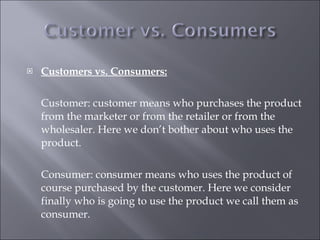
Customers vs. Consumers: Customer: customer means who purchases the product from the marketer or from the retailer or from the wholesaler. Here we don’t bother about who uses the product. Consumer: consumer means who uses the product of course purchased by the customer. Here we consider finally who is going to use the product we call them as consumer.
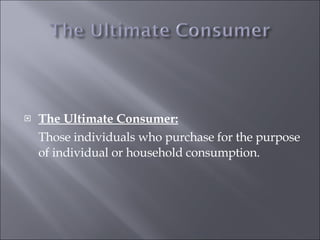
The Ultimate Consumer: Those individuals who purchase for the purpose of individual or household consumption.  
 
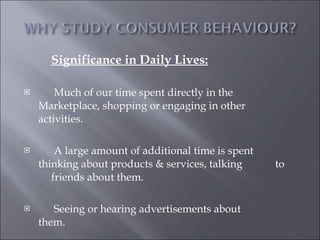
Significance in Daily Lives:   Much of our time spent directly in the  Marketplace, shopping or engaging in other  activities.   A large amount of additional time is spent  thinking about products & services, talking  to  friends about them.   Seeing or hearing advertisements about  them.
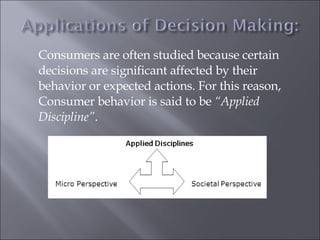
Consumers are often studied because certain decisions are significant affected by their behavior or expected actions. For this reason, Consumer behavior is said to be  “Applied Discipline” .
Advertising Managers, product managers, product designers and many others in profit-oriented businesses are interested in understanding consumers in order to be more effective at their tasks and earn more profit for their Organizations.
Consumers collectively influence  economic and social conditions  within an entire society.
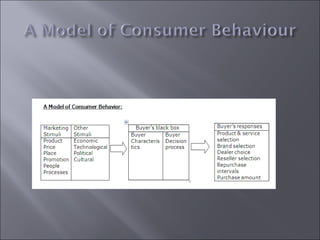
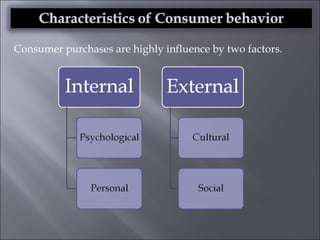
Consumer purchases are highly influence by two factors.
 
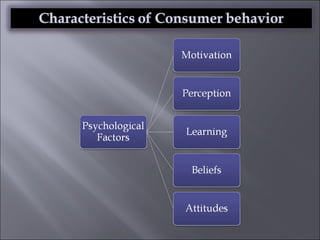
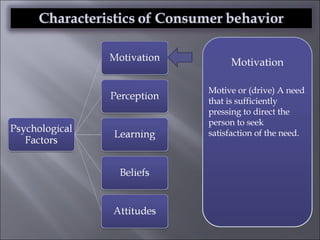
Motivation Motive or (drive) A need that is sufficiently pressing to direct the person to seek satisfaction of the need.
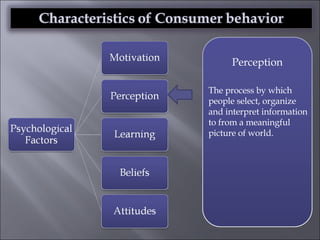
Perception The process by which people select, organize and interpret information to from a meaningful picture of world.
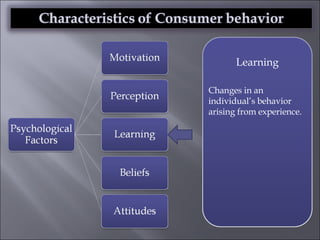
Learning Changes in an individual’s behavior arising from experience.
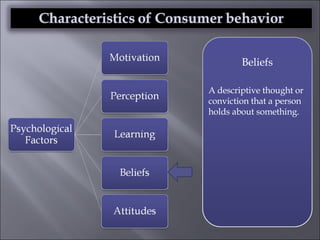
Beliefs A descriptive thought or conviction that a person holds about something.
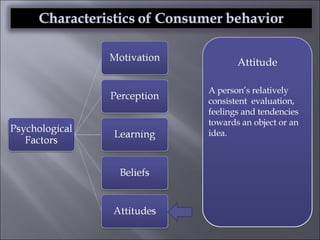
Attitude A person’s relatively consistent  evaluation, feelings and tendencies towards an object or an idea.
 
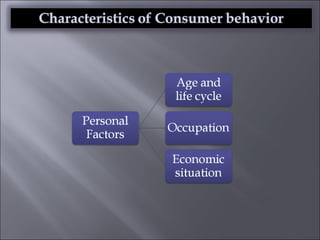
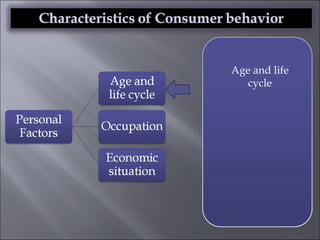
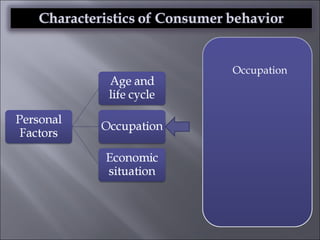
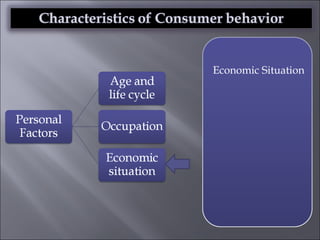
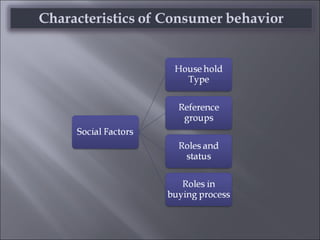
Age and life cycle
Occupation
Economic Situation
 
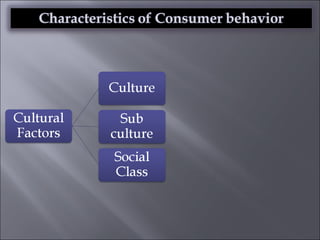
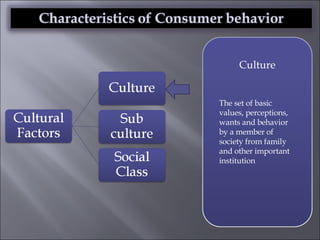
Culture The set of basic values, perceptions, wants and behavior by a member of society from family and other important institution
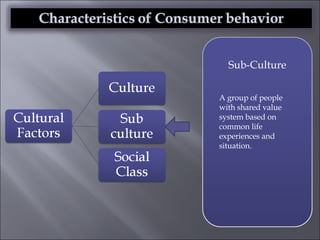
Sub-Culture A group of people with shared value system based on common life experiences and situation.
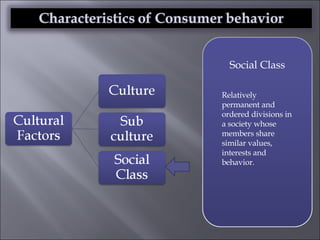
Social Class Relatively permanent and ordered divisions in a society whose members share similar values, interests and behavior.
 
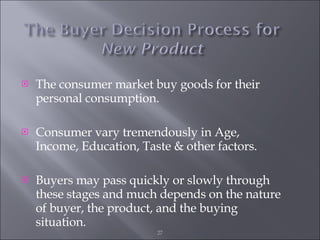
The consumer market buy goods for their personal consumption. Consumer vary tremendously in Age, Income, Education, Taste & other factors. Buyers may pass quickly or slowly through these stages and much depends on the nature of buyer, the product, and the buying situation.
A new product , a good service or idea that is perceived by some potential customers as new.   Adoption Process , the mental process through which an individual passes from first learning about an innovation to final adoption
Awareness : Consumer becomes aware of new product, but lacks information about it. Interest : Consumer seeks information about the new product. Evaluation : Consumer considers whether trying new product makes sense.
Trial : Consumer tries new product on a small scale. Adoption :  Consumer decides to make regular use of the new product.
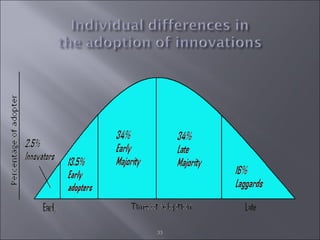
Innovators (2.5%) : They try new product or adopts a new idea. Early Adopters (13.5%) : Opinion leaders in their communities. Early Majority (34%) :They adopt new idea before average person.
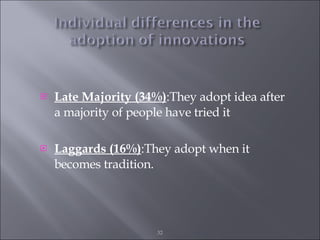
Late Majority (34%) :They adopt idea after a majority of people have tried it Laggards (16%) :They adopt when it becomes tradition.
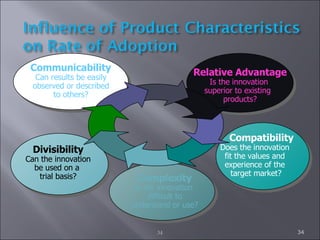
Divisibility Can the innovation be used on a  trial basis? Complexity Is the innovation  difficult to understand or use? Communicability  Can results be easily  observed or described  to others?  Compatibility Does the innovation  fit the values and  experience of the  target market? Relative Advantage Is the innovation  superior to existing  products?
It is difficult enough for companies marketing within the borders of a single country. For operating in many countries, understanding & serving the needs of consumers can be daunting. Although some countries may have some things in common ,their values, attitudes and behaviours often vary greatly. So, international marketers must understand their differences and adjust their products & marketing program accordingly.
Shaking heads from side to side means ‘NO’ in most countries but ‘YES’ in  Bulgaria  &  SriLanka . In South America, southern Europe & many Arab countries ,touching another person is a sign of warmth & friendship. In the  Orient , it is considered an invasion of privacy.
In Norway or Malaysia, it is rude to leave something on your plate when eating but in  Egypt , it is rude not to leave something on your plate..
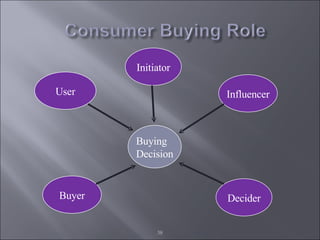
Buying Decision Influencer Initiator User Buyer Decider
The person who first suggests or thinks of the idea of buying a particular product or service. INFLUENCER A person whose views or advice carry some weight in making the final buying decision.
The person who ultimately makes a buying decision or any part of it- whether to buy, what to buy, how to buy or where to buy . Buyer The person who makes an actual purchase. User The person who consumes or uses a product or service.
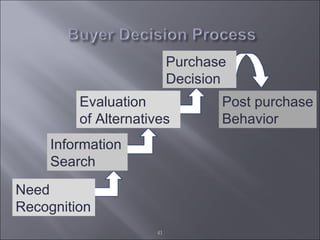
Post purchase Behavior Purchase Decision Information Search Need Recognition Evaluation of Alternatives
The first stage of the buyer decision in which  the consumer recognizes a problem or need.
The stage of the buyer decision process  in which the consumer aroused to  search for more information; the  consumer may simply have heightened  attention or may go into active  information search.
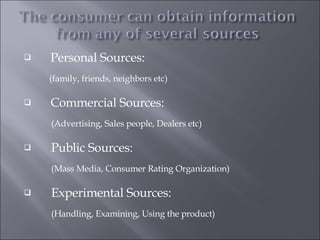
Personal Sources:   (family, friends, neighbors etc) Commercial Sources:  (Advertising, Sales people, Dealers etc) Public Sources: (Mass Media, Consumer Rating Organization) Experimental Sources:  (Handling, Examining, Using the product)
The stage of the buyer decision process  in which the consumer uses information to  evaluate alternative brands in the choice set.
The stage of the buyer decision process in which the consumer actually buys the product.
The stage of the buyer decision process in  which the consumer take further action after  the purchase, based on their satisfaction or dissatisfaction.
Sigmund Freud( 1856-1939)   sought to explain: People are largely unconscious about the real psychological forces shaping their behaviour As persons grows, repressing many urges Urges are never eliminated or under perfect control Why?
B/c they emerge: in dreams  in slips of tongue  in neurotic –  worried about smthg.  obsessive behaviour –  mind is filled with one particular thing ultimately in psychoses –  mental illness that effects the whole personality
Various ‘project techniques’ to throw the ego off guard for e.g., 1) word associations 2) sentence completion  3) picture interpretation  4) role playing
Interesting  & odd conclusions from researchers about buyer’s mind regarding certain purchases  For e.g., A/c to one classic study concluded: Consumer resist ‘prunes’ b/c they’re wrinkled  and remind people of sickness and old age - Motivation research remains a useful tool for marketers seeking a deeper understanding of consumer behaviours
Abraham Maslow(1908-1970  )   sought to explain: Why people are driven by particular needs at particular times? Why does one person spend much time and energy on: Personal safety ? On gaining the esteem of others?
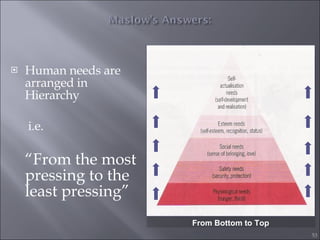
Human needs are arranged in Hierarchy   i.e.  “ From the most pressing to the least pressing” From Bottom to Top
In order of importance they are: Physiological needs  (hunger, thirst)  Daily usage commodities, for e.g.*wheat *milk *water etc. 2. Safety needs  (security, protection) * Health Protection  *Insurances  *Provident Funds etc. Social needs  (sence of belonging, love) How s/he is seen in:  * Get togethers    * Festivals  * Attending Parties
Esteem needs : (self-esteem, recognition, status) Occupation & Designation? Part of organization & his/her performance? Shaping Livings standards accordingly
5.  Self-actualization needs :  (Self-development & realization) Self-development Latest happenings in the art world? Do I invest my money in starting a business? What are the trends to make ROI’s? Realization How to minimize risks?! Why not to invest in a running business?
Perception : “ To form a meaning full picture of the world” Two people with similar motivation might act quite differently For e.g.  * Buyer  A  of Stereo System considers a fast talking  sales person loud or insincere.  * Buyer  B  of Stereo System considers the same person intelligent & helpful. Why perceptions are different of Buyer  A  &  B ?
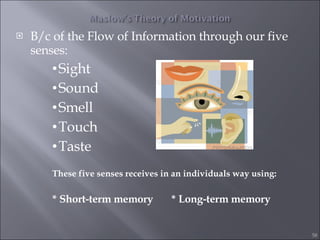
B/c of the Flow of Information through our five senses: Sight  Sound Smell Touch Taste These five senses receives in an individuals way using: * Short-term memory  * Long-term memory
Three perceptual processes: Selective exposure -   consumer’s attention   For e.g., a person exposed to more than 1500 ads a day – be precise/specific. Selective distortion  –  understanding consumer’s mindsets   For e.g., Nike Australia’s Annual sales from 500K to 1.3M in reducing their joggers prices. Selective retention – retain info. that supports people’s attitude & beliefs. For e.g., Nokia makes mobile sets for all age, group peoples.
SUBLIMINAL PERCEPTION – CAN CONSUMERS BE AFFECTED WITHOUT KNOWING IT? Lets watch a case study! This case study is available on YouTube as well: http://www.youtube.com/cssubliminalads

Consumer Behaviour

  • 1.
    Team Members: KhurramKhan Shahid Ali Riaz Saleem Arshad Khan Rehan Ahmed
  • 2.
    Team Members: KhurramKhan Shahid Ali Riaz Saleem Arshad Khan Rehan Ahmed
  • 3.
    Consumer Behavior: The buying behavior of final consumers, individuals & households who buy goods & services for personal consumption.
  • 4.
    Customers vs. Consumers:Customer: customer means who purchases the product from the marketer or from the retailer or from the wholesaler. Here we don’t bother about who uses the product. Consumer: consumer means who uses the product of course purchased by the customer. Here we consider finally who is going to use the product we call them as consumer.
  • 5.
    The Ultimate Consumer:Those individuals who purchase for the purpose of individual or household consumption.  
  • 6.
  • 7.
    Significance in DailyLives: Much of our time spent directly in the Marketplace, shopping or engaging in other activities. A large amount of additional time is spent thinking about products & services, talking to friends about them. Seeing or hearing advertisements about them.
  • 8.
    Consumers are oftenstudied because certain decisions are significant affected by their behavior or expected actions. For this reason, Consumer behavior is said to be “Applied Discipline” .
  • 9.
    Advertising Managers, productmanagers, product designers and many others in profit-oriented businesses are interested in understanding consumers in order to be more effective at their tasks and earn more profit for their Organizations.
  • 10.
    Consumers collectively influence economic and social conditions within an entire society.
  • 11.
    Consumer purchases arehighly influence by two factors.
  • 12.
  • 13.
    Motivation Motive or(drive) A need that is sufficiently pressing to direct the person to seek satisfaction of the need.
  • 14.
    Perception The processby which people select, organize and interpret information to from a meaningful picture of world.
  • 15.
    Learning Changes inan individual’s behavior arising from experience.
  • 16.
    Beliefs A descriptivethought or conviction that a person holds about something.
  • 17.
    Attitude A person’srelatively consistent evaluation, feelings and tendencies towards an object or an idea.
  • 18.
  • 19.
  • 20.
  • 21.
  • 22.
  • 23.
    Culture The setof basic values, perceptions, wants and behavior by a member of society from family and other important institution
  • 24.
    Sub-Culture A groupof people with shared value system based on common life experiences and situation.
  • 25.
    Social Class Relativelypermanent and ordered divisions in a society whose members share similar values, interests and behavior.
  • 26.
  • 27.
    The consumer marketbuy goods for their personal consumption. Consumer vary tremendously in Age, Income, Education, Taste & other factors. Buyers may pass quickly or slowly through these stages and much depends on the nature of buyer, the product, and the buying situation.
  • 28.
    A new product, a good service or idea that is perceived by some potential customers as new. Adoption Process , the mental process through which an individual passes from first learning about an innovation to final adoption
  • 29.
    Awareness : Consumerbecomes aware of new product, but lacks information about it. Interest : Consumer seeks information about the new product. Evaluation : Consumer considers whether trying new product makes sense.
  • 30.
    Trial : Consumertries new product on a small scale. Adoption : Consumer decides to make regular use of the new product.
  • 31.
    Innovators (2.5%) :They try new product or adopts a new idea. Early Adopters (13.5%) : Opinion leaders in their communities. Early Majority (34%) :They adopt new idea before average person.
  • 32.
    Late Majority (34%):They adopt idea after a majority of people have tried it Laggards (16%) :They adopt when it becomes tradition.
  • 34.
    Divisibility Can theinnovation be used on a trial basis? Complexity Is the innovation difficult to understand or use? Communicability Can results be easily observed or described to others? Compatibility Does the innovation fit the values and experience of the target market? Relative Advantage Is the innovation superior to existing products?
  • 35.
    It is difficultenough for companies marketing within the borders of a single country. For operating in many countries, understanding & serving the needs of consumers can be daunting. Although some countries may have some things in common ,their values, attitudes and behaviours often vary greatly. So, international marketers must understand their differences and adjust their products & marketing program accordingly.
  • 36.
    Shaking heads fromside to side means ‘NO’ in most countries but ‘YES’ in Bulgaria & SriLanka . In South America, southern Europe & many Arab countries ,touching another person is a sign of warmth & friendship. In the Orient , it is considered an invasion of privacy.
  • 37.
    In Norway orMalaysia, it is rude to leave something on your plate when eating but in Egypt , it is rude not to leave something on your plate..
  • 38.
    Buying Decision InfluencerInitiator User Buyer Decider
  • 39.
    The person whofirst suggests or thinks of the idea of buying a particular product or service. INFLUENCER A person whose views or advice carry some weight in making the final buying decision.
  • 40.
    The person whoultimately makes a buying decision or any part of it- whether to buy, what to buy, how to buy or where to buy . Buyer The person who makes an actual purchase. User The person who consumes or uses a product or service.
  • 41.
    Post purchase BehaviorPurchase Decision Information Search Need Recognition Evaluation of Alternatives
  • 42.
    The first stageof the buyer decision in which the consumer recognizes a problem or need.
  • 43.
    The stage ofthe buyer decision process in which the consumer aroused to search for more information; the consumer may simply have heightened attention or may go into active information search.
  • 44.
    Personal Sources: (family, friends, neighbors etc) Commercial Sources: (Advertising, Sales people, Dealers etc) Public Sources: (Mass Media, Consumer Rating Organization) Experimental Sources: (Handling, Examining, Using the product)
  • 45.
    The stage ofthe buyer decision process in which the consumer uses information to evaluate alternative brands in the choice set.
  • 46.
    The stage ofthe buyer decision process in which the consumer actually buys the product.
  • 47.
    The stage ofthe buyer decision process in which the consumer take further action after the purchase, based on their satisfaction or dissatisfaction.
  • 48.
    Sigmund Freud( 1856-1939) sought to explain: People are largely unconscious about the real psychological forces shaping their behaviour As persons grows, repressing many urges Urges are never eliminated or under perfect control Why?
  • 49.
    B/c they emerge:in dreams in slips of tongue in neurotic – worried about smthg. obsessive behaviour – mind is filled with one particular thing ultimately in psychoses – mental illness that effects the whole personality
  • 50.
    Various ‘project techniques’to throw the ego off guard for e.g., 1) word associations 2) sentence completion 3) picture interpretation 4) role playing
  • 51.
    Interesting &odd conclusions from researchers about buyer’s mind regarding certain purchases For e.g., A/c to one classic study concluded: Consumer resist ‘prunes’ b/c they’re wrinkled and remind people of sickness and old age - Motivation research remains a useful tool for marketers seeking a deeper understanding of consumer behaviours
  • 52.
    Abraham Maslow(1908-1970 ) sought to explain: Why people are driven by particular needs at particular times? Why does one person spend much time and energy on: Personal safety ? On gaining the esteem of others?
  • 53.
    Human needs arearranged in Hierarchy i.e. “ From the most pressing to the least pressing” From Bottom to Top
  • 54.
    In order ofimportance they are: Physiological needs (hunger, thirst) Daily usage commodities, for e.g.*wheat *milk *water etc. 2. Safety needs (security, protection) * Health Protection *Insurances *Provident Funds etc. Social needs (sence of belonging, love) How s/he is seen in: * Get togethers * Festivals * Attending Parties
  • 55.
    Esteem needs :(self-esteem, recognition, status) Occupation & Designation? Part of organization & his/her performance? Shaping Livings standards accordingly
  • 56.
    5. Self-actualizationneeds : (Self-development & realization) Self-development Latest happenings in the art world? Do I invest my money in starting a business? What are the trends to make ROI’s? Realization How to minimize risks?! Why not to invest in a running business?
  • 57.
    Perception : “To form a meaning full picture of the world” Two people with similar motivation might act quite differently For e.g. * Buyer A of Stereo System considers a fast talking sales person loud or insincere. * Buyer B of Stereo System considers the same person intelligent & helpful. Why perceptions are different of Buyer A & B ?
  • 58.
    B/c of theFlow of Information through our five senses: Sight Sound Smell Touch Taste These five senses receives in an individuals way using: * Short-term memory * Long-term memory
  • 59.
    Three perceptual processes:Selective exposure - consumer’s attention For e.g., a person exposed to more than 1500 ads a day – be precise/specific. Selective distortion – understanding consumer’s mindsets For e.g., Nike Australia’s Annual sales from 500K to 1.3M in reducing their joggers prices. Selective retention – retain info. that supports people’s attitude & beliefs. For e.g., Nokia makes mobile sets for all age, group peoples.
  • 60.
    SUBLIMINAL PERCEPTION –CAN CONSUMERS BE AFFECTED WITHOUT KNOWING IT? Lets watch a case study! This case study is available on YouTube as well: http://www.youtube.com/cssubliminalads

Editor's Notes

  • #2 Dated: 01-April-2009, Wednesday