Persuasion     and Advertising
 Psychology of Media – Fall 2011
Persuasion

• The process by which a person’s attitudes or
  behavior are influenced by communication
  with other people (Encyclopedia Britannica)
A new perspective in subliminal perception -
               Cuperflain& Clarke

• Semantically active context;
• Visual primacy over verbal content;
• Familiarity;
Recent Perspective on Unconscious Processing
               Pratkanis& Greenwald
• Accessibility Priming: Subliminal stimuli can
  increase accessibility and speed of recognition
  of semantically related stimuli that are
  presented afterwards (Marcel, 1983, Doctor-
  Bread > Doctor-Nurse)
• Mood Priming: Repeated presentation of
  negative subliminal primes increased disliking
  of a stimulus presented afterwards (and
  viceversa, Barghand Pietromonaco, 1982).
Review of Literature on subliminal perception

• Our mind constantly builds associations
  between element of our perception (inside
  and outside of our awareness).
• The existence and importance of
  unconscious learning,that is learning that
  happens outside of our awareness and
  attention;
What kind of learning?
• Is it a form of learning that we can use to prepare
   a test for school?
- Not really: Recognition and Memory of the
   subliminally presented stimuli are generally pretty
   poor or absent.
• Is it a form of learning that we can use to sell new
   products?
- Not even: Subliminally priming for obscure product
   didn’t produce any result as compared with
   priming for products that were already
   recognized;
What kind of learning?
• So what’s the most popular for of subliminal
   stimuli used in advertisement?
- Masked Stimuli?
- Not really;
- Sub threshold stimuli?
- Not even, they are actually either disturbing or of
   difficult recognition…
- Peripheral Attention Stimuli?
- Actually yes! That’s what Movie Product
   Placement is all about: It may not be great to
   actually sell product but is fundamental for Brand
   Image Building…
Elaboration Likelihood Model
           (ELM)
    Petty &Cacioppo1981
Elaboration Likelihood Model (ELM)
          Petty &Cacioppo1981

• It’s a model that summarizes decades of
  apparently inconsistent research on persuasion,
  by identifying two routes to persuasion:
• A Central Route;
• A Peripheral Route;
Elaboration Likelihood Model (ELM)
      Petty &Cacioppo1981
Elaboration Likelihood Model (ELM)
            Petty &Cacioppo1981

• Central route:
   - Generates issue-relevant cognitive responses
   (comprehension, retention, self generation of
   issue relevant content) to a message in an
   attempt to assess the true merits of the
   position taken;
   - Requires Motivation and Cognitive Resources;
- Produces lasting, robust changes in attitudes
   and possibly behavior;
Elaboration Likelihood Model (ELM)
             Petty &Cacioppo1981
• Peripheral Route:
  - Attitudes change because they have been
  associated with either positive or negative
  “cues” (such as attractiveness of the
  source/context, credibility of the source,
  number of arguments produced);
  - It is usually the preferred route in the absence
  of either Resources or Motivation;
  - Produces changes in attitudes that are
  shallow and short lived;
ELM - Petty &Cacioppo1981
• Study 1, JPSP, 1981:
• Method:
- 144 UMass undergraduates;
- IVs:2(involvement)X2(argument)X2(source);
- Material: tape recorded voice arguing about the
   introduction of COMPs;
- Personal involvement: COMPs in 1year Vs in 10yrs;
- Argument quality: Data, Stats Vs Anecdotal;
- Source Expertise: High School Vs Princeton Prof.;
- No Message condition: w/18 participants;
ELM - Petty &Cacioppo1981


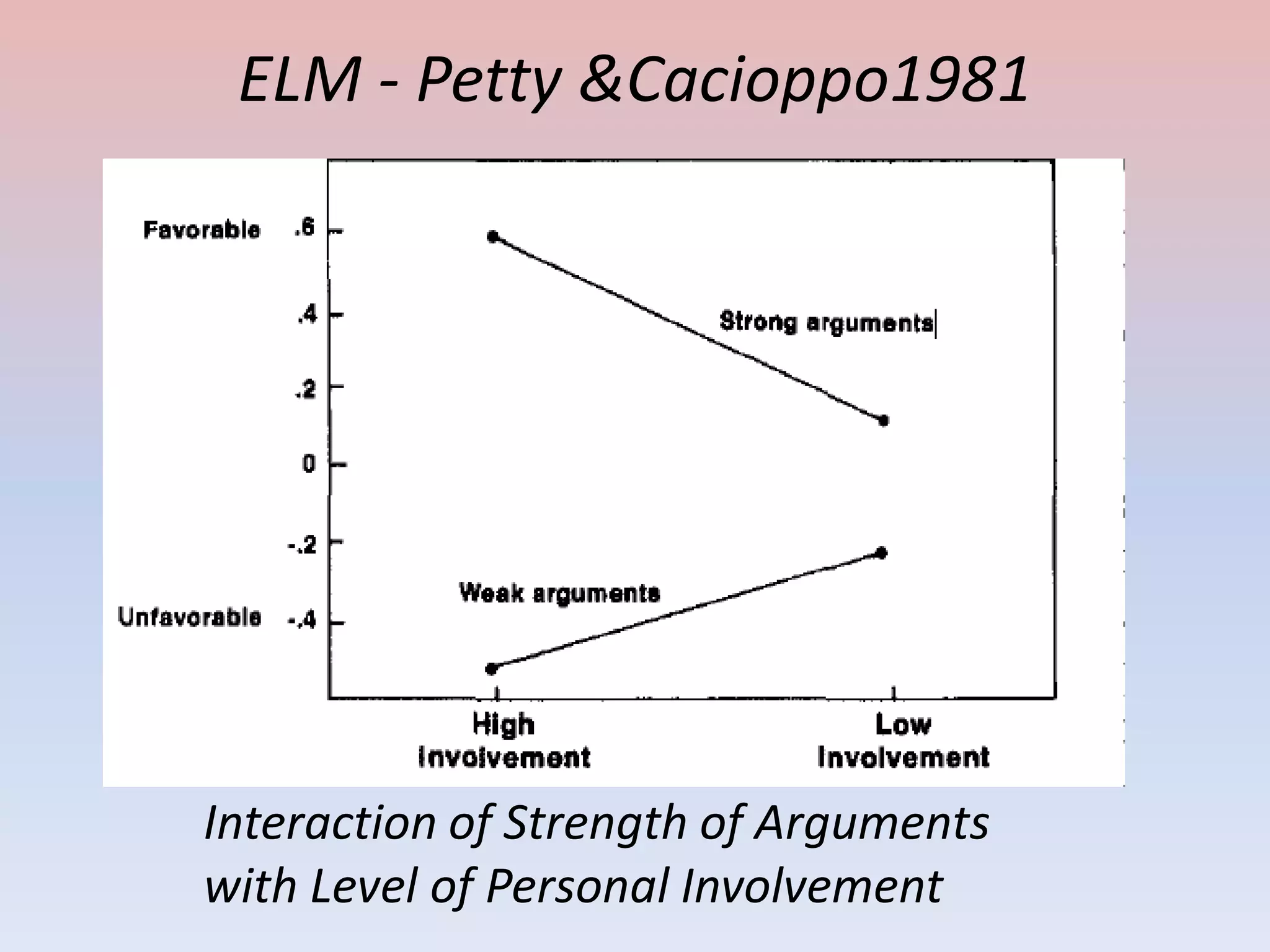
Interaction of Strength of Arguments
with Level of Personal Involvement
ELM - Petty &Cacioppo1981


Interaction of Perceived Expertise of the Source
with Level of Personal Involvement
ELM - Petty &Cacioppo1981


• When a message concerns an issue of high
  personal relevance the effectiveness of its appeal
  is function of the content;
• When a message concerns an issue oflow
  personal relevance the effectiveness of its appeal
  is function of the form;
ELM - Petty &Cacioppo1981


• The No Message condition outlined the
  possibility of a “boomerang” effect in
  persuasion which was at its strongest when
  weak arguments were delivered by a source
  that was also perceived to be low in expertise.
ELM - Petty &Cacioppo1984
• Study 2, JPSP, 1984:
A study to test the characteristics of the peripheral
   route: Could just the number of argument presented,
   even if all weak, be a clue for peripheral persuasion?
- 168 UMass undergraduates;
- IVs:2(involvement)X2(argument)X2(number of arg);
- Material, Personal Involvement and Quality of
   arguments were kept the same as the previous study;
- Number of Arguments: 3 Vs 9 arguments, either all
   strong or all weak;
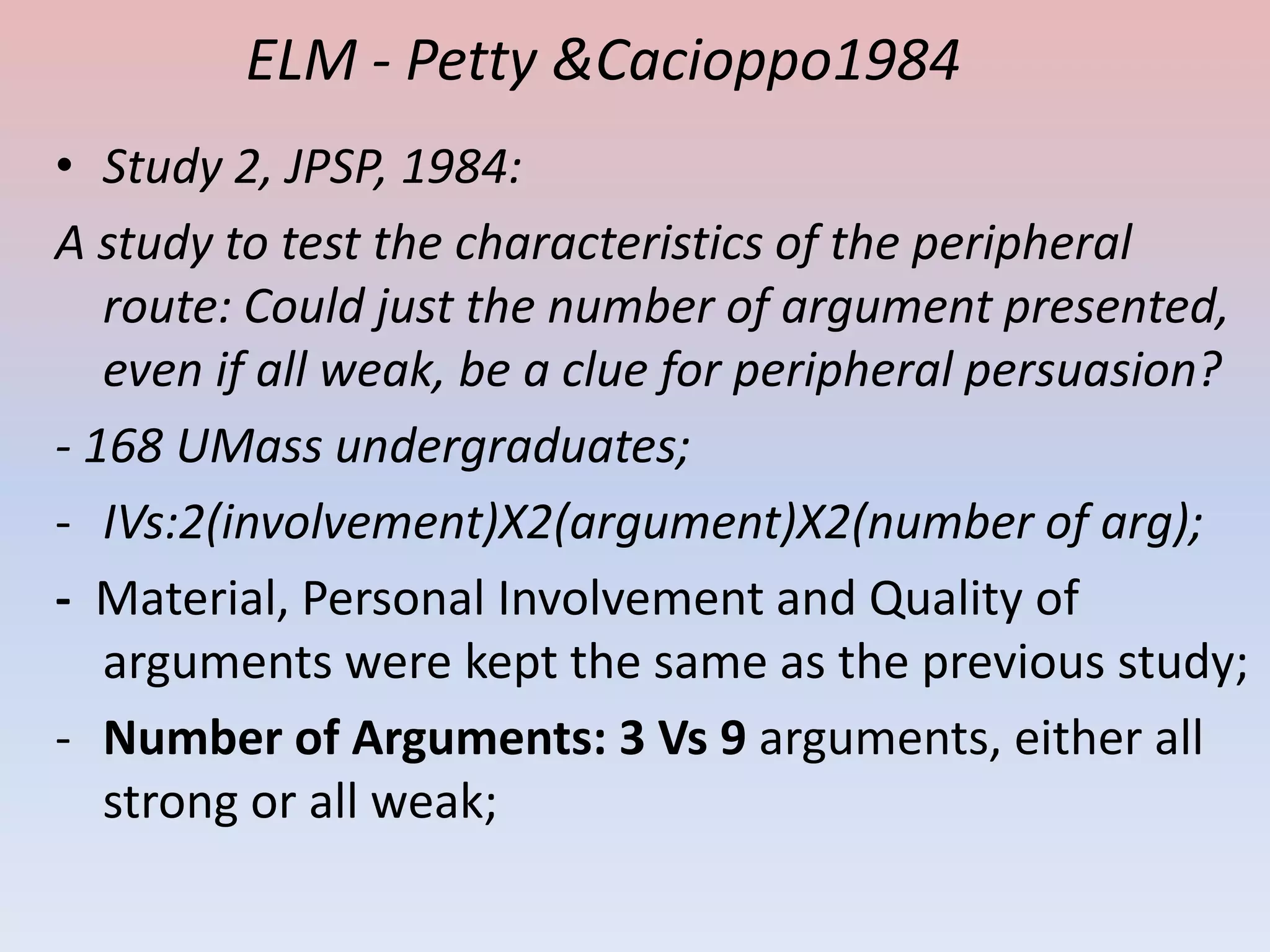
ELM - Petty &Cacioppo1984


• In Absence of a Relevant personal involvement,
  the mere number of argument presented,
  independently from their quality, acted as an
  effective clue for peripheral persuasion.
ELM – Petty, Wells & Brock 1976
• A study to test the role of available cognitive
  resources in determining the route of persuasion:
- Ivs: 2 (argument) X2 (distraction);
- Material: Listening to arguments for cutting in half
  tuitions;
- Arguments: Strong Vs Weak;
- Level of distraction: Following an X on the screen
  whose position was changed either frequently or
  very rarely.
ELM – Petty, Wells & Brock 1976


- Distractiondisrupts the normal effect of
  persuasion: weak arguments would have less
  negative effect and strong arguments less
  positive;
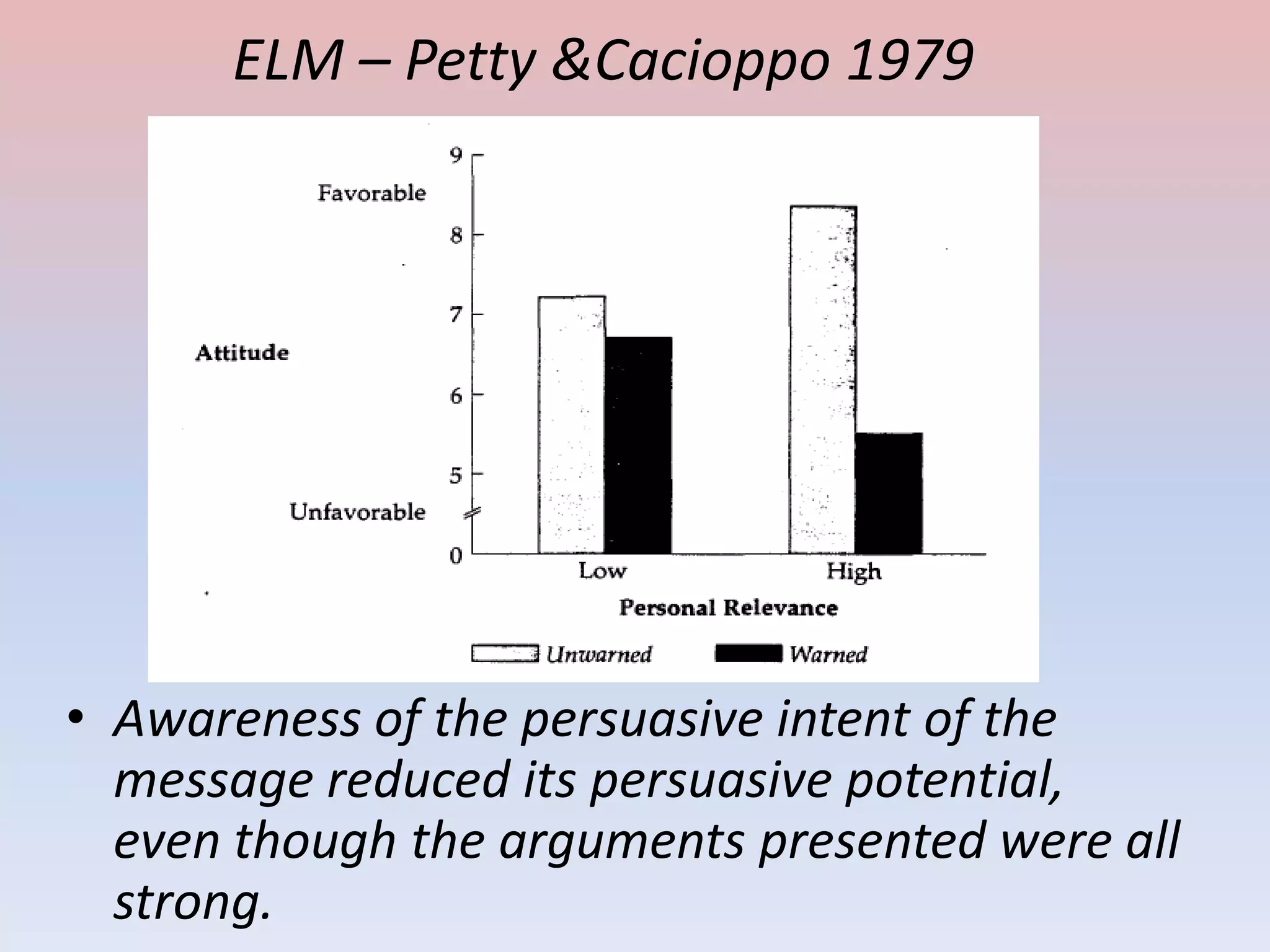
ELM – Petty &Cacioppo 1979
• A study to test the role of awareness of
  persuasive intent in determining the route of
  persuasion:
- Ivs: 2 (Personal Relevance) X2 (Warning);
- Material: Listening to (all strong) arguments
  introducing COMPs;
- Relevance: Now Vs In 10 yrs;
• Awareness of persuasive intent: pps received or
  not the communication that the message “was
  designed specifically to try to persuade college
  students of the desirability of changing certain
  college regulations”
ELM – Petty &Cacioppo 1979


• Awareness of the persuasive intent of the
  message reduced its persuasive potential,
  even though the arguments presented were all
  strong.
ELM – Petty &Cacioppo 1986
• A study on the consequences of route of
  persuasion:
- Material: Listening to (all strong) arguments
  about introducing COMPs;
- Relevance: Now Vs In 10 yrs;
- DV: attitudes checked immediately after and
  then again in 2 weeks;
ELM – Petty &Cacioppo 1986


• Attitudes change in Participants for whom
  personal relevance was high, and that were
  therefore assumed to have used Central Routes,
  lasted much longer than the peripheral route.
Pom14
Pom14

Pom14

  • 1.
    Persuasion and Advertising Psychology of Media – Fall 2011
  • 2.
    Persuasion • The processby which a person’s attitudes or behavior are influenced by communication with other people (Encyclopedia Britannica)
  • 3.
    A new perspectivein subliminal perception - Cuperflain& Clarke • Semantically active context; • Visual primacy over verbal content; • Familiarity;
  • 4.
    Recent Perspective onUnconscious Processing Pratkanis& Greenwald • Accessibility Priming: Subliminal stimuli can increase accessibility and speed of recognition of semantically related stimuli that are presented afterwards (Marcel, 1983, Doctor- Bread > Doctor-Nurse) • Mood Priming: Repeated presentation of negative subliminal primes increased disliking of a stimulus presented afterwards (and viceversa, Barghand Pietromonaco, 1982).
  • 5.
    Review of Literatureon subliminal perception • Our mind constantly builds associations between element of our perception (inside and outside of our awareness). • The existence and importance of unconscious learning,that is learning that happens outside of our awareness and attention;
  • 6.
    What kind oflearning? • Is it a form of learning that we can use to prepare a test for school? - Not really: Recognition and Memory of the subliminally presented stimuli are generally pretty poor or absent. • Is it a form of learning that we can use to sell new products? - Not even: Subliminally priming for obscure product didn’t produce any result as compared with priming for products that were already recognized;
  • 7.
    What kind oflearning? • So what’s the most popular for of subliminal stimuli used in advertisement? - Masked Stimuli? - Not really; - Sub threshold stimuli? - Not even, they are actually either disturbing or of difficult recognition… - Peripheral Attention Stimuli? - Actually yes! That’s what Movie Product Placement is all about: It may not be great to actually sell product but is fundamental for Brand Image Building…
  • 9.
    Elaboration Likelihood Model (ELM) Petty &Cacioppo1981
  • 10.
    Elaboration Likelihood Model(ELM) Petty &Cacioppo1981 • It’s a model that summarizes decades of apparently inconsistent research on persuasion, by identifying two routes to persuasion: • A Central Route; • A Peripheral Route;
  • 11.
    Elaboration Likelihood Model(ELM) Petty &Cacioppo1981
  • 12.
    Elaboration Likelihood Model(ELM) Petty &Cacioppo1981 • Central route: - Generates issue-relevant cognitive responses (comprehension, retention, self generation of issue relevant content) to a message in an attempt to assess the true merits of the position taken; - Requires Motivation and Cognitive Resources; - Produces lasting, robust changes in attitudes and possibly behavior;
  • 13.
    Elaboration Likelihood Model(ELM) Petty &Cacioppo1981 • Peripheral Route: - Attitudes change because they have been associated with either positive or negative “cues” (such as attractiveness of the source/context, credibility of the source, number of arguments produced); - It is usually the preferred route in the absence of either Resources or Motivation; - Produces changes in attitudes that are shallow and short lived;
  • 14.
    ELM - Petty&Cacioppo1981 • Study 1, JPSP, 1981: • Method: - 144 UMass undergraduates; - IVs:2(involvement)X2(argument)X2(source); - Material: tape recorded voice arguing about the introduction of COMPs; - Personal involvement: COMPs in 1year Vs in 10yrs; - Argument quality: Data, Stats Vs Anecdotal; - Source Expertise: High School Vs Princeton Prof.; - No Message condition: w/18 participants;
  • 15.
    ELM - Petty&Cacioppo1981 Interaction of Strength of Arguments with Level of Personal Involvement
  • 16.
    ELM - Petty&Cacioppo1981 Interaction of Perceived Expertise of the Source with Level of Personal Involvement
  • 17.
    ELM - Petty&Cacioppo1981 • When a message concerns an issue of high personal relevance the effectiveness of its appeal is function of the content; • When a message concerns an issue oflow personal relevance the effectiveness of its appeal is function of the form;
  • 18.
    ELM - Petty&Cacioppo1981 • The No Message condition outlined the possibility of a “boomerang” effect in persuasion which was at its strongest when weak arguments were delivered by a source that was also perceived to be low in expertise.
  • 19.
    ELM - Petty&Cacioppo1984 • Study 2, JPSP, 1984: A study to test the characteristics of the peripheral route: Could just the number of argument presented, even if all weak, be a clue for peripheral persuasion? - 168 UMass undergraduates; - IVs:2(involvement)X2(argument)X2(number of arg); - Material, Personal Involvement and Quality of arguments were kept the same as the previous study; - Number of Arguments: 3 Vs 9 arguments, either all strong or all weak;
  • 20.
    ELM - Petty&Cacioppo1984 • In Absence of a Relevant personal involvement, the mere number of argument presented, independently from their quality, acted as an effective clue for peripheral persuasion.
  • 21.
    ELM – Petty,Wells & Brock 1976 • A study to test the role of available cognitive resources in determining the route of persuasion: - Ivs: 2 (argument) X2 (distraction); - Material: Listening to arguments for cutting in half tuitions; - Arguments: Strong Vs Weak; - Level of distraction: Following an X on the screen whose position was changed either frequently or very rarely.
  • 22.
    ELM – Petty,Wells & Brock 1976 - Distractiondisrupts the normal effect of persuasion: weak arguments would have less negative effect and strong arguments less positive;
  • 23.
    ELM – Petty&Cacioppo 1979 • A study to test the role of awareness of persuasive intent in determining the route of persuasion: - Ivs: 2 (Personal Relevance) X2 (Warning); - Material: Listening to (all strong) arguments introducing COMPs; - Relevance: Now Vs In 10 yrs; • Awareness of persuasive intent: pps received or not the communication that the message “was designed specifically to try to persuade college students of the desirability of changing certain college regulations”
  • 24.
    ELM – Petty&Cacioppo 1979 • Awareness of the persuasive intent of the message reduced its persuasive potential, even though the arguments presented were all strong.
  • 25.
    ELM – Petty&Cacioppo 1986 • A study on the consequences of route of persuasion: - Material: Listening to (all strong) arguments about introducing COMPs; - Relevance: Now Vs In 10 yrs; - DV: attitudes checked immediately after and then again in 2 weeks;
  • 26.
    ELM – Petty&Cacioppo 1986 • Attitudes change in Participants for whom personal relevance was high, and that were therefore assumed to have used Central Routes, lasted much longer than the peripheral route.

Editor's Notes

  • #2 Dangerous world and The no country for the old men syndrome