Customer Relationship
Management
Chapter 5
Customer portfolio management
+
WHITE PAPER
UNIVERSITÀ LUMSA
Ms in Marketing & digital communication
Customer portfolio definition
 A customer portfolio is the collection of mutually
exclusive customer groups that comprise a
business’s entire customer base.
Objectives of Customer Portfolio Management (CPM)
 CPM aims to optimize business performance –
whether that means sales growth, enhanced
customer profitability or something else – across the
entire customer base.
 It does this by offering differentiated value
propositions to different segments of customers.
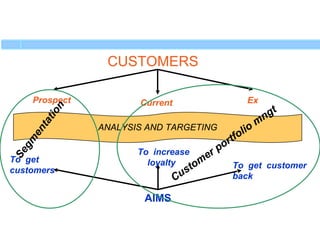
CUSTOMERS
Prospect Current Ex
AIMS
To get
customers
To increase
loyalty To get customer
back
ANALYSIS AND TARGETING
S
e
g
m
e
n
t
a
t
i
o
n
Custom
er portfolio m
ngt
How B2B customers differ from B2C customers
 Fewer in number
 Bigger in size
 Closer relationships with suppliers
 Derived demand
 Professional buying
 Direct purchase
Basic disciplines for CPM
 market segmentation
 sales forecasting
 activity-based costing
 customer lifetime value estimation
 data mining
Market segmentation definition
 Market segmentation is the process of dividing up a
market into more-or-less homogenous subsets for
which it is possible to create different value
propositions.
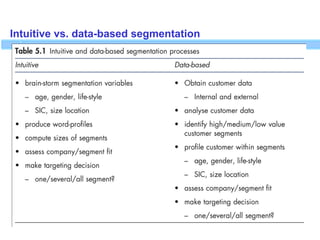
Intuitive vs. data-based segmentation
Market segmentation process
1. identify the business you are in
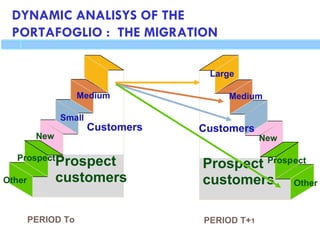
2. identify relevant segmentation variables
3. analyse the market using these variables
4. assess the value of the market segments
5. select target market(s) to serve
Types of competitor (kitchen furniture example)
 Benefit competitors
● other companies delivering the same benefit to customers.
These might include window replacement companies,
heating and air-conditioning companies and bathroom
renovation companies.
 Product competitors
● other companies marketing kitchens to customers seeking
the same benefit.
 Geographic competitors
● these are benefit and product competitors operating in the
same geographic territory.
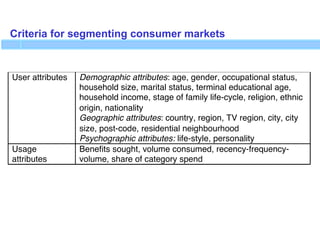
Criteria for segmenting consumer markets
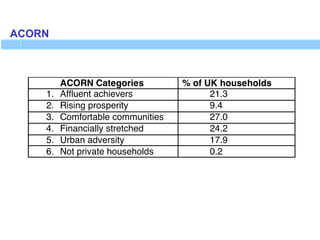
ACORN
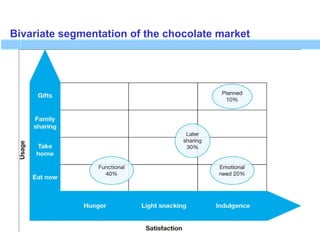
Bivariate segmentation of the chocolate market
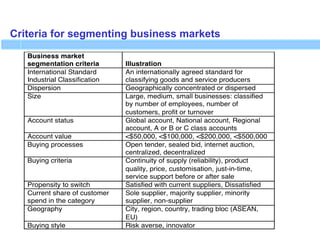
Criteria for segmenting business markets
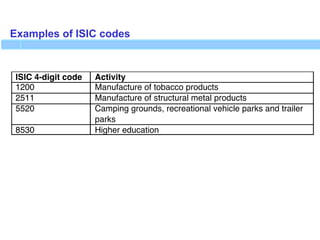
Examples of ISIC codes
IBM targets 18 industry sectors
Account-based segmentation variables
 account value
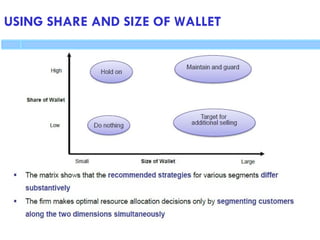
 share of category (share of wallet) spend
 propensity to switch
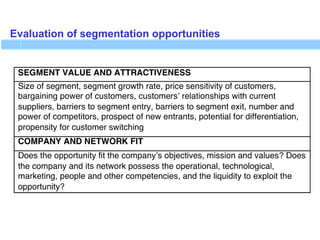
Evaluation of segmentation opportunities
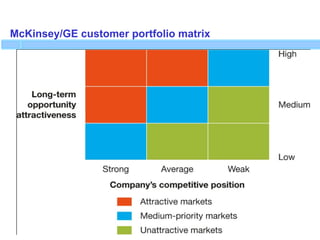
McKinsey/GE customer portfolio matrix
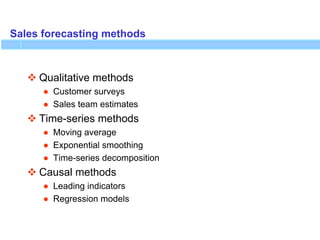
Sales forecasting methods
 Qualitative methods
● Customer surveys
● Sales team estimates
 Time-series methods
● Moving average
● Exponential smoothing
● Time-series decomposition
 Causal methods
● Leading indicators
● Regression models
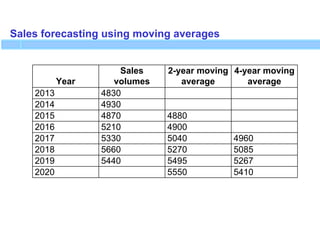
Sales forecasting using moving averages
Year
Sales
volumes
2-year moving
average
4-year moving
average
2013 4830
2014 4930
2015 4870 4880
2016 5210 4900
2017 5330 5040 4960
2018 5660 5270 5085
2019 5440 5495 5267
2020 5550 5410
Activity-based costing 1
Costs do vary from customer-to-customer. Some
customers are very costly to acquire and serve, others
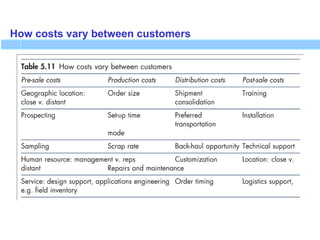
are not.
Customer acquisition costs
● Some customers require considerable sales effort to shift
them from prospect to first-time customer status: more sales
calls, visits to reference customer sites, free samples,
engineering advice, guarantees that switching costs will be
met by the vendor.
Terms of trade
● Price discounts, advertising and promotion support, slotting
allowances (cash paid to retailers for shelf space), extended
invoice due dates.
Activity-based costing 2
 Customer service costs
● Handling queries, claims and complaints, demands on
salesperson and contact centre, small order sizes, high
order frequency, just-in-time delivery, part-load shipments,
breaking bulk for delivery to multiple sites.
 Working capital costs
● Carrying inventory for the customer, cost of credit.
Advanced Marketing
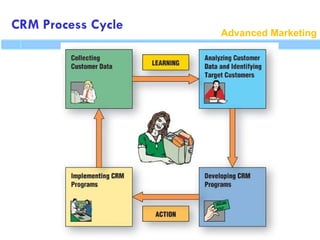
CRM Process Cycle
Collecting Customer Data: Customer Database
 Transactions – a complete history of purchases
 Purchase date, price paid, SKUs bought, whether or not the
purchase was stimulated by a promotion
 Customer contacts by retailer (touch points) --visits to web site,
inquires to call center, direct mail sent to customer
 Customer preferences
 Descriptive information about customer
 Demographic and psychographic data
 Customer’s responses to marketing activities
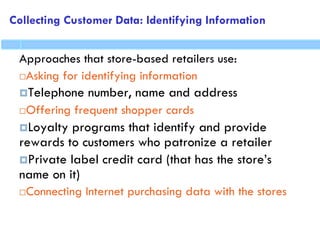
Collecting Customer Data: Identifying Information
Approaches that store-based retailers use:
Asking for identifying information
Telephone number, name and address
Offering frequent shopper cards
Loyalty programs that identify and provide
rewards to customers who patronize a retailer
Private label credit card (that has the store’s
name on it)
Connecting Internet purchasing data with the stores
Privacy Concerns
 Control over Collection
 Do customers know what
information is being collected?
 Do customers feel they can decide
upon the amount and type of
information collected by retailers?
 Control over Use
 Do customers know how the
information will be used by the
retailer?
 Will the retailer share the
information with third parties?
Steve Cole/Getty Images
 YOU FIND NEXT TOPICS IN WHITE PAPER
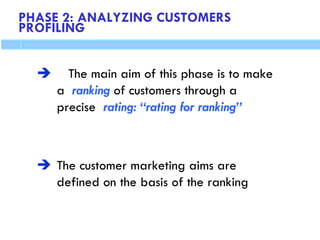
PHASE 2: ANALYZING CUSTOMERS
PROFILING
 The main aim of this phase is to make
a ranking of customers through a
precise rating: “rating for ranking”
 The customer marketing aims are
defined on the basis of the ranking
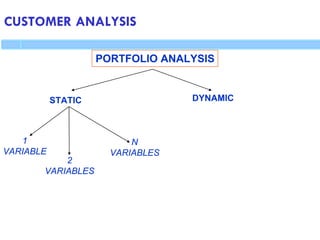
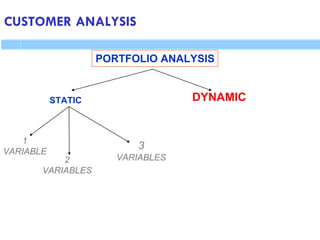
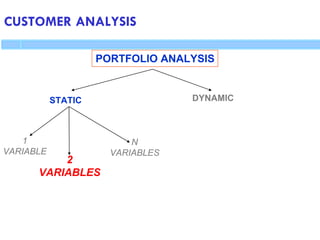
CUSTOMER ANALYSIS
PORTFOLIO ANALYSIS
STATIC DYNAMIC
1
VARIABLE
2
VARIABLES
N
VARIABLES
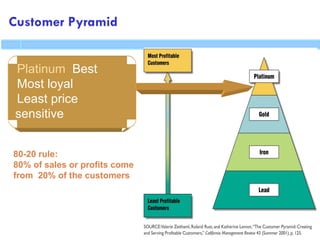
Customer Pyramid
Platinum Best
Most loyal
Least price
sensitive
80-20 rule:
80% of sales or profits come
from 20% of the customers
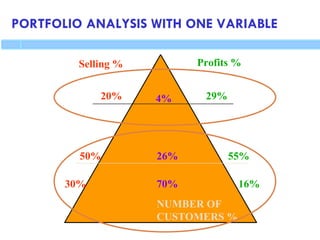
4%
Selling % Profits %
26%
20% 29%
50% 55%
30% 70% 16%
NUMBER OF
CUSTOMERS %
PORTFOLIO ANALYSIS WITH ONE VARIABLE
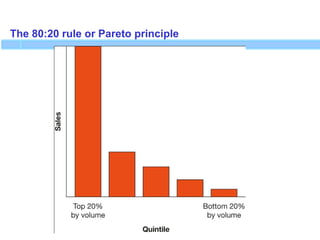
The 80:20 rule or Pareto principle
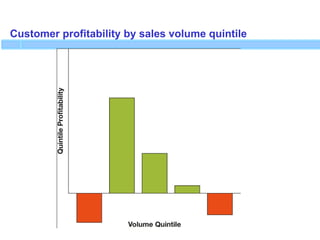
Customer profitability by sales volume quintile
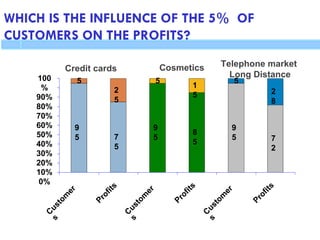
WHICH IS THE INFLUENCE OF THE 5% OF
CUSTOMERS ON THE PROFITS?
9
5 7
5
9
5
8
5
9
5 7
2
5
2
5
5
1
5
5
2
8
100
%
90%
80%
70%
60%
50%
40%
30%
20%
10%
0%
C
u
s
t
o
m
e
r
s
P
r
o
f
i
t
s
C
u
s
t
o
m
e
r
s
P
r
o
f
i
t
s
C
u
s
t
o
m
e
r
s
P
r
o
f
i
t
s
Credit cards Cosmetics Telephone market
Long Distance
PORTFOLIO ANAYLIS AND PYRAMID
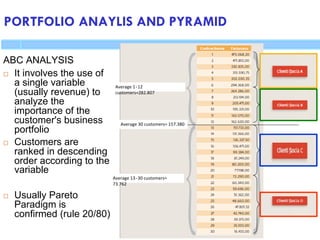
ABC ANALYSIS
 It involves the use of
a single variable
(usually revenue) to
analyze the
importance of the
customer's business
portfolio
 Customers are
ranked in descending
order according to the
variable
 Usually Pareto
Paradigm is
confirmed (rule 20/80)
Average 1‐12
customers=282.807
Average 30 customers= 157.380
Average 13‐30 customers=
73.762
CUSTOMER ANALYSIS
PORTFOLIO ANALYSIS
STATIC DYNAMIC
1
VARIABLE
2
VARIABLES
N
VARIABLES
CUSTOMERS PORTOFOLIO ANALISIS USING 2 VARIABLES
(CUSTOMERS MATRIX)
We use two variables
Matrixs are more realible and to identify Key Clients
It’s difficult to chose two variables
There are three different typologies
Matrices of customer profitability: economic variables
Matrices of the competitive situation of customers estimate the
customers' competitiveness in key markets
Matrices of customer relations: non-economic variables (satisfaction,
no complaints, ease of maintenance, etc.)
CUSTOMERS PORTOFOLIO ANALISIS USING
2 VARIABLES (CUSTOMERS MATRIX)
USING SHARE AND SIZE OF WALLET
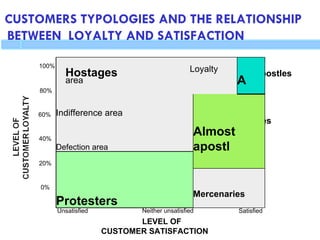
CUSTOMERS TYPOLOGIES AND THE RELATIONSHIP
BETWEEN LOYALTY AND SATISFACTION
CUSTOMER SATISFACTION
Very
Unsatisfied
Very
Satisfied
100%
40%
20%
0%
60%
80%
Unsatisfied Nor satisfied
Neither unsatisfied
LEVEL OF
Satisfied
es
postles
Hostages Loyalty
area A
Indifference area
Defection area
Almost
apostl
Protesters
Mercenaries
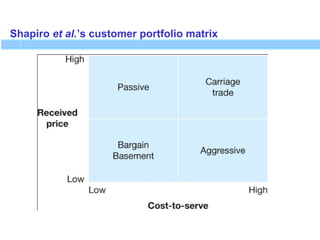
Shapiro et al.’s customer portfolio matrix
How costs vary between customers
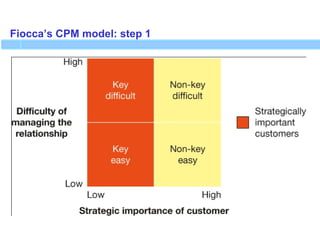
Fiocca’s CPM model: step 1
Fiocca step 1: Strategic importance
 Strategic importance is related to:
● value/volume of the customer’s purchases
● potential and prestige of the customer
● customer market leadership
● general desirability in terms of diversification of the supplier’s
markets, providing access to new markets, improving
technological expertise, and the impact on other
relationships
Fiocca step 1: Difficulty of managing relationship
 Difficulty of managing the customer relationship is
related to:
● product characteristics such as novelty and complexity
● account characteristics such as the customer’s needs and
requirements, customer’s buying behaviour , customer’s
power, customer’s technical and commercial competence
and the customer’s preference to do business with a number
of suppliers
● competition for the account which is assessed by
considering the number of competitors, the strength and
weaknesses of competitors and competitors’ position vis à
vis the customer
Fiocca step 2
 Assess key easy and key difficult accounts:
● The customer’s business attractiveness
● The strength of the buyer/seller relationship
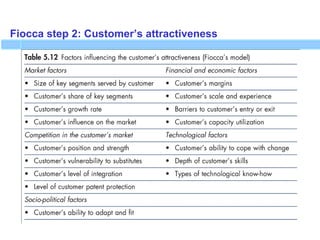
Fiocca step 2: Customer’s attractiveness
Fiocca step 2: Strength of relationship
 the length of relationship
 the volume or dollar value of purchases
 the importance of the customer (percentage of
customer’s purchases on supplier’s sales)
 personal friendships
 cooperation in product development
 management distance (language and culture)
 geographical distance
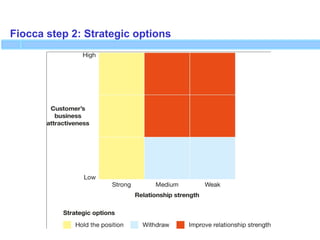
Fiocca step 2: Strategic options
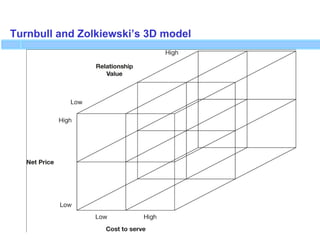
Turnbull and Zolkiewski’s 3D model
Additional CPA tools
 SWOT analysis
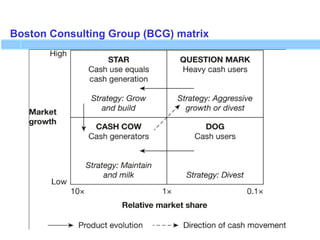
 BCG matrix analysis
Boston Consulting Group (BCG) matrix
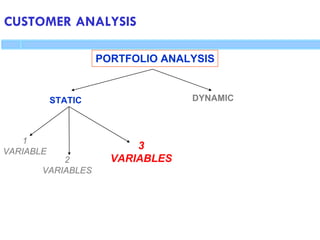
CUSTOMER ANALYSIS
PORTFOLIO ANALYSIS
STATIC DYNAMIC
1
VARIABLE
3
VARIABLES
2
VARIABLES
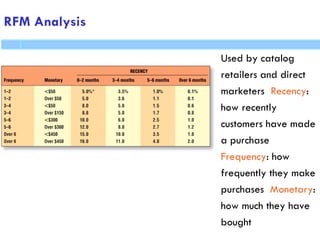
RFM Analysis
Used by catalog
retailers and direct
marketers Recency:
how recently
customers have made
a purchase
Frequency: how
frequently they make
purchases Monetary:
how much they have
bought
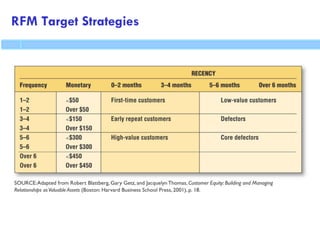
RFM Target Strategies
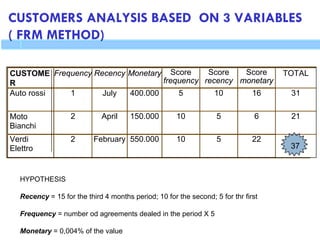
CUSTOMERS ANALYSIS BASED ON 3 VARIABLES
( FRM METHOD)
CUSTOME
R
Frequency Recency Monetary Score
frequency
Score
recency
Score
monetary
TOTAL
Auto rossi 1 July 400.000 5 10 16 31
Moto
Bianchi
2 April 150.000 10 5 6 21
Verdi
Elettro
2 February 550.000 10 5 22 37
HYPOTHESIS
Recency = 15 for the third 4 months period; 10 for the second; 5 for thr first
Frequency = number od agreements dealed in the period X 5
Monetary = 0,004% of the value
37
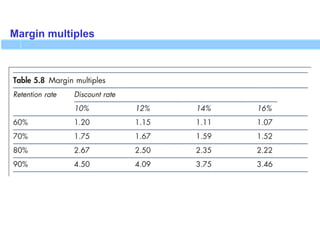
Margin multiples
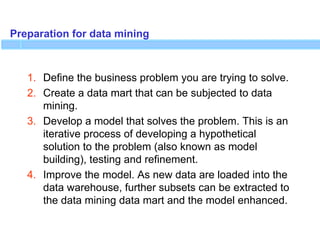
Preparation for data mining
1. Define the business problem you are trying to solve.
2. Create a data mart that can be subjected to data
mining.
3. Develop a model that solves the problem. This is an
iterative process of developing a hypothetical
solution to the problem (also known as model
building), testing and refinement.
4. Improve the model. As new data are loaded into the
data warehouse, further subsets can be extracted to
the data mining data mart and the model enhanced.
Data mining for CPM
 Clustering techniques
● CART
● CHAID
 Decision trees
 Neural networks
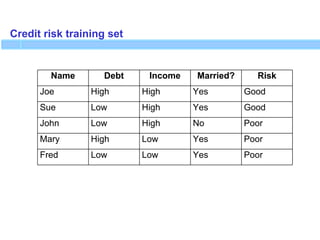
Credit risk training set
Name Debt Income Married? Risk
Joe High High Yes Good
Sue Low High Yes Good
John Low High No Poor
Mary High Low Yes Poor
Fred Low Low Yes Poor
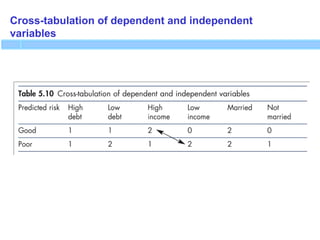
Cross-tabulation of dependent and independent
variables
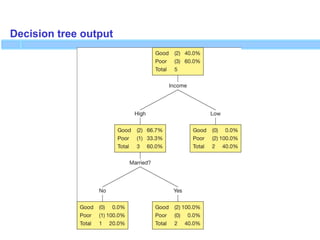
Decision tree output
CUSTOMER ANALYSIS
PORTFOLIO ANALYSIS
STATIC DYNAMIC
1
VARIABLE
3
VARIABLES
2
VARIABLES
Other
New
Prospect
Prospect
customers
Small
Medium
Customers
DYNAMIC ANALISYS OF THE
PORTAFOGLIO : THE MIGRATION
Other
ect
New
Prospect Prosp
customers
Medium
Large
Customers
PERIOD To PERIOD T+1
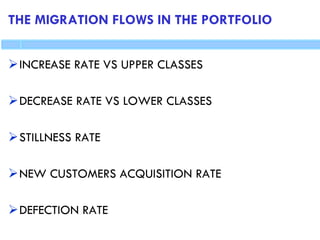
THE MIGRATION FLOWS IN THE PORTFOLIO
INCREASE RATE VS UPPER CLASSES
DECREASE RATE VS LOWER CLASSES
STILLNESS RATE
NEW CUSTOMERS ACQUISITION RATE
DEFECTION RATE
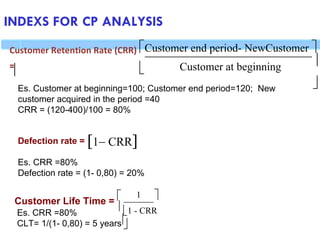
INDEXS FOR CP ANALYSIS


 Customer at beginning
Customer end period- NewCustomer 

1 - CRR

1
Customer Retention Rate (CRR)
=

Es. Customer at beginning=100; Customer end period=120; New
customer acquired in the period =40
CRR = (120-400)/100 = 80%
Defection rate = 1 CRR
Es. CRR =80%
Defection rate = (1- 0,80) = 20%
Es. CRR =80%
CLT= 1/(1- 0,80) = 5 years
Customer Life Time = 
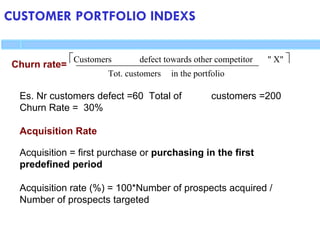
CUSTOMER PORTFOLIO INDEXS
Tot. customers in the portfolio
Churn rate=
Customers defect towards other competitor " X" 
Es. Nr customers defect =60 Total of customers =200
Churn Rate = 30%
Acquisition Rate
Acquisition = first purchase or purchasing in the first
predefined period
Acquisition rate (%) = 100*Number of prospects acquired /
Number of prospects targeted
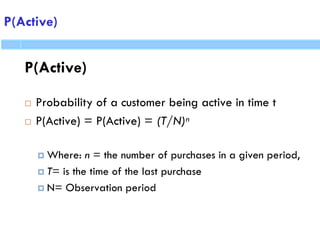
P(Active)
P(Active)
 Probability of a customer being active in time t
 P(Active) = P(Active) = (T/N)n
 Where: n = the number of purchases in a given period,
 T= is the time of the last purchase
 N= Observation period
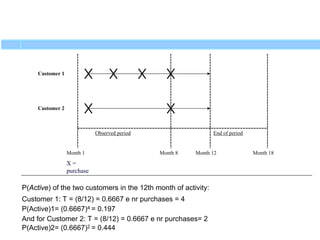
P(Active) of the two customers in the 12th month of activity:
Customer 1: T = (8/12) = 0.6667 e nr purchases = 4
P(Active)1= (0.6667)4 = 0.197
And for Customer 2: T = (8/12) = 0.6667 e nr purchases= 2
P(Active)2= (0.6667)2 = 0.444
Customer 1
Customer 2
Observed period End of period
Month 12
Month 8 Month 18
Month 1
X =
purchase
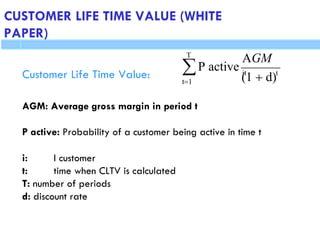
CUSTOMER LIFE TIME VALUE (WHITE
PAPER)
Customer Life Time Value:
AGM: Average gross margin in period t
P active: Probability of a customer being active in time t
i: I customer
t: time when CLTV is calculated
T: number of periods
d: discount rate
T

t1
t
(1  d)
P active
AGM
it
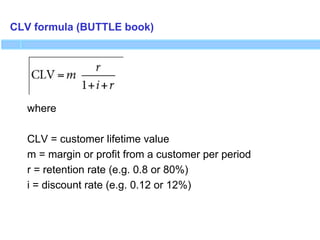
CLV formula (BUTTLE book)
where
CLV = customer lifetime value
m = margin or profit from a customer per period
r = retention rate (e.g. 0.8 or 80%)
i = discount rate (e.g. 0.12 or 12%)
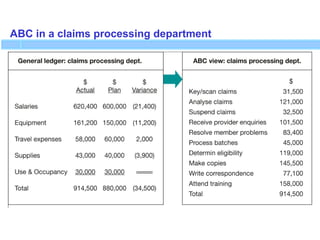
ABC in a claims processing department
How ABC helps CPM
 When combined with revenue figures, it tells you the
absolute and relative levels of profit generated by
each customer, segment or cohort
 It guides you towards actions that can be taken to
return customers to profit
 It helps prioritize and direct customer acquisition,
retention and development strategies
 It helps establish whether customization, and other
forms of value creation for customers, pays off
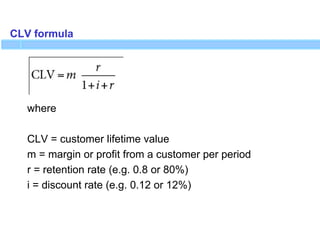
CLV formula
where
CLV = customer lifetime value
m = margin or profit from a customer per period
r = retention rate (e.g. 0.8 or 80%)
i = discount rate (e.g. 0.12 or 12%)
Neural networks
 Neural networks, also known as machine-based
learning, are another way of fitting a model to existing
data for prediction purposes.
 Neural networks can produce excellent predictions
from large and complex datasets containing
hundreds of interactive predictor variables, but the
neural networks are neither easy to understand nor
straightforward to use.
 Neural networks are represented by complex
mathematical equations, with many summations,
exponential functions and parameters.
Strategically significant customers 1
 High future lifetime value customers
● These customers will contribute significantly to the
company’s profitability in the future.
 High volume customers
● These customers might not generate much profit, but they
are strategically significant because of their absorption of
fixed costs, and the economies of scale they generate to
keep unit costs low.
Strategically significant customers 2
 Benchmark customers
● These are customers that other customers follow. For
example, Nippon Conlux supplies the hardware and software
for Coca-Cola’s vending operation. Whilst they might not
make much margin from that relationship, it has allowed
them to gain access to many other markets. ‘If we are good
enough for Coke, we are good enough for you’, is the
implied promise. Some IT companies create ‘reference sites’
at some of their more demanding customers.
Strategically significant customers 3
 Inspirations
● These are customers who bring about improvement in the
supplier’s business. They may identify new applications for a
product, product improvements or opportunities for cost
reductions. They may complain loudly and make
unreasonable demands but, in doing so, force change for the
better.
 Door openers
● These are customers that allow the supplier to gain access
to a new market. This may be done for no initial profit, but
with a view to proving credentials for further expansion. This
may be particularly important if crossing cultural boundaries,
say between west and east.
SSC’s at a Scandinavian timber processor
 Economic return
 Future business potential
 Learning value
 Reference value
 Strategic value by
 providing access to new markets
 strengthening incumbent positions
 building barriers to new entrants
This company considers five attributes in identifying their
strategically significant customers:
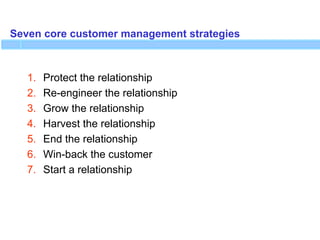
Seven core customer management strategies
1. Protect the relationship
2. Re-engineer the relationship
3. Grow the relationship
4. Harvest the relationship
5. End the relationship
6. Win-back the customer
7. Start a relationship

Customer portfolio management + WHITE PAPER.pdf

  • 1.
    Customer Relationship Management Chapter 5 Customerportfolio management + WHITE PAPER UNIVERSITÀ LUMSA Ms in Marketing & digital communication
  • 2.
    Customer portfolio definition A customer portfolio is the collection of mutually exclusive customer groups that comprise a business’s entire customer base.
  • 3.
    Objectives of CustomerPortfolio Management (CPM)  CPM aims to optimize business performance – whether that means sales growth, enhanced customer profitability or something else – across the entire customer base.  It does this by offering differentiated value propositions to different segments of customers.
  • 4.
    CUSTOMERS Prospect Current Ex AIMS Toget customers To increase loyalty To get customer back ANALYSIS AND TARGETING S e g m e n t a t i o n Custom er portfolio m ngt
  • 5.
    How B2B customersdiffer from B2C customers  Fewer in number  Bigger in size  Closer relationships with suppliers  Derived demand  Professional buying  Direct purchase
  • 6.
    Basic disciplines forCPM  market segmentation  sales forecasting  activity-based costing  customer lifetime value estimation  data mining
  • 7.
    Market segmentation definition Market segmentation is the process of dividing up a market into more-or-less homogenous subsets for which it is possible to create different value propositions.
  • 8.
  • 9.
    Market segmentation process 1.identify the business you are in 2. identify relevant segmentation variables 3. analyse the market using these variables 4. assess the value of the market segments 5. select target market(s) to serve
  • 10.
    Types of competitor(kitchen furniture example)  Benefit competitors ● other companies delivering the same benefit to customers. These might include window replacement companies, heating and air-conditioning companies and bathroom renovation companies.  Product competitors ● other companies marketing kitchens to customers seeking the same benefit.  Geographic competitors ● these are benefit and product competitors operating in the same geographic territory.
  • 11.
    Criteria for segmentingconsumer markets
  • 12.
  • 13.
    Bivariate segmentation ofthe chocolate market
  • 14.
    Criteria for segmentingbusiness markets
  • 15.
  • 16.
    IBM targets 18industry sectors
  • 17.
    Account-based segmentation variables account value  share of category (share of wallet) spend  propensity to switch
  • 18.
  • 19.
  • 20.
    Sales forecasting methods Qualitative methods ● Customer surveys ● Sales team estimates  Time-series methods ● Moving average ● Exponential smoothing ● Time-series decomposition  Causal methods ● Leading indicators ● Regression models
  • 21.
    Sales forecasting usingmoving averages Year Sales volumes 2-year moving average 4-year moving average 2013 4830 2014 4930 2015 4870 4880 2016 5210 4900 2017 5330 5040 4960 2018 5660 5270 5085 2019 5440 5495 5267 2020 5550 5410
  • 22.
    Activity-based costing 1 Costsdo vary from customer-to-customer. Some customers are very costly to acquire and serve, others are not. Customer acquisition costs ● Some customers require considerable sales effort to shift them from prospect to first-time customer status: more sales calls, visits to reference customer sites, free samples, engineering advice, guarantees that switching costs will be met by the vendor. Terms of trade ● Price discounts, advertising and promotion support, slotting allowances (cash paid to retailers for shelf space), extended invoice due dates.
  • 23.
    Activity-based costing 2 Customer service costs ● Handling queries, claims and complaints, demands on salesperson and contact centre, small order sizes, high order frequency, just-in-time delivery, part-load shipments, breaking bulk for delivery to multiple sites.  Working capital costs ● Carrying inventory for the customer, cost of credit.
  • 24.
  • 25.
    Collecting Customer Data:Customer Database  Transactions – a complete history of purchases  Purchase date, price paid, SKUs bought, whether or not the purchase was stimulated by a promotion  Customer contacts by retailer (touch points) --visits to web site, inquires to call center, direct mail sent to customer  Customer preferences  Descriptive information about customer  Demographic and psychographic data  Customer’s responses to marketing activities
  • 26.
    Collecting Customer Data:Identifying Information Approaches that store-based retailers use: Asking for identifying information Telephone number, name and address Offering frequent shopper cards Loyalty programs that identify and provide rewards to customers who patronize a retailer Private label credit card (that has the store’s name on it) Connecting Internet purchasing data with the stores
  • 27.
    Privacy Concerns  Controlover Collection  Do customers know what information is being collected?  Do customers feel they can decide upon the amount and type of information collected by retailers?  Control over Use  Do customers know how the information will be used by the retailer?  Will the retailer share the information with third parties? Steve Cole/Getty Images
  • 28.
     YOU FINDNEXT TOPICS IN WHITE PAPER
  • 29.
    PHASE 2: ANALYZINGCUSTOMERS PROFILING  The main aim of this phase is to make a ranking of customers through a precise rating: “rating for ranking”  The customer marketing aims are defined on the basis of the ranking
  • 30.
    CUSTOMER ANALYSIS PORTFOLIO ANALYSIS STATICDYNAMIC 1 VARIABLE 2 VARIABLES N VARIABLES
  • 31.
    Customer Pyramid Platinum Best Mostloyal Least price sensitive 80-20 rule: 80% of sales or profits come from 20% of the customers
  • 32.
    4% Selling % Profits% 26% 20% 29% 50% 55% 30% 70% 16% NUMBER OF CUSTOMERS % PORTFOLIO ANALYSIS WITH ONE VARIABLE
  • 33.
    The 80:20 ruleor Pareto principle
  • 34.
    Customer profitability bysales volume quintile
  • 35.
    WHICH IS THEINFLUENCE OF THE 5% OF CUSTOMERS ON THE PROFITS? 9 5 7 5 9 5 8 5 9 5 7 2 5 2 5 5 1 5 5 2 8 100 % 90% 80% 70% 60% 50% 40% 30% 20% 10% 0% C u s t o m e r s P r o f i t s C u s t o m e r s P r o f i t s C u s t o m e r s P r o f i t s Credit cards Cosmetics Telephone market Long Distance
  • 36.
    PORTFOLIO ANAYLIS ANDPYRAMID ABC ANALYSIS  It involves the use of a single variable (usually revenue) to analyze the importance of the customer's business portfolio  Customers are ranked in descending order according to the variable  Usually Pareto Paradigm is confirmed (rule 20/80) Average 1‐12 customers=282.807 Average 30 customers= 157.380 Average 13‐30 customers= 73.762
  • 37.
    CUSTOMER ANALYSIS PORTFOLIO ANALYSIS STATICDYNAMIC 1 VARIABLE 2 VARIABLES N VARIABLES
  • 38.
    CUSTOMERS PORTOFOLIO ANALISISUSING 2 VARIABLES (CUSTOMERS MATRIX) We use two variables Matrixs are more realible and to identify Key Clients It’s difficult to chose two variables There are three different typologies Matrices of customer profitability: economic variables Matrices of the competitive situation of customers estimate the customers' competitiveness in key markets Matrices of customer relations: non-economic variables (satisfaction, no complaints, ease of maintenance, etc.) CUSTOMERS PORTOFOLIO ANALISIS USING 2 VARIABLES (CUSTOMERS MATRIX)
  • 39.
    USING SHARE ANDSIZE OF WALLET
  • 40.
    CUSTOMERS TYPOLOGIES ANDTHE RELATIONSHIP BETWEEN LOYALTY AND SATISFACTION CUSTOMER SATISFACTION Very Unsatisfied Very Satisfied 100% 40% 20% 0% 60% 80% Unsatisfied Nor satisfied Neither unsatisfied LEVEL OF Satisfied es postles Hostages Loyalty area A Indifference area Defection area Almost apostl Protesters Mercenaries
  • 41.
    Shapiro et al.’scustomer portfolio matrix
  • 42.
    How costs varybetween customers
  • 43.
  • 44.
    Fiocca step 1:Strategic importance  Strategic importance is related to: ● value/volume of the customer’s purchases ● potential and prestige of the customer ● customer market leadership ● general desirability in terms of diversification of the supplier’s markets, providing access to new markets, improving technological expertise, and the impact on other relationships
  • 45.
    Fiocca step 1:Difficulty of managing relationship  Difficulty of managing the customer relationship is related to: ● product characteristics such as novelty and complexity ● account characteristics such as the customer’s needs and requirements, customer’s buying behaviour , customer’s power, customer’s technical and commercial competence and the customer’s preference to do business with a number of suppliers ● competition for the account which is assessed by considering the number of competitors, the strength and weaknesses of competitors and competitors’ position vis à vis the customer
  • 46.
    Fiocca step 2 Assess key easy and key difficult accounts: ● The customer’s business attractiveness ● The strength of the buyer/seller relationship
  • 47.
    Fiocca step 2:Customer’s attractiveness
  • 48.
    Fiocca step 2:Strength of relationship  the length of relationship  the volume or dollar value of purchases  the importance of the customer (percentage of customer’s purchases on supplier’s sales)  personal friendships  cooperation in product development  management distance (language and culture)  geographical distance
  • 49.
    Fiocca step 2:Strategic options
  • 50.
  • 51.
    Additional CPA tools SWOT analysis  BCG matrix analysis
  • 52.
  • 53.
    CUSTOMER ANALYSIS PORTFOLIO ANALYSIS STATICDYNAMIC 1 VARIABLE 3 VARIABLES 2 VARIABLES
  • 54.
    RFM Analysis Used bycatalog retailers and direct marketers Recency: how recently customers have made a purchase Frequency: how frequently they make purchases Monetary: how much they have bought
  • 55.
  • 56.
    CUSTOMERS ANALYSIS BASEDON 3 VARIABLES ( FRM METHOD) CUSTOME R Frequency Recency Monetary Score frequency Score recency Score monetary TOTAL Auto rossi 1 July 400.000 5 10 16 31 Moto Bianchi 2 April 150.000 10 5 6 21 Verdi Elettro 2 February 550.000 10 5 22 37 HYPOTHESIS Recency = 15 for the third 4 months period; 10 for the second; 5 for thr first Frequency = number od agreements dealed in the period X 5 Monetary = 0,004% of the value 37
  • 57.
  • 58.
    Preparation for datamining 1. Define the business problem you are trying to solve. 2. Create a data mart that can be subjected to data mining. 3. Develop a model that solves the problem. This is an iterative process of developing a hypothetical solution to the problem (also known as model building), testing and refinement. 4. Improve the model. As new data are loaded into the data warehouse, further subsets can be extracted to the data mining data mart and the model enhanced.
  • 59.
    Data mining forCPM  Clustering techniques ● CART ● CHAID  Decision trees  Neural networks
  • 60.
    Credit risk trainingset Name Debt Income Married? Risk Joe High High Yes Good Sue Low High Yes Good John Low High No Poor Mary High Low Yes Poor Fred Low Low Yes Poor
  • 61.
    Cross-tabulation of dependentand independent variables
  • 62.
  • 63.
    CUSTOMER ANALYSIS PORTFOLIO ANALYSIS STATICDYNAMIC 1 VARIABLE 3 VARIABLES 2 VARIABLES
  • 64.
    Other New Prospect Prospect customers Small Medium Customers DYNAMIC ANALISYS OFTHE PORTAFOGLIO : THE MIGRATION Other ect New Prospect Prosp customers Medium Large Customers PERIOD To PERIOD T+1
  • 65.
    THE MIGRATION FLOWSIN THE PORTFOLIO INCREASE RATE VS UPPER CLASSES DECREASE RATE VS LOWER CLASSES STILLNESS RATE NEW CUSTOMERS ACQUISITION RATE DEFECTION RATE
  • 66.
    INDEXS FOR CPANALYSIS    Customer at beginning Customer end period- NewCustomer   1 - CRR  1 Customer Retention Rate (CRR) =  Es. Customer at beginning=100; Customer end period=120; New customer acquired in the period =40 CRR = (120-400)/100 = 80% Defection rate = 1 CRR Es. CRR =80% Defection rate = (1- 0,80) = 20% Es. CRR =80% CLT= 1/(1- 0,80) = 5 years Customer Life Time = 
  • 67.
    CUSTOMER PORTFOLIO INDEXS Tot.customers in the portfolio Churn rate= Customers defect towards other competitor " X"  Es. Nr customers defect =60 Total of customers =200 Churn Rate = 30% Acquisition Rate Acquisition = first purchase or purchasing in the first predefined period Acquisition rate (%) = 100*Number of prospects acquired / Number of prospects targeted
  • 68.
    P(Active) P(Active)  Probability ofa customer being active in time t  P(Active) = P(Active) = (T/N)n  Where: n = the number of purchases in a given period,  T= is the time of the last purchase  N= Observation period
  • 69.
    P(Active) of thetwo customers in the 12th month of activity: Customer 1: T = (8/12) = 0.6667 e nr purchases = 4 P(Active)1= (0.6667)4 = 0.197 And for Customer 2: T = (8/12) = 0.6667 e nr purchases= 2 P(Active)2= (0.6667)2 = 0.444 Customer 1 Customer 2 Observed period End of period Month 12 Month 8 Month 18 Month 1 X = purchase
  • 70.
    CUSTOMER LIFE TIMEVALUE (WHITE PAPER) Customer Life Time Value: AGM: Average gross margin in period t P active: Probability of a customer being active in time t i: I customer t: time when CLTV is calculated T: number of periods d: discount rate T  t1 t (1  d) P active AGM it
  • 71.
    CLV formula (BUTTLEbook) where CLV = customer lifetime value m = margin or profit from a customer per period r = retention rate (e.g. 0.8 or 80%) i = discount rate (e.g. 0.12 or 12%)
  • 72.
    ABC in aclaims processing department
  • 73.
    How ABC helpsCPM  When combined with revenue figures, it tells you the absolute and relative levels of profit generated by each customer, segment or cohort  It guides you towards actions that can be taken to return customers to profit  It helps prioritize and direct customer acquisition, retention and development strategies  It helps establish whether customization, and other forms of value creation for customers, pays off
  • 74.
    CLV formula where CLV =customer lifetime value m = margin or profit from a customer per period r = retention rate (e.g. 0.8 or 80%) i = discount rate (e.g. 0.12 or 12%)
  • 75.
    Neural networks  Neuralnetworks, also known as machine-based learning, are another way of fitting a model to existing data for prediction purposes.  Neural networks can produce excellent predictions from large and complex datasets containing hundreds of interactive predictor variables, but the neural networks are neither easy to understand nor straightforward to use.  Neural networks are represented by complex mathematical equations, with many summations, exponential functions and parameters.
  • 76.
    Strategically significant customers1  High future lifetime value customers ● These customers will contribute significantly to the company’s profitability in the future.  High volume customers ● These customers might not generate much profit, but they are strategically significant because of their absorption of fixed costs, and the economies of scale they generate to keep unit costs low.
  • 77.
    Strategically significant customers2  Benchmark customers ● These are customers that other customers follow. For example, Nippon Conlux supplies the hardware and software for Coca-Cola’s vending operation. Whilst they might not make much margin from that relationship, it has allowed them to gain access to many other markets. ‘If we are good enough for Coke, we are good enough for you’, is the implied promise. Some IT companies create ‘reference sites’ at some of their more demanding customers.
  • 78.
    Strategically significant customers3  Inspirations ● These are customers who bring about improvement in the supplier’s business. They may identify new applications for a product, product improvements or opportunities for cost reductions. They may complain loudly and make unreasonable demands but, in doing so, force change for the better.  Door openers ● These are customers that allow the supplier to gain access to a new market. This may be done for no initial profit, but with a view to proving credentials for further expansion. This may be particularly important if crossing cultural boundaries, say between west and east.
  • 79.
    SSC’s at aScandinavian timber processor  Economic return  Future business potential  Learning value  Reference value  Strategic value by  providing access to new markets  strengthening incumbent positions  building barriers to new entrants This company considers five attributes in identifying their strategically significant customers:
  • 80.
    Seven core customermanagement strategies 1. Protect the relationship 2. Re-engineer the relationship 3. Grow the relationship 4. Harvest the relationship 5. End the relationship 6. Win-back the customer 7. Start a relationship