Business
Relationship
Management
HF438S C.01 – © 2012 Hewlett-Packard Development Company, L.P.3 - 2
Business Relationship Management:
• Purpose and objectives
• Scope
• Value to business
• Policies, principles and basic concepts
• Process activities, methods and techniques
• Triggers, inputs and outputs
• Interfaces
• CSFs and KPIs
• Challenges
• Risks
HF438S C.01 – © 2012 Hewlett-Packard Development Company, L.P.3 - 3
Purpose
• To establish and maintain a business relationship
between the service provider and the customer based
on understanding the customer and its business needs.
• To identify customer needs and ensure that the service
provider is able to meet these needs as business needs
change over time and between circumstance.
HF438S C.01 – © 2012 Hewlett-Packard Development Company, L.P.3 - 4
Objectives (1 of 2)
• Ensure that the services provider understands the
customer’s perspective of services.
• Ensure high levels of customer satisfaction
• Establish and maintain a constructive relationship
between the service provider and the customer.
• Identify changes to the customer environment that could
potentially impact service
• Ensure that the service provider is meeting the
business needs of the customer.
• To ensure that services and service levels are able to
deliver value.
HF438S C.01 – © 2012 Hewlett-Packard Development Company, L.P.3 - 5
Scope
• Business outcomes that the customer want to achieve.
• Services presently offered
• How customers use services
• Technology trends that could impact current services.
• Levels of customer satisfaction and improvement
initiatives to address dissatisfaction
• How to optimize services for the future.
• How the service provider is represented to the customer.
HF438S C.01 – © 2012 Hewlett-Packard Development Company, L.P.3 - 6
Value to business
• In the ability of the service provider to articulate and meet
the business needs of its customers. BRM creates a forum
for ongoing, structured communication with its customers.
This enables BRM to achieve better alignment and
integration of services in the future, as well as the ability the
current business outcomes.
HF438S C.01 – © 2012 Hewlett-Packard Development Company, L.P.3 - 7
Policies, Principles, Basic Concepts (1 of 2)
Policies:
Business relationship management and the business
relationship manager:
The process of BRM is often confused with the
business relationship manager role. This is because the role is
high profile and many customers identify the process activities
with the person playing the role.
Customer Portfolio:
The customer portfolio is a database or structured
document used to record all customers of the IT service
provider. The customer portfolio is BRM’s view of the
customers who receive services from the IT services provider.
Customer agreement portfolio:
HF438S C.01 – © 2012 Hewlett-Packard Development Company, L.P.3 - 8
Policies, Principles, Basic Concepts (1 of 2)
Customer agreement portfolio:
The customer agreement portfolio is a database or
structured document used to manage service contracts or
agreement between an IT service provider and its customers.
Each IT service delivered to a customer should have a
contract or other agreement that is listed in the customer
agreement portfolio.
Customer satisfaction: BRM measure customer satisfaction
and compares service provider performance with customer
satisfaction targets and previous scores. Survey are the most
common from of measuring customer satisfaction. Survey
should be easy to complete in a short time
Service Requirement:
BRM is involved in defining and clarifying requirement for se
HF438S C.01 – © 2012 Hewlett-Packard Development Company, L.P.3 - 9
Policies, Principles, Basic Concepts (1 of 2)
Services throughout its lifecycle. This type of activity is
specialized and will require expertise in business analysis.
Service provider can understand and use to design and built
the service, and to define metrics to determine success.
HF438S C.01 – © 2012 Hewlett-Packard Development Company, L.P.3 - 10
Process Activities, Methods, and Techniques
(1 of 3)
• The nature of the BRM process:
The BRM process consists of activities in every stage of the
service Lifecycle, nut it is rarely executed as a single end to end process.
The exact activities that are executed will depend on the situation that has
caused the service provider or customer to initiate the process.
The BRM process has distinct groups and sequence of activities,
even if they are not all performed from beginning to end every time the
process is initiated. For example, the process can be initiated in the
service Design Stage of the lifecycle by SLM, without first going through
service strategy.
HF438S C.01 – © 2012 Hewlett-Packard Development Company, L.P.3 - 11
Process Activities, Methods, and Techniques
(1 of 3)
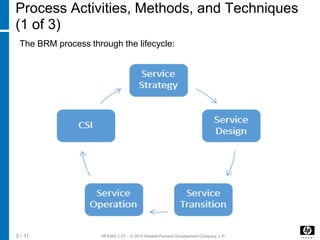
The BRM process through the lifecycle:
HF438S C.01 – © 2012 Hewlett-Packard Development Company, L.P.3 - 12
Triggers, Inputs and Outputs (1 of 2)
• The triggers will include:
• A New strategic initiative.
• A New service, or a change to an existing service, has
been initiated.
• A new opportunity has been identified.
• A service has been chartered by service portfolio
management.
• Customer requests or suggestion.
• Customer complaints.
• A customer meeting has been scheduled.
• A customer satisfaction survey has been scheduled.
HF438S C.01 – © 2012 Hewlett-Packard Development Company, L.P.3 - 13
Triggers, Inputs and Outputs (2 of 2)
• The Inputs of Business relationship management will
include:
• Customer requirements
• customer request, complaints, escalations or compliments.
• The service strategy.
• where possible the customers strategy
• The service portfolio
• To ensure that requirements are gathered in a timely fashion
• Service level agreement
• Request for change
• Pattern of business activity and user profiles defined by
demand management, and which need to be validated
business relationship management.
HF438S C.01 – © 2012 Hewlett-Packard Development Company, L.P.3 - 14
Output
• The outputs of Business relationship management will
include:
• Stakeholder definition
• Defined business outcomes
• Agreement to fund or pay for services
• The customer portfolio
• service requirements for strategy, design and transition
• Customer satisfaction survey, and the published result of
this survey.
• Schedule of customer activity in various service
management process activities.
• Schedule of training and awareness events.
• Report on customer perception of service performance.
3 - 15
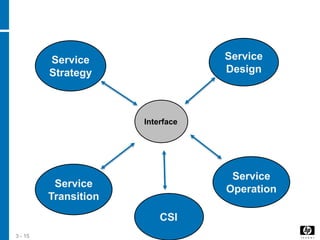
Interface
Service
Design
Service
Operation
CSI
Service
Transition
Service
Strategy
HF438S C.01 – © 2012 Hewlett-Packard Development Company, L.P.3 - 16
Interface
• The business relationship management process to
understand the customers priorities regarding service
performance and deliverable.
• Service catalogue management provides the basis for
many discussion, reviews and requests that are initiated
through business relationship management.
• Capacity and availability management rely on information
about business outcomes and service requirement gathered
through business relationship management.
• It provides valuable perspective's and information on
business priorities and outcomes for IT service continuity
management.
HF438S C.01 – © 2012 Hewlett-Packard Development Company, L.P.3 - 17
CSFs and KPIs:
• CSF The ability to document and understand customer
requirements of services.
KPI business outcomes and customer requirements
are documented and signed off by the customer as input into
service portfolio management.
• CSFs The ability to measure customer satisfaction levels
KPI customer satisfaction levels are consistently high
are used as feedback into service portfolio management.
CSFs The ability to identify changes to the customer
environment that cloud impact the type, level of utilization of
services provider.
KPI customer satisfaction and customer reterntion rates
are consistently high.
HF438S C.01 – © 2012 Hewlett-Packard Development Company, L.P.3 - 18
CSFs and KPIs:
• KPI improved customer satisfaction sources
• CFS identify technology trends that could potentially impact,
level or utilization
KPI opportunity return on investment has been measured
and a decision made to keep.
CSF the ability to establish and articulated business
requirements for new services
KPI every new service has a comprehensive set of
requirement
CSF its able to measure that the service provider is meeting
the business needs of customer.
KPI its defined ,minimum level in a structured customer
satisfaction survey.
HF438S C.01 – © 2012 Hewlett-Packard Development Company, L.P.3 - 19
CSFs and KPIs:
• KPI service performance is matched to business
outcomes, and reportable to the customer.
• CSF formal complaints and escalation processes are
available to customers
• KPI Number of complaints and escalations are
measured and trended over time and by customer.
HF438S C.01 – © 2012 Hewlett-Packard Development Company, L.P.3 - 20
Challenges:
• The need to be involved in defining services, and tracking
that they are delivered according to the agreed levels of
service
• A history of poor service
• Customer not being willing to share requirement, feedback,
and opportunities.
• Confusion between the role of business relationship
manager and the process of business relationship
management.
HF438S C.01 – © 2012 Hewlett-Packard Development Company, L.P.3 - 21
Risks:
• Confusion about the boundaries between these processes
• A disconnect between the customer facing process and
those focusing more on technology

Business relationship management

  • 1.
  • 2.
    HF438S C.01 –© 2012 Hewlett-Packard Development Company, L.P.3 - 2 Business Relationship Management: • Purpose and objectives • Scope • Value to business • Policies, principles and basic concepts • Process activities, methods and techniques • Triggers, inputs and outputs • Interfaces • CSFs and KPIs • Challenges • Risks
  • 3.
    HF438S C.01 –© 2012 Hewlett-Packard Development Company, L.P.3 - 3 Purpose • To establish and maintain a business relationship between the service provider and the customer based on understanding the customer and its business needs. • To identify customer needs and ensure that the service provider is able to meet these needs as business needs change over time and between circumstance.
  • 4.
    HF438S C.01 –© 2012 Hewlett-Packard Development Company, L.P.3 - 4 Objectives (1 of 2) • Ensure that the services provider understands the customer’s perspective of services. • Ensure high levels of customer satisfaction • Establish and maintain a constructive relationship between the service provider and the customer. • Identify changes to the customer environment that could potentially impact service • Ensure that the service provider is meeting the business needs of the customer. • To ensure that services and service levels are able to deliver value.
  • 5.
    HF438S C.01 –© 2012 Hewlett-Packard Development Company, L.P.3 - 5 Scope • Business outcomes that the customer want to achieve. • Services presently offered • How customers use services • Technology trends that could impact current services. • Levels of customer satisfaction and improvement initiatives to address dissatisfaction • How to optimize services for the future. • How the service provider is represented to the customer.
  • 6.
    HF438S C.01 –© 2012 Hewlett-Packard Development Company, L.P.3 - 6 Value to business • In the ability of the service provider to articulate and meet the business needs of its customers. BRM creates a forum for ongoing, structured communication with its customers. This enables BRM to achieve better alignment and integration of services in the future, as well as the ability the current business outcomes.
  • 7.
    HF438S C.01 –© 2012 Hewlett-Packard Development Company, L.P.3 - 7 Policies, Principles, Basic Concepts (1 of 2) Policies: Business relationship management and the business relationship manager: The process of BRM is often confused with the business relationship manager role. This is because the role is high profile and many customers identify the process activities with the person playing the role. Customer Portfolio: The customer portfolio is a database or structured document used to record all customers of the IT service provider. The customer portfolio is BRM’s view of the customers who receive services from the IT services provider. Customer agreement portfolio:
  • 8.
    HF438S C.01 –© 2012 Hewlett-Packard Development Company, L.P.3 - 8 Policies, Principles, Basic Concepts (1 of 2) Customer agreement portfolio: The customer agreement portfolio is a database or structured document used to manage service contracts or agreement between an IT service provider and its customers. Each IT service delivered to a customer should have a contract or other agreement that is listed in the customer agreement portfolio. Customer satisfaction: BRM measure customer satisfaction and compares service provider performance with customer satisfaction targets and previous scores. Survey are the most common from of measuring customer satisfaction. Survey should be easy to complete in a short time Service Requirement: BRM is involved in defining and clarifying requirement for se
  • 9.
    HF438S C.01 –© 2012 Hewlett-Packard Development Company, L.P.3 - 9 Policies, Principles, Basic Concepts (1 of 2) Services throughout its lifecycle. This type of activity is specialized and will require expertise in business analysis. Service provider can understand and use to design and built the service, and to define metrics to determine success.
  • 10.
    HF438S C.01 –© 2012 Hewlett-Packard Development Company, L.P.3 - 10 Process Activities, Methods, and Techniques (1 of 3) • The nature of the BRM process: The BRM process consists of activities in every stage of the service Lifecycle, nut it is rarely executed as a single end to end process. The exact activities that are executed will depend on the situation that has caused the service provider or customer to initiate the process. The BRM process has distinct groups and sequence of activities, even if they are not all performed from beginning to end every time the process is initiated. For example, the process can be initiated in the service Design Stage of the lifecycle by SLM, without first going through service strategy.
  • 11.
    HF438S C.01 –© 2012 Hewlett-Packard Development Company, L.P.3 - 11 Process Activities, Methods, and Techniques (1 of 3) The BRM process through the lifecycle:
  • 12.
    HF438S C.01 –© 2012 Hewlett-Packard Development Company, L.P.3 - 12 Triggers, Inputs and Outputs (1 of 2) • The triggers will include: • A New strategic initiative. • A New service, or a change to an existing service, has been initiated. • A new opportunity has been identified. • A service has been chartered by service portfolio management. • Customer requests or suggestion. • Customer complaints. • A customer meeting has been scheduled. • A customer satisfaction survey has been scheduled.
  • 13.
    HF438S C.01 –© 2012 Hewlett-Packard Development Company, L.P.3 - 13 Triggers, Inputs and Outputs (2 of 2) • The Inputs of Business relationship management will include: • Customer requirements • customer request, complaints, escalations or compliments. • The service strategy. • where possible the customers strategy • The service portfolio • To ensure that requirements are gathered in a timely fashion • Service level agreement • Request for change • Pattern of business activity and user profiles defined by demand management, and which need to be validated business relationship management.
  • 14.
    HF438S C.01 –© 2012 Hewlett-Packard Development Company, L.P.3 - 14 Output • The outputs of Business relationship management will include: • Stakeholder definition • Defined business outcomes • Agreement to fund or pay for services • The customer portfolio • service requirements for strategy, design and transition • Customer satisfaction survey, and the published result of this survey. • Schedule of customer activity in various service management process activities. • Schedule of training and awareness events. • Report on customer perception of service performance.
  • 15.
  • 16.
    HF438S C.01 –© 2012 Hewlett-Packard Development Company, L.P.3 - 16 Interface • The business relationship management process to understand the customers priorities regarding service performance and deliverable. • Service catalogue management provides the basis for many discussion, reviews and requests that are initiated through business relationship management. • Capacity and availability management rely on information about business outcomes and service requirement gathered through business relationship management. • It provides valuable perspective's and information on business priorities and outcomes for IT service continuity management.
  • 17.
    HF438S C.01 –© 2012 Hewlett-Packard Development Company, L.P.3 - 17 CSFs and KPIs: • CSF The ability to document and understand customer requirements of services. KPI business outcomes and customer requirements are documented and signed off by the customer as input into service portfolio management. • CSFs The ability to measure customer satisfaction levels KPI customer satisfaction levels are consistently high are used as feedback into service portfolio management. CSFs The ability to identify changes to the customer environment that cloud impact the type, level of utilization of services provider. KPI customer satisfaction and customer reterntion rates are consistently high.
  • 18.
    HF438S C.01 –© 2012 Hewlett-Packard Development Company, L.P.3 - 18 CSFs and KPIs: • KPI improved customer satisfaction sources • CFS identify technology trends that could potentially impact, level or utilization KPI opportunity return on investment has been measured and a decision made to keep. CSF the ability to establish and articulated business requirements for new services KPI every new service has a comprehensive set of requirement CSF its able to measure that the service provider is meeting the business needs of customer. KPI its defined ,minimum level in a structured customer satisfaction survey.
  • 19.
    HF438S C.01 –© 2012 Hewlett-Packard Development Company, L.P.3 - 19 CSFs and KPIs: • KPI service performance is matched to business outcomes, and reportable to the customer. • CSF formal complaints and escalation processes are available to customers • KPI Number of complaints and escalations are measured and trended over time and by customer.
  • 20.
    HF438S C.01 –© 2012 Hewlett-Packard Development Company, L.P.3 - 20 Challenges: • The need to be involved in defining services, and tracking that they are delivered according to the agreed levels of service • A history of poor service • Customer not being willing to share requirement, feedback, and opportunities. • Confusion between the role of business relationship manager and the process of business relationship management.
  • 21.
    HF438S C.01 –© 2012 Hewlett-Packard Development Company, L.P.3 - 21 Risks: • Confusion about the boundaries between these processes • A disconnect between the customer facing process and those focusing more on technology

Editor's Notes

  • #2 ITIL Service Design
  • #3 ITIL Service Design
  • #4 ITIL Service Design
  • #5 ITIL Service Design
  • #6 ITIL Service Design
  • #7 ITIL Service Design
  • #8 ITIL Service Design
  • #9 ITIL Service Design
  • #10 ITIL Service Design
  • #11 ITIL Service Design
  • #12 ITIL Service Design
  • #13 ITIL Service Design
  • #14 ITIL Service Design
  • #15 ITIL Service Design
  • #16 ITIL Service Design
  • #17 ITIL Service Design
  • #18 ITIL Service Design
  • #19 ITIL Service Design
  • #20 ITIL Service Design
  • #21 ITIL Service Design
  • #22 ITIL Service Design