


Role of Segmentation in Loyalty Marketing 
Prof. Francisco N. de los Reyes 
School of Statistics 
University of the Philippines, Diliman
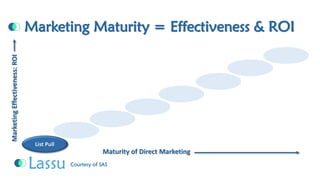
Marketing Maturity = Effectiveness & ROIList PullMaturity of Direct Marketing Marketing Effectiveness: ROI Courtesy of SAS
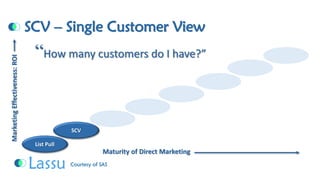
SCV –Single Customer ViewList PullSCVMaturity of Direct Marketing Marketing Effectiveness: ROI “How many customers do I have?” Courtesy of SAS
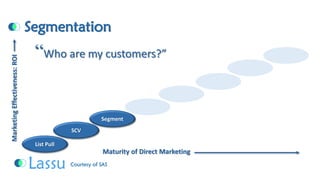
SegmentationList PullSCVSegmentMaturity of Direct Marketing Marketing Effectiveness: ROI Courtesy of SAS“Who are my customers?”
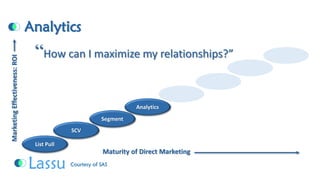
AnalyticsList PullSCVSegmentAnalyticsMaturity of Direct Marketing Marketing Effectiveness: ROI Courtesy of SAS“How can I maximize my relationships?”
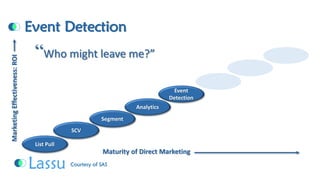
Event DetectionList PullSCVSegmentAnalyticsEvent DetectionMaturity of Direct Marketing Marketing Effectiveness: ROI Courtesy of SAS“Who might leave me?”
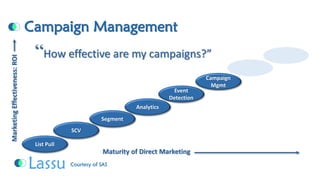
Campaign ManagementList PullSCVSegmentAnalyticsEvent DetectionCampaign MgmtMaturity of Direct Marketing Marketing Effectiveness: ROI Courtesy of SAS“How effective are my campaigns?”
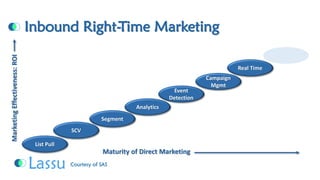
Inbound Right-Time MarketingList PullSCVSegmentAnalyticsEvent DetectionCampaign MgmtReal TimeMaturity of Direct Marketing Marketing Effectiveness: ROI Courtesy of SAS
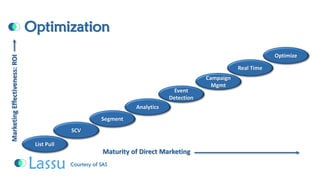
OptimizationList PullSCVSegmentAnalyticsEvent DetectionCampaign MgmtReal TimeOptimizeMaturity of Direct Marketing Marketing Effectiveness: ROI Courtesy of SAS
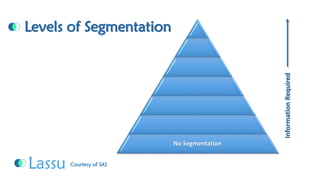
Levels of Segmentation Information Required Courtesy of SASNo Segmentation
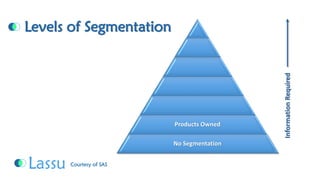
Levels of Segmentation Information Required Courtesy of SASProducts OwnedNo Segmentation
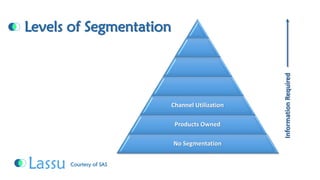
Levels of Segmentation Information Required Courtesy of SASChannel UtilizationProducts OwnedNo Segmentation
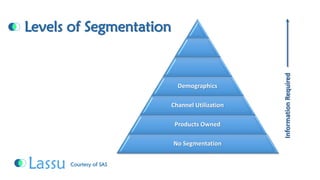
Levels of Segmentation Information Required Courtesy of SASDemographicsChannel UtilizationProducts OwnedNo Segmentation
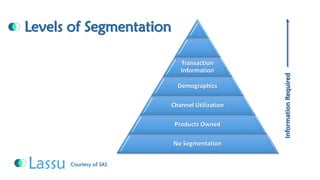
Levels of Segmentation Information Required Courtesy of SASTransaction InformationDemographicsChannel UtilizationProducts OwnedNo Segmentation
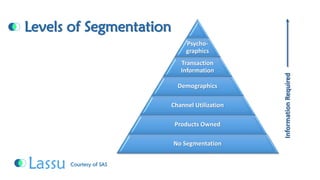
Levels of Segmentation Information Required Courtesy of SASPsycho- graphicsTransaction InformationDemographicsChannel UtilizationProducts OwnedNo Segmentation
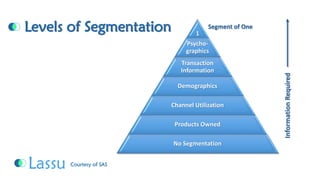
Levels of Segmentation Information Required Courtesy of SAS1Psycho- graphicsTransaction InformationDemographicsChannel UtilizationProducts OwnedNo SegmentationSegment of One
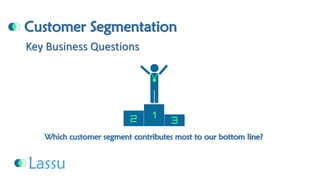
Customer SegmentationWhich customer segment contributes most to our bottom line? Key Business Questions
Customer SegmentationWhich segments should we grow? Key Business Questions
Customer SegmentationWhich segments should be retained or closely monitored? Key Business Questions
Customer SegmentationWhat are the profiles of customers in each segment? Key Business Questions
Customer SegmentationWhat products are saleable in each segment? Key Business Questions
Customer Segmentation•Identifies strategic business focus and direction•Analysis of customer behavior to gain insight into customer needs and preferencesKey Benefits & Capabilities
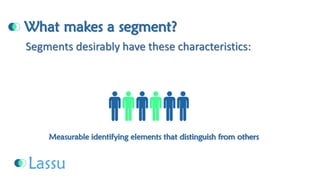
What makes a segment? Measurable identifying elements that distinguish from othersSegments desirably have these characteristics:
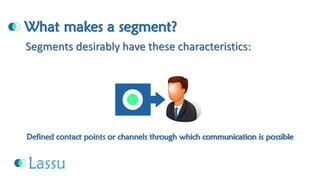
What makes a segment? Defined contact points or channels through which communication is possibleSegments desirably have these characteristics:
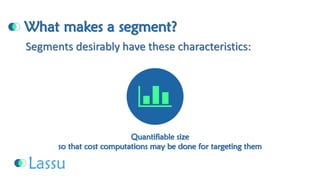
What makes a segment? Quantifiable size so that cost computations may be done for targeting themSegments desirably have these characteristics:
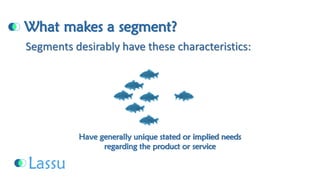
What makes a segment? Have generally unique stated or implied needsregarding the product or serviceSegments desirably have these characteristics:
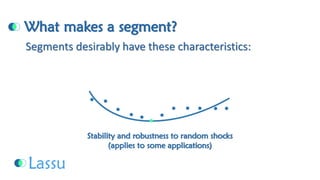
What makes a segment? Stability and robustness to random shocks(applies to some applications) Segments desirably have these characteristics:
What is Segmentation? “a process of creating groups of customers whohave SIMILAR behavior and characteristics”
Segmentation TypesUnsupervised data-driven segmentation; segments determined after data gathering and processing using statistical analysesSupervised segmentation based on pre-defined factors
Supervised Segmentation 
•Usually uses less variables with pre-defined “cuts”. 
•Ad-hoc, user-driven 
•Other variables are used as mere profilers and not active segmenters 
•Applicable when user has a distinct focus and variables of interest are readily available. 
30
Some Prototype Segmentations 
Customer Value versus Tenure 
Customer Value versus Transaction Type & Frequency 
Customer Value versus Risk 
Profit Margin or Profit Rate against Tenure, Transaction Frequency or Risk 
Purchase Behavior 
Other possible information: 
31 
Variety of Products Availed 
Life Stage 
Family Life Cycle 
The Remittance Market
Segmentation Variables 
•Measures the amount of business brought in by the customer 
•Also measures the capacity of a customer for cross-sell/upsell 
•There is difficulty in measuring “high”, “medium” and “low” value. 
•There are varying indicators of value 
•ADB (CA/SA) , Investments 
•Loan amount/ Outstanding Balance 
•Total purchase per transactionCustomer Value
Segmentation Variables 
•Measures the loyalty of customer with respect to time 
•Usually a “net time value”, i.e. lulls between product availment are not counted 
•Skewness in data is an issueTenure
Segmentation Variables 
•Identifies the “sleepers” from “transactors” 
•Number of Transactions per Month is a usual metric. 
•Time-between-transactionsis a good substitute segmentation variableTransaction Frequency
Segmentation Variables 
•Tag customers given certain warning signals 
•common indicators are: 
•Low ADB 
•Defaults 
•Lapses and claimsRisk Indicators
Segmentation Variables 
•Metric for each customer’s contribution to total profit 
•Used to level the number of products with the value of products availedProfitability
Segmentation Variables 
Common in Market Research but also evident in transactional information 
•Utility/benefit from product 
•Usage rate 
•Loyalty vis-à-vis switching, hopping, ambivalence 
•Propensity/Proclivity to buy/avail/take-up 
•Temporal stimuli (payday, holidays, special events) Behavior
Segmentation Variables 
Some segmentation variables are also profiling variables 
•Age, number of dependents, marital status 
•Ownerships (home, car, business, etc.) 
•Employment (nature of business, position, job tenure) 
•Geographic information 
•Delinquencies/ Fraud history, if any 
•ChannelsProfiling Variables
Cases in Point
Company A 
•Launched a loyalty card 
•Has big data on transactions 
•Known as an innovator 
•Challenge is to avert the impact of patent expiry and generic erosion
Company B 
•Has different/diverse businesses in different industries 
•Has product ownership, transactional data 
•Challenge is to maximize customer relationship through cross-sell and upsell
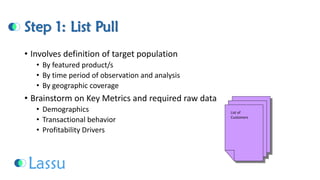
Step 1: List Pull 
•Involves definition of target population 
•By featured product/s 
•By time period of observation and analysis 
•By geographic coverage 
•Brainstorm on Key Metrics and required raw data 
•Demographics 
•Transactional behavior 
•Profitability Drivers 
List of Customers
List of CustomersStep 2: Single Customer View 
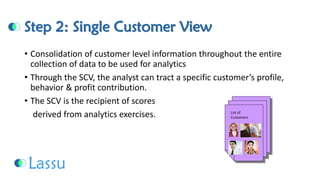
•Consolidation of customer level information throughout the entire collection of data to be used for analytics 
•Through the SCV, the analyst can tract a specific customer’s profile, behavior & profit contribution. 
•The SCV is the recipient of scores 
derived from analytics exercises.
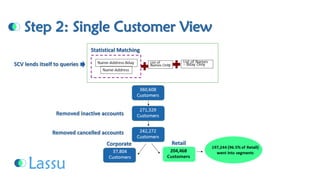
Step 2: Single Customer ViewSCV lends itself to queriesStatistical MatchingRemoved inactive accountsRemoved cancelled accountsCorporateRetail
Step 3: Segmentation 
•Identify and understand best and worst performing customers 
•Input for programs that focus on the following: 
•Increasing profitability 
•Motivating positive behavioral changes: 
•Activate sleepers 
•Increase usage of active customers 
•Leads to best targets for cross-selling and up-selling 
•Protect our most valued customers 
•It’s more expensive to acquire a new customer than retain a good one.
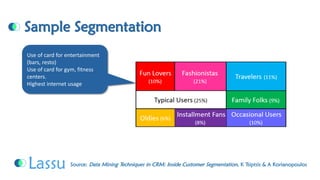
Sample SegmentationSource: Data Mining Techniques in CRM: Inside Customer Segmentation, K Tsiptsis & A Korianopoulos 
Use of card for entertainment (bars, resto) 
Use of card for gym, fitness centers. 
Highest internet usage
Sample SegmentationSource: Data Mining Techniques in CRM: Inside Customer Segmentation, K Tsiptsis & A Korianopoulos 
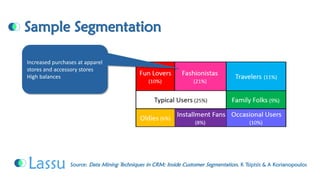
Increased purchases at apparel stores and accessory stores 
High balances
Sample SegmentationSource: Data Mining Techniques in CRM: Inside Customer Segmentation, K Tsiptsis & A Korianopoulos 
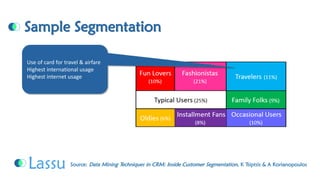
Use of card for travel & airfare 
Highest international usage 
Highest internet usage
Sample SegmentationSource: Data Mining Techniques in CRM: Inside Customer Segmentation, K Tsiptsis & A Korianopoulos 
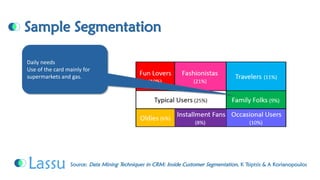
Daily needs 
Use of the card mainly for supermarkets and gas.
Sample SegmentationSource: Data Mining Techniques in CRM: Inside Customer Segmentation, K Tsiptsis & A Korianopoulos 
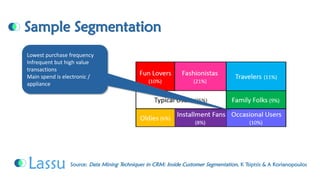
Lowest purchase frequency 
Infrequent but high value transactions 
Main spend is electronic / appliance
Sample SegmentationSource: Data Mining Techniques in CRM: Inside Customer Segmentation, K Tsiptsis & A Korianopoulos 
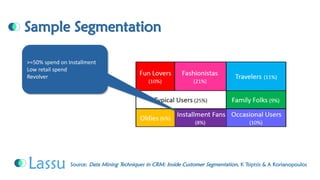
>=50% spend on Installment 
Low retail spend 
Revolver
Sample SegmentationSource: Data Mining Techniques in CRM: Inside Customer Segmentation, K Tsiptsis & A Korianopoulos 
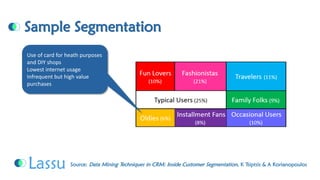
Use of card for heath purposes and DIY shops 
Lowest internet usage 
Infrequent but high value purchases
Sample SegmentationSource: Data Mining Techniques in CRM: Inside Customer Segmentation, K Tsiptsis & A Korianopoulos 
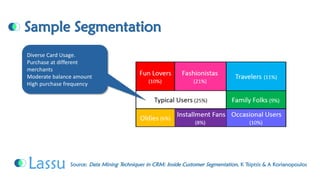
Diverse Card Usage. 
Purchase at different merchants 
Moderate balance amount 
High purchase frequency
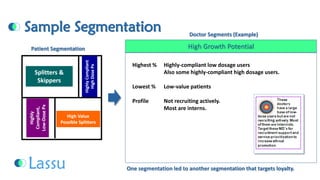
Sample SegmentationOne segmentation led to another segmentation that targets loyalty. Patient SegmentationDoctor Segments (Example) High Growth Potential 
Highest %Highly-compliant low dosage users 
Also some highly-compliant high dosage users. 
Lowest %Low-value patients 
ProfileNot recruiting actively. 
Most are interns.
Step 4: Analytics 
•Wide array of statistical analysis aimed at understanding the customer base and the derived segments. 
•Typical techniques are product association (market basket analysis), portfolio analysis (reports).
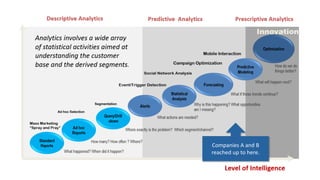
Companies A and B reached up to here.
Step 5: Event Detection 
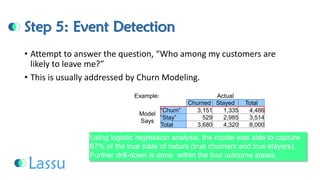
•Attempt to answer the question, “Who among my customers are likely to leave me?” 
•This is usually addressed by Churn Modeling. 
Example: 
Actual 
Churned 
Stayed 
Total 
Model 
Says 
“Churn” 
3,151 
1,335 
4,486 
“Stay” 
529 
2,985 
3,514 
Total 
3,680 
4,320 
8,000 
Using logistic regression analysis, themodelwas able to capture 87% of the true state of nature (true churners and true stayers). Further drill-down is done within the four outcome states.
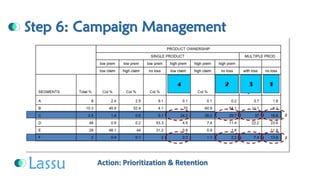
Step 6: Campaign ManagementAction: Prioritization & Retention
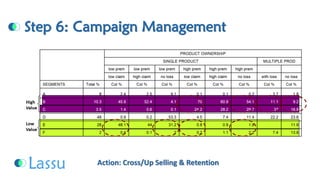
Step 6: Campaign ManagementAction: Cross/Up Selling & Retention
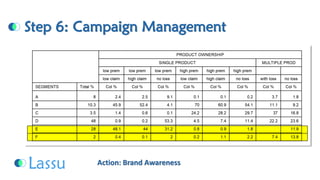
Step 6: Campaign ManagementAction: Brand Awareness
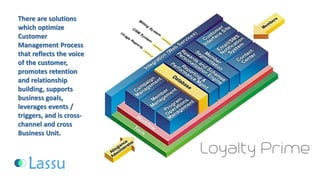
There are solutions which optimize Customer Management Process that reflects the voice of the customer, promotes retention and relationship building, supports business goals, leverages events / triggers, and is cross- channel and cross Business Unit.
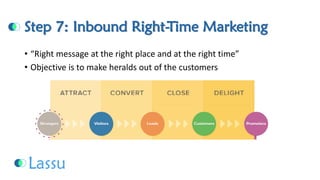
Step 7: Inbound Right-Time Marketing 
•“Right message at the right place and at the right time” 
•Objective is to make heralds out of the customers
Step 8 : Optimization 
•Cutting edge innovation 
•Tailor-fit customer relationship 
•Affinity and pride is established 
•Must beware of oversolicitation.
Please Remember 
•The goal of the segmentation analysis is to create manageable and meaningful customer groups among customers.
Please Remember 
•Segmentation is instrumental in increasing shareholder value by identifying: 
•Most high-value segment(s) 
•Segments with high potential for cross selling and/or up-selling 
•By focusing communications on a targeted segment, a causal effect would be a reduction in campaign costs
Please Remember 
•Segment definition 
•Supports retention, service prioritization and cross selling / up-selling efforts 
•Serves as input in developing new products 
•Segmentation is both a science and an art!
Thank you for your attention! Prof. Francisco N de los ReyesSchool of StatisticsUniversity of the Philippines, Diliman

2014 Customer Loyalty ASEAN Conference: Prof de los Reyes

  • 1.
    Role of Segmentationin Loyalty Marketing Prof. Francisco N. de los Reyes School of Statistics University of the Philippines, Diliman
  • 2.
    Marketing Maturity =Effectiveness & ROIList PullMaturity of Direct Marketing Marketing Effectiveness: ROI Courtesy of SAS
  • 3.
    SCV –Single CustomerViewList PullSCVMaturity of Direct Marketing Marketing Effectiveness: ROI “How many customers do I have?” Courtesy of SAS
  • 4.
    SegmentationList PullSCVSegmentMaturity ofDirect Marketing Marketing Effectiveness: ROI Courtesy of SAS“Who are my customers?”
  • 5.
    AnalyticsList PullSCVSegmentAnalyticsMaturity ofDirect Marketing Marketing Effectiveness: ROI Courtesy of SAS“How can I maximize my relationships?”
  • 6.
    Event DetectionList PullSCVSegmentAnalyticsEventDetectionMaturity of Direct Marketing Marketing Effectiveness: ROI Courtesy of SAS“Who might leave me?”
  • 7.
    Campaign ManagementList PullSCVSegmentAnalyticsEventDetectionCampaign MgmtMaturity of Direct Marketing Marketing Effectiveness: ROI Courtesy of SAS“How effective are my campaigns?”
  • 8.
    Inbound Right-Time MarketingListPullSCVSegmentAnalyticsEvent DetectionCampaign MgmtReal TimeMaturity of Direct Marketing Marketing Effectiveness: ROI Courtesy of SAS
  • 9.
    OptimizationList PullSCVSegmentAnalyticsEvent DetectionCampaignMgmtReal TimeOptimizeMaturity of Direct Marketing Marketing Effectiveness: ROI Courtesy of SAS
  • 10.
    Levels of SegmentationInformation Required Courtesy of SASNo Segmentation
  • 11.
    Levels of SegmentationInformation Required Courtesy of SASProducts OwnedNo Segmentation
  • 12.
    Levels of SegmentationInformation Required Courtesy of SASChannel UtilizationProducts OwnedNo Segmentation
  • 13.
    Levels of SegmentationInformation Required Courtesy of SASDemographicsChannel UtilizationProducts OwnedNo Segmentation
  • 14.
    Levels of SegmentationInformation Required Courtesy of SASTransaction InformationDemographicsChannel UtilizationProducts OwnedNo Segmentation
  • 15.
    Levels of SegmentationInformation Required Courtesy of SASPsycho- graphicsTransaction InformationDemographicsChannel UtilizationProducts OwnedNo Segmentation
  • 16.
    Levels of SegmentationInformation Required Courtesy of SAS1Psycho- graphicsTransaction InformationDemographicsChannel UtilizationProducts OwnedNo SegmentationSegment of One
  • 17.
    Customer SegmentationWhich customersegment contributes most to our bottom line? Key Business Questions
  • 18.
    Customer SegmentationWhich segmentsshould we grow? Key Business Questions
  • 19.
    Customer SegmentationWhich segmentsshould be retained or closely monitored? Key Business Questions
  • 20.
    Customer SegmentationWhat arethe profiles of customers in each segment? Key Business Questions
  • 21.
    Customer SegmentationWhat productsare saleable in each segment? Key Business Questions
  • 22.
    Customer Segmentation•Identifies strategicbusiness focus and direction•Analysis of customer behavior to gain insight into customer needs and preferencesKey Benefits & Capabilities
  • 23.
    What makes asegment? Measurable identifying elements that distinguish from othersSegments desirably have these characteristics:
  • 24.
    What makes asegment? Defined contact points or channels through which communication is possibleSegments desirably have these characteristics:
  • 25.
    What makes asegment? Quantifiable size so that cost computations may be done for targeting themSegments desirably have these characteristics:
  • 26.
    What makes asegment? Have generally unique stated or implied needsregarding the product or serviceSegments desirably have these characteristics:
  • 27.
    What makes asegment? Stability and robustness to random shocks(applies to some applications) Segments desirably have these characteristics:
  • 28.
    What is Segmentation?“a process of creating groups of customers whohave SIMILAR behavior and characteristics”
  • 29.
    Segmentation TypesUnsupervised data-drivensegmentation; segments determined after data gathering and processing using statistical analysesSupervised segmentation based on pre-defined factors
  • 30.
    Supervised Segmentation •Usuallyuses less variables with pre-defined “cuts”. •Ad-hoc, user-driven •Other variables are used as mere profilers and not active segmenters •Applicable when user has a distinct focus and variables of interest are readily available. 30
  • 31.
    Some Prototype Segmentations Customer Value versus Tenure Customer Value versus Transaction Type & Frequency Customer Value versus Risk Profit Margin or Profit Rate against Tenure, Transaction Frequency or Risk Purchase Behavior Other possible information: 31 Variety of Products Availed Life Stage Family Life Cycle The Remittance Market
  • 32.
    Segmentation Variables •Measuresthe amount of business brought in by the customer •Also measures the capacity of a customer for cross-sell/upsell •There is difficulty in measuring “high”, “medium” and “low” value. •There are varying indicators of value •ADB (CA/SA) , Investments •Loan amount/ Outstanding Balance •Total purchase per transactionCustomer Value
  • 33.
    Segmentation Variables •Measuresthe loyalty of customer with respect to time •Usually a “net time value”, i.e. lulls between product availment are not counted •Skewness in data is an issueTenure
  • 34.
    Segmentation Variables •Identifiesthe “sleepers” from “transactors” •Number of Transactions per Month is a usual metric. •Time-between-transactionsis a good substitute segmentation variableTransaction Frequency
  • 35.
    Segmentation Variables •Tagcustomers given certain warning signals •common indicators are: •Low ADB •Defaults •Lapses and claimsRisk Indicators
  • 36.
    Segmentation Variables •Metricfor each customer’s contribution to total profit •Used to level the number of products with the value of products availedProfitability
  • 37.
    Segmentation Variables Commonin Market Research but also evident in transactional information •Utility/benefit from product •Usage rate •Loyalty vis-à-vis switching, hopping, ambivalence •Propensity/Proclivity to buy/avail/take-up •Temporal stimuli (payday, holidays, special events) Behavior
  • 38.
    Segmentation Variables Somesegmentation variables are also profiling variables •Age, number of dependents, marital status •Ownerships (home, car, business, etc.) •Employment (nature of business, position, job tenure) •Geographic information •Delinquencies/ Fraud history, if any •ChannelsProfiling Variables
  • 39.
  • 40.
    Company A •Launcheda loyalty card •Has big data on transactions •Known as an innovator •Challenge is to avert the impact of patent expiry and generic erosion
  • 41.
    Company B •Hasdifferent/diverse businesses in different industries •Has product ownership, transactional data •Challenge is to maximize customer relationship through cross-sell and upsell
  • 42.
    Step 1: ListPull •Involves definition of target population •By featured product/s •By time period of observation and analysis •By geographic coverage •Brainstorm on Key Metrics and required raw data •Demographics •Transactional behavior •Profitability Drivers List of Customers
  • 43.
    List of CustomersStep2: Single Customer View •Consolidation of customer level information throughout the entire collection of data to be used for analytics •Through the SCV, the analyst can tract a specific customer’s profile, behavior & profit contribution. •The SCV is the recipient of scores derived from analytics exercises.
  • 44.
    Step 2: SingleCustomer ViewSCV lends itself to queriesStatistical MatchingRemoved inactive accountsRemoved cancelled accountsCorporateRetail
  • 45.
    Step 3: Segmentation •Identify and understand best and worst performing customers •Input for programs that focus on the following: •Increasing profitability •Motivating positive behavioral changes: •Activate sleepers •Increase usage of active customers •Leads to best targets for cross-selling and up-selling •Protect our most valued customers •It’s more expensive to acquire a new customer than retain a good one.
  • 46.
    Sample SegmentationSource: DataMining Techniques in CRM: Inside Customer Segmentation, K Tsiptsis & A Korianopoulos Use of card for entertainment (bars, resto) Use of card for gym, fitness centers. Highest internet usage
  • 47.
    Sample SegmentationSource: DataMining Techniques in CRM: Inside Customer Segmentation, K Tsiptsis & A Korianopoulos Increased purchases at apparel stores and accessory stores High balances
  • 48.
    Sample SegmentationSource: DataMining Techniques in CRM: Inside Customer Segmentation, K Tsiptsis & A Korianopoulos Use of card for travel & airfare Highest international usage Highest internet usage
  • 49.
    Sample SegmentationSource: DataMining Techniques in CRM: Inside Customer Segmentation, K Tsiptsis & A Korianopoulos Daily needs Use of the card mainly for supermarkets and gas.
  • 50.
    Sample SegmentationSource: DataMining Techniques in CRM: Inside Customer Segmentation, K Tsiptsis & A Korianopoulos Lowest purchase frequency Infrequent but high value transactions Main spend is electronic / appliance
  • 51.
    Sample SegmentationSource: DataMining Techniques in CRM: Inside Customer Segmentation, K Tsiptsis & A Korianopoulos >=50% spend on Installment Low retail spend Revolver
  • 52.
    Sample SegmentationSource: DataMining Techniques in CRM: Inside Customer Segmentation, K Tsiptsis & A Korianopoulos Use of card for heath purposes and DIY shops Lowest internet usage Infrequent but high value purchases
  • 53.
    Sample SegmentationSource: DataMining Techniques in CRM: Inside Customer Segmentation, K Tsiptsis & A Korianopoulos Diverse Card Usage. Purchase at different merchants Moderate balance amount High purchase frequency
  • 54.
    Sample SegmentationOne segmentationled to another segmentation that targets loyalty. Patient SegmentationDoctor Segments (Example) High Growth Potential Highest %Highly-compliant low dosage users Also some highly-compliant high dosage users. Lowest %Low-value patients ProfileNot recruiting actively. Most are interns.
  • 55.
    Step 4: Analytics •Wide array of statistical analysis aimed at understanding the customer base and the derived segments. •Typical techniques are product association (market basket analysis), portfolio analysis (reports).
  • 56.
    Companies A andB reached up to here.
  • 57.
    Step 5: EventDetection •Attempt to answer the question, “Who among my customers are likely to leave me?” •This is usually addressed by Churn Modeling. Example: Actual Churned Stayed Total Model Says “Churn” 3,151 1,335 4,486 “Stay” 529 2,985 3,514 Total 3,680 4,320 8,000 Using logistic regression analysis, themodelwas able to capture 87% of the true state of nature (true churners and true stayers). Further drill-down is done within the four outcome states.
  • 58.
    Step 6: CampaignManagementAction: Prioritization & Retention
  • 59.
    Step 6: CampaignManagementAction: Cross/Up Selling & Retention
  • 60.
    Step 6: CampaignManagementAction: Brand Awareness
  • 61.
    There are solutionswhich optimize Customer Management Process that reflects the voice of the customer, promotes retention and relationship building, supports business goals, leverages events / triggers, and is cross- channel and cross Business Unit.
  • 62.
    Step 7: InboundRight-Time Marketing •“Right message at the right place and at the right time” •Objective is to make heralds out of the customers
  • 63.
    Step 8 :Optimization •Cutting edge innovation •Tailor-fit customer relationship •Affinity and pride is established •Must beware of oversolicitation.
  • 64.
    Please Remember •Thegoal of the segmentation analysis is to create manageable and meaningful customer groups among customers.
  • 65.
    Please Remember •Segmentationis instrumental in increasing shareholder value by identifying: •Most high-value segment(s) •Segments with high potential for cross selling and/or up-selling •By focusing communications on a targeted segment, a causal effect would be a reduction in campaign costs
  • 66.
    Please Remember •Segmentdefinition •Supports retention, service prioritization and cross selling / up-selling efforts •Serves as input in developing new products •Segmentation is both a science and an art!
  • 67.
    Thank you foryour attention! Prof. Francisco N de los ReyesSchool of StatisticsUniversity of the Philippines, Diliman