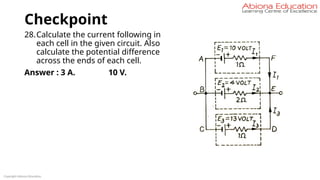
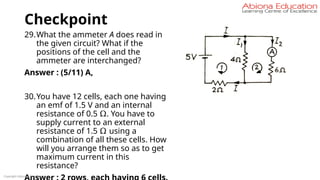
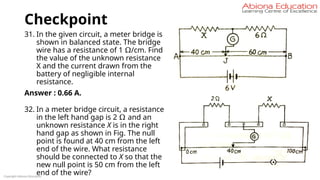
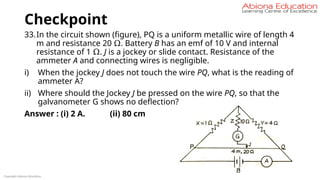
Current Electricity
Class XII | Physics | Chapter 3
Current Electricity 1
Copyright Abiona Education
Current Density
Copyright Abiona Education
Electric Current
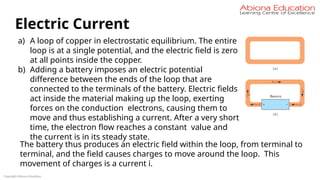
a) A loop of copper in electrostatic equilibrium. The entire
loop is at a single potential, and the electric field is zero
at all points inside the copper.
b) Adding a battery imposes an electric potential
difference between the ends of the loop that are
connected to the terminals of the battery. Electric fields
act inside the material making up the loop, exerting
forces on the conduction electrons, causing them to
move and thus establishing a current. After a very short
time, the electron flow reaches a constant value and
the current is in its steady state.
The battery thus produces an electric field within the loop, from terminal to
terminal, and the field causes charges to move around the loop. This
movement of charges is a current i.
Copyright Abiona Education
Electric Current
Although an electric current is a stream of moving charges, not all moving
charges constitute an electric current. If there is to be an electric current
through a given surface, there must be a net flow of charge through that
surface.
The free electrons (conduction electrons) in an isolated length of copper
wire are
in random motion at speeds of the order of 106
m/s.
If you pass a hypothetical plane through such a wire, conduction electrons
pass through it in both directions at the rate of many billions per second—but
there is no net transport of charge and thus no current through the wire.
However, if you connect the ends of the wire to a battery, you slightly bias the
flow in one direction, with the result that there now is a net transport of
Copyright Abiona Education
Electric Current
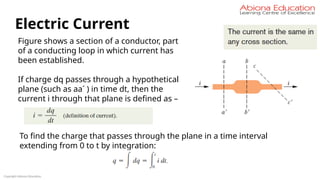
Figure shows a section of a conductor, part
of a conducting loop in which current has
been established.
If charge dq passes through a hypothetical
plane (such as aa´ ) in time dt, then the
current i through that plane is defined as –
To find the charge that passes through the plane in a time interval
extending from 0 to t by integration:
Copyright Abiona Education
Electric Current
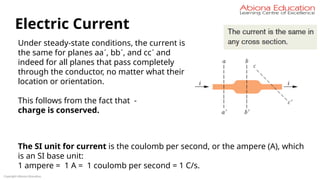
Under steady-state conditions, the current is
the same for planes aa´, bb´, and cc´ and
indeed for all planes that pass completely
through the conductor, no matter what their
location or orientation.
This follows from the fact that -
charge is conserved.
The SI unit for current is the coulomb per second, or the ampere (A), which
is an SI base unit:
1 ampere = 1 A = 1 coulomb per second = 1 C/s.
Copyright Abiona Education
Electric Current
Current is a scalar quantity because both charge and
time in that equation are scalars.
we often represent a current with an arrow to indicate
that charge is moving. Such arrows are not vectors
and they do not require vector addition.
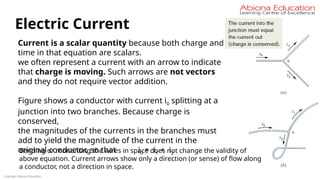
Figure shows a conductor with current i0 splitting at a
junction into two branches. Because charge is
conserved,
the magnitudes of the currents in the branches must
add to yield the magnitude of the current in the
original conductor, so that i0 = i1 + i2
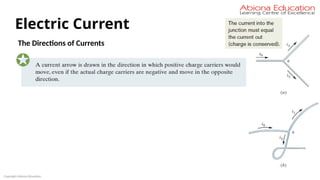
Bending or reorienting the wires in space does not change the validity of
above equation. Current arrows show only a direction (or sense) of flow along
a conductor, not a direction in space.
Copyright Abiona Education
Electric Current
The Directions of Currents
Copyright Abiona Education
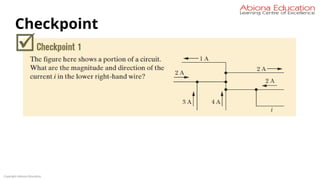
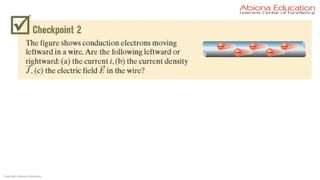
Checkpoint
Copyright Abiona Education
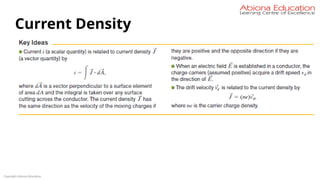
Current Density
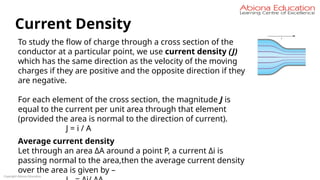
To study the flow of charge through a cross section of the
conductor at a particular point, we use current density (J)
which has the same direction as the velocity of the moving
charges if they are positive and the opposite direction if they
are negative.
For each element of the cross section, the magnitude J is
equal to the current per unit area through that element
(provided the area is normal to the direction of current).
J = i / A
Average current density
Let through an area ΔA around a point P, a current Δi is
passing normal to the area,then the average current density
over the area is given by –
Copyright Abiona Education
Current Density
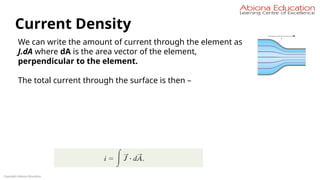
We can write the amount of current through the element as
J.dA where dA is the area vector of the element,
perpendicular to the element.
The total current through the surface is then –
Copyright Abiona Education
Current Density
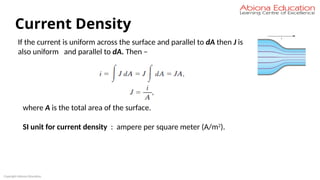
If the current is uniform across the surface and parallel to dA then J is
also uniform and parallel to dA. Then –
where A is the total area of the surface.
SI unit for current density : ampere per square meter (A/m2
).
Copyright Abiona Education
Current Density
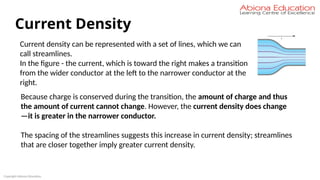
Current density can be represented with a set of lines, which we can
call streamlines.
In the figure - the current, which is toward the right makes a transition
from the wider conductor at the left to the narrower conductor at the
right.
Because charge is conserved during the transition, the amount of charge and thus
the amount of current cannot change. However, the current density does change
—it is greater in the narrower conductor.
The spacing of the streamlines suggests this increase in current density; streamlines
that are closer together imply greater current density.
Copyright Abiona Education
Current Density
Relation between J and E
J = I / A = V / RA = EL/ (ρL/A)A = E / ρ = σE
Or, J = σE
Or, E = ρJ
Current density is proportional to electric field
Direction of Current density is same as that of E
If electric field is uniform, current density will be constant.
If electric field is zero, current density and hence current will be zero
Copyright Abiona Education
Drift Speed
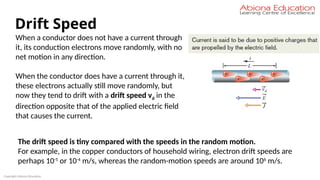
When a conductor does not have a current through
it, its conduction electrons move randomly, with no
net motion in any direction.
When the conductor does have a current through it,
these electrons actually still move randomly, but
now they tend to drift with a drift speed vd in the
direction opposite that of the applied electric field
that causes the current.
The drift speed is tiny compared with the speeds in the random motion.
For example, in the copper conductors of household wiring, electron drift speeds are
perhaps 10-5
or 10-4
m/s, whereas the random-motion speeds are around 106
m/s.
Copyright Abiona Education
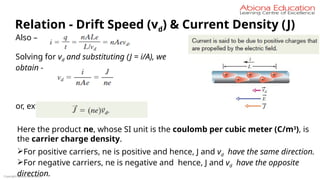
Relation - Drift Speed (vd) & Current Density (J)
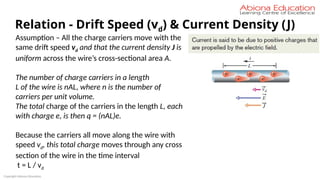
Assumption – All the charge carriers move with the
same drift speed vd and that the current density J is
uniform across the wire’s cross-sectional area A.
The number of charge carriers in a length
L of the wire is nAL, where n is the number of
carriers per unit volume.
The total charge of the carriers in the length L, each
with charge e, is then q = (nAL)e.
Because the carriers all move along the wire with
speed vd, this total charge moves through any cross
section of the wire in the time interval
t = L / vd
Copyright Abiona Education
Relation - Drift Speed (vd) & Current Density (J)
Also –
Solving for vd and substituting (J = i/A), we
obtain -
or, extended to vector form,
Here the product ne, whose SI unit is the coulomb per cubic meter (C/m3
), is
the carrier charge density.
For positive carriers, ne is positive and hence, J and vd have the same direction.
For negative carriers, ne is negative and hence, J and vd have the opposite
direction.
Copyright Abiona Education
Checkpoint
A copper wire has a square cross section of 6mm on a side. The wire is 10 m
long and carries a current of 3.6A. The density of free electrons is 8.5x1028
/
m3
. Find the magnitude of (a) the current density in the wire (b) electric field in
the wire (c) How much time is required for an electron to travel the length of
the wire. (Electrical resistivity = 1.72 x 10⁻⁸
Ohm-m.)
Ans:
(a)105
Am-2
(b) 1.72 x 10⁻³
Vm-1
(c) 1.36 x 10⁶
s
Copyright Abiona Education
Checkpoint
(a) Estimate the average drift speed of conduction electrons in a copper wire
of cross section area 1.0 x 10⁻⁷
m2
carrying a current of 1.5 A. Assume that
each Cu atom contributes roughly one conduction electron. The density of
Cu is 9.0 x 10³
kg/m3
and atomic mass is 63.5u.
(b) Compare the drift speed obtained with the speed of propagation of electric
field along the conductor , which cause the drift motion.
Ans:
(c) Vd = 1.1 mms-1
(d) An electric field traveling along the conductor has a speed of an
electromagnetic wave (3x10⁸
m/s)
Copyright Abiona Education
Checkpoint
How much time will be taken by an electron to move a distance l = 1 km in
copper wire of cross section A = 1mm2
, if it carries a current of 4.5 A? n=
1028
Ans: 3x 10⁶
sec
Find the approximate total distance travelled by an electron in the time
interval in which its displacement is 1m along the wire.
An:109
m
Copyright Abiona Education
Resistance and Resistivity
Copyright Abiona Education
Concept of Resistance
When current flows through a conductor, the conductor offers some
obstruction to the flow of the current. The obstruction offered to the flow of
current by the conductor or wire is called its resistance.
Cause of Resistance
Metal has free electrons and an equal number of positive ions (atoms which
has lost electrons. The positive ions do not move whereas electrons move
almost freely. These electrons are called as Free Electrons or Conduction
Electrons.
These free electrons moves at random and collide with each other and the
positive ions.
Copyright Abiona Education
Cause of Resistance
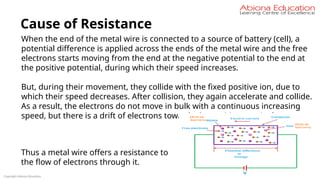
When the end of the metal wire is connected to a source of battery (cell), a
potential difference is applied across the ends of the metal wire and the free
electrons starts moving from the end at the negative potential to the end at
the positive potential, during which their speed increases.
But, during their movement, they collide with the fixed positive ion, due to
which their speed decreases. After collision, they again accelerate and collide.
As a result, the electrons do not move in bulk with a continuous increasing
speed, but there is a drift of electrons towards the positive terminal.
Thus a metal wire offers a resistance to
the flow of electrons through it.
Copyright Abiona Education
Colour code of Resistance
What is Resistor Colour Code?
Resistors are usually very tiny, and it is challenging to print resistance values
on them. So, colour bands are printed on them to represent the electrical
resistance. These colour bands are known as resistor colour codes.
Copyright Abiona Education
Colour code of Resistance
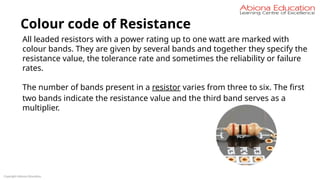
All leaded resistors with a power rating up to one watt are marked with
colour bands. They are given by several bands and together they specify the
resistance value, the tolerance rate and sometimes the reliability or failure
rates.
The number of bands present in a resistor varies from three to six. The first
two bands indicate the resistance value and the third band serves as a
multiplier.
Copyright Abiona Education
Resistance Color Table
Copyright Abiona Education
Resistance Color Table
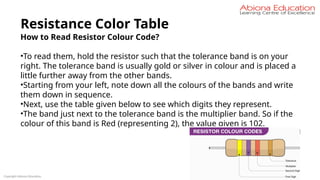
How to Read Resistor Colour Code?
•To read them, hold the resistor such that the tolerance band is on your
right. The tolerance band is usually gold or silver in colour and is placed a
little further away from the other bands.
•Starting from your left, note down all the colours of the bands and write
them down in sequence.
•Next, use the table given below to see which digits they represent.
•The band just next to the tolerance band is the multiplier band. So if the
colour of this band is Red (representing 2), the value given is 102.
Copyright Abiona Education
Resistance Color Table
Copyright Abiona Education
Resistance Color Table
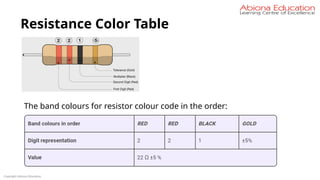
The band colours for resistor colour code in the order:
Copyright Abiona Education
Factors affecting the Resistance of a conductor
The resistance (R) between the ends of the conductor depends on following 4
factors:
1. Nature of the conductor: Different substances have different
concentration of free electrons, depending upon its material. Based on that
we have good conductors & poor conductors (insulators).
2. Length (l) of the conductor: No of collisions will be more in a long
conductor, hence R  l
3. Thickness or Area of cross section (A) of the conductor: R  1/A
4. Temperature of the conductor (T): R  T
Copyright Abiona Education
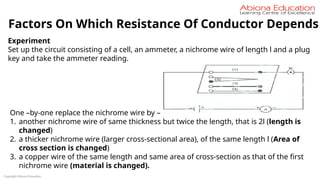
Experiment
Set up the circuit consisting of a cell, an ammeter, a nichrome wire of length l and a plug
key and take the ammeter reading.
One –by-one replace the nichrome wire by –
1. another nichrome wire of same thickness but twice the length, that is 2l (length is
changed)
2. a thicker nichrome wire (larger cross-sectional area), of the same length l (Area of
cross section is changed)
3. a copper wire of the same length and same area of cross-section as that of the first
nichrome wire (material is changed).
Factors On Which Resistance Of Conductor Depends
Copyright Abiona Education
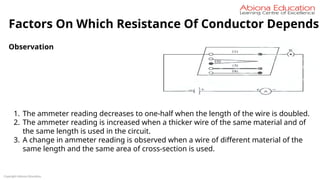
Observation
1. The ammeter reading decreases to one-half when the length of the wire is doubled.
2. The ammeter reading is increased when a thicker wire of the same material and of
the same length is used in the circuit.
3. A change in ammeter reading is observed when a wire of different material of the
same length and the same area of cross-section is used.
Factors On Which Resistance Of Conductor Depends
Copyright Abiona Education
Conclusion
Resistance of the conductor depends on –
1. Length
2. area of cross-section
3. Nature of its material.
Precise measurements have shown that –
Resistance of a uniform metallic conductor is directly proportional to its length (l)
and inversely proportional to the area of cross-section (A). That is,
R l
∝ and R 1/A
∝
Combining Eqs. we get , R l / A
∝
or, R = ρ l / A
where ρ (rho) is a constant of proportionality and is called the electrical resistivity of
the material of the conductor.
SI unit of resistivity is Ω m. [ ρ = RA/l = Ω x m2
/ m = Ω x m ]
Factors On Which Resistance Of Conductor Depends
Copyright Abiona Education
Factors On Which Resistance Of Conductor Depends
Conclusion
It is a characteristic property of the material.
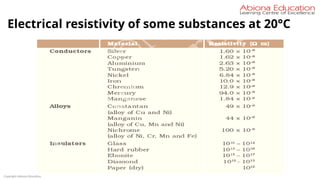
The metals and alloys have very low resistivity in the range of 10–8
Ω m to 10–6
Ω m. They
are good conductors of electricity.
Insulators like rubber and glass have resistivity of the order of 1012
to 1017
Ω m.
Note: Both the resistance and resistivity of a material vary with temperature.
Resistivity of an alloy is generally higher than that of its constituent metals. Alloys do not
oxidize (burn) readily at high temperatures. For this reason, they are commonly used in
electrical heating devices, like electric iron, toasters etc.
Tungsten is used almost exclusively for filaments of electric bulbs, whereas copper and
aluminum are generally used for electrical transmission lines.
Copyright Abiona Education
Electrical resistivity of some substances at 20°C
Copyright Abiona Education
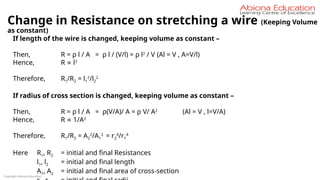
Change in Resistance on stretching a wire (Keeping Volume
as constant)
If length of the wire is changed, keeping volume as constant –
Then, R = ρ l / A = ρ l / (V/l) = ρ l2
/ V (Al = V , A=V/l)
Hence, R l
∝ 2
Therefore, R1/R2 = l1
2
/l2
2
If radius of cross section is changed, keeping volume as constant –
Then, R = ρ l / A = ρ(V/A)/ A = ρ V/ A2
(Al = V , l=V/A)
Hence, R 1/A
∝ 2
Therefore, R1/R2 = A2
2
/A1
2
= r2
4
/r1
4
Here R1, R2 = initial and final Resistances
l1, l2 = initial and final length
A1, A2 = initial and final area of cross-section
Copyright Abiona Education
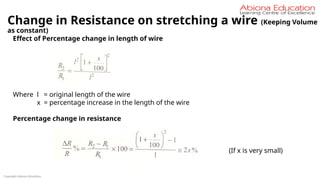
Change in Resistance on stretching a wire (Keeping Volume
as constant)
Effect of Percentage change in length of wire
Where l = original length of the wire
x = percentage increase in the length of the wire
Percentage change in resistance
(If x is very small)
Copyright Abiona Education
Checkpoint
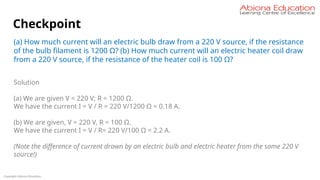
(a) How much current will an electric bulb draw from a 220 V source, if the resistance
of the bulb filament is 1200 Ω? (b) How much current will an electric heater coil draw
from a 220 V source, if the resistance of the heater coil is 100 Ω?
Solution
(a) We are given V = 220 V; R = 1200 Ω.
We have the current I = V / R = 220 V/1200 Ω = 0.18 A.
(b) We are given, V = 220 V, R = 100 Ω.
We have the current I = V / R= 220 V/100 Ω = 2.2 A.
(Note the difference of current drawn by an electric bulb and electric heater from the same 220 V
source!)
Copyright Abiona Education
Checkpoint
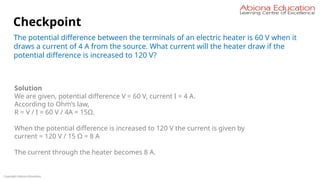
The potential difference between the terminals of an electric heater is 60 V when it
draws a current of 4 A from the source. What current will the heater draw if the
potential difference is increased to 120 V?
Solution
We are given, potential difference V = 60 V, current I = 4 A.
According to Ohm’s law,
R = V / I = 60 V / 4A = 15Ω.
When the potential difference is increased to 120 V the current is given by
current = 120 V / 15 Ω = 8 A
The current through the heater becomes 8 A.
Copyright Abiona Education
Checkpoint
Resistance of a metal wire of length 1 m is 26 Ω at 20°C. If the diameter of the wire is
0.3 mm, what will be the resistivity of the metal at that temperature?
Solution
We are given the resistance R of the wire = 26 Ω, diameter d = 0.3 mm = 3 × 10⁻⁴ m, and the
length l of the wire = 1 m.
Therefore, the resistivity of the given metallic wire is
ρ = (RA/l) = (Rπd2/4l )
Substitution of values in this gives
ρ = 1.84 × 10⁻⁶ Ω m
The resistivity of the metal at 20°C is 1.84 × 10⁻⁶ Ω m.
Copyright Abiona Education
Checkpoint
A wire of given material having length l and area of cross-section A has a resistance of
4 Ω. What would be the resistance of another wire of the same material having length
l/2 and area of cross-section 2A?
Solution
For first wire , R1 = ρ l /A = 4Ω
Now for second wire, R2 = ρ (L/2) /2A
R2= 1Ω
The resistance of the new wire is 1Ω.
Copyright Abiona Education
Checkpoint
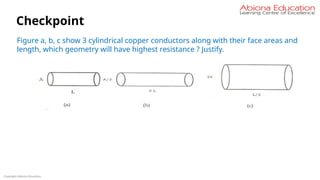
Figure a, b, c show 3 cylindrical copper conductors along with their face areas and
length, which geometry will have highest resistance ? Justify.
Copyright Abiona Education
Checkpoint
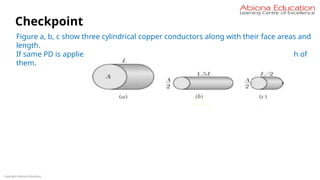
Figure a, b, c show three cylindrical copper conductors along with their face areas and
length.
If same PD is applied across each , then compare the current passing though each of
them.
Copyright Abiona Education
Checkpoint
The resistivity of three metals namely iron, silver and mercury are 10 x 10-8 ohm-m,
1.6 x 10⁻⁸
ohm-m and 94 x 10-8
ohm-m respectively. Answer the following using the
given data –
a) Which among the 3 metals is the best conductor?
b) If the length of the iron conductor is doubled, what will happen to its resistivity?
Copyright Abiona Education
Checkpoint
Compare the resistivity and resistance of two cubes of sides a and 3a, made of same
material.
Copyright Abiona Education
Checkpoint
If a wire is stretched to double its length, find the new resistance, if the original
resistance of the wire was R.
Ans: 4R
Copyright Abiona Education
Checkpoint
A wire is stretched to increase it’s length by 1%, find the percentage change in the
resistance.
Ans: 2%
Copyright Abiona Education
Checkpoint
A hollow cylinder of length l has inner and outer radius as a and b respectively. If the
resistivity of the material of the wire is ρ, then find the resistance of the cylinder
across the end of the cylinder.
Ans: ρl / π (b2
– a2
)
Copyright Abiona Education
Check Your Progress
1. On what factors does the resistance of a conductor depend?
2. Will current flow more easily through a thick wire or a thin wire of the same
material, when connected to the same source? Why?
3. Let the resistance of an electrical component remains constant while the potential
difference across the two ends of the component decreases to half of its former
value. What change will occur in the current through it?
4. Why are coils of electric toasters and electric irons made of an alloy rather than a
pure metal?
Copyright Abiona Education
Check Your Progress
5. Use the data in below Table to answer the following –
(a) Which among iron and mercury is a better conductor?
(b) Which material is the best conductor?
Copyright Abiona Education
Ohm’s Law
Copyright Abiona Education
Ohm’s Law
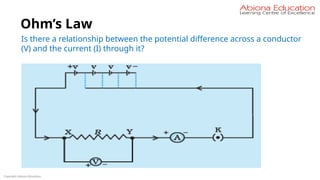
Is there a relationship between the potential difference across a conductor
(V) and the current (I) through it?
Copyright Abiona Education
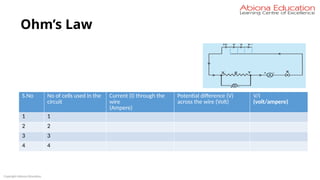
S.No No of cells used in the
circuit
Current (I) through the
wire
(Ampere)
Potential difference (V)
across the wire (Volt)
V/I
(volt/ampere)
1 1
2 2
3 3
4 4
Ohm’s Law
Copyright Abiona Education
S.No No of cells used in the
circuit
Current (I) through the
wire
(Ampere)
Potential difference (V)
across the wire (Volt)
V/I
(volt/ampere)
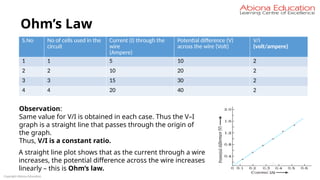
1 1 5 10 2
2 2 10 20 2
3 3 15 30 2
4 4 20 40 2
Observation:
Same value for V/I is obtained in each case. Thus the V–I
graph is a straight line that passes through the origin of
the graph.
Thus, V/I is a constant ratio.
A straight line plot shows that as the current through a wire
increases, the potential difference across the wire increases
linearly – this is Ohm’s law.
Ohm’s Law
Copyright Abiona Education
Ohm’s Law
A German physicist Georg Simon Ohm found out the relationship between the
current I, flowing in a metallic wire and the potential difference across its
terminals. The potential difference, V, across the ends of a given metallic
wire in an electric circuit is directly proportional to the current flowing
through it, provided its temperature remains the same. This is called Ohm’s
law.
In other words – V I
∝
or V/I = constant = R
V = IR
Here, R is a constant for the given metallic wire at a given temperature and is
called its resistance.
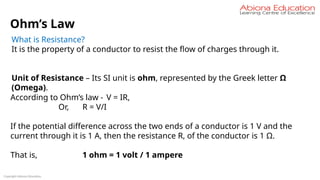
What is Resistance?
It is the property of a conductor to resist the flow of charges through it.
Copyright Abiona Education
What is Resistance?
It is the property of a conductor to resist the flow of charges through it.
Unit of Resistance – Its SI unit is ohm, represented by the Greek letter Ω
(Omega).
According to Ohm’s law - V = IR,
Or, R = V/I
If the potential difference across the two ends of a conductor is 1 V and the
current through it is 1 A, then the resistance R, of the conductor is 1 Ω.
That is, 1 ohm = 1 volt / 1 ampere
Ohm’s Law
Copyright Abiona Education
Ohm’s Law
Also, I = V/R
Current through a resistor is inversely proportional to its resistance.
If the resistance is doubled the current gets halved. In many practical cases it is
necessary to increase or decrease the current in an electric circuit.
A component used to regulate current without changing the voltage source
is called variable resistance. In an electric circuit, a device called rheostat is
often used to change the resistance in the circuit.
Conductance
The reciprocal of resistance is Conductance.
SI Unit : mho or (ohm) -1
Copyright Abiona Education
Ohm’s Law
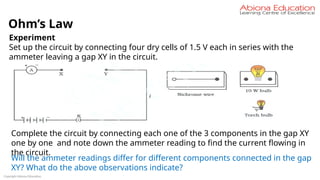
Experiment
Set up the circuit by connecting four dry cells of 1.5 V each in series with the
ammeter leaving a gap XY in the circuit.
Complete the circuit by connecting each one of the 3 components in the gap XY
one by one and note down the ammeter reading to find the current flowing in
the circuit.
Will the ammeter readings differ for different components connected in the gap
XY? What do the above observations indicate?
Copyright Abiona Education
Ohm’s Law
Observation:
Current is different for different components.
Why do they differ?
Certain components offer an easy path for the flow of electric current while the others
resist the flow.
Why?
Because motion of electrons in an electric circuit constitutes an electric current. The
electrons, however, are not completely free to move within a conductor. They are
restrained by the attraction of the atoms among which they move. Thus, motion of
electrons through a conductor is retarded by its resistance.
A component of a given size that offers a low resistance is a good conductor. A
conductor having some appreciable resistance is called a resistor. A component of
identical size that offers a higher resistance is a poor conductor. An insulator of the
same size offers even higher resistance.
Copyright Abiona Education
Ohm’s Law
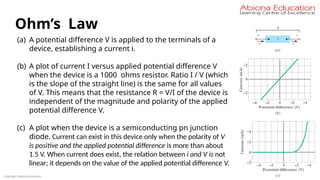
(a) A potential difference V is applied to the terminals of a
device, establishing a current i.
(b) A plot of current I versus applied potential difference V
when the device is a 1000 ohms resistor. Ratio I / V (which
is the slope of the straight line) is the same for all values
of V. This means that the resistance R = V/I of the device is
independent of the magnitude and polarity of the applied
potential difference V.
(c) A plot when the device is a semiconducting pn junction
diode. Current can exist in this device only when the polarity of V
is positive and the applied potential difference is more than about
1.5 V. When current does exist, the relation between i and V is not
linear; it depends on the value of the applied potential difference V.
Copyright Abiona Education
Ohm’s Law
We distinguish between the two types of device by saying
that one obeys Ohm’s law and the other does not.
Copyright Abiona Education
Ohm’s Law
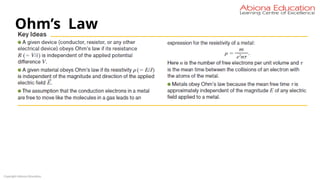
It is often contended that V = iR is a statement of Ohm’s law.
That is not true!
This equation is the defining equation for resistance, and it
applies to all conducting devices, whether they obey Ohm’s
law or not.
If we measure the potential difference V across, and the
current i through, any device, even a p-n junction diode, we
can find its resistance at that value of V as R = V/i.
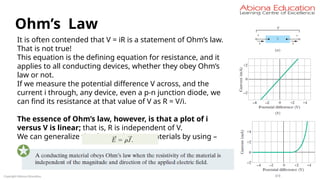
The essence of Ohm’s law, however, is that a plot of i
versus V is linear; that is, R is independent of V.
We can generalize this for conducting materials by using –
Copyright Abiona Education
Validity and failure of Ohm’s Law
Ohm’s law is not a law of nature, i.e., it is not a universal law that applies everywhere
under all conditions.
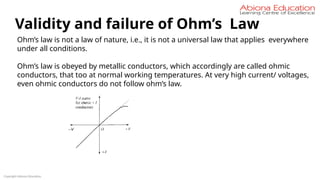
Ohm’s law is obeyed by metallic conductors, which accordingly are called ohmic
conductors, that too at normal working temperatures. At very high current/ voltages,
even ohmic conductors do not follow ohm’s law.
Copyright Abiona Education
Validity and failure of Ohm’s Law
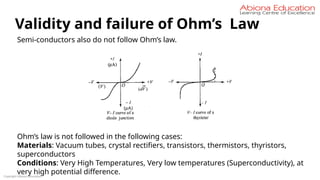
Semi-conductors also do not follow Ohm’s law.
Ohm’s law is not followed in the following cases:
Materials: Vacuum tubes, crystal rectifiers, transistors, thermistors, thyristors,
superconductors
Conditions: Very High Temperatures, Very low temperatures (Superconductivity), at
very high potential difference.
Copyright Abiona Education
A Microscopic View of Ohm’s Law
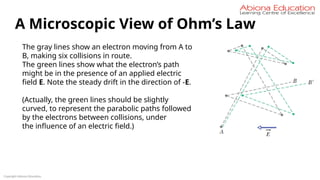
The gray lines show an electron moving from A to
B, making six collisions in route.
The green lines show what the electron’s path
might be in the presence of an applied electric
field E. Note the steady drift in the direction of -E.
(Actually, the green lines should be slightly
curved, to represent the parabolic paths followed
by the electrons between collisions, under
the influence of an electric field.)
Copyright Abiona Education
A Microscopic View of Ohm’s Law
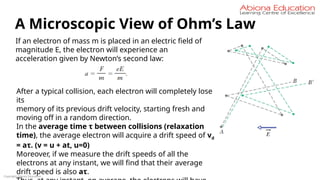
If an electron of mass m is placed in an electric field of
magnitude E, the electron will experience an
acceleration given by Newton’s second law:
After a typical collision, each electron will completely lose
its
memory of its previous drift velocity, starting fresh and
moving off in a random direction.
In the average time τ between collisions (relaxation
time), the average electron will acquire a drift speed of vd
= aτ. (v = u + at, u=0)
Moreover, if we measure the drift speeds of all the
electrons at any instant, we will find that their average
drift speed is also aτ.
Copyright Abiona Education
A Microscopic View of Ohm’s Law
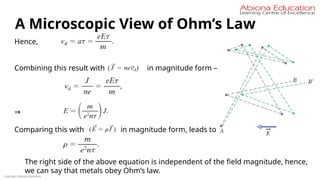
Hence,
Combining this result with in magnitude form –
⇒
Comparing this with in magnitude form, leads to
The right side of the above equation is independent of the field magnitude, hence,
we can say that metals obey Ohm’s law.
Copyright Abiona Education
Mobility
Conductivity arises from mobile charge carriers.
In metals, these mobile charge carriers are electrons; in an ionized gas they are
electrons and positive charge ions; in an electrolyte, they can be both positive and
negative ions. In a semiconductor material (e.g., Si, Ge), conduction is partly due to
electrons and partly due to electron vacancies (called as holes). Holes are sight of
missing electrons that acts as positive charges.
An important quantity is the mobility μ as the magnitude of the drift velocity per
unit electric field.
μ = Vd / E
Copyright Abiona Education
Checkpoint
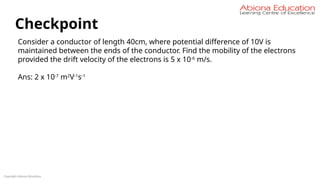
Consider a conductor of length 40cm, where potential difference of 10V is
maintained between the ends of the conductor. Find the mobility of the electrons
provided the drift velocity of the electrons is 5 x 10⁻⁶
m/s.
Ans: 2 x 10⁻⁷
m2
V-1
s-1
Checkpoint
71
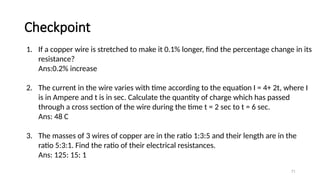
1. If a copper wire is stretched to make it 0.1% longer, find the percentage change in its
resistance?
Ans:0.2% increase
2. The current in the wire varies with time according to the equation I = 4+ 2t, where I
is in Ampere and t is in sec. Calculate the quantity of charge which has passed
through a cross section of the wire during the time t = 2 sec to t = 6 sec.
Ans: 48 C
3. The masses of 3 wires of copper are in the ratio 1:3:5 and their length are in the
ratio 5:3:1. Find the ratio of their electrical resistances.
Ans: 125: 15: 1
Checkpoint
72
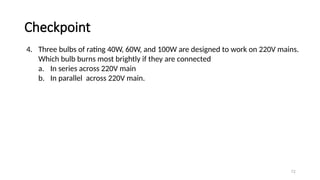
4. Three bulbs of rating 40W, 60W, and 100W are designed to work on 220V mains.
Which bulb burns most brightly if they are connected
a. In series across 220V main
b. In parallel across 220V main.
Effect of Temperature on Resistivity &
Resistance
73
As long as the temperature f the material is constant, the resistivity of the
material also remains constant. As the temperature of the material increases,
the relaxation time decreases, resistivity increases and hence resistance
increases.
As no of electrons per unit volume goes up the resistance decreases. This is
because the density of electron increases, more electrons can flow in response
to the potential difference and hence the current will increase. Therefore the
resistance decreases.
Effect of Temperature on Resistivity &
Resistance
74
Temperature coefficient of Resistivity
RT = RTo [ 1 + α(T – To) + β (T – To)2
]
Here α, β are called temperature
coefficient of resistivity.
In case of pure metal, β is very small, so
the resistance varies linearly with the rise
in temperature.
RT = RTo [ 1 + α(T – To)]
Similarly, resistivity also varies linearly with the rise in temperature -
ρT = ρTo [ 1 + α(T – To)]
Dimension of α : (Temperature)- 1
Effect of Temperature on Resistivity &
Resistance
75
Temperature coefficient of Resistivity
RT = RTo [ 1 + α(T – To) + β (T – To)2
]
Here α, β are called temperature
coefficient of resistivity.
In case of pure metal, β is very small, so
the resistance varies linearly with the rise
in temperature.
RT = RTo [ 1 + α(T – To)]
Similarly, resistivity also varies linearly with the rise in temperature -
ρT = ρTo [ 1 + α(T – To)]
Dimension of α : (Temperature)- 1
Checkpoint
76
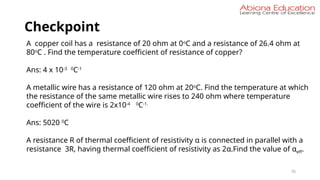
A copper coil has a resistance of 20 ohm at 0o
C and a resistance of 26.4 ohm at
80o
C . Find the temperature coefficient of resistance of copper?
Ans: 4 x 10⁻³ 0
C-1
A metallic wire has a resistance of 120 ohm at 20o
C. Find the temperature at which
the resistance of the same metallic wire rises to 240 ohm where temperature
coefficient of the wire is 2x10⁻⁴ 0
C-1.
Ans: 5020 0
C
A resistance R of thermal coefficient of resistivity α is connected in parallel with a
resistance 3R, having thermal coefficient of resistivity as 2α.Find the value of αeff.
Electric Cell
77
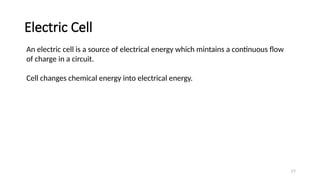
An electric cell is a source of electrical energy which mintains a continuous flow
of charge in a circuit.
Cell changes chemical energy into electrical energy.
Copyright Abiona Education
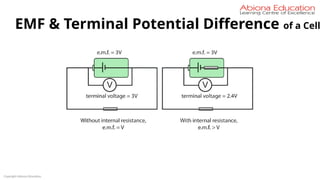
EMF & Terminal Potential Difference of a Cell
What is a Cell?
A cell is a device which provides the necessary potential difference to an electrical
circuit to maintain a continuous flow of current in it.
Electromotive force (e.m.f.)
The maximum potential difference between two electrodes or terminals of a cell in
an open circuit (i.e., a cell delivering no current) is called as the electromotive force
(e.m.f.) of the cell.
The electromotive force of a cell can also de defined as the energy supplied by the
cell to drive a unit charge around the complete circuit.
It is denoted by ɛ symbol.
SI Unit : volt (V) - same as that of electric potential and potential difference.
Copyright Abiona Education
EMF & Terminal Potential Difference of a Cell
Note:
Electromotive force is not a force, but it is work done per unit charge. It depends
upon –
1. The material of the electrode
2. The electrolyte used in the cell.
It is a characteristic property of a cell and is different for different cells. E.g., the
e.m.f. of Leclanche cell is 1.5 V and for a voltaic cell is 1.08 V.
3. However it is independent of –
a) Shape of the electrode
b) Distance between the electrodes
c) Amount of the electrolyte
Copyright Abiona Education
EMF & Terminal Potential Difference of a Cell
Terminal Potential Difference of cell
The potential difference between the electrode (or terminals) of a cell in closed
circuit (i.e., when current is drawn from the cell) is called the Terminal Voltage of the
cell.
It is denoted by letter V.
SI Unit : volt (V) - same as that of electric potential and potential difference.
Note:
When the current is made to flow in an external circuit by closing the switch, it is
observed that the voltmeter reading drops. This is called as Voltage drop. The reason
for this voltage drop is that as the current flows in the external circuit, there is a small
resistance offered by the cell (electrolyte within the cell) also.
Copyright Abiona Education
EMF & Terminal Potential Difference of a Cell
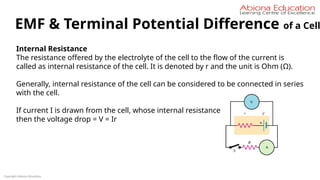
Internal Resistance
The resistance offered by the electrolyte of the cell to the flow of the current is
called as internal resistance of the cell. It is denoted by r and the unit is Ohm (Ω).
Generally, internal resistance of the cell can be considered to be connected in series
with the cell.
If current I is drawn from the cell, whose internal resistance is r,
then the voltage drop = V = Ir
Copyright Abiona Education
EMF & Terminal Potential Difference of a Cell
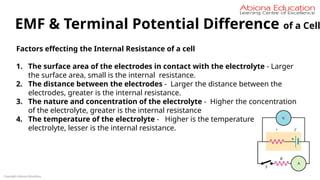
Factors effecting the Internal Resistance of a cell
1. The surface area of the electrodes in contact with the electrolyte - Larger
the surface area, small is the internal resistance.
2. The distance between the electrodes - Larger the distance between the
electrodes, greater is the internal resistance.
3. The nature and concentration of the electrolyte - Higher the concentration
of the electrolyte, greater is the internal resistance
4. The temperature of the electrolyte - Higher is the temperature of the
electrolyte, lesser is the internal resistance.
Copyright Abiona Education
Relationship between emf, terminal voltage and
internal resistance
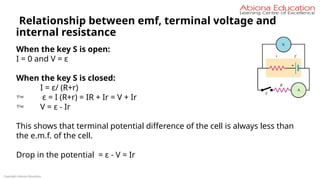
When the key S is open:
I = 0 and V = ɛ
When the key S is closed:
I = ɛ/ (R+r)
 ɛ = I (R+r) = IR + Ir = V + Ir
 V = ɛ - Ir
This shows that terminal potential difference of the cell is always less than
the e.m.f. of the cell.
Drop in the potential = ɛ - V = Ir
Copyright Abiona Education
Relationship between emf, terminal voltage and
internal resistance
Result
1. When the circuit is open, the terminal potential difference between the
electrodes of the cell is equal to the e.m.f of the cell in an open circuit.
2. When the circuit is closed, the terminal potential difference between the
electrodes of the cell is less than the e.m.f. of the cell.
3. The voltage consumed by the battery itself due to the internal resistance r is
equal to Ir, which is equal to the drop in the potential.
Copyright Abiona Education
Internal resistance (r) in terms of R, ɛ and V
We have –
I = ɛ/ (R+r) and I = V/R
Þ ɛ/ (R+r) = V/R
Þ r = (ɛ/v -1 ) R
Copyright Abiona Education
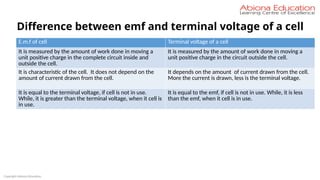
Difference between emf and terminal voltage of a cell
E.m.f of cell Terminal voltage of a cell
It is measured by the amount of work done in moving a
unit positive charge in the complete circuit inside and
outside the cell.
It is measured by the amount of work done in moving a
unit positive charge in the circuit outside the cell.
It is characteristic of the cell. It does not depend on the
amount of current drawn from the cell.
It depends on the amount of current drawn from the cell.
More the current is drawn, less is the terminal voltage.
It is equal to the terminal voltage, if cell is not in use.
While, it is greater than the terminal voltage, when it cell is
in use.
It is equal to the emf, if cell is not in use. While, it is less
than the emf, when it cell is in use.
Copyright Abiona Education
EMF & Terminal Potential Difference of a Cell
Work, Energy, and Emf
Copyright Abiona Education
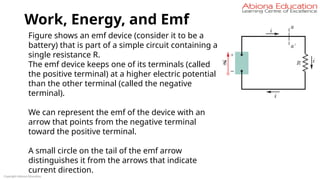
Figure shows an emf device (consider it to be a
battery) that is part of a simple circuit containing a
single resistance R.
The emf device keeps one of its terminals (called
the positive terminal) at a higher electric potential
than the other terminal (called the negative
terminal).
We can represent the emf of the device with an
arrow that points from the negative terminal
toward the positive terminal.
A small circle on the tail of the emf arrow
distinguishes it from the arrows that indicate
current direction.
Work, Energy, and Emf
Copyright Abiona Education
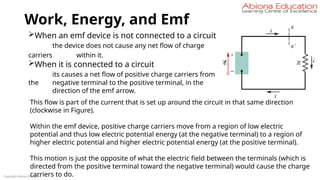
When an emf device is not connected to a circuit
the device does not cause any net flow of charge
carriers within it.
When it is connected to a circuit
its causes a net flow of positive charge carriers from
the negative terminal to the positive terminal, in the
direction of the emf arrow.
This flow is part of the current that is set up around the circuit in that same direction
(clockwise in Figure).
Within the emf device, positive charge carriers move from a region of low electric
potential and thus low electric potential energy (at the negative terminal) to a region of
higher electric potential and higher electric potential energy (at the positive terminal).
This motion is just the opposite of what the electric field between the terminals (which is
directed from the positive terminal toward the negative terminal) would cause the charge
carriers to do.
Work, Energy, and Emf
Copyright Abiona Education
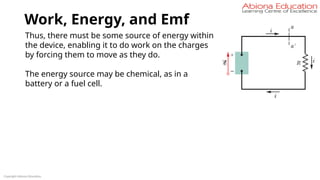
Thus, there must be some source of energy within
the device, enabling it to do work on the charges
by forcing them to move as they do.
The energy source may be chemical, as in a
battery or a fuel cell.
Work, Energy, and Emf
Copyright Abiona Education
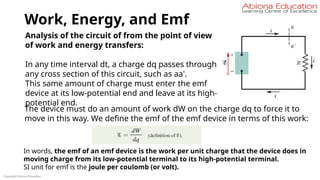
Analysis of the circuit of from the point of view
of work and energy transfers:
In any time interval dt, a charge dq passes through
any cross section of this circuit, such as aa'.
This same amount of charge must enter the emf
device at its low-potential end and leave at its high-
potential end.
The device must do an amount of work dW on the charge dq to force it to
move in this way. We define the emf of the emf device in terms of this work:
In words, the emf of an emf device is the work per unit charge that the device does in
moving charge from its low-potential terminal to its high-potential terminal.
SI unit for emf is the joule per coulomb (or volt).
Work, Energy, and Emf
Copyright Abiona Education
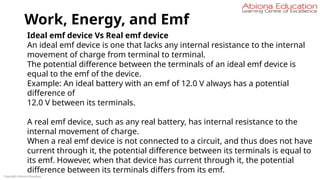
Ideal emf device Vs Real emf device
An ideal emf device is one that lacks any internal resistance to the internal
movement of charge from terminal to terminal.
The potential difference between the terminals of an ideal emf device is
equal to the emf of the device.
Example: An ideal battery with an emf of 12.0 V always has a potential
difference of
12.0 V between its terminals.
A real emf device, such as any real battery, has internal resistance to the
internal movement of charge.
When a real emf device is not connected to a circuit, and thus does not have
current through it, the potential difference between its terminals is equal to
its emf. However, when that device has current through it, the potential
difference between its terminals differs from its emf.
Work, Energy, and Emf
Copyright Abiona Education
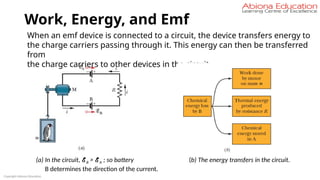
When an emf device is connected to a circuit, the device transfers energy to
the charge carriers passing through it. This energy can then be transferred
from
the charge carriers to other devices in the circuit.
(a) In the circuit, E B > E A ; so battery (b) The energy transfers in the circuit.
B determines the direction of the current.
Calculating the Current in a Single-Loop
Circuit
Copyright Abiona Education
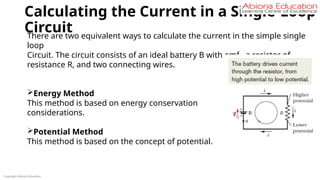
There are two equivalent ways to calculate the current in the simple single
loop
Circuit. The circuit consists of an ideal battery B with emf , a resistor of
resistance R, and two connecting wires.
Energy Method
This method is based on energy conservation
considerations.
Potential Method
This method is based on the concept of potential.
Calculating the Current in a Single-Loop
Circuit
Copyright Abiona Education
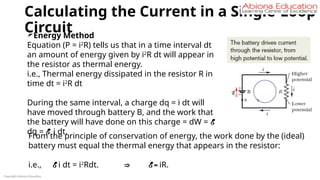
Energy Method
Equation (P = i2
R) tells us that in a time interval dt
an amount of energy given by i2
R dt will appear in
the resistor as thermal energy.
i.e., Thermal energy dissipated in the resistor R in
time dt = i2
R dt
During the same interval, a charge dq = i dt will
have moved through battery B, and the work that
the battery will have done on this charge = dW = E
dq = E i dt.
From the principle of conservation of energy, the work done by the (ideal)
battery must equal the thermal energy that appears in the resistor:
i.e., E i dt = i2
Rdt. ⇒ E = iR.
Calculating the Current in a Single-Loop
Circuit
Copyright Abiona Education
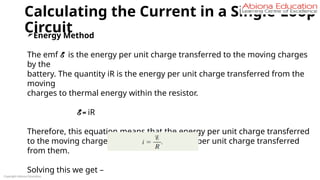
Energy Method
The emf E is the energy per unit charge transferred to the moving charges
by the
battery. The quantity iR is the energy per unit charge transferred from the
moving
charges to thermal energy within the resistor.
E = iR
Therefore, this equation means that the energy per unit charge transferred
to the moving charges is equal to the energy per unit charge transferred
from them.
Solving this we get –
Calculating the Current in a Single-Loop
Circuit
Copyright Abiona Education
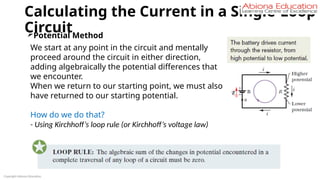
Potential Method
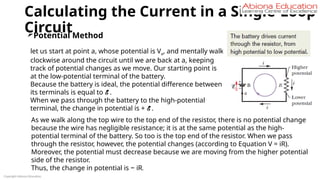
We start at any point in the circuit and mentally
proceed around the circuit in either direction,
adding algebraically the potential differences that
we encounter.
When we return to our starting point, we must also
have returned to our starting potential.
How do we do that?
- Using Kirchhoff’s loop rule (or Kirchhoff’s voltage law)
Calculating the Current in a Single-Loop
Circuit
Copyright Abiona Education
Potential Method
let us start at point a, whose potential is Va, and mentally walk
clockwise around the circuit until we are back at a, keeping
track of potential changes as we move. Our starting point is
at the low-potential terminal of the battery.
Because the battery is ideal, the potential difference between
its terminals is equal to E .
When we pass through the battery to the high-potential
terminal, the change in potential is + E .
As we walk along the top wire to the top end of the resistor, there is no potential change
because the wire has negligible resistance; it is at the same potential as the high-
potential terminal of the battery. So too is the top end of the resistor. When we pass
through the resistor, however, the potential changes (according to Equation V = iR).
Moreover, the potential must decrease because we are moving from the higher potential
side of the resistor.
Thus, the change in potential is − iR.
Calculating the Current in a Single-Loop
Circuit
Copyright Abiona Education
Potential Method
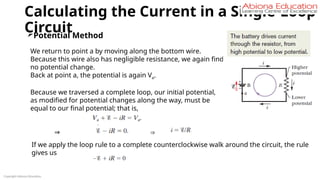
We return to point a by moving along the bottom wire.
Because this wire also has negligible resistance, we again find
no potential change.
Back at point a, the potential is again Va.
Because we traversed a complete loop, our initial potential,
as modified for potential changes along the way, must be
equal to our final potential; that is,
⇒ ⇒
If we apply the loop rule to a complete counterclockwise walk around the circuit, the rule
gives us
Terminal Potential Difference
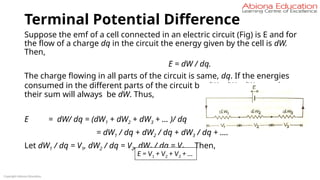
Suppose the emf of a cell connected in an electric circuit (Fig) is E and for
the flow of a charge dq in the circuit the energy given by the cell is dW.
Then,
E = dW / dq.
The charge flowing in all parts of the circuit is same, dq. If the energies
consumed in the different parts of the circuit be dW1, dW2, dW3, …, the
their sum will always be dW. Thus,
E = dW/ dq = (dW1 + dW2 + dW3 + … )/ dq
= dW1 / dq + dW2 / dq + dW3 / dq + ….
Let dW1 / dq = V1, dW2 / dq = V2, dW3 / dq = V3,… Then,
Copyright Abiona Education
E = V1 + V2 + V3 + …
Terminal Potential Difference
Clearly, V1, V2, V3, … are the potential energies consumed in different parts
of the circuit when unit charge flows through them. These are called the
‘terminal potential differences’ across the different parts of the circuit.
Thus, if for the flow of dq coulomb of charge in a part of an electrical
circuit, dW′ joule work is done (dW′ joule energy is consumed), then the
potential difference across that part will be V = dW′ / dq volt. Potential
difference is measured by voltmeter.
Copyright Abiona Education
Internal Resistance of a Cell and Back
emf
When we connect the plates of a cell by a wire, an electric current flows in
the wire from the positive plate of the cell towards the negative plate and
in the electrolyte (inside the cell) it flows from the negative plate towards
the positive plate. The resistance offered by the electrolyte of the cell to
the flow of current (ions) through it is called the ‘internal resistance’ of
the cell. Because of this resistance, a part of the energy given by the cell
is dissipated as heat inside the cell itself. The internal resistance of a cell
depends upon the following factors:
i) Is it directly proportional to the separation between the two plates of
the cell.
ii) It is inversely proportional to the plates area dipped into the
electrolyte.
iii) It depends upon the nature, concentration and temperature of the
electrolyte and increases with increase in concentration.
Copyright Abiona Education
Internal Resistance of a Cell and Back
emf
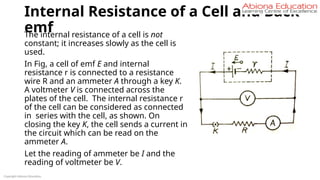
The internal resistance of a cell is not
constant; it increases slowly as the cell is
used.
In Fig, a cell of emf E and internal
resistance r is connected to a resistance
wire R and an ammeter A through a key K.
A voltmeter V is connected across the
plates of the cell. The internal resistance r
of the cell can be considered as connected
in series with the cell, as shown. On
closing the key K, the cell sends a current in
the circuit which can be read on the
ammeter A.
Let the reading of ammeter be I and the
reading of voltmeter be V.
Copyright Abiona Education
Internal Resistance of a Cell and Back
emf
Suppose, when a steady current I is established in the circuit, a charge dq
flows in the circuit in time dt. By the definition of emf, the work done by
the cell is given by.
dW = E dq = E I dt. (∵ dq = I dt)
The potential difference across the external resistance R is V. Hence, the
external work done by the cell is given by
dWext = V dq = V I dt.
The potential drop across the internal resistance r (in the electrolyte)
inside the cell is v = I r. Therefore, the internal work done by the cell is
given by
dWint = v I dt = I2
r dt.
Copyright Abiona Education
Internal Resistance of a Cell and Back
emf
By the law of conservation of energy, we have
dW = dWext + dWint
or EI dt = V I dt + I2
r dt
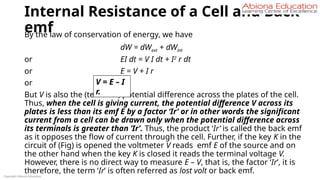
or E = V + I r
or
But V is also the (terminal) potential difference across the plates of the cell.
Thus, when the cell is giving current, the potential difference V across its
plates is less than its emf E by a factor ‘Ir’ or in other words the significant
current from a cell can be drawn only when the potential difference across
its terminals is greater than ‘Ir’. Thus, the product ‘Ir’ is called the back emf
as it opposes the flow of current through the cell. Further, if the key K in the
circuit of (Fig) is opened the voltmeter V reads emf E of the source and on
the other hand when the key K is closed it reads the terminal voltage V.
However, there is no direct way to measure E – V, that is, the factor ‘Ir’, it is
therefore, the term ‘Ir’ is often referred as lost volt or back emf.
Copyright Abiona Education
V = E – I
r.
Internal Resistance of a Cell and Back
emf
It is evident from the above equation that larger the current I drawn from
the cell, smaller will be the potential difference V across its plates. Thus,
emf (E) is the characteristic of each cell and its value remains constant for
the cell, while the terminal potential difference (V) goes on decreasing on
taking more and more current from the cell.
When no current is being drawn from the cell (I = 0), then the potential
difference across the plates of the cell equals the emf of the cell (V = E).
Hence, in Fig, when the key K is open, the reading of the voltmeter gives
the emf E of the cell.
Now, by Eq. (i) the internal resistance of the cell is given by
r = E – v / I.
Copyright Abiona Education
Internal Resistance of a Cell and Back
emf
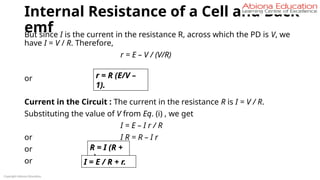
But since I is the current in the resistance R, across which the PD is V, we
have I = V / R. Therefore,
r = E – V / (V/R)
or
Current in the Circuit : The current in the resistance R is I = V / R.
Substituting the value of V from Eq. (i) , we get
I = E – I r / R
or I R = R – I r
or
or
Copyright Abiona Education
r = R (E/V –
1).
R = I (R +
r)
I = E / R + r.
Internal Resistance of a Cell and Back
emf
Here, (R + r) is the total (external + internal) resistance of the circuit. Thus,
the current drawn from the cell is obtained by the ratio of the emf of the
cell and the total resistance of the circuit. If there are more than one cell in
the circuit then the current is obtained by the ratio of the net emf in the
circuit and the total resistance. This statement, or the above equation,
expresses the law of conservation of energy for the electrical circuit. In
Figure, when current is drawn from the cell, then the direction of current
inside the cell is form the negative plate to the positive plate of the cell and
the potential difference V between the plates of the cell is less than the emf
E of the cell (V = E – Ir).
Copyright Abiona Education
Internal Resistance of a Cell and Back
emf
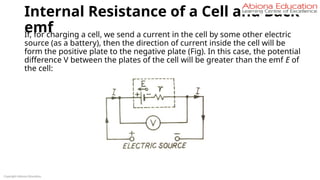
If, for charging a cell, we send a current in the cell by some other electric
source (as a battery), then the direction of current inside the cell will be
form the positive plate to the negative plate (Fig). In this case, the potential
difference V between the plates of the cell will be greater than the emf E of
the cell:
Copyright Abiona Education
Charging of Cell
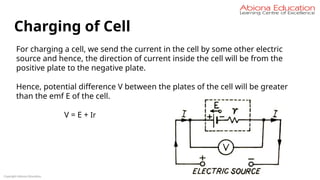
For charging a cell, we send the current in the cell by some other electric
source and hence, the direction of current inside the cell will be from the
positive plate to the negative plate.
Hence, potential difference V between the plates of the cell will be greater
than the emf E of the cell.
V = E + Ir
Copyright Abiona Education
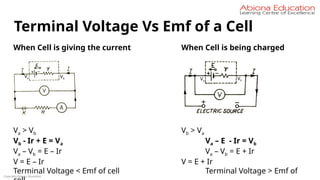
Terminal Voltage Vs Emf of a Cell
When Cell is giving the current When Cell is being charged
,
Va > Vb Vb > Va
Vb - Ir + E = Va Va – E - Ir = Vb
Va – Vb = E – Ir Va – Vb = E + Ir
V = E – Ir V = E + Ir
Terminal Voltage < Emf of cell Terminal Voltage > Emf of
Vb
Va Vb
Va
Combinations of Cells
A cell is a source of electric current. We cannot take a strong current from
a single cell. Usually, to get strong current two or more cells are to be
combined. The combination of cells is called ‘battery’. Cells ca be
combined in three ways :
(i) In Series, (ii) In Parallel and (iii) In Mixed grouping.
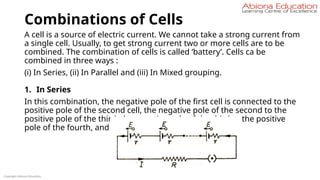
1. In Series
In this combination, the negative pole of the first cell is connected to the
positive pole of the second cell, the negative pole of the second to the
positive pole of the third, the negative pole of the third to the positive
pole of the fourth, and so on.
Copyright Abiona Education
Combinations of Cells
Suppose, n cells are connected in series in which the emf of each cell of E
and the internal resistance is r. These cells are sending current in an
external resistance is R.
Using Kirchhoff’s laws -
The emf of the cells, E eff = E = n E.
Total internal resistance, r eff = r = n r.
So, total resistance of the circuit = (n r + R).
If the current in the circuit be I, then
I = n E / (n r + R)
Copyright Abiona Education
Combinations of Cells
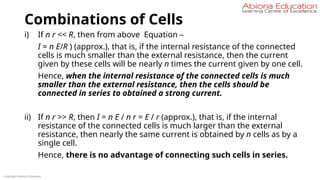
i) If n r << R, then from above Equation –
I = n E/R ) (approx.), that is, if the internal resistance of the connected
cells is much smaller than the external resistance, then the current
given by these cells will be nearly n times the current given by one cell.
Hence, when the internal resistance of the connected cells is much
smaller than the external resistance, then the cells should be
connected in series to obtained a strong current.
ii) If n r >> R, then I = n E / n r = E / r (approx.), that is, if the internal
resistance of the connected cells is much larger than the external
resistance, then nearly the same current is obtained by n cells as by a
single cell.
Hence, there is no advantage of connecting such cells in series.
Copyright Abiona Education
Combinations of Cells
2. In Parallel
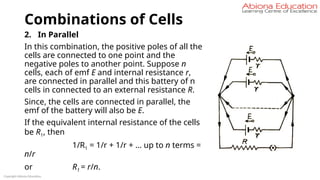
In this combination, the positive poles of all the
cells are connected to one point and the
negative poles to another point. Suppose n
cells, each of emf E and internal resistance r,
are connected in parallel and this battery of n
cells in connected to an external resistance R.
Since, the cells are connected in parallel, the
emf of the battery will also be E.
If the equivalent internal resistance of the cells
be R1, then
1/R1 = 1/r + 1/r + … up to n terms =
n/r
or R1 = r/n.
Copyright Abiona Education
Combinations of Cells
∴ Total resistance of the circuit = (r/n + R)
If the current in the external circuit be I, then I = E / [(r/n) + R] = n E / (r +
nR)
i) If r << R, that is, if the internal resistance of the cells is much smaller
than the external resistance, the r can be neglected in comparison to n
R. Then, from above equation –
I = n E / n R = E / R (approx.), that is, the total current will be equal to the current
given by a single cell. Hence, there is no advantage of connecting cells of small
internal resistance in parallel.
ii) If r >> R, that is, if the internal resistance of the cells is larger than the
external resistance, then the current will be I = n E/ r (approx.).
This current is nearly n times the current given by a single cell. Hence, when the
internal resistance of the cells is much larger than the external resistance, then
the cells should be connected in parallel.
Copyright Abiona Education
Combinations of Cells
3. In Mixed Grouping
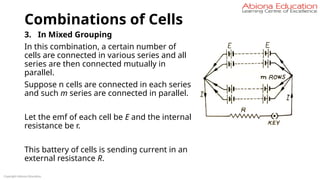
In this combination, a certain number of
cells are connected in various series and all
series are then connected mutually in
parallel.
Suppose n cells are connected in each series
and such m series are connected in parallel.
Let the emf of each cell be E and the internal
resistance be r.
This battery of cells is sending current in an
external resistance R.
Copyright Abiona Education
Combinations of Cells
The total emf of n cells connected in one series is n E. Since, all the series
are connected in parallel, the emf of the battery as a whole will also be n
E. Similarly, the total internal resistance of cells in a series is n r. Such m
series are connected in parallel.
Hence, if the internal resistance of the whole battery be R1, then
1 / R1 = 1 / n r + 1 / n r + … up to m terms = m / nr
or R1 = nr / m.
∴ Total resistance of the circuit = (nr/m + R)
If the current in the external circuit be I, then –
I = n E / [(n r/m) + R] = m n E / (n r + m R).
Copyright Abiona Education
Combinations of Cells
We have : I = n E / [(n r/m) + R] = m n E / (n r + m R)
It is clear from the above equation that for the value of I to be maximum,
the value of (n r + m R) should be minimum.
Now, n r + m R =
Therefore, for (n r + m R) to be minimum, the quantity
should be minimum . As this quantity is in square it cannot be negative,
hence its minimum value will be zero, that is,
or
Copyright Abiona Education
Combinations of Cells
or n r = m R
or R = n r / m.
But n r / m is the internal resistance of the whole battery.
Thus, in mixed grouping the current in the external circuit will be maximum
when the internal resistance of the whole battery is equal to the external
resistance.
By substituting n r / m = R in equation I = n E / [(n r/m) + R] = m n E / (n r + m
R),
Copyright Abiona Education
Combinations of Cells
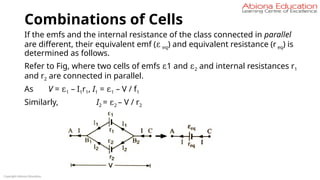
If the emfs and the internal resistance of the class connected in parallel
are different, their equivalent emf (ε eq) and equivalent resistance (r eq) is
determined as follows.
Refer to Fig, where two cells of emfs ε1 and ε2 and internal resistances r1
and r2 are connected in parallel.
As V = ε1 – I1r1, I1 = ε1 – V / f1
Similarly, I2 = ε2 – V / r2
Copyright Abiona Education
Combinations of Cells
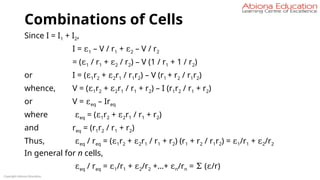
Since I = I1 + I2,
I = ε1 – V / r1 + ε2 – V / r2
= (ε1 / r1 + ε2 / r2) – V (1 / r1 + 1 / r2)
or I = (ε1r2 + ε2r1 / r1r2) – V (r1 + r2 / r1r2)
whence, V = (ε1r2 + ε2r1 / r1 + r2) – I (r1r2 / r1 + r2)
or V = εeq – Ireq
where εeq = (ε1r2 + ε2r1 / r1 + r2)
and req = (r1r2 / r1 + r2)
Thus, εeq / req = (ε1r2 + ε2r1 / r1 + r2) (r1 + r2 / r1r2) = ε1/r1 + ε2/r2
In general for n cells,
εeq / req = ε1/r1 + ε2/r2 +…+ εn/rn = Σ (ε/r)
Copyright Abiona Education
Combinations of Cells
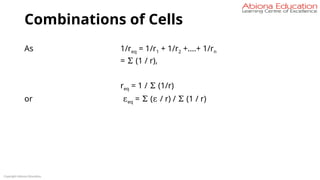
As 1/req = 1/r1 + 1/r2 +….+ 1/rn
= Σ (1 / r),
req = 1 / Σ (1/r)
or εeq = Σ (ε / r) / Σ (1 / r)
Copyright Abiona Education
KIRCHHOFF’S RULES
124
Electric circuits generally consist of a number of resistors and cells interconnected
sometimes in a complicated way.
The formulae we have derived earlier for series and parallel combinations of resistors
are not always sufficient to determine all the currents and potential differences in the
circuit.
Two rules, called Kirchhoff’s rules, are very useful for analysis of electric circuits.
1. Kirchhoff’s junction rule (or Kirchhoff’s current law).
2. Kirchhoff’s Loop rule
Kirchhoff’s Junction rule
125
Consider junction d for a moment:
Charge comes into that junction via incoming currents i1
and i3, and it leaves via outgoing current i2. Because
there is no variation in the charge at the junction, the
total incoming current must equal the total outgoing
current:
Kirchhoff’s Loop rule or Voltage law
126
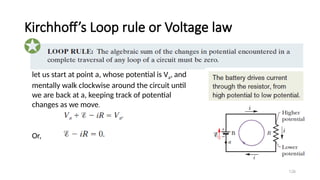
let us start at point a, whose potential is Va, and
mentally walk clockwise around the circuit until
we are back at a, keeping track of potential
changes as we move.
Or,
Kirchhoff’s Loop rule or Voltage law
127
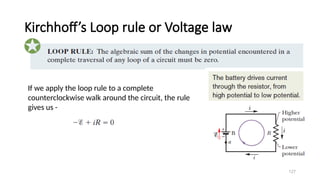
If we apply the loop rule to a complete
counterclockwise walk around the circuit, the rule
gives us -
Kirchhoff’s Loop rule or Voltage law
128
Check your progress
129
Other Single-Loop Circuits
130
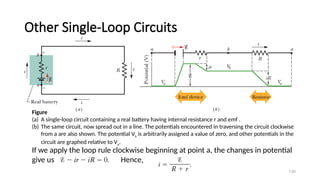
Figure
(a) A single-loop circuit containing a real battery having internal resistance r and emf .
(b) The same circuit, now spread out in a line. The potentials encountered in traversing the circuit clockwise
from a are also shown. The potential Va is arbitrarily assigned a value of zero, and other potentials in the
circuit are graphed relative to Va.
If we apply the loop rule clockwise beginning at point a, the changes in potential
give us Hence,
Other Single-Loop Circuits
131
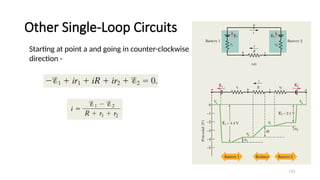
Starting at point a and going in counter-clockwise
direction -
Check Your Progress
132
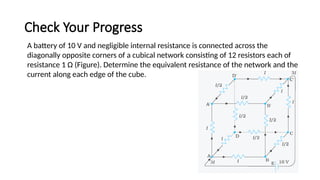
A battery of 10 V and negligible internal resistance is connected across the
diagonally opposite corners of a cubical network consisting of 12 resistors each of
resistance 1 Ω (Figure). Determine the equivalent resistance of the network and the
current along each edge of the cube.
Check Your Progress
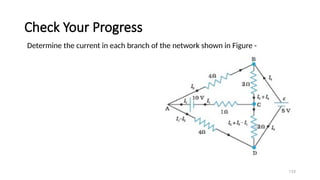
133
Determine the current in each branch of the network shown in Figure -
WHEATSTONE BRIDGE
134
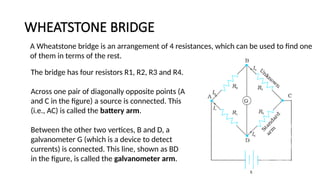
A Wheatstone bridge is an arrangement of 4 resistances, which can be used to find one
of them in terms of the rest.
The bridge has four resistors R1, R2, R3 and R4.
Across one pair of diagonally opposite points (A
and C in the figure) a source is connected. This
(i.e., AC) is called the battery arm.
Between the other two vertices, B and D, a
galvanometer G (which is a device to detect
currents) is connected. This line, shown as BD
in the figure, is called the galvanometer arm.
WHEATSTONE BRIDGE
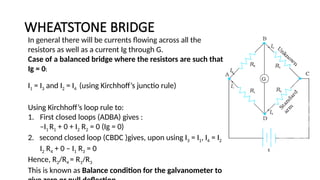
In general there will be currents flowing across all the
resistors as well as a current Ig through G.
Case of a balanced bridge where the resistors are such that
Ig = 0:
I1 = I3 and I2 = I4 (using Kirchhoff’s junctio rule)
Using Kirchhoff’s loop rule to:
1. First closed loops (ADBA) gives :
–I1 R1 + 0 + I2 R2 = 0 (Ig = 0)
2. second closed loop (CBDC )gives, upon using I3 = I1, I4 = I2
I2 R4 + 0 – I1 R3 = 0
Hence, R2/R4 = R1/R3
This is known as Balance condition for the galvanometer to
Check Your Progress
136
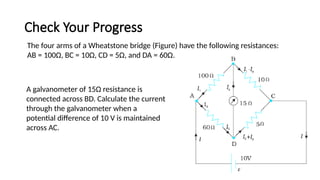
The four arms of a Wheatstone bridge (Figure) have the following resistances:
AB = 100Ω, BC = 10Ω, CD = 5Ω, and DA = 60Ω.
A galvanometer of 15Ω resistance is
connected across BD. Calculate the current
through the galvanometer when a
potential difference of 10 V is maintained
across AC.
METER BRIDGE
137
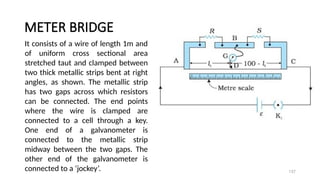
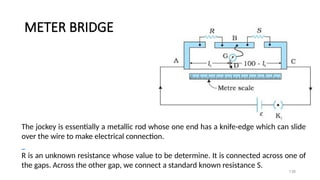
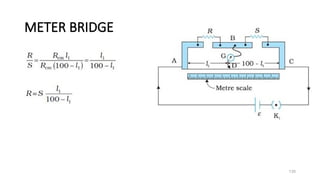
It consists of a wire of length 1m and
of uniform cross sectional area
stretched taut and clamped between
two thick metallic strips bent at right
angles, as shown. The metallic strip
has two gaps across which resistors
can be connected. The end points
where the wire is clamped are
connected to a cell through a key.
One end of a galvanometer is
connected to the metallic strip
midway between the two gaps. The
other end of the galvanometer is
connected to a ‘jockey’.
METER BRIDGE
138
The jockey is essentially a metallic rod whose one end has a knife-edge which can slide
over the wire to make electrical connection.
R is an unknown resistance whose value to be determine. It is connected across one of
the gaps. Across the other gap, we connect a standard known resistance S.
METER BRIDGE
139
Check Your Progress
140
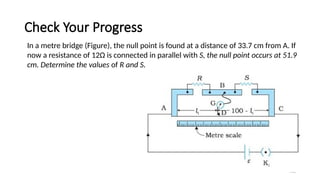
In a metre bridge (Figure), the null point is found at a distance of 33.7 cm from A. If
now a resistance of 12Ω is connected in parallel with S, the null point occurs at 51.9
cm. Determine the values of R and S.
Potentiometer
An instrument used for measuring accurately the emf or potential difference
is called a potentiometer.
It was first designed by Johann Christian Poggendorff.
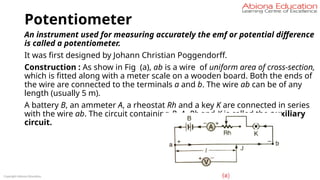
Construction : As show in Fig (a), ab is a wire of uniform area of cross-section,
which is fitted along with a meter scale on a wooden board. Both the ends of
the wire are connected to the terminals a and b. The wire ab can be of any
length (usually 5 m).
A battery B, an ammeter A, a rheostat Rh and a key K are connected in series
with the wire ab. The circuit containing B, A, Rh and K is called the auxiliary
circuit.
Copyright Abiona Education
Potentiometer
Principle of a Potentiometer
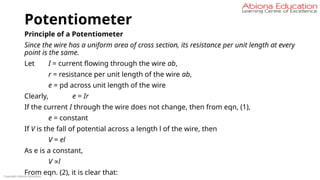
Since the wire has a uniform area of cross section, its resistance per unit length at every
point is the same.
Let I = current flowing through the wire ab,
r = resistance per unit length of the wire ab,
e = pd across unit length of the wire
Clearly, e = Ir
If the current I through the wire does not change, then from eqn, (1),
e = constant
If V is the fall of potential across a length l of the wire, then
V = el
As e is a constant,
V ∝l
From eqn. (2), it is clear that:
Copyright Abiona Education
Potentiometer
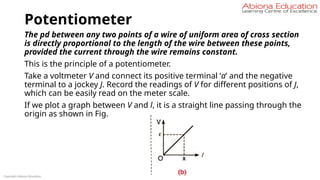
The pd between any two points of a wire of uniform area of cross section
is directly proportional to the length of the wire between these points,
provided the current through the wire remains constant.
This is the principle of a potentiometer.
Take a voltmeter V and connect its positive terminal ‘a’ and the negative
terminal to a jockey J. Record the readings of V for different positions of J,
which can be easily read on the meter scale.
If we plot a graph between V and l, it is a straight line passing through the
origin as shown in Fig.
Copyright Abiona Education
Uses of a Potentiometer
A potentiometer can be used for a variety of purposes as discussed below.
a) Measurement of emf of a Cell
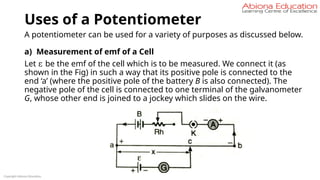
Let ε be the emf of the cell which is to be measured. We connect it (as
shown in the Fig) in such a way that its positive pole is connected to the
end ‘a’ (where the positive pole of the battery B is also connected). The
negative pole of the cell is connected to one terminal of the galvanometer
G, whose other end is joined to a jockey which slides on the wire.
Copyright Abiona Education
Uses of a Potentiometer
With the help of the jockey, we find the balance point ‘c’, when the
galvanometer shows no deflection. As the + ve pole of the cell is joined to
the point ‘a’ directly (i.e., without any resistance), the point ‘a’ and the + ve
pole of the cell are at the same potential. Since the galvanometer connected
between the –ve pole and the point ‘c’ shows no deflection, –ve pole of the
cell and the point ‘c’ are at the same potential. Clearly,
ε = pd between the +ve and –ve poles of the cell
= pd across ac
Let ac = x. From the graph [Fig], find the corresponding value of V which is
equal to ε (i.e., the emf of the cell).
Copyright Abiona Education
Uses of a Potentiometer
Advantages
i) The accuracy of potentiometer is great.
ii) At the balance point, no current flows through the cell. As such the
internal resistance of the cell has no effect and we are able to measure
emf of the cell accurately. If we use a voltmeter, it would draw some
current from the cell.
Since a potentiometer can measure the emf without drawing current, it
can be considered as ideal voltmeter.
Copyright Abiona Education
Uses of a Potentiometer
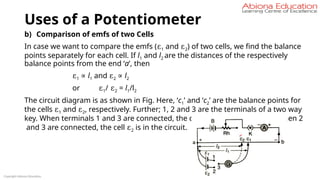
b) Comparison of emfs of two Cells
In case we want to compare the emfs (ε1 and ε2) of two cells, we find the balance
points separately for each cell. If l1 and l2 are the distances of the respectively
balance points from the end ‘a’, then
ε1 ∝ l1 and ε2 ∝ l2
or ε1/ ε2 = l1/l2
The circuit diagram is as shown in Fig. Here, ‘c1’ and ‘c2’ are the balance points for
the cells ε1 and ε2, respectively. Further; 1, 2 and 3 are the terminals of a two way
key. When terminals 1 and 3 are connected, the cell ε1 is in the circuit and when 2
and 3 are connected, the cell ε2 is in the circuit.
Copyright Abiona Education
Uses of a Potentiometer
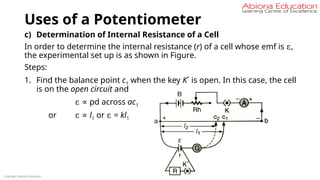
c) Determination of Internal Resistance of a Cell
In order to determine the internal resistance (r) of a cell whose emf is ε,
the experimental set up is as shown in Figure.
Steps:
1. Find the balance point c1 when the key K´ is open. In this case, the cell
is on the open circuit and
ε ∝ pd across ac1
or ε ∝ l1 or ε = kl1
Copyright Abiona Education
Uses of a Potentiometer
2. Again find the balance point c2 when the key K´ is closed and a
resistance R is in the circuit. In this case the cell is in the closed circuit
and
V = pd across ac2
i.e., V ∝ I2 or V = kl2
We know that r = [(ε – V) / V] x R
⇒ r = [(kl1 – kl2 ) / k2 l2 ] x R
⇒ r = [(l1 – l2 )/ l2 ] x R
Copyright Abiona Education
Checkpoint
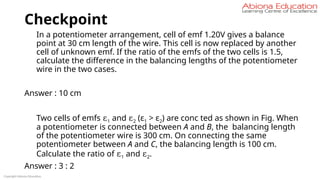
In a potentiometer arrangement, cell of emf 1.20V gives a balance
point at 30 cm length of the wire. This cell is now replaced by another
cell of unknown emf. If the ratio of the emfs of the two cells is 1.5,
calculate the difference in the balancing lengths of the potentiometer
wire in the two cases.
Answer : 10 cm
Two cells of emfs ε1 and ε2 (ε1 > ε2) are conc ted as shown in Fig. When
a potentiometer is connected between A and B, the balancing length
of the potentiometer wire is 300 cm. On connecting the same
potentiometer between A and C, the balancing length is 100 cm.
Calculate the ratio of ε1 and ε2.
Answer : 3 : 2
Copyright Abiona Education
Checkpoint
1. For driving a current of 3 A for 5 minutes in an electric current, 1350 J
of work is to be done. Find the emf of the source in the circuit.
Answer: 1.50 V.
2. A battery of emf 10 V and internal resistance 3 Ω is connected to a
resistor. The current in the circuit is 0.5 A. What is the resistance of the
resistor? What is the terminal voltage of the battery when the circuit is
closed?
Answer: 17 Ω 8.5 V.
Copyright Abiona Education
Checkpoint
3. (a) A car has a fresh storage battery of emf 12 V and internal resistance 5.0
x 10–2
Ω. The starter motor draws a current of 90 A. Find the terminal
voltage of the battery when the starter in on.
(b) After long use, the internal resistance of the battery increases to 500 Ω.
What maximum current can be drawn from the battery?
(c) If the discharged battery is charged by an external emf source, is the
terminal voltage of the battery during charging greater or less than 12 V?
Answer : (a) 7.5 V. (b) 24 mA. (c) V > E (During charging, V = E +
Ir)
4. A voltmeter of resistance 998 Ω is connected across a cell of emf 2 V and
internal resistance 2 Ω. Find the PD across the voltmeter, that across the
terminals of the cell and percentage error in the reading of the voltmeter.
Answer : 1.996 V. 0.2 %.
Copyright Abiona Education
Checkpoint
3. (a) A car has a fresh storage battery of emf 12 V and internal resistance
5.0 x 10⁻²
Ω. The starter motor draws a current of 90 A. Find the
terminal voltage of the battery when the starter in on.
(b) After long use, the internal resistance of the battery increases to
500 Ω. What maximum current can be drawn from the battery?
(c) If the discharged battery is charged by an external emf source, is
the terminal voltage of the battery during charging greater or less
than 12 V?
Answer : (a) 7.5 V. (b) 24 mA.
4. A voltmeter of resistance 998 Ω is connected across a cell of emf 2 V
and internal resistance 2 Ω. Find the PD across the voltmeter, that
across the terminals of the cell and percentage error in the reading of
the voltmeter.
Answer : 1.996 V. 0.2 %.
Copyright Abiona Education
Checkpoint
5. A DC supply of 120 V is connected to a large resistance X. 10 kΩ
resistance voltmeter placed in series in the circuit reads 4 V. Find the
value of X. Why a voltmeter has been used, instead of an ammeter, to
determine the large resistance X?
Answer : 290 KΩ.
6. If the galvanometer in the given circuit reads zero, find the value of the
resistor R. The 12 V source is resistance free.
Answer : 2 kΩ.
7. A variable rheostat of 2 kΩ is used to control the PD across a 500 Ω
load RL. If the resistance AB is 500 Ω, what is PD across RL? If RL is
removed, what should be the resistance BC to get 40 V between B and
C?
Answer : 21.5 V. 1600 Ω.
Copyright Abiona Education
Checkpoint
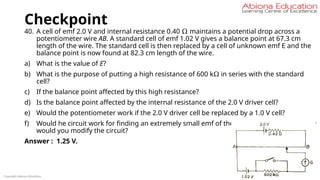
8. In the circuit shown in figure, E is a battery of emf 6 V and internal
resistance 1 Ω. Find the reading of the ammeter A, if it has negligible
resistance.
Answer : 0.5 A.
Fig
Copyright Abiona Education
Checkpoint
9. Two cells of same emf E, but different internal resistances r1 and r2 are
connected to an external resistance R, as shown. The voltmeter V reads
zero. Obtain an expression for R in terms of r1 and r2. Calculate the
voltage across the cell of internal resistance r2. (Assume that the
voltmeter V is infinite resistance).
Answer : R = r1 – r2.
Copyright Abiona Education
Checkpoint
10.A cell of emf 3.4 V and internal resistance 3 Ω is connected to an
ammeter having resistance 2 Ω and to an external resistance of 100 Ω.
When a voltmeter is connected across the 100 Ω resistance, the
ammeter reading is 0.04 A. Find the voltage read by the voltmeter and
its resistance. Had the voltmeter been an ideal one, what would have
been its reading?
Answer : R = 400 Ω. 3.2 V. 3.238 V.
Copyright Abiona Education
Checkpoint
11.Three identical cells each of emf 2 V and internal resistance 1 Ω are
connected in series to form a battery. The battery is then connected to
a parallel combination of two identical resistors, each of resistance 6
Ω. Find the current delivered by the battery.
Answer : 1 A.
Copyright Abiona Education
Checkpoint
12.Six lead accumulators, each of emf 2.0 V and internal resistance 0.015
Ω are joined in series to supply current to an external resistance of 8.5
Ω. Find the current drawn from the supply and its terminal voltage.
Answer : 1.4 A. 11.9 V.
13.A battery is made of 12 cells connected in series, each cell having an
emf E and internal resistance r. Some of the cells are connected with
wrong polarity. This battery is connected to another source of emf 2 E
and internal resistance 2 r. An ammeter in the circuit reads 3 A when
the battery and the source aid each other and 2 A when they oppose
each other. How many cells in the battery are connected with wrong
polarity?
Answer : one cell
Copyright Abiona Education
Checkpoint
14.An electric motor running at 50 V DC supply draws 12 A current. If the
efficiency of the motor is 30%, find the resistance of its windings. What
is the back emf in the motor?
Answer: 2.92 Ω. 15 V.
15.A battery of emf 2 V and internal resistance 0.1 Ω is being charged by a
current of 5 A. What will be the direction of current inside the battery?
What is the potential difference between the terminals of the battery.
Answer : 2.5 V.
16.Write down the readings of the ideal ammeter A and the ideal
voltmeter V in the given circuits (a) and (b).
Answer : 4.5 A. 1.5 V, 1.5 A. 7.5 V.
Copyright Abiona Education
Checkpoint
17.The given circuit carries two cells opposing each other and a number
of resistors. Find the current in each resistor and potential difference
across each cell.
Answer : 0.5 A. (1/3) A 1/6 A.
7.5 V 4.25 V.
18.A cell of emf 1.5 V and internal resistance 0.10 Ω is connected across a
resistor. The current in the circuit is 2.0 A. Find (a) rate of chemical
energy consumption of the cell, (b) rate of energy dissipation inside
the cell, (c) rate of energy dissipation in the resistor and (d) power
output of the cell.
Answer : 3.0 W.0.4 W. 2.6 W.
Copyright Abiona Education
Checkpoint
19.A series battery of six lead accumulators, each of emf 2.0 V and
internal resistance 0.50 Ω is charged by a 100 V DC supply. What series
resistance should be included in the charging circuit to limit the
current to 8.0 A? Find (a) the power supplied by the DC source, (b) the
power dissipated as heat and (c) the energy stored in the battery in 15
minutes.
Answer : 8.0 Ω.800 W. 704 W. 86400 J.
Copyright Abiona Education
Checkpoint
20.Find out the potential difference between the points B and A in the
adjoining diagram. Internal resistances of the cells are negligible.
Answer : 4 V.
Copyright Abiona Education
Checkpoint
21.A 15 V DC source is connected
across the series combination of
a 100 Ω and a 150 Ω resistor, as
shown in figure. A voltmeter
reads 7.5 V when connected
across the 150 Ω resistor. What
would it read when connected
across the 100 Ω resistor?
Answer : 5.0 V.
22.How much resistance should be
connected to 15 Ω resistor shown
in the circuit in adjoining figure,
so that the points M and N are at
the same potential.
Answer : 10 Ω
Copyright Abiona Education
Checkpoint
23.There is combination of four
resistances 4 Ω, 10 Ω, 4 Ω and 9 Ω,
as shown. Calculate the potential
difference between the points P and
Q and the values of currents flowing
in the different resistances.
Answer : 14.4 V. 1.6A, 0.8 A.
24.In the circuit adjacent shown E1 and
E2 are batteries having emfs 4.0 V
and 3.5 V, respectively and internal
resistance 1 Ω and 2 Ω respectively.
Using Kirchhoff’s laws, calculate
currents : I1, I2 and I3.
Answer : 0.2 A 0.1A 0.3 A.
Copyright Abiona Education
Checkpoint
25.A PD of 4 V is applied between the points A and B, as shown. Calculate
the equivalent resistance of the network across the points A and B and
the currents in the arms FCE and FDE.
Answer : 0.5 A.
Copyright Abiona Education
Checkpoint
26.Calculate the equivalent
resistance between points A and
B in the given network. If
between A and B a battery of emf
4 V and internal resistance 0.4 Ω
is connected, then determine
currents in different resistances.
Answer : 3.6 Ω.0.6 A 0.4 A.
27.An electrical circuit is shown in
the figure. Calculate the potential
difference across the resistor of
400 Ω, as will be measured by the
voltmeter V of resistance 400 Ω.
Answer : 20 / 3 V.
Copyright Abiona Education
Checkpoint
28.Calculate the current following in
each cell in the given circuit. Also
calculate the potential difference
across the ends of each cell.
Answer : 3 A. 10 V.
Copyright Abiona Education
Checkpoint
29.What the ammeter A does read in
the given circuit? What if the
positions of the cell and the
ammeter are interchanged?
Answer : (5/11) A,
30.You have 12 cells, each one having
an emf of 1.5 V and an internal
resistance of 0.5 Ω. You have to
supply current to an external
resistance of 1.5 Ω using a
combination of all these cells. How
will you arrange them so as to get
maximum current in this
resistance?
Copyright Abiona Education
Checkpoint
31. In the given circuit, a meter bridge is
shown in balanced state. The bridge
wire has a resistance of 1 Ω/cm. Find
the value of the unknown resistance
X and the current drawn from the
battery of negligible internal
resistance.
Answer : 0.66 A.
32. In a meter bridge circuit, a resistance
in the left hand gap is 2 Ω and an
unknown resistance X is in the right
hand gap as shown in Fig. The null
point is found at 40 cm from the left
end of the wire. What resistance
should be connected to X so that the
new null point is 50 cm from the left
end of the wire?
Copyright Abiona Education
Checkpoint
33.In the circuit shown (figure), PQ is a uniform metallic wire of length 4
m and resistance 20 Ω. Battery B has an emf of 10 V and internal
resistance of 1 Ω. J is a jockey or slide contact. Resistance of the
ammeter A and connecting wires is negligible.
i) When the jockey J does not touch the wire PQ, what is the reading of
ammeter A?
ii) Where should the Jockey J be pressed on the wire PQ, so that the
galvanometer G shows no deflection?
Answer : (i) 2 A. (ii) 80 cm
Copyright Abiona Education
Checkpoint
34.A 10 m long potentiometer wire carries a steady current. A 1.018 V
standard cell is balanced at a length of 850 cm. Find (i) the potential
gradient along the wire, (ii) the maximum emf that can be measured.
Answer : (i) 1.2 x 10⁻³
V / cm. (ii) 1.2 V.
35.Two cells of emf’s E1 and E2 (E1 > E2) are connected as shown. When a
potentiometer is connected between A and B, the balancing length of
the potentiometer wire is 300 cm. On connecting the same
potentiometer wire between A and C, the balancing length is 100 cm.
Compute E1/E2.
Answer : 1.5
Copyright Abiona Education
Checkpoint
36.A potentiometric arrangement used to measure the emf of a cell E1 is
shown. AB is the potentiometer wire of length 100 cm and resistance 5
Ω. The emf of a standard DC source (E) is 6 V and rheostat R is adjusted
to 5 Ω. If the null point is obtained at C with AC equal to 75 cm, what is
the emf to E1.
Answer : 2.25 V.
Copyright Abiona Education
Checkpoint
37.Figure shows uniform manganin wire XY of length 100 cm and
resistances 9 Ω, connected to an accumulator D of emf 4 V and
internal resistance 1 Ω through a variable resistance R. E is a cell of
emf 1.8 V connected to the wire XY via a jockey J and a central zero
galvanometer G. It is found that the galvanometer shows no deflection
when XJ = 80 cm. Find the value of R.
Answer : 6 Ω.
Copyright Abiona Education
Checkpoint
38.A potentiometer is being used for the determination of the internal
resistance of a cell of emf E = 1.5 V. The balance point of the cell in
open circuit is at 76.3 cm length of the potentiometer wire. When a
resistor of 9.5 Ω is connected across the cell, the balance point shifts
to 64.8 cm length of the wire. Fid the internal resistance of the cell.
Answer : 1.7 Ω.
39.A 10 m long uniform metallic wire having a resistance of 20 Ω is used
as a potentiometer wire. This wire is connected in series another
resistance of 480 Ω and a battery of emf 5 V having negligible internal
resistance. If an unknown emf e is balanced across 6 m of the
potentiometer wire, calculate.
i) the potential gradient across the potentiometer wire.
ii) the value of unknown emf e.
Answer : 0.2 V m–1. 0.12 volt.
Copyright Abiona Education
Checkpoint
40. A cell of emf 2.0 V and internal resistance 0.40 Ω maintains a potential drop across a
potentiometer wire AB. A standard cell of emf 1.02 V gives a balance point at 67.3 cm
length of the wire. The standard cell is then replaced by a cell of unknown emf E and the
balance point is now found at 82.3 cm length of the wire.
a) What is the value of E?
b) What is the purpose of putting a high resistance of 600 kΩ in series with the standard
cell?
c) If the balance point affected by this high resistance?
d) Is the balance point affected by the internal resistance of the 2.0 V driver cell?
e) Would the potentiometer work if the 2.0 V driver cell be replaced by a 1.0 V cell?
f) Would he circuit work for finding an extremely small emf of the order of a mV? If not, how
would you modify the circuit?
Answer : 1.25 V.
Copyright Abiona Education
Checkpoint
Copyright Abiona Education
38.A galvanometer having a coil of resistance 100 gives a full scale
deflection when a current of 1mA is passed through it. What is the value
of the resistance which can covert this galvanometer into ammeter
giving full scale deflection for a current of 10A?
(a) A resistance of required value is available but it will get burnt, if the
energy dissipated in it is more than 1W. Can it be used for the above
described conversion of the galvanometer.
(b) When this modified galvanometer is connected across the terminals of a
battery, it reads a current of 4A. The current drops to 1A, when a
resistance of 1 is connected in series with the modified galvanometer.
Find the emf and the internal resistance of the battery.

Current Electricity for JEE preparation.pptx

  • 1.
    Current Electricity Class XII| Physics | Chapter 3 Current Electricity 1
  • 2.
  • 3.
    Copyright Abiona Education ElectricCurrent a) A loop of copper in electrostatic equilibrium. The entire loop is at a single potential, and the electric field is zero at all points inside the copper. b) Adding a battery imposes an electric potential difference between the ends of the loop that are connected to the terminals of the battery. Electric fields act inside the material making up the loop, exerting forces on the conduction electrons, causing them to move and thus establishing a current. After a very short time, the electron flow reaches a constant value and the current is in its steady state. The battery thus produces an electric field within the loop, from terminal to terminal, and the field causes charges to move around the loop. This movement of charges is a current i.
  • 4.
    Copyright Abiona Education ElectricCurrent Although an electric current is a stream of moving charges, not all moving charges constitute an electric current. If there is to be an electric current through a given surface, there must be a net flow of charge through that surface. The free electrons (conduction electrons) in an isolated length of copper wire are in random motion at speeds of the order of 106 m/s. If you pass a hypothetical plane through such a wire, conduction electrons pass through it in both directions at the rate of many billions per second—but there is no net transport of charge and thus no current through the wire. However, if you connect the ends of the wire to a battery, you slightly bias the flow in one direction, with the result that there now is a net transport of
  • 5.
    Copyright Abiona Education ElectricCurrent Figure shows a section of a conductor, part of a conducting loop in which current has been established. If charge dq passes through a hypothetical plane (such as aa´ ) in time dt, then the current i through that plane is defined as – To find the charge that passes through the plane in a time interval extending from 0 to t by integration:
  • 6.
    Copyright Abiona Education ElectricCurrent Under steady-state conditions, the current is the same for planes aa´, bb´, and cc´ and indeed for all planes that pass completely through the conductor, no matter what their location or orientation. This follows from the fact that - charge is conserved. The SI unit for current is the coulomb per second, or the ampere (A), which is an SI base unit: 1 ampere = 1 A = 1 coulomb per second = 1 C/s.
  • 7.
    Copyright Abiona Education ElectricCurrent Current is a scalar quantity because both charge and time in that equation are scalars. we often represent a current with an arrow to indicate that charge is moving. Such arrows are not vectors and they do not require vector addition. Figure shows a conductor with current i0 splitting at a junction into two branches. Because charge is conserved, the magnitudes of the currents in the branches must add to yield the magnitude of the current in the original conductor, so that i0 = i1 + i2 Bending or reorienting the wires in space does not change the validity of above equation. Current arrows show only a direction (or sense) of flow along a conductor, not a direction in space.
  • 8.
    Copyright Abiona Education ElectricCurrent The Directions of Currents
  • 9.
  • 10.
    Copyright Abiona Education CurrentDensity To study the flow of charge through a cross section of the conductor at a particular point, we use current density (J) which has the same direction as the velocity of the moving charges if they are positive and the opposite direction if they are negative. For each element of the cross section, the magnitude J is equal to the current per unit area through that element (provided the area is normal to the direction of current). J = i / A Average current density Let through an area ΔA around a point P, a current Δi is passing normal to the area,then the average current density over the area is given by –
  • 11.
    Copyright Abiona Education CurrentDensity We can write the amount of current through the element as J.dA where dA is the area vector of the element, perpendicular to the element. The total current through the surface is then –
  • 12.
    Copyright Abiona Education CurrentDensity If the current is uniform across the surface and parallel to dA then J is also uniform and parallel to dA. Then – where A is the total area of the surface. SI unit for current density : ampere per square meter (A/m2 ).
  • 13.
    Copyright Abiona Education CurrentDensity Current density can be represented with a set of lines, which we can call streamlines. In the figure - the current, which is toward the right makes a transition from the wider conductor at the left to the narrower conductor at the right. Because charge is conserved during the transition, the amount of charge and thus the amount of current cannot change. However, the current density does change —it is greater in the narrower conductor. The spacing of the streamlines suggests this increase in current density; streamlines that are closer together imply greater current density.
  • 14.
    Copyright Abiona Education CurrentDensity Relation between J and E J = I / A = V / RA = EL/ (ρL/A)A = E / ρ = σE Or, J = σE Or, E = ρJ Current density is proportional to electric field Direction of Current density is same as that of E If electric field is uniform, current density will be constant. If electric field is zero, current density and hence current will be zero
  • 15.
    Copyright Abiona Education DriftSpeed When a conductor does not have a current through it, its conduction electrons move randomly, with no net motion in any direction. When the conductor does have a current through it, these electrons actually still move randomly, but now they tend to drift with a drift speed vd in the direction opposite that of the applied electric field that causes the current. The drift speed is tiny compared with the speeds in the random motion. For example, in the copper conductors of household wiring, electron drift speeds are perhaps 10-5 or 10-4 m/s, whereas the random-motion speeds are around 106 m/s.
  • 16.
    Copyright Abiona Education Relation- Drift Speed (vd) & Current Density (J) Assumption – All the charge carriers move with the same drift speed vd and that the current density J is uniform across the wire’s cross-sectional area A. The number of charge carriers in a length L of the wire is nAL, where n is the number of carriers per unit volume. The total charge of the carriers in the length L, each with charge e, is then q = (nAL)e. Because the carriers all move along the wire with speed vd, this total charge moves through any cross section of the wire in the time interval t = L / vd
  • 17.
    Copyright Abiona Education Relation- Drift Speed (vd) & Current Density (J) Also – Solving for vd and substituting (J = i/A), we obtain - or, extended to vector form, Here the product ne, whose SI unit is the coulomb per cubic meter (C/m3 ), is the carrier charge density. For positive carriers, ne is positive and hence, J and vd have the same direction. For negative carriers, ne is negative and hence, J and vd have the opposite direction.
  • 18.
  • 19.
    Copyright Abiona Education Checkpoint Acopper wire has a square cross section of 6mm on a side. The wire is 10 m long and carries a current of 3.6A. The density of free electrons is 8.5x1028 / m3 . Find the magnitude of (a) the current density in the wire (b) electric field in the wire (c) How much time is required for an electron to travel the length of the wire. (Electrical resistivity = 1.72 x 10⁻⁸ Ohm-m.) Ans: (a)105 Am-2 (b) 1.72 x 10⁻³ Vm-1 (c) 1.36 x 10⁶ s
  • 20.
    Copyright Abiona Education Checkpoint (a)Estimate the average drift speed of conduction electrons in a copper wire of cross section area 1.0 x 10⁻⁷ m2 carrying a current of 1.5 A. Assume that each Cu atom contributes roughly one conduction electron. The density of Cu is 9.0 x 10³ kg/m3 and atomic mass is 63.5u. (b) Compare the drift speed obtained with the speed of propagation of electric field along the conductor , which cause the drift motion. Ans: (c) Vd = 1.1 mms-1 (d) An electric field traveling along the conductor has a speed of an electromagnetic wave (3x10⁸ m/s)
  • 21.
    Copyright Abiona Education Checkpoint Howmuch time will be taken by an electron to move a distance l = 1 km in copper wire of cross section A = 1mm2 , if it carries a current of 4.5 A? n= 1028 Ans: 3x 10⁶ sec Find the approximate total distance travelled by an electron in the time interval in which its displacement is 1m along the wire. An:109 m
  • 22.
  • 23.
    Copyright Abiona Education Conceptof Resistance When current flows through a conductor, the conductor offers some obstruction to the flow of the current. The obstruction offered to the flow of current by the conductor or wire is called its resistance. Cause of Resistance Metal has free electrons and an equal number of positive ions (atoms which has lost electrons. The positive ions do not move whereas electrons move almost freely. These electrons are called as Free Electrons or Conduction Electrons. These free electrons moves at random and collide with each other and the positive ions.
  • 24.
    Copyright Abiona Education Causeof Resistance When the end of the metal wire is connected to a source of battery (cell), a potential difference is applied across the ends of the metal wire and the free electrons starts moving from the end at the negative potential to the end at the positive potential, during which their speed increases. But, during their movement, they collide with the fixed positive ion, due to which their speed decreases. After collision, they again accelerate and collide. As a result, the electrons do not move in bulk with a continuous increasing speed, but there is a drift of electrons towards the positive terminal. Thus a metal wire offers a resistance to the flow of electrons through it.
  • 25.
    Copyright Abiona Education Colourcode of Resistance What is Resistor Colour Code? Resistors are usually very tiny, and it is challenging to print resistance values on them. So, colour bands are printed on them to represent the electrical resistance. These colour bands are known as resistor colour codes.
  • 26.
    Copyright Abiona Education Colourcode of Resistance All leaded resistors with a power rating up to one watt are marked with colour bands. They are given by several bands and together they specify the resistance value, the tolerance rate and sometimes the reliability or failure rates. The number of bands present in a resistor varies from three to six. The first two bands indicate the resistance value and the third band serves as a multiplier.
  • 27.
  • 28.
    Copyright Abiona Education ResistanceColor Table How to Read Resistor Colour Code? •To read them, hold the resistor such that the tolerance band is on your right. The tolerance band is usually gold or silver in colour and is placed a little further away from the other bands. •Starting from your left, note down all the colours of the bands and write them down in sequence. •Next, use the table given below to see which digits they represent. •The band just next to the tolerance band is the multiplier band. So if the colour of this band is Red (representing 2), the value given is 102.
  • 29.
  • 30.
    Copyright Abiona Education ResistanceColor Table The band colours for resistor colour code in the order:
  • 31.
    Copyright Abiona Education Factorsaffecting the Resistance of a conductor The resistance (R) between the ends of the conductor depends on following 4 factors: 1. Nature of the conductor: Different substances have different concentration of free electrons, depending upon its material. Based on that we have good conductors & poor conductors (insulators). 2. Length (l) of the conductor: No of collisions will be more in a long conductor, hence R  l 3. Thickness or Area of cross section (A) of the conductor: R  1/A 4. Temperature of the conductor (T): R  T
  • 32.
    Copyright Abiona Education Experiment Setup the circuit consisting of a cell, an ammeter, a nichrome wire of length l and a plug key and take the ammeter reading. One –by-one replace the nichrome wire by – 1. another nichrome wire of same thickness but twice the length, that is 2l (length is changed) 2. a thicker nichrome wire (larger cross-sectional area), of the same length l (Area of cross section is changed) 3. a copper wire of the same length and same area of cross-section as that of the first nichrome wire (material is changed). Factors On Which Resistance Of Conductor Depends
  • 33.
    Copyright Abiona Education Observation 1.The ammeter reading decreases to one-half when the length of the wire is doubled. 2. The ammeter reading is increased when a thicker wire of the same material and of the same length is used in the circuit. 3. A change in ammeter reading is observed when a wire of different material of the same length and the same area of cross-section is used. Factors On Which Resistance Of Conductor Depends
  • 34.
    Copyright Abiona Education Conclusion Resistanceof the conductor depends on – 1. Length 2. area of cross-section 3. Nature of its material. Precise measurements have shown that – Resistance of a uniform metallic conductor is directly proportional to its length (l) and inversely proportional to the area of cross-section (A). That is, R l ∝ and R 1/A ∝ Combining Eqs. we get , R l / A ∝ or, R = ρ l / A where ρ (rho) is a constant of proportionality and is called the electrical resistivity of the material of the conductor. SI unit of resistivity is Ω m. [ ρ = RA/l = Ω x m2 / m = Ω x m ] Factors On Which Resistance Of Conductor Depends
  • 35.
    Copyright Abiona Education FactorsOn Which Resistance Of Conductor Depends Conclusion It is a characteristic property of the material. The metals and alloys have very low resistivity in the range of 10–8 Ω m to 10–6 Ω m. They are good conductors of electricity. Insulators like rubber and glass have resistivity of the order of 1012 to 1017 Ω m. Note: Both the resistance and resistivity of a material vary with temperature. Resistivity of an alloy is generally higher than that of its constituent metals. Alloys do not oxidize (burn) readily at high temperatures. For this reason, they are commonly used in electrical heating devices, like electric iron, toasters etc. Tungsten is used almost exclusively for filaments of electric bulbs, whereas copper and aluminum are generally used for electrical transmission lines.
  • 36.
    Copyright Abiona Education Electricalresistivity of some substances at 20°C
  • 37.
    Copyright Abiona Education Changein Resistance on stretching a wire (Keeping Volume as constant) If length of the wire is changed, keeping volume as constant – Then, R = ρ l / A = ρ l / (V/l) = ρ l2 / V (Al = V , A=V/l) Hence, R l ∝ 2 Therefore, R1/R2 = l1 2 /l2 2 If radius of cross section is changed, keeping volume as constant – Then, R = ρ l / A = ρ(V/A)/ A = ρ V/ A2 (Al = V , l=V/A) Hence, R 1/A ∝ 2 Therefore, R1/R2 = A2 2 /A1 2 = r2 4 /r1 4 Here R1, R2 = initial and final Resistances l1, l2 = initial and final length A1, A2 = initial and final area of cross-section
  • 38.
    Copyright Abiona Education Changein Resistance on stretching a wire (Keeping Volume as constant) Effect of Percentage change in length of wire Where l = original length of the wire x = percentage increase in the length of the wire Percentage change in resistance (If x is very small)
  • 39.
    Copyright Abiona Education Checkpoint (a)How much current will an electric bulb draw from a 220 V source, if the resistance of the bulb filament is 1200 Ω? (b) How much current will an electric heater coil draw from a 220 V source, if the resistance of the heater coil is 100 Ω? Solution (a) We are given V = 220 V; R = 1200 Ω. We have the current I = V / R = 220 V/1200 Ω = 0.18 A. (b) We are given, V = 220 V, R = 100 Ω. We have the current I = V / R= 220 V/100 Ω = 2.2 A. (Note the difference of current drawn by an electric bulb and electric heater from the same 220 V source!)
  • 40.
    Copyright Abiona Education Checkpoint Thepotential difference between the terminals of an electric heater is 60 V when it draws a current of 4 A from the source. What current will the heater draw if the potential difference is increased to 120 V? Solution We are given, potential difference V = 60 V, current I = 4 A. According to Ohm’s law, R = V / I = 60 V / 4A = 15Ω. When the potential difference is increased to 120 V the current is given by current = 120 V / 15 Ω = 8 A The current through the heater becomes 8 A.
  • 41.
    Copyright Abiona Education Checkpoint Resistanceof a metal wire of length 1 m is 26 Ω at 20°C. If the diameter of the wire is 0.3 mm, what will be the resistivity of the metal at that temperature? Solution We are given the resistance R of the wire = 26 Ω, diameter d = 0.3 mm = 3 × 10⁻⁴ m, and the length l of the wire = 1 m. Therefore, the resistivity of the given metallic wire is ρ = (RA/l) = (Rπd2/4l ) Substitution of values in this gives ρ = 1.84 × 10⁻⁶ Ω m The resistivity of the metal at 20°C is 1.84 × 10⁻⁶ Ω m.
  • 42.
    Copyright Abiona Education Checkpoint Awire of given material having length l and area of cross-section A has a resistance of 4 Ω. What would be the resistance of another wire of the same material having length l/2 and area of cross-section 2A? Solution For first wire , R1 = ρ l /A = 4Ω Now for second wire, R2 = ρ (L/2) /2A R2= 1Ω The resistance of the new wire is 1Ω.
  • 43.
    Copyright Abiona Education Checkpoint Figurea, b, c show 3 cylindrical copper conductors along with their face areas and length, which geometry will have highest resistance ? Justify.
  • 44.
    Copyright Abiona Education Checkpoint Figurea, b, c show three cylindrical copper conductors along with their face areas and length. If same PD is applied across each , then compare the current passing though each of them.
  • 45.
    Copyright Abiona Education Checkpoint Theresistivity of three metals namely iron, silver and mercury are 10 x 10-8 ohm-m, 1.6 x 10⁻⁸ ohm-m and 94 x 10-8 ohm-m respectively. Answer the following using the given data – a) Which among the 3 metals is the best conductor? b) If the length of the iron conductor is doubled, what will happen to its resistivity?
  • 46.
    Copyright Abiona Education Checkpoint Comparethe resistivity and resistance of two cubes of sides a and 3a, made of same material.
  • 47.
    Copyright Abiona Education Checkpoint Ifa wire is stretched to double its length, find the new resistance, if the original resistance of the wire was R. Ans: 4R
  • 48.
    Copyright Abiona Education Checkpoint Awire is stretched to increase it’s length by 1%, find the percentage change in the resistance. Ans: 2%
  • 49.
    Copyright Abiona Education Checkpoint Ahollow cylinder of length l has inner and outer radius as a and b respectively. If the resistivity of the material of the wire is ρ, then find the resistance of the cylinder across the end of the cylinder. Ans: ρl / π (b2 – a2 )
  • 50.
    Copyright Abiona Education CheckYour Progress 1. On what factors does the resistance of a conductor depend? 2. Will current flow more easily through a thick wire or a thin wire of the same material, when connected to the same source? Why? 3. Let the resistance of an electrical component remains constant while the potential difference across the two ends of the component decreases to half of its former value. What change will occur in the current through it? 4. Why are coils of electric toasters and electric irons made of an alloy rather than a pure metal?
  • 51.
    Copyright Abiona Education CheckYour Progress 5. Use the data in below Table to answer the following – (a) Which among iron and mercury is a better conductor? (b) Which material is the best conductor?
  • 52.
  • 53.
    Copyright Abiona Education Ohm’sLaw Is there a relationship between the potential difference across a conductor (V) and the current (I) through it?
  • 54.
    Copyright Abiona Education S.NoNo of cells used in the circuit Current (I) through the wire (Ampere) Potential difference (V) across the wire (Volt) V/I (volt/ampere) 1 1 2 2 3 3 4 4 Ohm’s Law
  • 55.
    Copyright Abiona Education S.NoNo of cells used in the circuit Current (I) through the wire (Ampere) Potential difference (V) across the wire (Volt) V/I (volt/ampere) 1 1 5 10 2 2 2 10 20 2 3 3 15 30 2 4 4 20 40 2 Observation: Same value for V/I is obtained in each case. Thus the V–I graph is a straight line that passes through the origin of the graph. Thus, V/I is a constant ratio. A straight line plot shows that as the current through a wire increases, the potential difference across the wire increases linearly – this is Ohm’s law. Ohm’s Law
  • 56.
    Copyright Abiona Education Ohm’sLaw A German physicist Georg Simon Ohm found out the relationship between the current I, flowing in a metallic wire and the potential difference across its terminals. The potential difference, V, across the ends of a given metallic wire in an electric circuit is directly proportional to the current flowing through it, provided its temperature remains the same. This is called Ohm’s law. In other words – V I ∝ or V/I = constant = R V = IR Here, R is a constant for the given metallic wire at a given temperature and is called its resistance. What is Resistance? It is the property of a conductor to resist the flow of charges through it.
  • 57.
    Copyright Abiona Education Whatis Resistance? It is the property of a conductor to resist the flow of charges through it. Unit of Resistance – Its SI unit is ohm, represented by the Greek letter Ω (Omega). According to Ohm’s law - V = IR, Or, R = V/I If the potential difference across the two ends of a conductor is 1 V and the current through it is 1 A, then the resistance R, of the conductor is 1 Ω. That is, 1 ohm = 1 volt / 1 ampere Ohm’s Law
  • 58.
    Copyright Abiona Education Ohm’sLaw Also, I = V/R Current through a resistor is inversely proportional to its resistance. If the resistance is doubled the current gets halved. In many practical cases it is necessary to increase or decrease the current in an electric circuit. A component used to regulate current without changing the voltage source is called variable resistance. In an electric circuit, a device called rheostat is often used to change the resistance in the circuit. Conductance The reciprocal of resistance is Conductance. SI Unit : mho or (ohm) -1
  • 59.
    Copyright Abiona Education Ohm’sLaw Experiment Set up the circuit by connecting four dry cells of 1.5 V each in series with the ammeter leaving a gap XY in the circuit. Complete the circuit by connecting each one of the 3 components in the gap XY one by one and note down the ammeter reading to find the current flowing in the circuit. Will the ammeter readings differ for different components connected in the gap XY? What do the above observations indicate?
  • 60.
    Copyright Abiona Education Ohm’sLaw Observation: Current is different for different components. Why do they differ? Certain components offer an easy path for the flow of electric current while the others resist the flow. Why? Because motion of electrons in an electric circuit constitutes an electric current. The electrons, however, are not completely free to move within a conductor. They are restrained by the attraction of the atoms among which they move. Thus, motion of electrons through a conductor is retarded by its resistance. A component of a given size that offers a low resistance is a good conductor. A conductor having some appreciable resistance is called a resistor. A component of identical size that offers a higher resistance is a poor conductor. An insulator of the same size offers even higher resistance.
  • 61.
    Copyright Abiona Education Ohm’sLaw (a) A potential difference V is applied to the terminals of a device, establishing a current i. (b) A plot of current I versus applied potential difference V when the device is a 1000 ohms resistor. Ratio I / V (which is the slope of the straight line) is the same for all values of V. This means that the resistance R = V/I of the device is independent of the magnitude and polarity of the applied potential difference V. (c) A plot when the device is a semiconducting pn junction diode. Current can exist in this device only when the polarity of V is positive and the applied potential difference is more than about 1.5 V. When current does exist, the relation between i and V is not linear; it depends on the value of the applied potential difference V.
  • 62.
    Copyright Abiona Education Ohm’sLaw We distinguish between the two types of device by saying that one obeys Ohm’s law and the other does not.
  • 63.
    Copyright Abiona Education Ohm’sLaw It is often contended that V = iR is a statement of Ohm’s law. That is not true! This equation is the defining equation for resistance, and it applies to all conducting devices, whether they obey Ohm’s law or not. If we measure the potential difference V across, and the current i through, any device, even a p-n junction diode, we can find its resistance at that value of V as R = V/i. The essence of Ohm’s law, however, is that a plot of i versus V is linear; that is, R is independent of V. We can generalize this for conducting materials by using –
  • 64.
    Copyright Abiona Education Validityand failure of Ohm’s Law Ohm’s law is not a law of nature, i.e., it is not a universal law that applies everywhere under all conditions. Ohm’s law is obeyed by metallic conductors, which accordingly are called ohmic conductors, that too at normal working temperatures. At very high current/ voltages, even ohmic conductors do not follow ohm’s law.
  • 65.
    Copyright Abiona Education Validityand failure of Ohm’s Law Semi-conductors also do not follow Ohm’s law. Ohm’s law is not followed in the following cases: Materials: Vacuum tubes, crystal rectifiers, transistors, thermistors, thyristors, superconductors Conditions: Very High Temperatures, Very low temperatures (Superconductivity), at very high potential difference.
  • 66.
    Copyright Abiona Education AMicroscopic View of Ohm’s Law The gray lines show an electron moving from A to B, making six collisions in route. The green lines show what the electron’s path might be in the presence of an applied electric field E. Note the steady drift in the direction of -E. (Actually, the green lines should be slightly curved, to represent the parabolic paths followed by the electrons between collisions, under the influence of an electric field.)
  • 67.
    Copyright Abiona Education AMicroscopic View of Ohm’s Law If an electron of mass m is placed in an electric field of magnitude E, the electron will experience an acceleration given by Newton’s second law: After a typical collision, each electron will completely lose its memory of its previous drift velocity, starting fresh and moving off in a random direction. In the average time τ between collisions (relaxation time), the average electron will acquire a drift speed of vd = aτ. (v = u + at, u=0) Moreover, if we measure the drift speeds of all the electrons at any instant, we will find that their average drift speed is also aτ.
  • 68.
    Copyright Abiona Education AMicroscopic View of Ohm’s Law Hence, Combining this result with in magnitude form – ⇒ Comparing this with in magnitude form, leads to The right side of the above equation is independent of the field magnitude, hence, we can say that metals obey Ohm’s law.
  • 69.
    Copyright Abiona Education Mobility Conductivityarises from mobile charge carriers. In metals, these mobile charge carriers are electrons; in an ionized gas they are electrons and positive charge ions; in an electrolyte, they can be both positive and negative ions. In a semiconductor material (e.g., Si, Ge), conduction is partly due to electrons and partly due to electron vacancies (called as holes). Holes are sight of missing electrons that acts as positive charges. An important quantity is the mobility μ as the magnitude of the drift velocity per unit electric field. μ = Vd / E
  • 70.
    Copyright Abiona Education Checkpoint Considera conductor of length 40cm, where potential difference of 10V is maintained between the ends of the conductor. Find the mobility of the electrons provided the drift velocity of the electrons is 5 x 10⁻⁶ m/s. Ans: 2 x 10⁻⁷ m2 V-1 s-1
  • 71.
    Checkpoint 71 1. If acopper wire is stretched to make it 0.1% longer, find the percentage change in its resistance? Ans:0.2% increase 2. The current in the wire varies with time according to the equation I = 4+ 2t, where I is in Ampere and t is in sec. Calculate the quantity of charge which has passed through a cross section of the wire during the time t = 2 sec to t = 6 sec. Ans: 48 C 3. The masses of 3 wires of copper are in the ratio 1:3:5 and their length are in the ratio 5:3:1. Find the ratio of their electrical resistances. Ans: 125: 15: 1
  • 72.
    Checkpoint 72 4. Three bulbsof rating 40W, 60W, and 100W are designed to work on 220V mains. Which bulb burns most brightly if they are connected a. In series across 220V main b. In parallel across 220V main.
  • 73.
    Effect of Temperatureon Resistivity & Resistance 73 As long as the temperature f the material is constant, the resistivity of the material also remains constant. As the temperature of the material increases, the relaxation time decreases, resistivity increases and hence resistance increases. As no of electrons per unit volume goes up the resistance decreases. This is because the density of electron increases, more electrons can flow in response to the potential difference and hence the current will increase. Therefore the resistance decreases.
  • 74.
    Effect of Temperatureon Resistivity & Resistance 74 Temperature coefficient of Resistivity RT = RTo [ 1 + α(T – To) + β (T – To)2 ] Here α, β are called temperature coefficient of resistivity. In case of pure metal, β is very small, so the resistance varies linearly with the rise in temperature. RT = RTo [ 1 + α(T – To)] Similarly, resistivity also varies linearly with the rise in temperature - ρT = ρTo [ 1 + α(T – To)] Dimension of α : (Temperature)- 1
  • 75.
    Effect of Temperatureon Resistivity & Resistance 75 Temperature coefficient of Resistivity RT = RTo [ 1 + α(T – To) + β (T – To)2 ] Here α, β are called temperature coefficient of resistivity. In case of pure metal, β is very small, so the resistance varies linearly with the rise in temperature. RT = RTo [ 1 + α(T – To)] Similarly, resistivity also varies linearly with the rise in temperature - ρT = ρTo [ 1 + α(T – To)] Dimension of α : (Temperature)- 1
  • 76.
    Checkpoint 76 A copper coilhas a resistance of 20 ohm at 0o C and a resistance of 26.4 ohm at 80o C . Find the temperature coefficient of resistance of copper? Ans: 4 x 10⁻³ 0 C-1 A metallic wire has a resistance of 120 ohm at 20o C. Find the temperature at which the resistance of the same metallic wire rises to 240 ohm where temperature coefficient of the wire is 2x10⁻⁴ 0 C-1. Ans: 5020 0 C A resistance R of thermal coefficient of resistivity α is connected in parallel with a resistance 3R, having thermal coefficient of resistivity as 2α.Find the value of αeff.
  • 77.
    Electric Cell 77 An electriccell is a source of electrical energy which mintains a continuous flow of charge in a circuit. Cell changes chemical energy into electrical energy.
  • 78.
    Copyright Abiona Education EMF& Terminal Potential Difference of a Cell What is a Cell? A cell is a device which provides the necessary potential difference to an electrical circuit to maintain a continuous flow of current in it. Electromotive force (e.m.f.) The maximum potential difference between two electrodes or terminals of a cell in an open circuit (i.e., a cell delivering no current) is called as the electromotive force (e.m.f.) of the cell. The electromotive force of a cell can also de defined as the energy supplied by the cell to drive a unit charge around the complete circuit. It is denoted by ɛ symbol. SI Unit : volt (V) - same as that of electric potential and potential difference.
  • 79.
    Copyright Abiona Education EMF& Terminal Potential Difference of a Cell Note: Electromotive force is not a force, but it is work done per unit charge. It depends upon – 1. The material of the electrode 2. The electrolyte used in the cell. It is a characteristic property of a cell and is different for different cells. E.g., the e.m.f. of Leclanche cell is 1.5 V and for a voltaic cell is 1.08 V. 3. However it is independent of – a) Shape of the electrode b) Distance between the electrodes c) Amount of the electrolyte
  • 80.
    Copyright Abiona Education EMF& Terminal Potential Difference of a Cell Terminal Potential Difference of cell The potential difference between the electrode (or terminals) of a cell in closed circuit (i.e., when current is drawn from the cell) is called the Terminal Voltage of the cell. It is denoted by letter V. SI Unit : volt (V) - same as that of electric potential and potential difference. Note: When the current is made to flow in an external circuit by closing the switch, it is observed that the voltmeter reading drops. This is called as Voltage drop. The reason for this voltage drop is that as the current flows in the external circuit, there is a small resistance offered by the cell (electrolyte within the cell) also.
  • 81.
    Copyright Abiona Education EMF& Terminal Potential Difference of a Cell Internal Resistance The resistance offered by the electrolyte of the cell to the flow of the current is called as internal resistance of the cell. It is denoted by r and the unit is Ohm (Ω). Generally, internal resistance of the cell can be considered to be connected in series with the cell. If current I is drawn from the cell, whose internal resistance is r, then the voltage drop = V = Ir
  • 82.
    Copyright Abiona Education EMF& Terminal Potential Difference of a Cell Factors effecting the Internal Resistance of a cell 1. The surface area of the electrodes in contact with the electrolyte - Larger the surface area, small is the internal resistance. 2. The distance between the electrodes - Larger the distance between the electrodes, greater is the internal resistance. 3. The nature and concentration of the electrolyte - Higher the concentration of the electrolyte, greater is the internal resistance 4. The temperature of the electrolyte - Higher is the temperature of the electrolyte, lesser is the internal resistance.
  • 83.
    Copyright Abiona Education Relationshipbetween emf, terminal voltage and internal resistance When the key S is open: I = 0 and V = ɛ When the key S is closed: I = ɛ/ (R+r)  ɛ = I (R+r) = IR + Ir = V + Ir  V = ɛ - Ir This shows that terminal potential difference of the cell is always less than the e.m.f. of the cell. Drop in the potential = ɛ - V = Ir
  • 84.
    Copyright Abiona Education Relationshipbetween emf, terminal voltage and internal resistance Result 1. When the circuit is open, the terminal potential difference between the electrodes of the cell is equal to the e.m.f of the cell in an open circuit. 2. When the circuit is closed, the terminal potential difference between the electrodes of the cell is less than the e.m.f. of the cell. 3. The voltage consumed by the battery itself due to the internal resistance r is equal to Ir, which is equal to the drop in the potential.
  • 85.
    Copyright Abiona Education Internalresistance (r) in terms of R, ɛ and V We have – I = ɛ/ (R+r) and I = V/R Þ ɛ/ (R+r) = V/R Þ r = (ɛ/v -1 ) R
  • 86.
    Copyright Abiona Education Differencebetween emf and terminal voltage of a cell E.m.f of cell Terminal voltage of a cell It is measured by the amount of work done in moving a unit positive charge in the complete circuit inside and outside the cell. It is measured by the amount of work done in moving a unit positive charge in the circuit outside the cell. It is characteristic of the cell. It does not depend on the amount of current drawn from the cell. It depends on the amount of current drawn from the cell. More the current is drawn, less is the terminal voltage. It is equal to the terminal voltage, if cell is not in use. While, it is greater than the terminal voltage, when it cell is in use. It is equal to the emf, if cell is not in use. While, it is less than the emf, when it cell is in use.
  • 87.
    Copyright Abiona Education EMF& Terminal Potential Difference of a Cell
  • 88.
    Work, Energy, andEmf Copyright Abiona Education Figure shows an emf device (consider it to be a battery) that is part of a simple circuit containing a single resistance R. The emf device keeps one of its terminals (called the positive terminal) at a higher electric potential than the other terminal (called the negative terminal). We can represent the emf of the device with an arrow that points from the negative terminal toward the positive terminal. A small circle on the tail of the emf arrow distinguishes it from the arrows that indicate current direction.
  • 89.
    Work, Energy, andEmf Copyright Abiona Education When an emf device is not connected to a circuit the device does not cause any net flow of charge carriers within it. When it is connected to a circuit its causes a net flow of positive charge carriers from the negative terminal to the positive terminal, in the direction of the emf arrow. This flow is part of the current that is set up around the circuit in that same direction (clockwise in Figure). Within the emf device, positive charge carriers move from a region of low electric potential and thus low electric potential energy (at the negative terminal) to a region of higher electric potential and higher electric potential energy (at the positive terminal). This motion is just the opposite of what the electric field between the terminals (which is directed from the positive terminal toward the negative terminal) would cause the charge carriers to do.
  • 90.
    Work, Energy, andEmf Copyright Abiona Education Thus, there must be some source of energy within the device, enabling it to do work on the charges by forcing them to move as they do. The energy source may be chemical, as in a battery or a fuel cell.
  • 91.
    Work, Energy, andEmf Copyright Abiona Education Analysis of the circuit of from the point of view of work and energy transfers: In any time interval dt, a charge dq passes through any cross section of this circuit, such as aa'. This same amount of charge must enter the emf device at its low-potential end and leave at its high- potential end. The device must do an amount of work dW on the charge dq to force it to move in this way. We define the emf of the emf device in terms of this work: In words, the emf of an emf device is the work per unit charge that the device does in moving charge from its low-potential terminal to its high-potential terminal. SI unit for emf is the joule per coulomb (or volt).
  • 92.
    Work, Energy, andEmf Copyright Abiona Education Ideal emf device Vs Real emf device An ideal emf device is one that lacks any internal resistance to the internal movement of charge from terminal to terminal. The potential difference between the terminals of an ideal emf device is equal to the emf of the device. Example: An ideal battery with an emf of 12.0 V always has a potential difference of 12.0 V between its terminals. A real emf device, such as any real battery, has internal resistance to the internal movement of charge. When a real emf device is not connected to a circuit, and thus does not have current through it, the potential difference between its terminals is equal to its emf. However, when that device has current through it, the potential difference between its terminals differs from its emf.
  • 93.
    Work, Energy, andEmf Copyright Abiona Education When an emf device is connected to a circuit, the device transfers energy to the charge carriers passing through it. This energy can then be transferred from the charge carriers to other devices in the circuit. (a) In the circuit, E B > E A ; so battery (b) The energy transfers in the circuit. B determines the direction of the current.
  • 94.
    Calculating the Currentin a Single-Loop Circuit Copyright Abiona Education There are two equivalent ways to calculate the current in the simple single loop Circuit. The circuit consists of an ideal battery B with emf , a resistor of resistance R, and two connecting wires. Energy Method This method is based on energy conservation considerations. Potential Method This method is based on the concept of potential.
  • 95.
    Calculating the Currentin a Single-Loop Circuit Copyright Abiona Education Energy Method Equation (P = i2 R) tells us that in a time interval dt an amount of energy given by i2 R dt will appear in the resistor as thermal energy. i.e., Thermal energy dissipated in the resistor R in time dt = i2 R dt During the same interval, a charge dq = i dt will have moved through battery B, and the work that the battery will have done on this charge = dW = E dq = E i dt. From the principle of conservation of energy, the work done by the (ideal) battery must equal the thermal energy that appears in the resistor: i.e., E i dt = i2 Rdt. ⇒ E = iR.
  • 96.
    Calculating the Currentin a Single-Loop Circuit Copyright Abiona Education Energy Method The emf E is the energy per unit charge transferred to the moving charges by the battery. The quantity iR is the energy per unit charge transferred from the moving charges to thermal energy within the resistor. E = iR Therefore, this equation means that the energy per unit charge transferred to the moving charges is equal to the energy per unit charge transferred from them. Solving this we get –
  • 97.
    Calculating the Currentin a Single-Loop Circuit Copyright Abiona Education Potential Method We start at any point in the circuit and mentally proceed around the circuit in either direction, adding algebraically the potential differences that we encounter. When we return to our starting point, we must also have returned to our starting potential. How do we do that? - Using Kirchhoff’s loop rule (or Kirchhoff’s voltage law)
  • 98.
    Calculating the Currentin a Single-Loop Circuit Copyright Abiona Education Potential Method let us start at point a, whose potential is Va, and mentally walk clockwise around the circuit until we are back at a, keeping track of potential changes as we move. Our starting point is at the low-potential terminal of the battery. Because the battery is ideal, the potential difference between its terminals is equal to E . When we pass through the battery to the high-potential terminal, the change in potential is + E . As we walk along the top wire to the top end of the resistor, there is no potential change because the wire has negligible resistance; it is at the same potential as the high- potential terminal of the battery. So too is the top end of the resistor. When we pass through the resistor, however, the potential changes (according to Equation V = iR). Moreover, the potential must decrease because we are moving from the higher potential side of the resistor. Thus, the change in potential is − iR.
  • 99.
    Calculating the Currentin a Single-Loop Circuit Copyright Abiona Education Potential Method We return to point a by moving along the bottom wire. Because this wire also has negligible resistance, we again find no potential change. Back at point a, the potential is again Va. Because we traversed a complete loop, our initial potential, as modified for potential changes along the way, must be equal to our final potential; that is, ⇒ ⇒ If we apply the loop rule to a complete counterclockwise walk around the circuit, the rule gives us
  • 100.
    Terminal Potential Difference Supposethe emf of a cell connected in an electric circuit (Fig) is E and for the flow of a charge dq in the circuit the energy given by the cell is dW. Then, E = dW / dq. The charge flowing in all parts of the circuit is same, dq. If the energies consumed in the different parts of the circuit be dW1, dW2, dW3, …, the their sum will always be dW. Thus, E = dW/ dq = (dW1 + dW2 + dW3 + … )/ dq = dW1 / dq + dW2 / dq + dW3 / dq + …. Let dW1 / dq = V1, dW2 / dq = V2, dW3 / dq = V3,… Then, Copyright Abiona Education E = V1 + V2 + V3 + …
  • 101.
    Terminal Potential Difference Clearly,V1, V2, V3, … are the potential energies consumed in different parts of the circuit when unit charge flows through them. These are called the ‘terminal potential differences’ across the different parts of the circuit. Thus, if for the flow of dq coulomb of charge in a part of an electrical circuit, dW′ joule work is done (dW′ joule energy is consumed), then the potential difference across that part will be V = dW′ / dq volt. Potential difference is measured by voltmeter. Copyright Abiona Education
  • 102.
    Internal Resistance ofa Cell and Back emf When we connect the plates of a cell by a wire, an electric current flows in the wire from the positive plate of the cell towards the negative plate and in the electrolyte (inside the cell) it flows from the negative plate towards the positive plate. The resistance offered by the electrolyte of the cell to the flow of current (ions) through it is called the ‘internal resistance’ of the cell. Because of this resistance, a part of the energy given by the cell is dissipated as heat inside the cell itself. The internal resistance of a cell depends upon the following factors: i) Is it directly proportional to the separation between the two plates of the cell. ii) It is inversely proportional to the plates area dipped into the electrolyte. iii) It depends upon the nature, concentration and temperature of the electrolyte and increases with increase in concentration. Copyright Abiona Education
  • 103.
    Internal Resistance ofa Cell and Back emf The internal resistance of a cell is not constant; it increases slowly as the cell is used. In Fig, a cell of emf E and internal resistance r is connected to a resistance wire R and an ammeter A through a key K. A voltmeter V is connected across the plates of the cell. The internal resistance r of the cell can be considered as connected in series with the cell, as shown. On closing the key K, the cell sends a current in the circuit which can be read on the ammeter A. Let the reading of ammeter be I and the reading of voltmeter be V. Copyright Abiona Education
  • 104.
    Internal Resistance ofa Cell and Back emf Suppose, when a steady current I is established in the circuit, a charge dq flows in the circuit in time dt. By the definition of emf, the work done by the cell is given by. dW = E dq = E I dt. (∵ dq = I dt) The potential difference across the external resistance R is V. Hence, the external work done by the cell is given by dWext = V dq = V I dt. The potential drop across the internal resistance r (in the electrolyte) inside the cell is v = I r. Therefore, the internal work done by the cell is given by dWint = v I dt = I2 r dt. Copyright Abiona Education
  • 105.
    Internal Resistance ofa Cell and Back emf By the law of conservation of energy, we have dW = dWext + dWint or EI dt = V I dt + I2 r dt or E = V + I r or But V is also the (terminal) potential difference across the plates of the cell. Thus, when the cell is giving current, the potential difference V across its plates is less than its emf E by a factor ‘Ir’ or in other words the significant current from a cell can be drawn only when the potential difference across its terminals is greater than ‘Ir’. Thus, the product ‘Ir’ is called the back emf as it opposes the flow of current through the cell. Further, if the key K in the circuit of (Fig) is opened the voltmeter V reads emf E of the source and on the other hand when the key K is closed it reads the terminal voltage V. However, there is no direct way to measure E – V, that is, the factor ‘Ir’, it is therefore, the term ‘Ir’ is often referred as lost volt or back emf. Copyright Abiona Education V = E – I r.
  • 106.
    Internal Resistance ofa Cell and Back emf It is evident from the above equation that larger the current I drawn from the cell, smaller will be the potential difference V across its plates. Thus, emf (E) is the characteristic of each cell and its value remains constant for the cell, while the terminal potential difference (V) goes on decreasing on taking more and more current from the cell. When no current is being drawn from the cell (I = 0), then the potential difference across the plates of the cell equals the emf of the cell (V = E). Hence, in Fig, when the key K is open, the reading of the voltmeter gives the emf E of the cell. Now, by Eq. (i) the internal resistance of the cell is given by r = E – v / I. Copyright Abiona Education
  • 107.
    Internal Resistance ofa Cell and Back emf But since I is the current in the resistance R, across which the PD is V, we have I = V / R. Therefore, r = E – V / (V/R) or Current in the Circuit : The current in the resistance R is I = V / R. Substituting the value of V from Eq. (i) , we get I = E – I r / R or I R = R – I r or or Copyright Abiona Education r = R (E/V – 1). R = I (R + r) I = E / R + r.
  • 108.
    Internal Resistance ofa Cell and Back emf Here, (R + r) is the total (external + internal) resistance of the circuit. Thus, the current drawn from the cell is obtained by the ratio of the emf of the cell and the total resistance of the circuit. If there are more than one cell in the circuit then the current is obtained by the ratio of the net emf in the circuit and the total resistance. This statement, or the above equation, expresses the law of conservation of energy for the electrical circuit. In Figure, when current is drawn from the cell, then the direction of current inside the cell is form the negative plate to the positive plate of the cell and the potential difference V between the plates of the cell is less than the emf E of the cell (V = E – Ir). Copyright Abiona Education
  • 109.
    Internal Resistance ofa Cell and Back emf If, for charging a cell, we send a current in the cell by some other electric source (as a battery), then the direction of current inside the cell will be form the positive plate to the negative plate (Fig). In this case, the potential difference V between the plates of the cell will be greater than the emf E of the cell: Copyright Abiona Education
  • 110.
    Copyright Abiona Education Chargingof Cell For charging a cell, we send the current in the cell by some other electric source and hence, the direction of current inside the cell will be from the positive plate to the negative plate. Hence, potential difference V between the plates of the cell will be greater than the emf E of the cell. V = E + Ir
  • 111.
    Copyright Abiona Education TerminalVoltage Vs Emf of a Cell When Cell is giving the current When Cell is being charged , Va > Vb Vb > Va Vb - Ir + E = Va Va – E - Ir = Vb Va – Vb = E – Ir Va – Vb = E + Ir V = E – Ir V = E + Ir Terminal Voltage < Emf of cell Terminal Voltage > Emf of Vb Va Vb Va
  • 112.
    Combinations of Cells Acell is a source of electric current. We cannot take a strong current from a single cell. Usually, to get strong current two or more cells are to be combined. The combination of cells is called ‘battery’. Cells ca be combined in three ways : (i) In Series, (ii) In Parallel and (iii) In Mixed grouping. 1. In Series In this combination, the negative pole of the first cell is connected to the positive pole of the second cell, the negative pole of the second to the positive pole of the third, the negative pole of the third to the positive pole of the fourth, and so on. Copyright Abiona Education
  • 113.
    Combinations of Cells Suppose,n cells are connected in series in which the emf of each cell of E and the internal resistance is r. These cells are sending current in an external resistance is R. Using Kirchhoff’s laws - The emf of the cells, E eff = E = n E. Total internal resistance, r eff = r = n r. So, total resistance of the circuit = (n r + R). If the current in the circuit be I, then I = n E / (n r + R) Copyright Abiona Education
  • 114.
    Combinations of Cells i)If n r << R, then from above Equation – I = n E/R ) (approx.), that is, if the internal resistance of the connected cells is much smaller than the external resistance, then the current given by these cells will be nearly n times the current given by one cell. Hence, when the internal resistance of the connected cells is much smaller than the external resistance, then the cells should be connected in series to obtained a strong current. ii) If n r >> R, then I = n E / n r = E / r (approx.), that is, if the internal resistance of the connected cells is much larger than the external resistance, then nearly the same current is obtained by n cells as by a single cell. Hence, there is no advantage of connecting such cells in series. Copyright Abiona Education
  • 115.
    Combinations of Cells 2.In Parallel In this combination, the positive poles of all the cells are connected to one point and the negative poles to another point. Suppose n cells, each of emf E and internal resistance r, are connected in parallel and this battery of n cells in connected to an external resistance R. Since, the cells are connected in parallel, the emf of the battery will also be E. If the equivalent internal resistance of the cells be R1, then 1/R1 = 1/r + 1/r + … up to n terms = n/r or R1 = r/n. Copyright Abiona Education
  • 116.
    Combinations of Cells ∴Total resistance of the circuit = (r/n + R) If the current in the external circuit be I, then I = E / [(r/n) + R] = n E / (r + nR) i) If r << R, that is, if the internal resistance of the cells is much smaller than the external resistance, the r can be neglected in comparison to n R. Then, from above equation – I = n E / n R = E / R (approx.), that is, the total current will be equal to the current given by a single cell. Hence, there is no advantage of connecting cells of small internal resistance in parallel. ii) If r >> R, that is, if the internal resistance of the cells is larger than the external resistance, then the current will be I = n E/ r (approx.). This current is nearly n times the current given by a single cell. Hence, when the internal resistance of the cells is much larger than the external resistance, then the cells should be connected in parallel. Copyright Abiona Education
  • 117.
    Combinations of Cells 3.In Mixed Grouping In this combination, a certain number of cells are connected in various series and all series are then connected mutually in parallel. Suppose n cells are connected in each series and such m series are connected in parallel. Let the emf of each cell be E and the internal resistance be r. This battery of cells is sending current in an external resistance R. Copyright Abiona Education
  • 118.
    Combinations of Cells Thetotal emf of n cells connected in one series is n E. Since, all the series are connected in parallel, the emf of the battery as a whole will also be n E. Similarly, the total internal resistance of cells in a series is n r. Such m series are connected in parallel. Hence, if the internal resistance of the whole battery be R1, then 1 / R1 = 1 / n r + 1 / n r + … up to m terms = m / nr or R1 = nr / m. ∴ Total resistance of the circuit = (nr/m + R) If the current in the external circuit be I, then – I = n E / [(n r/m) + R] = m n E / (n r + m R). Copyright Abiona Education
  • 119.
    Combinations of Cells Wehave : I = n E / [(n r/m) + R] = m n E / (n r + m R) It is clear from the above equation that for the value of I to be maximum, the value of (n r + m R) should be minimum. Now, n r + m R = Therefore, for (n r + m R) to be minimum, the quantity should be minimum . As this quantity is in square it cannot be negative, hence its minimum value will be zero, that is, or Copyright Abiona Education
  • 120.
    Combinations of Cells orn r = m R or R = n r / m. But n r / m is the internal resistance of the whole battery. Thus, in mixed grouping the current in the external circuit will be maximum when the internal resistance of the whole battery is equal to the external resistance. By substituting n r / m = R in equation I = n E / [(n r/m) + R] = m n E / (n r + m R), Copyright Abiona Education
  • 121.
    Combinations of Cells Ifthe emfs and the internal resistance of the class connected in parallel are different, their equivalent emf (ε eq) and equivalent resistance (r eq) is determined as follows. Refer to Fig, where two cells of emfs ε1 and ε2 and internal resistances r1 and r2 are connected in parallel. As V = ε1 – I1r1, I1 = ε1 – V / f1 Similarly, I2 = ε2 – V / r2 Copyright Abiona Education
  • 122.
    Combinations of Cells SinceI = I1 + I2, I = ε1 – V / r1 + ε2 – V / r2 = (ε1 / r1 + ε2 / r2) – V (1 / r1 + 1 / r2) or I = (ε1r2 + ε2r1 / r1r2) – V (r1 + r2 / r1r2) whence, V = (ε1r2 + ε2r1 / r1 + r2) – I (r1r2 / r1 + r2) or V = εeq – Ireq where εeq = (ε1r2 + ε2r1 / r1 + r2) and req = (r1r2 / r1 + r2) Thus, εeq / req = (ε1r2 + ε2r1 / r1 + r2) (r1 + r2 / r1r2) = ε1/r1 + ε2/r2 In general for n cells, εeq / req = ε1/r1 + ε2/r2 +…+ εn/rn = Σ (ε/r) Copyright Abiona Education
  • 123.
    Combinations of Cells As1/req = 1/r1 + 1/r2 +….+ 1/rn = Σ (1 / r), req = 1 / Σ (1/r) or εeq = Σ (ε / r) / Σ (1 / r) Copyright Abiona Education
  • 124.
    KIRCHHOFF’S RULES 124 Electric circuitsgenerally consist of a number of resistors and cells interconnected sometimes in a complicated way. The formulae we have derived earlier for series and parallel combinations of resistors are not always sufficient to determine all the currents and potential differences in the circuit. Two rules, called Kirchhoff’s rules, are very useful for analysis of electric circuits. 1. Kirchhoff’s junction rule (or Kirchhoff’s current law). 2. Kirchhoff’s Loop rule
  • 125.
    Kirchhoff’s Junction rule 125 Considerjunction d for a moment: Charge comes into that junction via incoming currents i1 and i3, and it leaves via outgoing current i2. Because there is no variation in the charge at the junction, the total incoming current must equal the total outgoing current:
  • 126.
    Kirchhoff’s Loop ruleor Voltage law 126 let us start at point a, whose potential is Va, and mentally walk clockwise around the circuit until we are back at a, keeping track of potential changes as we move. Or,
  • 127.
    Kirchhoff’s Loop ruleor Voltage law 127 If we apply the loop rule to a complete counterclockwise walk around the circuit, the rule gives us -
  • 128.
    Kirchhoff’s Loop ruleor Voltage law 128
  • 129.
  • 130.
    Other Single-Loop Circuits 130 Figure (a)A single-loop circuit containing a real battery having internal resistance r and emf . (b) The same circuit, now spread out in a line. The potentials encountered in traversing the circuit clockwise from a are also shown. The potential Va is arbitrarily assigned a value of zero, and other potentials in the circuit are graphed relative to Va. If we apply the loop rule clockwise beginning at point a, the changes in potential give us Hence,
  • 131.
    Other Single-Loop Circuits 131 Startingat point a and going in counter-clockwise direction -
  • 132.
    Check Your Progress 132 Abattery of 10 V and negligible internal resistance is connected across the diagonally opposite corners of a cubical network consisting of 12 resistors each of resistance 1 Ω (Figure). Determine the equivalent resistance of the network and the current along each edge of the cube.
  • 133.
    Check Your Progress 133 Determinethe current in each branch of the network shown in Figure -
  • 134.
    WHEATSTONE BRIDGE 134 A Wheatstonebridge is an arrangement of 4 resistances, which can be used to find one of them in terms of the rest. The bridge has four resistors R1, R2, R3 and R4. Across one pair of diagonally opposite points (A and C in the figure) a source is connected. This (i.e., AC) is called the battery arm. Between the other two vertices, B and D, a galvanometer G (which is a device to detect currents) is connected. This line, shown as BD in the figure, is called the galvanometer arm.
  • 135.
    WHEATSTONE BRIDGE In generalthere will be currents flowing across all the resistors as well as a current Ig through G. Case of a balanced bridge where the resistors are such that Ig = 0: I1 = I3 and I2 = I4 (using Kirchhoff’s junctio rule) Using Kirchhoff’s loop rule to: 1. First closed loops (ADBA) gives : –I1 R1 + 0 + I2 R2 = 0 (Ig = 0) 2. second closed loop (CBDC )gives, upon using I3 = I1, I4 = I2 I2 R4 + 0 – I1 R3 = 0 Hence, R2/R4 = R1/R3 This is known as Balance condition for the galvanometer to
  • 136.
    Check Your Progress 136 Thefour arms of a Wheatstone bridge (Figure) have the following resistances: AB = 100Ω, BC = 10Ω, CD = 5Ω, and DA = 60Ω. A galvanometer of 15Ω resistance is connected across BD. Calculate the current through the galvanometer when a potential difference of 10 V is maintained across AC.
  • 137.
    METER BRIDGE 137 It consistsof a wire of length 1m and of uniform cross sectional area stretched taut and clamped between two thick metallic strips bent at right angles, as shown. The metallic strip has two gaps across which resistors can be connected. The end points where the wire is clamped are connected to a cell through a key. One end of a galvanometer is connected to the metallic strip midway between the two gaps. The other end of the galvanometer is connected to a ‘jockey’.
  • 138.
    METER BRIDGE 138 The jockeyis essentially a metallic rod whose one end has a knife-edge which can slide over the wire to make electrical connection. R is an unknown resistance whose value to be determine. It is connected across one of the gaps. Across the other gap, we connect a standard known resistance S.
  • 139.
  • 140.
    Check Your Progress 140 Ina metre bridge (Figure), the null point is found at a distance of 33.7 cm from A. If now a resistance of 12Ω is connected in parallel with S, the null point occurs at 51.9 cm. Determine the values of R and S.
  • 141.
    Potentiometer An instrument usedfor measuring accurately the emf or potential difference is called a potentiometer. It was first designed by Johann Christian Poggendorff. Construction : As show in Fig (a), ab is a wire of uniform area of cross-section, which is fitted along with a meter scale on a wooden board. Both the ends of the wire are connected to the terminals a and b. The wire ab can be of any length (usually 5 m). A battery B, an ammeter A, a rheostat Rh and a key K are connected in series with the wire ab. The circuit containing B, A, Rh and K is called the auxiliary circuit. Copyright Abiona Education
  • 142.
    Potentiometer Principle of aPotentiometer Since the wire has a uniform area of cross section, its resistance per unit length at every point is the same. Let I = current flowing through the wire ab, r = resistance per unit length of the wire ab, e = pd across unit length of the wire Clearly, e = Ir If the current I through the wire does not change, then from eqn, (1), e = constant If V is the fall of potential across a length l of the wire, then V = el As e is a constant, V ∝l From eqn. (2), it is clear that: Copyright Abiona Education
  • 143.
    Potentiometer The pd betweenany two points of a wire of uniform area of cross section is directly proportional to the length of the wire between these points, provided the current through the wire remains constant. This is the principle of a potentiometer. Take a voltmeter V and connect its positive terminal ‘a’ and the negative terminal to a jockey J. Record the readings of V for different positions of J, which can be easily read on the meter scale. If we plot a graph between V and l, it is a straight line passing through the origin as shown in Fig. Copyright Abiona Education
  • 144.
    Uses of aPotentiometer A potentiometer can be used for a variety of purposes as discussed below. a) Measurement of emf of a Cell Let ε be the emf of the cell which is to be measured. We connect it (as shown in the Fig) in such a way that its positive pole is connected to the end ‘a’ (where the positive pole of the battery B is also connected). The negative pole of the cell is connected to one terminal of the galvanometer G, whose other end is joined to a jockey which slides on the wire. Copyright Abiona Education
  • 145.
    Uses of aPotentiometer With the help of the jockey, we find the balance point ‘c’, when the galvanometer shows no deflection. As the + ve pole of the cell is joined to the point ‘a’ directly (i.e., without any resistance), the point ‘a’ and the + ve pole of the cell are at the same potential. Since the galvanometer connected between the –ve pole and the point ‘c’ shows no deflection, –ve pole of the cell and the point ‘c’ are at the same potential. Clearly, ε = pd between the +ve and –ve poles of the cell = pd across ac Let ac = x. From the graph [Fig], find the corresponding value of V which is equal to ε (i.e., the emf of the cell). Copyright Abiona Education
  • 146.
    Uses of aPotentiometer Advantages i) The accuracy of potentiometer is great. ii) At the balance point, no current flows through the cell. As such the internal resistance of the cell has no effect and we are able to measure emf of the cell accurately. If we use a voltmeter, it would draw some current from the cell. Since a potentiometer can measure the emf without drawing current, it can be considered as ideal voltmeter. Copyright Abiona Education
  • 147.
    Uses of aPotentiometer b) Comparison of emfs of two Cells In case we want to compare the emfs (ε1 and ε2) of two cells, we find the balance points separately for each cell. If l1 and l2 are the distances of the respectively balance points from the end ‘a’, then ε1 ∝ l1 and ε2 ∝ l2 or ε1/ ε2 = l1/l2 The circuit diagram is as shown in Fig. Here, ‘c1’ and ‘c2’ are the balance points for the cells ε1 and ε2, respectively. Further; 1, 2 and 3 are the terminals of a two way key. When terminals 1 and 3 are connected, the cell ε1 is in the circuit and when 2 and 3 are connected, the cell ε2 is in the circuit. Copyright Abiona Education
  • 148.
    Uses of aPotentiometer c) Determination of Internal Resistance of a Cell In order to determine the internal resistance (r) of a cell whose emf is ε, the experimental set up is as shown in Figure. Steps: 1. Find the balance point c1 when the key K´ is open. In this case, the cell is on the open circuit and ε ∝ pd across ac1 or ε ∝ l1 or ε = kl1 Copyright Abiona Education
  • 149.
    Uses of aPotentiometer 2. Again find the balance point c2 when the key K´ is closed and a resistance R is in the circuit. In this case the cell is in the closed circuit and V = pd across ac2 i.e., V ∝ I2 or V = kl2 We know that r = [(ε – V) / V] x R ⇒ r = [(kl1 – kl2 ) / k2 l2 ] x R ⇒ r = [(l1 – l2 )/ l2 ] x R Copyright Abiona Education
  • 150.
    Checkpoint In a potentiometerarrangement, cell of emf 1.20V gives a balance point at 30 cm length of the wire. This cell is now replaced by another cell of unknown emf. If the ratio of the emfs of the two cells is 1.5, calculate the difference in the balancing lengths of the potentiometer wire in the two cases. Answer : 10 cm Two cells of emfs ε1 and ε2 (ε1 > ε2) are conc ted as shown in Fig. When a potentiometer is connected between A and B, the balancing length of the potentiometer wire is 300 cm. On connecting the same potentiometer between A and C, the balancing length is 100 cm. Calculate the ratio of ε1 and ε2. Answer : 3 : 2 Copyright Abiona Education
  • 151.
    Checkpoint 1. For drivinga current of 3 A for 5 minutes in an electric current, 1350 J of work is to be done. Find the emf of the source in the circuit. Answer: 1.50 V. 2. A battery of emf 10 V and internal resistance 3 Ω is connected to a resistor. The current in the circuit is 0.5 A. What is the resistance of the resistor? What is the terminal voltage of the battery when the circuit is closed? Answer: 17 Ω 8.5 V. Copyright Abiona Education
  • 152.
    Checkpoint 3. (a) Acar has a fresh storage battery of emf 12 V and internal resistance 5.0 x 10⁻² Ω. The starter motor draws a current of 90 A. Find the terminal voltage of the battery when the starter in on. (b) After long use, the internal resistance of the battery increases to 500 Ω. What maximum current can be drawn from the battery? (c) If the discharged battery is charged by an external emf source, is the terminal voltage of the battery during charging greater or less than 12 V? Answer : (a) 7.5 V. (b) 24 mA. (c) V > E (During charging, V = E + Ir) 4. A voltmeter of resistance 998 Ω is connected across a cell of emf 2 V and internal resistance 2 Ω. Find the PD across the voltmeter, that across the terminals of the cell and percentage error in the reading of the voltmeter. Answer : 1.996 V. 0.2 %. Copyright Abiona Education
  • 153.
    Checkpoint 3. (a) Acar has a fresh storage battery of emf 12 V and internal resistance 5.0 x 10⁻² Ω. The starter motor draws a current of 90 A. Find the terminal voltage of the battery when the starter in on. (b) After long use, the internal resistance of the battery increases to 500 Ω. What maximum current can be drawn from the battery? (c) If the discharged battery is charged by an external emf source, is the terminal voltage of the battery during charging greater or less than 12 V? Answer : (a) 7.5 V. (b) 24 mA. 4. A voltmeter of resistance 998 Ω is connected across a cell of emf 2 V and internal resistance 2 Ω. Find the PD across the voltmeter, that across the terminals of the cell and percentage error in the reading of the voltmeter. Answer : 1.996 V. 0.2 %. Copyright Abiona Education
  • 154.
    Checkpoint 5. A DCsupply of 120 V is connected to a large resistance X. 10 kΩ resistance voltmeter placed in series in the circuit reads 4 V. Find the value of X. Why a voltmeter has been used, instead of an ammeter, to determine the large resistance X? Answer : 290 KΩ. 6. If the galvanometer in the given circuit reads zero, find the value of the resistor R. The 12 V source is resistance free. Answer : 2 kΩ. 7. A variable rheostat of 2 kΩ is used to control the PD across a 500 Ω load RL. If the resistance AB is 500 Ω, what is PD across RL? If RL is removed, what should be the resistance BC to get 40 V between B and C? Answer : 21.5 V. 1600 Ω. Copyright Abiona Education
  • 155.
    Checkpoint 8. In thecircuit shown in figure, E is a battery of emf 6 V and internal resistance 1 Ω. Find the reading of the ammeter A, if it has negligible resistance. Answer : 0.5 A. Fig Copyright Abiona Education
  • 156.
    Checkpoint 9. Two cellsof same emf E, but different internal resistances r1 and r2 are connected to an external resistance R, as shown. The voltmeter V reads zero. Obtain an expression for R in terms of r1 and r2. Calculate the voltage across the cell of internal resistance r2. (Assume that the voltmeter V is infinite resistance). Answer : R = r1 – r2. Copyright Abiona Education
  • 157.
    Checkpoint 10.A cell ofemf 3.4 V and internal resistance 3 Ω is connected to an ammeter having resistance 2 Ω and to an external resistance of 100 Ω. When a voltmeter is connected across the 100 Ω resistance, the ammeter reading is 0.04 A. Find the voltage read by the voltmeter and its resistance. Had the voltmeter been an ideal one, what would have been its reading? Answer : R = 400 Ω. 3.2 V. 3.238 V. Copyright Abiona Education
  • 158.
    Checkpoint 11.Three identical cellseach of emf 2 V and internal resistance 1 Ω are connected in series to form a battery. The battery is then connected to a parallel combination of two identical resistors, each of resistance 6 Ω. Find the current delivered by the battery. Answer : 1 A. Copyright Abiona Education
  • 159.
    Checkpoint 12.Six lead accumulators,each of emf 2.0 V and internal resistance 0.015 Ω are joined in series to supply current to an external resistance of 8.5 Ω. Find the current drawn from the supply and its terminal voltage. Answer : 1.4 A. 11.9 V. 13.A battery is made of 12 cells connected in series, each cell having an emf E and internal resistance r. Some of the cells are connected with wrong polarity. This battery is connected to another source of emf 2 E and internal resistance 2 r. An ammeter in the circuit reads 3 A when the battery and the source aid each other and 2 A when they oppose each other. How many cells in the battery are connected with wrong polarity? Answer : one cell Copyright Abiona Education
  • 160.
    Checkpoint 14.An electric motorrunning at 50 V DC supply draws 12 A current. If the efficiency of the motor is 30%, find the resistance of its windings. What is the back emf in the motor? Answer: 2.92 Ω. 15 V. 15.A battery of emf 2 V and internal resistance 0.1 Ω is being charged by a current of 5 A. What will be the direction of current inside the battery? What is the potential difference between the terminals of the battery. Answer : 2.5 V. 16.Write down the readings of the ideal ammeter A and the ideal voltmeter V in the given circuits (a) and (b). Answer : 4.5 A. 1.5 V, 1.5 A. 7.5 V. Copyright Abiona Education
  • 161.
    Checkpoint 17.The given circuitcarries two cells opposing each other and a number of resistors. Find the current in each resistor and potential difference across each cell. Answer : 0.5 A. (1/3) A 1/6 A. 7.5 V 4.25 V. 18.A cell of emf 1.5 V and internal resistance 0.10 Ω is connected across a resistor. The current in the circuit is 2.0 A. Find (a) rate of chemical energy consumption of the cell, (b) rate of energy dissipation inside the cell, (c) rate of energy dissipation in the resistor and (d) power output of the cell. Answer : 3.0 W.0.4 W. 2.6 W. Copyright Abiona Education
  • 162.
    Checkpoint 19.A series batteryof six lead accumulators, each of emf 2.0 V and internal resistance 0.50 Ω is charged by a 100 V DC supply. What series resistance should be included in the charging circuit to limit the current to 8.0 A? Find (a) the power supplied by the DC source, (b) the power dissipated as heat and (c) the energy stored in the battery in 15 minutes. Answer : 8.0 Ω.800 W. 704 W. 86400 J. Copyright Abiona Education
  • 163.
    Checkpoint 20.Find out thepotential difference between the points B and A in the adjoining diagram. Internal resistances of the cells are negligible. Answer : 4 V. Copyright Abiona Education
  • 164.
    Checkpoint 21.A 15 VDC source is connected across the series combination of a 100 Ω and a 150 Ω resistor, as shown in figure. A voltmeter reads 7.5 V when connected across the 150 Ω resistor. What would it read when connected across the 100 Ω resistor? Answer : 5.0 V. 22.How much resistance should be connected to 15 Ω resistor shown in the circuit in adjoining figure, so that the points M and N are at the same potential. Answer : 10 Ω Copyright Abiona Education
  • 165.
    Checkpoint 23.There is combinationof four resistances 4 Ω, 10 Ω, 4 Ω and 9 Ω, as shown. Calculate the potential difference between the points P and Q and the values of currents flowing in the different resistances. Answer : 14.4 V. 1.6A, 0.8 A. 24.In the circuit adjacent shown E1 and E2 are batteries having emfs 4.0 V and 3.5 V, respectively and internal resistance 1 Ω and 2 Ω respectively. Using Kirchhoff’s laws, calculate currents : I1, I2 and I3. Answer : 0.2 A 0.1A 0.3 A. Copyright Abiona Education
  • 166.
    Checkpoint 25.A PD of4 V is applied between the points A and B, as shown. Calculate the equivalent resistance of the network across the points A and B and the currents in the arms FCE and FDE. Answer : 0.5 A. Copyright Abiona Education
  • 167.
    Checkpoint 26.Calculate the equivalent resistancebetween points A and B in the given network. If between A and B a battery of emf 4 V and internal resistance 0.4 Ω is connected, then determine currents in different resistances. Answer : 3.6 Ω.0.6 A 0.4 A. 27.An electrical circuit is shown in the figure. Calculate the potential difference across the resistor of 400 Ω, as will be measured by the voltmeter V of resistance 400 Ω. Answer : 20 / 3 V. Copyright Abiona Education
  • 168.
    Checkpoint 28.Calculate the currentfollowing in each cell in the given circuit. Also calculate the potential difference across the ends of each cell. Answer : 3 A. 10 V. Copyright Abiona Education
  • 169.
    Checkpoint 29.What the ammeterA does read in the given circuit? What if the positions of the cell and the ammeter are interchanged? Answer : (5/11) A, 30.You have 12 cells, each one having an emf of 1.5 V and an internal resistance of 0.5 Ω. You have to supply current to an external resistance of 1.5 Ω using a combination of all these cells. How will you arrange them so as to get maximum current in this resistance? Copyright Abiona Education
  • 170.
    Checkpoint 31. In thegiven circuit, a meter bridge is shown in balanced state. The bridge wire has a resistance of 1 Ω/cm. Find the value of the unknown resistance X and the current drawn from the battery of negligible internal resistance. Answer : 0.66 A. 32. In a meter bridge circuit, a resistance in the left hand gap is 2 Ω and an unknown resistance X is in the right hand gap as shown in Fig. The null point is found at 40 cm from the left end of the wire. What resistance should be connected to X so that the new null point is 50 cm from the left end of the wire? Copyright Abiona Education
  • 171.
    Checkpoint 33.In the circuitshown (figure), PQ is a uniform metallic wire of length 4 m and resistance 20 Ω. Battery B has an emf of 10 V and internal resistance of 1 Ω. J is a jockey or slide contact. Resistance of the ammeter A and connecting wires is negligible. i) When the jockey J does not touch the wire PQ, what is the reading of ammeter A? ii) Where should the Jockey J be pressed on the wire PQ, so that the galvanometer G shows no deflection? Answer : (i) 2 A. (ii) 80 cm Copyright Abiona Education
  • 172.
    Checkpoint 34.A 10 mlong potentiometer wire carries a steady current. A 1.018 V standard cell is balanced at a length of 850 cm. Find (i) the potential gradient along the wire, (ii) the maximum emf that can be measured. Answer : (i) 1.2 x 10⁻³ V / cm. (ii) 1.2 V. 35.Two cells of emf’s E1 and E2 (E1 > E2) are connected as shown. When a potentiometer is connected between A and B, the balancing length of the potentiometer wire is 300 cm. On connecting the same potentiometer wire between A and C, the balancing length is 100 cm. Compute E1/E2. Answer : 1.5 Copyright Abiona Education
  • 173.
    Checkpoint 36.A potentiometric arrangementused to measure the emf of a cell E1 is shown. AB is the potentiometer wire of length 100 cm and resistance 5 Ω. The emf of a standard DC source (E) is 6 V and rheostat R is adjusted to 5 Ω. If the null point is obtained at C with AC equal to 75 cm, what is the emf to E1. Answer : 2.25 V. Copyright Abiona Education
  • 174.
    Checkpoint 37.Figure shows uniformmanganin wire XY of length 100 cm and resistances 9 Ω, connected to an accumulator D of emf 4 V and internal resistance 1 Ω through a variable resistance R. E is a cell of emf 1.8 V connected to the wire XY via a jockey J and a central zero galvanometer G. It is found that the galvanometer shows no deflection when XJ = 80 cm. Find the value of R. Answer : 6 Ω. Copyright Abiona Education
  • 175.
    Checkpoint 38.A potentiometer isbeing used for the determination of the internal resistance of a cell of emf E = 1.5 V. The balance point of the cell in open circuit is at 76.3 cm length of the potentiometer wire. When a resistor of 9.5 Ω is connected across the cell, the balance point shifts to 64.8 cm length of the wire. Fid the internal resistance of the cell. Answer : 1.7 Ω. 39.A 10 m long uniform metallic wire having a resistance of 20 Ω is used as a potentiometer wire. This wire is connected in series another resistance of 480 Ω and a battery of emf 5 V having negligible internal resistance. If an unknown emf e is balanced across 6 m of the potentiometer wire, calculate. i) the potential gradient across the potentiometer wire. ii) the value of unknown emf e. Answer : 0.2 V m–1. 0.12 volt. Copyright Abiona Education
  • 176.
    Checkpoint 40. A cellof emf 2.0 V and internal resistance 0.40 Ω maintains a potential drop across a potentiometer wire AB. A standard cell of emf 1.02 V gives a balance point at 67.3 cm length of the wire. The standard cell is then replaced by a cell of unknown emf E and the balance point is now found at 82.3 cm length of the wire. a) What is the value of E? b) What is the purpose of putting a high resistance of 600 kΩ in series with the standard cell? c) If the balance point affected by this high resistance? d) Is the balance point affected by the internal resistance of the 2.0 V driver cell? e) Would the potentiometer work if the 2.0 V driver cell be replaced by a 1.0 V cell? f) Would he circuit work for finding an extremely small emf of the order of a mV? If not, how would you modify the circuit? Answer : 1.25 V. Copyright Abiona Education
  • 177.
    Checkpoint Copyright Abiona Education 38.Agalvanometer having a coil of resistance 100 gives a full scale deflection when a current of 1mA is passed through it. What is the value of the resistance which can covert this galvanometer into ammeter giving full scale deflection for a current of 10A? (a) A resistance of required value is available but it will get burnt, if the energy dissipated in it is more than 1W. Can it be used for the above described conversion of the galvanometer. (b) When this modified galvanometer is connected across the terminals of a battery, it reads a current of 4A. The current drops to 1A, when a resistance of 1 is connected in series with the modified galvanometer. Find the emf and the internal resistance of the battery.