Urwa Arshad
F2019067084
Electric Current & Microscopic view of electric
current
Introduction
 Electric current& formula& S.I. unit& quantity
 Types of charges
 Moving charges is a current or not a current
 Electric current in a conductor
 Direction of electric current
 How electric current measures?
 How Small quantities of electric current are expressed?
 Effects of current
 Sample problem
 Drift velocity
 Current density
 Sample problem
 Types of current
Electric current
 Def: The current is the rate at which
charge flows through surface.
 Meaning: flow of electrons
 Iavg=∆Q/∆t
 I ins= dQ/dt
 S. I unit is 1A
 IA=1C/s
 Electric current is a scalar quantity.
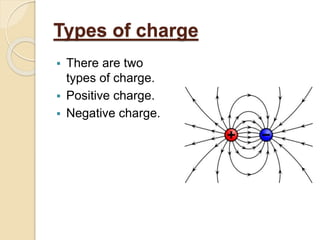
Types of charge
 There are two
types of charge.
 Positive charge.
 Negative charge.
Moving charges as a current or
when moving charges is not
current Its described as a
steam of moving
charges.
 May range very small
currents such as the
nerve impulse to a
large as the solar wind
emitted by the sun.
 There must be a “net”
flow of charges
towards one direction.
 When there is no net
flow of charge even
though there are
actual movement.
 Examples:
 Electrons of a copper
conductor in absence
of electric potential.
 Electrons just move
randomly the charge
flowing to one
direction is equal to
those flowing to the
other direction
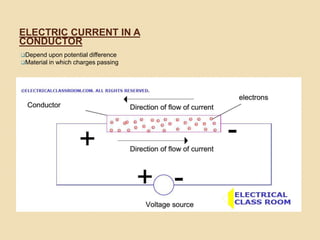
ELECTRIC CURRENT IN A
CONDUCTOR
Depend upon potential difference
Material in which charges passing
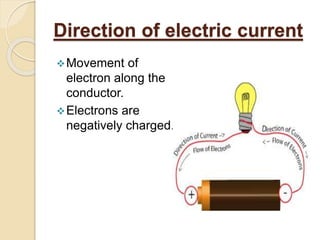
Direction of electric current
Movement of
electron along the
conductor.
Electrons are
negatively charged.
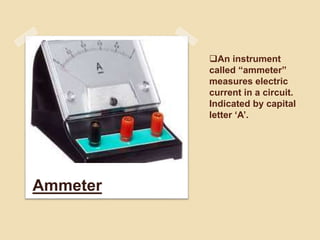
An instrument
called “ammeter”
measures electric
current in a circuit.
Indicated by capital
letter ‘A’.
Ammeter
How small quantities of
electric current are
expressed?
The small quantities of electric current
are expressed in :-
1. Milliampere ( 10 -3A )
2. Microampere ( 10 -6 A)
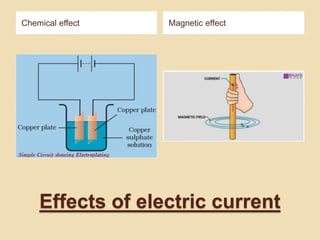
Effects of electric current
1. Heating effect (H=I2RT)
2. Magnetic effect: produces magnetic
field depend on value of current and
distance.
3. Chemical effect: dilute sulphuric aid
and copper sulphate are used as
electrode. Which conduct electricity
due to some chemical reactions.
Effects of electric current
Chemical effect Magnetic effect
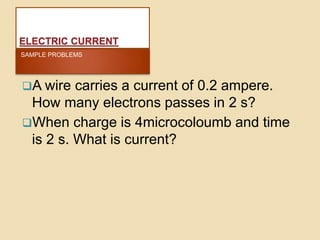
ELECTRIC CURRENT
SAMPLE PROBLEMS
A wire carries a current of 0.2 ampere.
How many electrons passes in 2 s?
When charge is 4microcoloumb and time
is 2 s. What is current?
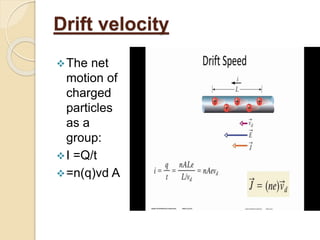
Drift velocity
The net
motion of
charged
particles
as a
group:
I =Q/t
=n(q)vd A
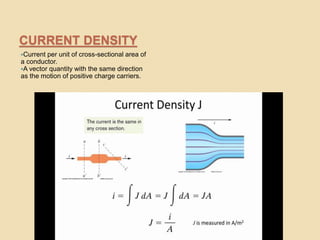
CURRENT DENSITY
Current per unit of cross-sectional area of
a conductor.
A vector quantity with the same direction
as the motion of positive charge carriers.
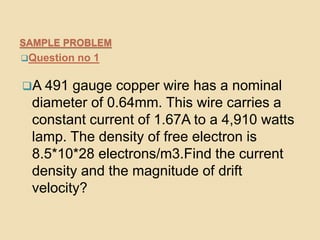
SAMPLE PROBLEM
Question no 1
A 491 gauge copper wire has a nominal
diameter of 0.64mm. This wire carries a
constant current of 1.67A to a 4,910 watts
lamp. The density of free electron is
8.5*10*28 electrons/m3.Find the current
density and the magnitude of drift
velocity?
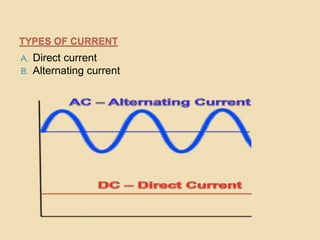
Types of current
Direct current: developed by Tomas
Alva Edison.
Graph is straight line.
Alternating current: developed by
Nekoola Tesla and George
Westinghouse, forming revalry with
Thomas Edison on War of the
Currents.
Graph is sinosoid.
TYPES OF CURRENT
A. Direct current
B. Alternating current
Thank You!

Emt presentation . (electric current) f2019067084

  • 1.
    Urwa Arshad F2019067084 Electric Current& Microscopic view of electric current
  • 2.
    Introduction  Electric current&formula& S.I. unit& quantity  Types of charges  Moving charges is a current or not a current  Electric current in a conductor  Direction of electric current  How electric current measures?  How Small quantities of electric current are expressed?  Effects of current  Sample problem  Drift velocity  Current density  Sample problem  Types of current
  • 3.
    Electric current  Def:The current is the rate at which charge flows through surface.  Meaning: flow of electrons  Iavg=∆Q/∆t  I ins= dQ/dt  S. I unit is 1A  IA=1C/s  Electric current is a scalar quantity.
  • 4.
    Types of charge There are two types of charge.  Positive charge.  Negative charge.
  • 5.
    Moving charges asa current or when moving charges is not current Its described as a steam of moving charges.  May range very small currents such as the nerve impulse to a large as the solar wind emitted by the sun.  There must be a “net” flow of charges towards one direction.  When there is no net flow of charge even though there are actual movement.  Examples:  Electrons of a copper conductor in absence of electric potential.  Electrons just move randomly the charge flowing to one direction is equal to those flowing to the other direction
  • 6.
    ELECTRIC CURRENT INA CONDUCTOR Depend upon potential difference Material in which charges passing
  • 7.
    Direction of electriccurrent Movement of electron along the conductor. Electrons are negatively charged.
  • 8.
    An instrument called “ammeter” measureselectric current in a circuit. Indicated by capital letter ‘A’. Ammeter
  • 9.
    How small quantitiesof electric current are expressed? The small quantities of electric current are expressed in :- 1. Milliampere ( 10 -3A ) 2. Microampere ( 10 -6 A)
  • 10.
    Effects of electriccurrent 1. Heating effect (H=I2RT) 2. Magnetic effect: produces magnetic field depend on value of current and distance. 3. Chemical effect: dilute sulphuric aid and copper sulphate are used as electrode. Which conduct electricity due to some chemical reactions.
  • 11.
    Effects of electriccurrent Chemical effect Magnetic effect
  • 12.
    ELECTRIC CURRENT SAMPLE PROBLEMS Awire carries a current of 0.2 ampere. How many electrons passes in 2 s? When charge is 4microcoloumb and time is 2 s. What is current?
  • 13.
    Drift velocity The net motionof charged particles as a group: I =Q/t =n(q)vd A
  • 14.
    CURRENT DENSITY Current perunit of cross-sectional area of a conductor. A vector quantity with the same direction as the motion of positive charge carriers.
  • 15.
    SAMPLE PROBLEM Question no1 A 491 gauge copper wire has a nominal diameter of 0.64mm. This wire carries a constant current of 1.67A to a 4,910 watts lamp. The density of free electron is 8.5*10*28 electrons/m3.Find the current density and the magnitude of drift velocity?
  • 16.
    Types of current Directcurrent: developed by Tomas Alva Edison. Graph is straight line. Alternating current: developed by Nekoola Tesla and George Westinghouse, forming revalry with Thomas Edison on War of the Currents. Graph is sinosoid.
  • 17.
    TYPES OF CURRENT A.Direct current B. Alternating current
  • 18.