By Hathib k.k.
Current Issues in
Inclusive Education
Now inclusive education has
got a wider dimension that it
includes providing education
not only for differently abled
children but also for the
children from marginalized
and socially excluded
communities together with
other children in normal
school set up. Let’s look at
the present Indian Scenario
in this regard.
By Hathib k.k.
What is Marginalization?
Marginalization is forcing
a person or a particular
group of a particular
society to be away from
the mainstream of the
society by denying him or
it all the rights and
opportunities for
developing himself or
itself by getting education
and participating in such
developmental activities.
By Hathib k.k.
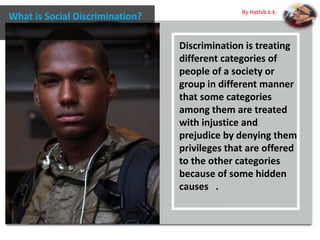
Discrimination is treating
different categories of
people of a society or
group in different manner
that some categories
among them are treated
with injustice and
prejudice by denying them
privileges that are offered
to the other categories
because of some hidden
causes .
What is Social Discrimination?
By Hathib k.k.
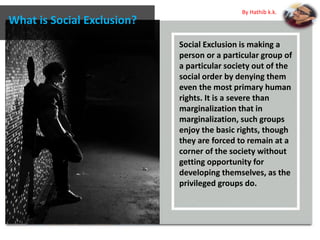
Social Exclusion is making a
person or a particular group of
a particular society out of the
social order by denying them
even the most primary human
rights. It is a severe than
marginalization that in
marginalization, such groups
enjoy the basic rights, though
they are forced to remain at a
corner of the society without
getting opportunity for
developing themselves, as the
privileged groups do.
What is Social Exclusion?
By Hathib k.k.
It is clear that Marginalization and
Social Exclusion Occur When there is
Social Discrimination
By Hathib k.k.
The following slides discuss the provisions and privileges that
Indian Constitution offers to the marginalized groups as a part
of Positive Discrimination Policy. These provisions proclaim
that there should be inclusion of all such marginalized sections
and differently abled children in normal schools.
By Hathib k.k.
Article 14
The State shall not deny to
any person equality before
the law or the equal
protection of the laws
within the territory of India
Prohibition of
discrimination on grounds
of religion, race, caste, sex
or place of birth
By Hathib k.k.
Article 14
Actually Says
That all the people should
not be treated in the same
manner, but people belong
to same circumstances
should be treated in the
same manner.eg. Each
person should not be taxed
by the same standard, but
the people of the same
circumstances should be
taxed by the same standard
By Hathib k.k.
Hence Article
14 Does say
That all the people should
not be considered for
admission for educational
institution or appointment
for the govt. sector on the
basis of same criteria, but
people of same
circumstances shall be
considered on the basis of
same criteria
By Hathib k.k.
So its clear that Artic14 Offers special
privileges for the Marginalized Groups
By Hathib k.k.
Article 15 (3)
Nothing in this article shall
prevent the State from
making any special
provision for women and
children ( Actually the
Article is for Prohibition of
discrimination on grounds
of religion, race, caste, sex
or place of birth. How ever,
on the basis of this the state
should not hesitate to offer
special provisions for such
people)
By Hathib k.k.
Article 15 (4)
Nothing in this article or in clause
( 2 ) of Article 29 shall prevent the
State from making any special
provision for the advancement of
any socially and educationally
backward classes of citizens or for
the Scheduled Castes and the
Scheduled Tribes ( clause ( 2 ) of
Article 29 says that no citizen shall
be denied admission into any
educational institution maintained
by the State or receiving aid out of
State funds on grounds only of
religion, race, caste, language or
any of them)
By Hathib k.k.
So the Indian Constitution says that the state shall
not misinterpret the main clause of the Article 15
and clause (2) of the Article 29 for denying the
special provision for the marginalized ones.
By Hathib k.k.
Article 17
Untouchability is abolished
and its practice in any form
is forbidden The
enforcement of any
disability arising out of
Untouchability shall be an
offence punishable in
accordance with law
By Hathib k.k.
So Article 17 strictly prohibits segregation on the
basis of religion or cast or such issue in classrooms
and school campuses, which often make students
from such circumstances stop their education
uncompleted .
By Hathib k.k.
Article 30 (1)
All minorities, whether
based on religion or
language, shall have the
right to establish and
administer educational
institutions of their choice
By Hathib k.k.
Article 30 (2)
The state shall not, in
granting aid to educational
institutions, discriminate
against any educational
institution on the ground
that it is under the
management of a minority,
whether based on religion
or language
By Hathib k.k.
So Article 30 ensures that the people of Minority
groups also get enough opportunity for gaining
proper education so that to be a part of the
mainstream .
By Hathib k.k.
Article 350 (A)
It shall be the endeavor of every
State and of every local authority
within the State to provide adequate
facilities for instruction in the
mother-tongue at the primary stage
of education to children belonging to
linguistic minority groups; and the
President may issue such directions
to any State as he considers necessary
or proper for securing the provision
of such facilities.
By Hathib k.k.
S497 of the Indian
Penal Code
Whoever has sexual intercourse with a
person who is and whom he knows or
has reason to believe to be the wife of
another man, without the consent or
connivance of that man, such sexual
intercourse not amounting to the
offence of rape, is guilty of the offence
of adultery, and shall be punished with
imprisonment of either description for
a term which may extend to five years,
or with fine, or with both. In such case
the wife shall not be punishable as an
abettor.
By Hathib k.k.
So S497 of IPC says that people of different
circumstances may not be treated in the same
manner
By Hathib k.k.
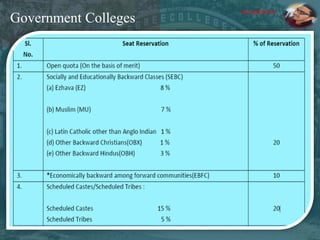
Let’s see the reservation of seats for the
marginalized groups in different Educational
Institutions
By Hathib k.k.
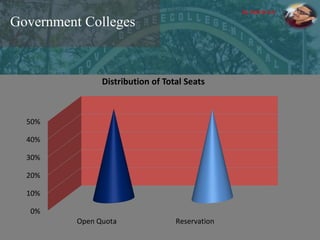
Government Colleges
0%
10%
20%
30%
40%
50%
Open Quota Reservation
Distribution of Total Seats
By Hathib k.k.
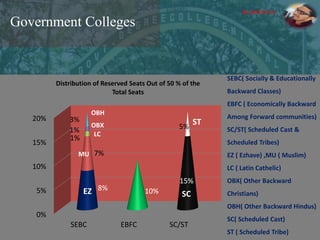
Government Colleges
0%
5%
10%
15%
20%
SEBC EBFC SC/ST
8% 10%
15%
7%
5%
1%
1%
3%
Distribution of Reserved Seats Out of 50 % of the
Total Seats
EZ
MU
LC
OBX
OBH
SC
ST
SEBC( Socially & Educationally
Backward Classes)
EBFC ( Economically Backward
Among Forward communities)
SC/ST( Scheduled Cast &
Scheduled Tribes)
EZ ( Ezhave) ,MU ( Muslim)
LC ( Latin Cathelic)
OBX( Other Backward
Christians)
OBH( Other Backward Hindus)
SC( Scheduled Cast)
ST ( Scheduled Tribe)
By Hathib k.k.
Government Colleges By Hathib k.k.
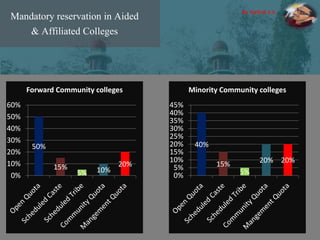
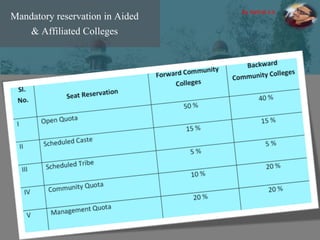
Mandatory reservation in Aided
& Affiliated Colleges
50%
15%
5% 10%
20%
0%
10%
20%
30%
40%
50%
60%
Forward Community colleges
40%
15%
5%
20% 20%
0%
5%
10%
15%
20%
25%
30%
35%
40%
45%
Minority Community colleges
By Hathib k.k.
Mandatory reservation in Aided
& Affiliated Colleges
By Hathib k.k.
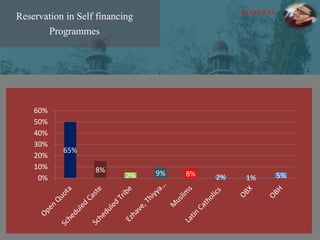
Reservation in Self financing
Programmes
65%
8%
2% 9% 8% 2% 1% 5%0%
10%
20%
30%
40%
50%
60%
By Hathib k.k.
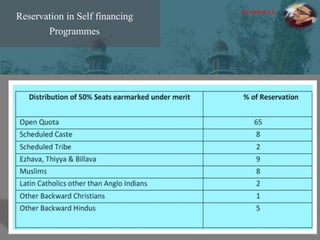
Reservation in Self financing
Programmes
By Hathib k.k.
The National Curriculum
Framework ( NCF) of 2005 has
forwarded strict criteria for
framing curriculum without
having any sort of gender bias.
By Hathib k.k.
Still Inclusion of
Children with diverse
needs is yet to be
realized-Why?
( Barriers before
Inclusion or Factors
behind the lack of
Inclusion)
Hesitation of
Concerned Authority
in Implementing the
Constitutional rights
and directions
The reservations are
taken away or high
jacked away by
undeserving people
Lack of awareness
among the parents of
children from such
communities and
sections about their
rights & provisions
Lack of Infra
structural
accessibility at
educational
institutions
Lack of teachers
capable of handling
such children with
positive attitude and
special measures.
Curricular activities
beyond their
capacities and
perspectives
Negative attitudes of
teachers towards
such children
Avoidance by peer
students inside and
outside the
classroom
Negative attitude of
the parents of the
normal children
towards the
marginalized &
differently abled
children
Negative attitude of
society towards such
children
Measures to be
taken for the
inclusion of Children
with diverse needs(
Marginalized and
differently abled
children) in the
normal educational
system
Concerned authority
should be sincere and
committed enough to
implement the
constitutional rights and
provisions without
considering the loop
holes and technicalities
The authority should
ensure that reservations
are not high jacked and
not wrongly distributed
by implementing
accurate verification
mechanism and severe
actions against those
who violate such rights
and provisions.
The parents and families
of such children should
be made aware of such
provisions and rights
through awareness
programmes and
advertisements on
printed and electronic
media.
Each institution should
offer all the infra
structural facilities
needed for such children
without any sort of
failure.
Trainees of mainstream
teacher education
centres also should be
provided skills for
handling such children
Special curricular
adaptations should be
taken for the sake of
children with diverse
needs.
Teachers should be
directed to keep positive
attitude towards such
children. Severe actions
should be taken against
those teachers who
segregate or torture
such children
The normal students
should be made ready to
mingle with children
from marginalized
groups and differently
abled children
Parents of normal
children also should be
provided awareness
classes in this regard.
Making use of whole
school approach i.e.
arranging the school
activities and schedules
with a broad aim of
incorporating health and
well being of the
students regardless to
any sort of difference in
their nature or status
Making use of
community based
education i.e to seek the
community
organizations to provide
formal and informal
education at practical
level.
Creating a positive social
attitude towards
disability and differently
abled and marginalized
children
Role of Different Social
Institutions in Inclusive
Education.
Role of Different Social
Institutions in Inclusive Education.
Family
1. Giving all the support and extra attention
2. Frequent visits to the school
3. Getting training for handling the children
4. Active communication with the teachers
5. Ensuring that their children are not
tortured
6. Accompanying the children when ever it is
needed
Role of Different Social
Institutions in Inclusive Education.
Peer Group
1. Avoiding bullying or mocking
2. Avoiding isolating or segregating
3. Collaborate Learning
4. Cross Age Peer Support
5. Forming Partners
6. Technical Support
7. Sharing Study Materials
Role of Different Social
Institutions in Inclusive Education.
Teachers
1. Preparing special strategy for handling such
children
2. Assisting them to enjoy the provisions for them
3. Giving them extra time for clarifying doubts
4. Making use of culturally responsive pedagogy
5. Regular consulting with special teachers-speech
therapy, psycho therapy, occupational therapy
Role of Different Social
Institutions in Inclusive Education.
Teachers
1. Keep the data base of the children with special
needs
2. Sharing Study Materials
3. Regular communication with their parents
4. Updating knowledge on special technologies
5. Making the learners know their strengths &
weaknesses
6. Make the learners aware of different technologies
to cope up with different disabilities.
7. Implementing learner friendly evaluation
Role of Different Social
Institutions in Inclusive Education.
Administrators/policy makers
1. Ensuring that the constitutional rights are
accurately implemented
2. Introducing new schemes for such children
3. Providing them special infra structural facilities
4. Providing scholarships.
5. Providing financial support to families of such
children
6. Offering employment to parents of such children
7. Offering multi cultural education
8. Implementing multi-grade teaching
It is a system of
education in which,
histories, culture,
philosophies etc. of
different people are
taught together
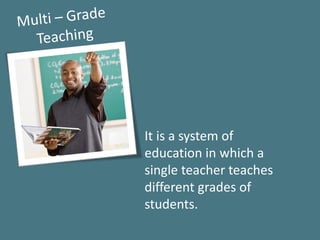
It is a system of
education in which a
single teacher teaches
different grades of
students.
Thank You

Current issues in inclusive education

  • 1.
    By Hathib k.k. CurrentIssues in Inclusive Education
  • 2.
    Now inclusive educationhas got a wider dimension that it includes providing education not only for differently abled children but also for the children from marginalized and socially excluded communities together with other children in normal school set up. Let’s look at the present Indian Scenario in this regard. By Hathib k.k.
  • 3.
    What is Marginalization? Marginalizationis forcing a person or a particular group of a particular society to be away from the mainstream of the society by denying him or it all the rights and opportunities for developing himself or itself by getting education and participating in such developmental activities. By Hathib k.k.
  • 4.
    Discrimination is treating differentcategories of people of a society or group in different manner that some categories among them are treated with injustice and prejudice by denying them privileges that are offered to the other categories because of some hidden causes . What is Social Discrimination? By Hathib k.k.
  • 5.
    Social Exclusion ismaking a person or a particular group of a particular society out of the social order by denying them even the most primary human rights. It is a severe than marginalization that in marginalization, such groups enjoy the basic rights, though they are forced to remain at a corner of the society without getting opportunity for developing themselves, as the privileged groups do. What is Social Exclusion? By Hathib k.k.
  • 6.
    It is clearthat Marginalization and Social Exclusion Occur When there is Social Discrimination By Hathib k.k.
  • 7.
    The following slidesdiscuss the provisions and privileges that Indian Constitution offers to the marginalized groups as a part of Positive Discrimination Policy. These provisions proclaim that there should be inclusion of all such marginalized sections and differently abled children in normal schools. By Hathib k.k.
  • 8.
    Article 14 The Stateshall not deny to any person equality before the law or the equal protection of the laws within the territory of India Prohibition of discrimination on grounds of religion, race, caste, sex or place of birth By Hathib k.k.
  • 9.
    Article 14 Actually Says Thatall the people should not be treated in the same manner, but people belong to same circumstances should be treated in the same manner.eg. Each person should not be taxed by the same standard, but the people of the same circumstances should be taxed by the same standard By Hathib k.k.
  • 10.
    Hence Article 14 Doessay That all the people should not be considered for admission for educational institution or appointment for the govt. sector on the basis of same criteria, but people of same circumstances shall be considered on the basis of same criteria By Hathib k.k.
  • 11.
    So its clearthat Artic14 Offers special privileges for the Marginalized Groups By Hathib k.k.
  • 12.
    Article 15 (3) Nothingin this article shall prevent the State from making any special provision for women and children ( Actually the Article is for Prohibition of discrimination on grounds of religion, race, caste, sex or place of birth. How ever, on the basis of this the state should not hesitate to offer special provisions for such people) By Hathib k.k.
  • 13.
    Article 15 (4) Nothingin this article or in clause ( 2 ) of Article 29 shall prevent the State from making any special provision for the advancement of any socially and educationally backward classes of citizens or for the Scheduled Castes and the Scheduled Tribes ( clause ( 2 ) of Article 29 says that no citizen shall be denied admission into any educational institution maintained by the State or receiving aid out of State funds on grounds only of religion, race, caste, language or any of them) By Hathib k.k.
  • 14.
    So the IndianConstitution says that the state shall not misinterpret the main clause of the Article 15 and clause (2) of the Article 29 for denying the special provision for the marginalized ones. By Hathib k.k.
  • 15.
    Article 17 Untouchability isabolished and its practice in any form is forbidden The enforcement of any disability arising out of Untouchability shall be an offence punishable in accordance with law By Hathib k.k.
  • 16.
    So Article 17strictly prohibits segregation on the basis of religion or cast or such issue in classrooms and school campuses, which often make students from such circumstances stop their education uncompleted . By Hathib k.k.
  • 17.
    Article 30 (1) Allminorities, whether based on religion or language, shall have the right to establish and administer educational institutions of their choice By Hathib k.k.
  • 18.
    Article 30 (2) Thestate shall not, in granting aid to educational institutions, discriminate against any educational institution on the ground that it is under the management of a minority, whether based on religion or language By Hathib k.k.
  • 19.
    So Article 30ensures that the people of Minority groups also get enough opportunity for gaining proper education so that to be a part of the mainstream . By Hathib k.k.
  • 20.
    Article 350 (A) Itshall be the endeavor of every State and of every local authority within the State to provide adequate facilities for instruction in the mother-tongue at the primary stage of education to children belonging to linguistic minority groups; and the President may issue such directions to any State as he considers necessary or proper for securing the provision of such facilities. By Hathib k.k.
  • 21.
    S497 of theIndian Penal Code Whoever has sexual intercourse with a person who is and whom he knows or has reason to believe to be the wife of another man, without the consent or connivance of that man, such sexual intercourse not amounting to the offence of rape, is guilty of the offence of adultery, and shall be punished with imprisonment of either description for a term which may extend to five years, or with fine, or with both. In such case the wife shall not be punishable as an abettor. By Hathib k.k.
  • 22.
    So S497 ofIPC says that people of different circumstances may not be treated in the same manner By Hathib k.k.
  • 23.
    Let’s see thereservation of seats for the marginalized groups in different Educational Institutions By Hathib k.k.
  • 24.
    Government Colleges 0% 10% 20% 30% 40% 50% Open QuotaReservation Distribution of Total Seats By Hathib k.k.
  • 25.
    Government Colleges 0% 5% 10% 15% 20% SEBC EBFCSC/ST 8% 10% 15% 7% 5% 1% 1% 3% Distribution of Reserved Seats Out of 50 % of the Total Seats EZ MU LC OBX OBH SC ST SEBC( Socially & Educationally Backward Classes) EBFC ( Economically Backward Among Forward communities) SC/ST( Scheduled Cast & Scheduled Tribes) EZ ( Ezhave) ,MU ( Muslim) LC ( Latin Cathelic) OBX( Other Backward Christians) OBH( Other Backward Hindus) SC( Scheduled Cast) ST ( Scheduled Tribe) By Hathib k.k.
  • 26.
  • 27.
    Mandatory reservation inAided & Affiliated Colleges 50% 15% 5% 10% 20% 0% 10% 20% 30% 40% 50% 60% Forward Community colleges 40% 15% 5% 20% 20% 0% 5% 10% 15% 20% 25% 30% 35% 40% 45% Minority Community colleges By Hathib k.k.
  • 28.
    Mandatory reservation inAided & Affiliated Colleges By Hathib k.k.
  • 29.
    Reservation in Selffinancing Programmes 65% 8% 2% 9% 8% 2% 1% 5%0% 10% 20% 30% 40% 50% 60% By Hathib k.k.
  • 30.
    Reservation in Selffinancing Programmes By Hathib k.k.
  • 31.
    The National Curriculum Framework( NCF) of 2005 has forwarded strict criteria for framing curriculum without having any sort of gender bias. By Hathib k.k.
  • 32.
    Still Inclusion of Childrenwith diverse needs is yet to be realized-Why? ( Barriers before Inclusion or Factors behind the lack of Inclusion)
  • 33.
    Hesitation of Concerned Authority inImplementing the Constitutional rights and directions
  • 34.
    The reservations are takenaway or high jacked away by undeserving people
  • 35.
    Lack of awareness amongthe parents of children from such communities and sections about their rights & provisions
  • 36.
    Lack of Infra structural accessibilityat educational institutions
  • 37.
    Lack of teachers capableof handling such children with positive attitude and special measures.
  • 38.
  • 39.
    Negative attitudes of teacherstowards such children
  • 40.
    Avoidance by peer studentsinside and outside the classroom
  • 41.
    Negative attitude of theparents of the normal children towards the marginalized & differently abled children
  • 42.
    Negative attitude of societytowards such children
  • 43.
    Measures to be takenfor the inclusion of Children with diverse needs( Marginalized and differently abled children) in the normal educational system
  • 44.
    Concerned authority should besincere and committed enough to implement the constitutional rights and provisions without considering the loop holes and technicalities
  • 45.
    The authority should ensurethat reservations are not high jacked and not wrongly distributed by implementing accurate verification mechanism and severe actions against those who violate such rights and provisions.
  • 46.
    The parents andfamilies of such children should be made aware of such provisions and rights through awareness programmes and advertisements on printed and electronic media.
  • 47.
    Each institution should offerall the infra structural facilities needed for such children without any sort of failure.
  • 48.
    Trainees of mainstream teachereducation centres also should be provided skills for handling such children
  • 49.
    Special curricular adaptations shouldbe taken for the sake of children with diverse needs.
  • 50.
    Teachers should be directedto keep positive attitude towards such children. Severe actions should be taken against those teachers who segregate or torture such children
  • 51.
    The normal students shouldbe made ready to mingle with children from marginalized groups and differently abled children
  • 52.
    Parents of normal childrenalso should be provided awareness classes in this regard.
  • 53.
    Making use ofwhole school approach i.e. arranging the school activities and schedules with a broad aim of incorporating health and well being of the students regardless to any sort of difference in their nature or status
  • 54.
    Making use of communitybased education i.e to seek the community organizations to provide formal and informal education at practical level.
  • 55.
    Creating a positivesocial attitude towards disability and differently abled and marginalized children
  • 56.
    Role of DifferentSocial Institutions in Inclusive Education.
  • 57.
    Role of DifferentSocial Institutions in Inclusive Education. Family 1. Giving all the support and extra attention 2. Frequent visits to the school 3. Getting training for handling the children 4. Active communication with the teachers 5. Ensuring that their children are not tortured 6. Accompanying the children when ever it is needed
  • 58.
    Role of DifferentSocial Institutions in Inclusive Education. Peer Group 1. Avoiding bullying or mocking 2. Avoiding isolating or segregating 3. Collaborate Learning 4. Cross Age Peer Support 5. Forming Partners 6. Technical Support 7. Sharing Study Materials
  • 59.
    Role of DifferentSocial Institutions in Inclusive Education. Teachers 1. Preparing special strategy for handling such children 2. Assisting them to enjoy the provisions for them 3. Giving them extra time for clarifying doubts 4. Making use of culturally responsive pedagogy 5. Regular consulting with special teachers-speech therapy, psycho therapy, occupational therapy
  • 60.
    Role of DifferentSocial Institutions in Inclusive Education. Teachers 1. Keep the data base of the children with special needs 2. Sharing Study Materials 3. Regular communication with their parents 4. Updating knowledge on special technologies 5. Making the learners know their strengths & weaknesses 6. Make the learners aware of different technologies to cope up with different disabilities. 7. Implementing learner friendly evaluation
  • 61.
    Role of DifferentSocial Institutions in Inclusive Education. Administrators/policy makers 1. Ensuring that the constitutional rights are accurately implemented 2. Introducing new schemes for such children 3. Providing them special infra structural facilities 4. Providing scholarships. 5. Providing financial support to families of such children 6. Offering employment to parents of such children 7. Offering multi cultural education 8. Implementing multi-grade teaching
  • 62.
    It is asystem of education in which, histories, culture, philosophies etc. of different people are taught together
  • 63.
    It is asystem of education in which a single teacher teaches different grades of students.
  • 64.