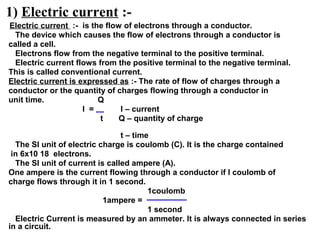
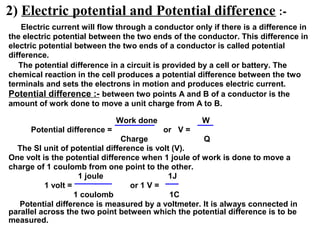
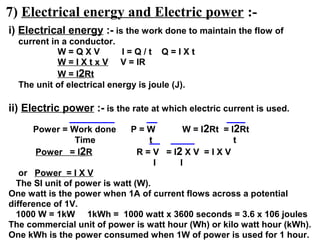
1. Electric current is the flow of electrons through a conductor. It is measured in amperes (A) and is caused by a potential difference provided by a cell or battery.
2. Ohm's law states that the current through a conductor is directly proportional to the potential difference across it, provided the temperature remains constant. It can be expressed as V=IR, where V is the potential difference, I is the current, and R is the resistance of the conductor.
3. The resistance of a conductor depends on its length, cross-sectional area, and material. Resistance increases with length and decreases with cross-sectional area. Materials like metals have low resistivity while insulators have high resistivity.