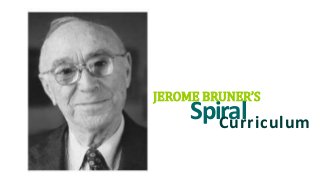
Spiral
Curriculum
JEROME BRUNER’S
The Spiral Curriculum was
proposed by Bruner in 1977.
What is Spiral Approach?
• It is a technique often used in teaching.
• A course of study in which students will see the
same topics throughout their school career, with
each encounter increasing in complexity and
reinforcing previous learning.
Spiral
1
2
The spiral curriculum also allows a logical
progression from simplistic ideas to
complicated ideas;
3
benefits
ascribed to the spiral
curriculum by its advocates
are:
The
The information is reinforced and solidified each
time the student revisits the subject matter;
Students are encouraged to apply the early
knowledge to later course objectives.
The Spiral Curriculum. Research into Practice By Johnston, Howard
•Section 5 of R.A 10533, states that
''The Curriculum shall use the spiral
progression approach to ensure
mastery of knowledge and skills after
each level.’’
in the Spiral Approach ,the
teaching concepts increase
and depth and breadth
across the Grade levels.
EXAMPLE 1
in Mathematics, Algebra, Geometry,
Statistics, and Trigonometry concepts are
being taught from kindergarten to grade
10.
in Science, Biology, Chemistry and
Physics will start to teach from
grade 3 (where science as a subject
starts) to grade 10 considering the
developmental stages of the
students.
EXAMPLE 2
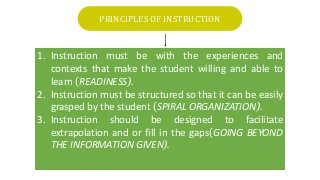
PRINCIPLES OF INSTRUCTION
1. Instruction must be with the experiences and
contexts that make the student willing and able to
learn (READINESS).
2. Instruction must be structured so that it can be easily
grasped by the student (SPIRAL ORGANIZATION).
3. Instruction should be designed to facilitate
extrapolation and or fill in the gaps(GOING BEYOND
THE INFORMATION GIVEN).
THANK YOU for
listening!
Lealy P. Cambal

Spiral-Curriculum-PPT.pptx

  • 1.
  • 2.
    The Spiral Curriculumwas proposed by Bruner in 1977.
  • 3.
    What is SpiralApproach? • It is a technique often used in teaching. • A course of study in which students will see the same topics throughout their school career, with each encounter increasing in complexity and reinforcing previous learning.
  • 4.
  • 5.
    1 2 The spiral curriculumalso allows a logical progression from simplistic ideas to complicated ideas; 3 benefits ascribed to the spiral curriculum by its advocates are: The The information is reinforced and solidified each time the student revisits the subject matter; Students are encouraged to apply the early knowledge to later course objectives. The Spiral Curriculum. Research into Practice By Johnston, Howard
  • 6.
    •Section 5 ofR.A 10533, states that ''The Curriculum shall use the spiral progression approach to ensure mastery of knowledge and skills after each level.’’
  • 7.
    in the SpiralApproach ,the teaching concepts increase and depth and breadth across the Grade levels.
  • 8.
    EXAMPLE 1 in Mathematics,Algebra, Geometry, Statistics, and Trigonometry concepts are being taught from kindergarten to grade 10.
  • 9.
    in Science, Biology,Chemistry and Physics will start to teach from grade 3 (where science as a subject starts) to grade 10 considering the developmental stages of the students. EXAMPLE 2
  • 10.
    PRINCIPLES OF INSTRUCTION 1.Instruction must be with the experiences and contexts that make the student willing and able to learn (READINESS). 2. Instruction must be structured so that it can be easily grasped by the student (SPIRAL ORGANIZATION). 3. Instruction should be designed to facilitate extrapolation and or fill in the gaps(GOING BEYOND THE INFORMATION GIVEN).
  • 11.

Editor's Notes

  • #6 The Spiral Curriculum. Research into Practice By Johnston, Howard