Produced for APIC 2019
Medical Textiles
ANTIMICROBIAL COPPER-INFUSED PATIENT
GOWNS AND LINENS BACKED BY MULTIPLE
OUTCOMES-BASED, PEER-REVIEWED STUDIES
The use of copper gowns and bed linens lowers bioburden and
infection rates.8-9-10
1
Neely A. N. et al, (2000) J Clin Microbiol. 38(2): 724-26. • 2
Noble W.A., (1981) in Microbiology of human skin, 2nd edn. Loyd-Luke Ltd. London., p75-85.
3
Huslage K. et al, (2010) Infect Control & Hosp Epidemiol. Aug (8):850-3. • 4
Dancer S.J., (2008) Lacent Infect Dis Feb;8(2)101-13.
5
Boyce J.M., (2007) J Hosp Infect 65 (suppl 2):50–54. • 6
Weber D.J. et al, (2007) Infect Control Hosp Epidemiol; 18:306–309. 7
Weber D.J. et al, (2010) Am J Infect Control; 38:S25–
S33. 8
Lazaray A. et al, (2014) IJID 24: 23-29. • 9
Sifri C.D. et al, (2016) AJIC 44(12), 1565-71. • 10
Burke G.H. et al, (2018) IJIC 14:1.
THE PATIENT ENVIRONMENT IS A KNOWN
SOURCE OF PATHOGEN TRANSMISSION
BED RAILS
BED LINENSPATIENT GOWN
OVER BED TABLE SINK
FLOOR
FLAT SURFACES
FURNITURE
THE MOST TOUCHED AND MOST CONTAMINATED SURFACES IN A HOSPITAL ROOM
MOST MRSA - CONTAMINATED
MOST C DIFFICILE CONTAMINATED
MOST TOUCHED frequency of touch
degree of contamination
3
2
1
Linens are most frequently touched3
and contaminated surfaces
in the room4
The patient environment is a known source of HAIs5-6-7
Cupron provides an extra layer of protection by targeting the
areas closest to the patient
Textiles are an excellent substrate for microbial proliferation
Due to large surface area, retention of oxygen, moisture and
temperature conditions present between the skin and textiles1
Healthcare laundries deliver hygenically clean linens to hospitals
Patients shed pathogens directly onto the textiles they use2
Bacterial shedding is greater in patients than in healthy individuals
This study of Cupron’s medical
textiles alone validates their
effectiveness in preventing
hospital acquired infections in a
real world clinical setting, along
with a robust infection
prevention protocol,
~Jacque Butler
Director of Infection Control and
Prevention at Sentara Healthcare
INNOVATION AND PATIENT SAFETY“
“
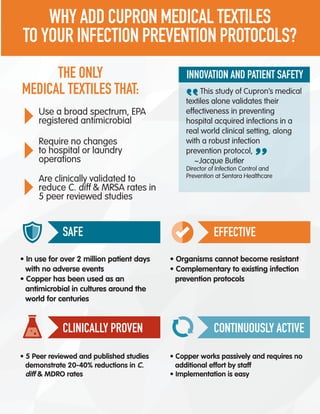
WHY ADD CUPRON MEDICAL TEXTILES
TO YOUR INFECTION PREVENTION PROTOCOLS?
Use a broad spectrum, EPA
registered antimicrobial
Are clinically validated to
reduce C. diff & MRSA rates in
5 peer reviewed studies
Require no changes
to hospital or laundry
operations
THE ONLY
MEDICAL TEXTILES THAT:
• In use for over 2 million patient days
with no adverse events
• Copper has been used as an
antimicrobial in cultures around the
world for centuries
• Organisms cannot become resistant
• Complementary to existing infection
prevention protocols
• 5 Peer reviewed and published studies
demonstrate 20-40% reductions in C.
diff & MDRO rates
• Copper works passively and requires no
additional effort by staff
• Implementation is easy
SAFE EFFECTIVE
CLINICALLY PROVEN CONTINUOUSLY ACTIVE
Sentara Obici Hospital
158 Beds
Sentara Albemarle Medical Center
142 Beds
Sentara Williamsburg Regional
Medical Center: 139 Beds
Sentara Rockingham Memorial Hospital
238 Beds
Sentara Martha Jefferson Hospital
150 Beds
Sentara Halifax Regional Hospital
192 Beds
CDI Rates
8.OO
6.OO
4.OO
2.OO
O.OO
18O Days9O Days 24O Days
6.7O
2.6O
3.29
5.77
3.55
6.O3
Pre Post
Results: During assessment periods 1 (90 days), 2 (180 days) and 3 (240 days), in comparison to
baseline periods 1, 2 and 3, there were 61.19% (p=0.0116), 41.09% (p=0.027), and 42.93% (p=0.0096)
reductions in the HAI per 10,000 patient hospitalization days caused by C. difficile, respectively; and
59.8% (p=0.0014), 39.91% (p=0.0145), and 37.19% (p=0.0108) in the reduction of HAI per 1,000 PD
caused by C. difficile and MDROs combined.
Discussion: The deployment of biocidal linens across six hospitals resulted in large and statistically significant
drops in both C. difficile infections and combined C. difficile and MDRO infections during all three time periods.
Study published in the Journal of Hospital Infection in 2018.
Methods: Rates of HAI caused by C. difficile and Multi Drug Resistant Organisms (MDROs) in 6 Sentara
Healthcare hospitals with similar patient demographics (total of 1,019 beds) were compared over three
parallel periods (90, 180 and 240 days) before and after replacing all the linens in inpatient rooms with
copper infused biocidal linens.
VIRGINIA AND NORTH CAROLINA
Beds: 1,019 • Patient Days in Study: 175,573 • Study Published: 2018
Sentara Healthcare Expanded Deployment:
Copper Patient Gowns and Linens
Butler,J.P.,(2018)AnalysisoftheroleofcopperinfusedcompositebedlinensandpatientgownsinreducingClostridiumdifficileandMultiDrugResistantOrganism
healthcare-associatedinfectionratesusingamultifacilityanalysiswithinahealthcaresystem.JournalofHospitalInfection2018Nov;100(3):130-134.
CDI + MDRO Infection Rates
O.34
O.8 O.76
O.O9
O.O8
O.O7
O.O6
O.O5
O.O4
O.O3
O.O2
O.O1
O
9O Days 18O Days 24O Days
O.48 O.48
O.84 6O% Drop
p=.OO14
4O% Drop
p=.O145
37% Drop
p=.O1O8
Pre Post
CDI + MDRO Rates
60% Drop
p=.0116
41% Drop
p=.027
43% Drop
p=.0096
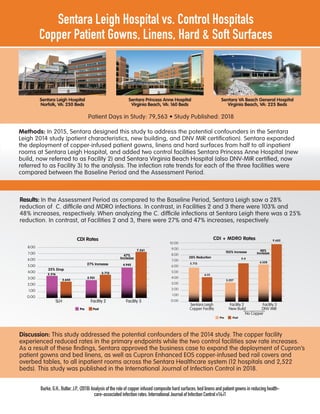
Results: In the Assessment Period as compared to the Baseline Period, Sentara Leigh saw a 28%
reduction of C. difficile and MDRO infections. In contrast, in Facilities 2 and 3 there were 103% and
48% increases, respectively. When analyzing the C. difficile infections at Sentara Leigh there was a 25%
reduction. In contrast, at Facilities 2 and 3, there were 27% and 47% increases, respectively.
Discussion: This study addressed the potential confounders of the 2014 study. The copper facility
experienced reduced rates in the primary endpoints while the two control facilities saw rate increases.
As a result of these findings, Sentara approved the business case to expand the deployment of Cupron’s
patient gowns and bed linens, as well as Cupron Enhanced EOS copper-infused bed rail covers and
overbed tables, to all inpatient rooms across the Sentara Healthcare system (12 hospitals and 2,522
beds). This study was published in the International Journal of Infection Control in 2018.
Methods: In 2015, Sentara designed this study to address the potential confounders in the Sentara
Leigh 2014 study (patient characteristics, new building, and DNV MIR certification). Sentara expanded
the deployment of copper-infused patient gowns, linens and hard surfaces from half to all inpatient
rooms at Sentara Leigh Hospital, and added two control facilities Sentara Princess Anne Hospital (new
build, now referred to as Facility 2) and Sentara Virginia Beach Hospital (also DNV-MIR certified, now
referred to as Facility 3) to the analysis. The infection rate trends for each of the three facilities were
compared between the Baseline Period and the Assessment Period.
Patient Days in Study: 79,563 • Study Published: 2018
Sentara Leigh Hospital vs. Control Hospitals
Copper Patient Gowns, Linens, Hard & Soft Surfaces
Burke,G.H.,Butler,J.P.,(2018)Analysisoftheroleofcopperinfusedcompositehardsurfaces,bedlinensandpatientgownsinreducinghealth-
care-associatedinfectionrates.InternationalJournalofInfectionControlv14:i1
CDI
8.OO
7.OO
6.OO
5.OO
4.OO
3.OO
2.OO
1.OO
O.OO
Facility 2SLH Facility 3
3.516
2.643
7.261Í
4.945
3.713
2.931
Pre Post
25% Drop
27% Increase
47%
Increase
CDI + MDRO
28% Reduction
103% Increase
1O.OO
9.OO
8.OO
7.OO
6.OO
5.OO
4.OO
3.OO
2.OO
1.OO
O.OO
New Build DNV MIRCopper Facility
Facility 2Sentara Leigh Facility 3
No Copper
5.713
4.111
9.682
6.528
6.6
3.257
Pre Post
48%
Increase
Sentara Leigh Hospital
Norfolk, VA: 250 Beds
Sentara Princess Anne Hospital
Virginia Beach, VA: 160 Beds
Sentara VA Beach General Hospital
Virginia Beach, VA: 225 Beds
CDI Rates Rates
Sentara Leigh Hospital
Norfolk, VA
Beds: 250
Patient Days in Study: 80,137
Study Published: 2016
ProducedforAPIC2018
CDI + Gram Negative MDRO
1O.OO
9.OO
8.OO
7.OO
6.OO
5.OO
4.OO
3.OO
2.OO
1.OO
O.OO
CDI CDI + MDRO
83%
Reduction
78%
Reduction
6.25
4.1O
O.69
1.38
Pre Post
p=.048
p=.023
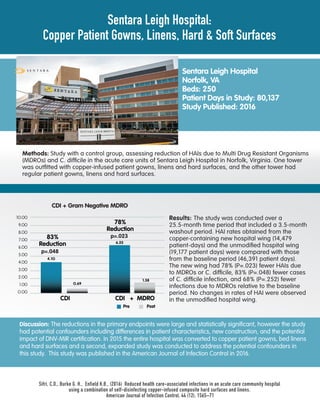
Results: The study was conducted over a
25.5-month time period that included a 3.5-month
washout period. HAI rates obtained from the
copper-containing new hospital wing (14,479
patient-days) and the unmodified hospital wing
(19,177 patient days) were compared with those
from the baseline period (46,391 patient days).
The new wing had 78% (P=.023) fewer HAIs due
to MDROs or C. difficile, 83% (P=.048) fewer cases
of C. difficile infection, and 68% (P=.252) fewer
infections due to MDROs relative to the baseline
period. No changes in rates of HAI were observed
in the unmodified hospital wing.
Methods: Study with a control group, assessing reduction of HAIs due to Multi Drug Resistant Organisms
(MDROs) and C. difficile in the acute care units of Sentara Leigh Hospital in Norfolk, Virginia. One tower
was outfitted with copper-infused patient gowns, linens and hard surfaces, and the other tower had
regular patient gowns, linens and hard surfaces.
Sentara Leigh Hospital:
Copper Patient Gowns, Linens, Hard & Soft Surfaces
Sifri, C.D., Burke G. H., Enfield K.B., (2016) Reduced health care-associated infections in an acute care community hospital
using a combination of self-disinfecting copper-infused composite hard surfaces and linens.
American Journal of Infection Control, 44 (12), 1565–71
Discussion: The reductions in the primary endpoints were large and statistically significant, however the study
had potential confounders including differences in patient characteristics, new construction, and the potential
impact of DNV-MIR certification. In 2015 the entire hospital was converted to copper patient gowns, bed linens
and hard surfaces and a second, expanded study was conducted to address the potential confounders in
this study. This study was published in the American Journal of Infection Control in 2016.
CDI + Gram Negative MDRO
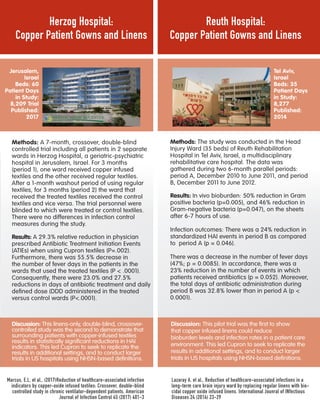
Methods: The study was conducted in the Head
Injury Ward (35 beds) of Reuth Rehabilitation
Hospital in Tel Aviv, Israel, a multidisciplinary
rehabilitative care hospital. The data was
gathered during two 6-month parallel periods:
period A, December 2010 to June 2011, and period
B, December 2011 to June 2012.
Results: In vivo bioburden: 50% reduction in Gram
positive bacteria (p=0.005), and 46% reduction in
Gram-negative bacteria (p=0.047), on the sheets
after 6-7 hours of use.
Infection outcomes: There was a 24% reduction in
standardized HAI events in period B as compared
to period A (p = 0.046).
There was a decrease in the number of fever days
(47%; p = 0.0085). In accordance, there was a
23% reduction in the number of events in which
patients received antibiotics (p = 0.052). Moreover,
the total days of antibiotic administration during
period B was 32.8% lower than in period A (p <
0.0001).
Tel Aviv,
Israel
Beds: 35
Patient Days
in Study:
8,277
Published:
2014
Reuth Hospital:
Copper Patient Gowns and Linens
Discussion: This pilot trial was the first to show
that copper infused linens could reduce
bioburden levels and infection rates in a patient care
environment. This led Cupron to seek to replicate the
results in additional settings, and to conduct larger
trials in US hospitals using NHSN-based definitions.
Lazaray A. et al., Reduction of healthcare-associated infections in a
long-term care brain injury ward by replacing regular linens with bio-
cidal copper oxide infused linens. International Jounral of INfectious
Diseases 24 (2014) 23-29
Methods: A 7-month, crossover, double-blind
controlled trial including all patients in 2 separate
wards in Herzog Hospital, a geriatric-psychiatric
hospital in Jerusalem, Israel. For 3 months
(period 1), one ward received copper infused
textiles and the other received regular textiles.
After a 1-month washout period of using regular
textiles, for 3 months (period 2) the ward that
received the treated textiles received the control
textiles and vice versa. The trial personnel were
blinded to which were treated or control textiles.
There were no differences in infection control
measures during the study.
Results: A 29.3% relative reduction in physician
prescribed Antibiotic Treatment Initiation Events
(ATIEs) when using Cupron textiles (P=.002).
Furthermore, there was 55.5% decrease in
the number of fever days in the patients in the
wards that used the treated textiles (P < .0001).
Consequently, there were 23.0% and 27.5%
reductions in days of antibiotic treatment and daily
defined dose (DDD administered in the treated
versus control wards (P<.0001).
Jerusalem,
Israel
Beds: 60
Patient Days
in Study:
8,209 Trial
Published:
2017
Herzog Hospital:
Copper Patient Gowns and Linens
Discussion: This linens-only, double-blind, crossover-
controlled study was the second to demonstrate that
surrounding patients with copper-infused textiles
results in statistically significant reductions in HAI
indicators. This led Cupron to seek to replicate the
results in additional settings, and to conduct larger
trials in US hospitals using NHSN-based definitions.
Marcus, E.L. et al., (2017)Reduction of healthcare-associated infection
indicators by copper-oxide infused textiles: Crossover, double-blind
controlled study in chronic ventilator-dependent patients. American
Journal of Infection Control 45 (2017) 401-3
Because bed linens and patient gowns are the most touched and contaminated
surfaces in the patient room, and due to their role as reservoirs and vectors for
pathogens, your healthcare laundry provider can serve an important role in your
patient safety initiatives.
Cupron works with several laundry providers every day and we recommend bringing
them into the discussion early.
FREQUENTLY ASKED QUESTIONS
Why are Cupron textiles a different color?
The fibers in Cupron Medical Textiles are permanently embedded with copper during manufacturing.
The unique color is caused by the copper content in the fabric and provides a strong visual indicator
as to which linens are antimicrobial and which are not.
Do Cupron textiles need to be laundered differently? Is there a special wash formula?
Cupron Medical Textiles do not need to be processed differently, but to aid the laundry sorting
process at the plant we recommend using separate colored bags for soiled white and Cupron linens.
Cupron can be laundered in either batch or tunnel washers with normal industrial detergents and
bleaches including peracetic acid, hydrogen peroxide, and chlorine. Cupron provides recommended
wash instructions; the only change is that fabric softener should not be used.
How long do they last?
Cupron’s linens are more durable than regular white linens. As a result, our largest laundry partner
gets >80% more servings from Cupron than regular white linens.
Longer linen life is positive, but do the linens
retain their efficacy?
Unlike laundry additives or topically applied
antimicrobials, Cupron’s antimicrobial copper
does not wash off or wear off over time due to the
embedded nature of the technology. Antimicrobial
testing shows that Cupron Medical Textiles retain
99.9% efficacy during the life of the product.
Number of Servings
7O
6O
5O
4O
3O
2O
1O
O
Standard Cupron
Washcloth Bath Towel Patient Gown Fitted Sheet Flat Sheet Thermal Spread
7
15
19
36
56
19
47 48
27 27
6O
35
Cupron linens can stay in circulation >80% longer
than regular white linens, and maintain their
efficacy throughout the life of the product
FREQUENTLY ASKED QUESTIONS
What is your safety record?
Cupron Medical Textiles have been in use for over 2 million patient days without any reported
adverse events due to copper.
What about copper allergies?
Because copper is an element that is found in many foods and multivitamins, true copper
allergies are extremely rare. Many people who believe they have a copper allergy have had
reactions to copper alloys containing nickel, which Cupron linens do not. There are two rare
conditions related to copper metabolism, Wilson’s disease and Menkes syndrome, and these are
flagged on admission.
Do you make privacy curtains?
Not at this time. Although studies show curtains are contaminated, our focus is on the textiles
closest to the patient as these are the most touched and contaminated surfaces in the room.
Do you have someone who can speak with my laundry provider?
Cupron can provide references to answer any questions.
Cupron linens have little
impact on our daily production
process. Providing Cupron linens is
a way we support our customers,
it’s important to be their partner in
infection prevention.	
~Charles Berge
President & General Manager,
Shared Hospital Services
INNOVATION AND PATIENT SAFETY“
“
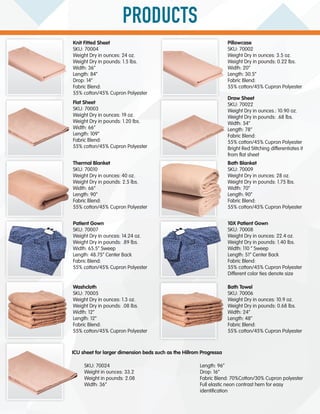
Knit Fitted Sheet
SKU: 70004
Weight Dry in ounces: 24 oz.
Weight Dry in pounds: 1.5 lbs.
Width: 36”
Length: 84”
Drop: 14”
Fabric Blend:
55% cotton/45% Cupron Polyester
Pillowcase
SKU: 70002
Weight Dry in ounces: 3.5 oz.
Weight Dry in pounds: 0.22 lbs.
Width: 20”
Length: 30.5”
Fabric Blend:
55% cotton/45% Cupron Polyester
Flat Sheet
SKU: 70003
Weight Dry in ounces: 19 oz.
Weight Dry in pounds: 1.20 lbs.
Width: 66”
Length: 109”
Fabric Blend:
55% cotton/45% Cupron Polyester
Draw Sheet
SKU: 70022
Weight Dry in ounces.: 10.90 oz.
Weight Dry in pounds: .68 lbs.
Width: 54”
Length: 78”
Fabric Blend:
55% cotton/45% Cupron Polyester
Bright Red Stitching differentiates it
from flat sheet
Thermal Blanket
SKU: 70010
Weight Dry in ounces: 40 oz.
Weight Dry in pounds: 2.5 lbs.
Width: 66”
Length: 90”
Fabric Blend:
55% cotton/45% Cupron Polyester
Bath Blanket
SKU: 70009
Weight Dry in ounces: 28 oz.
Weight Dry in pounds: 1.75 lbs.
Width: 70”
Length: 90”
Fabric Blend:
55% cotton/45% Cupron Polyester
Patient Gown
SKU: 70007
Weight Dry in ounces: 14.24 oz.
Weight Dry in pounds: .89 lbs.
Width: 65.5” Sweep
Length: 48.75” Center Back
Fabric Blend:
55% cotton/45% Cupron Polyester
10X Patient Gown
SKU: 70008
Weight Dry in ounces: 22.4 oz.
Weight Dry in pounds: 1.40 lbs.
Width: 110 “ Sweep
Length: 51” Center Back
Fabric Blend:
55% cotton/45% Cupron Polyester
Different color ties denote size
Washcloth
SKU: 70005
Weight Dry in ounces: 1.3 oz.
Weight Dry in pounds: .08 lbs.
Width: 12”
Length: 12”
Fabric Blend:
55% cotton/45% Cupron Polyester
Bath Towel
SKU: 70006
Weight Dry in ounces: 10.9 oz.
Weight Dry in pounds: 0.68 lbs.
Width: 24”
Length: 48”
Fabric Blend:
55% cotton/45% Cupron Polyester
PRODUCTS
SKU: 70024
Weight in ounces: 33.2
Weight in pounds: 2.08
Width: 36”
Length: 96”
Drop: 16”
Fabric Blend: 70%Cotton/30% Cupron polyester
Full elastic neon contrast hem for easy
identification
ICU sheet for larger dimension beds such as the Hillrom Progressa
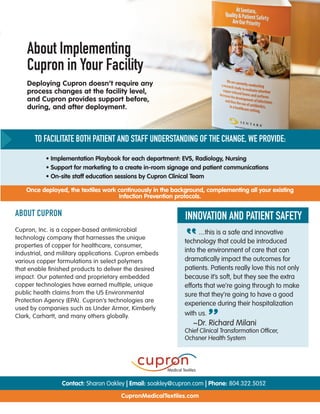
About Implementing
Cupron in Your Facility
Deploying Cupron doesn’t require any
process changes at the facility level,
and Cupron provides support before,
during, and after deployment.
• Implementation Playbook for each department: EVS, Radiology, Nursing
• Support for marketing to a create in-room signage and patient communications
• On-site staff education sessions by Cupron Clinical Team
TO FACILITATE BOTH PATIENT AND STAFF UNDERSTANDING OF THE CHANGE, WE PROVIDE:
Once deployed, the textiles work continuously in the background, complementing all your existing
Infection Prevention protocols.
ABOUT CUPRON
Cupron, Inc. is a copper-based antimicrobial
technology company that harnesses the unique
properties of copper for healthcare, consumer,
industrial, and military applications. Cupron embeds
various copper formulations in select polymers
that enable finished products to deliver the desired
impact. Our patented and proprietary embedded
copper technologies have earned multiple, unique
public health claims from the US Environmental
Protection Agency (EPA). Cupron’s technologies are
used by companies such as Under Armor, Kimberly
Clark, Carhartt, and many others globally.
Medical Textiles
...this is a safe and innovative
technology that could be introduced
into the environment of care that can
dramatically impact the outcomes for
patients. Patients really love this not only
because it’s soft, but they see the extra
efforts that we’re going through to make
sure that they’re going to have a good
experience during their hospitalization
with us.
~Dr. Richard Milani
Chief Clinical Transformation Officer,
Ochsner Health System
INNOVATION AND PATIENT SAFETY“
“
Contact: Sharon Oakley | Email: soakley@cupron.com | Phone: 804.322.5052
CupronMedicalTextiles.com
Medical Textiles

Cupron medical textiles 2019

  • 1.
    Produced for APIC2019 Medical Textiles ANTIMICROBIAL COPPER-INFUSED PATIENT GOWNS AND LINENS BACKED BY MULTIPLE OUTCOMES-BASED, PEER-REVIEWED STUDIES
  • 2.
    The use ofcopper gowns and bed linens lowers bioburden and infection rates.8-9-10 1 Neely A. N. et al, (2000) J Clin Microbiol. 38(2): 724-26. • 2 Noble W.A., (1981) in Microbiology of human skin, 2nd edn. Loyd-Luke Ltd. London., p75-85. 3 Huslage K. et al, (2010) Infect Control & Hosp Epidemiol. Aug (8):850-3. • 4 Dancer S.J., (2008) Lacent Infect Dis Feb;8(2)101-13. 5 Boyce J.M., (2007) J Hosp Infect 65 (suppl 2):50–54. • 6 Weber D.J. et al, (2007) Infect Control Hosp Epidemiol; 18:306–309. 7 Weber D.J. et al, (2010) Am J Infect Control; 38:S25– S33. 8 Lazaray A. et al, (2014) IJID 24: 23-29. • 9 Sifri C.D. et al, (2016) AJIC 44(12), 1565-71. • 10 Burke G.H. et al, (2018) IJIC 14:1. THE PATIENT ENVIRONMENT IS A KNOWN SOURCE OF PATHOGEN TRANSMISSION BED RAILS BED LINENSPATIENT GOWN OVER BED TABLE SINK FLOOR FLAT SURFACES FURNITURE THE MOST TOUCHED AND MOST CONTAMINATED SURFACES IN A HOSPITAL ROOM MOST MRSA - CONTAMINATED MOST C DIFFICILE CONTAMINATED MOST TOUCHED frequency of touch degree of contamination degree of contamination 3 2 1 Linens are most frequently touched3 and contaminated surfaces in the room4 The patient environment is a known source of HAIs5-6-7 Cupron provides an extra layer of protection by targeting the areas closest to the patient Textiles are an excellent substrate for microbial proliferation Due to large surface area, retention of oxygen, moisture and temperature conditions present between the skin and textiles1 Healthcare laundries deliver hygenically clean linens to hospitals Patients shed pathogens directly onto the textiles they use2 Bacterial shedding is greater in patients than in healthy individuals
  • 3.
    This study ofCupron’s medical textiles alone validates their effectiveness in preventing hospital acquired infections in a real world clinical setting, along with a robust infection prevention protocol, ~Jacque Butler Director of Infection Control and Prevention at Sentara Healthcare INNOVATION AND PATIENT SAFETY“ “ WHY ADD CUPRON MEDICAL TEXTILES TO YOUR INFECTION PREVENTION PROTOCOLS? Use a broad spectrum, EPA registered antimicrobial Are clinically validated to reduce C. diff & MRSA rates in 5 peer reviewed studies Require no changes to hospital or laundry operations THE ONLY MEDICAL TEXTILES THAT: • In use for over 2 million patient days with no adverse events • Copper has been used as an antimicrobial in cultures around the world for centuries • Organisms cannot become resistant • Complementary to existing infection prevention protocols • 5 Peer reviewed and published studies demonstrate 20-40% reductions in C. diff & MDRO rates • Copper works passively and requires no additional effort by staff • Implementation is easy SAFE EFFECTIVE CLINICALLY PROVEN CONTINUOUSLY ACTIVE
  • 4.
    Sentara Obici Hospital 158Beds Sentara Albemarle Medical Center 142 Beds Sentara Williamsburg Regional Medical Center: 139 Beds Sentara Rockingham Memorial Hospital 238 Beds Sentara Martha Jefferson Hospital 150 Beds Sentara Halifax Regional Hospital 192 Beds CDI Rates 8.OO 6.OO 4.OO 2.OO O.OO 18O Days9O Days 24O Days 6.7O 2.6O 3.29 5.77 3.55 6.O3 Pre Post Results: During assessment periods 1 (90 days), 2 (180 days) and 3 (240 days), in comparison to baseline periods 1, 2 and 3, there were 61.19% (p=0.0116), 41.09% (p=0.027), and 42.93% (p=0.0096) reductions in the HAI per 10,000 patient hospitalization days caused by C. difficile, respectively; and 59.8% (p=0.0014), 39.91% (p=0.0145), and 37.19% (p=0.0108) in the reduction of HAI per 1,000 PD caused by C. difficile and MDROs combined. Discussion: The deployment of biocidal linens across six hospitals resulted in large and statistically significant drops in both C. difficile infections and combined C. difficile and MDRO infections during all three time periods. Study published in the Journal of Hospital Infection in 2018. Methods: Rates of HAI caused by C. difficile and Multi Drug Resistant Organisms (MDROs) in 6 Sentara Healthcare hospitals with similar patient demographics (total of 1,019 beds) were compared over three parallel periods (90, 180 and 240 days) before and after replacing all the linens in inpatient rooms with copper infused biocidal linens. VIRGINIA AND NORTH CAROLINA Beds: 1,019 • Patient Days in Study: 175,573 • Study Published: 2018 Sentara Healthcare Expanded Deployment: Copper Patient Gowns and Linens Butler,J.P.,(2018)AnalysisoftheroleofcopperinfusedcompositebedlinensandpatientgownsinreducingClostridiumdifficileandMultiDrugResistantOrganism healthcare-associatedinfectionratesusingamultifacilityanalysiswithinahealthcaresystem.JournalofHospitalInfection2018Nov;100(3):130-134. CDI + MDRO Infection Rates O.34 O.8 O.76 O.O9 O.O8 O.O7 O.O6 O.O5 O.O4 O.O3 O.O2 O.O1 O 9O Days 18O Days 24O Days O.48 O.48 O.84 6O% Drop p=.OO14 4O% Drop p=.O145 37% Drop p=.O1O8 Pre Post CDI + MDRO Rates 60% Drop p=.0116 41% Drop p=.027 43% Drop p=.0096
  • 5.
    Results: In theAssessment Period as compared to the Baseline Period, Sentara Leigh saw a 28% reduction of C. difficile and MDRO infections. In contrast, in Facilities 2 and 3 there were 103% and 48% increases, respectively. When analyzing the C. difficile infections at Sentara Leigh there was a 25% reduction. In contrast, at Facilities 2 and 3, there were 27% and 47% increases, respectively. Discussion: This study addressed the potential confounders of the 2014 study. The copper facility experienced reduced rates in the primary endpoints while the two control facilities saw rate increases. As a result of these findings, Sentara approved the business case to expand the deployment of Cupron’s patient gowns and bed linens, as well as Cupron Enhanced EOS copper-infused bed rail covers and overbed tables, to all inpatient rooms across the Sentara Healthcare system (12 hospitals and 2,522 beds). This study was published in the International Journal of Infection Control in 2018. Methods: In 2015, Sentara designed this study to address the potential confounders in the Sentara Leigh 2014 study (patient characteristics, new building, and DNV MIR certification). Sentara expanded the deployment of copper-infused patient gowns, linens and hard surfaces from half to all inpatient rooms at Sentara Leigh Hospital, and added two control facilities Sentara Princess Anne Hospital (new build, now referred to as Facility 2) and Sentara Virginia Beach Hospital (also DNV-MIR certified, now referred to as Facility 3) to the analysis. The infection rate trends for each of the three facilities were compared between the Baseline Period and the Assessment Period. Patient Days in Study: 79,563 • Study Published: 2018 Sentara Leigh Hospital vs. Control Hospitals Copper Patient Gowns, Linens, Hard & Soft Surfaces Burke,G.H.,Butler,J.P.,(2018)Analysisoftheroleofcopperinfusedcompositehardsurfaces,bedlinensandpatientgownsinreducinghealth- care-associatedinfectionrates.InternationalJournalofInfectionControlv14:i1 CDI 8.OO 7.OO 6.OO 5.OO 4.OO 3.OO 2.OO 1.OO O.OO Facility 2SLH Facility 3 3.516 2.643 7.261Í 4.945 3.713 2.931 Pre Post 25% Drop 27% Increase 47% Increase CDI + MDRO 28% Reduction 103% Increase 1O.OO 9.OO 8.OO 7.OO 6.OO 5.OO 4.OO 3.OO 2.OO 1.OO O.OO New Build DNV MIRCopper Facility Facility 2Sentara Leigh Facility 3 No Copper 5.713 4.111 9.682 6.528 6.6 3.257 Pre Post 48% Increase Sentara Leigh Hospital Norfolk, VA: 250 Beds Sentara Princess Anne Hospital Virginia Beach, VA: 160 Beds Sentara VA Beach General Hospital Virginia Beach, VA: 225 Beds CDI Rates Rates
  • 6.
    Sentara Leigh Hospital Norfolk,VA Beds: 250 Patient Days in Study: 80,137 Study Published: 2016 ProducedforAPIC2018 CDI + Gram Negative MDRO 1O.OO 9.OO 8.OO 7.OO 6.OO 5.OO 4.OO 3.OO 2.OO 1.OO O.OO CDI CDI + MDRO 83% Reduction 78% Reduction 6.25 4.1O O.69 1.38 Pre Post p=.048 p=.023 Results: The study was conducted over a 25.5-month time period that included a 3.5-month washout period. HAI rates obtained from the copper-containing new hospital wing (14,479 patient-days) and the unmodified hospital wing (19,177 patient days) were compared with those from the baseline period (46,391 patient days). The new wing had 78% (P=.023) fewer HAIs due to MDROs or C. difficile, 83% (P=.048) fewer cases of C. difficile infection, and 68% (P=.252) fewer infections due to MDROs relative to the baseline period. No changes in rates of HAI were observed in the unmodified hospital wing. Methods: Study with a control group, assessing reduction of HAIs due to Multi Drug Resistant Organisms (MDROs) and C. difficile in the acute care units of Sentara Leigh Hospital in Norfolk, Virginia. One tower was outfitted with copper-infused patient gowns, linens and hard surfaces, and the other tower had regular patient gowns, linens and hard surfaces. Sentara Leigh Hospital: Copper Patient Gowns, Linens, Hard & Soft Surfaces Sifri, C.D., Burke G. H., Enfield K.B., (2016) Reduced health care-associated infections in an acute care community hospital using a combination of self-disinfecting copper-infused composite hard surfaces and linens. American Journal of Infection Control, 44 (12), 1565–71 Discussion: The reductions in the primary endpoints were large and statistically significant, however the study had potential confounders including differences in patient characteristics, new construction, and the potential impact of DNV-MIR certification. In 2015 the entire hospital was converted to copper patient gowns, bed linens and hard surfaces and a second, expanded study was conducted to address the potential confounders in this study. This study was published in the American Journal of Infection Control in 2016. CDI + Gram Negative MDRO
  • 7.
    Methods: The studywas conducted in the Head Injury Ward (35 beds) of Reuth Rehabilitation Hospital in Tel Aviv, Israel, a multidisciplinary rehabilitative care hospital. The data was gathered during two 6-month parallel periods: period A, December 2010 to June 2011, and period B, December 2011 to June 2012. Results: In vivo bioburden: 50% reduction in Gram positive bacteria (p=0.005), and 46% reduction in Gram-negative bacteria (p=0.047), on the sheets after 6-7 hours of use. Infection outcomes: There was a 24% reduction in standardized HAI events in period B as compared to period A (p = 0.046). There was a decrease in the number of fever days (47%; p = 0.0085). In accordance, there was a 23% reduction in the number of events in which patients received antibiotics (p = 0.052). Moreover, the total days of antibiotic administration during period B was 32.8% lower than in period A (p < 0.0001). Tel Aviv, Israel Beds: 35 Patient Days in Study: 8,277 Published: 2014 Reuth Hospital: Copper Patient Gowns and Linens Discussion: This pilot trial was the first to show that copper infused linens could reduce bioburden levels and infection rates in a patient care environment. This led Cupron to seek to replicate the results in additional settings, and to conduct larger trials in US hospitals using NHSN-based definitions. Lazaray A. et al., Reduction of healthcare-associated infections in a long-term care brain injury ward by replacing regular linens with bio- cidal copper oxide infused linens. International Jounral of INfectious Diseases 24 (2014) 23-29 Methods: A 7-month, crossover, double-blind controlled trial including all patients in 2 separate wards in Herzog Hospital, a geriatric-psychiatric hospital in Jerusalem, Israel. For 3 months (period 1), one ward received copper infused textiles and the other received regular textiles. After a 1-month washout period of using regular textiles, for 3 months (period 2) the ward that received the treated textiles received the control textiles and vice versa. The trial personnel were blinded to which were treated or control textiles. There were no differences in infection control measures during the study. Results: A 29.3% relative reduction in physician prescribed Antibiotic Treatment Initiation Events (ATIEs) when using Cupron textiles (P=.002). Furthermore, there was 55.5% decrease in the number of fever days in the patients in the wards that used the treated textiles (P < .0001). Consequently, there were 23.0% and 27.5% reductions in days of antibiotic treatment and daily defined dose (DDD administered in the treated versus control wards (P<.0001). Jerusalem, Israel Beds: 60 Patient Days in Study: 8,209 Trial Published: 2017 Herzog Hospital: Copper Patient Gowns and Linens Discussion: This linens-only, double-blind, crossover- controlled study was the second to demonstrate that surrounding patients with copper-infused textiles results in statistically significant reductions in HAI indicators. This led Cupron to seek to replicate the results in additional settings, and to conduct larger trials in US hospitals using NHSN-based definitions. Marcus, E.L. et al., (2017)Reduction of healthcare-associated infection indicators by copper-oxide infused textiles: Crossover, double-blind controlled study in chronic ventilator-dependent patients. American Journal of Infection Control 45 (2017) 401-3
  • 8.
    Because bed linensand patient gowns are the most touched and contaminated surfaces in the patient room, and due to their role as reservoirs and vectors for pathogens, your healthcare laundry provider can serve an important role in your patient safety initiatives. Cupron works with several laundry providers every day and we recommend bringing them into the discussion early. FREQUENTLY ASKED QUESTIONS Why are Cupron textiles a different color? The fibers in Cupron Medical Textiles are permanently embedded with copper during manufacturing. The unique color is caused by the copper content in the fabric and provides a strong visual indicator as to which linens are antimicrobial and which are not. Do Cupron textiles need to be laundered differently? Is there a special wash formula? Cupron Medical Textiles do not need to be processed differently, but to aid the laundry sorting process at the plant we recommend using separate colored bags for soiled white and Cupron linens. Cupron can be laundered in either batch or tunnel washers with normal industrial detergents and bleaches including peracetic acid, hydrogen peroxide, and chlorine. Cupron provides recommended wash instructions; the only change is that fabric softener should not be used. How long do they last? Cupron’s linens are more durable than regular white linens. As a result, our largest laundry partner gets >80% more servings from Cupron than regular white linens. Longer linen life is positive, but do the linens retain their efficacy? Unlike laundry additives or topically applied antimicrobials, Cupron’s antimicrobial copper does not wash off or wear off over time due to the embedded nature of the technology. Antimicrobial testing shows that Cupron Medical Textiles retain 99.9% efficacy during the life of the product. Number of Servings 7O 6O 5O 4O 3O 2O 1O O Standard Cupron Washcloth Bath Towel Patient Gown Fitted Sheet Flat Sheet Thermal Spread 7 15 19 36 56 19 47 48 27 27 6O 35 Cupron linens can stay in circulation >80% longer than regular white linens, and maintain their efficacy throughout the life of the product
  • 9.
    FREQUENTLY ASKED QUESTIONS Whatis your safety record? Cupron Medical Textiles have been in use for over 2 million patient days without any reported adverse events due to copper. What about copper allergies? Because copper is an element that is found in many foods and multivitamins, true copper allergies are extremely rare. Many people who believe they have a copper allergy have had reactions to copper alloys containing nickel, which Cupron linens do not. There are two rare conditions related to copper metabolism, Wilson’s disease and Menkes syndrome, and these are flagged on admission. Do you make privacy curtains? Not at this time. Although studies show curtains are contaminated, our focus is on the textiles closest to the patient as these are the most touched and contaminated surfaces in the room. Do you have someone who can speak with my laundry provider? Cupron can provide references to answer any questions. Cupron linens have little impact on our daily production process. Providing Cupron linens is a way we support our customers, it’s important to be their partner in infection prevention. ~Charles Berge President & General Manager, Shared Hospital Services INNOVATION AND PATIENT SAFETY“ “
  • 10.
    Knit Fitted Sheet SKU:70004 Weight Dry in ounces: 24 oz. Weight Dry in pounds: 1.5 lbs. Width: 36” Length: 84” Drop: 14” Fabric Blend: 55% cotton/45% Cupron Polyester Pillowcase SKU: 70002 Weight Dry in ounces: 3.5 oz. Weight Dry in pounds: 0.22 lbs. Width: 20” Length: 30.5” Fabric Blend: 55% cotton/45% Cupron Polyester Flat Sheet SKU: 70003 Weight Dry in ounces: 19 oz. Weight Dry in pounds: 1.20 lbs. Width: 66” Length: 109” Fabric Blend: 55% cotton/45% Cupron Polyester Draw Sheet SKU: 70022 Weight Dry in ounces.: 10.90 oz. Weight Dry in pounds: .68 lbs. Width: 54” Length: 78” Fabric Blend: 55% cotton/45% Cupron Polyester Bright Red Stitching differentiates it from flat sheet Thermal Blanket SKU: 70010 Weight Dry in ounces: 40 oz. Weight Dry in pounds: 2.5 lbs. Width: 66” Length: 90” Fabric Blend: 55% cotton/45% Cupron Polyester Bath Blanket SKU: 70009 Weight Dry in ounces: 28 oz. Weight Dry in pounds: 1.75 lbs. Width: 70” Length: 90” Fabric Blend: 55% cotton/45% Cupron Polyester Patient Gown SKU: 70007 Weight Dry in ounces: 14.24 oz. Weight Dry in pounds: .89 lbs. Width: 65.5” Sweep Length: 48.75” Center Back Fabric Blend: 55% cotton/45% Cupron Polyester 10X Patient Gown SKU: 70008 Weight Dry in ounces: 22.4 oz. Weight Dry in pounds: 1.40 lbs. Width: 110 “ Sweep Length: 51” Center Back Fabric Blend: 55% cotton/45% Cupron Polyester Different color ties denote size Washcloth SKU: 70005 Weight Dry in ounces: 1.3 oz. Weight Dry in pounds: .08 lbs. Width: 12” Length: 12” Fabric Blend: 55% cotton/45% Cupron Polyester Bath Towel SKU: 70006 Weight Dry in ounces: 10.9 oz. Weight Dry in pounds: 0.68 lbs. Width: 24” Length: 48” Fabric Blend: 55% cotton/45% Cupron Polyester PRODUCTS SKU: 70024 Weight in ounces: 33.2 Weight in pounds: 2.08 Width: 36” Length: 96” Drop: 16” Fabric Blend: 70%Cotton/30% Cupron polyester Full elastic neon contrast hem for easy identification ICU sheet for larger dimension beds such as the Hillrom Progressa
  • 11.
    About Implementing Cupron inYour Facility Deploying Cupron doesn’t require any process changes at the facility level, and Cupron provides support before, during, and after deployment. • Implementation Playbook for each department: EVS, Radiology, Nursing • Support for marketing to a create in-room signage and patient communications • On-site staff education sessions by Cupron Clinical Team TO FACILITATE BOTH PATIENT AND STAFF UNDERSTANDING OF THE CHANGE, WE PROVIDE: Once deployed, the textiles work continuously in the background, complementing all your existing Infection Prevention protocols. ABOUT CUPRON Cupron, Inc. is a copper-based antimicrobial technology company that harnesses the unique properties of copper for healthcare, consumer, industrial, and military applications. Cupron embeds various copper formulations in select polymers that enable finished products to deliver the desired impact. Our patented and proprietary embedded copper technologies have earned multiple, unique public health claims from the US Environmental Protection Agency (EPA). Cupron’s technologies are used by companies such as Under Armor, Kimberly Clark, Carhartt, and many others globally. Medical Textiles ...this is a safe and innovative technology that could be introduced into the environment of care that can dramatically impact the outcomes for patients. Patients really love this not only because it’s soft, but they see the extra efforts that we’re going through to make sure that they’re going to have a good experience during their hospitalization with us. ~Dr. Richard Milani Chief Clinical Transformation Officer, Ochsner Health System INNOVATION AND PATIENT SAFETY“ “ Contact: Sharon Oakley | Email: soakley@cupron.com | Phone: 804.322.5052 CupronMedicalTextiles.com
  • 12.