2020 HEALTH OF THE FORCE REPORT
Approved for public release; distribution unlimited.
Visit us at
https://phc.amedd.army.mil/topics/campaigns/hof
Create a healthier force for tomorrow.
HEALTH
FORCE
OF THE
2020
1
U.S. Army Photo
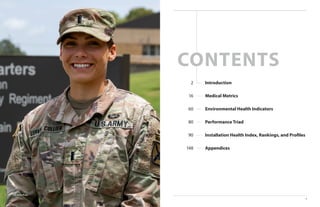
Introduction
Medical Metrics
Environmental Health Indicators
Performance Triad
Installation Health Index, Rankings, and Profiles
Appendices
2
16
60
80
90
148
CONTENTS
A suite of products to help YOU improve Force readiness!
Welcome to the 2020 Health of the Force Report
OVERVIEW
TOTALFORCEREADINESS
SOCIALREADINESS
AREFRESHEDHEALTH
OFTHEFORCEONLINE
In this changing world, one constant is the requirement for our Soldiers to
remain healthy and ready to achieve Force dominance. In its 6th
annual install-
ment, the 2020 Health of the Force report documents conditions that influence
the health and medical readiness of the U.S. Army Active Component (AC)
Soldier population. Leaders can use Health of the Force to optimize health
promotion measures and effect culture changes that influence both individual
Soldiers and Army institutions. Health of the Force presents Army-wide and
installation-level demographics and data for more than 20 health, wellness, and
environmental indicators at more than 40 installations worldwide. Installations
included in Health of the Force are those where the AC population exceeds 1,000
Soldiers. Data presented in this report reflect status for the prior year (i.e., the
2020 report reflects calendar year 2019 data).
The range of health metrics detailed in Health of the Force provides an evidence-
based resource that can help Army leaders understand the causes of and
contributors to medical non-readiness and direct informed policy and program-
matic efforts to optimize Soldier health. The medical and environmental metrics
detailed in the Health of the Force report will be a valuable resource for Army
leaders to provide recommendations to overcome both present and future
challenges.
Calendar year 2020 proved to be a challenging year in a multitude of ways. In
2020, the world encountered a global pandemic unlike anything experienced
within the past 100 years, coupled with a reckoning of centuries of racial dis-
crimination and the ensuing uprising of activism. Although the 2020 Health of
the Force report surveillance period does not cover the timeline of these world
events, it is imperative for senior leaders and the Total Army Family alike to
begin framing the conversations and analyses now that will be necessary to
effect real progress towards equity in health and racial disparities. The 2020
Health of the Force report offers a lens through which leaders can view the initial
examination of the essential relationship between social, racial, and health
inequities.
Health of the Force Online is a suite of interactive dashboards that provide Army
Soldier population health data by installation and command and enhance
the accompanying print report. In 2020, Health of the Force Online received
an extensive update of design, content, and usability. Users can dynamically
display health outcomes and drill down on characteristics and subpopulations
with over 70 interactive charts, graphs, and informative narratives across med-
ical and environmental content areas. This product is continuously evolving by
incorporating new data, generating new visualizations, and meeting the chang-
ing health needs of Army stakeholders. Together with the annual print report,
Health of the Force Online facilitates informed decisions that will improve the
readiness, health, and well-being of Soldiers.
Explore Health of the Force
Metric Pages
Discover more about health
readiness, health behaviors, and
environmental health indicators.
Spotlights
Review articles on emerging
issues, promising programs,
and local actions.
Installation Profiles and Rankings
Explore installation-level
strengths and challenges.
Health of the Force Online
Create customizable charts for
your population and metrics of
interest.
Methods, Contact Us, and Program Website
Learn more about the science
behind Health of the Force.
INTRODUCTION 3
2 2020 HEALTH OF THE FORCE REPORT
Introduction
INTRODUCTION 5
4 2020 HEALTH OF THE FORCE REPORT
Report Highlights
2020 HEALTH OF THE FORCE DEMOGRAPHICS:
Approximately 469,000 AC Soldiers
79% under 35 years old, 15% female
17%
Z
z
z
INJURY
BEHAVIORAL HEALTH
SUBSTANCE USE
OBESITY
HEARING
SEXUALLY TRANSMITTED INFECTIONS
ENVIRONMENTAL HEALTH INDICATORS
Over half (55%) of Soldiers experienced a
new injury in 2019.
A majority of injuries (72%) were cumulative
musculoskeletal overuse injuries.
Obesity prevalence remained
constant at 17% among Soldiers,
but there were marked racial
disparities. Asian Soldiers had
the lowest prevalence of obesity,
and rates were highest for Native Hawaiian/
Pacific Islander Soldiers.
The percentage of Soldiers with newly
identified hearing injuries and potentially
requiring a fitness-for-duty hearing evalua-
tion declined over the past 5 years.
Reported
chlamydia
infection
rates were
33% higher
than in 2015.
of Soldiers reported the use of
tobacco products, excluding
those who only used e-cigarettes.
Overall, 16% of Soldiers had a diagnosis of
one or more behavioral health disorders.
This prevalence has varied little over the last
5 years.
Behavioral health diagnoses were
more common among Soldiers
35 years of age and older than
among younger Soldiers.
55%
72%
16% 4.2%
4.6%
NEW INJURY
2015 2016 2017 2018 2019
OVERUSE INJURY
35+
of Soldiers had a substance use
disorder diagnosis. Rates were
highest among Soldiers <25 years of age,
and prevalence decreased with age.
of Soldiers had
access to drinking
water from an installation
community water system that
was fluoridated according to
Army regulation and Centers
for Disease Control and
Prevention guidelines.
of Soldiers had
access to drinking
water from an installation
community water system
that met all U.S. health-based
drinking water standards.
3.5%
<40%
95%
25%
TOBACCO PRODUCT USE
18
HEAT ILLNESS
Although the number of
heat stroke cases remained
constant, heat exhaustion
cases among Soldiers
decreased from the
previous reporting year.
2018 2019
1,244
1,127
19
21
23 24
PERFORMANCE TRIAD
Less than half of Soldiers are eating
the recommended 2 or more
servings of fruits per day (33%) or
2 or more servings of vegetables
per day (42%).
of Soldiers attained
7 or more hours of
sleep during work/duty weeks.
37% 8
1
2
3
4
5
6
7
THE ARMY RESPONSE TO THE COVID-19 PANDEMIC
EVALUATING THE HEALTH OF THE FORCE
IN THE PANDEMIC ERA
S P O T L I G H T
S P O T L I G H T
T
HE DATA DEPICTED IN THIS REPORT PRO-
vide a snapshot of the health of the force
during 2019, just before COVID-19 emerged as
a pandemic. The pandemic has transformed mili-
tary operations, healthcare delivery, and day-to-day
life in ways that will
undoubtedly shape
future Health of the
Force reports.
The 2021 Health of
the Force (2020 data) will likely report notable shifts
in medical metrics due to reduced healthcare access
and utilization. The types of care provided will reflect
increased virtual and telephone healthcare consul-
tations. Because both routine and elective care were
minimized for large portions of 2020, the frequency
of some conditions may appear artificially reduced.
Conversely, the incidence of some outcomes, such as
behavioral health disorders and obesity, may increase,
given the added stress and lifestyle changes precip-
itated by the pandemic. Additionally, reallocation
of public health resources to support the COVID-19
response may have compromised routine health sur-
veillance activities, including environmental and ento-
mological testing. Positive changes such as improved
air quality are also possible due to decreased energy
consumption.
The severity of
COVID-19 may be
influenced by an
individual’s underly-
ing health status, and
it seems to vary according to other personal charac-
teristics. The current Health of the Force report may
offer insights in the evaluation of Soldiers’ COVID-19
risk through its summaries of influential demo-
graphic factors such as age and race. The report also
describes the prevalence of concerning comorbid
conditions and behaviors such as chronic disease,
obesity, and tobacco use, all of which can increase
risk for severe COVID-19 outcomes. Furthermore,
Health of the Force provides baselines for key indi-
cators of health (e.g., diagnosed behavioral health
conditions) which can be used to assess the impact
of the pandemic.
I
N DECEMBER 2019, A HIGHLY INFECTIOUS NOVEL
coronavirus known as severe acute respiratory
syndrome coronavirus 2 (SARS-CoV-2) was first
detected in Wuhan, China. SARS-CoV-2 led to a pan-
demic known as Coronavirus Disease 2019 (COVID-19),
which has highlighted the role and importance of
public health. The U.S. Army faces a unique challenge
PREVENT
DETECT
RESPOND
Infection prevention is the most potent weapon against SARS-CoV-2. The APHC recom-
mended social distancing; quarantine; limiting the size of gatherings; comprehensive
respiratory and hand hygiene practices; and thorough cleaning and disinfection.
Detection and subsequent isolation of probable and confirmed COVID-19 cases limits
spread of the virus and maximizes continuity of operations. The APHC provided guidance
for rapidly detecting individuals who may be infectious, who are susceptible to infection
(including individuals with underlying health conditions that adversely affect the course of
the disease), and who may be immune to infection. The APHC also promoted and imple-
mented detection strategies, including population surveillance, disease modeling, screen-
ing, aggressive contact tracing, and molecular and serological assay-based testing . For
example, a pilot program at Aberdeen Proving Ground is assessing the feasibility of detect-
ing COVID-19 in wastewater as an indicator of COVID-19 prevalence at the installation.
To aid training units in their response to Soldiers diagnosed with COVID-19, the APHC recom-
mended isolating infected Soldiers quickly and implementing measures such as contact
tracing and quarantine to prevent or reduce the spread of COVID-19. This guidance provides
optimal strategies for limiting the number of individuals infected by someone diagnosed
with COVID-19, which is at the heart of the public health response to the pandemic.
The U.S. Army Public Health Center (APHC) disseminated COVID-19 preparedness
guidelines to Army units. This guidance presented a 3-pronged offensive
designed to prevent, detect, and respond to SARS-CoV-2.
when conducting training operations during a pan-
demic. The convergence of individuals from across
the country at training locations, close quarters,
and the effects of stressful conditions on trainees’
immune systems can increase the risks of infection
and viral transmission.
The current Health of the Force report may offer insights
in the evaluation of Soldiers’ COVID-19 risk through its
summaries of influential risk factors.
INTRODUCTION 7
6 2020 HEALTH OF THE FORCE REPORT
Introduction | Featured Spotlight
WHY ACKNOWLEDGING RACIAL/ETHNIC DIFFERENCES
IS KEY TO ADDRESSING HEALTH DISPARITIES
S P O T L I G H T
R
ACISM AND SOCIAL INEQUALITIES EXACER-
bated by the COVID-19 pandemic have forced
the U.S. and Army Senior Leaders (ASLs) to
reevaluate perceptions about ourselves and our
institutions.
Health disparities are “preventable differences in the
burden of disease, injury, violence, or in opportuni-
ties to achieve optimal health experienced by socially
disadvantaged racial, ethnic, and other population
groups” (CDC 2017a).
ASLs may assume
that health-related
inequities due to
race/ethnicity do
not exist or have
been reduced
because of com-
prehensive military benefits that include universal
healthcare, housing availability, and a federally man-
dated, rank-based pay structure, among others.
While health disparities by race/ethnicity are well-
documented in the U.S. civilian population (Raifman &
Raifman 2020; Rentsch et al. 2020; Mackey et al. 2021),
the peer-reviewed literature demonstrates a lack of
comparable studies in the Army. It is important for
ASLs to understand whether these disparities exist
among Soldiers in their units and how such disparities
may impact mission readiness. The 2020 Health of the
Force is the first edition to include metrics stratified by
race and ethnicity. This year’s data demonstrate the
most pronounced racial and ethnic disparities in obe-
sity, tobacco product use, and sexually transmitted
infections.
While Army benefits should ameliorate the impact
of some of these factors, generations of discrimina-
tory societal norms, specifically for Black Americans,
cannot be discounted. Knowledge gained through
understanding whether health and healthcare dis-
parities exist
among Soldiers
may also elu-
cidate unique
stressors among
Black or African-
American Soldiers.
Listed below are
several steps the Army can take to begin to investi-
gate the presence of these issues.
Each of these listed factors has been associated with
health and healthcare disparities among racial and
ethnic minorities. Understanding and dismantling
the negative health outcomes created as byproducts
of race-related issues must be thoughtful and delib-
erate. As stated by renowned American author and
activist James Baldwin,“Not everything that is faced
can be changed, but nothing can be changed until it
is faced.”
Annually report health outcomes and health
care utilization patterns by race/ethnicity and
ensure that ongoing surveillance efforts include
information by race/ethnicity to determine if
disparities exist.
1
Assessforthepresenceofimplicitbiasamong
militaryhealthcareproviders,andincorporate
discussions of implicit bias into routine didactic
sessions and required training.
2
Reassessstrategiestorecruitandretainhealth-
care providers who are underrepresented
minorities.
4
Comprehensively review military healthcare
policies to ensure they do not produce or
sustain inequity among race/ethnicity groups.
5
Establish training on racism and its effects on
health for medical providers.
3
Actions to Reduce Racial and Ethnic Disparities throughout the Enterprise
Racism and social inequalities exacerbated by the
COVID-19 pandemic have forced the U.S. and the
Army to reevaluate perceptions about ourselves
and our institutions.
”We know from the data that communities of color continue to
lag their counterpart white communities in measures of health,
wellness, economic opportunity and quality of life. In real-time,
we see that the most severe COVID-19 complications and death
disproportionately affect people of color. Army Medicine is
committed to practices that deliver first rate medical care that
ensures the health of our entire fighting Force and all of the
people who support them.”
—Lieutenant General R. Scott Dingle
The U.S. Army Surgeon General and Commanding General, U.S. Army Medical Command
INTRODUCTION 9
8 2020 HEALTH OF THE FORCE REPORT
Introduction | Featured Spotlight
Native Hawaiian/Pacific Islander White
Asian Black or African American
Not Hispanic or Latino
American Indian/Alaskan Native
Hispanic or Latino
= Approximately 5,000 Soldiers
* About 12,000 Soldiers identified as Hispanic or Latino, but had an Unknown or Other race. For this visualization, these Soldiers were
placed under the White race, as a majority of Hispanic or Latino Soldiers with an identified race were White (95%).
INTRODUCTION 11
10 2020 HEALTH OF THE FORCE REPORT
Introduction
Demographics
DEBUT OF RACE AND ETHNICITY IN HEALTH OF THE FORCE
The U.S. Army recognizes that Soldiers and their Families may experience racial and ethnic disparities at both
the individual and societal levels. The 2020 Health of the Force introduces health measure reporting by race and
ethnicity with the goal of identifying potential health disparities and providing leaders with the data to support
policies or programs aimed at reducing these disparities throughout the Force. The Army is uniquely positioned
to improve health equity for all Soldiers by addressing potential disparities that may negatively impact individual
and unit readiness.
The Office of Management and Budget (OMB) recommends the use of at least five categories when reporting
race: (1) American Indian or Alaska Native, (2) Asian, (3) Black or African American, (4) Native Hawaiian or
Other Pacific Islander, and (5) White. These categories are social-political constructs and are not scientific or
anthropological identities. Ethnicity is a different demographic than race that specifically reflects heritage,
nationality, lineage, or country of birth of a person or a person’s parents or ancestors. The OMB recommends a
minimum of two categories for reporting ethnicity: (1) Hispanic or Latino and (2) Not Hispanic or Latino (FR
1997). People who are Hispanic or Latino may be any race.
Race and ethnicity data were obtained from the Defense Manpower Data Center. When available and not
otherwise suppressed by case count rules (e.g., heat illness, sexually transmitted infection metrics), race and
ethnicity are reported for medical metrics and Performance Triad measures. In some cases, Soldier records
reflect races or ethnicities that are not captured in the OMB-recommended categories. As a result, the total
number of Soldiers for whom race and ethnicity are reported is less than the total AC population.
Distribution by Race and Ethnicity, AC Soldiers, 2019
Intersection of Race and Ethnicity,* AC Soldiers, 2019
Soldiers are reported in five categories of race and two categories of ethnicity. About 4% of Soldiers had an Unknown
or Other race, and 1% of Soldiers had an Unknown or Other ethnicity. Hispanic or Latino Soldiers with unknown race are
reported only in the Hispanic or Latino category.
Percent of AC Population
American Indian or Alaskan Native
Asian
Black or African American
Native Hawaiian or Pacific Islander
White
Hispanic or Latino
Not Hispanic or Latino
20 40 60
0 80 100
0.7
5.0
21
16
68
1.2
83
/ / / / / / / / / / / / / / / / / / / / / / / / / / / / / / / / / / / / / / / / / / / / / / / / / / / / / / / / / / / / / / / / / / / / / / / / / / / / / / / / / / / / / / / / / / / / / / / / / / / / / / / / / / / /
Race
Ethnicity
For the 2020 Health of the Force Report, race and ethnicity are presented as shown in the example
figure below.
Age
Percent
The above chart displays an example of how health outcomes are reported by race and ethnicity in this year’s report.
Soldiers who report more than one race are reported in each race category for which they identify. However, Soldiers who
identify only as Hispanic with no race or Hispanic and a White race are only included in the ‘Hispanic” category.
80
60
40
20
0
70 58 30 43 36 26 40 36
60
62 50 40 64
77 40 64 30 75 68 43
48 51 42 78 62 40 52 46 38
61
Native Hawaiian/
Pacific Islander
White (Not Hispanic
or Latino)
Hispanic
Asian Black or African
American
American Indian/
Alaskan Native
HEALTH OF THE FORCE ONLINE
S P O T L I G H T
H
EALTH OF THE FORCE ONLINE IS A DIGITAL
platform that allows users to access detailed
population health data by installation and
command. Through this suite of tools, leaders can
inform health promotion and prevention, drive
cultural and programmatic changes, and meet the
emerging health needs of the U.S. Army AC Soldier
population.
Users can dynamically display health outcomes, make
comparisons between populations, and easily share
findings with their colleagues and stakeholders.
These findings can be reinforced with the appropri-
ate context since health outcomes can now be exam-
ined by demographic characteristics including age
group, sex, and race/ethnicity. Further, connectedness
to other APHC dashboards and products provides
context for leaders to make evidence-based decisions
necessary to achieve force dominance.
Health of the Force Online houses over 70 charts,
graphs, and information pamphlets across 18 con-
tent areas. This suite is constantly evolving by incor-
porating new data, generating new visualizations,
and meeting the changing health needs of the AC
Soldier population. Together with the Health of the
Force print report, these products can provide the
necessary data to improve the readiness, health, and
well-being of Soldiers and the Total Army Family.
From a CAC-enabled device, visit the Health of the
Force homepage and select “Online Data” or visit
https://tiny.army.mil/r/tMG6.
Behavioral Health
Medical Metric: Behavioral Health (BH)
Behavioral Health
Information Sheet
Prevalence of Diagnoses
over Time
Prevalence Comparison
by Diagnosis
Prevalence Comparison
by Rank and Age
Prevalence Comparison
by Age, Sex, & Race
Behavioral Health Map
Estimated
%
of
Population
Reporting Unit
All
Sex
Female
Male
Age Group
≤24
25-34
35-44
≥45
Behavioral Health Disorder
Any BH Disorder
Adjustment Disorder
Anxiety Disorder
Mood Disorder
PTSD
Substance Use Disorder
Any BH disorder
Adjustment disorder Mood disorder
Anxiety disorder
PTSD
Substance use disorder
2014 2015 2016 2017 2018
INTRODUCTION 13
12 2020 HEALTH OF THE FORCE REPORT
Introduction | Demographics
ARMY DISTRIBUTION COMPARED TO U.S. CIVILIAN POPULATION
The Army AC population differs from the U.S. civilian employed workforce population with respect to the
distribution of age, sex, race, and ethnicity. For example, while 79% of Soldiers are under 35 years of age, just
37% of the U.S. civilian employed workforce population is under 35 years (BLS 2019). Soldiers are mostly male
(85%) compared to the U.S. civilian employed workforce population of adults aged 18 years or older, which is
53% male and 47% female. Further, 21% of Soldiers are Black or African American, compared to approximately
12% in the U.S. civilian workforce population of adults aged 18 years or older (BLS 2019). It is important to
keep these differences in mind, as health status and health disparities are often linked with age, sex, race, and
ethnicity. Health of the Force adjusts health metrics observed among the U.S. civilian population to fit the age
and sex distribution of the Army in order to facilitate meaningful comparisons between the populations. The
racial and ethnic distribution of the U.S. Army is similar to the U.S. population, and therefore adjustments are
not made based on race or ethnicity in comparisons to the U.S. population.
Age Distribution by Sex, AC Soldiers, 2019
Female Soldiers Male Soldiers
Population by Sex and Year, AC Soldiers, 2015–2019
In 2019, the estimated average monthly AC Soldier population was 468,567 Soldiers. Enlisted personnel accounted for
80% of AC end strength. Between 2015 to 2019, the number of female Soldiers in the AC increased by 19%.
Age
Year
Percent
of
AC
Population
Number
of
AC
Soldiers
468,567
71,792
396,775
463,698
69,274
394,424
463,711
68,652
395,059
469,187
68,184
401,003
476,759
60,485
416,274
HEALTH OF THE CANINE FORCE:
MEDICAL PROBLEMS AMONG NON-DEPLOYED MILITARY WORKING DOGS
S P O T L I G H T
Top 5 Medical Conditions Among Active MWDs,
as Reported in the Remote Online Veterinary
Record, February 2014 – July 2017
*Relating to nourishment or sustenance
Source: APHC 2019a
Master Problem
List Entries
MWDs affected
Counts
0
100
200
300
400
500
600
Derm
atologic
Alim
entary*
Dental
Soft tissue injury
M
usculoskeletal
S
INCE WORLD WAR I, THE U.S. MILITARY HAS
used Military Working Dogs (MWDs) in a variety
of capacities, including explosive detection, drug
detection, patrol/attack work, and special operations
support. Despite the long-term use of MWDs, compre-
hensive MWD medical data has not often been re-
ported in the scientific literature, especially for MWDs
in non-deployed settings. This lack of published litera-
ture limits the identification of trends or areas of focus
that could potentially guide future veterinary medical
support of MWDs.
Because MWDs are a valuable military resource, achiev-
ing a better understanding of their common medical
problems is crucial for keeping them healthy and mis-
sion-ready. Furthermore, better knowledge of MWD
medical data may also improve readiness and training
focus among the U.S. Army Veterinary Corps Officers
specifically responsible for the comprehensive veteri-
nary medical care of MWDs.
A recent study investigated all medical problems
recorded in the DOD Remote Online Veterinary Re-
cord for a population of young, non-deployed MWDs
(n=762) participating in initial entry training or provid-
ing support to their assigned permanent home sta-
tions (APHC 2019a). Medical problems for this popula-
tion were recorded on the Master Problem List (2,416
entries) by an attending veterinarian during MWD visits
to a veterinary treatment facility. Results are shown in
the figure, organized by previously established cate-
gorizations for MWD medical problems (Takara et al.
2014; Mey et al. 2019). Risk factors for the five leading
conditions (dermatologic, alimentary [nutritional], den-
tal, soft tissue, and musculoskeletal) were investigated.
While they varied by condition, common risk factors for
MWD medical conditions included sex, spay/neuter sta-
tus, breed, and occupational duty certification.
Assessing the training and work environments is
recommended to identify unnecessary exposures to
hazards, as well as additional preventive strategies for
MWDs at greater risk for medical conditions. Future ef-
forts should collect demographic and hazard exposure
information on all MWDs, potentially through future
annual and post-deployment handler surveys.
THE 2019 COMMUNITY STRENGTHS
AND THEMES ASSESSMENT REPORT
S P O T L I G H T
E
VERY 2 YEARS, ARMY COMMUNITIES AROUND
the globe use the Community Strengths and
Themes Assessment (CSTA) to gather feedback
from Service members, their spouses, and adult Fam-
ily members; Retirees; and DA Civilians. The CSTA is a
public health survey tool used to support each Army
installation’s assessment of its community’s perspec-
tives. Questions focus on the five domains of public
health: physical, emotional, family, spiritual, and
social/environmental. Each local Commander’s Ready
and Resilient Council (CR2C) works with the APHC to
conduct the CSTA over a 3-month period, after which
the results are compiled and a report is provided to
local leadership.
Key Findings of the 2019 CSTA Report
Top strengths among respondents included the
diversity of the Army community, recreation activities,
clean environments, and safe neighborhoods. Over-
whelmingly, respondents viewed their communities
as healthy and resilient.
30%of respondents indicated
a belief that seeking help
will negatively impact their career.
Most Frequently Cited Concern for Each Public Health Domain, 2019
Physical Health Emotional Health Spiritual Health Family Health
Social/Environmental
Health
35%
poor diet
51%
stress
43%
no concerns
57%
work-life
balance
32%
financial
issues
For a majority of respondents, the most frequently
cited issues of concern were work-life balance, finan-
cial issues, stress, depression, overweight/obesity, and
lack of family time or community connections (see
figure). Qualitative feedback included reoccurring
themes of high operational tempo, stress, and fund-
ing competing demands with limited resources.
Respondents also reported stigma from seeking help
and accessing resources related to emotional needs.
Thirty percent (30%) of respondents indicated a belief
that seeking help will negatively impact their career;
26% indicated that doing so was unlikely to impact
their career. Informal support networks such as
talking with a friend or chaplain were preferred.
The full 2019 Army CSTA Report is available from the
APHC Health Promotion Operations Division, https://
iphc.amedd.army.mil/organization/HPW/Pages/
HealthPromotionOperations.aspx. Community- and
command-specific CSTA results are available through
the local CR2C.
The CSTA is an important tool with which Army Com-
munity members can make their voices heard. Please
consider participating in your installation’s next CSTA.
INTRODUCTION 15
14 2020 HEALTH OF THE FORCE REPORT
Introduction
U.S. Army Photo
Injury
Behavioral Health
Substance Use
Sleep Disorders
Obesity
Tobacco Product Use
Heat Illness
Hearing
Sexually Transmitted Infections
Chronic Disease
Medical Metrics
MEDICAL METRICS 17
16 2020 HEALTH OF THE FORCE REPORT
U.S. Army Photo
PROJECTING THE COURSE OF PANDEMICS—
MODELING AS A TOOL IN THE FIGHT AGAINST COVID-19
S P O T L I G H T
* Increasing/decreasing criteria:
•	 	
The most recent 7-day window was used to best fit a line
through the Rt daily estimates.
•	 	
An up arrow denotes that local transmission is increasing
(slope > 0.0005).
•	 	
A down arrow denotes that local transmission is decreasing
(slope < -0.0005).
•	 	
A circle denotes that the local transmission is at a flat rate
(-0.0005 ≤ slope ≤ 0.0005).
* Green/Amber/Red criteria:
•	 	
The color indicates the current status of Rt, based on its 50%
confidence interval (CI).
•	 	
Green means that the entire 50% CI is below 1.0.
•	 	
Amber means that the 50% CI spans 1.0 but is not solely
above or below it completely.
•	 	Red means that the entire 50% CI is above 1.0.
The Army COVID-19 Model for
Epidemics (ACME) Tool used the
number of current hospitaliza-
tions to project capacity needs
at each MTF. For more infor-
mation, please go to: https://
cprobe.army.mil/rsc/acme
234,367
Population at Risk
25
Local Doubling Time (days)
0
Ventilators Available
2020-03-18
Ventilator Capacity Reached
Rt 1.24
Secondary infections per
infectious person
336 Beds
0 ICU Beds Available
2020-03-18
ICU Bed Capacity Reached
Not Exceeded
Bed Capacity Reached
All Hospital
Total Patient Impact
Max Beds 70 , Max ICU Beds 38 , Max Vents 15 , Time of Max Demand 2021-03-15
ICU Vent
20
0
40
60
Total
Patients
Days
Hospitalized
ICU
Ventilated
Jan Apr Jul
M
ODELS ARE A SUITE OF QUANTITATIVE
tools that attempt to project the course
of a disease through equations. While it is
impossible to capture all of the complexities of the
real world, enough data exist to develop models
that provide useful projections. New data help refine
models and allow actionable recommendations to be
made at the local level.
Early in the SARS-CoV-2 pandemic, medical treat-
ment facility (MTF) commanders had to make critical
and short-suspense logistics decisions with limited
data. To overcome this challenge, the APHC, U.S.
Army Futures Command, and U.S. Military Academy
developed the Army COVID-19 Model for Epidem-
ics (ACME) tool to provide MTF commanders with
projections of the expected numbers of hospital
ward beds, intensive care unit beds, and ventilators
they would need over time (see figure). Underlying
the ACME are mathematical and statistical models
estimating the average number of people that a
single infectious person could infect (i.e., effective
reproduction number; Rt) in each county and at each
MTF. Similarly, garrison commanders need guidance
on when to reduce Force Health Protection Condi-
tions and allow non-essential personnel to return to
work. From the models that estimate Rt, the ACME
produces a green-amber-red indicator to help com-
manders make this decision.*
Rt =1.24
Similar modeling efforts can be applied to non-com-
municable diseases. In April 2020, the Office of The
Surgeon General wanted to project the impact of
COVID-19 on the demand for behavioral health (BH)
care services when MTFs re-open. After MTFs re-open
and additional data on BH encounters are available,
forecasts will be more reliable because the models
will be able to identify the general trajectory of BH
care demand.
secondary infections
per infectious person
HOW DO THE NUMBERS COMPARE?
A DESCRIPTION OF SOLDIERS’ MEDICAL CARE
S P O T L I G H T
W
HEN A SOLDIER SEES A HEALTHCARE PRO-
vider, the provider must assign at least one
diagnosis code selected from the Interna-
tional Classification of Diseases (CDC 2020a). Providers
can include clinicians, physician assistants, and spe-
cialists in hospital settings as well as physical ther-
apists and psychologists. The diagnosis codes for
each medical visit or encounter are captured in the
Soldier's electronic health record. Military medical
data are often presented as statistics that summarize
all Soldier diagnoses for a given timeframe.
In addition to the specific medical metrics reported
in Health of the Force, the APHC consolidates the mil-
lions of primary diagnoses (i.e., first listed diagnosis
per medical encounter) for all Soldier encounters into
16 medical diagnosis categories. The burden that
each category has on the Military Health System can
then be compared using three summary measures: 1)
the number of encounters, 2) the number of Soldiers
affected, and 3) the number of hospital bed days.
Because each measure represents a different aspect
of impact or severity, all three measures are useful in
prioritizing prevention goals.
For example, for all Soldiers’ diagnoses in 2019 (see
figure), injuries resulted in the greatest number of
encounters and individuals affected. These numbers
were two and three times as great, respectively,
compared to those for the second leading diagnosis
category: mental and behavioral health. Therefore,
prioritizing injury prevention strategies may result in
an overall reduction in medical encounters. However,
mental and behavioral health diagnoses required
three times as many hospital bed days compared to
injuries, an outcome that may encourage initiatives
aimed at enhancing behavioral health to reduce
hospital stays.
The APHC produces this medical burden comparison
for each installation annually, as public health goals
are often best implemented at the local level and
with installation partners such as the CR2C. These
installation-specific data are accessible through the
Health of the Force Online dashboards (APHC 2020a).
Medical Encounters, Individuals Affected, and Hospital Bed Days by Category, AC Soldiers, 2019
M
aternal, Congenital
Pulm
onary
Digestive
Cardiovascular
M
etabolic, Endocrine
Cancer
Other
Injury
M
ental, Behavioral
Ill-Defined
Conditions
Neurologic
Infectious,Vector-Borne
Eye, Ear, Oral
Skin
Degenerative, Genetic M
SK
Genitourinary
0
500,000
1,000,000
1,500,000
2,000,000
2,500,000
0
10,000
20,000
30,000
40,000
50,000
60,000
70,000
80,000
Encounters/Indivuduals
Hospital
Bed
Days
Medical Encounters
Individual Affected
Hospital Bed Days
MEDICAL METRICS 19
18 2020 HEALTH OF THE FORCE REPORT
Medical Metrics
LEADING CAUSES OF
S P O T L I G H T In 2019, injuries and behavioral health conditions
were the leading reasons for Soldier profiles. Com-
bined, these conditions resulted in over 11.7 million
limited duty days (see table). Injuries were the leading
cause of medical non-readiness, accounting for 64%
(10.1 million days) of all limited duty days in 2019,
affecting over 154,000 Soldiers. The average duration
of injury profiles recorded in e-Profile in 2019 was
over 2 months. Musculoskeletal injuries, i.e., those af-
fecting bones, muscles, tendons, and ligaments, were
the most common cause of injury profiles. Musculo-
skeletal injuries result from strenuous or repetitive
activities, including lifting, carrying, or setting down
objects; falls; and repetitive movement and strain. In-
juries to the knee accounted for the greatest propor-
tion of limited duty days due to injury (17.5% among
men and 15.8% among women), followed by lower
back, shoulder, ankle, and foot injuries in men, and
hip, lower back, foot, and ankle injuries in women.
Together, injuries to these sites resulted in over 5 mil-
lion limited duty days, accounting for approximately
55% of all limited duty days for injuries in both men
and women.
Although fewer Soldiers received a profile for behav-
ioral health conditions than for injuries, the average
number of limited duty days for a behavioral health
profile was higher than the corresponding average
for an injury profile (see table). The ranking of behav-
ioral health conditions resulting in profiles mirrors
the prevalence of behavioral health conditions in the
Army. Adjustment disorders were the most common
reason for a behavioral health profile, followed by
depressive disorders, substance use and treatment,
posttraumatic stress disorder, and anxiety disorders.
Public health practitioners recommend that Soldiers
with injuries and behavioral health conditions seek
care as early as possible to foster a more rapid and
full recovery, possibly reducing the impact on opera-
tional readiness. Programs and policies that facilitate
early access to care could potentially reduce the
length of profiles for injuries and behavioral health
conditions.
Reducing medical non-readiness by mitigating or
preventing injuries and behavioral health conditions
is a primary objective of the APHC. MODS e-Profile
data offer insights regarding leading causes of med-
ical non-readiness and complement medical metric
data to provide a more comprehensive picture of the
health of the Force.
MEDICAL
NON-READINESS
The Top Temporary Profile Categories Contributing to Limited Duty Days (LDD), AC Soldiers, 2019
UNDERSTANDING MEDICAL NON-READINESS
Source: MODS 2019
Notes:
a Soldiers may appear in multiple profile categories. Profiles for pseudofolliculitis barbae (also known as ingrown hairs of the beard,
or razor bumps) were omitted from the list, as they rarely affect a Soldier’s medical readiness.
b Total number of AC Soldiers on profile (CY 2019): 188,876
c Total LDD, (CY 2019): 15,818,852
d The injury category includes conditions found in the musculoskeletal, neurology, podiatry, Initial Entry Training/
One Station Unit Training, and Initial Military Training sub-categories.
Maintaining a healthy, deployable fighting force is essential to our
national defense. To identify leading causes of medical non-read-
iness, epidemiologists at the APHC are harnessing e-Profile, a
software application within the Medical Operational Data System
(MODS) that allows global tracking of Soldiers who have medical
conditions requiring limited duty that may render them not ready
to deploy. The APHC has used e-Profile data to surveil Soldiers’
“profiles.” These e-Profile data can be used to inform prevention
and mitigation efforts.
Profile Categorya
Soldiers on Profileb
Total LDDc
Average LDD % All LDD
Injuryd
154,442 10,156,131 66 64.2
Behavioral Health 18,660 1,619,059 87 10.2
Pregnancy 9,632 1,443,683 150 9.1
Eye 5,329 241,275 45 1.5
Dermatology/Skin 5,292 233,748 44 1.5
General Surgery 5,036 221,379 44 1.4
Cardiology 3,564 213,201 60 1.3
Pulmonary 3,907 212,544 54 1.3
Dental 7,876 191,935 24 1.2
In 2019, 15.8 million limited duty days were
recommended for more than 188,000 AC Soldiers.
MEDICAL METRICS 21
20 2020 HEALTH OF THE FORCE REPORT
Medical Metrics
Injury
Injury is a substantial contributor to the Army’s healthcare burden, impacting medical readiness and
Soldier health. Each year, over half of all Soldiers experience an injury or injury-related musculoskeletal
(MSK) condition, accounting for approximately 2 million medical encounters and roughly 10 million
days of limited duty. Injuries were defined as damage or interruption of body tissue function caused
by an energy transfer that exceeds tissue tolerance suddenly (acute trauma) or gradually (cumulative
micro-trauma) (APHC 2017a). Cumulative micro-traumatic MSK injuries are referred to as “overuse”
injuries. Injury incidence was estimated using injury-specific diagnostic codes from inpatient and
outpatient medical encounter records in the Military Health System Data Repository (MDR).
There were 1,756 new injuries diagnosed among Soldiers per 1,000 person-years.
Incidence ranged from 1,257 to 2,739 injuries per 1,000 person-years across Army installations.
Incidence of Injury by Sex, Age, Race, and Ethnicity, AC Soldiers, 2019
Among AC Soldiers, 1,756 new injuries were diagnosed per 1,000 person-years in 2019. The rate reflects the potential
occurrence of multiple injuries per Soldier. Injury rates were higher among females, Soldiers over age 35 years, and
Black or African American Soldiers. Native Hawaiian/Pacific Islander Soldiers had lower rates of injury than Soldiers
identifying as other races.
Rate
Injury
Percent
of
Soldiers
Injured
Age
Age
Rate
Females (2,327 injuries per 1,000 person-years average)
Males (1,653 injuries per 1,000 person-years average)
Native Hawaiian/
Pacific Islander
White (Not Hispanic
or Latino)
Hispanic
Asian Black or African
American
American Indian/
Alaskan Native
Year
Incidence of Injury per 1,000 Person-Years, AC Soldiers, 2016–2019
The incidence of all new injuries and new “overuse” injuries in 2019 was similar to incidence rates in recent years.  
Injury
Rate
per
1,000
Person-Years
2016 2017 2018 2019
0
500
1,000
1,500
2,000 1,804
1,278
1,757
1,243
1,691
1,197
1,756
1,259
All injuries
Overuse injuries
Percent Injured by Sex and Age, AC Soldiers, 2019*
Top Five Mechanisms of Unintentional Outpatient Injuries, AC Soldiers, 2019
Overall, 55% of Soldiers had a new injury in 2019, and 72% of these injuries were considered overuse injuries. Age
is a risk factor for injuries, as 71% of Soldiers 45 years old and older reported injuries, compared to 52% of Soldiers under
the age of 25. Sixty-five percent of female Soldiers had a diagnosed injury in 2019 compared to 54% of male Soldiers. For
both male and female Soldiers across all age groups, overuse injuries, commonly attributed to military training, accounted
for the majority of injuries.
The leading mechanisms of injury
among outpatient encounters for
injuries with a cause code were over-
exertion (25%) and falls (21%). Note,
however, that only 10% of outpatient
injury encounters in 2019 included
a provider-specified International
Classification of Diseases, 10th
revision,
Clinical Modification (ICD-10-CM)
cause code.
Percent of Soldiers with ≥1 injury
Percent of Soldiers with ≥1 overuse injury
Sex and Age Category
Percent
1,756
1,257 2,739
*Soldiers with overuse injuries are represented in both injury categories.
Overexertion
Falls/Slips/Trips
Struck by/Against
MotorVehicleTraffic
Natural/Environmental
10
0 20 30
25
21
17
6.8
9.0
MEDICAL METRICS 23
22 2020 HEALTH OF THE FORCE REPORT
Medical Metrics
| Injury
ARMY WELLNESS CENTERS HELP SOLDIERS
IMPROVE PERFORMANCE
S P O T L I G H T
A
RMY WELLNESS CENTERS (AWCs), LOCATED
at 35 Army Installations, are uniquely posi-
tioned to provide state-of-the-art assistance
to Soldiers struggling to meet body composition
standards and run times. AWCs provide health and
performance assessments and personalized exercise
prescriptions to Soldiers, Family Members, Soldiers
for Life, and Department of the Army (DA) Civilians.
The AWC’s comprehen-
sive approach to health
and performance
includes utilization of
advanced technology
to assess an individu-
al’s aerobic fitness, body composition, and resting
metabolic rate, and to provide coaching on nutrition,
stress management, tobacco-free living, and general
wellness.
To identify Soldiers who would benefit from AWC
services, a recent study established AWC referral
guidelines for Soldiers (APHC 2021) based on a
combination of aerobic fitness levels (e.g., 2-mile run
time) and the Army Body Composition height-weight
standards (DA 2019), which are based on body mass
Injury Risk by APFT Run Time and BMI, Males and Females, AC Soldiers, 2017
index (BMI). The figure illustrates trends in injury risks
by aerobic fitness level and BMI for Soldiers and pro-
vides recommended AWC referral guidelines. Based
on these guidelines, an estimated 23% of Soldiers will
meet referral criteria.
The data are consistent with injury trends in Army
subpopulations. While current AWC referral guide-
lines are based on
Army Physical Fitness
Test (APFT) perfor-
mance, future guide-
lines will be based on
assessments of Army
Combat Fitness Test (ACFT) performance. Because
the ACFT is structured differently than the APFT, i.e.,
the 2-mile run is the last of six events, performance
on the run test will change. It is expected that general
trends will remain the same, and the slowest Soldiers
with highest BMI will benefit from AWC services.
Interim recommendations are for leaders to refer
Soldiers to the AWC if they fail the ACFT run test and/
or their weight is outside the Army Body Composition
standard. When comprehensive ACFT performance
data are available, specific guidance based on ACFT
run times will be developed.
Look for this logo on the
installation profile pages to
learn where AWCs are located.
Chart notes:
Data included all Soldiers with APFT run data, height, and weight recorded during 2017.
Cells represent octiles (males) and quartiles (females).
Darker shading indicates a higher proportion of Soldiers at risk of injury.
Females (n=17,268) Males (n=97,542)
(Fastest)
(Low)
(High)
(Slowest)
BMI BMI
Highest
(Low)
(High)
Soldiers with higher BMI and slower 2-mile run time were at greatest risk of injury.These Soldiers are therefore identified by the AWC referral guidelines.
2-Mile RunTime (Fastest) (Slowest)
2-Mile RunTime
Lower risk Lower risk
Higher risk Higher risk
Using Evidenced-Based Science to Reduce
U.S. Army–Europe Musculoskeletal Injury Rates
L O C A L A C T I O N
T
he number of first-time medical visits for musculoskeletal injury (MSKi)
within U.S. Army–Europe (USAREUR) has increased steadily since April
2018 (DA 2020a). To better monitor these MSKi rates, USAREUR created the
Physical Health of the Force (PHoF) Injury Prevention Working Group in April 2020.
The working group focuses on evaluating the rates of MSKi profiles, Active Duty Sol-
diers on a MSKi profile, and developing a strategic plan to reduce MSKi rates across
the Theater.
Research has shown that increased frequency
and distance of running elevates the likelihood of
a lower extremity MSKi (Jones and Hauschild
2015). Many unit physical readiness training
(PRT) schedules call for daily distance running
or ruck marching and leave little time for rest
between similar activities. Therefore, the PHoF
Injury Prevention working group standardized a
ramped PRT and special-population PRT sched-
ule that aligns with the doctrinal principles of
Holistic Health and Fitness (DA 2020b) and the
Building the Soldier Athlete handbook (AMEDD
2013). The standardized USAREUR program not
only allows units flexibility in choosing specific
training activities but also ensures the activities
are well-balanced each day and throughout the
week, allowing adequate rest for each muscle
group.
Educating Soldiers on why and how to increase
training intensity gradually is just as important
as creating standardized schedules. The
working group established an Injury Preven-
tion Pilot course that targets Master Fitness
Trainers. The course offers hands-on training
in advanced physical fitness techniques in
order to develop and implement comprehen-
sive training plans, utilizing proper exercise
techniques that safely progress Soldiers to the
next level of physical fitness while reducing
MSKi. The course builds upon the founda-
tional knowledge taught in the Master Fitness
Trainer Certification Course and allows for
additional hands-on application. The working
group also established an injury prevention
training block in the USAREUR Commander
and First Sergeant Courses in order to reach
unit leadership. The goal of addressing injury
prevention from two approaches is to change
Soldier behavior and attitudes regarding PRT,
ultimately reducing MSKi rates and increasing
medical readiness.
Initial Encounters at Military Treatment Facility for Soldiers with MSKi
Injury Rate
per 1,000
Rate
per
1,000
Soldier-years
1,400
Apr–Jun
2017
Oct–Dec
2017
Apr–Jun
2018
Oct–Dec
2018
Apr–Jun
2019
Oct–Dec
2019
1,600
1,800
Historical
(2016–present) Mean
Warning
Indication
Improvement
Indication
MEDICAL METRICS 25
24 2020 HEALTH OF THE FORCE REPORT
Medical Metrics
| Injury
SLEEP, INJURY, AND PHYSICAL PERFORMANCE
S P O T L I G H T
T
HE AMERICAN ACADEMY OF SLEEP MEDICINE
and Sleep Research Society recommends that
adults 18–64 years old get 7 or more hours
of sleep per night (AASM/SRS 2015). Poor sleep can
result in fatigue, which can contribute to factors
influencing injury risk, such as reduced propriocep-
tive ability (i.e., the body’s ability to perceive its own
position), changes in gait and balance, ligament lax-
ity, and alterations in muscle activity (Candau 1998,
Dickin 2008, Rozzi 1999, Sakai 1992). A recent inves-
tigation found that U.S. Army Special Operations
Command Soldiers who slept less than 8 hours per
night were 1.2 to 2.4 times more likely to experience
a MSKi compared to those who slept 8 or more hours
per night (Grier et al. 2020). Since approximately 60%
of Soldiers are getting less than the recommended 7
or more hours of sleep per night, the impact of poor
sleep on Army readiness may be significant.
Sleep deprivation adversely affects both aerobic
and resistance training performance (Fullagar 2015).
Poor sleep quality has also been linked to a lower
likelihood of meeting aerobic and resistance training
recommendations from the U.S. Centers for Disease
Control and Prevention (CDC) and the American
College of Sports Medicine (Lentino et al. 2013).
Soldiers who get the recommended 7 or more hours
of sleep per night are more likely to have lower body
fat and higher aerobic endurance. To optimize sleep,
reduce the risk of MSKi, and maintain or improve
performance, Soldiers can implement three sleep
strategies: establish a target bedtime and stick with
it; sleep in a comfortable, cool, quiet, dark, and safe
area; and relax and wind down 30–60 minutes before
going to sleep.
Interventions to improve sleep duration in Army pop-
ulations may have a positive impact on musculoskel-
etal injury prevention and physical performance. For
more information on sleep education, contact your
local Army Wellness Center.
Musculoskeletal Injury Incidence and Hours of Sleep per Night,
U.S. Army Special Operations Command Soldiers, 2018
%
Injury
Incidence
Hours of Sleep per Night
0
10
20
30
40
50
60
70
80
≤5 hours 6 hours 7 hours ≥8 hours
62 62 70 54 54 54 48 48 41 42 42 43
Source: Adapted from Grier et al. 2020
Chi-Square for Trend p<0.01
Females
Males
Total
!
WORK CAN BE A PAIN IN THE NECK
MITIGATING HEAD SUPPORTED MASS INJURIES WITH HEALTH HAZARD
ASSESSMENT CRITERIA
S P O T L I G H T
S
OLDIERS OFTEN WEAR HELMETS FOR LONG
periods of time. Weight and load distribution
of helmets and helmet-mounted devices (e.g.,
night vision goggles), known as head-supported
mass (HSM), can result in loading and stress on neck
musculoskeletal structures. HSM can contribute to
neck injuries similar to those from a vehicle accident
or can result in MSKi over long-term exposure. Poten-
tial adverse outcomes include impacts to readiness
and increases in direct and indirect costs. There is
currently no method for evaluating MSK and occupa-
tional health hazards associated with HSM systems
worn by dismounted Soldiers.
The Army Health Hazard Assessment Program pro-
vides support and assessments throughout the Army
acquisition lifecycle process. This support involves
evaluating new materiel systems, such as individ-
ual Soldier equipment and weapons, for potential
occupational health hazards prior to fielding. These
assessments require medical criteria, injury models,
system test data, and assessment tools to identify
and evaluate potential hazards associated with
normal use of a system and to formulate recommen-
dations for eliminating or controlling those hazards.
Newly developed injury and medical criteria must be
compatible with current design standards to ensure
the consistency of hazard assessments for specific
potential injury categories such as HSM. Injury mod-
els for HSM should provide the capability to assess
neck response to chronic and acute exposures to
Soldiers in military environments. In support of this
HSM can contribute to acute head and neck
injuries similar to those from a vehicle accident.
effort, the U.S. Army Aeromedical Research Labora-
tory (USAARL) is developing HSM criteria for delivery
to the APHC Health Hazard Assessment Division in
FY23. The USAAR Laboratory is also collaborating
with Army stakeholders to deliver standardized
methodology for measuring HSM, and with aca-
demic and military partners to develop expanded
HSM injury risk criteria.
This effort to develop and share technology to address
HSM is based on a 3-phased approach: understand
the problem, develop applicable medical criteria
for assessment of health hazards, and calculate and
report the risk of potential HSM injuries. Army leaders
can use this information to understand and mitigate
HSM exposures, improve readiness, decrease costs,
and improve the long-term well-being of Soldiers.
Future efforts will address HSM risk associated with
flight operations and ground vehicles.
U.S. Army Photo
Soldiers who
slept less than 8
hours per night
were 1.2 to 2.4
times more likely
to experience a
musculoskeletal
injury.
MEDICAL METRICS 27
26 2020 HEALTH OF THE FORCE REPORT
Medical Metrics
| Injury
DEPARTMENT OF THE ARMY CIVILIAN WORK-
RELATED INJURY CLAIMS AND LOST DAYS
S P O T L I G H T
T
HE U.S. ARMY EMPLOYS APPROXIMATELY
330,000 Department of the Army (DA) Civilians
(DA 2018), known as the Army Civilian Corps.
These personnel work in a variety of settings, includ-
ing military installations and industrial, office, and
healthcare settings. DA Civilians build and repair
vehicles, electronics, weapons, and materiel; provide
technical and administrative support; provide med-
ical care; and perform numerous other functions in
support of Soldiers. Like their military counterparts,
DA Civilians may suffer injuries related to their job
requirements. These injuries cost the Army in both
direct (e.g., medical) and indirect (e.g., lost time,
temporary replacement workers) costs. For example,
the Army paid over $3.4 million in Workers' Com-
pensation costs related to new claims from July 2019
through June 2020. Understanding likely causes of
injuries and where these injuries frequently occur can
help focus efforts to prevent injuries to the DA Civilian
workforce.
In 2019, the highest number of lost days due to DA
Civilian injuries were the result of slips/trips/falls, fol-
lowed by handling materials/equipment, and injuries
involving a vehicle/aircraft/watercraft. Similarly, the
injury categories with the highest reported number
of claims included slips/trips/falls, handling materials/
equipment, and injuries involving a vehicle/aircraft/
watercraft (DOD 2020a; see figure).
The occupational categories that experienced the
highest rate of lost days were sheet metal mechan-
ics, fire protection and prevention, and maintenance
mechanics. Similarly, the highest lost time case rates
were among the maintenance mechanics, fire pro-
tection and prevention, and sheet metal mechanics
categories (DOD 2020a).
There is value in understanding the primary causes
of lost time and Workers’ Compensation claims, as
well as the occupational categories most impacted by
work-related injuries. The variety of jobs performed
by DA Civilians necessitates identifying highest-risk
tasks and jobs, as well as tailoring and prioritizing
related assessments and interventions to effect the
greatest possible impact and strongest return on
investment. Reducing the occurrence and minimizing
the severity of these injuries will decrease costs and
improve morale, retention, and mission readiness.
Top Causes of DA Civilian Lost Time, FY19
Number
of
Lost
Days
Number
of
Claims
MOUTHGUARDS –
KEEPING MORE THAN JUST YOUR SMILE SAFE
S P O T L I G H T
A
N INJURY RELATED TO THE MOUTH AND
face is known as an orofacial injury, examples
of which include jaw fractures, soft tissue lac-
erations, and fractured/dislocated teeth. While the
injury itself may be confined to a small area, the con-
sequences can extend well beyond. Orofacial inju-
ries can be accompanied by substantial, long-lasting
functional, financial, and emotional burdens (Knapik
et al. 2020). Within the Army, these injuries can lead
to medical profiles and lost workdays, threatening
military readiness.
A mouthguard is a piece of equipment designed to
reduce the risk of an orofacial injury by cushioning
and redistributing the force from an impact (Knapik
et al. 2007). Commanders are directed to enforce
mouthguard use during specific training activities
such as rifle/bayonet and pugil stick training per
Army Regulation 600-63 (DA 2015). However, a
multitude of activities and sports have the potential
to injure the orofacial region. The American Dental
Association (ADA) has identified 29 activities which
warrant mouthguard use, including skateboarding,
basketball, weightlifting, and bicycling (ADA 2006).
While Soldiers are required to use mouthguards
during specific activities, there is great value in en-
couraging mouthguard use during any activity that
presents risk for an orofacial injury, both on and off
duty.
Custom-fitted mouthguards provide the highest level
of comfort, fit, and most importantly, protection (ADA
2006). Many military dental treatment facilities have
the capability to manufacture mouthguards at a Sol-
dier’s request. Two additional types of mouthguards
include stock (ready-to-wear) and boil-and-bite. While
these types are less expensive and do not require a
visit to the dentist, they also do not fit as well, thereby
offering a lower level of protection than a custom-fit-
ted mouthguard (ADA 2006). Soldiers’ proper use of
mouthguards, both on and off duty, will help pre-
serve and promote the health of the Force.
0
1,000
2,000
3,000
4,000
5,000
6,000
7,000
8,000
9,000
0
50
100
150
200
250
300
350
400
450
Not in
Source
Slip/Trip/
Fall
Handling
Materials/
Equipment
Involving a
Vehicle/
Aircraft/
Watercraft
Near Fall
Cases with Claims
Falling/
Projected
Objects
Poisons/
Fire/
Corrosives
Miscellaneous Guns/
Explosives
Unclassifed
Lost Days for Claims
(Not war)
8,040
414
7,469
331
4,063
175
2,266 105
1,479
8
2,009
25 568 18 290
2
3,651
80
2,169
74
U.S. Army Photo
MEDICAL METRICS 29
28 2020 HEALTH OF THE FORCE REPORT
Medical Metrics
Behavioral Health
The stressors of military life can strongly influence the psychological well-being of Soldiers and their
Families. Behavioral health conditions, particularly when unrecognized and untreated, can adversely
impact Soldiers’ medical readiness. Behavioral health conditions are also risk factors for other adverse
outcomes, such as impaired job performance, early discharge from the Army, and suicidal behavior.
The prevalence of behavioral health disorders was estimated using specific diagnostic codes from inpatient
and outpatient medical records in the MDR. In 2019, 16% of Soldiers had a diagnosis of one or more
behavioral health disorders, which include adjustment disorders, mood disorders, anxiety disorders,
posttraumatic stress disorder (PTSD), substance use disorders (SUDs), personality disorders, and psycho-
ses. Identifying behavioral health concerns early and encouraging Soldiers to seek treatment are priority
goals of the Army and lead to better long-term outcomes. Soldiers who do not receive timely treatment for
behavioral health concerns are at risk for negative outcomes and decreased readiness.
Overall, 16% of Soldiers had a diagnosed behavioral health disorder.
Prevalence ranged from 9.9% to 26% across Army installations.
Prevalence of Behavioral Health Disorder Diagnoses by Sex, Age, Race, and Ethnicity, AC Soldiers, 2019
The prevalence of any behavioral health diagnosis was higher among female Soldiers relative to male Soldiers in all
age and race, and ethnicity categories. Behavioral health diagnoses were more common among older Soldiers relative
to younger Soldiers (<35 years of age); prevalence was 5% higher for older White (Not Hispanic or Latino), Asian, and
Native Hawaiian/Pacific Islander Soldiers. Asian and Native Hawaiian/Pacific Islander Soldiers had the lowest prevalence
of behavioral health diagnoses, and Black or African American Soldiers had the highest prevalence of behavioral health
diagnoses.
Percent
Age
Age
Percent
Females (24% Average)
Males (14% Average)
Native Hawaiian/
Pacific Islander
White (Not Hispanic
or Latino)
Hispanic
Asian Black or African
American
American Indian/
Alaskan Native
16%
9.9% 26%
Prevalence of Behavioral Health Disorder Diagnoses by Sex and Condition, AC Soldiers, 2019
Prevalence of Behavioral Health Disorder Diagnoses by Condition, AC Soldiers, 2015–2019
The most common behavioral health diagnosis was adjustment disorder. The proportion of female Soldiers diagnosed with
adjustment disorder, anxiety disorder (excluding PTSD), or mood disorder was twice that of male Soldiers (e.g., 15% and
7.5% for adjustment disorder, respectively). Substance use disorder was the only behavioral health condition for which the
prevalence among male Soldiers exceeded that among female Soldiers (3.7% and 2.6%, respectively).
The proportion of AC Soldiers with a diagnosed behavioral health disorder changed little over the last 5 years.
Percent
Year
Females Males
Condition
Percent
Any BH disorder
Adjustment disorder
Anxiety disorder
Mood disorder
Substance use disorder
PTSD
25
5
0 10 15 20
24
14
15
7.5
8.8
4.1
8.2
3.7
3.6
2.4
2.6
3.7
Less than 1% of AC Soldiers were diagnosed with a personality disorder or psychosis.
0
5
10
15
20
2015 2016 2017 2018 2019
Any BH disorder 16 15
16
17
Adjustment disorder 8.6 8.5
9.0
8.8
Mood disorder 5.0 4.5
5.3
5.8
Anxiety disorder 5.4 4.9
5.8
6.1
PTSD 3.1 2.7
3.5
3.6
Substance use disorder 3.7 3.6
3.3
3.3
16
8.7
4.9
4.4
3.5
2.6
40
30
20
10
40
30
20
10
MEDICAL METRICS 31
30 2020 HEALTH OF THE FORCE REPORT
Medical Metrics
| Behavioral Health
Profiles for Behavioral Health Issues, AC Soldiers, 2019
During 2019, behavioral health issues were the second most frequent reason for temporary profiles after injury (see page
19 for details). Approximately 18,000 Soldiers were placed on temporary profiles longer than 7 days for issues related to
behavioral health. The mean length of these profiles was 82 limited duty days. Adjustment disorder accounted for the
largest number of behavioral health profiles, affecting approximately 6,300 Soldiers (34% of those with behavioral health
profiles). Profiles for substance abuse treatment, which affected approximately 1,100 Soldiers (6%) were the longest of the
behavioral health profiles (86 limited duty days, on average).
Reason for Profile
Number
of
Soldiers
Mean
Number
of
Limited
Duty
Days
Note: Categories are not mutually exclusive: Soldiers may have multiple profiles.
S P O T L I G H T
ADDRESSING STIGMA AND BARRIERS TO
RECEIVING BEHAVIORAL HEALTH CARE
R
ECEIVING BH TREATMENT STILL CARRIES
stigma both in the military and society at large.
Many Soldiers express reluctance to receive
BH treatment due to fears that it might impact their
careers or that they might be treated differently
by their peers or leaders. Soldiers also sometimes
avoid receiving BH treatment because they feel they
should be able to handle problems on their own, or
because they have negative perceptions of what the
treatment will be like. The Army has been actively
addressing stigma and other barriers to BH treat-
ment through a combination of education, research,
and routine screenings for BH problems during
periodic and deployment health assessments, as well
as during primary care visits.
BH conditions are afforded the same levels of confi-
dentiality and privacy protections as other medical
issues. Soldiers can choose from a range of available
BH treatment options (e.g., talk therapy, behavioral
therapy, medications), and Soldiers receiving BH
treatment always have the opportunity to provide
their input in the shared decisions that are made
regarding their care. BH providers work with Soldiers
to determine the optimal plan for ensuring health,
well-being, and mission readiness.
BH treatment is an important part of the comprehen-
sive medical services available to Soldiers and their
Families. Army leaders are at the front lines of com-
batting stigma and other barriers to BH care; their
continued attention to these issues is a key factor in
contributing to optimal mission readiness.
Ways to
Receive
BH Help
3 Urgent Need
Go to the nearest emergency room,
or call the National Suicide Prevention
Hotline at 1-800-273-8255.
Self-Referral
Walk-in to an installation BH clinic,
and ask for an appointment.
1 2 Provider Referral
Ask your Primary Care Provider;
some BH providers are located
in the same building.
67
6,300
3,800
2,000 1,900 1,700 1,500
1,100 940 810
410 260 170 110
75
79 77
68
77
86
72
66
74
69
62
71
MEDICAL METRICS 33
32 2020 HEALTH OF THE FORCE REPORT
Medical Metrics
U.S. Air Force photo
S P O T L I G H T
INCLUDED BUT NOT COUNTED—
LACK OF SEXUAL ORIENTATION DATA HAMPERS HEALTH OF THE FORCE
D
ESPITE THE 2011 REPEAL OF “DON’T ASK,
Don’t Tell”—the policy that prohibited openly
lesbian, gay, and bisexual (LGB) persons from
military service—the U.S. Army still lacks an under-
standing of the health status and disparities experi-
enced by LGB Soldiers.
The biannual Workplace and Gender Relations Survey
of Active Duty Members (Office of People Analytics
2018) reported that 14% of female and 4% of male
Soldier respondents identified as LGB. Further, this
survey found that LGB Service members experienced
sexual assault at rates far higher than their non-LGB
peers (see figure).
Additional evidence of health disparities was revealed
in the 2015 Health Related Behaviors Survey where 5%
of heterosexual female Service members had ever
attempted suicide compared to 9% of lesbian female
Service members and 15% of bisexual female Service
members (Beymer et al. 2021).
These studies signal unique health and readiness
implications for LGB Soldiers, yet most Department
of Defense (DOD) health surveys fail to collect sex-
ual orientation demographics. Since 2015, the U.S.
Surgeon General has flagged the deficit of sexual
orientation data in the Healthy People project and
has established objectives to improve health data
collection for LGB populations (DHHS 2020). The lack
of demographic data on LGB Soldiers means that
ASLs are unaware of the issues affecting the personal
and professional lives of 5% (or more) of their Soldiers.
Engaging in targeted data collection will allow the
Army to assess the needs of LGB Soldiers (and, by
extension, their Families) more accurately, thus facil-
itating policy and programs that ensure equitable
health outcomes for all Soldiers, regardless of sexual
orientation.
Source: Office of People Analytics 2018
Non-Lesbian, Gay, or Bisexual includes respondents who selected
Heterosexual or straight, Other, or Prefer not to answer.
Sexual
Assault
Rate
(%)
Sexual Assault among AC Service Members
by Sexual Orientation, 2016 and 2018
0
1
2
3
4
5
6
7
8
9
2016 2018 2016 2018
Lesbian, Gay, or Bisexual
Non-Lesbian, Gay or Bisexual
Female Male
6.3
3.5
9.0
4.8
3.7
0.4
3.6
0.3
| Behavioral Health
INTIMATE PARTNER VIOLENCE, AGE,
TREATMENT COMPLETION, AND RECIDIVISM
S P O T L I G H T
I
NTIMATE PARTNER VIOLENCE (IPV) IS DEFINED
as physical violence, sexual violence, or emotional
abuse by a current or former spouse or intimate
partner. IPV is a serious, treatable, public health
problem (WHO 2012). In the military, unique life
stressors that elevate the risk for IPV include multiple
deployments, family separation and reintegration,
combat-related brain injuries, frequent relocations,
financial strains, higher rates of alcohol abuse, and
military cultural norms (CRS 2019). IPV can lead to
separation/divorce, pending loss of career, demotion,
and increased risk for mental health conditions like
posttraumatic stress disorder, all of which are risk
factors associated with suicide ideation and attempt
(Bachynski et al. 2012; Bossarte et al. 2012; Hyman et
al. 2012; LeardMann et al. 2012).
In FY19, the Army Family Advocacy Program (FAP)
received over 3,700 reports of IPV (DA 2020c). Of
those, over 1,800 spouse and intimate partner abuse
incidents were substantiated (i.e., met the DOD defi-
nition of abuse and were adjudicated by the Incident
Determination Committee) (DOD 2016a, DA 2020c).
Five-year data (see figure) demonstrate that 96% of
Soldiers and Families who completed treatment did
not experience a recurrence of IPV in the following
year; however, only 73% of Soldiers initiated treat-
ment, and only 55% completed treatment.
People in positions of authority and influence (e.g.,
Officers, Noncommissioned Officers, Chaplains,
healthcare providers) can play an essential role
in raising awareness of IPV. Unit commanders are
encouraged to prioritize IPV, as it impacts the health
and well-being of unit personnel, their Families, and
the Force.
Understand the ongoing data collection
to monitor violence and the attitudes and
beliefs that perpetuate IPV.
Support research on the causes, conse-
quences, and costs of IPV and effective
prevention measures.
Deepen their understanding of both the
risk and protective factors related to vio-
lence, focusing on identifying key factors that
are modifiable.
To address IPV, Army leaders should—
1
2
3
Results of Soldier IPV Offender Treatment Programs, 5-year average, FY15–19
Source: DA 2020c
Number of Soldier IPV offenders
Soldier IPV offenders with
substantiated cases that
completed treatment
Soldier IPV offenders who completed
treatment and did not have a
follow-on incident within 12 months
1,626
901
864
55% of Soldier IPV offenders
(N=1,626) completed treatment
96% success rate(N=901)
0 500 1,000 1,500
PHYSICAL DISTANCING ≠ SOCIAL DISTANCING:
HOW TO MAINTAIN SOCIAL HEALTH AND REDUCE LONELINESS
S P O T L I G H T
I
N 2018, 46% OF AMERICANS
reported feeling lonely (Cigna
2018). In addition to experi-
encing the loneliness stressors
faced by the civilian community,
Soldiers experience unique
loneliness stressors through-
out their careers, including
permanent change of station,
geo-dispersion from family
due to overseas assignments,
and prolonged deployment.
While the COVID-19 pandemic
has added yet another stressor
that may lead to loneliness,
there are steps you can take to
improve your social health while
maintaining physical distancing
measures.
Much of what is happening is
beyond your control. During
times of uncertainty, focus your
effort, energy, and attention on
what you can control. Remember
that during times of loneliness or
physical distance, maintaining
some semblance of normalcy
is more important than ever
before.
Be Deliberate About Your Life On Social Media – Social media
posts can often be more impactful than objective data. While social
media can be a great place to share and receive up-to-date information,
misinformation or incomplete information can cause undue anxiety. Be
mindful of what you post and what you share.
1
Reconnect – Usetimesofincreasedphysicalisolationtoreconnect
with family and friends. Instead of texting, make a phone call;
hearing a loved one’s voice and knowing that person is safe and in good
health will ease the mind and spirit. Read a book to your child, or play
board games with your family. Going back to the basics of social inter-
action and personal connectedness are small actions that can provide
strong and significant support.
2
Three Steps to Increase Social Health During Times of
Loneliness
*Source: Cigna 2018
Exercise – If you have ever wanted to spend more time exercising,
start now. A strong and healthy body can help to increase endor-
phins, ward off infection, or improve recovery time. Finding creative
ways to maintain your physical fitness can reduce the negative effects of
stress and isolation.
3
In 2018, 46% of Americans reported feeling lonely.*
MEDICAL METRICS 35
34 2020 HEALTH OF THE FORCE REPORT
Medical Metrics
S P O T L I G H T
REDUCING EXCESSIVE ALCOHOL USE:
A JOINT RESPONSIBILITY
E
XCESSIVE ALCOHOL USE THREATENS SOLDIER
and Family health and readiness by increas-
ing risks for injuries, suicides, IPV, and sexual
assaults. Binge drinking (for men: five or more drinks
per occasion; for women: four or more drinks) is the
most common form of excessive alcohol use (CDC
2020b).
Although many factors influence excessive alcohol
use, Soldier perceptions about drinking in the military
and the availability of non-drinking recreation are
strongly associated with drinking patterns. For exam-
ple, in a recent survey of over 4,000 Soldiers, respon-
dents who endorsed statements that alcohol use and
binge drinking were the “norm” were 1.5 to 2.5 times
as likely to screen positive for excessive alcohol use
(APHC 2019b; see figure). Soldiers who reported a
lack of non-drinking recreational activities were more
than 3 times as likely to screen positive for excessive
alcohol use.
At the direct leadership level, leaders have an oppor-
tunity and responsibility to shape unit climates and
group norms to actively discourage binge drinking
and promote help-seeking for Soldiers who may
experience alcohol-related problems. Leaders can
also support their units by identifying and promot-
ing non-drinking off-duty activities, particularly for
underage Soldiers.
Binge drinking and its devastating costs and conse-
quences to Soldiers and Families are preventable. To
advance efforts at the direct leadership level, ASLs
should work with local governments and the com-
munities surrounding installations to implement
available, evidence-based public health strategies
to reduce excessive alcohol use, such as reducing
the density of alcohol outlets around and on post,
limiting hours of sale, and enhancing enforcement of
underage drinking laws (CPSTF 2020).
Source: Adapted from the CDC Social-Ecological Model (CDC 2020b)
Numbers indicate the percentage of Soldiers who agreed or strongly agreed with the statement (APHC 2019b).
Soldier Endorsement of Norms about Excessive Alcohol Use at a U.S. Army Installation
RELATIONSHIP
COMMUNITY
SOCIETAL Drinking is part of being in the military. (36%)
Peers at my rank think getting drunk is acceptable. (26%)
Leadership tolerates off-duty
intoxication. (34%)
Drinking is part of being in
my unit. (15%)
It’s hard to fit in this command
if you don’t drink. (12%)
Drinking is just about the
only recreation available at
my installation. (23%)
Drinking is encouraged at
parties at my installation. (23%)
I think getting drunk
is acceptable. (9.5%)
INDIVIDUAL
Substance Use
Substance use disorder includes the misuse of alcohol, cannabis, cocaine, hallucinogens, opioids, sedatives,
or stimulants. According to the Diagnostic and Statistical Manual of Mental Disorders, 5th
Edition (DSM-5®),
a substance use disorder diagnosis is based on evidence of impaired control, social impairment, risky use,
and pharmacological criteria (APA 2013). The misuse of alcohol, prescription medications, and other drugs
can impact Soldier readiness and resilience and may have negative effects on Family, friends, and the Army
community. Drug and alcohol overdose is the leading method of suicide attempts (APHC 2017b). The Army
continues to adapt prevention and treatment efforts to the unique characteristics of military life and culture.
In Health of the Force, substance use disorder prevalence was estimated using specific diagnostic codes from
inpatient and outpatient medical encounters in the MDR. Overall, more than 17,000 Soldiers were diagnosed
with a substance use disorder in 2019.
Overall, 3.5% of Soldiers had a substance use disorder.
Prevalence ranged from 1.4% to 7.0% across Army installations.
Prevalence of Substance Use Disorder Diagnoses by Sex, Age, Race, and Ethnicity, AC Soldiers, 2019
More than 17,000 Soldiers were diagnosed with a substance use disorder in 2019. The prevalence of substance use
disorders generally decreased with age. Prevalence was greater among Soldiers under the age of 25 compared to those in
any other age group. Male Soldiers had a higher prevalence of substance use disorder diagnoses relative to female
Soldiers in all age and race categories. The highest prevalence of substance use disorder diagnoses was observed
among American Indian/Alaskan Native Soldiers, followed by Black or African American Soldiers. The lowest prevalence
was observed among Asian Soldiers.
Percent
Age
Age
Percent
Females (2.6% Average)
Males (3.7% Average)
Native Hawaiian/
Pacific Islander
White (Not Hispanic
or Latino)
Hispanic
Asian Black or African
American
American Indian/
Alaskan Native
3.5%
1.4% 7.0%
6
4
2
6
4
2
Data from a random sample of Soldiers in 2015
showed that approximately 28%
reported binge drinking in the
past month (Meadows et al. 2018).
MEDICAL METRICS 37
36 2020 HEALTH OF THE FORCE REPORT
Medical Metrics
Sleep Disorders
High-quality sleep is critical to Soldier readiness and mission success. Quality sleep can help increase
productivity and decrease the risk of accidents, errors, and injuries. The prevalence of sleep disorders that
can impair readiness and function, including sleep apnea, insomnia, hypersomnia, circadian rhythm
sleep disorder, and narcolepsy, were assessed.
The prevalence of sleep disorders was determined using specific diagnostic codes from inpatient and
outpatient medical encounter records in the MDR. Soldiers may have more than one sleep disorder;
however, the overall prevalence of sleep disorders represents the percentage of AC Soldiers who have at
least one of the sleep disorders assessed.
Overall, 14% of Soldiers had a diagnosed sleep disorder.
Prevalence ranged from 6.9% to 25% across Army installations.
Most Frequently Diagnosed Sleep Disorders by Sex, AC Soldiers, 2019
Most Frequently Diagnosed Sleep Disorders by Sex, Race, and Ethnicity, AC Soldiers, 2019
Sleep apnea and insomnia diagnoses made up more
than 50% of the diagnosed sleep disorders in 2019.
Sleep apnea accounted for 39% of all sleep disorder diag-
noses. The majority of these diagnosis were for obstruc-
tive sleep apnea, a disorder that is associated with being
overweight or obese. The percentage of males diagnosed
with sleep apnea was over two times greater than that of
females. Insomnia accounted for 34% of sleep disorder
diagnoses. In contrast to sleep apnea, the percentage
of females diagnosed with insomnia was over 1.5 times
greater than that of males.
The prevalence of both sleep apnea and insomnia was highest among Black or African American Soldiers.
Females Males
Percent
0 10
8
6
4
2
Sleep Apnea
3.7
Insomnia
90
8.1
9.1
6.1
14%
6.9% 25%
Prevalence of Sleep Disorders by Sex, Age, Race, and Ethnicity, AC Soldiers, 2019
In 2019, approximately 14% of Soldiers had a sleep disorder. The prevalence of sleep disorders increased with age, and
sleep disorders were more common among female Soldiers in the older age categories. With the exception of male
Soldiers 45 years and older, Black or African American Soldiers had the highest prevalence of sleep disorders
compared to Soldiers in other race or ethnicity categories. American Indian/Alaskan Native Soldiers had the highest
prevalence of sleep disorders among male Soldiers 45 years and older.
Percent
Age
Age
Percent
Females (14% Average)
Males (14% Average)
Native Hawaiian/
Pacific Islander
White (Not Hispanic
or Latino)
Hispanic
Asian Black or African
American
American Indian/
Alaskan Native
* Data Suppressed
Percent
Sleep Apnea
Females
Males
Percent
Insomnia
Females
Males
MEDICAL METRICS 39
38 2020 HEALTH OF THE FORCE REPORT
Medical Metrics
Obesity
Obesity is a risk factor for cardiovascular disease, metabolic syndrome, type II diabetes, hypertension,
and other diseases. Early studies of SARS-CoV-2 patients indicate that being overweight or obese increases
risk of hospitalization, poor disease outcomes, and mortality.
BMI provides an estimate of body fat in adults and is calculated by dividing weight in kilograms by the
square of height in meters. The measurements used to calculate BMI are non-invasive and inexpensive to
obtain. For the Health of the Force, BMI was calculated using Soldiers' height and weight measurements
obtained during outpatient medical encounters and stored in the Military Health System Clinical Data
Repository Vitals (CDR Vitals). The CDC defines BMI greater than 18.5 but less than 25 as “normal
weight,” BMI greater than or equal to 25 but less than 30 as “overweight,” and BMI greater than or equal
to 30 as “obese.” While BMI does not differentiate between lean and fat mass, BMI greater than or equal
to 30 typically indicates excess body fat.
Although BMI provides a good estimate of body fat for a population, accurate assessment of body fat for
individuals requires more information. The relationship between BMI and body fat is influenced by age
and sex. Among males, especially younger males, BMI is more highly correlated with lean muscle mass
than percent body fat. Males and females of a given height and weight will have the same calculated
BMI; however, females will have, on average, a higher percent body fat compared to males. As males and
females age, they tend to lose muscle mass, and percent body fat increases.
Age Distribution and Prevalence of Obesity, AC Soldiers, 2019
The overall prevalence of obesity among AC Soldiers was 17%. Among Soldiers of both sexes, the prevalence of obesity
increased with age until the mid-40s.
Overall, 17% of Soldiers were classified as obese.
Obesity prevalence ranged from 12% to 26% across Army installations.
17%
12% 26%
26%
In comparison, 26% of a similar population
of U.S. adults were classified as obese.*
* The prevalence of obesity among Soldiers was lower compared to the employed U.S. adult population, after adjustment for
differences in distributions of age and sex.
Source: Behavioral Risk Factor Surveillance System (BRFSS 2020)
Source: CDR Vitals, from the outpatient encounter record
Percent
Percent
Obese
Age
Prevalence of Obesity by Sex, Age, Race, and Ethnicity, AC Soldiers, 2019
Among AC Soldiers, the prevalence of obesity varied widely by race and ethnicity. The prevalence of obesity was lower
for female Soldiers than males. Obesity prevalence was lowest for Asian Soldiers and highest for Native Hawaiian/
Pacific Islander Soldiers.
Percent
Age
Age
Percent
Females (7.3% Average)
Males (18% Average)
Native Hawaiian/
Pacific Islander
White (Not Hispanic
or Latino)
Hispanic
Asian Black or African
American
American Indian/
Alaskan Native
Female Soldiers Male Soldiers Male Obesity
Female Obesity
MEDICAL METRICS 41
40 2020 HEALTH OF THE FORCE REPORT
Medical Metrics
| Obesity
IMPACT OF AGE AND SEX ON BODY COMPOSITION
AND PHYSICAL FITNESS OF SOLDIERS
S P O T L I G H T
S
OLDIERS MUST MAINTAIN ADEQUATE LEV-
els of physical fitness to perform physically
demanding military tasks, including ruck
marching, digging trenches, unloading equipment,
etc. (Friedl 2015). Given the emergence of gender-
and age-neutral fitness standards in the new ACFT
(DA 2020d), it is important to understand how age
and sex are related to Soldier body composition and
fitness.
As Soldiers age, a decline in physical fitness and an
increase in body fat typically occur (Anderson 2014,
Dada 2017, Vogel 1992). Males exhibit higher levels
of aerobic fitness and muscle strength than females
(Friedl 2012, Vogel 1992). Although females have
lower body mass index (BMI) than males, females
exhibit higher percentages of body fat (Friedl 2012).
Higher body fat percentages and BMIs are associ-
ated with lower aerobic fitness and slower run times
(Anderson et al. 2014, Friedl 2012, Pierce 2017).
The figures show 2017 data on age and gender with
body fat, BMI, 2-mile run times, and push-up and
sit-up repetitions on the APFT for 123,963 male and
21,462 female Soldiers (DTMS 2017). These data
indicate that for any measure of physical fitness (e.g.,
aerobic fitness, muscle endurance, body compo-
sition), older males exhibit lower levels of physical
fitness than their younger counterparts, and females
do not perform as well as males. These data suggest
females and older males can be expected to not
perform as well, on average, for any of the six events
in the new ACFT.
These relationships are important to keep in mind as
the Army moves to gender- and age-neutral fitness
standards. The ACFT will not only narrow traditional
gaps in fitness but may also inspire Soldiers to main-
tain their fitness levels throughout their careers.
Relationships of Age, Sex, Body Fat Percentage*,
Body Mass Index, 2-mile Run Times, Push-ups,
and Sit-ups, AC Soldiers, 2017
Notes:
*Body fat percentages were calculated using well accepted age- and gender-adjusted equations (Gallagher et al. 2000).
Source: Digital Training Management System (DTMS)
Body Fat
Sit-ups
Push-ups
2- Mile Run
BMI
0
10
20
30
10
15
20
25
30
0
10
20
0
20
40
60
0
20
40
60
1
7
–
2
1
2
2
–
2
6
2
7
–
3
1
3
2
–
3
6
3
7
–
4
1
4
2
–
4
6
4
7
–
5
1
≥
5
2
Females Males
Age
Percent
kg/m
2
minutes
repetitions
repetitions
2-MILE RUN
PUSH-UPS
SIT-UPS
U.S. Army photos
MEDICAL METRICS 43
42 2020 HEALTH OF THE FORCE REPORT
Medical Metrics
Tobacco Product Use
Using tobacco products negatively impacts Soldier readiness by impairing physical fitness and by increas-
ing illness and absenteeism (DA 2015). In Health of the Force, the prevalence of tobacco product use is
estimated using data from the Periodic Health Assessment (PHA; DOD 2016b). The PHA asks Soldiers
which tobacco products they have used on at least one day in the last 30 days. For this report, smoking
products are defined as cigarettes, cigars, cigarillos, bidis, pipes, and hookah/waterpipes; smokeless
products are defined as chewing tobacco, snuff, dip, snus, and dissolvable tobacco products; e-cigarettes
are defined as electronic cigarettes or vape pens. Soldiers complete the PHA as part of a regular physical
exam which determines an individual’s ability to deploy. To avoid potential negative attention, Soldiers
may choose to underreport their tobacco usage or not to report it at all.
Excluding e-cigarette use, 25% of Soldiers reported using tobacco products.
Prevalence ranged from 11% to 31% across Army installations.
25%
11% 31%
Prevalence of Tobacco Use by Sex, Age, Race, and Ethnicity, AC Soldiers, 2019
Regardless of sex, the majority of tobacco product users were 34 years of age or younger. Across the age groups, the
prevalence of tobacco use among male Soldiers was roughly double that among female Soldiers. Tobacco use
was lowest among Black or African American Soldiers or Hispanic Soldiers. Tobacco use was most common among Native
Hawaiian/Pacific Islander Soldiers, followed by White (Not Hispanic or Latino) Soldiers and American Indian/Alaskan Native
Soldiers.
Percent
Age
Age
Percent
Females (11% Average)
Males (27% Average)
Native Hawaiian/
Pacific Islander
White (Not Hispanic
or Latino)
Hispanic
Asian Black or African
American
American Indian/
Alaskan Native
Prevalence of Tobacco Product Use by Type, Sex, and Age, AC Soldiers, 2019
For both sexes, smoking tobacco products were the primary type of tobacco used across age groups. However, e-cigarette
use among female Soldiers younger than 25 neared the prevalence of smoking tobacco products. Male Soldiers most
frequently reported using smoking tobacco products, followed by smokeless and e-cigarette products, across age groups.
Female Soldiers most frequently reported using smoking products, followed by e-cigarette products and smokeless
products, across age groups.
Age
Age
Females
Males
Percent
Percent
Prevalence of Nicotine Product Use, AC Soldiers, 2019
Among the tobacco product use categories reported in the PHA, the largest number of Soldiers reported smoking
(n=56,638; 17%), followed by the number of Soldiers who reported smokeless tobacco use (chewing or dipping)
(n=42,679; 13%). A total of 32,214 Soldiers (9.4%) who completed the PHA self-reported the use of e-cigarettes.
The age- and sex-adjusted U.S. population prevalence of tobacco product use (23%) is lower than the corresponding Army
prevalence (25%). In contrast, the U.S. smoking product use is higher in the US population (18%) than in the Army (17%). The
difference in tobacco use is driven by smokeless tobacco product use: the adjusted Army prevalence (13%) is nearly double
the age- and sex-adjusted national estimate (7.6%) (BRFSS 2020).
U.S. population tobacco use is estimated using BRFSS data, which were adjusted to the 2015 AC Soldier age and sex distribution
for working age adults 18–64 years of age. Tobacco product use is defined differently in the BRFSS than in the PHA. While the PHA
considers any use for at least one day in the past 30 days, BRFSS has a more stringent requirement (more than 100 cigarettes in
their lifetime and currently smoking some days or every day). Therefore, AC Soldier tobacco product use prevalence estimates
may be inflated relative to U.S. estimates. Comparisons of 2019 PHA data to historical PHA data and to national data should be
interpreted with caution. The BRFSS did not include e-cigarette use data.
25% 17% 13% 9%
Tobacco
product use
Smoking
products
Smokeless
products
E-cigarette
products
<25
Total 25–34 35–44 ≥45
0
5
15
10
20
10 1.3 9.7
9.9 1.1 5.7 10 1.4 3.9 8.9 0.60 1.7 7.0 0.38 0.85
5
15
10
<25
Total 25–34 35–44 ≥45
0
20
21 16 17
18 14 10 16 15 7.0 15 12 3.8 11 8.1 1.6
Smoking Product Smokeless Product E-cigarette
MEDICAL METRICS 45
44 2020 HEALTH OF THE FORCE REPORT
Medical Metrics
MEDICAL METRICS 47
| Tobacco Product Use
IMPACTS OF TOBACCO USE
ON PHYSICAL PERFORMANCE
S P O T L I G H T
T
OBACCO USE CAN HAVE A NEGATIVE IMPACT
on physical performance. In a study investigat-
ing tobacco use, dual users (i.e., those who used
cigarettes and vape products) had the lowest aver-
age performance results on the APFT (Dinkeloo et al.
2020; figure). On average, dual users ran 32 seconds
slower on the 2-mile run and performed 5 fewer
push-ups and 4 fewer sit-ups compared to non-smok-
ers. Other studies have shown relationships between
smoking history and reductions in physical perfor-
mance (de Borba et al. 2014, Misigoj-Durakovic et al.
2012). One study demonstrated reductions in aerobic
capacity in young adults with a history of only up to
5 years of cigarette smoking (Misigoj-Durakovic et al.
2012). Therefore, even newer tobacco users may be
susceptible to the negative effects of tobacco use. Average Army Physical Fitness Test Perfor-
mance for Non-Smokers, Smokers, Electronic
Nicotine Delivery System (ENDS) Users, and
Dual Users*
Use nicotine replacement therapy, such
as the patch, gum, lozenges, inhaler,
nasal spray, and prescription medications.
Avoid triggers by replacing cravings and
urges with positive behaviors such as
delaying tobacco use for 5 to 10 minutes, en-
gaging in physical exercise, and consuming
fruits and vegetables (Haibach et al. 2012).
If your goal is to quit smoking,
here are a few ways to get started:
*Dual users = smokers and ENDS users
Source: Dinkeloo et al. 2020
No use
Smoking
ENDS use
Dual use
Mean APFT 2-mile Run Time (Minutes)
Mean APFT Push-up Performance (Repititions)
Mean APFT Sit-up Performance (Repititions)
No use
Smoking
ENDS use
Dual use
No use
Smoking
ENDS use
Dual use
15.13
15.03
14.72
14.60
69.81
68.37
67.80
65.92
64.97
62.82
60.41
59.86
Some positive effects of tobacco-free living include
a higher level of aerobic fitness, greater muscular
strength, increased likelihood of meeting sleep
recommendations of 7–9 hours per night, reduced
likelihood of MSKi, and faster healing of injured
tissues (Knapik and Bedno 2018, Dinkeloo et al. 2020,
Grier et al. 2020).
If you want to quit, your local medical treatment
facility is a good place to start. Another resource
is the DOD YouCanQuit2 campaign (DOD 2020b),
which includes a 24/7 Live Chat feature providing
support, encouragement, and information. There’s
no better time to quit than now!
1
2
Up in Smoke: Decreasing Vaping Rates in the
Military District of Washington
L O C A L A C T I O N
T
he Military District of Washington (MDW) installations include Joint Base
Myer-Henderson Hall (JBM-HH), Fort Meade, and Fort Belvoir. Of the 30
installations in the continental U.S. analyzed for 2018, Soldiers at JBM-HH and
Fort Meade reported the highest electronic cigarette use at 11% and 10%, respectively.
In response to high rates of electronic cigarette
use, senior installation leaders directed the
development of safety briefing materials to
enable first-line squad leaders to support vaping
deterrence efforts. Additionally, in coordination
with MDW, the APHC developed a strategic
communication plan to reach Service members,
Family members, and Civilians. MDW worked
with the APHC experts in toxicology and health
promotion to develop materials that support
tobacco and electronic cigarette use behavior
change across the National Capital Region.
In August 2020, the APHC presented a briefing
on health effects and communication strategies
aligned to vaping dangers and their subsequent
potential impact on Soldier readiness and
resilience. Following this presentation, the team
developed products which included a safety
briefing training support package, short video
vignettes tailored to social media platforms,
information graphics to amplify the dangers
from vaping, and tobacco cessation resources.
These resources are available for Army-wide
utilization on the APHC website at: https://phc.
amedd.army.mil/topics/healthyliving/tfl/Pages/
Vaping.aspx (APHC 2020b).
Do you know what’s REALLY
in an e-cigarette?
These chemicals might cause
cancer and respiratory diseases.
Think before you vape.
46 2020 HEALTH OF THE FORCE REPORT
Medical Metrics
Formaldehyde
Acetaldehyde
Acrolein
Nicotine
Heat Illness
Heat illness refers to a group of conditions that occur when the body is unable to compensate for
increased body temperatures due to hot and humid environmental conditions and/or exertion during
exercise or training. These illnesses exist along a continuum of symptoms and, in the most severe cases,
can be life threatening. The heat illnesses assessed in Health of the Force include heat exhaustion and heat
stroke. These are reportable medical events that should be reported through the Disease Reporting System
internet (DRSi).
Heat illness was determined using specific diagnostic codes from inpatient and outpatient medical encoun-
ter records in the MDR, in addition to cases of heat exhaustion and heat stroke reported through DRSi.
An incident case is defined as an AC Soldier who had one or more qualifying heat exhaustion or heat
stroke diagnoses, or who was reported as a case of heat exhaustion or heat stroke in the calendar year 2019.
Soldiers who experienced more than one heat illness event in the calendar year were only counted once.
Incident Cases of Heat Illness by Month*, AC Soldiers, 2019
Incident Cases of Heat Illness by Age, AC Soldiers, 2019
In 2019, 1,427 incident cases of heat illness occurred. Of the incident cases, the majority (79%) were heat exhaustion, and
the remaining 21% were heat stroke. Although heat exhaustion and heat stroke were diagnosed and reported year-round,
the number of incident cases of heat illness was highest during the warmer months (May through September).
In 2019, 69% of heat exhaustions and 63% of heat strokes occurred in AC Soldiers younger than 25 years old.
*Months not shown had <20 cases for heat exhaustion and/or heat stroke.
0
100
200
300
400
MAY JUN JUL AUG SEP
Heat exhaustion
Heat stroke
99
25
125
46
321
69
265
70
176
44
Month
Cases of Heat Illness
Cases
of
Heat
Illness
Age
0 250 500 750 1,000
<25
25–34
35–44
≥45
775
296
52
190
93
16
4,1
Heat exhaustion Heat stroke
0
500
1,000
1,500
2015 2016 2017 2018 2019
Heat exhaustion
Heat stroke
1,030
246
994
219
1,004
236
1,244
302
1,127
300
Incident Cases of Heat Illness, AC Soldiers, 2015–2019
Heat Illness Cases by Installation*, AC Soldiers, 2019
The number of incident heat illness cases decreased in 2019 compared to 2018, but increased relative to 2015 through 2017.
The Army continues to emphasize prevention, recognition, and reporting of heat illness cases.
At the installation level, geographic location, weather patterns, and population characteristics (i.e., training populations)
are factors that can affect heat illness incidence. Several of the installations with the highest number of incident heat illness
cases are located in the Southeastern U.S.
*Installations not shown in the graph had fewer than 20 heat illness cases (heat exhaustion and heat stroke combined).
Year
Cases of Heat Illness
Cases
of
Heat
Illness
Fort Benning
Fort Bragg
Fort Campbell
Fort Hood
Fort Jackson
Fort Sill
Hawaii
Fort Stewart
Fort Leonard Wood
Fort Riley
Fort Polk
Fort Lee
JB San Antonio
JB Langley-Eustis
400
50
0 100 150 200 250 300 350
382
219
150
110
67
66
54
50
40
37
33
27
24
22
MEDICAL METRICS 49
48 2020 HEALTH OF THE FORCE REPORT
Medical Metrics
| Heat Illness
HEAT STRAIN DECISION AID KEEPS SOLDIERS
SHARP AND READY TO FIGHT
S P O T L I G H T
S
OLDIERS OFTEN WORK IN EXTREMELY HOT
and humid environments. In 2015, there were
2,350 incident diagnoses of heat illness among
AC Service members (AFHSB 2016). Cadre leaders find
themselves having to mitigate the potential causes
of heat illness among their troops to maintain a high
level of readiness.
The U.S. Army Medical Materiel Development Activity
(USAMMDA) is developing the Heat Strain Decision
Aid (HSDA), a smartphone app that simplifies the
many variables involved in calculating an optimal
work/rest cycle at both the individual and unit levels.
The user enters values into the HSDA for weather,
time of day and year, hydration, work intensity, and
uniform, and the app calculates the likelihood of heat
injuries based on that information. Uptake of this
personalized tool will help Army leaders reduce the
unknowns associated with heat illness. In this devel-
opment effort, the USAMMDA partnered with the
United States Army Research Institute of Environmen-
tal Medicine, which developed the algorithm used for
the predictions.
The HSDA will also be used at the unit level to help
Soldiers acclimatize safely to new environments and
training activities. The app will assist unit leaders with
mission planning, such as requiring the appropriate
amount of clothing, load, hydration, rest, first aid, and
on-the-ground medical personnel, based upon the
prediction of heat injuries that may occur over the
course of the mission.
After undergoing an operational assessment in July
2021, the HSDA will be deployed on Nett Warrior
devices and the U.S. Army Training and Doctrine
Command App Gateway. The HSDA will provide com-
manders, leaders, training cadre, and the preventive
medicine community with a tool that will allow for
greater awareness of heat illness and subsequently
maximize Force readiness. U.S. Army photo
MEDICAL METRICS 51
50 2020 HEALTH OF THE FORCE REPORT
Medical Metrics
Hearing
Good hearing preserves situational awareness during critical communication and auditory tasks (e.g.,
verbal conversation, acoustic stealth, sound detection, sound identification, and sound localization)
and is crucial to the success of training and both conventional and unconventional operations. Hearing
readiness is an essential component of medical readiness and is monitored via the Medical Protection
System (MEDPROS) using Defense Occupational and Environmental Health Readiness System – Hearing
Conservation (DOEHRS-HC) hearing test data. The Army Hearing Program (AHP) uses hearing metrics
to monitor hearing injuries and hearing readiness among AC Soldiers.
Percent New Significant Threshold Shifts, AC Soldiers, 2015–2019
Prevalence of Projected Hearing Profiles, AC Soldiers, 2015–2019
Overall, new significant threshold shifts (STS) decreased from 2015 to 2019, though a small increase of 0.35% was noted
between 2018 and 2019. An STS is a measure of hearing injury and is an average hearing decrease, in one or both ears,
across three critical speech frequencies. A Soldier’s annual hearing test is evaluated against their baseline hearing test for
the presence of an STS. In 2019, 4.2% of AC Soldiers experienced an STS, exceeding the AHP hearing injury goal of less than
or equal to 3%.
Percent Not Hearing Ready – HRC 4, AC Soldiers, 2016*–2019
In 2019, 6.9% of AC Soldiers were “Not Hearing Ready” and were assigned Hearing Readiness Classification 4 (HRC 4). This is
an increase from 2018 and above the desired AHP goal of ≤6%. AC Soldiers who are “Not Hearing Ready - HRC 4” are either
overdue for their annual hearing test (HRC 4A), require follow-up hearing testing to identify their true hearing ability (HRC
4B), or missed the 90-day follow-up hearing test window (HRC 4C).
The prevalence of projected hearing profiles among AC Soldiers continues to decline. AC Soldiers with a projected hearing
profile indicative of clinically significant hearing loss (i.e., an H-2 profile) decreased from 3.2% in 2015 to 2.6% in 2019. AC
Soldiers with a projected profile indicative of at least a moderate hearing loss and requiring a fitness-for-duty hearing
readiness evaluation (i.e., hearing profile ≥H-3) decreased from 1.1% in 2015 to 0.80% in 2019.
Percent
Year
Source: DOEHRS-HC Data Repository
0
2015 2016 2017 2018 2019
2
4
6
3.9 4.2
3.7
4.6
4.2
AHP Goal: ≤3%
Percent
Year
Source: DOEHRS-HC Data Repository
0
2015 2016 2017 2018 2019
2
4
6
AHP Goals: ≤3% (H-2) ≤2% (H-3)
2.8 2.6
2.9
3.2
3.1
0.81 0.80
0.85
1.1 1.0
H-2 ≥H-3 Percent
Year
Source: MEDPROS
*HRC data unavailable prior to CY16
0
2016 2017 2018 2019
2
4
6
8
7.8
6.9
6.4
4.1
AHP Goal: ≤ 6%
Hearing is a necessity for Soldier performance, affecting both survivability
and lethality. Hearing injuries impact mission performance during garrison
activities, training, deployments, and combat. Soldiers are susceptible to
noise-induced hearing loss (NIHL), in part, because such injuries are often
painless, progressive, and lack the immediacy for medical care associated
with an open wound or broken bone. NIHL is preventable with the use of
noise control engineering, monitoring audiometry, appropriate hearing
protection, hearing health education, and AHP command enforcement!
Contact your installation AHP Manager, Regional Health Command Audiology
Consultant, or the APHC AHP for assistance.
What you hear—or don’t hear—matters!
MEDICAL METRICS 53
52 2020 HEALTH OF THE FORCE REPORT
Medical Metrics
Sexually Transmitted Infections
Chlamydia is the most commonly reported sexually transmitted infection (STI) in the U.S., with about
4 million new infections estimated each year (CDC 2021). It is often referred to as the silent infection
because most infections do not cause symptoms, leaving people unaware that they are infected. Without
treatment, chlamydia can lead to reproductive health complications such as pelvic inflammatory disease,
ectopic pregnancy (i.e., pregnancy outside the uterus), chronic pelvic pain, and infertility, all of which can
compromise Soldier readiness and well-being.
Screening is essential to prevent transmission and the progression to severe disease outcomes which
disproportionately affect women. The U.S. Preventive Services Task Force (USPSTF) recommends that
sexually active females under 25 years of age, and those at increased risk (e.g., individuals with multiple
partners), be screened annually.
For the Army AC population, chlamydia cases reported by military MTFs were identified using the DRSi.
Incidence rates reflect all new infections; therefore, Soldiers may have more than one chlamydia infection
per calendar year. Rates presented are conservative, in part, because of the high proportion of non-symp-
tomatic infections which may evade detection and reporting.
Overall, 24 new chlamydia infections were reported per 1,000 person-years.
Incidence ranged from 11 to 41 per 1,000 person-years across Army installations.
24
11 41
Incidence of Reported Chlamydia Infection by Sex and Age, AC Soldiers, 2019
Incidence of Reported Chlamydia Infection by Sex, Race, and Ethnicity, AC Soldiers, 2019
The rate of reported chlamydia infections among female Soldiers was nearly 3 times the rate among male Soldiers.
Rates were highest among female Soldiers under 25 years of age, with 107 reported infections per 1,000 person-years.
These rates may be partially due to increased screening among pregnant females and female Soldiers under 25 years.
Disparities in rates of reported chlamydia infections were observed by race and ethnicity, with higher rates observed
among Black or African American Soldiers (rates were more than 3 times those reported among White (Not Hispanic or
Latino) Soldiers). Native Hawaiian/Pacific Islander Soldiers and Hispanic Soldiers had rates that were roughly twice the rate
observed among White (Not Hispanic or Latino) Soldiers. These disparities by race and ethnicity were observed among
both male and female Soldiers. Notably, rates among male Black or African American Soldiers were 2–4 times higher
than rates among male Soldiers identifying as another race or ethnicity. Similar differences in chlamydia incidence by
race and ethnicity have been observed nationally (CDC 2021a).
Age
Total <25 25–34 35–44 ≥45
0
20
40
120
80
100
60
54
107
26
19
14
33
3.6 2.9 1.4
1.8
Rate
per
1,000
Person-Years
Females
Females
Total
Males
Males Race/Ethnicity
Rate
per
1,000
Person-Years
Incidence of Reported Chlamydia Infection by Sex, AC Soldiers, 2015–2019
A steady rise in reported chlamydia infections has occurred over the past 5 years, consistent with rising chlamydia
incidence observed nationally. There has been a steady increase in rates of chlamydia among Soldiers, resulting in a 39%
increase since 2015. Greater increases were observed among male Soldiers over this period (a 41% increase compared to a
28% increase observed among female Soldiers).
Rate
per
1,000
Person-Years
Year
0
20
40
60
2015 2016 2017 2018 2019
Females
Males
Army Total
55
18
23
55
19
24
51
16
21
43
13
18
47
15
19
Black
or African American
Asian
American Indian/
Alaskan Native
Native Hawaiian/
Pacific Islander
White
(Not Hispanic or Latino)
Hispanic
0
20
60
40
80
22 44 17 15 33 11 49 69 43 31 76 19 15 41 12 27 62 20
MEDICAL METRICS 55
54 2020 HEALTH OF THE FORCE REPORT
Medical Metrics
ANTIBIOTIC-RESISTANT GONORRHEA –
AN URGENT HEALTH THREAT
S P O T L I G H T
| Sexually Transmitted Infections
A
PPROXIMATELY 1.6 MILLION NEW GONOR-
rhea infections are estimated to occur annu-
ally in the U.S., making it the second most
common reportable infectious disease (CDC 2021b).
With up to 70% of women and up to 60% of men
showing either mild or no symptoms, infections
can easily spread and potentially progress to com-
plications such as pelvic inflammatory disease and
infertility (Ghanem 2018). Annual screening is recom-
mended for high-risk groups such as women under
25 years and men who have sex with men.
Successful treatment has become increasingly chal-
lenging as the availability of effective antibiotics has
rapidly diminished. Complicating matters, there are
no rapid tests for antibiotic resistance that can inform
treatment (CDC 2019). The continued loss of effective
first-line treatments prompted the CDC to declare
antibiotic-resistant gonorrhea an urgent health threat
(CDC 2019). Currently, more than half of gonorrhea
infections are resistant to one or more antibiotics
(CDC 2021a), leaving only one class of antibiotics
effective: ceftriaxone. The CDC recommends a single
intramuscular injection of ceftriaxone for uncompli-
cated gonorrhea (St. Cyr et al. 2020). Since emerging
resistance remains a concern, patients are strongly
encouraged to be reevaluated by their healthcare
provider if their symptoms do not resolve within a
few days of treatment (CDC 2021a).
The phenomenon of antibiotic resistance has likely
contributed to surging gonorrhea infection rates,
which have increased nationally by 92% from a low in
2009 (CDC 2021a). Increases have also been observed
in the Army. When comparing age- and sex-standard-
ized incidence rates of gonorrhea between Soldiers
and 15–64 year-olds in the U.S., the national rates are
higher than those reported in the Army (Figure 1).
While adjusted rates within the Army are lower than
national estimates, the continued rise in gonorrhea
infections is concerning in light of increasing anti-
biotic resistance. Improvements in condom use,
screening, therapeutics, and treatment compliance
are needed to reduce transmission and combat anti-
biotic resistance.
Age- and Sex-Adjusted Incidence Rates of
Reported Gonorrhea, AC Soldiers Compared to
U.S. Population, 2015–2019*
*Army and U.S. rates adjusted by the 2015 AC Army age
and sex distribution; U.S. data include 15–64-year-olds
0.0
2015 2016 2017 2018 2019
1.0
2.0
3.0
4.0
5.0
3.0
3.4
3.8 3.9
3.1
2.7
3.7
4.4
4.6
4.8
Rate
per
1,000
person-years
Year
U.S. Population
AC Soldiers
U.S. Population
AC Soldiers
~1.6 MILLION
new infections, annually
Percent of AC Female Soldiers under 25 Years Old Screened for Chlamydia, 2015–2019
Age- and Sex-Adjusted Incidence Rates of Reported Chlamydia, AC Soldiers Compared to U.S. Adults,
2015–2019*
In 2019, approximately 82% of female Soldiers under 25 years old were screened for chlamydia in accordance with USPSTF
guidelines. Annual screening compliance has remained relatively stable over the past 5 years, fluctuating between 82%
and 84%; however, there is considerable variability by installation, with compliance ranging from 62% to 95% in 2019.
Overall, Army screening compliance was markedly higher than that observed nationally, where 2019 screening compliance
ranged from 47% to 58%, depending on the health insurance provider (NCQA 2019).
Chlamydia incidence rates observed among AC Soldiers were more than two-fold those reported among U.S. peers after
adjusting for age and sex differences between the two populations. This discrepancy is not necessarily indicative of
differences in the burden of disease. Higher observed rates of infection may also be attributed to increased access to care
and enhanced screening or reporting, both of which are positive attributes of a health system.
0
20
40
60
80
100
2015 2016 2017 2018 2019
Army average 82 82
84
82 84
Installation minimum 52 62
70
69 70
Installation maximum 99 95
97
95 96
Percent
Year
Source: Military Health System Population Health Portal (MHSPHP) available through Carepoint.
*Army and U.S. rates adjusted by the 2015 AC Army age and sex distribution; U.S. data include 15–64-year-olds
COMPARISON WITH U.S. RATES
U.S. population chlamydia rates are estimated using National Notifiable Disease Surveillance System (NNDSS) data reported by
the CDC (CDC 2021a); these data were restricted to the 15–64 age range and were adjusted to the 2015 AC Soldier age and sex
distribution. The NEDSS and the military’s DRSi track chlamydia and other nationally notifiable conditions using comparable
case definitions.
Rate
per
1,000
Person-Years
Year
0
5
10
15
20
25
2015 2016 2017 2018 2019
18
8.7
19
9.3
20
10
22
11 11
23
MEDICAL METRICS 57
56 2020 HEALTH OF THE FORCE REPORT
Medical Metrics
Chronic Disease
Many chronic diseases can limit Soldiers’ medical readiness. The chronic diseases assessed in Health of
the Force include cardiovascular disease, hypertension, cancer, asthma, arthritis, chronic obstructive
pulmonary disease (COPD), and diabetes. Each of these chronic diseases can be prevented and/or managed
in part by adopting healthy lifestyle choices such as maintaining a healthy diet, exercising regularly, and
avoiding tobacco use.
The prevalence of chronic diseases was determined using specific diagnostic codes from inpatient and
outpatient medical encounter records in the MDR. Soldiers may have more than one chronic disease;
however, the overall prevalence of chronic disease represents the proportion of AC Soldiers who have at
least one of the chronic diseases assessed.
Overall, 18% of Soldiers had a diagnosed chronic disease.
Prevalence ranged from 12% to 35% across Army installations.
18%
12% 35%
Prevalence of Chronic Disease by Sex, Age, Race, and Ethnicity, AC Soldiers, 2019
Among AC Soldiers in 2019, 20% of women and 17% of men had at least one diagnosed chronic disease. The prevalence
of chronic disease increased with age in the AC Soldier population. With the exception of male Soldiers 45 years and
older, Black or African American Soldiers had the highest prevalence of chronic disease compared to Soldiers
identifying as any other race. American Indian/Alaskan Native Soldiers had the highest prevalence of chronic disease
among male Soldiers 45 years and older.
Percent
Percent
Age
Age Age
Age
Percent
Percent
Females (20% Average)
Females (9.7% Average)
Males (17% Average)
Males (8.9% Average)
Native Hawaiian/
Pacific Islander
Native Hawaiian/
Pacific Islander
White (Not Hispanic
or Latino)
White (Not Hispanic
or Latino)
Hispanic Hispanic
Asian Asian
Black or African
American
Black or African
American
American Indian/
Alaskan Native
American Indian/
Alaskan Native
* Data Suppressed
Percent
Prevalence of Chronic Diseases by Disease Category, AC Soldiers, 2015–2019
Prevalence of Arthritis by Sex, Age, Race, and Ethnicity, AC Soldiers, 2019
In 2019, 18% of AC Soldiers had a diagnosed chronic disease. The prevalence of AC Soldiers with any diagnosed chronic
disease has been decreasing since 2015. The most prevalent diagnosed chronic disease was arthritis (8.9%), followed
by cardiovascular disease (5.7%). Hypertension (high blood pressure), although a contributor to cardiovascular disease,
was analyzed separately to characterize its distinct burden.
Arthritis is the common name for a group of inflammatory conditions that affect joints, the tissue around the joints, and
other connective tissue. Even though the prevalence is decreasing over time, arthritis is consistently the most prevalent
chronic disease among AC Soldiers. Arthritis can be related to overuse injuries and severe injuries to the joints, and is most
common among Soldiers 45 years and older. In this age group, Black or African American Soldiers and American Indian/
Alaskan Native Soldiers have the highest prevalence of arthritis.
The sum of disease categories is greater than the "Any" chronic disease prevalence, as Soldiers may have more than one condition.
Year:
Any (%) 18 18
19
20 21
Cardiovascular (%) 5.9 5.7
6.1
6.7 6.4
Hypertension (%) 5.4 5.2
5.7
6.3 6.1
Arthritis (%) 9.0 8.9
9.2
9.0 9.4
Asthma (%) 2.5 2.4
2.5
2.6 2.6
COPD (%) 1.0 0.9
1.1
1.4 1.3
Cancer (%) 0.4 0.4
0.4
0.4 0.4
Diabetes (%) 0.4 0.3
0.4
0.5 0.5
11 9.0 11 9.0 9.6 7.7 2.1 1.9 2.4 1.6
9.6 6.2 7.4 8.2 8.6 8.6 35 20 28 25 24 28 39 53 46 49
8.8 7.5 9.1 11 8.8 7.3 0.94 1.1 0.99 0.75 5.3 4.5 5.6 7.1 6.1 5.1 28 20 26 26 23 25 56 36 49 48 43 46
MEDICAL METRICS 59
58 2020 HEALTH OF THE FORCE REPORT
Medical Metrics
Air Quality
Drinking Water Quality
Water Fluoridation
Solid Waste Diversion
Tick-borne Disease
Mosquito-borne Disease
Heat Risk
Environmental
Health Indicators
U.S. Army Photo
ENVIRONMENTAL HEALTH INDICATORS 61
60 2020 HEALTH OF THE FORCE REPORT
Air Quality
The air quality environmental health indicator (EHI) reports how frequently the outdoor air near an
Army installation is in violation of U.S. health-based standards. It is quantified as the number of days in
a year when air pollution levels near the installation were deemed unhealthy for some or all of the gen-
eral public (i.e., days when the U.S. Environmental Protection Agency (EPA) Air Quality Index (AQI)
was greater than 100).
Poor air quality can contribute to both acute and chronic health effects for personnel who train, work,
exercise, or reside in an affected area. A growing body of evidence implicates air pollution in a range of
health conditions including cardiovascular and respiratory disease, cancer, type 2 diabetes, adult cogni-
tive decline, childhood obesity, and adverse birth outcomes (Bowe et al. 2018, Chen et al. 2017, Alderete
et al. 2017, Sapkota et al. 2010). Additionally, recent studies report that chronic exposure to fine particu-
late matter increases vulnerability to the most severe COVID-19 outcomes, including death (Wu 2020).
Worldwide, the air pollutants responsible for the majority of poor air quality days are ground-level ozone,
fine particulate matter known as PM2.5
, and coarse particulate matter known as PM10
.
Outdoor air pollution levels are measured at monitoring stations operated by State and Federal environ-
mental authorities. Using these data, the EPA publishes a daily AQI for over 1,000 counties in the U.S. The
EPA AQI is used to calculate poor air quality days at Army installations located within the U.S. At instal-
lations located outside the U.S., air quality data are obtained from host nation environmental authorities
and converted to the EPA AQI to determine the number of poor air quality days per year.
Distribution of Army Installations by Air Quality Status, 2019
Distribution of Army Population by Air Quality Status, 2019
The chart shows the number of poor air quality days at selected Army installations in 2019. Annual poor air quality days
ranged from 0 to 154, with the greatest number of days occurring at installations in Italy and South Korea.
The chart shows the percentage of the AC Soldiers based on the number of poor air quality days experienced at their
installation. In 2019, all of the highest risk installations were located outside of the continental U.S.
21
65.3%
10
14.2%
6
6.1%
6
14.4%
≤5 days/year
≤5 days/year
6–20 days/year
6–20 days/year
≥21 days/year
≥21 days/year
No data
No data
U.S.-based installation
Installation outside the U.S.
What’s Happening at Army Installations?
At Army installations within the U.S., most poor air
quality days were due to ground level ozone, which
is elevated seasonally between May and Septem-
ber. Exceptions occurred at Fort Wainwright, which
experienced high levels of PM2.5
in winter months
due to use of fireplaces and wood-burning stoves,
and in summer months due to local wildfires in the
Fairbanks area.
In Germany and Japan, most poor air quality days
were due to ground-level ozone. In contrast, poor
air quality days in Italy and South Korea were due
primarily to PM2.5
. Industrial emissions and vehic-
ular activity are responsible for degraded air qual-
ity conditions in both locations, with South Korea
experiencing an influx of PM2.5
from seasonal dust
storms originating in western China and Mongolia.
Multi-year trends at USAGs Vicenza and Humphreys
are shown in the charts. These installations con-
tinually experience the highest number of poor air
quality days compared to other installations tracked
in Health of the Force.
Climate Effects on Air Quality
Rising global temperatures driven by climate change are creating conditions that exacerbate poor air quality.
In 2019, Alaska experienced record temperatures that were more than 6 degrees Fahrenheit higher than the
long-term average for the state. Dry conditions resulting from this heat fueled July wildfires that burned nearly
2.5 million acres, equivalent to the combined area of Delaware and Rhode Island. These wildfires produced
PM2.5
levels in Fairbanks that violated U.S. air quality standards, including multiple days in the Hazardous cat-
egory on the AQI. Across the U.S., scientists have documented trends that show fire seasons start earlier, end
later, and result in fires that burn for longer intervals.
In addition to being a consequence of climate change, some air pollutants serve
as an accelerant, creating a feedback loop. Rising temperatures create condi-
tions conducive to wildfire, which emits carbon into the atmosphere, leading
to more warming. Similarly, high temperature is a catalyst in the formation of
ground-level ozone—a greenhouse gas. Thus, rising ozone levels become a
cause, as well as an effect, of climate change.
Service members can stay abreast of local air quality in the U.S.—along with rec-
ommended behavior modifications—via the EPA AirNow Mobile App. In addi-
tion to real-time air quality reports, it forecasts conditions for the coming week
to permit planning of outdoor activities. For locations outside the U.S., real-time
air quality is available at the Air Pollution in the World website: aqicn.org.
Year
Air Pollutants Contributing to Poor Air Quality Days,
USAG Vicenza
Air Pollutants Contributing to Poor Air Quality Days,
USAG Humphreys
Poor
Air
Quality
Days/Year
Poor
Air
Quality
Days/Year
Year
0
200
2015 2016 2017 2018 2019
50
100
150
1,116 7,675 14,279
0
200
2015 2016 2017 2018 2019
50
100
150
Ozone PM2.5
PM10
ENVIRONMENTAL HEALTH INDICATORS 63
62 2020 HEALTH OF THE FORCE REPORT
Environmental Health Indicators
DrinkingWater Quality
The drinking water quality EHI reflects whether community water systems (CWS) serving Army garri-
sons comply with health-based standards promulgated in the National Primary Drinking Water Regula-
tions (NPDWR). Health-based standards protect consumers against the presence of toxic contaminants
and excessive disinfectant, and obligate the use of treatment techniques to ensure a safe water supply.
These standards protect against acute health effects, which develop shortly after exposure (e.g., hemor-
rhagic diarrhea caused by E. coli), as well as non-acute health effects. Non-acute health effects result from
repeated exposure to a contaminant over a longer period of time (e.g., increased risk of bladder cancer
associated with elevated trihalomethanes). Although the U.S. drinking water supply is generally con-
sidered very safe, an estimated 16.4 million cases of gastroenteritis are attributed to U.S. CWS each year
(Allaire 2018). Aging infrastructure and increasingly degraded water sources present ongoing challenges
to providing safe water.
In order to meet the health-based standards specified in the NPDWR, water systems are required to mon-
itor for multiple contaminants. Monitoring frequency depends on the contaminant, with results reported
to the local environmental authority. NPDWR compliance data for CWS serving Army garrisons come
from an annual environmental data survey conducted by the Deputy Chief of Staff, G-9 (Installations),
from the EPA Safe Drinking Water Information System (SDWIS), and from annual Consumer Confidence
Reports prepared by local water purveyors.
Distribution of Army Installations by Drinking Water Quality Status, FY19
Distribution of Army Population by Drinking Water Quality Status, FY19
The chart shows the occurrence of health-based water quality violations at selected Army installations in FY19. Standards
violated in FY19 included the Surface Water Treatment Rule (SWTR) and Stage 2 Disinfectants/Disinfection Byproduct Rule
(D/DBPR). The Stage 2 D/DBPR has been violated at various Army installations in each of the last 4 years.
The chart shows the percentage of AC Soldiers based on drinking water violation status at Army installations in FY19. Nearly
95% of AC Soldiers had access to drinking water on their installation that met all health-based drinking water standards,
which was better than Healthy People 2030 (HP2030) goal of 92.1% (DHHS 2020).
38
94.8%
5
5.2%
No health-based
violation
No health-based
violation
Non-acute Violation
Non-acute Violation
Acute Violation
Acute Violation
No data
No data
U.S.-based installation
Installation outside the U.S.
What’s New?
Some efforts to curtail the spread of SARS-CoV-2 have created health concerns unrelated to the virus. The
shutdown of residential, commercial, and industrial properties has resulted in dormant plumbing systems and
stagnant water supplies, promoting potentially hazardous conditions. Lead and copper may leach into stagnant
water due to corrosion of water lines; this is exacerbated in water with higher acidity or low mineral content.
Stagnant water also promotes protective conditions for pathogens such as Legionella by encouraging biofilm
formation, creating undesirable water temperatures, and reducing the disinfectant level.
Although there are no national standards for re-opening buildings after
a prolonged shutdown, the APHC has produced a Technical Information
Paper on returning water systems to service after prolonged shutdowns
(https://tiny.army.mil/r/dGNWP/). Establishing a Water Management Plan
is the holistic means to protect water quality in larger buildings and
healthcare facilities. It uses a risk-based approach to detect and abate
hazardous conditions. This process is outlined in the American National
Standards Institute (ANSI) / American Society of Heating, Refrigeration,
and Air-Conditioning Engineers (ASHRAE) Standard 188-2020, Legionel-
losis: Risk Management for Building Water Systems (ASHRAE 2020) and
in a CDC “toolkit” (https://www.cdc.gov/legionella/wmp/toolkit/index.
html).
Population Served by CWS with No Reported
Health-Based Violations
91.3%
U.S.
(2019)
94.8%
Army
(FY19)
92.1%
HP2030
Goal
What’s Happening at Army Installations?
When comparing Army CWS to those across the
U.S., the Army has performed favorably since FY16.
In FY19, 94.8% of the AC population at Army instal-
lations tracked in Health of the Force were served by
CWS with no health-based violations, compared to
the national value of 91.3% (EPA 2020). Six health-
based drinking water violations were documented
at five Army CWS in FY19. All were violations of
non-acute health effect standards. USAG Wiesbaden
exceeded the copper action level, a repeat violation
at Clay Kaserne. The water at USAG Stuttgart (Patch
Barracks and Kelley Barracks), USAG Ansbach and
USAG Wiesbaden (McCully Barracks) was not properly
chlorinated, a violation of the SWTR. There were two
violations of the Stage 2 D/DBPR: USAG Japan was not
accurately monitoring turbidity, and Fort Riley expe-
rienced elevated trihalomethanes. Trihalomethanes
can occur when chlorine based disinfectant reacts
with naturally occurring organic matter in water.
The EPA tracks health-based violations at U.S. CWS
and found that violations of the SWTR and Stage 2
D/DBPR were the most common violations nationally
(EPA 2020). Army CWS experienced the same trend
during FY16–FY19. Improved treatment or operational
practices may be necessary to rectify these condi-
tions. However, these changes can be time- and/or
resource-intensive.
Consumers can learn more about their water quality in the annual Consumer Confidence
Report for their CWS, or at the EPA SDWIS (https://www.epa.gov/enviro/sdwis-overview).
ENVIRONMENTAL HEALTH INDICATORS 65
64 2020 HEALTH OF THE FORCE REPORT
Environmental Health Indicators
New! Proposed Change in Fluoride Limit
for Bottled Water
To align with PHC and CDC recommendations, the
U.S. Food and Drug Administration (which regu-
lates bottled water) released a rule in 2019 to lower
the allowable level of fluoride added to bottled
water. The proposed level is 0.7 mg/L, lower than
the current allowable range of 0.8–1.7 mg/L. Bot-
tled water without added fluoride would not be
affected (some bottled water may contain fluoride
from its source water).
Bottled water manufacturers are not re-
quired to disclose the amount of flu-
oride on the label unless they have
added fluoride. Most bottled waters
on the market contain less than 0.3
mg/L fluoride, below the PHS’s op-
timal level of fluoride. Products that
have been de-ionized, purified, de-
mineralized, or distilled were treated
before bottling and contain no or
trace amounts of fluoride, unless fluo-
ride is listed as an added ingredient.
Consumers should contact manufac-
turers directly to obtain the fluoride
content of a particular brand.
Water Fluoridation
The year 2020 marked the 75th
anniversary of the commencement of community water fluoridation in the
United States. Community water fluoridation is the practice of controlling the level of fluoride in drinking
water so that it meets optimal levels established by the U.S. Public Health Service (PHS). The American
Dental Association and CDC promote this practice as a safe, effective, cost-saving, and socially equitable
means of preventing and controlling dental caries in both children and adults. The water fluoridation EHI
reports the annual average fluoride concentration in the drinking water at Army installations.
Army regulations require drinking water supplies at Army installations to be “optimally fluoridated,”
which refers to the CDC- and PHS-recommended fluoride level of 0.7 mg/L. Fluoride is also regulated in
CWS as a requirement of the Safe Drinking Water Act (SDWA), which mandates a maximum level of 4
mg/L. Most Army water systems need to fluoridate their water to achieve a level of fluoride that will pro-
vide benefits to the consumers. However, some areas of the U.S. have naturally occurring fluoride. In these
areas, water systems may need to remove fluoride in order to meet federal and state standards.
To ensure optimally fluoridated water and compliance with the SDWA, water suppliers monitor fluoride
levels and report them to the local environmental authority. Data on fluoridation levels in Army CWS
come from an annual survey conducted by the Deputy Chief of Staff, G-9 (Installations) and SDWA-
mandated Consumer Confidence Reports.
Distribution of Army Installations by Water Fluoridation Status, FY19
Distribution of Army Population by Water Fluoridation Status, FY19
The chart shows the average fluoride concentration in drinking water at selected Army installations in FY19. Fluoride
concentrations ranged from 0–1.5 mg/L. The number of installations providing optimally fluoridated water increased from
17 in FY18 to 21 in FY19.
The chart shows the percentage of AC Soldiers based on the level of fluoride in drinking water at Army installations in FY19.
Less than 38% of AC Soldiers had access to installation drinking water that met the CDC-recommended fluoride level.
21
37.3%
21
62%
1
0.6%
>4.0 mg/L
>4.0 mg/L
No data
No data
U.S.-based installation
Installation outside the U.S.
How Does the Army Compare?
The CDC uses the Water Fluoridation Reporting
System to monitor nationwide water fluoridation
for HP2030. Fluoridation of CWS is one of the oral
health objectives in HP2030. The current objective
is for 77.1% of the U.S. population served by CWS
to receive optimally fluoridated water by 2030. In
2018, 73.0% of the U.S. population served by CWS
received optimally fluoridated water. Based on
data available at the time of this report, 37.3% of
the surveyed AC Army population received opti-
mally fluoridated water, 62% received water with
suboptimal fluoride levels, and fluoride data were
not available for the remaining population. The
proportion of the Army population receiving
optimally fluoridated water in FY19 is slightly
lower than FY18 (38.9%) and continues to lag
the U.S. population.
Population Receiving Optimally Fluoridated
Water
Installation Fluoridation Status by Water
Supplier, FY19
0.7–2.0 mg/L <0.7 mg/L or
2.1–4.0 mg/L
No Data
0 5 10 15 20 25
Privatized
Army-owned
Army-operated
Army-owned
Contractor-operated
Purchased
Other
3
2 4
1 1
5 5 1
10 11
Army Installations
Army
(FY19)
U.S.
(2018)
HP2030 Goal
73.0% 77.1%
37.3%
0.7–2.0 mg/L
0.7–2.0 mg/L
<0.7 mg/L or
2.1–4.0 mg/L
<0.7mg/L or
2.1–4.0 mg/L
ENVIRONMENTAL HEALTH INDICATORS 67
66 2020 HEALTH OF THE FORCE REPORT
Environmental Health Indicators
Solid Waste Diversion
The Solid Waste Diversion EHI measures the extent to which Army installations use beneficial practices
such as recycling, composting, or donating to divert solid wastes from landfill and incinerator disposal.
Diversion reduces the potential for waste-derived contaminants to be released from disposal sites into air,
surface water, and sources of drinking water, thus reducing the second-order health risks from human
exposures. The solid waste diversion rate is calculated as the mass of diverted waste divided by the mass of
the total waste stream (diverted plus disposed), and is expressed as a percentage.
Land disposal and incineration create potential health hazards when waste constituents such as dioxins,
chlorinated organics, and heavy metals are released to the environment via air emissions, soil gas, surface
runoff, and landfill leachate. Recent studies found that residing near landfills significantly increased the
likelihood of asthma, diabetes, and depression (Tomita et al. 2020), as well as respiratory disease, particu-
larly in children (Mataloni 2016). The heightened risk of certain human cancers (bladder, brain, and leu-
kemia) in proximity to landfills has also been documented (Lewis-Michl 1998). Diverting waste through
resource reallocation efforts is a strategy to mitigate these risks.
Solid Waste Annual Reporting for the Web (SWARWeb), operated by the Deputy Chief of Staff, G-9, is
the Army system of record for installation solid waste diversion data. Installations generating more than 1
ton of non-hazardous solid waste per day report facility tonnage for waste generation and diversion efforts
semiannually. These and other SWARWeb data are used to compute metrics for the DOD’s Integrated
Solid Waste Management Measures of Merit, reported by fiscal year.
Distribution of Army Installations by Solid Waste Diversion Rate, FY19
The chart shows the FY19 solid waste diversion rate at selected Army installations in FY19. Green status indicates that an
installation met or exceeded the FY19 DOD solid waste diversion goal of 50%. Waste diversion rates ranged from 0–73%.
Notably, 10 out of 11 installations outside the U.S. had diversion rates that were higher than the DOD goal.
21 14 8
≥50% 25–49% ≤24% No data U.S.-based installation
Installation outside the U.S.
How Does the Army Compare?
Of the installations tracked in this report, nearly half
(21 of 43) met or exceeded the current DOD goal,
which is comparable to FY18 (20 of 38 reporting data).
The FY19 average solid waste diversion rate for all
AC installations rose slightly from last year, reaching
45%. The FY19 DOD average diversion rate was 39%,
just under the FY18 rate of 40%. Despite consistently
meeting or exceeding 40% diversion from FY15–18,
the DOD issued a rollback of its diversion rate goal
from 50% to 40%, effective in FY20 (OSD 2020).
The Army has met the 50% diversion goal in 2 of the
last 5 years. Weakening global recycling markets and
the discontinuation of reimbursement for DOD recy-
cling programs have produced uncertainty, prompt-
ing the lowered standard.
What’s in a Goal?
How much do goals affect outcomes when it comes to reducing waste? To answer this question, we look to the
world’s top recyclers for components of success. Germany claims the number one spot, having recycled more
than 56% of its waste and composting another 18% in 2018, a remarkable increase from 3% reported three
decades earlier (Parker 2019). Germany has adopted the European Union target of 65% household recycling by
2035, as well as an aggressive goal for recycling packaging materials. South Korea recycled almost 54% in 2018,
bolstered by its pledge to cut plastic waste in half by 2030 (Parker 2019). In contrast, the 2018 diversion rate in
the U.S. was 32%. In 2020, after a 15-year hiatus, the EPA established a national recycling goal of 50% by 2030,
but participation is voluntary.
In addition to ambitious goals, the world’s best recyclers also institute landfill bans and make manufacturers
responsible for waste streams created by their products – actions the U.S. has been reluctant to take at a national
level (Alexander 2020). Notably, AC Army installation recycling rates around the world generally reflect the host
nations’ commitment to diverting solid waste, exceeding the 50% benchmark in all countries except the U.S.
Solid Waste Diversion Rate (%)
Solid
Waste
Diversion
Rate
(%)
Year
Army DOD
0
FY15 FY16 FY17 FY18 FY19
60
20
30
50
10
40
(FY19)
(FY20)
DOD Goal
0 10 20 30 40 50 60 70 80 90 100
Belgium
South Korea
Germany
Japan
Italy
United States
Army Garrison
Host Nation
Sources: SWARWeb; Statista (Japan); EPA (U.S.); EEA 2017 (Italy, Belgium); and Parker 2019 (Germany and South Korea).
Army and DOD Solid Waste Diversion Rates,
FY15–FY19
Average Solid Waste Diversion Rates for Countries with U.S. Army Garrisons
DOD Goal
“In celebration of America Recycles Day, I am proud
to announce the national goal to increase the U.S.
recycling rate to 50 percent by 2030.”
—Andrew R. Wheeler, November 2020
former Administrator, U.S. Environmental Protection Agency
ENVIRONMENTAL HEALTH INDICATORS 69
68 2020 HEALTH OF THE FORCE REPORT
Environmental Health Indicators
AK
WA MT ND
ID
NV
WY
OR
CA UT NM
CO
SD
AZ OK
TX
LA MS AL GA
FL
KS AR
NE MO
MN WI
IA IL IN OH
MI
KY
SC
MA
NC
WV VA MD DE
DC
PA NJ
NY
VT
ME
NH
RI
CT
TN
HI
Tick-borne Disease
The tick-borne disease EHI reflects the risk of acquiring Lyme disease at Army installations. Lyme dis-
ease risk is defined as low, moderate, or high risk of coming into contact with a Lyme vector tick that is
infected with the agent of Lyme disease. These ticks can be found on and around Army installations, and
Soldiers can be bitten while working or recreating on-post, or when spending time outside in tick habitat
off-post.
Lyme disease is the most common vector-borne disease in the U.S., with over 300,000 new cases esti-
mated each year. Bites from blacklegged ticks (also called “deer ticks”) cause the majority of Lyme disease
cases in the U.S. Ticks capable of transmitting Lyme disease are found worldwide, so the risk is present
abroad as well as at home. Lyme and many other tick-borne diseases have similar symptoms, such as fever,
headache, rash, and fatigue, which can make them difficult to diagnose. If left untreated, Lyme disease can
cause joint inflammation, memory problems, and even heart failure.
The Military Tick Identification/Infection Confirmation Kit Program (MilTICK, formerly the DOD
Human Tick Test Kit Program) is a free tick identification and testing service available to DOD-
affiliated personnel; approximately 3,000 ticks are submitted each year. Lyme disease risk data came from
MilTICK and environmental tick surveillance conducted by the Army Regional Public Health Com-
mands. Installations with “No Data” did not participate in MilTICK in 2019, and no Army environmental
surveillance data were available for that year. Additional data were obtained from the CDC and scientific
literature (CDC 2017b, Eisen et al. 2016, Li et al. 2019, Hyoung Im et al. 2019).
Distribution of Army Installations by Lyme Disease Risk, 2019
Distribution of Army Population by Lyme Disease Risk, 2019
The chart shows the risk of Lyme disease at selected Army installations in 2019. Many installations with a low Lyme disease
risk have elevated risks of other tick-borne diseases. For example, ehrlichiosis and an emerging red meat allergy have been
associated with the bite of the lone star tick, which is common in the southeast U.S.
The chart shows the percentage of AC Soldiers and Lyme disease risk status at their installation in 2019. The absence of MilTICK
and Army tick surveillance data in 2019 has resulted in a failure to characterize 34% of the AC Soldier population for risk of
exposure to Lyme disease.
7 12
15.8
10
39.6%
14
10.5% 34.1%
Low Risk
Low Risk
Moderate Risk
Moderate Risk
High Risk
High Risk
No data
No data
U.S.-based installation
Installation outside the U.S.
Corona and Lyme? Not in this Army!
With COVID-19 sweeping the world, it’s easy
to forget about more commonplace risks
to our health. However, tick-borne diseases
such as Lyme disease continue to threaten
the health of Soldiers and outdoor enthusi-
asts. The MilTICK Program is a free service
for ticks removed for DOD personnel and
their beneficiaries. Any tick that has bitten an
eligible person can be submitted to MilTICK
by healthcare providers using kits available
at DOD healthcare facilities or by individuals
using a mail-in process. Ticks are identified,
assessed for engorgement, and tested for
human pathogens. Results are used to assess
the risk associated with each tick bite. As
more ticks are submitted to MilTICK, more
data become available to assess tick-borne
disease risk at U.S. Military installations.
Presence of Lyme Disease Vector Ticks and Risk of Lyme Disease at Selected U.S. Army Installations
MilTICK Submissions by State (2018–2019)
The likelihood of coming into contact with a Lyme vector tick infected with the agent of Lyme disease varies based on the
climate, habitat, and wildlife present at an Army installation. In the U.S., Soldiers at installations in the northeast, midwest,
and mid-Atlantic are at greatest risk of contracting Lyme disease, although Lyme vector ticks and the Lyme bacteria are
present in many other areas.
Lyme Disease
Risk Level
Presence of Lyme
Vector Ticks
No MilTICK data
Established
Low
Reported
Moderate
No records
High
Ticks
Submitted
10 or fewer
11–50
51–200
201+
No Data
Visit MilTICK at:
https://phc.amedd.army.mil/topics/envirohealth/epm/Pages/HumanTickTestKitProgram.aspx
ENVIRONMENTAL HEALTH INDICATORS 71
70 2020 HEALTH OF THE FORCE REPORT
Environmental Health Indicators
Mosquito-borne Disease
We live in a data-driven world, and our approach to assessing the presence and threat of vector-borne diseases
should be no different. The APHC has launched a new capability that permits installations around the world to
view a calendar grid of predicted mosquito activity and riskiest days for disease transmission. Not only is this tool
useful for planning a surveillance season, but commanders could use it either to plan outdoor training events
that avoid the riskiest periods or to ensure extra precautions are taken through control measures applied during
those times.
The surveillance metric was created to provide a benchmark of surveillance days needed to adequately char-
acterize mosquito-borne disease risk to Service members working and living in a specific locale. Using this
benchmark provides confidence that no positives truly mean the disease-burden is low and not an artifact of
inadequate sampling. To view these products, visit the CAC-enabled CarePoint site at https://carepoint.health.
mil/sites/ENTO/opord (APHC 2020c).
* A transmission day
(TD) occurs when the
daily average tempera-
ture is between 64.2⁰F
and 96.8⁰F.
* A high transmission
day (HTD) occurs when
the daily average tem-
perature is between
78.8⁰F and 84.2⁰F.
Mosquito Surveillance Planning Tool TD HTD
January
February
March
April
May
June
July
August
September
October
November
December
1 7 14 21 28
The mosquito-borne disease EHI reflects the risk of being infected with dengue, chikungunya, or Zika
viruses carried by day-biting Aedes mosquitoes at Army installations. The warming global climate is
increasing the range where mosquitoes can live and thrive, as well as the portion of the year when they
are active and able to transmit disease (Kamal et al. 2018, Kraemer et al. 2015, Reinhold et al. 2018).
This metric combines parameters characterizing the window of vector activity and disease transmission,
local presence of vectors, and human case confirmation (local and travel-related) into a site-specific risk
index.
Health impacts from Aedes mosquitoes range from allergic reactions and dermatitis to debilitating infec-
tion and birth defects. Mosquito-borne pathogens often circulate in mosquito populations long before
human cases occur. Because of this, robust vector surveillance at the installation level is necessary to cre-
ate an early warning system for mosquito-borne disease threats. Since the majority of mosquito-borne
diseases have no vaccines, bite avoidance is the most important method of prevention.
Data used to derive the parameters summarized in the mosquito-borne disease EHI came from a vari-
ety of sources. These sources included state-of-the-art models on mosquito species behavior, community
surveillance reports on mosquito populations, human case confirmation, and local daily weather reports
provided by the U.S. Air Force 14th
Weather Squadron.
Distribution of Army Installations by Mosquito-borne Disease Risk, 2019
Distribution of Army Population by Mosquito-borne Disease Risk, 2019
The chart shows the risk of Aedes-specific mosquito-borne diseases at selected Army installations in 2019. While the Ae.
albopictus mosquito is more likely to be found in cooler climates than its vector counterpart, Ae. aegypti, the presence of
both species in an area greatly increases the risk of disease transmission.
The chart shows the percentage of AC Soldiers at risk of Aedes-specific mosquito-borne disease at selected Army installations
in 2019. Although a majority of installations are at moderate risk, nearly half of the AC Soldier population is at high risk for
disease transmission from day-biting mosquitoes.
5 21
18.1%
17
32.7% 49.2%
Low Risk
Low Risk
Moderate Risk
Moderate Risk
High Risk
High Risk
No data
No data
U.S.-based installation
Installation outside the U.S.
Mosquito-borne Disease Risk and Transmission Days
The icons on the risk map indicate an installation’s risk of disease (Zika, chikungunya, or dengue) transmission by day-biting
Aedes mosquitoes. The number in the icon represents the number of days per year that day-biting mosquitoes are likely to
be active and able to transmit a disease-causing pathogen. The distribution of both Aedes vectors is shown in the underly-
ing map and represents the 50–100% probability that they are present, based on spatial modeling (Kraemer et al. 2015).
A Data-Driven Dashboard for Mosquito Surveillance
Day of the Month
Risk of Disease Transmission
by Aedes Mosquitoes
Mosquito Distribution
Aedes aegypti
Aedes albopictus
Low
Moderate
High
164
87
119
167
177
156
154
166
205
163
220
245
67
73
182
177 172
146
177 188
227
145
239
183
241
108
217
226
201
40 357
34
ENVIRONMENTAL HEALTH INDICATORS 73
72 2020 HEALTH OF THE FORCE REPORT
Environmental Health Indicators
Heat Risk
The heat risk EHI reports the portion of the year when outdoor conditions heighten the risk of heat-
related health impacts. A heat risk day occurs when the National Weather Service heat index is greater
than 90°F for one or more hours during a day. Heat index incorporates outdoor temperature and relative
humidity, which are well-established as the principal environmental agents of heat illness (Mora 2017).
The EHI reports the number of heat risk days per year in proximity to an Army installation, and whether
the year of interest is consistent with the prior decade.
Globally, 2019 was the second-warmest year on record based on annual average surface temperatures,
with 9 of the 10 warmest years occurring since 2005 (NOAA 2020a). Within the U.S., four of the five hot-
test years on record have occurred since 2012 (NOAA 2020b). The frequency, persistence, and magnitude
of temperature rise has made heat the leading cause of weather-related fatalities in the U.S. over the last
30 years (National Weather Service 2018). Further, annual rates of heat illness across all military services
have risen in 4 of the last 5 years, with a slight decrease in 2019 (AFHSB 2020). Additional consequences
anticipated due to rising temperatures include increases in outdoor air pollution, seasonal allergens, and
weather-related mental health stress (USGCRP 2016).
Outdoor temperature, relative humidity, and the associated heat index used to characterize the area-wide
heat risk to an installation were acquired from weather stations nearest the population center of the instal-
lation. Weather data was provided by the U.S. Air Force 14th
Weather Squadron. Historic heat index at the
county level was obtained from scientific literature (Dahl 2019).
Distribution of Army Installations by Heat Risk Days, 2019
Distribution of Army Population by Heat Risk Days, 2019
Of the 43 Army installations tracked for this report, 10 experienced more than 100 heat risk days in 2019, mostly
concentrated in the south and southeast U.S. Heat risk days ranged from 0–149 days per year in 2019.
The chart shows the percentage of AC Soldiers based on the heat risk days documented at Army installations in 2019.
Nearly 40% of AC Soldiers were stationed at a location with more than 100 heat risk days during the year.
23.1% 1.3% 8.2% 27.8% 39.6%
≤10
days/year
11–25
days/year
26–50
days/year
51–100
days/year
>100
days/year
2019 Heat Risk Days at Army Installations
Annual days with one or more hours when Heat Index is above 90°F.
Average days per year with heat
index above 90°F (1971–2000)
0 26–50
1–10 51–100
11–25 101–203
2019 heat risk days compared to
recent 10-year average (2009–2018)
Greater than 10-year average
Similar to 10-year average
Less than 10-year average
Consequence of Rising Temperatures: Injury Rates
Climate studies have documented many human health impacts associated with rising ambient temperatures.
Consequences such as heat illness, worsened air quality, vector-borne disease, food-related infections, and
mental health stress are among those most commonly cited. Recent research has posited an additional
impact: increased injury morbidity and mortality.
In reviews of injury data from the last four decades, patterns have emerged pertaining to the seasonality
of injury due to intentional (assault, suicide) and unintentional (transportation, drowning, fall) events. These
studies assert the risk of certain injuries increases with rising ambient temperature (Otte im
Kampe 2016). One model developed from U.S. injury mortality data spanning 1980–2017
predicts increases in suicide, transportation, and assault deaths—
particularly among males aged 15–64—associated with small changes
(1.5° Celsius) in average ambient temperature (Parks 2020).
In addition to measures mitigating heat illness in training settings,
new programs and interventions may be necessary to increase
awareness and address other forms of Soldier health impacts that
result from exposure to rising ambient temperatures.
0 149
25 50 75 100 125
0
67
60
64
130
24
3
0
50
61
70
130
135
117
103
75 76
25
5
137
137
131
90
125
80 61
86
75
1
3
48
149
74
75
73
ENVIRONMENTAL HEALTH INDICATORS 75
74 2020 HEALTH OF THE FORCE REPORT
Environmental Health Indicators
ARMY ADVANCES AWARENESS OF CLIMATE HAZARDS IN THE U.S.
The U.S. climate continues to experience record-setting conditions that have become common in recent years;
2019 was the 23rd
consecutive year in which the national average temperature was above the 20th
century
average. Locations in the southeast U.S., Alaska, and Hawaii recorded all-time high temperatures in 2019, and
annual precipitation in the continental U.S. totaled almost 35 inches, making it the second wettest year on
record (NOAA 2020a). Because of these trends, Congress continues to prioritize investigation of climate change
impacts to national security, as evidenced by mandates in the National Defense Authorization Act (NDAA)
(Public Law 116–285, 2021). Climate hazards highlighted in the NDAA include the following:
Drought · Energy Demand · Flood · Heat · Land Degradation · Wildfire
The cost of U.S. climate-related disasters—$525 billion over the last 5 years (2015–2019)— is testament to the
increasing frequency and intensity of these conditions (NOAA 2020b). In comparison, the entire DOD budget
for FY20 was $690 billion. Beyond damage to property and the natural environment, demonstrated health risks
also result from the changing climate, as shown in the table.
In an effort to characterize climate hazards impacting military infrastructure and operational viability, the
Assistant Secretary of the Army (Installations, Energy and Environment) has released tools to help Army leaders
quantify and plan for impacts at their installation. The Army Climate Resilience Handbook (USACE 2020) and the
Army Climate Assessment Tool (DA 2020e) are resources designed to identify site-specific threats and develop
climate resilience measures. They assess and score severity of exposure to climate hazards at Army installations
for two 30-year climate epochs centered on 2050 and 2085, and at the lower future warming and higher future
warming scenarios developed by the U.S. Global Change Research Program.
Health Risks Associated with Climate Hazards
The projected severity of exposure to climate hazards at selected AC Army installations is shown in the table.
Colored cells denote installations with exposure scores within the first or second quartile from among 148 U.S.-
based Army installations studied (U.S. Army Installation Management Command, U.S. Army National Guard,
U.S. Army Reserve, and the U.S. Army Materiel Command). Exposure scores were evaluated for the near-term
climate epoch (2050) at the lower future warming scenario.
Severity of Climate Hazards at Selected Army Installations in the U.S.
“We know first-hand the risk that climate change poses to national security because it affects the work
we do every day.There is little about what the Department does to defend the American people that is
not affected by climate change. It is a national security issue, and we must treat it as such.”
—The Honorable Lloyd J. Austin III
Secretary of Defense
Installation
Climate Hazard
Drought
Energy
Demand
Coastal
Flooding
Riverine
Flooding Heat
Land
Degradation Wildfire
Aberdeen Proving Ground
Fort Belvoir
Fort Benning
Fort Bliss
Fort Bragg
Fort Campbell
Fort Carson
Fort Drum
Fort Gordon
Fort Hood
Fort Huachuca
Fort Irwin
Fort Jackson
Fort Knox
Fort Leavenworth
Fort Lee
Fort Leonard Wood
Fort Meade
Fort Polk
Fort Riley
Fort Rucker
Fort Sill
Fort Stewart
Fort Wainwright
Hawaii
JB Elmendorf-Richardson ND ND ND ND ND ND ND
JB Langley-Eustis ND ND ND ND ND ND ND
JB Lewis-McChord
JB Myer-Henderson Hall
JB San Antonio ND ND ND ND ND ND ND
Presidio of Monterey
USAG West Point
Exposure is only one of three determinants that influence ultimate vulnerability to the effects of climate
change; sensitivity and adaptability also play a role in whether and to what extent Army installations and
populations may be impacted. Early planning using these new resources can help to identify and mitigate the
mounting effects of global climate change on military health and readiness.
1st
quartile of Army installations with greatest exposure to climate hazard
2nd
quartile of Army installations with greatest exposure to climate hazard
ND – No data
Climate Hazard
Health Risk
Poor Air Quality
PoorWater
Quality
Loss of Comfort
Cooling or
Refrigeration Heat Illness
Disruption of
Water Supply
Waste or
Sewage Over-
flows
Vector-borne
Disease
Drought X X X
Energy Demand X X X
Flood X X X X X
Heat X X X X
Land Degradation X X
Wildfire X X X X X
ENVIRONMENTAL HEALTH INDICATORS 77
76 2020 HEALTH OF THE FORCE REPORT
Environmental Health Indicators
PROPER DISPOSAL OF UNWANTED ANTIBIOTICS
IS KEY TO MAINTAINING HEALTH
S P O T L I G H T
I
N THE U.S., ABOUT TWO-THIRDS OF ALL PRE-
scription medications go unused and become
waste (Law et al. 2015). These unused products are
sometimes discarded as household trash, flushed
down the toilet, or washed down the drain. Medica-
tions disposed in this manner can end up in landfills
or wastewater, leading to contaminated waterways
and drinking water sources, and contributing to anti-
microbial resistance (AMR).
AMR occurs when microorganisms (such as bacteria,
fungi, viruses, and parasites) acquire the ability to
overcome the antibiotics designed to defeat them.
Annually in the U.S., more than 2.8 million infections
and 35,000 deaths are attributed to antibiotic-resistant
infections (CDC 2019). Monitoring for AMR pathogens
is crucial to understanding the prevalence of AMR
in any given community. AMR can be combatted
through modified prescribing practices, such as elimi-
nating the dispensing of antibiotics for viral infections
such as the flu or common cold. Proper disposal is a
simple way for everyone to reduce AMR, and waste
pharmaceuticals can be collected at participating
DOD pharmacies. Through this initiative, over 119,000
pounds of patient waste pharmaceuticals were col-
lected in 2019, thereby providing secured destruction
of unused medications.
In 2019, the EPA published the Hazardous Waste Phar-
maceuticals Final Rule (CFR 2019). The rule streamlines
standards for handling hazardous waste pharmaceu-
ticals, with the goal of making drinking and surface
water safer. This approach is consistent with Policy
Memorandum 18-031, Management and Disposition
of Unwanted and Waste Pharmaceuticals (OTSG/
MEDCOM 2018). The policy requires Army MTFs to
manage unuseable antibiotics as pharmaceutical
waste for incineration, when possible, or according to
Federal, state, and local regulations.
Installations should adopt a conservative approach
by managing waste medications, except those on
the controlled substance list, as hazardous waste.
Although this approach could result in higher dis-
posal costs, it will reduce compliance confusion and
regulatory fines, as well as align with other countries
in the stewardship of waterways and protection of
antibiotic efficacy.
Source: aus der Beek et al. 2016
Number of pharma-
ceuticals detected in sur-
face water, groundwater,
tap water, and/or drinking
water
1–3 31–100
4–10 101–200
11–30 No data
Environmental Data Spur Policy to Limit Soldier
Exposure to Poor Air Quality
L O C A L A C T I O N
I
n 2018, Health of the Force reported six EHIs that characterize Soldier exposure
to environmental hazards at Army locations worldwide. One of these EHIs—Air
Quality—tracks the number of poor air quality days in the regions surrounding
Army installations. Data appearing in Health of the Force validated the perceptions of
Service members stationed in South Korea and led U.S. Forces Korea (USFK) Com-
mand Surgeons to revamp the local Medical Services regulation on air quality.
The EHI data showed that from 2015 through 2019,
outdoor air pollution levels at Army installations in
South Korea violated U.S. health-based air qual-
ity standards on more than 75 days per year (see
figure). In contrast, U.S. installations experienced
an average of 6 days per year when air quality
standards were violated during the same interval.
USFK, in coordination with the APHC, published
a comprehensive regulation, which includes air
quality surveillance tools, action thresholds, and
behavior management guidance when air pollu-
tion levels exceed health-based standards (USFK
2020). The goal of the regulation is to reduce expo-
sure to air pollutants that cause and exacerbate
respiratory and cardiovascular conditions. To that
end, it provides guidance for Service members
engaged in non-mission-critical activities; healthy
adults; medically sensitive individuals; and young
Family members. This guidance is particularly
timely, as recent studies report that chronic expo-
sure to fine particulate matter increases vulner-
ability to the most severe COVID-19 outcomes,
including death (Wu et al. 2020).
Annual Average Poor Air Quality Days
at U.S. Army Installations in South
Korea, 2015–2019
Average
Poor
Air
Quality
Days/Year
Installation
Ozone PM2.5
All Pollutants
0
150
USAG
Yongsan
USAG
Red Cloud
USAG
Humphreys
USAG
Daegu
25
50
75
100
125
18
53
42 39
64
76
125
113
91
81 83
59
ENVIRONMENTAL HEALTH INDICATORS 79
78 2020 HEALTH OF THE FORCE REPORT
Environmental Health Indicators
SLEEP, ACTIVITY, NUTRITION 81
80 2020 HEALTH OF THE FORCE REPORT
Sleep, activity, and nutrition (SAN), also known as the Performance
Triad (P3), work together as the pillars of optimal physical, behavioral,
and emotional health. Neglect of any single SAN domain can lead
to suboptimal performance and, in some cases, injury. The interre-
lationships between SAN domains are critical for maximizing Soldier
performance—Soldiers need to have balanced nutrients to fuel their
physical activity, and physical activity can impact the amount and
quality of sleep. To address those deficiencies, Leaders and Soldiers
need information about the SAN targets that Soldiers do not meet.
The Azimuth Check, previously known as the Global Assessment Tool
(GAT), is a survey designed to assess an individual’s SAN behaviors,
among other domains. Soldiers are required to complete the Azimuth
Check annually per Army Regulation 350-53, Comprehensive Soldier
and Family Fitness (DA 2014). The data presented here summarize the
proportions of Soldiers who met expert-defined SAN targets based
on data reported in the 2019 Azimuth Check.
Sleep
Activity
Nutrition
Performance Triad
SLEEP, ACTIVITY, NUTRITION 83
82 2020 HEALTH OF THE FORCE REPORT
Percent of AC Soldiers Who Met the Work/Duty Weeks Sleep Target by Sex, Age, Race,
and Ethnicity, 2019
A similar proportion of males (37%) and females (36%) reported meeting the sleep target of 7 or more hours of sleep
during work/duty weeks. For females, White (Not Hispanic or Latino) Soldiers had the highest proportion meeting this
target overall (42%), while Black or African American Soldiers had the lowest proportion overall (30%). For males, White (Not
Hispanic or Latino) Soldiers had the highest proportion meeting this target overall (40%), while Black or African American
Soldiers had the lowest proportion overall (29%).
Percent of AC Soldiers Who Met the Weekend/Days-Off Sleep Target by Sex, Age, Race,
and Ethnicity, 2019
An equal proportion of males and females (70%) reported meeting this sleep target. For females, American Indian/Alaskan
Native, Asian, and White (Not Hispanic or Latino) Soldiers had the highest proportion meeting this target overall (76%),
while Black or African American Soldiers had the lowest proportion overall (62%). For males, Asian and White (Not Hispanic
or Latino) Soldiers had the highest proportion meeting this target overall (73%), while Black or African American Soldiers
had the lowest proportion overall (60%).
Overall, 37% of Soldiers reported meeting the sleep target of 7 or more hours of sleep
during work/duty weeks.
Prevalence of meeting this sleep target ranged from 31% to 49% across Army installations.
31% 49%
4MFFQ%VUZ
4MFFQ/PO%VUZ
Overall, 70% of Soldiers reported meeting the sleep target of 7 or more hours of sleep
during weekends/days off.
Prevalence of meeting this sleep target ranged from 63% to 84% across Army installations.
63% 84%
Females (36% Average)
Males (37% Average)
* Data Suppressed
Native Hawaiian/
Pacific Islander
White (Not Hispanic
or Latino)
Hispanic
Asian Black or African
American
American Indian/
Alaskan Native
Females (70% Average)
Males (70% Average)
* Data Suppressed
Native Hawaiian/
Pacific Islander
White (Not Hispanic
or Latino)
Hispanic
Asian Black or African
American
American Indian/
Alaskan Native
Distribution of AC Soldiers Who Met Sleep Targets, 2019
Overall, a smaller proportion of Soldiers reported meeting the sleep target of 7 or more hours of sleep during work/duty
weeks. During work/duty weeks, over one-third of Soldiers (37%) reported obtaining 7 or more hours of sleep. During
weekends/days off, the majority of Soldiers (70%) reported obtaining 7 or more hours of sleep.
Percent
Hours of Sleep
4 hours or less 5 hours 6 hours 7 hours 8 or more hours
0
10
20
30
50
40
17
33
5 20
10 28 9 42
28
8
Work/Duty Days
Weekends/Days Off
Sleep
The CDC (CDC 2020c) and the National Sleep Foundation (NSF 2020) both recommend adults attain 7 or
more hours of sleep per night. On the Azimuth Check, Soldiers report the average approximate hours of
sleep they attain within a 24-hour period, during work/duty weeks and weekends/days off.
Sleep, Activity, Nutrition
Percent
Age
Age
Percent
Percent
Age
Age
Percent
70%
37%
SLEEP, ACTIVITY, NUTRITION 85
84 2020 HEALTH OF THE FORCE REPORT
Percent of AC Soldiers Who Met the Resistance Training Target by Sex, Age, Race, and Ethnicity, 2019
A greater proportion of males (85%), relative to females (79%) reported engaging in resistance training 2 or more days per
week. For females, Native Hawaiian/Pacific Islander Soldiers had the highest proportion meeting this target overall (83%),
while American Indian/Alaskan Native Soldiers had the lowest proportion overall (75%). For males, all racial and ethnic
groups were within 2% of one another overall, and there were no meaningful differences.
Percent of AC Soldiers Who Met the Aerobic Activity Target by Sex, Age, Race, and Ethnicity, 2019
A greater proportion of males (91%) relative to females (88%) achieved adequate moderate and/or vigorous aerobic activity
targets. For females, Native Hawaiian/Pacific Islander, White (Not Hispanic or Latino), and Hispanic Soldiers had the highest
proportion meeting this target overall (90%), while American Indian/Alaskan Native and Black or African American Soldiers
had the lowest proportion overall (85%). For males, all racial and ethnic groups were within 2% of one another overall, and
there were no meaningful differences.
Overall, 84% of Soldiers reported engaging in resistance training 2 or more days per week.
Prevalence of meeting this activity target ranged from 76% to 88% across Army installations.
76% 88%
Overall, 90% of Soldiers achieved adequate moderate and/or vigorous aerobic activity.
Prevalence of meeting this activity target ranged from 87% to 93% across Army installations.
87% 93%
* Data Suppressed
Native Hawaiian/
Pacific Islander
White (Not Hispanic
or Latino)
Hispanic
Asian Black or African
American
American Indian/
Alaskan Native
* Data Suppressed
Native Hawaiian/
Pacific Islander
White (Not Hispanic
or Latino)
Hispanic
Asian Black or African
American
American Indian/
Alaskan Native
Activity
The CDC recommends two physical activity targets (CDC 2020d). The first is attaining 2 or more days per
week of resistance training. The second is attaining adequate aerobic activity. The amount of activity can
be attained in one of three ways:
—150 minutes a week of moderate-intensity aerobic activity, or
—75 minutes a week of vigorous-intensity aerobic activity, or
—an equivalent combination of moderate- and vigorous-intensity aerobic activity.   
On the Azimuth Check, Soldiers report the average number of days per week in which they participated in
resistance training in the last 30 days. Soldiers also report the average number of days per week in which
they engaged in (a) vigorous activity and (b) moderate activity in the last 30 days, and the average number
of minutes per day in which they engaged in these activities.
Overall, the majority of Soldiers met the activity targets. The majority of Soldiers (84%) engaged in
resistance training 2 or more days per week. Most Soldiers (90%) achieved adequate moderate/vigorous
aerobic activity targets.
Sleep, Activity, Nutrition
DUJWJUZ3FTJTUBODF
DUJWJUZFSPCJD
Age
Females (79% Average)
Percent
Age
Males (85% Average)
Percent
Percent
Age
Females (88% Average)
Age
Percent
Males (91% Average)
90%
84%
SLEEP, ACTIVITY, NUTRITION 87
86 2020 HEALTH OF THE FORCE REPORT
Nutrition
On the Azimuth Check, Soldiers report the approximate servings of fruits and vegetables they consumed
during the past 30 days. Most Soldiers’ fruit consumption ranged from 3 to 6 servings per week to 2 to 3
servings per day. Vegetable consumption was a bit higher, with more Soldiers reporting multiple servings
per day. The nutrition targets used for the purposes of this report were informed using recommendations
provided by the U.S. Department of Agriculture (USDA 2019) two or more servings of fruits and two or
more servings of vegetables per day.
Percent of AC Soldiers Who Met the Fruit Consumption Target by Sex, Age, Race, and Ethnicity, 2019
A greater proportion of females (36%) relative to males (32%) reported eating two or more servings of fruit per day. For
females, American Indian/Alaskan Native and White (Not Hispanic or Latino) Soldiers had the highest proportion meeting
this target overall (38%), while Native Hawaiian/Pacific Islander Soldiers had the lowest proportion overall (31%). For males,
all racial and ethnic groups were within 4% of one another overall, and there were no meaningful differences.
Percent of AC Soldiers Who Met the Vegetable Consumption Target by Sex, Age, Race,
and Ethnicity, 2019
A greater proportion of females (45%) relative to males (42%) reported meeting this target. For females, White (Not
Hispanic or Latino) Soldiers had the highest proportion meeting this target overall (52%), while Native Hawaiian/Pacific
Islander Soldiers had the lowest proportion overall (39%). For males, White (Not Hispanic or Latino) Soldiers had the
highest proportion meeting this target overall (45%), while Black or African-American and Hispanic Soldiers had the
lowest proportion overall (38%).
Age
* Data Suppressed
Native Hawaiian/
Pacific Islander
White (Not Hispanic
or Latino)
Hispanic
Asian Black or African
American
American Indian/
Alaskan Native
Age
Percent
Females (45% Average)
Males (42% Average)
Native Hawaiian/
Pacific Islander
White (Not Hispanic
or Latino)
Hispanic
Asian Black or African
American
American Indian/
Alaskan Native
* Data Suppressed
Percent of AC Soldiers Who Met the Nutrition Targets, 2019
Overall, less than half of Soldiers met the nutrition targets. Nearly one-third of Soldiers (33%) met the target of two or more
servings of fruits per day. Less than half of Soldiers (42%) met the target of two or more servings of vegetables per day.
Percent
Number of Servings
Rarely
or never
1 or 2 servings
per week
3 to 6 servings
per week
1 serving
per day
2 to 3 servings
per day*
4 or more
servings per day*
0
10
20
30
6
4
16 24 22 24 8
10 23 21 31 11
Fruit Consumption
Vegetable Consumption
Overall, 33% of Soldiers reported eating two or more servings of fruits per day.
Prevalence of meeting this nutrition target ranged from 24% to 41% across Army installations.
24% 41%
Overall, 42% of Soldiers reported eating two or more servings of vegetables per day.
Prevalence of meeting this nutrition target ranged from 35% to 53% across Army installations.
35% 53%
Sleep, Activity, Nutrition
/VUSJUJPO'SVJU
/VUSJUJPO7FHFUBCMFT
Percent
Percent
Age
Females (36% Average)
Age
Percent
Males (32% Average)
33%
42%
*The total proportion of Soldiers who respectively reported consuming 2 to 3 or 4 or more servings of fruit per day, rounded to
the nearest whole percentage, is 33%.
SLEEP, ACTIVITY, NUTRITION 89
88 2020 HEALTH OF THE FORCE REPORT
FROM FOOD DESERT TO FOOD OASIS:
TRANSFORMING HEALTHY FOOD OPTIONS ON ARMY INSTALLATIONS
S P O T L I G H T
Sleep, Activity, Nutrition
H
EALTHY ARMY COMMUNITIES (HAC) IS AN
Army commitment focused on improving
the environment in three major areas: culture
change, active living (physical activity, environment,
and infrastructure), and healthy eating choices. HAC
stakeholders have made significant improvements in
the food environment on Army Installations, with the
goal of ensuring healthier eating choices are avail-
able regardless of location.
The Army Food Program has implemented revised
Dining Facility menu standards to deliver improved
performance nutrition and identification (Army Go
For Green® Program). Recipes revamped with health-
ier ingredients, and equipment updates such as air
fryers allow for healthier food preparation. In addi-
tion to deploying food trucks and kiosks to expand
Soldiers’ food access across installations, the Army
Food Program is enhancing its overall communica-
tion of options and the benefits of healthy choices
via print and electronic media.
Army Family and Morale, Welfare, and Recreation
(MWR) now requires that 25% of its food and bev-
erages are healthy menu items and meet aligned
nutritional criteria. Army Family MWR is providing
“healthy-only” food trucks and healthy-only “grab-
n-go” options to ensure healthier choices are avail-
able in non-traditional locations.
The Army and Air Force Exchange has opened or tran-
sitioned 128 national brand fast food locations across
the Army, including 75 brands that offer healthier
menu options. New digital displays in food courts
highlight healthier choices and menu calorie informa-
tion. “Be Fit” Healthier Choices items in Express stores
have increased 33% and include options such as fresh
fruit, yogurt, hard-boiled eggs, trail mix, nuts, tuna,
jerky, and veggie chips.
The Defense Commissary Agency’s “Thinking Out-
side the Box” is a growing internet resource providing
easy, nutritious, economical meal solutions, which
feature recipes and nutrition education incorporating
shelf-stable, chilled, and/or frozen items. Prices of
highlighted food items are discounted 10%. Incorpo-
ration of “Dietitian Approved” labels has quadrupled
in the last 2 years; these labels identify healthier
choices available in the deli, sushi bar, and displays of
healthy grab-n-go items.
As each Army installation strives to become a sta-
tion of choice and align with the types of healthy
food offered on university and corporate campuses
nationwide, HAC and its stakeholders continue to
support healthier choices in all areas of Army life to
ensure the food deserts of yesterday become the
healthy food oases of today and beyond.
37%
attained 7 or more hours of sleep
on weeknights/duty nights.
attained 7 or more hours of sleep
on weekends/non-duty nights.
70%
Percent of AC Soldiers Who Met SAN Targets, 2019
Summary
Sleep
achieved adequate moderate and/or
vigorous aerobic activity targets.
engaged in resistance training
2 or more days per week.
84% 90%
Activity
ate 2 or more servings of vegetables
per day.
ate 2 or more servings of fruits
per day.
33% 42%
Nutrition
INSPIRE • IDENTIFY • INTEGRATE
Healthy Army Communities Model
R
E
A
D
I
NESS RE
T
E
N
T
I
O
N
R
E
C
R
U
I
T
MENT
RESILIENC
E
CULTURE
CHANGE
HEALTHY
EATING
ACTIVE
LIVING
ENVIRONMENT
Soldiers
Families
Retirees
Civilians
Live
Learn
Eat
Work
Play
Shop
Sleep
INSTALLATION HEALTH INDEX 91
90 2020 HEALTH OF THE FORCE REPORT
Installation Health Index
The Health of the Force presents metrics with the intent of revealing actionable interpretations
of health data. The Installation Health Index (IHI) is a composite measure that can be used to
gauge the health of installation populations. The purpose of the IHI is to motivate discussions
about successes and challenges that can be leveraged across the Force.
The IHI combines installation-specific metric scores, each calculated by contrasting the instal-
lation’s metric value to the average value for the installations evaluated (subsequently referred to
as the Army average). It also incorporates the number of poor air quality days, an environmental
health metric. The IHI consists of two components: a score and a percentile.
The IHI incorporates age- and sex-adjusted val-
ues for six medical metrics (injury, sleep disorders,
chronic disease, obesity, tobacco product use,
STI), and installation air quality. The weights given
to each metric for calculation of the IHI are shown
here.
How should IHI be interpreted?
IHI Score IHI Percentile
The IHI is a global installation health indicator defined as a weighted average
of z-scores corresponding to six installation medical metric values and an
installation air quality score. IHI scores are standardized such that a score of
zero represents the average across the Army installations included in the 2020
Health of the Force; positive scores are above-average, and negative scores are
below-average.
The percentile for a given installation is
the probability of having an IHI equal to
or lower than that installation’s IHI.
Higher IHI scores reflect comparatively better installation health. IHI scores
less than -2 (i.e., more than 2 standard deviations (SD) below the average)
are color-coded in red. IHI scores between -1 and -2 (i.e., between 1 and 2 SD
below the average) are color-coded in yellow; IHI scores greater than or equal
to 1 (i.e., ≥1 SD above the average) are color-coded in green.
Higher IHI percentiles reflect more
favorable installation health relative to
other installations.
• Injury (30%)
• Obesity (BMI) (15%)
• Sleep disorders (15%)
• Chronic disease (15%)
• Tobacco product use (15%)
• Sexually transmitted infections (chlamydia) (5%)
• Air quality (5%)
Ranking by Installation Health Index Score
IHI Score (z-score)
-2.5 -1.5
-2.0 -0.5
-1.0 0.0 0.5 1.0 1.5 2.0 2.5
Fort Meade (-0.8)
Fort Leavenworth (-1.5)
Fort Belvoir (-1.5)
Fort Polk (-1.3)
Fort Lee (-1.3)
Fort Knox (-0.8)
Fort Sill (-2.0)
JB Langley-Eustis (-1.5)
Fort Irwin (-0.7)
Fort Benning (-0.6)
Fort Leonard Wood (-0.4)
Fort Hood (-1.0)
Fort Drum (0.0)
Fort Rucker (-0.1)
JB San Antonio (-0.1)
Fort Stewart (-0.7)
Fort Bliss (-0.4)
Fort Wainwright (0.1)
JB Elmendorf Richardson (0.1)
Fort Campbell (-0.1)
Fort Gordon (-0.3)
Hawaii (0.5)
Fort Carson (1.1)
Fort Jackson (0.0)
Fort Riley (0.3)
JB Myer-Henderson Hall (1.8)
Fort Huachuca (0.3)
Fort Bragg (0.8)
USAG West Point (1.9)
USAG Wiesbaden (-0.1)
USAG Rheinland-Pfalz (-0.9)
USAG Stuttgart (0.5)
USAG Daegu (1.1)
USAG Ansbach (0.9)
USAG Bavaria (0.6)
USAG Red Cloud (0.7)
USAG Humphreys (1.1)
USAG Vicenza (1.1)
USAG Yongsan (1.3)
Japan (1.8)
The ranking order is based on unrounded scores. U.S.-based installations and installations outside the U.S. are ranked separately.
COLOR-CODE KEY:
= Better than the Army average by 1 or more SD
= Worse than the Army average by between 1 and 2 SD
GREEN
AMBER
RED
NO COLOR ADDED
Installations Outside the U.S.
U.S.-based Installations
50
16 84 98 99.9
2
0.1
1
-1
Average
-2
-3 2 3 IHI Score
Percentile
See the Methods Appendix for more information
on the IHI.
The IHI should not be compared with prior years due to changes in data sources and methodology (e.g., new weighting, new
metric inclusion criteria, new tobacco product use definitions, etc). = Worse than the Army average by more than 2 SD
= About the same as the Army average
INSTALLATION HEALTH INDEX 93
92 2020 HEALTH OF THE FORCE REPORT
Installation Health Index
Injury
Incidence of Injuries per 1,000 person-years, adjusted average (and range) for
the installations presented, 2019
Chronic Disease
Chronic Disease Prevalence, adjusted average (and range) for the installations
presented, 2019
Fort Riley
JB Myer-Henderson Hall
Fort Carson
FortWainwright
USAGWest Point
Fort Bragg
Fort Bliss
Fort Polk
Hawaii
Fort Drum
Fort Stewart
JB Elmendorf -Richardson
Fort Campbell
Fort Hood
Fort Gordon
Fort Meade
Fort Irwin
JB San Antonio
Fort Knox
Fort Belvoir
Fort Huachuca
Fort LeonardWood
Fort Rucker
Fort Leavenworth
Fort Benning
JB Langley-Eustis
Fort Lee
Fort Sill
Fort Jackson
Fort Bragg
JB Myer-Henderson Hall
Fort Campbell
Fort Bliss
JB Elmendorf-Richardson
Fort Carson
Fort Irwin
Fort Jackson
FortWainwright
Fort Drum
Fort Hood
Fort Benning
Hawaii
Fort Riley
Fort LeonardWood
Fort Gordon
Fort Rucker
Fort Sill
JB Langley-Eustis
Fort Huachuca
Fort Lee
Fort Meade
Fort Stewart
USAGWest Point
JB San Antonio
Fort Knox
Fort Leavenworth
Fort Belvoir
Fort Polk
____________________________
____________________________
____________________________
____________________________
____________________________
____________________________
____________________________
____________________________
____________________________
____________________________
____________________________
____________________________
____________________________
____________________________
____________________________
____________________________
____________________________
____________________________
____________________________
____________________________
____________________________
____________________________
____________________________
____________________________
____________________________
____________________________
____________________________
____________________________
____________________________
____________________________
____________________________
____________________________
____________________________
____________________________
____________________________
____________________________
____________________________
____________________________
____________________________
____________________________
____________________________
____________________________
____________________________
____________________________
____________________________
____________________________
____________________________
____________________________
____________________________
____________________________
____________________________
____________________________
____________________________
____________________________
____________________________
____________________________
____________________________
____________________________
____________________________
____________________________
____________________________
____________________________
____________________________
____________________________
____________________________
____________________________
____________________________
____________________________
____________________________
____________________________
____________________________
____________________________
____________________________
____________________________
____________________________
____________________________
____________________________
____________________________
____________________________
____________________________
USAG Red Cloud
USAG Daegu
Japan
USAGYongsan
USAG Humphreys
USAG Stuttgart
USAGVicenza
USAG Bavaria
USAG Ansbach
USAG Rheinland-Pfalz
USAGWiesbaden
USAG Ansbach
USAGVicenza
Japan
USAG Humphreys
USAGYongsan
USAG Bavaria
USAG Daegu
USAGWiesbaden
USAG Red Cloud
USAG Stuttgart
USAG Rheinland-Pfalz
1,258 16%
2,388
1,756 18 17
24%
Army
Average
Army
Average
Rankings
by Medical
Metrics
The health data used to rank installations are
adjusted by age and sex to allow for a more accurate
comparison of health outcomes throughout the
Force. In contrast, the medical metrics pages report
crude estimates. Installations outside of the U.S. are
ranked separately from U.S.-based installations due
to differences which may bias their comparison.
 
Red, amber, and green color-coding symbolizes
installation health status compared to the average
across Health of the Force installations.
____________________________
____________________________
____________________________
____________________________
____________________________
____________________________
____________________________
____________________________
____________________________
____________________________
____________________________
Obesity
Obesity Prevalence, adjusted average (and range) for the installations
presented, 2019
USAGWest Point
JB Myer-Henderson Hall
Fort Carson
Fort Jackson
JB San Antonio
Fort Huachuca
Fort Bragg
Fort Benning
Hawaii
Fort LeonardWood
Fort Irwin
JB Elmendorf-Richardson
Fort Rucker
FortWainwright
Fort Riley
Fort Knox
Fort Campbell
Fort Polk
Fort Bliss
Fort Stewart
Fort Lee
Fort Hood
Fort Sill
Fort Drum
Fort Leavenworth
JB Langley Eustis
Fort Meade
Fort Belvoir
Fort Gordon
____________________________
____________________________
____________________________
____________________________
____________________________
____________________________
____________________________
____________________________
____________________________
____________________________
____________________________
____________________________
____________________________
____________________________
____________________________
____________________________
____________________________
____________________________
____________________________
____________________________
____________________________
____________________________
____________________________
____________________________
____________________________
____________________________
____________________________
____________________________
____________________________
USAGVicenza
USAGYongsan
USAG Bavaria
USAG Daegu
USAGWiesbaden
USAG Humphreys
USAG Stuttgart
USAG Red Cloud
USAG Ansbach
USAG Rheinland-Pfalz
Japan
13% 23%
Army
Average
The ranking order is based on adjusted,
unrounded rates. U.S.-based installations
and installations outside the U.S. are ranked
separately.
COLOR-CODE KEY:
GREEN
AMBER
RED
NO COLOR ADDED
Better than the Army average by 1 or
more SD
Worse than the Army average by between
1 and 2 SD
Worse than the Army average by more
than 2 SD
About the same as the
Army average
Installations Outside the U.S. Installations Outside the U.S. Installations Outside the U.S.
INSTALLATION HEALTH INDEX 95
94 2020 HEALTH OF THE FORCE REPORT
Installation Health Index
Tobacco Product Use
Tobaccoproductuse,excludinge-cigarettes,adjustedaverage(andrange)for
theinstallationspresented,2019
JB San Antonio
USAGWest Point
Fort Rucker
Fort Meade
Fort Gordon
Fort Belvoir
Hawaii
Fort Huachuca
Fort Lee
Fort Leavenworth
Fort Jackson
JB Myer-Henderson Hall
JB Langley-Eustis
Fort Knox
Fort Bliss
JB Elmendorf-Richardson
Fort LeonardWood
Fort Bragg
Fort Hood
Fort Stewart
Fort Drum
Fort Benning
Fort Carson
Fort Campbell
FortWainwright
Fort Sill
Fort Irwin
Fort Polk
Fort Riley
____________________________
____________________________
____________________________
____________________________
____________________________
____________________________
____________________________
____________________________
____________________________
____________________________
____________________________
____________________________
____________________________
____________________________
____________________________
____________________________
____________________________
____________________________
____________________________
____________________________
____________________________
____________________________
____________________________
____________________________
____________________________
____________________________
____________________________
____________________________
____________________________
____________________________
____________________________
____________________________
____________________________
____________________________
____________________________
____________________________
____________________________
____________________________
____________________________
____________________________
USAG Daegu
Japan
USAGYongsan
USAG Stuttgart
USAG Rheinland-Pfalz
USAG Humphreys
USAGWiesbaden
USAG Red Cloud
USAGVicenza
USAG Ansbach
USAG Bavaria
13% 30%
Army
Average
____________________________
____________________________
____________________________
____________________________
____________________________
____________________________
____________________________
____________________________
____________________________
____________________________
____________________________
E-cigarette Use
E-cigaretteuse,adjustedaverage(andrange)fortheinstallationspresented,
2019(Note:E-cigaretteuseisnotincorporatedintotheinstallationhealthindex
calculations.)
Fort Jackson
Fort Rucker
USAGWest Point
Fort Benning
Fort Belvoir
JB San Antonio
Fort Leavenworth
Fort Lee
JB Elmendorf-Richardson
Fort LeonardWood
Fort Knox
Fort Bragg
JB Langley-Eustis
Hawaii
Fort Campbell
Fort Gordon
FortWainwright
Fort Stewart
Fort Drum
Fort Polk
Fort Hood
Fort Carson
Fort Riley
Fort Bliss
Fort Sill
JB Myer-Henderson Hall
Fort Irwin
Fort Meade
Fort Huachuca
____________________________
____________________________
____________________________
____________________________
____________________________
____________________________
____________________________
____________________________
____________________________
____________________________
____________________________
____________________________
____________________________
____________________________
____________________________
____________________________
____________________________
____________________________
____________________________
____________________________
____________________________
____________________________
____________________________
____________________________
____________________________
____________________________
____________________________
____________________________
___________________________
USAGVicenza
USAG Stuttgart
USAGWiesbaden
USAG Bavaria
Japan
USAG Rheinland-Pfalz
USAG Ansbach
USAGYongsan
USAG Red Cloud
USAG Humphreys
USAG Daegu
4.7% 12%
Army
Average
Installations Outside the U.S. Installations Outside the U.S.
9.0
25
Installation Profiles
1.	 Crude values are not adjusted by age and sex.
2.	 Adjusted values are weighted averages of crude age- and sex-specific frequen-
cies, where the weights are the proportions of Soldiers in the corresponding
age and sex categories of the 2015 Army AC population. By using a common
adjustment standard such as this, we are able to make valid comparisons across
installations because it controls for age and sex differences in the population
which might influence crude rates.
3.	 The Army values represent crude values for the entire Army, and the ranges
represent crude values for the installations included in the report.
4.	 EHI color coding (green, amber, and red) indicates metric status at the affected
installation. Green denotes the desired condition.
5. 	 The IHI is a standardized weighted average of scores corresponding to six med-
ical metrics and an air quality metric. The percentile reflects the approximate
probability of having an IHI equal to or lower than the installation’s IHI. Higher
percentiles reflect better installation health.
6. 	 Air quality status was imputed from the surrounding Air Quality Control Region.
* 	 Medical metric values were not displayed if 20 cases were reported or when
the reporting compliance was estimated to be 50%. However, every installa-
tion met the reporting compliance threshold for the reporting year.
The below footnotes pertain to the installation profiles found on pages 96 through 139.
INSTALLATION PROFILE SUMMARIES 97
96 2020 HEALTH OF THE FORCE REPORT
Installation Profile Summaries
Footnotes: See page 95.
U.S. Installations
Fort Belvoir
Demographics: Approximately 3,400 AC Soldiers
	 46% under 35 years old, 23% female
Main Healthcare Facility: Fort Belvoir Community Hospital
Virginia
INSTALLATION ARMY
MEDICAL METRICS
Crude
Value1
Adjusted
Value2 Value Range3
Injury (rate per 1,000) 2,193 1,973 1,756 1,257–2,739
Behavioral health (%) 26 24 16 9.9–26
Substance use disorder (%) 3.0 3.8 3.5 1.4–7.0
Sleep disorder (%) 25 19 14 6.9–25
Obesity (%) 26 22 17 12–26
Tobacco product use (%) 16 19 25 11–31
STIs: Chlamydia infection (rate per 1,000) 11 18 24 11–41
Chronic disease (%) 35 24 18 12–35
Footnotes: See page 95.
Installation Health Index Score5
: -1.5 (20th
percentile)
PERFORMANCE TRIAD MEASURES
Installation Army
ENVIRONMENTAL HEALTH INDICATORS4
2 days/year
Poor air quality:
55%
Solid waste diversion rate:
0 days/year
Poor water quality:
High
Mosquito-borne disease risk:
0.70 mg/L
Water fluoridation:
High
Lyme disease risk:
73 days/year
Heat risk:
76%
2+ days per week of resistance training
87%
150+ minutes per week of aerobic activity
32%
2+ servings of fruits per day
47%
2+ servings of vegetables per day
42%
7+ hours of sleep (weeknight/duty night)
71%
7+ hours of sleep (weekend or non-duty night)
0 20 40 60 80 100
Percent
84%
90%
33%
42%
37%
69%
INSTALLATION PROFILE SUMMARIES 99
98 2020 HEALTH OF THE FORCE REPORT
Installation Profile Summaries
MEDICAL METRICS
Crude
Value1
Adjusted
Value2 Value Range3
Injury (rate per 1,000) 2,099 2,232 1,756 1,257–2,739
Behavioral health (%) 11 15 16 9.9–26
Substance use disorder (%) 2.0 2.4 3.5 1.4–7.0
Sleep disorder (%) 8.5 14 14 6.9–25
Obesity (%) 13 16 17 12–26
Tobacco product use (%) 28 27 25 11–31
STIs: Chlamydia infection (rate per 1,000) 12 14 24 11–41
Chronic disease (%) 12 20 18 12–35
MEDICAL METRICS
Crude
Value1
Adjusted
Value2 Value Range3
Injury (rate per 1,000) 1,622 1,676 1,756 1,257–2,739
Behavioral health (%) 18 19 16 9.9–26
Substance use disorder (%) 5.0 4.7 3.5 1.4–7.0
Sleep disorder (%) 16 18 14 6.9–25
Obesity (%) 17 18 17 12–26
Tobacco product use (%) 24 24 25 11–31
STIs: Chlamydia infection (rate per 1,000) 39 34 24 11–41
Chronic disease (%) 15 18 18 12–35
Footnotes: See page 95.
Fort Benning
Demographics: Approximately 21,000 AC Soldiers
	 85% under 35 years old, 7% female
Main Healthcare Facility: Martin Army Community Hospital
INSTALLATION ARMY
Georgia
PERFORMANCE TRIAD MEASURES
Installation Army
ENVIRONMENTAL HEALTH INDICATORS4
0 days/year
Poor air quality:
19%
Solid waste diversion rate:
0 days/year
Poor water quality:
High
Mosquito-borne disease risk:
0.61 mg/L
Water fluoridation:
Low
Lyme disease risk:
137 days/year
Heat risk:
88% 84%
2+ days per week of resistance training
92% 90%
150+ minutes per week of aerobic activity
41% 33%
2+ servings of fruits per day
49% 42%
2+ servings of vegetables per day
36% 37%
7+ hours of sleep (weeknight/duty night)
71% 69%
7+ hours of sleep (weekend or non-duty night)
0 20 40 60 80 100
Percent
Fort Bliss
Demographics: Approximately 26,000 AC Soldiers
	 81% under 35 years old, 15% female
Main Healthcare Facility: William Beaumont Army Medical Center
Texas
INSTALLATION ARMY
PERFORMANCE TRIAD MEASURES
Installation Army
ENVIRONMENTAL HEALTH INDICATORS4
13 days/year
Poor air quality:
50%
Solid waste diversion rate:
0 days/year
Poor water quality:
Moderate
Mosquito-borne disease risk:
0.83 mg/L
Water fluoridation:
No Data
Lyme disease risk:
86 days/year
Heat risk:
83%
2+ days per week of resistance training
91%
150+ minutes per week of aerobic activity
29%
2+ servings of fruits per day
39%
2+ servings of vegetables per day
34%
7+ hours of sleep (weeknight/duty night)
68%
7+ hours of sleep (weekend or non-duty night)
0 20 40 60 80 100
Percent
84%
90%
33%
42%
37%
69%
Installation Health Index Score5
: -0.6 (20–29th
percentile) Installation Health Index Score5
: -0.4 (30–39th
percentile)
INSTALLATION PROFILE SUMMARIES 101
100 2020 HEALTH OF THE FORCE REPORT
Installation Profile Summaries
MEDICAL METRICS
Crude
Value1
Adjusted
Value2 Value Range3
Injury (rate per 1,000) 1,607 1,650 1,756 1,257–2,739
Behavioral health (%) 12 13 16 9.9–26
Substance use disorder (%) 3.9 3.8 3.5 1.4–7.0
Sleep disorder (%) 13 14 14 6.9–25
Obesity (%) 16 16 17 12–26
Tobacco product use (%) 27 26 25 11–31
STIs: Chlamydia infection (rate per 1,000) 24 25 24 11–41
Chronic disease (%) 15 17 18 12–35
MEDICAL METRICS
Crude
Value1
Adjusted
Value2 Value Range3
Injury (rate per 1,000) 1,665 1,763 1,756 1,257–2,739
Behavioral health (%) 15 16 16 9.9–26
Substance use disorder (%) 3.5 3.2 3.5 1.4–7.0
Sleep disorder (%) 13 15 14 6.9–25
Obesity (%) 17 18 17 12–26
Tobacco product use (%) 29 28 25 11–31
STIs: Chlamydia infection (rate per 1,000) 21 19 24 11–41
Chronic disease (%) 14 18 18 12–35
Footnotes: See page 95.
Fort Bragg
Demographics: Approximately 44,000 AC Soldiers
	 78% under 35 years old, 12% female
Main Healthcare Facility: Womack Army Medical Center
North Carolina
INSTALLATION ARMY
PERFORMANCE TRIAD MEASURES
Installation Army
ENVIRONMENTAL HEALTH INDICATORS4
0 days/year
Poor air quality:
28%
Solid waste diversion rate:
0 days/year
Poor water quality:
High
Mosquito-borne disease risk:
0.44 mg/L
Water fluoridation:
Moderate
Lyme disease risk:
103 days/year
Heat risk:
85% 84%
2+ days per week of resistance training
91% 90%
150+ minutes per week of aerobic activity
32% 33%
2+ servings of fruits per day
43% 42%
2+ servings of vegetables per day
37% 37%
7+ hours of sleep (weeknight/duty night)
70% 69%
7+ hours of sleep (weekend or non-duty night)
0 20 40 60 80 100
Percent
Fort Campbell
Demographics: Approximately 27,000 AC Soldiers
	 85% under 35 years old, 12% female
Main Healthcare Facility: Blanchfield Army Community Hospital
Kentucky
Tennessee
INSTALLATION ARMY
PERFORMANCE TRIAD MEASURES
Installation Army
ENVIRONMENTAL HEALTH INDICATORS4
0 days/year
Poor air quality:
72%
Solid waste diversion rate:
0 days/year
Poor water quality:
Moderate
Mosquito-borne disease risk:
0.60 mg/L
Water fluoridation:
Moderate
Lyme disease risk:
90 days/year
Heat risk:
85%
2+ days per week of resistance training
92%
150+ minutes per week of aerobic activity
29%
2+ servings of fruits per day
39%
2+ servings of vegetables per day
39%
7+ hours of sleep (weeknight/duty night)
69%
7+ hours of sleep (weekend or non-duty night)
0 20 40 60 80 100
Percent
84%
90%
33%
42%
37%
69%
Installation Health Index Score5
: 0.8 (70–79th
percentile) Installation Health Index Score5
: -0.1 (40–49th
percentile)
INSTALLATION PROFILE SUMMARIES 103
102 2020 HEALTH OF THE FORCE REPORT
Installation Profile Summaries
MEDICAL METRICS
Crude
Value1
Adjusted
Value2 Value Range3
Injury (rate per 1,000) 1,377 1,459 1,756 1,257–2,739
Behavioral health (%) 14 15 16 9.9–26
Substance use disorder (%) 4.5 4.1 3.5 1.4–7.0
Sleep disorder (%) 11 14 14 6.9–25
Obesity (%) 13 14 17 12–26
Tobacco product use (%) 28 27 25 11–31
STIs: Chlamydia infection (rate per 1,000) 29 25 24 11–41
Chronic disease (%) 14 19 18 12–35
MEDICAL METRICS
Crude
Value1
Adjusted
Value2 Value Range3
Injury (rate per 1,000) 1,560 1,711 1,756 1,257–2,739
Behavioral health (%) 14 15 16 9.9–26
Substance use disorder (%) 4.3 3.9 3.5 1.4–7.0
Sleep disorder (%) 9.9 13 14 6.9–25
Obesity (%) 18 20 17 12–26
Tobacco product use (%) 28 27 25 11–31
STIs: Chlamydia infection (rate per 1,000) 25 20 24 11–41
Chronic disease (%) 13 19 18 12–35
Footnotes: See page 95.
Installation Health Index Score5
: 1.1 (80–89th
percentile)
Fort Carson
Demographics: Approximately 24,000 AC Soldiers
	 84% under 35 years old, 14% female
Main Healthcare Facility: Evans Army Community Hospital
Colorado
INSTALLATION ARMY
PERFORMANCE TRIAD MEASURES
Installation Army
ENVIRONMENTAL HEALTH INDICATORS4
0 days/year
Poor air quality:
42%
Solid waste diversion rate:
0 days/year
Poor water quality:
Low
Mosquito-borne disease risk:
0.41 mg/L
Water fluoridation:
No data
Lyme disease risk:
3 days/year
Heat risk:
83% 84%
2+ days per week of resistance training
91% 90%
150+ minutes per week of aerobic activity
30% 33%
2+ servings of fruits per day
40% 42%
2+ servings of vegetables per day
36% 37%
7+ hours of sleep (weeknight/duty night)
68% 69%
7+ hours of sleep (weekend or non-duty night)
0 20 40 60 80 100
Percent
Fort Drum
Demographics: Approximately 15,000 AC Soldiers
	 86% under 35 years old, 12% female
Main Healthcare Facility: Guthrie Army Health Clinic
New York
INSTALLATION ARMY
PERFORMANCE TRIAD MEASURES
Installation Army
ENVIRONMENTAL HEALTH INDICATORS4
0 days/year
Poor air quality:
41%
Solid waste diversion rate:
0 days/year
Poor water quality:
Low
Mosquito-borne disease risk:
0.74 mg/L
Water fluoridation:
High
Lyme disease risk:
5 days/year
Heat risk:
84%
2+ days per week of resistance training
90%
150+ minutes per week of aerobic activity
29%
2+ servings of fruits per day
39%
2+ servings of vegetables per day
39%
7+ hours of sleep (weeknight/duty night)
70%
7+ hours of sleep (weekend or non-duty night)
0 20 40 60 80 100
Percent
84%
90%
33%
42%
37%
69%
Installation Health Index Score5
: 0.0 (40–49th
percentile)
INSTALLATION PROFILE SUMMARIES 105
104 2020 HEALTH OF THE FORCE REPORT
Installation Profile Summaries
MEDICAL METRICS
Crude
Value1
Adjusted
Value2 Value Range3
Injury (rate per 1,000) 1,849 1,805 1,756 1,257–2,739
Behavioral health (%) 16 16 16 9.9–26
Substance use disorder (%) 2.1 2.1 3.5 1.4–7.0
Sleep disorder (%) 13 14 14 6.9–25
Obesity (%) 22 23 17 12–26
Tobacco product use (%) 18 19 25 11–31
STIs: Chlamydia infection (rate per 1,000) 22 19 24 11–41
Chronic disease (%) 19 20 18 12–35
MEDICAL METRICS
Crude
Value1
Adjusted
Value2 Value Range3
Injury (rate per 1,000) 1,720 1,801 1,756 1,257–2,739
Behavioral health (%) 18 18 16 9.9–26
Substance use disorder (%) 5.1 4.7 3.5 1.4–7.0
Sleep disorder (%) 16 19 14 6.9–25
Obesity (%) 17 19 17 12–26
Tobacco product use (%) 26 26 25 11–31
STIs: Chlamydia infection (rate per 1,000) 41 34 24 11–41
Chronic disease (%) 16 19 18 12–35
Footnotes: See page 95.
Fort Gordon
Demographics: Approximately 8,700 AC Soldiers
	 75% under 35 years old, 20% female
Main Healthcare Facility: Dwight D. EisenhowerArmy Medical Center
Georgia
INSTALLATION ARMY
PERFORMANCE TRIAD MEASURES
Installation Army
ENVIRONMENTAL HEALTH INDICATORS4
2 days/year
Poor air quality:
39%
Solid waste diversion rate:
0 days/year
Poor water quality:
High
Mosquito-borne disease risk:
0.73 mg/L
Water fluoridation:
Low
Lyme disease risk:
137 days/year
Heat risk:
80% 84%
2+ days per week of resistance training
88% 90%
150+ minutes per week of aerobic activity
28% 33%
2+ servings of fruits per day
40% 42%
2+ servings of vegetables per day
34% 37%
7+ hours of sleep (weeknight/duty night)
71% 69%
7+ hours of sleep (weekend or non-duty night)
0 20 40 60 80 100
Percent
Fort Hood
Demographics: Approximately 34,000 AC Soldiers
	 83% under 35 years old, 16% female
Main Healthcare Facility: Carl R. Darnall Army Medical Center
Texas
INSTALLATION ARMY
PERFORMANCE TRIAD MEASURES
Installation Army
ENVIRONMENTAL HEALTH INDICATORS4
2 days/year
Poor air quality:
36%
Solid waste diversion rate:
0 days/year
Poor water quality:
High
Mosquito-borne disease risk:
0.21 mg/L
Water fluoridation:
No data
Lyme disease risk:
130 days/year
Heat risk:
82%
2+ days per week of resistance training
90%
150+ minutes per week of aerobic activity
28%
2+ servings of fruits per day
38%
2+ servings of vegetables per day
33%
7+ hours of sleep (weeknight/duty night)
65%
7+ hours of sleep (weekend or non-duty night)
0 20 40 60 80 100
Percent
84%
90%
33%
42%
37%
69%
Installation Health Index Score5
: -0.3 (30–39th
percentile) Installation Health Index Score5
: -1.0 (20th
percentile)
INSTALLATION PROFILE SUMMARIES 107
106 2020 HEALTH OF THE FORCE REPORT
Installation Profile Summaries
MEDICAL METRICS
Crude
Value1
Adjusted
Value2 Value Range3
Injury (rate per 1,000) 2,031 2,025 1,756 1,257–2,739
Behavioral health (%) 9.9 10 16 9.9–26
Substance use disorder (%) 2.1 2.1 3.5 1.4–7.0
Sleep disorder (%) 12 13 14 6.9–25
Obesity (%) 15 16 17 12–26
Tobacco product use (%) 20 20 25 11–31
STIs: Chlamydia infection (rate per 1,000) 12 11 24 11–41
Chronic disease (%) 18 21 18 12–35
MEDICAL METRICS
Crude
Value1
Adjusted
Value2 Value Range3
Injury (rate per 1,000) 1,868 1,880 1,756 1,257–2,739
Behavioral health (%) 20 20 16 9.9–26
Substance use disorder (%) 7.0 6.7 3.5 1.4–7.0
Sleep disorder (%) 17 17 14 6.9–25
Obesity (%) 16 17 17 12–26
Tobacco product use (%) 29 29 25 11–31
STIs: Chlamydia infection (rate per 1,000) 20 18 24 11–41
Chronic disease (%) 17 19 18 12–35
Footnotes: See page 95.
Fort Huachuca
Demographics: Approximately 4,000 AC Soldiers
	 78% under 35 years old, 16% female
Main Healthcare Facility: Raymond W. Bliss Army Health Clinic
Arizona
INSTALLATION ARMY
PERFORMANCE TRIAD MEASURES
Installation Army
ENVIRONMENTAL HEALTH INDICATORS4
0 days/year
Poor air quality:
0%
Solid waste diversion rate:
0 days/year
Poor water quality:
Moderate
Mosquito-borne disease risk:
0.70 mg/L
Water fluoridation:
No data
Lyme disease risk:
24 days/year
Heat risk:
83% 84%
2+ days per week of resistance training
91% 90%
150+ minutes per week of aerobic activity
28% 33%
2+ servings of fruits per day
41% 42%
2+ servings of vegetables per day
40% 37%
7+ hours of sleep (weeknight/duty night)
73% 69%
7+ hours of sleep (weekend or non-duty night)
0 20 40 60 80 100
Percent
Fort Irwin
Demographics: Approximately 4,100 AC Soldiers
	 76% under 35 years old, 14% female
Main Healthcare Facility: Weed Army Community Hospital
California
INSTALLATION ARMY
PERFORMANCE TRIAD MEASURES
Installation Army
ENVIRONMENTAL HEALTH INDICATORS4
10 days/year
Poor air quality:
23%
Solid waste diversion rate:
0 days/year
Poor water quality:
Moderate
Mosquito-borne disease risk:
1.5 mg/L
Water fluoridation:
No data
Lyme disease risk:
75 days/year
Heat risk:
82%
2+ days per week of resistance training
91%
150+ minutes per week of aerobic activity
28%
2+ servings of fruits per day
39%
2+ servings of vegetables per day
35%
7+ hours of sleep (weeknight/duty night)
68%
7+ hours of sleep (weekend or non-duty night)
0 20 40 60 80 100
Percent
84%
90%
33%
42%
37%
69%
Installation Health Index Score5
: 0.3 (60–69th
percentile) Installation Health Index Score5
: -0.7 (20–29th
percentile)
INSTALLATION PROFILE SUMMARIES 109
108 2020 HEALTH OF THE FORCE REPORT
Installation Profile Summaries
MEDICAL METRICS
Crude
Value1
Adjusted
Value2 Value Range3
Injury (rate per 1,000) 2,739 2,388 1,756 1,257–2,739
Behavioral health (%) 14 15 16 9.9–26
Substance use disorder (%) 1.4 2.0 3.5 1.4–7.0
Sleep disorder (%) 6.9 11 14 6.9–25
Obesity (%) 12 15 17 12–26
Tobacco product use (%) 20 21 25 11–31
STIs: Chlamydia infection (rate per 1,000) 16 11 24 11–41
Chronic disease (%) 13 19 18 12–35
MEDICAL METRICS
Crude
Value1
Adjusted
Value2 Value Range3
Injury (rate per 1,000) 2,510 1,938 1,756 1,257–2,739
Behavioral health (%) 20 18 16 9.9–26
Substance use disorder (%) 2.4 2.5 3.5 1.4–7.0
Sleep disorder (%) 21 17 14 6.9–25
Obesity (%) 20 17 17 12–26
Tobacco product use (%) 21 23 25 11–31
STIs: Chlamydia infection (rate per 1,000) 15 14 24 11–41
Chronic disease (%) 30 23 18 12–35
Footnotes: See page 95.
Fort Jackson
Demographics: Approximately 8,900 AC Soldiers
	 86% under 35 years old, 28% female
Main Healthcare Facility: Moncrief Army Health Clinic
South Carolina
INSTALLATION ARMY
PERFORMANCE TRIAD MEASURES
Installation Army
ENVIRONMENTAL HEALTH INDICATORS4
2 days/year
Poor air quality:
38%
Solid waste diversion rate:
0 days/year
Poor water quality:
High
Mosquito-borne disease risk:
0.53 mg/L
Water fluoridation:
Moderate
Lyme disease risk:
117 days/year
Heat risk:
84% 84%
2+ days per week of resistance training
88% 90%
150+ minutes per week of aerobic activity
38% 33%
2+ servings of fruits per day
42% 42%
2+ servings of vegetables per day
37% 37%
7+ hours of sleep (weeknight/duty night)
64% 69%
7+ hours of sleep (weekend or non-duty night)
0 20 40 60 80 100
Percent
Fort Knox
Demographics: Approximately 4,400 AC Soldiers
	 65% under 35 years old, 23% female
Main Healthcare Facility: Ireland Army Health Clinic
Kentucky
INSTALLATION ARMY
PERFORMANCE TRIAD MEASURES
Installation Army
ENVIRONMENTAL HEALTH INDICATORS4
0 days/year
Poor air quality:
23%
Solid waste diversion rate:
0 days/year
Poor water quality:
Moderate
Mosquito-borne disease risk:
0.80 mg/L
Water fluoridation:
Low
Lyme disease risk:
64 days/year
Heat risk:
Percent
87%
2+ days per week of resistance training
93%
150+ minutes per week of aerobic activity
37%
2+ servings of fruits per day
51%
2+ servings of vegetables per day
44%
7+ hours of sleep (weeknight/duty night)
85%
7+ hours of sleep (weekend or non-duty night)
0 20 40 60 80 100
Percent
84%
90%
33%
42%
37%
69%
Installation Health Index Score5
: 0.0 (50–59th
percentile) Installation Health Index Score5
: -0.8 (20–29th
percentile)
INSTALLATION PROFILE SUMMARIES 111
110 2020 HEALTH OF THE FORCE REPORT
Installation Profile Summaries
MEDICAL METRICS
Crude
Value1
Adjusted
Value2 Value Range3
Injury (rate per 1,000) 2,448 2,215 1,756 1,257–2,739
Behavioral health (%) 18 18 16 9.9–26
Substance use disorder (%) 3.3 4.1 3.5 1.4–7.0
Sleep disorder (%) 20 16 14 6.9–25
Obesity (%) 24 20 17 12–26
Tobacco product use (%) 19 21 25 11–31
STIs: Chlamydia infection (rate per 1,000) 12 22 24 11–41
Chronic disease (%) 34 23 18 12–35
MEDICAL METRICS
Crude
Value1
Adjusted
Value2 Value Range3
Injury (rate per 1,000) 2,434 2,333 1,756 1,257–2,739
Behavioral health (%) 17 18 16 9.9–26
Substance use disorder (%) 2.5 3.0 3.5 1.4–7.0
Sleep disorder (%) 14 16 14 6.9–25
Obesity (%) 16 19 17 12–26
Tobacco product use (%) 20 20 25 11–31
STIs: Chlamydia infection (rate per 1,000) 17 14 24 11–41
Chronic disease (%) 18 22 18 12–35
Footnotes: See page 95.
Fort Leavenworth
Demographics: Approximately 3,200 AC Soldiers
	 50% under 35 years old, 16% female
Main Healthcare Facility: Munson Army Health Center
Kansas
INSTALLATION ARMY
PERFORMANCE TRIAD MEASURES
Installation Army
ENVIRONMENTAL HEALTH INDICATORS4
0 days/year
Poor air quality:
30%
Solid waste diversion rate:
0 days/year
Poor water quality:
Moderate
Mosquito-borne disease risk:
0.40 mg/L
Water fluoridation:
Low
Lyme disease risk:
61 days/year
Heat risk:
81% 84%
2+ days per week of resistance training
89% 90%
150+ minutes per week of aerobic activity
35% 33%
2+ servings of fruits per day
46% 42%
2+ servings of vegetables per day
43% 37%
7+ hours of sleep (weeknight/duty night)
72% 69%
7+ hours of sleep (weekend or non-duty night)
0 20 40 60 80 100
Percent
Fort Lee
Demographics: Approximately 6,700 AC Soldiers
	 75% under 35 years old, 25% female
Main Healthcare Facility: Kenner Army Health Clinic
Virginia
INSTALLATION ARMY
PERFORMANCE TRIAD MEASURES
Installation Army
ENVIRONMENTAL HEALTH INDICATORS4
No data
Poor air quality:
54%
Solid waste diversion rate:
0 days/year
Poor water quality:
High
Mosquito-borne disease risk:
0.59 mg/L
Water fluoridation:
Moderate
Lyme disease risk:
75 days/year
Heat risk:
82%
2+ days per week of resistance training
91%
150+ minutes per week of aerobic activity
27%
2+ servings of fruits per day
35%
2+ servings of vegetables per day
32%
7+ hours of sleep (weeknight/duty night)
65%
7+ hours of sleep (weekend or non-duty night)
0 20 40 60 80 100
Percent
84%
90%
33%
42%
37%
69%
Installation Health Index Score5
: -1.5 (20th
percentile) Installation Health Index Score5
: -1.3 (20th
percentile)
INSTALLATION PROFILE SUMMARIES 113
112 2020 HEALTH OF THE FORCE REPORT
Installation Profile Summaries
MEDICAL METRICS
Crude
Value1
Adjusted
Value2 Value Range3
Injury (rate per 1,000) 2,228 2,147 1,756 1,257–2,739
Behavioral health (%) 13 14 16 9.9–26
Substance use disorder (%) 1.9 2.1 3.5 1.4–7.0
Sleep disorder (%) 8.9 13 14 6.9–25
Obesity (%) 13 17 17 12–26
Tobacco product use (%) 25 26 25 11–31
STIs: Chlamydia infection (rate per 1,000) 11 9.1 24 11–41
Chronic disease (%) 13 20 18 12–35
MEDICAL METRICS
Crude
Value1
Adjusted
Value2 Value Range3
Injury (rate per 1,000) 1,983 1,857 1,756 1,257–2,739
Behavioral health (%) 20 18 16 9.9–26
Substance use disorder (%) 2.3 2.6 3.5 1.4–7.0
Sleep disorder (%) 20 17 14 6.9–25
Obesity (%) 23 21 17 12–26
Tobacco product use (%) 17 17 25 11–31
STIs: Chlamydia infection (rate per 1,000) 12 14 24 11–41
Chronic disease (%) 27 22 18 12–35
Footnotes: See page 95.
Fort Leonard Wood
Demographics: Approximately 9,400 AC Soldiers
	 84% under 35 years old, 21% female
Main Healthcare Facility: General Leonard Wood Army Community Hospital
Missouri
INSTALLATION ARMY
PERFORMANCE TRIAD MEASURES
Installation Army
ENVIRONMENTAL HEALTH INDICATORS4
No data
Poor air quality:
50%
Solid waste diversion rate:
0 days/year
Poor water quality:
Moderate
Mosquito-borne disease risk:
0.71 mg/L
Water fluoridation:
Moderate
Lyme disease risk:
60 days/year
Heat risk:
86% 84%
2+ days per week of resistance training
92% 90%
150+ minutes per week of aerobic activity
38% 33%
2+ servings of fruits per day
43% 42%
2+ servings of vegetables per day
36% 37%
7+ hours of sleep (weeknight/duty night)
73% 69%
7+ hours of sleep (weekend or non-duty night)
0 20 40 60 80 100
Percent
Fort Meade
Demographics: Approximately 3,900 AC Soldiers
	 63% under 35 years old, 20% female
Main Healthcare Facility: Kimbrough Ambulatory Care Center
Maryland
INSTALLATION ARMY
PERFORMANCE TRIAD MEASURES
Installation Army
ENVIRONMENTAL HEALTH INDICATORS4
7 days/year
Poor air quality:
22%
Solid waste diversion rate:
0 days/year
Poor water quality:
Moderate
Mosquito-borne disease risk:
0.95 mg/L
Water fluoridation:
High
Lyme disease risk:
74 days/year
Heat risk:
83%
2+ days per week of resistance training
90%
150+ minutes per week of aerobic activity
31%
2+ servings of fruits per day
45%
2+ servings of vegetables per day
38%
7+ hours of sleep (weeknight/duty night)
73%
7+ hours of sleep (weekend or non-duty night)
0 20 40 60 80 100
Percent
84%
90%
33%
42%
37%
69%
Installation Health Index Score5
: -0.4 (30–39th
percentile) Installation Health Index Score5
: -0.8 (20–29th
percentile)
INSTALLATION PROFILE SUMMARIES 115
114 2020 HEALTH OF THE FORCE REPORT
Installation Profile Summaries
MEDICAL METRICS
Crude
Value1
Adjusted
Value2 Value Range3
Injury (rate per 1,000) 1,599 1,687 1,756 1,257–2,739
Behavioral health (%) 17 18 16 9.9–26
Substance use disorder (%) 4.6 4.3 3.5 1.4–7.0
Sleep disorder (%) 15 18 14 6.9–25
Obesity (%) 16 18 17 12–26
Tobacco product use (%) 30 30 25 11–31
STIs: Chlamydia infection (rate per 1,000) 27 23 24 11–41
Chronic disease (%) 19 24 18 12–35
MEDICAL METRICS
Crude
Value1
Adjusted
Value2 Value Range3
Injury (rate per 1,000) 1,257 1,366 1,756 1,257–2,739
Behavioral health (%) 14 15 16 9.9–26
Substance use disorder (%) 4.8 4.4 3.5 1.4–7.0
Sleep disorder (%) 11 13 14 6.9–25
Obesity (%) 15 17 17 12–26
Tobacco product use (%) 31 30 25 11–31
STIs: Chlamydia infection (rate per 1,000) 33 27 24 11–41
Chronic disease (%) 14 20 18 12–35
Footnotes: See page 95.
Fort Polk
Demographics: Approximately 7,700 AC Soldiers
	 82% under 35 years old, 12% female
Main Healthcare Facility: Bayne-Jones Army Community Hospital
Louisiana
INSTALLATION ARMY
PERFORMANCE TRIAD MEASURES
Installation Army
ENVIRONMENTAL HEALTH INDICATORS4
No data
Poor air quality:
50%
Solid waste diversion rate:
0 days/year
Poor water quality:
High
Mosquito-borne disease risk:
1.00 mg/L
Water fluoridation:
No data
Lyme disease risk:
130 days/year
Heat risk:
84% 84%
2+ days per week of resistance training
90% 90%
150+ minutes per week of aerobic activity
30% 33%
2+ servings of fruits per day
40% 42%
2+ servings of vegetables per day
37% 37%
7+ hours of sleep (weeknight/duty night)
69% 69%
7+ hours of sleep (weekend or non-duty night)
0 20 40 60 80 100
Percent
Fort Riley
Demographics: Approximately 15,000 AC Soldiers
	 86% under 35 years old, 13% female
Main Healthcare Facility: Irwin Army Community Hospital
Kansas
INSTALLATION ARMY
PERFORMANCE TRIAD MEASURES
Installation Army
ENVIRONMENTAL HEALTH INDICATORS4
No data
Poor air quality:
43%
Solid waste diversion rate:
90 days/year
Poor water quality:
Moderate
Mosquito-borne disease risk:
0.51 mg/L
Water fluoridation:
Low
Lyme disease risk:
80 days/year
Heat risk:
83%
2+ days per week of resistance training
91%
150+ minutes per week of aerobic activity
29%
2+ servings of fruits per day
40%
2+ servings of vegetables per day
36%
7+ hours of sleep (weeknight/duty night)
69%
7+ hours of sleep (weekend or non-duty night)
0 20 40 60 80 100
Percent
84%
90%
33%
42%
37%
69%
Installation Health Index Score5
: -1.3 (20th
percentile) Installation Health Index Score5
: 0.3 (60–69th
percentile)
INSTALLATION PROFILE SUMMARIES 117
116 2020 HEALTH OF THE FORCE REPORT
Installation Profile Summaries
MEDICAL METRICS
Crude
Value1
Adjusted
Value2 Value Range3
Injury (rate per 1,000) 2,311 2,152 1,756 1,257–2,739
Behavioral health (%) 11 10 16 9.9–26
Substance use disorder (%) 1.5 1.6 3.5 1.4–7.0
Sleep disorder (%) 16 14 14 6.9–25
Obesity (%) 19 17 17 12–26
Tobacco product use (%) 17 17 25 11–31
STIs: Chlamydia infection (rate per 1,000) 14 16 24 11–41
Chronic disease (%) 22 20 18 12–35
MEDICAL METRICS
Crude
Value1
Adjusted
Value2 Value Range3
Injury (rate per 1,000) 2,263 2,362 1,756 1,257–2,739
Behavioral health (%) 20 22 16 9.9–26
Substance use disorder (%) 3.5 3.7 3.5 1.4–7.0
Sleep disorder (%) 13 19 14 6.9–25
Obesity (%) 16 19 17 12–26
Tobacco product use (%) 28 28 25 11–31
STIs: Chlamydia infection (rate per 1,000) 19 15 24 11–41
Chronic disease (%) 14 21 18 12–35
Footnotes: See page 95.
Fort Rucker
Demographics: Approximately 2,900 AC Soldiers
	 66% under 35 years old, 14% female
Main Healthcare Facility: Lyster Army Health Center
Alabama
INSTALLATION ARMY
PERFORMANCE TRIAD MEASURES
Installation Army
ENVIRONMENTAL HEALTH INDICATORS4
No data
Poor air quality:
55%
Solid waste diversion rate:
0 days/year
Poor water quality:
High
Mosquito-borne disease risk:
0.79 mg/L
Water fluoridation:
Low
Lyme disease risk:
135 days/year
Heat risk:
83% 84%
2+ days per week of resistance training
88% 90%
150+ minutes per week of aerobic activity
29% 33%
2+ servings of fruits per day
44% 42%
2+ servings of vegetables per day
47% 37%
7+ hours of sleep (weeknight/duty night)
76% 69%
7+ hours of sleep (weekend or non-duty night)
0 20 40 60 80 100
Percent
Fort Sill
Demographics: Approximately 12,000 AC Soldiers
	 86% under 35 years old, 17% female
Main Healthcare Facility: Reynolds Army Community Hospital
Oklahoma
INSTALLATION ARMY
PERFORMANCE TRIAD MEASURES
Installation Army
ENVIRONMENTAL HEALTH INDICATORS4
0 days/year
Poor air quality:
55%
Solid waste diversion rate:
0 days/year
Poor water quality:
High
Mosquito-borne disease risk:
0.58 mg/L
Water fluoridation:
Low
Lyme disease risk:
125 days/year
Heat risk:
86%
2+ days per week of resistance training
93%
150+ minutes per week of aerobic activity
30%
2+ servings of fruits per day
39%
2+ servings of vegetables per day
36%
7+ hours of sleep (weeknight/duty night)
76%
7+ hours of sleep (weekend or non-duty night)
0 20 40 60 80 100
Percent
84%
90%
33%
42%
37%
69%
Installation Health Index Score5
: -0.1 (40–49th
percentile) Installation Health Index Score5
: -2.0 (20th
percentile)
INSTALLATION PROFILE SUMMARIES 119
118 2020 HEALTH OF THE FORCE REPORT
Installation Profile Summaries
MEDICAL METRICS
Crude
Value1
Adjusted
Value2 Value Range3
Injury (rate per 1,000) 1,632 1,726 1,756 1,257–2,739
Behavioral health (%) 19 20 16 9.9–26
Substance use disorder (%) 4.6 4.3 3.5 1.4–7.0
Sleep disorder (%) 13 16 14 6.9–25
Obesity (%) 16 18 17 12–26
Tobacco product use (%) 27 27 25 11–31
STIs: Chlamydia infection (rate per 1,000) 26 21 24 11–41
Chronic disease (%) 17 22 18 12–35
MEDICAL METRICS
Crude
Value1
Adjusted
Value2 Value Range3
Injury (rate per 1,000) 1,341 1,512 1,756 1,257–2,739
Behavioral health (%) 13 14 16 9.9–26
Substance use disorder (%) 2.7 2.5 3.5 1.4–7.0
Sleep disorder (%) 11 15 14 6.9–25
Obesity (%) 14 17 17 12–26
Tobacco product use (%) 29 28 25 11–31
STIs: Chlamydia infection (rate per 1,000) 23 19 24 11–41
Chronic disease (%) 12 19 18 12–35
Footnotes: See page 95.
Fort Stewart
Demographics: Approximately 19,000 AC Soldiers
	 84% under 35 years old, 15% female
Main Healthcare Facility: Winn Army Community Hospital
Georgia
INSTALLATION ARMY
PERFORMANCE TRIAD MEASURES
Installation Army
ENVIRONMENTAL HEALTH INDICATORS4
No data
Poor air quality:
60%
Solid waste diversion rate:
0 days/year
Poor water quality:
High
Mosquito-borne disease risk:
0.99 mg/L
Water fluoridation:
Moderate
Lyme disease risk:
131 days/year
Heat risk:
85% 84%
2+ days per week of resistance training
91% 90%
150+ minutes per week of aerobic activity
31% 33%
2+ servings of fruits per day
41% 42%
2+ servings of vegetables per day
34% 37%
7+ hours of sleep (weeknight/duty night)
66% 69%
7+ hours of sleep (weekend or non-duty night)
0 20 40 60 80 100
Percent
Fort Wainwright
Demographics: Approximately 6,200 AC Soldiers
	 87% under 35 years old, 11% female
Main Healthcare Facility: Bassett Army Community Hospital
Alaska
INSTALLATION ARMY
PERFORMANCE TRIAD MEASURES
Installation Army
ENVIRONMENTAL HEALTH INDICATORS4
39 days/year
Poor air quality:
1%
Solid waste diversion rate:
0 days/year
Poor water quality:
Low
Mosquito-borne disease risk:
0.32 mg/L
Water fluoridation:
No data
Lyme disease risk:
0 days/year
Heat risk:
86%
2+ days per week of resistance training
89%
150+ minutes per week of aerobic activity
31%
2+ servings of fruits per day
39%
2+ servings of vegetables per day
36%
7+ hours of sleep (weeknight/duty night)
69%
7+ hours of sleep (weekend or non-duty night)
0 20 40 60 80 100
Percent
84%
90%
33%
42%
37%
69%
Installation Health Index Score5
: -0.7 (20–29th
percentile) Installation Health Index Score5
: 0.1 (50–59th
percentile)
INSTALLATION PROFILE SUMMARIES 121
120 2020 HEALTH OF THE FORCE REPORT
Installation Profile Summaries
MEDICAL METRICS
Crude
Value1
Adjusted
Value2 Value Range3
Injury (rate per 1,000) 1,713 1,707 1,756 1,257–2,739
Behavioral health (%) 15 15 16 9.9–26
Substance use disorder (%) 3.1 3.1 3.5 1.4–7.0
Sleep disorder (%) 14 15 14 6.9–25
Obesity (%) 16 16 17 12–26
Tobacco product use (%) 19 20 25 11–31
STIs: Chlamydia infection (rate per 1,000) 36 36 24 11–41
Chronic disease (%) 18 20 18 12–35
MEDICAL METRICS
Crude
Value1
Adjusted
Value2 Value Range3
Injury (rate per 1,000) 1,607 1,744 1,756 1,257–2,739
Behavioral health (%) 10 11 16 9.9–26
Substance use disorder (%) 3.7 3.3 3.5 1.4–7.0
Sleep disorder (%) 10 14 14 6.9–25
Obesity (%) 15 17 17 12–26
Tobacco product use (%) 26 24 25 11–31
STIs: Chlamydia infection (rate per 1,000) 34 28 24 11–41
Chronic disease (%) 12 18 18 12–35
Footnotes: See page 95.
Hawaii
Demographics: Approximately 19,000 AC Soldiers
	 77% under 35 years old, 18% female
Main Healthcare Facility: Tripler Army Medical Center and Desmond T. Doss Health Clinic-Schofield Barracks
Hawaii
INSTALLATION ARMY
PERFORMANCE TRIAD MEASURES
Installation Army
ENVIRONMENTAL HEALTH INDICATORS4
0 days/year
Poor air quality:
29%
Solid waste diversion rate:
0 days/year
Poor water quality:
High
Mosquito-borne disease risk:
0.63 mg/L
Water fluoridation:
No data
Lyme disease risk:
48 days/year
Heat risk:
83% 84%
2+ days per week of resistance training
90% 90%
150+ minutes per week of aerobic activity
29% 33%
2+ servings of fruits per day
41% 42%
2+ servings of vegetables per day
36% 37%
7+ hours of sleep (weeknight/duty night)
68% 69%
7+ hours of sleep (weekend or non-duty night)
0 20 40 60 80 100
Percent
JB Elmendorf-
Richardson
Demographics: Approximately 5,000 AC Soldiers
	 88% under 35 years old, 8% female
Main Healthcare Facility: Joint Base Elmendorf-Richardson Health and Wellness Center
Alaska
INSTALLATION ARMY
PERFORMANCE TRIAD MEASURES
Installation Army
ENVIRONMENTAL HEALTH INDICATORS4
9 days/year
Poor air quality:
11%
Solid waste diversion rate:
0 days/year
Poor water quality:
Low
Mosquito-borne disease risk:
0.46 mg/L
Water fluoridation:
No data
Lyme disease risk:
0 days/year
Heat risk:
86%
2+ days per week of resistance training
91%
150+ minutes per week of aerobic activity
28%
2+ servings of fruits per day
41%
2+ servings of vegetables per day
36%
7+ hours of sleep (weeknight/duty night)
72%
7+ hours of sleep (weekend or non-duty night)
0 20 40 60 80 100
Percent
84%
90%
33%
42%
37%
69%
Installation Health Index Score5
: 0.5 (60–69th
percentile) Installation Health Index Score5
: 0.1 (50–59th
percentile)
122 2020 HEALTH OF THE FORCE REPORT
Installation Profile Summaries
INSTALLATION PROFILE SUMMARIES 123
MEDICAL METRICS
Crude
Value1
Adjusted
Value2 Value Range3
Injury (rate per 1,000) 2,301 2,284 1,756 1,257–2,739
Behavioral health (%) 18 18 16 9.9–26
Substance use disorder (%) 2.9 3.0 3.5 1.4–7.0
Sleep disorder (%) 16 16 14 6.9–25
Obesity (%) 20 21 17 12–26
Tobacco product use (%) 22 23 25 11–31
STIs: Chlamydia infection (rate per 1,000) 21 20 24 11–41
Chronic disease (%) 21 21 18 12–35
MEDICAL METRICS
Crude
Value1
Adjusted
Value2 Value Range3
Injury (rate per 1,000) -- -- 1,756 1,257–2,739
Behavioral health (%) -- -- 16 9.9–26
Substance use disorder (%) -- -- 3.5 1.4–7.0
Sleep disorder (%) -- -- 14 6.9–25
Obesity (%) -- -- 17 12–26
Tobacco product use (%) 24 24 25 11–31
STIs: Chlamydia infection (rate per 1,000) 34 32 24 11–41
Chronic disease (%) -- -- 18 12–35
Footnotes: See page 95.
JB Langley-Eustis
Demographics: Approximately 5,600 AC Soldiers
	 73% under 35 years old, 14% female
Main Healthcare Facility: McDonald Army Health Clinic
Virginia
INSTALLATION ARMY
PERFORMANCE TRIAD MEASURES
Installation Army
ENVIRONMENTAL HEALTH INDICATORS4
0 days/year
Poor air quality:
42%
Solid waste diversion rate:
0 days/year
Poor water quality:
High
Mosquito-borne disease risk:
0.80 mg/L
Water fluoridation:
Moderate
Lyme disease risk:
76 days/year
Heat risk:
83% 84%
2+ days per week of resistance training
91% 90%
150+ minutes per week of aerobic activity
30% 33%
2+ servings of fruits per day
40% 42%
2+ servings of vegetables per day
38% 37%
7+ hours of sleep (weeknight/duty night)
68% 69%
7+ hours of sleep (weekend or non-duty night)
0 20 40 60 80 100
Percent
Footnotes: See page 95.
Demographics: Approximately 26,000 AC Soldiers
	 81% under 35 years old, 15% female
Main Healthcare Facility: Madigan Army Medical Center
Washington
INSTALLATION ARMY
PERFORMANCE TRIAD MEASURES
Installation Army
ENVIRONMENTAL HEALTH INDICATORS4
2 days/year
Poor air quality:
54%
Solid waste diversion rate:
0 days/year
Poor water quality:
Low
Mosquito-borne disease risk:
0.72 mg/L
Water fluoridation:
Moderate
Lyme disease risk:
1 days/year
Heat risk:
JB Lewis-McChord
-- MHS GENESIS data were unavailable for these metrics.
84%
2+ days per week of resistance training
91%
150+ minutes per week of aerobic activity
29%
2+ servings of fruits per day
42%
2+ servings of vegetables per day
36%
7+ hours of sleep (weeknight/duty night)
70%
7+ hours of sleep (weekend or non-duty night)
0 20 40 60 80 100
Percent
84%
90%
33%
42%
37%
69%
Installation Health Index Score5
: -1.5 (20th
percentile) Installation Health Index Score5
: Not Calculated
INSTALLATION PROFILE SUMMARIES 125
124 2020 HEALTH OF THE FORCE REPORT
Installation Profile Summaries
MEDICAL METRICS
Crude
Value1
Adjusted
Value2 Value Range3
Injury (rate per 1,000) 1,414 1,452 1,756 1,257–2,739
Behavioral health (%) 17 18 16 9.9–26
Substance use disorder (%) 4.1 3.5 3.5 1.4–7.0
Sleep disorder (%) 11 13 14 6.9–25
Obesity (%) 13 14 17 12–26
Tobacco product use (%) 23 21 25 11–31
STIs: Chlamydia infection (rate per 1,000) 22 21 24 11–41
Chronic disease (%) 15 18 18 12–35
MEDICAL METRICS
Crude
Value1
Adjusted
Value2 Value Range3
Injury (rate per 1,000) 2,159 1,896 1,756 1,257–2,739
Behavioral health (%) 22 20 16 9.9–26
Substance use disorder (%) 2.2 2.3 3.5 1.4–7.0
Sleep disorder (%) 21 19 14 6.9–25
Obesity (%) 16 15 17 12–26
Tobacco product use (%) 12 13 25 11–31
STIs: Chlamydia infection (rate per 1,000) 11 11 24 11–41
Chronic disease (%) 28 23 18 12–35
Footnotes: See page 95.
Demographics: Approximately 2,000 AC Soldiers
	 77% under 35 years old, 11% female
Main Healthcare Facility: Andrew Rader Army Health Clinic
Virginia
INSTALLATION ARMY
JB Myer-
Henderson Hall
PERFORMANCE TRIAD MEASURES
Installation Army
ENVIRONMENTAL HEALTH INDICATORS4
2 days/year
Poor air quality:
68%
Solid waste diversion rate:
0 days/year
Poor water quality:
High
Mosquito-borne disease risk:
0.70 mg/L
Water fluoridation:
Moderate
Lyme disease risk:
75 days/year
Heat risk:
81% 84%
2+ days per week of resistance training
90% 90%
150+ minutes per week of aerobic activity
36% 33%
2+ servings of fruits per day
53% 42%
2+ servings of vegetables per day
47% 37%
7+ hours of sleep (weeknight/duty night)
76% 69%
7+ hours of sleep (weekend or non-duty night)
0 20 40 60 80 100
Percent
PERFORMANCE TRIAD MEASURES
Installation Army
ENVIRONMENTAL HEALTH INDICATORS4
6 days/year
Poor air quality:
22%
Solid waste diversion rate:
0 days/year
Poor water quality:
High
Mosquito-borne disease risk:
0.18 mg/L
Water fluoridation:
Moderate
Lyme disease risk:
149 days/year
Heat risk:
JB San Antonio
Demographics: Approximately 8,200 AC Soldiers
	 62% under 35 years old, 30% female
Main Healthcare Facility: San Antonio Military Medical Center
Texas
INSTALLATION ARMY
80%
2+ days per week of resistance training
88%
150+ minutes per week of aerobic activity
36%
2+ servings of fruits per day
48%
2+ servings of vegetables per day
37%
7+ hours of sleep (weeknight/duty night)
73%
7+ hours of sleep (weekend or non-duty night)
0 20 40 60 80 100
Percent
84%
90%
33%
42%
37%
69%
Installation Health Index Score5
: 1.8 (≥90th
percentile) Installation Health Index Score5
: -0.1 (40–49th
percentile)
126 2020 HEALTH OF THE FORCE REPORT
Installation Profile Summaries
INSTALLATION PROFILE SUMMARIES 127
MEDICAL METRICS
Crude
Value1
Adjusted
Value2 Value Range3
Injury (rate per 1,000) -- -- 1,756 1,257–2,739
Behavioral health (%) -- -- 16 9.9–26
Substance use disorder (%) -- -- 3.5 1.4–7.0
Sleep disorder (%) -- -- 14 6.9–25
Obesity (%) -- -- 17 12–26
Tobacco product use (%) -- -- 25 11–31
STIs: Chlamydia infection (rate per 1,000) Data suppressed* 24 11–41
Chronic disease (%) -- -- 18 12–35
MEDICAL METRICS
Crude
Value1
Adjusted
Value2 Value Range3
Injury (rate per 1,000) 1,585 1,516 1,756 1,257–2,739
Behavioral health (%) 12 11 16 9.9–26
Substance use disorder (%) 1.6 1.5 3.5 1.4–7.0
Sleep disorder (%) 13 11 14 6.9–25
Obesity (%) 14 13 17 12–26
Tobacco product use (%) 11 15 25 11–31
STIs: Chlamydia infection (rate per 1,000) Data suppressed* 24 11–41
Chronic disease (%) 27 23 18 12–35
Footnotes: See page 95.
-- MHS GENESIS data were unavailable for these metrics.
Periodic Health Assessment data were unavailable for this installation.
PERFORMANCE TRIAD MEASURES
Installation Army
ENVIRONMENTAL HEALTH INDICATORS4
1 days/year
Poor air quality:
38%
Solid waste diversion rate:
0 days/year
Poor water quality:
Moderate
Mosquito-borne disease risk:
0.25 mg/L
Water fluoridation:
No Data
Lyme disease risk:
3 days/year
Heat risk:
Presidio of Monterey
Demographics: Approximately 1,100 AC Soldiers
	 83% under 35 years old, 21% female
Main Healthcare Facility: Presidio of Monterey Army Health Clinic
California
INSTALLATION ARMY
84% 84%
2+ days per week of resistance training
92% 90%
150+ minutes per week of aerobic activity
35% 33%
2+ servings of fruits per day
51% 42%
2+ servings of vegetables per day
44% 37%
7+ hours of sleep (weeknight/duty night)
81% 69%
7+ hours of sleep (weekend or non-duty night)
0 20 40 60 80 100
Percent
Footnotes: See page 95.
USAG West Point
Demographics: Approximately 1,500 AC Soldiers
	 57% under 35 years old, 19% female
Main Healthcare Facility: Keller Army Community Hospital
New York
INSTALLATION ARMY
Personnel and medical data were not available for cadets; estimates are limited to permanent party AC Soldiers.
PERFORMANCE TRIAD MEASURES
Installation Army
ENVIRONMENTAL HEALTH INDICATORS4
0 days/year
Poor air quality:
42%
Solid waste diversion rate:
0 days/year
Poor water quality:
Moderate
Mosquito-borne disease risk:
0.40 mg/L
Water fluoridation:
High
Lyme disease risk:
25 days/year
Heat risk:
79%
2+ days per week of resistance training
88%
150+ minutes per week of aerobic activity
41%
2+ servings of fruits per day
52%
2+ servings of vegetables per day
49%
7+ hours of sleep (weeknight/duty night)
77%
7+ hours of sleep (weekend or non-duty night)
0 20 40 60 80 100
Percent
84%
90%
33%
42%
37%
69%
Installation Health Index Score5
: Not Calculated Installation Health Index Score5
: 1.9 (≥90th
percentile)
INSTALLATION PROFILE SUMMARIES 129
128 2020 HEALTH OF THE FORCE REPORT
Installation Profile Summaries
MEDICAL METRICS
Crude
Value1
Adjusted
Value2 Value Range3
Injury (rate per 1,000) 1,346 1,362 1,756 1,257–2,739
Behavioral health (%) 13 13 16 9.9–26
Substance use disorder (%) 2.4 2.4 3.5 1.4–7.0
Sleep disorder (%) 9.1 9.0 14 6.9–25
Obesity (%) 20 19 17 12–26
Tobacco product use (%) 21 22 25 11–31
STIs: Chlamydia infection (rate per 1,000) 25 27 24 11–41
Chronic disease (%) 17 16 18 12–35
Footnotes: See page 95.
Army-Europe
Installations Outside 		
	 the United States
Army-Pacific
Japan
Demographics: Approximately 2,600 AC Soldiers
	 74% under 35 years old, 13% female
Main Healthcare Facility: The BG Crawford F. Sams U.S. Army Health Clinic
INSTALLATION ARMY
JAPAN
PERFORMANCE TRIAD MEASURES
Installation Army
ENVIRONMENTAL HEALTH INDICATORS4
20 days/year
Poor air quality:
50%
Solid waste diversion rate:
365 days/year
Poor water quality:
Moderate
Mosquito-borne disease risk:
1.1 mg/L
Water fluoridation:
No data
Lyme disease risk:
44 days/year
Heat risk:
Percent
82%
2+ days per week of resistance training
91%
150+ minutes per week of aerobic activity
30%
2+ servings of fruits per day
42%
2+ servings of vegetables per day
36%
7+ hours of sleep (weeknight/duty night)
65%
7+ hours of sleep (weekend or non-duty night)
0 20 40 60 80 100
Percent
84%
90%
33%
42%
37%
69%
Installation Health Index Score5
: 1.8 (≥90th
percentile)
INSTALLATION PROFILE SUMMARIES 131
130 2020 HEALTH OF THE FORCE REPORT
Installation Profile Summaries
MEDICAL METRICS
Crude
Value1
Adjusted
Value2 Value Range3
Injury (rate per 1,000) 1,685 1,705 1,756 1,257–2,739
Behavioral health (%) 16 16 16 9.9–26
Substance use disorder (%) 6.1 5.6 3.5 1.4–7.0
Sleep disorder (%) 9.4 11 14 6.9–25
Obesity (%) 16 18 17 12–26
Tobacco product use (%) 28 26 25 11–31
STIs: Chlamydia infection (rate per 1,000) 25 23 24 11–41
Chronic disease (%) 13 16 18 12–35
MEDICAL METRICS
Crude
Value1
Adjusted
Value2 Value Range3
Injury (rate per 1,000) 1,577 1,645 1,756 1,257–2,739
Behavioral health (%) 14 14 16 9.9–26
Substance use disorder (%) 4.7 4.1 3.5 1.4–7.0
Sleep disorder (%) 9.5 12 14 6.9–25
Obesity (%) 15 16 17 12–26
Tobacco product use (%) 30 29 25 11–31
STIs: Chlamydia infection (rate per 1,000) 32 29 24 11–41
Chronic disease (%) 13 18 18 12–35
Footnotes: See page 95.
USAG Ansbach
Demographics: Approximately 1,000 AC Soldiers
	 82% under 35 years old, 12% female
Main Healthcare Facility: Ansbach Army Health Clinic; Landstuhl Regional Medical Center
PERFORMANCE TRIAD MEASURES
Installation Army
ENVIRONMENTAL HEALTH INDICATORS4
3 days/year
Poor air quality:
62%
Solid waste diversion rate:
12 days/year
Poor water quality:
Moderate
Mosquito-borne disease risk:
0.60 mg/L
Water fluoridation:
High
Lyme disease risk:
5 days/year
Heat risk:
INSTALLATION ARMY
84% 84%
2+ days per week of resistance training
92% 90%
150+ minutes per week of aerobic activity
31% 33%
2+ servings of fruits per day
43% 42%
2+ servings of vegetables per day
36% 37%
7+ hours of sleep (weeknight/duty night)
71% 69%
7+ hours of sleep (weekend or non-duty night)
0 20 40 60 80 100
Percent
GERMANY USAG Bavaria
Demographics: Approximately 10,000 AC Soldiers
	 84% under 35 years old, 11% female
Main Healthcare Facility: U.S. Army Health Clinic Grafenwoehr
INSTALLATION ARMY
PERFORMANCE TRIAD MEASURES
Installation Army
ENVIRONMENTAL HEALTH INDICATORS4
3 days/year
Poor air quality:
60%
Solid waste diversion rate:
0 days/year
Poor water quality:
Moderate
Mosquito-borne disease risk:
0.61 mg/L
Water fluoridation:
High
Lyme disease risk:
7 days/year
Heat risk:
GERMANY
84%
2+ days per week of resistance training
91%
150+ minutes per week of aerobic activity
31%
2+ servings of fruits per day
41%
2+ servings of vegetables per day
35%
7+ hours of sleep (weeknight/duty night)
69%
7+ hours of sleep (weekend or non-duty night)
0 20 40 60 80 100
Percent
84%
90%
33%
42%
37%
69%
Installation Health Index Score5
: 0.9 (80–89th
percentile) Installation Health Index Score5
: 0.6 (70–79th
percentile)
INSTALLATION PROFILE SUMMARIES 133
132 2020 HEALTH OF THE FORCE REPORT
Installation Profile Summaries
MEDICAL METRICS
Crude
Value1
Adjusted
Value2 Value Range3
Injury (rate per 1,000) 1,349 1,344 1,756 1,257–2,739
Behavioral health (%) 13 13 16 9.9–26
Substance use disorder (%) 2.5 2.5 3.5 1.4–7.0
Sleep disorder (%) 11 13 14 6.9–25
Obesity (%) 15 17 17 12–26
Tobacco product use (%) 21 21 25 11–31
STIs: Chlamydia infection (rate per 1,000) 41 35 24 11–41
Chronic disease (%) 16 18 18 12–35
MEDICAL METRICS
Crude
Value1
Adjusted
Value2 Value Range3
Injury (rate per 1,000) 1,383 1,390 1,756 1,257–2,739
Behavioral health (%) 13 13 16 9.9–26
Substance use disorder (%) 3.6 3.4 3.5 1.4–7.0
Sleep disorder (%) 11 12 14 6.9–25
Obesity (%) 15 17 17 12–26
Tobacco product use (%) 23 23 25 11–31
STIs: Chlamydia infection (rate per 1,000) 36 29 24 11–41
Chronic disease (%) 14 17 18 12–35
Footnotes: See page 95.
USAG Daegu
PERFORMANCE TRIAD MEASURES
Installation Army
ENVIRONMENTAL HEALTH INDICATORS4
89 days/year
Poor air quality:
68%
Solid waste diversion rate:
0 days/year
Poor water quality:
Moderate
Mosquito-borne disease risk:
0.70 mg/L
Water fluoridation:
No data
Lyme disease risk:
51 days/year
Heat risk:
Demographics: Approximately 3,100 AC Soldiers
	 78% under 35 years old, 20% female
Main Healthcare Facility: Wood Army Health Clinic
INSTALLATION ARMY
SOUTH
KOREA
81% 84%
2+ days per week of resistance training
89% 90%
150+ minutes per week of aerobic activity
28% 33%
2+ servings of fruits per day
38% 42%
2+ servings of vegetables per day
31% 37%
7+ hours of sleep (weeknight/duty night)
63% 69%
7+ hours of sleep (weekend or non-duty night)
0 20 40 60 80 100
Percent
USAG Humphreys
Demographics: Approximately 7,400 AC Soldiers
	 78% under 35 years old, 16% female
Main Healthcare Facility: Brian D. Allgood Army Community Hosptial
INSTALLATION ARMY
PERFORMANCE TRIAD MEASURES
Installation Army
ENVIRONMENTAL HEALTH INDICATORS4
154 days/year
Poor air quality:
73%
Solid waste diversion rate:
0 days/year
Poor water quality:
Moderate
Mosquito-borne disease risk:
0.15 mg/L
Water fluoridation:
Moderate
Lyme disease risk:
37 days/year
Heat risk:
SOUTH
KOREA
83%
2+ days per week of resistance training
88%
150+ minutes per week of aerobic activity
29%
2+ servings of fruits per day
38%
2+ servings of vegetables per day
34%
7+ hours of sleep (weeknight/duty night)
69%
7+ hours of sleep (weekend or non-duty night)
0 20 40 60 80 100
Percent
84%
90%
33%
42%
37%
69%
Installation Health Index Score5
: 1.1 (80–89th
percentile) Installation Health Index Score5
: 1.1 (80–89th
percentile)
INSTALLATION PROFILE SUMMARIES 135
134 2020 HEALTH OF THE FORCE REPORT
Installation Profile Summaries
MEDICAL METRICS
Crude
Value1
Adjusted
Value2 Value Range3
Injury (rate per 1,000) 1,266 1,258 1,756 1,257–2,739
Behavioral health (%) 14 14 16 9.9–26
Substance use disorder (%) 4.2 4.0 3.5 1.4–7.0
Sleep disorder (%) 12 13 14 6.9–25
Obesity (%) 17 18 17 12–26
Tobacco product use (%) 25 26 25 11–31
STIs: Chlamydia infection (rate per 1,000) 28 24 24 11–41
Chronic disease (%) 17 19 18 12–35
MEDICAL METRICS
Crude
Value1
Adjusted
Value2 Value Range3
Injury (rate per 1,000) 1,779 1,756 1,756 1,257–2,739
Behavioral health (%) 20 20 16 9.9–26
Substance use disorder (%) 5.0 5.2 3.5 1.4–7.0
Sleep disorder (%) 20 20 14 6.9–25
Obesity (%) 19 19 17 12–26
Tobacco product use (%) 22 23 25 11–31
STIs: Chlamydia infection (rate per 1,000) 32 32 24 11–41
Chronic disease (%) 21 20 18 12–35
Footnotes: See page 95.
INSTALLATION ARMY
PERFORMANCE TRIAD MEASURES
Installation Army
ENVIRONMENTAL HEALTH INDICATORS4
105 days/year
Poor air quality:
52%
Solid waste diversion rate:
0 days/year
Poor water quality:
Moderate
Mosquito-borne disease risk:
No data
Water fluoridation:
No data
Lyme disease risk:
38 days/year
Heat risk:
USAG Red Cloud
Demographics: Approximately 2,800 AC Soldiers
	 75% under 35 years old, 17% female
Main Healthcare Facility: Camp Red Cloud Troop Medical Clinic
SOUTH
KOREA
SOUTH
KOREA
83% 84%
2+ days per week of resistance training
88% 90%
150+ minutes per week of aerobic activity
26% 33%
2+ servings of fruits per day
36% 42%
2+ servings of vegetables per day
33% 37%
7+ hours of sleep (weeknight/duty night)
65% 69%
7+ hours of sleep (weekend or non-duty night)
0 20 40 60 80 100
Percent
INSTALLATION ARMY
PERFORMANCE TRIAD MEASURES
Installation Army
ENVIRONMENTAL HEALTH INDICATORS4
10 days/year
Poor air quality:
46%
Solid waste diversion rate:
0 days/year
Poor water quality:
Moderate
Mosquito-borne disease risk:
1.0 mg/L
Water fluoridation:
High
Lyme disease risk:
8 days/year
Heat risk:
Demographics: Approximately 6,200 AC Soldiers
	 73% under 35 years old, 21% female
Main Healthcare Facilities: Kleber Health Clinic (aka U.S. Army Health Clinic Kaiserslautern);
		 Landstuhl Regional Medical Center
USAG Rheinland-Pfalz GERMANY
80%
2+ days per week of resistance training
89%
150+ minutes per week of aerobic activity
29%
2+ servings of fruits per day
39%
2+ servings of vegetables per day
35%
7+ hours of sleep (weeknight/duty night)
69%
7+ hours of sleep (weekend or non-duty night)
0 20 40 60 80 100
Percent
84%
90%
33%
42%
37%
69%
Installation Health Index Score5
: 0.7 (70–79th
percentile) Installation Health Index Score5
: -0.9 (20th
percentile)
INSTALLATION PROFILE SUMMARIES 137
136 2020 HEALTH OF THE FORCE REPORT
Installation Profile Summaries
MEDICAL METRICS
Crude
Value1
Adjusted
Value2 Value Range3
Injury (rate per 1,000) 1,576 1,445 1,756 1,257–2,739
Behavioral health (%) 15 15 16 9.9–26
Substance use disorder (%) 2.7 3.3 3.5 1.4–7.0
Sleep disorder (%) 19 15 14 6.9–25
Obesity (%) 20 18 17 12–26
Tobacco product use (%) 21 23 25 11–31
STIs: Chlamydia infection (rate per 1,000) 13 18 24 11–41
Chronic disease (%) 27 19 18 12–35
MEDICAL METRICS
Crude
Value1
Adjusted
Value2 Value Range3
Injury (rate per 1,000) 1,517 1,566 1,756 1,257–2,739
Behavioral health (%) 13 13 16 9.9–26
Substance use disorder (%) 3.9 3.7 3.5 1.4–7.0
Sleep disorder (%) 10 12 14 6.9–25
Obesity (%) 14 15 17 12–26
Tobacco product use (%) 27 26 25 11–31
STIs: Chlamydia infection (rate per 1,000) 23 23 24 11–41
Chronic disease (%) 13 16 18 12–35
Footnotes: See page 95.
USAG Stuttgart
Demographics: Approximately 1,700 AC Soldiers
	 55% under 35 years old, 12% female
Main Healthcare Facility: The Stuttgart Army Health Clinic
INSTALLATION ARMY
PERFORMANCE TRIAD MEASURES
Installation Army
ENVIRONMENTAL HEALTH INDICATORS4
11 days/year
Poor air quality:
55%
Solid waste diversion rate:
236 days/year
Poor water quality:
Moderate
Mosquito-borne disease risk:
0.80 mg/L
Water fluoridation:
High
Lyme disease risk:
8 days/year
Heat risk:
GERMANY
81% 84%
2+ days per week of resistance training
89% 90%
150+ minutes per week of aerobic activity
28% 33%
2+ servings of fruits per day
42% 42%
2+ servings of vegetables per day
39% 37%
7+ hours of sleep (weeknight/duty night)
70% 69%
7+ hours of sleep (weekend or non-duty night)
0 20 40 60 80 100
Percent
USAG Vicenza
INSTALLATION ARMY
Demographics: Approximately 3,200 AC Soldiers
	 78% under 35 years old, 11% female
Main Healthcare Facility: Vicenza Army Health Clinic
ITALY
PERFORMANCE TRIAD MEASURES
Installation Army
ENVIRONMENTAL HEALTH INDICATORS4
103 days/year
Poor air quality:
55%
Solid waste diversion rate:
0 days/year
Poor water quality:
Moderate
Mosquito-borne disease risk:
0.10 mg/L
Water fluoridation:
Moderate
Lyme disease risk:
63 days/year
Heat risk:
84%
2+ days per week of resistance training
90%
150+ minutes per week of aerobic activity
33%
2+ servings of fruits per day
45%
2+ servings of vegetables per day
36%
7+ hours of sleep (weeknight/duty night)
72%
7+ hours of sleep (weekend or non-duty night)
0 20 40 60 80 100
Percent
84%
90%
33%
42%
37%
69%
Installation Health Index Score5
: 0.5 (70–79th
percentile) Installation Health Index Score5
: 1.1 (80–89th
percentile)
INSTALLATION PROFILE SUMMARIES 139
138 2020 HEALTH OF THE FORCE REPORT
Installation Profile Summaries
MEDICAL METRICS
Crude
Value1
Adjusted
Value2 Value Range3
Injury (rate per 1,000) 1,792 1,746 1,756 1,257–2,739
Behavioral health (%) 19 19 16 9.9–26
Substance use disorder (%) 3.4 3.5 3.5 1.4–7.0
Sleep disorder (%) 16 16 14 6.9–25
Obesity (%) 17 17 17 12–26
Tobacco product use (%) 23 24 25 11–31
STIs: Chlamydia infection (rate per 1,000) 27 29 24 11–41
Chronic disease (%) 20 18 18 12–35
INSTALLATION ARMY
MEDICAL METRICS
Crude
Value1
Adjusted
Value2 Value Range3
Injury (rate per 1,000) 1,427 1,389 1,756 1,257–2,739
Behavioral health (%) 12 11 16 9.9–26
Substance use disorder (%) 2.6 2.6 3.5 1.4–7.0
Sleep disorder (%) 12 12 14 6.9–25
Obesity (%) 14 15 17 12–26
Tobacco product use (%) 22 23 25 11–31
STIs: Chlamydia infection (rate per 1,000) 36 35 24 11–41
Chronic disease (%) 18 18 18 12–35
Footnotes: See page 95.
USAG Wiesbaden
INSTALLATION ARMY
PERFORMANCE TRIAD MEASURES
Installation Army
ENVIRONMENTAL HEALTH INDICATORS4
17 days/year
Poor air quality:
51%
Solid waste diversion rate:
365 days/year
Poor water quality:
Moderate
Mosquito-borne disease risk:
0.00 mg/L
Water fluoridation:
High
Lyme disease risk:
9 days/year
Heat risk:
Demographics: Approximately 1,300 AC Soldiers
	 71% under 35 years old, 19% female
Main Healthcare Facilities: U.S. Army Health Clinic Wiesbaden; Landstuhl Regional Medical Center
GERMANY
82% 84%
2+ days per week of resistance training
87% 90%
150+ minutes per week of aerobic activity
24% 33%
2+ servings of fruits per day
35% 42%
2+ servings of vegetables per day
35% 37%
7+ hours of sleep (weeknight/duty night)
64% 69%
7+ hours of sleep (weekend or non-duty night)
0 20 40 60 80 100
Percent
USAG Yongsan
Demographics: Approximately 2,700 AC Soldiers
	 70% under 35 years old, 17% female
Main Healthcare Facility: USAG Yongsan Hospital
PERFORMANCE TRIAD MEASURES
Installation Army
ENVIRONMENTAL HEALTH INDICATORS4
71 days/year
Poor air quality:
70%
Solid waste diversion rate:
0 days/year
Poor water quality:
Moderate
Mosquito-borne disease risk:
0.97 mg/L
Water fluoridation:
No data
Lyme disease risk:
38 days/year
Heat risk:
SOUTH
KOREA
82%
2+ days per week of resistance training
88%
150+ minutes per week of aerobic activity
30%
2+ servings of fruits per day
40%
2+ servings of vegetables per day
35%
7+ hours of sleep (weeknight/duty night)
69%
7+ hours of sleep (weekend or non-duty night)
0 20 40 60 80 100
Percent
84%
90%
33%
42%
37%
69%
Installation Health Index Score5
: -0.1 (40–49th
percentile) Installation Health Index Score5
: 1.3 (≥90th
percentile)
Female
population (%)
Installation Profile Summaries
140 2020 HEALTH OF THE FORCE REPORT INSTALLATION PROFILE SUMMARIES 141
Fort Belvoir 3,400 46 23
Fort Benning 21,000 85 7
Fort Bliss 26,000 81 15
Fort Bragg 44,000 78 12
Fort Campbell 27,000 85 12
Fort Carson 24,000 84 14
Fort Drum 15,000 86 12
Fort Gordon 8,700 75 20
Fort Hood 34,000 83 16
Fort Huachuca 4,000 78 16
Fort Irwin 4,100 76 14
Fort Jackson 8,900 86 28
Fort Knox 4,400 65 23
Fort Leavenworth 3,200 50 16
Fort Lee 6,700 75 25
Fort Leonard Wood 9,400 84 21
Fort Meade 3,900 63 20
Fort Polk 7,700 82 12
Fort Riley 15,000 86 13
Fort Rucker 2,900 66 14
Fort Sill 12,000 86 17
Fort Stewart 19,000 84 15
Fort Wainwright 6,200 87 11
Hawaii 19,000 77 18
JB Elmendorf-Richardson 5,000 88 8
JB Langley-Eustis 5,600 73 14
JB Lewis-McChord 26,000 81 15
JB Myer-Henderson Hall 2,000 77 11
JB San Antonio 8,200 62 30
Presidio of Monterey 1,100 83 21
USAG West Point 1,500 57 19
INSTALLATIONS OUTSIDE THE UNITED STATES
Japan 2,600 74 13
USAG Ansbach 1,000 82 12
USAG Bavaria 10,000 84 11
USAG Daegu 3,100 78 20
USAG Humphreys 7,400 78 16
USAG Red Cloud 2,800 75 17
USAG Rheinland-Pfalz 6,200 73 21
USAG Stuttgart 1,700 55 12
USAG Vicenza 3,200 78 11
USAG Wiesbaden 1,300 71 19
USAG Yongsan 2,700 70 17
End-strength End-strength
Female
population (%)
Under 35
years old (%)
Under 35
years old (%)
Profiles (2019) Profiles (2019)
At a glance...
Installation Profile Summaries
142 2020 HEALTH OF THE FORCE REPORT INSTALLATION PROFILE SUMMARIES 143
Fort Belvoir 1,973 3.8 19 22 19 18 24
Fort Benning 2,232 2.4 14 16 27 14 20
Fort Bliss 1,676 4.7 18 18 24 34 18
Fort Bragg 1,650 3.8 14 16 26 25 17
Fort Campbell 1,763 3.2 15 18 28 19 18
Fort Carson 1,459 4.1 14 14 27 25 19
Fort Drum 1,711 3.9 13 20 27 20 19
Fort Gordon 1,805 2.1 14 23 19 19 20
Fort Hood 1,801 4.7 19 19 26 34 19
Fort Huachuca 2,025 2.1 13 16 20 11 21
Fort Irwin 1,880 6.7 17 17 29 18 19
Fort Jackson 2,388 2.0 11 15 21 11 19
Fort Knox 1,938 2.5 17 17 23 14 23
Fort Leavenworth 2,215 4.1 16 20 21 22 23
Fort Lee 2,333 3.0 16 19 20 14 22
Fort Leonard Wood 2,147 2.1 13 17 26 9.1 20
Fort Meade 1,857 2.6 17 21 17 14 22
Fort Polk 1,687 4.3 18 18 30 23 24
Fort Riley 1,366 4.4 13 17 30 27 20
Fort Rucker 2,152 1.6 14 17 17 16 20
Fort Sill 2,362 3.7 19 19 28 15 21
Fort Stewart 1,726 4.3 16 18 27 21 22
Fort Wainwright 1,512 2.5 15 17 28 19 19
Hawaii 1,707 3.1 15 16 20 36 20
JB Elmendorf-Richardson 1,744 3.3 14 17 24 28 18
JB Langley-Eustis 2,284 3.0 16 21 23 20 21
JB Lewis-McChord -- -- -- -- 24 32 --
JB Myer-Henderson Hall 1,452 3.5 13 14 21 21 18
JB San Antonio 1,896 2.3 19 15 13 11 23
Presidio of Monterey -- -- -- -- -- Data Suppressed* --
USAG West Point 1,516 1.5 11 13 15 Data Suppressed* 23
INSTALLATIONS OUTSIDE THE UNITED STATES
Japan 1,362 2.4 9 19 22 27 16
USAG Ansbach 1,705 5.6 11 18 26 23 16
USAG Bavaria 1,645 4.1 12 16 29 29 18
USAG Daegu 1,344 2.5 13 17 21 35 18
USAG Humphreys 1,390 3.4 12 17 23 29 17
USAG Red Cloud 1,258 4.0 13 18 26 24 19
USAG Rheinland-Pfalz 1,726 5.2 20 19 23 32 20
USAG Stuttgart 1,445 3.3 15 18 23 18 19
USAG Vicenza 1,566 3.7 12 15 26 23 16
USAG Wiesbaden 1,746 3.5 16 17 24 29 18
USAG Yongsan 1,389 2.6 12 15 23 35 18
Injury(rateper1,000)
Sleepdisorder(%)
Sleepdisorder(%)
Substanceusedisorder(%)
Obesity(%)
Obesity(%)
STIs:Chlamydiainfection(rateper1,000)
Tobaccoproductuse(%)
Chronicdisease(%)
Chronicdisease(%)
Footnotes: See page 95. Footnotes: See page 95.
Army 1,756 3.5 14 17 25 24 18 Army 1,756 3.5 14 17 25 24 18
Selected Medical Metrics
Presented values are adjusted for age and sex
Selected Medical Metrics
Presented values are adjusted for age and sex
Fort Belvoir 2 0 0.70 55 High High 73
Fort Benning 0 0 0.61 19 High Low 137
Fort Bliss 13 0 0.83 50 Moderate No Data 86
Fort Bragg 0 0 0.44 28 High Moderate 103
Fort Campbell 0 0 0.60 72 Moderate Moderate 90
Fort Carson 0 0 0.41 42 Low No Data 3
Fort Drum 0 0 0.74 41 Low High 5
Fort Gordon 2 0 0.73 39 High Low 137
Fort Hood 2 0 0.21 36 High No Data 130
Fort Huachuca 0 0 0.70 0 Moderate No Data 24
Fort Irwin 10 0 1.5 23 Moderate No Data 75
Fort Jackson 2 0 0.53 38 High Moderate 117
Fort Knox 0 0 0.80 23 Moderate Low 64
Fort Leavenworth 0 0 0.40 30 Moderate Low 61
Fort Lee No Data 0 0.59 54 High Moderate 75
Fort Leonard Wood No Data 0 0.71 50 Moderate Moderate 60
Fort Meade 7 0 0.95 22 Moderate High 74
Fort Polk No Data 0 1.00 50 High No Data 130
Fort Riley No Data 90 0.51 43 Moderate Low 80
Fort Rucker No Data 0 0.79 55 High Low 135
Fort Sill 0 0 0.58 55 High Low 125
Fort Stewart No Data 0 0.99 60 High Moderate 131
Fort Wainwright 39 0 0.32 1 Low No Data 0
Hawaii 0 0 0.63 29 High No Data 48
JB Elmendorf-Richardson 9 0 0.46 11 Low No Data 0
JB Langley-Eustis 0 0 0.80 42 High Moderate 76
JB Lewis-McChord 2 0 0.72 54 Low Moderate 1
JB Myer-Henderson Hall 2 0 0.70 68 High Moderate 75
JB San Antonio 6 0 0.18 22 High Moderate 149
Presidio of Monterey 1 0 0.25 38 Moderate No Data 3
USAG West Point 0 0 0.40 42 Moderate High 25
INSTALLATIONS OUTSIDE THE UNITED STATES
Japan 20 365 1.10 50 Moderate No Data 44
USAG Ansbach 3 12 0.60 62 Moderate High 5
USAG Bavaria 3 0 0.61 60 Moderate High 7
USAG Daegu 89 0 0.70 68 Moderate No Data 51
USAG Humphreys 154 0 0.15 73 Moderate Moderate 37
USAG Red Cloud 105 0 No Data 52 Moderate No Data 38
USAG Rheinland-Pfalz 10 0 1.00 46 Moderate High 8
USAG Stuttgart 11 236 0.80 55 Moderate High 8
USAG Vicenza 103 0 0.10 55 Moderate Moderate 63
USAG Wiesbaden 17 365 0.00 51 Moderate High 9
USAG Yongsan 71 0 0.97 70 Moderate No Data 38
144 2020 HEALTH OF THE FORCE REPORT INSTALLATION PROFILE SUMMARIES 145
Installation Profile Summaries
Poorairquality(daysperyear)
Poorwaterquality(daysperyear)
Solidwastediversionrate(%)
Waterfluoridation(mg/L)
Mosquito-bornediseaserisk
Lymediseaserisk
Lymediseaserisk
Heatrisk(daysperyear)
Environmental Health Indicators Environmental Health Indicators
Footnotes: See page 95. Footnotes: See page 95.
Fort Belvoir 42 71 76 87 32 47
Fort Benning 36 71 88 92 41 49
Fort Bliss 34 68 83 91 29 39
Fort Bragg 37 70 85 91 32 43
Fort Campbell 39 69 85 92 29 39
Fort Carson 36 68 83 91 30 40
Fort Drum 39 70 84 90 29 39
Fort Gordon 34 71 80 88 28 40
Fort Hood 33 65 82 90 28 38
Fort Huachuca 40 73 83 91 28 41
Fort Irwin 35 68 82 91 28 39
Fort Jackson 37 64 84 88 38 42
Fort Knox 44 85 87 93 37 51
Fort Leavenworth 43 72 81 89 35 46
Fort Lee 32 65 82 91 27 35
Fort Leonard Wood 36 73 86 92 38 43
Fort Meade 38 73 83 90 31 45
Fort Polk 37 69 84 90 30 40
Fort Riley 36 69 83 91 29 40
Fort Rucker 47 76 83 88 29 44
Fort Sill 36 76 86 93 30 39
Fort Stewart 34 66 85 91 31 41
Fort Wainwright 36 69 86 89 31 39
Hawaii 36 68 83 90 29 41
JB Elmendorf-Richardson 36 72 86 91 28 41
JB Langley-Eustis 38 68 83 91 30 40
JB Lewis-McChord 36 70 84 91 29 42
JB Myer-Henderson Hall 47 76 81 90 36 53
JB San Antonio 37 73 80 88 36 48
Presidio of Monterey 44 81 84 92 35 51
USAG West Point 49 77 79 88 41 52
INSTALLATIONS OUTSIDE THE UNITED STATES
Japan 36 65 82 91 30 42
USAG Ansbach 36 71 84 92 31 43
USAG Bavaria 35 69 84 91 31 41
USAG Daegu 31 63 81 89 28 38
USAG Humphreys 34 69 83 88 29 38
USAG Red Cloud 33 65 83 88 26 36
USAG Rheinland-Pfalz 35 69 80 89 29 39
USAG Stuttgart 39 70 81 89 28 42
USAG Vicenza 36 72 84 90 33 45
USAG Wiesbaden 35 64 82 87 24 35
USAG Yongsan 35 69 82 88 30 40
146 2020 HEALTH OF THE FORCE REPORT INSTALLATION PROFILE SUMMARIES 147
Installation Profile Summaries
7+hoursofsleep[weeknights](%)
7+hoursofsleep[weekends](%)
150+minutesperweek
ofaerobicactivity*(%)
150+minutesperweek
ofaerobicactivity*(%)
2+daysperweekof
resistancetraining(%)
2+daysperweek
ofresistancetraining(%)
2+servingsoffruitsperday(%)
2+servingsofvegetablesperday(%)
Army 37 69 84 90 33 42 Army 37 69 84 90 33 42
Performance Triad Performance Triad
METHODS 149
148 2020 HEALTH OF THE FORCE REPORT
APPENDICES
•	 Methods
•	 Acknowledgments
•	 References
•	 Acronyms and Abbreviations
•	 Index
Appendices
METHODS
I.	 Methodological and Data Updates
The 2020 edition of Health of the Force includes updates to methods and data, which limit direct
comparison to prior reports. Global changes to this report are summarized below. Changes affecting
a specific metric are included in the method summary for that metric.
•	 Population and medical metric estimates were enhanced by transitioning from quarterly
to monthly Defense Manpower Data Center (DMDC) personnel rosters. The additional
granularity of data resulted in more accurate person-time estimates for installations and
demographic subgroups. With this change, estimates were most improved for installations
that conduct initial entry training, as trainees have shorter tours of duty and more oppor-
tunities to be captured in the monthly data extracts.
•	 As in prior editions, certain medical metrics (i.e., injury, behavioral health, substance use
disorder, sleep disorder, obesity, and chronic disease) cannot be reported for installa-
tions that have transitioned to the MHS GENESIS electronic health recordkeeping system.
Affected installations include Joint Base Lewis-McChord (JBLM) and Presidio of Monterey
(PoM). However, all other Active Component (AC) demographics and metrics are available
for these installations and are now reported in the installation profile pages.
•	 Soldier age was calculated as the difference between the mid-point of the calendar year
(July 01, 2019) and the date of birth, rather than using the first day of the year. This change
removed the modest skewing of results towards a younger demographic while continuing
to stabilize the age categories across all data sources. The 2015 age and sex distribution
used as a standard for rate adjustments was also updated to reflect this change (Watkins et
al. 2018).
•	 For the first time, race and ethnicity demographics are presented in Health of the Force.
These strata are reported for the AC population, as well as the medical and Performance
Triad metrics. The Office of Management and Budget (OMB) has defined minimum stan-
dards for collecting and presenting data on race and ethnicity for Federal reporting
(FR 1997). Accordingly, the OMB-recommended categories have been adopted for this
report. DMDC personnel records including race or ethnicity other than those specified
by OMB, including no race or ethnicity, were categorized as other/unknown. These Sol-
diers contributed to AC Army estimates and were excluded from race- and ethnicity-spe-
cific summaries. DMDC data lacked sufficient detail to determine if Soldiers identified as
multi-racial.
•	 As is customary with Health of the Force reporting, multi-year data are presented over a
5-year period for certain medical metrics in order to provide discernment of trends in
these outcomes. Any methodological or data updates implemented with this reporting
cycle were applied when these trends were generated. As a result, updated estimates may
differ slightly from those in previous editions of Health of the Force. The look-back window
for trend data is 5 years (2015–2019). However, injury outcomes were restricted to a 4-year
METHODS 151
150 2020 HEALTH OF THE FORCE REPORT
look-back (2016–2019) in order to draw exclusively from diagnostic codes appearing in the
International Classification of Diseases, 10th
revision, Clinical Modification (ICD-10-CM), which
was updated in October 2015.
•	 The number of AC Soldiers assigned to U.S. Army Garrison (USAG) Ansbach met the esti-
mated average population of 1,000 AC Soldiers required for inclusion in the report.
II.	 AC Soldier Population and Installation Selection
AC Soldier demographics (i.e., age, sex, race, ethnicity, military occupational specialty, unit identi-
fication code, and assigned unit ZIP code) were obtained from DMDC personnel rosters. Since the
AC Soldier population is a dynamic population, end-strength numbers, based on December 2019
DMDC rosters, were used to determine the proportions of the AC Soldier population by age, sex,
race, and ethnicity.
AC Soldier population for installations that appear in Health of the Force were estimated from AC
Soldier person-time in DMDC personnel rosters. A Soldier’s contribution to the AC person-time
denominator was the number of days of the year that Soldier was on active duty and assigned to a
particular installation. A Soldier on active duty for an entire year contributed one person-year to the
denominator (population). Similarly, two different Soldiers on active duty for 6 months also con-
tributed one person-year to the denominator (population). Using this approach, population counts
reflect the actual amount of time each Soldier contributed to the AC cohort.
Unless otherwise noted, Soldiers were assigned to the last ZIP code of assignment during the calen-
dar year. However, unique methodologies were used for injury, heat illness, and STIs in which instal-
lation assignment was determined based on the Soldier’s assigned unit ZIP code during the month
of the event, plus or minus 3 months. Soldiers may belong to multiple installations over the course
of a year due to changes in unit assignment. Installation reporting units that appear in Health of the
Force are those with an average population of 1,000 or more AC Soldiers. Metrics and demographics
for installation reporting units appear in the installation profile pages. Personnel and medical data
were not available for cadets; therefore, USAG West Point estimates derived from DMDC data were
limited to permanent party AC Soldiers.
Metric summaries for the full AC Army cohort include all installations not affected by the MHS GENE-
SIS transition. These appear in the respective metric narratives and installation profile pages. Demo-
graphic summaries for the full AC cohort include all Soldiers regardless of installation assignment or
use of MHS GENESIS.
When evaluating the Installation Health Index (IHI) and rankings of key medical metrics, installations
located within the U.S. were aggregated and compared separately from installations outside the
U.S. This was done because the health status and health records of Soldiers stationed outside the
U.S. may vary in ways that could create bias when compared to U.S.-based Soldiers. As an example,
Soldiers assigned outside the U.S. are more likely to meet deployment medical standards compared
to Soldiers stationed at U.S. installations. There may also be differences in the healthcare delivery
records since installations outside the U.S. may be more likely to outsource care.
Appendices
III.	 Medical Metrics
Medical metrics were adapted from nationally recognized health indicators routinely tracked by
public health authorities such as the CDC, the Robert Wood Johnson Foundation, and the United
Health Foundation. For the AC Soldier population, the APHC-selected metrics used specific criteria:
1) the importance of the problem to Force health and readiness (e.g., prevalence and severity of the
condition), 2) the preventability of the problem, 3) the feasibility of the metric, 4) the timeliness and
frequency of data capture, and 5) the strength of supporting evidence (DHHS 2018). Metrics and
supporting health outcomes included in the report are described below; metrics included in the IHI
computation are designated with an asterisk.
Data used to calculate medical metric estimates were abstracted from the Military Health System
Data Repository (MDR), the Disease Reporting System, internet (DRSi), and the Periodic Health
Assessment (PHA). MDR ambulatory encounters were captured through the Comprehensive Ambu-
latory Professional Encounter Record (CAPER) and the TRICARE Encounter Record – Non-Institutional
(TED-NI). MDR inpatient admissions were captured through the Standard Inpatient Data Record
(SIDR) and the TRICARE Encounter Record – Institutional (TED-I). MDR vitals records (i.e., height and
weight) were captured through the Clinical Data Repository (CDR) Vitals table.
1. Injury*
Injury incidence rate: Number of newly diagnosed injuries per 1,000 person-years among AC
Soldiers in the calendar year
The incidence rates of new injuries were evaluated for AC Soldiers and trainees. Estimates were
derived from outpatient and inpatient medical and personnel records. Installation assignment was
determined based on the Soldier’s assigned unit ZIP code during the month of the injury, plus or
minus 3 months.
Injuries were defined using A Taxonomy of Injuries for Public Health Monitoring and Reporting
(APHC 2017a), which is based on the ICD-10-CM adopted in the U.S. as of fiscal year 2016. Injury is
defined as any damage to, or interruption of, body tissue caused by an energy transfer (energy may
be mechanical, thermal, nuclear, electrical, or chemical). Injury diagnoses include those for traumatic
injuries (ICD-10-CM S- and selected T-codes) and for injury-related musculoskeletal (MSK) conditions
(selected ICD10-CM M-codes).
Initial medical encounters with injury diagnosis codes included in the case definition were counted;
follow-up visits less than 60 days apart were excluded. After 60 days, a medical encounter with a
qualifying diagnosis was counted as a new injury. Rates per 1,000 person-years were computed
based on Soldier person-time. The percentage of Soldiers who received at least one new injury diag-
nosis during the calendar year was also reported by age and sex.
*Medical metrics that were included in the calculation of the IHI are identified with an asterisk.
METHODS 153
152 2020 HEALTH OF THE FORCE REPORT
2. Behavioral Health
Behavioral health disorder prevalence: Percentage of AC Soldiers with at least one qualifying
behavioral health diagnosis in the calendar year
The annual prevalence of seven sets of diagnosed behavioral health disorders of interest (adjust-
ment disorders, mood disorders, anxiety disorders, posttraumatic stress disorder (PTSD), substance
use disorders, personality disorders, and psychoses) among AC Soldiers and trainees was esti-
mated from International Classification of Diseases, 9th
revision, Clinical Modification (ICD-9-CM) and
ICD-10-CM codes identified in Soldiers’ medical records. Case definitions established by the APHC
were applied for the seven disorders of interest. Soldiers could have one or more diagnosed behav-
ioral health conditions. A composite measure, any behavioral health disorder, included Soldiers
with any of these disorder diagnoses. Installation assignment was determined by the Soldier’s last
assigned unit ZIP code for the calendar year.
The case definition used for this year’s report is the same as for last year’s report. However, this
differs from the case definition used in reports for 2017 and earlier, in which Soldiers who had ever
had a qualifying behavioral health diagnosis recorded in their military medical record were consid-
ered prevalent cases. For the 2020 report, the look-back period for existing cases was limited to 12
months in order to more accurately reflect the percentage of Soldiers with current diagnoses.
The prevalence of substance use disorders, a subcomponent of the behavioral health disorder mea-
sure, was evaluated for AC Soldiers. Disorder categories, which include alcohol, opioids, cannabis,
sedatives, cocaine, other stimulants, hallucinogens, inhalants, and other psychoactive substance-
related disorders, are presented in aggregate. As with the broader behavioral health disorder metric,
substance use disorder prevalence was estimated using ICD-9-CM and ICD-10-CM diagnosis codes
identified in the Soldier’s medical records. Installation assignment was determined by the Soldier’s
last assigned unit ZIP code for the calendar year.
e-Profile data from the Medical Operational Data System (MODS) were analyzed to assess tempo-
rary profiles of 7 or more days for selected behavioral health conditions. The data provide context
regarding the potential readiness impact.
3. Sleep Disorders*
Sleep disorder prevalence: Percentage of AC Soldiers with at least one qualifying sleep disorder
diagnosis in the calendar year
Sleep disorders were defined as a diagnosis of one of the following conditions: insomnia, hyper-
somnia, circadian rhythm sleep disorder, sleep apnea, narcolepsy and cataplexy, parasomnia, and
sleep-related movement disorders. The prevalence of sleep disorders among AC Soldiers and
trainees was estimated from ICD-10-CM diagnosis codes identified in the Soldier’s medical records.
Installation assignment was determined by the Soldier’s last assigned unit ZIP code for the calendar
year.
4. Obesity*
Obesity prevalence: Percentage of AC Soldiers with a body mass index (BMI) greater than or
equal to 30
BMI was calculated from height and weight measurements obtained from the CDR Vitals module
and captured during outpatient medical encounters for AC Soldiers and trainees. BMI was not cal-
culated for females who had a pregnancy-related diagnosis code in their ambulatory record or who
were assigned a pregnancy-related Medicare Severity Diagnosis Related Group code in their inpa-
tient record.
•	 Obese: BMI ≥30
•	 High Overweight: BMI ≥27.5 and 30
•	 Low Overweight: BMI ≥25 and 27.5
•	 Normal Weight: BMI ≥18.5 and 25
•	 Underweight: BMI 18.5
Most Soldiers had multiple encounter records, and for these, the mean BMI was calculated. The
denominator for obesity prevalence was the subset of Soldiers with at least one height/weight
recorded in the CDR Vitals. Soldiers’ installation assignments were based on the last assigned unit
ZIP code for the calendar year.
Mean BMI for AC Soldiers was compared to that of the employed U.S. population 18–64 years of age,
after adjusting both populations by age and sex using the 2015 Army AC Soldier population distri-
bution as the adjustment standard. Readily available survey data from the Behavioral Risk Factor
Surveillance System (BRFSS) were used for the comparison to the U.S. population.
5. Tobacco Product Use*
Tobacco product use prevalence: Percentage of AC Soldiers who reported having used at least
one tobacco product in the 30 days prior to completing the PHA
Tobacco product use data were obtained from the PHA, which collects self-reported information on
respondents’ current smoking behavior, use of smokeless tobacco, and e-cigarette use. Installation
assignment was determined by the Soldier’s last assigned unit ZIP code for calendar year 2019.
The measure “any tobacco product use” excludes Soldiers who use e-cigarettes but no other form
of tobacco. This differs from the measure in last year's report, which excluded Soldiers who used
e-cigarettes, whether or not they used other forms of tobacco.
Tobacco product use among the U.S. population, aged 18–64 years, was compared to that of the AC
Soldier population by adjusting military and national prevalence estimates to the 2015 AC Soldier
Appendices
METHODS 155
154 2020 HEALTH OF THE FORCE REPORT
age and sex distribution. Readily available survey data from the BRFSS were used for the analysis of
the U.S. population. Tobacco product use questions were modified in the 2018 PHA, and retained in
the 2019 PHA, to collect more detailed information regarding the types of tobacco used, including
e-cigarette/vaping information. Questions were also reworded to include any use within the past 30
days. This broader definition of current tobacco product use may have resulted in the inclusion of
casual users in addition to the frequent users identified in prior assessments. To be categorized as a
tobacco product user in national surveys such as the BRFSS, the respondent must meet a designated
use threshold (e.g., 100 cigarettes) and self-report current use, as opposed to any use in the past 30
days. Therefore, AC Soldier tobacco product use prevalence estimates may be inflated relative to
U.S. estimates. Comparisons of 2019 PHA data to historical PHA data and to national data should be
interpreted with caution.
6. Heat Illness
Heat illness cases: Number of AC Soldiers who had one or more qualifying heat exhaustion
or heat stroke diagnoses, or who were reported as a case of heat exhaustion or heat stroke
through the DRSi in the calendar year
Heat illnesses among AC Soldiers and trainees were reported based on incident cases identified
in the Defense Health Agency’s Weather-related Injury Repository, which captures a selection of
ICD-9-CM and ICD-10-CM codes in inpatient and outpatient medical encounter records and medi-
cal event reports of heat exhaustion and heat stroke through the DRSi. The diagnostic codes used
to identify heat illnesses were adapted from standard case definitions of heat exhaustion and
heat stroke established by the Armed Forces Health Surveillance Division (AFHSD). Soldiers were
counted as an incident case if they had an initial encounter for a heat illness within that calendar
year. Soldiers with only a follow-up or subsequent visit for a heat illness within a calendar year were
excluded. Consistent with the AFHSD case definition, Soldiers were considered an incident case only
once per calendar year. Installation assignment was determined by the Soldier’s assigned unit ZIP
code at the time of the heat illness event based on the month of the heat illness event, plus or minus
three months.
7. Hearing
Percent New Significant Threshold Shifts: Percentage of AC Soldiers with a new Significant
Threshold Shift (STS)
Prevalence of Projected Hearing Profiles: Percentage of AC Soldiers with a clinically significant
hearing loss and/or requiring a fitness-for-duty hearing readiness evaluation
Percent Not Hearing Ready: Percentage of AC Soldiers who are overdue for their annual hear-
ing test, are in need of a follow-up hearing test, or missed the follow-up hearing test window
Army hearing loss and injury data were obtained from the system of record, the Defense Occu-
pational and Environmental Health Readiness System – Hearing Conservation (DOEHRS-HC) Data
Repository (DR). Army hearing readiness data were obtained from DOEHRS-HC data utilized by the
Medical Protection System (MEDPROS). Hearing injury and hearing readiness classification metrics
are updated on a monthly basis in the Strategic Management System (SMS). Projected hearing
profile metrics are updated in the SMS on an annual basis. Hearing metrics are compared to goals
established by the Army Hearing Program.
8. Sexually Transmitted Infections (Chlamydia)*
Sexually transmitted infections (Chlamydia) incidence rate: Number of new chlamydia infec-
tions reported through DRSi per 1,000 person-years among AC Soldiers in the calendar year
The incidence of reported chlamydia infections was evaluated for AC Soldiers and trainees. Installa-
tion assignment was determined based on the Soldier’s assigned unit ZIP code during the month of
the chlamydia infection, plus or minus 3 months. For onset dates that fell outside this 3-month win-
dow, the MTF reporting the infection was used to determine installation assignment. Prior Health of
the Force reports assigned installations based on the reporting MTF; therefore, installation rates may
vary from those previously reported.
New or incident infections were identified from medical event reports submitted through the DRSi
using incidence rules published by the Armed Forces Health Surveillance Branch (now Division)
(AFHSB 2015). Incident case reports were counted; follow-up reports less than 30 days apart were
excluded. After 30 days, follow-up reports were counted as a new infection. DRSi entries which were
not confirmed or validated in DMDC as belonging to an AC Soldier were excluded; this exclusion cri-
teria was more restrictive than that used in prior reports and resulted in slight decreases in incidence
rate estimates.
Chlamydia infection rates per 1,000 Soldiers were computed using Soldier person-time. Incidence
rates for installations with fewer than 20 cases were not reported and were excluded from the IHI
computation since small case counts limit the reliability of the estimates. Poor reporting compliance
(50%) was also considered as an exclusion criterion; however, all installations met the reporting
threshold. Reporting compliance was determined by the Navy and Marine Corps Public Health
Center, which manages the DRSi.
Data extracted from the MHS Population Health Portal in Carepoint were used to examine annual
chlamydia screening among MHS-enrolled female AC Soldiers under age 25. The screening esti-
mates contextualize the reported rates and identify areas for improvement.
Age- and sex-adjusted incidence rates for AC Soldiers and a cohort of the U.S. population ranging in
age from 15–64 years were compared using the 2015 Army AC population distribution as the adjust-
ment standard. Age- and sex-specific national data published by the CDC were used in the analysis
of U.S population data. The DRSi follows reporting requirements and case classification standards
similar to those used by the CDC’s National Notifiable Disease Surveillance System (NNDSS), which is
used to generate national estimates.
Appendices
METHODS 157
156 2020 HEALTH OF THE FORCE REPORT
Appendices
vigorous activity. The equivalent combination is based on a formula in which vigorous activity is
more heavily weighted than moderate activity. The data for this metric are derived from a series of
Azimuth Check questions asking about the average number of days per week, in the last 30 days, in
which the Soldier engaged in (a) vigorous activity and (b) moderate activity, as well as the average
number of minutes per day in which the Soldier engaged in these activity levels.
3. Nutrition
Nutrition targets were informed by U.S. Department of Agriculture (USDA) recommendations,
which reflect the volume of fruits and vegetables that should be consumed daily. However, the
related Azimuth Check questions ask Soldiers to report the average number of fruit and vegetable
servings consumed over the last 30 days. Definitions of both USDA and Azimuth Check servings
are described in the table below. Due to these differences in how servings of fruits and vegetables
are quantified and how consumption frequencies are measured, targets for fruit and vegetable
consumption were analyzed as the percentage of Soldiers eating 2 or more servings of fruits and
vegetables, respectively, per day.
  Azimuth Check USDA
Fruit
Fresh, frozen, canned or dried, or
100% fruit juices. A serving is 1 cup
of fruit or ½ cup of fruit juice.
1 cup of fruit or 100% fruit juice,
or ½ cup of dried fruit can be
considered as 1 cup from the
Fruit Group.
Vegetables
Fresh, frozen, canned, cooked,
or raw. A serving is 1 cup of raw
vegetables or ½ cup of cooked
vegetables.
1 cup of raw or cooked vege-
tables or vegetable juice, or 2
cups of raw leafy greens can be
considered as 1 cup from the
Vegetable Group.
V. Environmental Health Indicators (EHIs)
EHIs are calculated for Army installations and joint bases with an estimated minimum average
population of 1,000 AC Soldiers. This includes the 42 installations shown in the Installation Profiles as
well as Aberdeen Proving Ground (APG). APG is retained as a legacy installation due to recent years
when its AC Soldier population was greater than 1,000, and the significance of regional environmen-
tal exposures.
1. Air Quality*
The metric for air quality is the number of days in a year when outdoor air pollution near an Army
installation violates the corresponding short-term (≤24 hours) U.S. National Ambient Air Quality
Standard (NAAQS). For U.S. installations, the number of poor air quality days is obtained from
9. Chronic Disease*
Chronic disease prevalence: Percentage of AC Soldiers with at least one qualifying new or exist-
ing chronic disease diagnosis in the calendar year
The prevalence of seven chronic conditions of interest (asthma, arthritis, chronic obstructive pul-
monary disease (COPD), cancer, diabetes, cardiovascular conditions, and hypertension) among AC
Soldiers and trainees was estimated from ICD-9-CM and ICD-10-CM diagnosis codes identified in the
Soldier’s medical records. Prevalent cases of chronic conditions were identified by diagnoses at any
point within the window of available medical encounter data (2010–2019). Soldiers with one or more
of the selected conditions were identified for the analysis, and Army-level trends were provided for
each diagnostic subset. Installation assignment was determined by the Soldier’s last assigned unit
ZIP code for the calendar year.
IV. Performance Triad
Performance Triad (P3) metrics reflect the percentage of Soldiers meeting national sleep, activity,
and nutrition (SAN) guidelines (e.g., CDC, National Sleep Foundation (NSF)). The P3 measures were
obtained in aggregate from the Army Resiliency Directorate in coordination with the Army Analytics
Group. Estimates were derived from relevant survey items collected within the Physical Domain of
the Azimuth Check (previously the Global Assessment Tool (GAT)). Soldiers are required to complete
the Azimuth Check annually per Army Regulation (AR) 350–53 (DA 2014). In 2019, 36% of AC Soldiers
completed the self-assessment. The P3 data were reported as an aggregated summary statistic
when at least 40 responses were available per stratum (e.g., installation, sex, age, race, and ethnicity
group). Installation assignment was determined by the Soldier’s last assigned unit ZIP code for the
calendar year.
1. Sleep
The sleep target was based on CDC and NSF guidelines and includes the percentage of Soldiers
reporting 7 or more hours of sleep within a 24-hour period. Sleep metrics were based on Azimuth
Check survey questions assessing self-reported average hours of sleep per 24-hour period during
work/duty weeks and weekends/days off.
2. Activity
Activity targets were based on CDC recommendations. The first activity target included in this
report is the percentage of Soldiers meeting the recommended 2 or more days per week of resis-
tance training. Data for this metric were derived from an Azimuth Check survey question asking
Soldiers to report the average number of days per week, in the last 30 days, in which they partici-
pated in resistance training. The second activity target is the percentage of Soldiers meeting aerobic
exercise targets, which may be met by performing either 75 minutes of vigorous aerobic activity per
week, 150 minutes of moderate activity per week, or an equivalent combination of moderate and
*Environmental Health Indicators that were included in the calculation of the IHI are identified with an asterisk.
METHODS 159
158 2020 HEALTH OF THE FORCE REPORT
Appendices
Air Quality Index (AQI) Reports and Daily Data summaries on the U.S. Environmental Protection
Agency (EPA) Air Data website. The AQI is a location-specific, daily numerical index derived from
air pollution measurements obtained at State- and Federally-operated air monitoring stations
throughout the U.S. An AQI score greater than 100 indicates that local air pollution levels are
higher than a short-term NAAQS, and the air quality is considered unhealthy for some or all of the
general public. Poor air quality days for a U.S. Army installation are calculated as the sum of all
days in a calendar year when the local AQI score is greater than 100. Air monitoring data are not
available from State or Federal regulatory authorities in the airsheds where the following U.S. Army
installations are located: Fort Lee, Fort Leonard Wood, Fort Polk, Fort Riley, Fort Rucker, and Fort
Stewart. For the purpose of the IHI computation, missing installation values are set to 0 as the lack of
an air monitoring station is deemed indicative of low risk/need.
For installations outside the U.S., poor air quality days are determined by converting local air moni-
toring data to a daily AQI based on the relevant short-term NAAQS. Days when the AQI was greater
than 100 were summed to determine the annual number of poor air quality days. Air monitoring
data are obtained from the Air Quality e-Reporting database at the European Environment Agency
for installations in Germany and Italy, and host nation environmental authorities for installations in
Japan and South Korea.
Green, amber, and red thresholds are established to create an awareness of air quality status in the
affected community and to encourage participation in the behavior modifications recommended
by public health authorities on days when air quality is degraded. The desired status is fewer poor
air quality days. Thresholds are based on the mean and top 5% of poor air quality days per year in
U.S. counties where ambient air monitoring occurs.
•	 Green: ≤ 5 poor air quality days per year
•	 Amber: 6–20 poor air quality days per year
•	 Red: ≥ 21 poor air quality days per year
2. Drinking Water Quality
The metric for drinking water quality is whether an Army installation’s potable water system meets
health-based standards under the Safe Drinking Water Act (SDWA). Data on drinking water vio-
lations are obtained from an annual environmental data call issued by Deputy Chief of Staff, G-9,
Environmental Division. If there is uncertainty in these data, details of a violation are verified by
discussion with garrison environmental staff. Additional references are used to verify drinking water
violations including the EPA Safe Drinking Water Information System (SDWIS) database, and the
annual Consumer Confidence Report (CCR) for the potable water system(s) serving the installation.
The CCR is an EPA-mandated report published annually by the water purveyor to inform consumers
about their local drinking water quality.
Green, amber, and red thresholds are established for the purpose of creating awareness of water
quality status in the affected community. Compliance with all health-based drinking water stan-
dards is the desired status.
•	 Green: No violation of any health-based drinking water standard
•	 Amber: Violation of a drinking water standard for non-acute health effects when
population exposure has occurred
•	 Red: Violation of a drinking water standard for acute health effects when population
exposure has occurred
3. Water Fluoridation
The metric for water fluoridation is the annual average concentration of fluoride in the potable
water provided to an Army installation. This concentration is compared to the CDC-recommended
optimal fluoride concentration of 0.7 mg/L, the SDWA secondary maximum contaminant level
(SMCL) for fluoride of 2.0 mg/L, and the maximum contaminant level (MCL) of 4.0 mg/L. Fluoride
concentration data for potable water systems serving Army installations are obtained from an
annual data call issued by the Deputy Chief of Staff, G-9, Environmental Division. Installations that
treat their own potable water measure fluoride levels at least annually, and submit this information
in reports to the local water regulatory authority. For installations that purchase potable water, fluo-
ride levels were obtained from the annual CCR for community water system(s) that provides potable
water to the installation.
Green, amber, and red thresholds are established to create awareness of water quality status in the
affected community. A fluoride concentration of 0.7 mg/L is the desired status. A fluoride concentra-
tion greater than 4.0 mg/L is a violation of the SDWA MCL.
•	 Green: Average fluoride concentration is 0.7–2.0 mg/L
•	 Amber: Average fluoride concentration is less than 0.7 mg/L or from 2.1-4.0 mg/L
•	 Red: Any fluoride concentration 4.0 mg/L
4. Solid Waste Diversion
The metric for solid waste diversion evaluates the Army’s progress in diverting non-hazardous solid
waste from traditional disposal methods that result in waste being consigned to landfills or inciner-
ators. Diversion occurs when waste is recycled, composted, mulched, or donated. The solid waste
diversion rate is calculated as the annual mass of diverted waste divided by the annual mass of the
total waste stream (diverted plus disposed) and is expressed as a percentage.
Solid waste data are obtained from the Solid Waste Annual Reporting for the Web (SWARWeb)
database, which is operated by the Deputy Chief of Staff (DCS), G-9, Energy and Facilities Engineer-
ing. Installation solid waste managers report waste generation and diversion data into SWARWeb in
response to semiannual data calls from DCS G-9. SWARWeb calculates diversion rates and economic
benefits according to the DoD Solid Waste Measures of Merit (MOM) in DoDI 4715.23 (DOD 2016c).
For quality assurance, waste management reports for certain installations are reviewed, and instal-
lations are contacted to verify data integrity, spot anomalies, and analyze waste generation details.
The solid waste diversion rate excludes waste generated from privatized housing, and construction
and demolition activities.
METHODS 161
160 2020 HEALTH OF THE FORCE REPORT
Appendices
6. Tick-borne Disease
The metric for tick-borne disease is an index reflecting the risk of coming into contact with a Lyme
vector tick (i.e., the blacklegged tick Ixodes scapularis or other Ixodes species tick) that is infected
with the agent of Lyme disease at an Army installation. The risk estimate variables include whether
an installation is in the predicted range for a Lyme vector tick, the number of human cases of Lyme
disease in that county, the number of human-biting ticks identified as Lyme vector ticks submit-
ted to Army programs, such as the Military Tick Identification/Infection Confirmation Kit (MilTICK)
Program, and the number of Lyme vector ticks carrying the Lyme disease pathogen tested by Army
programs.
The index score ranges from 0 to 5 and indicates the risk of contact with a Lyme vector tick infected
with the agent of Lyme disease. An index score of 0 to 1 represents a low risk of coming into contact
with a Lyme vector tick and being exposed to the agent of Lyme disease. A score of 2 to 3 represents
a moderate risk of coming into contact with a Lyme vector tick and being exposed to the agent of
Lyme disease. A score of 4 to 5 represents a high risk of coming into contact with a Lyme vector tick
and being exposed to the agent of Lyme disease. If no data were available from either MilTICK (for-
merly the DOD Human Tick Test Kit Program) or a Regional Public Health Command, the installation
received a score of “ND,” or “No Data.”
Tick-borne disease risk data (tick identification and testing) were compiled from ticks submitted to
MilTICK. Ticks are voluntarily submitted to MilTICK through MTFs or individuals who have access
to the MilTICK kits. All ticks submitted to MilTICK are included in a long-term passive surveillance
dataset; MilTICK does not actively collect ticks from the environment at DOD installations (i.e., active
surveillance).
When no MilTICK data were available for 2019, data from environmental tick surveillance conducted
by the Army Regional Public Health Commands were used. These ticks were collected actively from
pets, wildlife, and the environment, as well as humans in some locations outside the U.S.
Additional data from the CDC on reported Lyme disease cases by county for the years 2009–2018
were also used to estimate risk. All CDC data from this period reflect the case definition which
allowed for reporting of “confirmed” and “probable” cases. Only counties with 100 cases of Lyme
disease in the 10-year period were included, in order to rule out travel-related cases. County-level
surveillance data were also included to determine the range of Lyme vector ticks, as published most
recently by the CDC (Eisen et al. 2016).
No county data were available for Army installations outside the U.S, so recent publications were
consulted for estimates of Lyme disease risk (Li et al. 2019; Hyoung Im 2019).
Green, amber, and red categories have been established for the purpose of creating awareness of
Lyme disease risk in the affected community and to encourage participation in surveillance pro-
grams such as MilTICK, and behavior modifications such as tick checks, repellent use, and measures
recommended by the DOD Insect Repellent System.
Green: Index score of 0–1; no or low risk of contacting a Lyme vector tick
Amber: Index score of 2–3; moderate risk of contacting a Lyme vector tick
Red: Index score of 4–5; high risk of contacting a Lyme vector tick
Army installations at joint bases where Army is not the lead Service do not have a SWARWeb report-
ing requirement but are still required to compute diversion rates to meet DOD requirements. Solid
waste disposal tonnage and diversion rates from Joint Base (JB) Elmendorf-Richardson, JB Langley-
Eustis, and JB San Antonio were obtained by request from the Integrated Solid Waste Management
compliance manager of the Air Force Civil Engineer Center (AFCEC).
Green, amber, and red thresholds have been established for the purpose of creating awareness of
solid waste management practices and tracking conformance with the current DOD solid waste
diversion rate goal. A diversion rate ≥ 50% is the desired status, as stated in the DOD Strategic Sus-
tainability Performance Plan (2016).
•	 Green: ≥ 50% solid waste diversion rate
•	 Amber: 25–49% solid waste diversion rate
•	 Red: ≤ 24% solid waste diversion rate
5. Mosquito-borne Disease
The metric for mosquito-borne disease is an index reflecting the risk of being infected with dengue,
chikungunya, and Zika viruses from day-biting mosquitoes (Aedes aegypti and Aedes albopictus) at
an Army installation. The risk estimate is calculated by combining applied modeling methods for the
number of total and high transmission days per year, likelihood an installation has certain mosquito
species, and the presence of local and imported cases of dengue, chikungunya, and Zika.
The index score ranges from 0 to 13 and indicates the risk of contact with a dengue-, chikungunya-,
or Zika-competent mosquito vector (day-biting mosquito) at each Army installation. Variables in the
index include total transmission days, high transmission days, presence of Aedes aegypti and Aedes
albopictus in the local environment, and confirmation of imported or locally-acquired human cases
of dengue, chikungunya, and Zika in the area near the Army installation. An index score of 0–4.0
represents negligible or low risk. A score of 4.5–8.5 represents a moderate risk and suggests that the
mosquito species may be present, but disease transmission may be low or underreported. A score of
9.0–13.0 represents a high risk of endemic mosquito vector presence and potential disease transmis-
sion on an installation.
Green, amber, and red categories have been established for the purpose of creating awareness of
selected mosquito-borne disease risks in the affected community and to encourage participation in
recommended behavior modifications, such as elimination of breeding and harborage sites, use of
screens and self-closing doors, and use of personal protective measures (DOD Insect Repellent Sys-
tem—permethrin-treated clothing, repellent on exposed skin, and proper wear of uniform) when
active outdoors.
•	 Green: Risk index score 0–4.0
•	 Amber: Risk index score 4.5–8.5
•	 Red: Risk index score 9.0–13.0
METHODS 163
162 2020 HEALTH OF THE FORCE REPORT
Appendices
7. Heat Risk
The metric for heat risk reflects the number of days in a year when outdoor temperatures heighten
the risk of heat-related health impacts, and whether the year of interest is consistent or different
from the prior 10-year period. Heat risk days are calculated as the number of days in a calendar year
with at least one hour when the heat index is above 90⁰F. This corresponds to an outdoor heat sta-
tus of “Extreme Caution” as classified by the National Weather Service.
Hourly measurements for outdoor temperature and relative humidity are obtained from land-based
airport weather stations in closest proximity to installation cantonment areas or population centers.
Using these data, the U.S. Air Force 14th
Weather Squadron computes hourly heat index values for
each location of interest. Annual heat risk days are calculated for the year of interest and each of the
10 years prior to the year of interest. The mean and standard deviation (SD) for the prior 10 years are
calculated. Annual heat risk days for the year of interest are compared to the prior 10-year average ±
1 SD to show whether the year of interest is consistent with the prior decade.
VI. Installation Health Index (IHI)
The core metrics included in this report were prioritized for inclusion and weighting in the IHI
calculation based on the prevalence of the condition or factor, the potential health or readiness
impact, the preventability of the condition or factor, the validity of the data, supporting evidence,
and the importance to Army leadership. Although behavioral health impacts readiness, the behav-
ioral health medical metric was removed from the IHI in 2018 to avoid stigmatizing Soldiers who
seek treatment, and because treatment options for behavioral health conditions are not uniformly
available across all installations.
In generating the IHI, six selected medical metrics (injury, obesity, sleep disorders, chronic disease,
tobacco product use, and STIs [chlamydia]) for each included installation were individually stan-
dardized to the average across these installations using z-scores. Z-scores follow a standard normal
distribution, and reflect the number of standard deviations (amount of variation in data values for a
given metric) the installation is from the average for that medical metric. Values above the average
have positive z-scores, while values below the average have negative z-scores.
Installation medical metrics were adjusted by age and sex prior to standardization to allow more
valid comparisons. The 2015 U.S. Army population distribution was used as the standard based on
an assessment of reasonable contenders conducted by the APHC (Watkins et al. 2018). Direct stan-
dardization techniques were used whereby crude installation rates for each population strata (i.e.,
males 17–24, females 17–24,….,males 45–64, and females 45–64) were multiplied by the standard
and summed across strata to compute the installation adjusted rates. The same technique was
used when comparing Army rates to U.S. population rates for similarly defined metrics (i.e., obesity,
tobacco, and chlamydia). In these cases, both the Army and U.S. rates were adjusted to the standard.
In addition to the six age- and sex-adjusted medical measures, the IHI also includes one unadjusted
installation environmental health metric: number of poor air quality days. The air quality data are
not normally distributed, and vary widely by geographic location, particularly for installations
outside the U.S., where the number of poor air quality days were especially high relative to the
mean across all installations. Accordingly, the number of poor air quality days at each installation
was scored as follows for use in calculating the IHI: installations with missing or non-reported air
quality data received an air quality score of 0, and thus do not affect the IHI score; installations with
no reported poor air quality days received an air quality score of 2, the highest (best) possible score;
installations with between 1 and 4 poor air quality days received an air quality score of 1; installa-
tions with between 5 and 20 poor air quality days received an air quality score of -1; and installations
with greater than 20 poor air quality days received an air quality score of -2, the lowest (worst) possi-
ble score. These categories align with those used in the Environmental Health Indicator – Air Quality
section of Health of the Force.
Each installation’s IHI is a standardized score (z-score) calculated by pooling the metric-specific
scores for that installation. Metric-specific scores were weighted to prioritize readiness detractors,
as follows: injury–30%, sleep disorders–15%, obesity–15%, chronic disease–15%, tobacco product
use–15%, STI (chlamydia)–5%, and air quality–5%. The resulting weighted averages of these metrics
were then standardized using the mean and standard deviation across all installations presented
in Health of the Force (with the exception of JBLM and PoM, which had incomplete medical data) to
create the IHI score for each installation.
For ease of interpretation, the IHI is presented as a percentile as well as a z-score. The IHI percentile is
equal to the area under the standard normal probability distribution for each installation’s IHI score.
The IHI percentiles are categorized as follows: 20%, 20–29%, 30–39%, 40–49%, 50–59%, 60–69%,
70–79%, 80–89%, and ≥90%. Higher percentiles reflect more favorable health status.
Normally Distributed Data Curve
50
16 84 98 99.9
2
0.1
1
-1
Average
-2
-3 2 3 IHI Score
Percentile
METHODS 165
164 2020 HEALTH OF THE FORCE REPORT
Appendices
VII.	 Installation Profile Summaries
The installation profile summary pages report population estimates, and age and sex distributions.
Population estimates were derived from person-time calculated from DMDC personnel rosters.
Person-time, which is analogous to Full-Time Equivalents (FTE), estimates the average number of
Soldiers at an installation during the year. Installation assignments for AC Soldiers and trainees
(excluding cadets) were determined by unit ZIP code.
Installations with a high turnover, such as those with a large trainee population, may not be accus-
tomed to calculating their population size in this way. These estimates are intended to be a frame of
reference and do not necessarily correspond to the population evaluated for each metric included in
the installation profile summary and report.
VIII.	 Data Limitations
•	 Methodology changes from prior Health of the Force reports prevent direct comparisons of measures
across the reports. Updated trend charts are provided for affected metrics, and additional details
regarding installation demographics and metric components are included to provide clarity.
•	 Higher estimates for a metric may not be indicative of a problem but rather may reflect a greater
emphasis on detection and treatment.
•	 Composite measures or indices such as the IHI may mask important differences seen at the individ-
ual metric level. It is important to examine the components for which more targeted prevention
programs can be developed.
•	 Personnel and medical data for cadets were not available; therefore, USAG West Point estimates
using DMDC-derived data are limited to permanent party AC Soldiers.
•	 Metrics based on ICD-9-CM and ICD-10-CM codes entered in patient medical records are subject to
coding errors. Estimates may also be conservative given that individuals may not seek care or may
choose to seek care outside the MHS or the TRICARE claims network.
•	 The obesity proportions among populations reported in Health of the Force are estimated from BMIs
recorded for a subset of the population at clinical encounters. BMI alone should not be used to diag-
nose obesity in individuals.
•	 Measures based on self-reported data (Azimuth Check and PHA) are limited to a subset of the popu-
lation (i.e., survey respondents) and may be prone to biases.
•	 The STI (chlamydia) and heat illness metrics rely on reporting compliance. STI (chlamydia) estimates
are conservative given the high proportion of asymptomatic infections that are undetected.
•	 Azimuth Check data used for the P3 measures were aggregated across demographic strata, and
counts below 40 were not reported. Thus, age and sex adjustments for the installations were not
possible.
•	 DMDC race and ethnicity data were not sufficiently detailed to determine which Soldiers identified
as multi-racial. Conflicting entries were also possible over the 5-year timeframe; in this situation,
the most frequently used entry was selected.
•	 The Air Quality EHI relies on outdoor ambient air monitoring data that were deemed representa-
tive of air pollution levels experienced by the population working and living in the locale where
the Army installation is situated. The metric does not reflect exposures from indoor air pollution
sources.
•	 The Solid Waste Diversion EHI relies on SWARWeb solid waste generation and diversion data that
may reflect estimates rather than the actual weight of materials.
•	 The Mosquito-borne Disease EHI relies on mosquito specimens acquired by installations and for-
warded to the supporting Public Health Command Region for identification and pathogen testing.
Robustness of the risk characterizations is dependent upon installation surveillance programs
collecting specimens and ensuring delivery to the supporting region for identification and testing.
•	 The Tick-borne Disease EHI relies on tick specimens submitted to the MilTICK for identification
and pathogen testing. Robustness of the risk estimate is dependent upon installation populations
submitting human ticks to the MilTICK for analysis.
Appendices
Suggested citation:
U.S. Army Public Health Center. 2020. 2020 Health of the Force, [https://phc.amedd.army.mil/topics/campaigns/hof].
Appendices
ACKNOWLEDGMENTS 167
166 2020 HEALTH OF THE FORCE REPORT
John Ambrose, PhD, MPH, CHES1
Health of the Force Medical Metrics Team Lead
Clinical Public Health and Epidemiology Directorate
Amy Millikan Bell, MD, MPH1
Health of the Force Chair
APHC Medical Advisor
Matthew Beymer, PhD, MPH1
Health of the Force Editor-in-Chief
Behavioral and Social Health Outcomes Program
Jason Embrey1
Health of the Force Senior Designer
Visual Information and Digital Media Division
Andrew Fiore1,3
ORISE Fellow
Population Health Reporting Program
Marek Kopacz, MD, PhD1
Health of the Force Sleep, Activity, and Nutrition Team Lead
Public Health Assessment Division
Lisa Polyak, MSE, MHS1
Health of the Force Environmental Health Metrics Team Lead
Environmental Health Sciences and Engineering Directorate
Anne Quirin1,5
Health of the Force Technical Editor
Publication Management Division
Lisa Ruth, PhD1
Health of the Force Project Manager
Population Health Reporting Program
Shaina Zobel1
Health of the Force Product Manager
Population Health Reporting Program
Health of the Force
Working Group
ACKNOWLEDGMENTS
Health of the Force
Data Analysts
Matthew Allman, MPH, CPH2,11
Epidemiologist
Behavioral and Social Health Outcomes Program
Sara Birkmire1
Drinking Water Quality and Water Fluoridation Metrics Lead
Environmental Health Engineering Division
Phyon Christopher, MPH1
Epidemiologist
Injury Prevention Program
Stephanie Cinkovich, PhD2,11
Mosquito-borne Disease Metric Lead
Global Emerging Infections Surveillance Branch
Abimbola Daferiogho, MPH1
Sleep, Activity, and Nutrition Metric Lead
Public Health Assessment Division
Christopher Hill, MPH, CPH1
Epidemiologist
Behavioral and Social Health Outcomes Program
Matt Inscore, MPH1
Health of the Force Demographics and Obesity Metric Lead
Injury Prevention Program
Nikki Jordan, MPH1
Sexually Transmitted Infections Metric and Installation
Health Index Lead
Disease Epidemiology Program
Deborah Lake, AuD, CCC-A1
Hearing Metric Lead
Army Hearing Program
Alexis Maule, PhD1
Sleep Disorders, Chronic Disease, and Heat Illness Metrics Lead
Disease Epidemiology Program
Ashleigh McCabe, MPH1,2
Epidemiologist
Armed Forces Health Surveillance Division
Robyn Nadolny, PhD1
Tick-borne Disease Metric Lead
Laboratory Sciences Directorate
Jerrica Nichols1,2
Behavioral Health Epidemiologist
Armed Forces Health Surveillance Division
Anna Schuh Renner, PhD1
Injury Metric Lead
Injury Prevention Program
Patricia Rippey1
Solid Waste Diversion Metric Lead
Environmental Health Sciences Division
Meena Somanchi, PhD1,7
Epidemiologist and Biostatistician
Army Hearing Program
Anita Spiess, MSPH 1
Behavioral Health, Substance Use, and Tobacco Product Use
Metrics Lead
Behavioral and Social Health Outcomes Program
Larry Webber, LEHS1
Environmental Protection Specialist
Environmental Health Engineering Division
Health of the Force
Content Developers
Joseph Abraham, ScD1
Senior Scientist
Clinical Public Health and Epidemiology Directorate
Megan Amadeo, MS, ACSM EP-C1,7
Army Wellness Center Training Project Officer
Army Wellness Center Program
Jacob Ball, PhD, MA1
Health Statistician
Environmental Medicine Program
Robert Booze, MS, MBA, PMP1
Industrial Hygienist
Health Hazard Assessment Division
Amanda Braasch, MPH1
Program Lead
Health Promotion Operations Division
Caitlin Brooks, PT, DPT, MLD-C1
USAREUR Health Promotion Specialist
Health Promotion Division
Michelle Canham-Chervak, PhD, MPH1
Senior Epidemiologist/Program Manager
Injury Prevention Program
Corey Fitzgerald, MSW, MPH1
Public Health Social Worker
Health Education and Application Division
Karl Friedl, PhD10
Senior Research Scientist
Physiology
Ashley Force5,8
Public Affairs Support
Public Affairs Office
Appendices
ACKNOWLEDGMENTS 169
168 2020 HEALTH OF THE FORCE REPORT
Isaiah Garcia4
Statistician
Army Family Advocacy Program
Erin Goodell, PhD, ScM1,5
Senior Epidemiologist
Behavioral and Social Health Outcomes Program
Tyson Grier, MS1
Kinesiologist
Injury Prevention Program
Veronique Hauschild, MPH1
Master Consultant
Clinical Public Health and Epidemiology Directorate
Timothy Higdon9
Program Manager
G-9, Healthy Army Communities
MAJ Christa Hirleman, DMD, MS1
Public Health Dentist
Disease Epidemiology Program
Charles Hoge, MD4,6
Senior Scientist
Behavioral Health Division, Healthcare Delivery, G-3/5/7
Jennifer Humphries, PhD, LCSW4
Clinical Director
Army Family Advocacy Program
Michael Jarka, PhD, MSc1,5
Program Evaluator
Public Health Assessment Division
Brantley Jarvis, PhD1
Research Psychologist
Behavioral and Social Health Outcomes Program
T. Renee Johnson1
Health Promotion Project Officer to U.S. Army Military
District of Washington
Health Promotion Operations Division
Bruce Jones, MD, MPH1
Senior Scientist
Clinical Public Health and Epidemiology Directorate
Leon Kattengell, MA4
Functional Data Manager
Army Central Registry
Ricky Martinez, PhD, LCSW4
Deputy Clinical Director
Behavioral Health Division
Kelsey McCoskey, MS, OTR/L, CPE, CSPHP1
Ergonomist
Industrial Hygiene Field Services Division
Raul Mirza, DO, MPH, MS, CPS/A, FACOEM1
Director
Clinical Public Health and Epidemiology Directorate
Laura Mitvalsky, MS1
Director
Health Promotion and Wellness Directorate
Michelle Phillips1
Visual Information Specialist
Visual Information and Digital Media Division
Joseph Pierce, PhD1
Health Scientist
Injury Prevention Program
Joanna Reagan, MS, MHA, MSS, RDN1
Public Health Nutritionist
Health Education and Application Division
Jessica Saval1,7
Graphic Artist
Visual Information and Digital Media Division
Katherine Schaughency, PhD, MHS1
Epidemiologist
Behavioral and Social Health Outcomes Program
John Graham Snodgrass1
Visual Information Specialist
Visual Information and Digital Media Division
Lisa Strutz, PE1
Environmental Engineer
Environmental Health Sciences Division
Maisha Toussaint, PhD, MPH1
Epidemiologist
Behavioral and Social Health Outcomes Program
LTC Emilee Venn, DVM, MS, DACVECC1
Division Chief
Animal Health Division
Joanna Ward-Brown, BS, EP-C, EIM Level ll1,7
Army Wellness Center Project Officer
Army Wellness Center Operations Program
Eren Youmans Watkins, PhD, MPH1
Supervisory Epidemiologist
Behavioral and Social Health Outcomes Program
Marc Williams, PhD, Fellow AAAAI1
Biologist
Health Effects Division
Health of the Force
Content Developers
Health of the Force
Contributors
Health of the Force
Steering Committee
Dr. Joseph Abraham1
Dr. Amy Millikan Bell1
Ms. Amanda Braasch1
Ms. Cynthia Branton1
Dr. Michelle Canham-Chervak1
Dr. Stephanie Cinkovich2,11
Mr. Kevin Delaney1
MAJ Christa Hirleman1
Ms. Nikki Jordan1
Ms. Kelsey McCoskey1
Ms. Jerrica Nichols1,2
Mr. Todd Richards1
Dr. Lisa Ruth1
Dr. Eren Watkins1
Mr. George (Ginn) White1
LTC Chester Jean4
Ms. Essie Pfau1
Ms. Carey Phillips8
Mr. Kevin Russell1
COL Rebekah Sarsfield1
Mr. Scott Schiffhauer5,8
LTC Michael Superior1
LTC Joseph Taylor4
Ms. Gail Wolcott8
1	 U.S. Army Public Health Center
2	 Defense Health Agency
3	 Oak Ridge Institute for Science and Education
4	 Office of The Surgeon General
5	 General Dynamics Information Technology
6	 Walter Reed Army Institute of Research
7	 Knowesis Inc.
8	 U.S. Army Medical Materiel Development Activity
9	 U.S. Army Installation Management Command
10	 U.S. Army Research Institute of Environmental Medicine
11	 Cherokee Nation Strategic Programs
Appendices
REFERENCES 171
170 2020 HEALTH OF THE FORCE REPORT
REFERENCES
ADA Council on Access, Prevention and Interprofessional Relations and ADA Council on Scientific Affairs. 2006. Using
mouthguards to reduce the incidence and severity of sports-related oral injuries. J Am Dent Assoc 137(12):1712–
1720.
doi: 10.14219/jada.archive.2006.0118
Alderete, T.L., R. Habre, C.M. Toledo-Corral, K. Berhane, Z. Chen, F.W. Lurmann, M.J. Weigensberg, M.I. Goran, and F.D.
Gilliland. 2017. Longitudinal associations between ambient air pollution with insulin sensitivity, β-cell function,
and adiposity in Los Angeles Latino children. Diabetes, 66(7):1789–1796.
doi: 10.2337/db16-1416
Alexander, G. 2020. The State of Producer Responsibility in the United States. Earth 911,
https://earth911.com/business-policy/producer-responsibility-in-the-united-states/ (accessed 25 September 2020).
American Academy of Sleep Medicine (AASM) and Sleep Research Society (SRS). 2015. Seven or more hours of sleep
per night: A health necessity for adults,
https://aasm.org/seven-or-more-hours-of-sleep-per-night-a-health-necessity-for-adults/
American National Standards Institute (ANSI)/American Society of Heating, Refrigeration, and Air-Conditioning
Engineers (ASHRAE). 2020. ANSI/ASHRAE Standard 188-2020, Legionellosis: Risk Management for Building Water
Systems.
https://www.ashrae.org
American Psychiatric Association (APA). 2013. Substance-Related and Addictive Disorders. In: APA, ed. Diagnostic and
Statistical Manual of Mental Disorders, Fifth Edition,
https://dsm.psychiatryonline.org/doi/10.1176/appi.books.9780890425596.dsm16
Anderson, M.K., T. Grier, M. Canham-Chervak, T.T. Bushman, and B.H. Jones. 2014. Risk factors associated with higher
body fat in US Army female soldiers. US Army Med Dep J Apr–Jun;75–82.
https://pubmed.ncbi.nlm.nih.gov/24706247/
Armed Forces Health Surveillance Branch (AFHSB). 2020. Update: Heat Illness, Active Component, U.S. Armed Forces,
2019. MSMR 27(4):4–9.
https://pubmed.ncbi.nlm.nih.gov/32330063/
AFHSB. 2015. Surveillance Case Definitions,
https://www.health.mil/Military-Health-Topics/Combat-Support/Armed-Forces-Health-Surveillance-Branch/
Epidemiology-and-Analysis/Surveillance-Case-Definitions
aus der Beek, T., Weber, F-A, Bergmann, A., et al. 2016. Pharmaceuticals in the environment—Global occurrences and
perspectives. Environ Toxicol Chem 35(4):823–835.
doi: 10.1002/etc.3339
Bachynski, K.E., M. Canham-Chervak, S.A. Black, E.O. Dada, A.M. Millikan, and B.H. Jones. 2012. Mental health risk
factors for suicides in the U.S. Army, 2007–8. Inj Prev 18(6):405–412.
doi: 10.1136/injuryprev-2011-040112
Behavioral Risk Factor Surveillance System (BRFSS). 2020. 2019 BRFSS Survey Data and Documentation,
https://www.cdc.gov/brfss/annual_data/annual_2019.html
Beymer, M.R., Nichols, J.N., Watkins, E.Y., Jarvis, B.P., et al. 2021. “A Double-Edged Risk” – Suicide Behavior among
Heterosexual, Lesbian, and Bisexual Female Service Members in the United States Military. In Review: Arch Suicide
Res
Bossarte, R.M., K.L. Knox, R. Piegari, J. Altieri, J. Kemp, and I.R. Katz. 2012. Prevalence and characteristics of suicide
ideation and attempts among active military and veteran participants in a national health survey. Am J Public
Health 102(Suppl 1):S38–S40.
doi: 10.2105/AJPH.2011.300487
Bowe, B., Y. Xie, T. Li, Y. Yan, H. Xian, and Z. Al-Aly. 2018. The 2016 global and national burden of diabetes mellitus
attributable to PM2.5 air pollution. Lancet Glob Health, 2:e301–312.
doi: 10.1016/S2542-5196(18)30140-2
Bureau of Labor Statistics (BLS). 2019. Labor Force Statistics from the Current Population Survey,
https://www.bls.gov/cps/aa2019/cpsaat03.htm (accessed 26 January 2021).
Candau, R., Belli, A., Millet, G.Y., et al.1998. Energy cost and running mechanics during a treadmill run to voluntary
exhaustion in humans. Eur J Appl Physiol Occup Physiol 77(6):479–485.
doi: 10.1007/s004210050363
Centers for Disease Control and Prevention (CDC). 2021a. Sexually Transmitted Disease Surveillance 2019.
https://www.cdc.gov/std/statistics/2019/default.htm
CDC. 2021b. Sexually Transmitted Infections Prevalence, Incidence, and Cost Estimates in the United States,
https://www.cdc.gov/std/statistics/prevalence-2020-at-a-glance.htm
CDC 2020a. International Classification of Diseases, Tenth Revision, Clinical Modification (ICD-10-CM),
https://www.cdc.gov/nchs/icd/icd10cm.htm
CDC. 2020b. The Social-Ecological Model—A Framework for Prevention,
https://www.cdc.gov/violenceprevention/publichealthissue/social-ecologicalmodel.html
CDC. 2020c. How Much Sleep Do I Need?
https://www.cdc.gov/sleep/about_sleep/how_much_sleep.html (accessed 31 April 2021).
CDC. 2020d. How much physical activity do adults need?
https://www.cdc.gov/physicalactivity/basics/adults/index.htm (accessed 1 April 2021).
CDC. 2019. Antibiotic Resistance Threats in the United States, 2019,
http://dx.doi.org/10.15620/cdc:82532 (accessed 16 September 2019).
CDC. 2017a. Health Disparities,
https://www.cdc.gov/aging/disparities/index.htm
CDC. 2017b. Lyme Disease Surveillance and Available Data,
https://www.cdc.gov/lyme/stats/survfaq.html (accessed 28 October 2020).
Chen, H., Kwong, J.C., Copes, R., et al. 2017. Exposure to ambient air pollution and the incidence of dementia: A
population-based cohort study. Environ Int 108:271–277.
doi: 10.1016/j.envint.2017.08.020
Cigna. 2018. 2018 Cigna U.S. Loneliness Index,
https://www.multivu.com/players/English/8294451-cigna-us-loneliness-survey/docs/
IndexReport_1524069371598-173525450.pdf
Code of Federal Regulations (CFR). 2019. Title 40, Part 266, Subpart P—Hazardous Waste Pharmaceuticals. (40 CFR 266),
https://www.ecfr.gov/ (accessed 17 September 2020).
Community Preventive Services Task Force (CPSTF). 2020. CPSTF Findings for Excessive Alcohol Consumption,
https://www.thecommunityguide.org/content/task-force-findings-excessive-alcohol-consumption
Appendices
REFERENCES 173
172 2020 HEALTH OF THE FORCE REPORT
Congressional Research Service (CRS). 2019. Military and Intimate Partner Violence: Background and Issues for Congress.
December 4, 2019,
https://crsreports.congress.gov/product/pdf/R/R46097
Dada, E.O., M.K. Anderson, T. Grier, J.A. Alemany, and B.H. Jones. 2017. Sex and age differences in physical
performance: A comparison of Army basic training and operational populations. J Sci Med Sport 20(Suppl 4):S68–
S73.
doi: 10.1016/j.jsams.2017.10.002
Dahl, K., and S. Udvardy. 2019. US Military on the Front Lines of Extreme Heat,
https://www.ucsusa.org/resources/us-military-bases-risk-extreme-heat (accessed 13 February 2020).
De Borba, A., Jost, R., Gass, R. et al. 2014. The influence of active and passive smoking on the cardiorespiratory fitness
of adults. Multidiscip Respir Med 9(1):34.
doi: 10.1186/2049-6958-9-34
Department of the Army (DA). 2020a. Strategic Management System (SMS) [database],
https://www.sms.army.mil/
DA. 2020b. Field Manual 7–22, Holistic Health and Fitness,
https://armypubs.army.mil
DA. 2020c. Family Advocacy Program (FAP) Army Central Registry,
https://www.myarmyonesource.com/familyprogramsandservices/familyprograms/familyadvocacyprogram/
default.aspx (accessed 15 September 2020).
DA. 2020d. Army Combat Fitness Test [website],
https://www.army.mil/acft/
DA. 2020e. Assistant Secretary of the Army (Installations, Energy  Environment) Memorandum, Updated Army Climate
Assessment Tool Launch, 28 July 2020; Washington, D.C.
DA. 2019. Regulation 600–9, The Army Body Composition Program,
https://armypubs.army.mil
DA. 2018. Careers and Jobs. Civilian Careers,
https://www.goarmy.com/careers-and-jobs/army-civilian-careers.html (accessed 9 October 2020).
DA. 2015. Regulation 600–63, Army Health Promotion,
https://armypubs.army.mil
DA. 2014. Regulation 350–53, Comprehensive Soldier and Family Fitness,
https://armypubs.army.mil
Department of Defense (DOD). 2020a. Force Risk Reduction [website],
https://joint.safety.army.mil/Pages/home.html (accessed 9 October 2020).
DOD. 2020b. You Can Quit 2 [website],
https://www.ycq2.org/
DOD. 2016a. Manual 6400.01, Volume 3, Family Advocacy Program (FAP): Clinical Case Staff Meeting (CCSM) and Incident
Determination Committee (IDC),
https://www.esd.whs.mil/Portals/54/Documents/DD/issuances/dodm/640001m_vol3.pdf
DOD. 2016b. Form 3024, Annual Periodic Health Assessment,
http://www.esd.whs.mil/dd
DOD. 2016c. Department of Defense Instruction (DoDI) 4715.23, Integrated Recycling and Solid Waste Management.
Change 1, August 31, 2018;
https://www.esd.whs.mil
Dickin, D.C., and J.B. Doan. 2008. Postural stability in altered and unaltered sensory environments following fatiguing
exercise of lower extremity joints. Scand J Med Sci Sports 18(6):765–772.
doi: 10.1111/j.1600-0838.2007.00760.x
Dinkeloo, E., T. Grier, R. Brooks, and B.H. Jones. 2020. Vaping, Smoking, and the Physical Fitness of Active Young Men:
A Study of U.S. Army Soldiers. Am J Prev Med 58(1):e31–e37.
doi: 10.1016/j.amepre.2019.08.015
Eisen, R.J., L. Eisen, and C.B. Beard. 2016. County-scale distribution of Ixodes scapularis and Ixodes pacificus (Acari:
Ixodidae) in the continental United States. J Med Entomol 53(2): 349–386.
doi: 10.1093/jme/tjv237
European Environment Agency (EEA). 2017. Indicator assessment: waste recycling. Municipal waste recycled and
composted in Europe,
https://www.eea.europa.eu/data-and-maps/indicators/waste-recycling-1/assessment-1 (accessed 6 October
2020).
Friedl, K.E. 2012. Body composition and military performance—many things to many people. J Strength Cond Res
26(Suppl 2):S87–S100.
doi: 10.1519/JSC.0b013e31825ced6c
Friedl, K.E., Knapik, J.J., Häkkinen, K., et al. 2015. Perspectives on aerobic and strength influences on military physical
readiness: report of an international military physiology roundtable. J Strength Cond Res 29(Suppl 11):S10–S23.
doi: 10.1519/JSC.0000000000001025
Fullagar H., Skorski S., Duffield R., et. al. 2015. Sleep and athletic performance: the effects of sleep loss on exercise
performance, and physiological and cognitive responses to exercise. Sports Med 45(2):161–186.
doi: 10.1007/s40279-014-0260-0
Gallagher, D., S.B. Heymsfield, M. Heo, S.A. Jebb, P.R. Murgatroyd, and Y. Sakamoto. 2000. Healthy percentage body
fat ranges: an approach for developing guidelines based on body mass index. Am J Clin Nutr 72(3): 694–701.
doi: 10.1093/ajcn/72.3.694
Ghanem, K.G. 2018. Clinical manifestations and diagnosis of Neisseria gonorrhoeae infection in adults and
adolescents. UpToDate® [website],
https://www.uptodate.com/contents/clinical-manifestations-and-diagnosis-of-neisseria-gonorrhoeae-infection-
in-adults-and-adolescents
Grier T., E. Dinkeloo, M. Reynolds, and B.H. Jones. 2020. Sleep duration and musculoskeletal injury incidence in
physically active men and women: A study of U.S. Army Special Operation Forces Soldiers. Sleep Health 6(3):344–
349.
doi: 10.1016/j.sleh.2020.01.004
Haibach, J.P., G.G. Homish, and G.A. Giovino. 2012. A longitudinal evaluation of fruit and vegetable consumption and
cigarette smoking. Nicotine Tob Res 15(2):355–363.
doi: 10.1093/ntr/nts130
Hyman, J., R. Ireland, L. Frost, and L. Cottrell. 2012. Suicide incidence and risk factors in an active duty US military
population. Am J Public Health 102(Suppl 1):S138–S146.
doi: 10.2105/AJPH.2011.300484
Appendices
REFERENCES 175
174 2020 HEALTH OF THE FORCE REPORT
Hyoung Im, J., J. Baek, A. Durey, H. Yoon Kwon, M. Chung, and J. Lee. 2019. Current status of tick-borne diseases in
South Korea. Vector-Borne and Zoonotic Diseases 19(4): 225–233.
doi: 10.1089/vbz.2018.2298
Jones, B.H., Hauret, K.G., Dye, S.K., et al. 2017. Impact of physical fitness and body composition on injury risk among
active young adults: A study of Army trainees. J Sci Med Sport 20(Suppl 4):S17–S22.
doi: 10.1016/j.jsams.2017.09.015
Jones, B., and V. Hauschild. 2015. Physical Training, Fitness, and Injuries: Lessons Learned From Military Studies.
J Strength Cond Res 29(Suppl 11):S57–S64.
doi: 10.1519/JSC.0000000000001115 
Kamal, M., M.A. Kenawy, M.H. Rady, A.S. Khaled, and A.M. Samy. 2018. Mapping the global potential distributions of
two arboviral vectors Aedes aegypti and Ae. Albopictus under changing climate. PLoS ONE 13(12): e0210122.
doi: 10.1371/journal.pone.0210122
Knapik, J.J., and S. Bedno. 2018. Epidemiological Evidence and Possible Mechanisms for the Association between
Cigarette Smoking and Injuries (Part 1). J Spec Oper Med 18(1):108–112.
https://pubmed.ncbi.nlm.nih.gov/29533444/
Knapik, J.J., B.B. Hoedebecke, and T.A. Mitchener. 2020. Mouthguards for the prevention of orofacial injuries in military
and sports activities, part 1: history of mouthguard use. J Spec Oper Med 20(2):139–143.
https://pubmed.ncbi.nlm.nih.gov/32573752/
Knapik, J.J., Marshall, S.W., Lee, R.B., et al. 2007. Mouthguards in sport activities: history, physical properties, and injury
prevention effectiveness. Sports Med 37(2):117–144.
doi: 10.2165/00007256-200737020-00003
Kraemer, M.U., Sinka, M.E., Duda, K.A., et al. 2015. The global compendium of Aedes aegypti and Ae. albopictus
occurrence. Scientific Data 2:150035.
doi: 10.1038/sdata.2015.35
Law, A.V., Sakharkar, P., Zargarzadeh, A., et al. 2015. Taking stock of medication wastage: Unused medications in US
households. Res Social Admin Pharm 11(4):571–578.
doi: 10.1016/j.sapharm.2014.10.003
LeardMann, C.A., Powell, T.M., Smith, T.C., et al. 2013. Risk factors associated with suicide in current and former US
military personnel. JAMA 310(5):496–506.
doi: 10.1001/jama.2013.65164
Lentino, C.V., D.L. Purvis, K.J. Murphy, and P.A. Deuster. 2013. Sleep as a component of the performance triad: the
importance of sleep in a military population. US Army Med Dep J Oct–Dec:98–108.
https://pubmed.ncbi.nlm.nih.gov/24146247/
Lewis-Michl, E., Kallenbach, L.R., Geary, N. S., et al. 1998. State of New York Department of Health Investigation of Cancer
Incidence and Residence Near 38 Landfills With Soil Gas Migration Conditions, New York State, 1980–1989. Atlanta, GA:
Agency for Toxic Substances and Disease Registry.
Li, S., L. Gilbert, S.O. Van Wambeke, J. Yu, B.V. Purse, and P.A. Harrison. 2019. Lyme disease risks in Europe under
multiple drivers of change. Environ Health Perspect 127(6): 067010-1–067101-13.
doi: 10.1289/EHP4615
Mackey, K., Ayers, C.K., Kondo, K.K., et al. 2021. Racial and Ethnic Disparities in COVID-19 Related Infections,
Hospitalizations, and Deaths: A Systematic Review. Ann Intern Med 174(3):362–373.
https://doi.org/10.7326/M20-6306
Mataloni, F., Badaloni, C., Golini, M.N., et al. 2016. Morbidity and mortality of people who live close to municipal waste
landfills: a multisite cohort study. Int J Epidemiol 45(3):806–815.
doi: 10.1093/ije/dyw052
Meadows, S.O., Engel, C.C., Collins, R.L., et al. 2018. 2015 Department of Defense Health Related Behaviors Survey (HRBS) –
2018. Santa Monica, California: RAND Corporation.
Medical Operational Data System (MODS). 2019. e-Profile data,
https://www.mods.army.mil
Mey, W., A. Schuh-Renner, M.K. Anderson, H. Stevenson-LaMartina, and T. Grier. 2020. Risk factors for injury among
military working dogs deployed to Iraq. Prev Vet Med 176:104911.
doi: 10.1016/j.prevetmed.2020.104911
Military OneSource. 2018. 2018 Demographics. Profile of the Military Community,
https://www.militaryonesource.mil/data-research-and-statistics/military-community-demographics/2018-
demographics-profile
Misigoj-Durakovic, M., Bok D., Soric M., et al. 2012. The effect of cigarette smoking history on muscular and
cardiorespiratory endurance. J Addict Dis 31(4):389–396.
doi: 10.1080/10550887.2012.735567
Mora, C., Dousset, B., Caldwell, I.R., et al. 2017. Global Risk of Deadly Heat, Nature Climate Change 7:501–506.
https://doi.org/10.1038/nclimate3322
National Committee for Quality Assurance (NCQA). 2019. Chlamydia Screening in Women,
https://www.ncqa.org/hedis/measures/chlamydia-screening-in-women
National Oceanic and Atmospheric Administration (NOAA), National Centers for Environmental Information. 2020a.
State of the Climate: National Climate Report – Annual 2019,
https://www.ncdc.noaa.gov/sotc/national/201913 (accessed 17 December 2020).
NOAA, National Centers for Environmental Information. 2020b. Assessing the U.S. Climate in 2019,
https://www.ncei.noaa.gov/news/national-climate-201912 (accessed 18 December 2020).
National Sleep Foundation (NSF). 2020. How much sleep do we really need?
https://www.sleepfoundation.org/articles/how-much-sleep-do-we-really-need (accessed January 2020).
National Weather Service (NWS). 2018. Weather Related Fatality and Injury Statistics,
https://www.weather.gov/hazstat/ (accessed 28 October 2019).
Office of People Analytics. Annex 1: 2018 Workplace and Gender Relations Survey of Active Duty Members Overview
Report,
https://www.sapr.mil/sites/default/files/Annex_1_2018_WGRA_Overview_Report.pdf
Office of the Assistant Secretary of Defense (OSD). 2020. Memorandum, subject: Revision to the Department of Defense
Integrated Solid Waste Management Metrics, 16 March 2020, Washington, D.C.
Office of The Surgeon General/U.S. Army Medical Command (OTSG/MEDCOM). 2018. Policy Memorandum 18-031,
Management and Disposition of Unwanted and Waste Pharmaceuticals,
https://mitc.amedd.army.mil/sites/DC/Policy%20Memos/POLICY%2018-031.pdf
Parker, T. 2019. World Recycling Day: Here’s the five best recycling countries in the world.
18 Mar 2019. NS Packaging,
https://www.nspackaging.com/analysis/best-recycling-countries/# (accessed 22 September 2020).
Appendices
REFERENCES 177
176 2020 HEALTH OF THE FORCE REPORT
Pierce, J.R., DeGroot, D.W., Grier, T.L., et al. 2017. Body mass index predicts selected physical fitness attributes but is not
associated with performance on military relevant tasks in U.S. Army Soldiers. J Sci Med Sport 20(suppl 4):S79–84.
doi: 10.1016/j.jsams.2017.08.021 
Public Law (PL) 116–285—JAN. 01, 2021, National Defense Authorization Act for Fiscal Year 2021,
https://www.congress.gov/bill/116th-congress/house-bill/6395/text/pl?overview=closed (accessed 11 March 2021).
Raifman, M.A., and J.R. Raifman. 2020. Disparities in the Population at Risk of Severe Illness From COVID-19 by Race/
Ethnicity and Income. Am J Prev Med 59(1):137–139.
https://doi.org/10.1016/j.amepre.2020.04.003
Reinhold, J.M., C.R. Lazzari, and C. Lahondère. 2018. Effects of the Environmental Temperature on Aedes aegypti and
Aedes albopictus Mosquitoes: A Review. Insects 9(4):158.
doi: 10.3390/insects9040158
Rentsch, C.T., Kidwai-Khan, F., Tate, J.P., et al. 2020. Patterns of COVID-19 testing and mortality by race and ethnicity
among United States veterans: A nationwide cohort study. PLoS Med 22;17(9):e1003379.
https://doi.org/10.1371/journal.pmed.1003379
Rivera, L.O., J.D. Ford, M.M. Hartzell, and T.A. Hoover. 2018. An Evaluation of Army Wellness Center Clients’ Health-
Related Outcomes. Am J Health Promot 32(7):1526–1536.
doi: 10.1177/0890117117753184
Rozzi, S.L., S.M. Lephart, and F.H. Fu. 1999. Effects of muscular fatigue on knee joint laxity and neuromuscular
characteristics of male and female athletes. J Athl Train 34(2):106–114.
https://pubmed.ncbi.nlm.nih.gov/16558552/
Sakai H., S. Tanaka, H. Kurosawa, and A. Masujima. 1992. The effect of exercise on anterior knee laxity in female
basketball players. Int J Sports Med 13(7):552–554.
doi: 10.1055/s-2007-1024562
Sapkota, A., A.P Chelikowsky, K.E. Nachman, and B. Ritz. 2010. Exposure to particulate matter and adverse birth
outcomes: A comprehensive review and meta-analysis. Air Qual Atmos Health, 5(4):1–13.
https://doi.org/10.1007/s11869-010-0106-3
Takara, M.S., and K. Harrell. 2014. Noncombat-related injuries or illnesses incurred by military working dogs in a
combat zone. J Am Vet Med Assoc 245(10):1124–1128.
doi: 10.2460/javma.245.10.1124
Title 62, Federal Register 58782, Notice of Decision, Revisions to the Standards for the Classification of Federal Data on
Race and Ethnicity, October 30, 1997,
https://www.govinfo.gov/content/pkg/FR-1997-10-30/pdf/97-28653.pdf (accessed 8 January 2021).
Tomita, A., Cuadros, D.F., Burns, J.K., et al. 2020. Exposure to waste sites and their impact on health: a panel and
geospatial analysis of nationally representative data from South Africa, 2008–2015. Lancet Planet Health
4(6):e223–e234.
doi: 10.1016/S2542-5196(20)30101-7
United States Forces Korea (USFK). 2020. Regulation 40–6, USFK Air Quality Policy,
https://www.usfk.mil/Portals/105/USFK%20Air%20Quality%20Policy%202020%20Signature.pdf (accessed 24
August 2020).
U.S. Army Corps of Engineers (USACE). 2020. Army Climate Resilience Handbook. Prepared by Pinson, A.O., White, K.D.,
Moore, S.A., et al. Washington, D.C.
U.S. Army Medical Department (AMEDD) Rehabilitation and Reintegration Division. 2013. Building the Soldier Athlete,
https://www.hprc-online.org/total-force-fitness/service-specific-resources/army/army-resources-physical-fitness
(accessed 30 September 2020)
U.S. Army Public Health Center (APHC). 2021. Public Health Information Paper No. 22-02-0221, Establishing Army
Wellness Center Referral Guidelines for Injury Prevention Based on Aerobic Fitness and Body Composition. Aberdeen
Proving Ground, Maryland.
APHC. 2020a. Health of the Force Online,
https://carepoint.health.mil/sites/HOF/Pages/Home.aspx (CAC-enabled)
APHC. 2020b. Vaping: E-cigarettes  Personal Vaporizers,
https://phc.amedd.army.mil/topics/healthyliving/tfl/Pages/Vaping.aspx
APHC. 2020c. Vector-Borne Disease Surveillance and Control Data Products. Available at:
https://carepoint.health.mil/sites/ENTO (accessed 18 September 2020).
APHC. 2019a. Public Health Report No. S.0049068-19, Injuries and Other Medical Problems Among Young Military
Working Dogs (MWDs). Prepared by A. Schuh-Renner, C.A. Rappole, W. Mey, M. Takara, M.K. Anderson, S. Mullaney,
and T.L. Grier;
https://appsdticmil/dtic/tr/fulltext/u2/1078416pdf (accessed 24 September 2019).
APHC. 2019b. Assessment of Behavioral and Social Health Outcomes at [name of installation withheld]. Prepared by:
Anke, K.A., Beymer, M., Forys-Donohue, K., et al. Aberdeen Proving Ground, Maryland.
APHC. 2017a. Public Health Information Paper No. 12-01-0717, A Taxonomy of Injuries for Public Health Monitoring and
Reporting,
http://www.dtic.mil/docs/citations/AD1039481
APHC 2017b. Surveillance of Suicidal Behavior Publication (SSBP), January through December 2016.
https://phc.amedd.army.mil/topics/healthsurv/bhe/Pages/ssbp.aspx.
U.S. Department of Agriculture. 2019. Choose My Plate [website],
https://www.choosemyplate.gov/MyPlate (accessed 24 October 2019).
U.S. Department of Health and Human Services (DHHS). Healthy People 2030,
https://health.gov/healthypeople (accessed 19 August 2020).
DHHS. 2014. The Health Consequences of Smoking—50 Years of Progress. A Report of the Surgeon General,
https://www.ncbi.nlm.nih.gov/books/NBK179276/pdf/Bookshelf_NBK179276.pdf (accessed 28 August 2019).
U.S. Environmental Protection Agency (EPA). 2019. Resource Conservation and Recovery Act (RCRA) Hazardous Waste
Pharmaceuticals Final Rule. Federal Register Vol. 84, p.5816 and following.
U.S. Global Change Research Program (USGCRP). 2016. The Impacts of Climate Change on Human Health in the United
States: A Scientific Assessment. Crimmins, A., Balbus J., Gamble, J.L., et al., eds. Washington, D.C.
Vogel, J.A., and K.E. Friedl. 1992. Army Data: Body Composition and Physical Capacity. In: Body Composition and
Physical Performance: Applications for the Military Services, Institute of Medicine (U.S.) Committee on Military
Nutrition Research, B.M. Marriott, and J. Grumstrup-Scott, eds., 89–104. Washington, D.C.: National Academies
Press. 
Watkins, E.Y., Spiess, A., Abdul-Rahman, I., et al. 2018. Adjusting Suicide Rates in a Military Population: Methods to
Determine the Appropriate Standard Population. Am J Public Health 108(6):769–776.
doi: 10.2105/AJPH.2018.304410
Appendices
ACRONYMS AND ABBREVIATIONS 179
178 2020 HEALTH OF THE FORCE REPORT
ACRONYMS AND ABBREVIATIONS
AC – Active Component
ACFT – Army Combat Fitness Test
ACME – Army COVID-19 Model for Epidemics
ADA – American Dental Association
AFCEC – Air Force Civil Engineer Center
AFHSB – Armed Forces Health Surveillance Branch
AFHSD – Armed Forces Health Surveillance Division
AHP – Army Hearing Program
AMEDD – U.S. Army Medical Department
AMR – Anti-microbial Resistance
ANSI – American National Standards Institute
APA – American Psychological Association
APFT – Army Physical Fitness Test
APG – Aberdeen Proving Ground
APHC – U.S. Army Public Health Center
AQI – Air Quality Index
AR – Army Regulation
ASHRAE – American Society of Heating, Refrigeration and 	
	 Air-Conditioning Engineers
ASL – Army Senior Leader
BH – Behavioral Health
BLS – U.S. Bureau of Labor Statistics
BMI – Body Mass Index
BRFSS – Behavioral Risk Factor Surveillance System
CAPER – Comprehensive Ambulatory Professional
	 Encounter Record
CCR – Consumer Confidence Report
CDC – U.S. Centers for Disease Control and 	Prevention
CDR Vitals – Military Health System Clinical Data
	 Repository Vitals
CFR – Code of Federal Regulations
CI – Confidence Interval
COPD – Chronic Obstructive Pulmonary Disease
CPSTF – Community Preventive Services Task Force
CR2C – Commander’s Ready and Resilient Council
CRS – Congressional Research Service
CSTA – Community Strengths and Themes Assessment
CWS – Community Water System
CY – Calendar Year
D/DBPR – Disinfectants/Disinfection Byproduct Rule
DA – U.S. Department of the Army
DCS – Deputy Chief of Staff
DHHS – U.S. Department of Health and Human Services
DMDC – Defense Manpower Data Center
DOD – U.S. Department of Defense
DOEHRS-HC – Defense Occupational and
	 Environmental Health Readiness System – Hearing 	
	Conservation
DR – Data Repository
DRSi – Disease Reporting System internet
DSM-5® – Diagnostic and Statistical Manual of Mental 	
	 Disorders, 5th
Edition
DTMS – Digital Training Management System
EEA – European Environment Agency
EHI – Environmental Health Indicators
ENDS – Electronic Nicotine Delivery System
EPA – U.S. Environmental Protection Agency
FAP – Army Family Advocacy Program
FR – Federal Register
FTE – Full-Time Equivalent
FY – Fiscal Year
GAT – Global Assessment Tool
HP2030 – Healthy People 2030
HRC – Hearing Readiness Classification
HSDA – Heat Strain Decision Aid
HSM – Head-Supported Mass
HTD – High Transmission Day
ICD-10-CM – International Classification of Diseases, Tenth 	
	 Revision, Clinical Modification
ICD-9-CM – International Classification of Diseases, Ninth 	
	 Revision, Clinical Modification
IHI – Installation Health Index
JB – Joint Base
JBLM – Joint Base Lewis-McChord
JBM-HH – Joint Base Myer-Henderson Hall
LDD – Limited Duty Days
LGB – Lesbian, Gay, and Bisexual
MDR – Military Health System Data Repository
MDW – U.S. Army Military District of Washington
MEDCOM – U.S. Army Medical Command
MEDPROS – Medical Protection System
MHSPHP – Military Health System Population Health 	
	Portal
MilTICK – Military Tick Identification/Infection 		
	 Confirmation Kit Program
MODS – Medical Operational Data System
MOM – Measure(s) of Merit
MSK – Musculoskeletal
MSKi – Musculoskeletal Injury
MTF – Military Treatment Facility
MWD – Military Working Dog
MWR – Morale, Welfare, and Recreation
NAAQS – U.S. National Ambient Air Quality Standard
NCQA – National Committee for Quality Assurance
NDAA – National Defense Authorization Act
NNDSS – National Notifiable Disease Surveillance System
NIHL – Noise-Induced Hearing Loss
NOAA – National Oceanic and Atmospheric Administration
NPDWR – National Primary Drinking Water 	Regulations
NSF – National Sleep Foundation
NWS – National Weather Service
OMB – Office of Management and Budget
OTSG – Office of The Surgeon General
P3 – Performance Triad
PHA – Periodic Health Assessment
PHoF – Physical Health of the Force
PHS – U.S. Public Health Service
PL – Public Law
PoM – Presidio of Monterey
PRT – Physical Readiness Training
PTSD – Post-traumatic Stress Disorder
RCP – Representative Concentration Pathway
SAN – Sleep, Activity, and Nutrition
SD – Standard Deviation
SDWA – Safe Drinking Water Act
SDWIS – Safe Drinking Water Information System
SIDR – Standard Inpatient Data Record
SMCL – Secondary Maximum Contaminant Level
SMS – Strategic Management System
STI – Sexually Transmitted Infection
STS – Significant Threshold Shift
SWARWeb – Solid Waste Annual Reporting for the Web
SWTR – Surface Water Treatment Rule
TD – Transmission Day
TED-NI – TRICARE Encounter Record – Non-Institutional
USAARL – U.S. Army Aeromedical Research Laboratory
USACE – U.S. Army Corps of Engineers
USAG – U.S. Army Garrison
USAMMDA – U.S. Army Medical Materiel Development 	
	Activity
USAREUR – U.S. Army–Europe
USDA – U.S. Department of Agriculture
USFK – U.S. Forces Korea
USGCRP – U.S. Global Change Research Program
USPSTF – U.S. Preventive Services Task Force
WHO – World Health Organization
World Health Organization (WHO) and Pan American Health Organization. 2012. Understanding and Addressing
Violence Against Women: Intimate Partner Violence,
https://apps.who.int/iris/handle/10665/77432 (accessed 15 October 2020).
Wu, X., R.C. Nethery, M.B. Sabath, D. Braun, and F. Dominici. 2020. Air pollution and COVID-19 mortality in the United
States: Strengths and limitations of an ecological regression analysis. Sci Adv 6(45):eabd4049.
doi: https://doi.org/10.1126/sciadv.abd4049
Appendices
INDEX 181
180 2020 HEALTH OF THE FORCE REPORT
INDEX
A
Activity (See Performance Triad (P3)).
Adjustment disorders (See Behavioral health).
Air Force Civil Engineer Center (AFCEC), 152
Air quality (see also Environment).
	 Ozone, 62–63, 79
	 Particulate matter, 62, 79
Air Quality Index (AQI), 62–63, 149–150
Alcohol (See Substance use).
American Dental Association (ADA), 28, 66
American National Standards Institute (ANSI), 65
Antibiotics, 57, 78
Antibiotic resistance, 57
Antimicrobial resistance (AMR), 78
Anxiety (See Behavioral health).
Apnea, 38–39, 144
Armed Forces Health Surveillance Division (AFHSD), 46–147
Army Analytics Group (AAG), 148
Army Combat Fitness Test (ACFT), 25, 42
Army COVID–19 Model for Epidemics (ACME), 18
Army Family Advocacy Program (FAP), 34
Army Hearing Program (AHP), 52–53, 147
Army Physical Fitness Test (APFT), 25, 42, 47
Army Regulation (AR), 28, 66, 81, 148
Army Senior Leaders (ASLs), 8, 35, 37
Army Wellness Center (AWC), 25–26
Arthritis (See Chronic disease).
Asthma (See Chronic disease).
Azimuth, 81–82, 84, 86, 148–149, 156
B
Behavioral health, 7, 13, 18–21, 30–32, 34, 97–127, 129–139, 	
		 141, 144, 154
	 Adjustment disorder, 13, 21, 30–32, 144
	 Anxiety, 13, 21, 30–31, 33, 144
	 Behavioral Risk Factor Surveillance System 		
		 (BRFSS), 45, 145–146
	 Depression, 14, 68
	 Mood disorder, 13, 30–31, 144
	 Personality disorder, 30–31, 144
	 Posttraumatic stress disorder (PTSD), 21, 30–31, 34, 	
		144
	 Psychosis, 31
	 Rates by installation, 97–139
	 Stigma, 14, 32
	 Substance use disorder, 13, 30–31, 36, 97–127, 	
		 129–139, 141, 144
Body mass index (BMI), 25, 40, 42, 90, 145, 156
Binge drinking, 37
Bisexual (See LGB).
C
Cancer (see also Chronic disease), 19, 46, 58–59, 62, 64, 68, 	
		148
Canine, 15
Cannabis (See Substance use).
CDR Vitals, 40–41, 143, 145
Chlamydia (See Sexually transmitted infection).
Chronic disease, 7, 58–59, 90, 93, 97–127, 129–139, 141, 148, 	
		154–155
	 Arthritis, 58–59, 148
	 Asthma, 58–59, 68, 148
	 Cancer, 19, 46, 58–59, 62, 64, 68, 148
	 Cardiovascular, 19, 40, 58–59, 62, 79, 148
	 Cardiovascular disease, 40, 58–59
	 Chronic obstructive pulmonary disease (COPD), 	
		 58–59, 148
	 Dental caries, 66
	 Diabetes, 40, 58–59, 62, 68, 148
	 Hypertension, 40, 58–59, 148
	 Rates by installation, 97–139
Cigarette (See Tobacco).
Climate change (See Environment).
Clinical Data Repository, 40, 143
Cocaine (See Substance use).
Commander’s Ready and Resilient Council (CR2C), 14, 19
Community Preventive Services Task Force (CPSTF), 37
Community Strengths and Themes Assessment (CSTA), 14
Community Water System (CWS), 64–67, 151
Comprehensive Ambulatory Professional Encounter 	
		 Record (CAPER), 143
Consumer Confidence Report (CCR), 65, 150–151
Contaminants, 64, 68
Coronavirus Disease 2019 (COVID–19), 6–8, 18, 33, 62, 71, 79
D
Defense Health Agency (DHA), 146
Defense Manpower Data Center (DMDC), 10, 141–142, 147, 	
		156–157
Defense Occupational and Environmental Health
Readiness System – Hearing Conservation (DOEHRS–HC), 	
		 52, 147
Demographics, 7, 10–13, 15, 35, 97–127, 141–142, 156
	 Age, 7–8, 11–13, 22–23, 30, 34, 36, 38, 40–42,
		 44–45, 48, 54–59, 82–87, 90, 92, 95, 141–143, 	
		 145–148, 154, 156
	 Minority, demographic, 8
	 Population, 3, 6, 8, 10, 12–13, 15, 18, 24–26, 35, 40, 	
		 45, 49, 54, 56–58, 62, 64–67, 70, 72, 74, 77, 90, 	
		 95, 141–143, 145–147, 149, 151, 154, 156–157
	 Race and ethnicity, 8–11, 13, 22, 30, 36, 38–39, 41, 	
		 44, 54, 58, 59, 82–87, 141, 148, 157
	 Sex, 12–13, 15, 22–23, 30–31, 34–42, 44–45, 54–59, 	
		 82–87, 90, 92, 95, 141–143, 145–148, 154, 156
Diabetes (See Chronic disease).
Diagnostic and Statistical Manual of Mental Disorders,
		 5th Edition (DSM–5®), 36
Digital Training Management System (DTMS), 42
Disease Reporting System, internet (DRSi), 48, 54, 56, 143, 	
		146–147
Disinfectants/Disinfection Byproduct Rule (D/DBPR), 64–65
Drinking water (See Environment).
Drinking water quality (See Environment).
E
Electronic Nicotine Delivery System (ENDS), 47
Environment, 3, 7, 14–15, 23, 27, 48, 50, 52, 62–79, 88–90, 	
		 97–127, 129–139, 147, 149–155
	 Aedes aegypti, 73, 152
	 Aedes albopictus, 73, 152
	 Air quality, 7, 62–63, 75–76, 79, 90, 95, 97–127, 	
		 129–139, 149–150, 154–155, 157
	 Chikungunya, 72–73, 152
	 Climate, 37, 63, 71–72, 75–77
	 Climate change, 63, 76–77
	 Day-biting mosquito, 72–73, 152
	 Dengue, 72–73, 152
	 Drinking water, 64–66, 68, 78, 150–151
	 Drinking water quality, 64, 150
	 Environmental Health Indicator (EHI), 62–79, 95, 	
		 97–139, 149, 155, 147
		 Heat risk, 74–75, 154
			 Risk, by installation, 97–139
		 Lyme disease, 70–71, 97–127, 129–139, 153
			 Risk, by installation, 97–139
		 Mosquito-borne disease, 72–73, 152, 157
			 Risk, by installation, 97–139
		 Poor air quality, 62–63, 76, 79, 90, 149–150, 153
			 Measure, by installation, 97–139
		 Poor water quality, 76
			 Measure, by installation, 97–139
		 Solid waste diversion, 68–69, 151–152, 157
			 Rate, by installation, 97–139
		 Water fluoridation, 66–67, 151
			 Measure, by installation, 97–139
	 Heat strain, 50
	 Human Tick Test Kit Program, 70, 153
	 Ixodes scapularis, 153
	 Ozone, 62–63, 79
	 Particulate matter, 62, 79
	 Tick-borne disease, 70–71, 153, 157
Environmental Health Indicator (EHI) (See Environment).
Environmental Protection Agency (EPA), 62–65, 68–69, 78, 	
		150
Excessive alcohol use, 37
F
Fire, 29, 63
Fluoridation, 66–67, 97–127, 129–139, 151
Food desert, 8, 88–89
Fort Belvoir, 46, 77, 91–94, 97
Fort Benning, 49, 77, 91–94, 98
Fort Bliss, 77, 91–94, 99
Fort Bragg, 49, 77, 91–94, 100
Fort Campbell, 49, 77, 91–94, 101
Fort Carson, 77, 91–94, 102
Fort Drum, 77, 91–94, 103
Fort Gordon, 77, 91–94, 104
Fort Hood, 49, 77, 91–94, 105
Fort Huachuca, 77, 91–94, 106
Fort Irwin, 77, 91–94, 107
Fort Jackson, 49, 77, 91–94, 108
Fort Knox, 77, 91–94, 109
Fort Leavenworth, 77, 91–94, 110
Fort Lee, 49, 77, 91–94, 111, 150
Fort Leonard Wood, 49, 77, 91–94, 112, 150
Fort Lewis (See JB Lewis-McChord).
Fort Meade, 46, 77, 91–94, 113
Fort Myer (See JB Myer-Henderson Hall).
Appendices
INDEX 183
182 2020 HEALTH OF THE FORCE REPORT
Fort Polk, 49, 77, 91–94, 114, 150
Fort Richardson (See JB Elmendorf-Richardson).
Fort Riley, 49, 65, 77, 91–94, 115, 150
Fort Rucker, 77, 91–94, 116, 150
Fort Sill, 49, 77, 91–94, 117
Fort Stewart, 49, 77, 91–94, 118, 150
Fort Wainwright, 63, 77, 91–94, 119
G
Gay (See LGB).
Gender (See Demographics).
Global Assessment Tool (GAT), 81, 148
Gonorrhea (See Sexually Transmitted Infections).
H
Hawaii, 49, 76–77, 91–94, 120
Head–Supported Mass (HSM), 27
	 Hearing, 33, 52–53, 146–147
	 Hearing Readiness Classification, 53, 147
Significant threshold shift, 52, 146
Healthy Army Communities Model, 89
Healthy People 2030 (HP2030), 64–65, 67
Hearing Readiness Classification (HRC), 53
Heat illness, 48–50, 74–76, 146, 156
	 Heat exhaustion, 48–49, 146
	 Heat stroke, 48–49, 146
Heat risk, 74–75, 97–127, 129–139, 154
Heat Strain Decision Aid (HSDA), 50
High-transmission day (HTD), 73, 152
Housing, 8, 151
Hypertension, 40, 58–59, 148
I
Injury, 8, 15, 19, 21–29, 47, 52, 75, 81, 90, 92, 97–127, 129–139, 	
		 141, 143, 146–147, 154–155
	 Hearing, 33, 52–53, 146–147
	 Musculoskeletal (MSKi), 21, 22, 24, 26, 27, 47,143
	 Orofacial, 28
	 Prevention, 19, 24, 26
	 Rates by installation, 97–139
Insomnia, 38–39, 144
Installation Health Index (IHI), 90–95, 142–143, 147, 149–150,	
		154–156
	 Scores by installation, 91, 97–139
	 Z-score, 91, 155
International Classification of Diseases, Tenth Revision, 	
	 Clinical Modification (ICD–10–CM), 23, 142–144, 	
		 146, 148, 156
Intimate partner violence (IPV), 34
Ixodes scapularis (See Environment).
J
Japan, 63, 65, 69, 91–94, 129, 150
JB Elmendorf-Richardson, 77, 93–94, 121, 152
JB Langley-Eustis, 49, 77, 91–94, 122, 152
JB Lewis-McChord (JBLM), 77, 123, 141, 149, 155
JB Myer-Henderson Hall (JBM-HH), 46, 77, 91–94, 124
JB San Antonio, 49, 77, 91–94, 125, 152
L
Landfill, 68–69, 78, 151
Lesbian (See Lesbian, gay, and bisexual (LGB)).
Lesbian, gay, and bisexual (LGB), 33
Limited duty days (LDD), 20–21, 32
Lyme disease (See Environment).
M
Maximum contaminant level (MCL), 151
Measures of Merit (MOM), 68, 151
Medical care, 15, 19, 29, 53
Medical non-readiness, 3, 20–21
Medical Operational Data System (MODS), 20–21, 144
Medical Protection System (MEDPROS), 52–53, 147
Medical readiness, 3, 21–22, 24, 30, 52, 54, 58
Medical treatment facility (MTF), 18, 47, 54, 78, 147
Military District of Washington (MDW), 46
Military Health System (MHS), 19, 40, 56, 123, 126, 141–143, 	
		 147, 149, 156
Military Health System Clinical Data Repository Vitals
	 (CDR Vitals), 40
Military Health System Data Repository (MDR), 22, 30, 36, 	
		 38, 48, 58, 143
Military Health System Population Health Portal (MHSPHP),	
		56
Military Tick Identification–Infection Confirmation Kit 	
	 Program (MilTICK), 70–71, 153, 157
Military Working Dogs (MWDs), 15
Minority (See Demographics).
Model, epidemic, 6, 18, 27, 37, 72–73, 75, 89, 152
Mood disorder (See Behavioral health).
Morale, Welfare, and Recreation (MWR), 89
Mortality, 40, 75
Mosquito-borne disease (See Environment).
Mouth guard, 28
Musculoskeletal (MSK) condition(s), 15, 22, 143
Musculoskeletal injury (MSKi) (See Injury).
 
N
National Ambient Air Quality Standard (NAAQS), 149–150
National Committee for Quality Assurance (NCQA), 56
National Defense Authorization Act (NDAA), 76
National Electronic Disease Surveillance System (NEDSS), 	
		 56, 147
National Oceanic and Atmospheric Administration (NOAA),	
		 74, 76
National Primary Drinking Water Regulations (NPDWR), 64
Navy and Marine Corps Public Health Center, 8
Nicotine, 45–47
Noise-induced hearing loss (NIHL), 53
Nutrition, 15, 25, 81–89, 148–149
O
Obesity, 7, 14, 39–42, 62, 90, 93, 97–127, 129–139, 141, 145, 	
		154–156
	 Body composition, 25, 42
	 Overweight, 14, 39–40, 145
	 Rates by installation, 97–139
Obstructive sleep apnea, 39
Occupational health, 27
Office of Management and Budget (OMB), 10, 141
Office of The Surgeon General (OTSG), 18
Online, Health of the Force, 3, 13, 19
Opioid, (See Substance use.)
P
Particulate matter (PM), 62, 79
Performance Triad (P3), 10, 81, 97–127, 129–139, 141, 148, 156
	 Activity, 26, 28, 50, 63, 72–73, 81–89, 97–127, 	
		 129–139, 148–149
	 Measures by installation, 97–139
	 Nutrition, 15, 25, 81–89, 148–149
	 Sleep, 26, 38–39, 47, 81–90, 97–127, 129–139, 141, 	
		 144, 148, 154–155
	 Sleep, Activity, and Nutrition (SAN), 49, 77, 81, 88, 	
		 91–94, 125, 148, 152
Pandemic, 3, 6–8, 18, 33
Particulate matter (PM), 62, 79
Periodic Health Assessment (PHA), 44–45, 126, 143, 		
		 145–146, 156
Personality disorder (See Behavioral health).
Pharmaceuticals, 78
Physical Health of the Force (PHoF), 24
Physical performance, 26, 47
Physical Readiness Training (PRT), 24
Posttraumatic stress disorder (PTSD) (See Behavioral 	
	health).
Pregnancy, 21, 54, 145
Presidio of Monterey (PoM), 77, 126, 141, 149, 155
Prevention, 6, 13, 19–20, 24, 26, 29, 32, 34, 36, 49, 66, 72, 156
Psychosis (See Behavioral health).
Public Health Service, 66
Pulmonary (See Chronic Disease).
Q
Quarantine, 6
R
Racism, 8, 9
Repellent, insect, 152–153
Representative Concentration Pathway (RCP), 76–77
Respiratory, 28, 30, 46, 62, 68
	 Disease (see also Severe acute respiratory 		
	 syndrome coronavirus 2 (SARS–CoV–2), 46, 62, 68
S
Safety, 46
Safe Drinking Water Act (SDWA), 66, 150
Safe Drinking Water Information System (SDWIS), 64–65, 	
		150
Secondary maximum contaminant level (SMCL), 151
Severe acute respiratory syndrome coronavirus 2
	 (SARS–CoV–2), 6, 18, 40, 65,
Sexually transmitted infection (STI), 54, 56, 90, 147, 155–156
	 Chlamydia, 54–56, 90, 97–127, 129–139, 147, 		
		154–156
	 Gonorrhea, 57
	 Rates by installation, 97–139
Sexual orientation (See LGB).
Sexual violence (see also Intimate partner violence), 34.
Sleep (See Performance Triad (P3)).
Appendices
INDEX 185
184 2020 HEALTH OF THE FORCE REPORT
Sleep disorder, 38–39, 90, 97–127, 129–139, 141, 144, 154–155
	 Rates by installation, 97–139
Smokeless tobacco (See Tobacco product use).
Smoking (See Tobacco product use).
Solid waste diversion, 68–69, 97–127, 129–139, 151–152, 157
Substance use, 13, 21, 30–31, 36, 97–127, 129–139, 141, 144
	 Alcohol, 34, 36–37, 144
	 Cannabis, 36, 144
	 Cocaine, 36, 144
	 Hallucinogens, 36, 144
	 Opioid, 36, 144
	 Rates by installation, 97–139
	 Sedatives, 36, 144
	 Stimulants, 36, 144
Sexual orientation (See LGB).
Sexual violence, 34
Significant threshold shift (STS), 52, 146
Social distance, 6, 33
Solid Waste Annual Reporting for the Web (SWARWeb), 	
		 68–69, 151–152, 157
Stakeholders, 3, 13, 27, 88–89
Standard Inpatient Data Record (SIDR), 143
Strategic Management System (SMS), 147
Suicide, 32, 34–37, 75
Surface Water Treatment Rule (SWTR), 64–65
Surgeons General, 18, 35
Surveillance, 3, 6–7, 9, 40, 56, 70, 72–73, 79, 145–147, 153, 157
T
Tick-borne disease, 70–71, 153, 157
Tobacco, 7, 25, 44–47, 58, 90, 94, 97–127, 129–139, 145–146, 	
		154–155
Tobacco product use, 44–46, 90, 94, 97–127, 129–139, 	
		 145–146, 154–155
	 E-cigarettes, 44–45, 94, 145
	 Rates by installation, 97–139
	 Smokeless, 44–45, 145
	 Smoking, 44–45, 47, 145
	 Vaping, 46, 146
Trainees, 6, 141, 143–148, 156
Transmission day (TD), 73
TRICARE, 143, 156
TRICARE Encounter Record – Non-Institutional (TED–NI), 	
		143
Trihalomethanes, 64–65
U
U.S. Army Aeromedical Research Laboratory, 27
U.S. Army Civilian, 29
U.S. Army Corps of Engineers, 76
U.S. Army Garrison (USAG), 142
U.S. Army Installation Management Command (IMCOM), 77
U.S. Army Medical Command (MEDCOM), 78
U.S. Army Medical Materiel Development Activity 		
	 (USAMMDA), 50
U.S. Army Public Health Center (APHC), 6, 13–14, 18–21, 27, 	
		 46, 53, 65, 73, 79, 143–144, 154, 157
U.S. Army–Europe (USAREUR), 24
U.S. Centers for Disease Control and Prevention (CDC), 26, 	
		 40, 57, 65–67, 143, 147–148, 151, 153
U.S. Department of Agriculture, 86, 149
U.S. Forces Korea (USFK), 79
U.S. Global Change Research Program (USGCRP), 74, 76
U.S. Preventive Services Task Force (USPSTF), 54, 56
U.S. Public Health Service (PHS), 66–67
U.S. Training and Doctrine Command, 50
USAG Bavaria, 91–94, 131
USAG Daegu, 79, 91–94, 132
USAG Humphreys, 63, 79, 91–94, 133
USAG Red Cloud, 79, 91–94, 134
USAG Rheinland Pfalz, 91–94, 135
USAG Stuttgart, 65, 91–94, 136
USAG Vicenza, 63, 91–94, 137
USAG West Point, 77, 91–94, 127, 142, 156
USAG Wiesbaden, 65, 91–94, 138
USAG Yongsan, 79, 91–94, 139
V
Vaping (See Tobacco product use).
Vector-borne disease (See Environment).
Ventilators, 18
Veterinary, 15
X,Y
No entries.
W
Water fluoridation (See Environment).
Weather, 49–50, 72, 74, 146, 154
Wildfires, 63
Z
Zika virus (See Environment).
Z-score, 91, 155
Create a healthier force for tomorrow.
HEALTH
FORCE
OF THE
2020
HEALTH OF THE FORCE REPORT
2020
Visit us at https://phc.amedd.army.mil/topics/campaigns/hof

2020 Army Health of the Force

  • 1.
    2020 HEALTH OFTHE FORCE REPORT Approved for public release; distribution unlimited.
  • 2.
    Visit us at https://phc.amedd.army.mil/topics/campaigns/hof Createa healthier force for tomorrow. HEALTH FORCE OF THE 2020
  • 3.
    1 U.S. Army Photo Introduction MedicalMetrics Environmental Health Indicators Performance Triad Installation Health Index, Rankings, and Profiles Appendices 2 16 60 80 90 148 CONTENTS
  • 4.
    A suite ofproducts to help YOU improve Force readiness! Welcome to the 2020 Health of the Force Report OVERVIEW TOTALFORCEREADINESS SOCIALREADINESS AREFRESHEDHEALTH OFTHEFORCEONLINE In this changing world, one constant is the requirement for our Soldiers to remain healthy and ready to achieve Force dominance. In its 6th annual install- ment, the 2020 Health of the Force report documents conditions that influence the health and medical readiness of the U.S. Army Active Component (AC) Soldier population. Leaders can use Health of the Force to optimize health promotion measures and effect culture changes that influence both individual Soldiers and Army institutions. Health of the Force presents Army-wide and installation-level demographics and data for more than 20 health, wellness, and environmental indicators at more than 40 installations worldwide. Installations included in Health of the Force are those where the AC population exceeds 1,000 Soldiers. Data presented in this report reflect status for the prior year (i.e., the 2020 report reflects calendar year 2019 data). The range of health metrics detailed in Health of the Force provides an evidence- based resource that can help Army leaders understand the causes of and contributors to medical non-readiness and direct informed policy and program- matic efforts to optimize Soldier health. The medical and environmental metrics detailed in the Health of the Force report will be a valuable resource for Army leaders to provide recommendations to overcome both present and future challenges. Calendar year 2020 proved to be a challenging year in a multitude of ways. In 2020, the world encountered a global pandemic unlike anything experienced within the past 100 years, coupled with a reckoning of centuries of racial dis- crimination and the ensuing uprising of activism. Although the 2020 Health of the Force report surveillance period does not cover the timeline of these world events, it is imperative for senior leaders and the Total Army Family alike to begin framing the conversations and analyses now that will be necessary to effect real progress towards equity in health and racial disparities. The 2020 Health of the Force report offers a lens through which leaders can view the initial examination of the essential relationship between social, racial, and health inequities. Health of the Force Online is a suite of interactive dashboards that provide Army Soldier population health data by installation and command and enhance the accompanying print report. In 2020, Health of the Force Online received an extensive update of design, content, and usability. Users can dynamically display health outcomes and drill down on characteristics and subpopulations with over 70 interactive charts, graphs, and informative narratives across med- ical and environmental content areas. This product is continuously evolving by incorporating new data, generating new visualizations, and meeting the chang- ing health needs of Army stakeholders. Together with the annual print report, Health of the Force Online facilitates informed decisions that will improve the readiness, health, and well-being of Soldiers. Explore Health of the Force Metric Pages Discover more about health readiness, health behaviors, and environmental health indicators. Spotlights Review articles on emerging issues, promising programs, and local actions. Installation Profiles and Rankings Explore installation-level strengths and challenges. Health of the Force Online Create customizable charts for your population and metrics of interest. Methods, Contact Us, and Program Website Learn more about the science behind Health of the Force. INTRODUCTION 3 2 2020 HEALTH OF THE FORCE REPORT Introduction
  • 5.
    INTRODUCTION 5 4 2020HEALTH OF THE FORCE REPORT Report Highlights 2020 HEALTH OF THE FORCE DEMOGRAPHICS: Approximately 469,000 AC Soldiers 79% under 35 years old, 15% female 17% Z z z INJURY BEHAVIORAL HEALTH SUBSTANCE USE OBESITY HEARING SEXUALLY TRANSMITTED INFECTIONS ENVIRONMENTAL HEALTH INDICATORS Over half (55%) of Soldiers experienced a new injury in 2019. A majority of injuries (72%) were cumulative musculoskeletal overuse injuries. Obesity prevalence remained constant at 17% among Soldiers, but there were marked racial disparities. Asian Soldiers had the lowest prevalence of obesity, and rates were highest for Native Hawaiian/ Pacific Islander Soldiers. The percentage of Soldiers with newly identified hearing injuries and potentially requiring a fitness-for-duty hearing evalua- tion declined over the past 5 years. Reported chlamydia infection rates were 33% higher than in 2015. of Soldiers reported the use of tobacco products, excluding those who only used e-cigarettes. Overall, 16% of Soldiers had a diagnosis of one or more behavioral health disorders. This prevalence has varied little over the last 5 years. Behavioral health diagnoses were more common among Soldiers 35 years of age and older than among younger Soldiers. 55% 72% 16% 4.2% 4.6% NEW INJURY 2015 2016 2017 2018 2019 OVERUSE INJURY 35+ of Soldiers had a substance use disorder diagnosis. Rates were highest among Soldiers <25 years of age, and prevalence decreased with age. of Soldiers had access to drinking water from an installation community water system that was fluoridated according to Army regulation and Centers for Disease Control and Prevention guidelines. of Soldiers had access to drinking water from an installation community water system that met all U.S. health-based drinking water standards. 3.5% <40% 95% 25% TOBACCO PRODUCT USE 18 HEAT ILLNESS Although the number of heat stroke cases remained constant, heat exhaustion cases among Soldiers decreased from the previous reporting year. 2018 2019 1,244 1,127 19 21 23 24 PERFORMANCE TRIAD Less than half of Soldiers are eating the recommended 2 or more servings of fruits per day (33%) or 2 or more servings of vegetables per day (42%). of Soldiers attained 7 or more hours of sleep during work/duty weeks. 37% 8 1 2 3 4 5 6 7
  • 6.
    THE ARMY RESPONSETO THE COVID-19 PANDEMIC EVALUATING THE HEALTH OF THE FORCE IN THE PANDEMIC ERA S P O T L I G H T S P O T L I G H T T HE DATA DEPICTED IN THIS REPORT PRO- vide a snapshot of the health of the force during 2019, just before COVID-19 emerged as a pandemic. The pandemic has transformed mili- tary operations, healthcare delivery, and day-to-day life in ways that will undoubtedly shape future Health of the Force reports. The 2021 Health of the Force (2020 data) will likely report notable shifts in medical metrics due to reduced healthcare access and utilization. The types of care provided will reflect increased virtual and telephone healthcare consul- tations. Because both routine and elective care were minimized for large portions of 2020, the frequency of some conditions may appear artificially reduced. Conversely, the incidence of some outcomes, such as behavioral health disorders and obesity, may increase, given the added stress and lifestyle changes precip- itated by the pandemic. Additionally, reallocation of public health resources to support the COVID-19 response may have compromised routine health sur- veillance activities, including environmental and ento- mological testing. Positive changes such as improved air quality are also possible due to decreased energy consumption. The severity of COVID-19 may be influenced by an individual’s underly- ing health status, and it seems to vary according to other personal charac- teristics. The current Health of the Force report may offer insights in the evaluation of Soldiers’ COVID-19 risk through its summaries of influential demo- graphic factors such as age and race. The report also describes the prevalence of concerning comorbid conditions and behaviors such as chronic disease, obesity, and tobacco use, all of which can increase risk for severe COVID-19 outcomes. Furthermore, Health of the Force provides baselines for key indi- cators of health (e.g., diagnosed behavioral health conditions) which can be used to assess the impact of the pandemic. I N DECEMBER 2019, A HIGHLY INFECTIOUS NOVEL coronavirus known as severe acute respiratory syndrome coronavirus 2 (SARS-CoV-2) was first detected in Wuhan, China. SARS-CoV-2 led to a pan- demic known as Coronavirus Disease 2019 (COVID-19), which has highlighted the role and importance of public health. The U.S. Army faces a unique challenge PREVENT DETECT RESPOND Infection prevention is the most potent weapon against SARS-CoV-2. The APHC recom- mended social distancing; quarantine; limiting the size of gatherings; comprehensive respiratory and hand hygiene practices; and thorough cleaning and disinfection. Detection and subsequent isolation of probable and confirmed COVID-19 cases limits spread of the virus and maximizes continuity of operations. The APHC provided guidance for rapidly detecting individuals who may be infectious, who are susceptible to infection (including individuals with underlying health conditions that adversely affect the course of the disease), and who may be immune to infection. The APHC also promoted and imple- mented detection strategies, including population surveillance, disease modeling, screen- ing, aggressive contact tracing, and molecular and serological assay-based testing . For example, a pilot program at Aberdeen Proving Ground is assessing the feasibility of detect- ing COVID-19 in wastewater as an indicator of COVID-19 prevalence at the installation. To aid training units in their response to Soldiers diagnosed with COVID-19, the APHC recom- mended isolating infected Soldiers quickly and implementing measures such as contact tracing and quarantine to prevent or reduce the spread of COVID-19. This guidance provides optimal strategies for limiting the number of individuals infected by someone diagnosed with COVID-19, which is at the heart of the public health response to the pandemic. The U.S. Army Public Health Center (APHC) disseminated COVID-19 preparedness guidelines to Army units. This guidance presented a 3-pronged offensive designed to prevent, detect, and respond to SARS-CoV-2. when conducting training operations during a pan- demic. The convergence of individuals from across the country at training locations, close quarters, and the effects of stressful conditions on trainees’ immune systems can increase the risks of infection and viral transmission. The current Health of the Force report may offer insights in the evaluation of Soldiers’ COVID-19 risk through its summaries of influential risk factors. INTRODUCTION 7 6 2020 HEALTH OF THE FORCE REPORT Introduction | Featured Spotlight
  • 7.
    WHY ACKNOWLEDGING RACIAL/ETHNICDIFFERENCES IS KEY TO ADDRESSING HEALTH DISPARITIES S P O T L I G H T R ACISM AND SOCIAL INEQUALITIES EXACER- bated by the COVID-19 pandemic have forced the U.S. and Army Senior Leaders (ASLs) to reevaluate perceptions about ourselves and our institutions. Health disparities are “preventable differences in the burden of disease, injury, violence, or in opportuni- ties to achieve optimal health experienced by socially disadvantaged racial, ethnic, and other population groups” (CDC 2017a). ASLs may assume that health-related inequities due to race/ethnicity do not exist or have been reduced because of com- prehensive military benefits that include universal healthcare, housing availability, and a federally man- dated, rank-based pay structure, among others. While health disparities by race/ethnicity are well- documented in the U.S. civilian population (Raifman & Raifman 2020; Rentsch et al. 2020; Mackey et al. 2021), the peer-reviewed literature demonstrates a lack of comparable studies in the Army. It is important for ASLs to understand whether these disparities exist among Soldiers in their units and how such disparities may impact mission readiness. The 2020 Health of the Force is the first edition to include metrics stratified by race and ethnicity. This year’s data demonstrate the most pronounced racial and ethnic disparities in obe- sity, tobacco product use, and sexually transmitted infections. While Army benefits should ameliorate the impact of some of these factors, generations of discrimina- tory societal norms, specifically for Black Americans, cannot be discounted. Knowledge gained through understanding whether health and healthcare dis- parities exist among Soldiers may also elu- cidate unique stressors among Black or African- American Soldiers. Listed below are several steps the Army can take to begin to investi- gate the presence of these issues. Each of these listed factors has been associated with health and healthcare disparities among racial and ethnic minorities. Understanding and dismantling the negative health outcomes created as byproducts of race-related issues must be thoughtful and delib- erate. As stated by renowned American author and activist James Baldwin,“Not everything that is faced can be changed, but nothing can be changed until it is faced.” Annually report health outcomes and health care utilization patterns by race/ethnicity and ensure that ongoing surveillance efforts include information by race/ethnicity to determine if disparities exist. 1 Assessforthepresenceofimplicitbiasamong militaryhealthcareproviders,andincorporate discussions of implicit bias into routine didactic sessions and required training. 2 Reassessstrategiestorecruitandretainhealth- care providers who are underrepresented minorities. 4 Comprehensively review military healthcare policies to ensure they do not produce or sustain inequity among race/ethnicity groups. 5 Establish training on racism and its effects on health for medical providers. 3 Actions to Reduce Racial and Ethnic Disparities throughout the Enterprise Racism and social inequalities exacerbated by the COVID-19 pandemic have forced the U.S. and the Army to reevaluate perceptions about ourselves and our institutions. ”We know from the data that communities of color continue to lag their counterpart white communities in measures of health, wellness, economic opportunity and quality of life. In real-time, we see that the most severe COVID-19 complications and death disproportionately affect people of color. Army Medicine is committed to practices that deliver first rate medical care that ensures the health of our entire fighting Force and all of the people who support them.” —Lieutenant General R. Scott Dingle The U.S. Army Surgeon General and Commanding General, U.S. Army Medical Command INTRODUCTION 9 8 2020 HEALTH OF THE FORCE REPORT Introduction | Featured Spotlight
  • 8.
    Native Hawaiian/Pacific IslanderWhite Asian Black or African American Not Hispanic or Latino American Indian/Alaskan Native Hispanic or Latino = Approximately 5,000 Soldiers * About 12,000 Soldiers identified as Hispanic or Latino, but had an Unknown or Other race. For this visualization, these Soldiers were placed under the White race, as a majority of Hispanic or Latino Soldiers with an identified race were White (95%). INTRODUCTION 11 10 2020 HEALTH OF THE FORCE REPORT Introduction Demographics DEBUT OF RACE AND ETHNICITY IN HEALTH OF THE FORCE The U.S. Army recognizes that Soldiers and their Families may experience racial and ethnic disparities at both the individual and societal levels. The 2020 Health of the Force introduces health measure reporting by race and ethnicity with the goal of identifying potential health disparities and providing leaders with the data to support policies or programs aimed at reducing these disparities throughout the Force. The Army is uniquely positioned to improve health equity for all Soldiers by addressing potential disparities that may negatively impact individual and unit readiness. The Office of Management and Budget (OMB) recommends the use of at least five categories when reporting race: (1) American Indian or Alaska Native, (2) Asian, (3) Black or African American, (4) Native Hawaiian or Other Pacific Islander, and (5) White. These categories are social-political constructs and are not scientific or anthropological identities. Ethnicity is a different demographic than race that specifically reflects heritage, nationality, lineage, or country of birth of a person or a person’s parents or ancestors. The OMB recommends a minimum of two categories for reporting ethnicity: (1) Hispanic or Latino and (2) Not Hispanic or Latino (FR 1997). People who are Hispanic or Latino may be any race. Race and ethnicity data were obtained from the Defense Manpower Data Center. When available and not otherwise suppressed by case count rules (e.g., heat illness, sexually transmitted infection metrics), race and ethnicity are reported for medical metrics and Performance Triad measures. In some cases, Soldier records reflect races or ethnicities that are not captured in the OMB-recommended categories. As a result, the total number of Soldiers for whom race and ethnicity are reported is less than the total AC population. Distribution by Race and Ethnicity, AC Soldiers, 2019 Intersection of Race and Ethnicity,* AC Soldiers, 2019 Soldiers are reported in five categories of race and two categories of ethnicity. About 4% of Soldiers had an Unknown or Other race, and 1% of Soldiers had an Unknown or Other ethnicity. Hispanic or Latino Soldiers with unknown race are reported only in the Hispanic or Latino category. Percent of AC Population American Indian or Alaskan Native Asian Black or African American Native Hawaiian or Pacific Islander White Hispanic or Latino Not Hispanic or Latino 20 40 60 0 80 100 0.7 5.0 21 16 68 1.2 83 / / / / / / / / / / / / / / / / / / / / / / / / / / / / / / / / / / / / / / / / / / / / / / / / / / / / / / / / / / / / / / / / / / / / / / / / / / / / / / / / / / / / / / / / / / / / / / / / / / / / / / / / / / / / Race Ethnicity For the 2020 Health of the Force Report, race and ethnicity are presented as shown in the example figure below. Age Percent The above chart displays an example of how health outcomes are reported by race and ethnicity in this year’s report. Soldiers who report more than one race are reported in each race category for which they identify. However, Soldiers who identify only as Hispanic with no race or Hispanic and a White race are only included in the ‘Hispanic” category. 80 60 40 20 0 70 58 30 43 36 26 40 36 60 62 50 40 64 77 40 64 30 75 68 43 48 51 42 78 62 40 52 46 38 61 Native Hawaiian/ Pacific Islander White (Not Hispanic or Latino) Hispanic Asian Black or African American American Indian/ Alaskan Native
  • 9.
    HEALTH OF THEFORCE ONLINE S P O T L I G H T H EALTH OF THE FORCE ONLINE IS A DIGITAL platform that allows users to access detailed population health data by installation and command. Through this suite of tools, leaders can inform health promotion and prevention, drive cultural and programmatic changes, and meet the emerging health needs of the U.S. Army AC Soldier population. Users can dynamically display health outcomes, make comparisons between populations, and easily share findings with their colleagues and stakeholders. These findings can be reinforced with the appropri- ate context since health outcomes can now be exam- ined by demographic characteristics including age group, sex, and race/ethnicity. Further, connectedness to other APHC dashboards and products provides context for leaders to make evidence-based decisions necessary to achieve force dominance. Health of the Force Online houses over 70 charts, graphs, and information pamphlets across 18 con- tent areas. This suite is constantly evolving by incor- porating new data, generating new visualizations, and meeting the changing health needs of the AC Soldier population. Together with the Health of the Force print report, these products can provide the necessary data to improve the readiness, health, and well-being of Soldiers and the Total Army Family. From a CAC-enabled device, visit the Health of the Force homepage and select “Online Data” or visit https://tiny.army.mil/r/tMG6. Behavioral Health Medical Metric: Behavioral Health (BH) Behavioral Health Information Sheet Prevalence of Diagnoses over Time Prevalence Comparison by Diagnosis Prevalence Comparison by Rank and Age Prevalence Comparison by Age, Sex, & Race Behavioral Health Map Estimated % of Population Reporting Unit All Sex Female Male Age Group ≤24 25-34 35-44 ≥45 Behavioral Health Disorder Any BH Disorder Adjustment Disorder Anxiety Disorder Mood Disorder PTSD Substance Use Disorder Any BH disorder Adjustment disorder Mood disorder Anxiety disorder PTSD Substance use disorder 2014 2015 2016 2017 2018 INTRODUCTION 13 12 2020 HEALTH OF THE FORCE REPORT Introduction | Demographics ARMY DISTRIBUTION COMPARED TO U.S. CIVILIAN POPULATION The Army AC population differs from the U.S. civilian employed workforce population with respect to the distribution of age, sex, race, and ethnicity. For example, while 79% of Soldiers are under 35 years of age, just 37% of the U.S. civilian employed workforce population is under 35 years (BLS 2019). Soldiers are mostly male (85%) compared to the U.S. civilian employed workforce population of adults aged 18 years or older, which is 53% male and 47% female. Further, 21% of Soldiers are Black or African American, compared to approximately 12% in the U.S. civilian workforce population of adults aged 18 years or older (BLS 2019). It is important to keep these differences in mind, as health status and health disparities are often linked with age, sex, race, and ethnicity. Health of the Force adjusts health metrics observed among the U.S. civilian population to fit the age and sex distribution of the Army in order to facilitate meaningful comparisons between the populations. The racial and ethnic distribution of the U.S. Army is similar to the U.S. population, and therefore adjustments are not made based on race or ethnicity in comparisons to the U.S. population. Age Distribution by Sex, AC Soldiers, 2019 Female Soldiers Male Soldiers Population by Sex and Year, AC Soldiers, 2015–2019 In 2019, the estimated average monthly AC Soldier population was 468,567 Soldiers. Enlisted personnel accounted for 80% of AC end strength. Between 2015 to 2019, the number of female Soldiers in the AC increased by 19%. Age Year Percent of AC Population Number of AC Soldiers 468,567 71,792 396,775 463,698 69,274 394,424 463,711 68,652 395,059 469,187 68,184 401,003 476,759 60,485 416,274
  • 10.
    HEALTH OF THECANINE FORCE: MEDICAL PROBLEMS AMONG NON-DEPLOYED MILITARY WORKING DOGS S P O T L I G H T Top 5 Medical Conditions Among Active MWDs, as Reported in the Remote Online Veterinary Record, February 2014 – July 2017 *Relating to nourishment or sustenance Source: APHC 2019a Master Problem List Entries MWDs affected Counts 0 100 200 300 400 500 600 Derm atologic Alim entary* Dental Soft tissue injury M usculoskeletal S INCE WORLD WAR I, THE U.S. MILITARY HAS used Military Working Dogs (MWDs) in a variety of capacities, including explosive detection, drug detection, patrol/attack work, and special operations support. Despite the long-term use of MWDs, compre- hensive MWD medical data has not often been re- ported in the scientific literature, especially for MWDs in non-deployed settings. This lack of published litera- ture limits the identification of trends or areas of focus that could potentially guide future veterinary medical support of MWDs. Because MWDs are a valuable military resource, achiev- ing a better understanding of their common medical problems is crucial for keeping them healthy and mis- sion-ready. Furthermore, better knowledge of MWD medical data may also improve readiness and training focus among the U.S. Army Veterinary Corps Officers specifically responsible for the comprehensive veteri- nary medical care of MWDs. A recent study investigated all medical problems recorded in the DOD Remote Online Veterinary Re- cord for a population of young, non-deployed MWDs (n=762) participating in initial entry training or provid- ing support to their assigned permanent home sta- tions (APHC 2019a). Medical problems for this popula- tion were recorded on the Master Problem List (2,416 entries) by an attending veterinarian during MWD visits to a veterinary treatment facility. Results are shown in the figure, organized by previously established cate- gorizations for MWD medical problems (Takara et al. 2014; Mey et al. 2019). Risk factors for the five leading conditions (dermatologic, alimentary [nutritional], den- tal, soft tissue, and musculoskeletal) were investigated. While they varied by condition, common risk factors for MWD medical conditions included sex, spay/neuter sta- tus, breed, and occupational duty certification. Assessing the training and work environments is recommended to identify unnecessary exposures to hazards, as well as additional preventive strategies for MWDs at greater risk for medical conditions. Future ef- forts should collect demographic and hazard exposure information on all MWDs, potentially through future annual and post-deployment handler surveys. THE 2019 COMMUNITY STRENGTHS AND THEMES ASSESSMENT REPORT S P O T L I G H T E VERY 2 YEARS, ARMY COMMUNITIES AROUND the globe use the Community Strengths and Themes Assessment (CSTA) to gather feedback from Service members, their spouses, and adult Fam- ily members; Retirees; and DA Civilians. The CSTA is a public health survey tool used to support each Army installation’s assessment of its community’s perspec- tives. Questions focus on the five domains of public health: physical, emotional, family, spiritual, and social/environmental. Each local Commander’s Ready and Resilient Council (CR2C) works with the APHC to conduct the CSTA over a 3-month period, after which the results are compiled and a report is provided to local leadership. Key Findings of the 2019 CSTA Report Top strengths among respondents included the diversity of the Army community, recreation activities, clean environments, and safe neighborhoods. Over- whelmingly, respondents viewed their communities as healthy and resilient. 30%of respondents indicated a belief that seeking help will negatively impact their career. Most Frequently Cited Concern for Each Public Health Domain, 2019 Physical Health Emotional Health Spiritual Health Family Health Social/Environmental Health 35% poor diet 51% stress 43% no concerns 57% work-life balance 32% financial issues For a majority of respondents, the most frequently cited issues of concern were work-life balance, finan- cial issues, stress, depression, overweight/obesity, and lack of family time or community connections (see figure). Qualitative feedback included reoccurring themes of high operational tempo, stress, and fund- ing competing demands with limited resources. Respondents also reported stigma from seeking help and accessing resources related to emotional needs. Thirty percent (30%) of respondents indicated a belief that seeking help will negatively impact their career; 26% indicated that doing so was unlikely to impact their career. Informal support networks such as talking with a friend or chaplain were preferred. The full 2019 Army CSTA Report is available from the APHC Health Promotion Operations Division, https:// iphc.amedd.army.mil/organization/HPW/Pages/ HealthPromotionOperations.aspx. Community- and command-specific CSTA results are available through the local CR2C. The CSTA is an important tool with which Army Com- munity members can make their voices heard. Please consider participating in your installation’s next CSTA. INTRODUCTION 15 14 2020 HEALTH OF THE FORCE REPORT Introduction
  • 11.
    U.S. Army Photo Injury BehavioralHealth Substance Use Sleep Disorders Obesity Tobacco Product Use Heat Illness Hearing Sexually Transmitted Infections Chronic Disease Medical Metrics MEDICAL METRICS 17 16 2020 HEALTH OF THE FORCE REPORT U.S. Army Photo
  • 12.
    PROJECTING THE COURSEOF PANDEMICS— MODELING AS A TOOL IN THE FIGHT AGAINST COVID-19 S P O T L I G H T * Increasing/decreasing criteria: • The most recent 7-day window was used to best fit a line through the Rt daily estimates. • An up arrow denotes that local transmission is increasing (slope > 0.0005). • A down arrow denotes that local transmission is decreasing (slope < -0.0005). • A circle denotes that the local transmission is at a flat rate (-0.0005 ≤ slope ≤ 0.0005). * Green/Amber/Red criteria: • The color indicates the current status of Rt, based on its 50% confidence interval (CI). • Green means that the entire 50% CI is below 1.0. • Amber means that the 50% CI spans 1.0 but is not solely above or below it completely. • Red means that the entire 50% CI is above 1.0. The Army COVID-19 Model for Epidemics (ACME) Tool used the number of current hospitaliza- tions to project capacity needs at each MTF. For more infor- mation, please go to: https:// cprobe.army.mil/rsc/acme 234,367 Population at Risk 25 Local Doubling Time (days) 0 Ventilators Available 2020-03-18 Ventilator Capacity Reached Rt 1.24 Secondary infections per infectious person 336 Beds 0 ICU Beds Available 2020-03-18 ICU Bed Capacity Reached Not Exceeded Bed Capacity Reached All Hospital Total Patient Impact Max Beds 70 , Max ICU Beds 38 , Max Vents 15 , Time of Max Demand 2021-03-15 ICU Vent 20 0 40 60 Total Patients Days Hospitalized ICU Ventilated Jan Apr Jul M ODELS ARE A SUITE OF QUANTITATIVE tools that attempt to project the course of a disease through equations. While it is impossible to capture all of the complexities of the real world, enough data exist to develop models that provide useful projections. New data help refine models and allow actionable recommendations to be made at the local level. Early in the SARS-CoV-2 pandemic, medical treat- ment facility (MTF) commanders had to make critical and short-suspense logistics decisions with limited data. To overcome this challenge, the APHC, U.S. Army Futures Command, and U.S. Military Academy developed the Army COVID-19 Model for Epidem- ics (ACME) tool to provide MTF commanders with projections of the expected numbers of hospital ward beds, intensive care unit beds, and ventilators they would need over time (see figure). Underlying the ACME are mathematical and statistical models estimating the average number of people that a single infectious person could infect (i.e., effective reproduction number; Rt) in each county and at each MTF. Similarly, garrison commanders need guidance on when to reduce Force Health Protection Condi- tions and allow non-essential personnel to return to work. From the models that estimate Rt, the ACME produces a green-amber-red indicator to help com- manders make this decision.* Rt =1.24 Similar modeling efforts can be applied to non-com- municable diseases. In April 2020, the Office of The Surgeon General wanted to project the impact of COVID-19 on the demand for behavioral health (BH) care services when MTFs re-open. After MTFs re-open and additional data on BH encounters are available, forecasts will be more reliable because the models will be able to identify the general trajectory of BH care demand. secondary infections per infectious person HOW DO THE NUMBERS COMPARE? A DESCRIPTION OF SOLDIERS’ MEDICAL CARE S P O T L I G H T W HEN A SOLDIER SEES A HEALTHCARE PRO- vider, the provider must assign at least one diagnosis code selected from the Interna- tional Classification of Diseases (CDC 2020a). Providers can include clinicians, physician assistants, and spe- cialists in hospital settings as well as physical ther- apists and psychologists. The diagnosis codes for each medical visit or encounter are captured in the Soldier's electronic health record. Military medical data are often presented as statistics that summarize all Soldier diagnoses for a given timeframe. In addition to the specific medical metrics reported in Health of the Force, the APHC consolidates the mil- lions of primary diagnoses (i.e., first listed diagnosis per medical encounter) for all Soldier encounters into 16 medical diagnosis categories. The burden that each category has on the Military Health System can then be compared using three summary measures: 1) the number of encounters, 2) the number of Soldiers affected, and 3) the number of hospital bed days. Because each measure represents a different aspect of impact or severity, all three measures are useful in prioritizing prevention goals. For example, for all Soldiers’ diagnoses in 2019 (see figure), injuries resulted in the greatest number of encounters and individuals affected. These numbers were two and three times as great, respectively, compared to those for the second leading diagnosis category: mental and behavioral health. Therefore, prioritizing injury prevention strategies may result in an overall reduction in medical encounters. However, mental and behavioral health diagnoses required three times as many hospital bed days compared to injuries, an outcome that may encourage initiatives aimed at enhancing behavioral health to reduce hospital stays. The APHC produces this medical burden comparison for each installation annually, as public health goals are often best implemented at the local level and with installation partners such as the CR2C. These installation-specific data are accessible through the Health of the Force Online dashboards (APHC 2020a). Medical Encounters, Individuals Affected, and Hospital Bed Days by Category, AC Soldiers, 2019 M aternal, Congenital Pulm onary Digestive Cardiovascular M etabolic, Endocrine Cancer Other Injury M ental, Behavioral Ill-Defined Conditions Neurologic Infectious,Vector-Borne Eye, Ear, Oral Skin Degenerative, Genetic M SK Genitourinary 0 500,000 1,000,000 1,500,000 2,000,000 2,500,000 0 10,000 20,000 30,000 40,000 50,000 60,000 70,000 80,000 Encounters/Indivuduals Hospital Bed Days Medical Encounters Individual Affected Hospital Bed Days MEDICAL METRICS 19 18 2020 HEALTH OF THE FORCE REPORT Medical Metrics
  • 13.
    LEADING CAUSES OF SP O T L I G H T In 2019, injuries and behavioral health conditions were the leading reasons for Soldier profiles. Com- bined, these conditions resulted in over 11.7 million limited duty days (see table). Injuries were the leading cause of medical non-readiness, accounting for 64% (10.1 million days) of all limited duty days in 2019, affecting over 154,000 Soldiers. The average duration of injury profiles recorded in e-Profile in 2019 was over 2 months. Musculoskeletal injuries, i.e., those af- fecting bones, muscles, tendons, and ligaments, were the most common cause of injury profiles. Musculo- skeletal injuries result from strenuous or repetitive activities, including lifting, carrying, or setting down objects; falls; and repetitive movement and strain. In- juries to the knee accounted for the greatest propor- tion of limited duty days due to injury (17.5% among men and 15.8% among women), followed by lower back, shoulder, ankle, and foot injuries in men, and hip, lower back, foot, and ankle injuries in women. Together, injuries to these sites resulted in over 5 mil- lion limited duty days, accounting for approximately 55% of all limited duty days for injuries in both men and women. Although fewer Soldiers received a profile for behav- ioral health conditions than for injuries, the average number of limited duty days for a behavioral health profile was higher than the corresponding average for an injury profile (see table). The ranking of behav- ioral health conditions resulting in profiles mirrors the prevalence of behavioral health conditions in the Army. Adjustment disorders were the most common reason for a behavioral health profile, followed by depressive disorders, substance use and treatment, posttraumatic stress disorder, and anxiety disorders. Public health practitioners recommend that Soldiers with injuries and behavioral health conditions seek care as early as possible to foster a more rapid and full recovery, possibly reducing the impact on opera- tional readiness. Programs and policies that facilitate early access to care could potentially reduce the length of profiles for injuries and behavioral health conditions. Reducing medical non-readiness by mitigating or preventing injuries and behavioral health conditions is a primary objective of the APHC. MODS e-Profile data offer insights regarding leading causes of med- ical non-readiness and complement medical metric data to provide a more comprehensive picture of the health of the Force. MEDICAL NON-READINESS The Top Temporary Profile Categories Contributing to Limited Duty Days (LDD), AC Soldiers, 2019 UNDERSTANDING MEDICAL NON-READINESS Source: MODS 2019 Notes: a Soldiers may appear in multiple profile categories. Profiles for pseudofolliculitis barbae (also known as ingrown hairs of the beard, or razor bumps) were omitted from the list, as they rarely affect a Soldier’s medical readiness. b Total number of AC Soldiers on profile (CY 2019): 188,876 c Total LDD, (CY 2019): 15,818,852 d The injury category includes conditions found in the musculoskeletal, neurology, podiatry, Initial Entry Training/ One Station Unit Training, and Initial Military Training sub-categories. Maintaining a healthy, deployable fighting force is essential to our national defense. To identify leading causes of medical non-read- iness, epidemiologists at the APHC are harnessing e-Profile, a software application within the Medical Operational Data System (MODS) that allows global tracking of Soldiers who have medical conditions requiring limited duty that may render them not ready to deploy. The APHC has used e-Profile data to surveil Soldiers’ “profiles.” These e-Profile data can be used to inform prevention and mitigation efforts. Profile Categorya Soldiers on Profileb Total LDDc Average LDD % All LDD Injuryd 154,442 10,156,131 66 64.2 Behavioral Health 18,660 1,619,059 87 10.2 Pregnancy 9,632 1,443,683 150 9.1 Eye 5,329 241,275 45 1.5 Dermatology/Skin 5,292 233,748 44 1.5 General Surgery 5,036 221,379 44 1.4 Cardiology 3,564 213,201 60 1.3 Pulmonary 3,907 212,544 54 1.3 Dental 7,876 191,935 24 1.2 In 2019, 15.8 million limited duty days were recommended for more than 188,000 AC Soldiers. MEDICAL METRICS 21 20 2020 HEALTH OF THE FORCE REPORT Medical Metrics
  • 14.
    Injury Injury is asubstantial contributor to the Army’s healthcare burden, impacting medical readiness and Soldier health. Each year, over half of all Soldiers experience an injury or injury-related musculoskeletal (MSK) condition, accounting for approximately 2 million medical encounters and roughly 10 million days of limited duty. Injuries were defined as damage or interruption of body tissue function caused by an energy transfer that exceeds tissue tolerance suddenly (acute trauma) or gradually (cumulative micro-trauma) (APHC 2017a). Cumulative micro-traumatic MSK injuries are referred to as “overuse” injuries. Injury incidence was estimated using injury-specific diagnostic codes from inpatient and outpatient medical encounter records in the Military Health System Data Repository (MDR). There were 1,756 new injuries diagnosed among Soldiers per 1,000 person-years. Incidence ranged from 1,257 to 2,739 injuries per 1,000 person-years across Army installations. Incidence of Injury by Sex, Age, Race, and Ethnicity, AC Soldiers, 2019 Among AC Soldiers, 1,756 new injuries were diagnosed per 1,000 person-years in 2019. The rate reflects the potential occurrence of multiple injuries per Soldier. Injury rates were higher among females, Soldiers over age 35 years, and Black or African American Soldiers. Native Hawaiian/Pacific Islander Soldiers had lower rates of injury than Soldiers identifying as other races. Rate Injury Percent of Soldiers Injured Age Age Rate Females (2,327 injuries per 1,000 person-years average) Males (1,653 injuries per 1,000 person-years average) Native Hawaiian/ Pacific Islander White (Not Hispanic or Latino) Hispanic Asian Black or African American American Indian/ Alaskan Native Year Incidence of Injury per 1,000 Person-Years, AC Soldiers, 2016–2019 The incidence of all new injuries and new “overuse” injuries in 2019 was similar to incidence rates in recent years.   Injury Rate per 1,000 Person-Years 2016 2017 2018 2019 0 500 1,000 1,500 2,000 1,804 1,278 1,757 1,243 1,691 1,197 1,756 1,259 All injuries Overuse injuries Percent Injured by Sex and Age, AC Soldiers, 2019* Top Five Mechanisms of Unintentional Outpatient Injuries, AC Soldiers, 2019 Overall, 55% of Soldiers had a new injury in 2019, and 72% of these injuries were considered overuse injuries. Age is a risk factor for injuries, as 71% of Soldiers 45 years old and older reported injuries, compared to 52% of Soldiers under the age of 25. Sixty-five percent of female Soldiers had a diagnosed injury in 2019 compared to 54% of male Soldiers. For both male and female Soldiers across all age groups, overuse injuries, commonly attributed to military training, accounted for the majority of injuries. The leading mechanisms of injury among outpatient encounters for injuries with a cause code were over- exertion (25%) and falls (21%). Note, however, that only 10% of outpatient injury encounters in 2019 included a provider-specified International Classification of Diseases, 10th revision, Clinical Modification (ICD-10-CM) cause code. Percent of Soldiers with ≥1 injury Percent of Soldiers with ≥1 overuse injury Sex and Age Category Percent 1,756 1,257 2,739 *Soldiers with overuse injuries are represented in both injury categories. Overexertion Falls/Slips/Trips Struck by/Against MotorVehicleTraffic Natural/Environmental 10 0 20 30 25 21 17 6.8 9.0 MEDICAL METRICS 23 22 2020 HEALTH OF THE FORCE REPORT Medical Metrics
  • 15.
    | Injury ARMY WELLNESSCENTERS HELP SOLDIERS IMPROVE PERFORMANCE S P O T L I G H T A RMY WELLNESS CENTERS (AWCs), LOCATED at 35 Army Installations, are uniquely posi- tioned to provide state-of-the-art assistance to Soldiers struggling to meet body composition standards and run times. AWCs provide health and performance assessments and personalized exercise prescriptions to Soldiers, Family Members, Soldiers for Life, and Department of the Army (DA) Civilians. The AWC’s comprehen- sive approach to health and performance includes utilization of advanced technology to assess an individu- al’s aerobic fitness, body composition, and resting metabolic rate, and to provide coaching on nutrition, stress management, tobacco-free living, and general wellness. To identify Soldiers who would benefit from AWC services, a recent study established AWC referral guidelines for Soldiers (APHC 2021) based on a combination of aerobic fitness levels (e.g., 2-mile run time) and the Army Body Composition height-weight standards (DA 2019), which are based on body mass Injury Risk by APFT Run Time and BMI, Males and Females, AC Soldiers, 2017 index (BMI). The figure illustrates trends in injury risks by aerobic fitness level and BMI for Soldiers and pro- vides recommended AWC referral guidelines. Based on these guidelines, an estimated 23% of Soldiers will meet referral criteria. The data are consistent with injury trends in Army subpopulations. While current AWC referral guide- lines are based on Army Physical Fitness Test (APFT) perfor- mance, future guide- lines will be based on assessments of Army Combat Fitness Test (ACFT) performance. Because the ACFT is structured differently than the APFT, i.e., the 2-mile run is the last of six events, performance on the run test will change. It is expected that general trends will remain the same, and the slowest Soldiers with highest BMI will benefit from AWC services. Interim recommendations are for leaders to refer Soldiers to the AWC if they fail the ACFT run test and/ or their weight is outside the Army Body Composition standard. When comprehensive ACFT performance data are available, specific guidance based on ACFT run times will be developed. Look for this logo on the installation profile pages to learn where AWCs are located. Chart notes: Data included all Soldiers with APFT run data, height, and weight recorded during 2017. Cells represent octiles (males) and quartiles (females). Darker shading indicates a higher proportion of Soldiers at risk of injury. Females (n=17,268) Males (n=97,542) (Fastest) (Low) (High) (Slowest) BMI BMI Highest (Low) (High) Soldiers with higher BMI and slower 2-mile run time were at greatest risk of injury.These Soldiers are therefore identified by the AWC referral guidelines. 2-Mile RunTime (Fastest) (Slowest) 2-Mile RunTime Lower risk Lower risk Higher risk Higher risk Using Evidenced-Based Science to Reduce U.S. Army–Europe Musculoskeletal Injury Rates L O C A L A C T I O N T he number of first-time medical visits for musculoskeletal injury (MSKi) within U.S. Army–Europe (USAREUR) has increased steadily since April 2018 (DA 2020a). To better monitor these MSKi rates, USAREUR created the Physical Health of the Force (PHoF) Injury Prevention Working Group in April 2020. The working group focuses on evaluating the rates of MSKi profiles, Active Duty Sol- diers on a MSKi profile, and developing a strategic plan to reduce MSKi rates across the Theater. Research has shown that increased frequency and distance of running elevates the likelihood of a lower extremity MSKi (Jones and Hauschild 2015). Many unit physical readiness training (PRT) schedules call for daily distance running or ruck marching and leave little time for rest between similar activities. Therefore, the PHoF Injury Prevention working group standardized a ramped PRT and special-population PRT sched- ule that aligns with the doctrinal principles of Holistic Health and Fitness (DA 2020b) and the Building the Soldier Athlete handbook (AMEDD 2013). The standardized USAREUR program not only allows units flexibility in choosing specific training activities but also ensures the activities are well-balanced each day and throughout the week, allowing adequate rest for each muscle group. Educating Soldiers on why and how to increase training intensity gradually is just as important as creating standardized schedules. The working group established an Injury Preven- tion Pilot course that targets Master Fitness Trainers. The course offers hands-on training in advanced physical fitness techniques in order to develop and implement comprehen- sive training plans, utilizing proper exercise techniques that safely progress Soldiers to the next level of physical fitness while reducing MSKi. The course builds upon the founda- tional knowledge taught in the Master Fitness Trainer Certification Course and allows for additional hands-on application. The working group also established an injury prevention training block in the USAREUR Commander and First Sergeant Courses in order to reach unit leadership. The goal of addressing injury prevention from two approaches is to change Soldier behavior and attitudes regarding PRT, ultimately reducing MSKi rates and increasing medical readiness. Initial Encounters at Military Treatment Facility for Soldiers with MSKi Injury Rate per 1,000 Rate per 1,000 Soldier-years 1,400 Apr–Jun 2017 Oct–Dec 2017 Apr–Jun 2018 Oct–Dec 2018 Apr–Jun 2019 Oct–Dec 2019 1,600 1,800 Historical (2016–present) Mean Warning Indication Improvement Indication MEDICAL METRICS 25 24 2020 HEALTH OF THE FORCE REPORT Medical Metrics
  • 16.
    | Injury SLEEP, INJURY,AND PHYSICAL PERFORMANCE S P O T L I G H T T HE AMERICAN ACADEMY OF SLEEP MEDICINE and Sleep Research Society recommends that adults 18–64 years old get 7 or more hours of sleep per night (AASM/SRS 2015). Poor sleep can result in fatigue, which can contribute to factors influencing injury risk, such as reduced propriocep- tive ability (i.e., the body’s ability to perceive its own position), changes in gait and balance, ligament lax- ity, and alterations in muscle activity (Candau 1998, Dickin 2008, Rozzi 1999, Sakai 1992). A recent inves- tigation found that U.S. Army Special Operations Command Soldiers who slept less than 8 hours per night were 1.2 to 2.4 times more likely to experience a MSKi compared to those who slept 8 or more hours per night (Grier et al. 2020). Since approximately 60% of Soldiers are getting less than the recommended 7 or more hours of sleep per night, the impact of poor sleep on Army readiness may be significant. Sleep deprivation adversely affects both aerobic and resistance training performance (Fullagar 2015). Poor sleep quality has also been linked to a lower likelihood of meeting aerobic and resistance training recommendations from the U.S. Centers for Disease Control and Prevention (CDC) and the American College of Sports Medicine (Lentino et al. 2013). Soldiers who get the recommended 7 or more hours of sleep per night are more likely to have lower body fat and higher aerobic endurance. To optimize sleep, reduce the risk of MSKi, and maintain or improve performance, Soldiers can implement three sleep strategies: establish a target bedtime and stick with it; sleep in a comfortable, cool, quiet, dark, and safe area; and relax and wind down 30–60 minutes before going to sleep. Interventions to improve sleep duration in Army pop- ulations may have a positive impact on musculoskel- etal injury prevention and physical performance. For more information on sleep education, contact your local Army Wellness Center. Musculoskeletal Injury Incidence and Hours of Sleep per Night, U.S. Army Special Operations Command Soldiers, 2018 % Injury Incidence Hours of Sleep per Night 0 10 20 30 40 50 60 70 80 ≤5 hours 6 hours 7 hours ≥8 hours 62 62 70 54 54 54 48 48 41 42 42 43 Source: Adapted from Grier et al. 2020 Chi-Square for Trend p<0.01 Females Males Total ! WORK CAN BE A PAIN IN THE NECK MITIGATING HEAD SUPPORTED MASS INJURIES WITH HEALTH HAZARD ASSESSMENT CRITERIA S P O T L I G H T S OLDIERS OFTEN WEAR HELMETS FOR LONG periods of time. Weight and load distribution of helmets and helmet-mounted devices (e.g., night vision goggles), known as head-supported mass (HSM), can result in loading and stress on neck musculoskeletal structures. HSM can contribute to neck injuries similar to those from a vehicle accident or can result in MSKi over long-term exposure. Poten- tial adverse outcomes include impacts to readiness and increases in direct and indirect costs. There is currently no method for evaluating MSK and occupa- tional health hazards associated with HSM systems worn by dismounted Soldiers. The Army Health Hazard Assessment Program pro- vides support and assessments throughout the Army acquisition lifecycle process. This support involves evaluating new materiel systems, such as individ- ual Soldier equipment and weapons, for potential occupational health hazards prior to fielding. These assessments require medical criteria, injury models, system test data, and assessment tools to identify and evaluate potential hazards associated with normal use of a system and to formulate recommen- dations for eliminating or controlling those hazards. Newly developed injury and medical criteria must be compatible with current design standards to ensure the consistency of hazard assessments for specific potential injury categories such as HSM. Injury mod- els for HSM should provide the capability to assess neck response to chronic and acute exposures to Soldiers in military environments. In support of this HSM can contribute to acute head and neck injuries similar to those from a vehicle accident. effort, the U.S. Army Aeromedical Research Labora- tory (USAARL) is developing HSM criteria for delivery to the APHC Health Hazard Assessment Division in FY23. The USAAR Laboratory is also collaborating with Army stakeholders to deliver standardized methodology for measuring HSM, and with aca- demic and military partners to develop expanded HSM injury risk criteria. This effort to develop and share technology to address HSM is based on a 3-phased approach: understand the problem, develop applicable medical criteria for assessment of health hazards, and calculate and report the risk of potential HSM injuries. Army leaders can use this information to understand and mitigate HSM exposures, improve readiness, decrease costs, and improve the long-term well-being of Soldiers. Future efforts will address HSM risk associated with flight operations and ground vehicles. U.S. Army Photo Soldiers who slept less than 8 hours per night were 1.2 to 2.4 times more likely to experience a musculoskeletal injury. MEDICAL METRICS 27 26 2020 HEALTH OF THE FORCE REPORT Medical Metrics
  • 17.
    | Injury DEPARTMENT OFTHE ARMY CIVILIAN WORK- RELATED INJURY CLAIMS AND LOST DAYS S P O T L I G H T T HE U.S. ARMY EMPLOYS APPROXIMATELY 330,000 Department of the Army (DA) Civilians (DA 2018), known as the Army Civilian Corps. These personnel work in a variety of settings, includ- ing military installations and industrial, office, and healthcare settings. DA Civilians build and repair vehicles, electronics, weapons, and materiel; provide technical and administrative support; provide med- ical care; and perform numerous other functions in support of Soldiers. Like their military counterparts, DA Civilians may suffer injuries related to their job requirements. These injuries cost the Army in both direct (e.g., medical) and indirect (e.g., lost time, temporary replacement workers) costs. For example, the Army paid over $3.4 million in Workers' Com- pensation costs related to new claims from July 2019 through June 2020. Understanding likely causes of injuries and where these injuries frequently occur can help focus efforts to prevent injuries to the DA Civilian workforce. In 2019, the highest number of lost days due to DA Civilian injuries were the result of slips/trips/falls, fol- lowed by handling materials/equipment, and injuries involving a vehicle/aircraft/watercraft. Similarly, the injury categories with the highest reported number of claims included slips/trips/falls, handling materials/ equipment, and injuries involving a vehicle/aircraft/ watercraft (DOD 2020a; see figure). The occupational categories that experienced the highest rate of lost days were sheet metal mechan- ics, fire protection and prevention, and maintenance mechanics. Similarly, the highest lost time case rates were among the maintenance mechanics, fire pro- tection and prevention, and sheet metal mechanics categories (DOD 2020a). There is value in understanding the primary causes of lost time and Workers’ Compensation claims, as well as the occupational categories most impacted by work-related injuries. The variety of jobs performed by DA Civilians necessitates identifying highest-risk tasks and jobs, as well as tailoring and prioritizing related assessments and interventions to effect the greatest possible impact and strongest return on investment. Reducing the occurrence and minimizing the severity of these injuries will decrease costs and improve morale, retention, and mission readiness. Top Causes of DA Civilian Lost Time, FY19 Number of Lost Days Number of Claims MOUTHGUARDS – KEEPING MORE THAN JUST YOUR SMILE SAFE S P O T L I G H T A N INJURY RELATED TO THE MOUTH AND face is known as an orofacial injury, examples of which include jaw fractures, soft tissue lac- erations, and fractured/dislocated teeth. While the injury itself may be confined to a small area, the con- sequences can extend well beyond. Orofacial inju- ries can be accompanied by substantial, long-lasting functional, financial, and emotional burdens (Knapik et al. 2020). Within the Army, these injuries can lead to medical profiles and lost workdays, threatening military readiness. A mouthguard is a piece of equipment designed to reduce the risk of an orofacial injury by cushioning and redistributing the force from an impact (Knapik et al. 2007). Commanders are directed to enforce mouthguard use during specific training activities such as rifle/bayonet and pugil stick training per Army Regulation 600-63 (DA 2015). However, a multitude of activities and sports have the potential to injure the orofacial region. The American Dental Association (ADA) has identified 29 activities which warrant mouthguard use, including skateboarding, basketball, weightlifting, and bicycling (ADA 2006). While Soldiers are required to use mouthguards during specific activities, there is great value in en- couraging mouthguard use during any activity that presents risk for an orofacial injury, both on and off duty. Custom-fitted mouthguards provide the highest level of comfort, fit, and most importantly, protection (ADA 2006). Many military dental treatment facilities have the capability to manufacture mouthguards at a Sol- dier’s request. Two additional types of mouthguards include stock (ready-to-wear) and boil-and-bite. While these types are less expensive and do not require a visit to the dentist, they also do not fit as well, thereby offering a lower level of protection than a custom-fit- ted mouthguard (ADA 2006). Soldiers’ proper use of mouthguards, both on and off duty, will help pre- serve and promote the health of the Force. 0 1,000 2,000 3,000 4,000 5,000 6,000 7,000 8,000 9,000 0 50 100 150 200 250 300 350 400 450 Not in Source Slip/Trip/ Fall Handling Materials/ Equipment Involving a Vehicle/ Aircraft/ Watercraft Near Fall Cases with Claims Falling/ Projected Objects Poisons/ Fire/ Corrosives Miscellaneous Guns/ Explosives Unclassifed Lost Days for Claims (Not war) 8,040 414 7,469 331 4,063 175 2,266 105 1,479 8 2,009 25 568 18 290 2 3,651 80 2,169 74 U.S. Army Photo MEDICAL METRICS 29 28 2020 HEALTH OF THE FORCE REPORT Medical Metrics
  • 18.
    Behavioral Health The stressorsof military life can strongly influence the psychological well-being of Soldiers and their Families. Behavioral health conditions, particularly when unrecognized and untreated, can adversely impact Soldiers’ medical readiness. Behavioral health conditions are also risk factors for other adverse outcomes, such as impaired job performance, early discharge from the Army, and suicidal behavior. The prevalence of behavioral health disorders was estimated using specific diagnostic codes from inpatient and outpatient medical records in the MDR. In 2019, 16% of Soldiers had a diagnosis of one or more behavioral health disorders, which include adjustment disorders, mood disorders, anxiety disorders, posttraumatic stress disorder (PTSD), substance use disorders (SUDs), personality disorders, and psycho- ses. Identifying behavioral health concerns early and encouraging Soldiers to seek treatment are priority goals of the Army and lead to better long-term outcomes. Soldiers who do not receive timely treatment for behavioral health concerns are at risk for negative outcomes and decreased readiness. Overall, 16% of Soldiers had a diagnosed behavioral health disorder. Prevalence ranged from 9.9% to 26% across Army installations. Prevalence of Behavioral Health Disorder Diagnoses by Sex, Age, Race, and Ethnicity, AC Soldiers, 2019 The prevalence of any behavioral health diagnosis was higher among female Soldiers relative to male Soldiers in all age and race, and ethnicity categories. Behavioral health diagnoses were more common among older Soldiers relative to younger Soldiers (<35 years of age); prevalence was 5% higher for older White (Not Hispanic or Latino), Asian, and Native Hawaiian/Pacific Islander Soldiers. Asian and Native Hawaiian/Pacific Islander Soldiers had the lowest prevalence of behavioral health diagnoses, and Black or African American Soldiers had the highest prevalence of behavioral health diagnoses. Percent Age Age Percent Females (24% Average) Males (14% Average) Native Hawaiian/ Pacific Islander White (Not Hispanic or Latino) Hispanic Asian Black or African American American Indian/ Alaskan Native 16% 9.9% 26% Prevalence of Behavioral Health Disorder Diagnoses by Sex and Condition, AC Soldiers, 2019 Prevalence of Behavioral Health Disorder Diagnoses by Condition, AC Soldiers, 2015–2019 The most common behavioral health diagnosis was adjustment disorder. The proportion of female Soldiers diagnosed with adjustment disorder, anxiety disorder (excluding PTSD), or mood disorder was twice that of male Soldiers (e.g., 15% and 7.5% for adjustment disorder, respectively). Substance use disorder was the only behavioral health condition for which the prevalence among male Soldiers exceeded that among female Soldiers (3.7% and 2.6%, respectively). The proportion of AC Soldiers with a diagnosed behavioral health disorder changed little over the last 5 years. Percent Year Females Males Condition Percent Any BH disorder Adjustment disorder Anxiety disorder Mood disorder Substance use disorder PTSD 25 5 0 10 15 20 24 14 15 7.5 8.8 4.1 8.2 3.7 3.6 2.4 2.6 3.7 Less than 1% of AC Soldiers were diagnosed with a personality disorder or psychosis. 0 5 10 15 20 2015 2016 2017 2018 2019 Any BH disorder 16 15 16 17 Adjustment disorder 8.6 8.5 9.0 8.8 Mood disorder 5.0 4.5 5.3 5.8 Anxiety disorder 5.4 4.9 5.8 6.1 PTSD 3.1 2.7 3.5 3.6 Substance use disorder 3.7 3.6 3.3 3.3 16 8.7 4.9 4.4 3.5 2.6 40 30 20 10 40 30 20 10 MEDICAL METRICS 31 30 2020 HEALTH OF THE FORCE REPORT Medical Metrics
  • 19.
    | Behavioral Health Profilesfor Behavioral Health Issues, AC Soldiers, 2019 During 2019, behavioral health issues were the second most frequent reason for temporary profiles after injury (see page 19 for details). Approximately 18,000 Soldiers were placed on temporary profiles longer than 7 days for issues related to behavioral health. The mean length of these profiles was 82 limited duty days. Adjustment disorder accounted for the largest number of behavioral health profiles, affecting approximately 6,300 Soldiers (34% of those with behavioral health profiles). Profiles for substance abuse treatment, which affected approximately 1,100 Soldiers (6%) were the longest of the behavioral health profiles (86 limited duty days, on average). Reason for Profile Number of Soldiers Mean Number of Limited Duty Days Note: Categories are not mutually exclusive: Soldiers may have multiple profiles. S P O T L I G H T ADDRESSING STIGMA AND BARRIERS TO RECEIVING BEHAVIORAL HEALTH CARE R ECEIVING BH TREATMENT STILL CARRIES stigma both in the military and society at large. Many Soldiers express reluctance to receive BH treatment due to fears that it might impact their careers or that they might be treated differently by their peers or leaders. Soldiers also sometimes avoid receiving BH treatment because they feel they should be able to handle problems on their own, or because they have negative perceptions of what the treatment will be like. The Army has been actively addressing stigma and other barriers to BH treat- ment through a combination of education, research, and routine screenings for BH problems during periodic and deployment health assessments, as well as during primary care visits. BH conditions are afforded the same levels of confi- dentiality and privacy protections as other medical issues. Soldiers can choose from a range of available BH treatment options (e.g., talk therapy, behavioral therapy, medications), and Soldiers receiving BH treatment always have the opportunity to provide their input in the shared decisions that are made regarding their care. BH providers work with Soldiers to determine the optimal plan for ensuring health, well-being, and mission readiness. BH treatment is an important part of the comprehen- sive medical services available to Soldiers and their Families. Army leaders are at the front lines of com- batting stigma and other barriers to BH care; their continued attention to these issues is a key factor in contributing to optimal mission readiness. Ways to Receive BH Help 3 Urgent Need Go to the nearest emergency room, or call the National Suicide Prevention Hotline at 1-800-273-8255. Self-Referral Walk-in to an installation BH clinic, and ask for an appointment. 1 2 Provider Referral Ask your Primary Care Provider; some BH providers are located in the same building. 67 6,300 3,800 2,000 1,900 1,700 1,500 1,100 940 810 410 260 170 110 75 79 77 68 77 86 72 66 74 69 62 71 MEDICAL METRICS 33 32 2020 HEALTH OF THE FORCE REPORT Medical Metrics U.S. Air Force photo S P O T L I G H T INCLUDED BUT NOT COUNTED— LACK OF SEXUAL ORIENTATION DATA HAMPERS HEALTH OF THE FORCE D ESPITE THE 2011 REPEAL OF “DON’T ASK, Don’t Tell”—the policy that prohibited openly lesbian, gay, and bisexual (LGB) persons from military service—the U.S. Army still lacks an under- standing of the health status and disparities experi- enced by LGB Soldiers. The biannual Workplace and Gender Relations Survey of Active Duty Members (Office of People Analytics 2018) reported that 14% of female and 4% of male Soldier respondents identified as LGB. Further, this survey found that LGB Service members experienced sexual assault at rates far higher than their non-LGB peers (see figure). Additional evidence of health disparities was revealed in the 2015 Health Related Behaviors Survey where 5% of heterosexual female Service members had ever attempted suicide compared to 9% of lesbian female Service members and 15% of bisexual female Service members (Beymer et al. 2021). These studies signal unique health and readiness implications for LGB Soldiers, yet most Department of Defense (DOD) health surveys fail to collect sex- ual orientation demographics. Since 2015, the U.S. Surgeon General has flagged the deficit of sexual orientation data in the Healthy People project and has established objectives to improve health data collection for LGB populations (DHHS 2020). The lack of demographic data on LGB Soldiers means that ASLs are unaware of the issues affecting the personal and professional lives of 5% (or more) of their Soldiers. Engaging in targeted data collection will allow the Army to assess the needs of LGB Soldiers (and, by extension, their Families) more accurately, thus facil- itating policy and programs that ensure equitable health outcomes for all Soldiers, regardless of sexual orientation. Source: Office of People Analytics 2018 Non-Lesbian, Gay, or Bisexual includes respondents who selected Heterosexual or straight, Other, or Prefer not to answer. Sexual Assault Rate (%) Sexual Assault among AC Service Members by Sexual Orientation, 2016 and 2018 0 1 2 3 4 5 6 7 8 9 2016 2018 2016 2018 Lesbian, Gay, or Bisexual Non-Lesbian, Gay or Bisexual Female Male 6.3 3.5 9.0 4.8 3.7 0.4 3.6 0.3
  • 20.
    | Behavioral Health INTIMATEPARTNER VIOLENCE, AGE, TREATMENT COMPLETION, AND RECIDIVISM S P O T L I G H T I NTIMATE PARTNER VIOLENCE (IPV) IS DEFINED as physical violence, sexual violence, or emotional abuse by a current or former spouse or intimate partner. IPV is a serious, treatable, public health problem (WHO 2012). In the military, unique life stressors that elevate the risk for IPV include multiple deployments, family separation and reintegration, combat-related brain injuries, frequent relocations, financial strains, higher rates of alcohol abuse, and military cultural norms (CRS 2019). IPV can lead to separation/divorce, pending loss of career, demotion, and increased risk for mental health conditions like posttraumatic stress disorder, all of which are risk factors associated with suicide ideation and attempt (Bachynski et al. 2012; Bossarte et al. 2012; Hyman et al. 2012; LeardMann et al. 2012). In FY19, the Army Family Advocacy Program (FAP) received over 3,700 reports of IPV (DA 2020c). Of those, over 1,800 spouse and intimate partner abuse incidents were substantiated (i.e., met the DOD defi- nition of abuse and were adjudicated by the Incident Determination Committee) (DOD 2016a, DA 2020c). Five-year data (see figure) demonstrate that 96% of Soldiers and Families who completed treatment did not experience a recurrence of IPV in the following year; however, only 73% of Soldiers initiated treat- ment, and only 55% completed treatment. People in positions of authority and influence (e.g., Officers, Noncommissioned Officers, Chaplains, healthcare providers) can play an essential role in raising awareness of IPV. Unit commanders are encouraged to prioritize IPV, as it impacts the health and well-being of unit personnel, their Families, and the Force. Understand the ongoing data collection to monitor violence and the attitudes and beliefs that perpetuate IPV. Support research on the causes, conse- quences, and costs of IPV and effective prevention measures. Deepen their understanding of both the risk and protective factors related to vio- lence, focusing on identifying key factors that are modifiable. To address IPV, Army leaders should— 1 2 3 Results of Soldier IPV Offender Treatment Programs, 5-year average, FY15–19 Source: DA 2020c Number of Soldier IPV offenders Soldier IPV offenders with substantiated cases that completed treatment Soldier IPV offenders who completed treatment and did not have a follow-on incident within 12 months 1,626 901 864 55% of Soldier IPV offenders (N=1,626) completed treatment 96% success rate(N=901) 0 500 1,000 1,500 PHYSICAL DISTANCING ≠ SOCIAL DISTANCING: HOW TO MAINTAIN SOCIAL HEALTH AND REDUCE LONELINESS S P O T L I G H T I N 2018, 46% OF AMERICANS reported feeling lonely (Cigna 2018). In addition to experi- encing the loneliness stressors faced by the civilian community, Soldiers experience unique loneliness stressors through- out their careers, including permanent change of station, geo-dispersion from family due to overseas assignments, and prolonged deployment. While the COVID-19 pandemic has added yet another stressor that may lead to loneliness, there are steps you can take to improve your social health while maintaining physical distancing measures. Much of what is happening is beyond your control. During times of uncertainty, focus your effort, energy, and attention on what you can control. Remember that during times of loneliness or physical distance, maintaining some semblance of normalcy is more important than ever before. Be Deliberate About Your Life On Social Media – Social media posts can often be more impactful than objective data. While social media can be a great place to share and receive up-to-date information, misinformation or incomplete information can cause undue anxiety. Be mindful of what you post and what you share. 1 Reconnect – Usetimesofincreasedphysicalisolationtoreconnect with family and friends. Instead of texting, make a phone call; hearing a loved one’s voice and knowing that person is safe and in good health will ease the mind and spirit. Read a book to your child, or play board games with your family. Going back to the basics of social inter- action and personal connectedness are small actions that can provide strong and significant support. 2 Three Steps to Increase Social Health During Times of Loneliness *Source: Cigna 2018 Exercise – If you have ever wanted to spend more time exercising, start now. A strong and healthy body can help to increase endor- phins, ward off infection, or improve recovery time. Finding creative ways to maintain your physical fitness can reduce the negative effects of stress and isolation. 3 In 2018, 46% of Americans reported feeling lonely.* MEDICAL METRICS 35 34 2020 HEALTH OF THE FORCE REPORT Medical Metrics
  • 21.
    S P OT L I G H T REDUCING EXCESSIVE ALCOHOL USE: A JOINT RESPONSIBILITY E XCESSIVE ALCOHOL USE THREATENS SOLDIER and Family health and readiness by increas- ing risks for injuries, suicides, IPV, and sexual assaults. Binge drinking (for men: five or more drinks per occasion; for women: four or more drinks) is the most common form of excessive alcohol use (CDC 2020b). Although many factors influence excessive alcohol use, Soldier perceptions about drinking in the military and the availability of non-drinking recreation are strongly associated with drinking patterns. For exam- ple, in a recent survey of over 4,000 Soldiers, respon- dents who endorsed statements that alcohol use and binge drinking were the “norm” were 1.5 to 2.5 times as likely to screen positive for excessive alcohol use (APHC 2019b; see figure). Soldiers who reported a lack of non-drinking recreational activities were more than 3 times as likely to screen positive for excessive alcohol use. At the direct leadership level, leaders have an oppor- tunity and responsibility to shape unit climates and group norms to actively discourage binge drinking and promote help-seeking for Soldiers who may experience alcohol-related problems. Leaders can also support their units by identifying and promot- ing non-drinking off-duty activities, particularly for underage Soldiers. Binge drinking and its devastating costs and conse- quences to Soldiers and Families are preventable. To advance efforts at the direct leadership level, ASLs should work with local governments and the com- munities surrounding installations to implement available, evidence-based public health strategies to reduce excessive alcohol use, such as reducing the density of alcohol outlets around and on post, limiting hours of sale, and enhancing enforcement of underage drinking laws (CPSTF 2020). Source: Adapted from the CDC Social-Ecological Model (CDC 2020b) Numbers indicate the percentage of Soldiers who agreed or strongly agreed with the statement (APHC 2019b). Soldier Endorsement of Norms about Excessive Alcohol Use at a U.S. Army Installation RELATIONSHIP COMMUNITY SOCIETAL Drinking is part of being in the military. (36%) Peers at my rank think getting drunk is acceptable. (26%) Leadership tolerates off-duty intoxication. (34%) Drinking is part of being in my unit. (15%) It’s hard to fit in this command if you don’t drink. (12%) Drinking is just about the only recreation available at my installation. (23%) Drinking is encouraged at parties at my installation. (23%) I think getting drunk is acceptable. (9.5%) INDIVIDUAL Substance Use Substance use disorder includes the misuse of alcohol, cannabis, cocaine, hallucinogens, opioids, sedatives, or stimulants. According to the Diagnostic and Statistical Manual of Mental Disorders, 5th Edition (DSM-5®), a substance use disorder diagnosis is based on evidence of impaired control, social impairment, risky use, and pharmacological criteria (APA 2013). The misuse of alcohol, prescription medications, and other drugs can impact Soldier readiness and resilience and may have negative effects on Family, friends, and the Army community. Drug and alcohol overdose is the leading method of suicide attempts (APHC 2017b). The Army continues to adapt prevention and treatment efforts to the unique characteristics of military life and culture. In Health of the Force, substance use disorder prevalence was estimated using specific diagnostic codes from inpatient and outpatient medical encounters in the MDR. Overall, more than 17,000 Soldiers were diagnosed with a substance use disorder in 2019. Overall, 3.5% of Soldiers had a substance use disorder. Prevalence ranged from 1.4% to 7.0% across Army installations. Prevalence of Substance Use Disorder Diagnoses by Sex, Age, Race, and Ethnicity, AC Soldiers, 2019 More than 17,000 Soldiers were diagnosed with a substance use disorder in 2019. The prevalence of substance use disorders generally decreased with age. Prevalence was greater among Soldiers under the age of 25 compared to those in any other age group. Male Soldiers had a higher prevalence of substance use disorder diagnoses relative to female Soldiers in all age and race categories. The highest prevalence of substance use disorder diagnoses was observed among American Indian/Alaskan Native Soldiers, followed by Black or African American Soldiers. The lowest prevalence was observed among Asian Soldiers. Percent Age Age Percent Females (2.6% Average) Males (3.7% Average) Native Hawaiian/ Pacific Islander White (Not Hispanic or Latino) Hispanic Asian Black or African American American Indian/ Alaskan Native 3.5% 1.4% 7.0% 6 4 2 6 4 2 Data from a random sample of Soldiers in 2015 showed that approximately 28% reported binge drinking in the past month (Meadows et al. 2018). MEDICAL METRICS 37 36 2020 HEALTH OF THE FORCE REPORT Medical Metrics
  • 22.
    Sleep Disorders High-quality sleepis critical to Soldier readiness and mission success. Quality sleep can help increase productivity and decrease the risk of accidents, errors, and injuries. The prevalence of sleep disorders that can impair readiness and function, including sleep apnea, insomnia, hypersomnia, circadian rhythm sleep disorder, and narcolepsy, were assessed. The prevalence of sleep disorders was determined using specific diagnostic codes from inpatient and outpatient medical encounter records in the MDR. Soldiers may have more than one sleep disorder; however, the overall prevalence of sleep disorders represents the percentage of AC Soldiers who have at least one of the sleep disorders assessed. Overall, 14% of Soldiers had a diagnosed sleep disorder. Prevalence ranged from 6.9% to 25% across Army installations. Most Frequently Diagnosed Sleep Disorders by Sex, AC Soldiers, 2019 Most Frequently Diagnosed Sleep Disorders by Sex, Race, and Ethnicity, AC Soldiers, 2019 Sleep apnea and insomnia diagnoses made up more than 50% of the diagnosed sleep disorders in 2019. Sleep apnea accounted for 39% of all sleep disorder diag- noses. The majority of these diagnosis were for obstruc- tive sleep apnea, a disorder that is associated with being overweight or obese. The percentage of males diagnosed with sleep apnea was over two times greater than that of females. Insomnia accounted for 34% of sleep disorder diagnoses. In contrast to sleep apnea, the percentage of females diagnosed with insomnia was over 1.5 times greater than that of males. The prevalence of both sleep apnea and insomnia was highest among Black or African American Soldiers. Females Males Percent 0 10 8 6 4 2 Sleep Apnea 3.7 Insomnia 90 8.1 9.1 6.1 14% 6.9% 25% Prevalence of Sleep Disorders by Sex, Age, Race, and Ethnicity, AC Soldiers, 2019 In 2019, approximately 14% of Soldiers had a sleep disorder. The prevalence of sleep disorders increased with age, and sleep disorders were more common among female Soldiers in the older age categories. With the exception of male Soldiers 45 years and older, Black or African American Soldiers had the highest prevalence of sleep disorders compared to Soldiers in other race or ethnicity categories. American Indian/Alaskan Native Soldiers had the highest prevalence of sleep disorders among male Soldiers 45 years and older. Percent Age Age Percent Females (14% Average) Males (14% Average) Native Hawaiian/ Pacific Islander White (Not Hispanic or Latino) Hispanic Asian Black or African American American Indian/ Alaskan Native * Data Suppressed Percent Sleep Apnea Females Males Percent Insomnia Females Males MEDICAL METRICS 39 38 2020 HEALTH OF THE FORCE REPORT Medical Metrics
  • 23.
    Obesity Obesity is arisk factor for cardiovascular disease, metabolic syndrome, type II diabetes, hypertension, and other diseases. Early studies of SARS-CoV-2 patients indicate that being overweight or obese increases risk of hospitalization, poor disease outcomes, and mortality. BMI provides an estimate of body fat in adults and is calculated by dividing weight in kilograms by the square of height in meters. The measurements used to calculate BMI are non-invasive and inexpensive to obtain. For the Health of the Force, BMI was calculated using Soldiers' height and weight measurements obtained during outpatient medical encounters and stored in the Military Health System Clinical Data Repository Vitals (CDR Vitals). The CDC defines BMI greater than 18.5 but less than 25 as “normal weight,” BMI greater than or equal to 25 but less than 30 as “overweight,” and BMI greater than or equal to 30 as “obese.” While BMI does not differentiate between lean and fat mass, BMI greater than or equal to 30 typically indicates excess body fat. Although BMI provides a good estimate of body fat for a population, accurate assessment of body fat for individuals requires more information. The relationship between BMI and body fat is influenced by age and sex. Among males, especially younger males, BMI is more highly correlated with lean muscle mass than percent body fat. Males and females of a given height and weight will have the same calculated BMI; however, females will have, on average, a higher percent body fat compared to males. As males and females age, they tend to lose muscle mass, and percent body fat increases. Age Distribution and Prevalence of Obesity, AC Soldiers, 2019 The overall prevalence of obesity among AC Soldiers was 17%. Among Soldiers of both sexes, the prevalence of obesity increased with age until the mid-40s. Overall, 17% of Soldiers were classified as obese. Obesity prevalence ranged from 12% to 26% across Army installations. 17% 12% 26% 26% In comparison, 26% of a similar population of U.S. adults were classified as obese.* * The prevalence of obesity among Soldiers was lower compared to the employed U.S. adult population, after adjustment for differences in distributions of age and sex. Source: Behavioral Risk Factor Surveillance System (BRFSS 2020) Source: CDR Vitals, from the outpatient encounter record Percent Percent Obese Age Prevalence of Obesity by Sex, Age, Race, and Ethnicity, AC Soldiers, 2019 Among AC Soldiers, the prevalence of obesity varied widely by race and ethnicity. The prevalence of obesity was lower for female Soldiers than males. Obesity prevalence was lowest for Asian Soldiers and highest for Native Hawaiian/ Pacific Islander Soldiers. Percent Age Age Percent Females (7.3% Average) Males (18% Average) Native Hawaiian/ Pacific Islander White (Not Hispanic or Latino) Hispanic Asian Black or African American American Indian/ Alaskan Native Female Soldiers Male Soldiers Male Obesity Female Obesity MEDICAL METRICS 41 40 2020 HEALTH OF THE FORCE REPORT Medical Metrics
  • 24.
    | Obesity IMPACT OFAGE AND SEX ON BODY COMPOSITION AND PHYSICAL FITNESS OF SOLDIERS S P O T L I G H T S OLDIERS MUST MAINTAIN ADEQUATE LEV- els of physical fitness to perform physically demanding military tasks, including ruck marching, digging trenches, unloading equipment, etc. (Friedl 2015). Given the emergence of gender- and age-neutral fitness standards in the new ACFT (DA 2020d), it is important to understand how age and sex are related to Soldier body composition and fitness. As Soldiers age, a decline in physical fitness and an increase in body fat typically occur (Anderson 2014, Dada 2017, Vogel 1992). Males exhibit higher levels of aerobic fitness and muscle strength than females (Friedl 2012, Vogel 1992). Although females have lower body mass index (BMI) than males, females exhibit higher percentages of body fat (Friedl 2012). Higher body fat percentages and BMIs are associ- ated with lower aerobic fitness and slower run times (Anderson et al. 2014, Friedl 2012, Pierce 2017). The figures show 2017 data on age and gender with body fat, BMI, 2-mile run times, and push-up and sit-up repetitions on the APFT for 123,963 male and 21,462 female Soldiers (DTMS 2017). These data indicate that for any measure of physical fitness (e.g., aerobic fitness, muscle endurance, body compo- sition), older males exhibit lower levels of physical fitness than their younger counterparts, and females do not perform as well as males. These data suggest females and older males can be expected to not perform as well, on average, for any of the six events in the new ACFT. These relationships are important to keep in mind as the Army moves to gender- and age-neutral fitness standards. The ACFT will not only narrow traditional gaps in fitness but may also inspire Soldiers to main- tain their fitness levels throughout their careers. Relationships of Age, Sex, Body Fat Percentage*, Body Mass Index, 2-mile Run Times, Push-ups, and Sit-ups, AC Soldiers, 2017 Notes: *Body fat percentages were calculated using well accepted age- and gender-adjusted equations (Gallagher et al. 2000). Source: Digital Training Management System (DTMS) Body Fat Sit-ups Push-ups 2- Mile Run BMI 0 10 20 30 10 15 20 25 30 0 10 20 0 20 40 60 0 20 40 60 1 7 – 2 1 2 2 – 2 6 2 7 – 3 1 3 2 – 3 6 3 7 – 4 1 4 2 – 4 6 4 7 – 5 1 ≥ 5 2 Females Males Age Percent kg/m 2 minutes repetitions repetitions 2-MILE RUN PUSH-UPS SIT-UPS U.S. Army photos MEDICAL METRICS 43 42 2020 HEALTH OF THE FORCE REPORT Medical Metrics
  • 25.
    Tobacco Product Use Usingtobacco products negatively impacts Soldier readiness by impairing physical fitness and by increas- ing illness and absenteeism (DA 2015). In Health of the Force, the prevalence of tobacco product use is estimated using data from the Periodic Health Assessment (PHA; DOD 2016b). The PHA asks Soldiers which tobacco products they have used on at least one day in the last 30 days. For this report, smoking products are defined as cigarettes, cigars, cigarillos, bidis, pipes, and hookah/waterpipes; smokeless products are defined as chewing tobacco, snuff, dip, snus, and dissolvable tobacco products; e-cigarettes are defined as electronic cigarettes or vape pens. Soldiers complete the PHA as part of a regular physical exam which determines an individual’s ability to deploy. To avoid potential negative attention, Soldiers may choose to underreport their tobacco usage or not to report it at all. Excluding e-cigarette use, 25% of Soldiers reported using tobacco products. Prevalence ranged from 11% to 31% across Army installations. 25% 11% 31% Prevalence of Tobacco Use by Sex, Age, Race, and Ethnicity, AC Soldiers, 2019 Regardless of sex, the majority of tobacco product users were 34 years of age or younger. Across the age groups, the prevalence of tobacco use among male Soldiers was roughly double that among female Soldiers. Tobacco use was lowest among Black or African American Soldiers or Hispanic Soldiers. Tobacco use was most common among Native Hawaiian/Pacific Islander Soldiers, followed by White (Not Hispanic or Latino) Soldiers and American Indian/Alaskan Native Soldiers. Percent Age Age Percent Females (11% Average) Males (27% Average) Native Hawaiian/ Pacific Islander White (Not Hispanic or Latino) Hispanic Asian Black or African American American Indian/ Alaskan Native Prevalence of Tobacco Product Use by Type, Sex, and Age, AC Soldiers, 2019 For both sexes, smoking tobacco products were the primary type of tobacco used across age groups. However, e-cigarette use among female Soldiers younger than 25 neared the prevalence of smoking tobacco products. Male Soldiers most frequently reported using smoking tobacco products, followed by smokeless and e-cigarette products, across age groups. Female Soldiers most frequently reported using smoking products, followed by e-cigarette products and smokeless products, across age groups. Age Age Females Males Percent Percent Prevalence of Nicotine Product Use, AC Soldiers, 2019 Among the tobacco product use categories reported in the PHA, the largest number of Soldiers reported smoking (n=56,638; 17%), followed by the number of Soldiers who reported smokeless tobacco use (chewing or dipping) (n=42,679; 13%). A total of 32,214 Soldiers (9.4%) who completed the PHA self-reported the use of e-cigarettes. The age- and sex-adjusted U.S. population prevalence of tobacco product use (23%) is lower than the corresponding Army prevalence (25%). In contrast, the U.S. smoking product use is higher in the US population (18%) than in the Army (17%). The difference in tobacco use is driven by smokeless tobacco product use: the adjusted Army prevalence (13%) is nearly double the age- and sex-adjusted national estimate (7.6%) (BRFSS 2020). U.S. population tobacco use is estimated using BRFSS data, which were adjusted to the 2015 AC Soldier age and sex distribution for working age adults 18–64 years of age. Tobacco product use is defined differently in the BRFSS than in the PHA. While the PHA considers any use for at least one day in the past 30 days, BRFSS has a more stringent requirement (more than 100 cigarettes in their lifetime and currently smoking some days or every day). Therefore, AC Soldier tobacco product use prevalence estimates may be inflated relative to U.S. estimates. Comparisons of 2019 PHA data to historical PHA data and to national data should be interpreted with caution. The BRFSS did not include e-cigarette use data. 25% 17% 13% 9% Tobacco product use Smoking products Smokeless products E-cigarette products <25 Total 25–34 35–44 ≥45 0 5 15 10 20 10 1.3 9.7 9.9 1.1 5.7 10 1.4 3.9 8.9 0.60 1.7 7.0 0.38 0.85 5 15 10 <25 Total 25–34 35–44 ≥45 0 20 21 16 17 18 14 10 16 15 7.0 15 12 3.8 11 8.1 1.6 Smoking Product Smokeless Product E-cigarette MEDICAL METRICS 45 44 2020 HEALTH OF THE FORCE REPORT Medical Metrics
  • 26.
    MEDICAL METRICS 47 |Tobacco Product Use IMPACTS OF TOBACCO USE ON PHYSICAL PERFORMANCE S P O T L I G H T T OBACCO USE CAN HAVE A NEGATIVE IMPACT on physical performance. In a study investigat- ing tobacco use, dual users (i.e., those who used cigarettes and vape products) had the lowest aver- age performance results on the APFT (Dinkeloo et al. 2020; figure). On average, dual users ran 32 seconds slower on the 2-mile run and performed 5 fewer push-ups and 4 fewer sit-ups compared to non-smok- ers. Other studies have shown relationships between smoking history and reductions in physical perfor- mance (de Borba et al. 2014, Misigoj-Durakovic et al. 2012). One study demonstrated reductions in aerobic capacity in young adults with a history of only up to 5 years of cigarette smoking (Misigoj-Durakovic et al. 2012). Therefore, even newer tobacco users may be susceptible to the negative effects of tobacco use. Average Army Physical Fitness Test Perfor- mance for Non-Smokers, Smokers, Electronic Nicotine Delivery System (ENDS) Users, and Dual Users* Use nicotine replacement therapy, such as the patch, gum, lozenges, inhaler, nasal spray, and prescription medications. Avoid triggers by replacing cravings and urges with positive behaviors such as delaying tobacco use for 5 to 10 minutes, en- gaging in physical exercise, and consuming fruits and vegetables (Haibach et al. 2012). If your goal is to quit smoking, here are a few ways to get started: *Dual users = smokers and ENDS users Source: Dinkeloo et al. 2020 No use Smoking ENDS use Dual use Mean APFT 2-mile Run Time (Minutes) Mean APFT Push-up Performance (Repititions) Mean APFT Sit-up Performance (Repititions) No use Smoking ENDS use Dual use No use Smoking ENDS use Dual use 15.13 15.03 14.72 14.60 69.81 68.37 67.80 65.92 64.97 62.82 60.41 59.86 Some positive effects of tobacco-free living include a higher level of aerobic fitness, greater muscular strength, increased likelihood of meeting sleep recommendations of 7–9 hours per night, reduced likelihood of MSKi, and faster healing of injured tissues (Knapik and Bedno 2018, Dinkeloo et al. 2020, Grier et al. 2020). If you want to quit, your local medical treatment facility is a good place to start. Another resource is the DOD YouCanQuit2 campaign (DOD 2020b), which includes a 24/7 Live Chat feature providing support, encouragement, and information. There’s no better time to quit than now! 1 2 Up in Smoke: Decreasing Vaping Rates in the Military District of Washington L O C A L A C T I O N T he Military District of Washington (MDW) installations include Joint Base Myer-Henderson Hall (JBM-HH), Fort Meade, and Fort Belvoir. Of the 30 installations in the continental U.S. analyzed for 2018, Soldiers at JBM-HH and Fort Meade reported the highest electronic cigarette use at 11% and 10%, respectively. In response to high rates of electronic cigarette use, senior installation leaders directed the development of safety briefing materials to enable first-line squad leaders to support vaping deterrence efforts. Additionally, in coordination with MDW, the APHC developed a strategic communication plan to reach Service members, Family members, and Civilians. MDW worked with the APHC experts in toxicology and health promotion to develop materials that support tobacco and electronic cigarette use behavior change across the National Capital Region. In August 2020, the APHC presented a briefing on health effects and communication strategies aligned to vaping dangers and their subsequent potential impact on Soldier readiness and resilience. Following this presentation, the team developed products which included a safety briefing training support package, short video vignettes tailored to social media platforms, information graphics to amplify the dangers from vaping, and tobacco cessation resources. These resources are available for Army-wide utilization on the APHC website at: https://phc. amedd.army.mil/topics/healthyliving/tfl/Pages/ Vaping.aspx (APHC 2020b). Do you know what’s REALLY in an e-cigarette? These chemicals might cause cancer and respiratory diseases. Think before you vape. 46 2020 HEALTH OF THE FORCE REPORT Medical Metrics Formaldehyde Acetaldehyde Acrolein Nicotine
  • 27.
    Heat Illness Heat illnessrefers to a group of conditions that occur when the body is unable to compensate for increased body temperatures due to hot and humid environmental conditions and/or exertion during exercise or training. These illnesses exist along a continuum of symptoms and, in the most severe cases, can be life threatening. The heat illnesses assessed in Health of the Force include heat exhaustion and heat stroke. These are reportable medical events that should be reported through the Disease Reporting System internet (DRSi). Heat illness was determined using specific diagnostic codes from inpatient and outpatient medical encoun- ter records in the MDR, in addition to cases of heat exhaustion and heat stroke reported through DRSi. An incident case is defined as an AC Soldier who had one or more qualifying heat exhaustion or heat stroke diagnoses, or who was reported as a case of heat exhaustion or heat stroke in the calendar year 2019. Soldiers who experienced more than one heat illness event in the calendar year were only counted once. Incident Cases of Heat Illness by Month*, AC Soldiers, 2019 Incident Cases of Heat Illness by Age, AC Soldiers, 2019 In 2019, 1,427 incident cases of heat illness occurred. Of the incident cases, the majority (79%) were heat exhaustion, and the remaining 21% were heat stroke. Although heat exhaustion and heat stroke were diagnosed and reported year-round, the number of incident cases of heat illness was highest during the warmer months (May through September). In 2019, 69% of heat exhaustions and 63% of heat strokes occurred in AC Soldiers younger than 25 years old. *Months not shown had <20 cases for heat exhaustion and/or heat stroke. 0 100 200 300 400 MAY JUN JUL AUG SEP Heat exhaustion Heat stroke 99 25 125 46 321 69 265 70 176 44 Month Cases of Heat Illness Cases of Heat Illness Age 0 250 500 750 1,000 <25 25–34 35–44 ≥45 775 296 52 190 93 16 4,1 Heat exhaustion Heat stroke 0 500 1,000 1,500 2015 2016 2017 2018 2019 Heat exhaustion Heat stroke 1,030 246 994 219 1,004 236 1,244 302 1,127 300 Incident Cases of Heat Illness, AC Soldiers, 2015–2019 Heat Illness Cases by Installation*, AC Soldiers, 2019 The number of incident heat illness cases decreased in 2019 compared to 2018, but increased relative to 2015 through 2017. The Army continues to emphasize prevention, recognition, and reporting of heat illness cases. At the installation level, geographic location, weather patterns, and population characteristics (i.e., training populations) are factors that can affect heat illness incidence. Several of the installations with the highest number of incident heat illness cases are located in the Southeastern U.S. *Installations not shown in the graph had fewer than 20 heat illness cases (heat exhaustion and heat stroke combined). Year Cases of Heat Illness Cases of Heat Illness Fort Benning Fort Bragg Fort Campbell Fort Hood Fort Jackson Fort Sill Hawaii Fort Stewart Fort Leonard Wood Fort Riley Fort Polk Fort Lee JB San Antonio JB Langley-Eustis 400 50 0 100 150 200 250 300 350 382 219 150 110 67 66 54 50 40 37 33 27 24 22 MEDICAL METRICS 49 48 2020 HEALTH OF THE FORCE REPORT Medical Metrics
  • 28.
    | Heat Illness HEATSTRAIN DECISION AID KEEPS SOLDIERS SHARP AND READY TO FIGHT S P O T L I G H T S OLDIERS OFTEN WORK IN EXTREMELY HOT and humid environments. In 2015, there were 2,350 incident diagnoses of heat illness among AC Service members (AFHSB 2016). Cadre leaders find themselves having to mitigate the potential causes of heat illness among their troops to maintain a high level of readiness. The U.S. Army Medical Materiel Development Activity (USAMMDA) is developing the Heat Strain Decision Aid (HSDA), a smartphone app that simplifies the many variables involved in calculating an optimal work/rest cycle at both the individual and unit levels. The user enters values into the HSDA for weather, time of day and year, hydration, work intensity, and uniform, and the app calculates the likelihood of heat injuries based on that information. Uptake of this personalized tool will help Army leaders reduce the unknowns associated with heat illness. In this devel- opment effort, the USAMMDA partnered with the United States Army Research Institute of Environmen- tal Medicine, which developed the algorithm used for the predictions. The HSDA will also be used at the unit level to help Soldiers acclimatize safely to new environments and training activities. The app will assist unit leaders with mission planning, such as requiring the appropriate amount of clothing, load, hydration, rest, first aid, and on-the-ground medical personnel, based upon the prediction of heat injuries that may occur over the course of the mission. After undergoing an operational assessment in July 2021, the HSDA will be deployed on Nett Warrior devices and the U.S. Army Training and Doctrine Command App Gateway. The HSDA will provide com- manders, leaders, training cadre, and the preventive medicine community with a tool that will allow for greater awareness of heat illness and subsequently maximize Force readiness. U.S. Army photo MEDICAL METRICS 51 50 2020 HEALTH OF THE FORCE REPORT Medical Metrics
  • 29.
    Hearing Good hearing preservessituational awareness during critical communication and auditory tasks (e.g., verbal conversation, acoustic stealth, sound detection, sound identification, and sound localization) and is crucial to the success of training and both conventional and unconventional operations. Hearing readiness is an essential component of medical readiness and is monitored via the Medical Protection System (MEDPROS) using Defense Occupational and Environmental Health Readiness System – Hearing Conservation (DOEHRS-HC) hearing test data. The Army Hearing Program (AHP) uses hearing metrics to monitor hearing injuries and hearing readiness among AC Soldiers. Percent New Significant Threshold Shifts, AC Soldiers, 2015–2019 Prevalence of Projected Hearing Profiles, AC Soldiers, 2015–2019 Overall, new significant threshold shifts (STS) decreased from 2015 to 2019, though a small increase of 0.35% was noted between 2018 and 2019. An STS is a measure of hearing injury and is an average hearing decrease, in one or both ears, across three critical speech frequencies. A Soldier’s annual hearing test is evaluated against their baseline hearing test for the presence of an STS. In 2019, 4.2% of AC Soldiers experienced an STS, exceeding the AHP hearing injury goal of less than or equal to 3%. Percent Not Hearing Ready – HRC 4, AC Soldiers, 2016*–2019 In 2019, 6.9% of AC Soldiers were “Not Hearing Ready” and were assigned Hearing Readiness Classification 4 (HRC 4). This is an increase from 2018 and above the desired AHP goal of ≤6%. AC Soldiers who are “Not Hearing Ready - HRC 4” are either overdue for their annual hearing test (HRC 4A), require follow-up hearing testing to identify their true hearing ability (HRC 4B), or missed the 90-day follow-up hearing test window (HRC 4C). The prevalence of projected hearing profiles among AC Soldiers continues to decline. AC Soldiers with a projected hearing profile indicative of clinically significant hearing loss (i.e., an H-2 profile) decreased from 3.2% in 2015 to 2.6% in 2019. AC Soldiers with a projected profile indicative of at least a moderate hearing loss and requiring a fitness-for-duty hearing readiness evaluation (i.e., hearing profile ≥H-3) decreased from 1.1% in 2015 to 0.80% in 2019. Percent Year Source: DOEHRS-HC Data Repository 0 2015 2016 2017 2018 2019 2 4 6 3.9 4.2 3.7 4.6 4.2 AHP Goal: ≤3% Percent Year Source: DOEHRS-HC Data Repository 0 2015 2016 2017 2018 2019 2 4 6 AHP Goals: ≤3% (H-2) ≤2% (H-3) 2.8 2.6 2.9 3.2 3.1 0.81 0.80 0.85 1.1 1.0 H-2 ≥H-3 Percent Year Source: MEDPROS *HRC data unavailable prior to CY16 0 2016 2017 2018 2019 2 4 6 8 7.8 6.9 6.4 4.1 AHP Goal: ≤ 6% Hearing is a necessity for Soldier performance, affecting both survivability and lethality. Hearing injuries impact mission performance during garrison activities, training, deployments, and combat. Soldiers are susceptible to noise-induced hearing loss (NIHL), in part, because such injuries are often painless, progressive, and lack the immediacy for medical care associated with an open wound or broken bone. NIHL is preventable with the use of noise control engineering, monitoring audiometry, appropriate hearing protection, hearing health education, and AHP command enforcement! Contact your installation AHP Manager, Regional Health Command Audiology Consultant, or the APHC AHP for assistance. What you hear—or don’t hear—matters! MEDICAL METRICS 53 52 2020 HEALTH OF THE FORCE REPORT Medical Metrics
  • 30.
    Sexually Transmitted Infections Chlamydiais the most commonly reported sexually transmitted infection (STI) in the U.S., with about 4 million new infections estimated each year (CDC 2021). It is often referred to as the silent infection because most infections do not cause symptoms, leaving people unaware that they are infected. Without treatment, chlamydia can lead to reproductive health complications such as pelvic inflammatory disease, ectopic pregnancy (i.e., pregnancy outside the uterus), chronic pelvic pain, and infertility, all of which can compromise Soldier readiness and well-being. Screening is essential to prevent transmission and the progression to severe disease outcomes which disproportionately affect women. The U.S. Preventive Services Task Force (USPSTF) recommends that sexually active females under 25 years of age, and those at increased risk (e.g., individuals with multiple partners), be screened annually. For the Army AC population, chlamydia cases reported by military MTFs were identified using the DRSi. Incidence rates reflect all new infections; therefore, Soldiers may have more than one chlamydia infection per calendar year. Rates presented are conservative, in part, because of the high proportion of non-symp- tomatic infections which may evade detection and reporting. Overall, 24 new chlamydia infections were reported per 1,000 person-years. Incidence ranged from 11 to 41 per 1,000 person-years across Army installations. 24 11 41 Incidence of Reported Chlamydia Infection by Sex and Age, AC Soldiers, 2019 Incidence of Reported Chlamydia Infection by Sex, Race, and Ethnicity, AC Soldiers, 2019 The rate of reported chlamydia infections among female Soldiers was nearly 3 times the rate among male Soldiers. Rates were highest among female Soldiers under 25 years of age, with 107 reported infections per 1,000 person-years. These rates may be partially due to increased screening among pregnant females and female Soldiers under 25 years. Disparities in rates of reported chlamydia infections were observed by race and ethnicity, with higher rates observed among Black or African American Soldiers (rates were more than 3 times those reported among White (Not Hispanic or Latino) Soldiers). Native Hawaiian/Pacific Islander Soldiers and Hispanic Soldiers had rates that were roughly twice the rate observed among White (Not Hispanic or Latino) Soldiers. These disparities by race and ethnicity were observed among both male and female Soldiers. Notably, rates among male Black or African American Soldiers were 2–4 times higher than rates among male Soldiers identifying as another race or ethnicity. Similar differences in chlamydia incidence by race and ethnicity have been observed nationally (CDC 2021a). Age Total <25 25–34 35–44 ≥45 0 20 40 120 80 100 60 54 107 26 19 14 33 3.6 2.9 1.4 1.8 Rate per 1,000 Person-Years Females Females Total Males Males Race/Ethnicity Rate per 1,000 Person-Years Incidence of Reported Chlamydia Infection by Sex, AC Soldiers, 2015–2019 A steady rise in reported chlamydia infections has occurred over the past 5 years, consistent with rising chlamydia incidence observed nationally. There has been a steady increase in rates of chlamydia among Soldiers, resulting in a 39% increase since 2015. Greater increases were observed among male Soldiers over this period (a 41% increase compared to a 28% increase observed among female Soldiers). Rate per 1,000 Person-Years Year 0 20 40 60 2015 2016 2017 2018 2019 Females Males Army Total 55 18 23 55 19 24 51 16 21 43 13 18 47 15 19 Black or African American Asian American Indian/ Alaskan Native Native Hawaiian/ Pacific Islander White (Not Hispanic or Latino) Hispanic 0 20 60 40 80 22 44 17 15 33 11 49 69 43 31 76 19 15 41 12 27 62 20 MEDICAL METRICS 55 54 2020 HEALTH OF THE FORCE REPORT Medical Metrics
  • 31.
    ANTIBIOTIC-RESISTANT GONORRHEA – ANURGENT HEALTH THREAT S P O T L I G H T | Sexually Transmitted Infections A PPROXIMATELY 1.6 MILLION NEW GONOR- rhea infections are estimated to occur annu- ally in the U.S., making it the second most common reportable infectious disease (CDC 2021b). With up to 70% of women and up to 60% of men showing either mild or no symptoms, infections can easily spread and potentially progress to com- plications such as pelvic inflammatory disease and infertility (Ghanem 2018). Annual screening is recom- mended for high-risk groups such as women under 25 years and men who have sex with men. Successful treatment has become increasingly chal- lenging as the availability of effective antibiotics has rapidly diminished. Complicating matters, there are no rapid tests for antibiotic resistance that can inform treatment (CDC 2019). The continued loss of effective first-line treatments prompted the CDC to declare antibiotic-resistant gonorrhea an urgent health threat (CDC 2019). Currently, more than half of gonorrhea infections are resistant to one or more antibiotics (CDC 2021a), leaving only one class of antibiotics effective: ceftriaxone. The CDC recommends a single intramuscular injection of ceftriaxone for uncompli- cated gonorrhea (St. Cyr et al. 2020). Since emerging resistance remains a concern, patients are strongly encouraged to be reevaluated by their healthcare provider if their symptoms do not resolve within a few days of treatment (CDC 2021a). The phenomenon of antibiotic resistance has likely contributed to surging gonorrhea infection rates, which have increased nationally by 92% from a low in 2009 (CDC 2021a). Increases have also been observed in the Army. When comparing age- and sex-standard- ized incidence rates of gonorrhea between Soldiers and 15–64 year-olds in the U.S., the national rates are higher than those reported in the Army (Figure 1). While adjusted rates within the Army are lower than national estimates, the continued rise in gonorrhea infections is concerning in light of increasing anti- biotic resistance. Improvements in condom use, screening, therapeutics, and treatment compliance are needed to reduce transmission and combat anti- biotic resistance. Age- and Sex-Adjusted Incidence Rates of Reported Gonorrhea, AC Soldiers Compared to U.S. Population, 2015–2019* *Army and U.S. rates adjusted by the 2015 AC Army age and sex distribution; U.S. data include 15–64-year-olds 0.0 2015 2016 2017 2018 2019 1.0 2.0 3.0 4.0 5.0 3.0 3.4 3.8 3.9 3.1 2.7 3.7 4.4 4.6 4.8 Rate per 1,000 person-years Year U.S. Population AC Soldiers U.S. Population AC Soldiers ~1.6 MILLION new infections, annually Percent of AC Female Soldiers under 25 Years Old Screened for Chlamydia, 2015–2019 Age- and Sex-Adjusted Incidence Rates of Reported Chlamydia, AC Soldiers Compared to U.S. Adults, 2015–2019* In 2019, approximately 82% of female Soldiers under 25 years old were screened for chlamydia in accordance with USPSTF guidelines. Annual screening compliance has remained relatively stable over the past 5 years, fluctuating between 82% and 84%; however, there is considerable variability by installation, with compliance ranging from 62% to 95% in 2019. Overall, Army screening compliance was markedly higher than that observed nationally, where 2019 screening compliance ranged from 47% to 58%, depending on the health insurance provider (NCQA 2019). Chlamydia incidence rates observed among AC Soldiers were more than two-fold those reported among U.S. peers after adjusting for age and sex differences between the two populations. This discrepancy is not necessarily indicative of differences in the burden of disease. Higher observed rates of infection may also be attributed to increased access to care and enhanced screening or reporting, both of which are positive attributes of a health system. 0 20 40 60 80 100 2015 2016 2017 2018 2019 Army average 82 82 84 82 84 Installation minimum 52 62 70 69 70 Installation maximum 99 95 97 95 96 Percent Year Source: Military Health System Population Health Portal (MHSPHP) available through Carepoint. *Army and U.S. rates adjusted by the 2015 AC Army age and sex distribution; U.S. data include 15–64-year-olds COMPARISON WITH U.S. RATES U.S. population chlamydia rates are estimated using National Notifiable Disease Surveillance System (NNDSS) data reported by the CDC (CDC 2021a); these data were restricted to the 15–64 age range and were adjusted to the 2015 AC Soldier age and sex distribution. The NEDSS and the military’s DRSi track chlamydia and other nationally notifiable conditions using comparable case definitions. Rate per 1,000 Person-Years Year 0 5 10 15 20 25 2015 2016 2017 2018 2019 18 8.7 19 9.3 20 10 22 11 11 23 MEDICAL METRICS 57 56 2020 HEALTH OF THE FORCE REPORT Medical Metrics
  • 32.
    Chronic Disease Many chronicdiseases can limit Soldiers’ medical readiness. The chronic diseases assessed in Health of the Force include cardiovascular disease, hypertension, cancer, asthma, arthritis, chronic obstructive pulmonary disease (COPD), and diabetes. Each of these chronic diseases can be prevented and/or managed in part by adopting healthy lifestyle choices such as maintaining a healthy diet, exercising regularly, and avoiding tobacco use. The prevalence of chronic diseases was determined using specific diagnostic codes from inpatient and outpatient medical encounter records in the MDR. Soldiers may have more than one chronic disease; however, the overall prevalence of chronic disease represents the proportion of AC Soldiers who have at least one of the chronic diseases assessed. Overall, 18% of Soldiers had a diagnosed chronic disease. Prevalence ranged from 12% to 35% across Army installations. 18% 12% 35% Prevalence of Chronic Disease by Sex, Age, Race, and Ethnicity, AC Soldiers, 2019 Among AC Soldiers in 2019, 20% of women and 17% of men had at least one diagnosed chronic disease. The prevalence of chronic disease increased with age in the AC Soldier population. With the exception of male Soldiers 45 years and older, Black or African American Soldiers had the highest prevalence of chronic disease compared to Soldiers identifying as any other race. American Indian/Alaskan Native Soldiers had the highest prevalence of chronic disease among male Soldiers 45 years and older. Percent Percent Age Age Age Age Percent Percent Females (20% Average) Females (9.7% Average) Males (17% Average) Males (8.9% Average) Native Hawaiian/ Pacific Islander Native Hawaiian/ Pacific Islander White (Not Hispanic or Latino) White (Not Hispanic or Latino) Hispanic Hispanic Asian Asian Black or African American Black or African American American Indian/ Alaskan Native American Indian/ Alaskan Native * Data Suppressed Percent Prevalence of Chronic Diseases by Disease Category, AC Soldiers, 2015–2019 Prevalence of Arthritis by Sex, Age, Race, and Ethnicity, AC Soldiers, 2019 In 2019, 18% of AC Soldiers had a diagnosed chronic disease. The prevalence of AC Soldiers with any diagnosed chronic disease has been decreasing since 2015. The most prevalent diagnosed chronic disease was arthritis (8.9%), followed by cardiovascular disease (5.7%). Hypertension (high blood pressure), although a contributor to cardiovascular disease, was analyzed separately to characterize its distinct burden. Arthritis is the common name for a group of inflammatory conditions that affect joints, the tissue around the joints, and other connective tissue. Even though the prevalence is decreasing over time, arthritis is consistently the most prevalent chronic disease among AC Soldiers. Arthritis can be related to overuse injuries and severe injuries to the joints, and is most common among Soldiers 45 years and older. In this age group, Black or African American Soldiers and American Indian/ Alaskan Native Soldiers have the highest prevalence of arthritis. The sum of disease categories is greater than the "Any" chronic disease prevalence, as Soldiers may have more than one condition. Year: Any (%) 18 18 19 20 21 Cardiovascular (%) 5.9 5.7 6.1 6.7 6.4 Hypertension (%) 5.4 5.2 5.7 6.3 6.1 Arthritis (%) 9.0 8.9 9.2 9.0 9.4 Asthma (%) 2.5 2.4 2.5 2.6 2.6 COPD (%) 1.0 0.9 1.1 1.4 1.3 Cancer (%) 0.4 0.4 0.4 0.4 0.4 Diabetes (%) 0.4 0.3 0.4 0.5 0.5 11 9.0 11 9.0 9.6 7.7 2.1 1.9 2.4 1.6 9.6 6.2 7.4 8.2 8.6 8.6 35 20 28 25 24 28 39 53 46 49 8.8 7.5 9.1 11 8.8 7.3 0.94 1.1 0.99 0.75 5.3 4.5 5.6 7.1 6.1 5.1 28 20 26 26 23 25 56 36 49 48 43 46 MEDICAL METRICS 59 58 2020 HEALTH OF THE FORCE REPORT Medical Metrics
  • 33.
    Air Quality Drinking WaterQuality Water Fluoridation Solid Waste Diversion Tick-borne Disease Mosquito-borne Disease Heat Risk Environmental Health Indicators U.S. Army Photo ENVIRONMENTAL HEALTH INDICATORS 61 60 2020 HEALTH OF THE FORCE REPORT
  • 34.
    Air Quality The airquality environmental health indicator (EHI) reports how frequently the outdoor air near an Army installation is in violation of U.S. health-based standards. It is quantified as the number of days in a year when air pollution levels near the installation were deemed unhealthy for some or all of the gen- eral public (i.e., days when the U.S. Environmental Protection Agency (EPA) Air Quality Index (AQI) was greater than 100). Poor air quality can contribute to both acute and chronic health effects for personnel who train, work, exercise, or reside in an affected area. A growing body of evidence implicates air pollution in a range of health conditions including cardiovascular and respiratory disease, cancer, type 2 diabetes, adult cogni- tive decline, childhood obesity, and adverse birth outcomes (Bowe et al. 2018, Chen et al. 2017, Alderete et al. 2017, Sapkota et al. 2010). Additionally, recent studies report that chronic exposure to fine particu- late matter increases vulnerability to the most severe COVID-19 outcomes, including death (Wu 2020). Worldwide, the air pollutants responsible for the majority of poor air quality days are ground-level ozone, fine particulate matter known as PM2.5 , and coarse particulate matter known as PM10 . Outdoor air pollution levels are measured at monitoring stations operated by State and Federal environ- mental authorities. Using these data, the EPA publishes a daily AQI for over 1,000 counties in the U.S. The EPA AQI is used to calculate poor air quality days at Army installations located within the U.S. At instal- lations located outside the U.S., air quality data are obtained from host nation environmental authorities and converted to the EPA AQI to determine the number of poor air quality days per year. Distribution of Army Installations by Air Quality Status, 2019 Distribution of Army Population by Air Quality Status, 2019 The chart shows the number of poor air quality days at selected Army installations in 2019. Annual poor air quality days ranged from 0 to 154, with the greatest number of days occurring at installations in Italy and South Korea. The chart shows the percentage of the AC Soldiers based on the number of poor air quality days experienced at their installation. In 2019, all of the highest risk installations were located outside of the continental U.S. 21 65.3% 10 14.2% 6 6.1% 6 14.4% ≤5 days/year ≤5 days/year 6–20 days/year 6–20 days/year ≥21 days/year ≥21 days/year No data No data U.S.-based installation Installation outside the U.S. What’s Happening at Army Installations? At Army installations within the U.S., most poor air quality days were due to ground level ozone, which is elevated seasonally between May and Septem- ber. Exceptions occurred at Fort Wainwright, which experienced high levels of PM2.5 in winter months due to use of fireplaces and wood-burning stoves, and in summer months due to local wildfires in the Fairbanks area. In Germany and Japan, most poor air quality days were due to ground-level ozone. In contrast, poor air quality days in Italy and South Korea were due primarily to PM2.5 . Industrial emissions and vehic- ular activity are responsible for degraded air qual- ity conditions in both locations, with South Korea experiencing an influx of PM2.5 from seasonal dust storms originating in western China and Mongolia. Multi-year trends at USAGs Vicenza and Humphreys are shown in the charts. These installations con- tinually experience the highest number of poor air quality days compared to other installations tracked in Health of the Force. Climate Effects on Air Quality Rising global temperatures driven by climate change are creating conditions that exacerbate poor air quality. In 2019, Alaska experienced record temperatures that were more than 6 degrees Fahrenheit higher than the long-term average for the state. Dry conditions resulting from this heat fueled July wildfires that burned nearly 2.5 million acres, equivalent to the combined area of Delaware and Rhode Island. These wildfires produced PM2.5 levels in Fairbanks that violated U.S. air quality standards, including multiple days in the Hazardous cat- egory on the AQI. Across the U.S., scientists have documented trends that show fire seasons start earlier, end later, and result in fires that burn for longer intervals. In addition to being a consequence of climate change, some air pollutants serve as an accelerant, creating a feedback loop. Rising temperatures create condi- tions conducive to wildfire, which emits carbon into the atmosphere, leading to more warming. Similarly, high temperature is a catalyst in the formation of ground-level ozone—a greenhouse gas. Thus, rising ozone levels become a cause, as well as an effect, of climate change. Service members can stay abreast of local air quality in the U.S.—along with rec- ommended behavior modifications—via the EPA AirNow Mobile App. In addi- tion to real-time air quality reports, it forecasts conditions for the coming week to permit planning of outdoor activities. For locations outside the U.S., real-time air quality is available at the Air Pollution in the World website: aqicn.org. Year Air Pollutants Contributing to Poor Air Quality Days, USAG Vicenza Air Pollutants Contributing to Poor Air Quality Days, USAG Humphreys Poor Air Quality Days/Year Poor Air Quality Days/Year Year 0 200 2015 2016 2017 2018 2019 50 100 150 1,116 7,675 14,279 0 200 2015 2016 2017 2018 2019 50 100 150 Ozone PM2.5 PM10 ENVIRONMENTAL HEALTH INDICATORS 63 62 2020 HEALTH OF THE FORCE REPORT Environmental Health Indicators
  • 35.
    DrinkingWater Quality The drinkingwater quality EHI reflects whether community water systems (CWS) serving Army garri- sons comply with health-based standards promulgated in the National Primary Drinking Water Regula- tions (NPDWR). Health-based standards protect consumers against the presence of toxic contaminants and excessive disinfectant, and obligate the use of treatment techniques to ensure a safe water supply. These standards protect against acute health effects, which develop shortly after exposure (e.g., hemor- rhagic diarrhea caused by E. coli), as well as non-acute health effects. Non-acute health effects result from repeated exposure to a contaminant over a longer period of time (e.g., increased risk of bladder cancer associated with elevated trihalomethanes). Although the U.S. drinking water supply is generally con- sidered very safe, an estimated 16.4 million cases of gastroenteritis are attributed to U.S. CWS each year (Allaire 2018). Aging infrastructure and increasingly degraded water sources present ongoing challenges to providing safe water. In order to meet the health-based standards specified in the NPDWR, water systems are required to mon- itor for multiple contaminants. Monitoring frequency depends on the contaminant, with results reported to the local environmental authority. NPDWR compliance data for CWS serving Army garrisons come from an annual environmental data survey conducted by the Deputy Chief of Staff, G-9 (Installations), from the EPA Safe Drinking Water Information System (SDWIS), and from annual Consumer Confidence Reports prepared by local water purveyors. Distribution of Army Installations by Drinking Water Quality Status, FY19 Distribution of Army Population by Drinking Water Quality Status, FY19 The chart shows the occurrence of health-based water quality violations at selected Army installations in FY19. Standards violated in FY19 included the Surface Water Treatment Rule (SWTR) and Stage 2 Disinfectants/Disinfection Byproduct Rule (D/DBPR). The Stage 2 D/DBPR has been violated at various Army installations in each of the last 4 years. The chart shows the percentage of AC Soldiers based on drinking water violation status at Army installations in FY19. Nearly 95% of AC Soldiers had access to drinking water on their installation that met all health-based drinking water standards, which was better than Healthy People 2030 (HP2030) goal of 92.1% (DHHS 2020). 38 94.8% 5 5.2% No health-based violation No health-based violation Non-acute Violation Non-acute Violation Acute Violation Acute Violation No data No data U.S.-based installation Installation outside the U.S. What’s New? Some efforts to curtail the spread of SARS-CoV-2 have created health concerns unrelated to the virus. The shutdown of residential, commercial, and industrial properties has resulted in dormant plumbing systems and stagnant water supplies, promoting potentially hazardous conditions. Lead and copper may leach into stagnant water due to corrosion of water lines; this is exacerbated in water with higher acidity or low mineral content. Stagnant water also promotes protective conditions for pathogens such as Legionella by encouraging biofilm formation, creating undesirable water temperatures, and reducing the disinfectant level. Although there are no national standards for re-opening buildings after a prolonged shutdown, the APHC has produced a Technical Information Paper on returning water systems to service after prolonged shutdowns (https://tiny.army.mil/r/dGNWP/). Establishing a Water Management Plan is the holistic means to protect water quality in larger buildings and healthcare facilities. It uses a risk-based approach to detect and abate hazardous conditions. This process is outlined in the American National Standards Institute (ANSI) / American Society of Heating, Refrigeration, and Air-Conditioning Engineers (ASHRAE) Standard 188-2020, Legionel- losis: Risk Management for Building Water Systems (ASHRAE 2020) and in a CDC “toolkit” (https://www.cdc.gov/legionella/wmp/toolkit/index. html). Population Served by CWS with No Reported Health-Based Violations 91.3% U.S. (2019) 94.8% Army (FY19) 92.1% HP2030 Goal What’s Happening at Army Installations? When comparing Army CWS to those across the U.S., the Army has performed favorably since FY16. In FY19, 94.8% of the AC population at Army instal- lations tracked in Health of the Force were served by CWS with no health-based violations, compared to the national value of 91.3% (EPA 2020). Six health- based drinking water violations were documented at five Army CWS in FY19. All were violations of non-acute health effect standards. USAG Wiesbaden exceeded the copper action level, a repeat violation at Clay Kaserne. The water at USAG Stuttgart (Patch Barracks and Kelley Barracks), USAG Ansbach and USAG Wiesbaden (McCully Barracks) was not properly chlorinated, a violation of the SWTR. There were two violations of the Stage 2 D/DBPR: USAG Japan was not accurately monitoring turbidity, and Fort Riley expe- rienced elevated trihalomethanes. Trihalomethanes can occur when chlorine based disinfectant reacts with naturally occurring organic matter in water. The EPA tracks health-based violations at U.S. CWS and found that violations of the SWTR and Stage 2 D/DBPR were the most common violations nationally (EPA 2020). Army CWS experienced the same trend during FY16–FY19. Improved treatment or operational practices may be necessary to rectify these condi- tions. However, these changes can be time- and/or resource-intensive. Consumers can learn more about their water quality in the annual Consumer Confidence Report for their CWS, or at the EPA SDWIS (https://www.epa.gov/enviro/sdwis-overview). ENVIRONMENTAL HEALTH INDICATORS 65 64 2020 HEALTH OF THE FORCE REPORT Environmental Health Indicators
  • 36.
    New! Proposed Changein Fluoride Limit for Bottled Water To align with PHC and CDC recommendations, the U.S. Food and Drug Administration (which regu- lates bottled water) released a rule in 2019 to lower the allowable level of fluoride added to bottled water. The proposed level is 0.7 mg/L, lower than the current allowable range of 0.8–1.7 mg/L. Bot- tled water without added fluoride would not be affected (some bottled water may contain fluoride from its source water). Bottled water manufacturers are not re- quired to disclose the amount of flu- oride on the label unless they have added fluoride. Most bottled waters on the market contain less than 0.3 mg/L fluoride, below the PHS’s op- timal level of fluoride. Products that have been de-ionized, purified, de- mineralized, or distilled were treated before bottling and contain no or trace amounts of fluoride, unless fluo- ride is listed as an added ingredient. Consumers should contact manufac- turers directly to obtain the fluoride content of a particular brand. Water Fluoridation The year 2020 marked the 75th anniversary of the commencement of community water fluoridation in the United States. Community water fluoridation is the practice of controlling the level of fluoride in drinking water so that it meets optimal levels established by the U.S. Public Health Service (PHS). The American Dental Association and CDC promote this practice as a safe, effective, cost-saving, and socially equitable means of preventing and controlling dental caries in both children and adults. The water fluoridation EHI reports the annual average fluoride concentration in the drinking water at Army installations. Army regulations require drinking water supplies at Army installations to be “optimally fluoridated,” which refers to the CDC- and PHS-recommended fluoride level of 0.7 mg/L. Fluoride is also regulated in CWS as a requirement of the Safe Drinking Water Act (SDWA), which mandates a maximum level of 4 mg/L. Most Army water systems need to fluoridate their water to achieve a level of fluoride that will pro- vide benefits to the consumers. However, some areas of the U.S. have naturally occurring fluoride. In these areas, water systems may need to remove fluoride in order to meet federal and state standards. To ensure optimally fluoridated water and compliance with the SDWA, water suppliers monitor fluoride levels and report them to the local environmental authority. Data on fluoridation levels in Army CWS come from an annual survey conducted by the Deputy Chief of Staff, G-9 (Installations) and SDWA- mandated Consumer Confidence Reports. Distribution of Army Installations by Water Fluoridation Status, FY19 Distribution of Army Population by Water Fluoridation Status, FY19 The chart shows the average fluoride concentration in drinking water at selected Army installations in FY19. Fluoride concentrations ranged from 0–1.5 mg/L. The number of installations providing optimally fluoridated water increased from 17 in FY18 to 21 in FY19. The chart shows the percentage of AC Soldiers based on the level of fluoride in drinking water at Army installations in FY19. Less than 38% of AC Soldiers had access to installation drinking water that met the CDC-recommended fluoride level. 21 37.3% 21 62% 1 0.6% >4.0 mg/L >4.0 mg/L No data No data U.S.-based installation Installation outside the U.S. How Does the Army Compare? The CDC uses the Water Fluoridation Reporting System to monitor nationwide water fluoridation for HP2030. Fluoridation of CWS is one of the oral health objectives in HP2030. The current objective is for 77.1% of the U.S. population served by CWS to receive optimally fluoridated water by 2030. In 2018, 73.0% of the U.S. population served by CWS received optimally fluoridated water. Based on data available at the time of this report, 37.3% of the surveyed AC Army population received opti- mally fluoridated water, 62% received water with suboptimal fluoride levels, and fluoride data were not available for the remaining population. The proportion of the Army population receiving optimally fluoridated water in FY19 is slightly lower than FY18 (38.9%) and continues to lag the U.S. population. Population Receiving Optimally Fluoridated Water Installation Fluoridation Status by Water Supplier, FY19 0.7–2.0 mg/L <0.7 mg/L or 2.1–4.0 mg/L No Data 0 5 10 15 20 25 Privatized Army-owned Army-operated Army-owned Contractor-operated Purchased Other 3 2 4 1 1 5 5 1 10 11 Army Installations Army (FY19) U.S. (2018) HP2030 Goal 73.0% 77.1% 37.3% 0.7–2.0 mg/L 0.7–2.0 mg/L <0.7 mg/L or 2.1–4.0 mg/L <0.7mg/L or 2.1–4.0 mg/L ENVIRONMENTAL HEALTH INDICATORS 67 66 2020 HEALTH OF THE FORCE REPORT Environmental Health Indicators
  • 37.
    Solid Waste Diversion TheSolid Waste Diversion EHI measures the extent to which Army installations use beneficial practices such as recycling, composting, or donating to divert solid wastes from landfill and incinerator disposal. Diversion reduces the potential for waste-derived contaminants to be released from disposal sites into air, surface water, and sources of drinking water, thus reducing the second-order health risks from human exposures. The solid waste diversion rate is calculated as the mass of diverted waste divided by the mass of the total waste stream (diverted plus disposed), and is expressed as a percentage. Land disposal and incineration create potential health hazards when waste constituents such as dioxins, chlorinated organics, and heavy metals are released to the environment via air emissions, soil gas, surface runoff, and landfill leachate. Recent studies found that residing near landfills significantly increased the likelihood of asthma, diabetes, and depression (Tomita et al. 2020), as well as respiratory disease, particu- larly in children (Mataloni 2016). The heightened risk of certain human cancers (bladder, brain, and leu- kemia) in proximity to landfills has also been documented (Lewis-Michl 1998). Diverting waste through resource reallocation efforts is a strategy to mitigate these risks. Solid Waste Annual Reporting for the Web (SWARWeb), operated by the Deputy Chief of Staff, G-9, is the Army system of record for installation solid waste diversion data. Installations generating more than 1 ton of non-hazardous solid waste per day report facility tonnage for waste generation and diversion efforts semiannually. These and other SWARWeb data are used to compute metrics for the DOD’s Integrated Solid Waste Management Measures of Merit, reported by fiscal year. Distribution of Army Installations by Solid Waste Diversion Rate, FY19 The chart shows the FY19 solid waste diversion rate at selected Army installations in FY19. Green status indicates that an installation met or exceeded the FY19 DOD solid waste diversion goal of 50%. Waste diversion rates ranged from 0–73%. Notably, 10 out of 11 installations outside the U.S. had diversion rates that were higher than the DOD goal. 21 14 8 ≥50% 25–49% ≤24% No data U.S.-based installation Installation outside the U.S. How Does the Army Compare? Of the installations tracked in this report, nearly half (21 of 43) met or exceeded the current DOD goal, which is comparable to FY18 (20 of 38 reporting data). The FY19 average solid waste diversion rate for all AC installations rose slightly from last year, reaching 45%. The FY19 DOD average diversion rate was 39%, just under the FY18 rate of 40%. Despite consistently meeting or exceeding 40% diversion from FY15–18, the DOD issued a rollback of its diversion rate goal from 50% to 40%, effective in FY20 (OSD 2020). The Army has met the 50% diversion goal in 2 of the last 5 years. Weakening global recycling markets and the discontinuation of reimbursement for DOD recy- cling programs have produced uncertainty, prompt- ing the lowered standard. What’s in a Goal? How much do goals affect outcomes when it comes to reducing waste? To answer this question, we look to the world’s top recyclers for components of success. Germany claims the number one spot, having recycled more than 56% of its waste and composting another 18% in 2018, a remarkable increase from 3% reported three decades earlier (Parker 2019). Germany has adopted the European Union target of 65% household recycling by 2035, as well as an aggressive goal for recycling packaging materials. South Korea recycled almost 54% in 2018, bolstered by its pledge to cut plastic waste in half by 2030 (Parker 2019). In contrast, the 2018 diversion rate in the U.S. was 32%. In 2020, after a 15-year hiatus, the EPA established a national recycling goal of 50% by 2030, but participation is voluntary. In addition to ambitious goals, the world’s best recyclers also institute landfill bans and make manufacturers responsible for waste streams created by their products – actions the U.S. has been reluctant to take at a national level (Alexander 2020). Notably, AC Army installation recycling rates around the world generally reflect the host nations’ commitment to diverting solid waste, exceeding the 50% benchmark in all countries except the U.S. Solid Waste Diversion Rate (%) Solid Waste Diversion Rate (%) Year Army DOD 0 FY15 FY16 FY17 FY18 FY19 60 20 30 50 10 40 (FY19) (FY20) DOD Goal 0 10 20 30 40 50 60 70 80 90 100 Belgium South Korea Germany Japan Italy United States Army Garrison Host Nation Sources: SWARWeb; Statista (Japan); EPA (U.S.); EEA 2017 (Italy, Belgium); and Parker 2019 (Germany and South Korea). Army and DOD Solid Waste Diversion Rates, FY15–FY19 Average Solid Waste Diversion Rates for Countries with U.S. Army Garrisons DOD Goal “In celebration of America Recycles Day, I am proud to announce the national goal to increase the U.S. recycling rate to 50 percent by 2030.” —Andrew R. Wheeler, November 2020 former Administrator, U.S. Environmental Protection Agency ENVIRONMENTAL HEALTH INDICATORS 69 68 2020 HEALTH OF THE FORCE REPORT Environmental Health Indicators
  • 38.
    AK WA MT ND ID NV WY OR CAUT NM CO SD AZ OK TX LA MS AL GA FL KS AR NE MO MN WI IA IL IN OH MI KY SC MA NC WV VA MD DE DC PA NJ NY VT ME NH RI CT TN HI Tick-borne Disease The tick-borne disease EHI reflects the risk of acquiring Lyme disease at Army installations. Lyme dis- ease risk is defined as low, moderate, or high risk of coming into contact with a Lyme vector tick that is infected with the agent of Lyme disease. These ticks can be found on and around Army installations, and Soldiers can be bitten while working or recreating on-post, or when spending time outside in tick habitat off-post. Lyme disease is the most common vector-borne disease in the U.S., with over 300,000 new cases esti- mated each year. Bites from blacklegged ticks (also called “deer ticks”) cause the majority of Lyme disease cases in the U.S. Ticks capable of transmitting Lyme disease are found worldwide, so the risk is present abroad as well as at home. Lyme and many other tick-borne diseases have similar symptoms, such as fever, headache, rash, and fatigue, which can make them difficult to diagnose. If left untreated, Lyme disease can cause joint inflammation, memory problems, and even heart failure. The Military Tick Identification/Infection Confirmation Kit Program (MilTICK, formerly the DOD Human Tick Test Kit Program) is a free tick identification and testing service available to DOD- affiliated personnel; approximately 3,000 ticks are submitted each year. Lyme disease risk data came from MilTICK and environmental tick surveillance conducted by the Army Regional Public Health Com- mands. Installations with “No Data” did not participate in MilTICK in 2019, and no Army environmental surveillance data were available for that year. Additional data were obtained from the CDC and scientific literature (CDC 2017b, Eisen et al. 2016, Li et al. 2019, Hyoung Im et al. 2019). Distribution of Army Installations by Lyme Disease Risk, 2019 Distribution of Army Population by Lyme Disease Risk, 2019 The chart shows the risk of Lyme disease at selected Army installations in 2019. Many installations with a low Lyme disease risk have elevated risks of other tick-borne diseases. For example, ehrlichiosis and an emerging red meat allergy have been associated with the bite of the lone star tick, which is common in the southeast U.S. The chart shows the percentage of AC Soldiers and Lyme disease risk status at their installation in 2019. The absence of MilTICK and Army tick surveillance data in 2019 has resulted in a failure to characterize 34% of the AC Soldier population for risk of exposure to Lyme disease. 7 12 15.8 10 39.6% 14 10.5% 34.1% Low Risk Low Risk Moderate Risk Moderate Risk High Risk High Risk No data No data U.S.-based installation Installation outside the U.S. Corona and Lyme? Not in this Army! With COVID-19 sweeping the world, it’s easy to forget about more commonplace risks to our health. However, tick-borne diseases such as Lyme disease continue to threaten the health of Soldiers and outdoor enthusi- asts. The MilTICK Program is a free service for ticks removed for DOD personnel and their beneficiaries. Any tick that has bitten an eligible person can be submitted to MilTICK by healthcare providers using kits available at DOD healthcare facilities or by individuals using a mail-in process. Ticks are identified, assessed for engorgement, and tested for human pathogens. Results are used to assess the risk associated with each tick bite. As more ticks are submitted to MilTICK, more data become available to assess tick-borne disease risk at U.S. Military installations. Presence of Lyme Disease Vector Ticks and Risk of Lyme Disease at Selected U.S. Army Installations MilTICK Submissions by State (2018–2019) The likelihood of coming into contact with a Lyme vector tick infected with the agent of Lyme disease varies based on the climate, habitat, and wildlife present at an Army installation. In the U.S., Soldiers at installations in the northeast, midwest, and mid-Atlantic are at greatest risk of contracting Lyme disease, although Lyme vector ticks and the Lyme bacteria are present in many other areas. Lyme Disease Risk Level Presence of Lyme Vector Ticks No MilTICK data Established Low Reported Moderate No records High Ticks Submitted 10 or fewer 11–50 51–200 201+ No Data Visit MilTICK at: https://phc.amedd.army.mil/topics/envirohealth/epm/Pages/HumanTickTestKitProgram.aspx ENVIRONMENTAL HEALTH INDICATORS 71 70 2020 HEALTH OF THE FORCE REPORT Environmental Health Indicators
  • 39.
    Mosquito-borne Disease We livein a data-driven world, and our approach to assessing the presence and threat of vector-borne diseases should be no different. The APHC has launched a new capability that permits installations around the world to view a calendar grid of predicted mosquito activity and riskiest days for disease transmission. Not only is this tool useful for planning a surveillance season, but commanders could use it either to plan outdoor training events that avoid the riskiest periods or to ensure extra precautions are taken through control measures applied during those times. The surveillance metric was created to provide a benchmark of surveillance days needed to adequately char- acterize mosquito-borne disease risk to Service members working and living in a specific locale. Using this benchmark provides confidence that no positives truly mean the disease-burden is low and not an artifact of inadequate sampling. To view these products, visit the CAC-enabled CarePoint site at https://carepoint.health. mil/sites/ENTO/opord (APHC 2020c). * A transmission day (TD) occurs when the daily average tempera- ture is between 64.2⁰F and 96.8⁰F. * A high transmission day (HTD) occurs when the daily average tem- perature is between 78.8⁰F and 84.2⁰F. Mosquito Surveillance Planning Tool TD HTD January February March April May June July August September October November December 1 7 14 21 28 The mosquito-borne disease EHI reflects the risk of being infected with dengue, chikungunya, or Zika viruses carried by day-biting Aedes mosquitoes at Army installations. The warming global climate is increasing the range where mosquitoes can live and thrive, as well as the portion of the year when they are active and able to transmit disease (Kamal et al. 2018, Kraemer et al. 2015, Reinhold et al. 2018). This metric combines parameters characterizing the window of vector activity and disease transmission, local presence of vectors, and human case confirmation (local and travel-related) into a site-specific risk index. Health impacts from Aedes mosquitoes range from allergic reactions and dermatitis to debilitating infec- tion and birth defects. Mosquito-borne pathogens often circulate in mosquito populations long before human cases occur. Because of this, robust vector surveillance at the installation level is necessary to cre- ate an early warning system for mosquito-borne disease threats. Since the majority of mosquito-borne diseases have no vaccines, bite avoidance is the most important method of prevention. Data used to derive the parameters summarized in the mosquito-borne disease EHI came from a vari- ety of sources. These sources included state-of-the-art models on mosquito species behavior, community surveillance reports on mosquito populations, human case confirmation, and local daily weather reports provided by the U.S. Air Force 14th Weather Squadron. Distribution of Army Installations by Mosquito-borne Disease Risk, 2019 Distribution of Army Population by Mosquito-borne Disease Risk, 2019 The chart shows the risk of Aedes-specific mosquito-borne diseases at selected Army installations in 2019. While the Ae. albopictus mosquito is more likely to be found in cooler climates than its vector counterpart, Ae. aegypti, the presence of both species in an area greatly increases the risk of disease transmission. The chart shows the percentage of AC Soldiers at risk of Aedes-specific mosquito-borne disease at selected Army installations in 2019. Although a majority of installations are at moderate risk, nearly half of the AC Soldier population is at high risk for disease transmission from day-biting mosquitoes. 5 21 18.1% 17 32.7% 49.2% Low Risk Low Risk Moderate Risk Moderate Risk High Risk High Risk No data No data U.S.-based installation Installation outside the U.S. Mosquito-borne Disease Risk and Transmission Days The icons on the risk map indicate an installation’s risk of disease (Zika, chikungunya, or dengue) transmission by day-biting Aedes mosquitoes. The number in the icon represents the number of days per year that day-biting mosquitoes are likely to be active and able to transmit a disease-causing pathogen. The distribution of both Aedes vectors is shown in the underly- ing map and represents the 50–100% probability that they are present, based on spatial modeling (Kraemer et al. 2015). A Data-Driven Dashboard for Mosquito Surveillance Day of the Month Risk of Disease Transmission by Aedes Mosquitoes Mosquito Distribution Aedes aegypti Aedes albopictus Low Moderate High 164 87 119 167 177 156 154 166 205 163 220 245 67 73 182 177 172 146 177 188 227 145 239 183 241 108 217 226 201 40 357 34 ENVIRONMENTAL HEALTH INDICATORS 73 72 2020 HEALTH OF THE FORCE REPORT Environmental Health Indicators
  • 40.
    Heat Risk The heatrisk EHI reports the portion of the year when outdoor conditions heighten the risk of heat- related health impacts. A heat risk day occurs when the National Weather Service heat index is greater than 90°F for one or more hours during a day. Heat index incorporates outdoor temperature and relative humidity, which are well-established as the principal environmental agents of heat illness (Mora 2017). The EHI reports the number of heat risk days per year in proximity to an Army installation, and whether the year of interest is consistent with the prior decade. Globally, 2019 was the second-warmest year on record based on annual average surface temperatures, with 9 of the 10 warmest years occurring since 2005 (NOAA 2020a). Within the U.S., four of the five hot- test years on record have occurred since 2012 (NOAA 2020b). The frequency, persistence, and magnitude of temperature rise has made heat the leading cause of weather-related fatalities in the U.S. over the last 30 years (National Weather Service 2018). Further, annual rates of heat illness across all military services have risen in 4 of the last 5 years, with a slight decrease in 2019 (AFHSB 2020). Additional consequences anticipated due to rising temperatures include increases in outdoor air pollution, seasonal allergens, and weather-related mental health stress (USGCRP 2016). Outdoor temperature, relative humidity, and the associated heat index used to characterize the area-wide heat risk to an installation were acquired from weather stations nearest the population center of the instal- lation. Weather data was provided by the U.S. Air Force 14th Weather Squadron. Historic heat index at the county level was obtained from scientific literature (Dahl 2019). Distribution of Army Installations by Heat Risk Days, 2019 Distribution of Army Population by Heat Risk Days, 2019 Of the 43 Army installations tracked for this report, 10 experienced more than 100 heat risk days in 2019, mostly concentrated in the south and southeast U.S. Heat risk days ranged from 0–149 days per year in 2019. The chart shows the percentage of AC Soldiers based on the heat risk days documented at Army installations in 2019. Nearly 40% of AC Soldiers were stationed at a location with more than 100 heat risk days during the year. 23.1% 1.3% 8.2% 27.8% 39.6% ≤10 days/year 11–25 days/year 26–50 days/year 51–100 days/year >100 days/year 2019 Heat Risk Days at Army Installations Annual days with one or more hours when Heat Index is above 90°F. Average days per year with heat index above 90°F (1971–2000) 0 26–50 1–10 51–100 11–25 101–203 2019 heat risk days compared to recent 10-year average (2009–2018) Greater than 10-year average Similar to 10-year average Less than 10-year average Consequence of Rising Temperatures: Injury Rates Climate studies have documented many human health impacts associated with rising ambient temperatures. Consequences such as heat illness, worsened air quality, vector-borne disease, food-related infections, and mental health stress are among those most commonly cited. Recent research has posited an additional impact: increased injury morbidity and mortality. In reviews of injury data from the last four decades, patterns have emerged pertaining to the seasonality of injury due to intentional (assault, suicide) and unintentional (transportation, drowning, fall) events. These studies assert the risk of certain injuries increases with rising ambient temperature (Otte im Kampe 2016). One model developed from U.S. injury mortality data spanning 1980–2017 predicts increases in suicide, transportation, and assault deaths— particularly among males aged 15–64—associated with small changes (1.5° Celsius) in average ambient temperature (Parks 2020). In addition to measures mitigating heat illness in training settings, new programs and interventions may be necessary to increase awareness and address other forms of Soldier health impacts that result from exposure to rising ambient temperatures. 0 149 25 50 75 100 125 0 67 60 64 130 24 3 0 50 61 70 130 135 117 103 75 76 25 5 137 137 131 90 125 80 61 86 75 1 3 48 149 74 75 73 ENVIRONMENTAL HEALTH INDICATORS 75 74 2020 HEALTH OF THE FORCE REPORT Environmental Health Indicators
  • 41.
    ARMY ADVANCES AWARENESSOF CLIMATE HAZARDS IN THE U.S. The U.S. climate continues to experience record-setting conditions that have become common in recent years; 2019 was the 23rd consecutive year in which the national average temperature was above the 20th century average. Locations in the southeast U.S., Alaska, and Hawaii recorded all-time high temperatures in 2019, and annual precipitation in the continental U.S. totaled almost 35 inches, making it the second wettest year on record (NOAA 2020a). Because of these trends, Congress continues to prioritize investigation of climate change impacts to national security, as evidenced by mandates in the National Defense Authorization Act (NDAA) (Public Law 116–285, 2021). Climate hazards highlighted in the NDAA include the following: Drought · Energy Demand · Flood · Heat · Land Degradation · Wildfire The cost of U.S. climate-related disasters—$525 billion over the last 5 years (2015–2019)— is testament to the increasing frequency and intensity of these conditions (NOAA 2020b). In comparison, the entire DOD budget for FY20 was $690 billion. Beyond damage to property and the natural environment, demonstrated health risks also result from the changing climate, as shown in the table. In an effort to characterize climate hazards impacting military infrastructure and operational viability, the Assistant Secretary of the Army (Installations, Energy and Environment) has released tools to help Army leaders quantify and plan for impacts at their installation. The Army Climate Resilience Handbook (USACE 2020) and the Army Climate Assessment Tool (DA 2020e) are resources designed to identify site-specific threats and develop climate resilience measures. They assess and score severity of exposure to climate hazards at Army installations for two 30-year climate epochs centered on 2050 and 2085, and at the lower future warming and higher future warming scenarios developed by the U.S. Global Change Research Program. Health Risks Associated with Climate Hazards The projected severity of exposure to climate hazards at selected AC Army installations is shown in the table. Colored cells denote installations with exposure scores within the first or second quartile from among 148 U.S.- based Army installations studied (U.S. Army Installation Management Command, U.S. Army National Guard, U.S. Army Reserve, and the U.S. Army Materiel Command). Exposure scores were evaluated for the near-term climate epoch (2050) at the lower future warming scenario. Severity of Climate Hazards at Selected Army Installations in the U.S. “We know first-hand the risk that climate change poses to national security because it affects the work we do every day.There is little about what the Department does to defend the American people that is not affected by climate change. It is a national security issue, and we must treat it as such.” —The Honorable Lloyd J. Austin III Secretary of Defense Installation Climate Hazard Drought Energy Demand Coastal Flooding Riverine Flooding Heat Land Degradation Wildfire Aberdeen Proving Ground Fort Belvoir Fort Benning Fort Bliss Fort Bragg Fort Campbell Fort Carson Fort Drum Fort Gordon Fort Hood Fort Huachuca Fort Irwin Fort Jackson Fort Knox Fort Leavenworth Fort Lee Fort Leonard Wood Fort Meade Fort Polk Fort Riley Fort Rucker Fort Sill Fort Stewart Fort Wainwright Hawaii JB Elmendorf-Richardson ND ND ND ND ND ND ND JB Langley-Eustis ND ND ND ND ND ND ND JB Lewis-McChord JB Myer-Henderson Hall JB San Antonio ND ND ND ND ND ND ND Presidio of Monterey USAG West Point Exposure is only one of three determinants that influence ultimate vulnerability to the effects of climate change; sensitivity and adaptability also play a role in whether and to what extent Army installations and populations may be impacted. Early planning using these new resources can help to identify and mitigate the mounting effects of global climate change on military health and readiness. 1st quartile of Army installations with greatest exposure to climate hazard 2nd quartile of Army installations with greatest exposure to climate hazard ND – No data Climate Hazard Health Risk Poor Air Quality PoorWater Quality Loss of Comfort Cooling or Refrigeration Heat Illness Disruption of Water Supply Waste or Sewage Over- flows Vector-borne Disease Drought X X X Energy Demand X X X Flood X X X X X Heat X X X X Land Degradation X X Wildfire X X X X X ENVIRONMENTAL HEALTH INDICATORS 77 76 2020 HEALTH OF THE FORCE REPORT Environmental Health Indicators
  • 42.
    PROPER DISPOSAL OFUNWANTED ANTIBIOTICS IS KEY TO MAINTAINING HEALTH S P O T L I G H T I N THE U.S., ABOUT TWO-THIRDS OF ALL PRE- scription medications go unused and become waste (Law et al. 2015). These unused products are sometimes discarded as household trash, flushed down the toilet, or washed down the drain. Medica- tions disposed in this manner can end up in landfills or wastewater, leading to contaminated waterways and drinking water sources, and contributing to anti- microbial resistance (AMR). AMR occurs when microorganisms (such as bacteria, fungi, viruses, and parasites) acquire the ability to overcome the antibiotics designed to defeat them. Annually in the U.S., more than 2.8 million infections and 35,000 deaths are attributed to antibiotic-resistant infections (CDC 2019). Monitoring for AMR pathogens is crucial to understanding the prevalence of AMR in any given community. AMR can be combatted through modified prescribing practices, such as elimi- nating the dispensing of antibiotics for viral infections such as the flu or common cold. Proper disposal is a simple way for everyone to reduce AMR, and waste pharmaceuticals can be collected at participating DOD pharmacies. Through this initiative, over 119,000 pounds of patient waste pharmaceuticals were col- lected in 2019, thereby providing secured destruction of unused medications. In 2019, the EPA published the Hazardous Waste Phar- maceuticals Final Rule (CFR 2019). The rule streamlines standards for handling hazardous waste pharmaceu- ticals, with the goal of making drinking and surface water safer. This approach is consistent with Policy Memorandum 18-031, Management and Disposition of Unwanted and Waste Pharmaceuticals (OTSG/ MEDCOM 2018). The policy requires Army MTFs to manage unuseable antibiotics as pharmaceutical waste for incineration, when possible, or according to Federal, state, and local regulations. Installations should adopt a conservative approach by managing waste medications, except those on the controlled substance list, as hazardous waste. Although this approach could result in higher dis- posal costs, it will reduce compliance confusion and regulatory fines, as well as align with other countries in the stewardship of waterways and protection of antibiotic efficacy. Source: aus der Beek et al. 2016 Number of pharma- ceuticals detected in sur- face water, groundwater, tap water, and/or drinking water 1–3 31–100 4–10 101–200 11–30 No data Environmental Data Spur Policy to Limit Soldier Exposure to Poor Air Quality L O C A L A C T I O N I n 2018, Health of the Force reported six EHIs that characterize Soldier exposure to environmental hazards at Army locations worldwide. One of these EHIs—Air Quality—tracks the number of poor air quality days in the regions surrounding Army installations. Data appearing in Health of the Force validated the perceptions of Service members stationed in South Korea and led U.S. Forces Korea (USFK) Com- mand Surgeons to revamp the local Medical Services regulation on air quality. The EHI data showed that from 2015 through 2019, outdoor air pollution levels at Army installations in South Korea violated U.S. health-based air qual- ity standards on more than 75 days per year (see figure). In contrast, U.S. installations experienced an average of 6 days per year when air quality standards were violated during the same interval. USFK, in coordination with the APHC, published a comprehensive regulation, which includes air quality surveillance tools, action thresholds, and behavior management guidance when air pollu- tion levels exceed health-based standards (USFK 2020). The goal of the regulation is to reduce expo- sure to air pollutants that cause and exacerbate respiratory and cardiovascular conditions. To that end, it provides guidance for Service members engaged in non-mission-critical activities; healthy adults; medically sensitive individuals; and young Family members. This guidance is particularly timely, as recent studies report that chronic expo- sure to fine particulate matter increases vulner- ability to the most severe COVID-19 outcomes, including death (Wu et al. 2020). Annual Average Poor Air Quality Days at U.S. Army Installations in South Korea, 2015–2019 Average Poor Air Quality Days/Year Installation Ozone PM2.5 All Pollutants 0 150 USAG Yongsan USAG Red Cloud USAG Humphreys USAG Daegu 25 50 75 100 125 18 53 42 39 64 76 125 113 91 81 83 59 ENVIRONMENTAL HEALTH INDICATORS 79 78 2020 HEALTH OF THE FORCE REPORT Environmental Health Indicators
  • 43.
    SLEEP, ACTIVITY, NUTRITION81 80 2020 HEALTH OF THE FORCE REPORT Sleep, activity, and nutrition (SAN), also known as the Performance Triad (P3), work together as the pillars of optimal physical, behavioral, and emotional health. Neglect of any single SAN domain can lead to suboptimal performance and, in some cases, injury. The interre- lationships between SAN domains are critical for maximizing Soldier performance—Soldiers need to have balanced nutrients to fuel their physical activity, and physical activity can impact the amount and quality of sleep. To address those deficiencies, Leaders and Soldiers need information about the SAN targets that Soldiers do not meet. The Azimuth Check, previously known as the Global Assessment Tool (GAT), is a survey designed to assess an individual’s SAN behaviors, among other domains. Soldiers are required to complete the Azimuth Check annually per Army Regulation 350-53, Comprehensive Soldier and Family Fitness (DA 2014). The data presented here summarize the proportions of Soldiers who met expert-defined SAN targets based on data reported in the 2019 Azimuth Check. Sleep Activity Nutrition Performance Triad
  • 44.
    SLEEP, ACTIVITY, NUTRITION83 82 2020 HEALTH OF THE FORCE REPORT Percent of AC Soldiers Who Met the Work/Duty Weeks Sleep Target by Sex, Age, Race, and Ethnicity, 2019 A similar proportion of males (37%) and females (36%) reported meeting the sleep target of 7 or more hours of sleep during work/duty weeks. For females, White (Not Hispanic or Latino) Soldiers had the highest proportion meeting this target overall (42%), while Black or African American Soldiers had the lowest proportion overall (30%). For males, White (Not Hispanic or Latino) Soldiers had the highest proportion meeting this target overall (40%), while Black or African American Soldiers had the lowest proportion overall (29%). Percent of AC Soldiers Who Met the Weekend/Days-Off Sleep Target by Sex, Age, Race, and Ethnicity, 2019 An equal proportion of males and females (70%) reported meeting this sleep target. For females, American Indian/Alaskan Native, Asian, and White (Not Hispanic or Latino) Soldiers had the highest proportion meeting this target overall (76%), while Black or African American Soldiers had the lowest proportion overall (62%). For males, Asian and White (Not Hispanic or Latino) Soldiers had the highest proportion meeting this target overall (73%), while Black or African American Soldiers had the lowest proportion overall (60%). Overall, 37% of Soldiers reported meeting the sleep target of 7 or more hours of sleep during work/duty weeks. Prevalence of meeting this sleep target ranged from 31% to 49% across Army installations. 31% 49% 4MFFQ%VUZ 4MFFQ/PO%VUZ Overall, 70% of Soldiers reported meeting the sleep target of 7 or more hours of sleep during weekends/days off. Prevalence of meeting this sleep target ranged from 63% to 84% across Army installations. 63% 84% Females (36% Average) Males (37% Average) * Data Suppressed Native Hawaiian/ Pacific Islander White (Not Hispanic or Latino) Hispanic Asian Black or African American American Indian/ Alaskan Native Females (70% Average) Males (70% Average) * Data Suppressed Native Hawaiian/ Pacific Islander White (Not Hispanic or Latino) Hispanic Asian Black or African American American Indian/ Alaskan Native Distribution of AC Soldiers Who Met Sleep Targets, 2019 Overall, a smaller proportion of Soldiers reported meeting the sleep target of 7 or more hours of sleep during work/duty weeks. During work/duty weeks, over one-third of Soldiers (37%) reported obtaining 7 or more hours of sleep. During weekends/days off, the majority of Soldiers (70%) reported obtaining 7 or more hours of sleep. Percent Hours of Sleep 4 hours or less 5 hours 6 hours 7 hours 8 or more hours 0 10 20 30 50 40 17 33 5 20 10 28 9 42 28 8 Work/Duty Days Weekends/Days Off Sleep The CDC (CDC 2020c) and the National Sleep Foundation (NSF 2020) both recommend adults attain 7 or more hours of sleep per night. On the Azimuth Check, Soldiers report the average approximate hours of sleep they attain within a 24-hour period, during work/duty weeks and weekends/days off. Sleep, Activity, Nutrition Percent Age Age Percent Percent Age Age Percent 70% 37%
  • 45.
    SLEEP, ACTIVITY, NUTRITION85 84 2020 HEALTH OF THE FORCE REPORT Percent of AC Soldiers Who Met the Resistance Training Target by Sex, Age, Race, and Ethnicity, 2019 A greater proportion of males (85%), relative to females (79%) reported engaging in resistance training 2 or more days per week. For females, Native Hawaiian/Pacific Islander Soldiers had the highest proportion meeting this target overall (83%), while American Indian/Alaskan Native Soldiers had the lowest proportion overall (75%). For males, all racial and ethnic groups were within 2% of one another overall, and there were no meaningful differences. Percent of AC Soldiers Who Met the Aerobic Activity Target by Sex, Age, Race, and Ethnicity, 2019 A greater proportion of males (91%) relative to females (88%) achieved adequate moderate and/or vigorous aerobic activity targets. For females, Native Hawaiian/Pacific Islander, White (Not Hispanic or Latino), and Hispanic Soldiers had the highest proportion meeting this target overall (90%), while American Indian/Alaskan Native and Black or African American Soldiers had the lowest proportion overall (85%). For males, all racial and ethnic groups were within 2% of one another overall, and there were no meaningful differences. Overall, 84% of Soldiers reported engaging in resistance training 2 or more days per week. Prevalence of meeting this activity target ranged from 76% to 88% across Army installations. 76% 88% Overall, 90% of Soldiers achieved adequate moderate and/or vigorous aerobic activity. Prevalence of meeting this activity target ranged from 87% to 93% across Army installations. 87% 93% * Data Suppressed Native Hawaiian/ Pacific Islander White (Not Hispanic or Latino) Hispanic Asian Black or African American American Indian/ Alaskan Native * Data Suppressed Native Hawaiian/ Pacific Islander White (Not Hispanic or Latino) Hispanic Asian Black or African American American Indian/ Alaskan Native Activity The CDC recommends two physical activity targets (CDC 2020d). The first is attaining 2 or more days per week of resistance training. The second is attaining adequate aerobic activity. The amount of activity can be attained in one of three ways: —150 minutes a week of moderate-intensity aerobic activity, or —75 minutes a week of vigorous-intensity aerobic activity, or —an equivalent combination of moderate- and vigorous-intensity aerobic activity.    On the Azimuth Check, Soldiers report the average number of days per week in which they participated in resistance training in the last 30 days. Soldiers also report the average number of days per week in which they engaged in (a) vigorous activity and (b) moderate activity in the last 30 days, and the average number of minutes per day in which they engaged in these activities. Overall, the majority of Soldiers met the activity targets. The majority of Soldiers (84%) engaged in resistance training 2 or more days per week. Most Soldiers (90%) achieved adequate moderate/vigorous aerobic activity targets. Sleep, Activity, Nutrition DUJWJUZ3FTJTUBODF DUJWJUZFSPCJD Age Females (79% Average) Percent Age Males (85% Average) Percent Percent Age Females (88% Average) Age Percent Males (91% Average) 90% 84%
  • 46.
    SLEEP, ACTIVITY, NUTRITION87 86 2020 HEALTH OF THE FORCE REPORT Nutrition On the Azimuth Check, Soldiers report the approximate servings of fruits and vegetables they consumed during the past 30 days. Most Soldiers’ fruit consumption ranged from 3 to 6 servings per week to 2 to 3 servings per day. Vegetable consumption was a bit higher, with more Soldiers reporting multiple servings per day. The nutrition targets used for the purposes of this report were informed using recommendations provided by the U.S. Department of Agriculture (USDA 2019) two or more servings of fruits and two or more servings of vegetables per day. Percent of AC Soldiers Who Met the Fruit Consumption Target by Sex, Age, Race, and Ethnicity, 2019 A greater proportion of females (36%) relative to males (32%) reported eating two or more servings of fruit per day. For females, American Indian/Alaskan Native and White (Not Hispanic or Latino) Soldiers had the highest proportion meeting this target overall (38%), while Native Hawaiian/Pacific Islander Soldiers had the lowest proportion overall (31%). For males, all racial and ethnic groups were within 4% of one another overall, and there were no meaningful differences. Percent of AC Soldiers Who Met the Vegetable Consumption Target by Sex, Age, Race, and Ethnicity, 2019 A greater proportion of females (45%) relative to males (42%) reported meeting this target. For females, White (Not Hispanic or Latino) Soldiers had the highest proportion meeting this target overall (52%), while Native Hawaiian/Pacific Islander Soldiers had the lowest proportion overall (39%). For males, White (Not Hispanic or Latino) Soldiers had the highest proportion meeting this target overall (45%), while Black or African-American and Hispanic Soldiers had the lowest proportion overall (38%). Age * Data Suppressed Native Hawaiian/ Pacific Islander White (Not Hispanic or Latino) Hispanic Asian Black or African American American Indian/ Alaskan Native Age Percent Females (45% Average) Males (42% Average) Native Hawaiian/ Pacific Islander White (Not Hispanic or Latino) Hispanic Asian Black or African American American Indian/ Alaskan Native * Data Suppressed Percent of AC Soldiers Who Met the Nutrition Targets, 2019 Overall, less than half of Soldiers met the nutrition targets. Nearly one-third of Soldiers (33%) met the target of two or more servings of fruits per day. Less than half of Soldiers (42%) met the target of two or more servings of vegetables per day. Percent Number of Servings Rarely or never 1 or 2 servings per week 3 to 6 servings per week 1 serving per day 2 to 3 servings per day* 4 or more servings per day* 0 10 20 30 6 4 16 24 22 24 8 10 23 21 31 11 Fruit Consumption Vegetable Consumption Overall, 33% of Soldiers reported eating two or more servings of fruits per day. Prevalence of meeting this nutrition target ranged from 24% to 41% across Army installations. 24% 41% Overall, 42% of Soldiers reported eating two or more servings of vegetables per day. Prevalence of meeting this nutrition target ranged from 35% to 53% across Army installations. 35% 53% Sleep, Activity, Nutrition /VUSJUJPO'SVJU /VUSJUJPO7FHFUBCMFT Percent Percent Age Females (36% Average) Age Percent Males (32% Average) 33% 42% *The total proportion of Soldiers who respectively reported consuming 2 to 3 or 4 or more servings of fruit per day, rounded to the nearest whole percentage, is 33%.
  • 47.
    SLEEP, ACTIVITY, NUTRITION89 88 2020 HEALTH OF THE FORCE REPORT FROM FOOD DESERT TO FOOD OASIS: TRANSFORMING HEALTHY FOOD OPTIONS ON ARMY INSTALLATIONS S P O T L I G H T Sleep, Activity, Nutrition H EALTHY ARMY COMMUNITIES (HAC) IS AN Army commitment focused on improving the environment in three major areas: culture change, active living (physical activity, environment, and infrastructure), and healthy eating choices. HAC stakeholders have made significant improvements in the food environment on Army Installations, with the goal of ensuring healthier eating choices are avail- able regardless of location. The Army Food Program has implemented revised Dining Facility menu standards to deliver improved performance nutrition and identification (Army Go For Green® Program). Recipes revamped with health- ier ingredients, and equipment updates such as air fryers allow for healthier food preparation. In addi- tion to deploying food trucks and kiosks to expand Soldiers’ food access across installations, the Army Food Program is enhancing its overall communica- tion of options and the benefits of healthy choices via print and electronic media. Army Family and Morale, Welfare, and Recreation (MWR) now requires that 25% of its food and bev- erages are healthy menu items and meet aligned nutritional criteria. Army Family MWR is providing “healthy-only” food trucks and healthy-only “grab- n-go” options to ensure healthier choices are avail- able in non-traditional locations. The Army and Air Force Exchange has opened or tran- sitioned 128 national brand fast food locations across the Army, including 75 brands that offer healthier menu options. New digital displays in food courts highlight healthier choices and menu calorie informa- tion. “Be Fit” Healthier Choices items in Express stores have increased 33% and include options such as fresh fruit, yogurt, hard-boiled eggs, trail mix, nuts, tuna, jerky, and veggie chips. The Defense Commissary Agency’s “Thinking Out- side the Box” is a growing internet resource providing easy, nutritious, economical meal solutions, which feature recipes and nutrition education incorporating shelf-stable, chilled, and/or frozen items. Prices of highlighted food items are discounted 10%. Incorpo- ration of “Dietitian Approved” labels has quadrupled in the last 2 years; these labels identify healthier choices available in the deli, sushi bar, and displays of healthy grab-n-go items. As each Army installation strives to become a sta- tion of choice and align with the types of healthy food offered on university and corporate campuses nationwide, HAC and its stakeholders continue to support healthier choices in all areas of Army life to ensure the food deserts of yesterday become the healthy food oases of today and beyond. 37% attained 7 or more hours of sleep on weeknights/duty nights. attained 7 or more hours of sleep on weekends/non-duty nights. 70% Percent of AC Soldiers Who Met SAN Targets, 2019 Summary Sleep achieved adequate moderate and/or vigorous aerobic activity targets. engaged in resistance training 2 or more days per week. 84% 90% Activity ate 2 or more servings of vegetables per day. ate 2 or more servings of fruits per day. 33% 42% Nutrition INSPIRE • IDENTIFY • INTEGRATE Healthy Army Communities Model R E A D I NESS RE T E N T I O N R E C R U I T MENT RESILIENC E CULTURE CHANGE HEALTHY EATING ACTIVE LIVING ENVIRONMENT Soldiers Families Retirees Civilians Live Learn Eat Work Play Shop Sleep
  • 48.
    INSTALLATION HEALTH INDEX91 90 2020 HEALTH OF THE FORCE REPORT Installation Health Index Installation Health Index The Health of the Force presents metrics with the intent of revealing actionable interpretations of health data. The Installation Health Index (IHI) is a composite measure that can be used to gauge the health of installation populations. The purpose of the IHI is to motivate discussions about successes and challenges that can be leveraged across the Force. The IHI combines installation-specific metric scores, each calculated by contrasting the instal- lation’s metric value to the average value for the installations evaluated (subsequently referred to as the Army average). It also incorporates the number of poor air quality days, an environmental health metric. The IHI consists of two components: a score and a percentile. The IHI incorporates age- and sex-adjusted val- ues for six medical metrics (injury, sleep disorders, chronic disease, obesity, tobacco product use, STI), and installation air quality. The weights given to each metric for calculation of the IHI are shown here. How should IHI be interpreted? IHI Score IHI Percentile The IHI is a global installation health indicator defined as a weighted average of z-scores corresponding to six installation medical metric values and an installation air quality score. IHI scores are standardized such that a score of zero represents the average across the Army installations included in the 2020 Health of the Force; positive scores are above-average, and negative scores are below-average. The percentile for a given installation is the probability of having an IHI equal to or lower than that installation’s IHI. Higher IHI scores reflect comparatively better installation health. IHI scores less than -2 (i.e., more than 2 standard deviations (SD) below the average) are color-coded in red. IHI scores between -1 and -2 (i.e., between 1 and 2 SD below the average) are color-coded in yellow; IHI scores greater than or equal to 1 (i.e., ≥1 SD above the average) are color-coded in green. Higher IHI percentiles reflect more favorable installation health relative to other installations. • Injury (30%) • Obesity (BMI) (15%) • Sleep disorders (15%) • Chronic disease (15%) • Tobacco product use (15%) • Sexually transmitted infections (chlamydia) (5%) • Air quality (5%) Ranking by Installation Health Index Score IHI Score (z-score) -2.5 -1.5 -2.0 -0.5 -1.0 0.0 0.5 1.0 1.5 2.0 2.5 Fort Meade (-0.8) Fort Leavenworth (-1.5) Fort Belvoir (-1.5) Fort Polk (-1.3) Fort Lee (-1.3) Fort Knox (-0.8) Fort Sill (-2.0) JB Langley-Eustis (-1.5) Fort Irwin (-0.7) Fort Benning (-0.6) Fort Leonard Wood (-0.4) Fort Hood (-1.0) Fort Drum (0.0) Fort Rucker (-0.1) JB San Antonio (-0.1) Fort Stewart (-0.7) Fort Bliss (-0.4) Fort Wainwright (0.1) JB Elmendorf Richardson (0.1) Fort Campbell (-0.1) Fort Gordon (-0.3) Hawaii (0.5) Fort Carson (1.1) Fort Jackson (0.0) Fort Riley (0.3) JB Myer-Henderson Hall (1.8) Fort Huachuca (0.3) Fort Bragg (0.8) USAG West Point (1.9) USAG Wiesbaden (-0.1) USAG Rheinland-Pfalz (-0.9) USAG Stuttgart (0.5) USAG Daegu (1.1) USAG Ansbach (0.9) USAG Bavaria (0.6) USAG Red Cloud (0.7) USAG Humphreys (1.1) USAG Vicenza (1.1) USAG Yongsan (1.3) Japan (1.8) The ranking order is based on unrounded scores. U.S.-based installations and installations outside the U.S. are ranked separately. COLOR-CODE KEY: = Better than the Army average by 1 or more SD = Worse than the Army average by between 1 and 2 SD GREEN AMBER RED NO COLOR ADDED Installations Outside the U.S. U.S.-based Installations 50 16 84 98 99.9 2 0.1 1 -1 Average -2 -3 2 3 IHI Score Percentile See the Methods Appendix for more information on the IHI. The IHI should not be compared with prior years due to changes in data sources and methodology (e.g., new weighting, new metric inclusion criteria, new tobacco product use definitions, etc). = Worse than the Army average by more than 2 SD = About the same as the Army average
  • 49.
    INSTALLATION HEALTH INDEX93 92 2020 HEALTH OF THE FORCE REPORT Installation Health Index Injury Incidence of Injuries per 1,000 person-years, adjusted average (and range) for the installations presented, 2019 Chronic Disease Chronic Disease Prevalence, adjusted average (and range) for the installations presented, 2019 Fort Riley JB Myer-Henderson Hall Fort Carson FortWainwright USAGWest Point Fort Bragg Fort Bliss Fort Polk Hawaii Fort Drum Fort Stewart JB Elmendorf -Richardson Fort Campbell Fort Hood Fort Gordon Fort Meade Fort Irwin JB San Antonio Fort Knox Fort Belvoir Fort Huachuca Fort LeonardWood Fort Rucker Fort Leavenworth Fort Benning JB Langley-Eustis Fort Lee Fort Sill Fort Jackson Fort Bragg JB Myer-Henderson Hall Fort Campbell Fort Bliss JB Elmendorf-Richardson Fort Carson Fort Irwin Fort Jackson FortWainwright Fort Drum Fort Hood Fort Benning Hawaii Fort Riley Fort LeonardWood Fort Gordon Fort Rucker Fort Sill JB Langley-Eustis Fort Huachuca Fort Lee Fort Meade Fort Stewart USAGWest Point JB San Antonio Fort Knox Fort Leavenworth Fort Belvoir Fort Polk ____________________________ ____________________________ ____________________________ ____________________________ ____________________________ ____________________________ ____________________________ ____________________________ ____________________________ ____________________________ ____________________________ ____________________________ ____________________________ ____________________________ ____________________________ ____________________________ ____________________________ ____________________________ ____________________________ ____________________________ ____________________________ ____________________________ ____________________________ ____________________________ ____________________________ ____________________________ ____________________________ ____________________________ ____________________________ ____________________________ ____________________________ ____________________________ ____________________________ ____________________________ ____________________________ ____________________________ ____________________________ ____________________________ ____________________________ ____________________________ ____________________________ ____________________________ ____________________________ ____________________________ ____________________________ ____________________________ ____________________________ ____________________________ ____________________________ ____________________________ ____________________________ ____________________________ ____________________________ ____________________________ ____________________________ ____________________________ ____________________________ ____________________________ ____________________________ ____________________________ ____________________________ ____________________________ ____________________________ ____________________________ ____________________________ ____________________________ ____________________________ ____________________________ ____________________________ ____________________________ ____________________________ ____________________________ ____________________________ ____________________________ ____________________________ ____________________________ ____________________________ ____________________________ ____________________________ ____________________________ USAG Red Cloud USAG Daegu Japan USAGYongsan USAG Humphreys USAG Stuttgart USAGVicenza USAG Bavaria USAG Ansbach USAG Rheinland-Pfalz USAGWiesbaden USAG Ansbach USAGVicenza Japan USAG Humphreys USAGYongsan USAG Bavaria USAG Daegu USAGWiesbaden USAG Red Cloud USAG Stuttgart USAG Rheinland-Pfalz 1,258 16% 2,388 1,756 18 17 24% Army Average Army Average Rankings by Medical Metrics The health data used to rank installations are adjusted by age and sex to allow for a more accurate comparison of health outcomes throughout the Force. In contrast, the medical metrics pages report crude estimates. Installations outside of the U.S. are ranked separately from U.S.-based installations due to differences which may bias their comparison.   Red, amber, and green color-coding symbolizes installation health status compared to the average across Health of the Force installations. ____________________________ ____________________________ ____________________________ ____________________________ ____________________________ ____________________________ ____________________________ ____________________________ ____________________________ ____________________________ ____________________________ Obesity Obesity Prevalence, adjusted average (and range) for the installations presented, 2019 USAGWest Point JB Myer-Henderson Hall Fort Carson Fort Jackson JB San Antonio Fort Huachuca Fort Bragg Fort Benning Hawaii Fort LeonardWood Fort Irwin JB Elmendorf-Richardson Fort Rucker FortWainwright Fort Riley Fort Knox Fort Campbell Fort Polk Fort Bliss Fort Stewart Fort Lee Fort Hood Fort Sill Fort Drum Fort Leavenworth JB Langley Eustis Fort Meade Fort Belvoir Fort Gordon ____________________________ ____________________________ ____________________________ ____________________________ ____________________________ ____________________________ ____________________________ ____________________________ ____________________________ ____________________________ ____________________________ ____________________________ ____________________________ ____________________________ ____________________________ ____________________________ ____________________________ ____________________________ ____________________________ ____________________________ ____________________________ ____________________________ ____________________________ ____________________________ ____________________________ ____________________________ ____________________________ ____________________________ ____________________________ USAGVicenza USAGYongsan USAG Bavaria USAG Daegu USAGWiesbaden USAG Humphreys USAG Stuttgart USAG Red Cloud USAG Ansbach USAG Rheinland-Pfalz Japan 13% 23% Army Average The ranking order is based on adjusted, unrounded rates. U.S.-based installations and installations outside the U.S. are ranked separately. COLOR-CODE KEY: GREEN AMBER RED NO COLOR ADDED Better than the Army average by 1 or more SD Worse than the Army average by between 1 and 2 SD Worse than the Army average by more than 2 SD About the same as the Army average Installations Outside the U.S. Installations Outside the U.S. Installations Outside the U.S.
  • 50.
    INSTALLATION HEALTH INDEX95 94 2020 HEALTH OF THE FORCE REPORT Installation Health Index Tobacco Product Use Tobaccoproductuse,excludinge-cigarettes,adjustedaverage(andrange)for theinstallationspresented,2019 JB San Antonio USAGWest Point Fort Rucker Fort Meade Fort Gordon Fort Belvoir Hawaii Fort Huachuca Fort Lee Fort Leavenworth Fort Jackson JB Myer-Henderson Hall JB Langley-Eustis Fort Knox Fort Bliss JB Elmendorf-Richardson Fort LeonardWood Fort Bragg Fort Hood Fort Stewart Fort Drum Fort Benning Fort Carson Fort Campbell FortWainwright Fort Sill Fort Irwin Fort Polk Fort Riley ____________________________ ____________________________ ____________________________ ____________________________ ____________________________ ____________________________ ____________________________ ____________________________ ____________________________ ____________________________ ____________________________ ____________________________ ____________________________ ____________________________ ____________________________ ____________________________ ____________________________ ____________________________ ____________________________ ____________________________ ____________________________ ____________________________ ____________________________ ____________________________ ____________________________ ____________________________ ____________________________ ____________________________ ____________________________ ____________________________ ____________________________ ____________________________ ____________________________ ____________________________ ____________________________ ____________________________ ____________________________ ____________________________ ____________________________ ____________________________ USAG Daegu Japan USAGYongsan USAG Stuttgart USAG Rheinland-Pfalz USAG Humphreys USAGWiesbaden USAG Red Cloud USAGVicenza USAG Ansbach USAG Bavaria 13% 30% Army Average ____________________________ ____________________________ ____________________________ ____________________________ ____________________________ ____________________________ ____________________________ ____________________________ ____________________________ ____________________________ ____________________________ E-cigarette Use E-cigaretteuse,adjustedaverage(andrange)fortheinstallationspresented, 2019(Note:E-cigaretteuseisnotincorporatedintotheinstallationhealthindex calculations.) Fort Jackson Fort Rucker USAGWest Point Fort Benning Fort Belvoir JB San Antonio Fort Leavenworth Fort Lee JB Elmendorf-Richardson Fort LeonardWood Fort Knox Fort Bragg JB Langley-Eustis Hawaii Fort Campbell Fort Gordon FortWainwright Fort Stewart Fort Drum Fort Polk Fort Hood Fort Carson Fort Riley Fort Bliss Fort Sill JB Myer-Henderson Hall Fort Irwin Fort Meade Fort Huachuca ____________________________ ____________________________ ____________________________ ____________________________ ____________________________ ____________________________ ____________________________ ____________________________ ____________________________ ____________________________ ____________________________ ____________________________ ____________________________ ____________________________ ____________________________ ____________________________ ____________________________ ____________________________ ____________________________ ____________________________ ____________________________ ____________________________ ____________________________ ____________________________ ____________________________ ____________________________ ____________________________ ____________________________ ___________________________ USAGVicenza USAG Stuttgart USAGWiesbaden USAG Bavaria Japan USAG Rheinland-Pfalz USAG Ansbach USAGYongsan USAG Red Cloud USAG Humphreys USAG Daegu 4.7% 12% Army Average Installations Outside the U.S. Installations Outside the U.S. 9.0 25 Installation Profiles 1. Crude values are not adjusted by age and sex. 2. Adjusted values are weighted averages of crude age- and sex-specific frequen- cies, where the weights are the proportions of Soldiers in the corresponding age and sex categories of the 2015 Army AC population. By using a common adjustment standard such as this, we are able to make valid comparisons across installations because it controls for age and sex differences in the population which might influence crude rates. 3. The Army values represent crude values for the entire Army, and the ranges represent crude values for the installations included in the report. 4. EHI color coding (green, amber, and red) indicates metric status at the affected installation. Green denotes the desired condition. 5. The IHI is a standardized weighted average of scores corresponding to six med- ical metrics and an air quality metric. The percentile reflects the approximate probability of having an IHI equal to or lower than the installation’s IHI. Higher percentiles reflect better installation health. 6. Air quality status was imputed from the surrounding Air Quality Control Region. * Medical metric values were not displayed if 20 cases were reported or when the reporting compliance was estimated to be 50%. However, every installa- tion met the reporting compliance threshold for the reporting year. The below footnotes pertain to the installation profiles found on pages 96 through 139.
  • 51.
    INSTALLATION PROFILE SUMMARIES97 96 2020 HEALTH OF THE FORCE REPORT Installation Profile Summaries Footnotes: See page 95. U.S. Installations Fort Belvoir Demographics: Approximately 3,400 AC Soldiers 46% under 35 years old, 23% female Main Healthcare Facility: Fort Belvoir Community Hospital Virginia INSTALLATION ARMY MEDICAL METRICS Crude Value1 Adjusted Value2 Value Range3 Injury (rate per 1,000) 2,193 1,973 1,756 1,257–2,739 Behavioral health (%) 26 24 16 9.9–26 Substance use disorder (%) 3.0 3.8 3.5 1.4–7.0 Sleep disorder (%) 25 19 14 6.9–25 Obesity (%) 26 22 17 12–26 Tobacco product use (%) 16 19 25 11–31 STIs: Chlamydia infection (rate per 1,000) 11 18 24 11–41 Chronic disease (%) 35 24 18 12–35 Footnotes: See page 95. Installation Health Index Score5 : -1.5 (20th percentile) PERFORMANCE TRIAD MEASURES Installation Army ENVIRONMENTAL HEALTH INDICATORS4 2 days/year Poor air quality: 55% Solid waste diversion rate: 0 days/year Poor water quality: High Mosquito-borne disease risk: 0.70 mg/L Water fluoridation: High Lyme disease risk: 73 days/year Heat risk: 76% 2+ days per week of resistance training 87% 150+ minutes per week of aerobic activity 32% 2+ servings of fruits per day 47% 2+ servings of vegetables per day 42% 7+ hours of sleep (weeknight/duty night) 71% 7+ hours of sleep (weekend or non-duty night) 0 20 40 60 80 100 Percent 84% 90% 33% 42% 37% 69%
  • 52.
    INSTALLATION PROFILE SUMMARIES99 98 2020 HEALTH OF THE FORCE REPORT Installation Profile Summaries MEDICAL METRICS Crude Value1 Adjusted Value2 Value Range3 Injury (rate per 1,000) 2,099 2,232 1,756 1,257–2,739 Behavioral health (%) 11 15 16 9.9–26 Substance use disorder (%) 2.0 2.4 3.5 1.4–7.0 Sleep disorder (%) 8.5 14 14 6.9–25 Obesity (%) 13 16 17 12–26 Tobacco product use (%) 28 27 25 11–31 STIs: Chlamydia infection (rate per 1,000) 12 14 24 11–41 Chronic disease (%) 12 20 18 12–35 MEDICAL METRICS Crude Value1 Adjusted Value2 Value Range3 Injury (rate per 1,000) 1,622 1,676 1,756 1,257–2,739 Behavioral health (%) 18 19 16 9.9–26 Substance use disorder (%) 5.0 4.7 3.5 1.4–7.0 Sleep disorder (%) 16 18 14 6.9–25 Obesity (%) 17 18 17 12–26 Tobacco product use (%) 24 24 25 11–31 STIs: Chlamydia infection (rate per 1,000) 39 34 24 11–41 Chronic disease (%) 15 18 18 12–35 Footnotes: See page 95. Footnotes: See page 95. Fort Benning Demographics: Approximately 21,000 AC Soldiers 85% under 35 years old, 7% female Main Healthcare Facility: Martin Army Community Hospital INSTALLATION ARMY Georgia PERFORMANCE TRIAD MEASURES Installation Army ENVIRONMENTAL HEALTH INDICATORS4 0 days/year Poor air quality: 19% Solid waste diversion rate: 0 days/year Poor water quality: High Mosquito-borne disease risk: 0.61 mg/L Water fluoridation: Low Lyme disease risk: 137 days/year Heat risk: 88% 84% 2+ days per week of resistance training 92% 90% 150+ minutes per week of aerobic activity 41% 33% 2+ servings of fruits per day 49% 42% 2+ servings of vegetables per day 36% 37% 7+ hours of sleep (weeknight/duty night) 71% 69% 7+ hours of sleep (weekend or non-duty night) 0 20 40 60 80 100 Percent Fort Bliss Demographics: Approximately 26,000 AC Soldiers 81% under 35 years old, 15% female Main Healthcare Facility: William Beaumont Army Medical Center Texas INSTALLATION ARMY PERFORMANCE TRIAD MEASURES Installation Army ENVIRONMENTAL HEALTH INDICATORS4 13 days/year Poor air quality: 50% Solid waste diversion rate: 0 days/year Poor water quality: Moderate Mosquito-borne disease risk: 0.83 mg/L Water fluoridation: No Data Lyme disease risk: 86 days/year Heat risk: 83% 2+ days per week of resistance training 91% 150+ minutes per week of aerobic activity 29% 2+ servings of fruits per day 39% 2+ servings of vegetables per day 34% 7+ hours of sleep (weeknight/duty night) 68% 7+ hours of sleep (weekend or non-duty night) 0 20 40 60 80 100 Percent 84% 90% 33% 42% 37% 69% Installation Health Index Score5 : -0.6 (20–29th percentile) Installation Health Index Score5 : -0.4 (30–39th percentile)
  • 53.
    INSTALLATION PROFILE SUMMARIES101 100 2020 HEALTH OF THE FORCE REPORT Installation Profile Summaries MEDICAL METRICS Crude Value1 Adjusted Value2 Value Range3 Injury (rate per 1,000) 1,607 1,650 1,756 1,257–2,739 Behavioral health (%) 12 13 16 9.9–26 Substance use disorder (%) 3.9 3.8 3.5 1.4–7.0 Sleep disorder (%) 13 14 14 6.9–25 Obesity (%) 16 16 17 12–26 Tobacco product use (%) 27 26 25 11–31 STIs: Chlamydia infection (rate per 1,000) 24 25 24 11–41 Chronic disease (%) 15 17 18 12–35 MEDICAL METRICS Crude Value1 Adjusted Value2 Value Range3 Injury (rate per 1,000) 1,665 1,763 1,756 1,257–2,739 Behavioral health (%) 15 16 16 9.9–26 Substance use disorder (%) 3.5 3.2 3.5 1.4–7.0 Sleep disorder (%) 13 15 14 6.9–25 Obesity (%) 17 18 17 12–26 Tobacco product use (%) 29 28 25 11–31 STIs: Chlamydia infection (rate per 1,000) 21 19 24 11–41 Chronic disease (%) 14 18 18 12–35 Footnotes: See page 95. Footnotes: See page 95. Fort Bragg Demographics: Approximately 44,000 AC Soldiers 78% under 35 years old, 12% female Main Healthcare Facility: Womack Army Medical Center North Carolina INSTALLATION ARMY PERFORMANCE TRIAD MEASURES Installation Army ENVIRONMENTAL HEALTH INDICATORS4 0 days/year Poor air quality: 28% Solid waste diversion rate: 0 days/year Poor water quality: High Mosquito-borne disease risk: 0.44 mg/L Water fluoridation: Moderate Lyme disease risk: 103 days/year Heat risk: 85% 84% 2+ days per week of resistance training 91% 90% 150+ minutes per week of aerobic activity 32% 33% 2+ servings of fruits per day 43% 42% 2+ servings of vegetables per day 37% 37% 7+ hours of sleep (weeknight/duty night) 70% 69% 7+ hours of sleep (weekend or non-duty night) 0 20 40 60 80 100 Percent Fort Campbell Demographics: Approximately 27,000 AC Soldiers 85% under 35 years old, 12% female Main Healthcare Facility: Blanchfield Army Community Hospital Kentucky Tennessee INSTALLATION ARMY PERFORMANCE TRIAD MEASURES Installation Army ENVIRONMENTAL HEALTH INDICATORS4 0 days/year Poor air quality: 72% Solid waste diversion rate: 0 days/year Poor water quality: Moderate Mosquito-borne disease risk: 0.60 mg/L Water fluoridation: Moderate Lyme disease risk: 90 days/year Heat risk: 85% 2+ days per week of resistance training 92% 150+ minutes per week of aerobic activity 29% 2+ servings of fruits per day 39% 2+ servings of vegetables per day 39% 7+ hours of sleep (weeknight/duty night) 69% 7+ hours of sleep (weekend or non-duty night) 0 20 40 60 80 100 Percent 84% 90% 33% 42% 37% 69% Installation Health Index Score5 : 0.8 (70–79th percentile) Installation Health Index Score5 : -0.1 (40–49th percentile)
  • 54.
    INSTALLATION PROFILE SUMMARIES103 102 2020 HEALTH OF THE FORCE REPORT Installation Profile Summaries MEDICAL METRICS Crude Value1 Adjusted Value2 Value Range3 Injury (rate per 1,000) 1,377 1,459 1,756 1,257–2,739 Behavioral health (%) 14 15 16 9.9–26 Substance use disorder (%) 4.5 4.1 3.5 1.4–7.0 Sleep disorder (%) 11 14 14 6.9–25 Obesity (%) 13 14 17 12–26 Tobacco product use (%) 28 27 25 11–31 STIs: Chlamydia infection (rate per 1,000) 29 25 24 11–41 Chronic disease (%) 14 19 18 12–35 MEDICAL METRICS Crude Value1 Adjusted Value2 Value Range3 Injury (rate per 1,000) 1,560 1,711 1,756 1,257–2,739 Behavioral health (%) 14 15 16 9.9–26 Substance use disorder (%) 4.3 3.9 3.5 1.4–7.0 Sleep disorder (%) 9.9 13 14 6.9–25 Obesity (%) 18 20 17 12–26 Tobacco product use (%) 28 27 25 11–31 STIs: Chlamydia infection (rate per 1,000) 25 20 24 11–41 Chronic disease (%) 13 19 18 12–35 Footnotes: See page 95. Footnotes: See page 95. Installation Health Index Score5 : 1.1 (80–89th percentile) Fort Carson Demographics: Approximately 24,000 AC Soldiers 84% under 35 years old, 14% female Main Healthcare Facility: Evans Army Community Hospital Colorado INSTALLATION ARMY PERFORMANCE TRIAD MEASURES Installation Army ENVIRONMENTAL HEALTH INDICATORS4 0 days/year Poor air quality: 42% Solid waste diversion rate: 0 days/year Poor water quality: Low Mosquito-borne disease risk: 0.41 mg/L Water fluoridation: No data Lyme disease risk: 3 days/year Heat risk: 83% 84% 2+ days per week of resistance training 91% 90% 150+ minutes per week of aerobic activity 30% 33% 2+ servings of fruits per day 40% 42% 2+ servings of vegetables per day 36% 37% 7+ hours of sleep (weeknight/duty night) 68% 69% 7+ hours of sleep (weekend or non-duty night) 0 20 40 60 80 100 Percent Fort Drum Demographics: Approximately 15,000 AC Soldiers 86% under 35 years old, 12% female Main Healthcare Facility: Guthrie Army Health Clinic New York INSTALLATION ARMY PERFORMANCE TRIAD MEASURES Installation Army ENVIRONMENTAL HEALTH INDICATORS4 0 days/year Poor air quality: 41% Solid waste diversion rate: 0 days/year Poor water quality: Low Mosquito-borne disease risk: 0.74 mg/L Water fluoridation: High Lyme disease risk: 5 days/year Heat risk: 84% 2+ days per week of resistance training 90% 150+ minutes per week of aerobic activity 29% 2+ servings of fruits per day 39% 2+ servings of vegetables per day 39% 7+ hours of sleep (weeknight/duty night) 70% 7+ hours of sleep (weekend or non-duty night) 0 20 40 60 80 100 Percent 84% 90% 33% 42% 37% 69% Installation Health Index Score5 : 0.0 (40–49th percentile)
  • 55.
    INSTALLATION PROFILE SUMMARIES105 104 2020 HEALTH OF THE FORCE REPORT Installation Profile Summaries MEDICAL METRICS Crude Value1 Adjusted Value2 Value Range3 Injury (rate per 1,000) 1,849 1,805 1,756 1,257–2,739 Behavioral health (%) 16 16 16 9.9–26 Substance use disorder (%) 2.1 2.1 3.5 1.4–7.0 Sleep disorder (%) 13 14 14 6.9–25 Obesity (%) 22 23 17 12–26 Tobacco product use (%) 18 19 25 11–31 STIs: Chlamydia infection (rate per 1,000) 22 19 24 11–41 Chronic disease (%) 19 20 18 12–35 MEDICAL METRICS Crude Value1 Adjusted Value2 Value Range3 Injury (rate per 1,000) 1,720 1,801 1,756 1,257–2,739 Behavioral health (%) 18 18 16 9.9–26 Substance use disorder (%) 5.1 4.7 3.5 1.4–7.0 Sleep disorder (%) 16 19 14 6.9–25 Obesity (%) 17 19 17 12–26 Tobacco product use (%) 26 26 25 11–31 STIs: Chlamydia infection (rate per 1,000) 41 34 24 11–41 Chronic disease (%) 16 19 18 12–35 Footnotes: See page 95. Footnotes: See page 95. Fort Gordon Demographics: Approximately 8,700 AC Soldiers 75% under 35 years old, 20% female Main Healthcare Facility: Dwight D. EisenhowerArmy Medical Center Georgia INSTALLATION ARMY PERFORMANCE TRIAD MEASURES Installation Army ENVIRONMENTAL HEALTH INDICATORS4 2 days/year Poor air quality: 39% Solid waste diversion rate: 0 days/year Poor water quality: High Mosquito-borne disease risk: 0.73 mg/L Water fluoridation: Low Lyme disease risk: 137 days/year Heat risk: 80% 84% 2+ days per week of resistance training 88% 90% 150+ minutes per week of aerobic activity 28% 33% 2+ servings of fruits per day 40% 42% 2+ servings of vegetables per day 34% 37% 7+ hours of sleep (weeknight/duty night) 71% 69% 7+ hours of sleep (weekend or non-duty night) 0 20 40 60 80 100 Percent Fort Hood Demographics: Approximately 34,000 AC Soldiers 83% under 35 years old, 16% female Main Healthcare Facility: Carl R. Darnall Army Medical Center Texas INSTALLATION ARMY PERFORMANCE TRIAD MEASURES Installation Army ENVIRONMENTAL HEALTH INDICATORS4 2 days/year Poor air quality: 36% Solid waste diversion rate: 0 days/year Poor water quality: High Mosquito-borne disease risk: 0.21 mg/L Water fluoridation: No data Lyme disease risk: 130 days/year Heat risk: 82% 2+ days per week of resistance training 90% 150+ minutes per week of aerobic activity 28% 2+ servings of fruits per day 38% 2+ servings of vegetables per day 33% 7+ hours of sleep (weeknight/duty night) 65% 7+ hours of sleep (weekend or non-duty night) 0 20 40 60 80 100 Percent 84% 90% 33% 42% 37% 69% Installation Health Index Score5 : -0.3 (30–39th percentile) Installation Health Index Score5 : -1.0 (20th percentile)
  • 56.
    INSTALLATION PROFILE SUMMARIES107 106 2020 HEALTH OF THE FORCE REPORT Installation Profile Summaries MEDICAL METRICS Crude Value1 Adjusted Value2 Value Range3 Injury (rate per 1,000) 2,031 2,025 1,756 1,257–2,739 Behavioral health (%) 9.9 10 16 9.9–26 Substance use disorder (%) 2.1 2.1 3.5 1.4–7.0 Sleep disorder (%) 12 13 14 6.9–25 Obesity (%) 15 16 17 12–26 Tobacco product use (%) 20 20 25 11–31 STIs: Chlamydia infection (rate per 1,000) 12 11 24 11–41 Chronic disease (%) 18 21 18 12–35 MEDICAL METRICS Crude Value1 Adjusted Value2 Value Range3 Injury (rate per 1,000) 1,868 1,880 1,756 1,257–2,739 Behavioral health (%) 20 20 16 9.9–26 Substance use disorder (%) 7.0 6.7 3.5 1.4–7.0 Sleep disorder (%) 17 17 14 6.9–25 Obesity (%) 16 17 17 12–26 Tobacco product use (%) 29 29 25 11–31 STIs: Chlamydia infection (rate per 1,000) 20 18 24 11–41 Chronic disease (%) 17 19 18 12–35 Footnotes: See page 95. Footnotes: See page 95. Fort Huachuca Demographics: Approximately 4,000 AC Soldiers 78% under 35 years old, 16% female Main Healthcare Facility: Raymond W. Bliss Army Health Clinic Arizona INSTALLATION ARMY PERFORMANCE TRIAD MEASURES Installation Army ENVIRONMENTAL HEALTH INDICATORS4 0 days/year Poor air quality: 0% Solid waste diversion rate: 0 days/year Poor water quality: Moderate Mosquito-borne disease risk: 0.70 mg/L Water fluoridation: No data Lyme disease risk: 24 days/year Heat risk: 83% 84% 2+ days per week of resistance training 91% 90% 150+ minutes per week of aerobic activity 28% 33% 2+ servings of fruits per day 41% 42% 2+ servings of vegetables per day 40% 37% 7+ hours of sleep (weeknight/duty night) 73% 69% 7+ hours of sleep (weekend or non-duty night) 0 20 40 60 80 100 Percent Fort Irwin Demographics: Approximately 4,100 AC Soldiers 76% under 35 years old, 14% female Main Healthcare Facility: Weed Army Community Hospital California INSTALLATION ARMY PERFORMANCE TRIAD MEASURES Installation Army ENVIRONMENTAL HEALTH INDICATORS4 10 days/year Poor air quality: 23% Solid waste diversion rate: 0 days/year Poor water quality: Moderate Mosquito-borne disease risk: 1.5 mg/L Water fluoridation: No data Lyme disease risk: 75 days/year Heat risk: 82% 2+ days per week of resistance training 91% 150+ minutes per week of aerobic activity 28% 2+ servings of fruits per day 39% 2+ servings of vegetables per day 35% 7+ hours of sleep (weeknight/duty night) 68% 7+ hours of sleep (weekend or non-duty night) 0 20 40 60 80 100 Percent 84% 90% 33% 42% 37% 69% Installation Health Index Score5 : 0.3 (60–69th percentile) Installation Health Index Score5 : -0.7 (20–29th percentile)
  • 57.
    INSTALLATION PROFILE SUMMARIES109 108 2020 HEALTH OF THE FORCE REPORT Installation Profile Summaries MEDICAL METRICS Crude Value1 Adjusted Value2 Value Range3 Injury (rate per 1,000) 2,739 2,388 1,756 1,257–2,739 Behavioral health (%) 14 15 16 9.9–26 Substance use disorder (%) 1.4 2.0 3.5 1.4–7.0 Sleep disorder (%) 6.9 11 14 6.9–25 Obesity (%) 12 15 17 12–26 Tobacco product use (%) 20 21 25 11–31 STIs: Chlamydia infection (rate per 1,000) 16 11 24 11–41 Chronic disease (%) 13 19 18 12–35 MEDICAL METRICS Crude Value1 Adjusted Value2 Value Range3 Injury (rate per 1,000) 2,510 1,938 1,756 1,257–2,739 Behavioral health (%) 20 18 16 9.9–26 Substance use disorder (%) 2.4 2.5 3.5 1.4–7.0 Sleep disorder (%) 21 17 14 6.9–25 Obesity (%) 20 17 17 12–26 Tobacco product use (%) 21 23 25 11–31 STIs: Chlamydia infection (rate per 1,000) 15 14 24 11–41 Chronic disease (%) 30 23 18 12–35 Footnotes: See page 95. Footnotes: See page 95. Fort Jackson Demographics: Approximately 8,900 AC Soldiers 86% under 35 years old, 28% female Main Healthcare Facility: Moncrief Army Health Clinic South Carolina INSTALLATION ARMY PERFORMANCE TRIAD MEASURES Installation Army ENVIRONMENTAL HEALTH INDICATORS4 2 days/year Poor air quality: 38% Solid waste diversion rate: 0 days/year Poor water quality: High Mosquito-borne disease risk: 0.53 mg/L Water fluoridation: Moderate Lyme disease risk: 117 days/year Heat risk: 84% 84% 2+ days per week of resistance training 88% 90% 150+ minutes per week of aerobic activity 38% 33% 2+ servings of fruits per day 42% 42% 2+ servings of vegetables per day 37% 37% 7+ hours of sleep (weeknight/duty night) 64% 69% 7+ hours of sleep (weekend or non-duty night) 0 20 40 60 80 100 Percent Fort Knox Demographics: Approximately 4,400 AC Soldiers 65% under 35 years old, 23% female Main Healthcare Facility: Ireland Army Health Clinic Kentucky INSTALLATION ARMY PERFORMANCE TRIAD MEASURES Installation Army ENVIRONMENTAL HEALTH INDICATORS4 0 days/year Poor air quality: 23% Solid waste diversion rate: 0 days/year Poor water quality: Moderate Mosquito-borne disease risk: 0.80 mg/L Water fluoridation: Low Lyme disease risk: 64 days/year Heat risk: Percent 87% 2+ days per week of resistance training 93% 150+ minutes per week of aerobic activity 37% 2+ servings of fruits per day 51% 2+ servings of vegetables per day 44% 7+ hours of sleep (weeknight/duty night) 85% 7+ hours of sleep (weekend or non-duty night) 0 20 40 60 80 100 Percent 84% 90% 33% 42% 37% 69% Installation Health Index Score5 : 0.0 (50–59th percentile) Installation Health Index Score5 : -0.8 (20–29th percentile)
  • 58.
    INSTALLATION PROFILE SUMMARIES111 110 2020 HEALTH OF THE FORCE REPORT Installation Profile Summaries MEDICAL METRICS Crude Value1 Adjusted Value2 Value Range3 Injury (rate per 1,000) 2,448 2,215 1,756 1,257–2,739 Behavioral health (%) 18 18 16 9.9–26 Substance use disorder (%) 3.3 4.1 3.5 1.4–7.0 Sleep disorder (%) 20 16 14 6.9–25 Obesity (%) 24 20 17 12–26 Tobacco product use (%) 19 21 25 11–31 STIs: Chlamydia infection (rate per 1,000) 12 22 24 11–41 Chronic disease (%) 34 23 18 12–35 MEDICAL METRICS Crude Value1 Adjusted Value2 Value Range3 Injury (rate per 1,000) 2,434 2,333 1,756 1,257–2,739 Behavioral health (%) 17 18 16 9.9–26 Substance use disorder (%) 2.5 3.0 3.5 1.4–7.0 Sleep disorder (%) 14 16 14 6.9–25 Obesity (%) 16 19 17 12–26 Tobacco product use (%) 20 20 25 11–31 STIs: Chlamydia infection (rate per 1,000) 17 14 24 11–41 Chronic disease (%) 18 22 18 12–35 Footnotes: See page 95. Footnotes: See page 95. Fort Leavenworth Demographics: Approximately 3,200 AC Soldiers 50% under 35 years old, 16% female Main Healthcare Facility: Munson Army Health Center Kansas INSTALLATION ARMY PERFORMANCE TRIAD MEASURES Installation Army ENVIRONMENTAL HEALTH INDICATORS4 0 days/year Poor air quality: 30% Solid waste diversion rate: 0 days/year Poor water quality: Moderate Mosquito-borne disease risk: 0.40 mg/L Water fluoridation: Low Lyme disease risk: 61 days/year Heat risk: 81% 84% 2+ days per week of resistance training 89% 90% 150+ minutes per week of aerobic activity 35% 33% 2+ servings of fruits per day 46% 42% 2+ servings of vegetables per day 43% 37% 7+ hours of sleep (weeknight/duty night) 72% 69% 7+ hours of sleep (weekend or non-duty night) 0 20 40 60 80 100 Percent Fort Lee Demographics: Approximately 6,700 AC Soldiers 75% under 35 years old, 25% female Main Healthcare Facility: Kenner Army Health Clinic Virginia INSTALLATION ARMY PERFORMANCE TRIAD MEASURES Installation Army ENVIRONMENTAL HEALTH INDICATORS4 No data Poor air quality: 54% Solid waste diversion rate: 0 days/year Poor water quality: High Mosquito-borne disease risk: 0.59 mg/L Water fluoridation: Moderate Lyme disease risk: 75 days/year Heat risk: 82% 2+ days per week of resistance training 91% 150+ minutes per week of aerobic activity 27% 2+ servings of fruits per day 35% 2+ servings of vegetables per day 32% 7+ hours of sleep (weeknight/duty night) 65% 7+ hours of sleep (weekend or non-duty night) 0 20 40 60 80 100 Percent 84% 90% 33% 42% 37% 69% Installation Health Index Score5 : -1.5 (20th percentile) Installation Health Index Score5 : -1.3 (20th percentile)
  • 59.
    INSTALLATION PROFILE SUMMARIES113 112 2020 HEALTH OF THE FORCE REPORT Installation Profile Summaries MEDICAL METRICS Crude Value1 Adjusted Value2 Value Range3 Injury (rate per 1,000) 2,228 2,147 1,756 1,257–2,739 Behavioral health (%) 13 14 16 9.9–26 Substance use disorder (%) 1.9 2.1 3.5 1.4–7.0 Sleep disorder (%) 8.9 13 14 6.9–25 Obesity (%) 13 17 17 12–26 Tobacco product use (%) 25 26 25 11–31 STIs: Chlamydia infection (rate per 1,000) 11 9.1 24 11–41 Chronic disease (%) 13 20 18 12–35 MEDICAL METRICS Crude Value1 Adjusted Value2 Value Range3 Injury (rate per 1,000) 1,983 1,857 1,756 1,257–2,739 Behavioral health (%) 20 18 16 9.9–26 Substance use disorder (%) 2.3 2.6 3.5 1.4–7.0 Sleep disorder (%) 20 17 14 6.9–25 Obesity (%) 23 21 17 12–26 Tobacco product use (%) 17 17 25 11–31 STIs: Chlamydia infection (rate per 1,000) 12 14 24 11–41 Chronic disease (%) 27 22 18 12–35 Footnotes: See page 95. Footnotes: See page 95. Fort Leonard Wood Demographics: Approximately 9,400 AC Soldiers 84% under 35 years old, 21% female Main Healthcare Facility: General Leonard Wood Army Community Hospital Missouri INSTALLATION ARMY PERFORMANCE TRIAD MEASURES Installation Army ENVIRONMENTAL HEALTH INDICATORS4 No data Poor air quality: 50% Solid waste diversion rate: 0 days/year Poor water quality: Moderate Mosquito-borne disease risk: 0.71 mg/L Water fluoridation: Moderate Lyme disease risk: 60 days/year Heat risk: 86% 84% 2+ days per week of resistance training 92% 90% 150+ minutes per week of aerobic activity 38% 33% 2+ servings of fruits per day 43% 42% 2+ servings of vegetables per day 36% 37% 7+ hours of sleep (weeknight/duty night) 73% 69% 7+ hours of sleep (weekend or non-duty night) 0 20 40 60 80 100 Percent Fort Meade Demographics: Approximately 3,900 AC Soldiers 63% under 35 years old, 20% female Main Healthcare Facility: Kimbrough Ambulatory Care Center Maryland INSTALLATION ARMY PERFORMANCE TRIAD MEASURES Installation Army ENVIRONMENTAL HEALTH INDICATORS4 7 days/year Poor air quality: 22% Solid waste diversion rate: 0 days/year Poor water quality: Moderate Mosquito-borne disease risk: 0.95 mg/L Water fluoridation: High Lyme disease risk: 74 days/year Heat risk: 83% 2+ days per week of resistance training 90% 150+ minutes per week of aerobic activity 31% 2+ servings of fruits per day 45% 2+ servings of vegetables per day 38% 7+ hours of sleep (weeknight/duty night) 73% 7+ hours of sleep (weekend or non-duty night) 0 20 40 60 80 100 Percent 84% 90% 33% 42% 37% 69% Installation Health Index Score5 : -0.4 (30–39th percentile) Installation Health Index Score5 : -0.8 (20–29th percentile)
  • 60.
    INSTALLATION PROFILE SUMMARIES115 114 2020 HEALTH OF THE FORCE REPORT Installation Profile Summaries MEDICAL METRICS Crude Value1 Adjusted Value2 Value Range3 Injury (rate per 1,000) 1,599 1,687 1,756 1,257–2,739 Behavioral health (%) 17 18 16 9.9–26 Substance use disorder (%) 4.6 4.3 3.5 1.4–7.0 Sleep disorder (%) 15 18 14 6.9–25 Obesity (%) 16 18 17 12–26 Tobacco product use (%) 30 30 25 11–31 STIs: Chlamydia infection (rate per 1,000) 27 23 24 11–41 Chronic disease (%) 19 24 18 12–35 MEDICAL METRICS Crude Value1 Adjusted Value2 Value Range3 Injury (rate per 1,000) 1,257 1,366 1,756 1,257–2,739 Behavioral health (%) 14 15 16 9.9–26 Substance use disorder (%) 4.8 4.4 3.5 1.4–7.0 Sleep disorder (%) 11 13 14 6.9–25 Obesity (%) 15 17 17 12–26 Tobacco product use (%) 31 30 25 11–31 STIs: Chlamydia infection (rate per 1,000) 33 27 24 11–41 Chronic disease (%) 14 20 18 12–35 Footnotes: See page 95. Footnotes: See page 95. Fort Polk Demographics: Approximately 7,700 AC Soldiers 82% under 35 years old, 12% female Main Healthcare Facility: Bayne-Jones Army Community Hospital Louisiana INSTALLATION ARMY PERFORMANCE TRIAD MEASURES Installation Army ENVIRONMENTAL HEALTH INDICATORS4 No data Poor air quality: 50% Solid waste diversion rate: 0 days/year Poor water quality: High Mosquito-borne disease risk: 1.00 mg/L Water fluoridation: No data Lyme disease risk: 130 days/year Heat risk: 84% 84% 2+ days per week of resistance training 90% 90% 150+ minutes per week of aerobic activity 30% 33% 2+ servings of fruits per day 40% 42% 2+ servings of vegetables per day 37% 37% 7+ hours of sleep (weeknight/duty night) 69% 69% 7+ hours of sleep (weekend or non-duty night) 0 20 40 60 80 100 Percent Fort Riley Demographics: Approximately 15,000 AC Soldiers 86% under 35 years old, 13% female Main Healthcare Facility: Irwin Army Community Hospital Kansas INSTALLATION ARMY PERFORMANCE TRIAD MEASURES Installation Army ENVIRONMENTAL HEALTH INDICATORS4 No data Poor air quality: 43% Solid waste diversion rate: 90 days/year Poor water quality: Moderate Mosquito-borne disease risk: 0.51 mg/L Water fluoridation: Low Lyme disease risk: 80 days/year Heat risk: 83% 2+ days per week of resistance training 91% 150+ minutes per week of aerobic activity 29% 2+ servings of fruits per day 40% 2+ servings of vegetables per day 36% 7+ hours of sleep (weeknight/duty night) 69% 7+ hours of sleep (weekend or non-duty night) 0 20 40 60 80 100 Percent 84% 90% 33% 42% 37% 69% Installation Health Index Score5 : -1.3 (20th percentile) Installation Health Index Score5 : 0.3 (60–69th percentile)
  • 61.
    INSTALLATION PROFILE SUMMARIES117 116 2020 HEALTH OF THE FORCE REPORT Installation Profile Summaries MEDICAL METRICS Crude Value1 Adjusted Value2 Value Range3 Injury (rate per 1,000) 2,311 2,152 1,756 1,257–2,739 Behavioral health (%) 11 10 16 9.9–26 Substance use disorder (%) 1.5 1.6 3.5 1.4–7.0 Sleep disorder (%) 16 14 14 6.9–25 Obesity (%) 19 17 17 12–26 Tobacco product use (%) 17 17 25 11–31 STIs: Chlamydia infection (rate per 1,000) 14 16 24 11–41 Chronic disease (%) 22 20 18 12–35 MEDICAL METRICS Crude Value1 Adjusted Value2 Value Range3 Injury (rate per 1,000) 2,263 2,362 1,756 1,257–2,739 Behavioral health (%) 20 22 16 9.9–26 Substance use disorder (%) 3.5 3.7 3.5 1.4–7.0 Sleep disorder (%) 13 19 14 6.9–25 Obesity (%) 16 19 17 12–26 Tobacco product use (%) 28 28 25 11–31 STIs: Chlamydia infection (rate per 1,000) 19 15 24 11–41 Chronic disease (%) 14 21 18 12–35 Footnotes: See page 95. Footnotes: See page 95. Fort Rucker Demographics: Approximately 2,900 AC Soldiers 66% under 35 years old, 14% female Main Healthcare Facility: Lyster Army Health Center Alabama INSTALLATION ARMY PERFORMANCE TRIAD MEASURES Installation Army ENVIRONMENTAL HEALTH INDICATORS4 No data Poor air quality: 55% Solid waste diversion rate: 0 days/year Poor water quality: High Mosquito-borne disease risk: 0.79 mg/L Water fluoridation: Low Lyme disease risk: 135 days/year Heat risk: 83% 84% 2+ days per week of resistance training 88% 90% 150+ minutes per week of aerobic activity 29% 33% 2+ servings of fruits per day 44% 42% 2+ servings of vegetables per day 47% 37% 7+ hours of sleep (weeknight/duty night) 76% 69% 7+ hours of sleep (weekend or non-duty night) 0 20 40 60 80 100 Percent Fort Sill Demographics: Approximately 12,000 AC Soldiers 86% under 35 years old, 17% female Main Healthcare Facility: Reynolds Army Community Hospital Oklahoma INSTALLATION ARMY PERFORMANCE TRIAD MEASURES Installation Army ENVIRONMENTAL HEALTH INDICATORS4 0 days/year Poor air quality: 55% Solid waste diversion rate: 0 days/year Poor water quality: High Mosquito-borne disease risk: 0.58 mg/L Water fluoridation: Low Lyme disease risk: 125 days/year Heat risk: 86% 2+ days per week of resistance training 93% 150+ minutes per week of aerobic activity 30% 2+ servings of fruits per day 39% 2+ servings of vegetables per day 36% 7+ hours of sleep (weeknight/duty night) 76% 7+ hours of sleep (weekend or non-duty night) 0 20 40 60 80 100 Percent 84% 90% 33% 42% 37% 69% Installation Health Index Score5 : -0.1 (40–49th percentile) Installation Health Index Score5 : -2.0 (20th percentile)
  • 62.
    INSTALLATION PROFILE SUMMARIES119 118 2020 HEALTH OF THE FORCE REPORT Installation Profile Summaries MEDICAL METRICS Crude Value1 Adjusted Value2 Value Range3 Injury (rate per 1,000) 1,632 1,726 1,756 1,257–2,739 Behavioral health (%) 19 20 16 9.9–26 Substance use disorder (%) 4.6 4.3 3.5 1.4–7.0 Sleep disorder (%) 13 16 14 6.9–25 Obesity (%) 16 18 17 12–26 Tobacco product use (%) 27 27 25 11–31 STIs: Chlamydia infection (rate per 1,000) 26 21 24 11–41 Chronic disease (%) 17 22 18 12–35 MEDICAL METRICS Crude Value1 Adjusted Value2 Value Range3 Injury (rate per 1,000) 1,341 1,512 1,756 1,257–2,739 Behavioral health (%) 13 14 16 9.9–26 Substance use disorder (%) 2.7 2.5 3.5 1.4–7.0 Sleep disorder (%) 11 15 14 6.9–25 Obesity (%) 14 17 17 12–26 Tobacco product use (%) 29 28 25 11–31 STIs: Chlamydia infection (rate per 1,000) 23 19 24 11–41 Chronic disease (%) 12 19 18 12–35 Footnotes: See page 95. Footnotes: See page 95. Fort Stewart Demographics: Approximately 19,000 AC Soldiers 84% under 35 years old, 15% female Main Healthcare Facility: Winn Army Community Hospital Georgia INSTALLATION ARMY PERFORMANCE TRIAD MEASURES Installation Army ENVIRONMENTAL HEALTH INDICATORS4 No data Poor air quality: 60% Solid waste diversion rate: 0 days/year Poor water quality: High Mosquito-borne disease risk: 0.99 mg/L Water fluoridation: Moderate Lyme disease risk: 131 days/year Heat risk: 85% 84% 2+ days per week of resistance training 91% 90% 150+ minutes per week of aerobic activity 31% 33% 2+ servings of fruits per day 41% 42% 2+ servings of vegetables per day 34% 37% 7+ hours of sleep (weeknight/duty night) 66% 69% 7+ hours of sleep (weekend or non-duty night) 0 20 40 60 80 100 Percent Fort Wainwright Demographics: Approximately 6,200 AC Soldiers 87% under 35 years old, 11% female Main Healthcare Facility: Bassett Army Community Hospital Alaska INSTALLATION ARMY PERFORMANCE TRIAD MEASURES Installation Army ENVIRONMENTAL HEALTH INDICATORS4 39 days/year Poor air quality: 1% Solid waste diversion rate: 0 days/year Poor water quality: Low Mosquito-borne disease risk: 0.32 mg/L Water fluoridation: No data Lyme disease risk: 0 days/year Heat risk: 86% 2+ days per week of resistance training 89% 150+ minutes per week of aerobic activity 31% 2+ servings of fruits per day 39% 2+ servings of vegetables per day 36% 7+ hours of sleep (weeknight/duty night) 69% 7+ hours of sleep (weekend or non-duty night) 0 20 40 60 80 100 Percent 84% 90% 33% 42% 37% 69% Installation Health Index Score5 : -0.7 (20–29th percentile) Installation Health Index Score5 : 0.1 (50–59th percentile)
  • 63.
    INSTALLATION PROFILE SUMMARIES121 120 2020 HEALTH OF THE FORCE REPORT Installation Profile Summaries MEDICAL METRICS Crude Value1 Adjusted Value2 Value Range3 Injury (rate per 1,000) 1,713 1,707 1,756 1,257–2,739 Behavioral health (%) 15 15 16 9.9–26 Substance use disorder (%) 3.1 3.1 3.5 1.4–7.0 Sleep disorder (%) 14 15 14 6.9–25 Obesity (%) 16 16 17 12–26 Tobacco product use (%) 19 20 25 11–31 STIs: Chlamydia infection (rate per 1,000) 36 36 24 11–41 Chronic disease (%) 18 20 18 12–35 MEDICAL METRICS Crude Value1 Adjusted Value2 Value Range3 Injury (rate per 1,000) 1,607 1,744 1,756 1,257–2,739 Behavioral health (%) 10 11 16 9.9–26 Substance use disorder (%) 3.7 3.3 3.5 1.4–7.0 Sleep disorder (%) 10 14 14 6.9–25 Obesity (%) 15 17 17 12–26 Tobacco product use (%) 26 24 25 11–31 STIs: Chlamydia infection (rate per 1,000) 34 28 24 11–41 Chronic disease (%) 12 18 18 12–35 Footnotes: See page 95. Footnotes: See page 95. Hawaii Demographics: Approximately 19,000 AC Soldiers 77% under 35 years old, 18% female Main Healthcare Facility: Tripler Army Medical Center and Desmond T. Doss Health Clinic-Schofield Barracks Hawaii INSTALLATION ARMY PERFORMANCE TRIAD MEASURES Installation Army ENVIRONMENTAL HEALTH INDICATORS4 0 days/year Poor air quality: 29% Solid waste diversion rate: 0 days/year Poor water quality: High Mosquito-borne disease risk: 0.63 mg/L Water fluoridation: No data Lyme disease risk: 48 days/year Heat risk: 83% 84% 2+ days per week of resistance training 90% 90% 150+ minutes per week of aerobic activity 29% 33% 2+ servings of fruits per day 41% 42% 2+ servings of vegetables per day 36% 37% 7+ hours of sleep (weeknight/duty night) 68% 69% 7+ hours of sleep (weekend or non-duty night) 0 20 40 60 80 100 Percent JB Elmendorf- Richardson Demographics: Approximately 5,000 AC Soldiers 88% under 35 years old, 8% female Main Healthcare Facility: Joint Base Elmendorf-Richardson Health and Wellness Center Alaska INSTALLATION ARMY PERFORMANCE TRIAD MEASURES Installation Army ENVIRONMENTAL HEALTH INDICATORS4 9 days/year Poor air quality: 11% Solid waste diversion rate: 0 days/year Poor water quality: Low Mosquito-borne disease risk: 0.46 mg/L Water fluoridation: No data Lyme disease risk: 0 days/year Heat risk: 86% 2+ days per week of resistance training 91% 150+ minutes per week of aerobic activity 28% 2+ servings of fruits per day 41% 2+ servings of vegetables per day 36% 7+ hours of sleep (weeknight/duty night) 72% 7+ hours of sleep (weekend or non-duty night) 0 20 40 60 80 100 Percent 84% 90% 33% 42% 37% 69% Installation Health Index Score5 : 0.5 (60–69th percentile) Installation Health Index Score5 : 0.1 (50–59th percentile)
  • 64.
    122 2020 HEALTHOF THE FORCE REPORT Installation Profile Summaries INSTALLATION PROFILE SUMMARIES 123 MEDICAL METRICS Crude Value1 Adjusted Value2 Value Range3 Injury (rate per 1,000) 2,301 2,284 1,756 1,257–2,739 Behavioral health (%) 18 18 16 9.9–26 Substance use disorder (%) 2.9 3.0 3.5 1.4–7.0 Sleep disorder (%) 16 16 14 6.9–25 Obesity (%) 20 21 17 12–26 Tobacco product use (%) 22 23 25 11–31 STIs: Chlamydia infection (rate per 1,000) 21 20 24 11–41 Chronic disease (%) 21 21 18 12–35 MEDICAL METRICS Crude Value1 Adjusted Value2 Value Range3 Injury (rate per 1,000) -- -- 1,756 1,257–2,739 Behavioral health (%) -- -- 16 9.9–26 Substance use disorder (%) -- -- 3.5 1.4–7.0 Sleep disorder (%) -- -- 14 6.9–25 Obesity (%) -- -- 17 12–26 Tobacco product use (%) 24 24 25 11–31 STIs: Chlamydia infection (rate per 1,000) 34 32 24 11–41 Chronic disease (%) -- -- 18 12–35 Footnotes: See page 95. JB Langley-Eustis Demographics: Approximately 5,600 AC Soldiers 73% under 35 years old, 14% female Main Healthcare Facility: McDonald Army Health Clinic Virginia INSTALLATION ARMY PERFORMANCE TRIAD MEASURES Installation Army ENVIRONMENTAL HEALTH INDICATORS4 0 days/year Poor air quality: 42% Solid waste diversion rate: 0 days/year Poor water quality: High Mosquito-borne disease risk: 0.80 mg/L Water fluoridation: Moderate Lyme disease risk: 76 days/year Heat risk: 83% 84% 2+ days per week of resistance training 91% 90% 150+ minutes per week of aerobic activity 30% 33% 2+ servings of fruits per day 40% 42% 2+ servings of vegetables per day 38% 37% 7+ hours of sleep (weeknight/duty night) 68% 69% 7+ hours of sleep (weekend or non-duty night) 0 20 40 60 80 100 Percent Footnotes: See page 95. Demographics: Approximately 26,000 AC Soldiers 81% under 35 years old, 15% female Main Healthcare Facility: Madigan Army Medical Center Washington INSTALLATION ARMY PERFORMANCE TRIAD MEASURES Installation Army ENVIRONMENTAL HEALTH INDICATORS4 2 days/year Poor air quality: 54% Solid waste diversion rate: 0 days/year Poor water quality: Low Mosquito-borne disease risk: 0.72 mg/L Water fluoridation: Moderate Lyme disease risk: 1 days/year Heat risk: JB Lewis-McChord -- MHS GENESIS data were unavailable for these metrics. 84% 2+ days per week of resistance training 91% 150+ minutes per week of aerobic activity 29% 2+ servings of fruits per day 42% 2+ servings of vegetables per day 36% 7+ hours of sleep (weeknight/duty night) 70% 7+ hours of sleep (weekend or non-duty night) 0 20 40 60 80 100 Percent 84% 90% 33% 42% 37% 69% Installation Health Index Score5 : -1.5 (20th percentile) Installation Health Index Score5 : Not Calculated
  • 65.
    INSTALLATION PROFILE SUMMARIES125 124 2020 HEALTH OF THE FORCE REPORT Installation Profile Summaries MEDICAL METRICS Crude Value1 Adjusted Value2 Value Range3 Injury (rate per 1,000) 1,414 1,452 1,756 1,257–2,739 Behavioral health (%) 17 18 16 9.9–26 Substance use disorder (%) 4.1 3.5 3.5 1.4–7.0 Sleep disorder (%) 11 13 14 6.9–25 Obesity (%) 13 14 17 12–26 Tobacco product use (%) 23 21 25 11–31 STIs: Chlamydia infection (rate per 1,000) 22 21 24 11–41 Chronic disease (%) 15 18 18 12–35 MEDICAL METRICS Crude Value1 Adjusted Value2 Value Range3 Injury (rate per 1,000) 2,159 1,896 1,756 1,257–2,739 Behavioral health (%) 22 20 16 9.9–26 Substance use disorder (%) 2.2 2.3 3.5 1.4–7.0 Sleep disorder (%) 21 19 14 6.9–25 Obesity (%) 16 15 17 12–26 Tobacco product use (%) 12 13 25 11–31 STIs: Chlamydia infection (rate per 1,000) 11 11 24 11–41 Chronic disease (%) 28 23 18 12–35 Footnotes: See page 95. Footnotes: See page 95. Demographics: Approximately 2,000 AC Soldiers 77% under 35 years old, 11% female Main Healthcare Facility: Andrew Rader Army Health Clinic Virginia INSTALLATION ARMY JB Myer- Henderson Hall PERFORMANCE TRIAD MEASURES Installation Army ENVIRONMENTAL HEALTH INDICATORS4 2 days/year Poor air quality: 68% Solid waste diversion rate: 0 days/year Poor water quality: High Mosquito-borne disease risk: 0.70 mg/L Water fluoridation: Moderate Lyme disease risk: 75 days/year Heat risk: 81% 84% 2+ days per week of resistance training 90% 90% 150+ minutes per week of aerobic activity 36% 33% 2+ servings of fruits per day 53% 42% 2+ servings of vegetables per day 47% 37% 7+ hours of sleep (weeknight/duty night) 76% 69% 7+ hours of sleep (weekend or non-duty night) 0 20 40 60 80 100 Percent PERFORMANCE TRIAD MEASURES Installation Army ENVIRONMENTAL HEALTH INDICATORS4 6 days/year Poor air quality: 22% Solid waste diversion rate: 0 days/year Poor water quality: High Mosquito-borne disease risk: 0.18 mg/L Water fluoridation: Moderate Lyme disease risk: 149 days/year Heat risk: JB San Antonio Demographics: Approximately 8,200 AC Soldiers 62% under 35 years old, 30% female Main Healthcare Facility: San Antonio Military Medical Center Texas INSTALLATION ARMY 80% 2+ days per week of resistance training 88% 150+ minutes per week of aerobic activity 36% 2+ servings of fruits per day 48% 2+ servings of vegetables per day 37% 7+ hours of sleep (weeknight/duty night) 73% 7+ hours of sleep (weekend or non-duty night) 0 20 40 60 80 100 Percent 84% 90% 33% 42% 37% 69% Installation Health Index Score5 : 1.8 (≥90th percentile) Installation Health Index Score5 : -0.1 (40–49th percentile)
  • 66.
    126 2020 HEALTHOF THE FORCE REPORT Installation Profile Summaries INSTALLATION PROFILE SUMMARIES 127 MEDICAL METRICS Crude Value1 Adjusted Value2 Value Range3 Injury (rate per 1,000) -- -- 1,756 1,257–2,739 Behavioral health (%) -- -- 16 9.9–26 Substance use disorder (%) -- -- 3.5 1.4–7.0 Sleep disorder (%) -- -- 14 6.9–25 Obesity (%) -- -- 17 12–26 Tobacco product use (%) -- -- 25 11–31 STIs: Chlamydia infection (rate per 1,000) Data suppressed* 24 11–41 Chronic disease (%) -- -- 18 12–35 MEDICAL METRICS Crude Value1 Adjusted Value2 Value Range3 Injury (rate per 1,000) 1,585 1,516 1,756 1,257–2,739 Behavioral health (%) 12 11 16 9.9–26 Substance use disorder (%) 1.6 1.5 3.5 1.4–7.0 Sleep disorder (%) 13 11 14 6.9–25 Obesity (%) 14 13 17 12–26 Tobacco product use (%) 11 15 25 11–31 STIs: Chlamydia infection (rate per 1,000) Data suppressed* 24 11–41 Chronic disease (%) 27 23 18 12–35 Footnotes: See page 95. -- MHS GENESIS data were unavailable for these metrics. Periodic Health Assessment data were unavailable for this installation. PERFORMANCE TRIAD MEASURES Installation Army ENVIRONMENTAL HEALTH INDICATORS4 1 days/year Poor air quality: 38% Solid waste diversion rate: 0 days/year Poor water quality: Moderate Mosquito-borne disease risk: 0.25 mg/L Water fluoridation: No Data Lyme disease risk: 3 days/year Heat risk: Presidio of Monterey Demographics: Approximately 1,100 AC Soldiers 83% under 35 years old, 21% female Main Healthcare Facility: Presidio of Monterey Army Health Clinic California INSTALLATION ARMY 84% 84% 2+ days per week of resistance training 92% 90% 150+ minutes per week of aerobic activity 35% 33% 2+ servings of fruits per day 51% 42% 2+ servings of vegetables per day 44% 37% 7+ hours of sleep (weeknight/duty night) 81% 69% 7+ hours of sleep (weekend or non-duty night) 0 20 40 60 80 100 Percent Footnotes: See page 95. USAG West Point Demographics: Approximately 1,500 AC Soldiers 57% under 35 years old, 19% female Main Healthcare Facility: Keller Army Community Hospital New York INSTALLATION ARMY Personnel and medical data were not available for cadets; estimates are limited to permanent party AC Soldiers. PERFORMANCE TRIAD MEASURES Installation Army ENVIRONMENTAL HEALTH INDICATORS4 0 days/year Poor air quality: 42% Solid waste diversion rate: 0 days/year Poor water quality: Moderate Mosquito-borne disease risk: 0.40 mg/L Water fluoridation: High Lyme disease risk: 25 days/year Heat risk: 79% 2+ days per week of resistance training 88% 150+ minutes per week of aerobic activity 41% 2+ servings of fruits per day 52% 2+ servings of vegetables per day 49% 7+ hours of sleep (weeknight/duty night) 77% 7+ hours of sleep (weekend or non-duty night) 0 20 40 60 80 100 Percent 84% 90% 33% 42% 37% 69% Installation Health Index Score5 : Not Calculated Installation Health Index Score5 : 1.9 (≥90th percentile)
  • 67.
    INSTALLATION PROFILE SUMMARIES129 128 2020 HEALTH OF THE FORCE REPORT Installation Profile Summaries MEDICAL METRICS Crude Value1 Adjusted Value2 Value Range3 Injury (rate per 1,000) 1,346 1,362 1,756 1,257–2,739 Behavioral health (%) 13 13 16 9.9–26 Substance use disorder (%) 2.4 2.4 3.5 1.4–7.0 Sleep disorder (%) 9.1 9.0 14 6.9–25 Obesity (%) 20 19 17 12–26 Tobacco product use (%) 21 22 25 11–31 STIs: Chlamydia infection (rate per 1,000) 25 27 24 11–41 Chronic disease (%) 17 16 18 12–35 Footnotes: See page 95. Footnotes: See page 95. Army-Europe Installations Outside the United States Army-Pacific Japan Demographics: Approximately 2,600 AC Soldiers 74% under 35 years old, 13% female Main Healthcare Facility: The BG Crawford F. Sams U.S. Army Health Clinic INSTALLATION ARMY JAPAN PERFORMANCE TRIAD MEASURES Installation Army ENVIRONMENTAL HEALTH INDICATORS4 20 days/year Poor air quality: 50% Solid waste diversion rate: 365 days/year Poor water quality: Moderate Mosquito-borne disease risk: 1.1 mg/L Water fluoridation: No data Lyme disease risk: 44 days/year Heat risk: Percent 82% 2+ days per week of resistance training 91% 150+ minutes per week of aerobic activity 30% 2+ servings of fruits per day 42% 2+ servings of vegetables per day 36% 7+ hours of sleep (weeknight/duty night) 65% 7+ hours of sleep (weekend or non-duty night) 0 20 40 60 80 100 Percent 84% 90% 33% 42% 37% 69% Installation Health Index Score5 : 1.8 (≥90th percentile)
  • 68.
    INSTALLATION PROFILE SUMMARIES131 130 2020 HEALTH OF THE FORCE REPORT Installation Profile Summaries MEDICAL METRICS Crude Value1 Adjusted Value2 Value Range3 Injury (rate per 1,000) 1,685 1,705 1,756 1,257–2,739 Behavioral health (%) 16 16 16 9.9–26 Substance use disorder (%) 6.1 5.6 3.5 1.4–7.0 Sleep disorder (%) 9.4 11 14 6.9–25 Obesity (%) 16 18 17 12–26 Tobacco product use (%) 28 26 25 11–31 STIs: Chlamydia infection (rate per 1,000) 25 23 24 11–41 Chronic disease (%) 13 16 18 12–35 MEDICAL METRICS Crude Value1 Adjusted Value2 Value Range3 Injury (rate per 1,000) 1,577 1,645 1,756 1,257–2,739 Behavioral health (%) 14 14 16 9.9–26 Substance use disorder (%) 4.7 4.1 3.5 1.4–7.0 Sleep disorder (%) 9.5 12 14 6.9–25 Obesity (%) 15 16 17 12–26 Tobacco product use (%) 30 29 25 11–31 STIs: Chlamydia infection (rate per 1,000) 32 29 24 11–41 Chronic disease (%) 13 18 18 12–35 Footnotes: See page 95. Footnotes: See page 95. USAG Ansbach Demographics: Approximately 1,000 AC Soldiers 82% under 35 years old, 12% female Main Healthcare Facility: Ansbach Army Health Clinic; Landstuhl Regional Medical Center PERFORMANCE TRIAD MEASURES Installation Army ENVIRONMENTAL HEALTH INDICATORS4 3 days/year Poor air quality: 62% Solid waste diversion rate: 12 days/year Poor water quality: Moderate Mosquito-borne disease risk: 0.60 mg/L Water fluoridation: High Lyme disease risk: 5 days/year Heat risk: INSTALLATION ARMY 84% 84% 2+ days per week of resistance training 92% 90% 150+ minutes per week of aerobic activity 31% 33% 2+ servings of fruits per day 43% 42% 2+ servings of vegetables per day 36% 37% 7+ hours of sleep (weeknight/duty night) 71% 69% 7+ hours of sleep (weekend or non-duty night) 0 20 40 60 80 100 Percent GERMANY USAG Bavaria Demographics: Approximately 10,000 AC Soldiers 84% under 35 years old, 11% female Main Healthcare Facility: U.S. Army Health Clinic Grafenwoehr INSTALLATION ARMY PERFORMANCE TRIAD MEASURES Installation Army ENVIRONMENTAL HEALTH INDICATORS4 3 days/year Poor air quality: 60% Solid waste diversion rate: 0 days/year Poor water quality: Moderate Mosquito-borne disease risk: 0.61 mg/L Water fluoridation: High Lyme disease risk: 7 days/year Heat risk: GERMANY 84% 2+ days per week of resistance training 91% 150+ minutes per week of aerobic activity 31% 2+ servings of fruits per day 41% 2+ servings of vegetables per day 35% 7+ hours of sleep (weeknight/duty night) 69% 7+ hours of sleep (weekend or non-duty night) 0 20 40 60 80 100 Percent 84% 90% 33% 42% 37% 69% Installation Health Index Score5 : 0.9 (80–89th percentile) Installation Health Index Score5 : 0.6 (70–79th percentile)
  • 69.
    INSTALLATION PROFILE SUMMARIES133 132 2020 HEALTH OF THE FORCE REPORT Installation Profile Summaries MEDICAL METRICS Crude Value1 Adjusted Value2 Value Range3 Injury (rate per 1,000) 1,349 1,344 1,756 1,257–2,739 Behavioral health (%) 13 13 16 9.9–26 Substance use disorder (%) 2.5 2.5 3.5 1.4–7.0 Sleep disorder (%) 11 13 14 6.9–25 Obesity (%) 15 17 17 12–26 Tobacco product use (%) 21 21 25 11–31 STIs: Chlamydia infection (rate per 1,000) 41 35 24 11–41 Chronic disease (%) 16 18 18 12–35 MEDICAL METRICS Crude Value1 Adjusted Value2 Value Range3 Injury (rate per 1,000) 1,383 1,390 1,756 1,257–2,739 Behavioral health (%) 13 13 16 9.9–26 Substance use disorder (%) 3.6 3.4 3.5 1.4–7.0 Sleep disorder (%) 11 12 14 6.9–25 Obesity (%) 15 17 17 12–26 Tobacco product use (%) 23 23 25 11–31 STIs: Chlamydia infection (rate per 1,000) 36 29 24 11–41 Chronic disease (%) 14 17 18 12–35 Footnotes: See page 95. Footnotes: See page 95. USAG Daegu PERFORMANCE TRIAD MEASURES Installation Army ENVIRONMENTAL HEALTH INDICATORS4 89 days/year Poor air quality: 68% Solid waste diversion rate: 0 days/year Poor water quality: Moderate Mosquito-borne disease risk: 0.70 mg/L Water fluoridation: No data Lyme disease risk: 51 days/year Heat risk: Demographics: Approximately 3,100 AC Soldiers 78% under 35 years old, 20% female Main Healthcare Facility: Wood Army Health Clinic INSTALLATION ARMY SOUTH KOREA 81% 84% 2+ days per week of resistance training 89% 90% 150+ minutes per week of aerobic activity 28% 33% 2+ servings of fruits per day 38% 42% 2+ servings of vegetables per day 31% 37% 7+ hours of sleep (weeknight/duty night) 63% 69% 7+ hours of sleep (weekend or non-duty night) 0 20 40 60 80 100 Percent USAG Humphreys Demographics: Approximately 7,400 AC Soldiers 78% under 35 years old, 16% female Main Healthcare Facility: Brian D. Allgood Army Community Hosptial INSTALLATION ARMY PERFORMANCE TRIAD MEASURES Installation Army ENVIRONMENTAL HEALTH INDICATORS4 154 days/year Poor air quality: 73% Solid waste diversion rate: 0 days/year Poor water quality: Moderate Mosquito-borne disease risk: 0.15 mg/L Water fluoridation: Moderate Lyme disease risk: 37 days/year Heat risk: SOUTH KOREA 83% 2+ days per week of resistance training 88% 150+ minutes per week of aerobic activity 29% 2+ servings of fruits per day 38% 2+ servings of vegetables per day 34% 7+ hours of sleep (weeknight/duty night) 69% 7+ hours of sleep (weekend or non-duty night) 0 20 40 60 80 100 Percent 84% 90% 33% 42% 37% 69% Installation Health Index Score5 : 1.1 (80–89th percentile) Installation Health Index Score5 : 1.1 (80–89th percentile)
  • 70.
    INSTALLATION PROFILE SUMMARIES135 134 2020 HEALTH OF THE FORCE REPORT Installation Profile Summaries MEDICAL METRICS Crude Value1 Adjusted Value2 Value Range3 Injury (rate per 1,000) 1,266 1,258 1,756 1,257–2,739 Behavioral health (%) 14 14 16 9.9–26 Substance use disorder (%) 4.2 4.0 3.5 1.4–7.0 Sleep disorder (%) 12 13 14 6.9–25 Obesity (%) 17 18 17 12–26 Tobacco product use (%) 25 26 25 11–31 STIs: Chlamydia infection (rate per 1,000) 28 24 24 11–41 Chronic disease (%) 17 19 18 12–35 MEDICAL METRICS Crude Value1 Adjusted Value2 Value Range3 Injury (rate per 1,000) 1,779 1,756 1,756 1,257–2,739 Behavioral health (%) 20 20 16 9.9–26 Substance use disorder (%) 5.0 5.2 3.5 1.4–7.0 Sleep disorder (%) 20 20 14 6.9–25 Obesity (%) 19 19 17 12–26 Tobacco product use (%) 22 23 25 11–31 STIs: Chlamydia infection (rate per 1,000) 32 32 24 11–41 Chronic disease (%) 21 20 18 12–35 Footnotes: See page 95. Footnotes: See page 95. INSTALLATION ARMY PERFORMANCE TRIAD MEASURES Installation Army ENVIRONMENTAL HEALTH INDICATORS4 105 days/year Poor air quality: 52% Solid waste diversion rate: 0 days/year Poor water quality: Moderate Mosquito-borne disease risk: No data Water fluoridation: No data Lyme disease risk: 38 days/year Heat risk: USAG Red Cloud Demographics: Approximately 2,800 AC Soldiers 75% under 35 years old, 17% female Main Healthcare Facility: Camp Red Cloud Troop Medical Clinic SOUTH KOREA SOUTH KOREA 83% 84% 2+ days per week of resistance training 88% 90% 150+ minutes per week of aerobic activity 26% 33% 2+ servings of fruits per day 36% 42% 2+ servings of vegetables per day 33% 37% 7+ hours of sleep (weeknight/duty night) 65% 69% 7+ hours of sleep (weekend or non-duty night) 0 20 40 60 80 100 Percent INSTALLATION ARMY PERFORMANCE TRIAD MEASURES Installation Army ENVIRONMENTAL HEALTH INDICATORS4 10 days/year Poor air quality: 46% Solid waste diversion rate: 0 days/year Poor water quality: Moderate Mosquito-borne disease risk: 1.0 mg/L Water fluoridation: High Lyme disease risk: 8 days/year Heat risk: Demographics: Approximately 6,200 AC Soldiers 73% under 35 years old, 21% female Main Healthcare Facilities: Kleber Health Clinic (aka U.S. Army Health Clinic Kaiserslautern); Landstuhl Regional Medical Center USAG Rheinland-Pfalz GERMANY 80% 2+ days per week of resistance training 89% 150+ minutes per week of aerobic activity 29% 2+ servings of fruits per day 39% 2+ servings of vegetables per day 35% 7+ hours of sleep (weeknight/duty night) 69% 7+ hours of sleep (weekend or non-duty night) 0 20 40 60 80 100 Percent 84% 90% 33% 42% 37% 69% Installation Health Index Score5 : 0.7 (70–79th percentile) Installation Health Index Score5 : -0.9 (20th percentile)
  • 71.
    INSTALLATION PROFILE SUMMARIES137 136 2020 HEALTH OF THE FORCE REPORT Installation Profile Summaries MEDICAL METRICS Crude Value1 Adjusted Value2 Value Range3 Injury (rate per 1,000) 1,576 1,445 1,756 1,257–2,739 Behavioral health (%) 15 15 16 9.9–26 Substance use disorder (%) 2.7 3.3 3.5 1.4–7.0 Sleep disorder (%) 19 15 14 6.9–25 Obesity (%) 20 18 17 12–26 Tobacco product use (%) 21 23 25 11–31 STIs: Chlamydia infection (rate per 1,000) 13 18 24 11–41 Chronic disease (%) 27 19 18 12–35 MEDICAL METRICS Crude Value1 Adjusted Value2 Value Range3 Injury (rate per 1,000) 1,517 1,566 1,756 1,257–2,739 Behavioral health (%) 13 13 16 9.9–26 Substance use disorder (%) 3.9 3.7 3.5 1.4–7.0 Sleep disorder (%) 10 12 14 6.9–25 Obesity (%) 14 15 17 12–26 Tobacco product use (%) 27 26 25 11–31 STIs: Chlamydia infection (rate per 1,000) 23 23 24 11–41 Chronic disease (%) 13 16 18 12–35 Footnotes: See page 95. Footnotes: See page 95. USAG Stuttgart Demographics: Approximately 1,700 AC Soldiers 55% under 35 years old, 12% female Main Healthcare Facility: The Stuttgart Army Health Clinic INSTALLATION ARMY PERFORMANCE TRIAD MEASURES Installation Army ENVIRONMENTAL HEALTH INDICATORS4 11 days/year Poor air quality: 55% Solid waste diversion rate: 236 days/year Poor water quality: Moderate Mosquito-borne disease risk: 0.80 mg/L Water fluoridation: High Lyme disease risk: 8 days/year Heat risk: GERMANY 81% 84% 2+ days per week of resistance training 89% 90% 150+ minutes per week of aerobic activity 28% 33% 2+ servings of fruits per day 42% 42% 2+ servings of vegetables per day 39% 37% 7+ hours of sleep (weeknight/duty night) 70% 69% 7+ hours of sleep (weekend or non-duty night) 0 20 40 60 80 100 Percent USAG Vicenza INSTALLATION ARMY Demographics: Approximately 3,200 AC Soldiers 78% under 35 years old, 11% female Main Healthcare Facility: Vicenza Army Health Clinic ITALY PERFORMANCE TRIAD MEASURES Installation Army ENVIRONMENTAL HEALTH INDICATORS4 103 days/year Poor air quality: 55% Solid waste diversion rate: 0 days/year Poor water quality: Moderate Mosquito-borne disease risk: 0.10 mg/L Water fluoridation: Moderate Lyme disease risk: 63 days/year Heat risk: 84% 2+ days per week of resistance training 90% 150+ minutes per week of aerobic activity 33% 2+ servings of fruits per day 45% 2+ servings of vegetables per day 36% 7+ hours of sleep (weeknight/duty night) 72% 7+ hours of sleep (weekend or non-duty night) 0 20 40 60 80 100 Percent 84% 90% 33% 42% 37% 69% Installation Health Index Score5 : 0.5 (70–79th percentile) Installation Health Index Score5 : 1.1 (80–89th percentile)
  • 72.
    INSTALLATION PROFILE SUMMARIES139 138 2020 HEALTH OF THE FORCE REPORT Installation Profile Summaries MEDICAL METRICS Crude Value1 Adjusted Value2 Value Range3 Injury (rate per 1,000) 1,792 1,746 1,756 1,257–2,739 Behavioral health (%) 19 19 16 9.9–26 Substance use disorder (%) 3.4 3.5 3.5 1.4–7.0 Sleep disorder (%) 16 16 14 6.9–25 Obesity (%) 17 17 17 12–26 Tobacco product use (%) 23 24 25 11–31 STIs: Chlamydia infection (rate per 1,000) 27 29 24 11–41 Chronic disease (%) 20 18 18 12–35 INSTALLATION ARMY MEDICAL METRICS Crude Value1 Adjusted Value2 Value Range3 Injury (rate per 1,000) 1,427 1,389 1,756 1,257–2,739 Behavioral health (%) 12 11 16 9.9–26 Substance use disorder (%) 2.6 2.6 3.5 1.4–7.0 Sleep disorder (%) 12 12 14 6.9–25 Obesity (%) 14 15 17 12–26 Tobacco product use (%) 22 23 25 11–31 STIs: Chlamydia infection (rate per 1,000) 36 35 24 11–41 Chronic disease (%) 18 18 18 12–35 Footnotes: See page 95. Footnotes: See page 95. USAG Wiesbaden INSTALLATION ARMY PERFORMANCE TRIAD MEASURES Installation Army ENVIRONMENTAL HEALTH INDICATORS4 17 days/year Poor air quality: 51% Solid waste diversion rate: 365 days/year Poor water quality: Moderate Mosquito-borne disease risk: 0.00 mg/L Water fluoridation: High Lyme disease risk: 9 days/year Heat risk: Demographics: Approximately 1,300 AC Soldiers 71% under 35 years old, 19% female Main Healthcare Facilities: U.S. Army Health Clinic Wiesbaden; Landstuhl Regional Medical Center GERMANY 82% 84% 2+ days per week of resistance training 87% 90% 150+ minutes per week of aerobic activity 24% 33% 2+ servings of fruits per day 35% 42% 2+ servings of vegetables per day 35% 37% 7+ hours of sleep (weeknight/duty night) 64% 69% 7+ hours of sleep (weekend or non-duty night) 0 20 40 60 80 100 Percent USAG Yongsan Demographics: Approximately 2,700 AC Soldiers 70% under 35 years old, 17% female Main Healthcare Facility: USAG Yongsan Hospital PERFORMANCE TRIAD MEASURES Installation Army ENVIRONMENTAL HEALTH INDICATORS4 71 days/year Poor air quality: 70% Solid waste diversion rate: 0 days/year Poor water quality: Moderate Mosquito-borne disease risk: 0.97 mg/L Water fluoridation: No data Lyme disease risk: 38 days/year Heat risk: SOUTH KOREA 82% 2+ days per week of resistance training 88% 150+ minutes per week of aerobic activity 30% 2+ servings of fruits per day 40% 2+ servings of vegetables per day 35% 7+ hours of sleep (weeknight/duty night) 69% 7+ hours of sleep (weekend or non-duty night) 0 20 40 60 80 100 Percent 84% 90% 33% 42% 37% 69% Installation Health Index Score5 : -0.1 (40–49th percentile) Installation Health Index Score5 : 1.3 (≥90th percentile)
  • 73.
    Female population (%) Installation ProfileSummaries 140 2020 HEALTH OF THE FORCE REPORT INSTALLATION PROFILE SUMMARIES 141 Fort Belvoir 3,400 46 23 Fort Benning 21,000 85 7 Fort Bliss 26,000 81 15 Fort Bragg 44,000 78 12 Fort Campbell 27,000 85 12 Fort Carson 24,000 84 14 Fort Drum 15,000 86 12 Fort Gordon 8,700 75 20 Fort Hood 34,000 83 16 Fort Huachuca 4,000 78 16 Fort Irwin 4,100 76 14 Fort Jackson 8,900 86 28 Fort Knox 4,400 65 23 Fort Leavenworth 3,200 50 16 Fort Lee 6,700 75 25 Fort Leonard Wood 9,400 84 21 Fort Meade 3,900 63 20 Fort Polk 7,700 82 12 Fort Riley 15,000 86 13 Fort Rucker 2,900 66 14 Fort Sill 12,000 86 17 Fort Stewart 19,000 84 15 Fort Wainwright 6,200 87 11 Hawaii 19,000 77 18 JB Elmendorf-Richardson 5,000 88 8 JB Langley-Eustis 5,600 73 14 JB Lewis-McChord 26,000 81 15 JB Myer-Henderson Hall 2,000 77 11 JB San Antonio 8,200 62 30 Presidio of Monterey 1,100 83 21 USAG West Point 1,500 57 19 INSTALLATIONS OUTSIDE THE UNITED STATES Japan 2,600 74 13 USAG Ansbach 1,000 82 12 USAG Bavaria 10,000 84 11 USAG Daegu 3,100 78 20 USAG Humphreys 7,400 78 16 USAG Red Cloud 2,800 75 17 USAG Rheinland-Pfalz 6,200 73 21 USAG Stuttgart 1,700 55 12 USAG Vicenza 3,200 78 11 USAG Wiesbaden 1,300 71 19 USAG Yongsan 2,700 70 17 End-strength End-strength Female population (%) Under 35 years old (%) Under 35 years old (%) Profiles (2019) Profiles (2019) At a glance...
  • 74.
    Installation Profile Summaries 1422020 HEALTH OF THE FORCE REPORT INSTALLATION PROFILE SUMMARIES 143 Fort Belvoir 1,973 3.8 19 22 19 18 24 Fort Benning 2,232 2.4 14 16 27 14 20 Fort Bliss 1,676 4.7 18 18 24 34 18 Fort Bragg 1,650 3.8 14 16 26 25 17 Fort Campbell 1,763 3.2 15 18 28 19 18 Fort Carson 1,459 4.1 14 14 27 25 19 Fort Drum 1,711 3.9 13 20 27 20 19 Fort Gordon 1,805 2.1 14 23 19 19 20 Fort Hood 1,801 4.7 19 19 26 34 19 Fort Huachuca 2,025 2.1 13 16 20 11 21 Fort Irwin 1,880 6.7 17 17 29 18 19 Fort Jackson 2,388 2.0 11 15 21 11 19 Fort Knox 1,938 2.5 17 17 23 14 23 Fort Leavenworth 2,215 4.1 16 20 21 22 23 Fort Lee 2,333 3.0 16 19 20 14 22 Fort Leonard Wood 2,147 2.1 13 17 26 9.1 20 Fort Meade 1,857 2.6 17 21 17 14 22 Fort Polk 1,687 4.3 18 18 30 23 24 Fort Riley 1,366 4.4 13 17 30 27 20 Fort Rucker 2,152 1.6 14 17 17 16 20 Fort Sill 2,362 3.7 19 19 28 15 21 Fort Stewart 1,726 4.3 16 18 27 21 22 Fort Wainwright 1,512 2.5 15 17 28 19 19 Hawaii 1,707 3.1 15 16 20 36 20 JB Elmendorf-Richardson 1,744 3.3 14 17 24 28 18 JB Langley-Eustis 2,284 3.0 16 21 23 20 21 JB Lewis-McChord -- -- -- -- 24 32 -- JB Myer-Henderson Hall 1,452 3.5 13 14 21 21 18 JB San Antonio 1,896 2.3 19 15 13 11 23 Presidio of Monterey -- -- -- -- -- Data Suppressed* -- USAG West Point 1,516 1.5 11 13 15 Data Suppressed* 23 INSTALLATIONS OUTSIDE THE UNITED STATES Japan 1,362 2.4 9 19 22 27 16 USAG Ansbach 1,705 5.6 11 18 26 23 16 USAG Bavaria 1,645 4.1 12 16 29 29 18 USAG Daegu 1,344 2.5 13 17 21 35 18 USAG Humphreys 1,390 3.4 12 17 23 29 17 USAG Red Cloud 1,258 4.0 13 18 26 24 19 USAG Rheinland-Pfalz 1,726 5.2 20 19 23 32 20 USAG Stuttgart 1,445 3.3 15 18 23 18 19 USAG Vicenza 1,566 3.7 12 15 26 23 16 USAG Wiesbaden 1,746 3.5 16 17 24 29 18 USAG Yongsan 1,389 2.6 12 15 23 35 18 Injury(rateper1,000) Injury(rateper1,000) Sleepdisorder(%) Sleepdisorder(%) Substanceusedisorder(%) Substanceusedisorder(%) Obesity(%) Obesity(%) STIs:Chlamydiainfection(rateper1,000) STIs:Chlamydiainfection(rateper1,000) Tobaccoproductuse(%) Tobaccoproductuse(%) Chronicdisease(%) Chronicdisease(%) Footnotes: See page 95. Footnotes: See page 95. Army 1,756 3.5 14 17 25 24 18 Army 1,756 3.5 14 17 25 24 18 Selected Medical Metrics Presented values are adjusted for age and sex Selected Medical Metrics Presented values are adjusted for age and sex
  • 75.
    Fort Belvoir 20 0.70 55 High High 73 Fort Benning 0 0 0.61 19 High Low 137 Fort Bliss 13 0 0.83 50 Moderate No Data 86 Fort Bragg 0 0 0.44 28 High Moderate 103 Fort Campbell 0 0 0.60 72 Moderate Moderate 90 Fort Carson 0 0 0.41 42 Low No Data 3 Fort Drum 0 0 0.74 41 Low High 5 Fort Gordon 2 0 0.73 39 High Low 137 Fort Hood 2 0 0.21 36 High No Data 130 Fort Huachuca 0 0 0.70 0 Moderate No Data 24 Fort Irwin 10 0 1.5 23 Moderate No Data 75 Fort Jackson 2 0 0.53 38 High Moderate 117 Fort Knox 0 0 0.80 23 Moderate Low 64 Fort Leavenworth 0 0 0.40 30 Moderate Low 61 Fort Lee No Data 0 0.59 54 High Moderate 75 Fort Leonard Wood No Data 0 0.71 50 Moderate Moderate 60 Fort Meade 7 0 0.95 22 Moderate High 74 Fort Polk No Data 0 1.00 50 High No Data 130 Fort Riley No Data 90 0.51 43 Moderate Low 80 Fort Rucker No Data 0 0.79 55 High Low 135 Fort Sill 0 0 0.58 55 High Low 125 Fort Stewart No Data 0 0.99 60 High Moderate 131 Fort Wainwright 39 0 0.32 1 Low No Data 0 Hawaii 0 0 0.63 29 High No Data 48 JB Elmendorf-Richardson 9 0 0.46 11 Low No Data 0 JB Langley-Eustis 0 0 0.80 42 High Moderate 76 JB Lewis-McChord 2 0 0.72 54 Low Moderate 1 JB Myer-Henderson Hall 2 0 0.70 68 High Moderate 75 JB San Antonio 6 0 0.18 22 High Moderate 149 Presidio of Monterey 1 0 0.25 38 Moderate No Data 3 USAG West Point 0 0 0.40 42 Moderate High 25 INSTALLATIONS OUTSIDE THE UNITED STATES Japan 20 365 1.10 50 Moderate No Data 44 USAG Ansbach 3 12 0.60 62 Moderate High 5 USAG Bavaria 3 0 0.61 60 Moderate High 7 USAG Daegu 89 0 0.70 68 Moderate No Data 51 USAG Humphreys 154 0 0.15 73 Moderate Moderate 37 USAG Red Cloud 105 0 No Data 52 Moderate No Data 38 USAG Rheinland-Pfalz 10 0 1.00 46 Moderate High 8 USAG Stuttgart 11 236 0.80 55 Moderate High 8 USAG Vicenza 103 0 0.10 55 Moderate Moderate 63 USAG Wiesbaden 17 365 0.00 51 Moderate High 9 USAG Yongsan 71 0 0.97 70 Moderate No Data 38 144 2020 HEALTH OF THE FORCE REPORT INSTALLATION PROFILE SUMMARIES 145 Installation Profile Summaries Poorairquality(daysperyear) Poorairquality(daysperyear) Poorwaterquality(daysperyear) Poorwaterquality(daysperyear) Solidwastediversionrate(%) Solidwastediversionrate(%) Waterfluoridation(mg/L) Waterfluoridation(mg/L) Mosquito-bornediseaserisk Mosquito-bornediseaserisk Lymediseaserisk Lymediseaserisk Heatrisk(daysperyear) Heatrisk(daysperyear) Environmental Health Indicators Environmental Health Indicators Footnotes: See page 95. Footnotes: See page 95.
  • 76.
    Fort Belvoir 4271 76 87 32 47 Fort Benning 36 71 88 92 41 49 Fort Bliss 34 68 83 91 29 39 Fort Bragg 37 70 85 91 32 43 Fort Campbell 39 69 85 92 29 39 Fort Carson 36 68 83 91 30 40 Fort Drum 39 70 84 90 29 39 Fort Gordon 34 71 80 88 28 40 Fort Hood 33 65 82 90 28 38 Fort Huachuca 40 73 83 91 28 41 Fort Irwin 35 68 82 91 28 39 Fort Jackson 37 64 84 88 38 42 Fort Knox 44 85 87 93 37 51 Fort Leavenworth 43 72 81 89 35 46 Fort Lee 32 65 82 91 27 35 Fort Leonard Wood 36 73 86 92 38 43 Fort Meade 38 73 83 90 31 45 Fort Polk 37 69 84 90 30 40 Fort Riley 36 69 83 91 29 40 Fort Rucker 47 76 83 88 29 44 Fort Sill 36 76 86 93 30 39 Fort Stewart 34 66 85 91 31 41 Fort Wainwright 36 69 86 89 31 39 Hawaii 36 68 83 90 29 41 JB Elmendorf-Richardson 36 72 86 91 28 41 JB Langley-Eustis 38 68 83 91 30 40 JB Lewis-McChord 36 70 84 91 29 42 JB Myer-Henderson Hall 47 76 81 90 36 53 JB San Antonio 37 73 80 88 36 48 Presidio of Monterey 44 81 84 92 35 51 USAG West Point 49 77 79 88 41 52 INSTALLATIONS OUTSIDE THE UNITED STATES Japan 36 65 82 91 30 42 USAG Ansbach 36 71 84 92 31 43 USAG Bavaria 35 69 84 91 31 41 USAG Daegu 31 63 81 89 28 38 USAG Humphreys 34 69 83 88 29 38 USAG Red Cloud 33 65 83 88 26 36 USAG Rheinland-Pfalz 35 69 80 89 29 39 USAG Stuttgart 39 70 81 89 28 42 USAG Vicenza 36 72 84 90 33 45 USAG Wiesbaden 35 64 82 87 24 35 USAG Yongsan 35 69 82 88 30 40 146 2020 HEALTH OF THE FORCE REPORT INSTALLATION PROFILE SUMMARIES 147 Installation Profile Summaries 7+hoursofsleep[weeknights](%) 7+hoursofsleep[weeknights](%) 7+hoursofsleep[weekends](%) 7+hoursofsleep[weekends](%) 150+minutesperweek ofaerobicactivity*(%) 150+minutesperweek ofaerobicactivity*(%) 2+daysperweekof resistancetraining(%) 2+daysperweek ofresistancetraining(%) 2+servingsoffruitsperday(%) 2+servingsoffruitsperday(%) 2+servingsofvegetablesperday(%) 2+servingsofvegetablesperday(%) Army 37 69 84 90 33 42 Army 37 69 84 90 33 42 Performance Triad Performance Triad
  • 77.
    METHODS 149 148 2020HEALTH OF THE FORCE REPORT APPENDICES • Methods • Acknowledgments • References • Acronyms and Abbreviations • Index Appendices METHODS I. Methodological and Data Updates The 2020 edition of Health of the Force includes updates to methods and data, which limit direct comparison to prior reports. Global changes to this report are summarized below. Changes affecting a specific metric are included in the method summary for that metric. • Population and medical metric estimates were enhanced by transitioning from quarterly to monthly Defense Manpower Data Center (DMDC) personnel rosters. The additional granularity of data resulted in more accurate person-time estimates for installations and demographic subgroups. With this change, estimates were most improved for installations that conduct initial entry training, as trainees have shorter tours of duty and more oppor- tunities to be captured in the monthly data extracts. • As in prior editions, certain medical metrics (i.e., injury, behavioral health, substance use disorder, sleep disorder, obesity, and chronic disease) cannot be reported for installa- tions that have transitioned to the MHS GENESIS electronic health recordkeeping system. Affected installations include Joint Base Lewis-McChord (JBLM) and Presidio of Monterey (PoM). However, all other Active Component (AC) demographics and metrics are available for these installations and are now reported in the installation profile pages. • Soldier age was calculated as the difference between the mid-point of the calendar year (July 01, 2019) and the date of birth, rather than using the first day of the year. This change removed the modest skewing of results towards a younger demographic while continuing to stabilize the age categories across all data sources. The 2015 age and sex distribution used as a standard for rate adjustments was also updated to reflect this change (Watkins et al. 2018). • For the first time, race and ethnicity demographics are presented in Health of the Force. These strata are reported for the AC population, as well as the medical and Performance Triad metrics. The Office of Management and Budget (OMB) has defined minimum stan- dards for collecting and presenting data on race and ethnicity for Federal reporting (FR 1997). Accordingly, the OMB-recommended categories have been adopted for this report. DMDC personnel records including race or ethnicity other than those specified by OMB, including no race or ethnicity, were categorized as other/unknown. These Sol- diers contributed to AC Army estimates and were excluded from race- and ethnicity-spe- cific summaries. DMDC data lacked sufficient detail to determine if Soldiers identified as multi-racial. • As is customary with Health of the Force reporting, multi-year data are presented over a 5-year period for certain medical metrics in order to provide discernment of trends in these outcomes. Any methodological or data updates implemented with this reporting cycle were applied when these trends were generated. As a result, updated estimates may differ slightly from those in previous editions of Health of the Force. The look-back window for trend data is 5 years (2015–2019). However, injury outcomes were restricted to a 4-year
  • 78.
    METHODS 151 150 2020HEALTH OF THE FORCE REPORT look-back (2016–2019) in order to draw exclusively from diagnostic codes appearing in the International Classification of Diseases, 10th revision, Clinical Modification (ICD-10-CM), which was updated in October 2015. • The number of AC Soldiers assigned to U.S. Army Garrison (USAG) Ansbach met the esti- mated average population of 1,000 AC Soldiers required for inclusion in the report. II. AC Soldier Population and Installation Selection AC Soldier demographics (i.e., age, sex, race, ethnicity, military occupational specialty, unit identi- fication code, and assigned unit ZIP code) were obtained from DMDC personnel rosters. Since the AC Soldier population is a dynamic population, end-strength numbers, based on December 2019 DMDC rosters, were used to determine the proportions of the AC Soldier population by age, sex, race, and ethnicity. AC Soldier population for installations that appear in Health of the Force were estimated from AC Soldier person-time in DMDC personnel rosters. A Soldier’s contribution to the AC person-time denominator was the number of days of the year that Soldier was on active duty and assigned to a particular installation. A Soldier on active duty for an entire year contributed one person-year to the denominator (population). Similarly, two different Soldiers on active duty for 6 months also con- tributed one person-year to the denominator (population). Using this approach, population counts reflect the actual amount of time each Soldier contributed to the AC cohort. Unless otherwise noted, Soldiers were assigned to the last ZIP code of assignment during the calen- dar year. However, unique methodologies were used for injury, heat illness, and STIs in which instal- lation assignment was determined based on the Soldier’s assigned unit ZIP code during the month of the event, plus or minus 3 months. Soldiers may belong to multiple installations over the course of a year due to changes in unit assignment. Installation reporting units that appear in Health of the Force are those with an average population of 1,000 or more AC Soldiers. Metrics and demographics for installation reporting units appear in the installation profile pages. Personnel and medical data were not available for cadets; therefore, USAG West Point estimates derived from DMDC data were limited to permanent party AC Soldiers. Metric summaries for the full AC Army cohort include all installations not affected by the MHS GENE- SIS transition. These appear in the respective metric narratives and installation profile pages. Demo- graphic summaries for the full AC cohort include all Soldiers regardless of installation assignment or use of MHS GENESIS. When evaluating the Installation Health Index (IHI) and rankings of key medical metrics, installations located within the U.S. were aggregated and compared separately from installations outside the U.S. This was done because the health status and health records of Soldiers stationed outside the U.S. may vary in ways that could create bias when compared to U.S.-based Soldiers. As an example, Soldiers assigned outside the U.S. are more likely to meet deployment medical standards compared to Soldiers stationed at U.S. installations. There may also be differences in the healthcare delivery records since installations outside the U.S. may be more likely to outsource care. Appendices III. Medical Metrics Medical metrics were adapted from nationally recognized health indicators routinely tracked by public health authorities such as the CDC, the Robert Wood Johnson Foundation, and the United Health Foundation. For the AC Soldier population, the APHC-selected metrics used specific criteria: 1) the importance of the problem to Force health and readiness (e.g., prevalence and severity of the condition), 2) the preventability of the problem, 3) the feasibility of the metric, 4) the timeliness and frequency of data capture, and 5) the strength of supporting evidence (DHHS 2018). Metrics and supporting health outcomes included in the report are described below; metrics included in the IHI computation are designated with an asterisk. Data used to calculate medical metric estimates were abstracted from the Military Health System Data Repository (MDR), the Disease Reporting System, internet (DRSi), and the Periodic Health Assessment (PHA). MDR ambulatory encounters were captured through the Comprehensive Ambu- latory Professional Encounter Record (CAPER) and the TRICARE Encounter Record – Non-Institutional (TED-NI). MDR inpatient admissions were captured through the Standard Inpatient Data Record (SIDR) and the TRICARE Encounter Record – Institutional (TED-I). MDR vitals records (i.e., height and weight) were captured through the Clinical Data Repository (CDR) Vitals table. 1. Injury* Injury incidence rate: Number of newly diagnosed injuries per 1,000 person-years among AC Soldiers in the calendar year The incidence rates of new injuries were evaluated for AC Soldiers and trainees. Estimates were derived from outpatient and inpatient medical and personnel records. Installation assignment was determined based on the Soldier’s assigned unit ZIP code during the month of the injury, plus or minus 3 months. Injuries were defined using A Taxonomy of Injuries for Public Health Monitoring and Reporting (APHC 2017a), which is based on the ICD-10-CM adopted in the U.S. as of fiscal year 2016. Injury is defined as any damage to, or interruption of, body tissue caused by an energy transfer (energy may be mechanical, thermal, nuclear, electrical, or chemical). Injury diagnoses include those for traumatic injuries (ICD-10-CM S- and selected T-codes) and for injury-related musculoskeletal (MSK) conditions (selected ICD10-CM M-codes). Initial medical encounters with injury diagnosis codes included in the case definition were counted; follow-up visits less than 60 days apart were excluded. After 60 days, a medical encounter with a qualifying diagnosis was counted as a new injury. Rates per 1,000 person-years were computed based on Soldier person-time. The percentage of Soldiers who received at least one new injury diag- nosis during the calendar year was also reported by age and sex. *Medical metrics that were included in the calculation of the IHI are identified with an asterisk.
  • 79.
    METHODS 153 152 2020HEALTH OF THE FORCE REPORT 2. Behavioral Health Behavioral health disorder prevalence: Percentage of AC Soldiers with at least one qualifying behavioral health diagnosis in the calendar year The annual prevalence of seven sets of diagnosed behavioral health disorders of interest (adjust- ment disorders, mood disorders, anxiety disorders, posttraumatic stress disorder (PTSD), substance use disorders, personality disorders, and psychoses) among AC Soldiers and trainees was esti- mated from International Classification of Diseases, 9th revision, Clinical Modification (ICD-9-CM) and ICD-10-CM codes identified in Soldiers’ medical records. Case definitions established by the APHC were applied for the seven disorders of interest. Soldiers could have one or more diagnosed behav- ioral health conditions. A composite measure, any behavioral health disorder, included Soldiers with any of these disorder diagnoses. Installation assignment was determined by the Soldier’s last assigned unit ZIP code for the calendar year. The case definition used for this year’s report is the same as for last year’s report. However, this differs from the case definition used in reports for 2017 and earlier, in which Soldiers who had ever had a qualifying behavioral health diagnosis recorded in their military medical record were consid- ered prevalent cases. For the 2020 report, the look-back period for existing cases was limited to 12 months in order to more accurately reflect the percentage of Soldiers with current diagnoses. The prevalence of substance use disorders, a subcomponent of the behavioral health disorder mea- sure, was evaluated for AC Soldiers. Disorder categories, which include alcohol, opioids, cannabis, sedatives, cocaine, other stimulants, hallucinogens, inhalants, and other psychoactive substance- related disorders, are presented in aggregate. As with the broader behavioral health disorder metric, substance use disorder prevalence was estimated using ICD-9-CM and ICD-10-CM diagnosis codes identified in the Soldier’s medical records. Installation assignment was determined by the Soldier’s last assigned unit ZIP code for the calendar year. e-Profile data from the Medical Operational Data System (MODS) were analyzed to assess tempo- rary profiles of 7 or more days for selected behavioral health conditions. The data provide context regarding the potential readiness impact. 3. Sleep Disorders* Sleep disorder prevalence: Percentage of AC Soldiers with at least one qualifying sleep disorder diagnosis in the calendar year Sleep disorders were defined as a diagnosis of one of the following conditions: insomnia, hyper- somnia, circadian rhythm sleep disorder, sleep apnea, narcolepsy and cataplexy, parasomnia, and sleep-related movement disorders. The prevalence of sleep disorders among AC Soldiers and trainees was estimated from ICD-10-CM diagnosis codes identified in the Soldier’s medical records. Installation assignment was determined by the Soldier’s last assigned unit ZIP code for the calendar year. 4. Obesity* Obesity prevalence: Percentage of AC Soldiers with a body mass index (BMI) greater than or equal to 30 BMI was calculated from height and weight measurements obtained from the CDR Vitals module and captured during outpatient medical encounters for AC Soldiers and trainees. BMI was not cal- culated for females who had a pregnancy-related diagnosis code in their ambulatory record or who were assigned a pregnancy-related Medicare Severity Diagnosis Related Group code in their inpa- tient record. • Obese: BMI ≥30 • High Overweight: BMI ≥27.5 and 30 • Low Overweight: BMI ≥25 and 27.5 • Normal Weight: BMI ≥18.5 and 25 • Underweight: BMI 18.5 Most Soldiers had multiple encounter records, and for these, the mean BMI was calculated. The denominator for obesity prevalence was the subset of Soldiers with at least one height/weight recorded in the CDR Vitals. Soldiers’ installation assignments were based on the last assigned unit ZIP code for the calendar year. Mean BMI for AC Soldiers was compared to that of the employed U.S. population 18–64 years of age, after adjusting both populations by age and sex using the 2015 Army AC Soldier population distri- bution as the adjustment standard. Readily available survey data from the Behavioral Risk Factor Surveillance System (BRFSS) were used for the comparison to the U.S. population. 5. Tobacco Product Use* Tobacco product use prevalence: Percentage of AC Soldiers who reported having used at least one tobacco product in the 30 days prior to completing the PHA Tobacco product use data were obtained from the PHA, which collects self-reported information on respondents’ current smoking behavior, use of smokeless tobacco, and e-cigarette use. Installation assignment was determined by the Soldier’s last assigned unit ZIP code for calendar year 2019. The measure “any tobacco product use” excludes Soldiers who use e-cigarettes but no other form of tobacco. This differs from the measure in last year's report, which excluded Soldiers who used e-cigarettes, whether or not they used other forms of tobacco. Tobacco product use among the U.S. population, aged 18–64 years, was compared to that of the AC Soldier population by adjusting military and national prevalence estimates to the 2015 AC Soldier Appendices
  • 80.
    METHODS 155 154 2020HEALTH OF THE FORCE REPORT age and sex distribution. Readily available survey data from the BRFSS were used for the analysis of the U.S. population. Tobacco product use questions were modified in the 2018 PHA, and retained in the 2019 PHA, to collect more detailed information regarding the types of tobacco used, including e-cigarette/vaping information. Questions were also reworded to include any use within the past 30 days. This broader definition of current tobacco product use may have resulted in the inclusion of casual users in addition to the frequent users identified in prior assessments. To be categorized as a tobacco product user in national surveys such as the BRFSS, the respondent must meet a designated use threshold (e.g., 100 cigarettes) and self-report current use, as opposed to any use in the past 30 days. Therefore, AC Soldier tobacco product use prevalence estimates may be inflated relative to U.S. estimates. Comparisons of 2019 PHA data to historical PHA data and to national data should be interpreted with caution. 6. Heat Illness Heat illness cases: Number of AC Soldiers who had one or more qualifying heat exhaustion or heat stroke diagnoses, or who were reported as a case of heat exhaustion or heat stroke through the DRSi in the calendar year Heat illnesses among AC Soldiers and trainees were reported based on incident cases identified in the Defense Health Agency’s Weather-related Injury Repository, which captures a selection of ICD-9-CM and ICD-10-CM codes in inpatient and outpatient medical encounter records and medi- cal event reports of heat exhaustion and heat stroke through the DRSi. The diagnostic codes used to identify heat illnesses were adapted from standard case definitions of heat exhaustion and heat stroke established by the Armed Forces Health Surveillance Division (AFHSD). Soldiers were counted as an incident case if they had an initial encounter for a heat illness within that calendar year. Soldiers with only a follow-up or subsequent visit for a heat illness within a calendar year were excluded. Consistent with the AFHSD case definition, Soldiers were considered an incident case only once per calendar year. Installation assignment was determined by the Soldier’s assigned unit ZIP code at the time of the heat illness event based on the month of the heat illness event, plus or minus three months. 7. Hearing Percent New Significant Threshold Shifts: Percentage of AC Soldiers with a new Significant Threshold Shift (STS) Prevalence of Projected Hearing Profiles: Percentage of AC Soldiers with a clinically significant hearing loss and/or requiring a fitness-for-duty hearing readiness evaluation Percent Not Hearing Ready: Percentage of AC Soldiers who are overdue for their annual hear- ing test, are in need of a follow-up hearing test, or missed the follow-up hearing test window Army hearing loss and injury data were obtained from the system of record, the Defense Occu- pational and Environmental Health Readiness System – Hearing Conservation (DOEHRS-HC) Data Repository (DR). Army hearing readiness data were obtained from DOEHRS-HC data utilized by the Medical Protection System (MEDPROS). Hearing injury and hearing readiness classification metrics are updated on a monthly basis in the Strategic Management System (SMS). Projected hearing profile metrics are updated in the SMS on an annual basis. Hearing metrics are compared to goals established by the Army Hearing Program. 8. Sexually Transmitted Infections (Chlamydia)* Sexually transmitted infections (Chlamydia) incidence rate: Number of new chlamydia infec- tions reported through DRSi per 1,000 person-years among AC Soldiers in the calendar year The incidence of reported chlamydia infections was evaluated for AC Soldiers and trainees. Installa- tion assignment was determined based on the Soldier’s assigned unit ZIP code during the month of the chlamydia infection, plus or minus 3 months. For onset dates that fell outside this 3-month win- dow, the MTF reporting the infection was used to determine installation assignment. Prior Health of the Force reports assigned installations based on the reporting MTF; therefore, installation rates may vary from those previously reported. New or incident infections were identified from medical event reports submitted through the DRSi using incidence rules published by the Armed Forces Health Surveillance Branch (now Division) (AFHSB 2015). Incident case reports were counted; follow-up reports less than 30 days apart were excluded. After 30 days, follow-up reports were counted as a new infection. DRSi entries which were not confirmed or validated in DMDC as belonging to an AC Soldier were excluded; this exclusion cri- teria was more restrictive than that used in prior reports and resulted in slight decreases in incidence rate estimates. Chlamydia infection rates per 1,000 Soldiers were computed using Soldier person-time. Incidence rates for installations with fewer than 20 cases were not reported and were excluded from the IHI computation since small case counts limit the reliability of the estimates. Poor reporting compliance (50%) was also considered as an exclusion criterion; however, all installations met the reporting threshold. Reporting compliance was determined by the Navy and Marine Corps Public Health Center, which manages the DRSi. Data extracted from the MHS Population Health Portal in Carepoint were used to examine annual chlamydia screening among MHS-enrolled female AC Soldiers under age 25. The screening esti- mates contextualize the reported rates and identify areas for improvement. Age- and sex-adjusted incidence rates for AC Soldiers and a cohort of the U.S. population ranging in age from 15–64 years were compared using the 2015 Army AC population distribution as the adjust- ment standard. Age- and sex-specific national data published by the CDC were used in the analysis of U.S population data. The DRSi follows reporting requirements and case classification standards similar to those used by the CDC’s National Notifiable Disease Surveillance System (NNDSS), which is used to generate national estimates. Appendices
  • 81.
    METHODS 157 156 2020HEALTH OF THE FORCE REPORT Appendices vigorous activity. The equivalent combination is based on a formula in which vigorous activity is more heavily weighted than moderate activity. The data for this metric are derived from a series of Azimuth Check questions asking about the average number of days per week, in the last 30 days, in which the Soldier engaged in (a) vigorous activity and (b) moderate activity, as well as the average number of minutes per day in which the Soldier engaged in these activity levels. 3. Nutrition Nutrition targets were informed by U.S. Department of Agriculture (USDA) recommendations, which reflect the volume of fruits and vegetables that should be consumed daily. However, the related Azimuth Check questions ask Soldiers to report the average number of fruit and vegetable servings consumed over the last 30 days. Definitions of both USDA and Azimuth Check servings are described in the table below. Due to these differences in how servings of fruits and vegetables are quantified and how consumption frequencies are measured, targets for fruit and vegetable consumption were analyzed as the percentage of Soldiers eating 2 or more servings of fruits and vegetables, respectively, per day.   Azimuth Check USDA Fruit Fresh, frozen, canned or dried, or 100% fruit juices. A serving is 1 cup of fruit or ½ cup of fruit juice. 1 cup of fruit or 100% fruit juice, or ½ cup of dried fruit can be considered as 1 cup from the Fruit Group. Vegetables Fresh, frozen, canned, cooked, or raw. A serving is 1 cup of raw vegetables or ½ cup of cooked vegetables. 1 cup of raw or cooked vege- tables or vegetable juice, or 2 cups of raw leafy greens can be considered as 1 cup from the Vegetable Group. V. Environmental Health Indicators (EHIs) EHIs are calculated for Army installations and joint bases with an estimated minimum average population of 1,000 AC Soldiers. This includes the 42 installations shown in the Installation Profiles as well as Aberdeen Proving Ground (APG). APG is retained as a legacy installation due to recent years when its AC Soldier population was greater than 1,000, and the significance of regional environmen- tal exposures. 1. Air Quality* The metric for air quality is the number of days in a year when outdoor air pollution near an Army installation violates the corresponding short-term (≤24 hours) U.S. National Ambient Air Quality Standard (NAAQS). For U.S. installations, the number of poor air quality days is obtained from 9. Chronic Disease* Chronic disease prevalence: Percentage of AC Soldiers with at least one qualifying new or exist- ing chronic disease diagnosis in the calendar year The prevalence of seven chronic conditions of interest (asthma, arthritis, chronic obstructive pul- monary disease (COPD), cancer, diabetes, cardiovascular conditions, and hypertension) among AC Soldiers and trainees was estimated from ICD-9-CM and ICD-10-CM diagnosis codes identified in the Soldier’s medical records. Prevalent cases of chronic conditions were identified by diagnoses at any point within the window of available medical encounter data (2010–2019). Soldiers with one or more of the selected conditions were identified for the analysis, and Army-level trends were provided for each diagnostic subset. Installation assignment was determined by the Soldier’s last assigned unit ZIP code for the calendar year. IV. Performance Triad Performance Triad (P3) metrics reflect the percentage of Soldiers meeting national sleep, activity, and nutrition (SAN) guidelines (e.g., CDC, National Sleep Foundation (NSF)). The P3 measures were obtained in aggregate from the Army Resiliency Directorate in coordination with the Army Analytics Group. Estimates were derived from relevant survey items collected within the Physical Domain of the Azimuth Check (previously the Global Assessment Tool (GAT)). Soldiers are required to complete the Azimuth Check annually per Army Regulation (AR) 350–53 (DA 2014). In 2019, 36% of AC Soldiers completed the self-assessment. The P3 data were reported as an aggregated summary statistic when at least 40 responses were available per stratum (e.g., installation, sex, age, race, and ethnicity group). Installation assignment was determined by the Soldier’s last assigned unit ZIP code for the calendar year. 1. Sleep The sleep target was based on CDC and NSF guidelines and includes the percentage of Soldiers reporting 7 or more hours of sleep within a 24-hour period. Sleep metrics were based on Azimuth Check survey questions assessing self-reported average hours of sleep per 24-hour period during work/duty weeks and weekends/days off. 2. Activity Activity targets were based on CDC recommendations. The first activity target included in this report is the percentage of Soldiers meeting the recommended 2 or more days per week of resis- tance training. Data for this metric were derived from an Azimuth Check survey question asking Soldiers to report the average number of days per week, in the last 30 days, in which they partici- pated in resistance training. The second activity target is the percentage of Soldiers meeting aerobic exercise targets, which may be met by performing either 75 minutes of vigorous aerobic activity per week, 150 minutes of moderate activity per week, or an equivalent combination of moderate and *Environmental Health Indicators that were included in the calculation of the IHI are identified with an asterisk.
  • 82.
    METHODS 159 158 2020HEALTH OF THE FORCE REPORT Appendices Air Quality Index (AQI) Reports and Daily Data summaries on the U.S. Environmental Protection Agency (EPA) Air Data website. The AQI is a location-specific, daily numerical index derived from air pollution measurements obtained at State- and Federally-operated air monitoring stations throughout the U.S. An AQI score greater than 100 indicates that local air pollution levels are higher than a short-term NAAQS, and the air quality is considered unhealthy for some or all of the general public. Poor air quality days for a U.S. Army installation are calculated as the sum of all days in a calendar year when the local AQI score is greater than 100. Air monitoring data are not available from State or Federal regulatory authorities in the airsheds where the following U.S. Army installations are located: Fort Lee, Fort Leonard Wood, Fort Polk, Fort Riley, Fort Rucker, and Fort Stewart. For the purpose of the IHI computation, missing installation values are set to 0 as the lack of an air monitoring station is deemed indicative of low risk/need. For installations outside the U.S., poor air quality days are determined by converting local air moni- toring data to a daily AQI based on the relevant short-term NAAQS. Days when the AQI was greater than 100 were summed to determine the annual number of poor air quality days. Air monitoring data are obtained from the Air Quality e-Reporting database at the European Environment Agency for installations in Germany and Italy, and host nation environmental authorities for installations in Japan and South Korea. Green, amber, and red thresholds are established to create an awareness of air quality status in the affected community and to encourage participation in the behavior modifications recommended by public health authorities on days when air quality is degraded. The desired status is fewer poor air quality days. Thresholds are based on the mean and top 5% of poor air quality days per year in U.S. counties where ambient air monitoring occurs. • Green: ≤ 5 poor air quality days per year • Amber: 6–20 poor air quality days per year • Red: ≥ 21 poor air quality days per year 2. Drinking Water Quality The metric for drinking water quality is whether an Army installation’s potable water system meets health-based standards under the Safe Drinking Water Act (SDWA). Data on drinking water vio- lations are obtained from an annual environmental data call issued by Deputy Chief of Staff, G-9, Environmental Division. If there is uncertainty in these data, details of a violation are verified by discussion with garrison environmental staff. Additional references are used to verify drinking water violations including the EPA Safe Drinking Water Information System (SDWIS) database, and the annual Consumer Confidence Report (CCR) for the potable water system(s) serving the installation. The CCR is an EPA-mandated report published annually by the water purveyor to inform consumers about their local drinking water quality. Green, amber, and red thresholds are established for the purpose of creating awareness of water quality status in the affected community. Compliance with all health-based drinking water stan- dards is the desired status. • Green: No violation of any health-based drinking water standard • Amber: Violation of a drinking water standard for non-acute health effects when population exposure has occurred • Red: Violation of a drinking water standard for acute health effects when population exposure has occurred 3. Water Fluoridation The metric for water fluoridation is the annual average concentration of fluoride in the potable water provided to an Army installation. This concentration is compared to the CDC-recommended optimal fluoride concentration of 0.7 mg/L, the SDWA secondary maximum contaminant level (SMCL) for fluoride of 2.0 mg/L, and the maximum contaminant level (MCL) of 4.0 mg/L. Fluoride concentration data for potable water systems serving Army installations are obtained from an annual data call issued by the Deputy Chief of Staff, G-9, Environmental Division. Installations that treat their own potable water measure fluoride levels at least annually, and submit this information in reports to the local water regulatory authority. For installations that purchase potable water, fluo- ride levels were obtained from the annual CCR for community water system(s) that provides potable water to the installation. Green, amber, and red thresholds are established to create awareness of water quality status in the affected community. A fluoride concentration of 0.7 mg/L is the desired status. A fluoride concentra- tion greater than 4.0 mg/L is a violation of the SDWA MCL. • Green: Average fluoride concentration is 0.7–2.0 mg/L • Amber: Average fluoride concentration is less than 0.7 mg/L or from 2.1-4.0 mg/L • Red: Any fluoride concentration 4.0 mg/L 4. Solid Waste Diversion The metric for solid waste diversion evaluates the Army’s progress in diverting non-hazardous solid waste from traditional disposal methods that result in waste being consigned to landfills or inciner- ators. Diversion occurs when waste is recycled, composted, mulched, or donated. The solid waste diversion rate is calculated as the annual mass of diverted waste divided by the annual mass of the total waste stream (diverted plus disposed) and is expressed as a percentage. Solid waste data are obtained from the Solid Waste Annual Reporting for the Web (SWARWeb) database, which is operated by the Deputy Chief of Staff (DCS), G-9, Energy and Facilities Engineer- ing. Installation solid waste managers report waste generation and diversion data into SWARWeb in response to semiannual data calls from DCS G-9. SWARWeb calculates diversion rates and economic benefits according to the DoD Solid Waste Measures of Merit (MOM) in DoDI 4715.23 (DOD 2016c). For quality assurance, waste management reports for certain installations are reviewed, and instal- lations are contacted to verify data integrity, spot anomalies, and analyze waste generation details. The solid waste diversion rate excludes waste generated from privatized housing, and construction and demolition activities.
  • 83.
    METHODS 161 160 2020HEALTH OF THE FORCE REPORT Appendices 6. Tick-borne Disease The metric for tick-borne disease is an index reflecting the risk of coming into contact with a Lyme vector tick (i.e., the blacklegged tick Ixodes scapularis or other Ixodes species tick) that is infected with the agent of Lyme disease at an Army installation. The risk estimate variables include whether an installation is in the predicted range for a Lyme vector tick, the number of human cases of Lyme disease in that county, the number of human-biting ticks identified as Lyme vector ticks submit- ted to Army programs, such as the Military Tick Identification/Infection Confirmation Kit (MilTICK) Program, and the number of Lyme vector ticks carrying the Lyme disease pathogen tested by Army programs. The index score ranges from 0 to 5 and indicates the risk of contact with a Lyme vector tick infected with the agent of Lyme disease. An index score of 0 to 1 represents a low risk of coming into contact with a Lyme vector tick and being exposed to the agent of Lyme disease. A score of 2 to 3 represents a moderate risk of coming into contact with a Lyme vector tick and being exposed to the agent of Lyme disease. A score of 4 to 5 represents a high risk of coming into contact with a Lyme vector tick and being exposed to the agent of Lyme disease. If no data were available from either MilTICK (for- merly the DOD Human Tick Test Kit Program) or a Regional Public Health Command, the installation received a score of “ND,” or “No Data.” Tick-borne disease risk data (tick identification and testing) were compiled from ticks submitted to MilTICK. Ticks are voluntarily submitted to MilTICK through MTFs or individuals who have access to the MilTICK kits. All ticks submitted to MilTICK are included in a long-term passive surveillance dataset; MilTICK does not actively collect ticks from the environment at DOD installations (i.e., active surveillance). When no MilTICK data were available for 2019, data from environmental tick surveillance conducted by the Army Regional Public Health Commands were used. These ticks were collected actively from pets, wildlife, and the environment, as well as humans in some locations outside the U.S. Additional data from the CDC on reported Lyme disease cases by county for the years 2009–2018 were also used to estimate risk. All CDC data from this period reflect the case definition which allowed for reporting of “confirmed” and “probable” cases. Only counties with 100 cases of Lyme disease in the 10-year period were included, in order to rule out travel-related cases. County-level surveillance data were also included to determine the range of Lyme vector ticks, as published most recently by the CDC (Eisen et al. 2016). No county data were available for Army installations outside the U.S, so recent publications were consulted for estimates of Lyme disease risk (Li et al. 2019; Hyoung Im 2019). Green, amber, and red categories have been established for the purpose of creating awareness of Lyme disease risk in the affected community and to encourage participation in surveillance pro- grams such as MilTICK, and behavior modifications such as tick checks, repellent use, and measures recommended by the DOD Insect Repellent System. Green: Index score of 0–1; no or low risk of contacting a Lyme vector tick Amber: Index score of 2–3; moderate risk of contacting a Lyme vector tick Red: Index score of 4–5; high risk of contacting a Lyme vector tick Army installations at joint bases where Army is not the lead Service do not have a SWARWeb report- ing requirement but are still required to compute diversion rates to meet DOD requirements. Solid waste disposal tonnage and diversion rates from Joint Base (JB) Elmendorf-Richardson, JB Langley- Eustis, and JB San Antonio were obtained by request from the Integrated Solid Waste Management compliance manager of the Air Force Civil Engineer Center (AFCEC). Green, amber, and red thresholds have been established for the purpose of creating awareness of solid waste management practices and tracking conformance with the current DOD solid waste diversion rate goal. A diversion rate ≥ 50% is the desired status, as stated in the DOD Strategic Sus- tainability Performance Plan (2016). • Green: ≥ 50% solid waste diversion rate • Amber: 25–49% solid waste diversion rate • Red: ≤ 24% solid waste diversion rate 5. Mosquito-borne Disease The metric for mosquito-borne disease is an index reflecting the risk of being infected with dengue, chikungunya, and Zika viruses from day-biting mosquitoes (Aedes aegypti and Aedes albopictus) at an Army installation. The risk estimate is calculated by combining applied modeling methods for the number of total and high transmission days per year, likelihood an installation has certain mosquito species, and the presence of local and imported cases of dengue, chikungunya, and Zika. The index score ranges from 0 to 13 and indicates the risk of contact with a dengue-, chikungunya-, or Zika-competent mosquito vector (day-biting mosquito) at each Army installation. Variables in the index include total transmission days, high transmission days, presence of Aedes aegypti and Aedes albopictus in the local environment, and confirmation of imported or locally-acquired human cases of dengue, chikungunya, and Zika in the area near the Army installation. An index score of 0–4.0 represents negligible or low risk. A score of 4.5–8.5 represents a moderate risk and suggests that the mosquito species may be present, but disease transmission may be low or underreported. A score of 9.0–13.0 represents a high risk of endemic mosquito vector presence and potential disease transmis- sion on an installation. Green, amber, and red categories have been established for the purpose of creating awareness of selected mosquito-borne disease risks in the affected community and to encourage participation in recommended behavior modifications, such as elimination of breeding and harborage sites, use of screens and self-closing doors, and use of personal protective measures (DOD Insect Repellent Sys- tem—permethrin-treated clothing, repellent on exposed skin, and proper wear of uniform) when active outdoors. • Green: Risk index score 0–4.0 • Amber: Risk index score 4.5–8.5 • Red: Risk index score 9.0–13.0
  • 84.
    METHODS 163 162 2020HEALTH OF THE FORCE REPORT Appendices 7. Heat Risk The metric for heat risk reflects the number of days in a year when outdoor temperatures heighten the risk of heat-related health impacts, and whether the year of interest is consistent or different from the prior 10-year period. Heat risk days are calculated as the number of days in a calendar year with at least one hour when the heat index is above 90⁰F. This corresponds to an outdoor heat sta- tus of “Extreme Caution” as classified by the National Weather Service. Hourly measurements for outdoor temperature and relative humidity are obtained from land-based airport weather stations in closest proximity to installation cantonment areas or population centers. Using these data, the U.S. Air Force 14th Weather Squadron computes hourly heat index values for each location of interest. Annual heat risk days are calculated for the year of interest and each of the 10 years prior to the year of interest. The mean and standard deviation (SD) for the prior 10 years are calculated. Annual heat risk days for the year of interest are compared to the prior 10-year average ± 1 SD to show whether the year of interest is consistent with the prior decade. VI. Installation Health Index (IHI) The core metrics included in this report were prioritized for inclusion and weighting in the IHI calculation based on the prevalence of the condition or factor, the potential health or readiness impact, the preventability of the condition or factor, the validity of the data, supporting evidence, and the importance to Army leadership. Although behavioral health impacts readiness, the behav- ioral health medical metric was removed from the IHI in 2018 to avoid stigmatizing Soldiers who seek treatment, and because treatment options for behavioral health conditions are not uniformly available across all installations. In generating the IHI, six selected medical metrics (injury, obesity, sleep disorders, chronic disease, tobacco product use, and STIs [chlamydia]) for each included installation were individually stan- dardized to the average across these installations using z-scores. Z-scores follow a standard normal distribution, and reflect the number of standard deviations (amount of variation in data values for a given metric) the installation is from the average for that medical metric. Values above the average have positive z-scores, while values below the average have negative z-scores. Installation medical metrics were adjusted by age and sex prior to standardization to allow more valid comparisons. The 2015 U.S. Army population distribution was used as the standard based on an assessment of reasonable contenders conducted by the APHC (Watkins et al. 2018). Direct stan- dardization techniques were used whereby crude installation rates for each population strata (i.e., males 17–24, females 17–24,….,males 45–64, and females 45–64) were multiplied by the standard and summed across strata to compute the installation adjusted rates. The same technique was used when comparing Army rates to U.S. population rates for similarly defined metrics (i.e., obesity, tobacco, and chlamydia). In these cases, both the Army and U.S. rates were adjusted to the standard. In addition to the six age- and sex-adjusted medical measures, the IHI also includes one unadjusted installation environmental health metric: number of poor air quality days. The air quality data are not normally distributed, and vary widely by geographic location, particularly for installations outside the U.S., where the number of poor air quality days were especially high relative to the mean across all installations. Accordingly, the number of poor air quality days at each installation was scored as follows for use in calculating the IHI: installations with missing or non-reported air quality data received an air quality score of 0, and thus do not affect the IHI score; installations with no reported poor air quality days received an air quality score of 2, the highest (best) possible score; installations with between 1 and 4 poor air quality days received an air quality score of 1; installa- tions with between 5 and 20 poor air quality days received an air quality score of -1; and installations with greater than 20 poor air quality days received an air quality score of -2, the lowest (worst) possi- ble score. These categories align with those used in the Environmental Health Indicator – Air Quality section of Health of the Force. Each installation’s IHI is a standardized score (z-score) calculated by pooling the metric-specific scores for that installation. Metric-specific scores were weighted to prioritize readiness detractors, as follows: injury–30%, sleep disorders–15%, obesity–15%, chronic disease–15%, tobacco product use–15%, STI (chlamydia)–5%, and air quality–5%. The resulting weighted averages of these metrics were then standardized using the mean and standard deviation across all installations presented in Health of the Force (with the exception of JBLM and PoM, which had incomplete medical data) to create the IHI score for each installation. For ease of interpretation, the IHI is presented as a percentile as well as a z-score. The IHI percentile is equal to the area under the standard normal probability distribution for each installation’s IHI score. The IHI percentiles are categorized as follows: 20%, 20–29%, 30–39%, 40–49%, 50–59%, 60–69%, 70–79%, 80–89%, and ≥90%. Higher percentiles reflect more favorable health status. Normally Distributed Data Curve 50 16 84 98 99.9 2 0.1 1 -1 Average -2 -3 2 3 IHI Score Percentile
  • 85.
    METHODS 165 164 2020HEALTH OF THE FORCE REPORT Appendices VII. Installation Profile Summaries The installation profile summary pages report population estimates, and age and sex distributions. Population estimates were derived from person-time calculated from DMDC personnel rosters. Person-time, which is analogous to Full-Time Equivalents (FTE), estimates the average number of Soldiers at an installation during the year. Installation assignments for AC Soldiers and trainees (excluding cadets) were determined by unit ZIP code. Installations with a high turnover, such as those with a large trainee population, may not be accus- tomed to calculating their population size in this way. These estimates are intended to be a frame of reference and do not necessarily correspond to the population evaluated for each metric included in the installation profile summary and report. VIII. Data Limitations • Methodology changes from prior Health of the Force reports prevent direct comparisons of measures across the reports. Updated trend charts are provided for affected metrics, and additional details regarding installation demographics and metric components are included to provide clarity. • Higher estimates for a metric may not be indicative of a problem but rather may reflect a greater emphasis on detection and treatment. • Composite measures or indices such as the IHI may mask important differences seen at the individ- ual metric level. It is important to examine the components for which more targeted prevention programs can be developed. • Personnel and medical data for cadets were not available; therefore, USAG West Point estimates using DMDC-derived data are limited to permanent party AC Soldiers. • Metrics based on ICD-9-CM and ICD-10-CM codes entered in patient medical records are subject to coding errors. Estimates may also be conservative given that individuals may not seek care or may choose to seek care outside the MHS or the TRICARE claims network. • The obesity proportions among populations reported in Health of the Force are estimated from BMIs recorded for a subset of the population at clinical encounters. BMI alone should not be used to diag- nose obesity in individuals. • Measures based on self-reported data (Azimuth Check and PHA) are limited to a subset of the popu- lation (i.e., survey respondents) and may be prone to biases. • The STI (chlamydia) and heat illness metrics rely on reporting compliance. STI (chlamydia) estimates are conservative given the high proportion of asymptomatic infections that are undetected. • Azimuth Check data used for the P3 measures were aggregated across demographic strata, and counts below 40 were not reported. Thus, age and sex adjustments for the installations were not possible. • DMDC race and ethnicity data were not sufficiently detailed to determine which Soldiers identified as multi-racial. Conflicting entries were also possible over the 5-year timeframe; in this situation, the most frequently used entry was selected. • The Air Quality EHI relies on outdoor ambient air monitoring data that were deemed representa- tive of air pollution levels experienced by the population working and living in the locale where the Army installation is situated. The metric does not reflect exposures from indoor air pollution sources. • The Solid Waste Diversion EHI relies on SWARWeb solid waste generation and diversion data that may reflect estimates rather than the actual weight of materials. • The Mosquito-borne Disease EHI relies on mosquito specimens acquired by installations and for- warded to the supporting Public Health Command Region for identification and pathogen testing. Robustness of the risk characterizations is dependent upon installation surveillance programs collecting specimens and ensuring delivery to the supporting region for identification and testing. • The Tick-borne Disease EHI relies on tick specimens submitted to the MilTICK for identification and pathogen testing. Robustness of the risk estimate is dependent upon installation populations submitting human ticks to the MilTICK for analysis. Appendices Suggested citation: U.S. Army Public Health Center. 2020. 2020 Health of the Force, [https://phc.amedd.army.mil/topics/campaigns/hof].
  • 86.
    Appendices ACKNOWLEDGMENTS 167 166 2020HEALTH OF THE FORCE REPORT John Ambrose, PhD, MPH, CHES1 Health of the Force Medical Metrics Team Lead Clinical Public Health and Epidemiology Directorate Amy Millikan Bell, MD, MPH1 Health of the Force Chair APHC Medical Advisor Matthew Beymer, PhD, MPH1 Health of the Force Editor-in-Chief Behavioral and Social Health Outcomes Program Jason Embrey1 Health of the Force Senior Designer Visual Information and Digital Media Division Andrew Fiore1,3 ORISE Fellow Population Health Reporting Program Marek Kopacz, MD, PhD1 Health of the Force Sleep, Activity, and Nutrition Team Lead Public Health Assessment Division Lisa Polyak, MSE, MHS1 Health of the Force Environmental Health Metrics Team Lead Environmental Health Sciences and Engineering Directorate Anne Quirin1,5 Health of the Force Technical Editor Publication Management Division Lisa Ruth, PhD1 Health of the Force Project Manager Population Health Reporting Program Shaina Zobel1 Health of the Force Product Manager Population Health Reporting Program Health of the Force Working Group ACKNOWLEDGMENTS Health of the Force Data Analysts Matthew Allman, MPH, CPH2,11 Epidemiologist Behavioral and Social Health Outcomes Program Sara Birkmire1 Drinking Water Quality and Water Fluoridation Metrics Lead Environmental Health Engineering Division Phyon Christopher, MPH1 Epidemiologist Injury Prevention Program Stephanie Cinkovich, PhD2,11 Mosquito-borne Disease Metric Lead Global Emerging Infections Surveillance Branch Abimbola Daferiogho, MPH1 Sleep, Activity, and Nutrition Metric Lead Public Health Assessment Division Christopher Hill, MPH, CPH1 Epidemiologist Behavioral and Social Health Outcomes Program Matt Inscore, MPH1 Health of the Force Demographics and Obesity Metric Lead Injury Prevention Program Nikki Jordan, MPH1 Sexually Transmitted Infections Metric and Installation Health Index Lead Disease Epidemiology Program Deborah Lake, AuD, CCC-A1 Hearing Metric Lead Army Hearing Program Alexis Maule, PhD1 Sleep Disorders, Chronic Disease, and Heat Illness Metrics Lead Disease Epidemiology Program Ashleigh McCabe, MPH1,2 Epidemiologist Armed Forces Health Surveillance Division Robyn Nadolny, PhD1 Tick-borne Disease Metric Lead Laboratory Sciences Directorate Jerrica Nichols1,2 Behavioral Health Epidemiologist Armed Forces Health Surveillance Division Anna Schuh Renner, PhD1 Injury Metric Lead Injury Prevention Program Patricia Rippey1 Solid Waste Diversion Metric Lead Environmental Health Sciences Division Meena Somanchi, PhD1,7 Epidemiologist and Biostatistician Army Hearing Program Anita Spiess, MSPH 1 Behavioral Health, Substance Use, and Tobacco Product Use Metrics Lead Behavioral and Social Health Outcomes Program Larry Webber, LEHS1 Environmental Protection Specialist Environmental Health Engineering Division Health of the Force Content Developers Joseph Abraham, ScD1 Senior Scientist Clinical Public Health and Epidemiology Directorate Megan Amadeo, MS, ACSM EP-C1,7 Army Wellness Center Training Project Officer Army Wellness Center Program Jacob Ball, PhD, MA1 Health Statistician Environmental Medicine Program Robert Booze, MS, MBA, PMP1 Industrial Hygienist Health Hazard Assessment Division Amanda Braasch, MPH1 Program Lead Health Promotion Operations Division Caitlin Brooks, PT, DPT, MLD-C1 USAREUR Health Promotion Specialist Health Promotion Division Michelle Canham-Chervak, PhD, MPH1 Senior Epidemiologist/Program Manager Injury Prevention Program Corey Fitzgerald, MSW, MPH1 Public Health Social Worker Health Education and Application Division Karl Friedl, PhD10 Senior Research Scientist Physiology Ashley Force5,8 Public Affairs Support Public Affairs Office
  • 87.
    Appendices ACKNOWLEDGMENTS 169 168 2020HEALTH OF THE FORCE REPORT Isaiah Garcia4 Statistician Army Family Advocacy Program Erin Goodell, PhD, ScM1,5 Senior Epidemiologist Behavioral and Social Health Outcomes Program Tyson Grier, MS1 Kinesiologist Injury Prevention Program Veronique Hauschild, MPH1 Master Consultant Clinical Public Health and Epidemiology Directorate Timothy Higdon9 Program Manager G-9, Healthy Army Communities MAJ Christa Hirleman, DMD, MS1 Public Health Dentist Disease Epidemiology Program Charles Hoge, MD4,6 Senior Scientist Behavioral Health Division, Healthcare Delivery, G-3/5/7 Jennifer Humphries, PhD, LCSW4 Clinical Director Army Family Advocacy Program Michael Jarka, PhD, MSc1,5 Program Evaluator Public Health Assessment Division Brantley Jarvis, PhD1 Research Psychologist Behavioral and Social Health Outcomes Program T. Renee Johnson1 Health Promotion Project Officer to U.S. Army Military District of Washington Health Promotion Operations Division Bruce Jones, MD, MPH1 Senior Scientist Clinical Public Health and Epidemiology Directorate Leon Kattengell, MA4 Functional Data Manager Army Central Registry Ricky Martinez, PhD, LCSW4 Deputy Clinical Director Behavioral Health Division Kelsey McCoskey, MS, OTR/L, CPE, CSPHP1 Ergonomist Industrial Hygiene Field Services Division Raul Mirza, DO, MPH, MS, CPS/A, FACOEM1 Director Clinical Public Health and Epidemiology Directorate Laura Mitvalsky, MS1 Director Health Promotion and Wellness Directorate Michelle Phillips1 Visual Information Specialist Visual Information and Digital Media Division Joseph Pierce, PhD1 Health Scientist Injury Prevention Program Joanna Reagan, MS, MHA, MSS, RDN1 Public Health Nutritionist Health Education and Application Division Jessica Saval1,7 Graphic Artist Visual Information and Digital Media Division Katherine Schaughency, PhD, MHS1 Epidemiologist Behavioral and Social Health Outcomes Program John Graham Snodgrass1 Visual Information Specialist Visual Information and Digital Media Division Lisa Strutz, PE1 Environmental Engineer Environmental Health Sciences Division Maisha Toussaint, PhD, MPH1 Epidemiologist Behavioral and Social Health Outcomes Program LTC Emilee Venn, DVM, MS, DACVECC1 Division Chief Animal Health Division Joanna Ward-Brown, BS, EP-C, EIM Level ll1,7 Army Wellness Center Project Officer Army Wellness Center Operations Program Eren Youmans Watkins, PhD, MPH1 Supervisory Epidemiologist Behavioral and Social Health Outcomes Program Marc Williams, PhD, Fellow AAAAI1 Biologist Health Effects Division Health of the Force Content Developers Health of the Force Contributors Health of the Force Steering Committee Dr. Joseph Abraham1 Dr. Amy Millikan Bell1 Ms. Amanda Braasch1 Ms. Cynthia Branton1 Dr. Michelle Canham-Chervak1 Dr. Stephanie Cinkovich2,11 Mr. Kevin Delaney1 MAJ Christa Hirleman1 Ms. Nikki Jordan1 Ms. Kelsey McCoskey1 Ms. Jerrica Nichols1,2 Mr. Todd Richards1 Dr. Lisa Ruth1 Dr. Eren Watkins1 Mr. George (Ginn) White1 LTC Chester Jean4 Ms. Essie Pfau1 Ms. Carey Phillips8 Mr. Kevin Russell1 COL Rebekah Sarsfield1 Mr. Scott Schiffhauer5,8 LTC Michael Superior1 LTC Joseph Taylor4 Ms. Gail Wolcott8 1 U.S. Army Public Health Center 2 Defense Health Agency 3 Oak Ridge Institute for Science and Education 4 Office of The Surgeon General 5 General Dynamics Information Technology 6 Walter Reed Army Institute of Research 7 Knowesis Inc. 8 U.S. Army Medical Materiel Development Activity 9 U.S. Army Installation Management Command 10 U.S. Army Research Institute of Environmental Medicine 11 Cherokee Nation Strategic Programs
  • 88.
    Appendices REFERENCES 171 170 2020HEALTH OF THE FORCE REPORT REFERENCES ADA Council on Access, Prevention and Interprofessional Relations and ADA Council on Scientific Affairs. 2006. Using mouthguards to reduce the incidence and severity of sports-related oral injuries. J Am Dent Assoc 137(12):1712– 1720. doi: 10.14219/jada.archive.2006.0118 Alderete, T.L., R. Habre, C.M. Toledo-Corral, K. Berhane, Z. Chen, F.W. Lurmann, M.J. Weigensberg, M.I. Goran, and F.D. Gilliland. 2017. Longitudinal associations between ambient air pollution with insulin sensitivity, β-cell function, and adiposity in Los Angeles Latino children. Diabetes, 66(7):1789–1796. doi: 10.2337/db16-1416 Alexander, G. 2020. The State of Producer Responsibility in the United States. Earth 911, https://earth911.com/business-policy/producer-responsibility-in-the-united-states/ (accessed 25 September 2020). American Academy of Sleep Medicine (AASM) and Sleep Research Society (SRS). 2015. Seven or more hours of sleep per night: A health necessity for adults, https://aasm.org/seven-or-more-hours-of-sleep-per-night-a-health-necessity-for-adults/ American National Standards Institute (ANSI)/American Society of Heating, Refrigeration, and Air-Conditioning Engineers (ASHRAE). 2020. ANSI/ASHRAE Standard 188-2020, Legionellosis: Risk Management for Building Water Systems. https://www.ashrae.org American Psychiatric Association (APA). 2013. Substance-Related and Addictive Disorders. In: APA, ed. Diagnostic and Statistical Manual of Mental Disorders, Fifth Edition, https://dsm.psychiatryonline.org/doi/10.1176/appi.books.9780890425596.dsm16 Anderson, M.K., T. Grier, M. Canham-Chervak, T.T. Bushman, and B.H. Jones. 2014. Risk factors associated with higher body fat in US Army female soldiers. US Army Med Dep J Apr–Jun;75–82. https://pubmed.ncbi.nlm.nih.gov/24706247/ Armed Forces Health Surveillance Branch (AFHSB). 2020. Update: Heat Illness, Active Component, U.S. Armed Forces, 2019. MSMR 27(4):4–9. https://pubmed.ncbi.nlm.nih.gov/32330063/ AFHSB. 2015. Surveillance Case Definitions, https://www.health.mil/Military-Health-Topics/Combat-Support/Armed-Forces-Health-Surveillance-Branch/ Epidemiology-and-Analysis/Surveillance-Case-Definitions aus der Beek, T., Weber, F-A, Bergmann, A., et al. 2016. Pharmaceuticals in the environment—Global occurrences and perspectives. Environ Toxicol Chem 35(4):823–835. doi: 10.1002/etc.3339 Bachynski, K.E., M. Canham-Chervak, S.A. Black, E.O. Dada, A.M. Millikan, and B.H. Jones. 2012. Mental health risk factors for suicides in the U.S. Army, 2007–8. Inj Prev 18(6):405–412. doi: 10.1136/injuryprev-2011-040112 Behavioral Risk Factor Surveillance System (BRFSS). 2020. 2019 BRFSS Survey Data and Documentation, https://www.cdc.gov/brfss/annual_data/annual_2019.html Beymer, M.R., Nichols, J.N., Watkins, E.Y., Jarvis, B.P., et al. 2021. “A Double-Edged Risk” – Suicide Behavior among Heterosexual, Lesbian, and Bisexual Female Service Members in the United States Military. In Review: Arch Suicide Res Bossarte, R.M., K.L. Knox, R. Piegari, J. Altieri, J. Kemp, and I.R. Katz. 2012. Prevalence and characteristics of suicide ideation and attempts among active military and veteran participants in a national health survey. Am J Public Health 102(Suppl 1):S38–S40. doi: 10.2105/AJPH.2011.300487 Bowe, B., Y. Xie, T. Li, Y. Yan, H. Xian, and Z. Al-Aly. 2018. The 2016 global and national burden of diabetes mellitus attributable to PM2.5 air pollution. Lancet Glob Health, 2:e301–312. doi: 10.1016/S2542-5196(18)30140-2 Bureau of Labor Statistics (BLS). 2019. Labor Force Statistics from the Current Population Survey, https://www.bls.gov/cps/aa2019/cpsaat03.htm (accessed 26 January 2021). Candau, R., Belli, A., Millet, G.Y., et al.1998. Energy cost and running mechanics during a treadmill run to voluntary exhaustion in humans. Eur J Appl Physiol Occup Physiol 77(6):479–485. doi: 10.1007/s004210050363 Centers for Disease Control and Prevention (CDC). 2021a. Sexually Transmitted Disease Surveillance 2019. https://www.cdc.gov/std/statistics/2019/default.htm CDC. 2021b. Sexually Transmitted Infections Prevalence, Incidence, and Cost Estimates in the United States, https://www.cdc.gov/std/statistics/prevalence-2020-at-a-glance.htm CDC 2020a. International Classification of Diseases, Tenth Revision, Clinical Modification (ICD-10-CM), https://www.cdc.gov/nchs/icd/icd10cm.htm CDC. 2020b. The Social-Ecological Model—A Framework for Prevention, https://www.cdc.gov/violenceprevention/publichealthissue/social-ecologicalmodel.html CDC. 2020c. How Much Sleep Do I Need? https://www.cdc.gov/sleep/about_sleep/how_much_sleep.html (accessed 31 April 2021). CDC. 2020d. How much physical activity do adults need? https://www.cdc.gov/physicalactivity/basics/adults/index.htm (accessed 1 April 2021). CDC. 2019. Antibiotic Resistance Threats in the United States, 2019, http://dx.doi.org/10.15620/cdc:82532 (accessed 16 September 2019). CDC. 2017a. Health Disparities, https://www.cdc.gov/aging/disparities/index.htm CDC. 2017b. Lyme Disease Surveillance and Available Data, https://www.cdc.gov/lyme/stats/survfaq.html (accessed 28 October 2020). Chen, H., Kwong, J.C., Copes, R., et al. 2017. Exposure to ambient air pollution and the incidence of dementia: A population-based cohort study. Environ Int 108:271–277. doi: 10.1016/j.envint.2017.08.020 Cigna. 2018. 2018 Cigna U.S. Loneliness Index, https://www.multivu.com/players/English/8294451-cigna-us-loneliness-survey/docs/ IndexReport_1524069371598-173525450.pdf Code of Federal Regulations (CFR). 2019. Title 40, Part 266, Subpart P—Hazardous Waste Pharmaceuticals. (40 CFR 266), https://www.ecfr.gov/ (accessed 17 September 2020). Community Preventive Services Task Force (CPSTF). 2020. CPSTF Findings for Excessive Alcohol Consumption, https://www.thecommunityguide.org/content/task-force-findings-excessive-alcohol-consumption
  • 89.
    Appendices REFERENCES 173 172 2020HEALTH OF THE FORCE REPORT Congressional Research Service (CRS). 2019. Military and Intimate Partner Violence: Background and Issues for Congress. December 4, 2019, https://crsreports.congress.gov/product/pdf/R/R46097 Dada, E.O., M.K. Anderson, T. Grier, J.A. Alemany, and B.H. Jones. 2017. Sex and age differences in physical performance: A comparison of Army basic training and operational populations. J Sci Med Sport 20(Suppl 4):S68– S73. doi: 10.1016/j.jsams.2017.10.002 Dahl, K., and S. Udvardy. 2019. US Military on the Front Lines of Extreme Heat, https://www.ucsusa.org/resources/us-military-bases-risk-extreme-heat (accessed 13 February 2020). De Borba, A., Jost, R., Gass, R. et al. 2014. The influence of active and passive smoking on the cardiorespiratory fitness of adults. Multidiscip Respir Med 9(1):34. doi: 10.1186/2049-6958-9-34 Department of the Army (DA). 2020a. Strategic Management System (SMS) [database], https://www.sms.army.mil/ DA. 2020b. Field Manual 7–22, Holistic Health and Fitness, https://armypubs.army.mil DA. 2020c. Family Advocacy Program (FAP) Army Central Registry, https://www.myarmyonesource.com/familyprogramsandservices/familyprograms/familyadvocacyprogram/ default.aspx (accessed 15 September 2020). DA. 2020d. Army Combat Fitness Test [website], https://www.army.mil/acft/ DA. 2020e. Assistant Secretary of the Army (Installations, Energy Environment) Memorandum, Updated Army Climate Assessment Tool Launch, 28 July 2020; Washington, D.C. DA. 2019. Regulation 600–9, The Army Body Composition Program, https://armypubs.army.mil DA. 2018. Careers and Jobs. Civilian Careers, https://www.goarmy.com/careers-and-jobs/army-civilian-careers.html (accessed 9 October 2020). DA. 2015. Regulation 600–63, Army Health Promotion, https://armypubs.army.mil DA. 2014. Regulation 350–53, Comprehensive Soldier and Family Fitness, https://armypubs.army.mil Department of Defense (DOD). 2020a. Force Risk Reduction [website], https://joint.safety.army.mil/Pages/home.html (accessed 9 October 2020). DOD. 2020b. You Can Quit 2 [website], https://www.ycq2.org/ DOD. 2016a. Manual 6400.01, Volume 3, Family Advocacy Program (FAP): Clinical Case Staff Meeting (CCSM) and Incident Determination Committee (IDC), https://www.esd.whs.mil/Portals/54/Documents/DD/issuances/dodm/640001m_vol3.pdf DOD. 2016b. Form 3024, Annual Periodic Health Assessment, http://www.esd.whs.mil/dd DOD. 2016c. Department of Defense Instruction (DoDI) 4715.23, Integrated Recycling and Solid Waste Management. Change 1, August 31, 2018; https://www.esd.whs.mil Dickin, D.C., and J.B. Doan. 2008. Postural stability in altered and unaltered sensory environments following fatiguing exercise of lower extremity joints. Scand J Med Sci Sports 18(6):765–772. doi: 10.1111/j.1600-0838.2007.00760.x Dinkeloo, E., T. Grier, R. Brooks, and B.H. Jones. 2020. Vaping, Smoking, and the Physical Fitness of Active Young Men: A Study of U.S. Army Soldiers. Am J Prev Med 58(1):e31–e37. doi: 10.1016/j.amepre.2019.08.015 Eisen, R.J., L. Eisen, and C.B. Beard. 2016. County-scale distribution of Ixodes scapularis and Ixodes pacificus (Acari: Ixodidae) in the continental United States. J Med Entomol 53(2): 349–386. doi: 10.1093/jme/tjv237 European Environment Agency (EEA). 2017. Indicator assessment: waste recycling. Municipal waste recycled and composted in Europe, https://www.eea.europa.eu/data-and-maps/indicators/waste-recycling-1/assessment-1 (accessed 6 October 2020). Friedl, K.E. 2012. Body composition and military performance—many things to many people. J Strength Cond Res 26(Suppl 2):S87–S100. doi: 10.1519/JSC.0b013e31825ced6c Friedl, K.E., Knapik, J.J., Häkkinen, K., et al. 2015. Perspectives on aerobic and strength influences on military physical readiness: report of an international military physiology roundtable. J Strength Cond Res 29(Suppl 11):S10–S23. doi: 10.1519/JSC.0000000000001025 Fullagar H., Skorski S., Duffield R., et. al. 2015. Sleep and athletic performance: the effects of sleep loss on exercise performance, and physiological and cognitive responses to exercise. Sports Med 45(2):161–186. doi: 10.1007/s40279-014-0260-0 Gallagher, D., S.B. Heymsfield, M. Heo, S.A. Jebb, P.R. Murgatroyd, and Y. Sakamoto. 2000. Healthy percentage body fat ranges: an approach for developing guidelines based on body mass index. Am J Clin Nutr 72(3): 694–701. doi: 10.1093/ajcn/72.3.694 Ghanem, K.G. 2018. Clinical manifestations and diagnosis of Neisseria gonorrhoeae infection in adults and adolescents. UpToDate® [website], https://www.uptodate.com/contents/clinical-manifestations-and-diagnosis-of-neisseria-gonorrhoeae-infection- in-adults-and-adolescents Grier T., E. Dinkeloo, M. Reynolds, and B.H. Jones. 2020. Sleep duration and musculoskeletal injury incidence in physically active men and women: A study of U.S. Army Special Operation Forces Soldiers. Sleep Health 6(3):344– 349. doi: 10.1016/j.sleh.2020.01.004 Haibach, J.P., G.G. Homish, and G.A. Giovino. 2012. A longitudinal evaluation of fruit and vegetable consumption and cigarette smoking. Nicotine Tob Res 15(2):355–363. doi: 10.1093/ntr/nts130 Hyman, J., R. Ireland, L. Frost, and L. Cottrell. 2012. Suicide incidence and risk factors in an active duty US military population. Am J Public Health 102(Suppl 1):S138–S146. doi: 10.2105/AJPH.2011.300484
  • 90.
    Appendices REFERENCES 175 174 2020HEALTH OF THE FORCE REPORT Hyoung Im, J., J. Baek, A. Durey, H. Yoon Kwon, M. Chung, and J. Lee. 2019. Current status of tick-borne diseases in South Korea. Vector-Borne and Zoonotic Diseases 19(4): 225–233. doi: 10.1089/vbz.2018.2298 Jones, B.H., Hauret, K.G., Dye, S.K., et al. 2017. Impact of physical fitness and body composition on injury risk among active young adults: A study of Army trainees. J Sci Med Sport 20(Suppl 4):S17–S22. doi: 10.1016/j.jsams.2017.09.015 Jones, B., and V. Hauschild. 2015. Physical Training, Fitness, and Injuries: Lessons Learned From Military Studies. J Strength Cond Res 29(Suppl 11):S57–S64. doi: 10.1519/JSC.0000000000001115  Kamal, M., M.A. Kenawy, M.H. Rady, A.S. Khaled, and A.M. Samy. 2018. Mapping the global potential distributions of two arboviral vectors Aedes aegypti and Ae. Albopictus under changing climate. PLoS ONE 13(12): e0210122. doi: 10.1371/journal.pone.0210122 Knapik, J.J., and S. Bedno. 2018. Epidemiological Evidence and Possible Mechanisms for the Association between Cigarette Smoking and Injuries (Part 1). J Spec Oper Med 18(1):108–112. https://pubmed.ncbi.nlm.nih.gov/29533444/ Knapik, J.J., B.B. Hoedebecke, and T.A. Mitchener. 2020. Mouthguards for the prevention of orofacial injuries in military and sports activities, part 1: history of mouthguard use. J Spec Oper Med 20(2):139–143. https://pubmed.ncbi.nlm.nih.gov/32573752/ Knapik, J.J., Marshall, S.W., Lee, R.B., et al. 2007. Mouthguards in sport activities: history, physical properties, and injury prevention effectiveness. Sports Med 37(2):117–144. doi: 10.2165/00007256-200737020-00003 Kraemer, M.U., Sinka, M.E., Duda, K.A., et al. 2015. The global compendium of Aedes aegypti and Ae. albopictus occurrence. Scientific Data 2:150035. doi: 10.1038/sdata.2015.35 Law, A.V., Sakharkar, P., Zargarzadeh, A., et al. 2015. Taking stock of medication wastage: Unused medications in US households. Res Social Admin Pharm 11(4):571–578. doi: 10.1016/j.sapharm.2014.10.003 LeardMann, C.A., Powell, T.M., Smith, T.C., et al. 2013. Risk factors associated with suicide in current and former US military personnel. JAMA 310(5):496–506. doi: 10.1001/jama.2013.65164 Lentino, C.V., D.L. Purvis, K.J. Murphy, and P.A. Deuster. 2013. Sleep as a component of the performance triad: the importance of sleep in a military population. US Army Med Dep J Oct–Dec:98–108. https://pubmed.ncbi.nlm.nih.gov/24146247/ Lewis-Michl, E., Kallenbach, L.R., Geary, N. S., et al. 1998. State of New York Department of Health Investigation of Cancer Incidence and Residence Near 38 Landfills With Soil Gas Migration Conditions, New York State, 1980–1989. Atlanta, GA: Agency for Toxic Substances and Disease Registry. Li, S., L. Gilbert, S.O. Van Wambeke, J. Yu, B.V. Purse, and P.A. Harrison. 2019. Lyme disease risks in Europe under multiple drivers of change. Environ Health Perspect 127(6): 067010-1–067101-13. doi: 10.1289/EHP4615 Mackey, K., Ayers, C.K., Kondo, K.K., et al. 2021. Racial and Ethnic Disparities in COVID-19 Related Infections, Hospitalizations, and Deaths: A Systematic Review. Ann Intern Med 174(3):362–373. https://doi.org/10.7326/M20-6306 Mataloni, F., Badaloni, C., Golini, M.N., et al. 2016. Morbidity and mortality of people who live close to municipal waste landfills: a multisite cohort study. Int J Epidemiol 45(3):806–815. doi: 10.1093/ije/dyw052 Meadows, S.O., Engel, C.C., Collins, R.L., et al. 2018. 2015 Department of Defense Health Related Behaviors Survey (HRBS) – 2018. Santa Monica, California: RAND Corporation. Medical Operational Data System (MODS). 2019. e-Profile data, https://www.mods.army.mil Mey, W., A. Schuh-Renner, M.K. Anderson, H. Stevenson-LaMartina, and T. Grier. 2020. Risk factors for injury among military working dogs deployed to Iraq. Prev Vet Med 176:104911. doi: 10.1016/j.prevetmed.2020.104911 Military OneSource. 2018. 2018 Demographics. Profile of the Military Community, https://www.militaryonesource.mil/data-research-and-statistics/military-community-demographics/2018- demographics-profile Misigoj-Durakovic, M., Bok D., Soric M., et al. 2012. The effect of cigarette smoking history on muscular and cardiorespiratory endurance. J Addict Dis 31(4):389–396. doi: 10.1080/10550887.2012.735567 Mora, C., Dousset, B., Caldwell, I.R., et al. 2017. Global Risk of Deadly Heat, Nature Climate Change 7:501–506. https://doi.org/10.1038/nclimate3322 National Committee for Quality Assurance (NCQA). 2019. Chlamydia Screening in Women, https://www.ncqa.org/hedis/measures/chlamydia-screening-in-women National Oceanic and Atmospheric Administration (NOAA), National Centers for Environmental Information. 2020a. State of the Climate: National Climate Report – Annual 2019, https://www.ncdc.noaa.gov/sotc/national/201913 (accessed 17 December 2020). NOAA, National Centers for Environmental Information. 2020b. Assessing the U.S. Climate in 2019, https://www.ncei.noaa.gov/news/national-climate-201912 (accessed 18 December 2020). National Sleep Foundation (NSF). 2020. How much sleep do we really need? https://www.sleepfoundation.org/articles/how-much-sleep-do-we-really-need (accessed January 2020). National Weather Service (NWS). 2018. Weather Related Fatality and Injury Statistics, https://www.weather.gov/hazstat/ (accessed 28 October 2019). Office of People Analytics. Annex 1: 2018 Workplace and Gender Relations Survey of Active Duty Members Overview Report, https://www.sapr.mil/sites/default/files/Annex_1_2018_WGRA_Overview_Report.pdf Office of the Assistant Secretary of Defense (OSD). 2020. Memorandum, subject: Revision to the Department of Defense Integrated Solid Waste Management Metrics, 16 March 2020, Washington, D.C. Office of The Surgeon General/U.S. Army Medical Command (OTSG/MEDCOM). 2018. Policy Memorandum 18-031, Management and Disposition of Unwanted and Waste Pharmaceuticals, https://mitc.amedd.army.mil/sites/DC/Policy%20Memos/POLICY%2018-031.pdf Parker, T. 2019. World Recycling Day: Here’s the five best recycling countries in the world. 18 Mar 2019. NS Packaging, https://www.nspackaging.com/analysis/best-recycling-countries/# (accessed 22 September 2020).
  • 91.
    Appendices REFERENCES 177 176 2020HEALTH OF THE FORCE REPORT Pierce, J.R., DeGroot, D.W., Grier, T.L., et al. 2017. Body mass index predicts selected physical fitness attributes but is not associated with performance on military relevant tasks in U.S. Army Soldiers. J Sci Med Sport 20(suppl 4):S79–84. doi: 10.1016/j.jsams.2017.08.021  Public Law (PL) 116–285—JAN. 01, 2021, National Defense Authorization Act for Fiscal Year 2021, https://www.congress.gov/bill/116th-congress/house-bill/6395/text/pl?overview=closed (accessed 11 March 2021). Raifman, M.A., and J.R. Raifman. 2020. Disparities in the Population at Risk of Severe Illness From COVID-19 by Race/ Ethnicity and Income. Am J Prev Med 59(1):137–139. https://doi.org/10.1016/j.amepre.2020.04.003 Reinhold, J.M., C.R. Lazzari, and C. Lahondère. 2018. Effects of the Environmental Temperature on Aedes aegypti and Aedes albopictus Mosquitoes: A Review. Insects 9(4):158. doi: 10.3390/insects9040158 Rentsch, C.T., Kidwai-Khan, F., Tate, J.P., et al. 2020. Patterns of COVID-19 testing and mortality by race and ethnicity among United States veterans: A nationwide cohort study. PLoS Med 22;17(9):e1003379. https://doi.org/10.1371/journal.pmed.1003379 Rivera, L.O., J.D. Ford, M.M. Hartzell, and T.A. Hoover. 2018. An Evaluation of Army Wellness Center Clients’ Health- Related Outcomes. Am J Health Promot 32(7):1526–1536. doi: 10.1177/0890117117753184 Rozzi, S.L., S.M. Lephart, and F.H. Fu. 1999. Effects of muscular fatigue on knee joint laxity and neuromuscular characteristics of male and female athletes. J Athl Train 34(2):106–114. https://pubmed.ncbi.nlm.nih.gov/16558552/ Sakai H., S. Tanaka, H. Kurosawa, and A. Masujima. 1992. The effect of exercise on anterior knee laxity in female basketball players. Int J Sports Med 13(7):552–554. doi: 10.1055/s-2007-1024562 Sapkota, A., A.P Chelikowsky, K.E. Nachman, and B. Ritz. 2010. Exposure to particulate matter and adverse birth outcomes: A comprehensive review and meta-analysis. Air Qual Atmos Health, 5(4):1–13. https://doi.org/10.1007/s11869-010-0106-3 Takara, M.S., and K. Harrell. 2014. Noncombat-related injuries or illnesses incurred by military working dogs in a combat zone. J Am Vet Med Assoc 245(10):1124–1128. doi: 10.2460/javma.245.10.1124 Title 62, Federal Register 58782, Notice of Decision, Revisions to the Standards for the Classification of Federal Data on Race and Ethnicity, October 30, 1997, https://www.govinfo.gov/content/pkg/FR-1997-10-30/pdf/97-28653.pdf (accessed 8 January 2021). Tomita, A., Cuadros, D.F., Burns, J.K., et al. 2020. Exposure to waste sites and their impact on health: a panel and geospatial analysis of nationally representative data from South Africa, 2008–2015. Lancet Planet Health 4(6):e223–e234. doi: 10.1016/S2542-5196(20)30101-7 United States Forces Korea (USFK). 2020. Regulation 40–6, USFK Air Quality Policy, https://www.usfk.mil/Portals/105/USFK%20Air%20Quality%20Policy%202020%20Signature.pdf (accessed 24 August 2020). U.S. Army Corps of Engineers (USACE). 2020. Army Climate Resilience Handbook. Prepared by Pinson, A.O., White, K.D., Moore, S.A., et al. Washington, D.C. U.S. Army Medical Department (AMEDD) Rehabilitation and Reintegration Division. 2013. Building the Soldier Athlete, https://www.hprc-online.org/total-force-fitness/service-specific-resources/army/army-resources-physical-fitness (accessed 30 September 2020) U.S. Army Public Health Center (APHC). 2021. Public Health Information Paper No. 22-02-0221, Establishing Army Wellness Center Referral Guidelines for Injury Prevention Based on Aerobic Fitness and Body Composition. Aberdeen Proving Ground, Maryland. APHC. 2020a. Health of the Force Online, https://carepoint.health.mil/sites/HOF/Pages/Home.aspx (CAC-enabled) APHC. 2020b. Vaping: E-cigarettes Personal Vaporizers, https://phc.amedd.army.mil/topics/healthyliving/tfl/Pages/Vaping.aspx APHC. 2020c. Vector-Borne Disease Surveillance and Control Data Products. Available at: https://carepoint.health.mil/sites/ENTO (accessed 18 September 2020). APHC. 2019a. Public Health Report No. S.0049068-19, Injuries and Other Medical Problems Among Young Military Working Dogs (MWDs). Prepared by A. Schuh-Renner, C.A. Rappole, W. Mey, M. Takara, M.K. Anderson, S. Mullaney, and T.L. Grier; https://appsdticmil/dtic/tr/fulltext/u2/1078416pdf (accessed 24 September 2019). APHC. 2019b. Assessment of Behavioral and Social Health Outcomes at [name of installation withheld]. Prepared by: Anke, K.A., Beymer, M., Forys-Donohue, K., et al. Aberdeen Proving Ground, Maryland. APHC. 2017a. Public Health Information Paper No. 12-01-0717, A Taxonomy of Injuries for Public Health Monitoring and Reporting, http://www.dtic.mil/docs/citations/AD1039481 APHC 2017b. Surveillance of Suicidal Behavior Publication (SSBP), January through December 2016. https://phc.amedd.army.mil/topics/healthsurv/bhe/Pages/ssbp.aspx. U.S. Department of Agriculture. 2019. Choose My Plate [website], https://www.choosemyplate.gov/MyPlate (accessed 24 October 2019). U.S. Department of Health and Human Services (DHHS). Healthy People 2030, https://health.gov/healthypeople (accessed 19 August 2020). DHHS. 2014. The Health Consequences of Smoking—50 Years of Progress. A Report of the Surgeon General, https://www.ncbi.nlm.nih.gov/books/NBK179276/pdf/Bookshelf_NBK179276.pdf (accessed 28 August 2019). U.S. Environmental Protection Agency (EPA). 2019. Resource Conservation and Recovery Act (RCRA) Hazardous Waste Pharmaceuticals Final Rule. Federal Register Vol. 84, p.5816 and following. U.S. Global Change Research Program (USGCRP). 2016. The Impacts of Climate Change on Human Health in the United States: A Scientific Assessment. Crimmins, A., Balbus J., Gamble, J.L., et al., eds. Washington, D.C. Vogel, J.A., and K.E. Friedl. 1992. Army Data: Body Composition and Physical Capacity. In: Body Composition and Physical Performance: Applications for the Military Services, Institute of Medicine (U.S.) Committee on Military Nutrition Research, B.M. Marriott, and J. Grumstrup-Scott, eds., 89–104. Washington, D.C.: National Academies Press.  Watkins, E.Y., Spiess, A., Abdul-Rahman, I., et al. 2018. Adjusting Suicide Rates in a Military Population: Methods to Determine the Appropriate Standard Population. Am J Public Health 108(6):769–776. doi: 10.2105/AJPH.2018.304410
  • 92.
    Appendices ACRONYMS AND ABBREVIATIONS179 178 2020 HEALTH OF THE FORCE REPORT ACRONYMS AND ABBREVIATIONS AC – Active Component ACFT – Army Combat Fitness Test ACME – Army COVID-19 Model for Epidemics ADA – American Dental Association AFCEC – Air Force Civil Engineer Center AFHSB – Armed Forces Health Surveillance Branch AFHSD – Armed Forces Health Surveillance Division AHP – Army Hearing Program AMEDD – U.S. Army Medical Department AMR – Anti-microbial Resistance ANSI – American National Standards Institute APA – American Psychological Association APFT – Army Physical Fitness Test APG – Aberdeen Proving Ground APHC – U.S. Army Public Health Center AQI – Air Quality Index AR – Army Regulation ASHRAE – American Society of Heating, Refrigeration and Air-Conditioning Engineers ASL – Army Senior Leader BH – Behavioral Health BLS – U.S. Bureau of Labor Statistics BMI – Body Mass Index BRFSS – Behavioral Risk Factor Surveillance System CAPER – Comprehensive Ambulatory Professional Encounter Record CCR – Consumer Confidence Report CDC – U.S. Centers for Disease Control and Prevention CDR Vitals – Military Health System Clinical Data Repository Vitals CFR – Code of Federal Regulations CI – Confidence Interval COPD – Chronic Obstructive Pulmonary Disease CPSTF – Community Preventive Services Task Force CR2C – Commander’s Ready and Resilient Council CRS – Congressional Research Service CSTA – Community Strengths and Themes Assessment CWS – Community Water System CY – Calendar Year D/DBPR – Disinfectants/Disinfection Byproduct Rule DA – U.S. Department of the Army DCS – Deputy Chief of Staff DHHS – U.S. Department of Health and Human Services DMDC – Defense Manpower Data Center DOD – U.S. Department of Defense DOEHRS-HC – Defense Occupational and Environmental Health Readiness System – Hearing Conservation DR – Data Repository DRSi – Disease Reporting System internet DSM-5® – Diagnostic and Statistical Manual of Mental Disorders, 5th Edition DTMS – Digital Training Management System EEA – European Environment Agency EHI – Environmental Health Indicators ENDS – Electronic Nicotine Delivery System EPA – U.S. Environmental Protection Agency FAP – Army Family Advocacy Program FR – Federal Register FTE – Full-Time Equivalent FY – Fiscal Year GAT – Global Assessment Tool HP2030 – Healthy People 2030 HRC – Hearing Readiness Classification HSDA – Heat Strain Decision Aid HSM – Head-Supported Mass HTD – High Transmission Day ICD-10-CM – International Classification of Diseases, Tenth Revision, Clinical Modification ICD-9-CM – International Classification of Diseases, Ninth Revision, Clinical Modification IHI – Installation Health Index JB – Joint Base JBLM – Joint Base Lewis-McChord JBM-HH – Joint Base Myer-Henderson Hall LDD – Limited Duty Days LGB – Lesbian, Gay, and Bisexual MDR – Military Health System Data Repository MDW – U.S. Army Military District of Washington MEDCOM – U.S. Army Medical Command MEDPROS – Medical Protection System MHSPHP – Military Health System Population Health Portal MilTICK – Military Tick Identification/Infection Confirmation Kit Program MODS – Medical Operational Data System MOM – Measure(s) of Merit MSK – Musculoskeletal MSKi – Musculoskeletal Injury MTF – Military Treatment Facility MWD – Military Working Dog MWR – Morale, Welfare, and Recreation NAAQS – U.S. National Ambient Air Quality Standard NCQA – National Committee for Quality Assurance NDAA – National Defense Authorization Act NNDSS – National Notifiable Disease Surveillance System NIHL – Noise-Induced Hearing Loss NOAA – National Oceanic and Atmospheric Administration NPDWR – National Primary Drinking Water Regulations NSF – National Sleep Foundation NWS – National Weather Service OMB – Office of Management and Budget OTSG – Office of The Surgeon General P3 – Performance Triad PHA – Periodic Health Assessment PHoF – Physical Health of the Force PHS – U.S. Public Health Service PL – Public Law PoM – Presidio of Monterey PRT – Physical Readiness Training PTSD – Post-traumatic Stress Disorder RCP – Representative Concentration Pathway SAN – Sleep, Activity, and Nutrition SD – Standard Deviation SDWA – Safe Drinking Water Act SDWIS – Safe Drinking Water Information System SIDR – Standard Inpatient Data Record SMCL – Secondary Maximum Contaminant Level SMS – Strategic Management System STI – Sexually Transmitted Infection STS – Significant Threshold Shift SWARWeb – Solid Waste Annual Reporting for the Web SWTR – Surface Water Treatment Rule TD – Transmission Day TED-NI – TRICARE Encounter Record – Non-Institutional USAARL – U.S. Army Aeromedical Research Laboratory USACE – U.S. Army Corps of Engineers USAG – U.S. Army Garrison USAMMDA – U.S. Army Medical Materiel Development Activity USAREUR – U.S. Army–Europe USDA – U.S. Department of Agriculture USFK – U.S. Forces Korea USGCRP – U.S. Global Change Research Program USPSTF – U.S. Preventive Services Task Force WHO – World Health Organization World Health Organization (WHO) and Pan American Health Organization. 2012. Understanding and Addressing Violence Against Women: Intimate Partner Violence, https://apps.who.int/iris/handle/10665/77432 (accessed 15 October 2020). Wu, X., R.C. Nethery, M.B. Sabath, D. Braun, and F. Dominici. 2020. Air pollution and COVID-19 mortality in the United States: Strengths and limitations of an ecological regression analysis. Sci Adv 6(45):eabd4049. doi: https://doi.org/10.1126/sciadv.abd4049
  • 93.
    Appendices INDEX 181 180 2020HEALTH OF THE FORCE REPORT INDEX A Activity (See Performance Triad (P3)). Adjustment disorders (See Behavioral health). Air Force Civil Engineer Center (AFCEC), 152 Air quality (see also Environment). Ozone, 62–63, 79 Particulate matter, 62, 79 Air Quality Index (AQI), 62–63, 149–150 Alcohol (See Substance use). American Dental Association (ADA), 28, 66 American National Standards Institute (ANSI), 65 Antibiotics, 57, 78 Antibiotic resistance, 57 Antimicrobial resistance (AMR), 78 Anxiety (See Behavioral health). Apnea, 38–39, 144 Armed Forces Health Surveillance Division (AFHSD), 46–147 Army Analytics Group (AAG), 148 Army Combat Fitness Test (ACFT), 25, 42 Army COVID–19 Model for Epidemics (ACME), 18 Army Family Advocacy Program (FAP), 34 Army Hearing Program (AHP), 52–53, 147 Army Physical Fitness Test (APFT), 25, 42, 47 Army Regulation (AR), 28, 66, 81, 148 Army Senior Leaders (ASLs), 8, 35, 37 Army Wellness Center (AWC), 25–26 Arthritis (See Chronic disease). Asthma (See Chronic disease). Azimuth, 81–82, 84, 86, 148–149, 156 B Behavioral health, 7, 13, 18–21, 30–32, 34, 97–127, 129–139, 141, 144, 154 Adjustment disorder, 13, 21, 30–32, 144 Anxiety, 13, 21, 30–31, 33, 144 Behavioral Risk Factor Surveillance System (BRFSS), 45, 145–146 Depression, 14, 68 Mood disorder, 13, 30–31, 144 Personality disorder, 30–31, 144 Posttraumatic stress disorder (PTSD), 21, 30–31, 34, 144 Psychosis, 31 Rates by installation, 97–139 Stigma, 14, 32 Substance use disorder, 13, 30–31, 36, 97–127, 129–139, 141, 144 Body mass index (BMI), 25, 40, 42, 90, 145, 156 Binge drinking, 37 Bisexual (See LGB). C Cancer (see also Chronic disease), 19, 46, 58–59, 62, 64, 68, 148 Canine, 15 Cannabis (See Substance use). CDR Vitals, 40–41, 143, 145 Chlamydia (See Sexually transmitted infection). Chronic disease, 7, 58–59, 90, 93, 97–127, 129–139, 141, 148, 154–155 Arthritis, 58–59, 148 Asthma, 58–59, 68, 148 Cancer, 19, 46, 58–59, 62, 64, 68, 148 Cardiovascular, 19, 40, 58–59, 62, 79, 148 Cardiovascular disease, 40, 58–59 Chronic obstructive pulmonary disease (COPD), 58–59, 148 Dental caries, 66 Diabetes, 40, 58–59, 62, 68, 148 Hypertension, 40, 58–59, 148 Rates by installation, 97–139 Cigarette (See Tobacco). Climate change (See Environment). Clinical Data Repository, 40, 143 Cocaine (See Substance use). Commander’s Ready and Resilient Council (CR2C), 14, 19 Community Preventive Services Task Force (CPSTF), 37 Community Strengths and Themes Assessment (CSTA), 14 Community Water System (CWS), 64–67, 151 Comprehensive Ambulatory Professional Encounter Record (CAPER), 143 Consumer Confidence Report (CCR), 65, 150–151 Contaminants, 64, 68 Coronavirus Disease 2019 (COVID–19), 6–8, 18, 33, 62, 71, 79 D Defense Health Agency (DHA), 146 Defense Manpower Data Center (DMDC), 10, 141–142, 147, 156–157 Defense Occupational and Environmental Health Readiness System – Hearing Conservation (DOEHRS–HC), 52, 147 Demographics, 7, 10–13, 15, 35, 97–127, 141–142, 156 Age, 7–8, 11–13, 22–23, 30, 34, 36, 38, 40–42, 44–45, 48, 54–59, 82–87, 90, 92, 95, 141–143, 145–148, 154, 156 Minority, demographic, 8 Population, 3, 6, 8, 10, 12–13, 15, 18, 24–26, 35, 40, 45, 49, 54, 56–58, 62, 64–67, 70, 72, 74, 77, 90, 95, 141–143, 145–147, 149, 151, 154, 156–157 Race and ethnicity, 8–11, 13, 22, 30, 36, 38–39, 41, 44, 54, 58, 59, 82–87, 141, 148, 157 Sex, 12–13, 15, 22–23, 30–31, 34–42, 44–45, 54–59, 82–87, 90, 92, 95, 141–143, 145–148, 154, 156 Diabetes (See Chronic disease). Diagnostic and Statistical Manual of Mental Disorders, 5th Edition (DSM–5®), 36 Digital Training Management System (DTMS), 42 Disease Reporting System, internet (DRSi), 48, 54, 56, 143, 146–147 Disinfectants/Disinfection Byproduct Rule (D/DBPR), 64–65 Drinking water (See Environment). Drinking water quality (See Environment). E Electronic Nicotine Delivery System (ENDS), 47 Environment, 3, 7, 14–15, 23, 27, 48, 50, 52, 62–79, 88–90, 97–127, 129–139, 147, 149–155 Aedes aegypti, 73, 152 Aedes albopictus, 73, 152 Air quality, 7, 62–63, 75–76, 79, 90, 95, 97–127, 129–139, 149–150, 154–155, 157 Chikungunya, 72–73, 152 Climate, 37, 63, 71–72, 75–77 Climate change, 63, 76–77 Day-biting mosquito, 72–73, 152 Dengue, 72–73, 152 Drinking water, 64–66, 68, 78, 150–151 Drinking water quality, 64, 150 Environmental Health Indicator (EHI), 62–79, 95, 97–139, 149, 155, 147 Heat risk, 74–75, 154 Risk, by installation, 97–139 Lyme disease, 70–71, 97–127, 129–139, 153 Risk, by installation, 97–139 Mosquito-borne disease, 72–73, 152, 157 Risk, by installation, 97–139 Poor air quality, 62–63, 76, 79, 90, 149–150, 153 Measure, by installation, 97–139 Poor water quality, 76 Measure, by installation, 97–139 Solid waste diversion, 68–69, 151–152, 157 Rate, by installation, 97–139 Water fluoridation, 66–67, 151 Measure, by installation, 97–139 Heat strain, 50 Human Tick Test Kit Program, 70, 153 Ixodes scapularis, 153 Ozone, 62–63, 79 Particulate matter, 62, 79 Tick-borne disease, 70–71, 153, 157 Environmental Health Indicator (EHI) (See Environment). Environmental Protection Agency (EPA), 62–65, 68–69, 78, 150 Excessive alcohol use, 37 F Fire, 29, 63 Fluoridation, 66–67, 97–127, 129–139, 151 Food desert, 8, 88–89 Fort Belvoir, 46, 77, 91–94, 97 Fort Benning, 49, 77, 91–94, 98 Fort Bliss, 77, 91–94, 99 Fort Bragg, 49, 77, 91–94, 100 Fort Campbell, 49, 77, 91–94, 101 Fort Carson, 77, 91–94, 102 Fort Drum, 77, 91–94, 103 Fort Gordon, 77, 91–94, 104 Fort Hood, 49, 77, 91–94, 105 Fort Huachuca, 77, 91–94, 106 Fort Irwin, 77, 91–94, 107 Fort Jackson, 49, 77, 91–94, 108 Fort Knox, 77, 91–94, 109 Fort Leavenworth, 77, 91–94, 110 Fort Lee, 49, 77, 91–94, 111, 150 Fort Leonard Wood, 49, 77, 91–94, 112, 150 Fort Lewis (See JB Lewis-McChord). Fort Meade, 46, 77, 91–94, 113 Fort Myer (See JB Myer-Henderson Hall).
  • 94.
    Appendices INDEX 183 182 2020HEALTH OF THE FORCE REPORT Fort Polk, 49, 77, 91–94, 114, 150 Fort Richardson (See JB Elmendorf-Richardson). Fort Riley, 49, 65, 77, 91–94, 115, 150 Fort Rucker, 77, 91–94, 116, 150 Fort Sill, 49, 77, 91–94, 117 Fort Stewart, 49, 77, 91–94, 118, 150 Fort Wainwright, 63, 77, 91–94, 119 G Gay (See LGB). Gender (See Demographics). Global Assessment Tool (GAT), 81, 148 Gonorrhea (See Sexually Transmitted Infections). H Hawaii, 49, 76–77, 91–94, 120 Head–Supported Mass (HSM), 27 Hearing, 33, 52–53, 146–147 Hearing Readiness Classification, 53, 147 Significant threshold shift, 52, 146 Healthy Army Communities Model, 89 Healthy People 2030 (HP2030), 64–65, 67 Hearing Readiness Classification (HRC), 53 Heat illness, 48–50, 74–76, 146, 156 Heat exhaustion, 48–49, 146 Heat stroke, 48–49, 146 Heat risk, 74–75, 97–127, 129–139, 154 Heat Strain Decision Aid (HSDA), 50 High-transmission day (HTD), 73, 152 Housing, 8, 151 Hypertension, 40, 58–59, 148 I Injury, 8, 15, 19, 21–29, 47, 52, 75, 81, 90, 92, 97–127, 129–139, 141, 143, 146–147, 154–155 Hearing, 33, 52–53, 146–147 Musculoskeletal (MSKi), 21, 22, 24, 26, 27, 47,143 Orofacial, 28 Prevention, 19, 24, 26 Rates by installation, 97–139 Insomnia, 38–39, 144 Installation Health Index (IHI), 90–95, 142–143, 147, 149–150, 154–156 Scores by installation, 91, 97–139 Z-score, 91, 155 International Classification of Diseases, Tenth Revision, Clinical Modification (ICD–10–CM), 23, 142–144, 146, 148, 156 Intimate partner violence (IPV), 34 Ixodes scapularis (See Environment). J Japan, 63, 65, 69, 91–94, 129, 150 JB Elmendorf-Richardson, 77, 93–94, 121, 152 JB Langley-Eustis, 49, 77, 91–94, 122, 152 JB Lewis-McChord (JBLM), 77, 123, 141, 149, 155 JB Myer-Henderson Hall (JBM-HH), 46, 77, 91–94, 124 JB San Antonio, 49, 77, 91–94, 125, 152 L Landfill, 68–69, 78, 151 Lesbian (See Lesbian, gay, and bisexual (LGB)). Lesbian, gay, and bisexual (LGB), 33 Limited duty days (LDD), 20–21, 32 Lyme disease (See Environment). M Maximum contaminant level (MCL), 151 Measures of Merit (MOM), 68, 151 Medical care, 15, 19, 29, 53 Medical non-readiness, 3, 20–21 Medical Operational Data System (MODS), 20–21, 144 Medical Protection System (MEDPROS), 52–53, 147 Medical readiness, 3, 21–22, 24, 30, 52, 54, 58 Medical treatment facility (MTF), 18, 47, 54, 78, 147 Military District of Washington (MDW), 46 Military Health System (MHS), 19, 40, 56, 123, 126, 141–143, 147, 149, 156 Military Health System Clinical Data Repository Vitals (CDR Vitals), 40 Military Health System Data Repository (MDR), 22, 30, 36, 38, 48, 58, 143 Military Health System Population Health Portal (MHSPHP), 56 Military Tick Identification–Infection Confirmation Kit Program (MilTICK), 70–71, 153, 157 Military Working Dogs (MWDs), 15 Minority (See Demographics). Model, epidemic, 6, 18, 27, 37, 72–73, 75, 89, 152 Mood disorder (See Behavioral health). Morale, Welfare, and Recreation (MWR), 89 Mortality, 40, 75 Mosquito-borne disease (See Environment). Mouth guard, 28 Musculoskeletal (MSK) condition(s), 15, 22, 143 Musculoskeletal injury (MSKi) (See Injury).   N National Ambient Air Quality Standard (NAAQS), 149–150 National Committee for Quality Assurance (NCQA), 56 National Defense Authorization Act (NDAA), 76 National Electronic Disease Surveillance System (NEDSS), 56, 147 National Oceanic and Atmospheric Administration (NOAA), 74, 76 National Primary Drinking Water Regulations (NPDWR), 64 Navy and Marine Corps Public Health Center, 8 Nicotine, 45–47 Noise-induced hearing loss (NIHL), 53 Nutrition, 15, 25, 81–89, 148–149 O Obesity, 7, 14, 39–42, 62, 90, 93, 97–127, 129–139, 141, 145, 154–156 Body composition, 25, 42 Overweight, 14, 39–40, 145 Rates by installation, 97–139 Obstructive sleep apnea, 39 Occupational health, 27 Office of Management and Budget (OMB), 10, 141 Office of The Surgeon General (OTSG), 18 Online, Health of the Force, 3, 13, 19 Opioid, (See Substance use.) P Particulate matter (PM), 62, 79 Performance Triad (P3), 10, 81, 97–127, 129–139, 141, 148, 156 Activity, 26, 28, 50, 63, 72–73, 81–89, 97–127, 129–139, 148–149 Measures by installation, 97–139 Nutrition, 15, 25, 81–89, 148–149 Sleep, 26, 38–39, 47, 81–90, 97–127, 129–139, 141, 144, 148, 154–155 Sleep, Activity, and Nutrition (SAN), 49, 77, 81, 88, 91–94, 125, 148, 152 Pandemic, 3, 6–8, 18, 33 Particulate matter (PM), 62, 79 Periodic Health Assessment (PHA), 44–45, 126, 143, 145–146, 156 Personality disorder (See Behavioral health). Pharmaceuticals, 78 Physical Health of the Force (PHoF), 24 Physical performance, 26, 47 Physical Readiness Training (PRT), 24 Posttraumatic stress disorder (PTSD) (See Behavioral health). Pregnancy, 21, 54, 145 Presidio of Monterey (PoM), 77, 126, 141, 149, 155 Prevention, 6, 13, 19–20, 24, 26, 29, 32, 34, 36, 49, 66, 72, 156 Psychosis (See Behavioral health). Public Health Service, 66 Pulmonary (See Chronic Disease). Q Quarantine, 6 R Racism, 8, 9 Repellent, insect, 152–153 Representative Concentration Pathway (RCP), 76–77 Respiratory, 28, 30, 46, 62, 68 Disease (see also Severe acute respiratory syndrome coronavirus 2 (SARS–CoV–2), 46, 62, 68 S Safety, 46 Safe Drinking Water Act (SDWA), 66, 150 Safe Drinking Water Information System (SDWIS), 64–65, 150 Secondary maximum contaminant level (SMCL), 151 Severe acute respiratory syndrome coronavirus 2 (SARS–CoV–2), 6, 18, 40, 65, Sexually transmitted infection (STI), 54, 56, 90, 147, 155–156 Chlamydia, 54–56, 90, 97–127, 129–139, 147, 154–156 Gonorrhea, 57 Rates by installation, 97–139 Sexual orientation (See LGB). Sexual violence (see also Intimate partner violence), 34. Sleep (See Performance Triad (P3)).
  • 95.
    Appendices INDEX 185 184 2020HEALTH OF THE FORCE REPORT Sleep disorder, 38–39, 90, 97–127, 129–139, 141, 144, 154–155 Rates by installation, 97–139 Smokeless tobacco (See Tobacco product use). Smoking (See Tobacco product use). Solid waste diversion, 68–69, 97–127, 129–139, 151–152, 157 Substance use, 13, 21, 30–31, 36, 97–127, 129–139, 141, 144 Alcohol, 34, 36–37, 144 Cannabis, 36, 144 Cocaine, 36, 144 Hallucinogens, 36, 144 Opioid, 36, 144 Rates by installation, 97–139 Sedatives, 36, 144 Stimulants, 36, 144 Sexual orientation (See LGB). Sexual violence, 34 Significant threshold shift (STS), 52, 146 Social distance, 6, 33 Solid Waste Annual Reporting for the Web (SWARWeb), 68–69, 151–152, 157 Stakeholders, 3, 13, 27, 88–89 Standard Inpatient Data Record (SIDR), 143 Strategic Management System (SMS), 147 Suicide, 32, 34–37, 75 Surface Water Treatment Rule (SWTR), 64–65 Surgeons General, 18, 35 Surveillance, 3, 6–7, 9, 40, 56, 70, 72–73, 79, 145–147, 153, 157 T Tick-borne disease, 70–71, 153, 157 Tobacco, 7, 25, 44–47, 58, 90, 94, 97–127, 129–139, 145–146, 154–155 Tobacco product use, 44–46, 90, 94, 97–127, 129–139, 145–146, 154–155 E-cigarettes, 44–45, 94, 145 Rates by installation, 97–139 Smokeless, 44–45, 145 Smoking, 44–45, 47, 145 Vaping, 46, 146 Trainees, 6, 141, 143–148, 156 Transmission day (TD), 73 TRICARE, 143, 156 TRICARE Encounter Record – Non-Institutional (TED–NI), 143 Trihalomethanes, 64–65 U U.S. Army Aeromedical Research Laboratory, 27 U.S. Army Civilian, 29 U.S. Army Corps of Engineers, 76 U.S. Army Garrison (USAG), 142 U.S. Army Installation Management Command (IMCOM), 77 U.S. Army Medical Command (MEDCOM), 78 U.S. Army Medical Materiel Development Activity (USAMMDA), 50 U.S. Army Public Health Center (APHC), 6, 13–14, 18–21, 27, 46, 53, 65, 73, 79, 143–144, 154, 157 U.S. Army–Europe (USAREUR), 24 U.S. Centers for Disease Control and Prevention (CDC), 26, 40, 57, 65–67, 143, 147–148, 151, 153 U.S. Department of Agriculture, 86, 149 U.S. Forces Korea (USFK), 79 U.S. Global Change Research Program (USGCRP), 74, 76 U.S. Preventive Services Task Force (USPSTF), 54, 56 U.S. Public Health Service (PHS), 66–67 U.S. Training and Doctrine Command, 50 USAG Bavaria, 91–94, 131 USAG Daegu, 79, 91–94, 132 USAG Humphreys, 63, 79, 91–94, 133 USAG Red Cloud, 79, 91–94, 134 USAG Rheinland Pfalz, 91–94, 135 USAG Stuttgart, 65, 91–94, 136 USAG Vicenza, 63, 91–94, 137 USAG West Point, 77, 91–94, 127, 142, 156 USAG Wiesbaden, 65, 91–94, 138 USAG Yongsan, 79, 91–94, 139 V Vaping (See Tobacco product use). Vector-borne disease (See Environment). Ventilators, 18 Veterinary, 15 X,Y No entries. W Water fluoridation (See Environment). Weather, 49–50, 72, 74, 146, 154 Wildfires, 63 Z Zika virus (See Environment). Z-score, 91, 155 Create a healthier force for tomorrow. HEALTH FORCE OF THE 2020
  • 96.
    HEALTH OF THEFORCE REPORT 2020 Visit us at https://phc.amedd.army.mil/topics/campaigns/hof