https://www.grassrootshealth
.net/wp-
content/uploads/2020/04/Ali
pio-Vit-D-COVID-Severity-
Preprint-04-22-2020.pdf
https://www.medrxiv.
org/content/10.1101/
2020.06.01.2011233
4v2
A cohort study to evaluate the effect of combination Vitamin D, Magnesium and Vitamin
B12 (DMB) on progression to severe outcome in older COVID-19 patients.
Chuen Wen Tan et al
Chart Date 7/1/2020
©2020 Gras s roots Health
Mendy et al., BMJ, 2020. www.grassrootshealth.net
https://www.medrxiv.org/content/10.1101/2020.06.25.20137323v2
Factors Associated with Hospitalization and Disease Severity in a Racially and Ethnically
Diverse Population of COVID-19 Patients
Angelico Mendy et al
https://www.medrxiv.org/content/10.1101/2020.05.08.20095893v1
Association of Vitamin D Deficiency and Treatment with COVID-19 Incidence
View ORCID ProfileDavid O Meltzer
Results: Among 4,314 patients tested for COVID-19, 499 had a vitamin D level in the
year before testing. Vitamin D status at the time of COVID-19 testing was categorized
as likely deficient for 127(25%) patients, likely sufficient for 291(58%) patients, and
uncertain for 81(16%) patients.
In multivariate analysis, testing positive for COVID-19 was associated with:
- increasing age(RR(age<50)=1.05,p<0.021;RR(age≥50)=1.02,p<0.064)),
- non-white race(RR=2.54,p<0.01) and
- being likely vitamin D deficient
- predicted COVID-19 rates in the vitamin D deficient group of 21.6%(95%CI[14.0%-
29.2%] ) versus 12.2%(95%CI[8.9%-15.4%]) in the vitamin D sufficient group.
- Conclusions and Relevance: Vitamin D deficiency that is not sufficiently treated is
associated with COVID-19 risk. Testing and treatment for vitamin D deficiency to
address COVID-19 warrant aggressive pursuit and study.
https://www.medrxiv.org/content/10.1101/2020.07.01.20144329v1.full.pdf
Low plasma 25(OH) vitamin D level is associated with increased risk of COVID-19 infection: an
Israeli population-based study
Eugene Merzon et al
14,000 members of Leumit Health Services who were tested for COVID-19 infection from February
1st to April 30th 2020, and who had at least one previous blood test for plasma 25(OH)D level.
"Suboptimal" or "low" plasma 25(OH)D level was defined as plasma 25-hydroxyvitamin D, or
25(OH)D, concentration below 30 ng/mL.
RESULTS:
Of 7,807 individuals, 782 (10.1%) were COVID-19-positive, and 7,025 (89.9%) COVID-19-negative.
The mean plasma vitamin D level was significantly lower among those who tested positive than
negative for COVID-19 [19.00 ng/mL (95% confidence interval [CI] 18.41-19.59) vs. 20.55 (95% CI
20.32-20.78)]. Univariate analysis demonstrated an association between low plasma 25(OH)D level
and increased likelihood of COVID-19 infection [crude odds ratio (OR) of 1.58 (95% CI 1.24-2.01,
p<0.001)], and of hospitalization due to the SARS-CoV-2 virus [crude OR of 2.09 (95% CI 1.01- 4.30,
p<0.05)].
In multivariate analyses that controlled for demographic variables, and psychiatric and somatic
disorders, the adjusted OR of COVID-19 infection [1.45 (95% CI 1.08-1.95, p<0.001)], and of
hospitalization due to the SARS-CoV-2 virus [1.95 (95% CI 0.98-4.845, p=0.061)] were preserved.
In the multivariate analyses, age over 50 years, male gender and low-medium socioeconomic status
were also positively associated with the risk of COVID-19 infection; age over 50 years was positively
associated with the likelihood of hospitalization due to COVID-19.
Conclusion: Low plasma 25(OH)D level appears to be an independent risk factor for
COVID-19 infection and hospitalization.
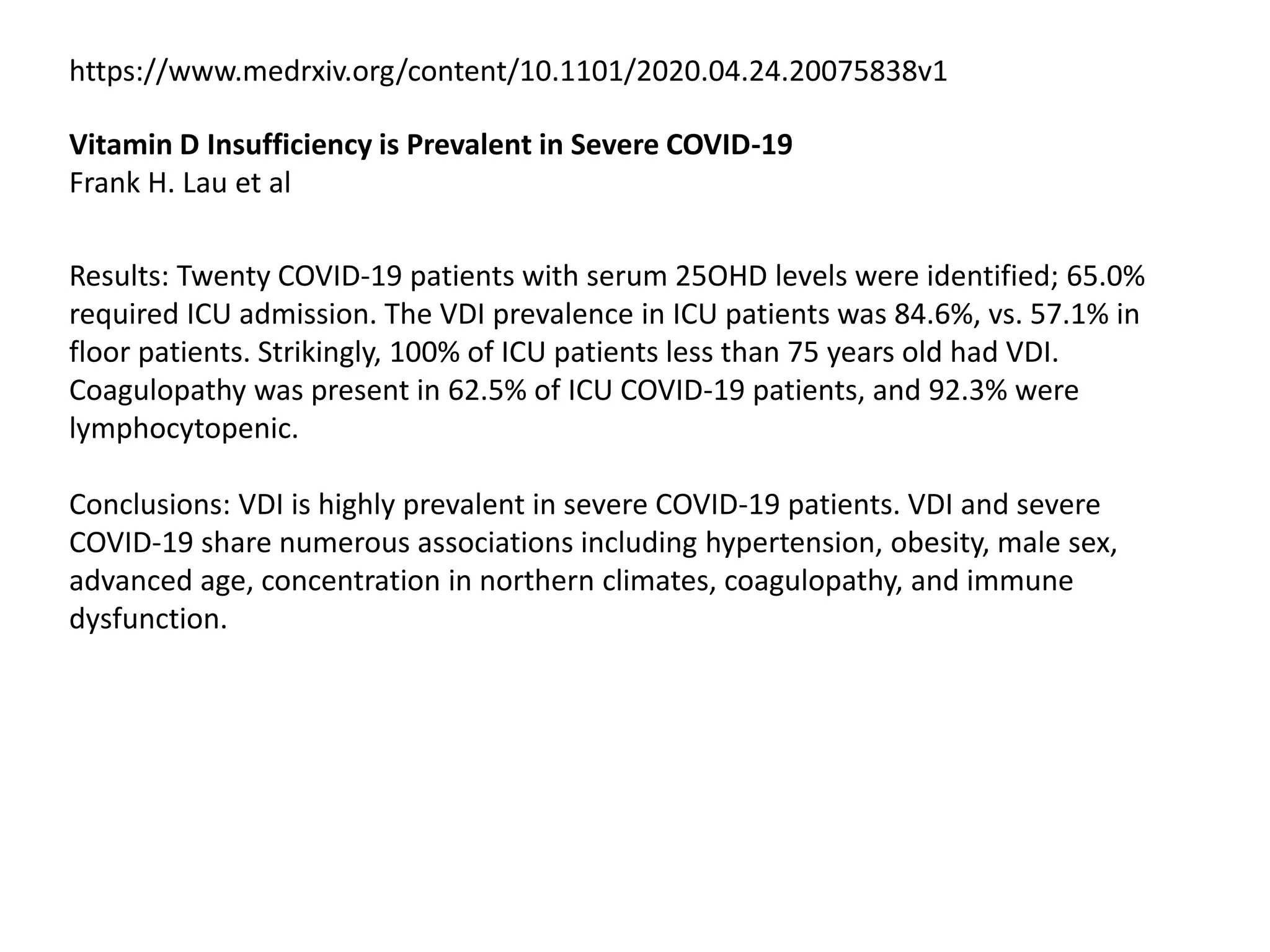
https://www.medrxiv.org/content/10.1101/2020.04.24.20075838v1
Vitamin D Insufficiency is Prevalent in Severe COVID-19
Frank H. Lau et al
Results: Twenty COVID-19 patients with serum 25OHD levels were identified; 65.0%
required ICU admission. The VDI prevalence in ICU patients was 84.6%, vs. 57.1% in
floor patients. Strikingly, 100% of ICU patients less than 75 years old had VDI.
Coagulopathy was present in 62.5% of ICU COVID-19 patients, and 92.3% were
lymphocytopenic.
Conclusions: VDI is highly prevalent in severe COVID-19 patients. VDI and severe
COVID-19 share numerous associations including hypertension, obesity, male sex,
advanced age, concentration in northern climates, coagulopathy, and immune
dysfunction.
https://www.medrxiv.org/content/10.1101/2020.06.01.20112334v2
A cohort study to evaluate the effect of combination Vitamin D, Magnesium and
Vitamin B12 (DMB) on progression to severe outcome in older COVID-19 patients.
Chuen Wen Tan et al
Results:
Between 15 January and 15 April 2020, 43 consecutive COVID-19 patients aged ≥50 were identified. 17
patients received DMB and 26 patients did not. Baseline demographic characteristics between the two
groups was significantly different in age. In univariate analysis, age and hypertension showed significant
influence on outcome while DMB retained protective significance after adjusting for age or hypertension
separately in multivariate analysis.
Fewer DMB patients than controls required initiation of oxygen therapy during their hospitalization (17.6%
vs 61.5%, P=0.006). DMB exposure was associated with odds ratios of 0.13 (95% CI: 0.03 − 0.59) and
0.20 (95% CI: 0.04 − 0.93) for oxygen therapy and/or intensive care support on univariate and multivariate
analyses respectively.
Conclusions:
DMB combination in older COVID-19 patients was associated with a significant reduction in proportion of
patients with clinical deterioration requiring oxygen support and/or intensive care support. This study
supports further larger randomized control trials to ascertain the full benefit of DMB in ameliorating COVID-
19 severity.
"The COVID-19 pandemic has severe short-term and long-term
consequences on individuals, health systems, and economies.
Considering the studies on the role of vitamin D in the prevention
of acute respiratory infections, supplementation of vitamin D may
be reasonable also for the prevention of SARS-CoV-2 infections and
reducing morbidity and mortality in COVID-19 high-risk patients.
Vitamin D deficiency is more common in older age groups, smokers,
obese, and patients with chronic
diseases such as diabetes, hypertension, various gastroenterological
diseases, and also in African Americans. The high-risk groups that
have more complications and higher mortality in COVID-19 coincide
with groups that have a high incidence of vitamin D deficiency.
We believe that vitamin D deficiency might be one of the important
risk factors for COVID-19 complications and higher mortality."
https://www.mayoclinicproceedings.org/article/S0025-6196(20)30602-9/pdf
D covid v3a

D covid v3a

  • 1.
  • 2.
    https://www.medrxiv. org/content/10.1101/ 2020.06.01.2011233 4v2 A cohort studyto evaluate the effect of combination Vitamin D, Magnesium and Vitamin B12 (DMB) on progression to severe outcome in older COVID-19 patients. Chuen Wen Tan et al
  • 3.
    Chart Date 7/1/2020 ©2020Gras s roots Health Mendy et al., BMJ, 2020. www.grassrootshealth.net https://www.medrxiv.org/content/10.1101/2020.06.25.20137323v2 Factors Associated with Hospitalization and Disease Severity in a Racially and Ethnically Diverse Population of COVID-19 Patients Angelico Mendy et al
  • 4.
    https://www.medrxiv.org/content/10.1101/2020.05.08.20095893v1 Association of VitaminD Deficiency and Treatment with COVID-19 Incidence View ORCID ProfileDavid O Meltzer Results: Among 4,314 patients tested for COVID-19, 499 had a vitamin D level in the year before testing. Vitamin D status at the time of COVID-19 testing was categorized as likely deficient for 127(25%) patients, likely sufficient for 291(58%) patients, and uncertain for 81(16%) patients. In multivariate analysis, testing positive for COVID-19 was associated with: - increasing age(RR(age<50)=1.05,p<0.021;RR(age≥50)=1.02,p<0.064)), - non-white race(RR=2.54,p<0.01) and - being likely vitamin D deficient - predicted COVID-19 rates in the vitamin D deficient group of 21.6%(95%CI[14.0%- 29.2%] ) versus 12.2%(95%CI[8.9%-15.4%]) in the vitamin D sufficient group. - Conclusions and Relevance: Vitamin D deficiency that is not sufficiently treated is associated with COVID-19 risk. Testing and treatment for vitamin D deficiency to address COVID-19 warrant aggressive pursuit and study.
  • 5.
    https://www.medrxiv.org/content/10.1101/2020.07.01.20144329v1.full.pdf Low plasma 25(OH)vitamin D level is associated with increased risk of COVID-19 infection: an Israeli population-based study Eugene Merzon et al 14,000 members of Leumit Health Services who were tested for COVID-19 infection from February 1st to April 30th 2020, and who had at least one previous blood test for plasma 25(OH)D level. "Suboptimal" or "low" plasma 25(OH)D level was defined as plasma 25-hydroxyvitamin D, or 25(OH)D, concentration below 30 ng/mL. RESULTS: Of 7,807 individuals, 782 (10.1%) were COVID-19-positive, and 7,025 (89.9%) COVID-19-negative. The mean plasma vitamin D level was significantly lower among those who tested positive than negative for COVID-19 [19.00 ng/mL (95% confidence interval [CI] 18.41-19.59) vs. 20.55 (95% CI 20.32-20.78)]. Univariate analysis demonstrated an association between low plasma 25(OH)D level and increased likelihood of COVID-19 infection [crude odds ratio (OR) of 1.58 (95% CI 1.24-2.01, p<0.001)], and of hospitalization due to the SARS-CoV-2 virus [crude OR of 2.09 (95% CI 1.01- 4.30, p<0.05)]. In multivariate analyses that controlled for demographic variables, and psychiatric and somatic disorders, the adjusted OR of COVID-19 infection [1.45 (95% CI 1.08-1.95, p<0.001)], and of hospitalization due to the SARS-CoV-2 virus [1.95 (95% CI 0.98-4.845, p=0.061)] were preserved. In the multivariate analyses, age over 50 years, male gender and low-medium socioeconomic status were also positively associated with the risk of COVID-19 infection; age over 50 years was positively associated with the likelihood of hospitalization due to COVID-19. Conclusion: Low plasma 25(OH)D level appears to be an independent risk factor for COVID-19 infection and hospitalization.
  • 6.
    https://www.medrxiv.org/content/10.1101/2020.04.24.20075838v1 Vitamin D Insufficiencyis Prevalent in Severe COVID-19 Frank H. Lau et al Results: Twenty COVID-19 patients with serum 25OHD levels were identified; 65.0% required ICU admission. The VDI prevalence in ICU patients was 84.6%, vs. 57.1% in floor patients. Strikingly, 100% of ICU patients less than 75 years old had VDI. Coagulopathy was present in 62.5% of ICU COVID-19 patients, and 92.3% were lymphocytopenic. Conclusions: VDI is highly prevalent in severe COVID-19 patients. VDI and severe COVID-19 share numerous associations including hypertension, obesity, male sex, advanced age, concentration in northern climates, coagulopathy, and immune dysfunction.
  • 7.
    https://www.medrxiv.org/content/10.1101/2020.06.01.20112334v2 A cohort studyto evaluate the effect of combination Vitamin D, Magnesium and Vitamin B12 (DMB) on progression to severe outcome in older COVID-19 patients. Chuen Wen Tan et al Results: Between 15 January and 15 April 2020, 43 consecutive COVID-19 patients aged ≥50 were identified. 17 patients received DMB and 26 patients did not. Baseline demographic characteristics between the two groups was significantly different in age. In univariate analysis, age and hypertension showed significant influence on outcome while DMB retained protective significance after adjusting for age or hypertension separately in multivariate analysis. Fewer DMB patients than controls required initiation of oxygen therapy during their hospitalization (17.6% vs 61.5%, P=0.006). DMB exposure was associated with odds ratios of 0.13 (95% CI: 0.03 − 0.59) and 0.20 (95% CI: 0.04 − 0.93) for oxygen therapy and/or intensive care support on univariate and multivariate analyses respectively. Conclusions: DMB combination in older COVID-19 patients was associated with a significant reduction in proportion of patients with clinical deterioration requiring oxygen support and/or intensive care support. This study supports further larger randomized control trials to ascertain the full benefit of DMB in ameliorating COVID- 19 severity.
  • 8.
    "The COVID-19 pandemichas severe short-term and long-term consequences on individuals, health systems, and economies. Considering the studies on the role of vitamin D in the prevention of acute respiratory infections, supplementation of vitamin D may be reasonable also for the prevention of SARS-CoV-2 infections and reducing morbidity and mortality in COVID-19 high-risk patients. Vitamin D deficiency is more common in older age groups, smokers, obese, and patients with chronic diseases such as diabetes, hypertension, various gastroenterological diseases, and also in African Americans. The high-risk groups that have more complications and higher mortality in COVID-19 coincide with groups that have a high incidence of vitamin D deficiency. We believe that vitamin D deficiency might be one of the important risk factors for COVID-19 complications and higher mortality." https://www.mayoclinicproceedings.org/article/S0025-6196(20)30602-9/pdf

Editor's Notes

  • #2 https://www.grassrootshealth.net/wp-content/uploads/2020/04/Alipio-Vit-D-COVID-Severity-Preprint-04-22-2020.pdf Vitamin D supplementation could possibly improve clinical outcomes of patients infected with Coronavirus-2019 (Covid- 2019) Mark M. Alipio April 9, 2020
  • #3 https://www.medrxiv.org/content/10.1101/2020.06.01.20112334v2