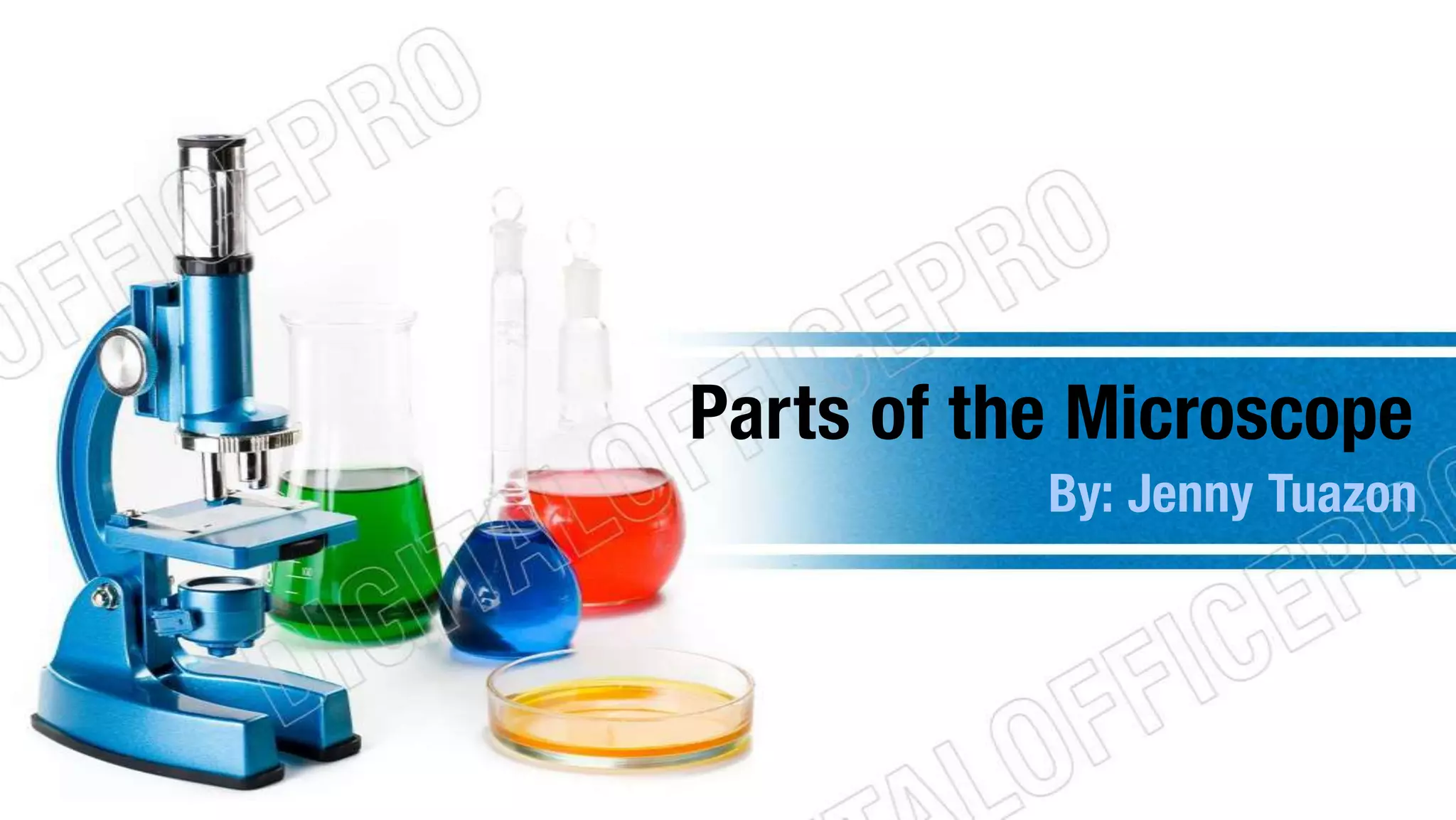
Parts of the Microscope 
By: Jenny Tuazon
Parts of the Microscope 
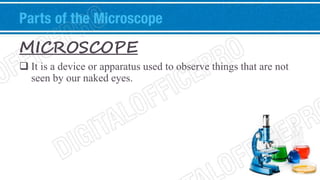
MICROSCOPE 
 It is a device or apparatus used to observe things that are not 
seen by our naked eyes.
Parts of the Microscope
Parts of the Microscope 
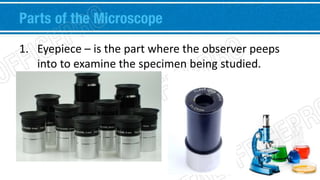
1. Eyepiece – is the part where the observer peeps 
into to examine the specimen being studied.
Parts of the Microscope 
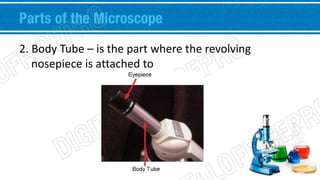
2. Body Tube – is the part where the revolving 
nosepiece is attached to
Parts of the Microscope 
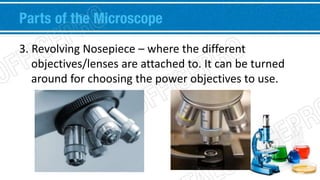
3. Revolving Nosepiece – where the different 
objectives/lenses are attached to. It can be turned 
around for choosing the power objectives to use.
Parts of the Microscope 
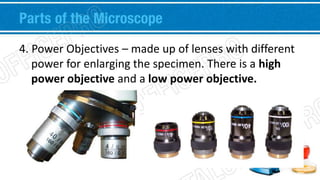
4. Power Objectives – made up of lenses with different 
power for enlarging the specimen. There is a high 
power objective and a low power objective.
Parts of the Microscope 
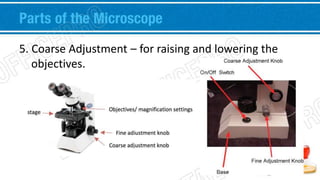
5. Coarse Adjustment – for raising and lowering the 
objectives.
Parts of the Microscope 
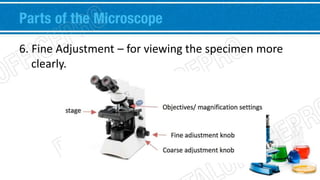
6. Fine Adjustment – for viewing the specimen more 
clearly.
Parts of the Microscope 
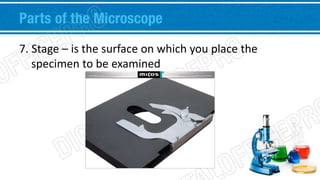
7. Stage – is the surface on which you place the 
specimen to be examined
Parts of the Microscope 
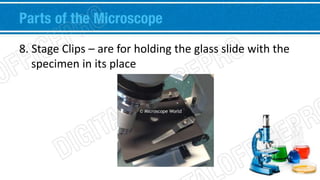
8. Stage Clips – are for holding the glass slide with the 
specimen in its place
Parts of the Microscope 
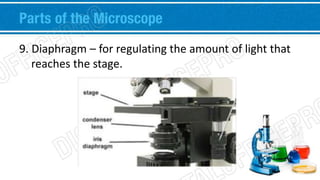
9. Diaphragm – for regulating the amount of light that 
reaches the stage.
Parts of the Microscope 
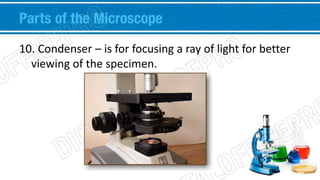
10. Condenser – is for focusing a ray of light for better 
viewing of the specimen.
Parts of the Microscope 
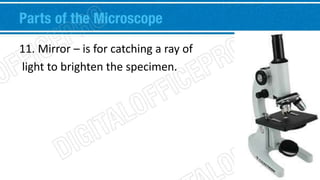
11. Mirror – is for catching a ray of 
light to brighten the specimen.
Parts of the Microscope 
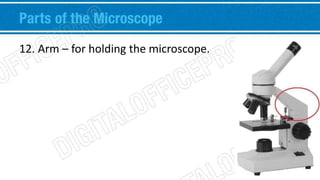
12. Arm – for holding the microscope.
Parts of the Microscope 
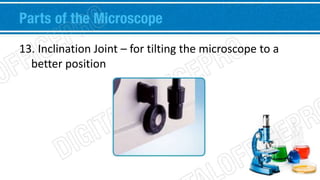
13. Inclination Joint – for tilting the microscope to a 
better position
Parts of the Microscope 
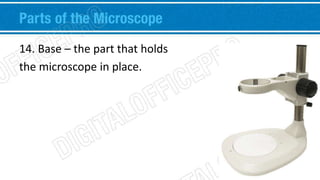
14. Base – the part that holds 
the microscope in place.

Cunanan, mark bryan

  • 1.
    Parts of theMicroscope By: Jenny Tuazon
  • 2.
    Parts of theMicroscope MICROSCOPE  It is a device or apparatus used to observe things that are not seen by our naked eyes.
  • 3.
    Parts of theMicroscope
  • 4.
    Parts of theMicroscope 1. Eyepiece – is the part where the observer peeps into to examine the specimen being studied.
  • 5.
    Parts of theMicroscope 2. Body Tube – is the part where the revolving nosepiece is attached to
  • 6.
    Parts of theMicroscope 3. Revolving Nosepiece – where the different objectives/lenses are attached to. It can be turned around for choosing the power objectives to use.
  • 7.
    Parts of theMicroscope 4. Power Objectives – made up of lenses with different power for enlarging the specimen. There is a high power objective and a low power objective.
  • 8.
    Parts of theMicroscope 5. Coarse Adjustment – for raising and lowering the objectives.
  • 9.
    Parts of theMicroscope 6. Fine Adjustment – for viewing the specimen more clearly.
  • 10.
    Parts of theMicroscope 7. Stage – is the surface on which you place the specimen to be examined
  • 11.
    Parts of theMicroscope 8. Stage Clips – are for holding the glass slide with the specimen in its place
  • 12.
    Parts of theMicroscope 9. Diaphragm – for regulating the amount of light that reaches the stage.
  • 13.
    Parts of theMicroscope 10. Condenser – is for focusing a ray of light for better viewing of the specimen.
  • 14.
    Parts of theMicroscope 11. Mirror – is for catching a ray of light to brighten the specimen.
  • 15.
    Parts of theMicroscope 12. Arm – for holding the microscope.
  • 16.
    Parts of theMicroscope 13. Inclination Joint – for tilting the microscope to a better position
  • 17.
    Parts of theMicroscope 14. Base – the part that holds the microscope in place.