Microscope Parts and Functions
Created by: Joevani S. Peñol
Edited by: Brandi Shoemaker
Microscope
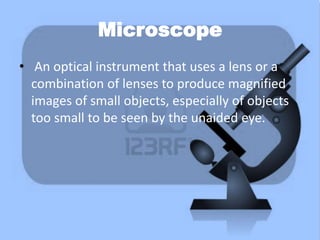
• An optical instrument that uses a lens or a
combination of lenses to produce magnified
images of small objects, especially of objects
too small to be seen by the unaided eye.
Microscope Parts and Functions
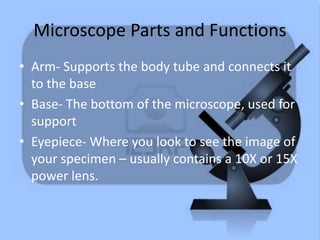
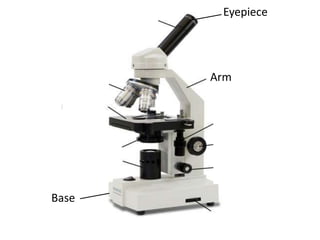
• Arm- Supports the body tube and connects it
to the base
• Base- The bottom of the microscope, used for
support
• Eyepiece- Where you look to see the image of
your specimen – usually contains a 10X or 15X
power lens.
BASE
Eyepiece
Base
Arm
Microscope Parts and Functions
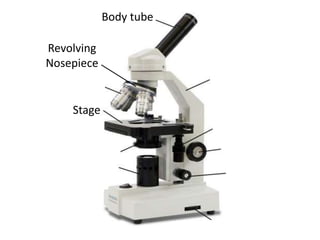
• Body tube- Connects the eyepiece to the
objective lenses.
• Revolving Nosepiece- This is the part that
holds two or more objective lenses and can be
rotated to easily change power.
• Stage- The flat platform where you place your
slides.
Stage
Revolving
Nosepiece
Body tube
Microscope Parts and Functions
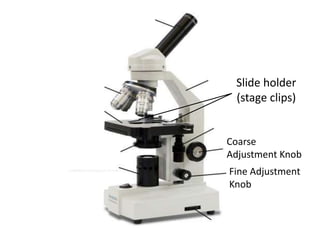
• Fine Adjustment Knob--small, round knob on
the side of the microscope used to fine-tune
the focus of your specimen
• Coarse Adjustment Knob--large, round knob
on the side of the microscope used to move
the stage up and down in order to bring the
specimen into general focus.
• Slide holder (stage clips)--hold the slide in
place
Slide holder
(stage clips)
Coarse
Adjustment Knob
Fine Adjustment
Knob
Microscope Parts and Functions
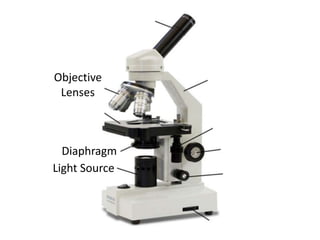
• Diaphragm- controls the light going through
the aperture (hole in the stage).
• Light source-it projects light upwards through
the diaphragm, slide and lenses..
• Objective lenses-Low (4X), medium (10X), and
high (40X) objectives--used use to increase the
magnification of the specimen.
Objective
Lenses
Diaphragm
Light Source
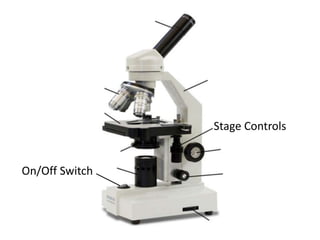
Microscope Parts and Functions
• Stage Controls-- These knobs move the stage
left and right or up and down.
• On/off switch: This switch on the base of the
microscope turns the light source off and on.
On/Off Switch
Stage Controls
Proper Way of Focusing the
Microscope
• Always observe the specimen or object using
the LOWEST POWER object first.
• Focus using the COARSE ADJUSTMENT KNOB
to bring the object into focus. Bring the object
into sharp focus by using the fine adjustment
knob.
Proper Way of Focusing the
Microscope
• Focus, and then move to a higher power
objective, if needed.
• Use only the FINE ADJUSTMENT KNOB when
using the HIGHEST (longest) POWER
OBJECTIVE.
Proper Way of Focusing the
Microscope
• Keep both eyes open to reduce eyestrain.
Keep eye slightly above the eyepiece to
reduce eyelash interference.
• To find out the total magnification of the
object, multiply the power of the eyepiece
lens (10X) by the power of the objective.
Handling the Microscope
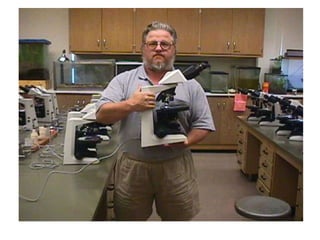
• Always use two hands to move the
microscope. Place one hand around the arm,
lift the scope, and then put your other hand
under the base of the scope for support.
• Be gentle.
Storing the Microscope
• Dust is an enemy to microscope lenses; always
keep the microscope covered when not in use.
References
• http://www.thefreedictionary.com/microscop
e
• http://www.saskschools.ca/curr_content/biol
ogy20/unit1/UNIT1MODULE2LESSON1c.htm
• http://www.microscope-
microscope.org/basic/microscope-parts.htm

Microscopepartsandfunctions

  • 1.
    Microscope Parts andFunctions Created by: Joevani S. Peñol Edited by: Brandi Shoemaker
  • 2.
    Microscope • An opticalinstrument that uses a lens or a combination of lenses to produce magnified images of small objects, especially of objects too small to be seen by the unaided eye.
  • 3.
    Microscope Parts andFunctions • Arm- Supports the body tube and connects it to the base • Base- The bottom of the microscope, used for support • Eyepiece- Where you look to see the image of your specimen – usually contains a 10X or 15X power lens.
  • 4.
  • 5.
    Microscope Parts andFunctions • Body tube- Connects the eyepiece to the objective lenses. • Revolving Nosepiece- This is the part that holds two or more objective lenses and can be rotated to easily change power. • Stage- The flat platform where you place your slides.
  • 6.
  • 7.
    Microscope Parts andFunctions • Fine Adjustment Knob--small, round knob on the side of the microscope used to fine-tune the focus of your specimen • Coarse Adjustment Knob--large, round knob on the side of the microscope used to move the stage up and down in order to bring the specimen into general focus. • Slide holder (stage clips)--hold the slide in place
  • 8.
  • 9.
    Microscope Parts andFunctions • Diaphragm- controls the light going through the aperture (hole in the stage). • Light source-it projects light upwards through the diaphragm, slide and lenses.. • Objective lenses-Low (4X), medium (10X), and high (40X) objectives--used use to increase the magnification of the specimen.
  • 10.
  • 11.
    Microscope Parts andFunctions • Stage Controls-- These knobs move the stage left and right or up and down. • On/off switch: This switch on the base of the microscope turns the light source off and on.
  • 12.
  • 13.
    Proper Way ofFocusing the Microscope • Always observe the specimen or object using the LOWEST POWER object first. • Focus using the COARSE ADJUSTMENT KNOB to bring the object into focus. Bring the object into sharp focus by using the fine adjustment knob.
  • 14.
    Proper Way ofFocusing the Microscope • Focus, and then move to a higher power objective, if needed. • Use only the FINE ADJUSTMENT KNOB when using the HIGHEST (longest) POWER OBJECTIVE.
  • 15.
    Proper Way ofFocusing the Microscope • Keep both eyes open to reduce eyestrain. Keep eye slightly above the eyepiece to reduce eyelash interference. • To find out the total magnification of the object, multiply the power of the eyepiece lens (10X) by the power of the objective.
  • 16.
    Handling the Microscope •Always use two hands to move the microscope. Place one hand around the arm, lift the scope, and then put your other hand under the base of the scope for support. • Be gentle.
  • 18.
    Storing the Microscope •Dust is an enemy to microscope lenses; always keep the microscope covered when not in use.
  • 19.