The document provides an overview of microscopes, detailing the functions and components of both simple and compound microscopes. A simple microscope uses a single biconvex lens for small magnifications, while a compound microscope employs two lenses for highly magnified images. Both types consist of mechanical parts for support and adjustment, and optical parts for light passage and magnification.
Introduction:
A microscope isa scientific instrument that makes
things that are too small into big so that they can be
examined correctly. The use of microscope is to view
objects and areas of objects that cannot be seen with
the naked eyes. They do this by magnification and
resolution. Magnification means how many times the
object is enlarged within the viewing lens. Resolution
means how detailed the object appears when viewed.
The micro organisms are so small for visualization of
microorganisms microscope is used. It magnifies the
size of an apparent image of an object.
3.
SIMPLE MICROSCOPE:
A simplemicroscope is used to obtain small
magnifications. It is usually used for study of
microscopic algae, fungi and biological
specimen.
Principle:
Light from a light source (mirror) passes through
a thin transparent object. A biconvex lens
magnifies the size of the object to get an
enlarged virtual image. The image is viewed
from the other side.
5.
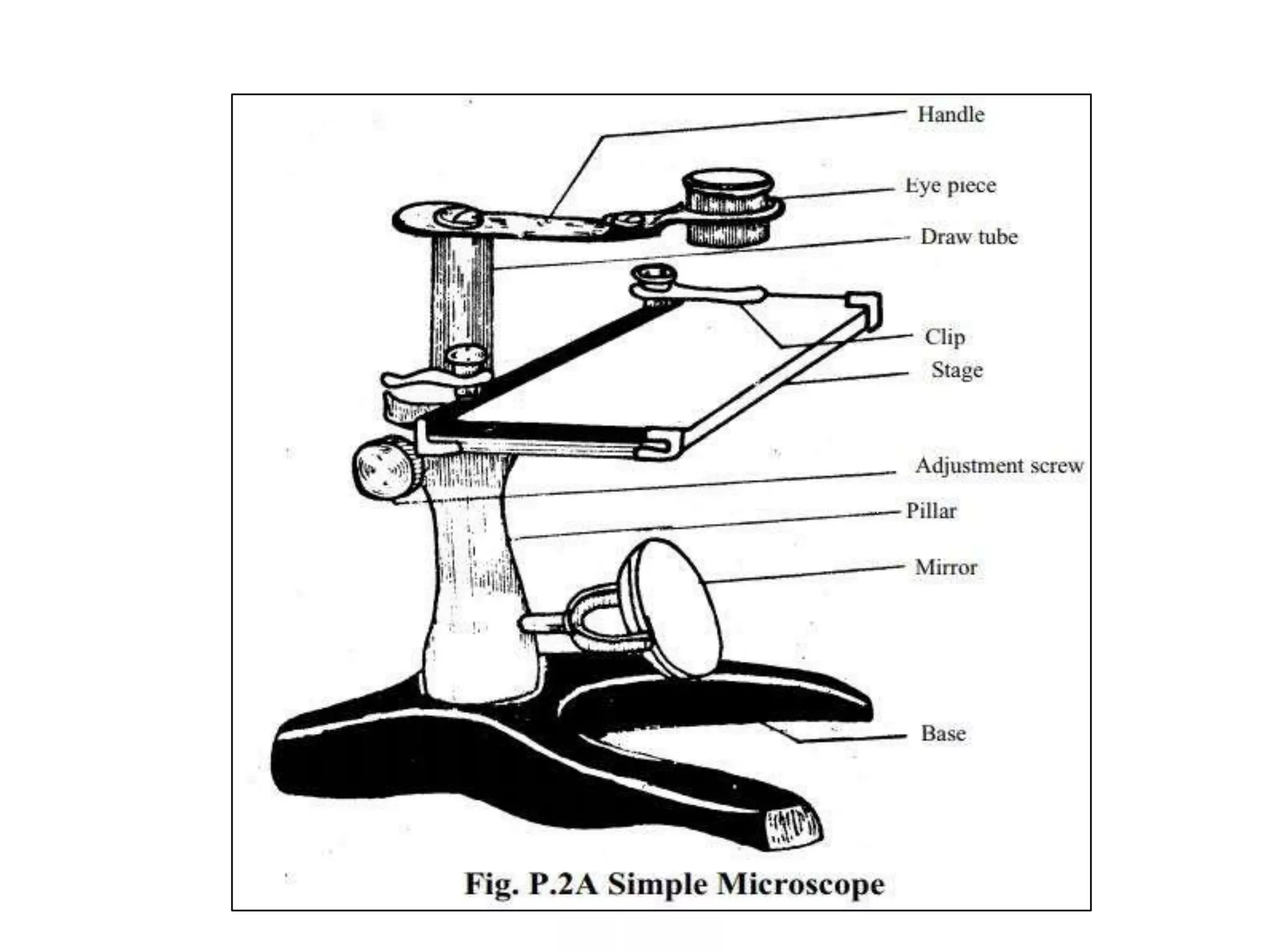
The part ofsimple microscope are of two categories:
Mechanical parts and optical parts.
1. Mechanical parts: These parts support the optical
parts and help in their adjustment for focusing the
object. They include metal stand and stage.
a) Metal stand: It has heavy base plate and a vertical
rod fitted to it, which provide support and stability to
other parts of the microscope.
b) Stage: It is a rectangular metal plate fitted to the
vertical rod . It has a central hole for light to pass from
below. Slide with specimen to be observed is kept on
the stage, in such a way that, the specimen remain
just on the central hole.
6.
2. Optical Parts:These parts are involved in passing
the light through the object (specimen) and
magnifying its size. They includes mirror and lens.
a) Mirror: A Plano convex mirror is fitted below the
stage to the vertical rod by means of a frame. It
focused the surrounding light on the object to be
observed.
b) Lens: The biconvex lens is fitted above the stage, to
the vertical rod by means of frame. It magnifies the
size of the object and the enlarged virtual image
formed is observed by keeping the eye above it. For
proper focusing the lens can be moved up and down
by the frame.
7.
COMPOUND MICROSCOPE:
A compoundmicroscope is an optical instrument
consisting of two convex lenses of short focal lengths
which is used for observing the highly magnified
images of tiny object.
Principle:
The compound microscope works on the principle
that when a tiny object to be magnified is placed just
beyond the focus of its objective lens, a virtual,
inverted and highly magnified image of the object is
formed at the least distance of distinct vision from the
eye held close to the eyepiece.
9.
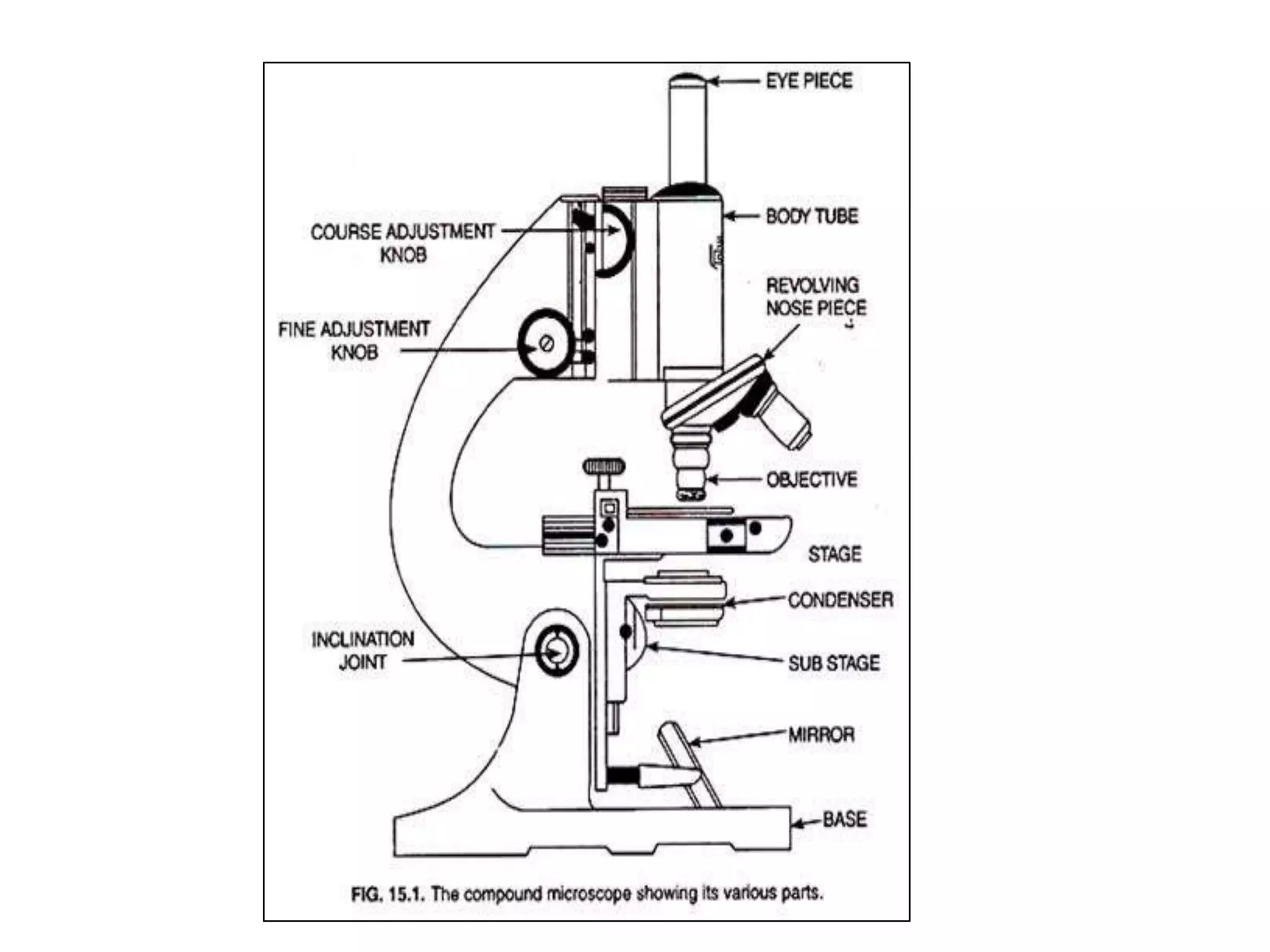
The part ofcompound microscope are of two categories: Mechanical
parts and optical parts.
1. Mechanical Parts: It includes base or foot, pillar, arm, inclination
joint, stage, clips, diaphragm, body tube, nose piece, coarse adjustment
knob and fine adjustment knob.
i) Foot or base: It is the basal, horse shoe shaped structure. It provides
support to all remaining parts of the microscope.
ii) Pillar: A small strong vertical projection developing from the foot or
base is called pillar.
iii) Arm: It is curved and strong structure used for handling the entire
instrument.
iv) Inclination Joint: A joint at which the arm is attached to the pillar of
the microscope is called inclination joint. It is used for tilting the
microscope.
v) Stage: It is a flat rectangular plate attached to the lower end of the
arm. Slide or object is placed on the stage and studied. A hole is present
in the centre of the stage. Light rays passed through this hole.
10.
vi) Clips: Twoclips are attached on the upper part of the stage. These
are used for holding the slide in position.
vii) Diaphragm: It is attached beneath the stage. It regulates the
intensity or amount of light entering into the microscope.
viii) Condenser: It is the lens situated beneath the stage. It controls the
size of the light beam. It gathers light from the mirror and directs it to
objective lens. Condenser may be lowered or raised by a knob present
on the side beneath the stage.
ix) Body Tube: It the tubular, hollow part attached to the upper part of
the arm of microscope. It can be moved up and down with the help of
adjustment knobs.
x) Nose piece: It is circular and revolving metallic part attached to the
lower end of the body tube. It has three holes in which objective lenses
can be fitted.
xi) Coarse adjustment knob: It is a large sized knob used to move the
body tube up and down for bringing the object into focus.
xii) Fine adjustment knob: It is the small sized knob. It is used for fine
and sharp focusing of the object. Exact focusing is done by this knob.
11.
2. Optical parts:These includes eyepiece lens, objective
lenses and mirror.
i) Eyepiece or ocular: It is lens fitted at the top of the body
tube. It is always marked with a number (5X, 10X, 15X) on its
rim. This number shows its magnification power. Magnified
images of the object are seen with the eyepiece.
ii) Objective Lenses: Three objective lenses are attached to
the revolving nose piece at the bottom of the body tube.
These are low power objective (10X), high power objective
(45X) and oil immersion objective (100X).
iii) Mirror: It is either attached to lower end of the arm or to
the pillar. It contains the plane mirror on one side and a
concave mirror on the other side. Mirror is used to reflect the
light rays into the microscope.