Let’s have some fun
first!
Read each statement carefully. Select
the correct answer from the word bank
•I have many jobs. I make bile to help your stomach break
down food. I also store nutrients your body needs. What am
i?
LIVER
•I AM A MUSCLE LOCATED BEHIND YOUR LUNGS. I AM ALWAYS
MOVING AND NEVER GET TIRED. I PUMP BLOOD TO ALL PARTS OF
YOUR BODY. WHAT AM I?
Heart
WE ARE A PAIR OF FILTERS THAT CLEAN YOUR BLOOD. WE TAKE LIQUID WASTE FROM YOUR BLOODSTREAM
AND WE SEND IT DOWN TO YOUR BLADDER. WHAT ARE WE?
KIDNEY
• WE TAKE OXYGEN THAT YOUR BODY NEEDS FROM THE AIR AND PUT IT IN YOUR BLOODSTREAM. WE ALSO
TAKE CARBON DIOXIDE THAT IS IN YOUR BLOOD AND SEND IT OUT IN YOUR BODY. WHAT ARE WE?
LUNGS
• I CONTROL YOUR MUSCLES AND ALL OF THE ORGANS IN YOUR BODY. I MAKE SURE YOU BREATHE
AUTOMATICALLY, ENSURE YOUR HEART BEATS PROPERLY , AND REMIND YOUTO BLINK YOUR EYES. I EVEN
HOLD ALL OF YOUR THOUGHTS AND MEMORIES. WHAT AM I?
BRAIN
You are going to perform another activity that will make
you understand our topic for this day
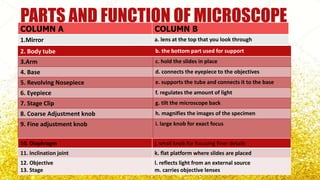
PARTS AND FUNCTION OF MICROSCOPE
2. Body tube b. the bottom part used for support
3.Arm c. hold the slides in place
4. Base d. connects the eyepiece to the objectives
5. Revolving Nosepiece e. supports the tube and connects it to the base
6. Eyepiece f. regulates the amount of light
7. Stage Clip g. tilt the microscope back
8. Coarse Adjustment knob h. magnifies the images of the specimen
9. Fine adjustment knob i. large knob for exact focus
COLUMN A COLUMN B
1.Mirror a. lens at the top that you look through
10. Diaphragm j. small knob for focusing finer details
11. Inclination joint k. flat platform where slides are placed
12. Objective
13. Stage
l. reflects light from an external source
m. carries objective lenses
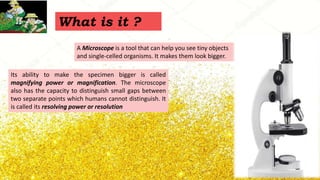
What is it ?
A Microscope is a tool that can help you see tiny objects
and single-celled organisms. It makes them look bigger.
Its ability to make the specimen bigger is called
magnifying power or magnification. The microscope
also has the capacity to distinguish small gaps between
two separate points which humans cannot distinguish. It
is called its resolving power or resolution
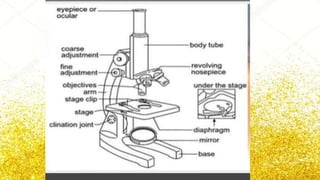
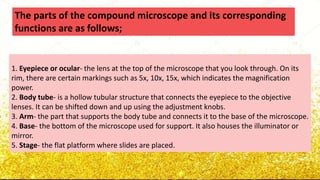
The parts of the compound microscope and its corresponding
functions are as follows;
1. Eyepiece or ocular- the lens at the top of the microscope that you look through. On its
rim, there are certain markings such as 5x, 10x, 15x, which indicates the magnification
power.
2. Body tube- is a hollow tubular structure that connects the eyepiece to the objective
lenses. It can be shifted down and up using the adjustment knobs.
3. Arm- the part that supports the body tube and connects it to the base of the microscope.
4. Base- the bottom of the microscope used for support. It also houses the illuminator or
mirror.
5. Stage- the flat platform where slides are placed.
The parts of the compound microscope and its corresponding
functions are as follows;
6. Stage clips- hold the slides in place.
7. Mirror- it is used to reflect light from an external light source up to the diaphragm,
object to be observed, and lenses. Positioning the microscope towards diffused light from
the windows and ceiling one can see through the eyepiece a bright circle of light called
the field of view.
8. Revolving nosepiece- carries the objective lenses and can be rotated to easily change
power (magnification).
9. Fine adjustment knob- the small knob used for focusing finer details of the specimen
being viewed.
10. Coarse adjustment knob- the large knob located on the arm of the microscope used
for moving the body tube down and up for bringing the object to be examined under
exact focus.
The parts of the compound microscope and its corresponding
functions are as follows;
11. Objective- a component that magnifies the images of the specimen to form an enlarged image. There
are three (3) objective lenses, namely;
a. Oil immersion objective (OIO)-used to view bacteria, very small protists, and fungi. It is marked 97x or
100x or the word “oil”.
b. High power objective (HPO)- is marked 40x, 43x, or 60x.
c. Low power objective (LPO)- is marked 10x or 12x.
12. Inclination joint- a joint where the arm is fastened to the base. It is used to tilt the microscope for more
comfortable viewing.
13. Diaphragm- is fastened below the stage. It regulates the amount of light passing through the specimen.
Figure 2. Parts of the Compound Light Microscope
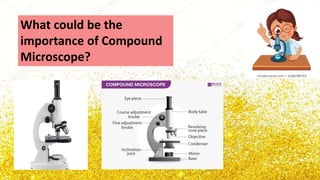
What could be the
importance of Compound
Microscope?
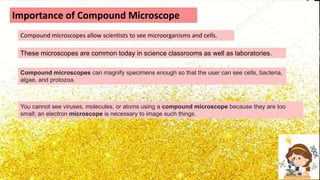
Importance of Compound Microscope
Compound microscopes allow scientists to see microorganisms and cells.
These microscopes are common today in science classrooms as well as laboratories.
Compound microscopes can magnify specimens enough so that the user can see cells, bacteria,
algae, and protozoa.
You cannot see viruses, molecules, or atoms using a compound microscope because they are too
small; an electron microscope is necessary to image such things.
What I Have Learned
My Part, My Function
Directions: Label the parts of the microscope and give its corresponding functions. Start at part A down to part M. Write
your answers in the table provided.
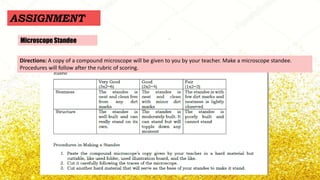
ASSIGNMENT
Microscope Standee
Directions: A copy of a compound microscope will be given to you by your teacher. Make a microscope standee.
Procedures will follow after the rubric of scoring.
COMPOUND MICROSCOPE COT 2ND.pptx

COMPOUND MICROSCOPE COT 2ND.pptx

  • 2.
  • 3.
    Read each statementcarefully. Select the correct answer from the word bank •I have many jobs. I make bile to help your stomach break down food. I also store nutrients your body needs. What am i? LIVER
  • 4.
    •I AM AMUSCLE LOCATED BEHIND YOUR LUNGS. I AM ALWAYS MOVING AND NEVER GET TIRED. I PUMP BLOOD TO ALL PARTS OF YOUR BODY. WHAT AM I? Heart
  • 5.
    WE ARE APAIR OF FILTERS THAT CLEAN YOUR BLOOD. WE TAKE LIQUID WASTE FROM YOUR BLOODSTREAM AND WE SEND IT DOWN TO YOUR BLADDER. WHAT ARE WE? KIDNEY
  • 6.
    • WE TAKEOXYGEN THAT YOUR BODY NEEDS FROM THE AIR AND PUT IT IN YOUR BLOODSTREAM. WE ALSO TAKE CARBON DIOXIDE THAT IS IN YOUR BLOOD AND SEND IT OUT IN YOUR BODY. WHAT ARE WE? LUNGS
  • 7.
    • I CONTROLYOUR MUSCLES AND ALL OF THE ORGANS IN YOUR BODY. I MAKE SURE YOU BREATHE AUTOMATICALLY, ENSURE YOUR HEART BEATS PROPERLY , AND REMIND YOUTO BLINK YOUR EYES. I EVEN HOLD ALL OF YOUR THOUGHTS AND MEMORIES. WHAT AM I? BRAIN
  • 9.
    You are goingto perform another activity that will make you understand our topic for this day
  • 11.
    PARTS AND FUNCTIONOF MICROSCOPE 2. Body tube b. the bottom part used for support 3.Arm c. hold the slides in place 4. Base d. connects the eyepiece to the objectives 5. Revolving Nosepiece e. supports the tube and connects it to the base 6. Eyepiece f. regulates the amount of light 7. Stage Clip g. tilt the microscope back 8. Coarse Adjustment knob h. magnifies the images of the specimen 9. Fine adjustment knob i. large knob for exact focus COLUMN A COLUMN B 1.Mirror a. lens at the top that you look through 10. Diaphragm j. small knob for focusing finer details 11. Inclination joint k. flat platform where slides are placed 12. Objective 13. Stage l. reflects light from an external source m. carries objective lenses
  • 12.
    What is it? A Microscope is a tool that can help you see tiny objects and single-celled organisms. It makes them look bigger. Its ability to make the specimen bigger is called magnifying power or magnification. The microscope also has the capacity to distinguish small gaps between two separate points which humans cannot distinguish. It is called its resolving power or resolution
  • 13.
    The parts ofthe compound microscope and its corresponding functions are as follows; 1. Eyepiece or ocular- the lens at the top of the microscope that you look through. On its rim, there are certain markings such as 5x, 10x, 15x, which indicates the magnification power. 2. Body tube- is a hollow tubular structure that connects the eyepiece to the objective lenses. It can be shifted down and up using the adjustment knobs. 3. Arm- the part that supports the body tube and connects it to the base of the microscope. 4. Base- the bottom of the microscope used for support. It also houses the illuminator or mirror. 5. Stage- the flat platform where slides are placed.
  • 14.
    The parts ofthe compound microscope and its corresponding functions are as follows; 6. Stage clips- hold the slides in place. 7. Mirror- it is used to reflect light from an external light source up to the diaphragm, object to be observed, and lenses. Positioning the microscope towards diffused light from the windows and ceiling one can see through the eyepiece a bright circle of light called the field of view. 8. Revolving nosepiece- carries the objective lenses and can be rotated to easily change power (magnification). 9. Fine adjustment knob- the small knob used for focusing finer details of the specimen being viewed. 10. Coarse adjustment knob- the large knob located on the arm of the microscope used for moving the body tube down and up for bringing the object to be examined under exact focus.
  • 15.
    The parts ofthe compound microscope and its corresponding functions are as follows; 11. Objective- a component that magnifies the images of the specimen to form an enlarged image. There are three (3) objective lenses, namely; a. Oil immersion objective (OIO)-used to view bacteria, very small protists, and fungi. It is marked 97x or 100x or the word “oil”. b. High power objective (HPO)- is marked 40x, 43x, or 60x. c. Low power objective (LPO)- is marked 10x or 12x. 12. Inclination joint- a joint where the arm is fastened to the base. It is used to tilt the microscope for more comfortable viewing. 13. Diaphragm- is fastened below the stage. It regulates the amount of light passing through the specimen.
  • 16.
    Figure 2. Partsof the Compound Light Microscope
  • 17.
    What could bethe importance of Compound Microscope?
  • 18.
    Importance of CompoundMicroscope Compound microscopes allow scientists to see microorganisms and cells. These microscopes are common today in science classrooms as well as laboratories. Compound microscopes can magnify specimens enough so that the user can see cells, bacteria, algae, and protozoa. You cannot see viruses, molecules, or atoms using a compound microscope because they are too small; an electron microscope is necessary to image such things.
  • 20.
    What I HaveLearned My Part, My Function Directions: Label the parts of the microscope and give its corresponding functions. Start at part A down to part M. Write your answers in the table provided.
  • 21.
    ASSIGNMENT Microscope Standee Directions: Acopy of a compound microscope will be given to you by your teacher. Make a microscope standee. Procedures will follow after the rubric of scoring.