Chapter 1
Nature and Concept of
Management
Prepared by:
Jenny Tuazon, LPT
Definition and Functions of
Management
Management
“Manage others as you would like to be
managed” – Brian Tracy (Golden Rule of
Management)
 Process and a systematic way of doing things
Process of coordinating and overseeing the
work performance of individuals, so that they
could efficiently and effectively accomplish
their chosen aims or goals
Management
Process of designing and maintaining an
environment for efficiently accomplishing
selected aims
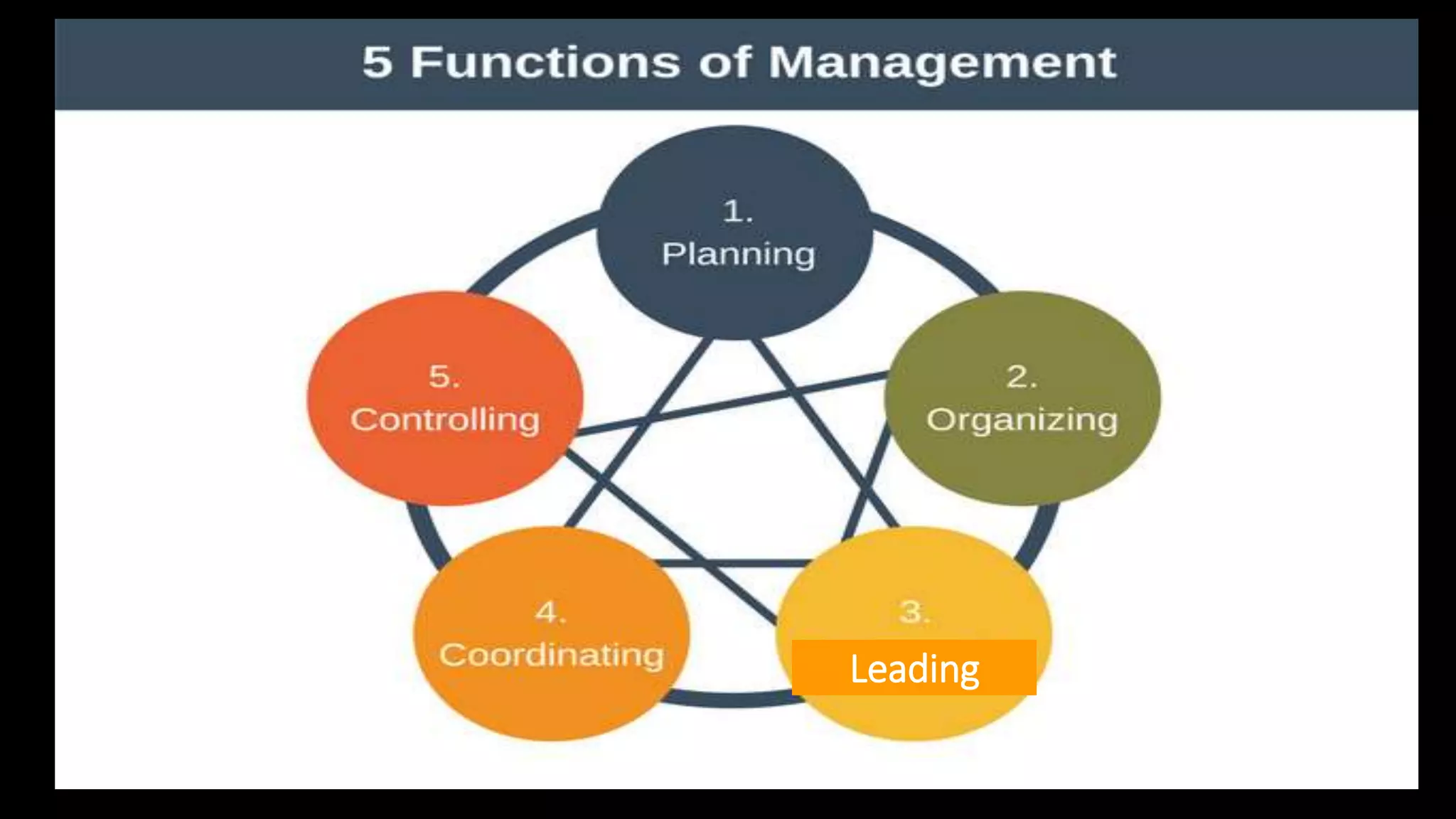
Leading
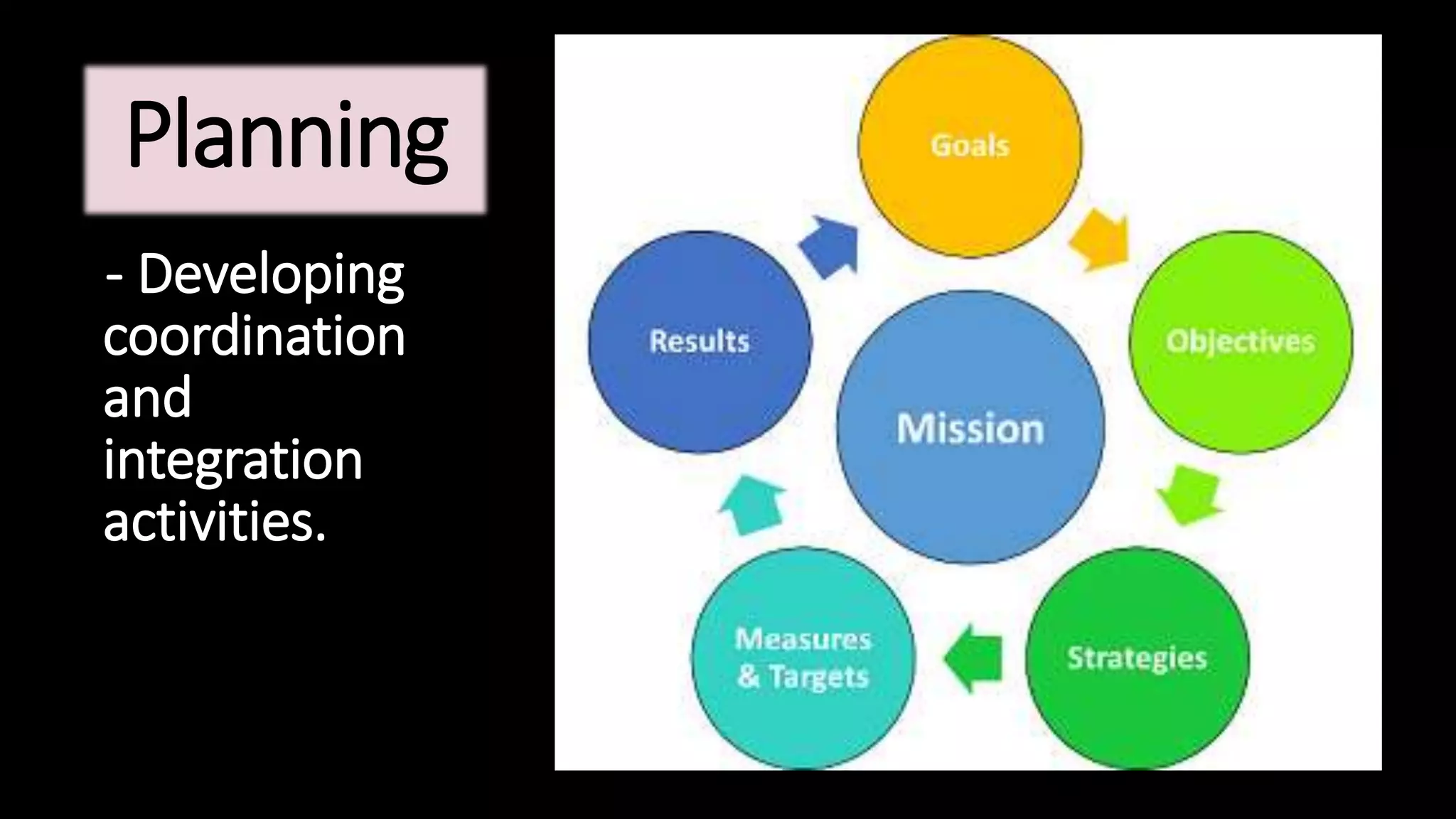
Planning
- Developing
coordination
and
integration
activities.
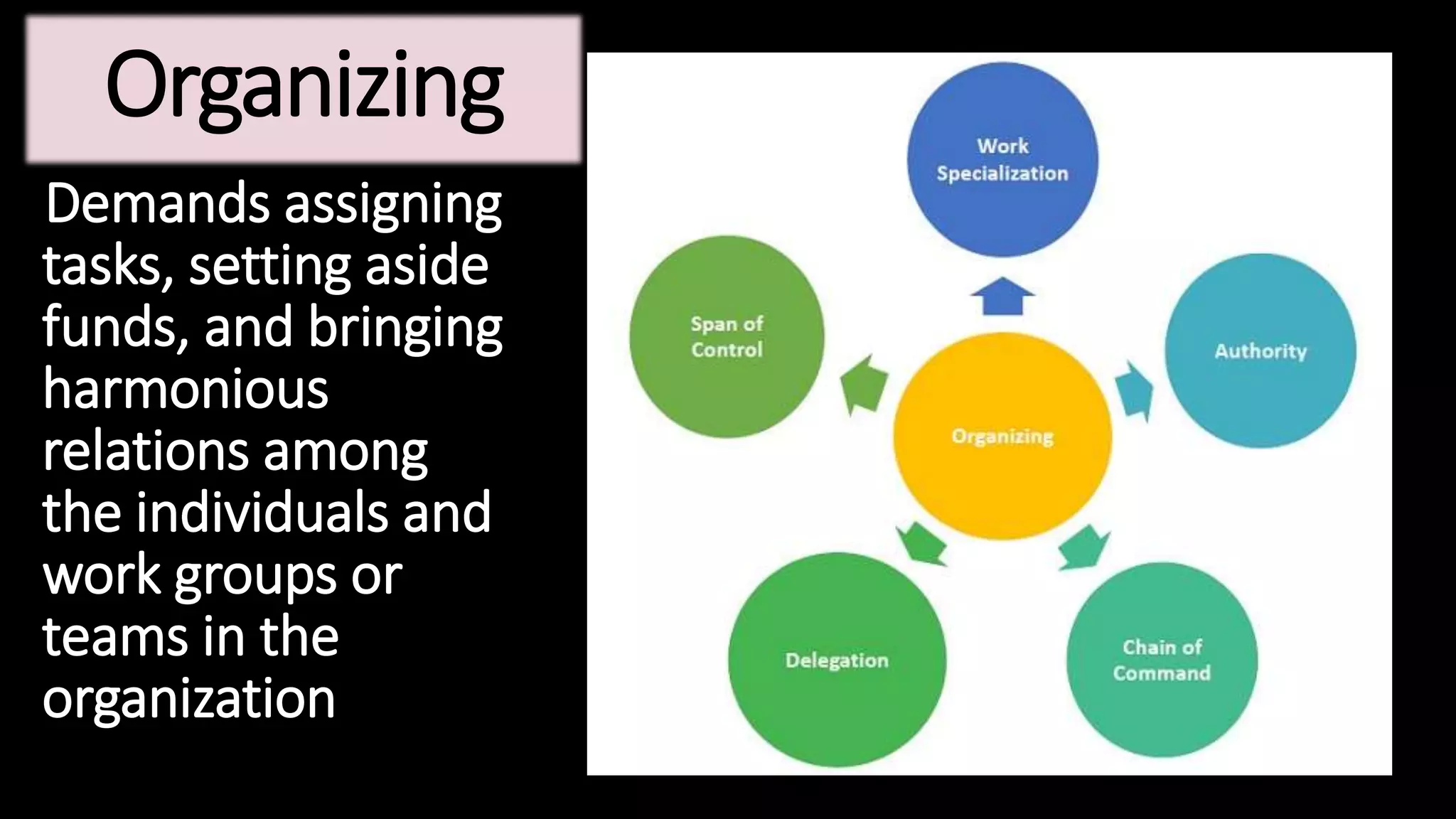
Demands assigning
tasks, setting aside
funds, and bringing
harmonious
relations among
the individuals and
work groups or
teams in the
organization
Organizing
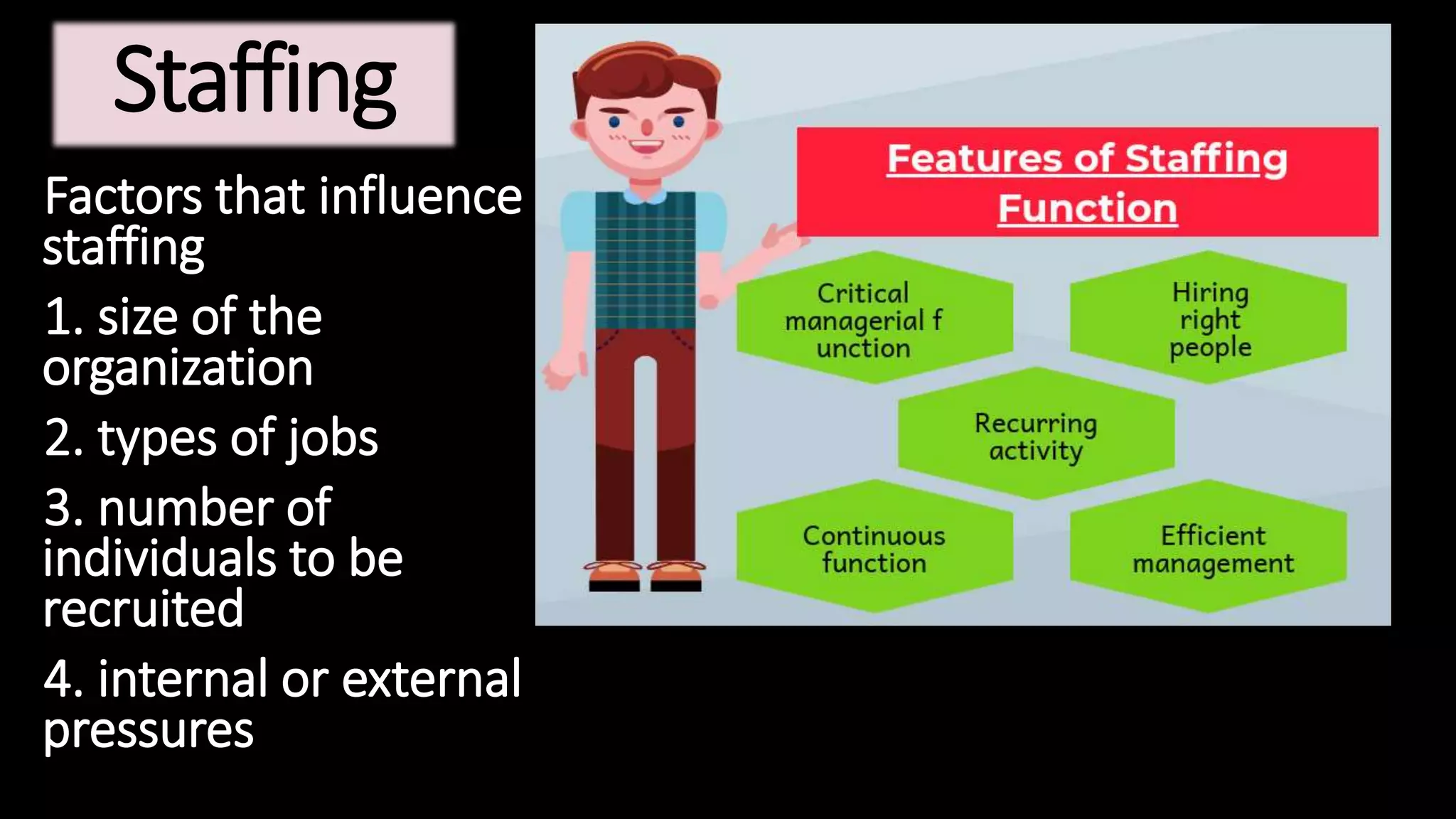
Factors that influence
staffing
1. size of the
organization
2. types of jobs
3. number of
individuals to be
recruited
4. internal or external
pressures
Staffing
Influencing or
motivating
subordinates to do
their best so that
they would be able
to help the
organizations’
endeavor to attain
their set goals.
Leading/
Coordinating
Correcting the
performance of the
individuals or work
groups or teams to
ensure that they are
all working toward
the previously set
goals and plans of
the organization.
Controlling
COORDINATION, EFFICIENCY, AND
EFFECTIVENESS:
INTRINSIC TO THE NATURE OF
MANAGEMENT
LESSON 2
EVOLUTION OF MANAGEMENT
THEORIES
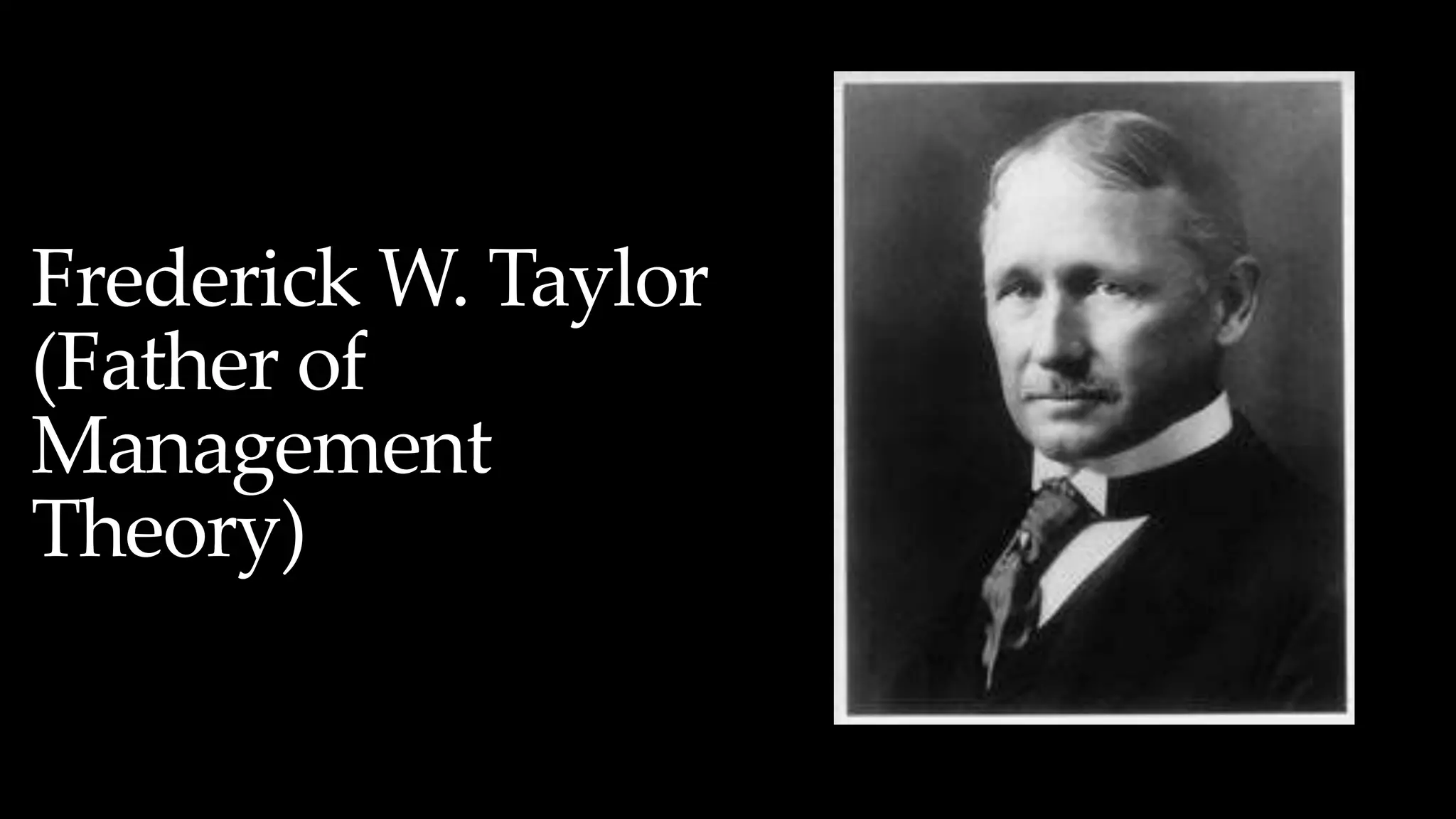
Frederick W. Taylor
(Father of
Management
Theory)
Taylor’s Scientific Management
Principles
1. Develop a science for each element of an
individual’s work to replace the old rule of thumb
method.
2. Scientifically select and then train, teach and
develop the worker
3. Heartily cooperate with the workers so as to
ensure that all work is done in accordance with the
principles of the science that has been developed
Taylor’s Scientific Management
Principles
4. Divide work and responsibility almost equal
between management and workers
Henry Fayol and Max Weber
(Contributions to General
Administrative Theory)
Henry Fayol’s Management
Principles
1. Work Division or Specialization
2. Authority
3. Discipline
4. Unity of Command
5. Unity of Direction
6. Subordination of individual interest to
general interest
Henry Fayol’s Management
Principles
7. Remuneration Pay
8. Centralization
9. Scalar Chain of Authority
10. Maintenance of Order
11. Equity/Fairness
12. Stability/ security of tenure of workers
13. Employee Initiative
14. Promotion of team spirit or esprit de corps
Division of Work
- whole work is divided into small tasks
Authority and Responsibility
- refers to the issue of commands followed by
responsibility for their consequences.
- Authority – means the right of a superior to
give enhanced order to his subordinates
- responsibility means obligation for
performance
Discipline
Refers to the obedience, proper conduct in
relation to others, respect of authority. It is
essential for the smooth functioning of all
organizations
Unity of Command
- states that each subordinate
should receive orders and be
accountable to one and only
superior. Unity of command also
makes it easier to fix
responsibility for mistakes.
Unity of Direction
- It seeks to ensure unity of action,
focusing of efforts and
coordination of strength
Remuneration
- workers must be paid sufficiently
as this is a chief motivation of
employees and therefore greatly
influences productivity
- Remuneration is paid to worker as
per their capacity and productivity
The Degree of Centralization
- Centralization implies the
concentration of decision making
authority at the top management
- Decentralization is sharing of
authority with lower levels
Scalar Chain
- refers to the chain of superiors
ranging from the top management
to lowest rank.
- The principle suggests that there
should be a clear line of authority
from top to bottom linking all
managers at all levels
Order
- Social order ensures the fluid
operation of a company through
authoritative procedure
Equity
- Employees must be treated kindly, and justice
must be enacted to ensure a just workplace
- Managers should be fair and impartial when
dealing with employees, giving equal attention
towards all employees.
Stability of Tenure of Personnel
- An employee cannot render useful
service if he is removed before he
becomes accustomed to the work
assigned to him.
Initiative
- Initiative on part of the employees
is a source of strength for
organization because it provides
new and better ideas.
Esprit de Corps
- refers to the need of the managers to ensure
and develop morale in the workplace.
- Team spirit helps improve an atmosphere of
mutual trust and understanding
5 Key Roles in
Management
(Fayol)
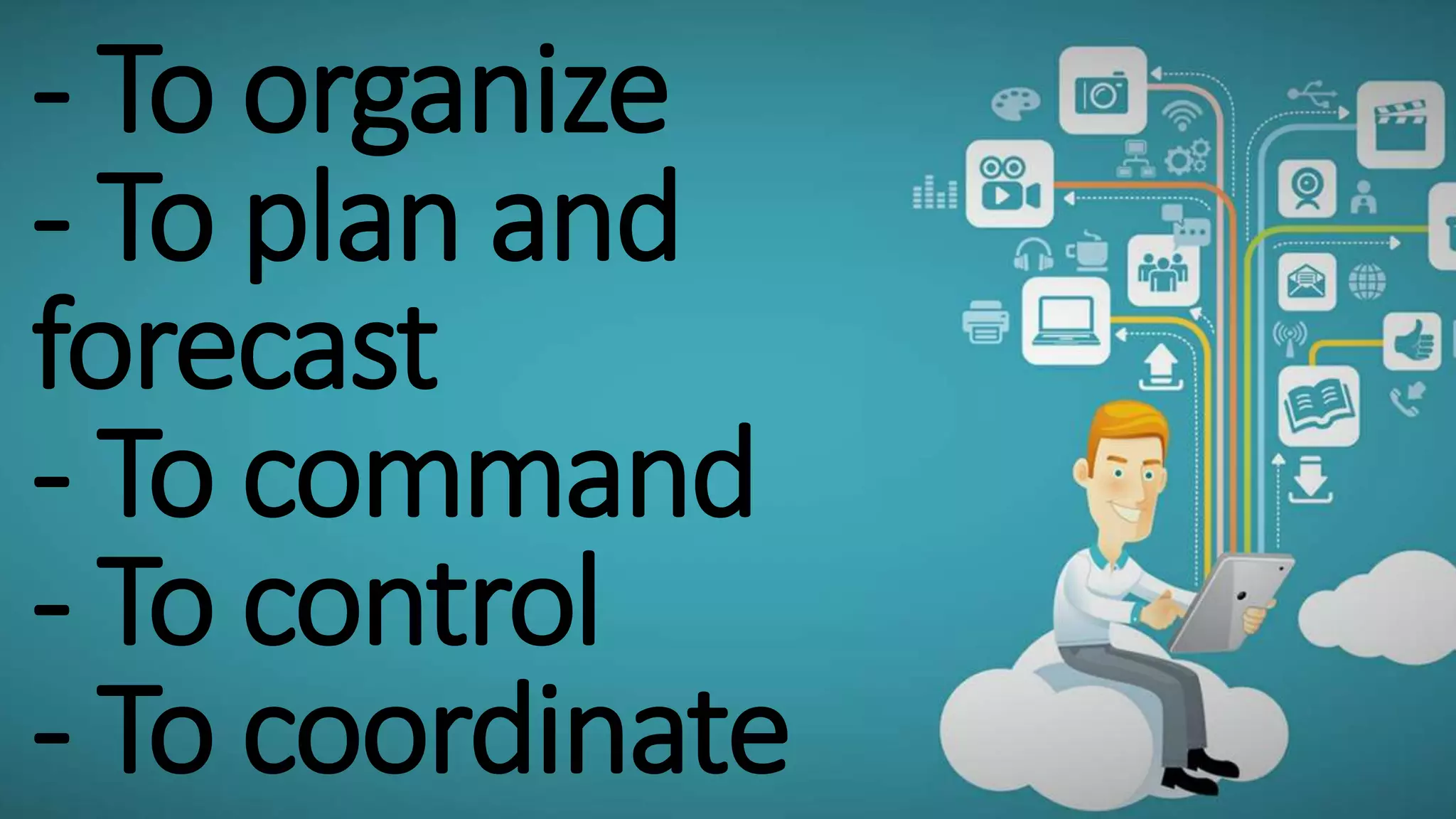
- To organize
- To plan and
forecast
- To command
- To control
- To coordinate
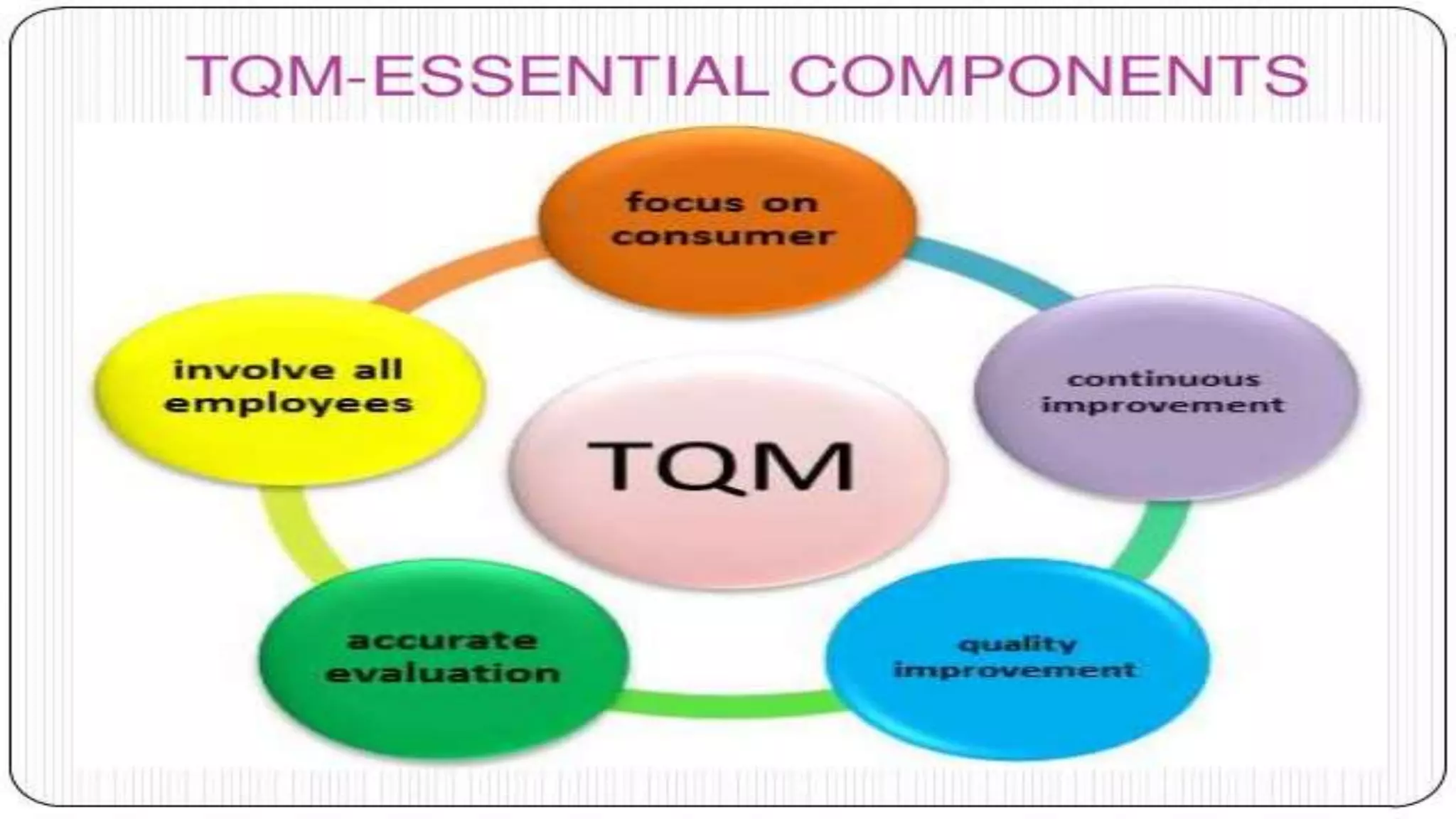
Total Quality Management
- is a management philosophy
that focuses on the satisfaction
of customers, their
needs, and
expectations.
W. Edwards Deming and Joseph
M. Juran - introduced the
customer oriented idea in the
1950’s.
Deming’s 14 points of
top Management
1.Create constancy of purpose
for improvement of products
and services
2. Adopt the new TQM
3. Cease dependence on mass
inspection by doing things
right the first time
4. End the practice of awarding
business on the basis of the price
tag alone.
5. Constantly improve the system
of production and services.
6. Institute training
7. Drive out fear
8. Adopt and institute leadership
9. Break down barriers between
staff areas
10. Eliminate slogans, focus on
correction of defects in the
system
11. Eliminate numerical quotas
for the work force
12. Remove barriers that rob
people of “pride of
workmanship”
13. Encourage education and self
improvement for everyone
14. Take action to accomplish the
transformation.
Fitness of Quality According to
Juran
1. Quality of Design – through
market research, product, and
concept
2. Quality of Conformance – through
management, manpower and
technology
3. Availability – through reliability,
maintainability and logistic support
4. Full service – through promptness,
competence and integrity.
Juran’s Quality Planning Roadmap
1. Identify your costumers
2. Determine their needs
3. Translate them into one’s
language
4. Develop a product that can
respond to needs
5. Develop processes which are
able to produce those product
features
6. Prove that the process can
produce the product
7. Transfer the resulting plans to
the operating forces
Organizational Behavior (OB)
Approach
- the study of human behavior in
organizational settings, the
interface between human
behavior and the organization,
and the organization itself.
Lesson 3
Functions,
Roles, and Skills
of a Manager
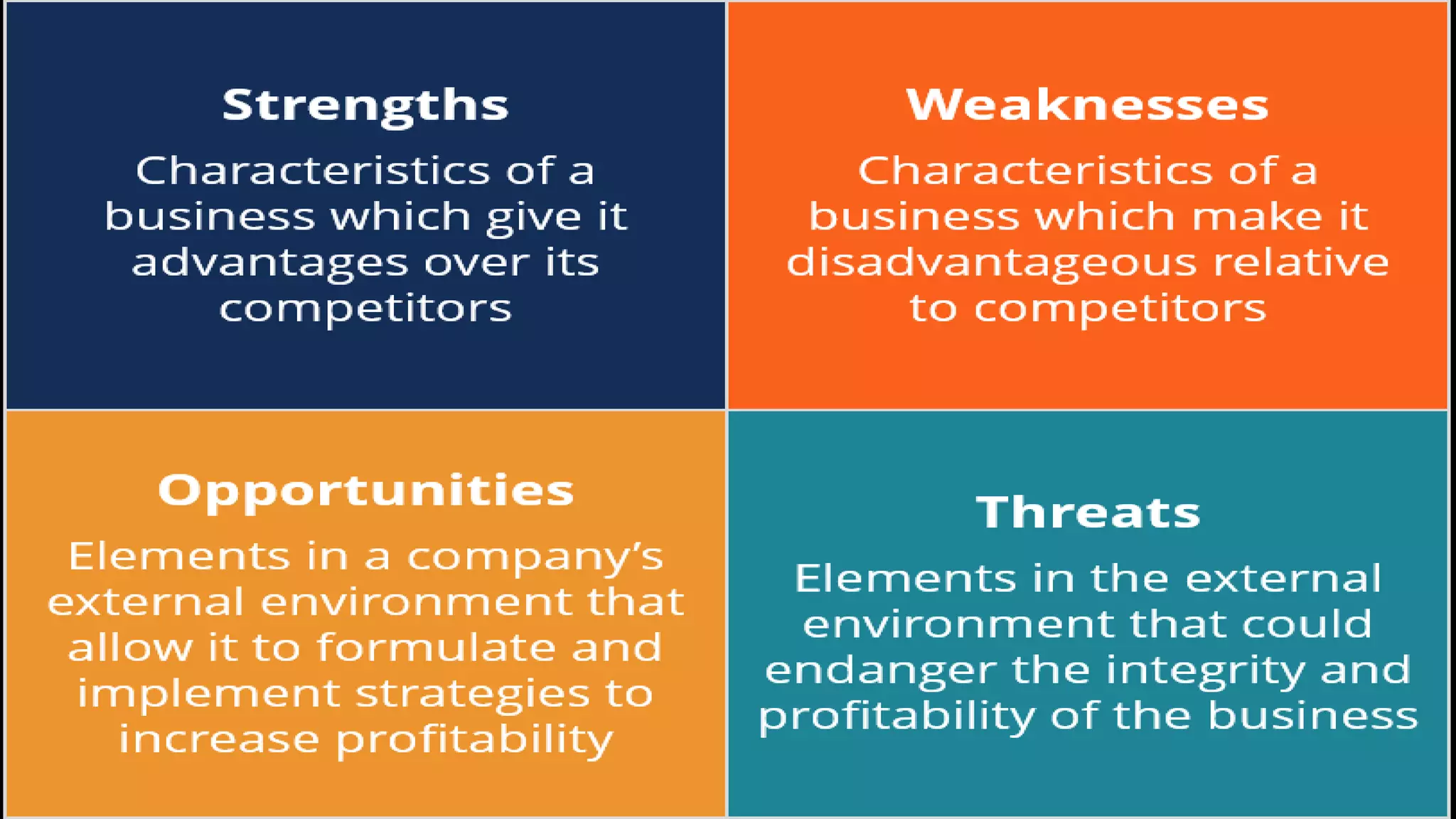
SWOT Analysis
- is an acronym for STRENGTHS,
WEAKNESSES, OPPORTUNITIES,
and THREATS
The SWOT Analysis – is an
approach used to diagnose the
current state of an organization
SWOT Analysis
SWOT Analysis

Oragnization and management

  • 1.
    Chapter 1 Nature andConcept of Management Prepared by: Jenny Tuazon, LPT
  • 2.
  • 3.
    Management “Manage others asyou would like to be managed” – Brian Tracy (Golden Rule of Management)  Process and a systematic way of doing things Process of coordinating and overseeing the work performance of individuals, so that they could efficiently and effectively accomplish their chosen aims or goals
  • 4.
    Management Process of designingand maintaining an environment for efficiently accomplishing selected aims
  • 6.
  • 7.
  • 8.
    Demands assigning tasks, settingaside funds, and bringing harmonious relations among the individuals and work groups or teams in the organization Organizing
  • 9.
    Factors that influence staffing 1.size of the organization 2. types of jobs 3. number of individuals to be recruited 4. internal or external pressures Staffing
  • 10.
    Influencing or motivating subordinates todo their best so that they would be able to help the organizations’ endeavor to attain their set goals. Leading/ Coordinating
  • 11.
    Correcting the performance ofthe individuals or work groups or teams to ensure that they are all working toward the previously set goals and plans of the organization. Controlling
  • 13.
  • 14.
    LESSON 2 EVOLUTION OFMANAGEMENT THEORIES
  • 15.
    Frederick W. Taylor (Fatherof Management Theory)
  • 16.
    Taylor’s Scientific Management Principles 1.Develop a science for each element of an individual’s work to replace the old rule of thumb method. 2. Scientifically select and then train, teach and develop the worker 3. Heartily cooperate with the workers so as to ensure that all work is done in accordance with the principles of the science that has been developed
  • 17.
    Taylor’s Scientific Management Principles 4.Divide work and responsibility almost equal between management and workers
  • 18.
    Henry Fayol andMax Weber (Contributions to General Administrative Theory)
  • 19.
    Henry Fayol’s Management Principles 1.Work Division or Specialization 2. Authority 3. Discipline 4. Unity of Command 5. Unity of Direction 6. Subordination of individual interest to general interest
  • 20.
    Henry Fayol’s Management Principles 7.Remuneration Pay 8. Centralization 9. Scalar Chain of Authority 10. Maintenance of Order 11. Equity/Fairness 12. Stability/ security of tenure of workers 13. Employee Initiative 14. Promotion of team spirit or esprit de corps
  • 21.
    Division of Work -whole work is divided into small tasks Authority and Responsibility - refers to the issue of commands followed by responsibility for their consequences. - Authority – means the right of a superior to give enhanced order to his subordinates - responsibility means obligation for performance
  • 22.
    Discipline Refers to theobedience, proper conduct in relation to others, respect of authority. It is essential for the smooth functioning of all organizations
  • 23.
    Unity of Command -states that each subordinate should receive orders and be accountable to one and only superior. Unity of command also makes it easier to fix responsibility for mistakes.
  • 24.
    Unity of Direction -It seeks to ensure unity of action, focusing of efforts and coordination of strength
  • 25.
    Remuneration - workers mustbe paid sufficiently as this is a chief motivation of employees and therefore greatly influences productivity - Remuneration is paid to worker as per their capacity and productivity
  • 26.
    The Degree ofCentralization - Centralization implies the concentration of decision making authority at the top management - Decentralization is sharing of authority with lower levels
  • 27.
    Scalar Chain - refersto the chain of superiors ranging from the top management to lowest rank. - The principle suggests that there should be a clear line of authority from top to bottom linking all managers at all levels
  • 28.
    Order - Social orderensures the fluid operation of a company through authoritative procedure
  • 29.
    Equity - Employees mustbe treated kindly, and justice must be enacted to ensure a just workplace - Managers should be fair and impartial when dealing with employees, giving equal attention towards all employees.
  • 30.
    Stability of Tenureof Personnel - An employee cannot render useful service if he is removed before he becomes accustomed to the work assigned to him.
  • 31.
    Initiative - Initiative onpart of the employees is a source of strength for organization because it provides new and better ideas.
  • 32.
    Esprit de Corps -refers to the need of the managers to ensure and develop morale in the workplace. - Team spirit helps improve an atmosphere of mutual trust and understanding
  • 33.
    5 Key Rolesin Management (Fayol)
  • 34.
    - To organize -To plan and forecast - To command - To control - To coordinate
  • 35.
    Total Quality Management -is a management philosophy that focuses on the satisfaction of customers, their needs, and expectations.
  • 37.
    W. Edwards Demingand Joseph M. Juran - introduced the customer oriented idea in the 1950’s.
  • 38.
    Deming’s 14 pointsof top Management
  • 39.
    1.Create constancy ofpurpose for improvement of products and services 2. Adopt the new TQM 3. Cease dependence on mass inspection by doing things right the first time
  • 40.
    4. End thepractice of awarding business on the basis of the price tag alone. 5. Constantly improve the system of production and services. 6. Institute training 7. Drive out fear
  • 41.
    8. Adopt andinstitute leadership 9. Break down barriers between staff areas 10. Eliminate slogans, focus on correction of defects in the system
  • 42.
    11. Eliminate numericalquotas for the work force 12. Remove barriers that rob people of “pride of workmanship” 13. Encourage education and self improvement for everyone
  • 43.
    14. Take actionto accomplish the transformation.
  • 44.
    Fitness of QualityAccording to Juran 1. Quality of Design – through market research, product, and concept
  • 45.
    2. Quality ofConformance – through management, manpower and technology 3. Availability – through reliability, maintainability and logistic support 4. Full service – through promptness, competence and integrity.
  • 46.
    Juran’s Quality PlanningRoadmap 1. Identify your costumers 2. Determine their needs 3. Translate them into one’s language 4. Develop a product that can respond to needs
  • 47.
    5. Develop processeswhich are able to produce those product features 6. Prove that the process can produce the product 7. Transfer the resulting plans to the operating forces
  • 48.
    Organizational Behavior (OB) Approach -the study of human behavior in organizational settings, the interface between human behavior and the organization, and the organization itself.
  • 49.
    Lesson 3 Functions, Roles, andSkills of a Manager
  • 50.
    SWOT Analysis - isan acronym for STRENGTHS, WEAKNESSES, OPPORTUNITIES, and THREATS The SWOT Analysis – is an approach used to diagnose the current state of an organization
  • 52.
  • 53.