What Is

Culture?
“We talk a lot and talk pretty well
about race, but we don‟t listen
enough. And I‟m hoping that if we
listen to each other, we can begin to
… make this society of ours into less
and less of a country of strangers.”
-David Shipler, 1997
“Appreciation

of our
differences starts with the
acknowledgment of our
similarities”

-Peter Reese
What Is Culture?


The customary ways in which
humans live. For example; diet,
family forms and processes, social
organizations, and religions.

Info taken from: The Four Skills of Cultural Diversity Competence,
by Mikel Hogan-Garcia
Ethnic Group or Culture
Group


The cultural heritage, or aspects of
culture, that a group shares and
attempts to hand down from one
generation to the next through
learning.

Info taken from: The Four Skills of Cultural Diversity Competence,
by Mikel Hogan-Garcia
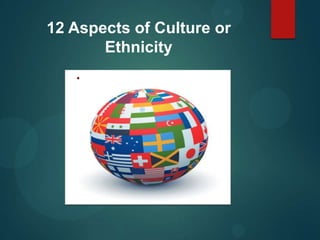
12 Aspects of Culture or
Ethnicity
1.
2.
3.
4.
5.
6.
7.
8.
9.
10.
11.
12.

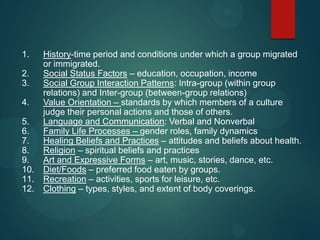
History-time period and conditions under which a group migrated
or immigrated.
Social Status Factors – education, occupation, income
Social Group Interaction Patterns: Intra-group (within group
relations) and Inter-group (between-group relations)
Value Orientation – standards by which members of a culture
judge their personal actions and those of others.
Language and Communication: Verbal and Nonverbal
Family Life Processes – gender roles, family dynamics
Healing Beliefs and Practices – attitudes and beliefs about health.
Religion – spiritual beliefs and practices
Art and Expressive Forms – art, music, stories, dance, etc.
Diet/Foods – preferred food eaten by groups.
Recreation – activities, sports for leisure, etc.
Clothing – types, styles, and extent of body coverings.
Personal Culture – Core
Identity


Includes everything an individual
finds meaningful, beliefs, values,
perceptions, assumptions, and
framework about reality.



Developed through social
interaction with family and others in
your environment.
Cultural Competence Skill
Areas
 Awareness

and Acceptance
of Differences

 Self-Awareness
 Dynamics

of Difference

 Knowledge

of Client‟s Culture

 Adaptation

of Skills
Self-Awareness



“It is impossible to appreciate the
impact of culture on the lives of
others, particularly clients, if one is
out of touch with his or her own
cultural background.”
Self-Awareness


“Many people never acknowledge how
their day-to-day behaviors have been
shaped by cultural norms and values and
reinforced by families, peers, and social
institutions. How one defines „family‟,
identifies desirable life goals, views
problems, and even says hello are all
influenced by the culture in which one
functions” (Cross, 1988, p.2).
Self-Awareness
 Requires

self-knowledge of
own culture in order to know
when cultural limits are likely to
be pushed, foreseeing
potential areas of tension, and
conflict with specific client
groups.
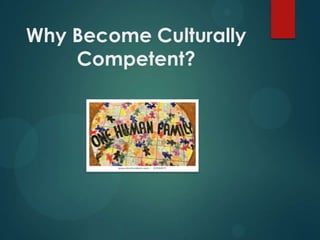
Why Become Culturally
Competent?
Ethnocentrism


The belief that one‟s own group or culture
is superior to all other groups or cultures.



The tendency of most people to use their
own way of life as a standard for judging
others; now also indicates the belief, on
the part of most individuals, that their
race, culture, society, etc., are superior to
all others

Info taken from: nku.edu website
Ethnorelativsm
These people have gone from being neutral about
difference to being positive. They not only accept
cultural differences, but are willing and able to
adjust their own behavior to conform to different
norms. They are able to empathize with people
from different cultures. In many ways, they
become what is known as bi cultural or multi
cultural, effortlessly adjusting their behavior to suit
the culture of the people they're with, "style
switching," in other words. They do not give up
their own or birth culture's values and beliefs, but
they do integrate aspects of other cultures into it.
Info taken from www.peacecorps.gov
What do you think?
Are you a Global Citizen?

The peoples of the world are one people, enriched by individual
differences, united by the common bond of humanity.
The diversity of the Glob…
Curated by Halina Ostańkowicz-Bazan
http://www.scoop.it/t/are-you-a-global-citizen

What is culture?

  • 1.
  • 2.
    “We talk alot and talk pretty well about race, but we don‟t listen enough. And I‟m hoping that if we listen to each other, we can begin to … make this society of ours into less and less of a country of strangers.” -David Shipler, 1997
  • 3.
    “Appreciation of our differences startswith the acknowledgment of our similarities” -Peter Reese
  • 4.
    What Is Culture?  Thecustomary ways in which humans live. For example; diet, family forms and processes, social organizations, and religions. Info taken from: The Four Skills of Cultural Diversity Competence, by Mikel Hogan-Garcia
  • 5.
    Ethnic Group orCulture Group  The cultural heritage, or aspects of culture, that a group shares and attempts to hand down from one generation to the next through learning. Info taken from: The Four Skills of Cultural Diversity Competence, by Mikel Hogan-Garcia
  • 6.
    12 Aspects ofCulture or Ethnicity
  • 7.
    1. 2. 3. 4. 5. 6. 7. 8. 9. 10. 11. 12. History-time period andconditions under which a group migrated or immigrated. Social Status Factors – education, occupation, income Social Group Interaction Patterns: Intra-group (within group relations) and Inter-group (between-group relations) Value Orientation – standards by which members of a culture judge their personal actions and those of others. Language and Communication: Verbal and Nonverbal Family Life Processes – gender roles, family dynamics Healing Beliefs and Practices – attitudes and beliefs about health. Religion – spiritual beliefs and practices Art and Expressive Forms – art, music, stories, dance, etc. Diet/Foods – preferred food eaten by groups. Recreation – activities, sports for leisure, etc. Clothing – types, styles, and extent of body coverings.
  • 8.
    Personal Culture –Core Identity  Includes everything an individual finds meaningful, beliefs, values, perceptions, assumptions, and framework about reality.  Developed through social interaction with family and others in your environment.
  • 9.
    Cultural Competence Skill Areas Awareness and Acceptance of Differences  Self-Awareness  Dynamics of Difference  Knowledge of Client‟s Culture  Adaptation of Skills
  • 10.
    Self-Awareness  “It is impossibleto appreciate the impact of culture on the lives of others, particularly clients, if one is out of touch with his or her own cultural background.”
  • 11.
    Self-Awareness  “Many people neveracknowledge how their day-to-day behaviors have been shaped by cultural norms and values and reinforced by families, peers, and social institutions. How one defines „family‟, identifies desirable life goals, views problems, and even says hello are all influenced by the culture in which one functions” (Cross, 1988, p.2).
  • 12.
    Self-Awareness  Requires self-knowledge of ownculture in order to know when cultural limits are likely to be pushed, foreseeing potential areas of tension, and conflict with specific client groups.
  • 13.
  • 14.
    Ethnocentrism  The belief thatone‟s own group or culture is superior to all other groups or cultures.  The tendency of most people to use their own way of life as a standard for judging others; now also indicates the belief, on the part of most individuals, that their race, culture, society, etc., are superior to all others Info taken from: nku.edu website
  • 15.
    Ethnorelativsm These people havegone from being neutral about difference to being positive. They not only accept cultural differences, but are willing and able to adjust their own behavior to conform to different norms. They are able to empathize with people from different cultures. In many ways, they become what is known as bi cultural or multi cultural, effortlessly adjusting their behavior to suit the culture of the people they're with, "style switching," in other words. They do not give up their own or birth culture's values and beliefs, but they do integrate aspects of other cultures into it. Info taken from www.peacecorps.gov
  • 17.
    What do youthink? Are you a Global Citizen? The peoples of the world are one people, enriched by individual differences, united by the common bond of humanity. The diversity of the Glob… Curated by Halina Ostańkowicz-Bazan http://www.scoop.it/t/are-you-a-global-citizen