CT POSITIONING PROTOCOLS,
CONTRAST PROTOCOLS
OVERVIEW OF CT IMAGING AND ITS
IMPORTANCE IN BRAIN DIAGNOSTICS.
 CT Brain provides cross-sectional views of the brain’s structure
 It helps in identifying traumatic damage, bleeding and infections affecting
the brain with great accuracy
 CT Angiography helps in evaluating blood vessels, detecting aneurysms,
blockages and malformations of the brain
 It provides support in early diagnosis and improves treatment outcome
significantly.
PATIENT PREPARATION, POSITIONING
AND EQUIPMENTS
 Ensure fasting of the patient and remove all metal objects
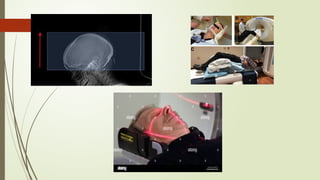
 Patient is supine with head straight and secured in headrest
 Align laser light with anatomical landmarks for precise positioning
 Perform a scout image to verify the positioning
 CT scanner is set according to protocol and imaging requirements
CT SETTINGS
 Image Mode : Use axial or helical mode
 Slice Thickness : Set between 0.6 - 5 mm
 Scan Range : Covers the region under interest
 Tube Voltage : Commonly set at 150 kVp
 Tube Current : Adjust based on patient size, between 200 to 400 mA
 Scan Timing : Dependent on organ under review
 Reconstruction Algorithm
 Post processing
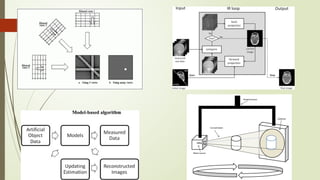
RECONSTRUCTION ALGORITHMS
 Filtered Back Projection :
 A traditional method that uses convolution filters to reduce blurring and reconstructs
images quickly.
 It is used widely but can introduce noise and artifacts
 Iterative Reconstruction :
 A modern approach that starts with an initial image assumption and refines it through
multiple iterations.
 It reduces noise and improves image quality while minimizing radiation dose.
 Model Based Iterative Reconstruction
 A more advanced version of iterative reconstruction incorporating statistical modelling,
physics and optics
 Provides superior image clarity and accuracy, esp in low dose scan
 Cone Beam Reconstruction
 These are specifically designed for cone beam CT scanners, this algorithm
processes data from multiple angels to create 3D images
 Deep Learning Based Recontruction
 Convolutional neural networks (CNNs), are trained on large datasets to learn
patterns and features in medical images. These models can reconstruct high-
quality images from raw or noisy data.
 This newer cutting edge approach is currently gaining traction in modern CT
Imaging
CT POSITIONING FOR HEAD IMAGING
 Patient positioning – patient lies supine on CT table with head placed in
headrest for stability, aligned in the midline, ensuring no tilt or rotation
 The chin is slightly tucked to align the orbitomeatal line (OML)
perpendicular to the table
 Landmark
 External landmark – External auditory meatus and outer canthus of eye
 Internal landmark – The base of skull and vertex
 Location
 Start – Base of skull (foramen magnum)
 End – Vertex of skull
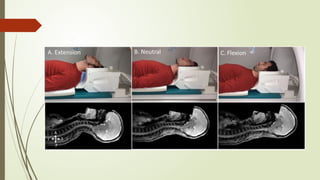
CT POSITIONING IN CERVICAL SPINE
 Patient positioning – Patient lies supine with head, neck aligned to midline
 Arms are positioned alongside body with shoulders pulled down
 Landmarks
 External – Sternal notch and external auditory meatus
 Internal – Hyoid bone and thyroid cartilage
 Locations
 Start – Base of the skull to include upper cervical spine and pharynx
 End – Extends to thoracic inlet covering lower spine
CT POSITIONING IN CHEST
 Patient positioning – patient supine
 Both arms raised above head to reduce interference in chest region
 Landmarks
 External – Sternal notch (manubrium) and xiphoid process
 Internal – apex of lung and diaphragm level
 Location
 Start – Begins at apex of lung (just above thoracic inlet)
 End – Extends to costophrenic angles (just below the diaphragm)
 Patient is instructed to hold the breath to minimize motion artifacts
 Confirm field of view (FOV) to ensure both lungs and mediastinum are incl.
CT POSITIONING IN ABDOMEN
 Patient positioning – Lies supine
 Arms are placed overhead
 Landmarks
 External – xiphoid process (upper landmark) and pubic symphasis (lower
landmark)
 Internal – Including liver, kidneys, pancreas, spleen, bowel loops
 Scan Location
 Start - Above dome of diaphragm
 End – Extend iliac crest or pubic symphasis
CT Angiography of Head, Neck, Chest and Abdomen
CT Contrast Protocols
 Used for enhancing visibility of blood vessels, tissues and abnormalities
 Primarily Iodinated contrast are used
 Ionic – Diatriazoate, iothalamate, metrizoate
 Non ionic – iohexol, iopamidol, iodixanol (Pref due to less ADR)
 Osmolarity
 High Osmolality – Older agents, high ADR
 Low Osmolality – Newer agent, safer, widely used.
What to tell the patient before giving
contrast?
“Normal anatomy on CT Scan is all grey. Air shows up black, and bone
shows up bright white. Without any kind of contrast, All the blood vessels in
your brain will appear grey. The contrast agent will help to highlight the
blood vessels and any problems associated with it. It will also highlight any
kind of infection or inflammation or bleeding. So if there’s anything going on
in there, chances are, I’m going to be able to see it. The IV contrast will give
you a warm feeling all over, but sometimes it’ll vary from person to person. It
will also give you a little bit of a metal taste. This is all normal. Sometimes the
contrast will make people a little bit noxious, but if you have any kind of
problems, please, let me know. Do you have any questions?”
Preparation for CT angio Patient
 Fasting
 Hydration
 Medication Review
 Contrast Allergy check
 RFT (BUN and creatinine)
 IV Placement
 Comfortable clothing
 Breath hold Practice
Medication Review
 Beta Blockers
 Lower heart rate for better clarity esp for cardiac CT angiography
 Nitroglycerine
 Dilate coronary arteries, enhancing vessel visualization
 AntiHistamine and Steroids
 Premedicate in patients with contrast allergies to reduce reaction risk
 Anticoagulants
 Review to assess bleeding risk esp if invasive procedures are planned post
angiography
Review of Metformin in CT
Angiography
 Rare but serious risk of Metformin Associated Lactic Acidosis (MALA)
 Mechanism :
 Iodinated contrast can temporarily affect kidney function leading to reduced
clearance of metformin and accumulation of lactate which may trigger lactic
acidosis
 Pre Procedure Guidelines:
 Assess RFT by test like serum creatinine or GFR
 Discontinue metformin 24 to 48 hours before producer if GFR < 30 ml/min/1.73 m2
 Post Procedure Guidelines:
 Reassess RFT 48 hours after procedure
 Resume metformin only if RFT is stable and within normal limits
Impact of breath holding on various
Imaging
 Motion reduction
 Minimize respiratory motion, prevents blurring and motion artifacts
 Improved Clarity
 Blood vessels and organs appear sharper and more defined
 Accurate Alignment
 Essential for studies like CT Angiography where precise timing with contrast
injection is critical
 Patient Compliance
 Provides consistent and reproducible imagine results
When to capture Images?
 After giving contrast through IV, it travels up the arm to the heart and then
to the brain and other organs. To catch the images we need to capture
contrast in its desired phase.
 Usually this is during the venous phase as both veins and arteries have
contrast
 Timing helps to capture the images at the right moment
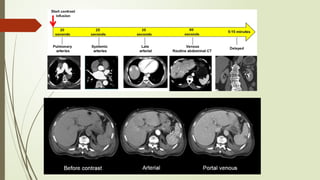
Phases of enhancement
 The purpose of CECT is to find lesion which many be hypovascular or
hypervascular as compared to the normal tissue.
 The various phases help in identifying and highlighting certain tissues which
take up or lose contrast as per its corresponding uptake.
Non-enhanced CT
• Detection of calcifications, fat in tumors, fat stranding in inflammations like appendicitis,
diverticulitis
Early arterial phase
• Contrast is still in arteries and has not enhanced organs or soft tissues
Late arterial phase
• Structures receiving blood supply will show optimal enhancement
Hepatic or late portal phase
• Liver parenchyma enhances through portal vein blood supply
Nephrogenic phase
• All of renal parenchyma enhances including medulla enhances.
Delayed phase
• Wash out of contrast in abdominal structures except for fibrotic tissue
IV contrast timings
Hounsfield Units
 Hounsfield Units (HU) are a scale used in CT imaging to measure tissue
density relative to water.
 Water is assigned 0 HU, air is -1000 HU, and dense structures like bone range
up to +1000 HU or more. Different tissues have specific HU values, aiding in
differentiation.
 The human eye can only differentiate upto 20 shades of grey effectively
 CT images contain upto 256 shades of grey which make it difficult for
interpretation of CT images
Windows settings
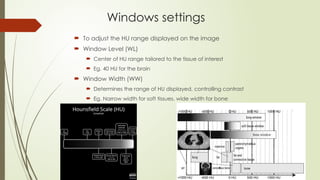
 To adjust the HU range displayed on the image
 Window Level (WL)
 Center of HU range tailored to the tissue of interest
 Eg. 40 HU for the brain
 Window Width (WW)
 Determines the range of HU displayed, controlling contrast
 Eg. Narrow width for soft tissues, wide width for bone
Windows in CT imaging of Head and
Brain
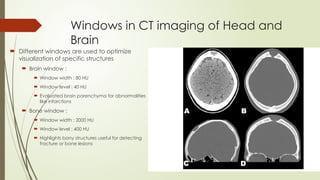
 Different windows are used to optimize
visualization of specific structures
 Brain window :
 Window width : 80 HU
 Window level : 40 HU
 Evaluated brain parenchyma for abnormalities
like infarctions
 Bone window :
 Window width : 2000 HU
 Window level : 400 HU
 Highlights bony structures useful for detecting
fracture or bone lesions
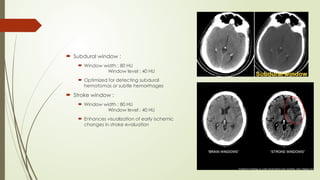
 Subdural window :
 Window width : 80 HU
Window level : 40 HU
 Optimized for detecting subdural
hematomas or subtle hemorrhages
 Stroke window :
 Window width : 80 HU
Window level : 40 HU
 Enhances visualization of early ischemic
changes in stroke evaluation
CT Positioning in Head with Contrast
Position / Landmark Center on patient’s chin
Scan Start Below base of skull (foramen magnum)
Scan End Vertex of the skull
Breath Hold None
IV Access 22 G or larger, antecubital
IV Contrast Adult 100 ml OMNI 300 @ 2.0mL/ sec
Contrast Delay Scan 5 minutes from Start of Injection
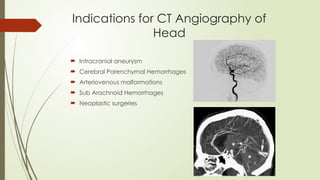
Indications for CT Angiography of
Head
 Intracranial aneurysm
 Cerebral Parenchymal Hemorrhages
 Arteriovenous malformations
 Sub Arachnoid Hemorrhages
 Neoplastic surgeries
CT Angiography Head and Neck
Position / Landmark Level of Aortic Arch
Scan Start Below Aortic Arch
Scan End Above Skull
Breath hold None
IV Access 20 G or larger, Antecubital
IV Contrast Adults 50 ml OMNI 350 @ 5.0 ml/sec
Contrast Delay Bolus Tracked : Trigger Scan @ 120 HU
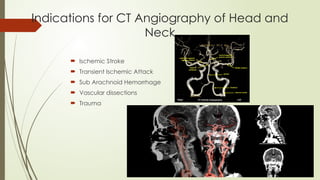
Indications for CT Angiography of Head and
Neck
 Ischemic Stroke
 Transient Ischemic Attack
 Sub Arachnoid Hemorrhage
 Vascular dissections
 Trauma
CT positioning in Chest with Contrast
Position / Landmark Supine centered above the lung
apices
Scout Scan Start Above lung apices
Scout Scan End Adrenals / upper kidneys
Breath hold Inspiration
IV Access 18G -22G
Location: No lower than 2” below the
AC crease of the elbow, pressure
approved TLC, PICC lines,
(NOTE: For PV IV flush with the arm in
the position it will be for the scan)
IV Contrast Adults OMNI 350 80 ml
Contrast Delay 60 sec
Indications for CE CT Chest
 Suspected cases of lung cancer and staging
purposes
 Thoracic vascular diseases
 Pulmonary Parenchymal diseases
 Pleural diseases
 Airway evaluation
 Sternal and Mediastinal infections
ADR associated to Contrast
 Idiosynscratic reactions
 Mild : scattered urticarial rashes, pruritis, retching,
 Moderate : Vomiting, facial edema, tachycardia
 Severe : arrhythmias, laryngeal edema, pulmonary edema, seizures
 Nonidiosyncratic reactions :
 Mostly due heightened sympathetic activity : bradycardia, hypotension, and
vasovagal reactions; neuropathy; cardiovascular reactions; extravasation; and
delayed reactions.
 Other nonidiosyncratic reactions include sensations of warmth, a metallic taste in
the mouth, and nausea and vomiting.
Management of ADR in CECT
 For any reactions : STOP CONTRAST ADMINISTRATION
 Depending upon severity of the reaction (One or more steps to be followed):
 Call for help
 Airway , Breathing, Circulation
 Epinephrine Administration ( 0.3 – 0.5 mg )
 Antihistamines : Inj Chlorpheniramine maleate (25 -50 mg)
 Corticosteroids : Inj Hydrocortisone (100 mg)
 Bronchodilators : B2 agoinst
 IV Fluids
 Monitor, document and follow up
Specific ADR
 Nephropathy :
 Elevation of 0.5 mg% or more than baseline of creatinine after 1-3 days after
ICM injections. The elevation reaches peak by 7 days and returns to normal
by 14 days.
 Incidence is estimated around 2-7 % of population.
 Post sequelae of is persistent decrease of renal function in upto 25% patients
 Cardiovascular reactions :
 Due to vasovagal reactions due to anaphylactic reactions
 Bradycardia with peripheral vasodilation with lower threshold for ventricular
arrhythmias and cardiac arrest in severe cases.
 Majority cases are self limiting but can be an indicator of a more severe
evolving reactions
Management of Contrast associated Nephropathy
 Monitor RFT
 Supportive care : Provide fluids to maintain hydration and kidney function
 Dialysis in severe case
 Renal Replacement therapy
 Avoid further contrast exposure
CT postioning protocols & Contrast protocols.pptx

  • 1.
  • 2.
    OVERVIEW OF CTIMAGING AND ITS IMPORTANCE IN BRAIN DIAGNOSTICS.  CT Brain provides cross-sectional views of the brain’s structure  It helps in identifying traumatic damage, bleeding and infections affecting the brain with great accuracy  CT Angiography helps in evaluating blood vessels, detecting aneurysms, blockages and malformations of the brain  It provides support in early diagnosis and improves treatment outcome significantly.
  • 3.
    PATIENT PREPARATION, POSITIONING ANDEQUIPMENTS  Ensure fasting of the patient and remove all metal objects  Patient is supine with head straight and secured in headrest  Align laser light with anatomical landmarks for precise positioning  Perform a scout image to verify the positioning  CT scanner is set according to protocol and imaging requirements
  • 4.
    CT SETTINGS  ImageMode : Use axial or helical mode  Slice Thickness : Set between 0.6 - 5 mm  Scan Range : Covers the region under interest  Tube Voltage : Commonly set at 150 kVp  Tube Current : Adjust based on patient size, between 200 to 400 mA  Scan Timing : Dependent on organ under review  Reconstruction Algorithm  Post processing
  • 5.
    RECONSTRUCTION ALGORITHMS  FilteredBack Projection :  A traditional method that uses convolution filters to reduce blurring and reconstructs images quickly.  It is used widely but can introduce noise and artifacts  Iterative Reconstruction :  A modern approach that starts with an initial image assumption and refines it through multiple iterations.  It reduces noise and improves image quality while minimizing radiation dose.  Model Based Iterative Reconstruction  A more advanced version of iterative reconstruction incorporating statistical modelling, physics and optics  Provides superior image clarity and accuracy, esp in low dose scan
  • 6.
     Cone BeamReconstruction  These are specifically designed for cone beam CT scanners, this algorithm processes data from multiple angels to create 3D images  Deep Learning Based Recontruction  Convolutional neural networks (CNNs), are trained on large datasets to learn patterns and features in medical images. These models can reconstruct high- quality images from raw or noisy data.  This newer cutting edge approach is currently gaining traction in modern CT Imaging
  • 8.
    CT POSITIONING FORHEAD IMAGING  Patient positioning – patient lies supine on CT table with head placed in headrest for stability, aligned in the midline, ensuring no tilt or rotation  The chin is slightly tucked to align the orbitomeatal line (OML) perpendicular to the table  Landmark  External landmark – External auditory meatus and outer canthus of eye  Internal landmark – The base of skull and vertex  Location  Start – Base of skull (foramen magnum)  End – Vertex of skull
  • 10.
    CT POSITIONING INCERVICAL SPINE  Patient positioning – Patient lies supine with head, neck aligned to midline  Arms are positioned alongside body with shoulders pulled down  Landmarks  External – Sternal notch and external auditory meatus  Internal – Hyoid bone and thyroid cartilage  Locations  Start – Base of the skull to include upper cervical spine and pharynx  End – Extends to thoracic inlet covering lower spine
  • 12.
    CT POSITIONING INCHEST  Patient positioning – patient supine  Both arms raised above head to reduce interference in chest region  Landmarks  External – Sternal notch (manubrium) and xiphoid process  Internal – apex of lung and diaphragm level  Location  Start – Begins at apex of lung (just above thoracic inlet)  End – Extends to costophrenic angles (just below the diaphragm)  Patient is instructed to hold the breath to minimize motion artifacts  Confirm field of view (FOV) to ensure both lungs and mediastinum are incl.
  • 15.
    CT POSITIONING INABDOMEN  Patient positioning – Lies supine  Arms are placed overhead  Landmarks  External – xiphoid process (upper landmark) and pubic symphasis (lower landmark)  Internal – Including liver, kidneys, pancreas, spleen, bowel loops  Scan Location  Start - Above dome of diaphragm  End – Extend iliac crest or pubic symphasis
  • 17.
    CT Angiography ofHead, Neck, Chest and Abdomen CT Contrast Protocols
  • 19.
     Used forenhancing visibility of blood vessels, tissues and abnormalities  Primarily Iodinated contrast are used  Ionic – Diatriazoate, iothalamate, metrizoate  Non ionic – iohexol, iopamidol, iodixanol (Pref due to less ADR)  Osmolarity  High Osmolality – Older agents, high ADR  Low Osmolality – Newer agent, safer, widely used.
  • 20.
    What to tellthe patient before giving contrast? “Normal anatomy on CT Scan is all grey. Air shows up black, and bone shows up bright white. Without any kind of contrast, All the blood vessels in your brain will appear grey. The contrast agent will help to highlight the blood vessels and any problems associated with it. It will also highlight any kind of infection or inflammation or bleeding. So if there’s anything going on in there, chances are, I’m going to be able to see it. The IV contrast will give you a warm feeling all over, but sometimes it’ll vary from person to person. It will also give you a little bit of a metal taste. This is all normal. Sometimes the contrast will make people a little bit noxious, but if you have any kind of problems, please, let me know. Do you have any questions?”
  • 21.
    Preparation for CTangio Patient  Fasting  Hydration  Medication Review  Contrast Allergy check  RFT (BUN and creatinine)  IV Placement  Comfortable clothing  Breath hold Practice
  • 22.
    Medication Review  BetaBlockers  Lower heart rate for better clarity esp for cardiac CT angiography  Nitroglycerine  Dilate coronary arteries, enhancing vessel visualization  AntiHistamine and Steroids  Premedicate in patients with contrast allergies to reduce reaction risk  Anticoagulants  Review to assess bleeding risk esp if invasive procedures are planned post angiography
  • 23.
    Review of Metforminin CT Angiography  Rare but serious risk of Metformin Associated Lactic Acidosis (MALA)  Mechanism :  Iodinated contrast can temporarily affect kidney function leading to reduced clearance of metformin and accumulation of lactate which may trigger lactic acidosis  Pre Procedure Guidelines:  Assess RFT by test like serum creatinine or GFR  Discontinue metformin 24 to 48 hours before producer if GFR < 30 ml/min/1.73 m2  Post Procedure Guidelines:  Reassess RFT 48 hours after procedure  Resume metformin only if RFT is stable and within normal limits
  • 24.
    Impact of breathholding on various Imaging  Motion reduction  Minimize respiratory motion, prevents blurring and motion artifacts  Improved Clarity  Blood vessels and organs appear sharper and more defined  Accurate Alignment  Essential for studies like CT Angiography where precise timing with contrast injection is critical  Patient Compliance  Provides consistent and reproducible imagine results
  • 25.
    When to captureImages?  After giving contrast through IV, it travels up the arm to the heart and then to the brain and other organs. To catch the images we need to capture contrast in its desired phase.  Usually this is during the venous phase as both veins and arteries have contrast  Timing helps to capture the images at the right moment
  • 26.
    Phases of enhancement The purpose of CECT is to find lesion which many be hypovascular or hypervascular as compared to the normal tissue.  The various phases help in identifying and highlighting certain tissues which take up or lose contrast as per its corresponding uptake.
  • 27.
    Non-enhanced CT • Detectionof calcifications, fat in tumors, fat stranding in inflammations like appendicitis, diverticulitis Early arterial phase • Contrast is still in arteries and has not enhanced organs or soft tissues Late arterial phase • Structures receiving blood supply will show optimal enhancement Hepatic or late portal phase • Liver parenchyma enhances through portal vein blood supply Nephrogenic phase • All of renal parenchyma enhances including medulla enhances. Delayed phase • Wash out of contrast in abdominal structures except for fibrotic tissue
  • 28.
  • 31.
    Hounsfield Units  HounsfieldUnits (HU) are a scale used in CT imaging to measure tissue density relative to water.  Water is assigned 0 HU, air is -1000 HU, and dense structures like bone range up to +1000 HU or more. Different tissues have specific HU values, aiding in differentiation.  The human eye can only differentiate upto 20 shades of grey effectively  CT images contain upto 256 shades of grey which make it difficult for interpretation of CT images
  • 32.
    Windows settings  Toadjust the HU range displayed on the image  Window Level (WL)  Center of HU range tailored to the tissue of interest  Eg. 40 HU for the brain  Window Width (WW)  Determines the range of HU displayed, controlling contrast  Eg. Narrow width for soft tissues, wide width for bone
  • 33.
    Windows in CTimaging of Head and Brain  Different windows are used to optimize visualization of specific structures  Brain window :  Window width : 80 HU  Window level : 40 HU  Evaluated brain parenchyma for abnormalities like infarctions  Bone window :  Window width : 2000 HU  Window level : 400 HU  Highlights bony structures useful for detecting fracture or bone lesions
  • 34.
     Subdural window:  Window width : 80 HU Window level : 40 HU  Optimized for detecting subdural hematomas or subtle hemorrhages  Stroke window :  Window width : 80 HU Window level : 40 HU  Enhances visualization of early ischemic changes in stroke evaluation
  • 35.
    CT Positioning inHead with Contrast Position / Landmark Center on patient’s chin Scan Start Below base of skull (foramen magnum) Scan End Vertex of the skull Breath Hold None IV Access 22 G or larger, antecubital IV Contrast Adult 100 ml OMNI 300 @ 2.0mL/ sec Contrast Delay Scan 5 minutes from Start of Injection
  • 36.
    Indications for CTAngiography of Head  Intracranial aneurysm  Cerebral Parenchymal Hemorrhages  Arteriovenous malformations  Sub Arachnoid Hemorrhages  Neoplastic surgeries
  • 37.
    CT Angiography Headand Neck Position / Landmark Level of Aortic Arch Scan Start Below Aortic Arch Scan End Above Skull Breath hold None IV Access 20 G or larger, Antecubital IV Contrast Adults 50 ml OMNI 350 @ 5.0 ml/sec Contrast Delay Bolus Tracked : Trigger Scan @ 120 HU
  • 38.
    Indications for CTAngiography of Head and Neck  Ischemic Stroke  Transient Ischemic Attack  Sub Arachnoid Hemorrhage  Vascular dissections  Trauma
  • 39.
    CT positioning inChest with Contrast Position / Landmark Supine centered above the lung apices Scout Scan Start Above lung apices Scout Scan End Adrenals / upper kidneys Breath hold Inspiration IV Access 18G -22G Location: No lower than 2” below the AC crease of the elbow, pressure approved TLC, PICC lines, (NOTE: For PV IV flush with the arm in the position it will be for the scan) IV Contrast Adults OMNI 350 80 ml Contrast Delay 60 sec
  • 40.
    Indications for CECT Chest  Suspected cases of lung cancer and staging purposes  Thoracic vascular diseases  Pulmonary Parenchymal diseases  Pleural diseases  Airway evaluation  Sternal and Mediastinal infections
  • 41.
    ADR associated toContrast  Idiosynscratic reactions  Mild : scattered urticarial rashes, pruritis, retching,  Moderate : Vomiting, facial edema, tachycardia  Severe : arrhythmias, laryngeal edema, pulmonary edema, seizures  Nonidiosyncratic reactions :  Mostly due heightened sympathetic activity : bradycardia, hypotension, and vasovagal reactions; neuropathy; cardiovascular reactions; extravasation; and delayed reactions.  Other nonidiosyncratic reactions include sensations of warmth, a metallic taste in the mouth, and nausea and vomiting.
  • 42.
    Management of ADRin CECT  For any reactions : STOP CONTRAST ADMINISTRATION  Depending upon severity of the reaction (One or more steps to be followed):  Call for help  Airway , Breathing, Circulation  Epinephrine Administration ( 0.3 – 0.5 mg )  Antihistamines : Inj Chlorpheniramine maleate (25 -50 mg)  Corticosteroids : Inj Hydrocortisone (100 mg)  Bronchodilators : B2 agoinst  IV Fluids  Monitor, document and follow up
  • 43.
    Specific ADR  Nephropathy:  Elevation of 0.5 mg% or more than baseline of creatinine after 1-3 days after ICM injections. The elevation reaches peak by 7 days and returns to normal by 14 days.  Incidence is estimated around 2-7 % of population.  Post sequelae of is persistent decrease of renal function in upto 25% patients  Cardiovascular reactions :  Due to vasovagal reactions due to anaphylactic reactions  Bradycardia with peripheral vasodilation with lower threshold for ventricular arrhythmias and cardiac arrest in severe cases.  Majority cases are self limiting but can be an indicator of a more severe evolving reactions
  • 44.
    Management of Contrastassociated Nephropathy  Monitor RFT  Supportive care : Provide fluids to maintain hydration and kidney function  Dialysis in severe case  Renal Replacement therapy  Avoid further contrast exposure