A Guide to Logic Models – Grant Writing

            Susy Campos & Cheryn Wojcik
                     October 12, 2011


A Service
   Of:                             Sponsored by:
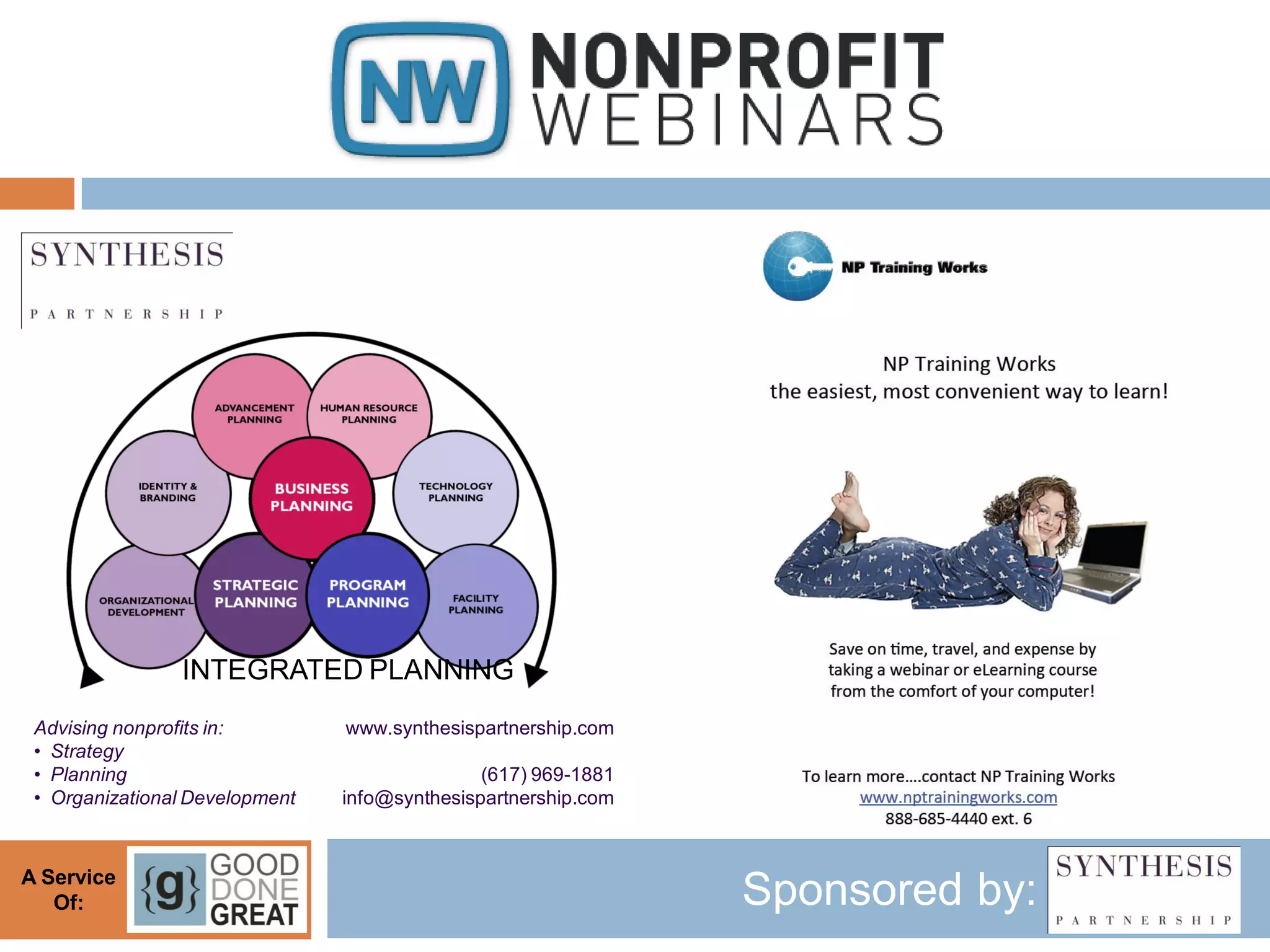
INTEGRATED PLANNING
 Advising nonprofits in:        www.synthesispartnership.com
 • Strategy
 • Planning                                    (617) 969-1881
 • Organizational Development   info@synthesispartnership.com


A Service
   Of:                                                          Sponsored by:
Affordable collaborative data
             management in the cloud.

A Service
   Of:                        Sponsored by:
Today’s Speakers


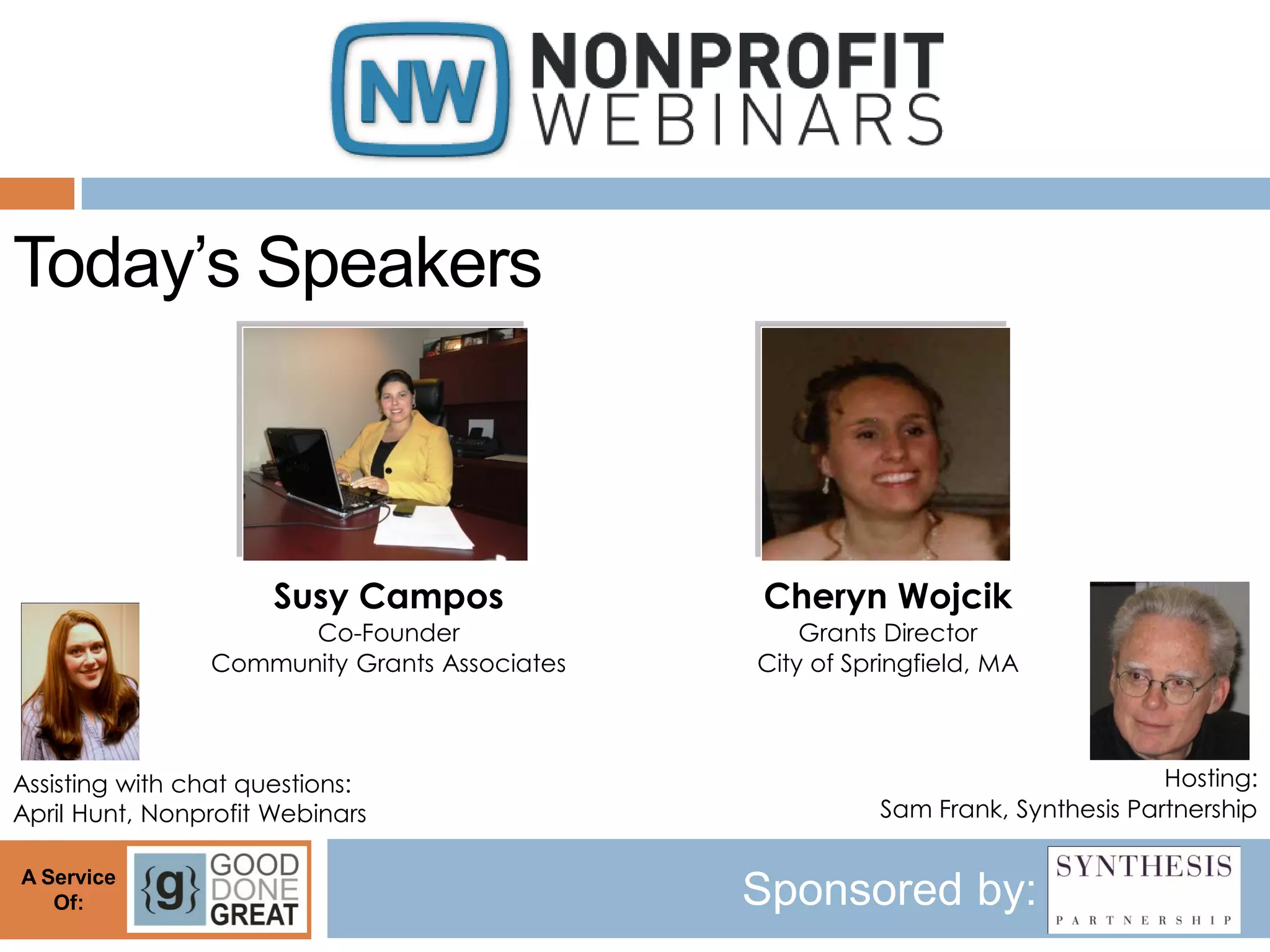
                      Susy Campos             Cheryn Wojcik
                      Co-Founder                  Grants Director
                Community Grants Associates   City of Springfield, MA


Assisting with chat questions:                                                  Hosting:
April Hunt, Nonprofit Webinars                          Sam Frank, Synthesis Partnership

A Service
   Of:                                        Sponsored by:
A Guide to Logic Models

     In Grant Writing
Topics
•   What is a Logic Model?

•   How to read a logic Model

•   Why Logic Models are important?

•   Meaningful participation of key stakeholders

•   Logic Model’s Core Components

•   What does a logic model look like?

•   Using the logic model to plan for evaluation.

•   Benefits of developing logic models

•   What are funders looking for in a logic model?
What is a Logic Model?
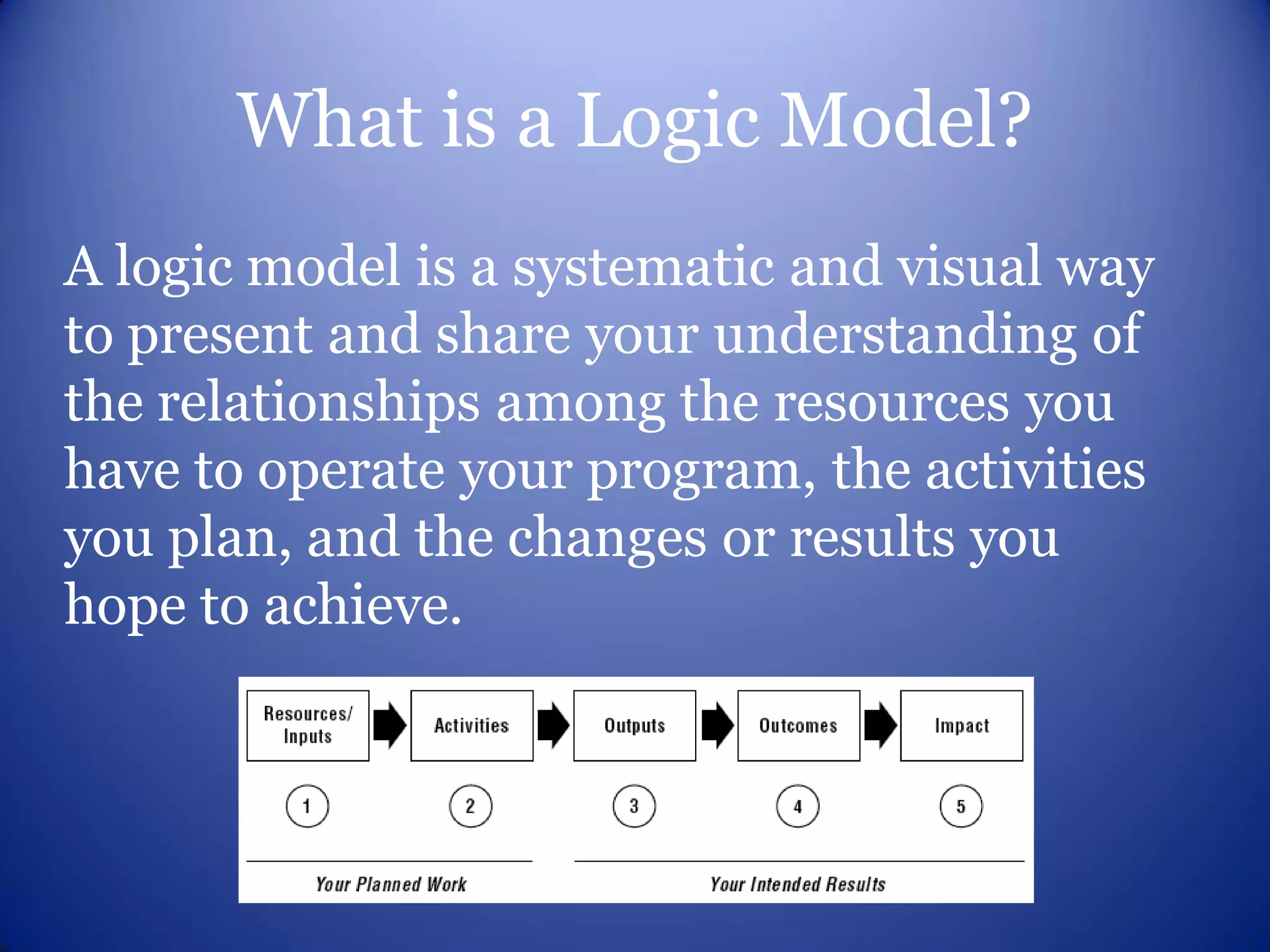
A logic model is a systematic and visual way
to present and share your understanding of
the relationships among the resources you
have to operate your program, the activities
you plan, and the changes or results you
hope to achieve.
What is a Logic Model?
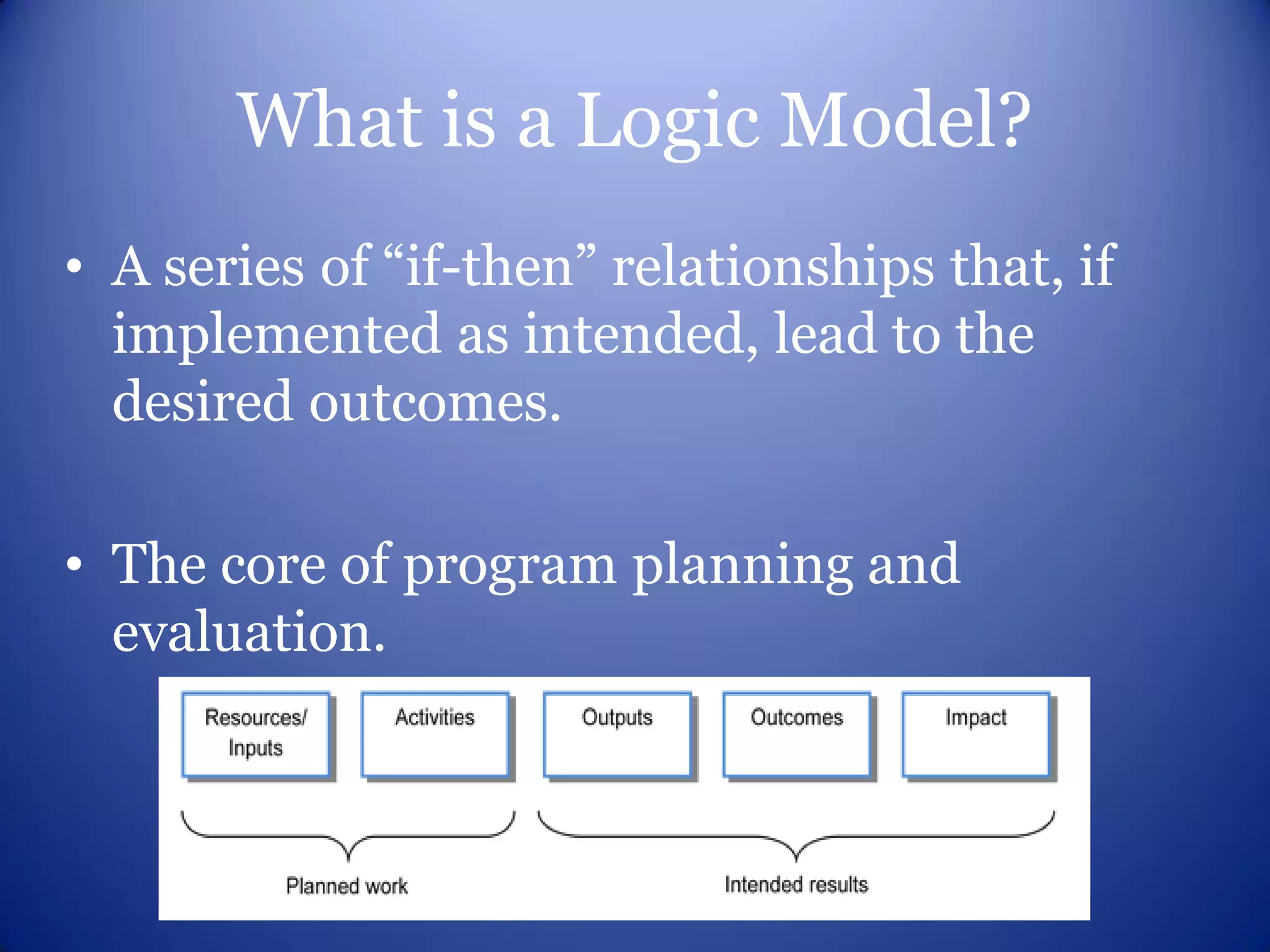
• A series of “if-then” relationships that, if
  implemented as intended, lead to the
  desired outcomes.

• The core of program planning and
  evaluation.
How to read a logic model
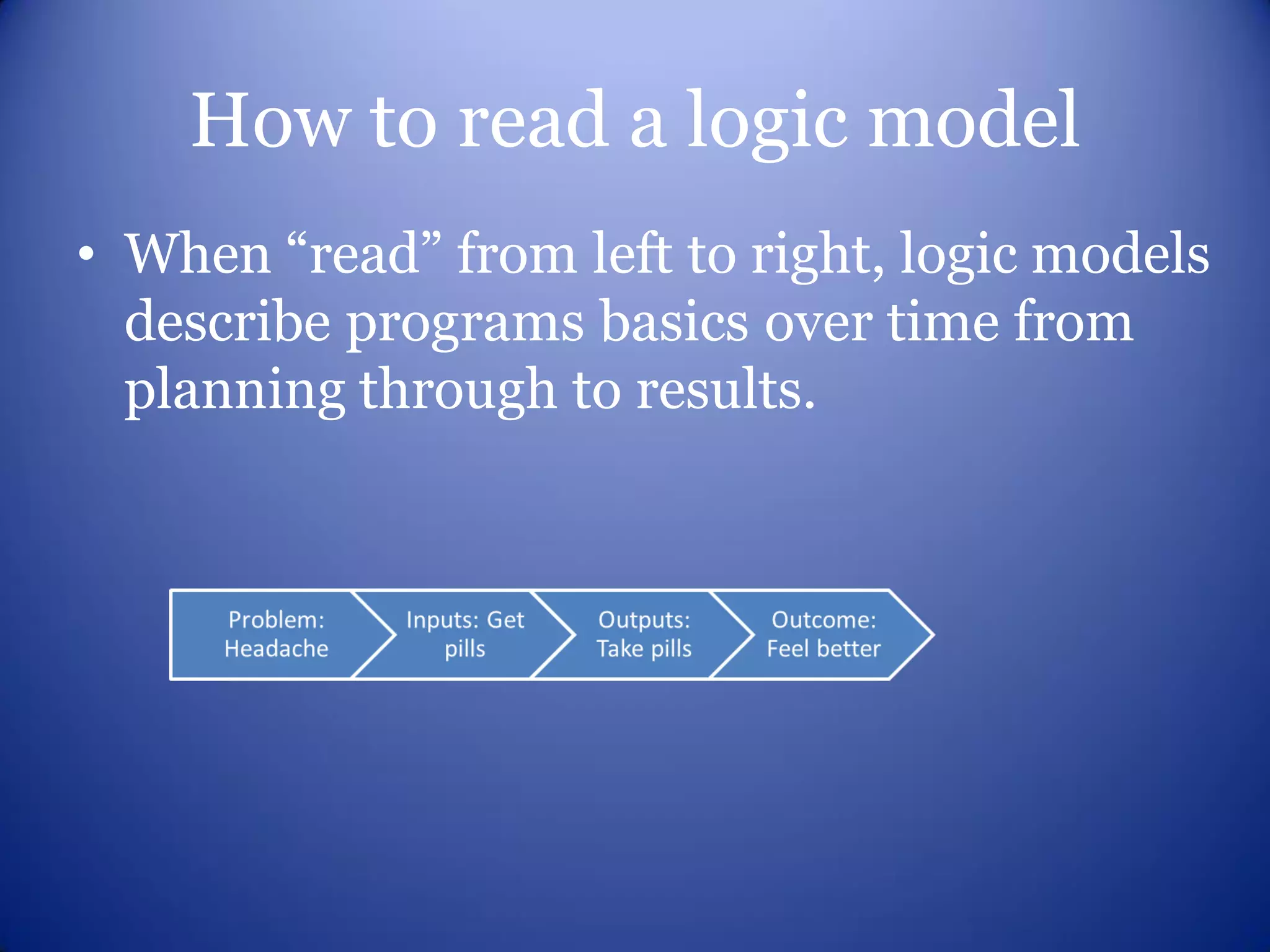
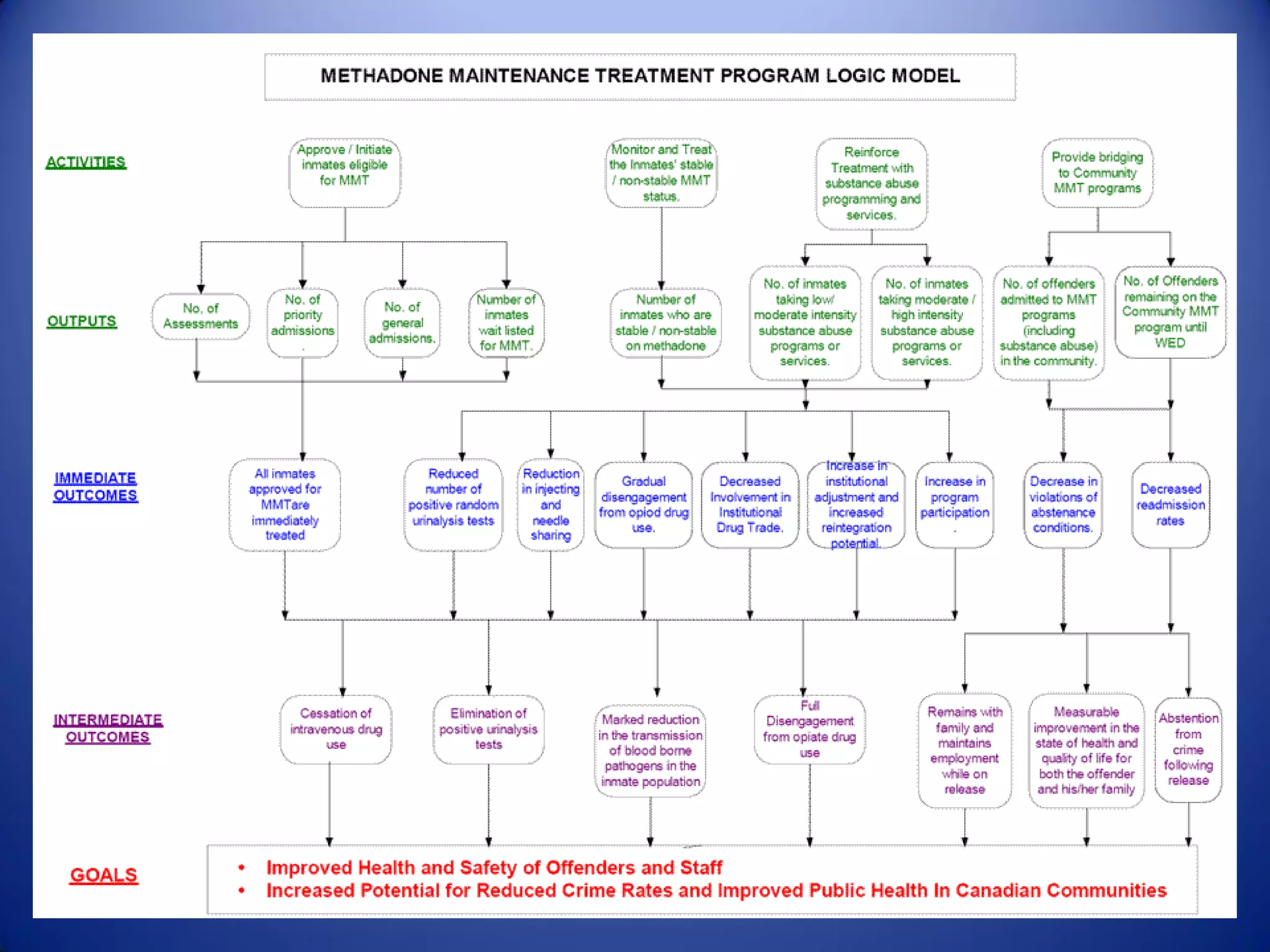
• When “read” from left to right, logic models
  describe programs basics over time from
  planning through to results.
Why Logic Models are Important
   Provides organization and project staff a “big
    picture” view of the project’s scope of work.

 Cataloguing of the resources and actions
 needed to reach intended results.

 Documenting connections among available
 resources, planned activities and expected
 results.
Why Logic Models are Important
 Describing the results aimed for in terms of specific,
  measurable, action-oriented, realistic and timed
  outcomes.

 Mapping an agency’s impact helps one to visualize and
  understand how human and financial investments can
  contribute to achieving intended goals and can lead to
  programmatic improvements.

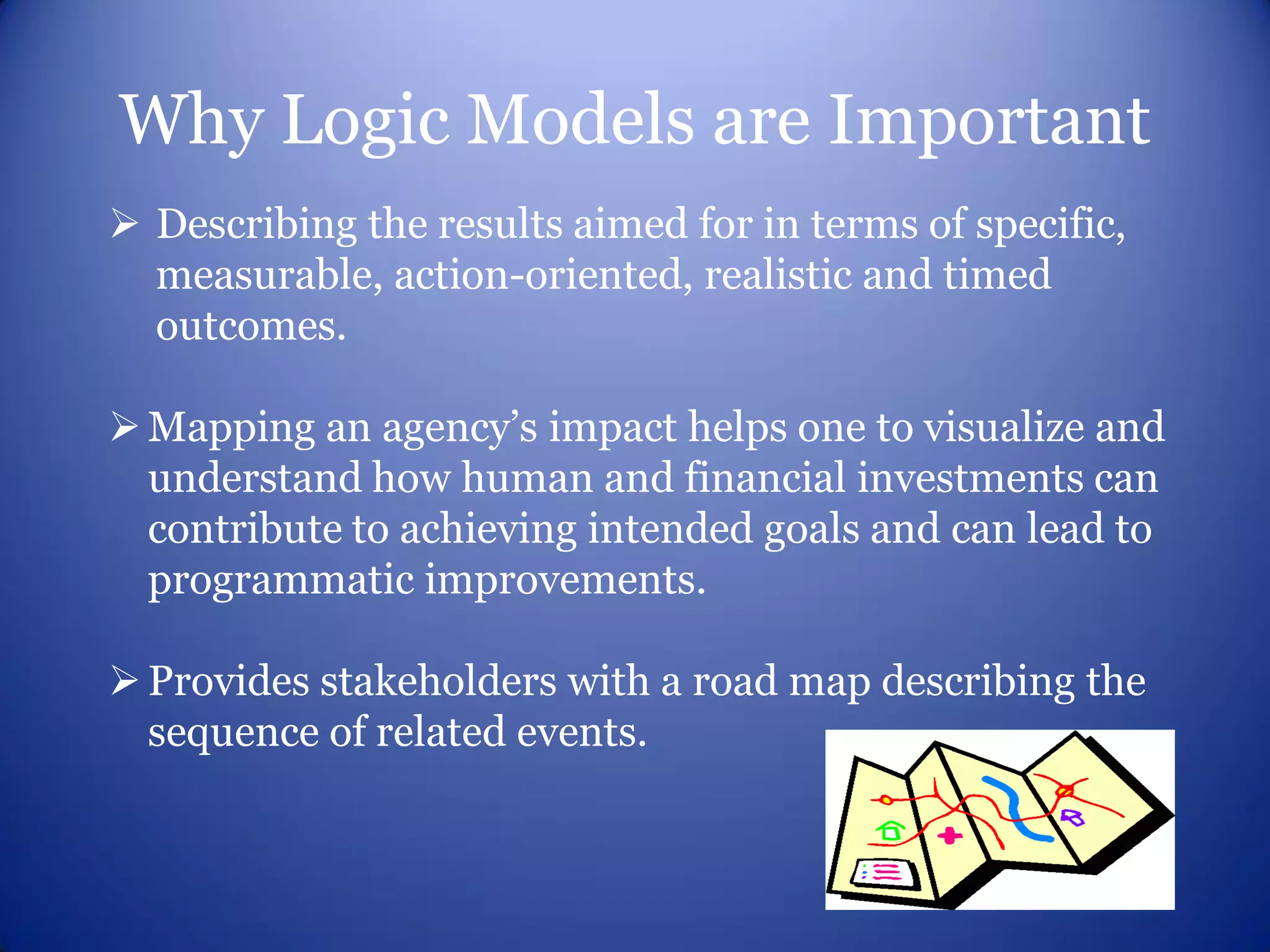
 Provides stakeholders with a road map describing the
  sequence of related events.
Meaningful Participation of Key
            Stakeholders
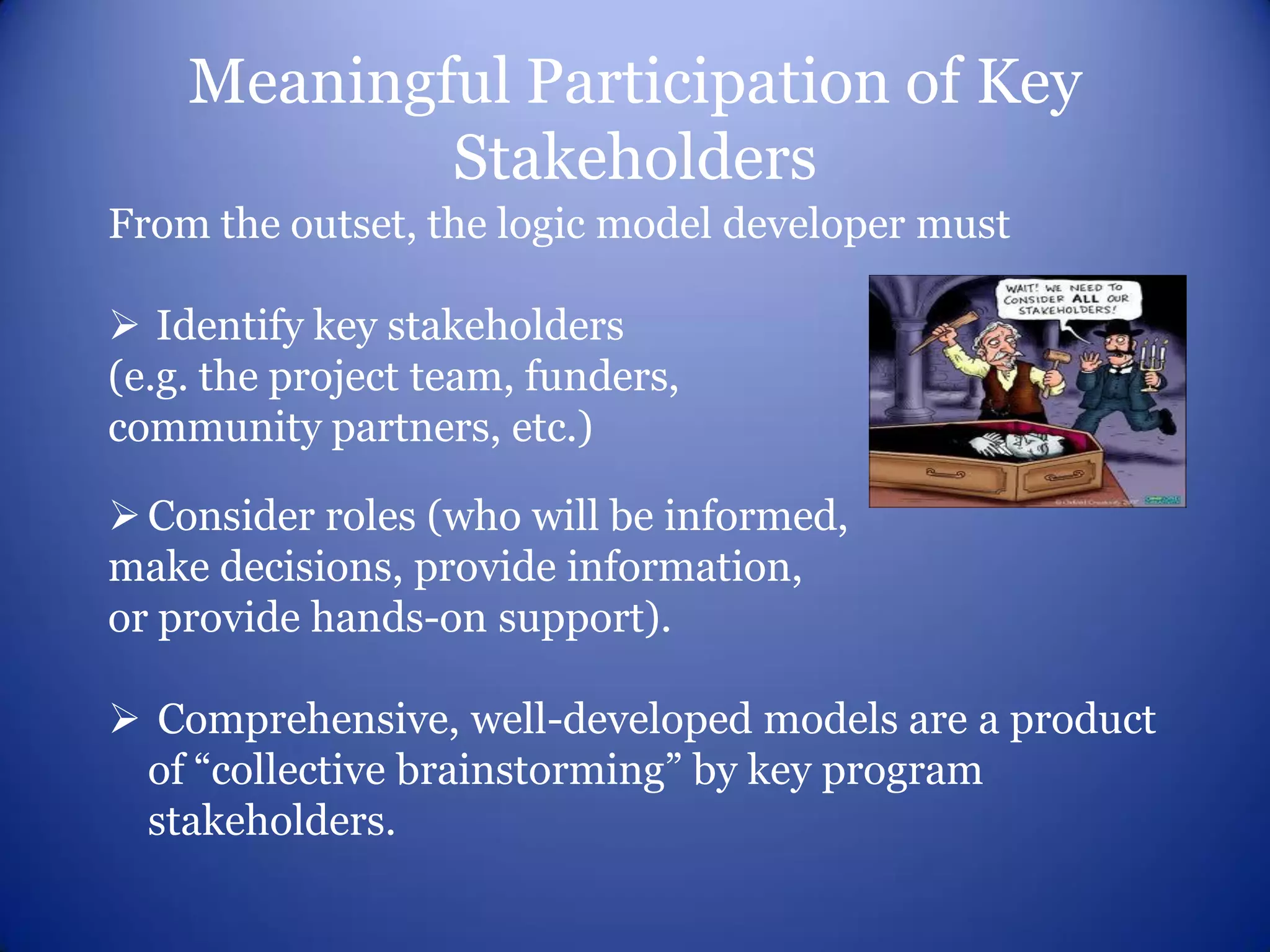
From the outset, the logic model developer must

 Identify key stakeholders
(e.g. the project team, funders,
community partners, etc.)

 Consider roles (who will be informed,
make decisions, provide information,
or provide hands-on support).

 Comprehensive, well-developed models are a product
 of “collective brainstorming” by key program
 stakeholders.
Meaningful Participation of Key
            Stakeholders
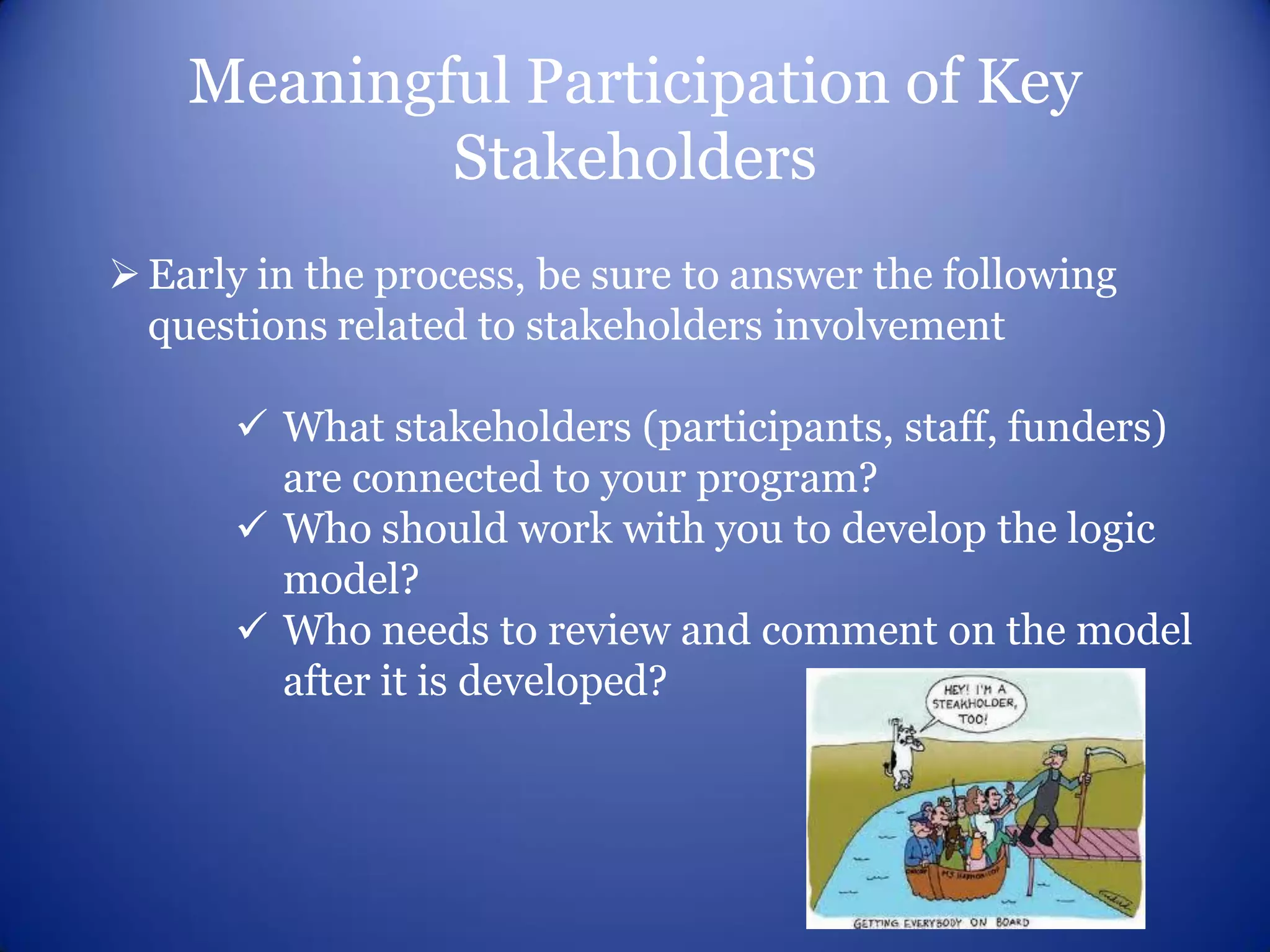
 Early in the process, be sure to answer the following
  questions related to stakeholders involvement

       What stakeholders (participants, staff, funders)
        are connected to your program?
       Who should work with you to develop the logic
        model?
       Who needs to review and comment on the model
        after it is developed?
Core Components
           http://www.researchutilization.org/logicmodel/learn.html

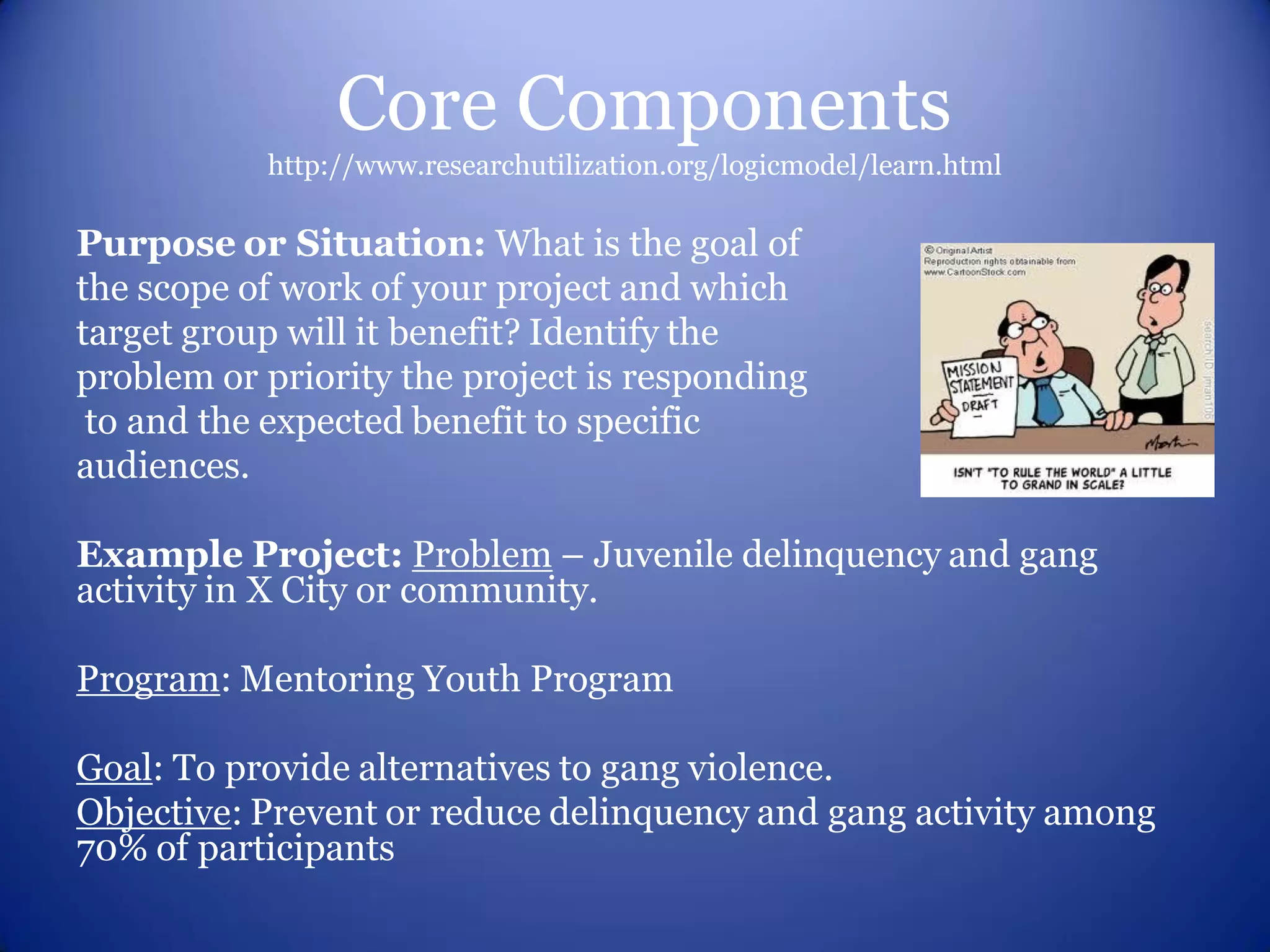
Purpose or Situation: What is the goal of
the scope of work of your project and which
target group will it benefit? Identify the
problem or priority the project is responding
 to and the expected benefit to specific
audiences.

Example Project: Problem – Juvenile delinquency and gang
activity in X City or community.

Program: Mentoring Youth Program

Goal: To provide alternatives to gang violence.
Objective: Prevent or reduce delinquency and gang activity among
70% of participants
Core Components

Resources or Inputs: What is available to make your
project’s scope of work operational? Resources could
include the human, financial, host organization, or
community resources and support a project has available
to apply to its work.

Example: Youth Mentoring Program
- Staff – to train mentors, recruit, outreach
- Volunteer Mentors
- Training provided
- Building/Space for the Mentors and Mentees to meet.
Core Components

Activities: With your project resources, what
project activities do you plan to implement?
Project activities include the research,
development, training, technical assistance,
dissemination, and other activities specified in
your grant proposal
  Example: Youth Mentoring Program
  - Outreach and referral services
  - Recruit X youth to the program
  - Recruit additional Mentor Volunteers
  - Provide Training to Mentor Volunteers
Core Components

• Result or Outputs: What products,
 services, or events do you anticipate
 delivering through accomplishment of your
 planned activities?

  Example: Youth Mentoring Program
  - # of program participants recruited
  - # of program participants served
  - % decrease in gang-related incident arrests
Core Components

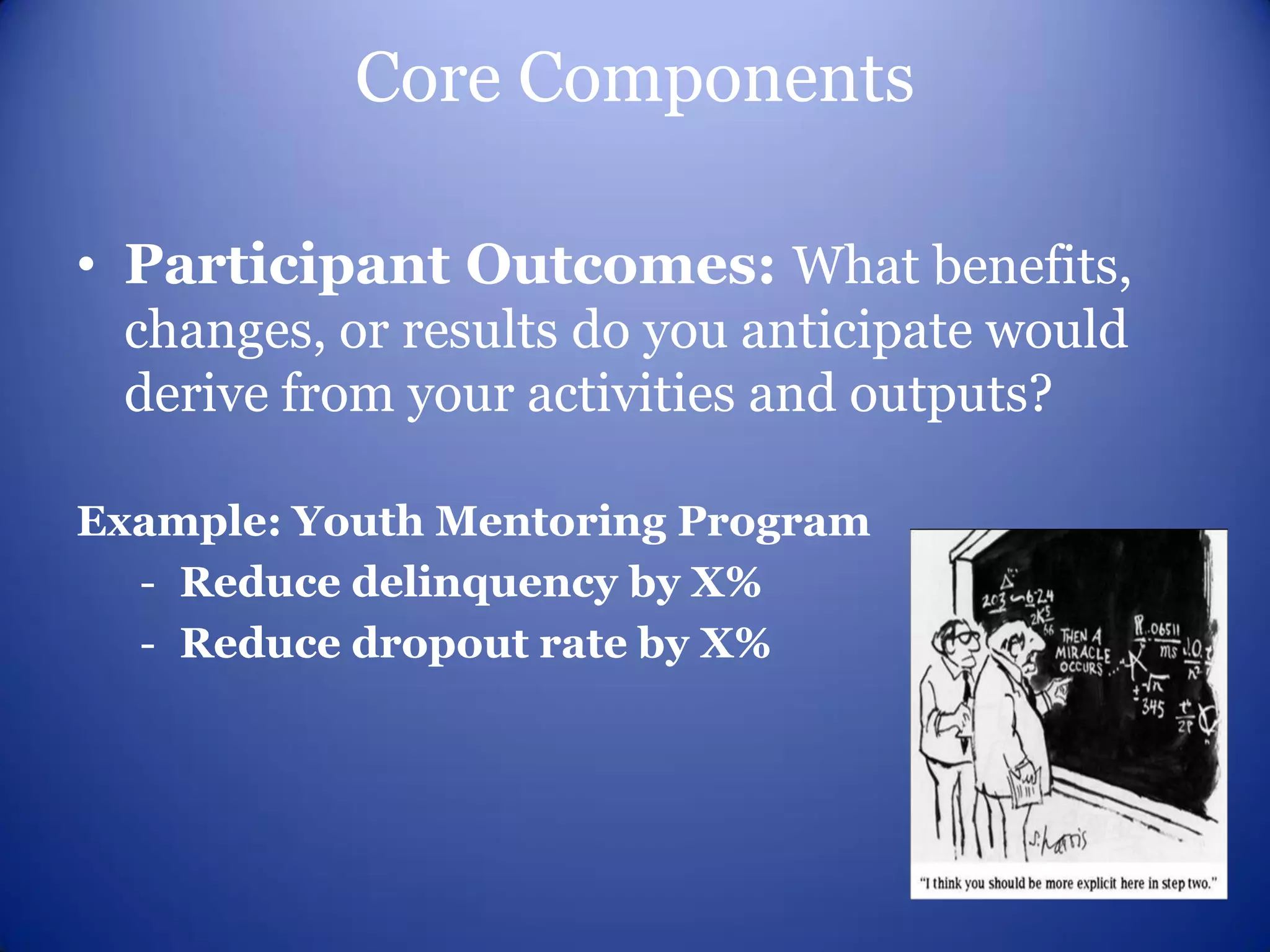
• Participant Outcomes: What benefits,
 changes, or results do you anticipate would
 derive from your activities and outputs?

Example: Youth Mentoring Program
  - Reduce delinquency by X%
  - Reduce dropout rate by X%
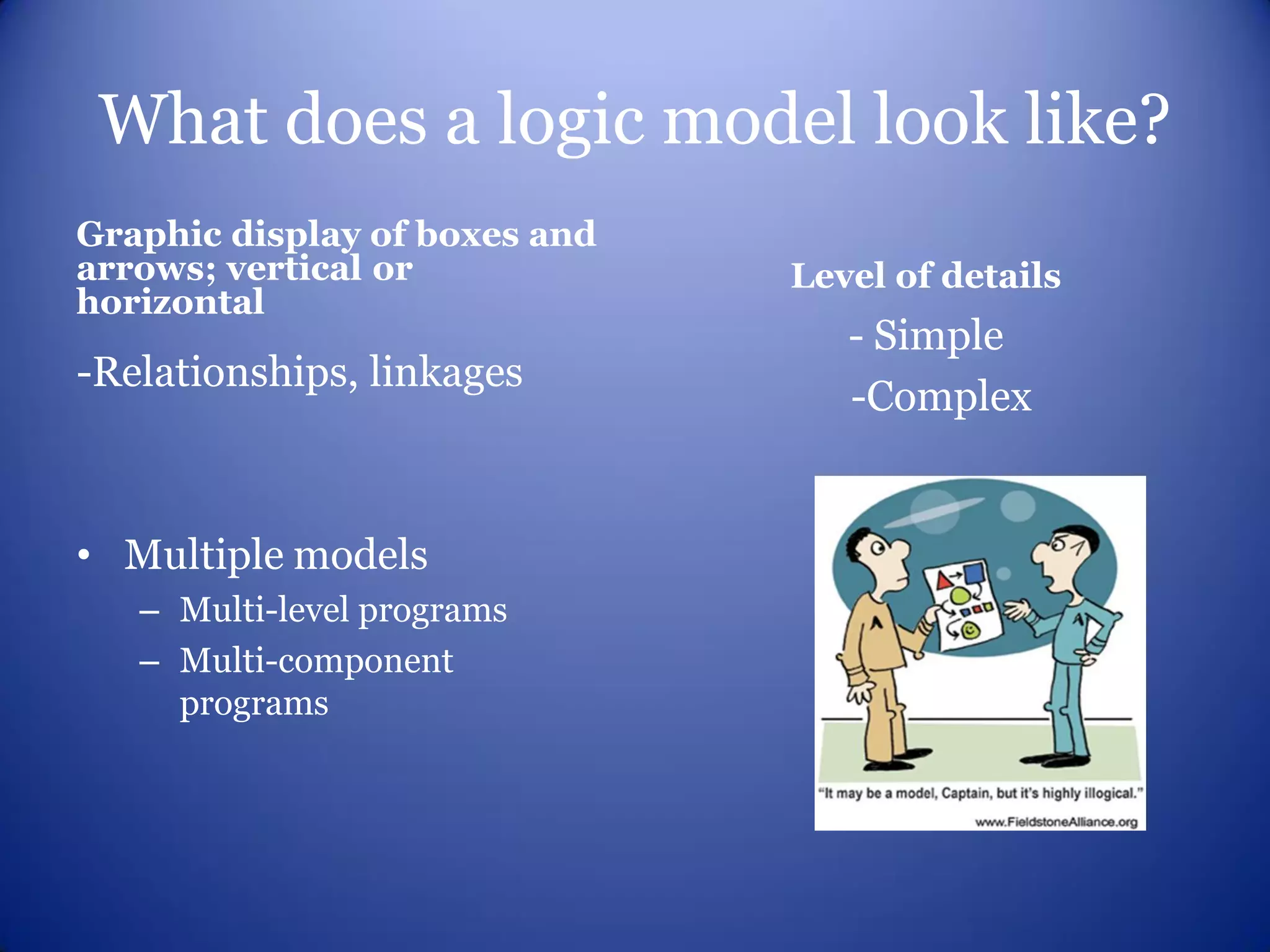
What does a logic model look like?
Graphic display of boxes and
arrows; vertical or            Level of details
horizontal
                                  - Simple
-Relationships, linkages
                                  -Complex


• Multiple models
   – Multi-level programs
   – Multi-component
     programs
What does a logic model look like?
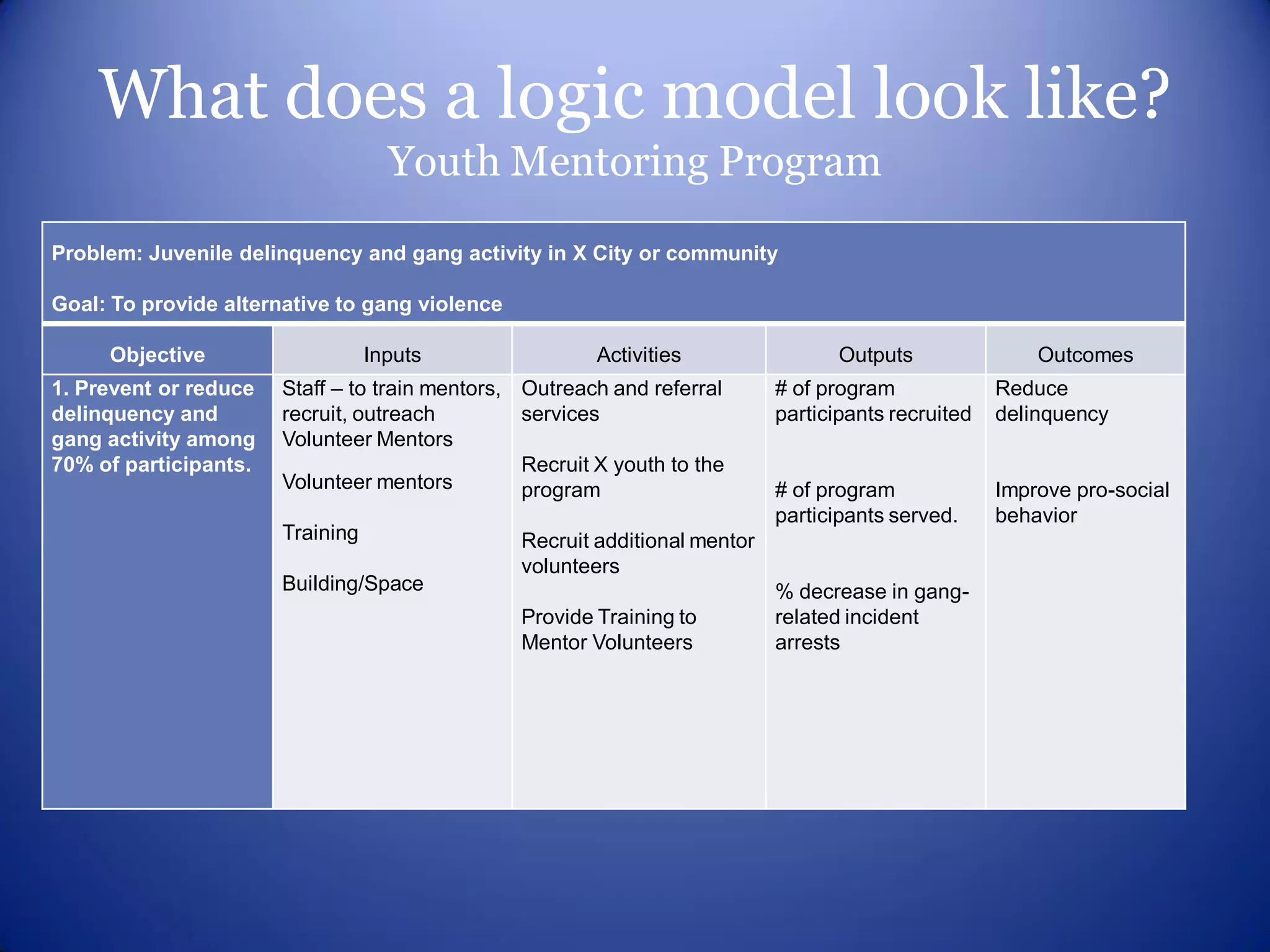
                                    Youth Mentoring Program

Problem: Juvenile delinquency and gang activity in X City or community

Goal: To provide alternative to gang violence

     Objective                    Inputs                 Activities                Outputs               Outcomes
1. Prevent or reduce   Staff – to train mentors, Outreach and referral      # of program             Reduce
delinquency and        recruit, outreach         services                   participants recruited   delinquency
gang activity among    Volunteer Mentors
70% of participants.                             Recruit X youth to the
                       Volunteer mentors         program                    # of program             Improve pro-social
                                                                            participants served.     behavior
                       Training                 Recruit additional mentor
                                                volunteers
                       Building/Space                                       % decrease in gang-
                                                Provide Training to         related incident
                                                Mentor Volunteers           arrests
Branding
Using the logic model to plan for
             evaluation
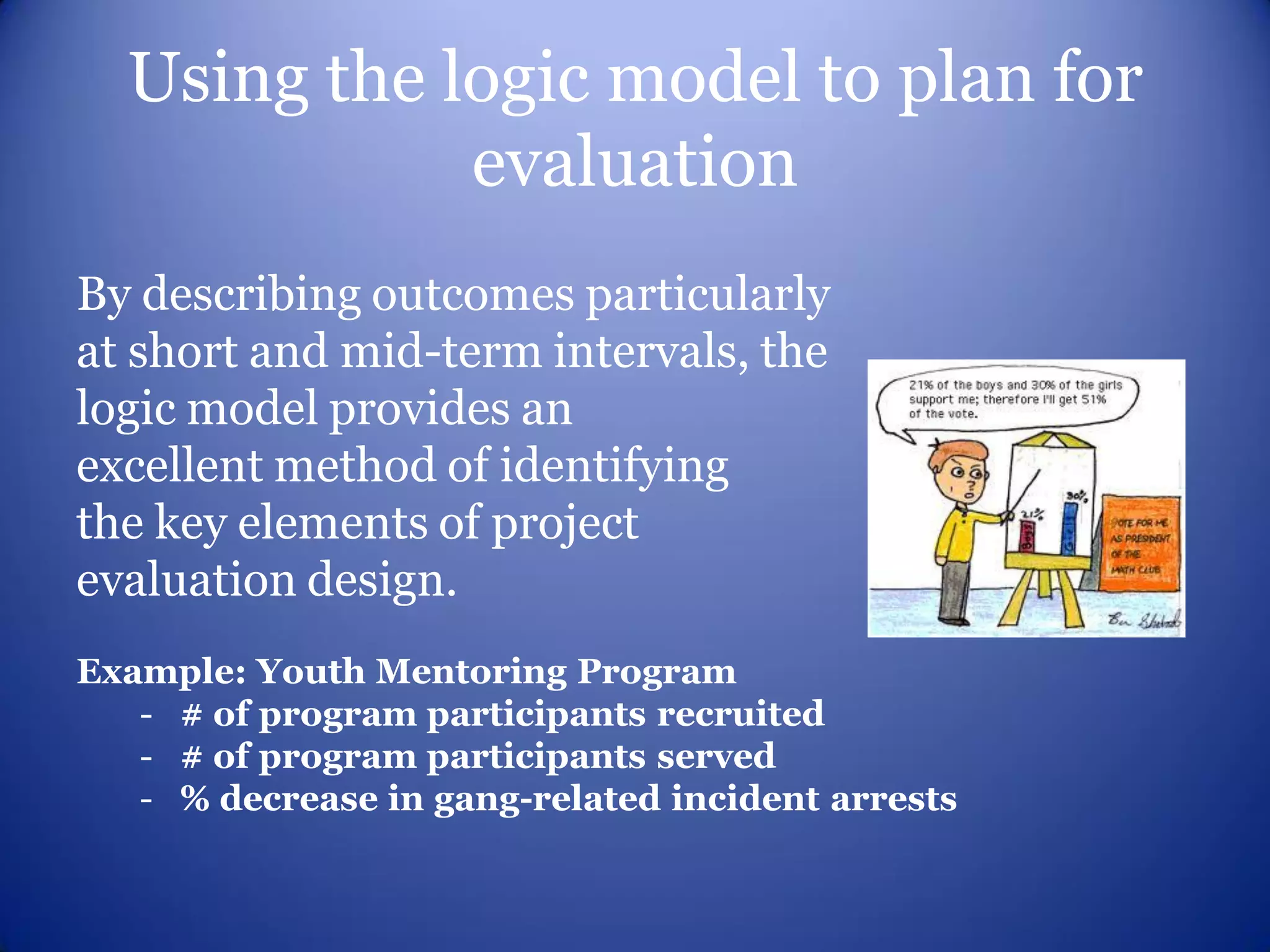
By describing outcomes particularly
at short and mid-term intervals, the
logic model provides an
excellent method of identifying
the key elements of project
evaluation design.
Example: Youth Mentoring Program
   - # of program participants recruited
   - # of program participants served
   - % decrease in gang-related incident arrests
Using the logic model to plan for
             evaluation

All logic model outcome statements should be
coupled with descriptions of data and data
sources that will be used to suggest progress
toward outcome goals.

           Example: Youth Mentoring Program
            - Reduce delinquency by X%
            - Reduce dropout rate by X%
Using the logic model to plan for
             evaluation

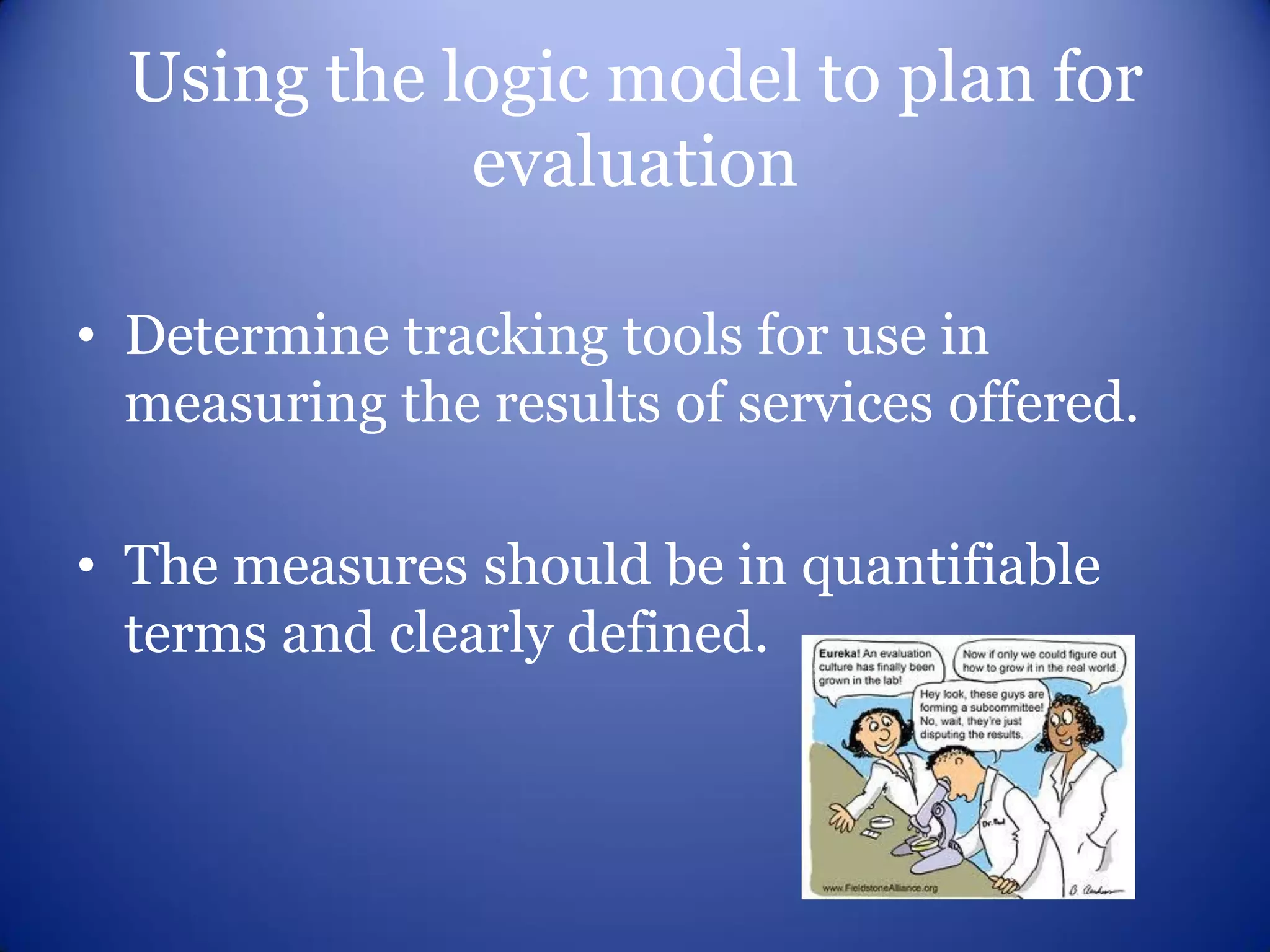
• Determine tracking tools for use in
  measuring the results of services offered.

• The measures should be in quantifiable
  terms and clearly defined.
Using the logic model to plan for
            evaluation

A good guide for determining performance
measures is the acronym SMART. They should
be:
• Specific
• Measurable
• Attainable
• Realistic
• Timely
Benefits of developing logic models
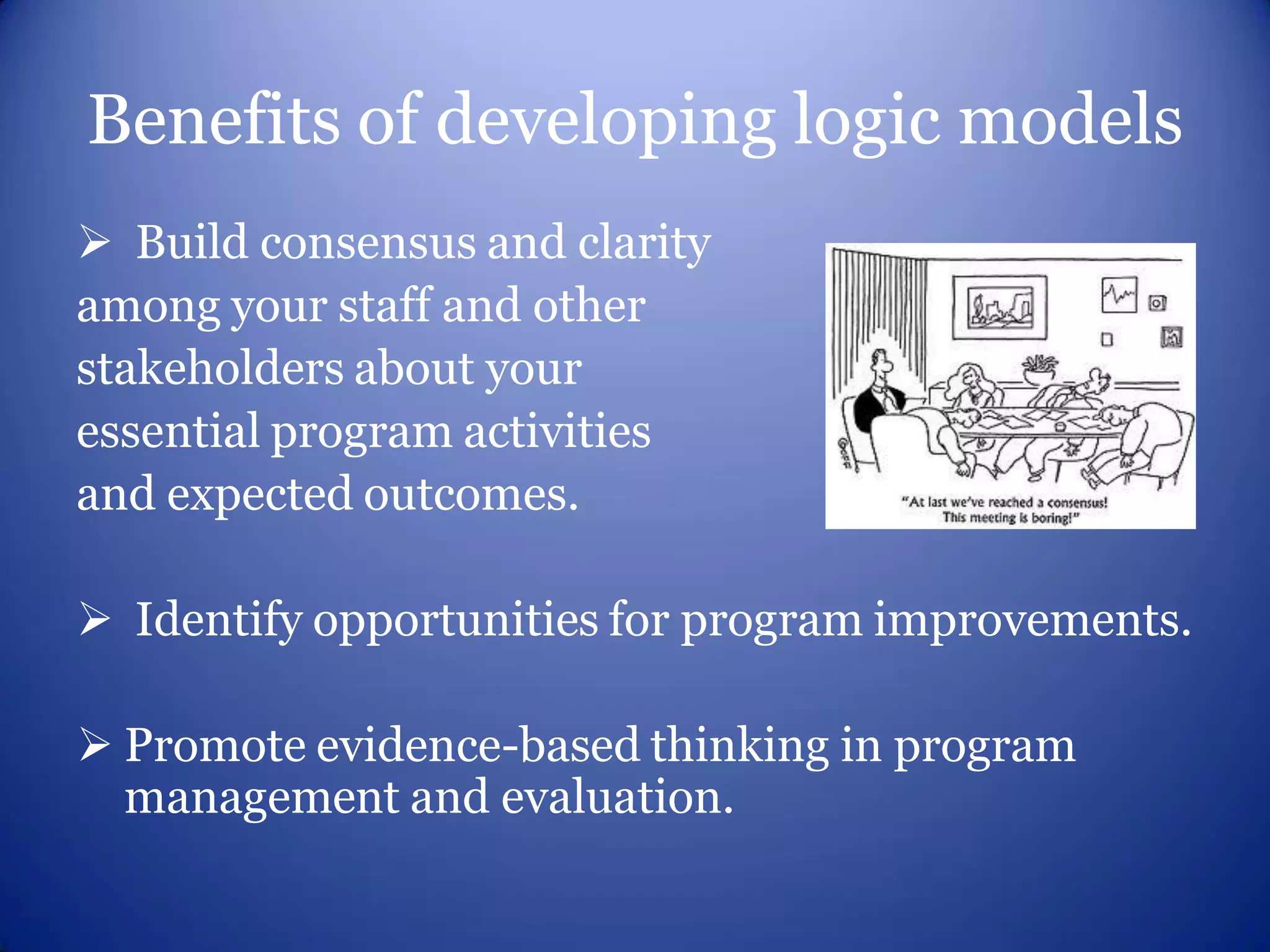
 Build consensus and clarity
among your staff and other
stakeholders about your
essential program activities
and expected outcomes.

 Identify opportunities for program improvements.

 Promote evidence-based thinking in program
  management and evaluation.
Benefits of developing logic models
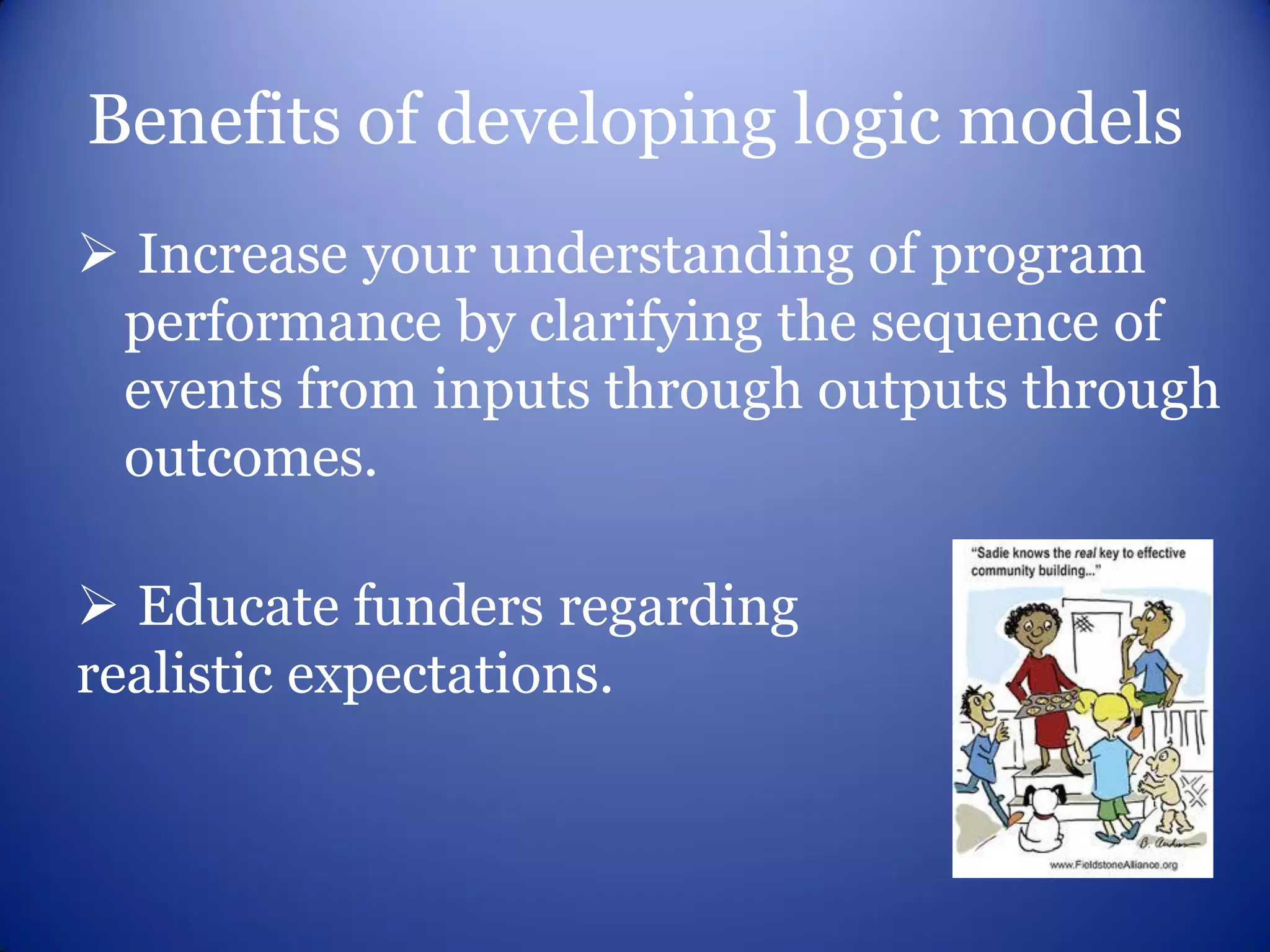
 Increase your understanding of program
 performance by clarifying the sequence of
 events from inputs through outputs through
 outcomes.

 Educate funders regarding
realistic expectations.
What are funders looking for in a
           Logic Model

Does the logic model include all of the
 program’s most important activities or
 services?
What are funders looking for in a
           Logic Model

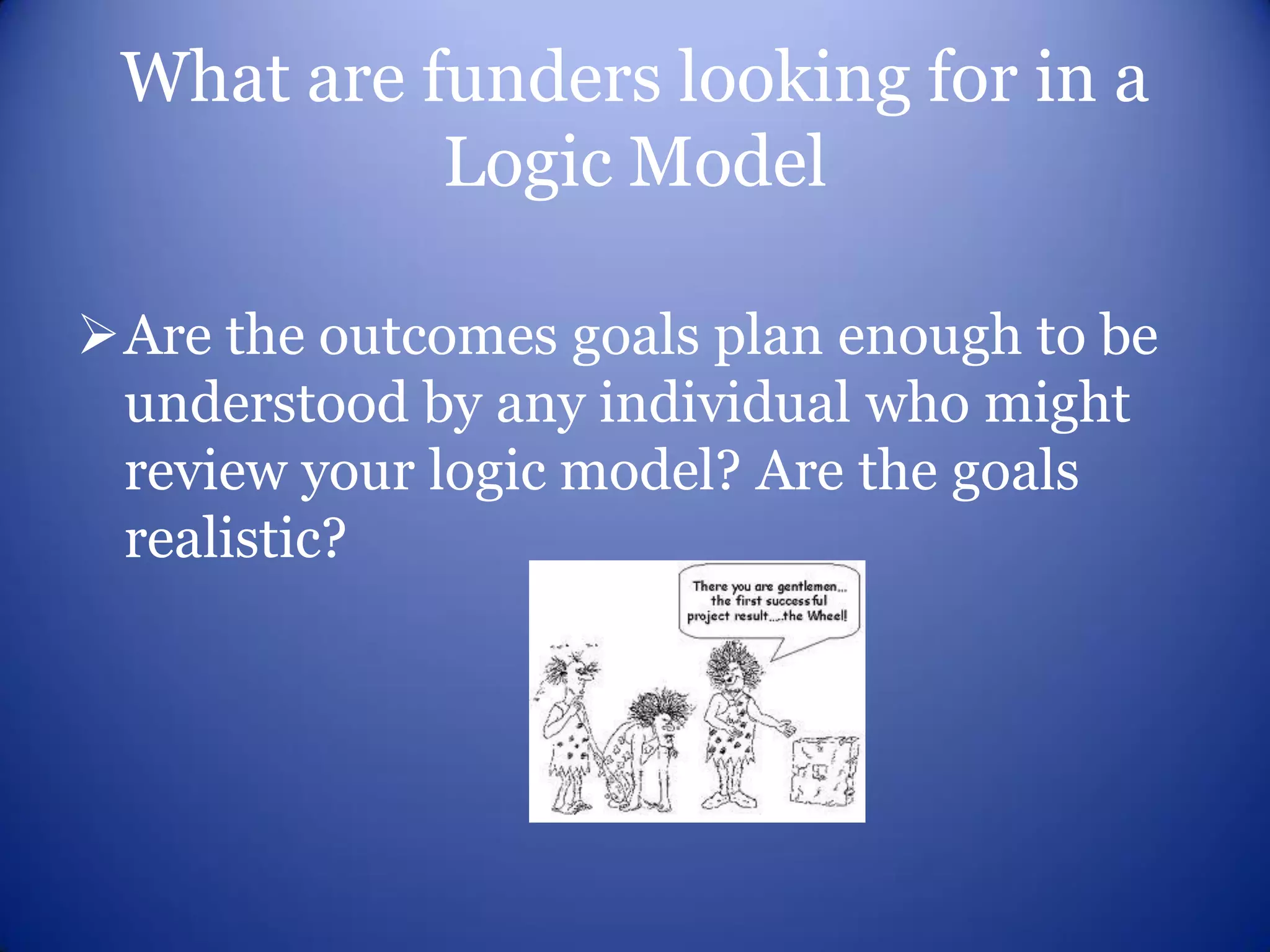
Are the outcomes goals plan enough to be
 understood by any individual who might
 review your logic model? Are the goals
 realistic?
What are funders looking for in a
           Logic Model

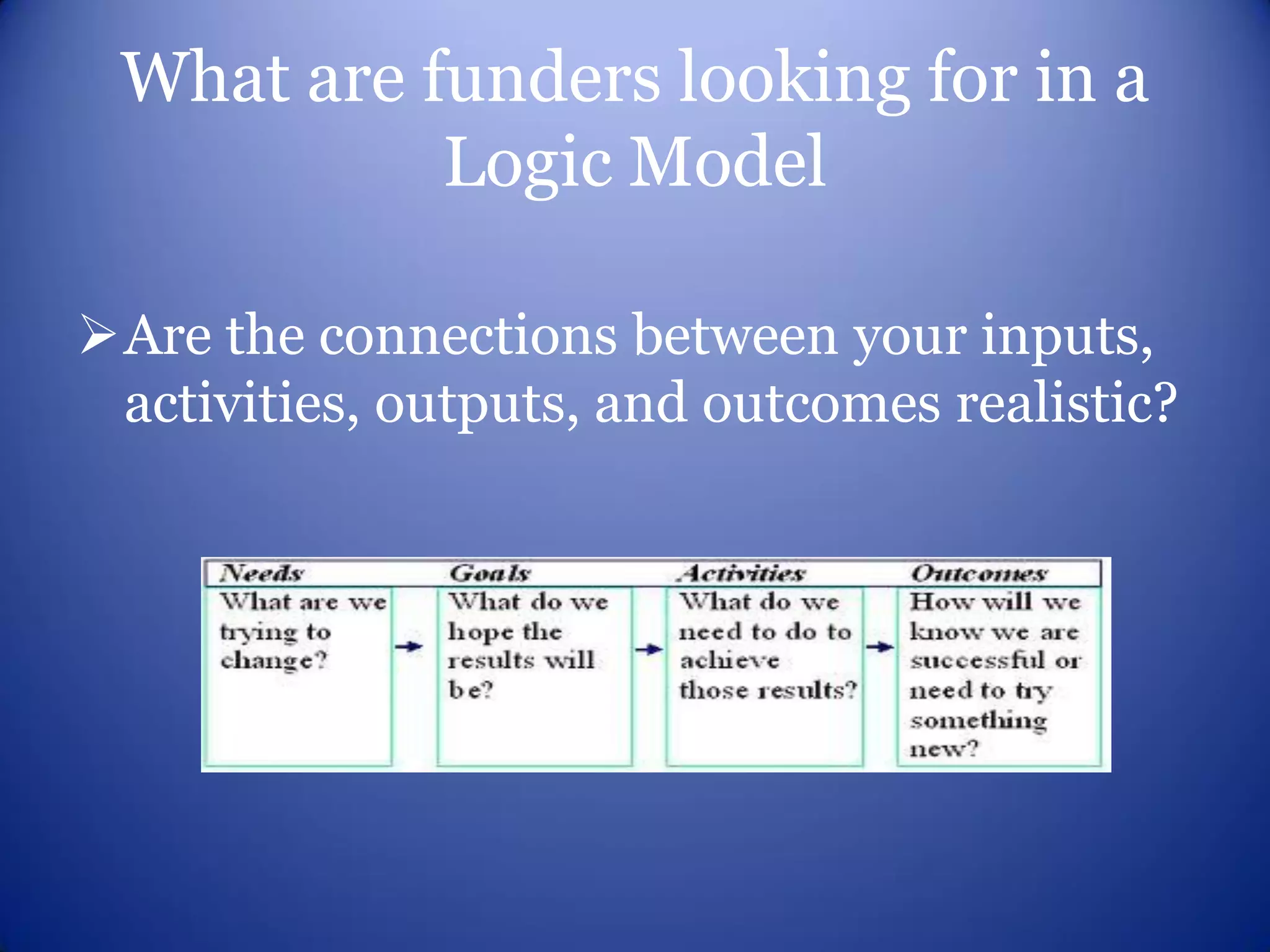
Are the connections between your inputs,
 activities, outputs, and outcomes realistic?
What are funders looking for in a
           Logic Model
Are the connections between
your inputs, activities,
outputs, and outcomes realistic?

Logic models that are rushed often end up
 displaying faulty logic, insufficient evidence,
 or models copied from other programs that
 don’t quite fit yours.
Thank You !

Community Grants Associates, Inc.
 www.communitygrantsnow.com
Find listings for our current season
          of webinars and register at:

            NonprofitWebinars.com


A Service
   Of:                     Sponsored by:

A Guide to Logic Models – Grant Writing

  • 1.
    A Guide toLogic Models – Grant Writing Susy Campos & Cheryn Wojcik October 12, 2011 A Service Of: Sponsored by:
  • 2.
    INTEGRATED PLANNING Advisingnonprofits in: www.synthesispartnership.com • Strategy • Planning (617) 969-1881 • Organizational Development info@synthesispartnership.com A Service Of: Sponsored by:
  • 3.
    Affordable collaborative data management in the cloud. A Service Of: Sponsored by:
  • 4.
    Today’s Speakers Susy Campos Cheryn Wojcik Co-Founder Grants Director Community Grants Associates City of Springfield, MA Assisting with chat questions: Hosting: April Hunt, Nonprofit Webinars Sam Frank, Synthesis Partnership A Service Of: Sponsored by:
  • 6.
    A Guide toLogic Models In Grant Writing
  • 7.
    Topics • What is a Logic Model? • How to read a logic Model • Why Logic Models are important? • Meaningful participation of key stakeholders • Logic Model’s Core Components • What does a logic model look like? • Using the logic model to plan for evaluation. • Benefits of developing logic models • What are funders looking for in a logic model?
  • 8.
    What is aLogic Model? A logic model is a systematic and visual way to present and share your understanding of the relationships among the resources you have to operate your program, the activities you plan, and the changes or results you hope to achieve.
  • 9.
    What is aLogic Model? • A series of “if-then” relationships that, if implemented as intended, lead to the desired outcomes. • The core of program planning and evaluation.
  • 10.
    How to reada logic model • When “read” from left to right, logic models describe programs basics over time from planning through to results.
  • 11.
    Why Logic Modelsare Important  Provides organization and project staff a “big picture” view of the project’s scope of work.  Cataloguing of the resources and actions needed to reach intended results.  Documenting connections among available resources, planned activities and expected results.
  • 12.
    Why Logic Modelsare Important  Describing the results aimed for in terms of specific, measurable, action-oriented, realistic and timed outcomes.  Mapping an agency’s impact helps one to visualize and understand how human and financial investments can contribute to achieving intended goals and can lead to programmatic improvements.  Provides stakeholders with a road map describing the sequence of related events.
  • 13.
    Meaningful Participation ofKey Stakeholders From the outset, the logic model developer must  Identify key stakeholders (e.g. the project team, funders, community partners, etc.)  Consider roles (who will be informed, make decisions, provide information, or provide hands-on support).  Comprehensive, well-developed models are a product of “collective brainstorming” by key program stakeholders.
  • 14.
    Meaningful Participation ofKey Stakeholders  Early in the process, be sure to answer the following questions related to stakeholders involvement  What stakeholders (participants, staff, funders) are connected to your program?  Who should work with you to develop the logic model?  Who needs to review and comment on the model after it is developed?
  • 15.
    Core Components http://www.researchutilization.org/logicmodel/learn.html Purpose or Situation: What is the goal of the scope of work of your project and which target group will it benefit? Identify the problem or priority the project is responding to and the expected benefit to specific audiences. Example Project: Problem – Juvenile delinquency and gang activity in X City or community. Program: Mentoring Youth Program Goal: To provide alternatives to gang violence. Objective: Prevent or reduce delinquency and gang activity among 70% of participants
  • 16.
    Core Components Resources orInputs: What is available to make your project’s scope of work operational? Resources could include the human, financial, host organization, or community resources and support a project has available to apply to its work. Example: Youth Mentoring Program - Staff – to train mentors, recruit, outreach - Volunteer Mentors - Training provided - Building/Space for the Mentors and Mentees to meet.
  • 17.
    Core Components Activities: Withyour project resources, what project activities do you plan to implement? Project activities include the research, development, training, technical assistance, dissemination, and other activities specified in your grant proposal Example: Youth Mentoring Program - Outreach and referral services - Recruit X youth to the program - Recruit additional Mentor Volunteers - Provide Training to Mentor Volunteers
  • 18.
    Core Components • Resultor Outputs: What products, services, or events do you anticipate delivering through accomplishment of your planned activities? Example: Youth Mentoring Program - # of program participants recruited - # of program participants served - % decrease in gang-related incident arrests
  • 19.
    Core Components • ParticipantOutcomes: What benefits, changes, or results do you anticipate would derive from your activities and outputs? Example: Youth Mentoring Program - Reduce delinquency by X% - Reduce dropout rate by X%
  • 20.
    What does alogic model look like? Graphic display of boxes and arrows; vertical or Level of details horizontal - Simple -Relationships, linkages -Complex • Multiple models – Multi-level programs – Multi-component programs
  • 21.
    What does alogic model look like? Youth Mentoring Program Problem: Juvenile delinquency and gang activity in X City or community Goal: To provide alternative to gang violence Objective Inputs Activities Outputs Outcomes 1. Prevent or reduce Staff – to train mentors, Outreach and referral # of program Reduce delinquency and recruit, outreach services participants recruited delinquency gang activity among Volunteer Mentors 70% of participants. Recruit X youth to the Volunteer mentors program # of program Improve pro-social participants served. behavior Training Recruit additional mentor volunteers Building/Space % decrease in gang- Provide Training to related incident Mentor Volunteers arrests
  • 22.
  • 23.
    Using the logicmodel to plan for evaluation By describing outcomes particularly at short and mid-term intervals, the logic model provides an excellent method of identifying the key elements of project evaluation design. Example: Youth Mentoring Program - # of program participants recruited - # of program participants served - % decrease in gang-related incident arrests
  • 24.
    Using the logicmodel to plan for evaluation All logic model outcome statements should be coupled with descriptions of data and data sources that will be used to suggest progress toward outcome goals. Example: Youth Mentoring Program - Reduce delinquency by X% - Reduce dropout rate by X%
  • 25.
    Using the logicmodel to plan for evaluation • Determine tracking tools for use in measuring the results of services offered. • The measures should be in quantifiable terms and clearly defined.
  • 26.
    Using the logicmodel to plan for evaluation A good guide for determining performance measures is the acronym SMART. They should be: • Specific • Measurable • Attainable • Realistic • Timely
  • 27.
    Benefits of developinglogic models  Build consensus and clarity among your staff and other stakeholders about your essential program activities and expected outcomes.  Identify opportunities for program improvements.  Promote evidence-based thinking in program management and evaluation.
  • 28.
    Benefits of developinglogic models  Increase your understanding of program performance by clarifying the sequence of events from inputs through outputs through outcomes.  Educate funders regarding realistic expectations.
  • 29.
    What are funderslooking for in a Logic Model Does the logic model include all of the program’s most important activities or services?
  • 30.
    What are funderslooking for in a Logic Model Are the outcomes goals plan enough to be understood by any individual who might review your logic model? Are the goals realistic?
  • 31.
    What are funderslooking for in a Logic Model Are the connections between your inputs, activities, outputs, and outcomes realistic?
  • 32.
    What are funderslooking for in a Logic Model Are the connections between your inputs, activities, outputs, and outcomes realistic? Logic models that are rushed often end up displaying faulty logic, insufficient evidence, or models copied from other programs that don’t quite fit yours.
  • 33.
    Thank You ! CommunityGrants Associates, Inc. www.communitygrantsnow.com
  • 34.
    Find listings forour current season of webinars and register at: NonprofitWebinars.com A Service Of: Sponsored by: