Understanding Injectors and Fertilizer RatiosSteven E. Newman, Ph.D., A.A.F.Greenhouse Crops Extension Specialist and Professor of FloricultureColorado State University Extension
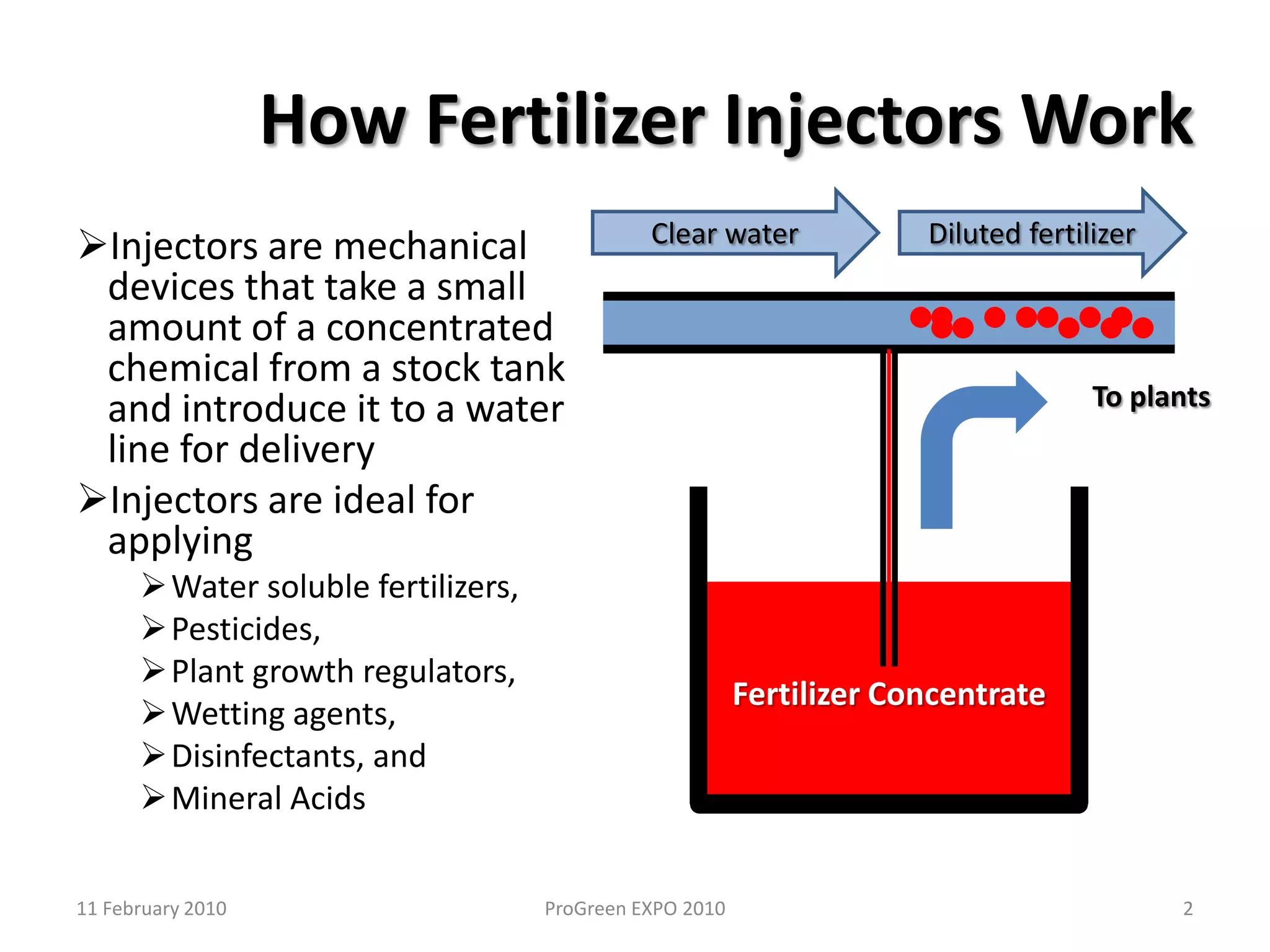
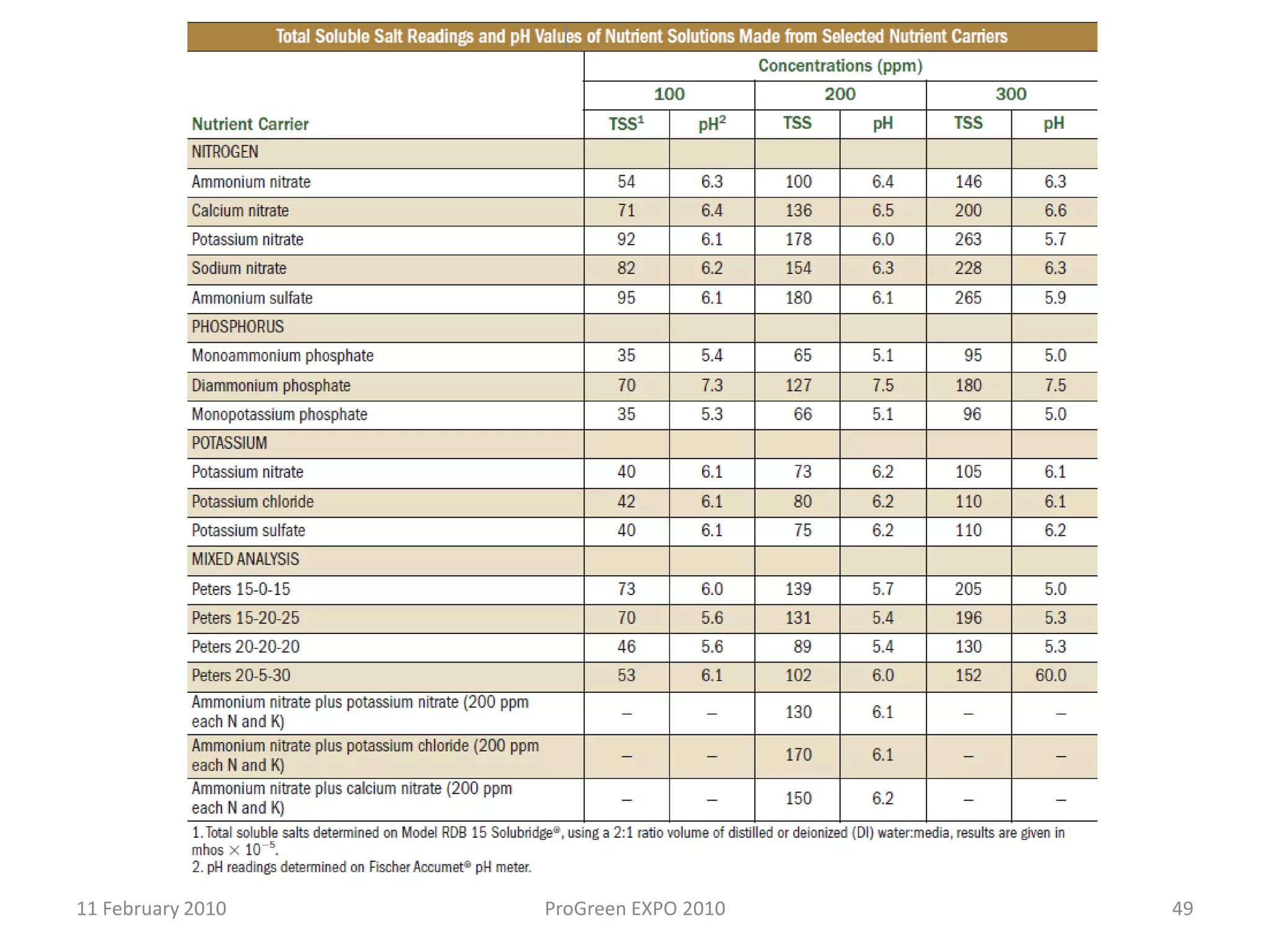
How Fertilizer Injectors WorkInjectors are mechanical devices that take a small amount of a concentrated chemical from a stock tank and introduce it to a water line for delivery
Injectors are ideal for applying
Water soluble fertilizers,
Pesticides,
Plant growth regulators,
Wetting agents,
Disinfectants, and
Mineral Acids211 February 2010ProGreen EXPO 2010Clear waterDiluted fertilizerTo plantsFertilizer Concentrate
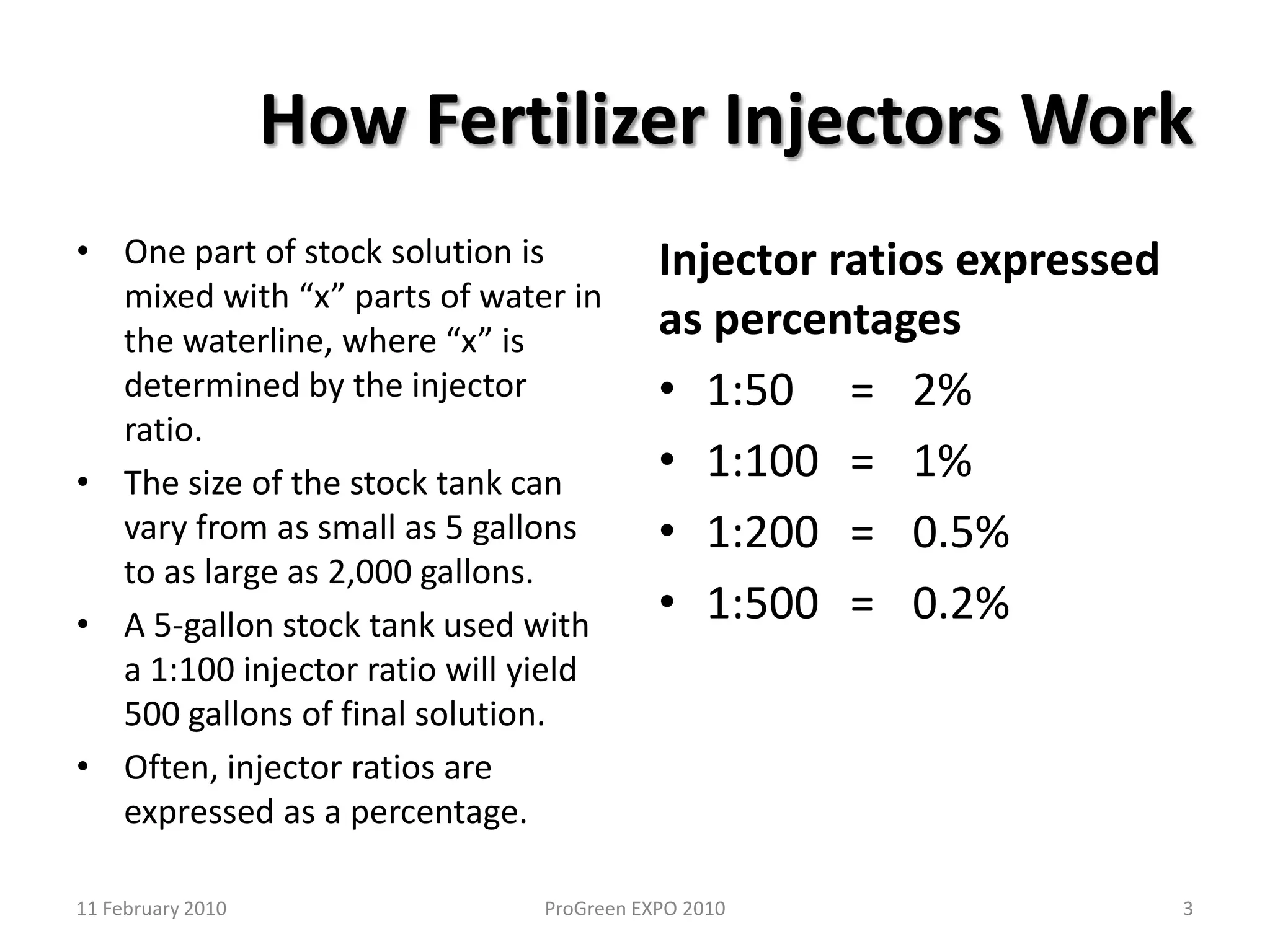
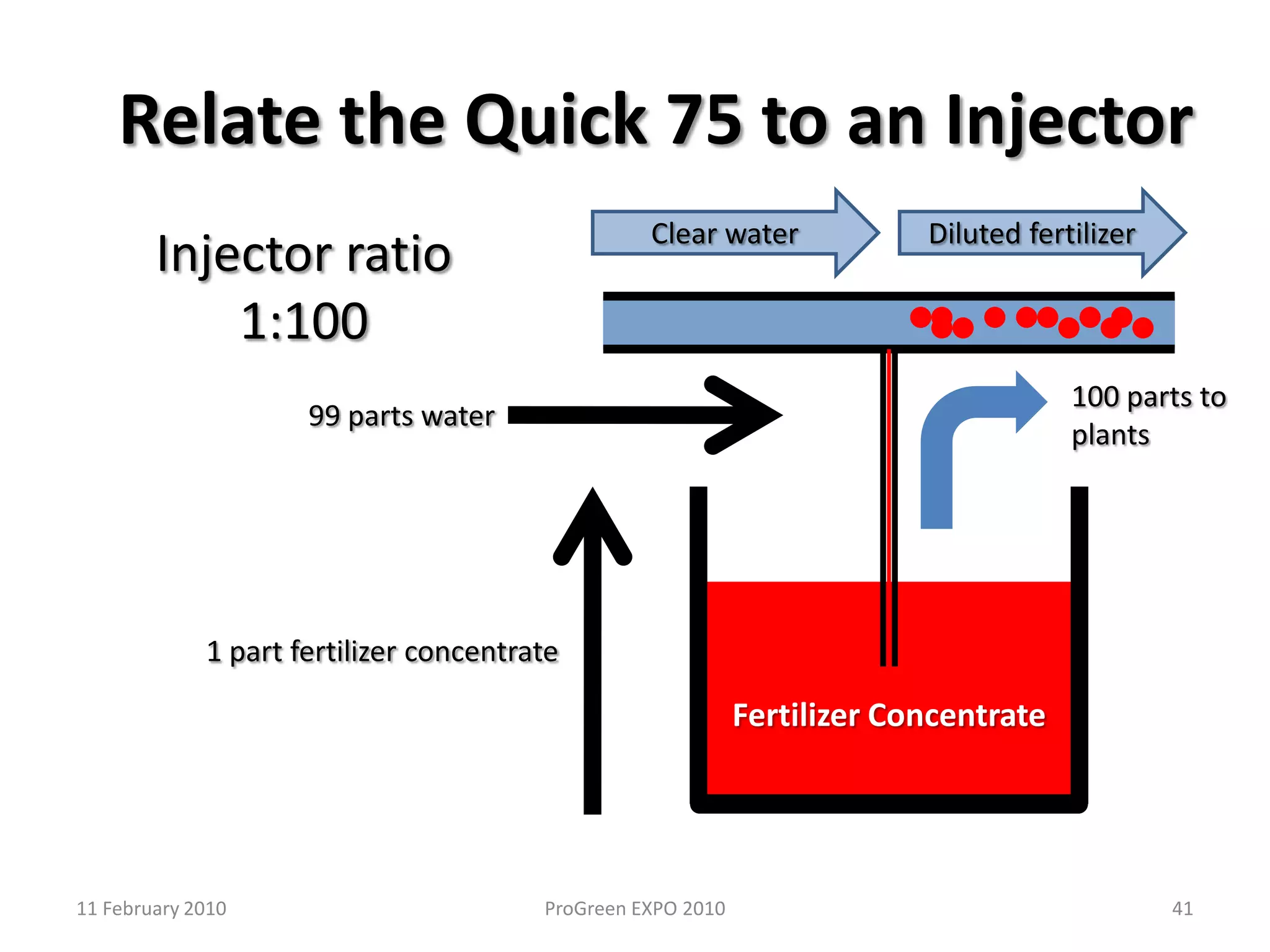
How Fertilizer Injectors WorkOne part of stock solution is mixed with “x” parts of water in the waterline, where “x” is determined by the injector ratio.The size of the stock tank can vary from as small as 5 gallons to as large as 2,000 gallons.A 5-gallon stock tank used with a 1:100 injector ratio will yield 500 gallons of final solution.Often, injector ratios are expressed as a percentage.Injector ratios expressed as percentages1:50	= 	2%1:100	= 	1%1:200	= 	0.5%1:500	= 	0.2%311 February 2010ProGreen EXPO 2010
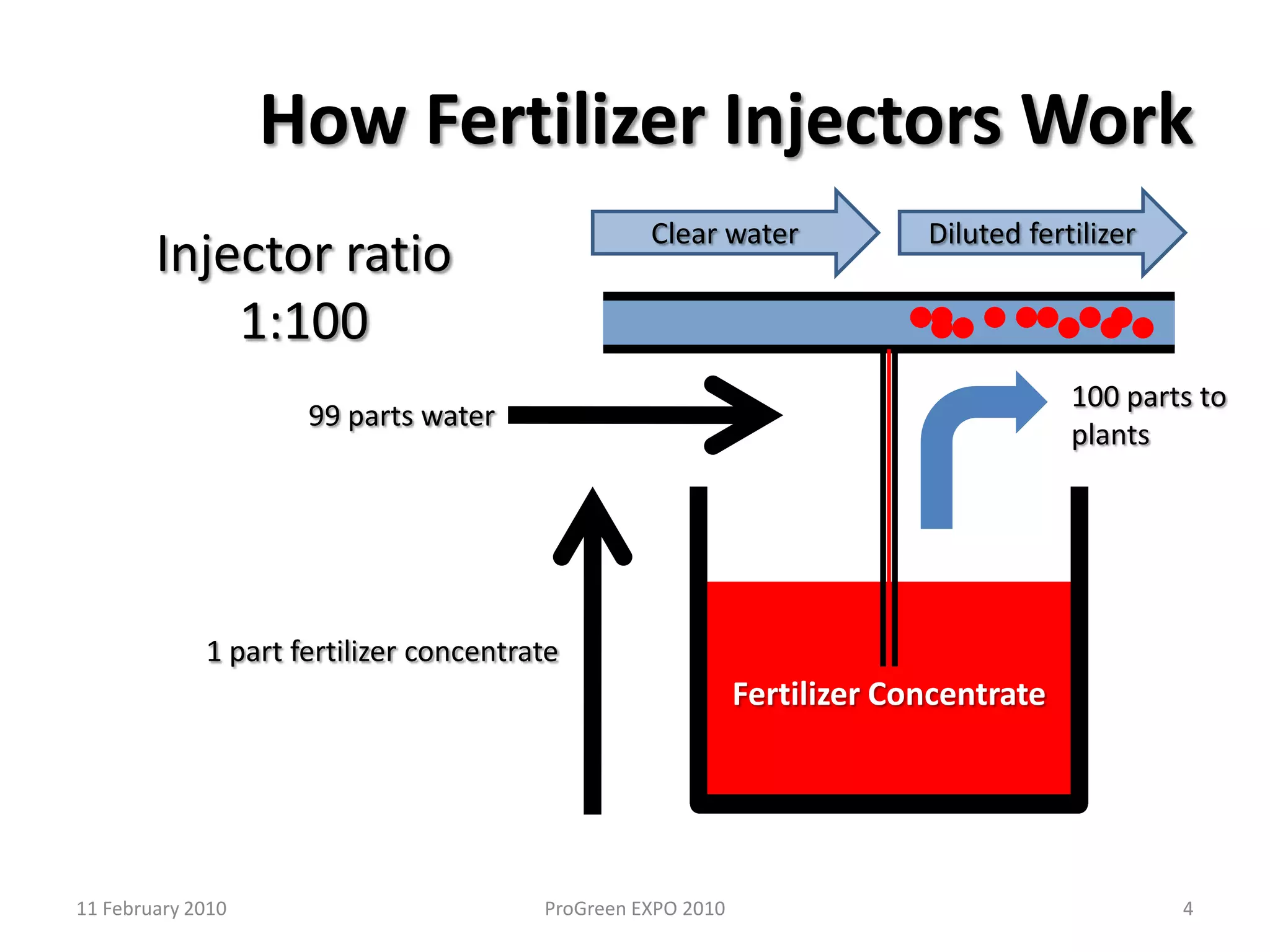
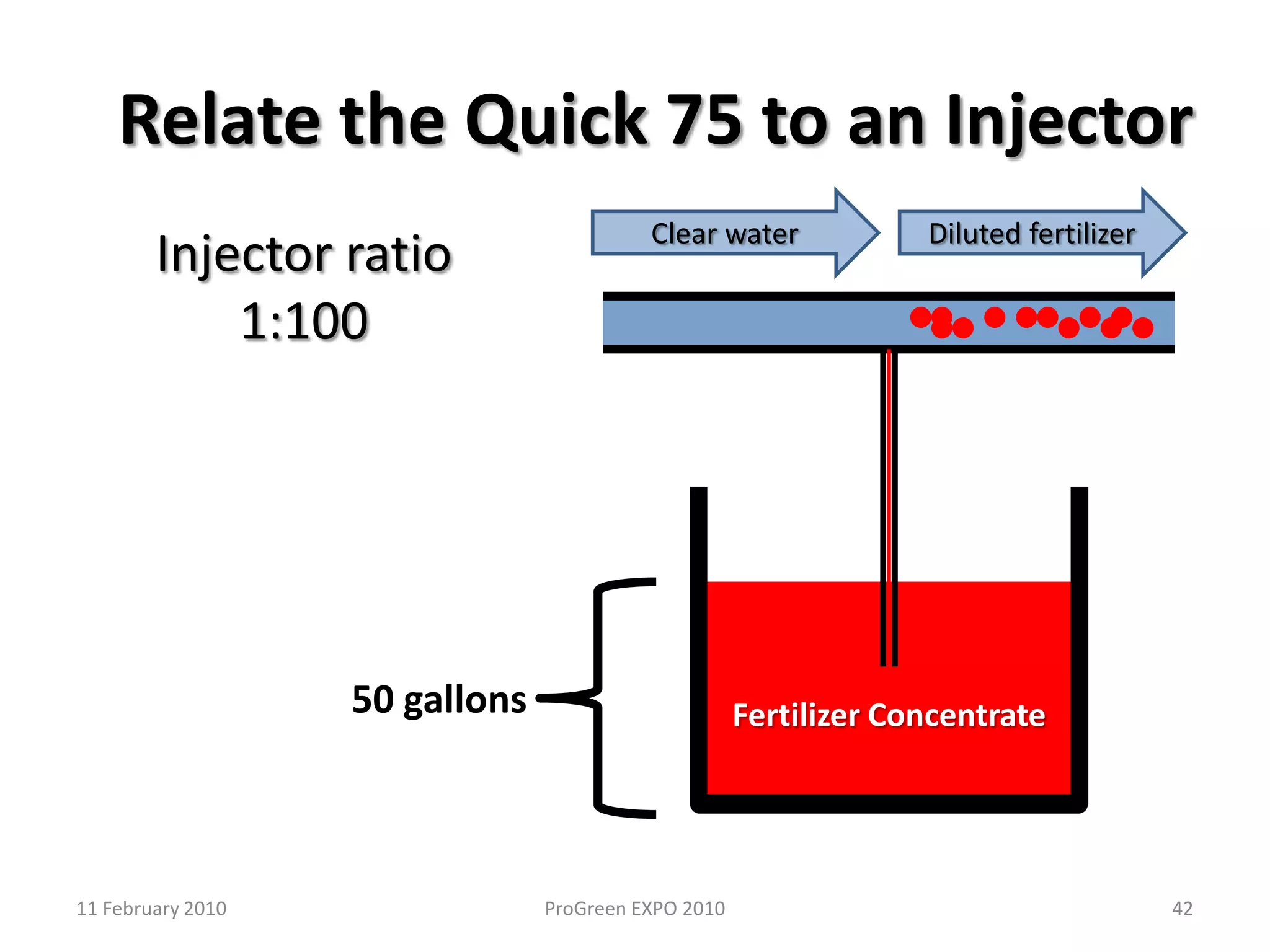
How Fertilizer Injectors Work411 February 2010ProGreen EXPO 2010Clear waterDiluted fertilizerInjector ratio1:100100 parts toplants99 parts waterFertilizer Concentrate1 part fertilizer concentrate
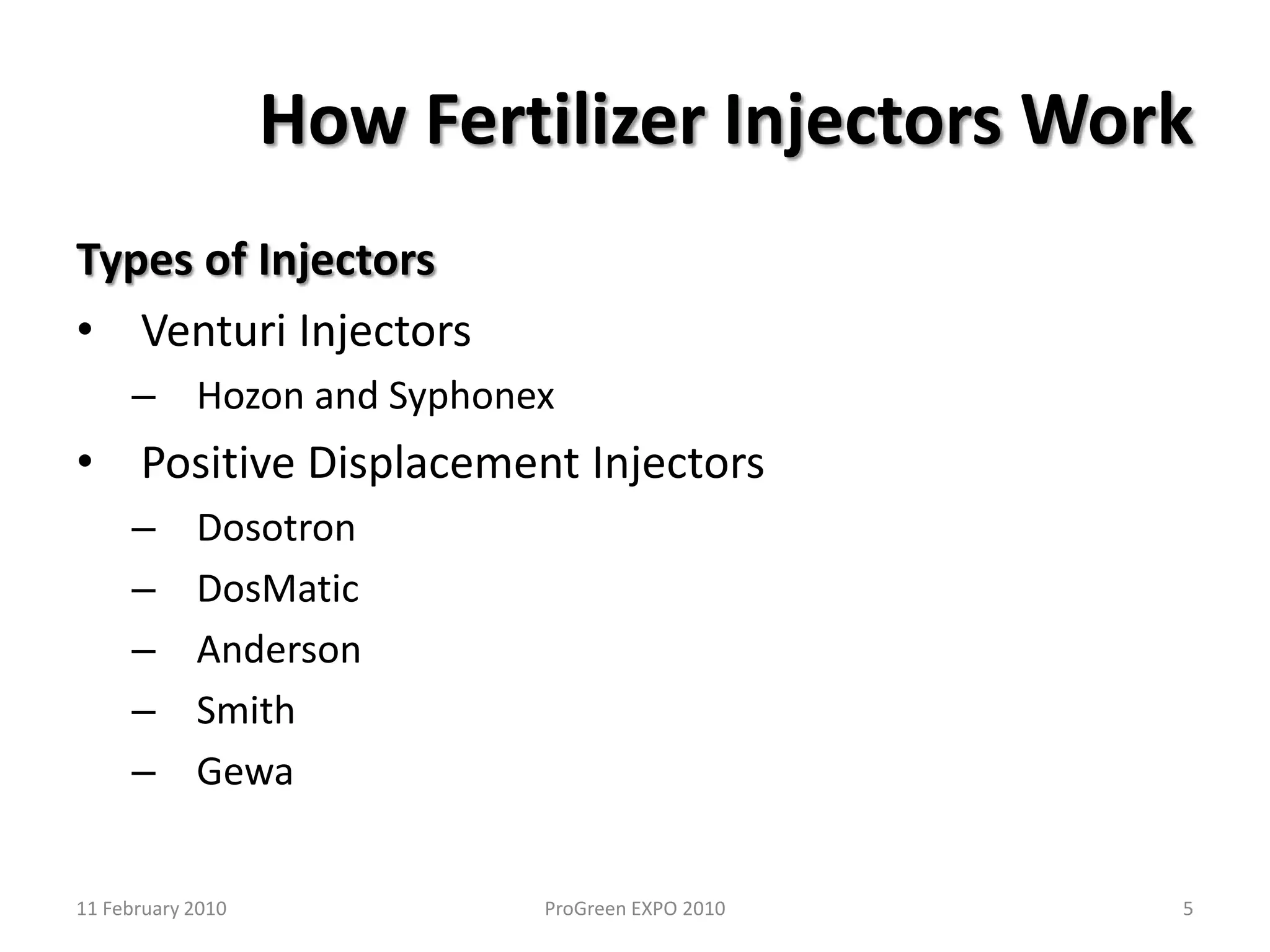
How Fertilizer Injectors WorkTypes of InjectorsVenturi InjectorsHozon and SyphonexPositive Displacement InjectorsDosotronDosMaticAndersonSmithGewa511 February 2010ProGreen EXPO 2010
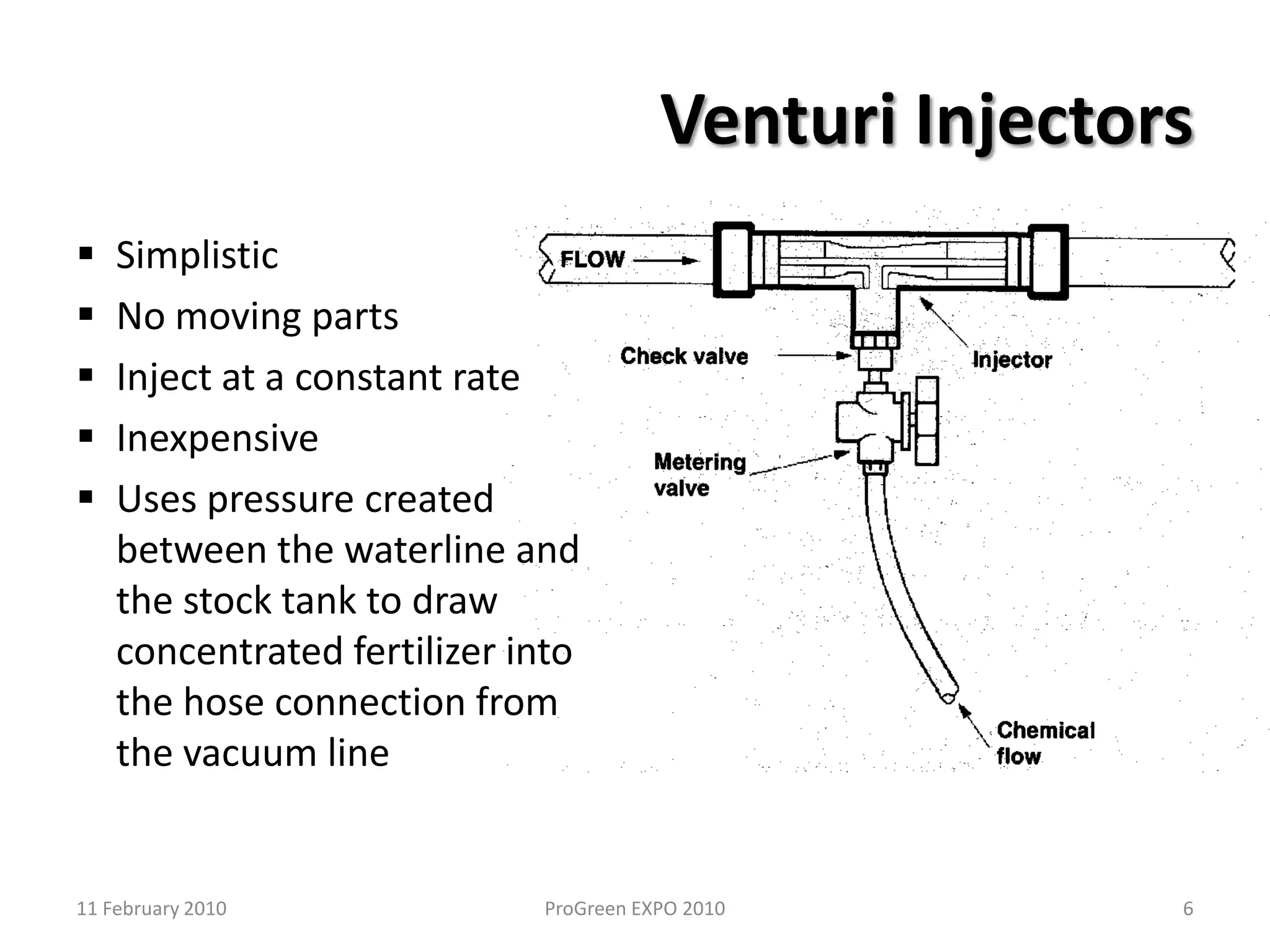
Venturi Injectors611 February 2010ProGreen EXPO 2010Simplistic
No moving parts
Inject at a constant rate
Inexpensive
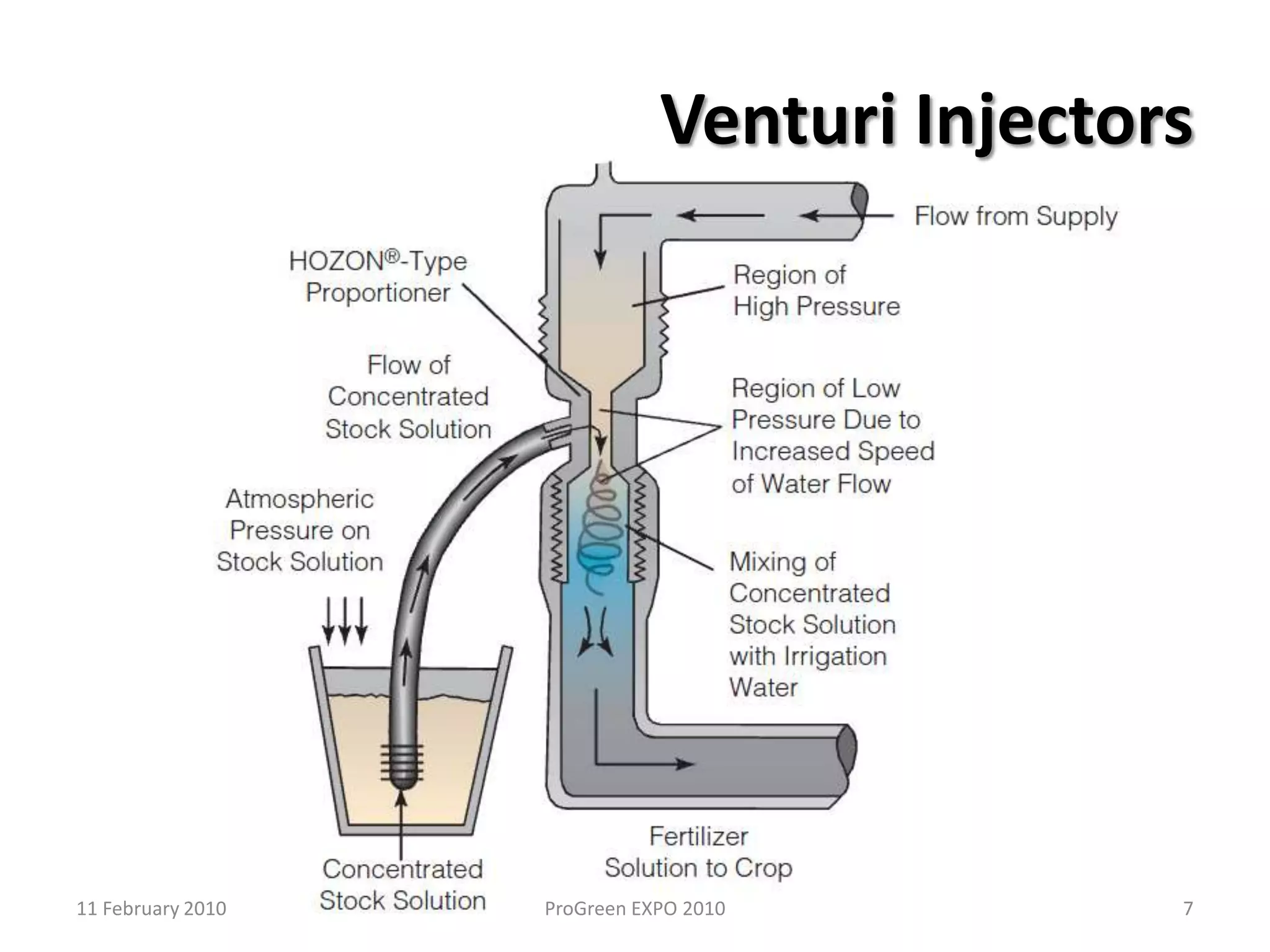
Uses pressure created between the waterline and the stock tank to draw concentrated fertilizer into the hose connection from the vacuum lineVenturi Injectors711 February 2010ProGreen EXPO 2010
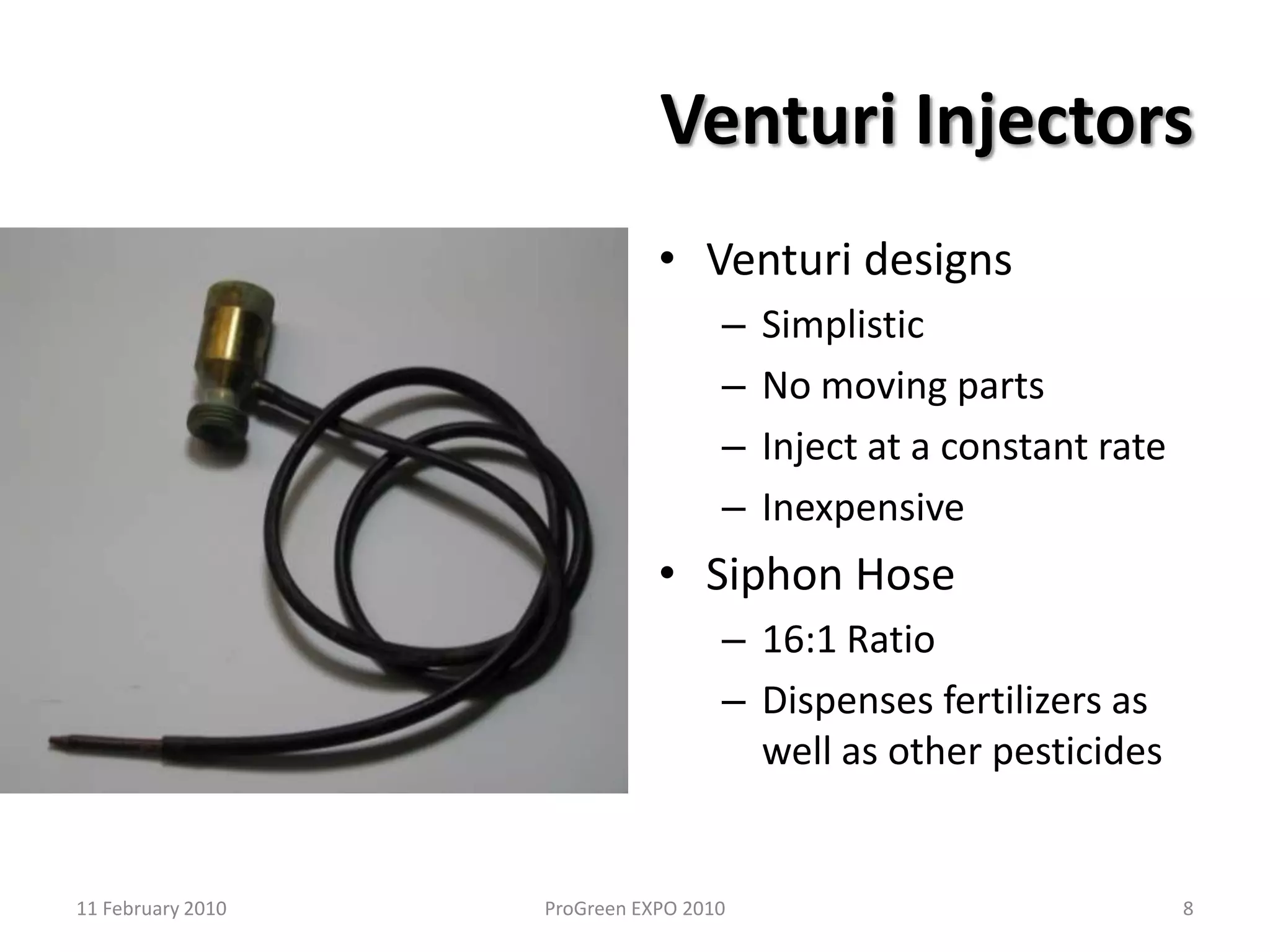
Venturi InjectorsVenturi designsSimplisticNo moving partsInject at a constant rateInexpensiveSiphon Hose16:1 Ratio Dispenses fertilizers as well as other pesticides811 February 2010ProGreen EXPO 2010
Venturi Fertilizer InjectorsProsSimple with no moving partsInexpensiveFlexible for many chemicals including wettable powdersPortableConsBack pressure can stop siphon (check valve)Unit should not be further than 50 feet from hose endReduction in water pressure and flowMinimum 35 psi water pressure911 February 2010ProGreen EXPO 2010
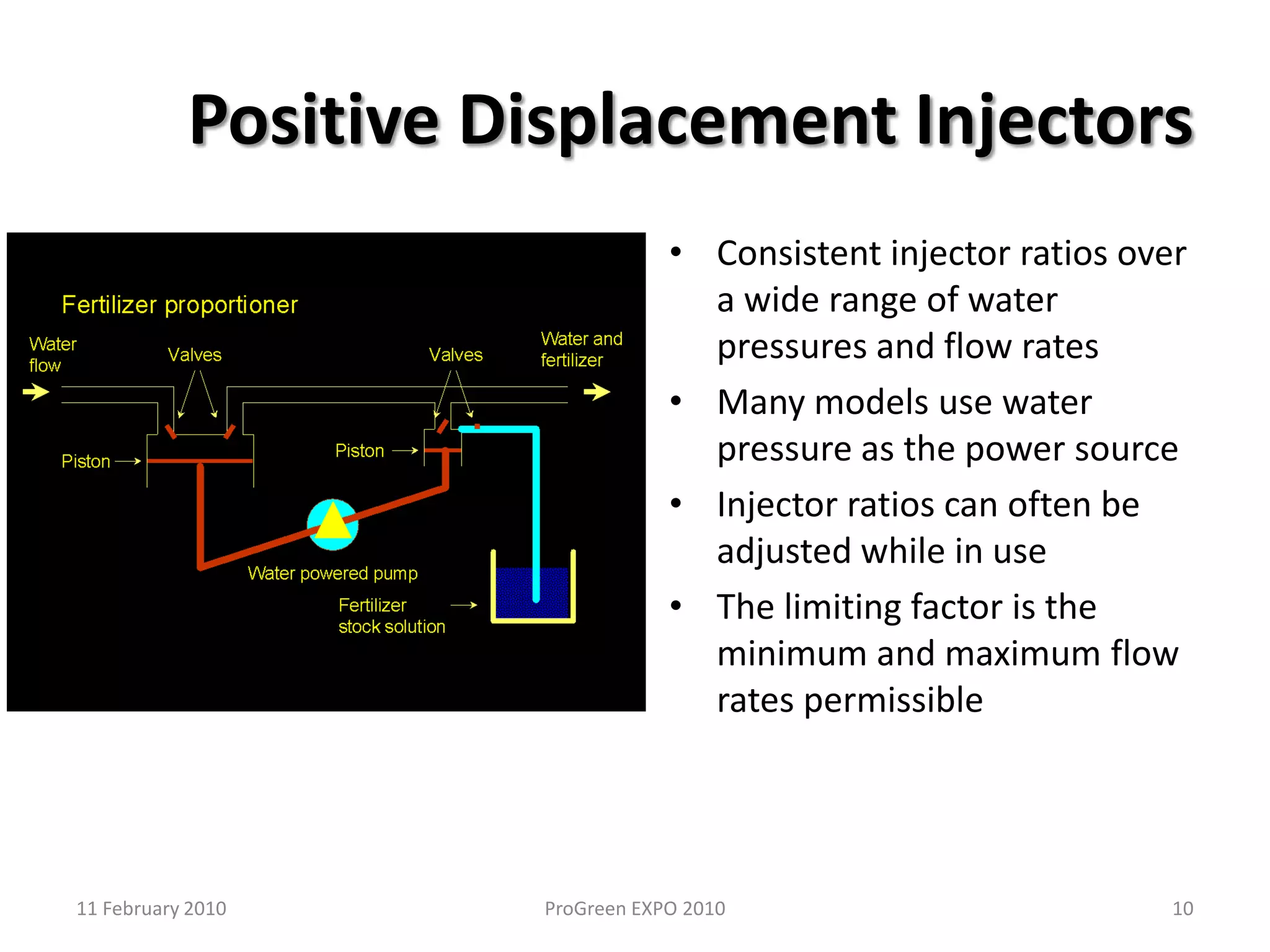
Positive Displacement InjectorsConsistent injector ratios over a wide range of water pressures and flow ratesMany models use water pressure as the power sourceInjector ratios can often be adjusted while in useThe limiting factor is the minimum and maximum flow rates permissible1011 February 2010ProGreen EXPO 2010
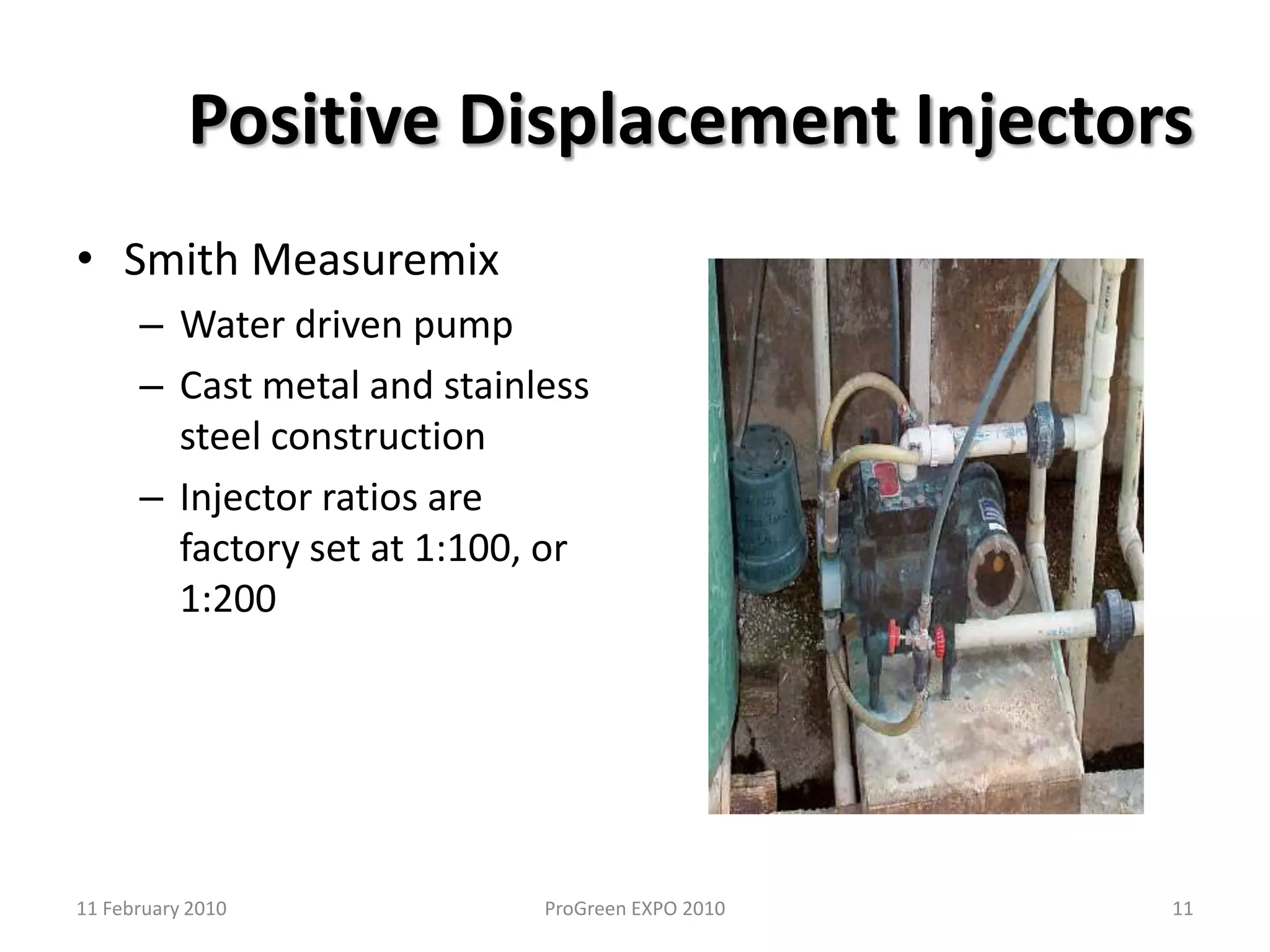
Positive Displacement InjectorsSmith MeasuremixWater driven pumpCast metal and stainless steel constructionInjector ratios are factory set at 1:100, or 1:2001111 February 2010ProGreen EXPO 2010
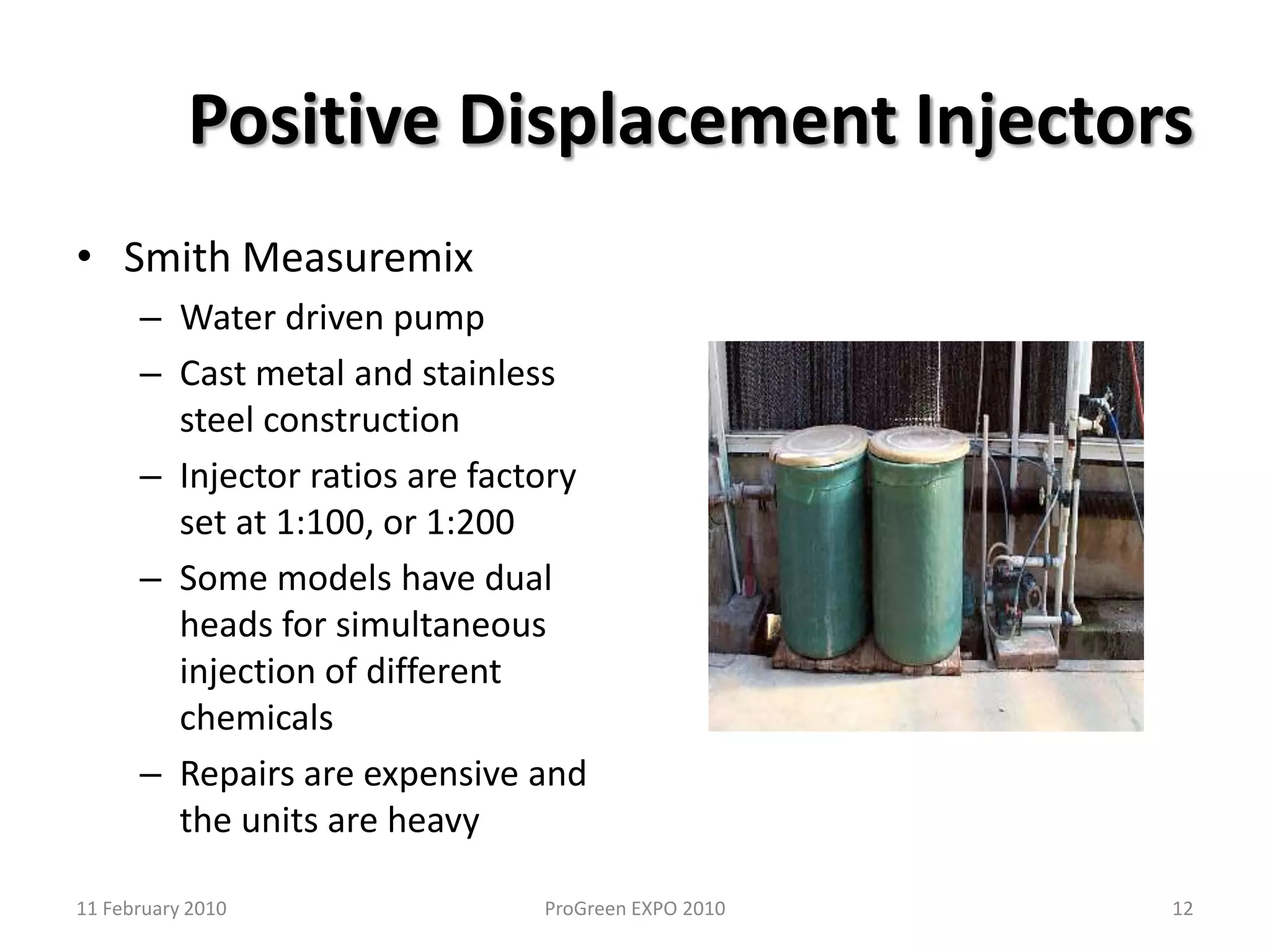
Positive Displacement InjectorsSmith MeasuremixWater driven pumpCast metal and stainless steel constructionInjector ratios are factory set at 1:100, or 1:200Some models have dual heads for simultaneous injection of different chemicalsRepairs are expensive and the units are heavy1211 February 2010ProGreen EXPO 2010
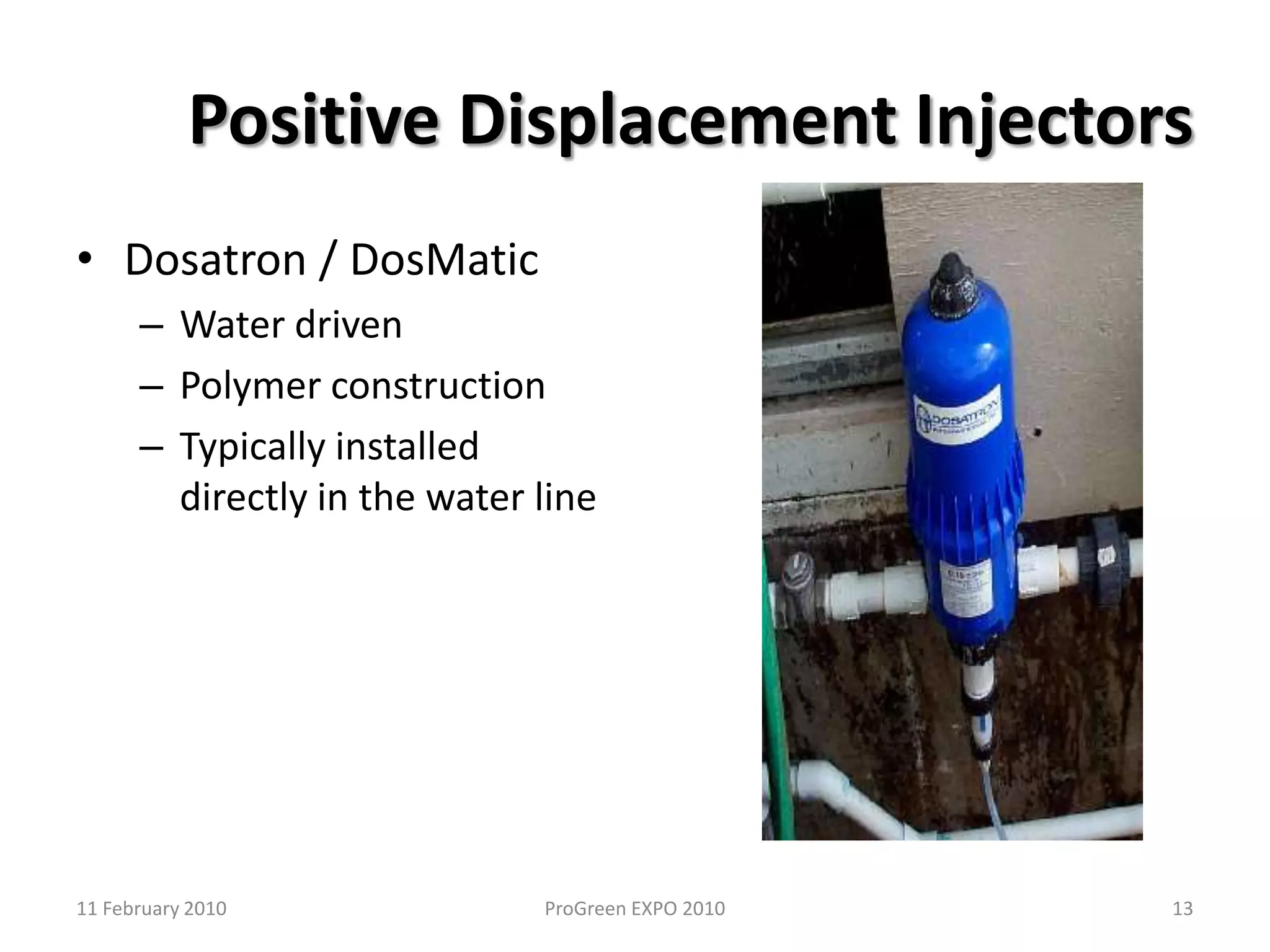
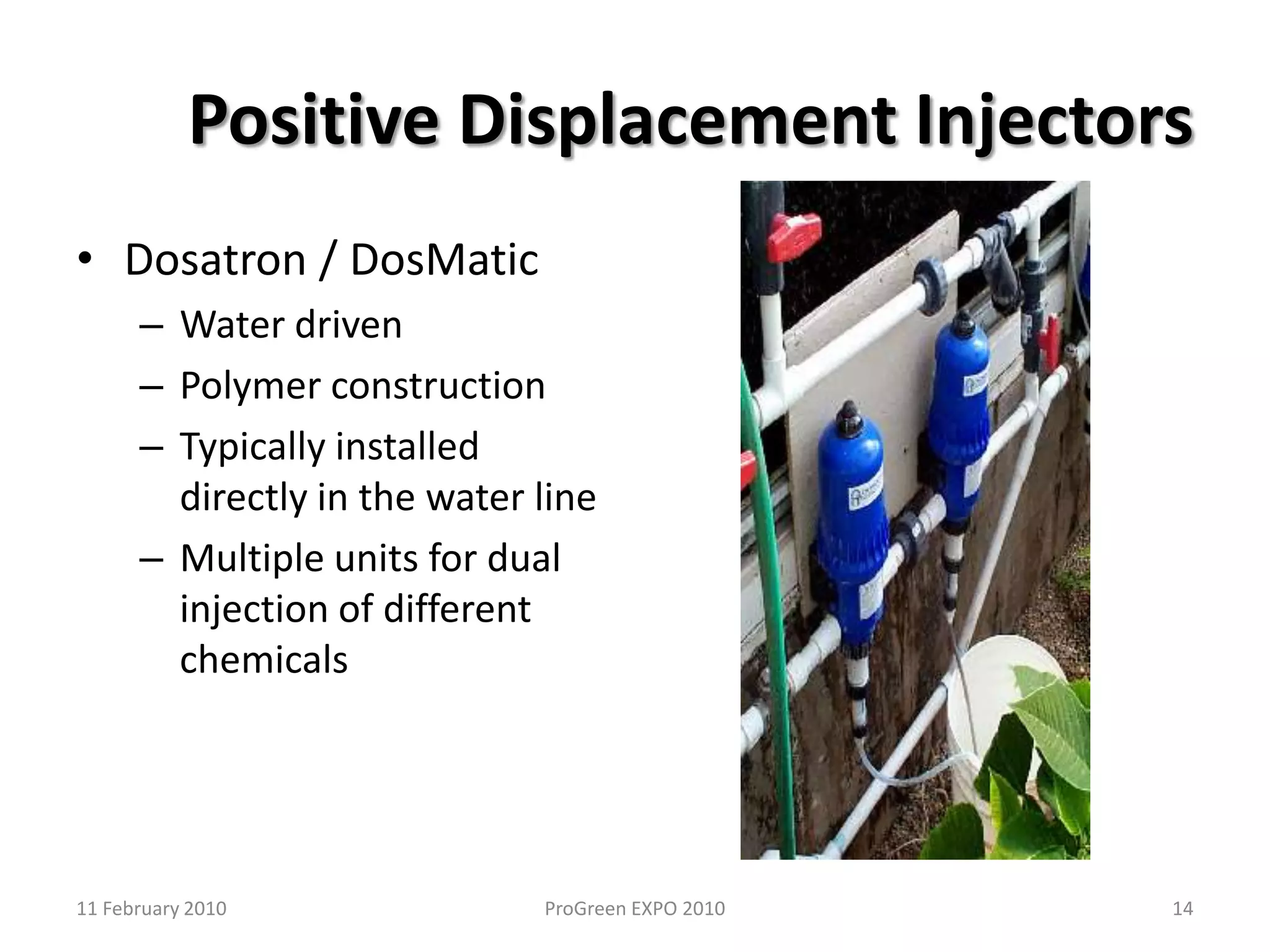
Positive Displacement InjectorsDosatron / DosMaticWater drivenPolymer constructionTypically installed directly in the water line1311 February 2010ProGreen EXPO 2010
Positive Displacement InjectorsDosatron / DosMaticWater drivenPolymer constructionTypically installed directly in the water lineMultiple units for dual injection of different chemicals1411 February 2010ProGreen EXPO 2010
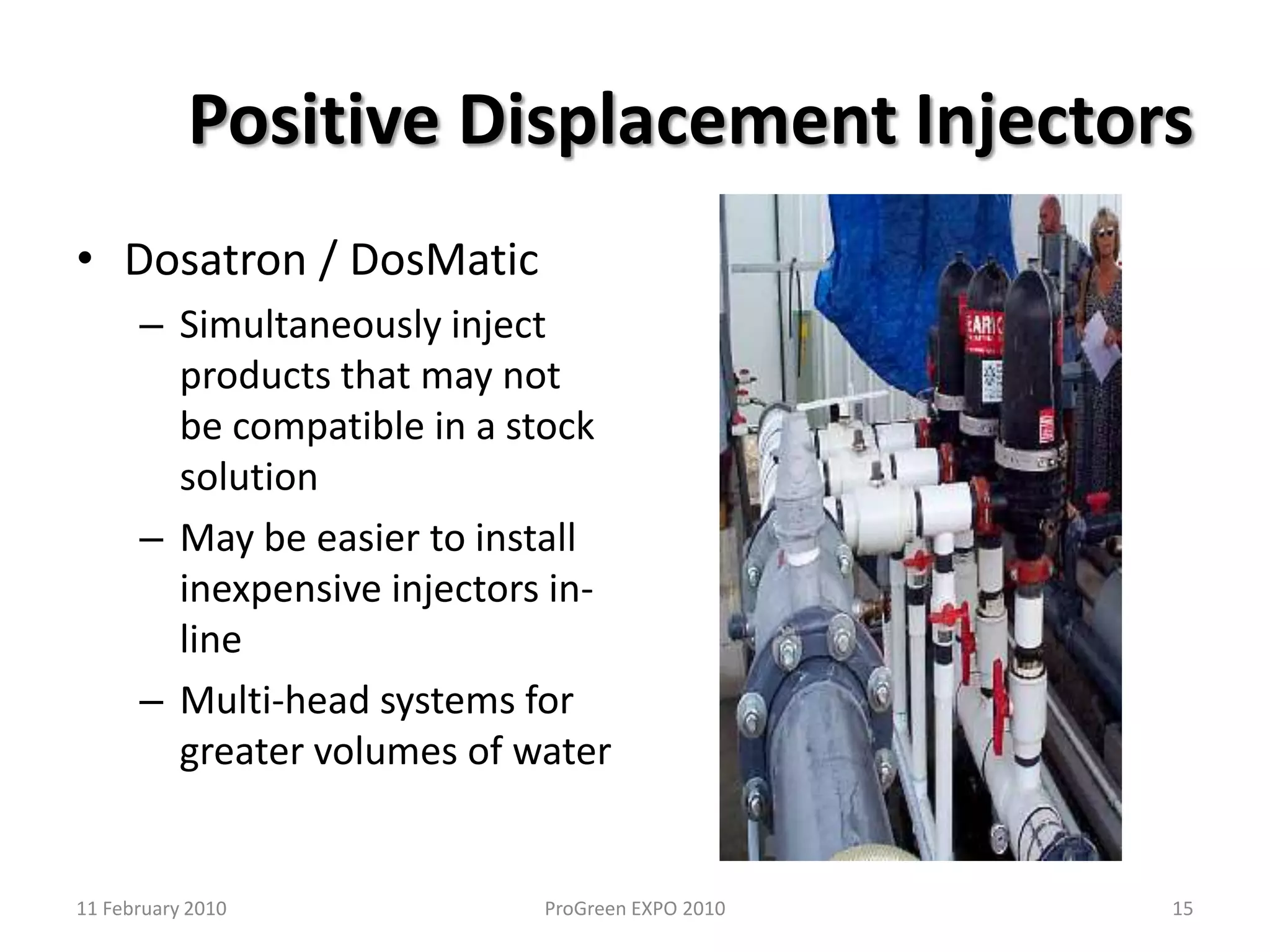
Positive Displacement InjectorsDosatron / DosMaticSimultaneously inject products that may not be compatible in a stock solutionMay be easier to install inexpensive injectors in-lineMulti-head systems for greater volumes of water1511 February 2010ProGreen EXPO 2010
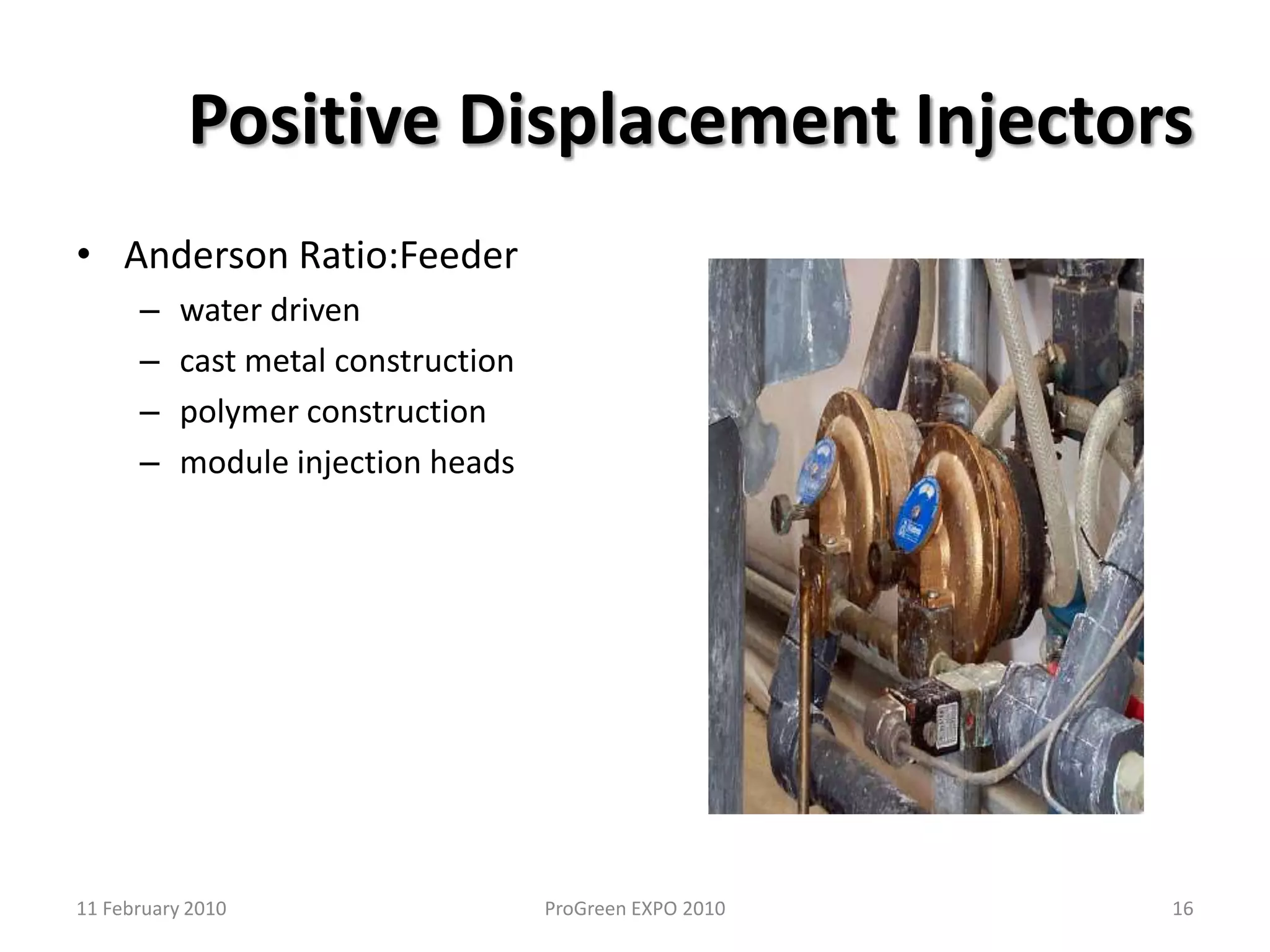
Positive Displacement InjectorsAnderson Ratio:Feederwater drivencast metal constructionpolymer constructionmodule injection heads1611 February 2010ProGreen EXPO 2010
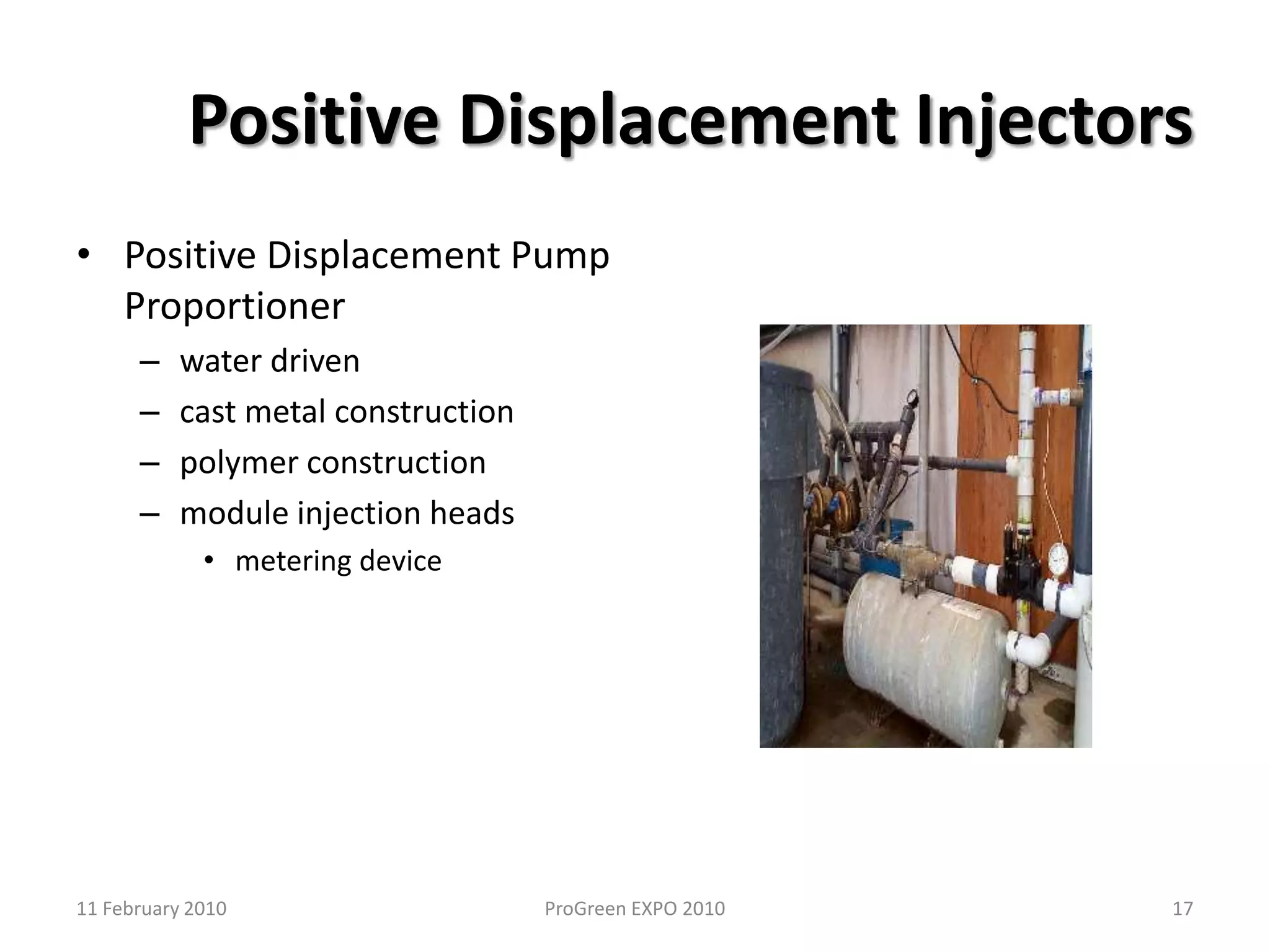
Positive Displacement InjectorsPositive Displacement Pump Proportionerwater drivencast metal constructionpolymer constructionmodule injection headsmetering device1711 February 2010ProGreen EXPO 2010
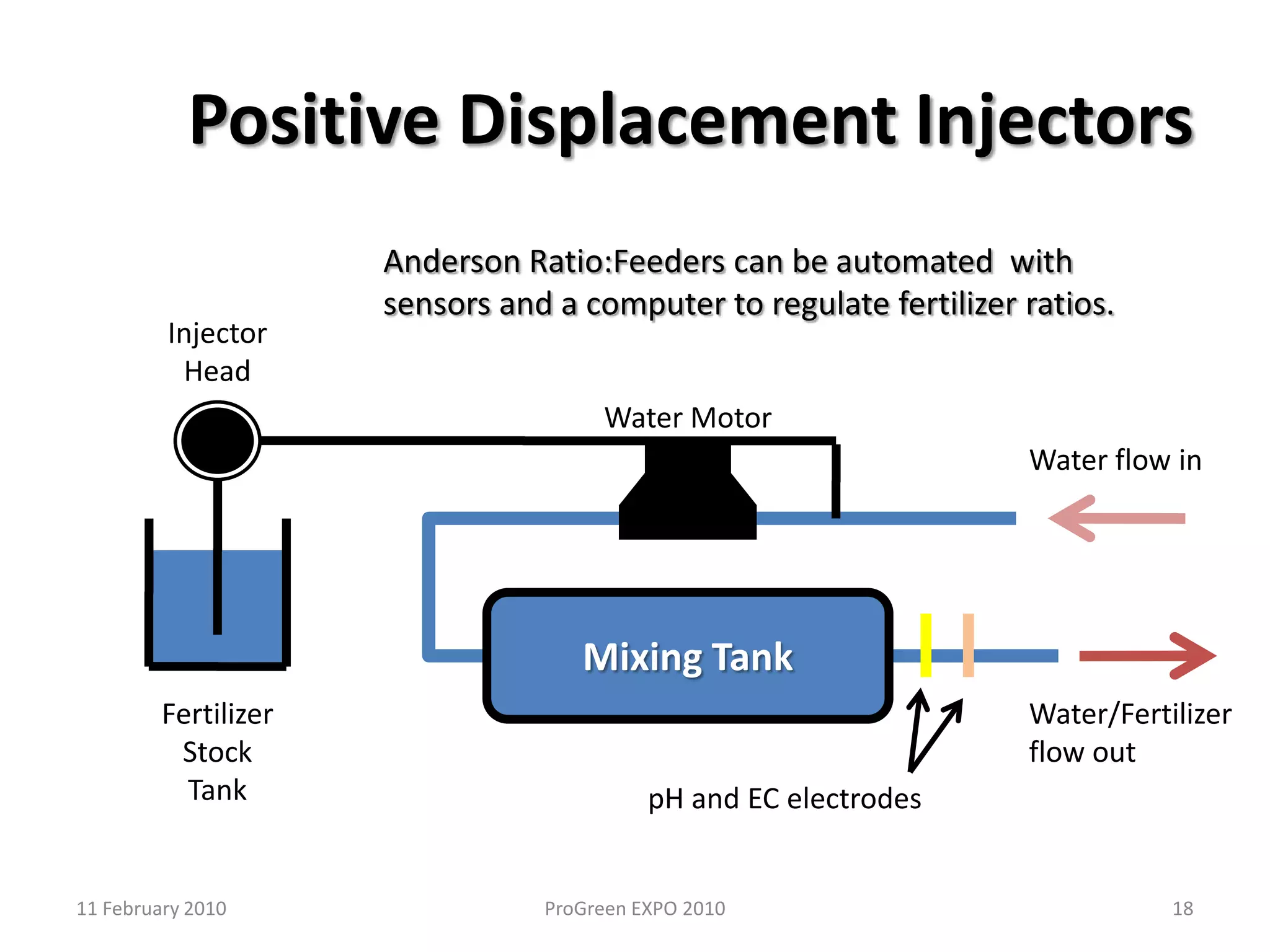
Positive Displacement Injectors1811 February 2010ProGreen EXPO 2010Anderson Ratio:Feeders can be automated  with sensors and a computer to regulate fertilizer ratios.InjectorHeadWater MotorWater flow inMixing TankFertilizerStockTankWater/Fertilizerflow outpH and EC electrodes
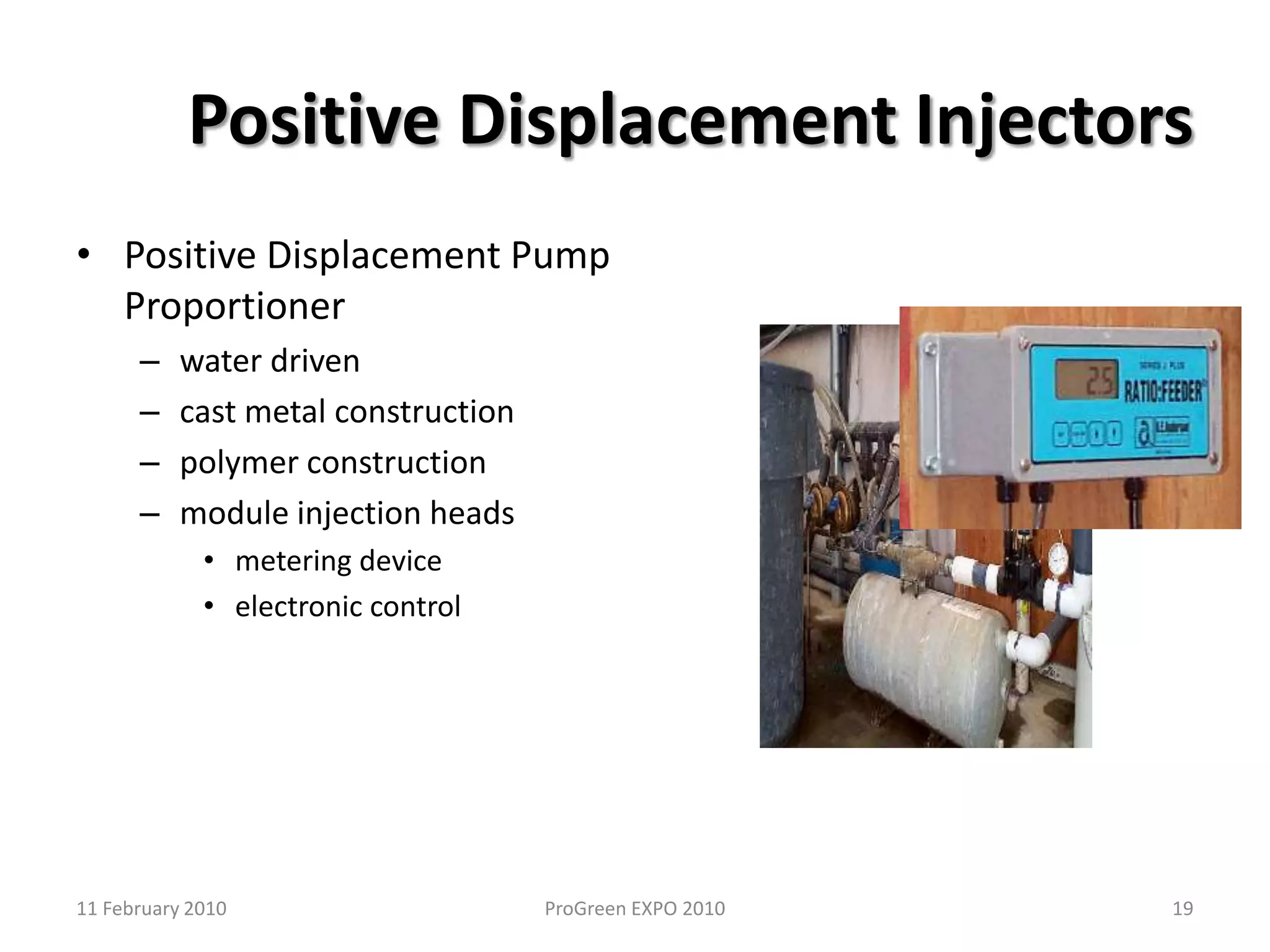
Positive Displacement InjectorsPositive Displacement Pump Proportionerwater drivencast metal constructionpolymer constructionmodule injection headsmetering deviceelectronic control1911 February 2010ProGreen EXPO 2010
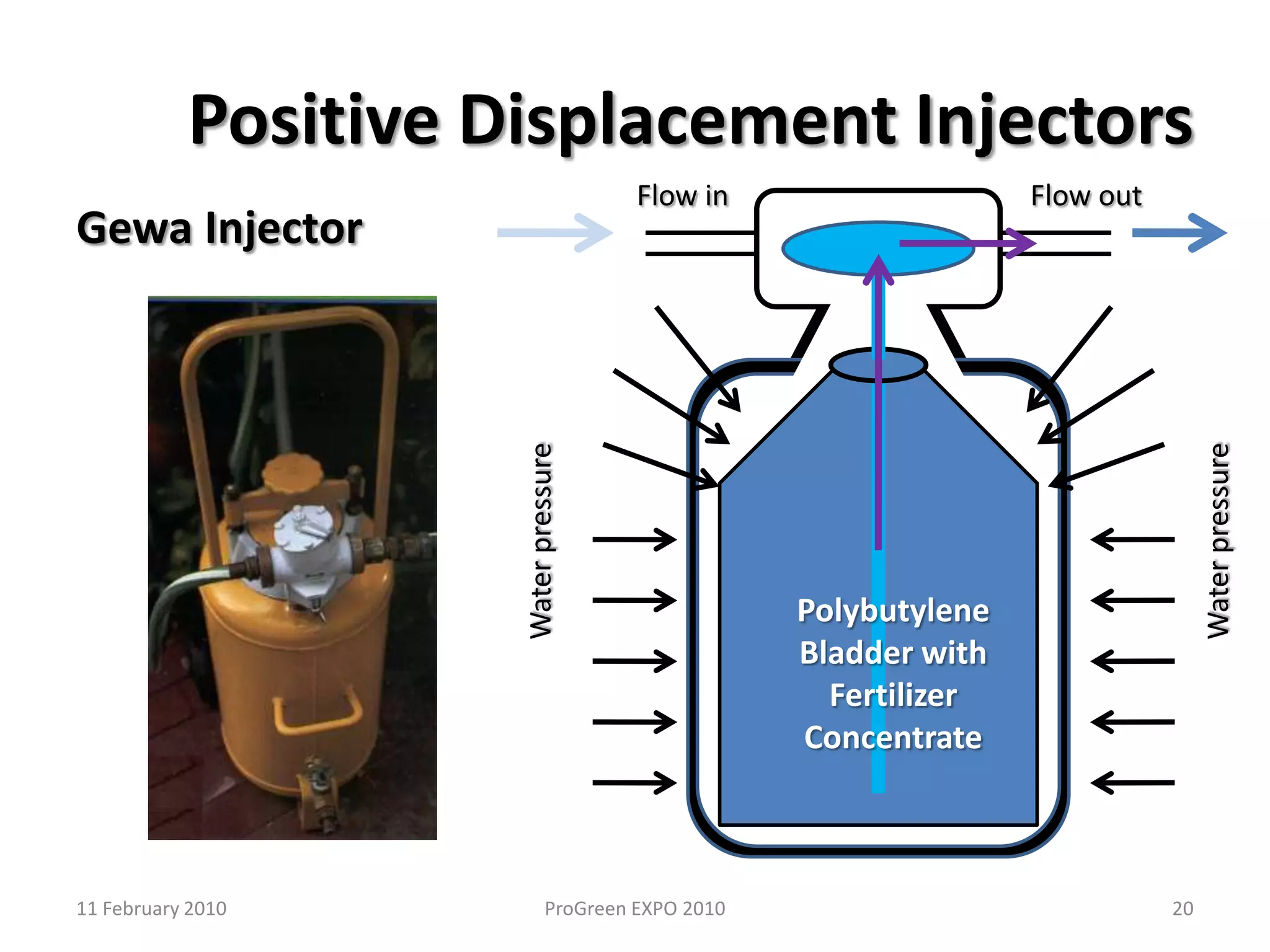
Positive Displacement InjectorsGewa Injector2011 February 2010ProGreen EXPO 2010Flow inFlow outWater pressureWater pressurePolybutyleneBladder withFertilizerConcentrate
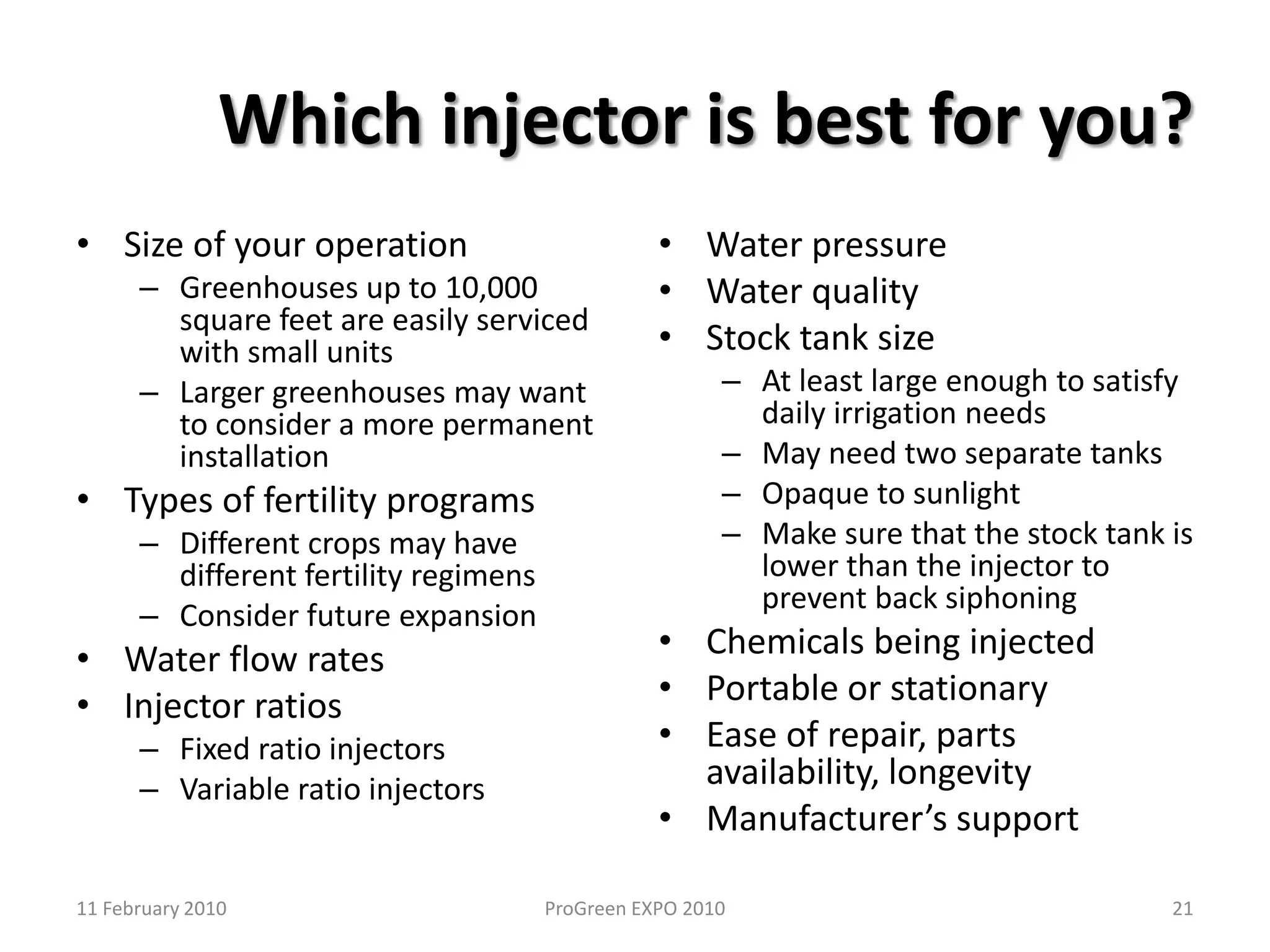
Which injector is best for you?Size of your operationGreenhouses up to 10,000 square feet are easily serviced with small unitsLarger greenhouses may want to consider a more permanent installationTypes of fertility programsDifferent crops may have different fertility regimensConsider future expansionWater flow ratesInjector ratiosFixed ratio injectorsVariable ratio injectorsWater pressureWater qualityStock tank sizeAt least large enough to satisfy daily irrigation needsMay need two separate tanksOpaque to sunlightMake sure that the stock tank is lower than the injector to prevent back siphoning Chemicals being injectedPortable or stationaryEase of repair, parts availability, longevityManufacturer’s support2111 February 2010ProGreen EXPO 2010
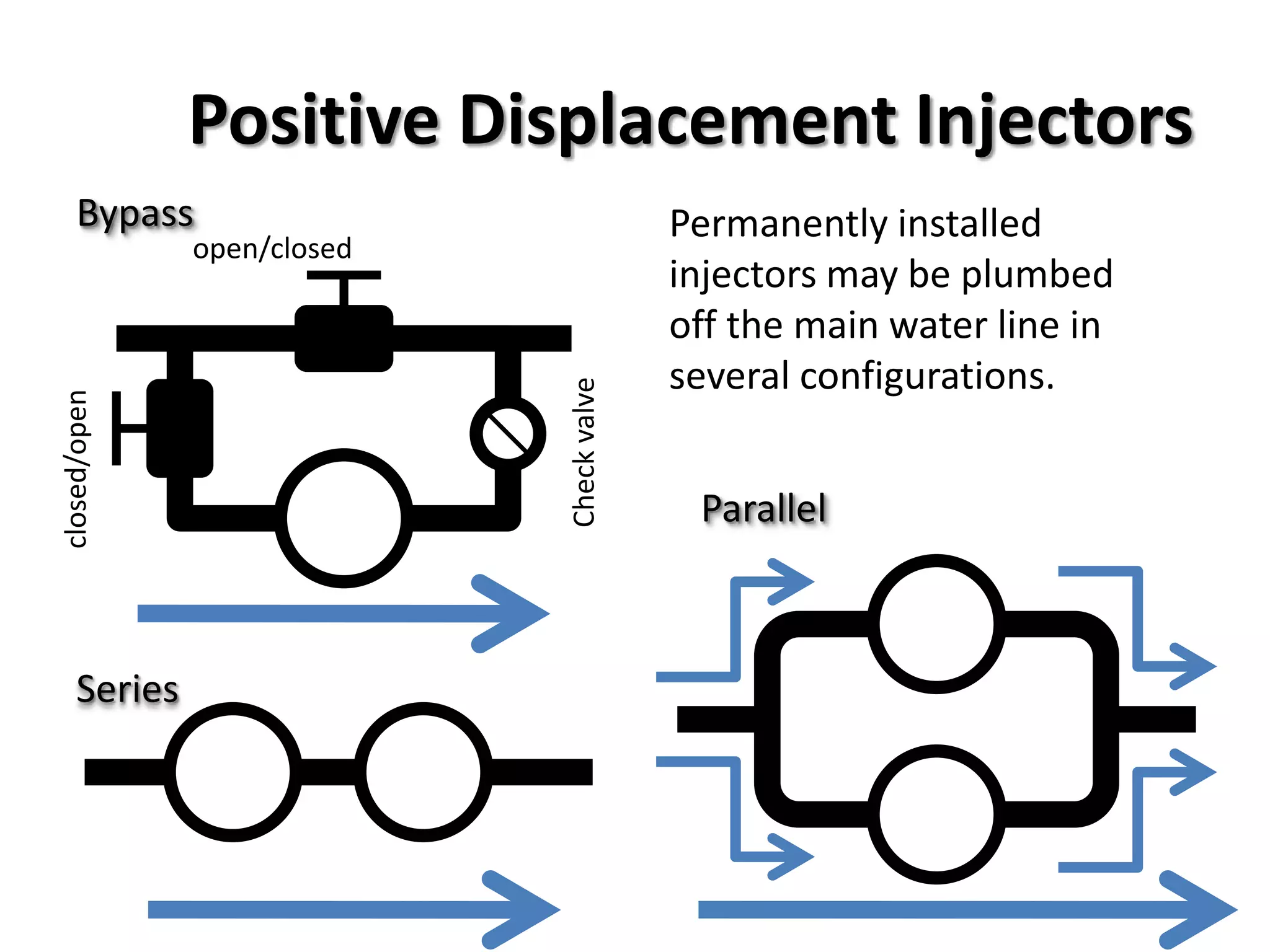
Positive Displacement InjectorsBypassPermanently installed injectors may be plumbed off the main water line in several configurations.open/closedCheck valveclosed/openParallelSeries
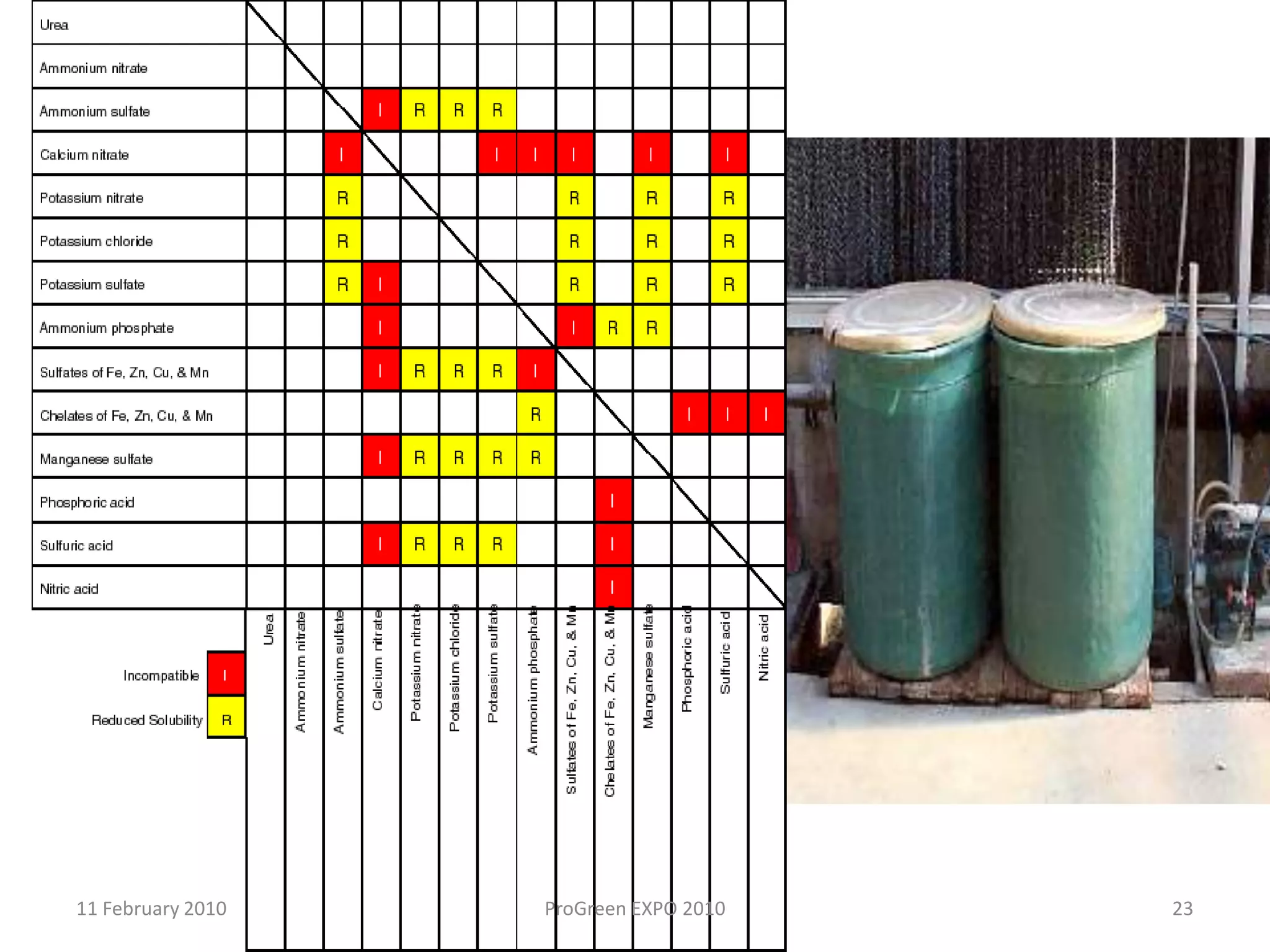
2311 February 2010ProGreen EXPO 2010
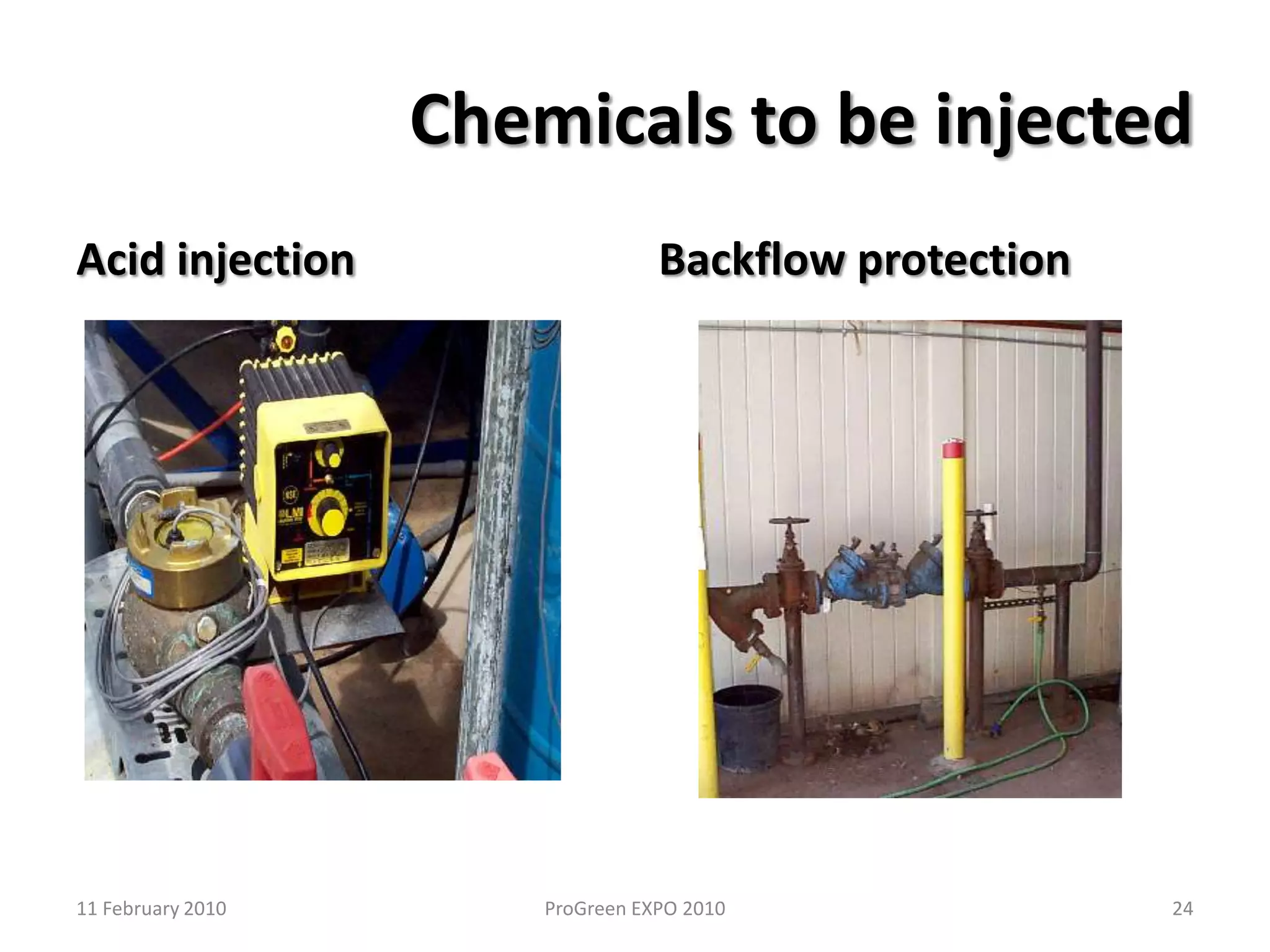
Chemicals to be injectedAcid injectionBackflow protection2411 February 2010ProGreen EXPO 2010
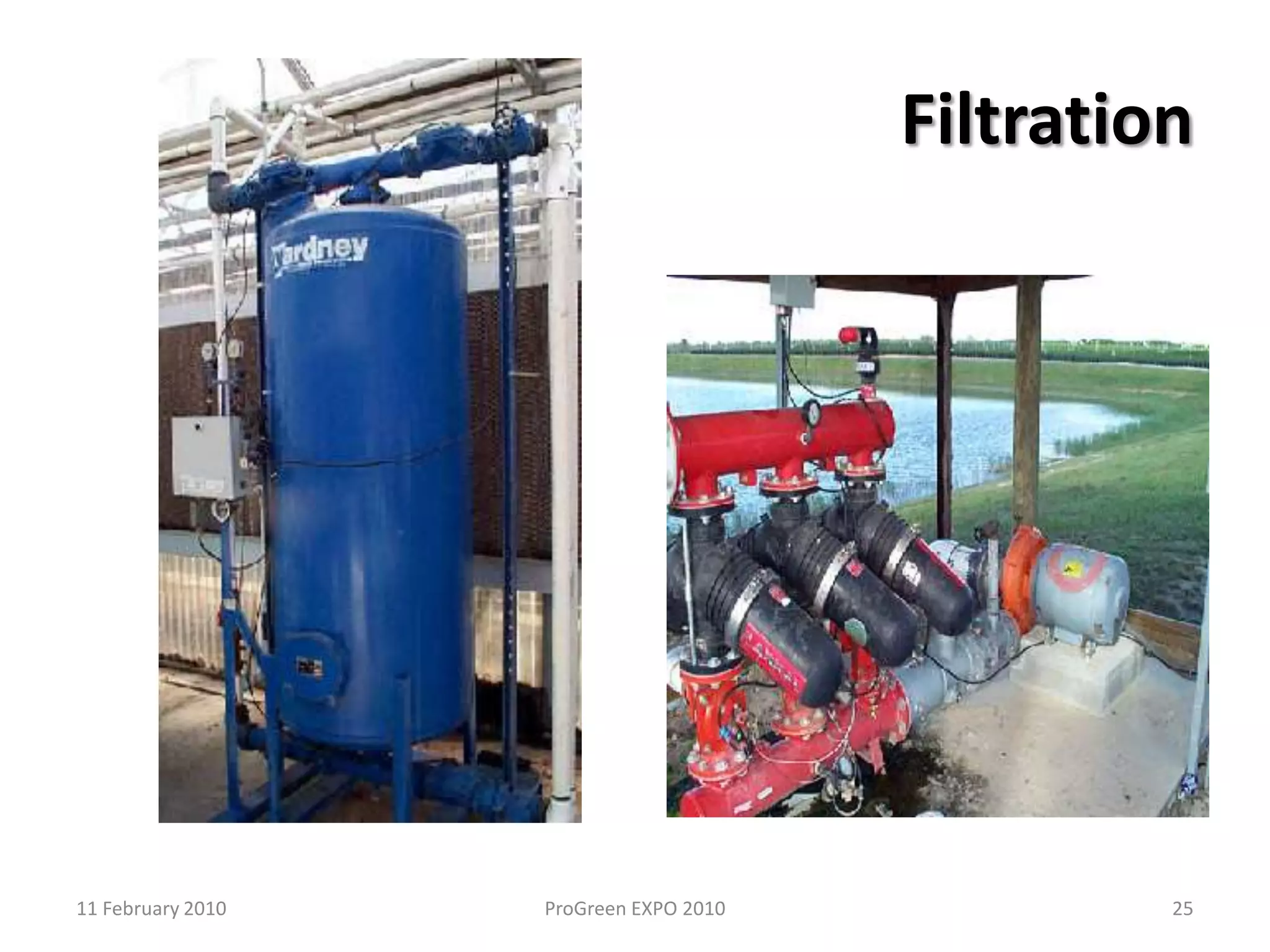
Filtration2511 February 2010ProGreen EXPO 2010
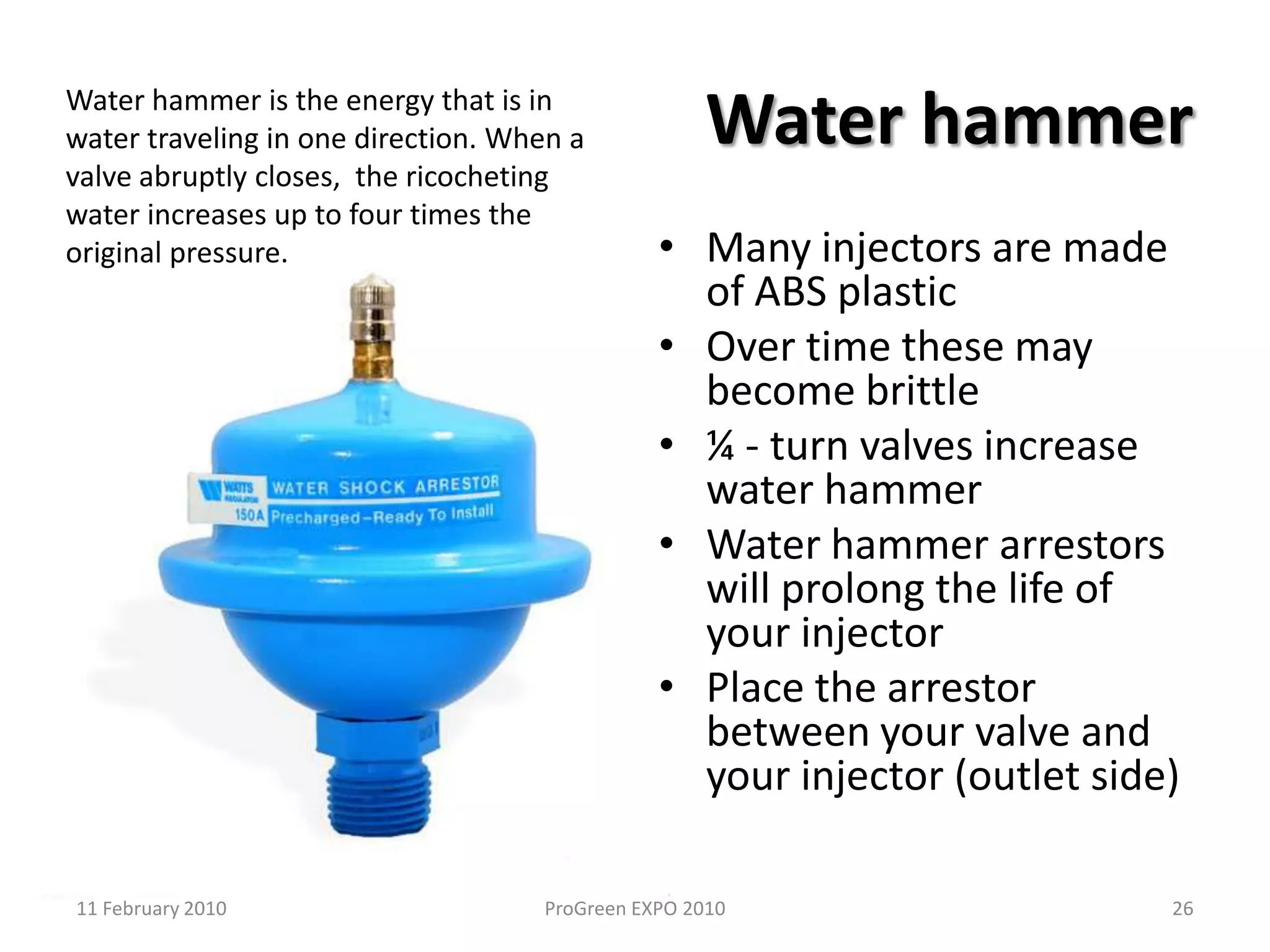
Water hammerMany injectors are made of ABS plasticOver time these may become brittle¼ - turn valves increase water hammerWater hammer arrestors will prolong the life of your injectorPlace the arrestor between your valve and your injector (outlet side)2611 February 2010ProGreen EXPO 2010Water hammer is the energy that is in water traveling in one direction. When a valve abruptly closes,  the ricocheting water increases up to four times the original pressure.
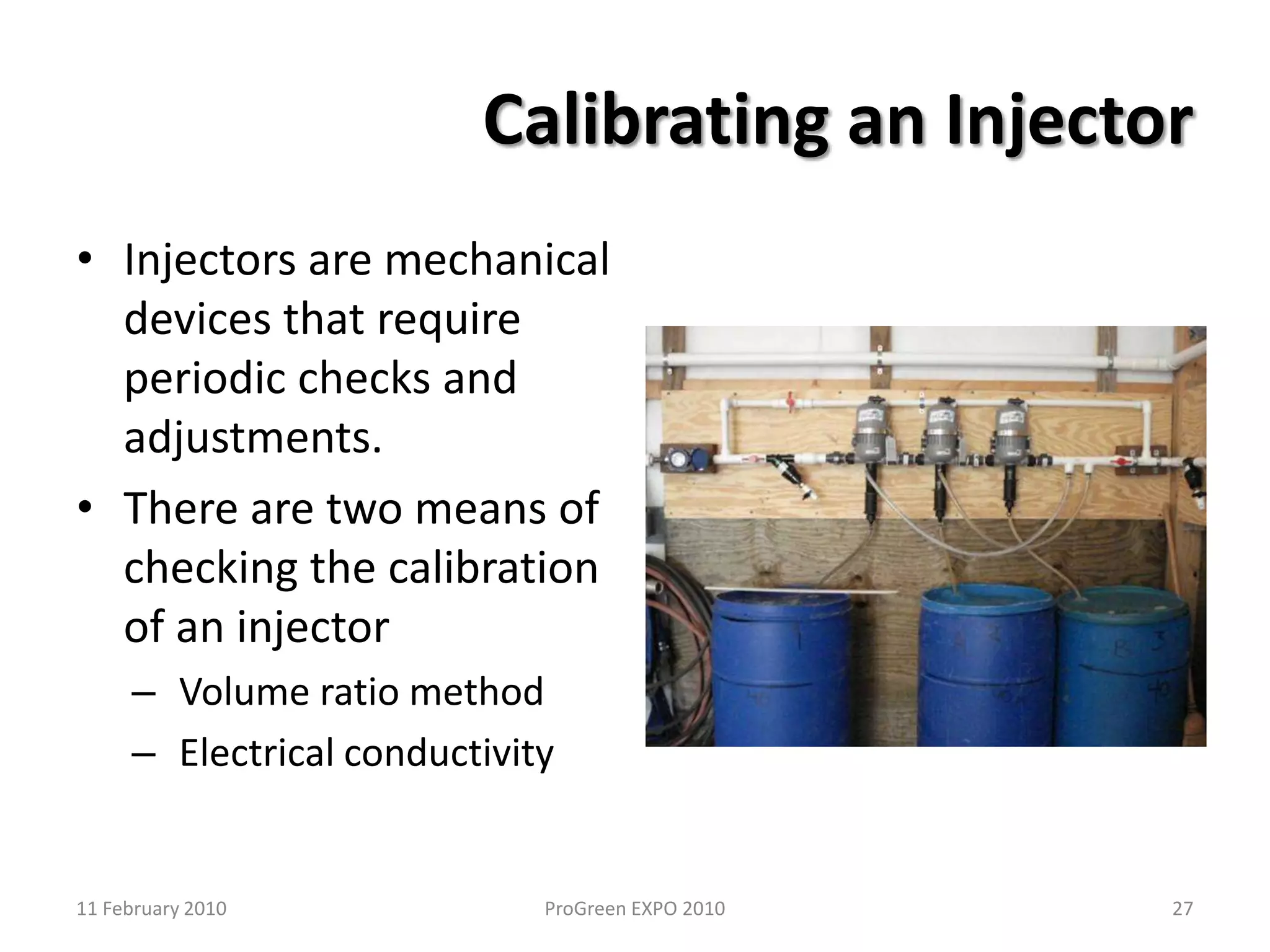
Calibrating an InjectorInjectors are mechanical devices that require periodic checks and adjustments. There are two means of checking the calibration of an injectorVolume ratio methodElectrical conductivity2711 February 2010ProGreen EXPO 2010
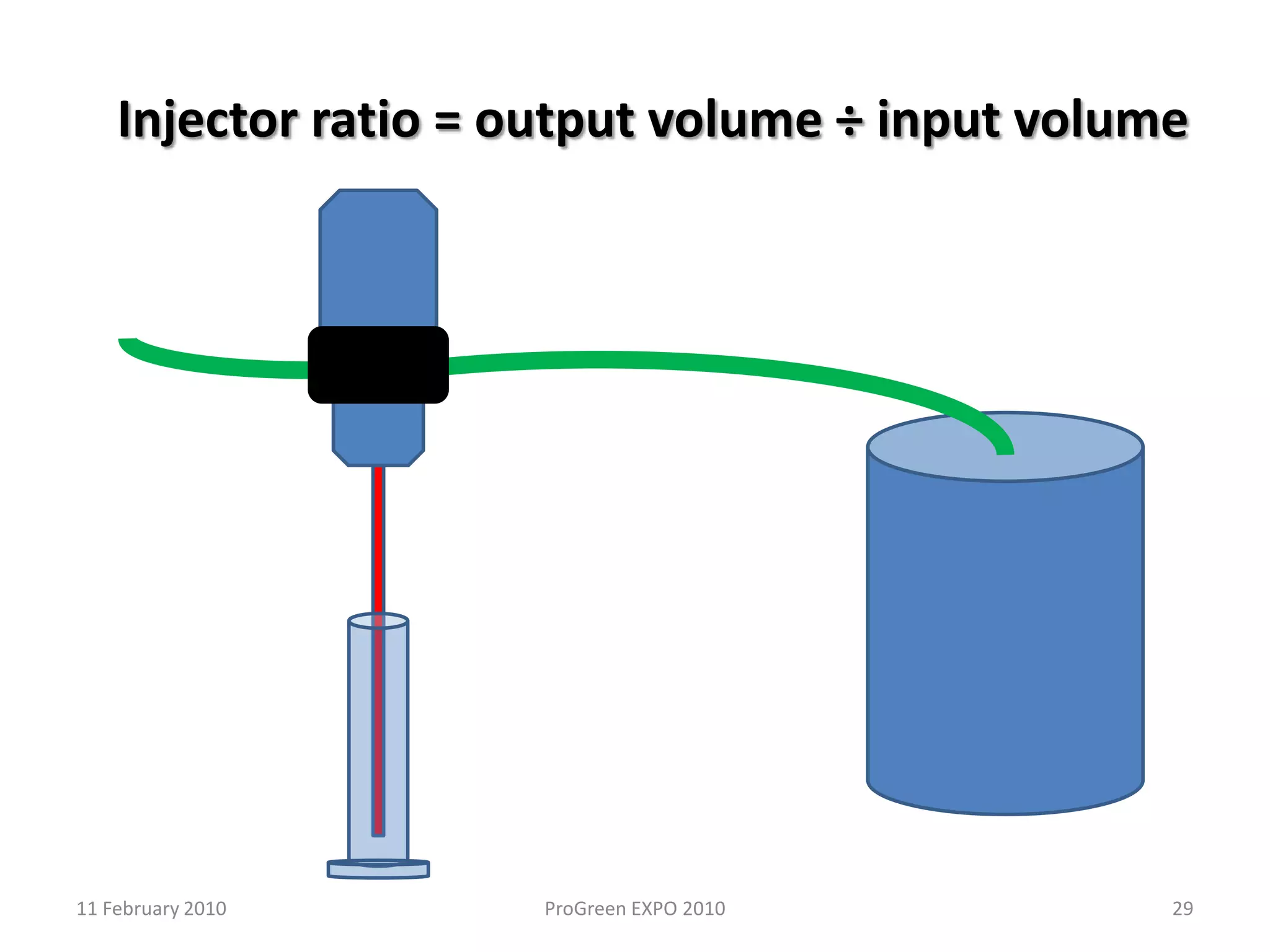
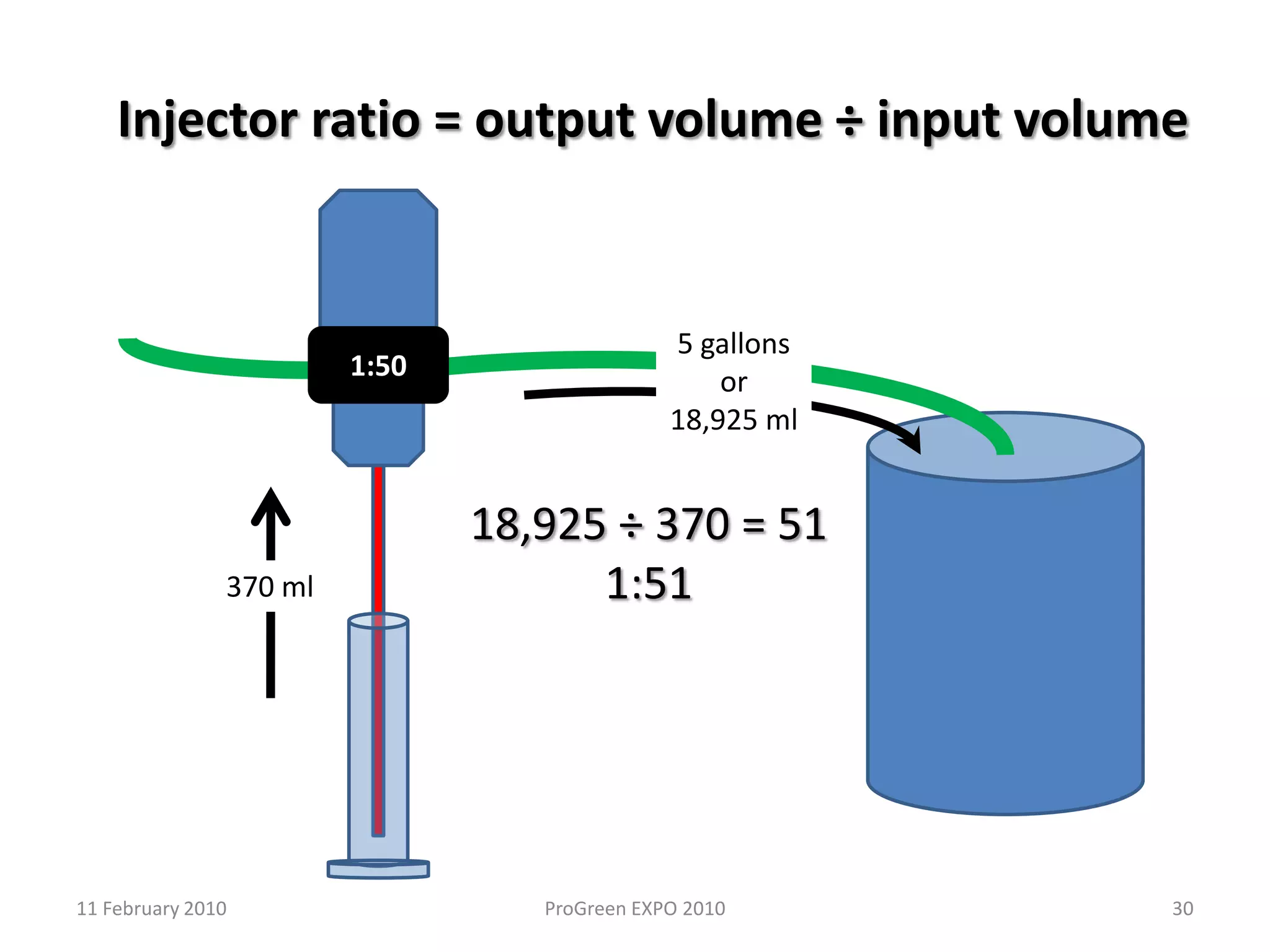
Volume Ratio Calibration MethodEquipmentGraduated cylinderOne or two liter is bestLarge container with a known volumeFive gallon bucketInjector with hoses and tubesProcedurePlace the siphon tube into the graduated cylinder and operate the water and injector at a normal pressureAllow the system to empty one volume of the graduated cylinder to charge the systemRefill the graduated cylinder and run the injector until the cylinder is half emptyDischarge the water from the injector into the large bucket.Measure the uptake volume and the discharge volumeThe injector equals the output volume divided by the input volume2811 February 2010ProGreen EXPO 2010
2911 February 2010ProGreen EXPO 2010Injector ratio = output volume ÷ input volume
3011 February 2010ProGreen EXPO 2010Injector ratio = output volume ÷ input volume5 gallonsor18,925 ml1:5018,925 ÷ 370 = 511:51370 ml
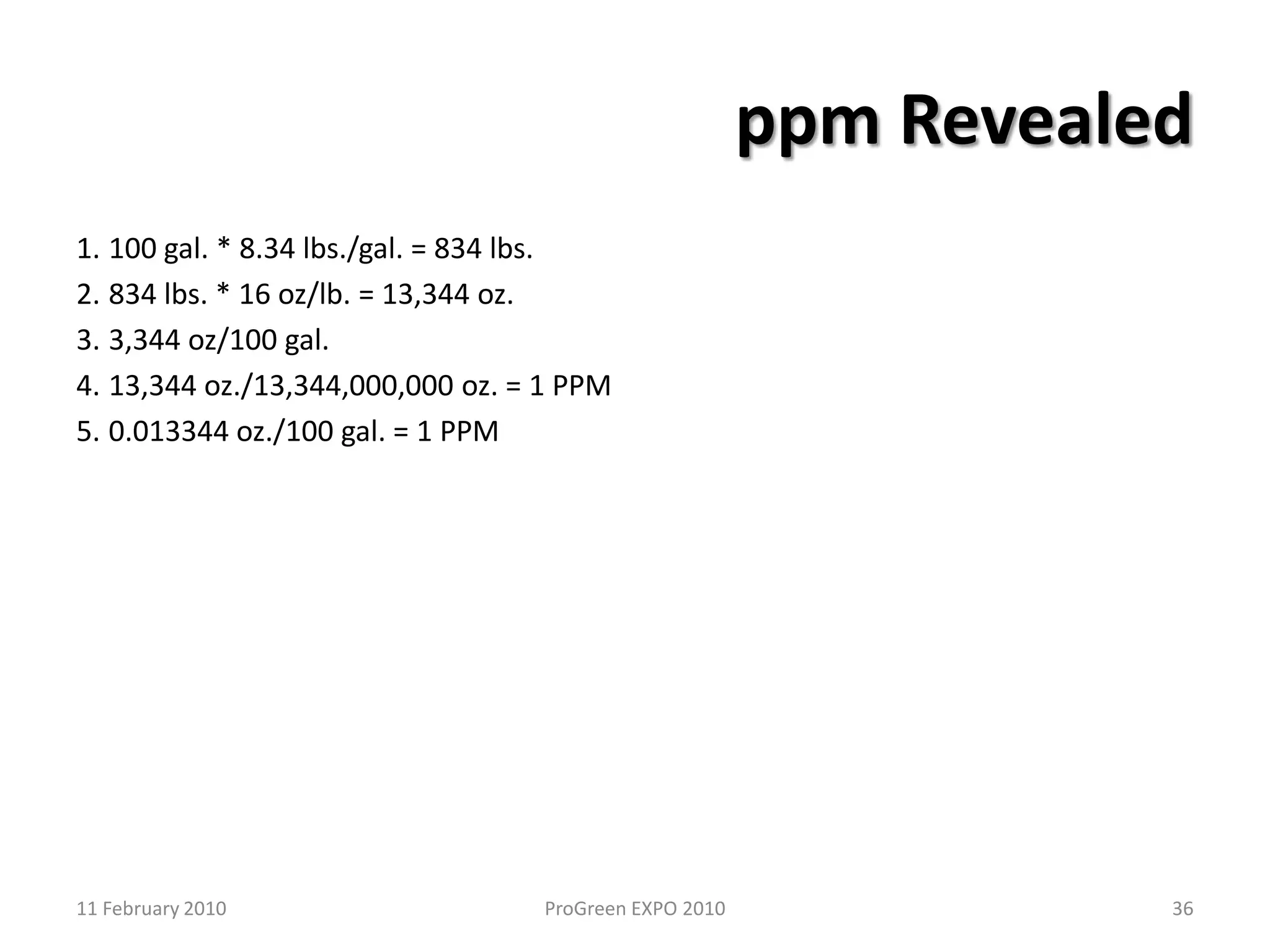
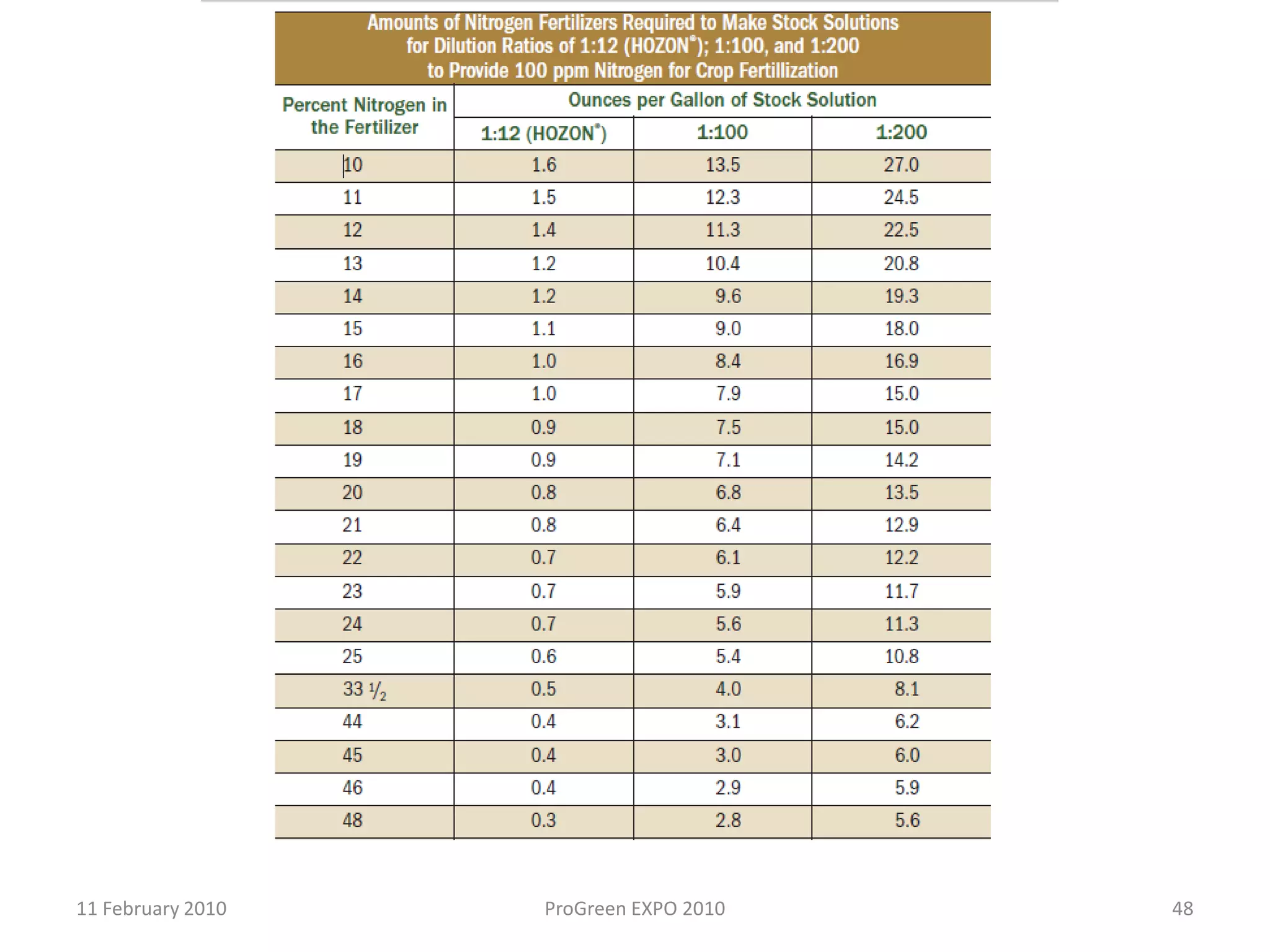
Calculating Parts per MillionMost greenhouse fertilization recommendations are based on parts per million or ppmMost manufacturers provide tables for easy reference, but they are not necessary.With a little knowledge, a calculator, and some patience, you can do this on your own.3111 February 2010ProGreen EXPO 2010
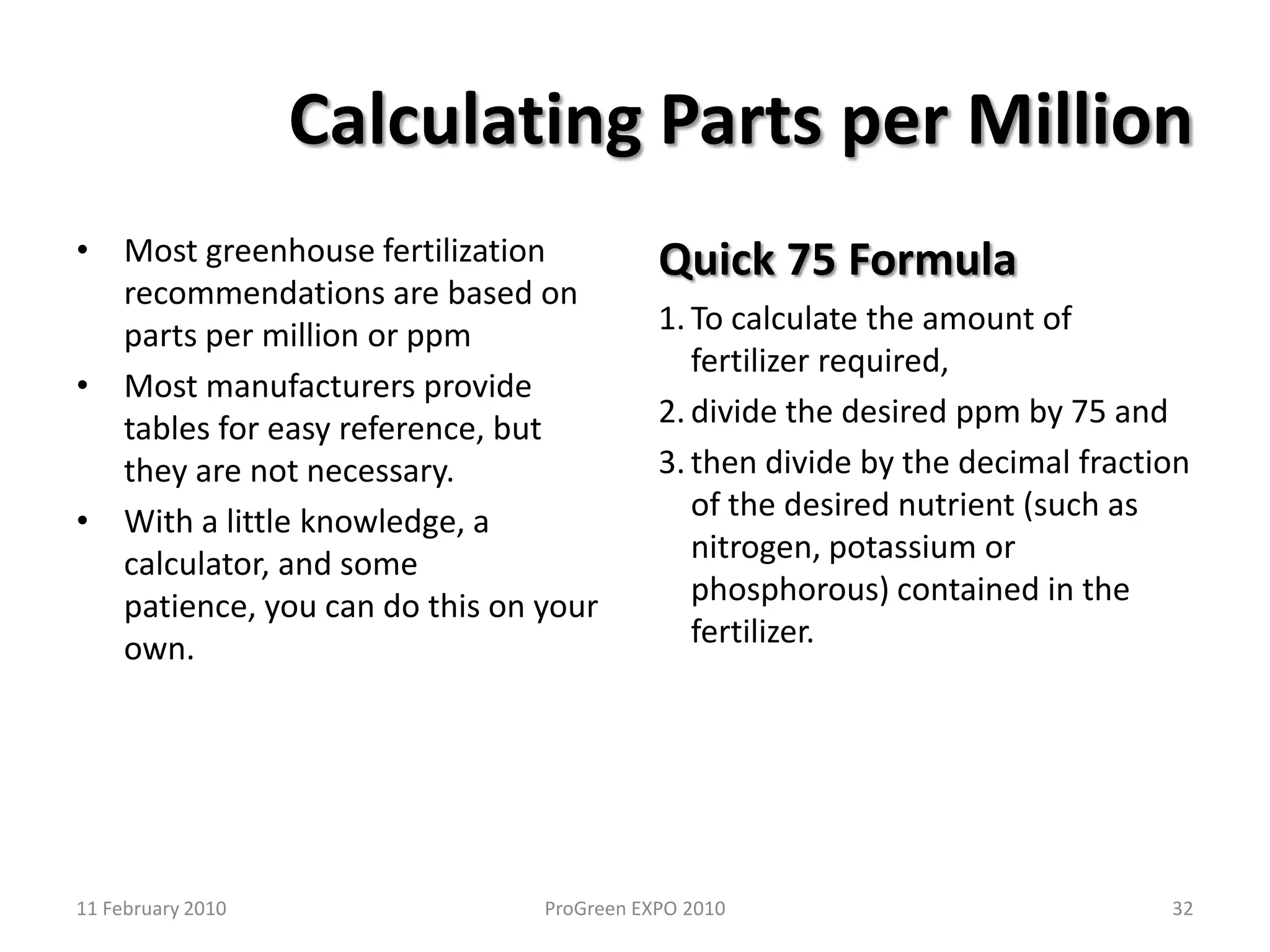
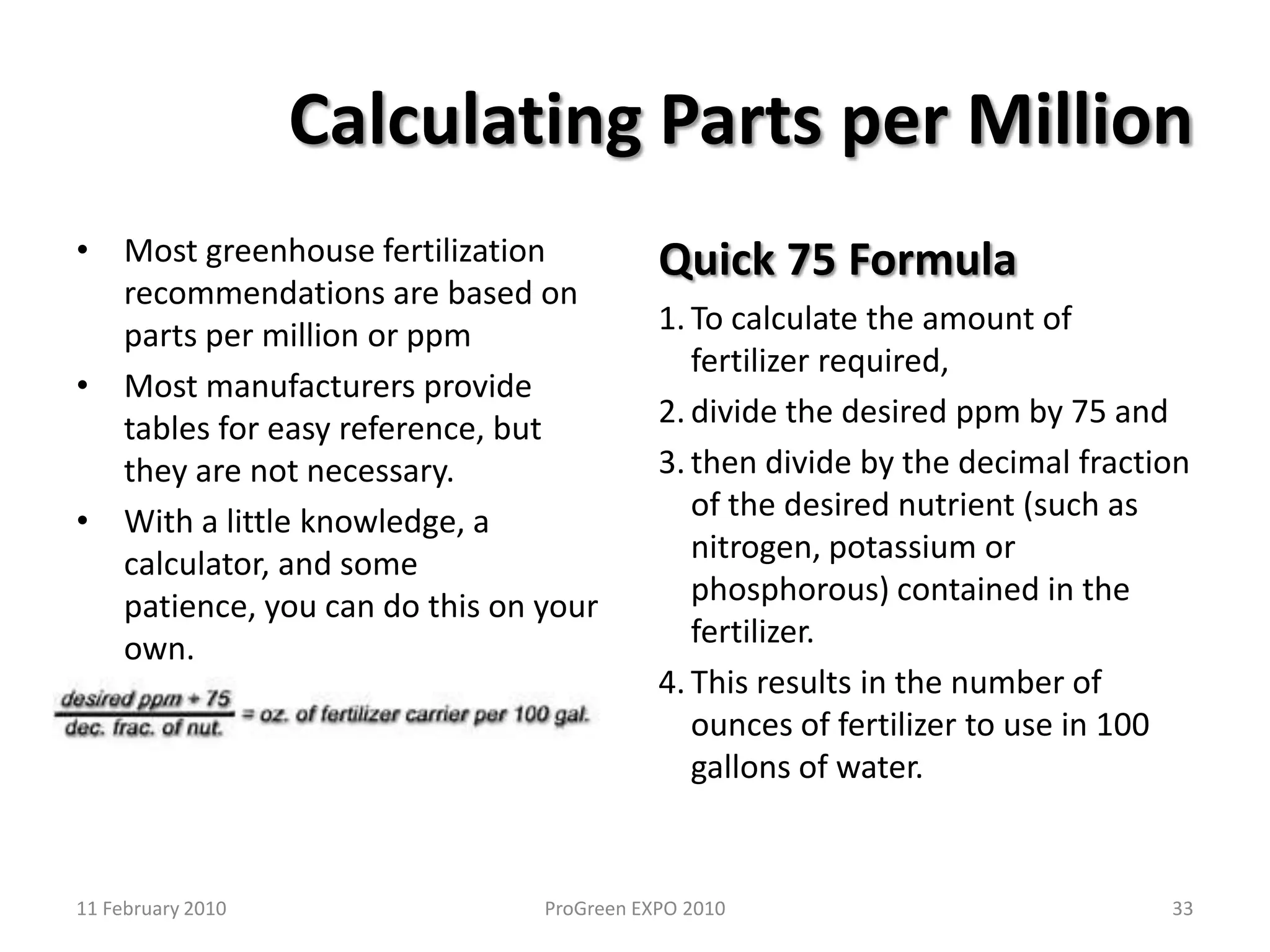
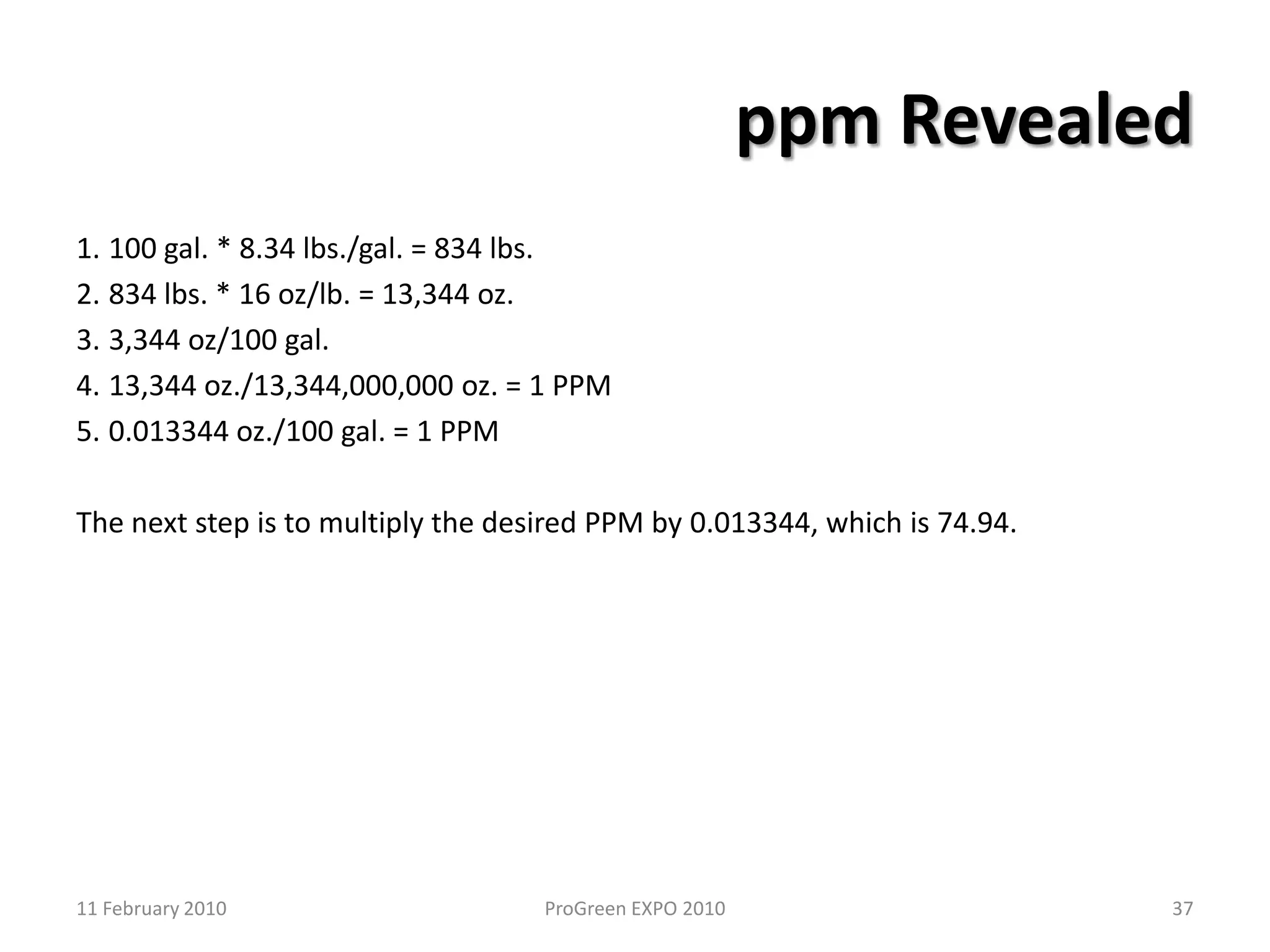
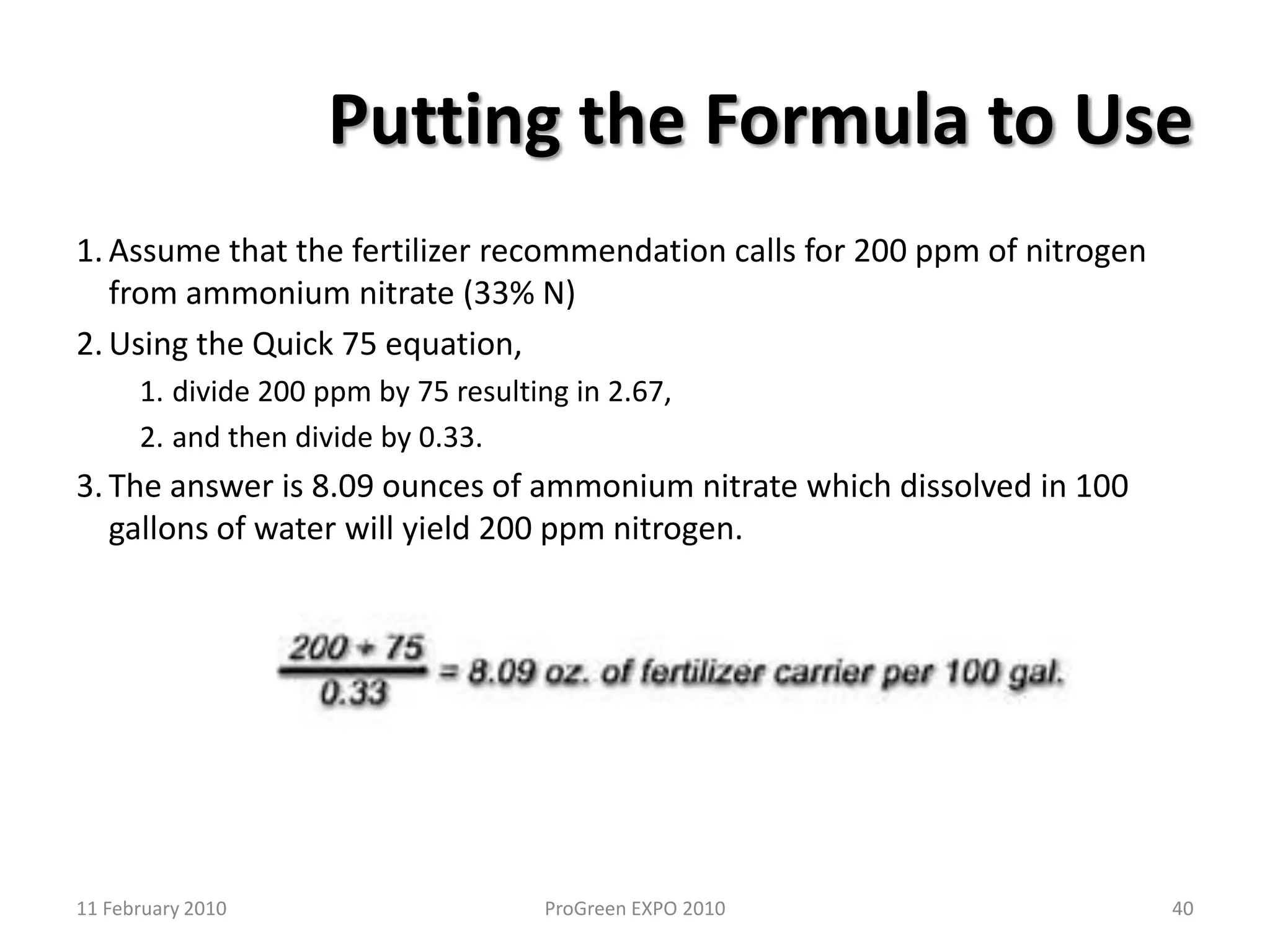
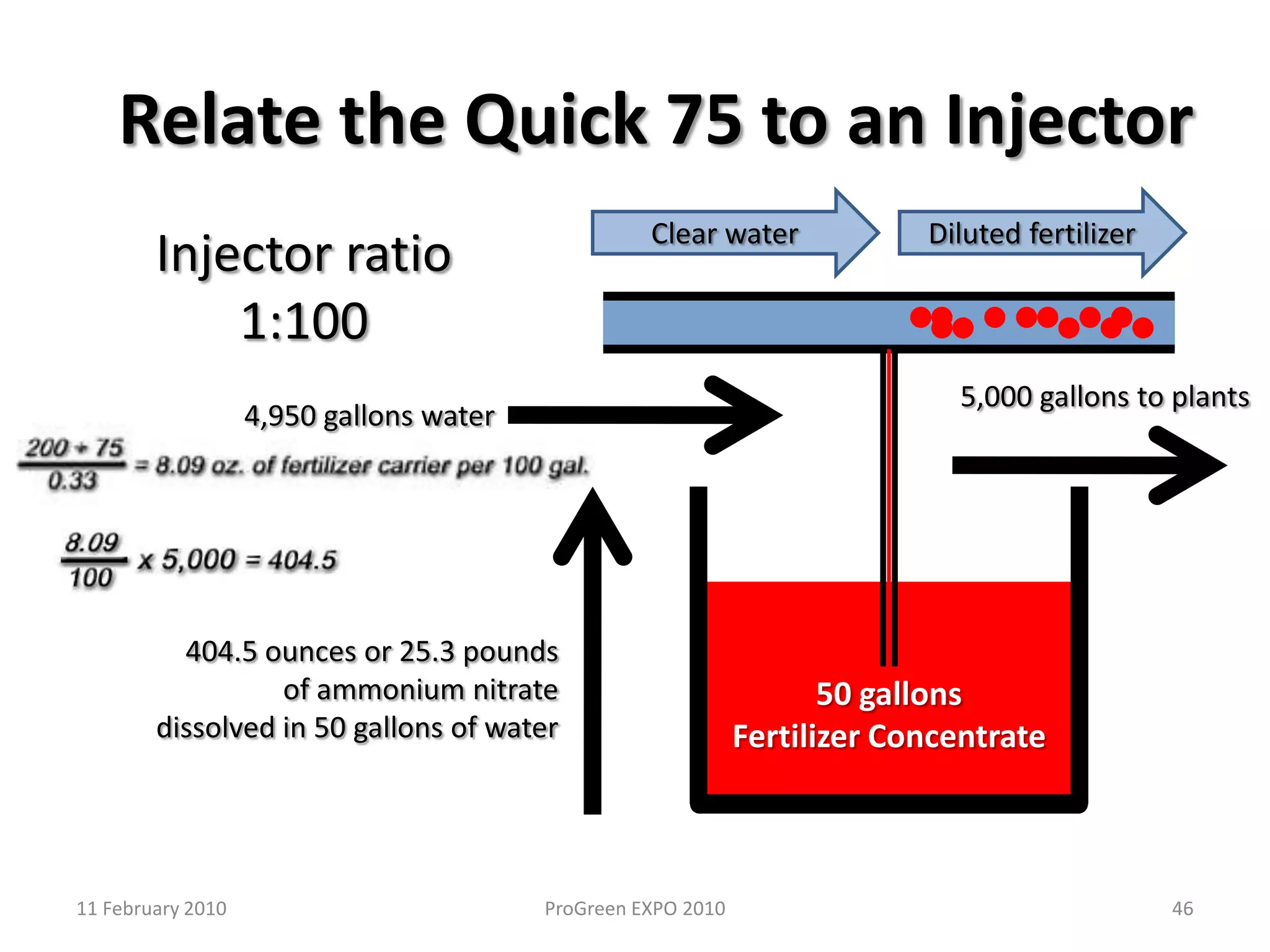
Calculating Parts per MillionMost greenhouse fertilization recommendations are based on parts per million or ppmMost manufacturers provide tables for easy reference, but they are not necessary.With a little knowledge, a calculator, and some patience, you can do this on your own.Quick 75 FormulaTo calculate the amount of fertilizer required,divide the desired ppm by 75 and then divide by the decimal fraction of the desired nutrient (such as nitrogen, potassium or phosphorous) contained in the fertilizer.3211 February 2010ProGreen EXPO 2010
Calculating Parts per MillionMost greenhouse fertilization recommendations are based on parts per million or ppmMost manufacturers provide tables for easy reference, but they are not necessary.With a little knowledge, a calculator, and some patience, you can do this on your own.Quick 75 FormulaTo calculate the amount of fertilizer required,divide the desired ppm by 75 and then divide by the decimal fraction of the desired nutrient (such as nitrogen, potassium or phosphorous) contained in the fertilizer.This results in the number of ounces of fertilizer to use in 100 gallons of water.3311 February 2010ProGreen EXPO 2010
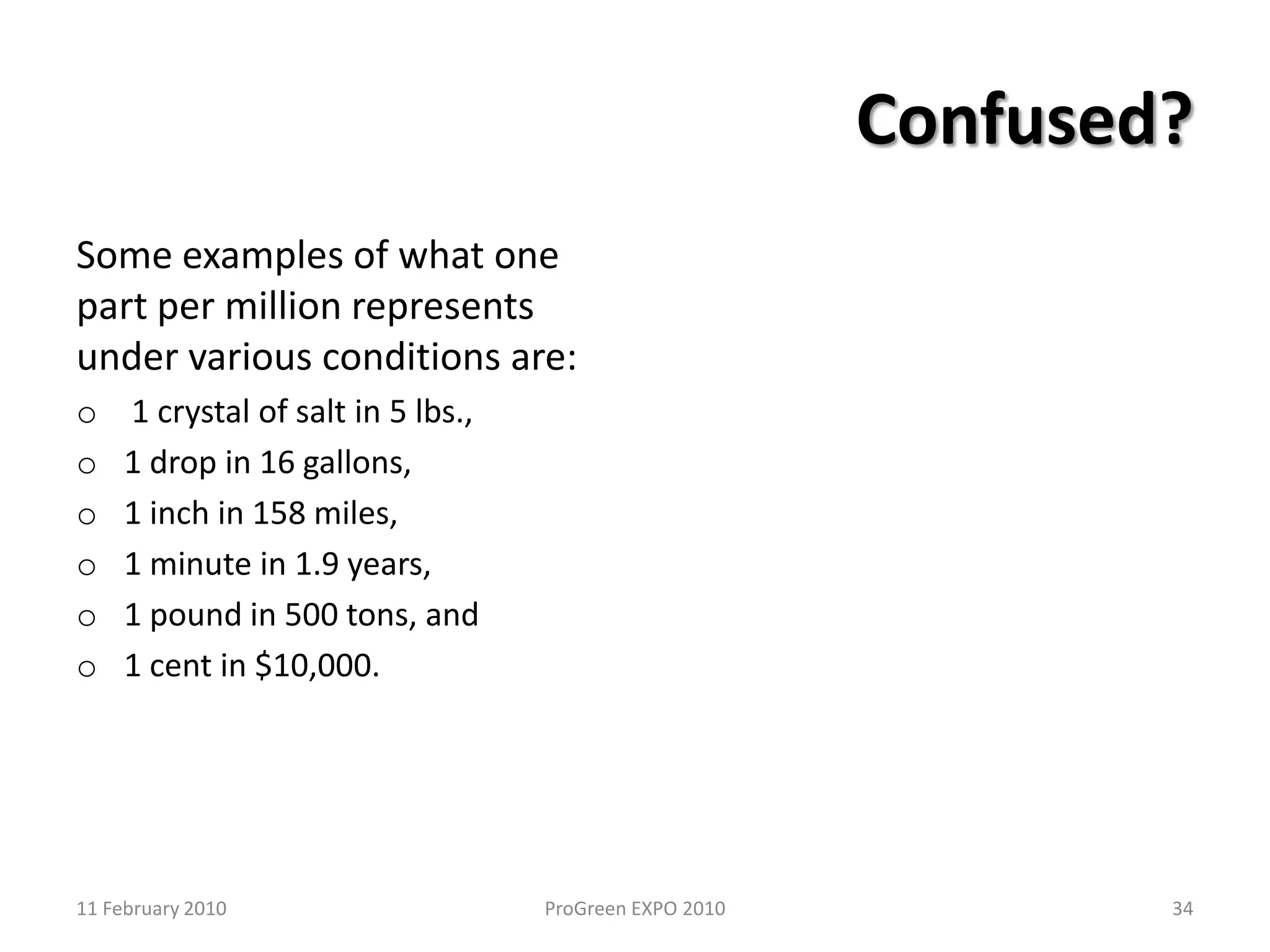
Confused?Some examples of what one part per million represents under various conditions are:1 crystal of salt in 5 lbs.,
1 drop in 16 gallons,
1 inch in 158 miles,
1 minute in 1.9 years,
1 pound in 500 tons, and
1 cent in $10,000.3411 February 2010ProGreen EXPO 2010
Confused?Some examples of what one part per million represents under various conditions are:1 crystal of salt in 5 lbs.,
1 drop in 16 gallons,
1 inch in 158 miles,

Understanding Injectors And Fertilizer Ratios

  • 1.
    Understanding Injectors andFertilizer RatiosSteven E. Newman, Ph.D., A.A.F.Greenhouse Crops Extension Specialist and Professor of FloricultureColorado State University Extension
  • 2.
    How Fertilizer InjectorsWorkInjectors are mechanical devices that take a small amount of a concentrated chemical from a stock tank and introduce it to a water line for delivery
  • 3.
  • 4.
  • 5.
  • 6.
  • 7.
  • 8.
  • 9.
    Mineral Acids211 February2010ProGreen EXPO 2010Clear waterDiluted fertilizerTo plantsFertilizer Concentrate
  • 10.
    How Fertilizer InjectorsWorkOne part of stock solution is mixed with “x” parts of water in the waterline, where “x” is determined by the injector ratio.The size of the stock tank can vary from as small as 5 gallons to as large as 2,000 gallons.A 5-gallon stock tank used with a 1:100 injector ratio will yield 500 gallons of final solution.Often, injector ratios are expressed as a percentage.Injector ratios expressed as percentages1:50 = 2%1:100 = 1%1:200 = 0.5%1:500 = 0.2%311 February 2010ProGreen EXPO 2010
  • 11.
    How Fertilizer InjectorsWork411 February 2010ProGreen EXPO 2010Clear waterDiluted fertilizerInjector ratio1:100100 parts toplants99 parts waterFertilizer Concentrate1 part fertilizer concentrate
  • 12.
    How Fertilizer InjectorsWorkTypes of InjectorsVenturi InjectorsHozon and SyphonexPositive Displacement InjectorsDosotronDosMaticAndersonSmithGewa511 February 2010ProGreen EXPO 2010
  • 13.
    Venturi Injectors611 February2010ProGreen EXPO 2010Simplistic
  • 14.
  • 15.
    Inject at aconstant rate
  • 16.
  • 17.
    Uses pressure createdbetween the waterline and the stock tank to draw concentrated fertilizer into the hose connection from the vacuum lineVenturi Injectors711 February 2010ProGreen EXPO 2010
  • 18.
    Venturi InjectorsVenturi designsSimplisticNomoving partsInject at a constant rateInexpensiveSiphon Hose16:1 Ratio Dispenses fertilizers as well as other pesticides811 February 2010ProGreen EXPO 2010
  • 19.
    Venturi Fertilizer InjectorsProsSimplewith no moving partsInexpensiveFlexible for many chemicals including wettable powdersPortableConsBack pressure can stop siphon (check valve)Unit should not be further than 50 feet from hose endReduction in water pressure and flowMinimum 35 psi water pressure911 February 2010ProGreen EXPO 2010
  • 20.
    Positive Displacement InjectorsConsistentinjector ratios over a wide range of water pressures and flow ratesMany models use water pressure as the power sourceInjector ratios can often be adjusted while in useThe limiting factor is the minimum and maximum flow rates permissible1011 February 2010ProGreen EXPO 2010
  • 21.
    Positive Displacement InjectorsSmithMeasuremixWater driven pumpCast metal and stainless steel constructionInjector ratios are factory set at 1:100, or 1:2001111 February 2010ProGreen EXPO 2010
  • 22.
    Positive Displacement InjectorsSmithMeasuremixWater driven pumpCast metal and stainless steel constructionInjector ratios are factory set at 1:100, or 1:200Some models have dual heads for simultaneous injection of different chemicalsRepairs are expensive and the units are heavy1211 February 2010ProGreen EXPO 2010
  • 23.
    Positive Displacement InjectorsDosatron/ DosMaticWater drivenPolymer constructionTypically installed directly in the water line1311 February 2010ProGreen EXPO 2010
  • 24.
    Positive Displacement InjectorsDosatron/ DosMaticWater drivenPolymer constructionTypically installed directly in the water lineMultiple units for dual injection of different chemicals1411 February 2010ProGreen EXPO 2010
  • 25.
    Positive Displacement InjectorsDosatron/ DosMaticSimultaneously inject products that may not be compatible in a stock solutionMay be easier to install inexpensive injectors in-lineMulti-head systems for greater volumes of water1511 February 2010ProGreen EXPO 2010
  • 26.
    Positive Displacement InjectorsAndersonRatio:Feederwater drivencast metal constructionpolymer constructionmodule injection heads1611 February 2010ProGreen EXPO 2010
  • 27.
    Positive Displacement InjectorsPositiveDisplacement Pump Proportionerwater drivencast metal constructionpolymer constructionmodule injection headsmetering device1711 February 2010ProGreen EXPO 2010
  • 28.
    Positive Displacement Injectors1811February 2010ProGreen EXPO 2010Anderson Ratio:Feeders can be automated with sensors and a computer to regulate fertilizer ratios.InjectorHeadWater MotorWater flow inMixing TankFertilizerStockTankWater/Fertilizerflow outpH and EC electrodes
  • 29.
    Positive Displacement InjectorsPositiveDisplacement Pump Proportionerwater drivencast metal constructionpolymer constructionmodule injection headsmetering deviceelectronic control1911 February 2010ProGreen EXPO 2010
  • 30.
    Positive Displacement InjectorsGewaInjector2011 February 2010ProGreen EXPO 2010Flow inFlow outWater pressureWater pressurePolybutyleneBladder withFertilizerConcentrate
  • 31.
    Which injector isbest for you?Size of your operationGreenhouses up to 10,000 square feet are easily serviced with small unitsLarger greenhouses may want to consider a more permanent installationTypes of fertility programsDifferent crops may have different fertility regimensConsider future expansionWater flow ratesInjector ratiosFixed ratio injectorsVariable ratio injectorsWater pressureWater qualityStock tank sizeAt least large enough to satisfy daily irrigation needsMay need two separate tanksOpaque to sunlightMake sure that the stock tank is lower than the injector to prevent back siphoning Chemicals being injectedPortable or stationaryEase of repair, parts availability, longevityManufacturer’s support2111 February 2010ProGreen EXPO 2010
  • 32.
    Positive Displacement InjectorsBypassPermanentlyinstalled injectors may be plumbed off the main water line in several configurations.open/closedCheck valveclosed/openParallelSeries
  • 33.
  • 34.
    Chemicals to beinjectedAcid injectionBackflow protection2411 February 2010ProGreen EXPO 2010
  • 35.
  • 36.
    Water hammerMany injectorsare made of ABS plasticOver time these may become brittle¼ - turn valves increase water hammerWater hammer arrestors will prolong the life of your injectorPlace the arrestor between your valve and your injector (outlet side)2611 February 2010ProGreen EXPO 2010Water hammer is the energy that is in water traveling in one direction. When a valve abruptly closes, the ricocheting water increases up to four times the original pressure.
  • 37.
    Calibrating an InjectorInjectorsare mechanical devices that require periodic checks and adjustments. There are two means of checking the calibration of an injectorVolume ratio methodElectrical conductivity2711 February 2010ProGreen EXPO 2010
  • 38.
    Volume Ratio CalibrationMethodEquipmentGraduated cylinderOne or two liter is bestLarge container with a known volumeFive gallon bucketInjector with hoses and tubesProcedurePlace the siphon tube into the graduated cylinder and operate the water and injector at a normal pressureAllow the system to empty one volume of the graduated cylinder to charge the systemRefill the graduated cylinder and run the injector until the cylinder is half emptyDischarge the water from the injector into the large bucket.Measure the uptake volume and the discharge volumeThe injector equals the output volume divided by the input volume2811 February 2010ProGreen EXPO 2010
  • 39.
    2911 February 2010ProGreenEXPO 2010Injector ratio = output volume ÷ input volume
  • 40.
    3011 February 2010ProGreenEXPO 2010Injector ratio = output volume ÷ input volume5 gallonsor18,925 ml1:5018,925 ÷ 370 = 511:51370 ml
  • 41.
    Calculating Parts perMillionMost greenhouse fertilization recommendations are based on parts per million or ppmMost manufacturers provide tables for easy reference, but they are not necessary.With a little knowledge, a calculator, and some patience, you can do this on your own.3111 February 2010ProGreen EXPO 2010
  • 42.
    Calculating Parts perMillionMost greenhouse fertilization recommendations are based on parts per million or ppmMost manufacturers provide tables for easy reference, but they are not necessary.With a little knowledge, a calculator, and some patience, you can do this on your own.Quick 75 FormulaTo calculate the amount of fertilizer required,divide the desired ppm by 75 and then divide by the decimal fraction of the desired nutrient (such as nitrogen, potassium or phosphorous) contained in the fertilizer.3211 February 2010ProGreen EXPO 2010
  • 43.
    Calculating Parts perMillionMost greenhouse fertilization recommendations are based on parts per million or ppmMost manufacturers provide tables for easy reference, but they are not necessary.With a little knowledge, a calculator, and some patience, you can do this on your own.Quick 75 FormulaTo calculate the amount of fertilizer required,divide the desired ppm by 75 and then divide by the decimal fraction of the desired nutrient (such as nitrogen, potassium or phosphorous) contained in the fertilizer.This results in the number of ounces of fertilizer to use in 100 gallons of water.3311 February 2010ProGreen EXPO 2010
  • 44.
    Confused?Some examples ofwhat one part per million represents under various conditions are:1 crystal of salt in 5 lbs.,
  • 45.
    1 drop in16 gallons,
  • 46.
    1 inch in158 miles,
  • 47.
    1 minute in1.9 years,
  • 48.
    1 pound in500 tons, and
  • 49.
    1 cent in$10,000.3411 February 2010ProGreen EXPO 2010
  • 50.
    Confused?Some examples ofwhat one part per million represents under various conditions are:1 crystal of salt in 5 lbs.,
  • 51.
    1 drop in16 gallons,
  • 52.
    1 inch in158 miles,
  • 53.
    1 minute in1.9 years,
  • 54.
    1 pound in500 tons, and
  • 55.
    1 cent in$10,000.To calculate ppm in 100 gallons of water,First multiply 100 gallons by 8.34 pounds per gallon which equals 834 pounds. Multiply 834 pounds by 16 ounces per pound which equals 13,344 ounces per 100 gallons. Therefore, 13,344 ounces per 13,344,000,000 ounces equals 1 part per million, or more simply 0.013344 ounces per 100 gallons of water equals 1 PPM.3511 February 2010ProGreen EXPO 2010
  • 56.
    ppm Revealed100 gal.* 8.34 lbs./gal. = 834 lbs. 834 lbs. * 16 oz/lb. = 13,344 oz. 3,344 oz/100 gal. 13,344 oz./13,344,000,000 oz. = 1 PPM 0.013344 oz./100 gal. = 1 PPM 3611 February 2010ProGreen EXPO 2010
  • 57.
    ppm Revealed100 gal.* 8.34 lbs./gal. = 834 lbs. 834 lbs. * 16 oz/lb. = 13,344 oz. 3,344 oz/100 gal. 13,344 oz./13,344,000,000 oz. = 1 PPM 0.013344 oz./100 gal. = 1 PPM The next step is to multiply the desired PPM by 0.013344, which is 74.94.3711 February 2010ProGreen EXPO 2010
  • 58.
    ppm Revealed100 gal.* 8.34 lbs./gal. = 834 lbs. 834 lbs. * 16 oz/lb. = 13,344 oz. 3,344 oz/100 gal. 13,344 oz./13,344,000,000 oz. = 1 PPM 0.013344 oz./100 gal. = 1 PPM The next step is to multiply the desired PPM by 0.013344, which is 74.94.3811 February 2010ProGreen EXPO 2010
  • 59.
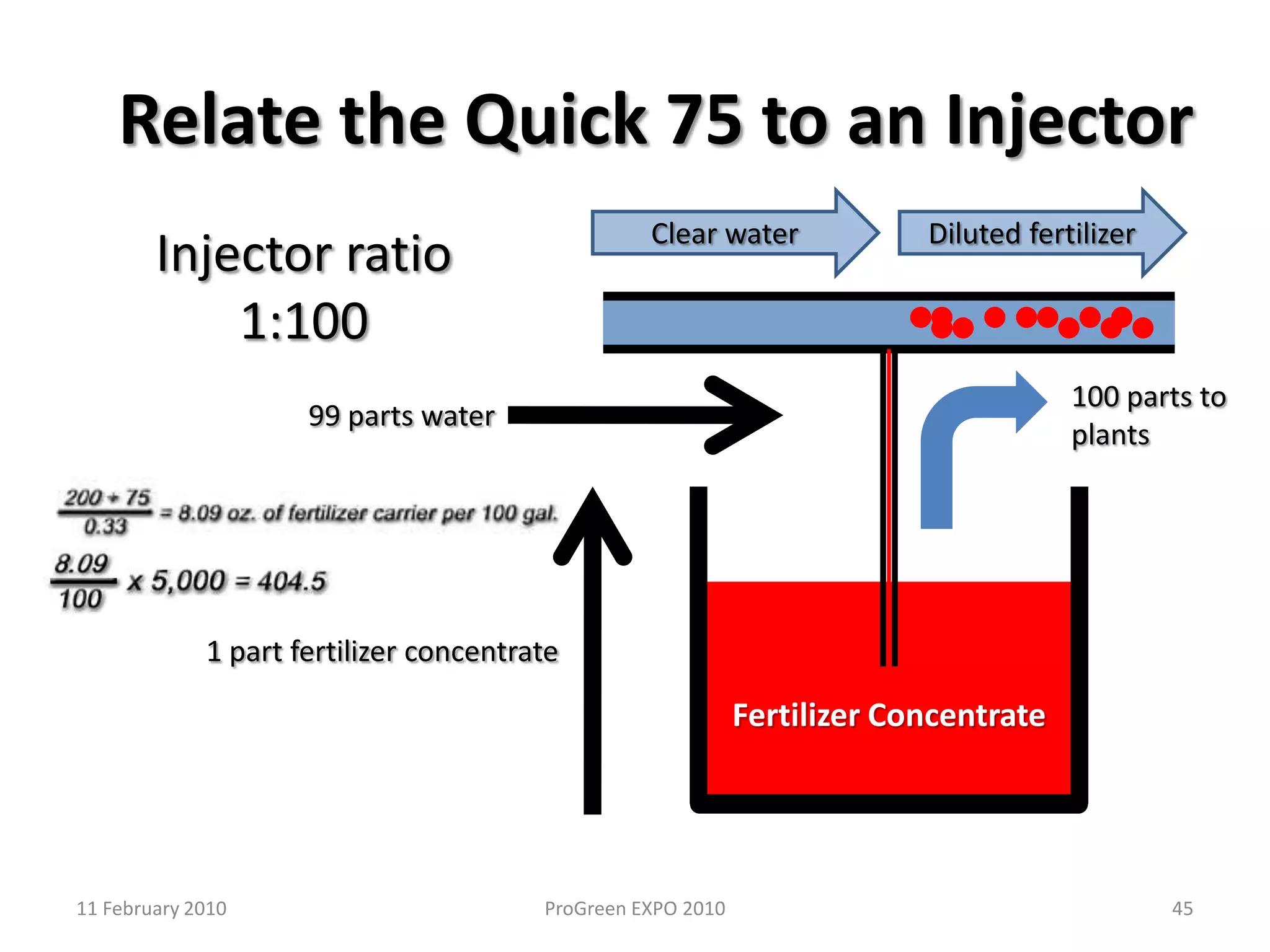
    Putting the Formulato UseAssume that the fertilizer recommendation calls for 200 ppm of nitrogen from ammonium nitrate (33% N)Using the Quick 75 equation, divide 200 ppm by 75 resulting in 2.67,and then divide by 0.33. The answer is 8.09 ounces of ammonium nitrate which dissolved in 100 gallons of water will yield 200 ppm nitrogen. 3911 February 2010ProGreen EXPO 2010
  • 60.
    Putting the Formulato UseAssume that the fertilizer recommendation calls for 200 ppm of nitrogen from ammonium nitrate (33% N)Using the Quick 75 equation, divide 200 ppm by 75 resulting in 2.67,and then divide by 0.33. The answer is 8.09 ounces of ammonium nitrate which dissolved in 100 gallons of water will yield 200 ppm nitrogen. 4011 February 2010ProGreen EXPO 2010
  • 61.
    Relate the Quick75 to an Injector4111 February 2010ProGreen EXPO 2010Clear waterDiluted fertilizerInjector ratio1:100100 parts toplants99 parts waterFertilizer Concentrate1 part fertilizer concentrate
  • 62.
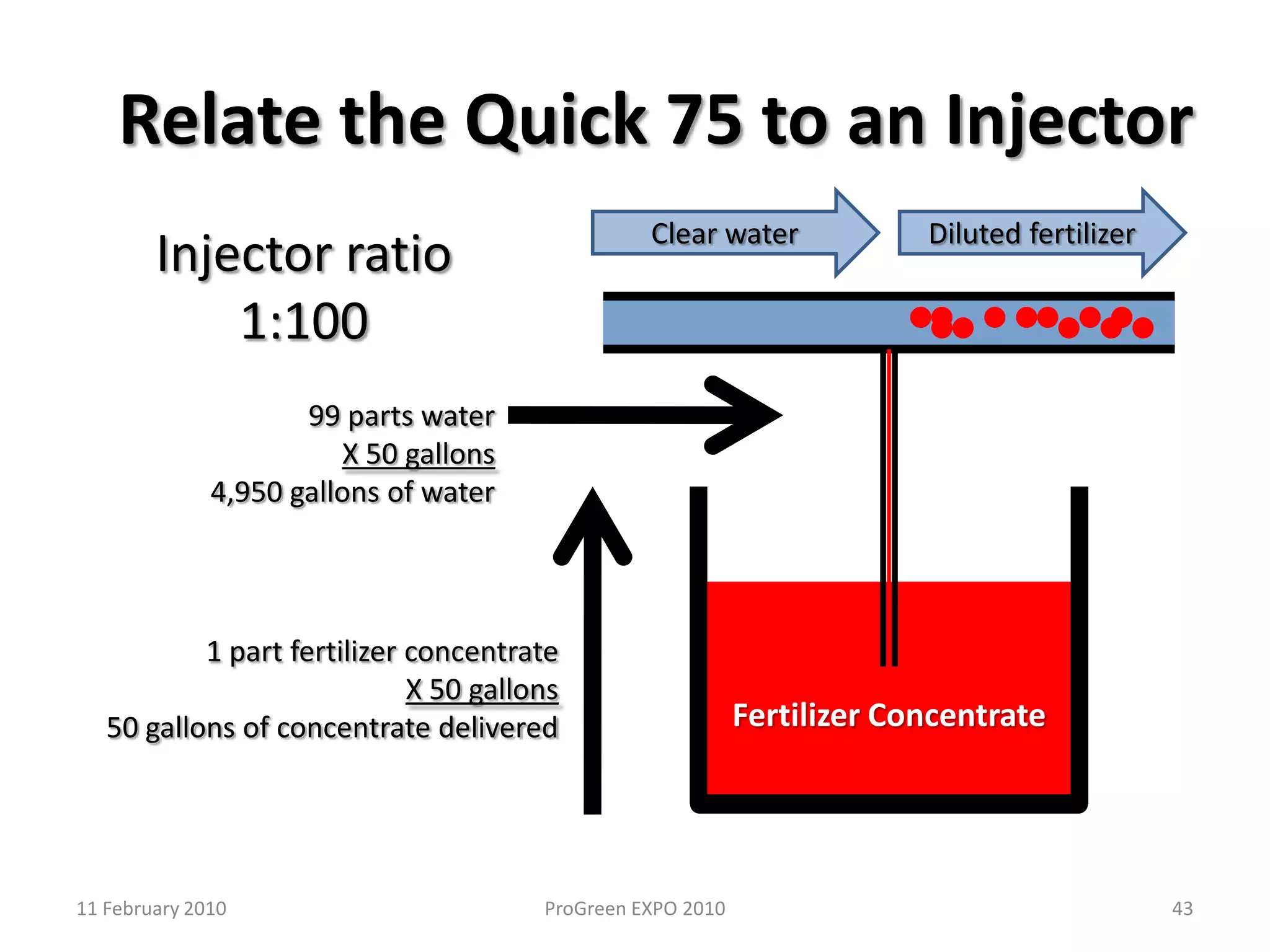
    Relate the Quick75 to an Injector4211 February 2010ProGreen EXPO 2010Clear waterDiluted fertilizerInjector ratio1:100Fertilizer Concentrate50 gallons
  • 63.
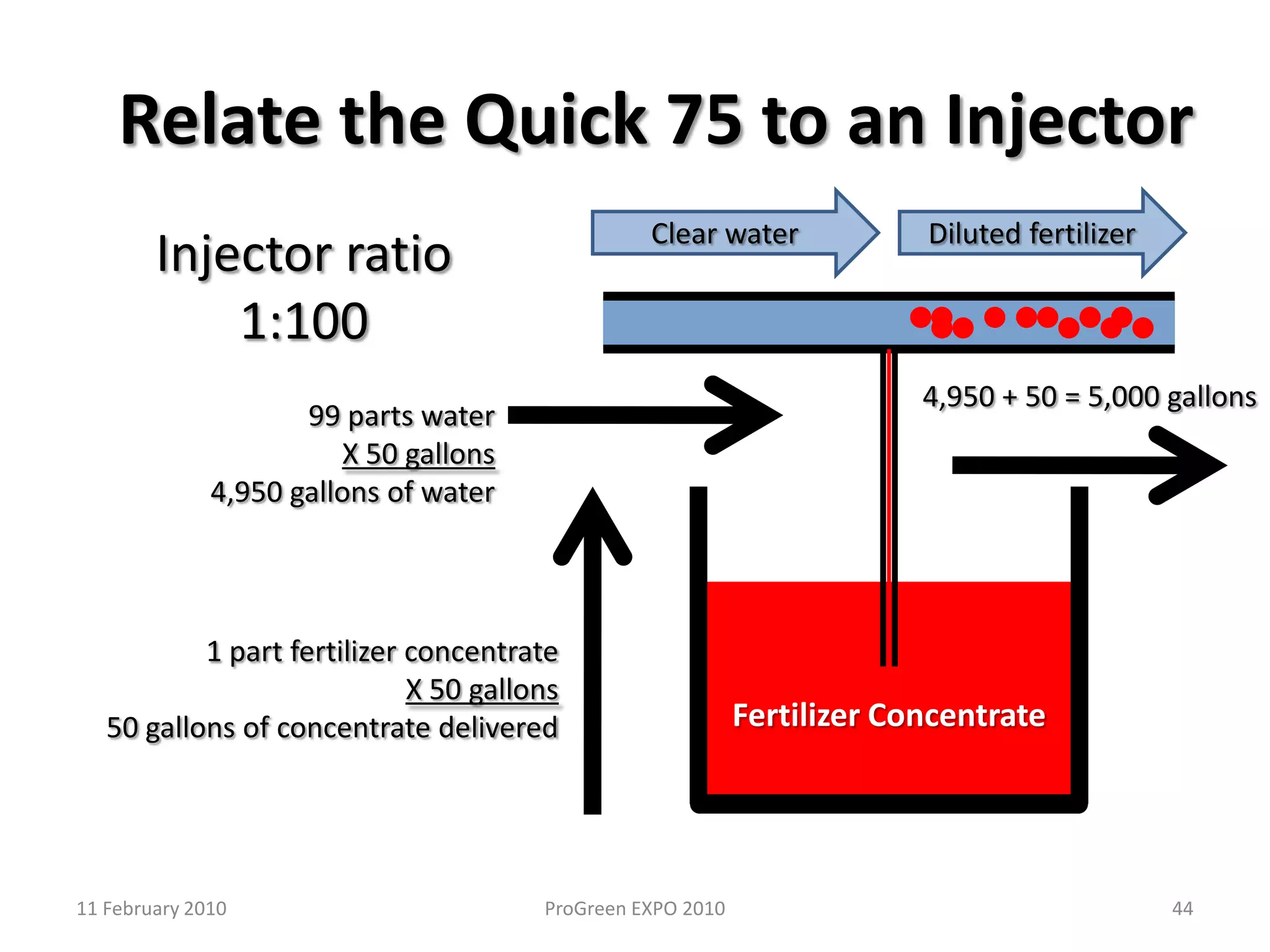
    Relate the Quick75 to an Injector4311 February 2010ProGreen EXPO 2010Clear waterDiluted fertilizerInjector ratio1:10099 parts waterX 50 gallons4,950 gallons of waterFertilizer Concentrate1 part fertilizer concentrateX 50 gallons50 gallons of concentrate delivered
  • 64.
    Relate the Quick75 to an Injector4411 February 2010ProGreen EXPO 2010Clear waterDiluted fertilizerInjector ratio1:1004,950 + 50 = 5,000 gallons99 parts waterX 50 gallons4,950 gallons of waterFertilizer Concentrate1 part fertilizer concentrateX 50 gallons50 gallons of concentrate delivered
  • 65.
    Relate the Quick75 to an Injector4511 February 2010ProGreen EXPO 2010Clear waterDiluted fertilizerInjector ratio1:100100 parts toplants99 parts waterFertilizer Concentrate1 part fertilizer concentrate
  • 66.
    Relate the Quick75 to an Injector4611 February 2010ProGreen EXPO 2010Clear waterDiluted fertilizerInjector ratio1:1005,000 gallons to plants4,950 gallonswater50 gallonsFertilizer Concentrate404.5 ounces or 25.3 pounds of ammonium nitrate dissolved in 50 gallons of water
  • 67.
    Still want atable?4711 February 2010ProGreen EXPO 2010
  • 68.
  • 69.
  • 70.
    Shameless Commerce5011 February2010ProGreen EXPO 2010
  • 71.
    Shameless Commerce5111 February2010ProGreen EXPO 2010ProGreen EXPO Special Price$120
  • 72.
    52For more information,contact me athttp://ghex.colostate.edu/http://www.twitter.com/newman7118http://twitpic.com/photos/newman7118http://www.facebook.com/senewmanhttp://ghadvisor.blogspot.comhttp://www.linkedin.com/in/snewman7118stevennewman@chat.extension.orgsteven.newman@colostate.eduAnd….. (970) 491-71185211 February 2010ProGreen EXPO 2010