Corporate Social Responsibility
session-4
Prof. S.K.Palhan
skpalhan@selfeffectiveness.com
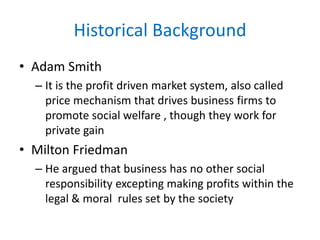
Historical Background
• Adam Smith
– It is the profit driven market system, also called
price mechanism that drives business firms to
promote social welfare , though they work for
private gain
• Milton Friedman
– He argued that business has no other social
responsibility excepting making profits within the
legal & moral rules set by the society
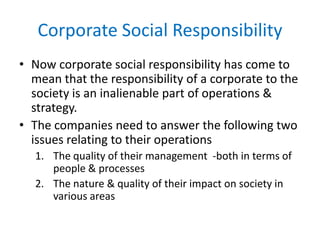
Corporate Social Responsibility
• Now corporate social responsibility has come to
mean that the responsibility of a corporate to the
society is an inalienable part of operations &
strategy.
• The companies need to answer the following two
issues relating to their operations
1. The quality of their management -both in terms of
people & processes
2. The nature & quality of their impact on society in
various areas
Why social responsibility of
business ?
• The limited view of focus on profits alone
would be counter productive to its objective.
Why social responsibility of
business ?
• The ethical & social behaviour of a corporation
is essential for generation of profit, since
profits would come in the long run only due to
the reputation of the company & its social
behaviour
• In a democratic society any kind of enterprise
exist for the sake of society. Therefore the
enterprise is accountable to the society
CSR –Defined from different
perspectives
• The World Business Council For Sustainable
Development
– CSR is the continuing commitment by the business
to behave ethically& contribute to economic
development while improving the quality of life of
the workforce & their families as well as of the
local community & society at large
• In USA
– CSR has been traditionally defined in terms of
philanthropy model
Corporate Social Responsibility
• In Europe
–Focus is on operating the core business in a
socially responsible way, complimented by
investment in communities for solid case
reasons
–Social responsibility is an integral part of the
wealth creation process. If it is
philanthropic in nature then this would be
dropped first in hard times
Corporate Social Responsibility
• Mahatma Gandhi
– Wealth created from society has to be ploughed
back into society
Substance of CSR
1. It is an attempt made by companies to be
voluntarily responsible to ethical & social
considerations
2. It is not legal binding for the company, unlike
corporate accountability
3. Set of obligations which are desirable in
terms of the objectives & values of a society
4. Set of obligations to project, enhance
society in which it works
Substance of CSR
5. Overall relation ship of the organization with
the various stakeholders
6. It covers the following expectations/
responsibilities
– Economic
– Legal
– Ethical
– Philanthropic
Substance of CSR
7. The socially responsible company should strive
to
– Make profit
– Obey the law
– Be ethical
– Be a good corporate citizen
8. Social responsibility is temporal and society
based
– It differs from society to society
– It changes over time
CSR at present
• Importance of CSR realized due to
– Greater acceptance of business linkage with
external environment
– Greater professionalism in business
– Evolution of managers from all levels of general
society
Implementation of CSR
• Systematic implementation of CSR implies
– The adoption of strong organizational values &
norms depicting behaviour that are appropriate
towards a variety of stakeholders
– The continuous generation of intelligence about
stakeholder issues, along with positive response
to those issues
4 Models for implementation
1. Ethical –Mahatma Gandhi
– Voluntary commitment by companies to public
welfare
2. Statist –Jawaharlal Nehru
– State ownership and legal requirements
determine corporate responsibilities
Models for implementation
3. Liberal –Milton Friedman
– Corporate responsibility limited to private
owners the needs of the stakeholders-
customers, creditors ,employees, communities
etc.
4. Stakeholder – R. Edward Freeman
– Corporate responsibility to the needs of the
stakeholders-customers, creditors ,employees,
communities etc.
CSR-Advantages
1. Improved financial performance
2. Enhanced brand image & reputation
3. Increased sales & customer loyalty
4. Increased ability to attract & retain
employees
CSR-Advantages
5. Reduced regulatory oversight
6. Innovation & learning
7. Better risk management
8. Easier access to capital
9. Environmental improvements
Scope of CSR
• Market forces
• Mandated actions
• Voluntary actions
• CSR addresses the following issues
– Community assistance in solving problems of the
community
– Health& welfare
– Education
– Human rights
– Natural environment
– Culture (music , art, sports etc)
Steps In CSR-
The International Chamber of
Commerce
1. Confirm CEO/Board commitment to prioritize
responsible business conduct
2. State company purpose & agree on company
values
3. Identify key stakeholders
4. Define business principles & policies
5. Establish implementation procedure &
management systems
Steps In CSR-The International
Chamber of Commerce
6. Benchmark against selected external code &
standards
7. Setup internal monitoring mechanisms
8. Use language that everyone can understand
9. Set up pragmatic & realistic objectives
Standards On CSR
• The Caux Round Table-founded in 1986
• OECD Guidelines—1976, updated in 2000
• United Nations Global Compact-2000,
– MD Tata steel among 18 others representing
business , labour, civil society leaders on the Board
of UNGC IN 2006
– More than 2,500 participating companies in over
90 countries
Standards On CSR
• Asia Pacific Economic Cooperation-code in
1999
• AA 1000 Accountability –in1999 for reporting
guidelines to improve accountability
• Social Accountability-8000 standard
• Principles for Global Corporate Responsibility-
with inputs from 275 religious institutions
Awards For CSR
• More than 24 prestigious international awards
constituted in various countries
– Most admired companies list
• Business fortune
• Management today
• Financial times
• Asian business
National Awards for CSR in India
• National award for excellence in corporate
governance
• Mother Teresa award for corporate citizen
• FICCI CSR award
National Awards for CSR in India
• The economic times award for corporate
excellence
• TERI CSR Award
• CNBC TV18 India business leader award
• Pegasus CSR award of Readers Digest
• Business for social responsibility award- by
BSE& NASSCOM Foundation
CSR- issues in India
• Corruption
• The license Raj
• Black money
• Non responsive systems for punishment &
reward
CSR-Indian examples
• AMM Foundation-education, health, rural
development
• Asian paints-community development
• BHEL, IPCL, NTPC- Health, education , rural
development
• Tata-community development, social welfare,
tribal development, education, health,
agriculture etc
• Wipro –quality , education
CSR-Indian examples
• GAIL-environment, drinking water, medical
• Godrej- environment & conservation
• Dr. Reddy’s lab-education , livelihood
• SAIL-agriculture, education, health, dairy,
poultry, fisheries & drinking water
• ITC- rural development
• TVS group-rural development, technical
education

CSR4 061111

  • 1.
    Corporate Social Responsibility session-4 Prof.S.K.Palhan skpalhan@selfeffectiveness.com
  • 2.
    Historical Background • AdamSmith – It is the profit driven market system, also called price mechanism that drives business firms to promote social welfare , though they work for private gain • Milton Friedman – He argued that business has no other social responsibility excepting making profits within the legal & moral rules set by the society
  • 3.
    Corporate Social Responsibility •Now corporate social responsibility has come to mean that the responsibility of a corporate to the society is an inalienable part of operations & strategy. • The companies need to answer the following two issues relating to their operations 1. The quality of their management -both in terms of people & processes 2. The nature & quality of their impact on society in various areas
  • 4.
    Why social responsibilityof business ? • The limited view of focus on profits alone would be counter productive to its objective.
  • 5.
    Why social responsibilityof business ? • The ethical & social behaviour of a corporation is essential for generation of profit, since profits would come in the long run only due to the reputation of the company & its social behaviour • In a democratic society any kind of enterprise exist for the sake of society. Therefore the enterprise is accountable to the society
  • 6.
    CSR –Defined fromdifferent perspectives • The World Business Council For Sustainable Development – CSR is the continuing commitment by the business to behave ethically& contribute to economic development while improving the quality of life of the workforce & their families as well as of the local community & society at large • In USA – CSR has been traditionally defined in terms of philanthropy model
  • 7.
    Corporate Social Responsibility •In Europe –Focus is on operating the core business in a socially responsible way, complimented by investment in communities for solid case reasons –Social responsibility is an integral part of the wealth creation process. If it is philanthropic in nature then this would be dropped first in hard times
  • 8.
    Corporate Social Responsibility •Mahatma Gandhi – Wealth created from society has to be ploughed back into society
  • 9.
    Substance of CSR 1.It is an attempt made by companies to be voluntarily responsible to ethical & social considerations 2. It is not legal binding for the company, unlike corporate accountability 3. Set of obligations which are desirable in terms of the objectives & values of a society 4. Set of obligations to project, enhance society in which it works
  • 10.
    Substance of CSR 5.Overall relation ship of the organization with the various stakeholders 6. It covers the following expectations/ responsibilities – Economic – Legal – Ethical – Philanthropic
  • 11.
    Substance of CSR 7.The socially responsible company should strive to – Make profit – Obey the law – Be ethical – Be a good corporate citizen 8. Social responsibility is temporal and society based – It differs from society to society – It changes over time
  • 12.
    CSR at present •Importance of CSR realized due to – Greater acceptance of business linkage with external environment – Greater professionalism in business – Evolution of managers from all levels of general society
  • 13.
    Implementation of CSR •Systematic implementation of CSR implies – The adoption of strong organizational values & norms depicting behaviour that are appropriate towards a variety of stakeholders – The continuous generation of intelligence about stakeholder issues, along with positive response to those issues
  • 14.
    4 Models forimplementation 1. Ethical –Mahatma Gandhi – Voluntary commitment by companies to public welfare 2. Statist –Jawaharlal Nehru – State ownership and legal requirements determine corporate responsibilities
  • 15.
    Models for implementation 3.Liberal –Milton Friedman – Corporate responsibility limited to private owners the needs of the stakeholders- customers, creditors ,employees, communities etc. 4. Stakeholder – R. Edward Freeman – Corporate responsibility to the needs of the stakeholders-customers, creditors ,employees, communities etc.
  • 16.
    CSR-Advantages 1. Improved financialperformance 2. Enhanced brand image & reputation 3. Increased sales & customer loyalty 4. Increased ability to attract & retain employees
  • 17.
    CSR-Advantages 5. Reduced regulatoryoversight 6. Innovation & learning 7. Better risk management 8. Easier access to capital 9. Environmental improvements
  • 18.
    Scope of CSR •Market forces • Mandated actions • Voluntary actions • CSR addresses the following issues – Community assistance in solving problems of the community – Health& welfare – Education – Human rights – Natural environment – Culture (music , art, sports etc)
  • 19.
    Steps In CSR- TheInternational Chamber of Commerce 1. Confirm CEO/Board commitment to prioritize responsible business conduct 2. State company purpose & agree on company values 3. Identify key stakeholders 4. Define business principles & policies 5. Establish implementation procedure & management systems
  • 20.
    Steps In CSR-TheInternational Chamber of Commerce 6. Benchmark against selected external code & standards 7. Setup internal monitoring mechanisms 8. Use language that everyone can understand 9. Set up pragmatic & realistic objectives
  • 21.
    Standards On CSR •The Caux Round Table-founded in 1986 • OECD Guidelines—1976, updated in 2000 • United Nations Global Compact-2000, – MD Tata steel among 18 others representing business , labour, civil society leaders on the Board of UNGC IN 2006 – More than 2,500 participating companies in over 90 countries
  • 22.
    Standards On CSR •Asia Pacific Economic Cooperation-code in 1999 • AA 1000 Accountability –in1999 for reporting guidelines to improve accountability • Social Accountability-8000 standard • Principles for Global Corporate Responsibility- with inputs from 275 religious institutions
  • 23.
    Awards For CSR •More than 24 prestigious international awards constituted in various countries – Most admired companies list • Business fortune • Management today • Financial times • Asian business
  • 24.
    National Awards forCSR in India • National award for excellence in corporate governance • Mother Teresa award for corporate citizen • FICCI CSR award
  • 25.
    National Awards forCSR in India • The economic times award for corporate excellence • TERI CSR Award • CNBC TV18 India business leader award • Pegasus CSR award of Readers Digest • Business for social responsibility award- by BSE& NASSCOM Foundation
  • 26.
    CSR- issues inIndia • Corruption • The license Raj • Black money • Non responsive systems for punishment & reward
  • 27.
    CSR-Indian examples • AMMFoundation-education, health, rural development • Asian paints-community development • BHEL, IPCL, NTPC- Health, education , rural development • Tata-community development, social welfare, tribal development, education, health, agriculture etc • Wipro –quality , education
  • 28.
    CSR-Indian examples • GAIL-environment,drinking water, medical • Godrej- environment & conservation • Dr. Reddy’s lab-education , livelihood • SAIL-agriculture, education, health, dairy, poultry, fisheries & drinking water • ITC- rural development • TVS group-rural development, technical education