Continual Service Improvement
principles
Service improvement must focus on
• increasing the efficiency
• maximizing the effectiveness
• optimizing the cost of services
Mustufa Sir
3.1 CSI and organizational
change
• Improving service
management is to embark
upon an organizational change
programme.
• Many organizational change
programmes fail to achieve
the desired results.
• Successful ITSM requires
understanding the way in
which work is done and
putting in place a programme
of change within the IT
organization.
Mustufa Sir
3.2 Ownership
• The principle of ownership is
fundamental to any improvement
strategy.
• The CSI owner is accountable for
the success of Continual Service
Improvement in the organization.
• This ownership responsibility
extends beyond ensuring the CSI
practices are embedded in the
organization but also to ensuring
there are adequate resources
(including people and technology)
to support and enable CSI.
Mustufa Sir
3.3 Role definitions
• It is important to identify and differentiate between two basic role
groupings within CSI: production vs. project.
• Production roles focus on CSI as a way of life within an organization.
• Project roles reflect the more traditional approach to improvement efforts
based on formal programmes and projects.
• Typical roles are CSI manager, service manager, service owner, process
owner, operations analyst, measurement analyst, reporting analyst and
quality assurance analyst among many others.
Mustufa Sir
Mustufa Sir
3.4 External and internal drivers
• There are two major areas within every
organization driving improvement: aspects
which are external to the organization such as
regulation, legislation, competition, external
customer requirements, market pressures and
economics; and,
• secondly, aspects which are internal to the
organization such as organizational structures,
culture, capacity to accept change, existing
and projected staffing levels, unions rules, etc.
Mustufa Sir
3.5 Service Level Management
• Fully accepting that the IT organization must become a
service provider to the business or cease to be
relevant.
• Involving the business and determining their service
level requirements.
• Defining a customer-facing Service Catalogue which
details every service and service package offered by IT
with options, parameters and pricing.
• Identifying internal IT departmental relationships,
negotiating the terms and responsibilities of the
internal relationships.
Mustufa Sir
3.6 The Deming Cycle
• W. Edwards Deming is best known for
his management philosophy leading to
higher quality, increased productivity,
and a more competitive position.
• For quality improvement he proposed
the Deming Cycle or Circle.
• This cycle is particularly applicable in
CSI.
• The four key stages of the cycle are
Plan, Do, Check and Act, after which a
phase of consolidation prevents the
circle from rolling back down the hill.
Mustufa Sir
3.7 Service measurement
• Baselines are used to establish an initial data point to
determine if a service or process needs to be improved.
• To validate – monitoring and measuring to validate
previous decisions
• To direct – monitoring and measuring to set direction for
activities in order to meet set targets. It is the most
prevalent reason for monitoring and measuring
• To justify – monitoring and measuring to justify, with
factual evidence or proof, that a course of action is required
• To intervene – monitoring and measuring to identify a
point of intervention including subsequent changes and
corrective actions.
Mustufa Sir
3.8 Knowledge Management
• Those who do not learn from history are
condemned to repeat it.
• Knowledge Management plays a key role in
CSI.
• Within each service lifecycle phase, data
should be captured to enable knowledge gain
and an understanding of what is actually
happening, thus enabling wisdom.
Mustufa Sir
3.9 Benchmarks
• Benchmarking (also known as ‘best practice
benchmarking’ or ‘process benchmarking’) is
a process used in management, particularly
strategic management, in which organizations
evaluate various aspects of their processes in
relation to best practice, usually within their
own sector.
Mustufa Sir
3.10 Governance
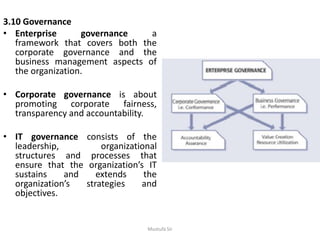
• Enterprise governance a
framework that covers both the
corporate governance and the
business management aspects of
the organization.
• Corporate governance is about
promoting corporate fairness,
transparency and accountability.
• IT governance consists of the
leadership, organizational
structures and processes that
ensure that the organization’s IT
sustains and extends the
organization’s strategies and
objectives.
Mustufa Sir
Reference:
Mustufa Sir
Thank you..
All the best.
Mustufa Sir

CSI principles

  • 1.
    Continual Service Improvement principles Serviceimprovement must focus on • increasing the efficiency • maximizing the effectiveness • optimizing the cost of services Mustufa Sir
  • 2.
    3.1 CSI andorganizational change • Improving service management is to embark upon an organizational change programme. • Many organizational change programmes fail to achieve the desired results. • Successful ITSM requires understanding the way in which work is done and putting in place a programme of change within the IT organization. Mustufa Sir
  • 3.
    3.2 Ownership • Theprinciple of ownership is fundamental to any improvement strategy. • The CSI owner is accountable for the success of Continual Service Improvement in the organization. • This ownership responsibility extends beyond ensuring the CSI practices are embedded in the organization but also to ensuring there are adequate resources (including people and technology) to support and enable CSI. Mustufa Sir
  • 4.
    3.3 Role definitions •It is important to identify and differentiate between two basic role groupings within CSI: production vs. project. • Production roles focus on CSI as a way of life within an organization. • Project roles reflect the more traditional approach to improvement efforts based on formal programmes and projects. • Typical roles are CSI manager, service manager, service owner, process owner, operations analyst, measurement analyst, reporting analyst and quality assurance analyst among many others. Mustufa Sir
  • 5.
  • 6.
    3.4 External andinternal drivers • There are two major areas within every organization driving improvement: aspects which are external to the organization such as regulation, legislation, competition, external customer requirements, market pressures and economics; and, • secondly, aspects which are internal to the organization such as organizational structures, culture, capacity to accept change, existing and projected staffing levels, unions rules, etc. Mustufa Sir
  • 7.
    3.5 Service LevelManagement • Fully accepting that the IT organization must become a service provider to the business or cease to be relevant. • Involving the business and determining their service level requirements. • Defining a customer-facing Service Catalogue which details every service and service package offered by IT with options, parameters and pricing. • Identifying internal IT departmental relationships, negotiating the terms and responsibilities of the internal relationships. Mustufa Sir
  • 8.
    3.6 The DemingCycle • W. Edwards Deming is best known for his management philosophy leading to higher quality, increased productivity, and a more competitive position. • For quality improvement he proposed the Deming Cycle or Circle. • This cycle is particularly applicable in CSI. • The four key stages of the cycle are Plan, Do, Check and Act, after which a phase of consolidation prevents the circle from rolling back down the hill. Mustufa Sir
  • 9.
    3.7 Service measurement •Baselines are used to establish an initial data point to determine if a service or process needs to be improved. • To validate – monitoring and measuring to validate previous decisions • To direct – monitoring and measuring to set direction for activities in order to meet set targets. It is the most prevalent reason for monitoring and measuring • To justify – monitoring and measuring to justify, with factual evidence or proof, that a course of action is required • To intervene – monitoring and measuring to identify a point of intervention including subsequent changes and corrective actions. Mustufa Sir
  • 10.
    3.8 Knowledge Management •Those who do not learn from history are condemned to repeat it. • Knowledge Management plays a key role in CSI. • Within each service lifecycle phase, data should be captured to enable knowledge gain and an understanding of what is actually happening, thus enabling wisdom. Mustufa Sir
  • 11.
    3.9 Benchmarks • Benchmarking(also known as ‘best practice benchmarking’ or ‘process benchmarking’) is a process used in management, particularly strategic management, in which organizations evaluate various aspects of their processes in relation to best practice, usually within their own sector. Mustufa Sir
  • 12.
    3.10 Governance • Enterprisegovernance a framework that covers both the corporate governance and the business management aspects of the organization. • Corporate governance is about promoting corporate fairness, transparency and accountability. • IT governance consists of the leadership, organizational structures and processes that ensure that the organization’s IT sustains and extends the organization’s strategies and objectives. Mustufa Sir
  • 13.
  • 14.
    Thank you.. All thebest. Mustufa Sir