BCM II NERVOUS SYSTEM
CSF PHYSIOLOGY
CSF Functions
 provide mechanical protection
maintain a stable extracellular
environment for the brain
Remove some waste products
nutrition
Convey messages? (hormones/releasing
factors/neurotransmitters)
CSF Production
70 % CSF produced
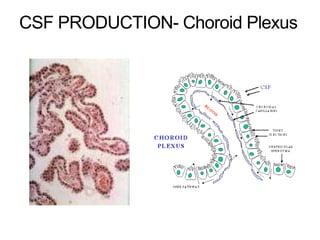
in choroid plexuses of
lateral, third and
fourth ventricles
produced at rate of
500 ml/day or
approximately
20ml/hour (0.3-0.5
ml/kg/hr)
eliminated by being
absorbed into the
arachnoid villi -->
dural sinus --> jugular
system
 The secretion of fluid by
the choroid plexus
depends on the active
Na+-transport across the
cells into the CSF. The
electrical gradient pulls
along Cl-, and both ions
drag water by osmosis.
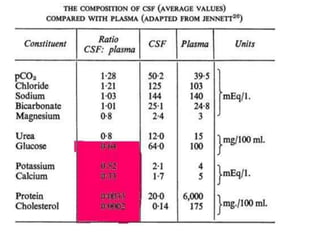
The CSF has lower [K+],
[glucose], and much
lower [protein] than blood
plasma, and higher
concentrations of Na+
and Cl-. The production
of CSF in the choroid
plexuses is an active
secretory process, and
not directly dependent on
the arterial blood
pressure.
CSF Production
• Other sources of CSF production from
capillary ultrafiltrate (Virchow-Robin
spaces)
• Additionally some produced from
metabolic H2O production
CSF PRODUCTION- Choroid Plexus
Ependymal Cell Membrane Transport
CSF Production
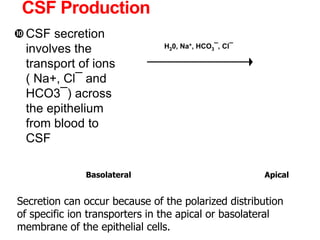
CSF secretion
involves the
transport of ions
( Na+, Cl¯ and
HCO3¯) across
the epithelium
from blood to
CSF
Basolateral Apical
H20, Na+, HCO3¯, Cl¯
Secretion can occur because of the polarized distribution
of specific ion transporters in the apical or basolateral
membrane of the epithelial cells.
CSF Production
 ANP receptors found in choroid plexus
 ANP decreases CSF production
 Choroid plexus epithelial cells express
receptors for atrial natriuretic peptide
that when stimulated increase cGMP
levels and inhibit cerebral spinal fluid
production
 Aquaporin-AQP1 channels are thought
to be involved in the production of
cerebral spinal fluid
CSF Circulation
 lateral ventricles-->
foramen of Monro third
ventricle --> aqueduct of
Sylvius --> fourth
ventricle --> foramina of
Magendie and Luschka --
> subarachnoid space of
brain and spinal cord -->
reabsorption into venous
sinus blood via
arachnoid granulations
CSF Absorption

CSF and Cerebral Blood flow.pptx

  • 1.
    BCM II NERVOUSSYSTEM CSF PHYSIOLOGY
  • 2.
    CSF Functions  providemechanical protection maintain a stable extracellular environment for the brain Remove some waste products nutrition Convey messages? (hormones/releasing factors/neurotransmitters)
  • 3.
    CSF Production 70 %CSF produced in choroid plexuses of lateral, third and fourth ventricles produced at rate of 500 ml/day or approximately 20ml/hour (0.3-0.5 ml/kg/hr) eliminated by being absorbed into the arachnoid villi --> dural sinus --> jugular system  The secretion of fluid by the choroid plexus depends on the active Na+-transport across the cells into the CSF. The electrical gradient pulls along Cl-, and both ions drag water by osmosis. The CSF has lower [K+], [glucose], and much lower [protein] than blood plasma, and higher concentrations of Na+ and Cl-. The production of CSF in the choroid plexuses is an active secretory process, and not directly dependent on the arterial blood pressure.
  • 4.
    CSF Production • Othersources of CSF production from capillary ultrafiltrate (Virchow-Robin spaces) • Additionally some produced from metabolic H2O production
  • 5.
  • 6.
  • 7.
  • 8.
    CSF Production CSF secretion involvesthe transport of ions ( Na+, Cl¯ and HCO3¯) across the epithelium from blood to CSF Basolateral Apical H20, Na+, HCO3¯, Cl¯ Secretion can occur because of the polarized distribution of specific ion transporters in the apical or basolateral membrane of the epithelial cells.
  • 9.
    CSF Production  ANPreceptors found in choroid plexus  ANP decreases CSF production  Choroid plexus epithelial cells express receptors for atrial natriuretic peptide that when stimulated increase cGMP levels and inhibit cerebral spinal fluid production  Aquaporin-AQP1 channels are thought to be involved in the production of cerebral spinal fluid
  • 11.
    CSF Circulation  lateralventricles--> foramen of Monro third ventricle --> aqueduct of Sylvius --> fourth ventricle --> foramina of Magendie and Luschka -- > subarachnoid space of brain and spinal cord --> reabsorption into venous sinus blood via arachnoid granulations
  • 12.