UNIVERSITY OF KABIANGA
KAPKATET CAMPUS
GROUP 11 PRESENTATION
SCHOOL OF: HEALTH SCIENCES
DEPARTMENT: CLINICAL MEDICINE
COURSE TITLE: CLINICAL PHARMACOLOGY
COURSE CODE: BCM 223
INSTRUCTOR: DR. ANTHONY YIAILE
TASK; Discuss the pharmacotherapy of drugs used in
management of pain and inflammation (20mks)
GROUP MEMBERS
1. ONYANYI JOSEPH……..BCM/K/0038/2021
2. MAGRINA LETING…….BCM/K/0025/2021
3. TIMOTHY KEITANY……BCM/K/0034/2021
4. SYLVIA NEKESA…………BCM/K/0015/2021
5. BRIAN KIPCHUMBA….BCM/K/0022/2021
6. BRENDA RICHARD…….BCM/K/0503/2021
INTRODUCTION
• Inflammation is a vascular response
to injury
• Analgesics are drugs that relieve pain.
• NSAIDS are drugs that reduces inflammation
and are effective against pain and fever.
• Antipyretics are agents that relieve fever
• Pain is initiated by harmful stimuli.
• Pain and fever are common symptoms.
Signs of inflammation
• Redness caused by dilation of vessels
• Pain due to increased pressure exerted
by accumulation of interstitial fluid
• Heat caused by increased blood flow
• Swelling due to an extravascular accumulation
of fluid
• Loss of function
PAIN
 Is important becauseit signals“disease”
 Its relief is an important duty
of a clinician.
 It also increases perspiration cooling body.
 Analgesia: state where painful stimuli
moderated, although still perceived no
longer painful.
PATHOPHYSIOLOGY OF PAIN
PATHOPHYSIOLOGY OF FEVER
Fever is elevated body temperature (>37.80 C ).
• Results from rise hypothalamic set points.
• Crucial component initiating fever is pyrogens.
• Are classified as endogenous or exogenous.
• Elevated prostaglandin-E2 alter firing rate of,
• neurons within hypothalamus that control
thermoregulation.
DRUGS USED IN MANAGEMENT OF PAIN
● There are opioid and Non-opioid drugs.
● The Non-opioid drugs include NSAIDs.
Differences between NSAIDs and opioid analgesics
● They do not depress the CNS.
● They do not produce physical dependence.
● Weaker analgesic activity except inflammatory pain.
● Act primarily on peripheral pain mechanisms.
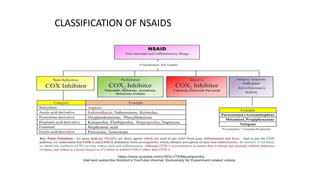
CLASSIFICATION OF NSAIDS
MODE OF ACTION OF NSAIDs
● Posses anti-inflammatory, analgesic and antipyretic properties.
● Inhibit COX that converts endoperoxides into PGs.
● COX enzymes are of 2 types:
● COX 1:cytoprotective PGs in gastric lining.
● COX 2: generate PGs to mediate inflammation.
● NSAIDs only relieve pain secondary to inflammation.
THERAPEUTIC ACTIONS OF NSAIDs
● Analgesia: inhibit COX2 mediated PG synthesis.
● anti-Inflammatory: Inhibition of PG synthesis attenuates.
● Antipyretic: Lowers PG levels in hypothalamus.
● closing patent ductus arteriosus in neonates.
● Rx systemic mastocytosis (elevated mast cells).
● Cardio protection.
PHARMACOKINETIC PROPERTIES OF NSAIDs
● Absorption: readily absorbed after P.O intake.
peak plasma concertation reached 2-4 hrs.
● Distribution: widely distributed as protein bound.
● Metabolism: hepatic via oxidation and conjugation.
● Elimination: renally through secretion and filtration.
● Half life of individual agents varies.
SPECIFIC EXAMPLES OF NSAIDs AND THEIR USES
1.PARACETAMOL (ACETAMINOPHEN)
• Is a mild analgesic and antipyretic.
• MOA: It inhibits synthesis of prostaglandins.
• Pharmacokinetics: is well absorbed from GIT.
• Its distribution is by passive diffusion.
• Metabolism takes place in the liver.
• Eliminated: in urine as glucuronide, sulphate
conjugates.
PARACETAMOL Cont…
• Precaution : patients with Hepatic & renal failures.
• Contraindications: Severe renal impairment, Paracetamol
Hypersensitivity.
• Side Effects: Reversible skin rashes and
• Blood dyscrasia, vomiting and stomach ache.
• Dosage - Adult: 1-2 tablets every 4-6 hours
• Children (6-12 years): ½ -1 tablet 3 -4 times daily.
2.ASPRIN (ACETYSALICYLATE)
• Is an Antipyretic and mild analgesic.
• MOA: inhibits both COX-1 and COX-2
• Pharmacokinetics – Absorption: absorbed in the stomach.
• Its distribution is by passive diffusion.
• metabolism takes place in the liver.
• and it's excreted in the urine.
ASPRIN Cont…
• Interactions: interferes with the coagulation irreversibly.
• Precautions: renal impairment, Gastric ulcer, Gout.
• Contraindication: Hypersensitivity to NSAIDs, Asthma, Hemophilia.
• S.E: GI disturbances, hypersensitivity reactions, thirst.
• Not used children below 12 years.
• Causes Reye’ssyndrome in age group.
3.IBUPROFEN
• Managing mild to moderate pain, antipyretic.
• MOA: Non-selective inhibitor of COX.
• Pharmacokinetics – Absorption: absorbed in the stomach.
• Its distribution is by passive diffusion.
• Metabolism takes place in the liver.
• Excretion: urine as metabolites and bile.
IBUPROFEN Cont…
• Interactions: antidepressants, diuretics and beta-blockers.
• Precautions: Asthma, Bronchospasm, Elderly Hepatic disorders.
• Contraindication: Hypersensitivity to Ibuprofen, Peptic ulcer.
• S.E: GI disturbances, hypersensitivity, visual changes.
• Not recommended for children weighing >5kg.
• Use with caution in hx ulcer.
TOPICAL NSAIDs
• Several NSAIDs available as topical preparations.
• They include Ibuprofen and Piroxicam.
• penetrate skin, enter tissues or joints,
• to reduce processes that cause pain.
• Systemic absorption occurs but is modest.
• They cause local irritation of skin.
OTHER NSAIDs
• Celecoxib: used for long-term pain management,
• in patients with hx dyspepsia/GI bleeding.
• Dexketoprofen: has Less respiratory side effects.
• Ketorolac: for acute pain management(<5days).
• Indomethacin: powerful anti-inflammatory ,weak analgesic action.
• Naproxen: x20 potent COX inhibitor : aspirin.
SYSTEMIC ADVERSE EFFECTS OF NSAIDs
● CVS: fluid retention, HTN, edema, tachycardia.
● GIT: bleeding ulcers, nausea, vomiting, diarrhea.
● CNS: fatigue, insomnia, nervousness, agitation, confusion.
● Uterus: prolongation of gestation and labor.
● Metabolic: hyperglycemia, metabolic acidosis, glycogen depletion.
● Renal :interstitial nephritis, proteinuria, papillary necrosis.
NSAID POSOINING
• NSAIDs poisoning common since found OTC.
• Poisoning caused by accidental/suicidal overdose.
• Ibuprofen, acetaminophen, and aspirin poisoning common.
• Aspirin : glucose depletion, inhibiting Krebs cycle,
• Metabolic acidosis, electrolytes loss. Reyes syndrome.
• Corrected using activated charcoal and IV-Na2CO3.
PARACETAMOL POISONING
• Occurs dose is 7.5-10g for adults
• And 150-200mg for children.
• M.O.T: Excess metabolized to toxic NAPQI.
•NAQQIdoesn’t react glutathione =hepatocellular injury.
• Symptoms: abdominal pain, tender hepatic edge.
• Treatment: activated charcoal 2hrs after ingestion.
• N-acetylcysteine (antidote) to increase glutathione production.
REYE’S SYNDROME
• Condition causes swelling in liver & brain.
• It often affects children and teenagers.
• Happens when a child takes Aspirin.
• Signs and symptoms include Confusion, seizures.
• Early diagnosis & treatment save child's life.
• Caution giving Aspirin to children & teenagers.
IBUPROFEN POISONING
• Excess dose >3200mg/day for adults & >400mg/day,
• Overdose causes excessive inhibition of COX-1.
• Causes reduced PG synthesis & metabolic acidosis.
• Symptoms: nausea, vomiting, abdominal pain, dizziness.
• Decontaminant- use activated charcoal absorbed it.
• Forced alkaline diuresis neutralizes metabolic acidosis.
PREGNANCY AND LACTATION
• NSAIDs affect fertility & risk pregnancy loss.
• Use in second trimester considered safe,
• But was associated with fetal cryptorchidism.
• Avoided in 3rd trimester, significant fetal risks,
• Such as ductus arteriosus, intracranial hemorrhage.
• low infant exposure through breast milk.
REFERENCES
• Drug Index.it. (2019). Drugindex.it; PWA.
https://drugindex.it/clinical_details/169
• Ritter, M. J. (2008). A Textbook of Clinical Pharmacology and
Therapeutics (5th ed.). Hodder Arnold, Copyright.
• Nonsteroidal anti-inflammatory drug - Wikipedia. (2022). Retrieved 2
April 2022, from https://en.wikipedia.org/wiki/Nonsteroidal_anti-
inflammatory_drug
• Brunton, L.(2006). Goodman& Gilman’sthe pharmacologicalbasisof
therapeutics, 11th ed. Mcgraw-Hill Education, Copyright.
• Katzung, B. G. (2018). Basic & clinical pharmacology (14th ed.).
McGraw-Hill Education, Copyright
• www.wikipedia website: the free encyclopedia

DOC-20230301-WA0023..pptx

  • 1.
    UNIVERSITY OF KABIANGA KAPKATETCAMPUS GROUP 11 PRESENTATION SCHOOL OF: HEALTH SCIENCES DEPARTMENT: CLINICAL MEDICINE COURSE TITLE: CLINICAL PHARMACOLOGY COURSE CODE: BCM 223 INSTRUCTOR: DR. ANTHONY YIAILE TASK; Discuss the pharmacotherapy of drugs used in management of pain and inflammation (20mks)
  • 2.
    GROUP MEMBERS 1. ONYANYIJOSEPH……..BCM/K/0038/2021 2. MAGRINA LETING…….BCM/K/0025/2021 3. TIMOTHY KEITANY……BCM/K/0034/2021 4. SYLVIA NEKESA…………BCM/K/0015/2021 5. BRIAN KIPCHUMBA….BCM/K/0022/2021 6. BRENDA RICHARD…….BCM/K/0503/2021
  • 3.
    INTRODUCTION • Inflammation isa vascular response to injury • Analgesics are drugs that relieve pain. • NSAIDS are drugs that reduces inflammation and are effective against pain and fever. • Antipyretics are agents that relieve fever • Pain is initiated by harmful stimuli. • Pain and fever are common symptoms.
  • 4.
    Signs of inflammation •Redness caused by dilation of vessels • Pain due to increased pressure exerted by accumulation of interstitial fluid • Heat caused by increased blood flow • Swelling due to an extravascular accumulation of fluid • Loss of function
  • 5.
    PAIN  Is importantbecauseit signals“disease”  Its relief is an important duty of a clinician.  It also increases perspiration cooling body.  Analgesia: state where painful stimuli moderated, although still perceived no longer painful.
  • 6.
  • 7.
    PATHOPHYSIOLOGY OF FEVER Feveris elevated body temperature (>37.80 C ). • Results from rise hypothalamic set points. • Crucial component initiating fever is pyrogens. • Are classified as endogenous or exogenous. • Elevated prostaglandin-E2 alter firing rate of, • neurons within hypothalamus that control thermoregulation.
  • 8.
    DRUGS USED INMANAGEMENT OF PAIN ● There are opioid and Non-opioid drugs. ● The Non-opioid drugs include NSAIDs. Differences between NSAIDs and opioid analgesics ● They do not depress the CNS. ● They do not produce physical dependence. ● Weaker analgesic activity except inflammatory pain. ● Act primarily on peripheral pain mechanisms.
  • 9.
  • 10.
    MODE OF ACTIONOF NSAIDs ● Posses anti-inflammatory, analgesic and antipyretic properties. ● Inhibit COX that converts endoperoxides into PGs. ● COX enzymes are of 2 types: ● COX 1:cytoprotective PGs in gastric lining. ● COX 2: generate PGs to mediate inflammation. ● NSAIDs only relieve pain secondary to inflammation.
  • 11.
    THERAPEUTIC ACTIONS OFNSAIDs ● Analgesia: inhibit COX2 mediated PG synthesis. ● anti-Inflammatory: Inhibition of PG synthesis attenuates. ● Antipyretic: Lowers PG levels in hypothalamus. ● closing patent ductus arteriosus in neonates. ● Rx systemic mastocytosis (elevated mast cells). ● Cardio protection.
  • 12.
    PHARMACOKINETIC PROPERTIES OFNSAIDs ● Absorption: readily absorbed after P.O intake. peak plasma concertation reached 2-4 hrs. ● Distribution: widely distributed as protein bound. ● Metabolism: hepatic via oxidation and conjugation. ● Elimination: renally through secretion and filtration. ● Half life of individual agents varies.
  • 13.
    SPECIFIC EXAMPLES OFNSAIDs AND THEIR USES 1.PARACETAMOL (ACETAMINOPHEN) • Is a mild analgesic and antipyretic. • MOA: It inhibits synthesis of prostaglandins. • Pharmacokinetics: is well absorbed from GIT. • Its distribution is by passive diffusion. • Metabolism takes place in the liver. • Eliminated: in urine as glucuronide, sulphate conjugates.
  • 14.
    PARACETAMOL Cont… • Precaution: patients with Hepatic & renal failures. • Contraindications: Severe renal impairment, Paracetamol Hypersensitivity. • Side Effects: Reversible skin rashes and • Blood dyscrasia, vomiting and stomach ache. • Dosage - Adult: 1-2 tablets every 4-6 hours • Children (6-12 years): ½ -1 tablet 3 -4 times daily.
  • 15.
    2.ASPRIN (ACETYSALICYLATE) • Isan Antipyretic and mild analgesic. • MOA: inhibits both COX-1 and COX-2 • Pharmacokinetics – Absorption: absorbed in the stomach. • Its distribution is by passive diffusion. • metabolism takes place in the liver. • and it's excreted in the urine.
  • 16.
    ASPRIN Cont… • Interactions:interferes with the coagulation irreversibly. • Precautions: renal impairment, Gastric ulcer, Gout. • Contraindication: Hypersensitivity to NSAIDs, Asthma, Hemophilia. • S.E: GI disturbances, hypersensitivity reactions, thirst. • Not used children below 12 years. • Causes Reye’ssyndrome in age group.
  • 17.
    3.IBUPROFEN • Managing mildto moderate pain, antipyretic. • MOA: Non-selective inhibitor of COX. • Pharmacokinetics – Absorption: absorbed in the stomach. • Its distribution is by passive diffusion. • Metabolism takes place in the liver. • Excretion: urine as metabolites and bile.
  • 18.
    IBUPROFEN Cont… • Interactions:antidepressants, diuretics and beta-blockers. • Precautions: Asthma, Bronchospasm, Elderly Hepatic disorders. • Contraindication: Hypersensitivity to Ibuprofen, Peptic ulcer. • S.E: GI disturbances, hypersensitivity, visual changes. • Not recommended for children weighing >5kg. • Use with caution in hx ulcer.
  • 19.
    TOPICAL NSAIDs • SeveralNSAIDs available as topical preparations. • They include Ibuprofen and Piroxicam. • penetrate skin, enter tissues or joints, • to reduce processes that cause pain. • Systemic absorption occurs but is modest. • They cause local irritation of skin.
  • 20.
    OTHER NSAIDs • Celecoxib:used for long-term pain management, • in patients with hx dyspepsia/GI bleeding. • Dexketoprofen: has Less respiratory side effects. • Ketorolac: for acute pain management(<5days). • Indomethacin: powerful anti-inflammatory ,weak analgesic action. • Naproxen: x20 potent COX inhibitor : aspirin.
  • 21.
    SYSTEMIC ADVERSE EFFECTSOF NSAIDs ● CVS: fluid retention, HTN, edema, tachycardia. ● GIT: bleeding ulcers, nausea, vomiting, diarrhea. ● CNS: fatigue, insomnia, nervousness, agitation, confusion. ● Uterus: prolongation of gestation and labor. ● Metabolic: hyperglycemia, metabolic acidosis, glycogen depletion. ● Renal :interstitial nephritis, proteinuria, papillary necrosis.
  • 22.
    NSAID POSOINING • NSAIDspoisoning common since found OTC. • Poisoning caused by accidental/suicidal overdose. • Ibuprofen, acetaminophen, and aspirin poisoning common. • Aspirin : glucose depletion, inhibiting Krebs cycle, • Metabolic acidosis, electrolytes loss. Reyes syndrome. • Corrected using activated charcoal and IV-Na2CO3.
  • 23.
    PARACETAMOL POISONING • Occursdose is 7.5-10g for adults • And 150-200mg for children. • M.O.T: Excess metabolized to toxic NAPQI. •NAQQIdoesn’t react glutathione =hepatocellular injury. • Symptoms: abdominal pain, tender hepatic edge. • Treatment: activated charcoal 2hrs after ingestion. • N-acetylcysteine (antidote) to increase glutathione production.
  • 24.
    REYE’S SYNDROME • Conditioncauses swelling in liver & brain. • It often affects children and teenagers. • Happens when a child takes Aspirin. • Signs and symptoms include Confusion, seizures. • Early diagnosis & treatment save child's life. • Caution giving Aspirin to children & teenagers.
  • 25.
    IBUPROFEN POISONING • Excessdose >3200mg/day for adults & >400mg/day, • Overdose causes excessive inhibition of COX-1. • Causes reduced PG synthesis & metabolic acidosis. • Symptoms: nausea, vomiting, abdominal pain, dizziness. • Decontaminant- use activated charcoal absorbed it. • Forced alkaline diuresis neutralizes metabolic acidosis.
  • 26.
    PREGNANCY AND LACTATION •NSAIDs affect fertility & risk pregnancy loss. • Use in second trimester considered safe, • But was associated with fetal cryptorchidism. • Avoided in 3rd trimester, significant fetal risks, • Such as ductus arteriosus, intracranial hemorrhage. • low infant exposure through breast milk.
  • 27.
    REFERENCES • Drug Index.it.(2019). Drugindex.it; PWA. https://drugindex.it/clinical_details/169 • Ritter, M. J. (2008). A Textbook of Clinical Pharmacology and Therapeutics (5th ed.). Hodder Arnold, Copyright. • Nonsteroidal anti-inflammatory drug - Wikipedia. (2022). Retrieved 2 April 2022, from https://en.wikipedia.org/wiki/Nonsteroidal_anti- inflammatory_drug • Brunton, L.(2006). Goodman& Gilman’sthe pharmacologicalbasisof therapeutics, 11th ed. Mcgraw-Hill Education, Copyright. • Katzung, B. G. (2018). Basic & clinical pharmacology (14th ed.). McGraw-Hill Education, Copyright • www.wikipedia website: the free encyclopedia