DRUG DEVELOPMENT PROCESS
DURING CLINICAL TRIALS.
Step1:Discovery and development.
• Researchers discovered new drug through
• New insight into a disease process
• Existing treatments that have unanticipated effect
• New technologies
• Trial tests to find a possible beneficial effect
Thousands compounds are potential candidates but
Only small compounds call’s for further studies
Development
Researchers conducts experiments to gather information on;
• Absorption,distribution,metabolism and excretion
• Potential benefits and mechanisms of actions
• Best dosage
• Best way of administration
• Side effects
• Effects on different groups of people
• Interaction with other drugs and treatments
• It’s effectiveness compared to other drugs
Step2:Preclinical research
To establish whether it is toxic
There are two types of Preclinical trials;
1. Invitro
2. Invivo
Preclinical trials are not very large
They are detailed into dosing and toxicity
Step3:Clinical research
After review of findings in preclinical testing
Refers to trials done on people
Developers consider their accomplishments
For every different clinical research phases
Researchers begin Investigational New Drug process
Designing clinical trials
• Meant to answer specific research questions
• It follows a protocol
• The protocol is developed by researchers
• Before a preclinical trial begins,
• Researchers review prior information about drug
• Research questions and objectives are developed
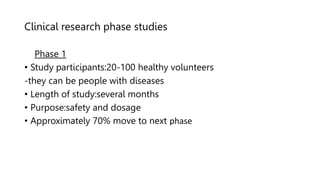
Clinical research phase studies
Phase 1
• Study participants:20-100 healthy volunteers
-they can be people with diseases
• Length of study:several months
• Purpose:safety and dosage
• Approximately 70% move to next phase
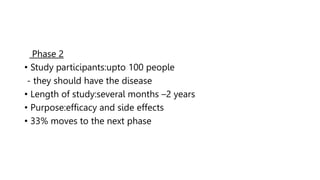
Phase 2
• Study participants:upto 100 people
- they should have the disease
• Length of study:several months –2 years
• Purpose:efficacy and side effects
• 33% moves to the next phase
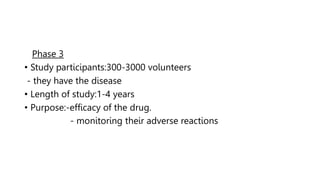
Phase 3
• Study participants:300-3000 volunteers
- they have the disease
• Length of study:1-4 years
• Purpose:-efficacy of the drug.
- monitoring their adverse reactions
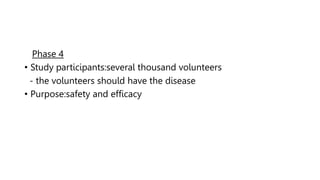
Phase 4
• Study participants:several thousand volunteers
- the volunteers should have the disease
• Purpose:safety and efficacy
Step 4:FDA drug review
• If a drug developer has evidence
from preclinical and clinical trials that
a drug is safe and effective
for its use,the company file’s
application to market the drug
• FDA reviews their data for decisions
New drug application
• It demonstrates that a drug is
safe and effective for intended use
• Drug developers must include the following;
1. Preclinical data to phase 3 trials
2. Proposed labelling
3. Safety updates
4. Drug abuse information
5. Patent information
6. Institutional review board compliance information
7. Directions for use
• For complete data presented,the review
team takes 6-10 months to approve it
FDA approval.
• Labeling accurately and objectively describes basis
for approval and how best to
use the drug
• Sometimes FDA requires the developer to
address questions based on existing data
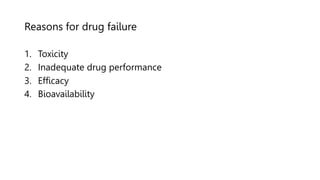
Reasons for drug failure
1. Toxicity
2. Inadequate drug performance
3. Efficacy
4. Bioavailability
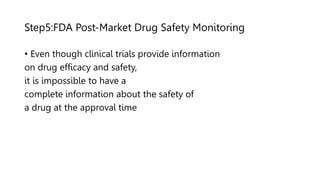
Step5:FDA Post-Market Drug Safety Monitoring
• Even though clinical trials provide information
on drug efficacy and safety,
it is impossible to have a
complete information about the safety of
a drug at the approval time
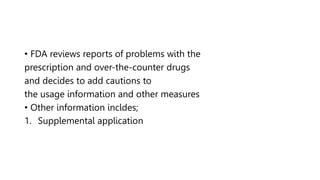
• FDA reviews reports of problems with the
prescription and over-the-counter drugs
and decides to add cautions to
the usage information and other measures
• Other information incldes;
1. Supplemental application
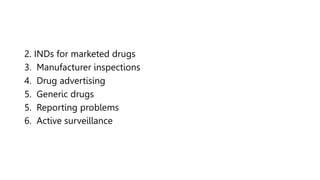
2. INDs for marketed drugs
3. Manufacturer inspections
4. Drug advertising
5. Generic drugs
5. Reporting problems
6. Active surveillance

Drug development during clinical trials.pptx

  • 1.
  • 2.
    Step1:Discovery and development. •Researchers discovered new drug through • New insight into a disease process • Existing treatments that have unanticipated effect • New technologies • Trial tests to find a possible beneficial effect
  • 3.
    Thousands compounds arepotential candidates but Only small compounds call’s for further studies
  • 4.
    Development Researchers conducts experimentsto gather information on; • Absorption,distribution,metabolism and excretion • Potential benefits and mechanisms of actions • Best dosage • Best way of administration
  • 5.
    • Side effects •Effects on different groups of people • Interaction with other drugs and treatments • It’s effectiveness compared to other drugs
  • 6.
    Step2:Preclinical research To establishwhether it is toxic There are two types of Preclinical trials; 1. Invitro 2. Invivo Preclinical trials are not very large They are detailed into dosing and toxicity
  • 7.
    Step3:Clinical research After reviewof findings in preclinical testing Refers to trials done on people Developers consider their accomplishments For every different clinical research phases Researchers begin Investigational New Drug process
  • 8.
    Designing clinical trials •Meant to answer specific research questions • It follows a protocol • The protocol is developed by researchers • Before a preclinical trial begins, • Researchers review prior information about drug • Research questions and objectives are developed
  • 9.
    Clinical research phasestudies Phase 1 • Study participants:20-100 healthy volunteers -they can be people with diseases • Length of study:several months • Purpose:safety and dosage • Approximately 70% move to next phase
  • 10.
    Phase 2 • Studyparticipants:upto 100 people - they should have the disease • Length of study:several months –2 years • Purpose:efficacy and side effects • 33% moves to the next phase
  • 11.
    Phase 3 • Studyparticipants:300-3000 volunteers - they have the disease • Length of study:1-4 years • Purpose:-efficacy of the drug. - monitoring their adverse reactions
  • 12.
    Phase 4 • Studyparticipants:several thousand volunteers - the volunteers should have the disease • Purpose:safety and efficacy
  • 13.
    Step 4:FDA drugreview • If a drug developer has evidence from preclinical and clinical trials that a drug is safe and effective for its use,the company file’s application to market the drug • FDA reviews their data for decisions
  • 14.
    New drug application •It demonstrates that a drug is safe and effective for intended use • Drug developers must include the following; 1. Preclinical data to phase 3 trials 2. Proposed labelling 3. Safety updates
  • 15.
    4. Drug abuseinformation 5. Patent information 6. Institutional review board compliance information 7. Directions for use • For complete data presented,the review team takes 6-10 months to approve it
  • 16.
    FDA approval. • Labelingaccurately and objectively describes basis for approval and how best to use the drug • Sometimes FDA requires the developer to address questions based on existing data
  • 17.
    Reasons for drugfailure 1. Toxicity 2. Inadequate drug performance 3. Efficacy 4. Bioavailability
  • 18.
    Step5:FDA Post-Market DrugSafety Monitoring • Even though clinical trials provide information on drug efficacy and safety, it is impossible to have a complete information about the safety of a drug at the approval time
  • 19.
    • FDA reviewsreports of problems with the prescription and over-the-counter drugs and decides to add cautions to the usage information and other measures • Other information incldes; 1. Supplemental application
  • 20.
    2. INDs formarketed drugs 3. Manufacturer inspections 4. Drug advertising 5. Generic drugs 5. Reporting problems 6. Active surveillance