CSF PHYSIOLOGY
Presenter: Dr Kaushal Deep Singh
MCh Senior Resident
Department of Neurosurgery
Sher-i-Kashmir Institute of Medical
Sciences (SKIMS), Srinagar
Date: 08/03/2018
HISTORY
Emanuel Swedenborg who discovered CSF,
referred to it as “highly gifted juice” that is
dispensed from the roof of the fourth ventricle
to the medulla oblongata, and the spinal cord.
Albrecht von Haller found that that the
“water” in the brain, in case of excess
secretion, descends to the base of the skull
resulting in hydrocephalus.
OUTLINE
• CSF SPACES AND CSF CIRCULATION
• CSF FORMATION, REABSORPTION AND
FACTORS AFFECTING THEM
• ALTERATION IN CSF DYNAMICS IN
PATHOLOGIES
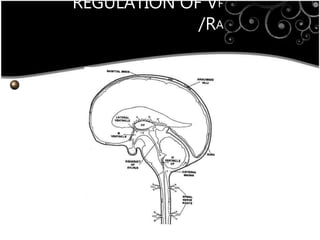
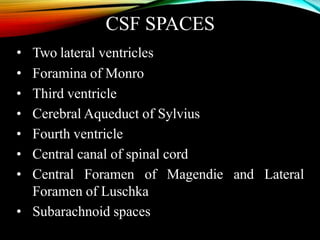
CSF SPACES
• Two lateral ventricles
• Foramina of Monro
• Third ventricle
• Cerebral Aqueduct of Sylvius
• Fourth ventricle
• Central canal of spinal cord
• Central Foramen of Magendie and Lateral
Foramen of Luschka
• Subarachnoid spaces
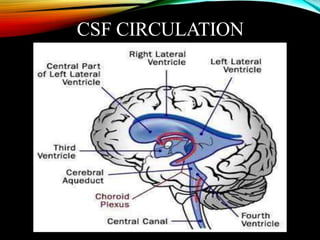
CSF CIRCULATION
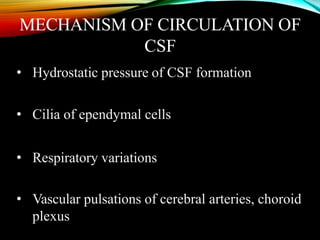
MECHANISM OF CIRCULATION OF
CSF
• Hydrostatic pressure of CSF formation
• Cilia of ependymal cells
• Respiratory variations
• Vascular pulsations of cerebral arteries, choroid
plexus
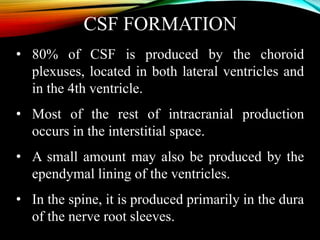
CSF FORMATION
• 80% of CSF is produced by the choroid
plexuses, located in both lateral ventricles and
in the 4th ventricle.
• Most of the rest of intracranial production
occurs in the interstitial space.
• A small amount may also be produced by the
ependymal lining of the ventricles.
• In the spine, it is produced primarily in the dura
of the nerve root sleeves.
CSF FORMATION
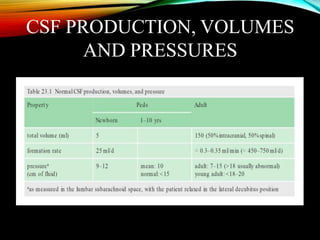
• CSF is “turned over” ≈ 3-4 times every day.
• Rate of formation is independent of the
intracranial pressure.
• Except in the limiting case when ICP becomes
so high that cerebral blood flow is reduced.
CSF FORMATION: Choroid Plexus
• Invagination of blood vessels & leptomeninges
covered by a layer of modified ependyma
• Epithelium forms the blood-CSF barrier
• Carbonic anhydrase present in the epithelium
& Na+-K+ pump in luminal plasma membrane
play major role in CSF formation
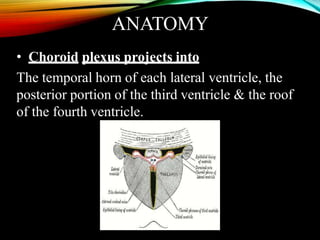
ANATOMY
• Choroid plexus projects into
The temporal horn of each lateral ventricle, the
posterior portion of the third ventricle & the roof
of the fourth ventricle.
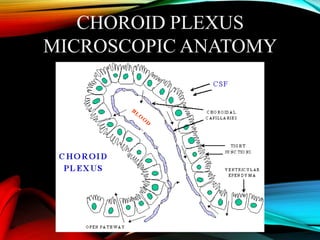
CHOROID PLEXUS
MICROSCOPIC ANATOMY
CSF PRODUCTION, VOLUMES
AND PRESSURES
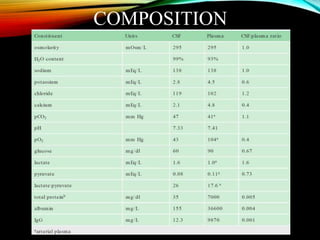
COMPOSITION
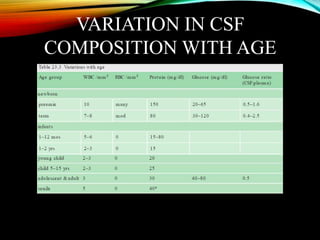
VARIATION IN CSF
COMPOSITION WITH AGE
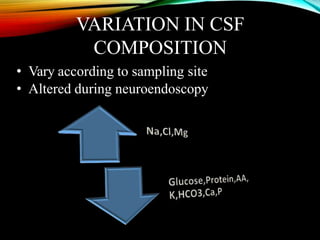
VARIATION IN CSF
COMPOSITION
• Vary according to sampling site
• Altered during neuroendoscopy
MOVEMENT OF GLUCOSE
• Glucose concentration is 60% that of plasma.
• Remains constant, unless blood glucose >270-
360.
• Enters CSF quickly by facilitated transport.
• Rate ∝ Serum glucose.
MOVEMENT OF PROTEIN
• CSF protein concentrations are ≤ 0.5% of
plasma protein concentration.
• If structural barrier between ECF & CSF
spaces are not intact, it enters, but then also
cleared from CSF spaces into dural sinuses -
because of the sink effectof flowing CSF.
VENTRICLES 26mg/100ml
CISTERNA MAGNA 32mg/100ml
LUMBAR SAC 42mg/100ml
Vf AND ICP/MAP
• As long as MAP remains >70 mm of Hg,
increase of ICP [upto 20 mm of Hg] has no
major impact on Vƒ
• When MAP is significantly lowered → CBF↓
→ CPP↓, Vƒ↓
CSF RESORPTION
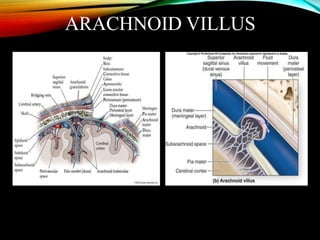
• CSF is absorbed primarily by arachnoid villi
(granulations) that extend into the dural venous
sinuses.
• Arachnoid Villi are protrusion of the arachnoid matter
through perforations in the dura into the lumina of
venous sinuses
• Other sites of absorption include the choroid plexuses
and lymphatics.
• Intracranial-Superior sagittal sinus[85%-90%]
• Spinal-dural sinusoids on dorsal nerve roots[15%]
ARACHNOID VILLUS
L
MECHANISM OF CSF
REABSORPTION
• High velocity of blood flow through the fixed
diameter of the sinuses & the low intraluminal
pressure that develops @ the circumference of
the sinus wall where the arachnoid villi enter,
cause a suction –pump action
• Rate of reabsorption (Va); @ ICPs > 7 cms of
H2O, Va ↑ directly as ICP ↑[relation linear upto
ICP of 30 cms of H2O]
DETERMINANTS OF
REABSORPTION
• Endothelium covering the villus acts as a CSF-
blood barrier
• If through endothelium:(1)pinocytic vesicles
(2)transcellular openings
• Trans villous hydrostatic pressure gradient [CSF
pressure-Venous sinus pressure]
• Resorption remains normal upto a CSF pressure
of 30 cm of H2O; above this it decreases
CSF DRAINAGE & CEREBRAL
EDEMA
• Vasogenic edema resolves partly by drainage
of fluid into ventricular CSF
• Factors influencing:
(1) pressure gradient between brain tissue andCSF
(2)sink action of CSF
• Brain ECF proteins cleared by glial uptake
FUNCTIONS OF CSF-
SUPPORT,NUTRITION
• The low specific gravity of CSF (1.007)
relative to that of the brain (1.040) reduces the
effective mass of a 1400g brain to only 47g.
• Stable supply of nutrients, primarily glucose;
also vitamins, eicosanoids, monosaccharides,
neutral & basic amino acids.
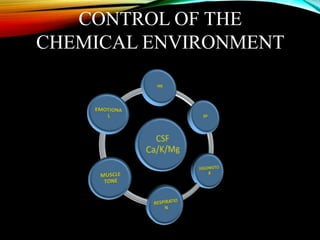
CONTROL OF THE
CHEMICAL ENVIRONMENT
• Exchange between neural tissue & CSF is
easy upto a diffusion distance 15mm (max)
& ISF space and CSF spaces are continuous
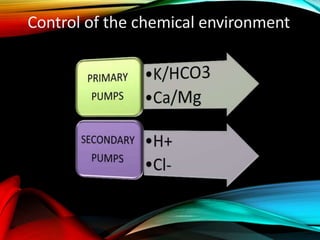
CONTROL OF THE
CHEMICAL ENVIRONMENT
Control of the chemical environment
EXCRETION
• Removes metabolic products, unwanted
drugs
• BBB excludes out toxic large, polar and lipid
insoluble drugs, humoral agents.
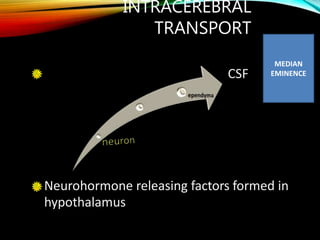
INTRACEREBRAL
TRANSPORT
CSF
Neurohormone releasing factors formed in
hypothalamus
MEDIAN
EMINENCE
REGULATION OF VF
/RA
NEUROGENIC REGULATION
Adrenergic nerves from superior and lower
cervical ganglia innervate CP
3rd ventricle rich in cholinergic
innervation, whereas 4th ventricle devoid of
it
Peptidergic nerves contain VIP and
substance-P : both are potent vasodilators
ADRENERGIC
SYSTEM
α  constriction βdilatation
Decrease carbonic anhydrase activity
Norepinephrine:↓ Vf
high α mediated vasoconstriction
Low β1 mediated inhibitory action on CP
CHOLINERGIC
SYSTEM
Also ↓ Vf
Receptors presumably muscarinic
Act on CP epithelium, rather than on
vasculature
METABOLIC REGULATION
HYPOTHERMIA: ↓ Vf – By decreasing
secretory and transport process and by ↓ing
CBF
between 41310 C: each 10 C↓in
temperature, ↓ Vf by 11%
HYPOCAPNIA: acutely ↓ Vf [mechanism :
↓ CBF, ↓ H+ for exchange with Na]
METABOLIC REGULATION
Metabolic alkalosis ↓ Vf due to pH effect
Metabolic acidosis: no change
VF IN CHANGE OF
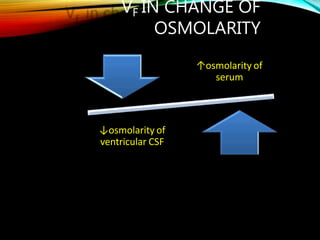
OSMOLARITY
↑osmolarity of
serum
↓osmolarity of
ventricular CSF
ALTERATIONS IN VARIOUS
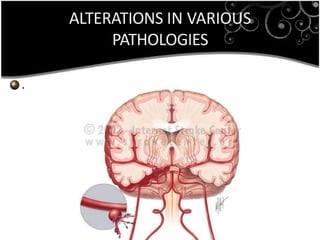
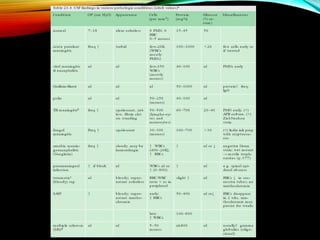
PATHOLOGIES
.
THANK YOU

CSF physiology

  • 1.
    CSF PHYSIOLOGY Presenter: DrKaushal Deep Singh MCh Senior Resident Department of Neurosurgery Sher-i-Kashmir Institute of Medical Sciences (SKIMS), Srinagar Date: 08/03/2018
  • 2.
    HISTORY Emanuel Swedenborg whodiscovered CSF, referred to it as “highly gifted juice” that is dispensed from the roof of the fourth ventricle to the medulla oblongata, and the spinal cord. Albrecht von Haller found that that the “water” in the brain, in case of excess secretion, descends to the base of the skull resulting in hydrocephalus.
  • 3.
    OUTLINE • CSF SPACESAND CSF CIRCULATION • CSF FORMATION, REABSORPTION AND FACTORS AFFECTING THEM • ALTERATION IN CSF DYNAMICS IN PATHOLOGIES
  • 4.
    CSF SPACES • Twolateral ventricles • Foramina of Monro • Third ventricle • Cerebral Aqueduct of Sylvius • Fourth ventricle • Central canal of spinal cord • Central Foramen of Magendie and Lateral Foramen of Luschka • Subarachnoid spaces
  • 5.
  • 6.
    MECHANISM OF CIRCULATIONOF CSF • Hydrostatic pressure of CSF formation • Cilia of ependymal cells • Respiratory variations • Vascular pulsations of cerebral arteries, choroid plexus
  • 7.
    CSF FORMATION • 80%of CSF is produced by the choroid plexuses, located in both lateral ventricles and in the 4th ventricle. • Most of the rest of intracranial production occurs in the interstitial space. • A small amount may also be produced by the ependymal lining of the ventricles. • In the spine, it is produced primarily in the dura of the nerve root sleeves.
  • 8.
    CSF FORMATION • CSFis “turned over” ≈ 3-4 times every day. • Rate of formation is independent of the intracranial pressure. • Except in the limiting case when ICP becomes so high that cerebral blood flow is reduced.
  • 9.
    CSF FORMATION: ChoroidPlexus • Invagination of blood vessels & leptomeninges covered by a layer of modified ependyma • Epithelium forms the blood-CSF barrier • Carbonic anhydrase present in the epithelium & Na+-K+ pump in luminal plasma membrane play major role in CSF formation
  • 10.
    ANATOMY • Choroid plexusprojects into The temporal horn of each lateral ventricle, the posterior portion of the third ventricle & the roof of the fourth ventricle.
  • 11.
  • 12.
  • 13.
  • 14.
  • 15.
    VARIATION IN CSF COMPOSITION •Vary according to sampling site • Altered during neuroendoscopy
  • 16.
    MOVEMENT OF GLUCOSE •Glucose concentration is 60% that of plasma. • Remains constant, unless blood glucose >270- 360. • Enters CSF quickly by facilitated transport. • Rate ∝ Serum glucose.
  • 17.
    MOVEMENT OF PROTEIN •CSF protein concentrations are ≤ 0.5% of plasma protein concentration. • If structural barrier between ECF & CSF spaces are not intact, it enters, but then also cleared from CSF spaces into dural sinuses - because of the sink effectof flowing CSF. VENTRICLES 26mg/100ml CISTERNA MAGNA 32mg/100ml LUMBAR SAC 42mg/100ml
  • 18.
    Vf AND ICP/MAP •As long as MAP remains >70 mm of Hg, increase of ICP [upto 20 mm of Hg] has no major impact on Vƒ • When MAP is significantly lowered → CBF↓ → CPP↓, Vƒ↓
  • 19.
    CSF RESORPTION • CSFis absorbed primarily by arachnoid villi (granulations) that extend into the dural venous sinuses. • Arachnoid Villi are protrusion of the arachnoid matter through perforations in the dura into the lumina of venous sinuses • Other sites of absorption include the choroid plexuses and lymphatics. • Intracranial-Superior sagittal sinus[85%-90%] • Spinal-dural sinusoids on dorsal nerve roots[15%]
  • 20.
  • 21.
    MECHANISM OF CSF REABSORPTION •High velocity of blood flow through the fixed diameter of the sinuses & the low intraluminal pressure that develops @ the circumference of the sinus wall where the arachnoid villi enter, cause a suction –pump action • Rate of reabsorption (Va); @ ICPs > 7 cms of H2O, Va ↑ directly as ICP ↑[relation linear upto ICP of 30 cms of H2O]
  • 22.
    DETERMINANTS OF REABSORPTION • Endotheliumcovering the villus acts as a CSF- blood barrier • If through endothelium:(1)pinocytic vesicles (2)transcellular openings • Trans villous hydrostatic pressure gradient [CSF pressure-Venous sinus pressure] • Resorption remains normal upto a CSF pressure of 30 cm of H2O; above this it decreases
  • 23.
    CSF DRAINAGE &CEREBRAL EDEMA • Vasogenic edema resolves partly by drainage of fluid into ventricular CSF • Factors influencing: (1) pressure gradient between brain tissue andCSF (2)sink action of CSF • Brain ECF proteins cleared by glial uptake
  • 24.
    FUNCTIONS OF CSF- SUPPORT,NUTRITION •The low specific gravity of CSF (1.007) relative to that of the brain (1.040) reduces the effective mass of a 1400g brain to only 47g. • Stable supply of nutrients, primarily glucose; also vitamins, eicosanoids, monosaccharides, neutral & basic amino acids.
  • 25.
    CONTROL OF THE CHEMICALENVIRONMENT • Exchange between neural tissue & CSF is easy upto a diffusion distance 15mm (max) & ISF space and CSF spaces are continuous
  • 26.
  • 27.
    Control of thechemical environment
  • 28.
    EXCRETION • Removes metabolicproducts, unwanted drugs • BBB excludes out toxic large, polar and lipid insoluble drugs, humoral agents.
  • 29.
    INTRACEREBRAL TRANSPORT CSF Neurohormone releasing factorsformed in hypothalamus MEDIAN EMINENCE
  • 30.
  • 31.
    NEUROGENIC REGULATION Adrenergic nervesfrom superior and lower cervical ganglia innervate CP 3rd ventricle rich in cholinergic innervation, whereas 4th ventricle devoid of it Peptidergic nerves contain VIP and substance-P : both are potent vasodilators
  • 32.
    ADRENERGIC SYSTEM α  constrictionβdilatation Decrease carbonic anhydrase activity Norepinephrine:↓ Vf high α mediated vasoconstriction Low β1 mediated inhibitory action on CP
  • 33.
    CHOLINERGIC SYSTEM Also ↓ Vf Receptorspresumably muscarinic Act on CP epithelium, rather than on vasculature
  • 34.
    METABOLIC REGULATION HYPOTHERMIA: ↓Vf – By decreasing secretory and transport process and by ↓ing CBF between 41310 C: each 10 C↓in temperature, ↓ Vf by 11% HYPOCAPNIA: acutely ↓ Vf [mechanism : ↓ CBF, ↓ H+ for exchange with Na]
  • 35.
    METABOLIC REGULATION Metabolic alkalosis↓ Vf due to pH effect Metabolic acidosis: no change
  • 36.
    VF IN CHANGEOF OSMOLARITY ↑osmolarity of serum ↓osmolarity of ventricular CSF
  • 37.
  • 39.

Editor's Notes

  • #8 (accounts for ≈ 95% of CSF produced in the choroid plexuses)
  • #9 (accounts for ≈ 95% of CSF produced in the choroid plexuses)
  • #20 (accounts for ≈ 95% of CSF produced in the choroid plexuses)