01.) Introduction of Direct & Indirect stakeholders in construction Industry
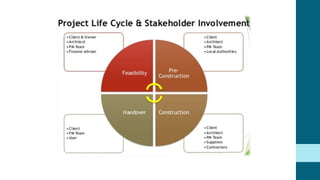
02.) Project life cycle & stakeholder involvement
03.) RIBA Plan of work stages
04.) Stakeholders’ involvement through the project life cycle
 Client
 Architect
 Quantity Surveyor
 Structural engineer
05.) Interviewed details from a stakeholder
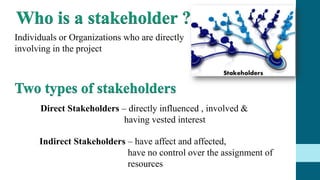
Individuals or Organizations who are directly
involving in the project
Direct Stakeholders – directly influenced , involved &
having vested interest
Indirect Stakeholders – have affect and affected,
have no control over the assignment of
resources
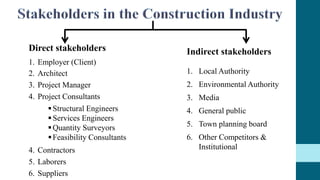
Direct stakeholders
1. Employer (Client)
2. Architect
3. Project Manager
4. Project Consultants
Structural Engineers
Services Engineers
Quantity Surveyors
Feasibility Consultants
4. Contractors
5. Laborers
6. Suppliers
Indirect stakeholders
1. Local Authority
2. Environmental Authority
3. Media
4. General public
5. Town planning board
6. Other Competitors &
Institutional
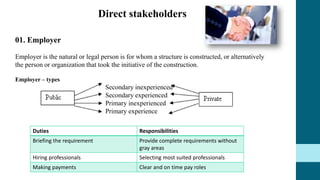
Direct stakeholders
Secondary inexperienced
Secondary experienced
Primary inexperienced
Primary experience
01. Employer
Employer is the natural or legal person is for whom a structure is constructed, or alternatively
the person or organization that took the initiative of the construction.
Duties Responsibilities
Briefing the requirement Provide complete requirements without
gray areas
Hiring professionals Selecting most suited professionals
Making payments Clear and on time pay roles
Employer – types
2. Architect
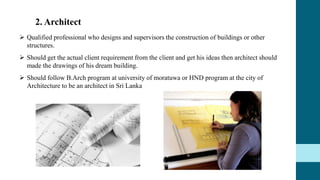
 Qualified professional who designs and supervisors the construction of buildings or other
structures.
 Should get the actual client requirement from the client and get his ideas then architect should
made the drawings of his dream building.
 Should follow B.Arch program at university of moratuwa or HND program at the city of
Architecture to be an architect in Sri Lanka
Responsibilities of a Project Manager
 Manager the day to day working
 Report the progress of the project
 Plan and arrange visited to the site for each an every consultant
 Coordination among the team
 Assuring the quality of their work
 Ensure the health, safety and environmental aspects
WHO ?
 A project manager is a professional in the field of management
 responsible for leading a project from initial stage up to the completion
 It includes planning execution of the work and managing the resources
HOW?
To be a project manager professionally qualified construction expert who are eligible need to follow post
graduate diploma or master program.
3. Project Manager
4. Contractor
Person or firm who undertakes to complete a project/building in accordance with
given client’s requirements.
5. Laborers
Work on given instruction under the supervision. There are two types of laborers,
skilled and unskilled
6. Suppliers - Marketing and commercial product providers are called suppliers.
7. Project consultants
Structural Engineer – design a structure of the building, materials and systems
Quantity Surveyor - professional with expert knowledge on construction costs and contracts.
Cost
Services Engineer - Building services engineering, technical building services engineering for
the internal environment and environmental impact of a building. Facilitating of the services of
plumbing, electrical, mechanical designs/ designing the systems.
Feasibility Consultant - Can be a professionally
qualified engineer, architect or quantity surveyor and he
can get that profession by his work experience and
feasibility studies.
Indirect Stakeholders
Local Authority
Get approvals from the authority whether the project can do or not in the area
some areas are prohibited to build residential.
Environmental Authority
Given approvals to the development by assessing and reporting. They do a complete experiment of
the environment of specific area and prepare EIA document. (Environmental Impact assessment.)
Media
Reflect analytical view of the project and transferring information to the general public. They are not
actively involved the project to achieved the goal but they influenced to search their mistakes and
publication the project by using media. (eg : uma oye project)
General Public - Accepting or rejecting the project execution by forcing to the government
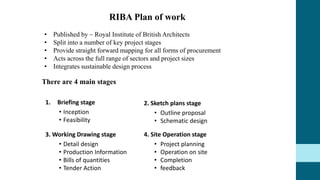
RIBA Plan of work
• Published by – Royal Institute of British Architects
• Split into a number of key project stages
• Provide straight forward mapping for all forms of procurement
• Acts across the full range of sectors and project sizes
• Integrates sustainable design process
There are 4 main stages
1. Briefing stage
• Inception
• Feasibility
2. Sketch plans stage
• Outline proposal
• Schematic design
3. Working Drawing stage
• Detail design
• Production Information
• Bills of quantities
• Tender Action
4. Site Operation stage
• Project planning
• Operation on site
• Completion
• feedback
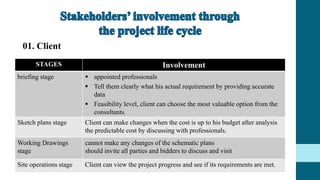
01. Client
STAGES Involvement
briefing stage  appointed professionals
 Tell them clearly what his actual requirement by providing accurate
data
 Feasibility level, client can choose the most valuable option from the
consultants.
Sketch plans stage Client can make changes when the cost is up to his budget after analysis
the predictable cost by discussing with professionals.
Working Drawings
stage
cannot make any changes of the schematic plans
should invite all parties and bidders to discuss and visit
Site operations stage Client can view the project progress and see if its requirements are met.
Responsibilities of client
 Selecting most suitable professionals
 Briefing the requirement clearly
 Provide complete requirements without gray areas
 Giving accurate data it is mainly effected to analyze the budget
 Firm decision making ability
 Making payments to the professionals clear and on time
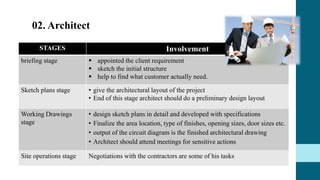
02. Architect
STAGES Involvement
briefing stage  appointed the client requirement
 sketch the initial structure
 help to find what customer actually need.
Sketch plans stage • give the architectural layout of the project
• End of this stage architect should do a preliminary design layout
Working Drawings
stage
• design sketch plans in detail and developed with specifications
• Finalize the area location, type of finishes, opening sizes, door sizes etc.
• output of the circuit diagram is the finished architectural drawing
• Architect should attend meetings for sensitive actions
Site operations stage Negotiations with the contractors are some of his tasks
Duties and Responsibilities of Architect
 Should follow different building styles, patterns, easy to use and build as a end user
 Duty to build it safer way
 Sustainability to ensure it meets the needs of its occupants
 Requirements of state and federal regulators
Architect Skills
 Good Understanding ability
 Communication Skills
 Design, Plan and developed creatively and cost effectively
 Use new methods, technology
03. Quantity Surveyor
What does quantity surveyor do?
Type of Quantity Surveyor
 Apply building economics and provide estimates at planning stage.
 Prepare the bill of Quantities from plans
 Analyze tenders, prepare and analyze data
1. Professional quantity surveyor
Dealing with contracts and costs on construction projects. Cover a range of activities
which benefit analysis, lifecycle costing, tendering, valuation, change control, dispute
resolution and estimation
2. contractors quantity surveyor
Specifically performed by the contractor as opposed to the construction work described
and measured in the construction contract between the developer and the contractor
STAGES Involvement
briefing stage provide rough estimates based on architectures
Sketch plans stage No significant cost deviations. It should prepare cost estimates for
approvals during the planning phase. Cost plan is the outcome of that
stage.
Working Drawings
stage
 check whether the cost if it is feasible in terms of the budget of the
client
 Full cost control is required
 should get all cost problems. After this stage cost is fixed
 In production information stage, qs need to check the cost estimate is
within the budget or not
 prepare BOQ, must submit tenders and participate in meetings.
Site operations stage should prepare the monthly cost analysis report and final accounts
Role of a Quantity surveyor
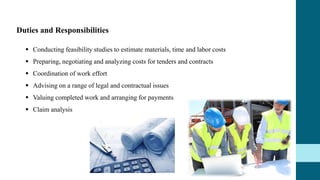
Duties and Responsibilities
 Conducting feasibility studies to estimate materials, time and labor costs
 Preparing, negotiating and analyzing costs for tenders and contracts
 Coordination of work effort
 Advising on a range of legal and contractual issues
 Valuing completed work and arranging for payments
 Claim analysis
1. Can you explain the path you have followed to become this stage? (Followed courses/ degrees/
PHD etc.)
2. How many projects you involved up to now?
3. Present involvement project and what is your designation of that project?
4. How do you handle the laborers?
5. How you communicate with other professionals and what kind of support give you from other
stakeholder to do your work perfectly?
6. What kind of rules and regulations you followed according to your job profile?
7. How do you work with indirect stakeholders?
Name : - Mahanama M.N.G.A.M
Present work place : - Sanken Construction Pvt Ltd.
Profession : - Engineer
Interviewed details from a stakeholder
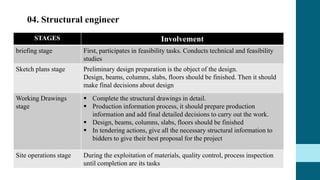
04. Structural engineer
STAGES Involvement
briefing stage First, participates in feasibility tasks. Conducts technical and feasibility
studies
Sketch plans stage Preliminary design preparation is the object of the design.
Design, beams, columns, slabs, floors should be finished. Then it should
make final decisions about design
Working Drawings
stage
 Complete the structural drawings in detail.
 Production information process, it should prepare production
information and add final detailed decisions to carry out the work.
 Design, beams, columns, slabs, floors should be finished
 In tendering actions, give all the necessary structural information to
bidders to give their best proposal for the project
Site operations stage During the exploitation of materials, quality control, process inspection
until completion are its tasks
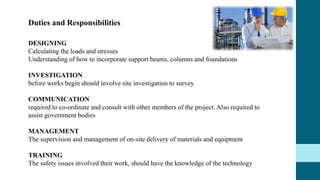
DESIGNING
Calculating the loads and stresses
Understanding of how to incorporate support beams, columns and foundations
INVESTIGATION
before works begin should involve site investigation to survey
COMMUNICATION
required to co-ordinate and consult with other members of the project. Also required to
assist government bodies
MANAGEMENT
The supervision and management of on-site delivery of materials and equipment
TRAINING
The safety issues involved their work, should have the knowledge of the technology
Duties and Responsibilities
Stakeholder’s Involvement in Construction Industry

Stakeholder’s Involvement in Construction Industry

  • 2.
    01.) Introduction ofDirect & Indirect stakeholders in construction Industry 02.) Project life cycle & stakeholder involvement 03.) RIBA Plan of work stages 04.) Stakeholders’ involvement through the project life cycle  Client  Architect  Quantity Surveyor  Structural engineer 05.) Interviewed details from a stakeholder
  • 3.
    Individuals or Organizationswho are directly involving in the project Direct Stakeholders – directly influenced , involved & having vested interest Indirect Stakeholders – have affect and affected, have no control over the assignment of resources
  • 4.
    Direct stakeholders 1. Employer(Client) 2. Architect 3. Project Manager 4. Project Consultants Structural Engineers Services Engineers Quantity Surveyors Feasibility Consultants 4. Contractors 5. Laborers 6. Suppliers Indirect stakeholders 1. Local Authority 2. Environmental Authority 3. Media 4. General public 5. Town planning board 6. Other Competitors & Institutional
  • 5.
    Direct stakeholders Secondary inexperienced Secondaryexperienced Primary inexperienced Primary experience 01. Employer Employer is the natural or legal person is for whom a structure is constructed, or alternatively the person or organization that took the initiative of the construction. Duties Responsibilities Briefing the requirement Provide complete requirements without gray areas Hiring professionals Selecting most suited professionals Making payments Clear and on time pay roles Employer – types
  • 6.
    2. Architect  Qualifiedprofessional who designs and supervisors the construction of buildings or other structures.  Should get the actual client requirement from the client and get his ideas then architect should made the drawings of his dream building.  Should follow B.Arch program at university of moratuwa or HND program at the city of Architecture to be an architect in Sri Lanka
  • 7.
    Responsibilities of aProject Manager  Manager the day to day working  Report the progress of the project  Plan and arrange visited to the site for each an every consultant  Coordination among the team  Assuring the quality of their work  Ensure the health, safety and environmental aspects WHO ?  A project manager is a professional in the field of management  responsible for leading a project from initial stage up to the completion  It includes planning execution of the work and managing the resources HOW? To be a project manager professionally qualified construction expert who are eligible need to follow post graduate diploma or master program. 3. Project Manager
  • 8.
    4. Contractor Person orfirm who undertakes to complete a project/building in accordance with given client’s requirements. 5. Laborers Work on given instruction under the supervision. There are two types of laborers, skilled and unskilled 6. Suppliers - Marketing and commercial product providers are called suppliers.
  • 9.
    7. Project consultants StructuralEngineer – design a structure of the building, materials and systems Quantity Surveyor - professional with expert knowledge on construction costs and contracts. Cost Services Engineer - Building services engineering, technical building services engineering for the internal environment and environmental impact of a building. Facilitating of the services of plumbing, electrical, mechanical designs/ designing the systems. Feasibility Consultant - Can be a professionally qualified engineer, architect or quantity surveyor and he can get that profession by his work experience and feasibility studies.
  • 10.
    Indirect Stakeholders Local Authority Getapprovals from the authority whether the project can do or not in the area some areas are prohibited to build residential. Environmental Authority Given approvals to the development by assessing and reporting. They do a complete experiment of the environment of specific area and prepare EIA document. (Environmental Impact assessment.) Media Reflect analytical view of the project and transferring information to the general public. They are not actively involved the project to achieved the goal but they influenced to search their mistakes and publication the project by using media. (eg : uma oye project) General Public - Accepting or rejecting the project execution by forcing to the government
  • 12.
    RIBA Plan ofwork • Published by – Royal Institute of British Architects • Split into a number of key project stages • Provide straight forward mapping for all forms of procurement • Acts across the full range of sectors and project sizes • Integrates sustainable design process There are 4 main stages 1. Briefing stage • Inception • Feasibility 2. Sketch plans stage • Outline proposal • Schematic design 3. Working Drawing stage • Detail design • Production Information • Bills of quantities • Tender Action 4. Site Operation stage • Project planning • Operation on site • Completion • feedback
  • 13.
    01. Client STAGES Involvement briefingstage  appointed professionals  Tell them clearly what his actual requirement by providing accurate data  Feasibility level, client can choose the most valuable option from the consultants. Sketch plans stage Client can make changes when the cost is up to his budget after analysis the predictable cost by discussing with professionals. Working Drawings stage cannot make any changes of the schematic plans should invite all parties and bidders to discuss and visit Site operations stage Client can view the project progress and see if its requirements are met.
  • 14.
    Responsibilities of client Selecting most suitable professionals  Briefing the requirement clearly  Provide complete requirements without gray areas  Giving accurate data it is mainly effected to analyze the budget  Firm decision making ability  Making payments to the professionals clear and on time
  • 15.
    02. Architect STAGES Involvement briefingstage  appointed the client requirement  sketch the initial structure  help to find what customer actually need. Sketch plans stage • give the architectural layout of the project • End of this stage architect should do a preliminary design layout Working Drawings stage • design sketch plans in detail and developed with specifications • Finalize the area location, type of finishes, opening sizes, door sizes etc. • output of the circuit diagram is the finished architectural drawing • Architect should attend meetings for sensitive actions Site operations stage Negotiations with the contractors are some of his tasks
  • 16.
    Duties and Responsibilitiesof Architect  Should follow different building styles, patterns, easy to use and build as a end user  Duty to build it safer way  Sustainability to ensure it meets the needs of its occupants  Requirements of state and federal regulators Architect Skills  Good Understanding ability  Communication Skills  Design, Plan and developed creatively and cost effectively  Use new methods, technology
  • 17.
    03. Quantity Surveyor Whatdoes quantity surveyor do? Type of Quantity Surveyor  Apply building economics and provide estimates at planning stage.  Prepare the bill of Quantities from plans  Analyze tenders, prepare and analyze data 1. Professional quantity surveyor Dealing with contracts and costs on construction projects. Cover a range of activities which benefit analysis, lifecycle costing, tendering, valuation, change control, dispute resolution and estimation 2. contractors quantity surveyor Specifically performed by the contractor as opposed to the construction work described and measured in the construction contract between the developer and the contractor
  • 18.
    STAGES Involvement briefing stageprovide rough estimates based on architectures Sketch plans stage No significant cost deviations. It should prepare cost estimates for approvals during the planning phase. Cost plan is the outcome of that stage. Working Drawings stage  check whether the cost if it is feasible in terms of the budget of the client  Full cost control is required  should get all cost problems. After this stage cost is fixed  In production information stage, qs need to check the cost estimate is within the budget or not  prepare BOQ, must submit tenders and participate in meetings. Site operations stage should prepare the monthly cost analysis report and final accounts Role of a Quantity surveyor
  • 19.
    Duties and Responsibilities Conducting feasibility studies to estimate materials, time and labor costs  Preparing, negotiating and analyzing costs for tenders and contracts  Coordination of work effort  Advising on a range of legal and contractual issues  Valuing completed work and arranging for payments  Claim analysis
  • 20.
    1. Can youexplain the path you have followed to become this stage? (Followed courses/ degrees/ PHD etc.) 2. How many projects you involved up to now? 3. Present involvement project and what is your designation of that project? 4. How do you handle the laborers? 5. How you communicate with other professionals and what kind of support give you from other stakeholder to do your work perfectly? 6. What kind of rules and regulations you followed according to your job profile? 7. How do you work with indirect stakeholders? Name : - Mahanama M.N.G.A.M Present work place : - Sanken Construction Pvt Ltd. Profession : - Engineer Interviewed details from a stakeholder
  • 21.
    04. Structural engineer STAGESInvolvement briefing stage First, participates in feasibility tasks. Conducts technical and feasibility studies Sketch plans stage Preliminary design preparation is the object of the design. Design, beams, columns, slabs, floors should be finished. Then it should make final decisions about design Working Drawings stage  Complete the structural drawings in detail.  Production information process, it should prepare production information and add final detailed decisions to carry out the work.  Design, beams, columns, slabs, floors should be finished  In tendering actions, give all the necessary structural information to bidders to give their best proposal for the project Site operations stage During the exploitation of materials, quality control, process inspection until completion are its tasks
  • 22.
    DESIGNING Calculating the loadsand stresses Understanding of how to incorporate support beams, columns and foundations INVESTIGATION before works begin should involve site investigation to survey COMMUNICATION required to co-ordinate and consult with other members of the project. Also required to assist government bodies MANAGEMENT The supervision and management of on-site delivery of materials and equipment TRAINING The safety issues involved their work, should have the knowledge of the technology Duties and Responsibilities