Supply Chain
Management and
Logistics in Construction
Delivering tomorrow’s built environment
A number of different authors, academics and
professionals put supply chain management and
logistics practices in the construction industry
under the spotlight.
This is a brief overview, chapter by chapter.
Contents
Introduction
PART ONE - Strategic Perspectives
01 The challenge of construction logistics
02 Aggregating global products for just-in-time delivery to construction
sites
03 Construction logistics - supply of bulk materials
04 Effective management of a construction project supply chain
05 Construction supply chain management strategy
Logistics & Operations
Contents
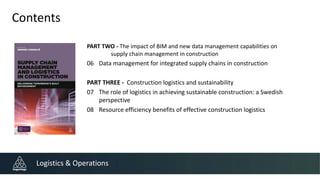
PART TWO - The impact of BIM and new data management capabilities on
supply chain management in construction
06 Data management for integrated supply chains in construction
PART THREE - Construction logistics and sustainability
07 The role of logistics in achieving sustainable construction: a Swedish
perspective
08 Resource efficiency benefits of effective construction logistics
Logistics & Operations
Contents
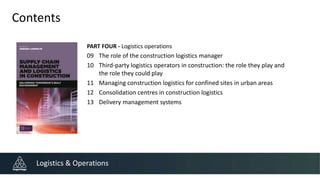
PART FOUR - Logistics operations
09 The role of the construction logistics manager
10 Third-party logistics operators in construction: the role they play and
the role they could play
11 Managing construction logistics for confined sites in urban areas
12 Consolidation centres in construction logistics
13 Delivery management systems
Logistics & Operations
Chapter 01
The challenge of construction logistics
The first chapter provides a broad introduction to logistics management. It explores the
ways in which construction logistics differs from logistics in other industries while at the
same time identifying lessons that can be learnt from sectors such as retailing and
manufacturing.
Some of the topics covered:
• Defining logistics, understanding its importance and how it interacts with supply
chain management, purchasing etc
• Transport and storage activities within logistics
• The particular characteristics of construction logistics and and issues that
emerge, particularly with regard to developments in urban areas
• Conclusions and key features of the challenge of managing logistics within
construction
Logistics & Operations
Michael Browne
Professor of Logistics
at the University of
Westminster
Chapter 02
Aggregating global products for just-in-time delivery to
construction sites
Looking mainly at house building the author concludes that effective logistics requires
kits of products to be delivered just-in-time at the right location by a logistics process
integrated with the build process. To do this efficiently requires an ability to source and
aggregate products globally.
Some of the topics covered:
• Global sourcing
• Investment in procurement and centralized decision making
• Environmental legislation, quality and good waste management
• Lean supply onto site with plot-picked delivery
The author then explores which players in the construction supply chain have the
best ability to offer aggregation and lean-delivery capability. This discussion
considers construction companies, builders merchants, third-party logistics
specialists, multichannel providers and emerging web retailers.
Logistics & Operations
Mark Franklin
At time of writing,
Service and Supply
Chain Director at
Travis Perkins. Now
Global Parts and
Supply Chain
Director at Jaguar
Land Rover.
Chapter 03
Construction logistics - supply of bulk materials
The largest element of the construction supply chain, bulk materials also constitute the
largest material flow in the UK economy with 200 million tonnes of these materials
being used in construction each year. The nature of the material supply, modes of
transport and the customer base are all described.
Materials covered:
• Cement
• Aggregates
• Asphalt
• Ready-mix concrete
The chapter then analyses the supply chain maturity and discusses the steps
required to realize benefits of a truly integrated supply chain.
Logistics & Operations
Matthew Woodcock
Head of Group
Logistics and Supply
Chain, Lafarge
Tarmac
Chapter 04
Effective management of a construction project supply chain
This chapter explores construction logistics with regard to operational, organizational
and cultural factors. From a main contractor point of view and looking at a five-year
horizon it proposes the changes needed to significantly improve supply chain and
logistics performance.
Some of the topics covered:
• Defining effective logistics management and current best practice
• The control of fragmented supply chains
• Strategies such as prefabrication, off-site production and the use of
consolidation centres
The chapter outlines an improvement strategy and the practical, operational
elements it is based on. The case is made using real-life data from recent London
inner city developments.
Logistics & Operations
Stephen Robbins
At time of writing,
Logistics Manager at
Laing O’Rourke. Now
Operations Service
Manager at Wilson
James. Co-author of
previously published
authoritative book
on construction
logistics.
Chapter 05
Construction supply chain management strategy
The chapter discusses how the role of the supply chain has grown in the construction
industry. Risk assessment and the selection of supply chain partners are analysed from a
main contractor point of view.
Some of the topics covered:
• Understanding the different types of supply chain risk
• Prequalification and assessment of the different risk categories
• Framework agreements
• The management of logistics in construction
One approach to developing supply chain partnerships is illustrated using a case
study from Mace Business School.
Logistics & Operations
Brian Moone
Director of Supply
Chain Management
and Development at
Mace. Established
and runs the Mace
Business School.
Chapter 06
Data management for integrated supply chains in construction
The focus here is on information exchange within the fragmented and often adversarial
construction industry. Building Information Modelling (BIM) will provide processes and
technology that can help build truly collaborative and integrated project teams.
Some of the topics covered:
• Information management in construction; complexity, BIM and data
management
• ‘Big data’ - what it is, and what it means for construction
• Data and the integrated supply chain: supply chain management systems
• Enterprise level integration
The authors conclude that by creating/generating data, and by using and sharing
data intelligently - facilitated by BIM tools and processes - decision making will
improve and the benefits of true supply chain integration can be realized.
Logistics & Operations
Wes Beaumont and
Jason Underwood
Wes is part of Turner
& Townsend BIM
and analytics team.
Jason holds several
senior posts within
the School of the
Built Environment,
University of Salford,
including Director of
the MSc BIM
programme.
Chapter 07
The role of logistics in achieving sustainable construction:
a Swedish perspective
Based on an eight-dimensional model for the comprehensive analysis of sustainability, a
logistics strategy for sustainable construction is developed.
Some of the topics covered:
• A supply chain approach based on sequenced, JIT deliveries via a logistics centre
(consolidation centre)
• The importance of planning, team building and admin support
• Practical considerations including labelling, packaging and deliveries
• Financial benefits of a sustainable approach
The approach is demonstrated in two case studies based on current highly
prestigious construction projects in Sweden, one a hospital project and the other
an inner city mixed development.
Logistics & Operations
Monika Bubholz, Camilla
Einarsson and Lars-Göran
Sporre
Monika is Sustainability
Consultant and Camilla is
Logistics Consultant, both
at Sweco Industry AB.
Lars-Göran was, at time of
writing, Head of Business
Development, Industry
and Logistics at Sweco;
now Senior Vice President
and head of the Industry
Division of COWI AB.
Chapter 08
Resource efficiency benefits of effective construction logistics
The chapter sets out the environmental impacts of construction and shows where
effective construction logistics can improve the overall sustainability of a construction
project. How good logistics practice can improve performance is illustrated with
strategies relevant for all participants in the supply chain.
Some of the topics covered:
• Transport
• Reverse logistics
• Packaging
• Off-site manufacturing
• Just-in-time delivery
• On-site logistics specialists
Logistics & Operations
Malcolm Waddell
Project Manager
with WRAP where he
led the development
of guidance, tools
and resources for
material logistics
planning and
resource efficiency in
the construction
industry.
• Demand smoothing
• Construction consolidation centres
• Off-site manufacturing
• Waste management and reprocessing
logistics opportunities
• Delivery management systems
Chapter 09
The role of the construction logistics manager
Within construction the logistics manager is a relative newcomer. The role, what it
entails and its importance are gradually becoming better understood, but across the
industry it is still a work-in-progress. The chapter defines the role in detail.
Some of the topics covered:
• The responsibilities of the logistics manager
• The pros and cons of using in-house or out-sourced professional resources such
as agency staff, consultants, third-party logistics companies etc
• The demands of the role, qualifications and personal characteristics
The chapter further explains how the Construction Logistics Plan (CLP) is not only a
responsibility of the logistics manager but a key tool in performing his/her duties. A
detailed CLP template is included in the chapter.
Logistics & Operations
Andy Brown
Operations Director,
Mace Group responsible
for construction logistics
planning and
operations.
Chapter 10
Third-party logistics operators in construction: the role they
play and the role they could play
While third-party logistics operators (3PL) provide many services to the construction
industry they do not play the strategically central role they do in many other industries
eg omni-channel retailing. The chapter analyses how the role of 3PLs will evolve and
their use grow, and the potential benefits that will follow.
Some of the topics covered:
• Supply chain analysis: structure, complexity, presence of a dominant entity
• Primary and secondary distribution networks, international supply chains etc
• Final mile logistics - construction consolidation centres
The author sets out three phases in the evolution of the role of the 3PL and
discusses how eg the implementation of BIM will enable their role to expand.
Three case studies, including one covering the London 2012 Olympics and
Paralympics, are used to exemplify and underpin the discussion.
Logistics & Operations
Pete Flinders
Contract Manager for
Wincanton, running its
construction
consolidation centres
and building materials
distribution.
Chapter 11
Managing construction logistics for confined sites in urban areas
There is a significant global trend of urban growth which puts the construction industry
under relentless pressure to manage the logistics of construction in busy congested
cities. The chapter explores the material management issues of confined sites and
discusses issues concerning material flows on-site and to-site.
Some of the topics covered:
• Material flow and material routing management on site
• Material flow routing to sites in congested cities
• Project programme and coordination of subcontractors
• Impacts on productivity and health and safety
The chapter draws on extensive literature research but also on real project data. In
conclusion it finds that material flow needs to be controlled and ‘programme-
driven’ and this can be greatly facilitated by eg the use of a construction
consolidation centre.
Logistics & Operations
Ruvinde Kooragamage
Works as a planner with
Vinci Construction while
finalizing a Doctorate of
Engineering at UCL which
includes developing a
logistics model to control
material flow to confined
sites in congested cities.
Chapter 12
Consolidation centres in construction logistics
The effective management of the logistics of a construction project can often benefit
greatly from the use of a Construction Consolidation Centre (CCC). The chapter deals in
some detail with their functions, operation and management and gives examples of
different solutions from small single project CCCs to large multi project operations.
Some of the topics covered:
• Resources, functionality and operation of a CCC
• The benefits of using a CCC: financial, programme certainty, environmental, etc
• Examples of different types of CCC and where they should be located
• Why CCCs are not more commonly used and what could be done to promote
their wider application
An endnote presents up-to-date research from a large London hospital project
confirming significant savings and productivity gains attributed to the CCC.
Logistics & Operations
Greger Lundesjö
Independent consultant,
Lundesjo Consulting.
Chapter 13
Delivery management systems
A construction project depends on bringing together materials, people and equipment -
a complex process that needs to be managed. The chapter describes the function of
delivery management systems, how they support the construction process and the
benefits generated.
Some of the topics covered:
• What a delivery management system is and the features of computerized,
cloud-based, delivery management
• The benefits of proper management of deliveries
• Who should use a delivery management system and what can be expected in
future developments eg the connection with BIM
The discussion is supported by four case studies from the UK and Australia,
demonstrating the benefits of ‘real-time’ transparency and control.
Logistics & Operations
Rick Ballard and Nick
Hoare
Rick is a founder member
of the The Logistics
Business and founding
Chairman of the
Construction Supply Chain
Forum of the Chartered
Institute of Logistics and
Transport.
Nick is a Senior Systems
Consultant with The
Logistics Business.
Thank you

Supply Chain Management and Logistics in Construction

  • 1.
    Supply Chain Management and Logisticsin Construction Delivering tomorrow’s built environment
  • 2.
    A number ofdifferent authors, academics and professionals put supply chain management and logistics practices in the construction industry under the spotlight. This is a brief overview, chapter by chapter.
  • 3.
    Contents Introduction PART ONE -Strategic Perspectives 01 The challenge of construction logistics 02 Aggregating global products for just-in-time delivery to construction sites 03 Construction logistics - supply of bulk materials 04 Effective management of a construction project supply chain 05 Construction supply chain management strategy Logistics & Operations
  • 4.
    Contents PART TWO -The impact of BIM and new data management capabilities on supply chain management in construction 06 Data management for integrated supply chains in construction PART THREE - Construction logistics and sustainability 07 The role of logistics in achieving sustainable construction: a Swedish perspective 08 Resource efficiency benefits of effective construction logistics Logistics & Operations
  • 5.
    Contents PART FOUR -Logistics operations 09 The role of the construction logistics manager 10 Third-party logistics operators in construction: the role they play and the role they could play 11 Managing construction logistics for confined sites in urban areas 12 Consolidation centres in construction logistics 13 Delivery management systems Logistics & Operations
  • 6.
    Chapter 01 The challengeof construction logistics The first chapter provides a broad introduction to logistics management. It explores the ways in which construction logistics differs from logistics in other industries while at the same time identifying lessons that can be learnt from sectors such as retailing and manufacturing. Some of the topics covered: • Defining logistics, understanding its importance and how it interacts with supply chain management, purchasing etc • Transport and storage activities within logistics • The particular characteristics of construction logistics and and issues that emerge, particularly with regard to developments in urban areas • Conclusions and key features of the challenge of managing logistics within construction Logistics & Operations Michael Browne Professor of Logistics at the University of Westminster
  • 7.
    Chapter 02 Aggregating globalproducts for just-in-time delivery to construction sites Looking mainly at house building the author concludes that effective logistics requires kits of products to be delivered just-in-time at the right location by a logistics process integrated with the build process. To do this efficiently requires an ability to source and aggregate products globally. Some of the topics covered: • Global sourcing • Investment in procurement and centralized decision making • Environmental legislation, quality and good waste management • Lean supply onto site with plot-picked delivery The author then explores which players in the construction supply chain have the best ability to offer aggregation and lean-delivery capability. This discussion considers construction companies, builders merchants, third-party logistics specialists, multichannel providers and emerging web retailers. Logistics & Operations Mark Franklin At time of writing, Service and Supply Chain Director at Travis Perkins. Now Global Parts and Supply Chain Director at Jaguar Land Rover.
  • 8.
    Chapter 03 Construction logistics- supply of bulk materials The largest element of the construction supply chain, bulk materials also constitute the largest material flow in the UK economy with 200 million tonnes of these materials being used in construction each year. The nature of the material supply, modes of transport and the customer base are all described. Materials covered: • Cement • Aggregates • Asphalt • Ready-mix concrete The chapter then analyses the supply chain maturity and discusses the steps required to realize benefits of a truly integrated supply chain. Logistics & Operations Matthew Woodcock Head of Group Logistics and Supply Chain, Lafarge Tarmac
  • 9.
    Chapter 04 Effective managementof a construction project supply chain This chapter explores construction logistics with regard to operational, organizational and cultural factors. From a main contractor point of view and looking at a five-year horizon it proposes the changes needed to significantly improve supply chain and logistics performance. Some of the topics covered: • Defining effective logistics management and current best practice • The control of fragmented supply chains • Strategies such as prefabrication, off-site production and the use of consolidation centres The chapter outlines an improvement strategy and the practical, operational elements it is based on. The case is made using real-life data from recent London inner city developments. Logistics & Operations Stephen Robbins At time of writing, Logistics Manager at Laing O’Rourke. Now Operations Service Manager at Wilson James. Co-author of previously published authoritative book on construction logistics.
  • 10.
    Chapter 05 Construction supplychain management strategy The chapter discusses how the role of the supply chain has grown in the construction industry. Risk assessment and the selection of supply chain partners are analysed from a main contractor point of view. Some of the topics covered: • Understanding the different types of supply chain risk • Prequalification and assessment of the different risk categories • Framework agreements • The management of logistics in construction One approach to developing supply chain partnerships is illustrated using a case study from Mace Business School. Logistics & Operations Brian Moone Director of Supply Chain Management and Development at Mace. Established and runs the Mace Business School.
  • 11.
    Chapter 06 Data managementfor integrated supply chains in construction The focus here is on information exchange within the fragmented and often adversarial construction industry. Building Information Modelling (BIM) will provide processes and technology that can help build truly collaborative and integrated project teams. Some of the topics covered: • Information management in construction; complexity, BIM and data management • ‘Big data’ - what it is, and what it means for construction • Data and the integrated supply chain: supply chain management systems • Enterprise level integration The authors conclude that by creating/generating data, and by using and sharing data intelligently - facilitated by BIM tools and processes - decision making will improve and the benefits of true supply chain integration can be realized. Logistics & Operations Wes Beaumont and Jason Underwood Wes is part of Turner & Townsend BIM and analytics team. Jason holds several senior posts within the School of the Built Environment, University of Salford, including Director of the MSc BIM programme.
  • 12.
    Chapter 07 The roleof logistics in achieving sustainable construction: a Swedish perspective Based on an eight-dimensional model for the comprehensive analysis of sustainability, a logistics strategy for sustainable construction is developed. Some of the topics covered: • A supply chain approach based on sequenced, JIT deliveries via a logistics centre (consolidation centre) • The importance of planning, team building and admin support • Practical considerations including labelling, packaging and deliveries • Financial benefits of a sustainable approach The approach is demonstrated in two case studies based on current highly prestigious construction projects in Sweden, one a hospital project and the other an inner city mixed development. Logistics & Operations Monika Bubholz, Camilla Einarsson and Lars-Göran Sporre Monika is Sustainability Consultant and Camilla is Logistics Consultant, both at Sweco Industry AB. Lars-Göran was, at time of writing, Head of Business Development, Industry and Logistics at Sweco; now Senior Vice President and head of the Industry Division of COWI AB.
  • 13.
    Chapter 08 Resource efficiencybenefits of effective construction logistics The chapter sets out the environmental impacts of construction and shows where effective construction logistics can improve the overall sustainability of a construction project. How good logistics practice can improve performance is illustrated with strategies relevant for all participants in the supply chain. Some of the topics covered: • Transport • Reverse logistics • Packaging • Off-site manufacturing • Just-in-time delivery • On-site logistics specialists Logistics & Operations Malcolm Waddell Project Manager with WRAP where he led the development of guidance, tools and resources for material logistics planning and resource efficiency in the construction industry. • Demand smoothing • Construction consolidation centres • Off-site manufacturing • Waste management and reprocessing logistics opportunities • Delivery management systems
  • 14.
    Chapter 09 The roleof the construction logistics manager Within construction the logistics manager is a relative newcomer. The role, what it entails and its importance are gradually becoming better understood, but across the industry it is still a work-in-progress. The chapter defines the role in detail. Some of the topics covered: • The responsibilities of the logistics manager • The pros and cons of using in-house or out-sourced professional resources such as agency staff, consultants, third-party logistics companies etc • The demands of the role, qualifications and personal characteristics The chapter further explains how the Construction Logistics Plan (CLP) is not only a responsibility of the logistics manager but a key tool in performing his/her duties. A detailed CLP template is included in the chapter. Logistics & Operations Andy Brown Operations Director, Mace Group responsible for construction logistics planning and operations.
  • 15.
    Chapter 10 Third-party logisticsoperators in construction: the role they play and the role they could play While third-party logistics operators (3PL) provide many services to the construction industry they do not play the strategically central role they do in many other industries eg omni-channel retailing. The chapter analyses how the role of 3PLs will evolve and their use grow, and the potential benefits that will follow. Some of the topics covered: • Supply chain analysis: structure, complexity, presence of a dominant entity • Primary and secondary distribution networks, international supply chains etc • Final mile logistics - construction consolidation centres The author sets out three phases in the evolution of the role of the 3PL and discusses how eg the implementation of BIM will enable their role to expand. Three case studies, including one covering the London 2012 Olympics and Paralympics, are used to exemplify and underpin the discussion. Logistics & Operations Pete Flinders Contract Manager for Wincanton, running its construction consolidation centres and building materials distribution.
  • 16.
    Chapter 11 Managing constructionlogistics for confined sites in urban areas There is a significant global trend of urban growth which puts the construction industry under relentless pressure to manage the logistics of construction in busy congested cities. The chapter explores the material management issues of confined sites and discusses issues concerning material flows on-site and to-site. Some of the topics covered: • Material flow and material routing management on site • Material flow routing to sites in congested cities • Project programme and coordination of subcontractors • Impacts on productivity and health and safety The chapter draws on extensive literature research but also on real project data. In conclusion it finds that material flow needs to be controlled and ‘programme- driven’ and this can be greatly facilitated by eg the use of a construction consolidation centre. Logistics & Operations Ruvinde Kooragamage Works as a planner with Vinci Construction while finalizing a Doctorate of Engineering at UCL which includes developing a logistics model to control material flow to confined sites in congested cities.
  • 17.
    Chapter 12 Consolidation centresin construction logistics The effective management of the logistics of a construction project can often benefit greatly from the use of a Construction Consolidation Centre (CCC). The chapter deals in some detail with their functions, operation and management and gives examples of different solutions from small single project CCCs to large multi project operations. Some of the topics covered: • Resources, functionality and operation of a CCC • The benefits of using a CCC: financial, programme certainty, environmental, etc • Examples of different types of CCC and where they should be located • Why CCCs are not more commonly used and what could be done to promote their wider application An endnote presents up-to-date research from a large London hospital project confirming significant savings and productivity gains attributed to the CCC. Logistics & Operations Greger Lundesjö Independent consultant, Lundesjo Consulting.
  • 18.
    Chapter 13 Delivery managementsystems A construction project depends on bringing together materials, people and equipment - a complex process that needs to be managed. The chapter describes the function of delivery management systems, how they support the construction process and the benefits generated. Some of the topics covered: • What a delivery management system is and the features of computerized, cloud-based, delivery management • The benefits of proper management of deliveries • Who should use a delivery management system and what can be expected in future developments eg the connection with BIM The discussion is supported by four case studies from the UK and Australia, demonstrating the benefits of ‘real-time’ transparency and control. Logistics & Operations Rick Ballard and Nick Hoare Rick is a founder member of the The Logistics Business and founding Chairman of the Construction Supply Chain Forum of the Chartered Institute of Logistics and Transport. Nick is a Senior Systems Consultant with The Logistics Business.
  • 19.