
CS304PC:Computer Organization
and Architecture (R18 II(I sem))
Department of computer science and engineering (AI/ML)
Session 32
by
Asst.Prof.M.Gokilavani
VITS
3/21/2023 Department of CSE (AI/ML) 1
TEXTBOOK:
• 1. Computer System Architecture – M. Moris Mano,
Third Edition, Pearson/PHI.
REFERENCES:
• Computer Organization – Car Hamacher, Zvonks
Vranesic, Safea Zaky, Vth Edition, McGraw Hill.
• Computer Organization and Architecture – William
Stallings Sixth Edition, Pearson/PHI.
• Structured Computer Organization – Andrew S.
Tanenbaum, 4th Edition, PHI/Pearson.
3/21/2023 Department of CSE (AI/ML) 2
Unit V
Reduced Instruction set computer: CISC
characteristics, RISC characteristics.
Pipeline and vector processing: parallel processing,
pipelining, Arithmetic pipeline, instruction pipeline,
RISC pipeline, vector processing, array processing.
Multi Processors: Characteristics of multiprocessors,
interconnection structures, Interprocessors arbitration,
Interprocessors communication and synchronization,
cache coherence.
3/21/2023 Department of CSE (AI/ML) 3
Topics covered in session 32
3/21/2023 Department of CSE (AI/ML) 4
•Reduced Instruction set computer
•Pipeline and vector processing
•Multi Processors
Interprocessors communication and
synchronization
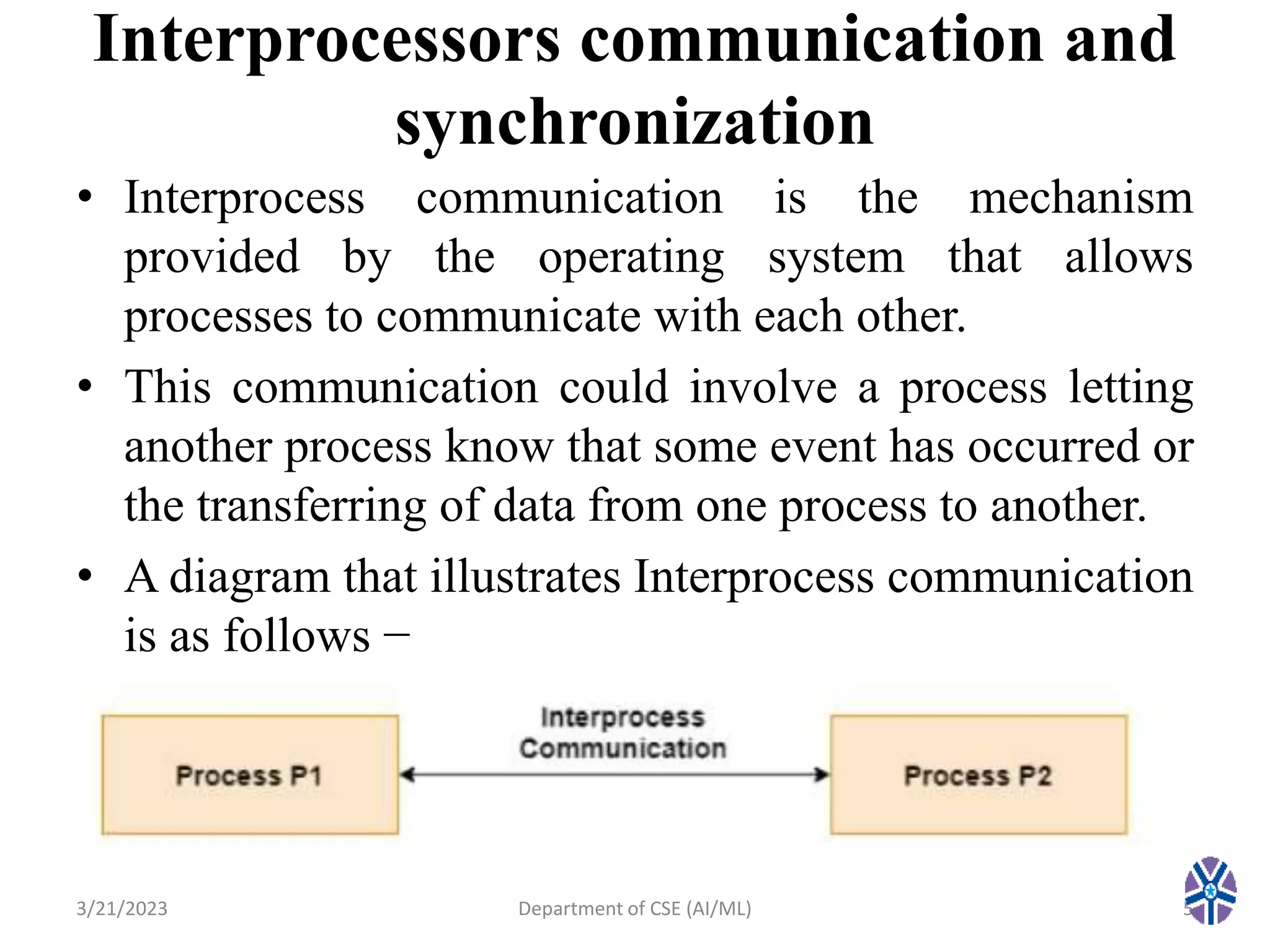
• Interprocess communication is the mechanism
provided by the operating system that allows
processes to communicate with each other.
• This communication could involve a process letting
another process know that some event has occurred or
the transferring of data from one process to another.
• A diagram that illustrates Interprocess communication
is as follows −
3/21/2023 Department of CSE (AI/ML) 5
Synchronization
• Synchronization is a necessary part of Interprocess
communication.
• It is either provided by the Interprocess control mechanism or
handled by the communicating processes.
• Some of the methods to provide synchronization are as
follows:
• Semaphore
• Mutual Exclusion
• Barrier
• Spinlock
3/21/2023 Department of CSE (AI/ML) 6
• Semaphore: A semaphore is a variable that
controls the access to a common resource by
multiple processes.
• The two types of semaphores are binary
semaphores and counting semaphores.
• Mutual Exclusion: Mutual exclusion requires
that only one process thread can enter the critical
section at a time.
• This is useful for synchronization and also
prevents race conditions.
3/21/2023 Department of CSE (AI/ML) 7
• Barrier: A barrier does not allow individual
processes to proceed until all the processes reach
it.
• Many parallel languages and collective routines
impose barriers.
• Spinlock: This is a type of lock.
• The processes trying to acquire this lock wait in a
loop while checking if the lock is available or not.
• This is known as busy waiting because the
process is not doing any useful operation even
though it is active.
3/21/2023 Department of CSE (AI/ML) 8
Approaches to Interprocess
Communication
• The different approaches to implement Interprocess
communication are given as follows −
• Pipe
• Socket
• File Signal
• Shared memory message QUEUE
3/21/2023 Department of CSE (AI/ML) 9
• Pipe: A pipe is a data channel that is unidirectional.
• Two pipes can be used to create a two-way data channel
between two processes.
• This uses standard input and output methods.
• Pipes are used in all POSIX systems as well as
Windows operating systems.
• Socket: The socket is the endpoint for sending or
receiving data in a network.
• This is true for data sent between processes on the same
computer or data sent between different computers on
the same network.
• Most of the operating systems use sockets for
Interprocess communication.
3/21/2023 Department of CSE (AI/ML) 10
• File: A file is a data record that may be stored on a
disk or acquired on demand by a file server.
• Multiple processes can access a file as required. All
operating systems use files for data storage.
• Signal: Signals are useful in Interprocess
communication in a limited way.
• They are system messages that are sent from one
process to another.
• Normally, signals are not used to transfer data but are
used for remote commands between processes.
3/21/2023 Department of CSE (AI/ML) 11
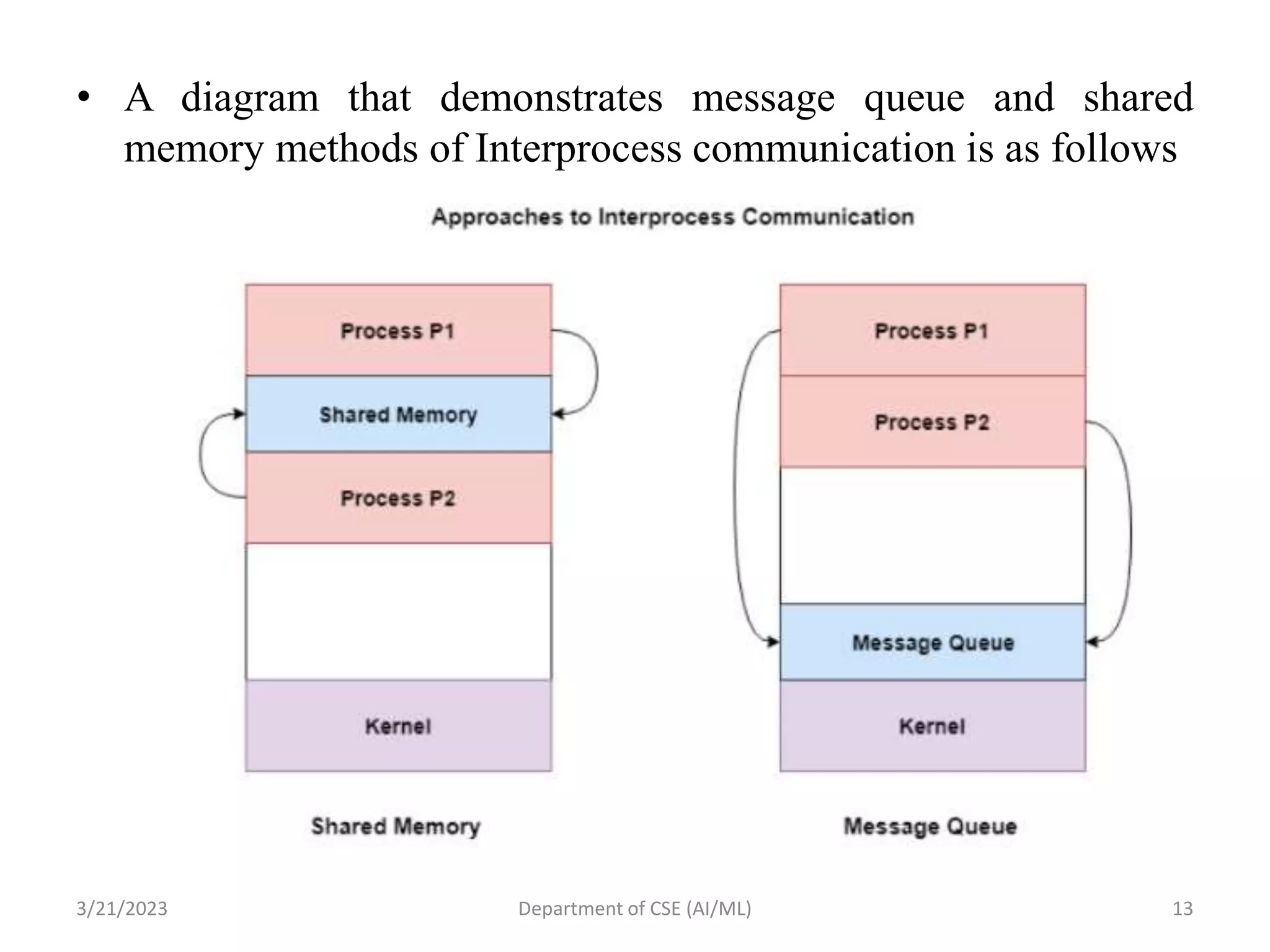
• Shared Memory: Shared memory is the memory that
can be simultaneously accessed by multiple processes.
• This is done so that the processes can communicate
with each other.
• All POSIX systems, as well as Windows operating
systems use shared memory.
• Message Queue: Multiple processes can read and write
data to the message queue without being connected to
each other.
• Messages are stored in the queue until their recipient
retrieves them.
• Message queues are quite useful for Interprocess
communication and are used by most operating
systems.
3/21/2023 Department of CSE (AI/ML) 12
• A diagram that demonstrates message queue and shared
memory methods of Interprocess communication is as follows
3/21/2023 Department of CSE (AI/ML) 13
Topics to be covered in next session 32
• Pipeline and vector processing
3/21/2023 Department of CSE (AI/ML) 14
Thank you!!!

CS304PC:Computer Organization and Architecture Session 32 Interprocessors communication and synchronization.pptx

  • 1.
    CS304PC:Computer Organization and Architecture(R18 II(I sem)) Department of computer science and engineering (AI/ML) Session 32 by Asst.Prof.M.Gokilavani VITS 3/21/2023 Department of CSE (AI/ML) 1
  • 2.
    TEXTBOOK: • 1. ComputerSystem Architecture – M. Moris Mano, Third Edition, Pearson/PHI. REFERENCES: • Computer Organization – Car Hamacher, Zvonks Vranesic, Safea Zaky, Vth Edition, McGraw Hill. • Computer Organization and Architecture – William Stallings Sixth Edition, Pearson/PHI. • Structured Computer Organization – Andrew S. Tanenbaum, 4th Edition, PHI/Pearson. 3/21/2023 Department of CSE (AI/ML) 2
  • 3.
    Unit V Reduced Instructionset computer: CISC characteristics, RISC characteristics. Pipeline and vector processing: parallel processing, pipelining, Arithmetic pipeline, instruction pipeline, RISC pipeline, vector processing, array processing. Multi Processors: Characteristics of multiprocessors, interconnection structures, Interprocessors arbitration, Interprocessors communication and synchronization, cache coherence. 3/21/2023 Department of CSE (AI/ML) 3
  • 4.
    Topics covered insession 32 3/21/2023 Department of CSE (AI/ML) 4 •Reduced Instruction set computer •Pipeline and vector processing •Multi Processors
  • 5.
    Interprocessors communication and synchronization •Interprocess communication is the mechanism provided by the operating system that allows processes to communicate with each other. • This communication could involve a process letting another process know that some event has occurred or the transferring of data from one process to another. • A diagram that illustrates Interprocess communication is as follows − 3/21/2023 Department of CSE (AI/ML) 5
  • 6.
    Synchronization • Synchronization isa necessary part of Interprocess communication. • It is either provided by the Interprocess control mechanism or handled by the communicating processes. • Some of the methods to provide synchronization are as follows: • Semaphore • Mutual Exclusion • Barrier • Spinlock 3/21/2023 Department of CSE (AI/ML) 6
  • 7.
    • Semaphore: Asemaphore is a variable that controls the access to a common resource by multiple processes. • The two types of semaphores are binary semaphores and counting semaphores. • Mutual Exclusion: Mutual exclusion requires that only one process thread can enter the critical section at a time. • This is useful for synchronization and also prevents race conditions. 3/21/2023 Department of CSE (AI/ML) 7
  • 8.
    • Barrier: Abarrier does not allow individual processes to proceed until all the processes reach it. • Many parallel languages and collective routines impose barriers. • Spinlock: This is a type of lock. • The processes trying to acquire this lock wait in a loop while checking if the lock is available or not. • This is known as busy waiting because the process is not doing any useful operation even though it is active. 3/21/2023 Department of CSE (AI/ML) 8
  • 9.
    Approaches to Interprocess Communication •The different approaches to implement Interprocess communication are given as follows − • Pipe • Socket • File Signal • Shared memory message QUEUE 3/21/2023 Department of CSE (AI/ML) 9
  • 10.
    • Pipe: Apipe is a data channel that is unidirectional. • Two pipes can be used to create a two-way data channel between two processes. • This uses standard input and output methods. • Pipes are used in all POSIX systems as well as Windows operating systems. • Socket: The socket is the endpoint for sending or receiving data in a network. • This is true for data sent between processes on the same computer or data sent between different computers on the same network. • Most of the operating systems use sockets for Interprocess communication. 3/21/2023 Department of CSE (AI/ML) 10
  • 11.
    • File: Afile is a data record that may be stored on a disk or acquired on demand by a file server. • Multiple processes can access a file as required. All operating systems use files for data storage. • Signal: Signals are useful in Interprocess communication in a limited way. • They are system messages that are sent from one process to another. • Normally, signals are not used to transfer data but are used for remote commands between processes. 3/21/2023 Department of CSE (AI/ML) 11
  • 12.
    • Shared Memory:Shared memory is the memory that can be simultaneously accessed by multiple processes. • This is done so that the processes can communicate with each other. • All POSIX systems, as well as Windows operating systems use shared memory. • Message Queue: Multiple processes can read and write data to the message queue without being connected to each other. • Messages are stored in the queue until their recipient retrieves them. • Message queues are quite useful for Interprocess communication and are used by most operating systems. 3/21/2023 Department of CSE (AI/ML) 12
  • 13.
    • A diagramthat demonstrates message queue and shared memory methods of Interprocess communication is as follows 3/21/2023 Department of CSE (AI/ML) 13
  • 14.
    Topics to becovered in next session 32 • Pipeline and vector processing 3/21/2023 Department of CSE (AI/ML) 14 Thank you!!!