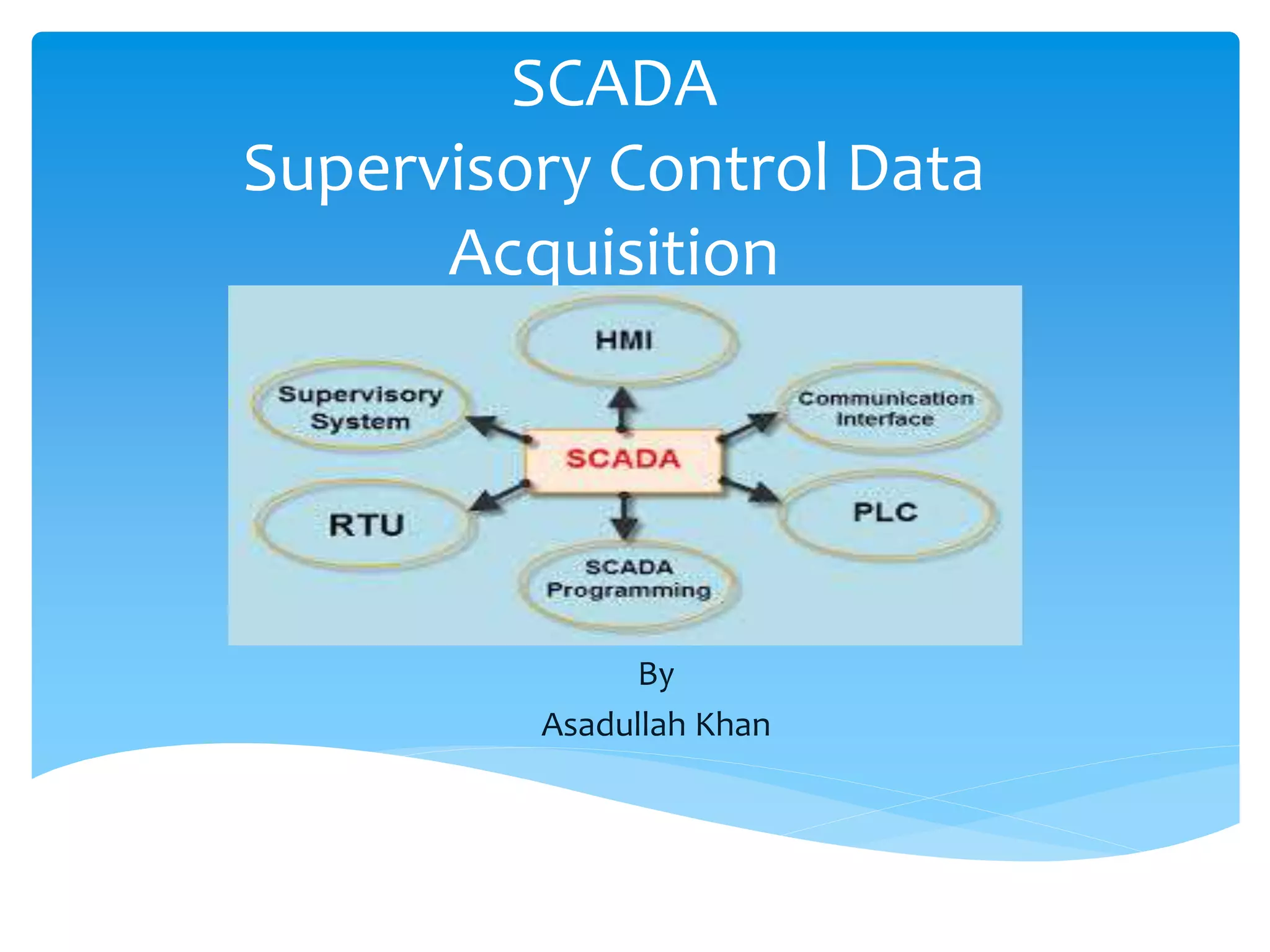
SCADA
Supervisory Control Data
Acquisition
By
Asadullah Khan
 SCADA refer to a system that collect data from various plants or other remote
devices and then send this data to control computer which Manage and control
this data.

 SCADA USES
 Electric power generation, transmission and distribution
 Water, wastewater and sewage
 Buildings, facilities and environments
 Manufacturing
 Mass transit
 Traffic signals
 Oil and Gas
 Food and Beverage Production

SCADA
Supervisory Control Data Acquisition
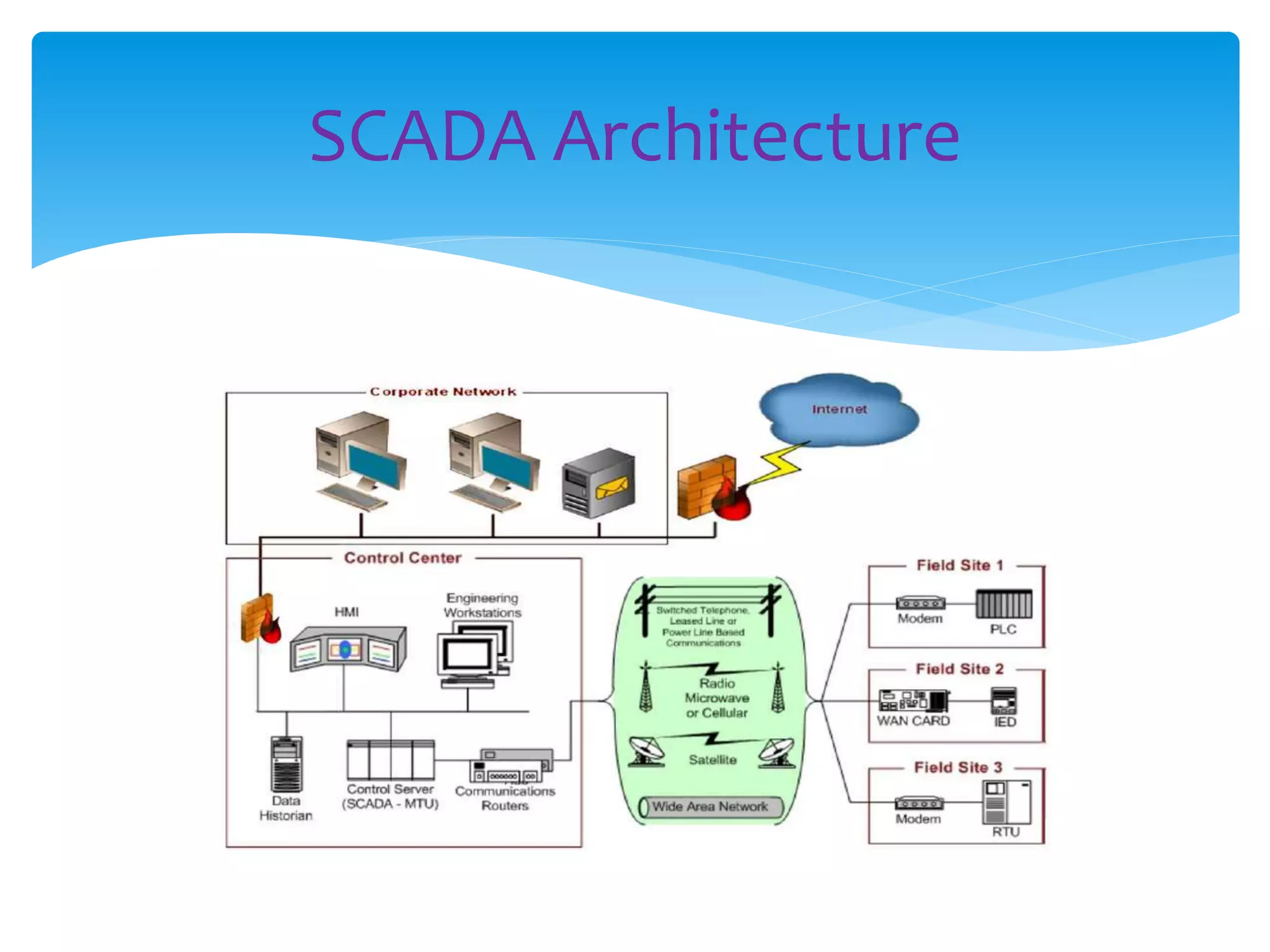
SCADA Architecture
 There three basic Components of SCADA
Architecture.
 Control Centre
 Field Site
 CommunicationLink
SCADA Architecture
Control center is responsible to communicate with field component
It has main Function
 together data in real time
 To record System events into a log file
 Information Storage and report for analysis
 Presentation of information in graphic and text form to operator
It consist of the following Components
 SCADA Server or MTU
 HMI Human Machine Interface
 Engineering Workstation
 Data Historian
 Communication router
 All these components are linked by Local area Network
Control Centre
Master Terminal Unit
 The MTU is the Heart of Control Center. MTU issues command to RTU/PLC’s/IED ( in field sites) and
asked the desired information from RTU.
 It communication through communication link
Human Machine Interface
 The HMI is hardware and software which enable human operator to control process data
 It provide tool for configuration and
 It also display information that required to supervise the field devices
 It can run on CMS (Central Monitoring System)
 The decision of action of any fault is taken in here
Data Historian
 This is database placed at control center for recording and storage information for any analysis
Engineering Workstation/Programming
 It helps to manage Logistic information and trouble Shooting guide
Control Centre
Communication Link
 There is usually long distance between control center and field site. The effective communication is
necessary for effective flow message to and from the MTU and PLC/RTU/IED’S
Link can either be
 Phone
 Cellular network
 Satellite
 Fiber optics

 Remote Terminal Unit
 It support to SCADA System remotely
 Its primary task to controlled collect data from processing equipment and send back to this data to
MTU through communication network
 Occasionally PLC are deployed as field devices to replace RTU’s
Control Centre
 Field site consist of Modem and PLC which connect to the
sensors and other field devices through bus network.
 The processed data fro the PLC passes through modem
where it is modulated transmitted through the
communication Modem to control center .
 PLC (Programmable Logic Controller
 It execute Logical function using electrical hardware such
as switches, counter and timer
 It is also responsible for supervisory and data acquisition
through sensors and convert data received from sensors to
digital format
Field site-1
 Field site -2 has both WAN card and Intelligent Electronic
devices connected directly to Modem there is no need of
PLC. It is enough intelligent to handle data.
 IED ( Intelligent Electronic Devices)
 It is the basic components of substation perform
protection, Monitoring, controlling and data acquisition
function
 IED are microprocessor based devices with the capability
to exchange data and control signals with another devices
i.e electronic meter, controller )over communication link
Field Site-2
The reason why you can see SCADA systems deployed
in many different industries is that these systems can
bring many benefits. Some of them are:
 Receiving real-time information to monitor
equipment
 Remote industrial control
 Storage of performance data for later analysis
 It allows for proactive maintenance and decreases
downtime
Advantage of SCADA

Scada

  • 1.
  • 2.
     SCADA referto a system that collect data from various plants or other remote devices and then send this data to control computer which Manage and control this data.   SCADA USES  Electric power generation, transmission and distribution  Water, wastewater and sewage  Buildings, facilities and environments  Manufacturing  Mass transit  Traffic signals  Oil and Gas  Food and Beverage Production  SCADA Supervisory Control Data Acquisition
  • 3.
  • 4.
     There threebasic Components of SCADA Architecture.  Control Centre  Field Site  CommunicationLink SCADA Architecture
  • 5.
    Control center isresponsible to communicate with field component It has main Function  together data in real time  To record System events into a log file  Information Storage and report for analysis  Presentation of information in graphic and text form to operator It consist of the following Components  SCADA Server or MTU  HMI Human Machine Interface  Engineering Workstation  Data Historian  Communication router  All these components are linked by Local area Network Control Centre
  • 6.
    Master Terminal Unit The MTU is the Heart of Control Center. MTU issues command to RTU/PLC’s/IED ( in field sites) and asked the desired information from RTU.  It communication through communication link Human Machine Interface  The HMI is hardware and software which enable human operator to control process data  It provide tool for configuration and  It also display information that required to supervise the field devices  It can run on CMS (Central Monitoring System)  The decision of action of any fault is taken in here Data Historian  This is database placed at control center for recording and storage information for any analysis Engineering Workstation/Programming  It helps to manage Logistic information and trouble Shooting guide Control Centre
  • 7.
    Communication Link  Thereis usually long distance between control center and field site. The effective communication is necessary for effective flow message to and from the MTU and PLC/RTU/IED’S Link can either be  Phone  Cellular network  Satellite  Fiber optics   Remote Terminal Unit  It support to SCADA System remotely  Its primary task to controlled collect data from processing equipment and send back to this data to MTU through communication network  Occasionally PLC are deployed as field devices to replace RTU’s Control Centre
  • 8.
     Field siteconsist of Modem and PLC which connect to the sensors and other field devices through bus network.  The processed data fro the PLC passes through modem where it is modulated transmitted through the communication Modem to control center .  PLC (Programmable Logic Controller  It execute Logical function using electrical hardware such as switches, counter and timer  It is also responsible for supervisory and data acquisition through sensors and convert data received from sensors to digital format Field site-1
  • 9.
     Field site-2 has both WAN card and Intelligent Electronic devices connected directly to Modem there is no need of PLC. It is enough intelligent to handle data.  IED ( Intelligent Electronic Devices)  It is the basic components of substation perform protection, Monitoring, controlling and data acquisition function  IED are microprocessor based devices with the capability to exchange data and control signals with another devices i.e electronic meter, controller )over communication link Field Site-2
  • 10.
    The reason whyyou can see SCADA systems deployed in many different industries is that these systems can bring many benefits. Some of them are:  Receiving real-time information to monitor equipment  Remote industrial control  Storage of performance data for later analysis  It allows for proactive maintenance and decreases downtime Advantage of SCADA