LENNARD-JONES POTENTIAL:
CRYSTALS OF INERT GASES
Presented By,
Sujata Sinha
17PH05012
Motivation :-
To know about crystal binding … What holds
crystals together ?
 BRIEF FLOW OF THE PRESENTATION
1. Introduction
2. Properties of inert gas crystals
3. Types of Interaction
4. Lennard-Jone Potential
5. Applications
6. Limitations
7. Conclusion
Introduction
Simplest Crystal
Electron Distribution
Properties
Electronic Configuration
Types of interaction
1. Van der Waals-London Interaction :-
x+ +- -
R
X 2
x 1
 The Unperturbed Hamiltonian
𝐻0 =
𝑝1
2
2𝑚
+
1
2
Κ𝑥1
2
+
𝑝2
2
2𝑚
+
1
2
Κ𝑥2
2
 The Coulomb Interaction Energy of two oscillators
𝐻1 =
𝑒2
𝑅
+
𝑒2
𝑅 + 𝑥1 − 𝑥2
−
𝑒2
𝑅 + 𝑥1
−
𝑒2
𝑅 − 𝑥2
≈ −
2𝑒2
𝑅3 𝑥1 𝑥2
 Total Hamiltonian ,
ℋ = 𝐻0 + 𝐻1
 This H can be diagonalised by the Normal Mode
transformation
𝑥 𝑠 =
1
2
𝑥1 + 𝑥2
𝑥 𝑎 =
1
2
𝑥1 − 𝑥2
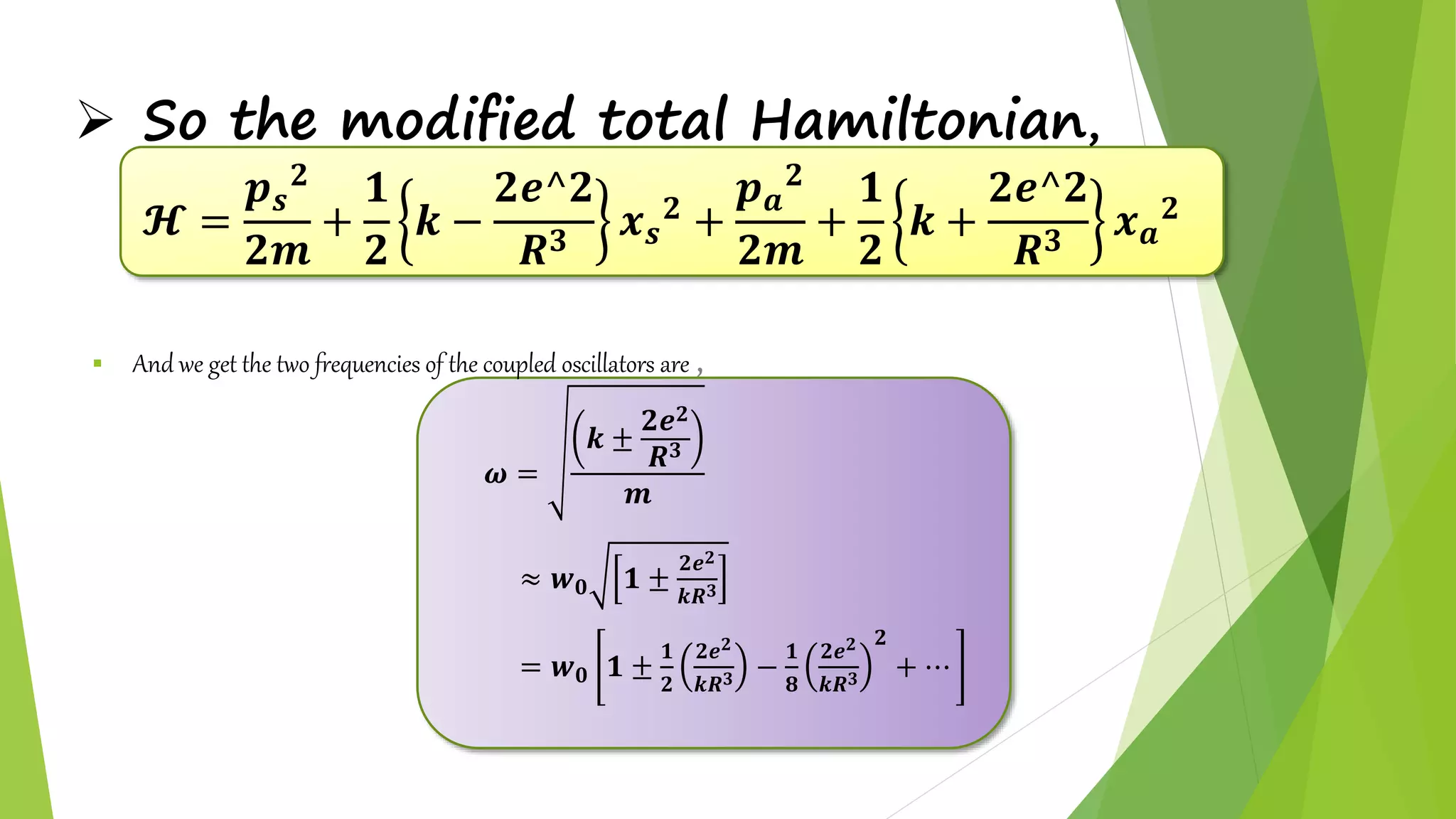
 So the modified total Hamiltonian,
𝓗 =
𝒑 𝒔
𝟐
𝟐𝒎
+
𝟏
𝟐
𝒌 −
𝟐𝒆^𝟐
𝑹 𝟑
𝒙 𝒔
𝟐
+
𝒑 𝒂
𝟐
𝟐𝒎
+
𝟏
𝟐
𝒌 +
𝟐𝒆^𝟐
𝑹 𝟑
𝒙 𝒂
𝟐
 And we get the two frequencies of the coupled oscillators are ,
𝝎 =
𝒌 ±
𝟐𝒆 𝟐
𝑹 𝟑
𝒎
≈ 𝒘 𝟎 𝟏 ±
𝟐𝒆 𝟐
𝒌𝑹 𝟑
= 𝒘 𝟎 𝟏 ±
𝟏
𝟐
𝟐𝒆 𝟐
𝒌𝑹 𝟑 −
𝟏
𝟖
𝟐𝒆 𝟐
𝒌𝑹 𝟑
𝟐
+ ⋯
 Because of the interaction the sum is lowered by
∆𝑼 =
𝟏
𝟐
ℏ ∆𝒘 𝒔 + ∆𝒘 𝒂 =-ℏ𝒘 𝟎
𝟏
𝟖
𝟐𝒆 𝟐
𝒌𝑹 𝟑
𝟐
∆𝑼 = −
𝑨
𝑹 𝟔
 The Zero Point energy of the system is
U=
𝟏
𝟐
ℏ 𝒘 𝒔 + 𝒘 𝒂
 This is known as Van der Waal Interaction or London Interaction
or Dipole-Dipole Interaction .
𝐴 = ℏ𝑤0
𝑒4
2𝑘2
2. Repulsive Interaction :-
Effect Of Pauli Principle
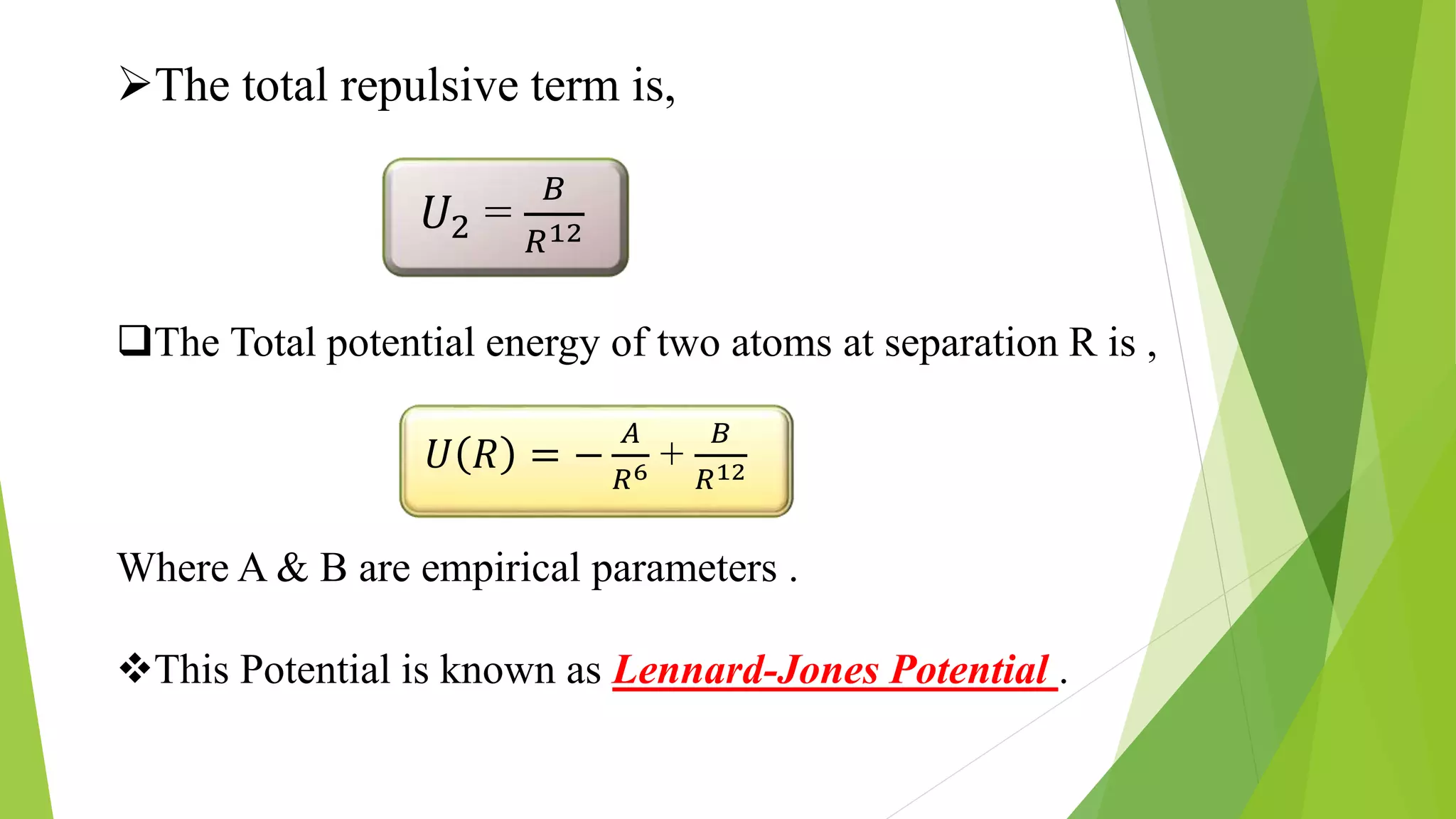
The total repulsive term is,
𝑈2 =
𝐵
𝑅12
The Total potential energy of two atoms at separation R is ,
𝑈 𝑅 = −
𝐴
𝑅6 +
𝐵
𝑅12
Where A & B are empirical parameters .
This Potential is known as Lennard-Jones Potential .
Curve of Lennard-Jones Potential
U(R)=4∈[ (σ/R)^12 – (σ/R)^6 ]
Where , A = 4∈σ^6 & B = 4∈σ^12
 Application of Lennard-Jones Potential
:-
 Differentiating the L-J Potential w.r.t r gives net
intermolecular force .
 It describes the properties of gases and to model dispersion
and overlap interactions in molecular models .
 It describes the lowest energy arrangement of infinite
number of atoms .
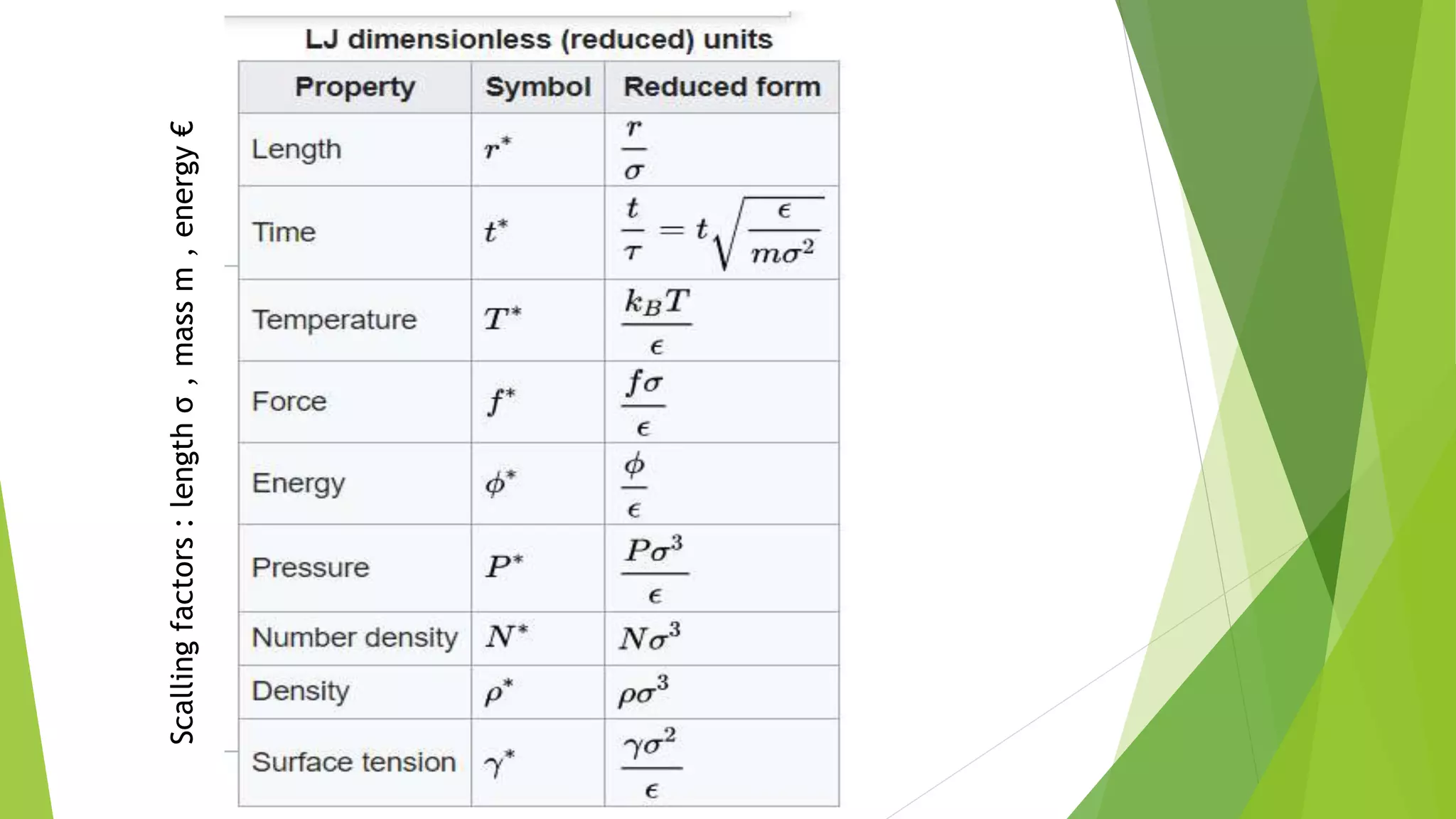
 Dimensionless unit can be defined .
Scallingfactors:lengthσ,massm,energy€
Application :-
 Limitations :-
 The L-J potential has only two parameters (A and B), which determine the
length and energy scales. The potential is therefore limited in how accurately it
can be fitted to the properties of any real material.
 With the L-J potential, the number of atoms bonded to an atom does not affect
bond strength. The bond energy per atom thus rises linearly with the number of
bonds per atom. But experiments show that in real materials, bond energy per
atom rises quadratically with the number of bonds.
 The bonding of the L-J potential has no directionality: the potential is
spherically symmetric.
 The sixth-power term models effectively the dipole–dipole interactions due to
electron dispersion in noble gases (London dispersion forces), but it does not
represent other kinds of bonding well. The twelfth-power term appearing in the
potential is chosen for its ease of calculation for simulations (by squaring the
sixth-power term) and is not theoretically or physically based.
 The potential diverges when two atoms approach one another. This may create
instabilities that require special treatment in molecular dynamics simulations.
Crystals of inert gases

Crystals of inert gases

  • 1.
    LENNARD-JONES POTENTIAL: CRYSTALS OFINERT GASES Presented By, Sujata Sinha 17PH05012
  • 2.
    Motivation :- To knowabout crystal binding … What holds crystals together ?
  • 3.
     BRIEF FLOWOF THE PRESENTATION 1. Introduction 2. Properties of inert gas crystals 3. Types of Interaction 4. Lennard-Jone Potential 5. Applications 6. Limitations 7. Conclusion
  • 4.
  • 6.
    Types of interaction 1.Van der Waals-London Interaction :- x+ +- - R X 2 x 1
  • 7.
     The UnperturbedHamiltonian 𝐻0 = 𝑝1 2 2𝑚 + 1 2 Κ𝑥1 2 + 𝑝2 2 2𝑚 + 1 2 Κ𝑥2 2  The Coulomb Interaction Energy of two oscillators 𝐻1 = 𝑒2 𝑅 + 𝑒2 𝑅 + 𝑥1 − 𝑥2 − 𝑒2 𝑅 + 𝑥1 − 𝑒2 𝑅 − 𝑥2 ≈ − 2𝑒2 𝑅3 𝑥1 𝑥2
  • 8.
     Total Hamiltonian, ℋ = 𝐻0 + 𝐻1  This H can be diagonalised by the Normal Mode transformation 𝑥 𝑠 = 1 2 𝑥1 + 𝑥2 𝑥 𝑎 = 1 2 𝑥1 − 𝑥2
  • 9.
     So themodified total Hamiltonian, 𝓗 = 𝒑 𝒔 𝟐 𝟐𝒎 + 𝟏 𝟐 𝒌 − 𝟐𝒆^𝟐 𝑹 𝟑 𝒙 𝒔 𝟐 + 𝒑 𝒂 𝟐 𝟐𝒎 + 𝟏 𝟐 𝒌 + 𝟐𝒆^𝟐 𝑹 𝟑 𝒙 𝒂 𝟐  And we get the two frequencies of the coupled oscillators are , 𝝎 = 𝒌 ± 𝟐𝒆 𝟐 𝑹 𝟑 𝒎 ≈ 𝒘 𝟎 𝟏 ± 𝟐𝒆 𝟐 𝒌𝑹 𝟑 = 𝒘 𝟎 𝟏 ± 𝟏 𝟐 𝟐𝒆 𝟐 𝒌𝑹 𝟑 − 𝟏 𝟖 𝟐𝒆 𝟐 𝒌𝑹 𝟑 𝟐 + ⋯
  • 10.
     Because ofthe interaction the sum is lowered by ∆𝑼 = 𝟏 𝟐 ℏ ∆𝒘 𝒔 + ∆𝒘 𝒂 =-ℏ𝒘 𝟎 𝟏 𝟖 𝟐𝒆 𝟐 𝒌𝑹 𝟑 𝟐 ∆𝑼 = − 𝑨 𝑹 𝟔  The Zero Point energy of the system is U= 𝟏 𝟐 ℏ 𝒘 𝒔 + 𝒘 𝒂  This is known as Van der Waal Interaction or London Interaction or Dipole-Dipole Interaction . 𝐴 = ℏ𝑤0 𝑒4 2𝑘2
  • 11.
  • 12.
    Effect Of PauliPrinciple
  • 13.
    The total repulsiveterm is, 𝑈2 = 𝐵 𝑅12 The Total potential energy of two atoms at separation R is , 𝑈 𝑅 = − 𝐴 𝑅6 + 𝐵 𝑅12 Where A & B are empirical parameters . This Potential is known as Lennard-Jones Potential .
  • 14.
    Curve of Lennard-JonesPotential U(R)=4∈[ (σ/R)^12 – (σ/R)^6 ] Where , A = 4∈σ^6 & B = 4∈σ^12
  • 15.
     Application ofLennard-Jones Potential :-  Differentiating the L-J Potential w.r.t r gives net intermolecular force .  It describes the properties of gases and to model dispersion and overlap interactions in molecular models .  It describes the lowest energy arrangement of infinite number of atoms .  Dimensionless unit can be defined .
  • 16.
  • 17.
  • 18.
     Limitations :- The L-J potential has only two parameters (A and B), which determine the length and energy scales. The potential is therefore limited in how accurately it can be fitted to the properties of any real material.  With the L-J potential, the number of atoms bonded to an atom does not affect bond strength. The bond energy per atom thus rises linearly with the number of bonds per atom. But experiments show that in real materials, bond energy per atom rises quadratically with the number of bonds.  The bonding of the L-J potential has no directionality: the potential is spherically symmetric.  The sixth-power term models effectively the dipole–dipole interactions due to electron dispersion in noble gases (London dispersion forces), but it does not represent other kinds of bonding well. The twelfth-power term appearing in the potential is chosen for its ease of calculation for simulations (by squaring the sixth-power term) and is not theoretically or physically based.  The potential diverges when two atoms approach one another. This may create instabilities that require special treatment in molecular dynamics simulations.