Solid State Physics (Lec-1)
What holds Solids Together: Chemical
Bonding
Dr. Saeed Mahmud Ullah
Professor
EEE, DU
Text Book
• The Oxford Solid State Basics
– Steven H. Simon
– 1st Edition, Oxford University Press
– Chapter 6
Why atoms stick together: Bonding
• A chemical bond forms when it is energetically favorable, i.e., when the
energy of the bonded atoms is less than the energies of the separated
atoms.
• From a chemist’s point of view: different types of chemical bonds
depending on the types of atoms involved, in particular,
– depending on the atom’s position on the periodic table
– and on the atom’s electronegativity—which is its tendency to attract
electrons.
• Here, we will discuss
– ionic bonds,
– covalent bonds,
– van der Waals (fluctuating dipole, or molecular) bonds,
– metallic bonds, and
– hydrogen bonds.
Electron Affinity
• The amount of energy released when an electron is added to a neutral
atom to form an anion.
• The electron affinity is the potential energy change of the atom when
an electron is added to a neutral gaseous atom to form a negative ion.
• So the more the electron affinity the more favourable the electron
addition process is.
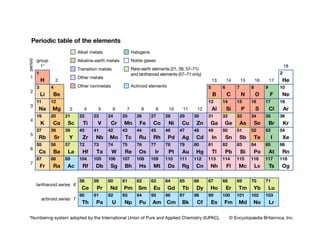
• Electron affinity increases across the periodic table from left to right due
to nuclear charge increases. As nuclear charge (positive) increases, it
attracts more negatively charged electrons.
• It also increases from bottom to top in the periodic table due to decrease
in atomic size.
Ionization Energy
• Energy required to remove one electron from a neutral atom to create a
positive ion
• It is a minimum for the alkali metals (left of the periodic table) which
have a single electron outside a closed shell.
• It generally increases across a row on the periodic maximum for the noble
gases which have closed shells.
• For example, sodium requires only 496 kJ/mol or 5.14 eV/atom to ionize it
while neon, the noble gas requires 2081 kJ/mol or 21.56 eV/atom.
• The ionization energy can be thought of as a kind of counter property
to electronegativity in the sense that a low ionization energy implies that
an element readily gives electrons to a reaction, while a high
electronegativity implies that an element strongly seeks to take electrons
in a reaction.
Electronegativity
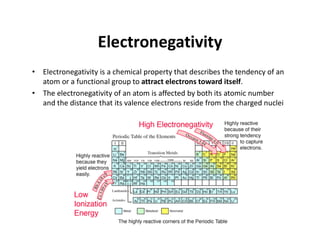
• Electronegativity is a chemical property that describes the tendency of an
atom or a functional group to attract electrons toward itself.
• The electronegativity of an atom is affected by both its atomic number
and the distance that its valence electrons reside from the charged nuclei
Electronegativity
• In order to determine whether an electron is likely to be transferred
between one atom and another, it is convenient to use the so-called
electronegativity, which roughly describes how much an atom “wants”
electrons, or how much an atom attracts electrons to itself.
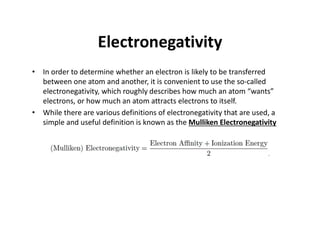
• While there are various definitions of electronegativity that are used, a
simple and useful definition is known as the Mulliken Electronegativity
Ionic Bonds
• The general idea of an ionic bond is that for certain compounds (for
example, binary compounds, such as NaCl, made of one element in group I
and one element in group VII), it is energetically favorable for an electron
to be physically transferred from one atom to the other, leaving two
oppositely charged ions which then attract each other.
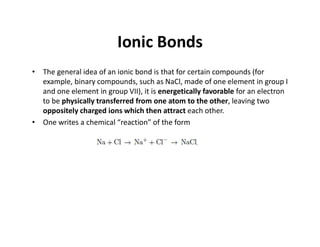
• One writes a chemical “reaction” of the form
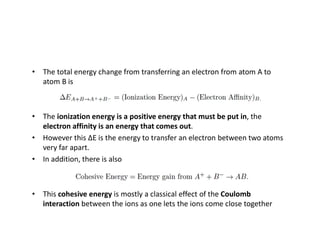
• The total energy change from transferring an electron from atom A to
atom B is
• The ionization energy is a positive energy that must be put in, the
electron affinity is an energy that comes out.
• However this ΔE is the energy to transfer an electron between two atoms
very far apart.
• In addition, there is also
• This cohesive energy is mostly a classical effect of the Coulomb
interaction between the ions as one lets the ions come close together
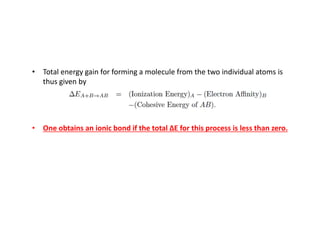
• Total energy gain for forming a molecule from the two individual atoms is
thus given by
• One obtains an ionic bond if the total ΔE for this process is less than zero.
• In bonding, the electron is always transferred from the atom of
lower electronegativity to higher electronegativity.
• The greater the difference in electronegativities between two
atoms the more completely the electron is transferred from one
atom to the other.
• If the difference in electronegativities is small, then the electron is
only partially transferred from one atom to the other.
Properties of Ionic Solids
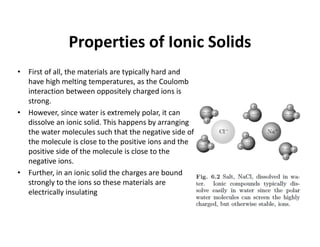
• First of all, the materials are typically hard and
have high melting temperatures, as the Coulomb
interaction between oppositely charged ions is
strong.
• However, since water is extremely polar, it can
dissolve an ionic solid. This happens by arranging
the water molecules such that the negative side of
the molecule is close to the positive ions and the
positive side of the molecule is close to the
negative ions.
• Further, in an ionic solid the charges are bound
strongly to the ions so these materials are
electrically insulating
Covalent Bond
• A covalent bond is a bond where electrons are shared roughly equally
between two atoms.
• There are several models that can be used to describe the covalent bond.
Particle in a Box Picture
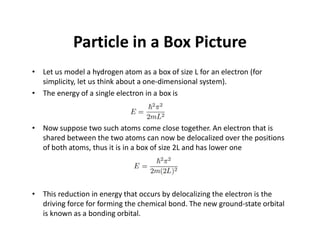
• Let us model a hydrogen atom as a box of size L for an electron (for
simplicity, let us think about a one-dimensional system).
• The energy of a single electron in a box is
• Now suppose two such atoms come close together. An electron that is
shared between the two atoms can now be delocalized over the positions
of both atoms, thus it is in a box of size 2L and has lower one
• This reduction in energy that occurs by delocalizing the electron is the
driving force for forming the chemical bond. The new ground-state orbital
is known as a bonding orbital.
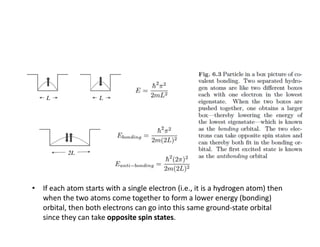
• If each atom starts with a single electron (i.e., it is a hydrogen atom) then
when the two atoms come together to form a lower energy (bonding)
orbital, then both electrons can go into this same ground-state orbital
since they can take opposite spin states.
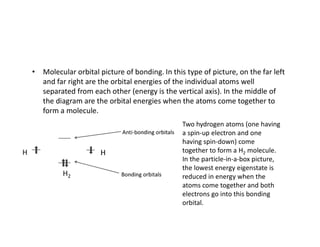
• Molecular orbital picture of bonding. In this type of picture, on the far left
and far right are the orbital energies of the individual atoms well
separated from each other (energy is the vertical axis). In the middle of
the diagram are the orbital energies when the atoms come together to
form a molecule.
Two hydrogen atoms (one having
a spin-up electron and one
having spin-down) come
together to form a H2 molecule.
In the particle-in-a-box picture,
the lowest energy eigenstate is
reduced in energy when the
atoms come together and both
electrons go into this bonding
orbital.
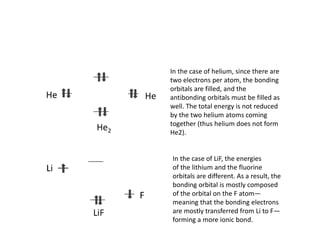
In the case of helium, since there are
two electrons per atom, the bonding
orbitals are filled, and the
antibonding orbitals must be filled as
well. The total energy is not reduced
by the two helium atoms coming
together (thus helium does not form
He2).
In the case of LiF, the energies
of the lithium and the fluorine
orbitals are different. As a result, the
bonding orbital is mostly composed
of the orbital on the F atom—
meaning that the bonding electrons
are mostly transferred from Li to F—
forming a more ionic bond.
Van der Waals, Fluctuating Dipole
Forces, or Molecular Bonding
• When two atoms (or two molecules) are very far apart from each other,
there remains an attraction between them due to what is known as van
der Waals forces, sometimes known as fluctuating dipole forces, or
molecular bonding.
• In short, both atoms have a dipole moment, which may be zero on
average, but can fluctuate “momentarily” due to quantum mechanics. If
the first atom obtains a momentary dipole moment, the second atom can
polarize—also obtaining a dipole moment to lower its energy. As a result,
the two atoms (momentarily dipoles) will attract each other.
• This type of bonding between atoms is very typical of inert atoms (such as
noble gases: He, Ne, Kr, Ar, Xe) whose electrons do not participate in
covalent bonds or ionic bonds.
• This bonding is weak compared to covalent or ionic bonds, but it is also
long ranged in comparison since the electrons do not need to hop
between atoms.
• let us consider an electron orbiting a nucleus (say, a proton).
• If the electron is at a fixed position, there is a dipole moment p = er,
where r is the vector from the electron to the proton.
• With the electron “orbiting” (i.e, in an unperturbed eigenstate), the
average dipole moment is zero. However, if an electric field is applied to
the atom, the atom will develop a polarization (i.e., it will be more likely
for the electron to be found on one side of the nucleus than on the other).
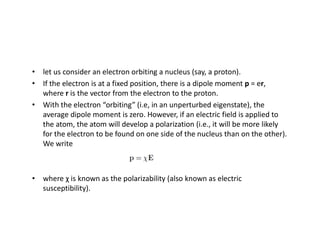
We write
• where χ is known as the polarizability (also known as electric
susceptibility).
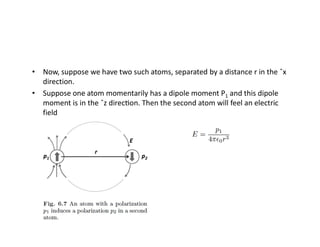
• Now, suppose we have two such atoms, separated by a distance r in the ˆx
direction.
• Suppose one atom momentarily has a dipole moment P1 and this dipole
moment is in the ˆz direc on. Then the second atom will feel an electric
field
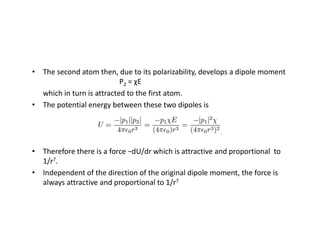
• The second atom then, due to its polarizability, develops a dipole moment
P2 = χE
which in turn is attracted to the first atom.
• The potential energy between these two dipoles is
• Therefore there is a force −dU/dr which is attractive and proportional to
1/r7.
• Independent of the direction of the original dipole moment, the force is
always attractive and proportional to 1/r7
• While these fluctuating dipolar forces are generally weak, they are the
only forces that occur when electrons cannot be shared or transferred
between atoms—either in the case where the electrons are not chemically
active or when the atoms are far apart.
Metallic Bonding
• One defines a metallic bond to be the bonding that occurs in a metal.
• These bonds are similar to covalent bonds in the sense that electrons are
shared between atoms, but in this case the electrons become delocalized
throughout the crystal
Hydrogen Bonds
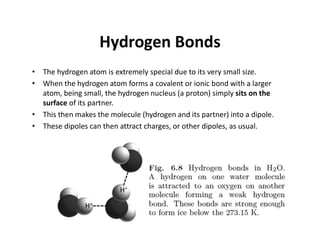
• The hydrogen atom is extremely special due to its very small size.
• When the hydrogen atom forms a covalent or ionic bond with a larger
atom, being small, the hydrogen nucleus (a proton) simply sits on the
surface of its partner.
• This then makes the molecule (hydrogen and its partner) into a dipole.
• These dipoles can then attract charges, or other dipoles, as usual.

solid state L-1, Solid state physics, chemical bonding, Dr. Saed Mahmud ullah

  • 1.
    Solid State Physics(Lec-1) What holds Solids Together: Chemical Bonding Dr. Saeed Mahmud Ullah Professor EEE, DU
  • 2.
    Text Book • TheOxford Solid State Basics – Steven H. Simon – 1st Edition, Oxford University Press – Chapter 6
  • 3.
    Why atoms sticktogether: Bonding • A chemical bond forms when it is energetically favorable, i.e., when the energy of the bonded atoms is less than the energies of the separated atoms. • From a chemist’s point of view: different types of chemical bonds depending on the types of atoms involved, in particular, – depending on the atom’s position on the periodic table – and on the atom’s electronegativity—which is its tendency to attract electrons. • Here, we will discuss – ionic bonds, – covalent bonds, – van der Waals (fluctuating dipole, or molecular) bonds, – metallic bonds, and – hydrogen bonds.
  • 4.
    Electron Affinity • Theamount of energy released when an electron is added to a neutral atom to form an anion. • The electron affinity is the potential energy change of the atom when an electron is added to a neutral gaseous atom to form a negative ion. • So the more the electron affinity the more favourable the electron addition process is. • Electron affinity increases across the periodic table from left to right due to nuclear charge increases. As nuclear charge (positive) increases, it attracts more negatively charged electrons. • It also increases from bottom to top in the periodic table due to decrease in atomic size.
  • 6.
    Ionization Energy • Energyrequired to remove one electron from a neutral atom to create a positive ion • It is a minimum for the alkali metals (left of the periodic table) which have a single electron outside a closed shell. • It generally increases across a row on the periodic maximum for the noble gases which have closed shells. • For example, sodium requires only 496 kJ/mol or 5.14 eV/atom to ionize it while neon, the noble gas requires 2081 kJ/mol or 21.56 eV/atom. • The ionization energy can be thought of as a kind of counter property to electronegativity in the sense that a low ionization energy implies that an element readily gives electrons to a reaction, while a high electronegativity implies that an element strongly seeks to take electrons in a reaction.
  • 7.
    Electronegativity • Electronegativity isa chemical property that describes the tendency of an atom or a functional group to attract electrons toward itself. • The electronegativity of an atom is affected by both its atomic number and the distance that its valence electrons reside from the charged nuclei
  • 8.
    Electronegativity • In orderto determine whether an electron is likely to be transferred between one atom and another, it is convenient to use the so-called electronegativity, which roughly describes how much an atom “wants” electrons, or how much an atom attracts electrons to itself. • While there are various definitions of electronegativity that are used, a simple and useful definition is known as the Mulliken Electronegativity
  • 9.
    Ionic Bonds • Thegeneral idea of an ionic bond is that for certain compounds (for example, binary compounds, such as NaCl, made of one element in group I and one element in group VII), it is energetically favorable for an electron to be physically transferred from one atom to the other, leaving two oppositely charged ions which then attract each other. • One writes a chemical “reaction” of the form
  • 10.
    • The totalenergy change from transferring an electron from atom A to atom B is • The ionization energy is a positive energy that must be put in, the electron affinity is an energy that comes out. • However this ΔE is the energy to transfer an electron between two atoms very far apart. • In addition, there is also • This cohesive energy is mostly a classical effect of the Coulomb interaction between the ions as one lets the ions come close together
  • 11.
    • Total energygain for forming a molecule from the two individual atoms is thus given by • One obtains an ionic bond if the total ΔE for this process is less than zero.
  • 12.
    • In bonding,the electron is always transferred from the atom of lower electronegativity to higher electronegativity. • The greater the difference in electronegativities between two atoms the more completely the electron is transferred from one atom to the other. • If the difference in electronegativities is small, then the electron is only partially transferred from one atom to the other.
  • 13.
    Properties of IonicSolids • First of all, the materials are typically hard and have high melting temperatures, as the Coulomb interaction between oppositely charged ions is strong. • However, since water is extremely polar, it can dissolve an ionic solid. This happens by arranging the water molecules such that the negative side of the molecule is close to the positive ions and the positive side of the molecule is close to the negative ions. • Further, in an ionic solid the charges are bound strongly to the ions so these materials are electrically insulating
  • 14.
    Covalent Bond • Acovalent bond is a bond where electrons are shared roughly equally between two atoms. • There are several models that can be used to describe the covalent bond.
  • 15.
    Particle in aBox Picture • Let us model a hydrogen atom as a box of size L for an electron (for simplicity, let us think about a one-dimensional system). • The energy of a single electron in a box is • Now suppose two such atoms come close together. An electron that is shared between the two atoms can now be delocalized over the positions of both atoms, thus it is in a box of size 2L and has lower one • This reduction in energy that occurs by delocalizing the electron is the driving force for forming the chemical bond. The new ground-state orbital is known as a bonding orbital.
  • 16.
    • If eachatom starts with a single electron (i.e., it is a hydrogen atom) then when the two atoms come together to form a lower energy (bonding) orbital, then both electrons can go into this same ground-state orbital since they can take opposite spin states.
  • 17.
    • Molecular orbitalpicture of bonding. In this type of picture, on the far left and far right are the orbital energies of the individual atoms well separated from each other (energy is the vertical axis). In the middle of the diagram are the orbital energies when the atoms come together to form a molecule. Two hydrogen atoms (one having a spin-up electron and one having spin-down) come together to form a H2 molecule. In the particle-in-a-box picture, the lowest energy eigenstate is reduced in energy when the atoms come together and both electrons go into this bonding orbital.
  • 18.
    In the caseof helium, since there are two electrons per atom, the bonding orbitals are filled, and the antibonding orbitals must be filled as well. The total energy is not reduced by the two helium atoms coming together (thus helium does not form He2). In the case of LiF, the energies of the lithium and the fluorine orbitals are different. As a result, the bonding orbital is mostly composed of the orbital on the F atom— meaning that the bonding electrons are mostly transferred from Li to F— forming a more ionic bond.
  • 19.
    Van der Waals,Fluctuating Dipole Forces, or Molecular Bonding • When two atoms (or two molecules) are very far apart from each other, there remains an attraction between them due to what is known as van der Waals forces, sometimes known as fluctuating dipole forces, or molecular bonding. • In short, both atoms have a dipole moment, which may be zero on average, but can fluctuate “momentarily” due to quantum mechanics. If the first atom obtains a momentary dipole moment, the second atom can polarize—also obtaining a dipole moment to lower its energy. As a result, the two atoms (momentarily dipoles) will attract each other. • This type of bonding between atoms is very typical of inert atoms (such as noble gases: He, Ne, Kr, Ar, Xe) whose electrons do not participate in covalent bonds or ionic bonds. • This bonding is weak compared to covalent or ionic bonds, but it is also long ranged in comparison since the electrons do not need to hop between atoms.
  • 20.
    • let usconsider an electron orbiting a nucleus (say, a proton). • If the electron is at a fixed position, there is a dipole moment p = er, where r is the vector from the electron to the proton. • With the electron “orbiting” (i.e, in an unperturbed eigenstate), the average dipole moment is zero. However, if an electric field is applied to the atom, the atom will develop a polarization (i.e., it will be more likely for the electron to be found on one side of the nucleus than on the other). We write • where χ is known as the polarizability (also known as electric susceptibility).
  • 21.
    • Now, supposewe have two such atoms, separated by a distance r in the ˆx direction. • Suppose one atom momentarily has a dipole moment P1 and this dipole moment is in the ˆz direc on. Then the second atom will feel an electric field
  • 22.
    • The secondatom then, due to its polarizability, develops a dipole moment P2 = χE which in turn is attracted to the first atom. • The potential energy between these two dipoles is • Therefore there is a force −dU/dr which is attractive and proportional to 1/r7. • Independent of the direction of the original dipole moment, the force is always attractive and proportional to 1/r7
  • 23.
    • While thesefluctuating dipolar forces are generally weak, they are the only forces that occur when electrons cannot be shared or transferred between atoms—either in the case where the electrons are not chemically active or when the atoms are far apart.
  • 24.
    Metallic Bonding • Onedefines a metallic bond to be the bonding that occurs in a metal. • These bonds are similar to covalent bonds in the sense that electrons are shared between atoms, but in this case the electrons become delocalized throughout the crystal
  • 25.
    Hydrogen Bonds • Thehydrogen atom is extremely special due to its very small size. • When the hydrogen atom forms a covalent or ionic bond with a larger atom, being small, the hydrogen nucleus (a proton) simply sits on the surface of its partner. • This then makes the molecule (hydrogen and its partner) into a dipole. • These dipoles can then attract charges, or other dipoles, as usual.