CRYPTOGRAPHY & NETWORK
SECURITY
Paper Code: ETIT-403
Text Book:
[T1] William Stallings, "Cryptography and Network Security - Principles and Practices", Prentice Hall of India, Third Edition, 2003.
[T2] Wade Trappe, Lawrence C Washington, “Introduction to Cryptography with coding theory”, 2nd ed, Pearson, 2007.
Reference Book:
[R1] R.Rajaram, “Network Security and Cryptography” SciTech Publication, First Edition, 2013.
[R2] Atul Kahate, "Cryptography and Network Security", Tata McGraw-Hill, 2003
[R3] Bruce Schneier, "Applied Cryptography", John Wiley & Sons Inc, 2001.
UNIT- I:
Basic Cryptographic Techniques, Computational Complexity, Finite Fields, Number
Theory, DES and AES, Public Key Cryptosystems, Traffic Confidentiality, Cryptanalysis,
Intractable (Hard) Problems, Hash Functions, OSI Security Architecture Privacy of Data.
[T1, T2] [No. of Hrs: 11]
UNIT- II:
Linear Cryptanalysis, Differential Cryptanalysis, DES, Triple DES, Message
Authentication and Digital Signatures, Attacks on Protocols, Elliptic Curve Architecture
and Cryptography, Public Key Cryptography and RSA, , Evaluation criteria for AES, Key
Management, Authentication requirements Digital forensics including digital evidence
handling: Media forensics, Cyber forensics, Software forensics, Mobile forensics.
[T1, T2] [No. of Hrs: 11]
Roadmap
Computer Security
Network Security
Mutual Trust
Cryptographic algorithms
 symmetric ciphers
 asymmetric encryption
 hash functions
Computer Security
• The protection afforded to an automated information system in
order to attain the applicable objectives of preserving the
integrity, availability and confidentiality of information system
resources (includes hardware, software, firmware,
information/data, and telecommunications)
• Three key objectives that are at the heart of computer security
Levels of Impact
can define 3 levels of impact from a security breach
 Low
 Moderate
 High
Examples of Security Requirements
• confidentiality – student grades
• integrity – patient information
• availability – authentication service
Computer Security Challenges
1. Not simple
2. Must consider potential attacks
3. Procedures used counter-intuitive
4. Involve algorithms and secret info
5. Must decide where to deploy mechanisms
6. Battle of wits between attacker / admin
7. Not perceived on benefit until fails
8. Requires regular monitoring
9. Too often an after-thought
10. Regarded as impediment to using system
OSI(Open Systems Interconnection) Security
Architecture
• ITU-T X.800 (International Telecommunication Union
Telecommunication Standardization Sector) “Security
Architecture for OSI”
• Defines a systematic way of defining and providing security
requirements
• It provides a useful, abstract, overview of concepts we will
study
Aspects of Security
• Consider Three aspects of information security:
• Security attack
• Security mechanism
• Security service
• Important terms
• Threat – a potential for violation of security
• Attack – an assault on system security, a deliberate attempt to evade security
services
Passive Attacks
Active Attacks
Security Service
• Enhance security of data processing systems and information
transfers of an organization
• Intended to counter security attacks
• Using one or more security mechanisms
• Often replicates functions normally associated with physical
documents
• which, for example, have signatures, dates; need protection from
disclosure, tampering, or destruction; be notarized or witnessed; be
recorded or licensed
Security Services
• X.800:
“ A service provided by a protocol layer of communicating
open systems, which ensures adequate security of the
systems or of data transfers”.
• RFC 2828:
“ A processing or communication service provided by a
system to give a specific kind of protection to system
resources”.
Security Services (X.800)
• Authentication - assurance that communicating entity is the one
claimed
• have both peer-entity & data origin authentication
• Access Control - prevention of the unauthorized use of a resource
• Data Confidentiality – protection of data from unauthorized disclosure
• Data Integrity - assurance that data received is as sent by an
authorized entity
• Non-Repudiation - protection against denial by one of the parties in a
communication
• Availability – resource accessible/usable
Security Mechanisms (X.800)
• Specific security mechanisms:
• encipherment, digital signatures, access controls, data integrity,
authentication exchange, traffic padding, routing control,
notarization
• Pervasive security mechanisms:
• trusted functionality, security labels, event detection, security audit
trails, security recovery
Security Mechanism
• Feature designed to detect, prevent, or recover from a security
attack
• No single mechanism that will support all services required
• However one particular element underlies many of the security
mechanisms in use:
 cryptographic techniques
Network Security
Network and Internet security consists of measures to deter,
prevent, detect, and correct security violations that involve the
transmission of information.
Example
A network manager, D, transmits a message to a computer, E,
under its management. The message instructs computer E to
update an authorization file to include the identities of a number of
new users who are to be given access to that computer. User F
intercepts the message, alters its contents to add or delete entries,
and then forwards the message to computer E, which accepts the
message as coming from manager D and updates its authorization
file accordingly.
Model for Network Security
 Using this model we are require to:
1. Design a suitable algorithm for the security transformation.
2. Generate the secret information (keys) used by the algorithm.
3. Develop methods to distribute and share the secret information.
4. Specify a protocol enabling the principals to use the
transformation and secret information for a security service.
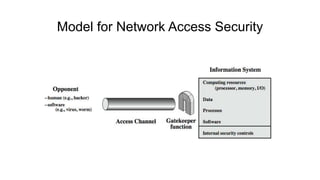
Model for Network Access Security
 using this model we are require to:
1. Select appropriate gatekeeper functions to identify users.
2. Implement security controls to ensure only authorised users
access designated information or resources.
What Is Cryptography?
• Cryptography -- from the Greek for “secret writing” -- is the
mathematical “scrambling” of data so that only someone with the
necessary key can “unscramble” it.
• Cryptography allows secure transmission of private information
over insecure channels (for example packet-switched networks).
• Cryptography also allows secure storage of sensitive data on any
computer.
Some Basic Terminology
• plaintext - original message
• ciphertext - coded message
• cipher - algorithm for transforming plaintext to ciphertext
• key - info used in cipher known only to sender/receiver
• encipher (encrypt) - converting plaintext to ciphertext
• decipher (decrypt) - recovering ciphertext from plaintext
• cryptography - study of encryption principles/methods
• cryptanalysis (codebreaking) - study of principles/ methods of
deciphering ciphertext without knowing key
• cryptology - field of both cryptography and cryptanalysis
Symmetric Cipher Model
Requirements
• Two requirements for secure use of symmetric encryption:
• a strong encryption algorithm
• a secret key known only to sender / receiver
• Mathematically have:
Y = E(K, X)
X = D(K, Y)
• Assume encryption algorithm is known
• Implies a secure channel to distribute key
Cryptography
• Can characterize cryptographic system by:
• type of encryption operations used
• substitution
• transposition
• product
• number of keys used
• single-key or private
• two-key or public
• way in which plaintext is processed
• block
• stream
Cryptanalysis
• Objective to recover key not just message
• General approaches:
• cryptanalytic attack
• brute-force attack
• If either succeed all key use compromised
Cryptanalytic Attacks
ciphertext only
 only know algorithm & ciphertext, is statistical, know or can identify plaintext
known plaintext
 know/suspect plaintext & ciphertext
chosen plaintext
 select plaintext and obtain ciphertext
chosen ciphertext
 select ciphertext and obtain plaintext
chosen text
 select plaintext or ciphertext to en/decrypt
More Definitions
unconditional security
 no matter how much computer power or time is available, the
cipher cannot be broken since the ciphertext provides insufficient
information to uniquely determine the corresponding plaintext
computational security
 given limited computing resources (eg time needed for calculations
is greater than age of universe), the cipher cannot be broken
Brute Force Search
• Always possible to simply try every key
• Most basic attack, proportional to key size
• Assume either know / recognise plaintext
Key Size (bits) Number of Alternative Keys Time required at 1 decryption/µs Time required at 106
decryptions/µs
32 232 = 4.3  109 231 µs = 35.8 minutes 2.15 milliseconds
56 256 = 7.2  1016 255 µs = 1142 years 10.01 hours
128 2128 = 3.4  1038 2127 µs = 5.4  1024 years 5.4  1018 years
168 2168 = 3.7  1050 2167 µs = 5.9  1036 years 5.9  1030 years
26 characters
(permutation)
26! = 4  1026 2  1026 µs = 6.4  1012 years 6.4  106 years
Caesar Cipher
• Earliest known substitution cipher
• By Julius Caesar
• First attested use in military affairs
• Replaces each letter by 3rd letter on
• Example:
meet me after the party
PHHW PH DIWHU WKH SDUWB
Caesar Cipher
• Can define transformation as:
a b c d e f g h i j k l m n o p q r s t u v w x y z
D E F G H I J K L M N O P Q R S T U V W X Y Z A B C
• Mathematically give each letter a number
a b c d e f g h i j k l m n o p q r s t u v w x y z
0 1 2 3 4 5 6 7 8 9 10 11 12 13 14 15 16 17 18 19 20 21 22 23 24 25
• Then have Caesar cipher as:
c = E(k, p) = (p + k) mod (26)
p = D(k, c) = (c – k) mod (26)
Cryptanalysis of Caesar Cipher
Only have 26 possible ciphers
A maps to A,B,..Z
Could simply try each in turn
A brute force search
Given ciphertext, just try all shifts of letters
Do need to recognize when have plaintext
eg. break ciphertext "GCUA VQ DTGCM“
easy to break
Monoalphabetic Cipher
• Rather than just shifting the alphabet
• Could shuffle (jumble) the letters arbitrarily
• Each plaintext letter maps to a different random ciphertext letter
• Hence key is 26 letters long
Plain: abcdefghijklmnopqrstuvwxyz
Cipher: DKVQFIBJWPESCXHTMYAUOLRGZN
Plaintext: ifwewishtoreplaceletters
Ciphertext: WIRFRWAJUHYFTSDVFSFUUFYA
Monoalphabetic Cipher Security
• Now have a total of 26! = 4 x 1026 keys
• With so many keys, might think is secure
• But would be !!!WRONG!!!
• Problem is language characteristics
Language Redundancy and Cryptanalysis
human languages are redundant
eg "th lrd s m shphrd shll nt wnt"
letters are not equally commonly used
in English E is by far the most common letter
• followed by T,R,N,I,O,A,S
other letters like Z,J,K,Q,X are fairly rare
have tables of single, double & triple letter frequencies for
various languages
English Letter Frequencies
Use in Cryptanalysis
• key concept - monoalphabetic substitution ciphers do not change
relative letter frequencies
• discovered by Arabian scientists in 9th century
• calculate letter frequencies for ciphertext
• compare counts/plots against known values
• if caesar cipher look for common peaks/troughs
• peaks at: A-E-I triple, NO pair, RST triple
• troughs at: JK, X-Z
• for monoalphabetic must identify each letter
• tables of common double/triple letters help
Example Cryptanalysis
• given ciphertext:
UZQSOVUOHXMOPVGPOZPEVSGZWSZOPFPESXUD
BMETSXAIZ
VUEPHZHMDZSHZOWSFPAPPDTSVPQUZWYMXUZUHSX
EPYEPOPDZSZUFPOMBZWPFUPZHMDJUDTMOHMQ
• count relative letter frequencies
• A-2, B-2,C-0,D-6,E-6,F-4,G-2,H-7,I-1,J-1,K-0,L-0,M-8,N-0,O-9,P-16,Q-3,R-0,S-10,T-3,U-10,V-5,
W-4,X-5,Y-2,Z-15
• guess P & Z are e and t
• guess ZW is th and hence ZWP is the
• proceeding with trial and error finally get:
it was disclosed yesterday that several informal but
direct contacts have been made with political
representatives of the viet cong in moscow
Playfair Cipher
not even the large number of keys in a monoalphabetic cipher
provides security
one approach to improving security was to encrypt multiple letters
the Playfair Cipher is an example
invented by Charles Wheatstone in 1854, but named after his
friend Baron Playfair
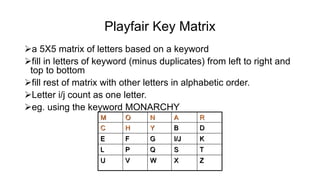
Playfair Key Matrix
a 5X5 matrix of letters based on a keyword
fill in letters of keyword (minus duplicates) from left to right and
top to bottom
fill rest of matrix with other letters in alphabetic order.
Letter i/j count as one letter.
eg. using the keyword MONARCHY
M O N A R
C H Y B D
E F G I/J K
L P Q S T
U V W X Z
Encrypting and Decrypting
• Plaintext is encrypted two letters at a time as follows:
1. If a pair is a repeated letter, insert filler like ‘X’
2. If both letters fall in the same row, replace each with letter to right
(wrapping back to start from end)
3. If both letters fall in the same column, replace each with the letter below it
(wrapping to top from bottom)
4. otherwise each letter in a pair is replaced by the letter in the same row and
in the column of the other letter of the pair
Security of Playfair Cipher
security much improved over monoalphabetic
since have 26 x 26 = 676 diagrams
would need a 676 entry frequency table to analyse (verses 26
for a monoalphabetic)
and correspondingly more ciphertext
was widely used for many years
• e.g. by US & British military in WW1
it can be broken, given a few hundred letters
since still has much of plaintext structure
Playfair Cipher
• Plain text – tall trees
• Key – occurrence
• Plain text – name
• Key – playfair
• Plain text – helloworld, whydontyou,impossible
• Key – keyword
• Plain text – mecseroom416
• Key - keyword
Hill Ciphers
• Created by Lester S. Hill in 1929
• Polygraphic Substitution Ciphers
• Encrypts letters in groups
• Frequency analysis more difficult
• Uses matrices to encrypt and decrypt
• Uses modular arithmetic (Mod 26)
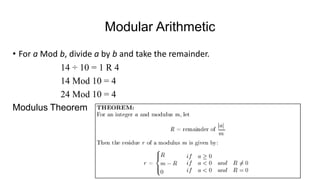
Modular Arithmetic
• For a Mod b, divide a by b and take the remainder.
14 ÷ 10 = 1 R 4
14 Mod 10 = 4
24 Mod 10 = 4
Modulus Theorem
Modulus Examples
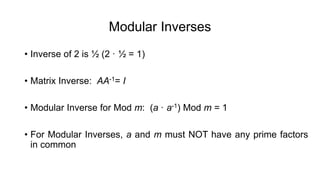
Modular Inverses
• Inverse of 2 is ½ (2 · ½ = 1)
• Matrix Inverse: AA-1= I
• Modular Inverse for Mod m: (a · a-1) Mod m = 1
• For Modular Inverses, a and m must NOT have any prime factors
in common
Modular Inverses of Mod 26
A 1 2 5 7 9 11 15 17 19 21 23 25
A-1 1 9 21 15 3 19 7 23 11 5 17 25
Example – Find the Modular Inverse of 9 for Mod 26
9 · 3 = 27
27 Mod 26 = 1
3 is the Modular Inverse of 9 Mod 26
Hill Cipher Matrices
• One matrix to encrypt, one to decrypt
• Must be n x n, invertible matrices
• Decryption matrix must be modular inverse of encryption matrix
in Mod 26
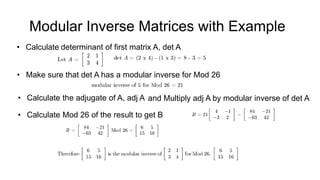
Modular Inverse Matrices with Example
• Calculate determinant of first matrix A, det A
• Make sure that det A has a modular inverse for Mod 26
• Calculate the adjugate of A, adj A and Multiply adj A by modular inverse of det A
• Calculate Mod 26 of the result to get B
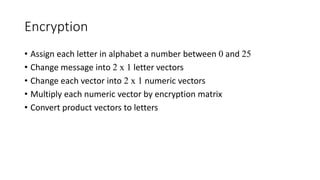
Encryption
• Assign each letter in alphabet a number between 0 and 25
• Change message into 2 x 1 letter vectors
• Change each vector into 2 x 1 numeric vectors
• Multiply each numeric vector by encryption matrix
• Convert product vectors to letters
Change Message to Vectors
Message to encrypt = HELLO WORLD
A B C D E F G H I J K L M
0 1 2 3 4 5 6 7 8 9 10 11 12
N O P Q R S T U V W X Y Z
13 14 15 16 17 18 19 20 21 22 23 24 25
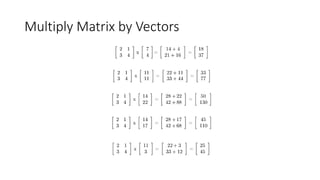
Multiply Matrix by Vectors
Convert to Mod 26
Convert Numbers to Letters
HELLO WORLD has been encrypted to
SLHZY ATGZT
Decryption
• Change message into 2 x 1 letter vectors
• Change each vector into 2 x 1 numeric vectors
• Multiply each numeric vector by decryption matrix
• Convert new vectors to letters
Change Message to Vectors
Message to encrypt = SLHZYATGZT
Multiply Matrix by Vectors
Convert to Mod 26
Convert Numbers to Letters
SLHZYATGZT has been decrypted to
HELLO WORLD
Polyalphabetic Ciphers
polyalphabetic substitution ciphers
improve security using multiple cipher alphabets
make cryptanalysis harder with more alphabets to guess and flatter
frequency distribution
use a key to select which alphabet is used for each letter of the
message
use each alphabet in turn
repeat from start after end of key is reached.
Vigenère Cipher
• simplest polyalphabetic substitution cipher
• effectively multiple caesar ciphers
• key is multiple letters long K = k1 k2 ... kd
• ith letter specifies ith alphabet to use
• use each alphabet in turn
• repeat from start after d letters in message
• decryption simply works in reverse
Example of Vigenère Cipher
write the plaintext out
write the keyword repeated above it
use each key letter as a caesar cipher key
encrypt the corresponding plaintext letter
eg using keyword deceptive
key: deceptivedeceptivedeceptive
plaintext: wearediscoveredsaveyourself
ciphertext:ZICVTWQNGRZGVTWAVZHCQYGLMGJ
Aids
• simple aids can assist with en/decryption
• a Saint-Cyr Slide is a simple manual aid
• a slide with repeated alphabet
• line up plaintext 'A' with key letter, eg 'C'
• then read off any mapping for key letter
• can bend round into a cipher disk
• or expand into a Vigenère Tableau
Security of Vigenère Ciphers
• have multiple ciphertext letters for each plaintext letter
• hence letter frequencies are obscured
• but not totally lost
• start with letter frequencies
• see if look monoalphabetic or not
• if not, then need to determine number of alphabets, since then can
attach each
Kasiski Method
• method developed by Babbage / Kasiski
• repetitions in ciphertext give clues to period
• so find same plaintext an exact period apart
• which results in the same ciphertext
• of course, could also be random fluke
• eg repeated “VTW” in previous example
• suggests size of 3 or 9
• then attack each monoalphabetic cipher individually using same
techniques as before
Autokey Cipher
• ideally want a key as long as the message
• Vigenère proposed the autokey cipher
• with keyword is prefixed to message as key
• knowing keyword can recover the first few letters
• use these in turn on the rest of the message
• but still have frequency characteristics to attack
• eg. given key deceptive
key: deceptivewearediscoveredsav
plaintext: wearediscoveredsaveyourself
ciphertext:ZICVTWQNGKZEIIGASXSTSLVVWLA
Vernam Cipher
ultimate defense is to use a key as long as the plaintext
with no statistical relationship to it
invented by AT&T engineer Gilbert Vernam in 1918
originally proposed using a very long but eventually repeating key
One-Time Pad
• if a truly random key as long as the message is used, the cipher will be
secure
• called a One-Time pad
• is unbreakable since ciphertext bears no statistical relationship to the
plaintext
• since for any plaintext & any ciphertext there exists a key mapping
one to other
• can only use the key once though
• problems in generation & safe distribution of key
Transposition Ciphers
now consider classical transposition or permutation ciphers
these hide the message by rearranging the letter order
without altering the actual letters used
can recognise these since have the same frequency distribution as
the original text
Rail Fence cipher
• write message letters out diagonally over a number of rows
• then read off cipher row by row
• eg. write message out as:
m e m a t r h t g p r y
e t e f e t e o a a t
• giving ciphertext
MEMATRHTGPRYETEFETEOAAT
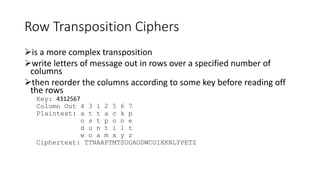
Row Transposition Ciphers
is a more complex transposition
write letters of message out in rows over a specified number of
columns
then reorder the columns according to some key before reading off
the rows
Key: 4312567
Column Out 4 3 1 2 5 6 7
Plaintext: a t t a c k p
o s t p o n e
d u n t i l t
w o a m x y z
Ciphertext: TTNAAPTMTSUOAODWCOIXKNLYPETZ
Product Ciphers
• ciphers using substitutions or transpositions are not secure because
of language characteristics
• hence consider using several ciphers in succession to make harder,
but:
• two substitutions make a more complex substitution
• two transpositions make more complex transposition
• but a substitution followed by a transposition makes a new much harder
cipher
• this is bridge from classical to modern ciphers
Rotor Machines
• before modern ciphers, rotor machines were most common complex
ciphers in use
• widely used in WW2
• German Enigma, Allied Hagelin, Japanese Purple
• implemented a very complex, varying substitution cipher
• used a series of cylinders, each giving one substitution, which rotated
and changed after each letter was encrypted
• with 3 cylinders have 263=17576 alphabets
Hagelin Rotor Machine
Rotor Machine Principles
Steganography
• an alternative to encryption
• hides existence of message
• using only a subset of letters/words in a longer message marked in some way
• using invisible ink
• hiding in LSB in graphic image or sound file
• has drawbacks
• high overhead to hide relatively few info bits
• advantage is can obscure encryption use
Cryptographic Algorithms and Protocols
Four main areas:
Symmetric encryption: Used to conceal the contents of blocks or
streams of data of any size, including messages, files, encryption
keys, and passwords.
Asymmetric encryption: Used to conceal small blocks of data,
such as encryption keys and hash function values, which are used in
digital signatures.
Data integrity algorithms: Used to protect blocks of data, such as
messages, from alteration.
Authentication protocols: These are schemes based on the use of
cryptographic algorithms designed to authenticate the identity of
entities.
Classical Cryptography:
Secret-Key or Symmetric Cryptography
• A and B agree on an encryption method and a shared key.
• A uses the key and the encryption method to encrypt (or encipher) a
message and sends it to B.
• B uses the same key and the related decryption method to decrypt (or
decipher) the message.
Advantages of Classical Cryptography
• There are some very fast classical encryption (and decryption) algorithms
• Since the speed of a method varies with the length of the key, faster
algorithms allow one to use longer key values.
• Larger key values make it harder to guess the key value -- and break the
code -- by brute force.
Disadvantages of Classical Cryptography
• Requires secure transmission of key value
• Requires a separate key for each group of people that wishes to exchange
encrypted messages (readable by any group member)
• For example, to have a separate key for each pair of people, 100
people would need 4950 different keys.

CRYPTOGRAPHY & NETWORK SECURITY [Autosaved].pptx

  • 1.
    CRYPTOGRAPHY & NETWORK SECURITY PaperCode: ETIT-403 Text Book: [T1] William Stallings, "Cryptography and Network Security - Principles and Practices", Prentice Hall of India, Third Edition, 2003. [T2] Wade Trappe, Lawrence C Washington, “Introduction to Cryptography with coding theory”, 2nd ed, Pearson, 2007. Reference Book: [R1] R.Rajaram, “Network Security and Cryptography” SciTech Publication, First Edition, 2013. [R2] Atul Kahate, "Cryptography and Network Security", Tata McGraw-Hill, 2003 [R3] Bruce Schneier, "Applied Cryptography", John Wiley & Sons Inc, 2001.
  • 2.
    UNIT- I: Basic CryptographicTechniques, Computational Complexity, Finite Fields, Number Theory, DES and AES, Public Key Cryptosystems, Traffic Confidentiality, Cryptanalysis, Intractable (Hard) Problems, Hash Functions, OSI Security Architecture Privacy of Data. [T1, T2] [No. of Hrs: 11] UNIT- II: Linear Cryptanalysis, Differential Cryptanalysis, DES, Triple DES, Message Authentication and Digital Signatures, Attacks on Protocols, Elliptic Curve Architecture and Cryptography, Public Key Cryptography and RSA, , Evaluation criteria for AES, Key Management, Authentication requirements Digital forensics including digital evidence handling: Media forensics, Cyber forensics, Software forensics, Mobile forensics. [T1, T2] [No. of Hrs: 11]
  • 3.
    Roadmap Computer Security Network Security MutualTrust Cryptographic algorithms  symmetric ciphers  asymmetric encryption  hash functions
  • 4.
    Computer Security • Theprotection afforded to an automated information system in order to attain the applicable objectives of preserving the integrity, availability and confidentiality of information system resources (includes hardware, software, firmware, information/data, and telecommunications) • Three key objectives that are at the heart of computer security
  • 5.
    Levels of Impact candefine 3 levels of impact from a security breach  Low  Moderate  High
  • 6.
    Examples of SecurityRequirements • confidentiality – student grades • integrity – patient information • availability – authentication service
  • 7.
    Computer Security Challenges 1.Not simple 2. Must consider potential attacks 3. Procedures used counter-intuitive 4. Involve algorithms and secret info 5. Must decide where to deploy mechanisms 6. Battle of wits between attacker / admin 7. Not perceived on benefit until fails 8. Requires regular monitoring 9. Too often an after-thought 10. Regarded as impediment to using system
  • 8.
    OSI(Open Systems Interconnection)Security Architecture • ITU-T X.800 (International Telecommunication Union Telecommunication Standardization Sector) “Security Architecture for OSI” • Defines a systematic way of defining and providing security requirements • It provides a useful, abstract, overview of concepts we will study
  • 9.
    Aspects of Security •Consider Three aspects of information security: • Security attack • Security mechanism • Security service • Important terms • Threat – a potential for violation of security • Attack – an assault on system security, a deliberate attempt to evade security services
  • 10.
  • 11.
  • 12.
    Security Service • Enhancesecurity of data processing systems and information transfers of an organization • Intended to counter security attacks • Using one or more security mechanisms • Often replicates functions normally associated with physical documents • which, for example, have signatures, dates; need protection from disclosure, tampering, or destruction; be notarized or witnessed; be recorded or licensed
  • 13.
    Security Services • X.800: “A service provided by a protocol layer of communicating open systems, which ensures adequate security of the systems or of data transfers”. • RFC 2828: “ A processing or communication service provided by a system to give a specific kind of protection to system resources”.
  • 14.
    Security Services (X.800) •Authentication - assurance that communicating entity is the one claimed • have both peer-entity & data origin authentication • Access Control - prevention of the unauthorized use of a resource • Data Confidentiality – protection of data from unauthorized disclosure • Data Integrity - assurance that data received is as sent by an authorized entity • Non-Repudiation - protection against denial by one of the parties in a communication • Availability – resource accessible/usable
  • 15.
    Security Mechanisms (X.800) •Specific security mechanisms: • encipherment, digital signatures, access controls, data integrity, authentication exchange, traffic padding, routing control, notarization • Pervasive security mechanisms: • trusted functionality, security labels, event detection, security audit trails, security recovery
  • 16.
    Security Mechanism • Featuredesigned to detect, prevent, or recover from a security attack • No single mechanism that will support all services required • However one particular element underlies many of the security mechanisms in use:  cryptographic techniques
  • 17.
    Network Security Network andInternet security consists of measures to deter, prevent, detect, and correct security violations that involve the transmission of information. Example A network manager, D, transmits a message to a computer, E, under its management. The message instructs computer E to update an authorization file to include the identities of a number of new users who are to be given access to that computer. User F intercepts the message, alters its contents to add or delete entries, and then forwards the message to computer E, which accepts the message as coming from manager D and updates its authorization file accordingly.
  • 18.
  • 19.
    Model for NetworkSecurity  Using this model we are require to: 1. Design a suitable algorithm for the security transformation. 2. Generate the secret information (keys) used by the algorithm. 3. Develop methods to distribute and share the secret information. 4. Specify a protocol enabling the principals to use the transformation and secret information for a security service.
  • 20.
    Model for NetworkAccess Security
  • 21.
    Model for NetworkAccess Security  using this model we are require to: 1. Select appropriate gatekeeper functions to identify users. 2. Implement security controls to ensure only authorised users access designated information or resources.
  • 22.
    What Is Cryptography? •Cryptography -- from the Greek for “secret writing” -- is the mathematical “scrambling” of data so that only someone with the necessary key can “unscramble” it. • Cryptography allows secure transmission of private information over insecure channels (for example packet-switched networks). • Cryptography also allows secure storage of sensitive data on any computer.
  • 23.
    Some Basic Terminology •plaintext - original message • ciphertext - coded message • cipher - algorithm for transforming plaintext to ciphertext • key - info used in cipher known only to sender/receiver • encipher (encrypt) - converting plaintext to ciphertext • decipher (decrypt) - recovering ciphertext from plaintext • cryptography - study of encryption principles/methods • cryptanalysis (codebreaking) - study of principles/ methods of deciphering ciphertext without knowing key • cryptology - field of both cryptography and cryptanalysis
  • 24.
  • 25.
    Requirements • Two requirementsfor secure use of symmetric encryption: • a strong encryption algorithm • a secret key known only to sender / receiver • Mathematically have: Y = E(K, X) X = D(K, Y) • Assume encryption algorithm is known • Implies a secure channel to distribute key
  • 26.
    Cryptography • Can characterizecryptographic system by: • type of encryption operations used • substitution • transposition • product • number of keys used • single-key or private • two-key or public • way in which plaintext is processed • block • stream
  • 27.
    Cryptanalysis • Objective torecover key not just message • General approaches: • cryptanalytic attack • brute-force attack • If either succeed all key use compromised
  • 28.
    Cryptanalytic Attacks ciphertext only only know algorithm & ciphertext, is statistical, know or can identify plaintext known plaintext  know/suspect plaintext & ciphertext chosen plaintext  select plaintext and obtain ciphertext chosen ciphertext  select ciphertext and obtain plaintext chosen text  select plaintext or ciphertext to en/decrypt
  • 29.
    More Definitions unconditional security no matter how much computer power or time is available, the cipher cannot be broken since the ciphertext provides insufficient information to uniquely determine the corresponding plaintext computational security  given limited computing resources (eg time needed for calculations is greater than age of universe), the cipher cannot be broken
  • 30.
    Brute Force Search •Always possible to simply try every key • Most basic attack, proportional to key size • Assume either know / recognise plaintext Key Size (bits) Number of Alternative Keys Time required at 1 decryption/µs Time required at 106 decryptions/µs 32 232 = 4.3  109 231 µs = 35.8 minutes 2.15 milliseconds 56 256 = 7.2  1016 255 µs = 1142 years 10.01 hours 128 2128 = 3.4  1038 2127 µs = 5.4  1024 years 5.4  1018 years 168 2168 = 3.7  1050 2167 µs = 5.9  1036 years 5.9  1030 years 26 characters (permutation) 26! = 4  1026 2  1026 µs = 6.4  1012 years 6.4  106 years
  • 31.
    Caesar Cipher • Earliestknown substitution cipher • By Julius Caesar • First attested use in military affairs • Replaces each letter by 3rd letter on • Example: meet me after the party PHHW PH DIWHU WKH SDUWB
  • 32.
    Caesar Cipher • Candefine transformation as: a b c d e f g h i j k l m n o p q r s t u v w x y z D E F G H I J K L M N O P Q R S T U V W X Y Z A B C • Mathematically give each letter a number a b c d e f g h i j k l m n o p q r s t u v w x y z 0 1 2 3 4 5 6 7 8 9 10 11 12 13 14 15 16 17 18 19 20 21 22 23 24 25 • Then have Caesar cipher as: c = E(k, p) = (p + k) mod (26) p = D(k, c) = (c – k) mod (26)
  • 33.
    Cryptanalysis of CaesarCipher Only have 26 possible ciphers A maps to A,B,..Z Could simply try each in turn A brute force search Given ciphertext, just try all shifts of letters Do need to recognize when have plaintext eg. break ciphertext "GCUA VQ DTGCM“ easy to break
  • 34.
    Monoalphabetic Cipher • Ratherthan just shifting the alphabet • Could shuffle (jumble) the letters arbitrarily • Each plaintext letter maps to a different random ciphertext letter • Hence key is 26 letters long Plain: abcdefghijklmnopqrstuvwxyz Cipher: DKVQFIBJWPESCXHTMYAUOLRGZN Plaintext: ifwewishtoreplaceletters Ciphertext: WIRFRWAJUHYFTSDVFSFUUFYA
  • 35.
    Monoalphabetic Cipher Security •Now have a total of 26! = 4 x 1026 keys • With so many keys, might think is secure • But would be !!!WRONG!!! • Problem is language characteristics
  • 36.
    Language Redundancy andCryptanalysis human languages are redundant eg "th lrd s m shphrd shll nt wnt" letters are not equally commonly used in English E is by far the most common letter • followed by T,R,N,I,O,A,S other letters like Z,J,K,Q,X are fairly rare have tables of single, double & triple letter frequencies for various languages
  • 37.
  • 38.
    Use in Cryptanalysis •key concept - monoalphabetic substitution ciphers do not change relative letter frequencies • discovered by Arabian scientists in 9th century • calculate letter frequencies for ciphertext • compare counts/plots against known values • if caesar cipher look for common peaks/troughs • peaks at: A-E-I triple, NO pair, RST triple • troughs at: JK, X-Z • for monoalphabetic must identify each letter • tables of common double/triple letters help
  • 39.
    Example Cryptanalysis • givenciphertext: UZQSOVUOHXMOPVGPOZPEVSGZWSZOPFPESXUD BMETSXAIZ VUEPHZHMDZSHZOWSFPAPPDTSVPQUZWYMXUZUHSX EPYEPOPDZSZUFPOMBZWPFUPZHMDJUDTMOHMQ • count relative letter frequencies • A-2, B-2,C-0,D-6,E-6,F-4,G-2,H-7,I-1,J-1,K-0,L-0,M-8,N-0,O-9,P-16,Q-3,R-0,S-10,T-3,U-10,V-5, W-4,X-5,Y-2,Z-15 • guess P & Z are e and t • guess ZW is th and hence ZWP is the • proceeding with trial and error finally get: it was disclosed yesterday that several informal but direct contacts have been made with political representatives of the viet cong in moscow
  • 40.
    Playfair Cipher not eventhe large number of keys in a monoalphabetic cipher provides security one approach to improving security was to encrypt multiple letters the Playfair Cipher is an example invented by Charles Wheatstone in 1854, but named after his friend Baron Playfair
  • 41.
    Playfair Key Matrix a5X5 matrix of letters based on a keyword fill in letters of keyword (minus duplicates) from left to right and top to bottom fill rest of matrix with other letters in alphabetic order. Letter i/j count as one letter. eg. using the keyword MONARCHY M O N A R C H Y B D E F G I/J K L P Q S T U V W X Z
  • 42.
    Encrypting and Decrypting •Plaintext is encrypted two letters at a time as follows: 1. If a pair is a repeated letter, insert filler like ‘X’ 2. If both letters fall in the same row, replace each with letter to right (wrapping back to start from end) 3. If both letters fall in the same column, replace each with the letter below it (wrapping to top from bottom) 4. otherwise each letter in a pair is replaced by the letter in the same row and in the column of the other letter of the pair
  • 43.
    Security of PlayfairCipher security much improved over monoalphabetic since have 26 x 26 = 676 diagrams would need a 676 entry frequency table to analyse (verses 26 for a monoalphabetic) and correspondingly more ciphertext was widely used for many years • e.g. by US & British military in WW1 it can be broken, given a few hundred letters since still has much of plaintext structure
  • 44.
    Playfair Cipher • Plaintext – tall trees • Key – occurrence • Plain text – name • Key – playfair • Plain text – helloworld, whydontyou,impossible • Key – keyword • Plain text – mecseroom416 • Key - keyword
  • 45.
    Hill Ciphers • Createdby Lester S. Hill in 1929 • Polygraphic Substitution Ciphers • Encrypts letters in groups • Frequency analysis more difficult • Uses matrices to encrypt and decrypt • Uses modular arithmetic (Mod 26)
  • 46.
    Modular Arithmetic • Fora Mod b, divide a by b and take the remainder. 14 ÷ 10 = 1 R 4 14 Mod 10 = 4 24 Mod 10 = 4 Modulus Theorem
  • 47.
  • 48.
    Modular Inverses • Inverseof 2 is ½ (2 · ½ = 1) • Matrix Inverse: AA-1= I • Modular Inverse for Mod m: (a · a-1) Mod m = 1 • For Modular Inverses, a and m must NOT have any prime factors in common
  • 49.
    Modular Inverses ofMod 26 A 1 2 5 7 9 11 15 17 19 21 23 25 A-1 1 9 21 15 3 19 7 23 11 5 17 25 Example – Find the Modular Inverse of 9 for Mod 26 9 · 3 = 27 27 Mod 26 = 1 3 is the Modular Inverse of 9 Mod 26
  • 50.
    Hill Cipher Matrices •One matrix to encrypt, one to decrypt • Must be n x n, invertible matrices • Decryption matrix must be modular inverse of encryption matrix in Mod 26
  • 51.
    Modular Inverse Matriceswith Example • Calculate determinant of first matrix A, det A • Make sure that det A has a modular inverse for Mod 26 • Calculate the adjugate of A, adj A and Multiply adj A by modular inverse of det A • Calculate Mod 26 of the result to get B
  • 52.
    Encryption • Assign eachletter in alphabet a number between 0 and 25 • Change message into 2 x 1 letter vectors • Change each vector into 2 x 1 numeric vectors • Multiply each numeric vector by encryption matrix • Convert product vectors to letters
  • 53.
    Change Message toVectors Message to encrypt = HELLO WORLD A B C D E F G H I J K L M 0 1 2 3 4 5 6 7 8 9 10 11 12 N O P Q R S T U V W X Y Z 13 14 15 16 17 18 19 20 21 22 23 24 25
  • 54.
  • 55.
  • 56.
    Convert Numbers toLetters HELLO WORLD has been encrypted to SLHZY ATGZT
  • 57.
    Decryption • Change messageinto 2 x 1 letter vectors • Change each vector into 2 x 1 numeric vectors • Multiply each numeric vector by decryption matrix • Convert new vectors to letters
  • 58.
    Change Message toVectors Message to encrypt = SLHZYATGZT
  • 59.
  • 60.
  • 61.
    Convert Numbers toLetters SLHZYATGZT has been decrypted to HELLO WORLD
  • 62.
    Polyalphabetic Ciphers polyalphabetic substitutionciphers improve security using multiple cipher alphabets make cryptanalysis harder with more alphabets to guess and flatter frequency distribution use a key to select which alphabet is used for each letter of the message use each alphabet in turn repeat from start after end of key is reached.
  • 63.
    Vigenère Cipher • simplestpolyalphabetic substitution cipher • effectively multiple caesar ciphers • key is multiple letters long K = k1 k2 ... kd • ith letter specifies ith alphabet to use • use each alphabet in turn • repeat from start after d letters in message • decryption simply works in reverse
  • 64.
    Example of VigenèreCipher write the plaintext out write the keyword repeated above it use each key letter as a caesar cipher key encrypt the corresponding plaintext letter eg using keyword deceptive key: deceptivedeceptivedeceptive plaintext: wearediscoveredsaveyourself ciphertext:ZICVTWQNGRZGVTWAVZHCQYGLMGJ
  • 65.
    Aids • simple aidscan assist with en/decryption • a Saint-Cyr Slide is a simple manual aid • a slide with repeated alphabet • line up plaintext 'A' with key letter, eg 'C' • then read off any mapping for key letter • can bend round into a cipher disk • or expand into a Vigenère Tableau
  • 66.
    Security of VigenèreCiphers • have multiple ciphertext letters for each plaintext letter • hence letter frequencies are obscured • but not totally lost • start with letter frequencies • see if look monoalphabetic or not • if not, then need to determine number of alphabets, since then can attach each
  • 67.
    Kasiski Method • methoddeveloped by Babbage / Kasiski • repetitions in ciphertext give clues to period • so find same plaintext an exact period apart • which results in the same ciphertext • of course, could also be random fluke • eg repeated “VTW” in previous example • suggests size of 3 or 9 • then attack each monoalphabetic cipher individually using same techniques as before
  • 68.
    Autokey Cipher • ideallywant a key as long as the message • Vigenère proposed the autokey cipher • with keyword is prefixed to message as key • knowing keyword can recover the first few letters • use these in turn on the rest of the message • but still have frequency characteristics to attack • eg. given key deceptive key: deceptivewearediscoveredsav plaintext: wearediscoveredsaveyourself ciphertext:ZICVTWQNGKZEIIGASXSTSLVVWLA
  • 69.
    Vernam Cipher ultimate defenseis to use a key as long as the plaintext with no statistical relationship to it invented by AT&T engineer Gilbert Vernam in 1918 originally proposed using a very long but eventually repeating key
  • 70.
    One-Time Pad • ifa truly random key as long as the message is used, the cipher will be secure • called a One-Time pad • is unbreakable since ciphertext bears no statistical relationship to the plaintext • since for any plaintext & any ciphertext there exists a key mapping one to other • can only use the key once though • problems in generation & safe distribution of key
  • 71.
    Transposition Ciphers now considerclassical transposition or permutation ciphers these hide the message by rearranging the letter order without altering the actual letters used can recognise these since have the same frequency distribution as the original text
  • 72.
    Rail Fence cipher •write message letters out diagonally over a number of rows • then read off cipher row by row • eg. write message out as: m e m a t r h t g p r y e t e f e t e o a a t • giving ciphertext MEMATRHTGPRYETEFETEOAAT
  • 73.
    Row Transposition Ciphers isa more complex transposition write letters of message out in rows over a specified number of columns then reorder the columns according to some key before reading off the rows Key: 4312567 Column Out 4 3 1 2 5 6 7 Plaintext: a t t a c k p o s t p o n e d u n t i l t w o a m x y z Ciphertext: TTNAAPTMTSUOAODWCOIXKNLYPETZ
  • 74.
    Product Ciphers • ciphersusing substitutions or transpositions are not secure because of language characteristics • hence consider using several ciphers in succession to make harder, but: • two substitutions make a more complex substitution • two transpositions make more complex transposition • but a substitution followed by a transposition makes a new much harder cipher • this is bridge from classical to modern ciphers
  • 75.
    Rotor Machines • beforemodern ciphers, rotor machines were most common complex ciphers in use • widely used in WW2 • German Enigma, Allied Hagelin, Japanese Purple • implemented a very complex, varying substitution cipher • used a series of cylinders, each giving one substitution, which rotated and changed after each letter was encrypted • with 3 cylinders have 263=17576 alphabets
  • 76.
  • 77.
  • 78.
    Steganography • an alternativeto encryption • hides existence of message • using only a subset of letters/words in a longer message marked in some way • using invisible ink • hiding in LSB in graphic image or sound file • has drawbacks • high overhead to hide relatively few info bits • advantage is can obscure encryption use
  • 79.
    Cryptographic Algorithms andProtocols Four main areas: Symmetric encryption: Used to conceal the contents of blocks or streams of data of any size, including messages, files, encryption keys, and passwords. Asymmetric encryption: Used to conceal small blocks of data, such as encryption keys and hash function values, which are used in digital signatures. Data integrity algorithms: Used to protect blocks of data, such as messages, from alteration. Authentication protocols: These are schemes based on the use of cryptographic algorithms designed to authenticate the identity of entities.
  • 80.
    Classical Cryptography: Secret-Key orSymmetric Cryptography • A and B agree on an encryption method and a shared key. • A uses the key and the encryption method to encrypt (or encipher) a message and sends it to B. • B uses the same key and the related decryption method to decrypt (or decipher) the message.
  • 81.
    Advantages of ClassicalCryptography • There are some very fast classical encryption (and decryption) algorithms • Since the speed of a method varies with the length of the key, faster algorithms allow one to use longer key values. • Larger key values make it harder to guess the key value -- and break the code -- by brute force.
  • 82.
    Disadvantages of ClassicalCryptography • Requires secure transmission of key value • Requires a separate key for each group of people that wishes to exchange encrypted messages (readable by any group member) • For example, to have a separate key for each pair of people, 100 people would need 4950 different keys.