Message Passing
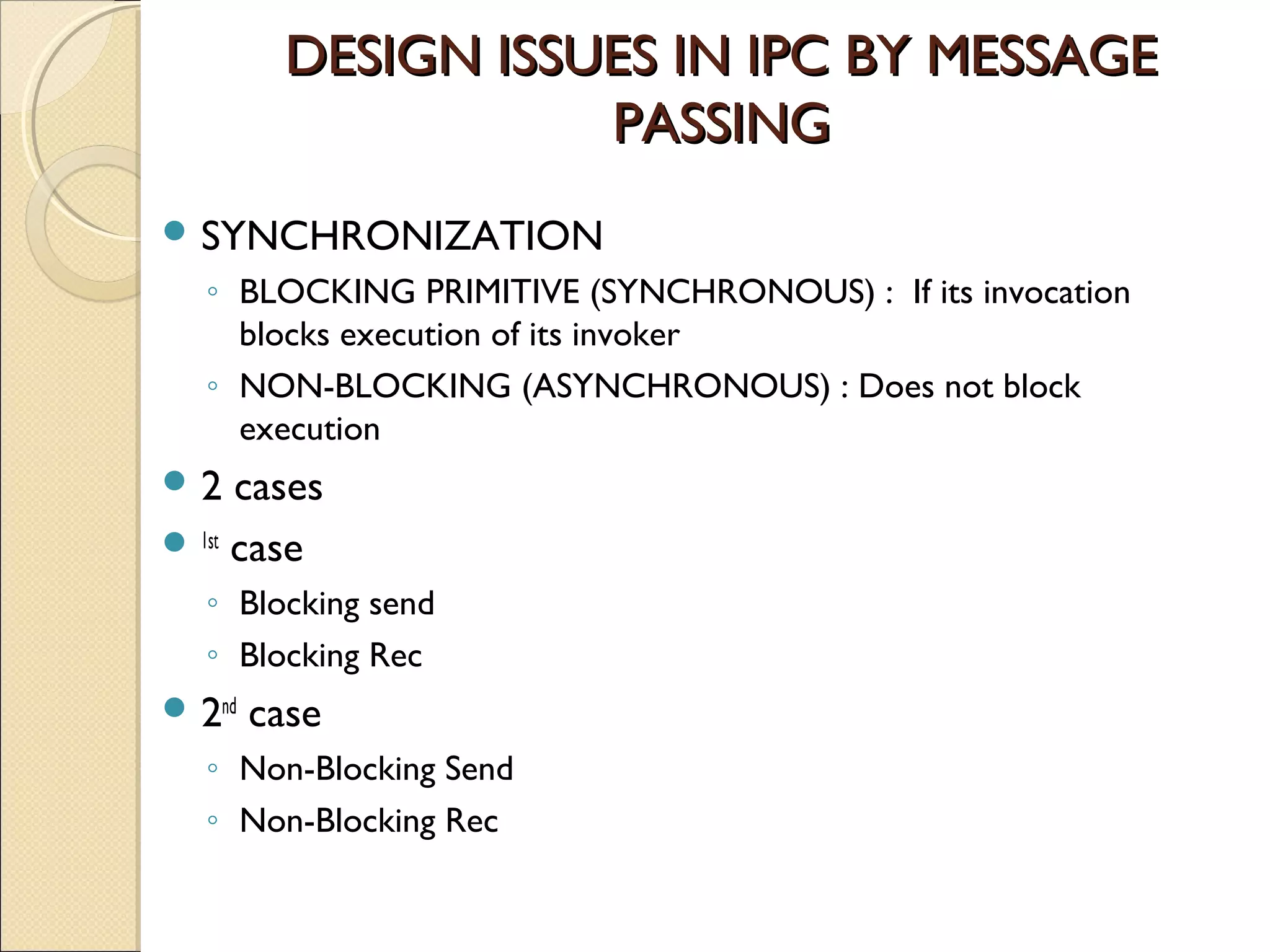
DESIGN ISSUES IN IPC BY MESSAGEDESIGN ISSUES IN IPC BY MESSAGE
PASSINGPASSING
 SYNCHRONIZATION
◦ BLOCKING PRIMITIVE (SYNCHRONOUS) : If its invocation
blocks execution of its invoker
◦ NON-BLOCKING (ASYNCHRONOUS) : Does not block
execution
 2 cases
 1st
case
◦ Blocking send
◦ Blocking Rec
 2nd
case
◦ Non-Blocking Send
◦ Non-Blocking Rec
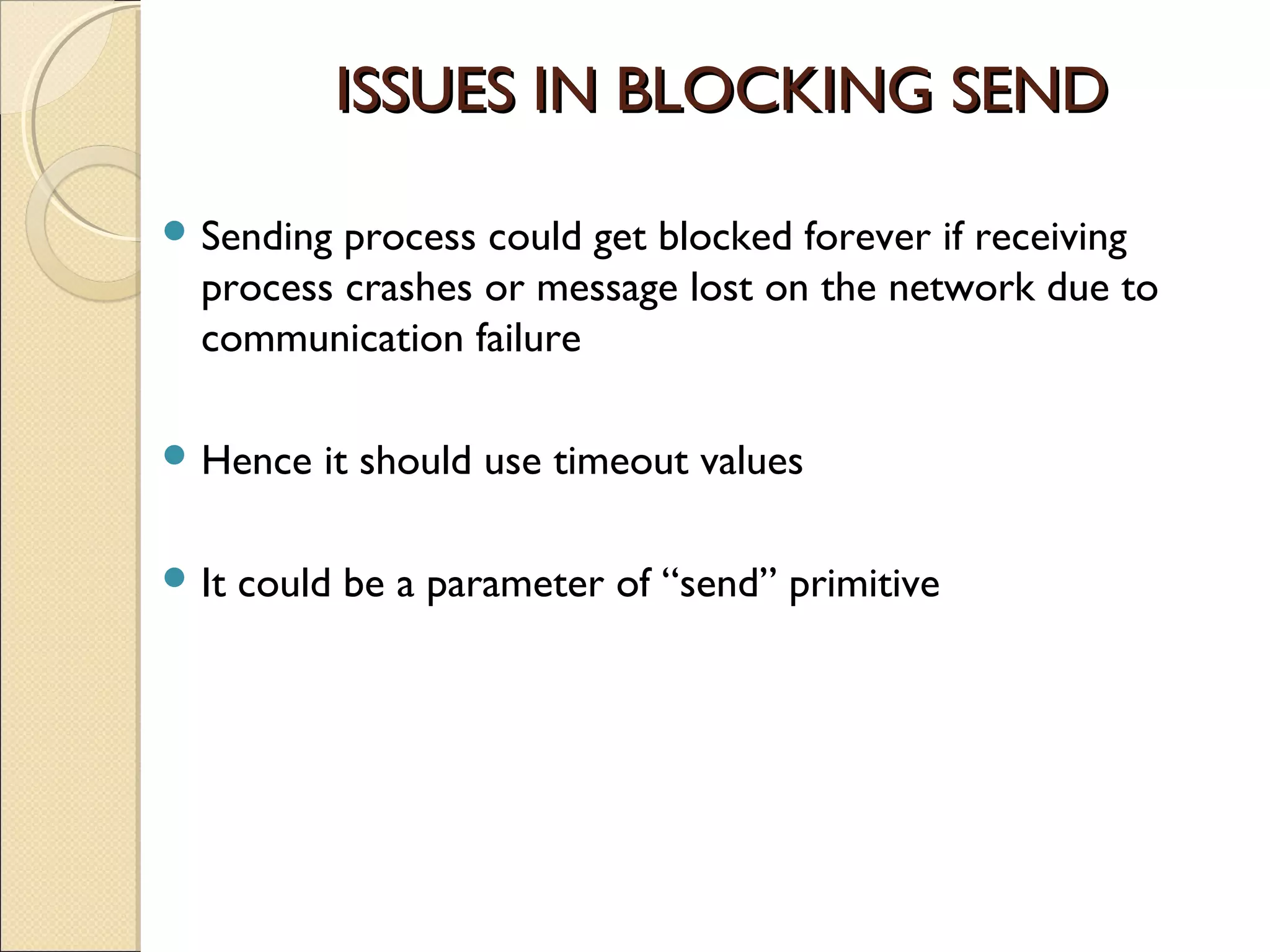
ISSUES IN BLOCKING SENDISSUES IN BLOCKING SEND
 Sending process could get blocked forever if receiving
process crashes or message lost on the network due to
communication failure
 Hence it should use timeout values
 It could be a parameter of “send” primitive
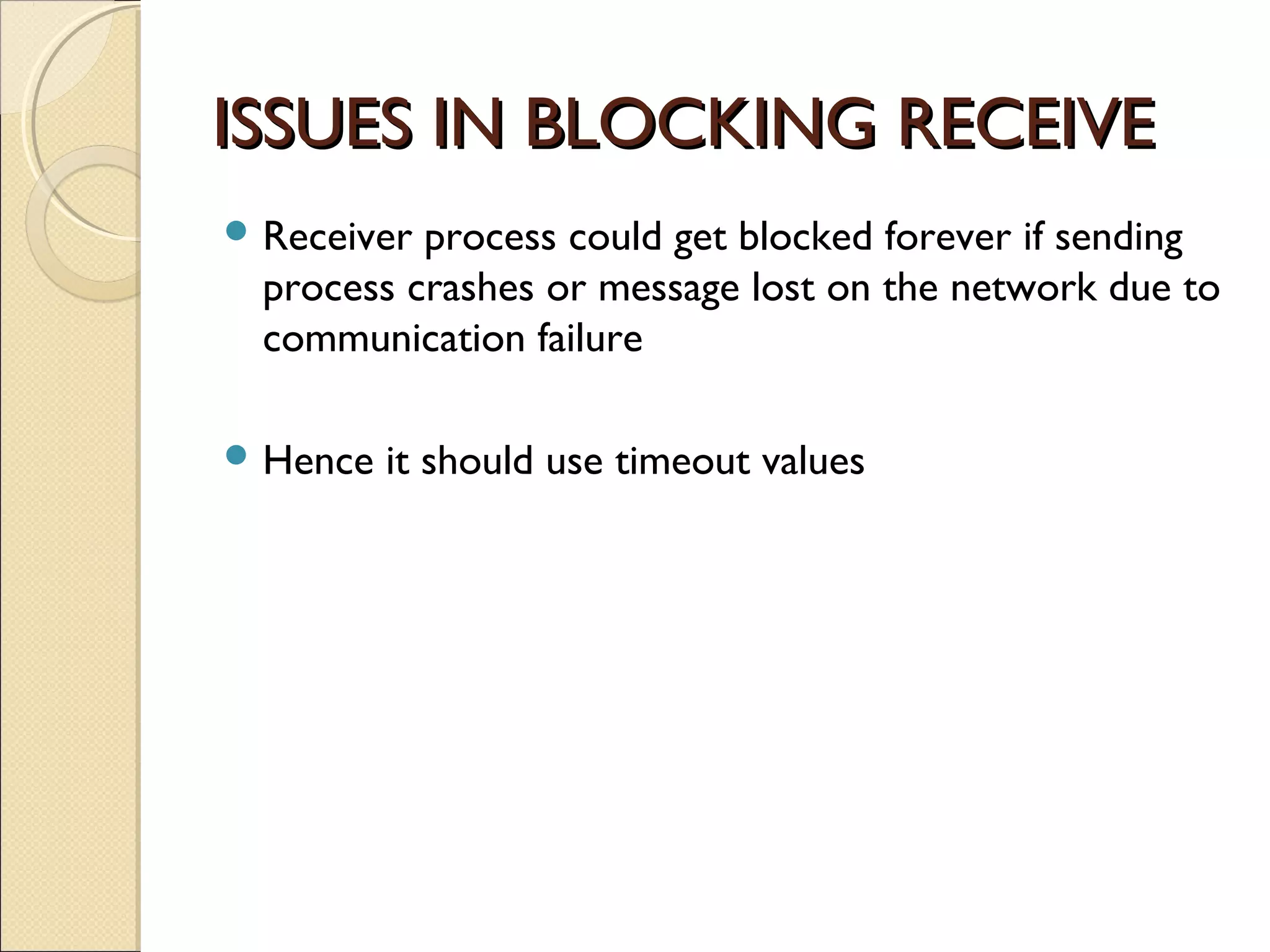
ISSUES IN BLOCKING RECEIVEISSUES IN BLOCKING RECEIVE
 Receiver process could get blocked forever if sending
process crashes or message lost on the network due to
communication failure
 Hence it should use timeout values
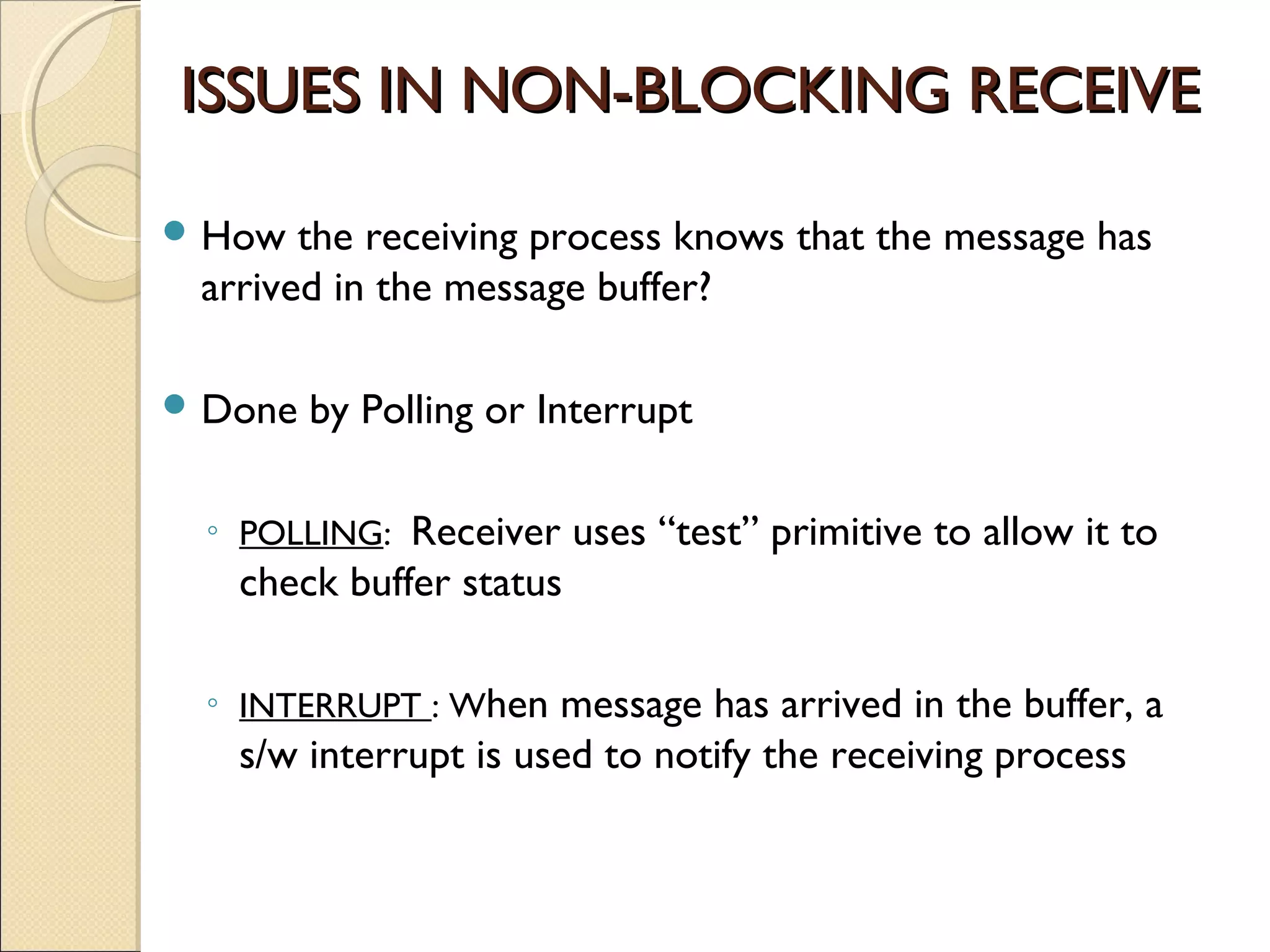
ISSUES IN NON-BLOCKING RECEIVEISSUES IN NON-BLOCKING RECEIVE
 How the receiving process knows that the message has
arrived in the message buffer?
 Done by Polling or Interrupt
◦ POLLING: Receiver uses “test” primitive to allow it to
check buffer status
◦ INTERRUPT : When message has arrived in the buffer, a
s/w interrupt is used to notify the receiving process
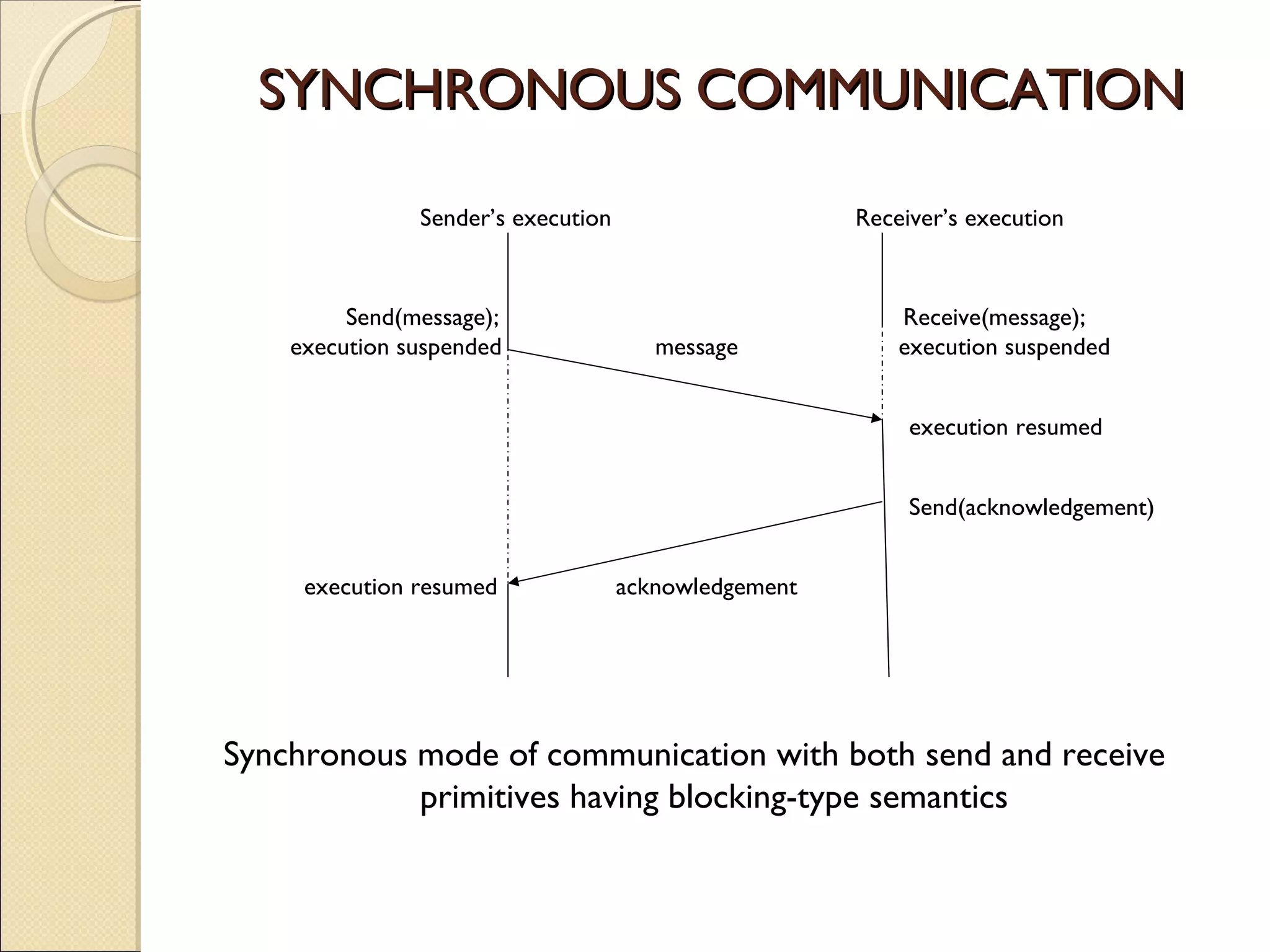
SYNCHRONOUS COMMUNICATIONSYNCHRONOUS COMMUNICATION
Sender’s execution Receiver’s execution
Send(message); Receive(message);
execution suspended message execution suspended
execution resumed
Send(acknowledgement)
execution resumed acknowledgement
Synchronous mode of communication with both send and receive
primitives having blocking-type semantics
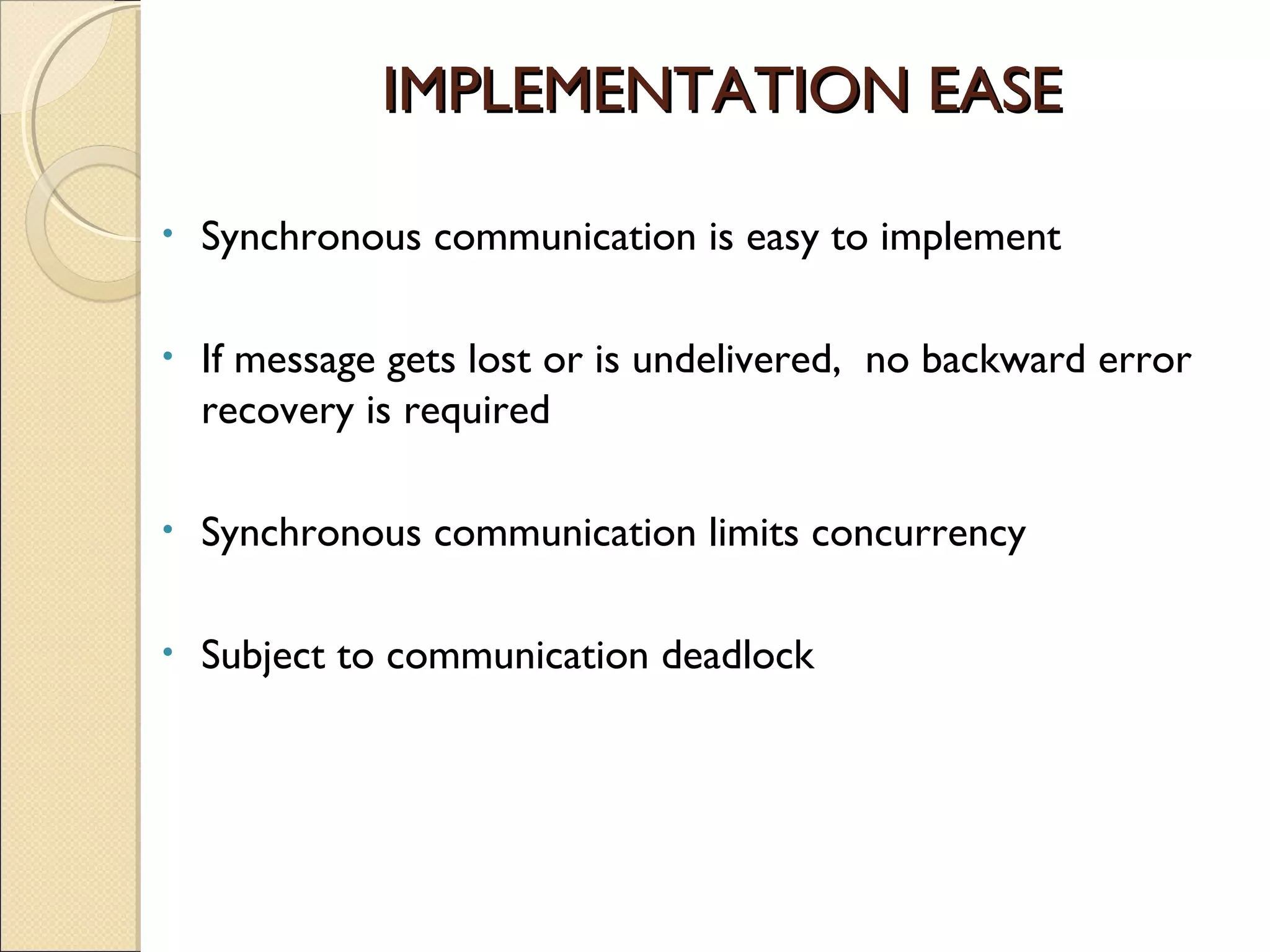
IMPLEMENTATION EASEIMPLEMENTATION EASE
• Synchronous communication is easy to implement
• If message gets lost or is undelivered, no backward error
recovery is required
• Synchronous communication limits concurrency
• Subject to communication deadlock
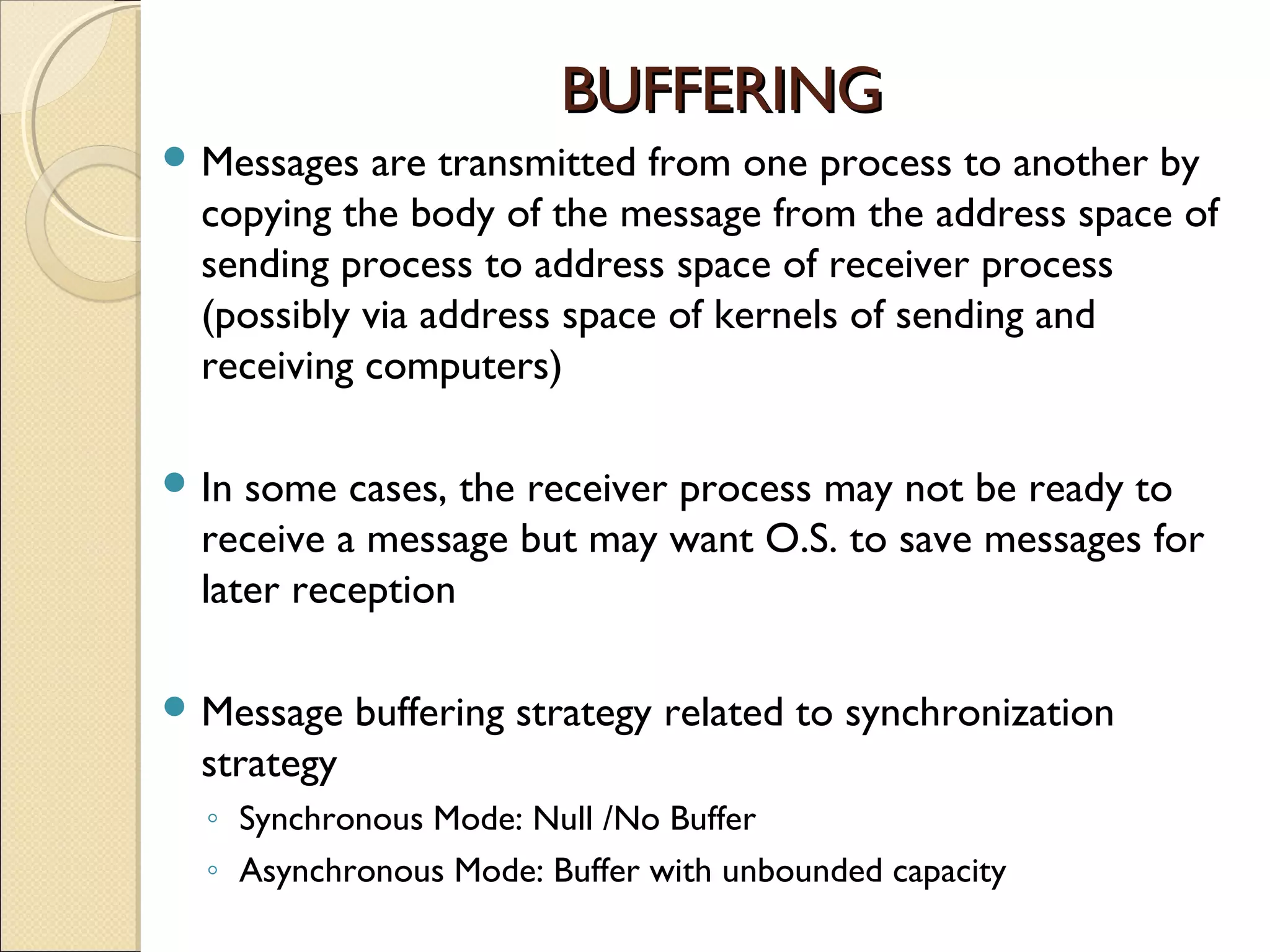
BUFFERINGBUFFERING
 Messages are transmitted from one process to another by
copying the body of the message from the address space of
sending process to address space of receiver process
(possibly via address space of kernels of sending and
receiving computers)
 In some cases, the receiver process may not be ready to
receive a message but may want O.S. to save messages for
later reception
 Message buffering strategy related to synchronization
strategy
◦ Synchronous Mode: Null /No Buffer
◦ Asynchronous Mode: Buffer with unbounded capacity
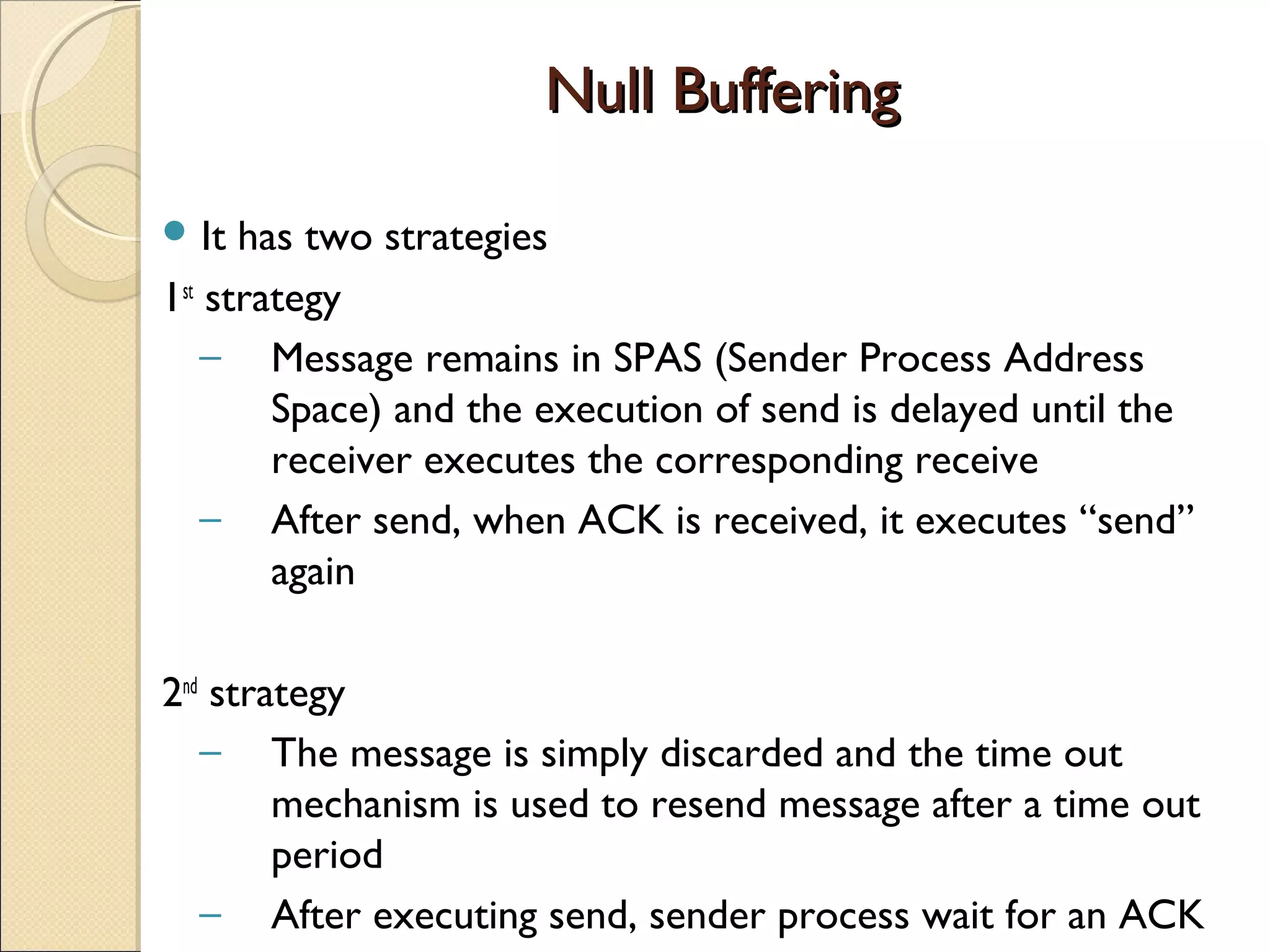
Null BufferingNull Buffering
 It has two strategies
1st
strategy
– Message remains in SPAS (Sender Process Address
Space) and the execution of send is delayed until the
receiver executes the corresponding receive
– After send, when ACK is received, it executes “send”
again
2nd
strategy
– The message is simply discarded and the time out
mechanism is used to resend message after a time out
period
– After executing send, sender process wait for an ACK
Single-Message BufferSingle-Message Buffer
 If the receiver is not ready, a message has to be
transferred two or more times hence null buffer
strategy is generally not suitable for synchronous
communication
 Therefore, synchronous communication use a single-
message buffer strategy
 A buffer having a capacity to store a single message is
used on the receiver’s node
FINITE BOUND BUFFER
 A create-buffer system call is provided to the user.
 This system call when executed by a receiver process
creates a buffer of a size specified by receiver either in
kernel AS. or receiver process AS.
11
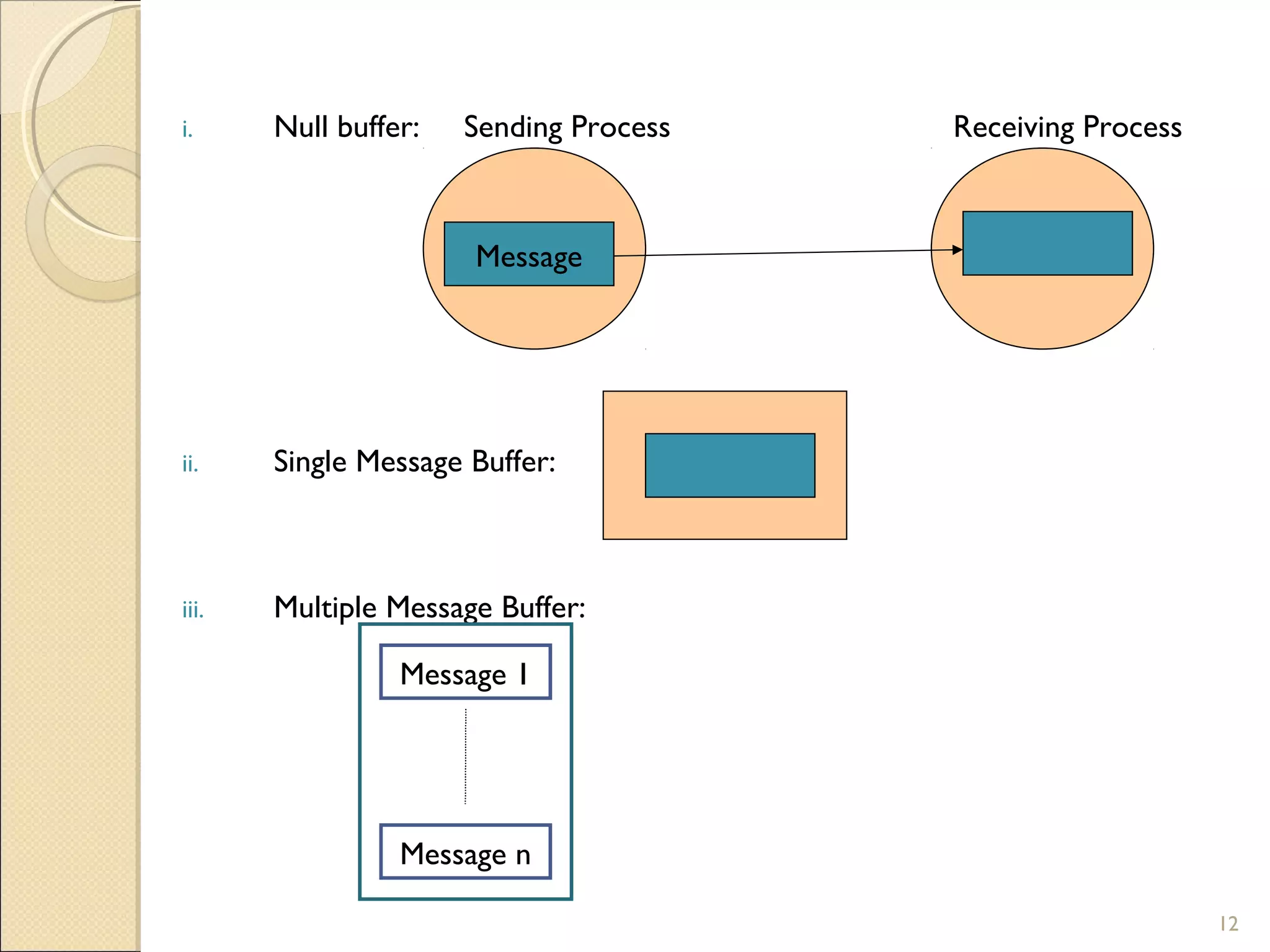
i. Null buffer: Sending Process Receiving Process
ii. Single Message Buffer:
iii. Multiple Message Buffer:
Message
Message 1
Message n
12
ENCODING AND DECODING OFENCODING AND DECODING OF
MESSAGE DATAMESSAGE DATA
Structure of program/object should be preserved while they
are being transmitted from address space of sending
process to RPAS.
Difficult to achieve because
 Absolute ptr losses its meaning when transferred from one
process AS to another
◦ Requires flattening and shaping of objects
 Receiver process should have a-priori knowledge of varying
memory occupied by various data items
Due to above problems, program object not transferred in
their original form. First converted to stream form by
encoding. 13
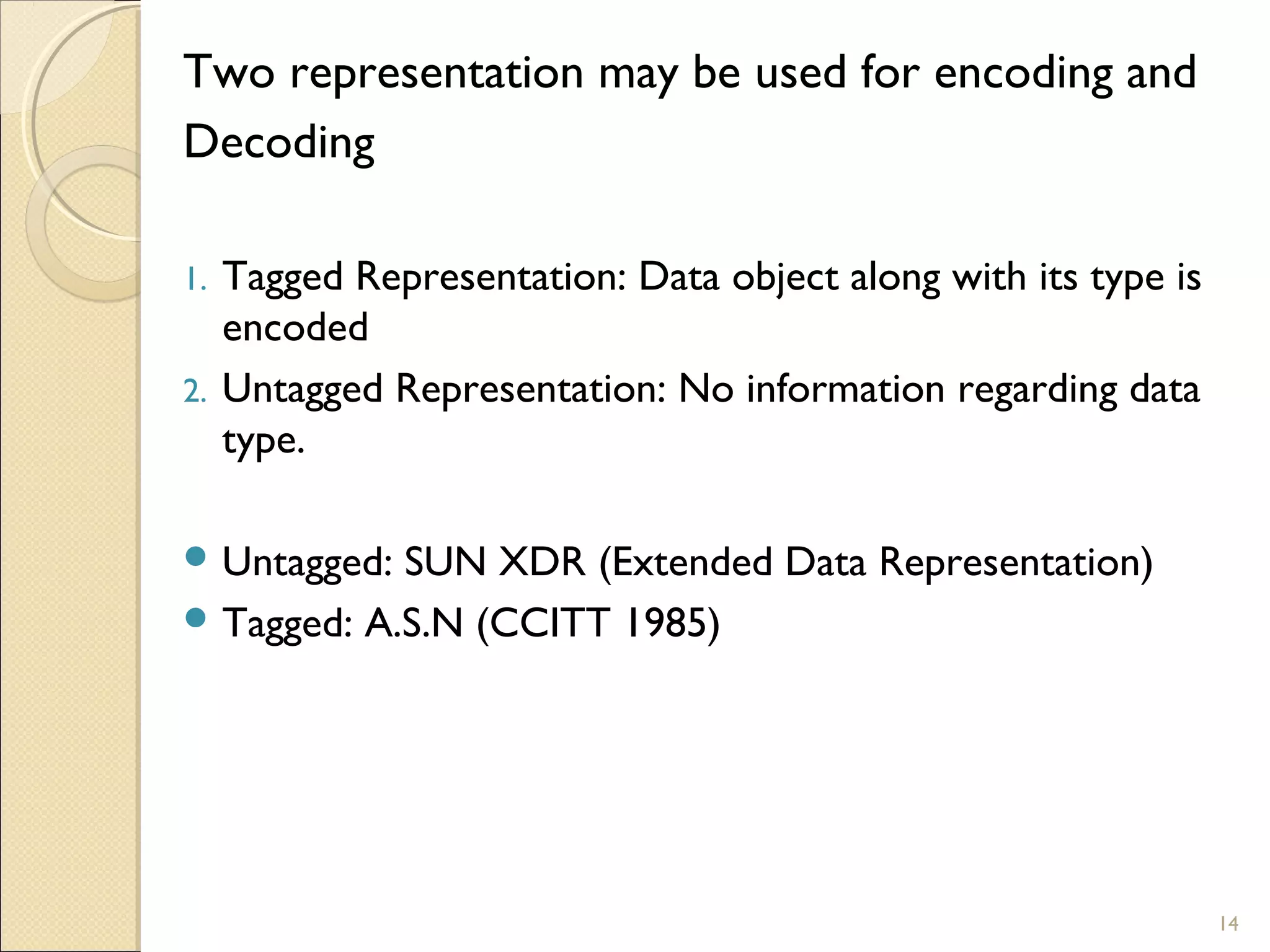
Two representation may be used for encoding and
Decoding
1. Tagged Representation: Data object along with its type is
encoded
2. Untagged Representation: No information regarding data
type.
 Untagged: SUN XDR (Extended Data Representation)
 Tagged: A.S.N (CCITT 1985)
14
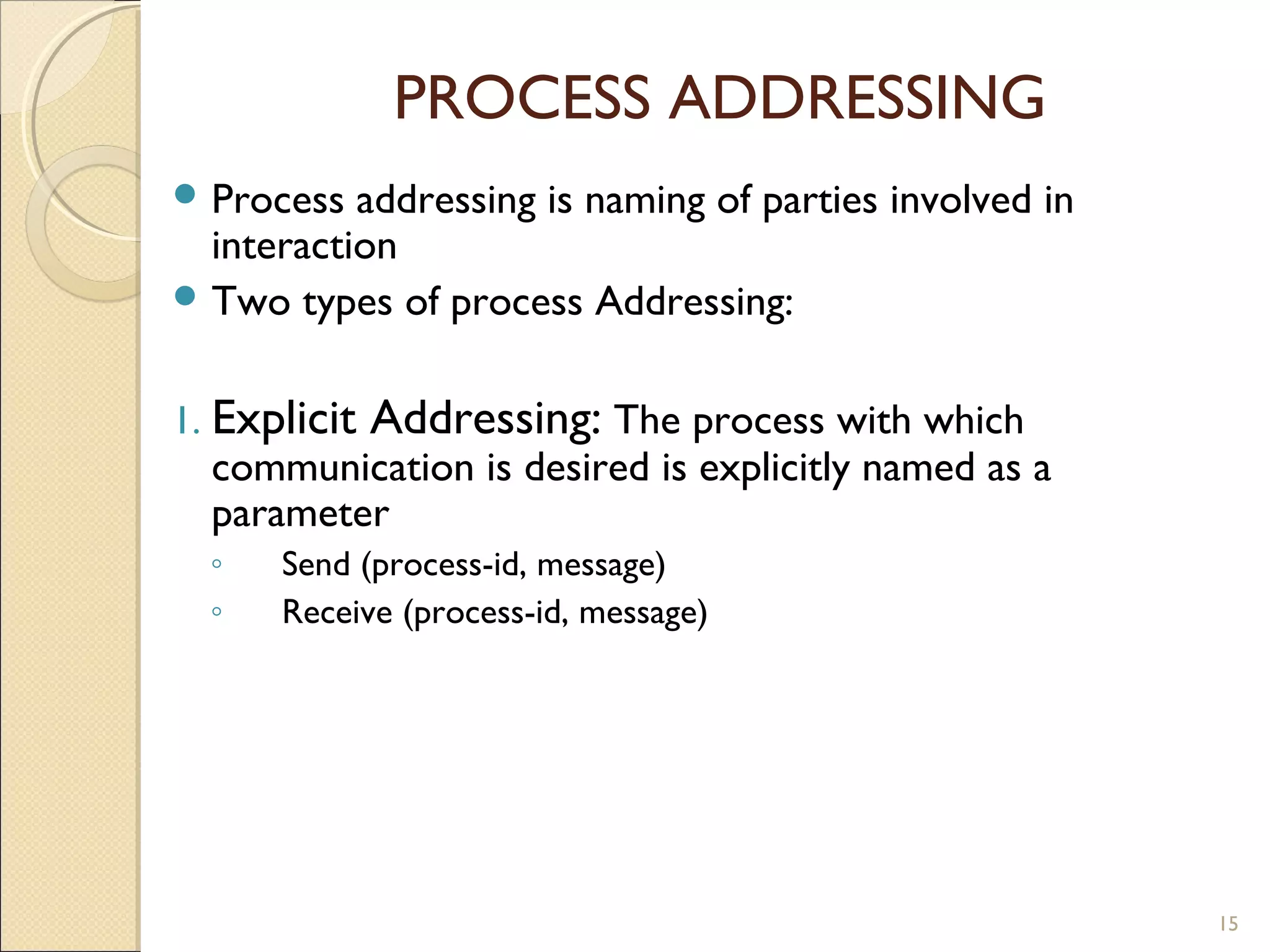
PROCESS ADDRESSING
 Process addressing is naming of parties involved in
interaction
 Two types of process Addressing:
1. Explicit Addressing: The process with which
communication is desired is explicitly named as a
parameter
◦ Send (process-id, message)
◦ Receive (process-id, message)
15
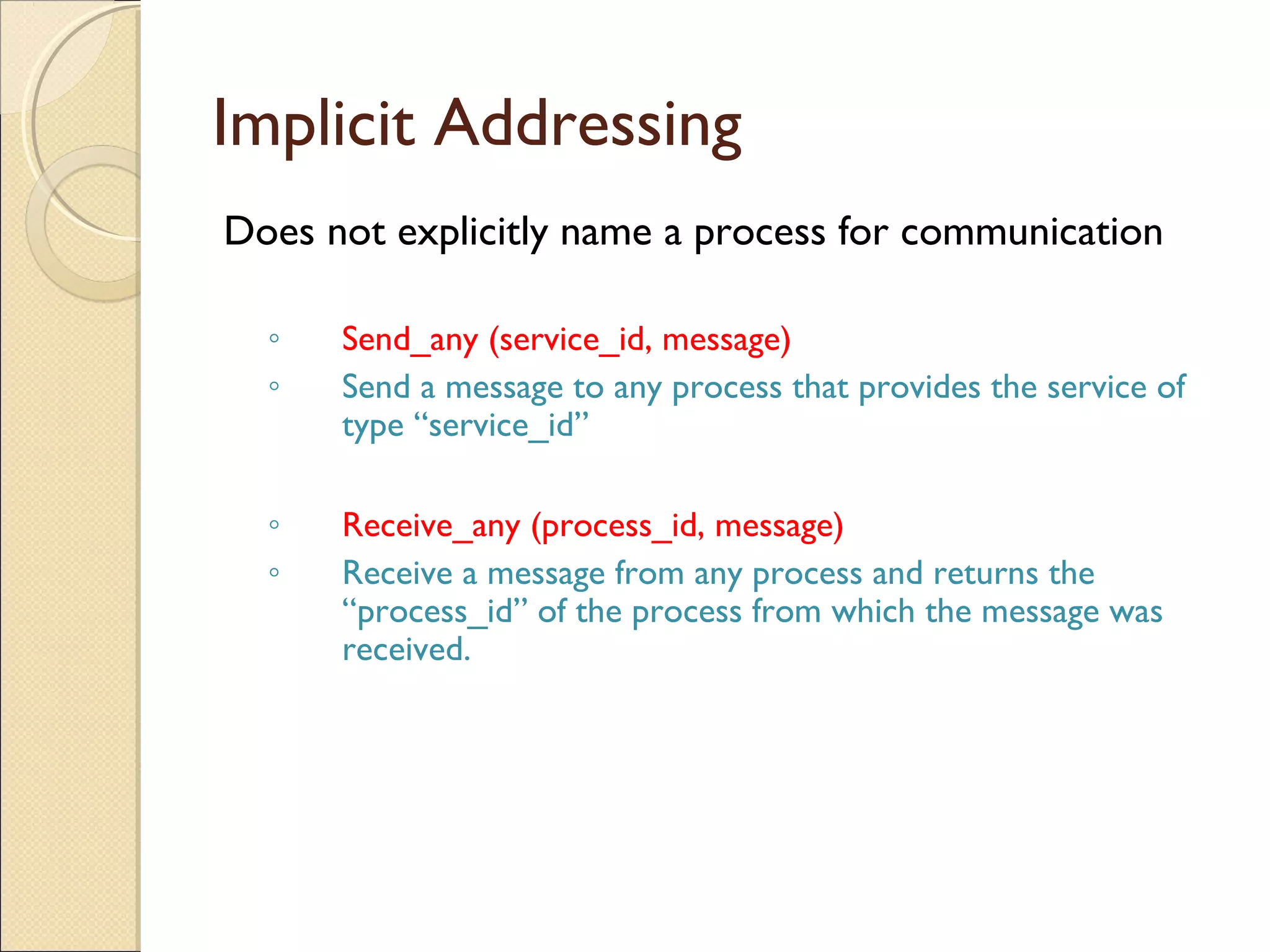
Implicit Addressing
Does not explicitly name a process for communication
◦ Send_any (service_id, message)
◦ Send a message to any process that provides the service of
type “service_id”
◦ Receive_any (process_id, message)
◦ Receive a message from any process and returns the
“process_id” of the process from which the message was
received.
PROCESS ADDRESSING (contd..)
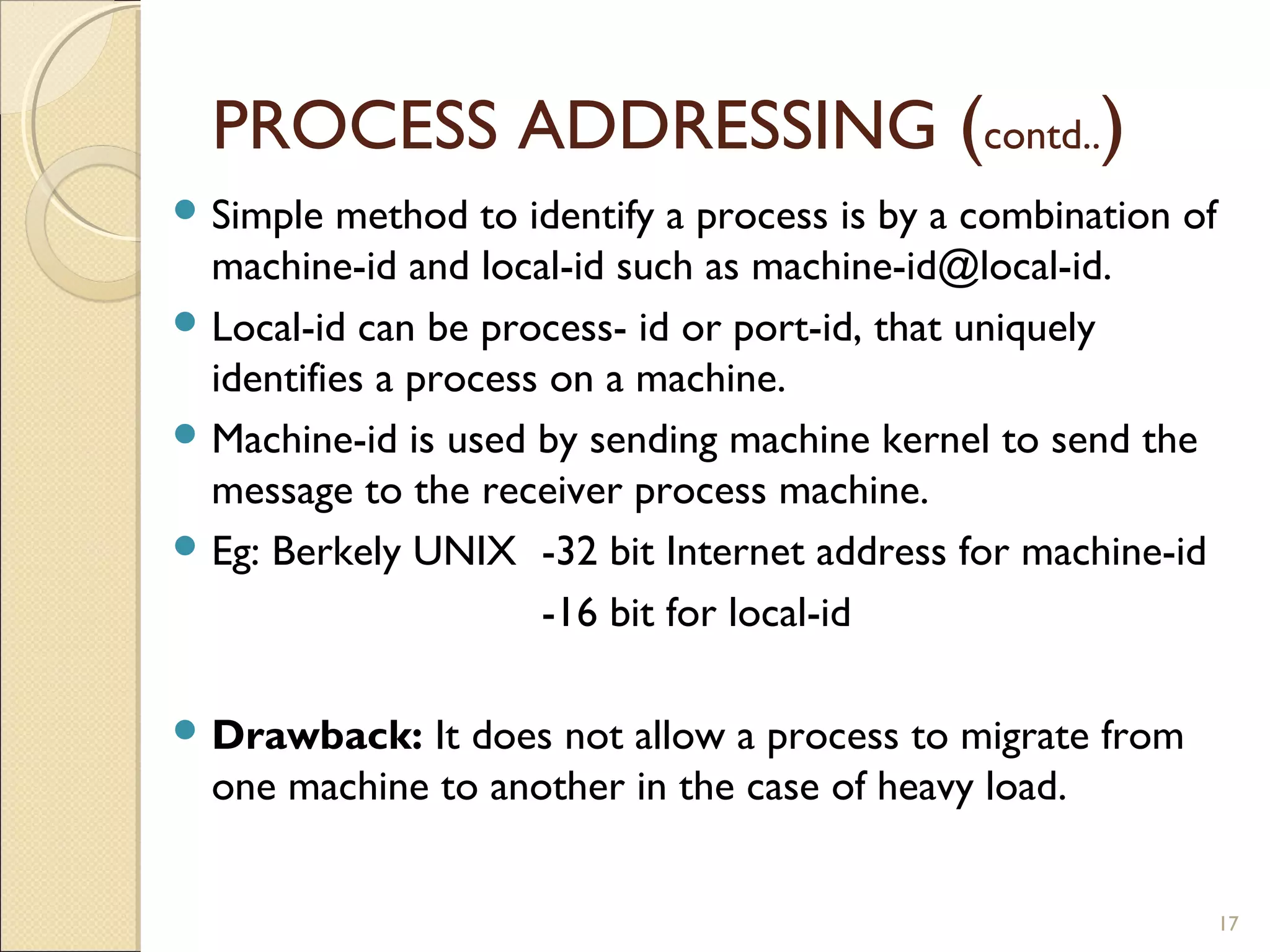
 Simple method to identify a process is by a combination of
machine-id and local-id such as machine-id@local-id.
 Local-id can be process- id or port-id, that uniquely
identifies a process on a machine.
 Machine-id is used by sending machine kernel to send the
message to the receiver process machine.
 Eg: Berkely UNIX -32 bit Internet address for machine-id
-16 bit for local-id
 Drawback: It does not allow a process to migrate from
one machine to another in the case of heavy load.
17
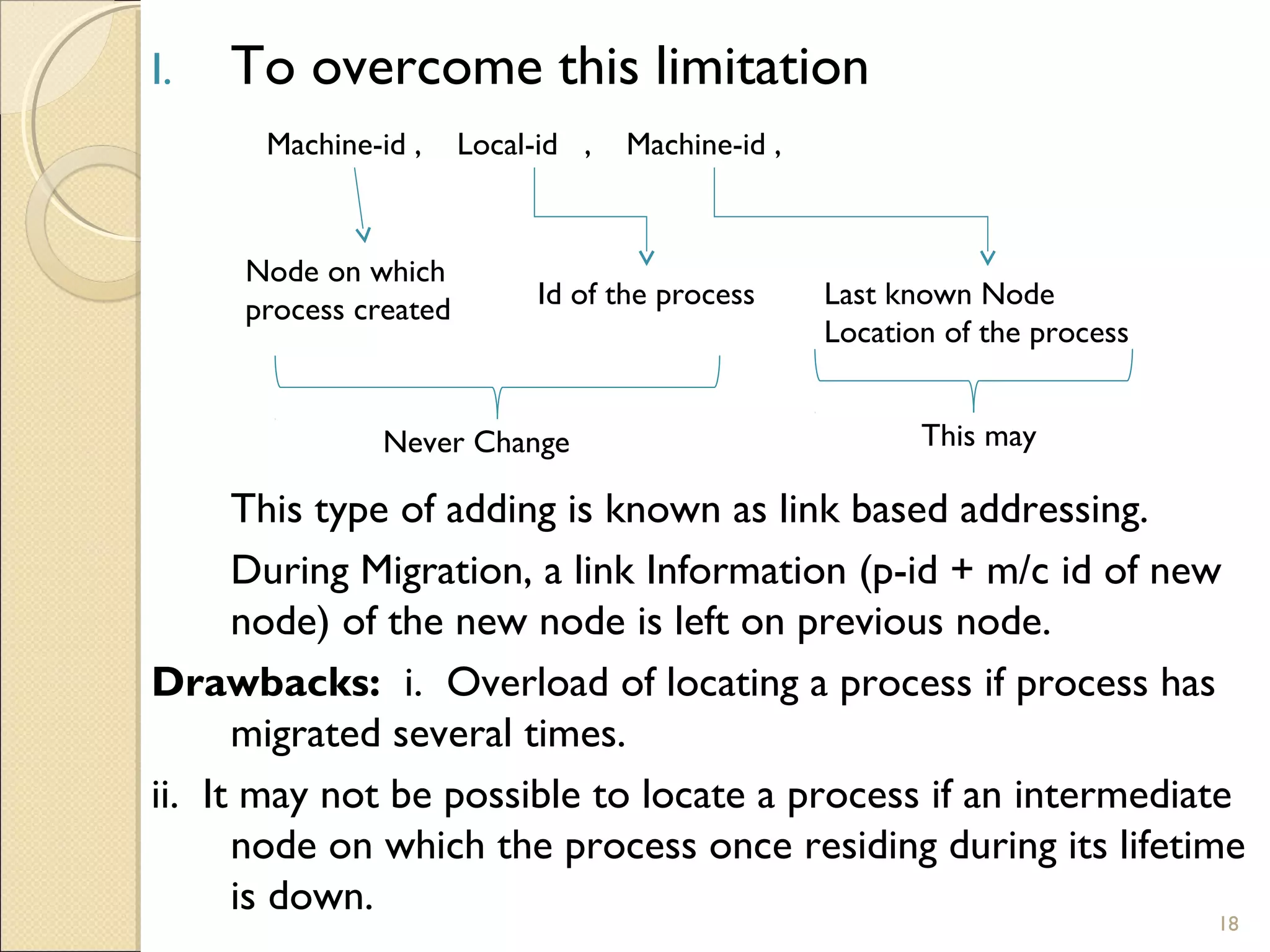
I. To overcome this limitation
This type of adding is known as link based addressing.
During Migration, a link Information (p-id + m/c id of new
node) of the new node is left on previous node.
Drawbacks: i. Overload of locating a process if process has
migrated several times.
ii. It may not be possible to locate a process if an intermediate
node on which the process once residing during its lifetime
is down.
Node on which
process created Id of the process Last known Node
Location of the process
Machine-id , Machine-id ,Local-id ,
Never Change This may
18
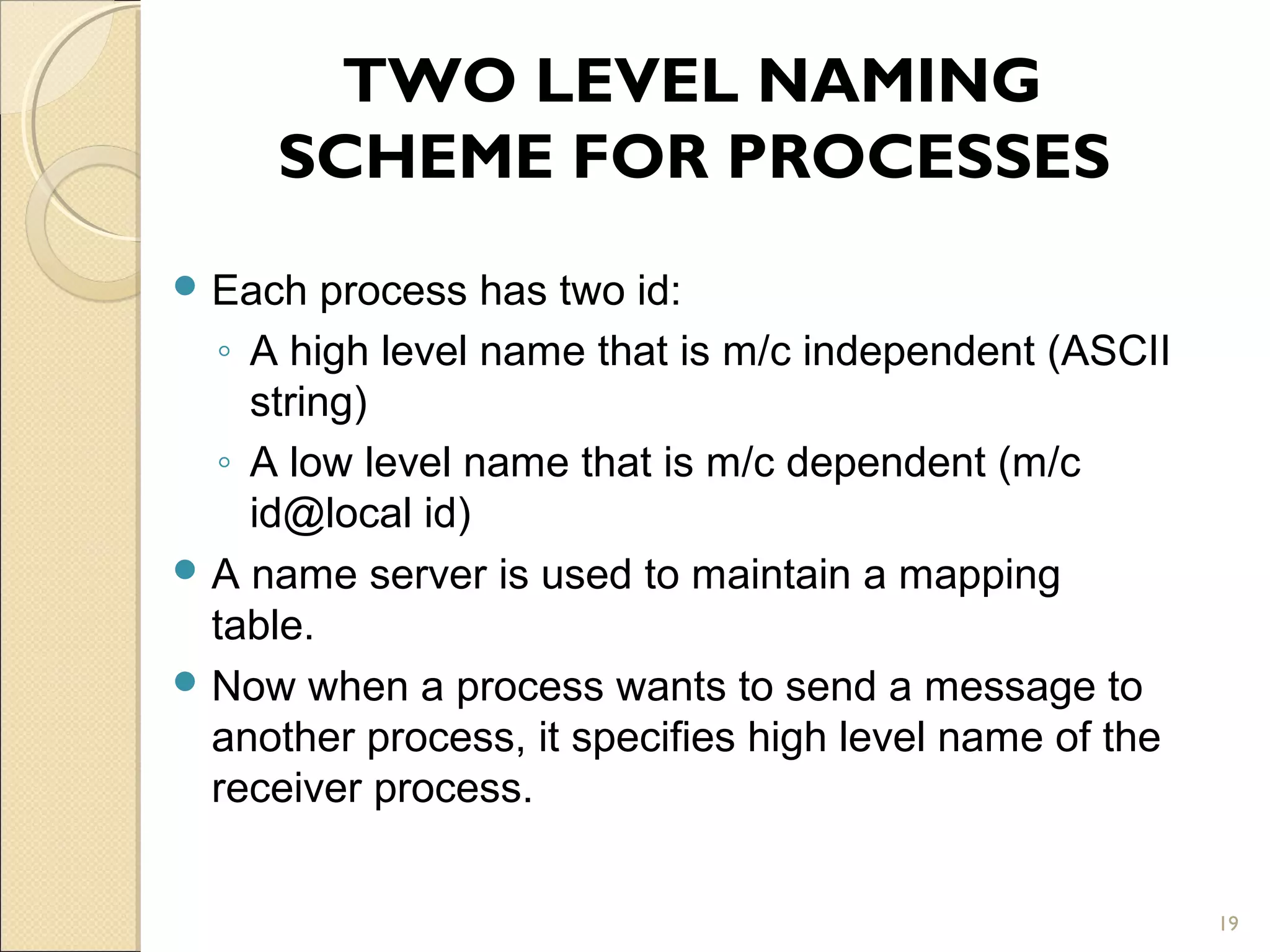
TWO LEVEL NAMING
SCHEME FOR PROCESSES
 Each process has two id:
◦ A high level name that is m/c independent (ASCII
string)
◦ A low level name that is m/c dependent (m/c
id@local id)
 A name server is used to maintain a mapping
table.
 Now when a process wants to send a message to
another process, it specifies high level name of the
receiver process.
19
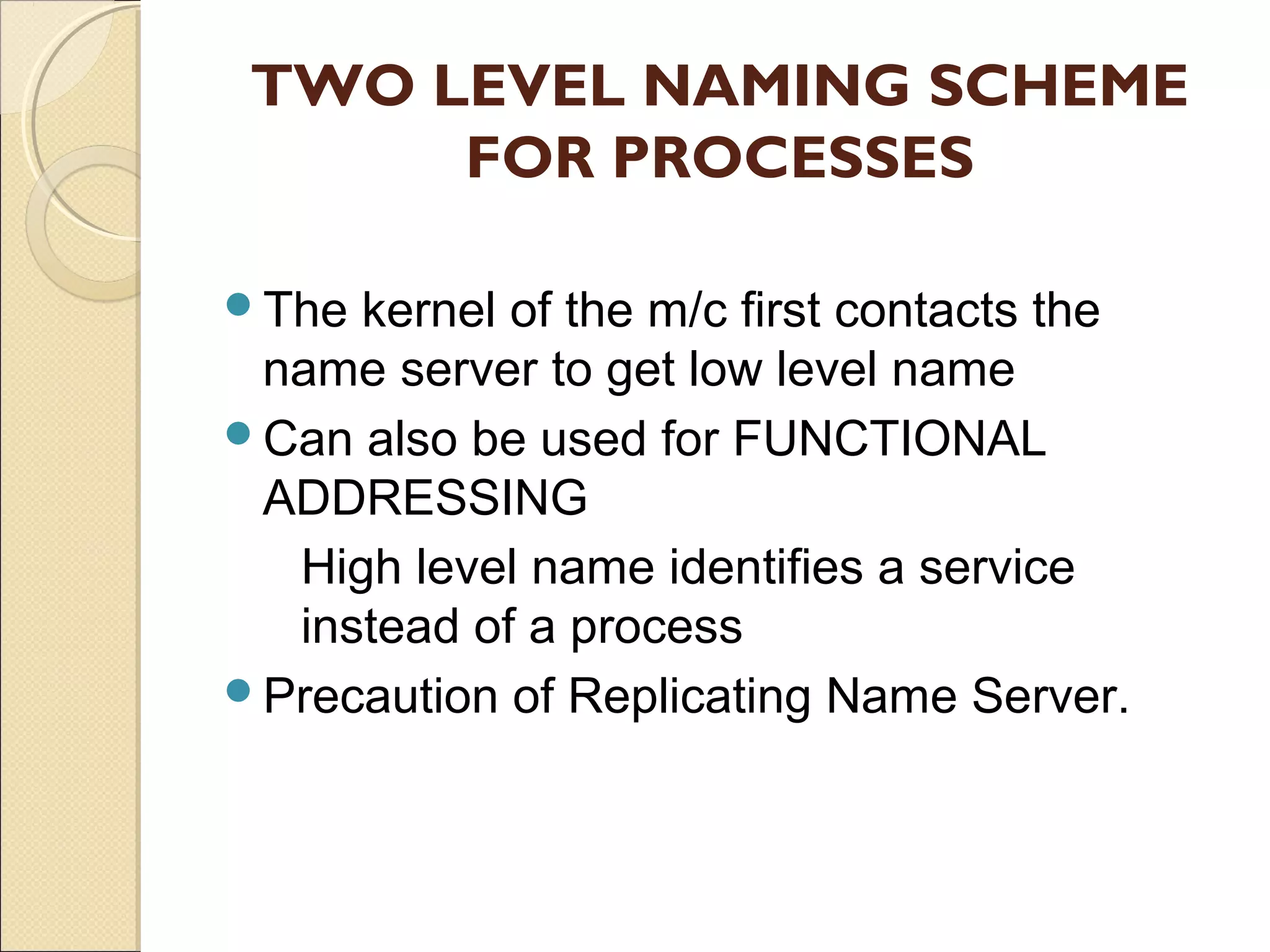
TWO LEVEL NAMING SCHEME
FOR PROCESSES
The kernel of the m/c first contacts the
name server to get low level name
Can also be used for FUNCTIONAL
ADDRESSING
High level name identifies a service
instead of a process
Precaution of Replicating Name Server.
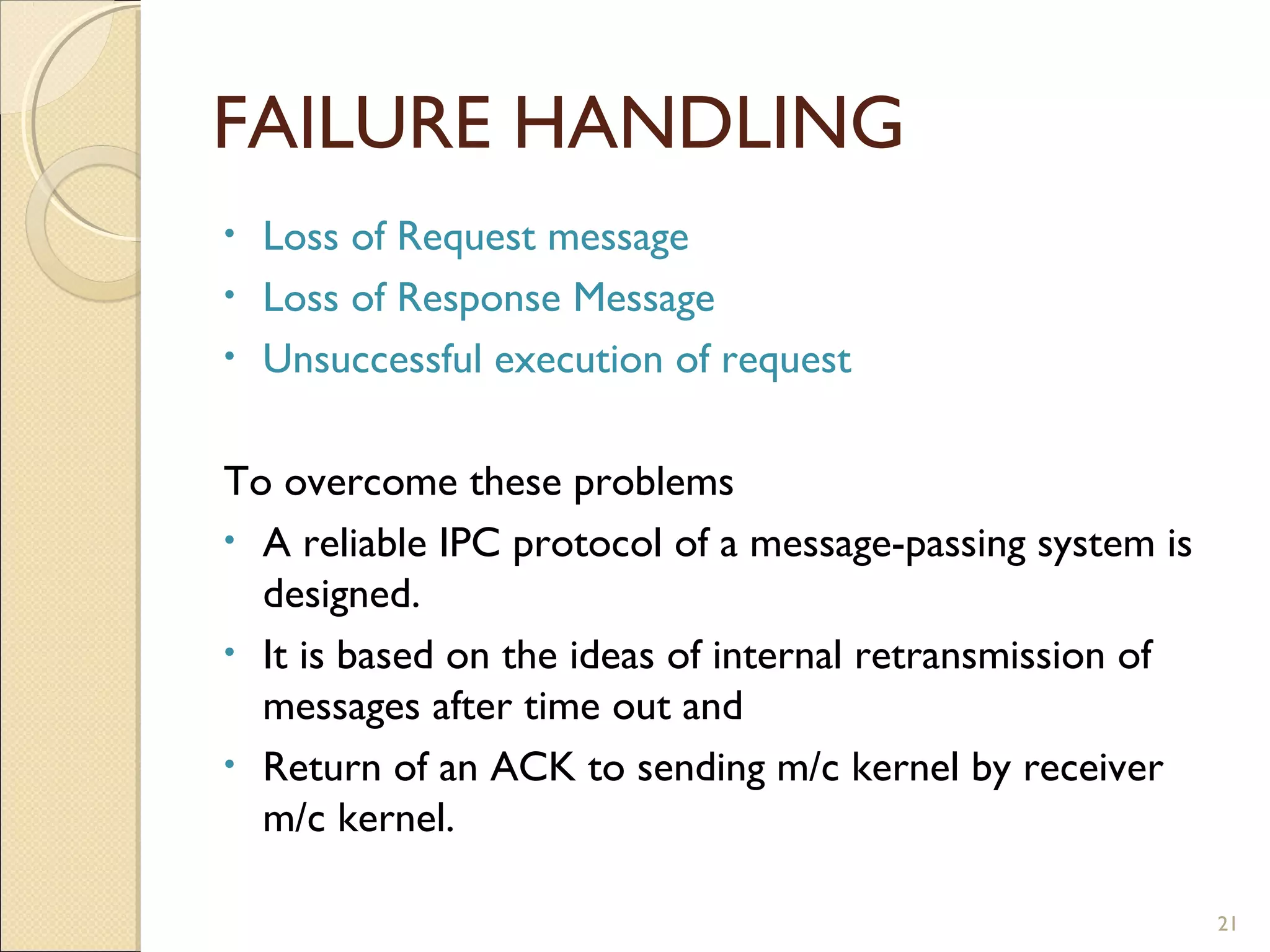
FAILURE HANDLING
• Loss of Request message
• Loss of Response Message
• Unsuccessful execution of request
To overcome these problems
• A reliable IPC protocol of a message-passing system is
designed.
• It is based on the ideas of internal retransmission of
messages after time out and
• Return of an ACK to sending m/c kernel by receiver
m/c kernel.
21
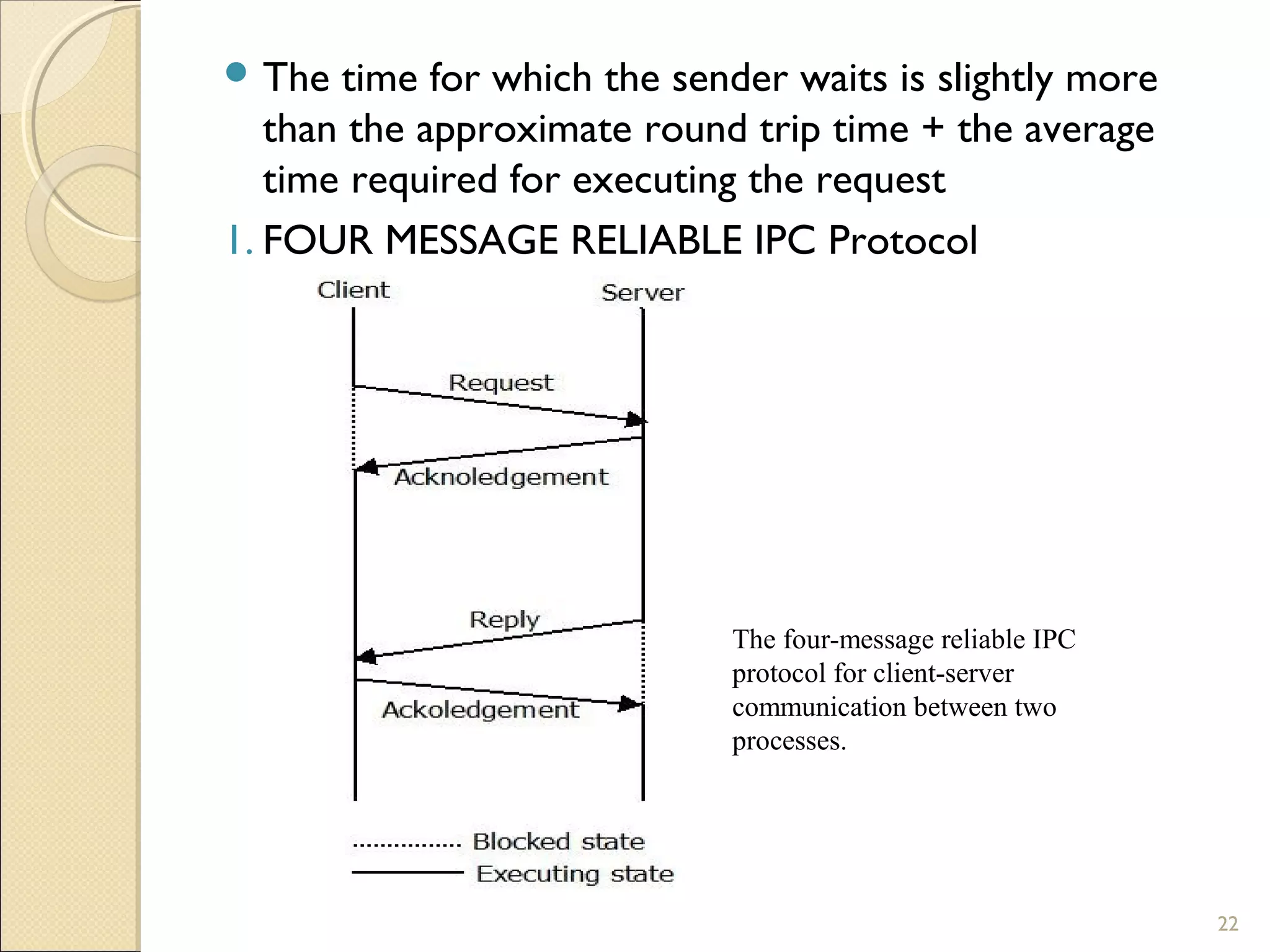
 The time for which the sender waits is slightly more
than the approximate round trip time + the average
time required for executing the request
1. FOUR MESSAGE RELIABLE IPC Protocol
22
The four-message reliable IPC
protocol for client-server
communication between two
processes.
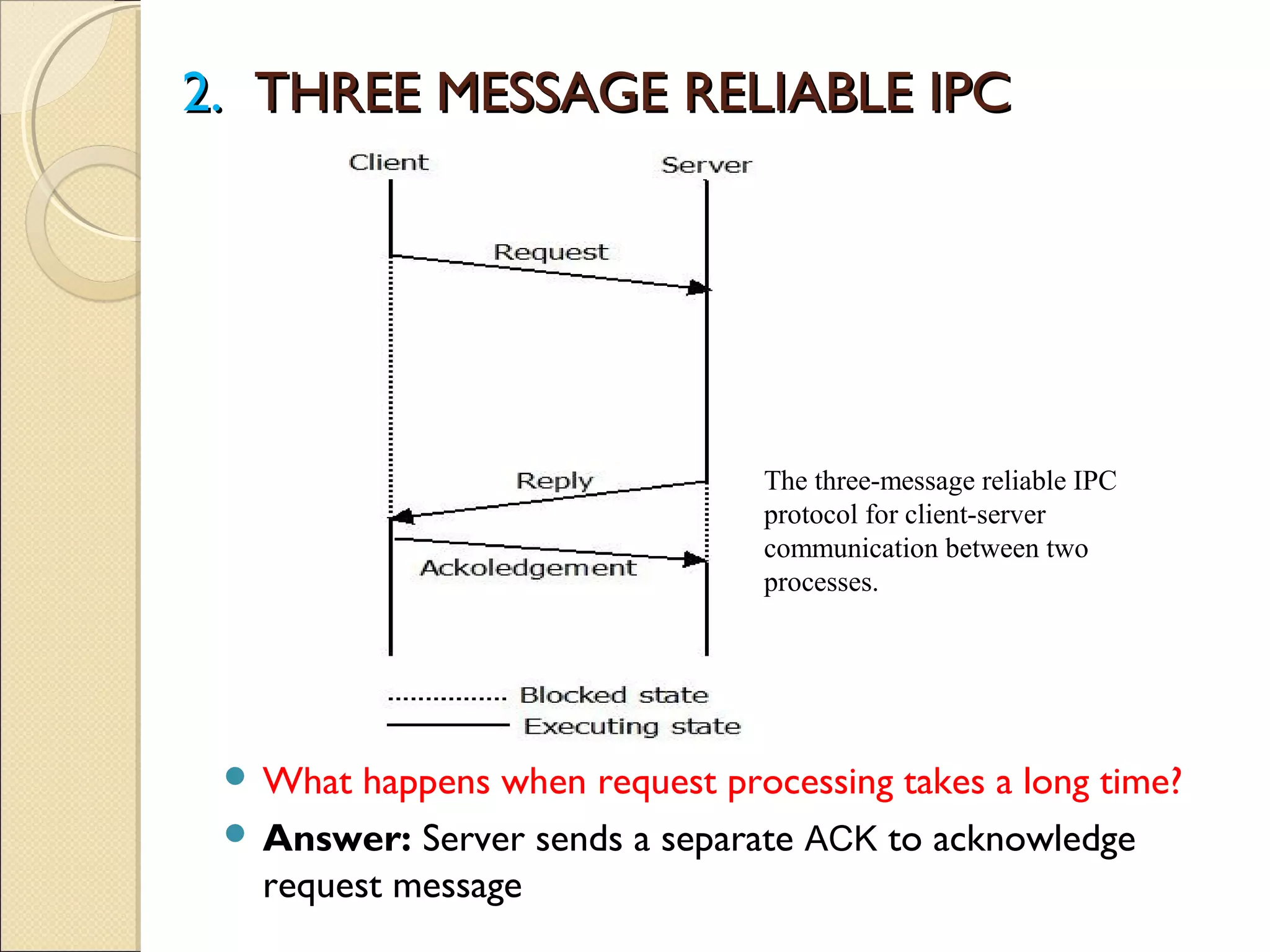
2.2. THREE MESSAGE RELIABLE IPCTHREE MESSAGE RELIABLE IPC
 What happens when request processing takes a long time?
 Answer: Server sends a separate ACK to acknowledge
request message
The three-message reliable IPC
protocol for client-server
communication between two
processes.
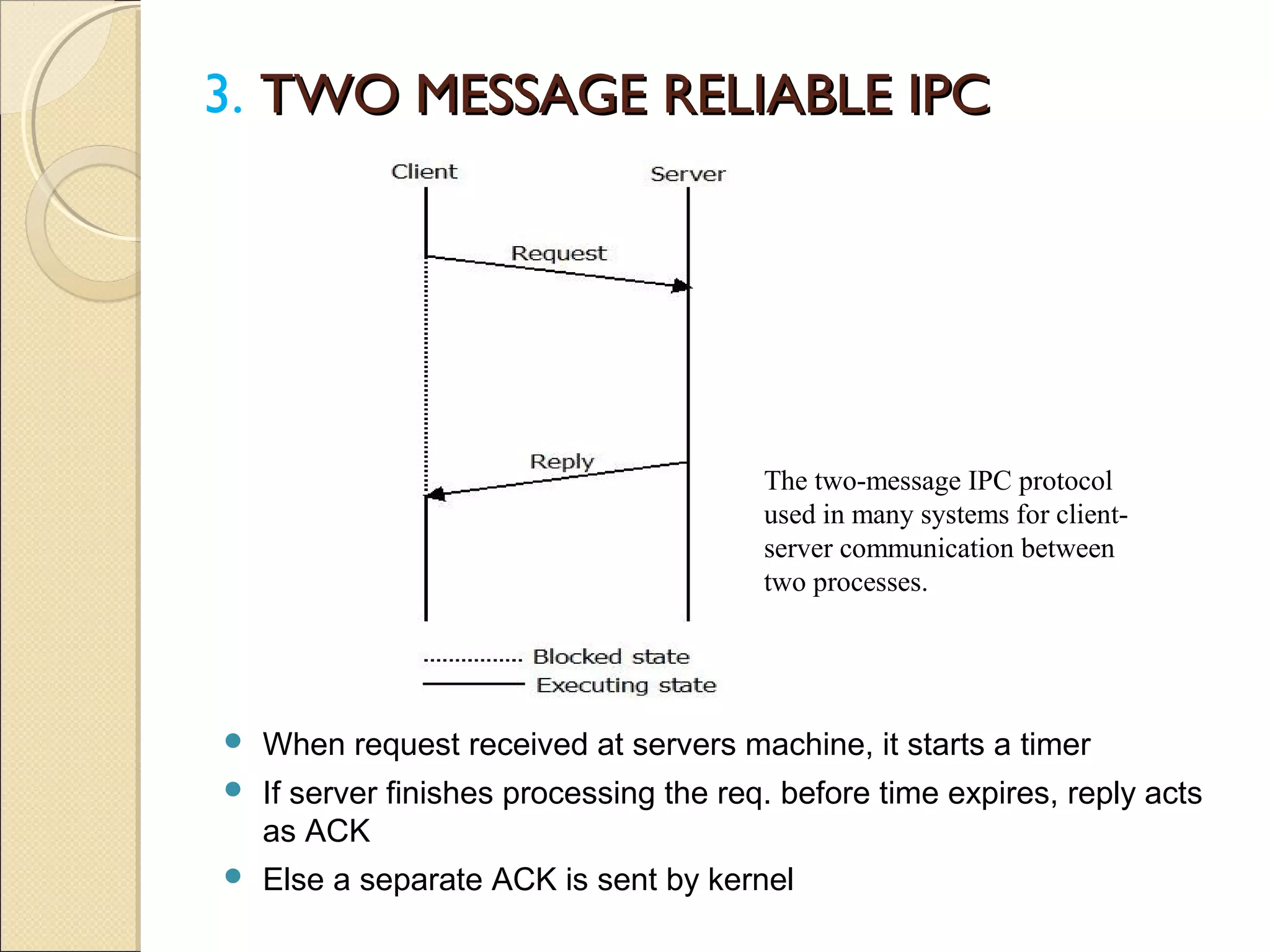
3. TWO MESSAGE RELIABLE IPCTWO MESSAGE RELIABLE IPC
 When request received at servers machine, it starts a timer
 If server finishes processing the req. before time expires, reply acts
as ACK
 Else a separate ACK is sent by kernel
The two-message IPC protocol
used in many systems for client-
server communication between
two processes.
Idempotency
Means repeatibility
An Idempotent operation produces the
same result without any side effects, no
matter how many times it is performed
with the same argument.
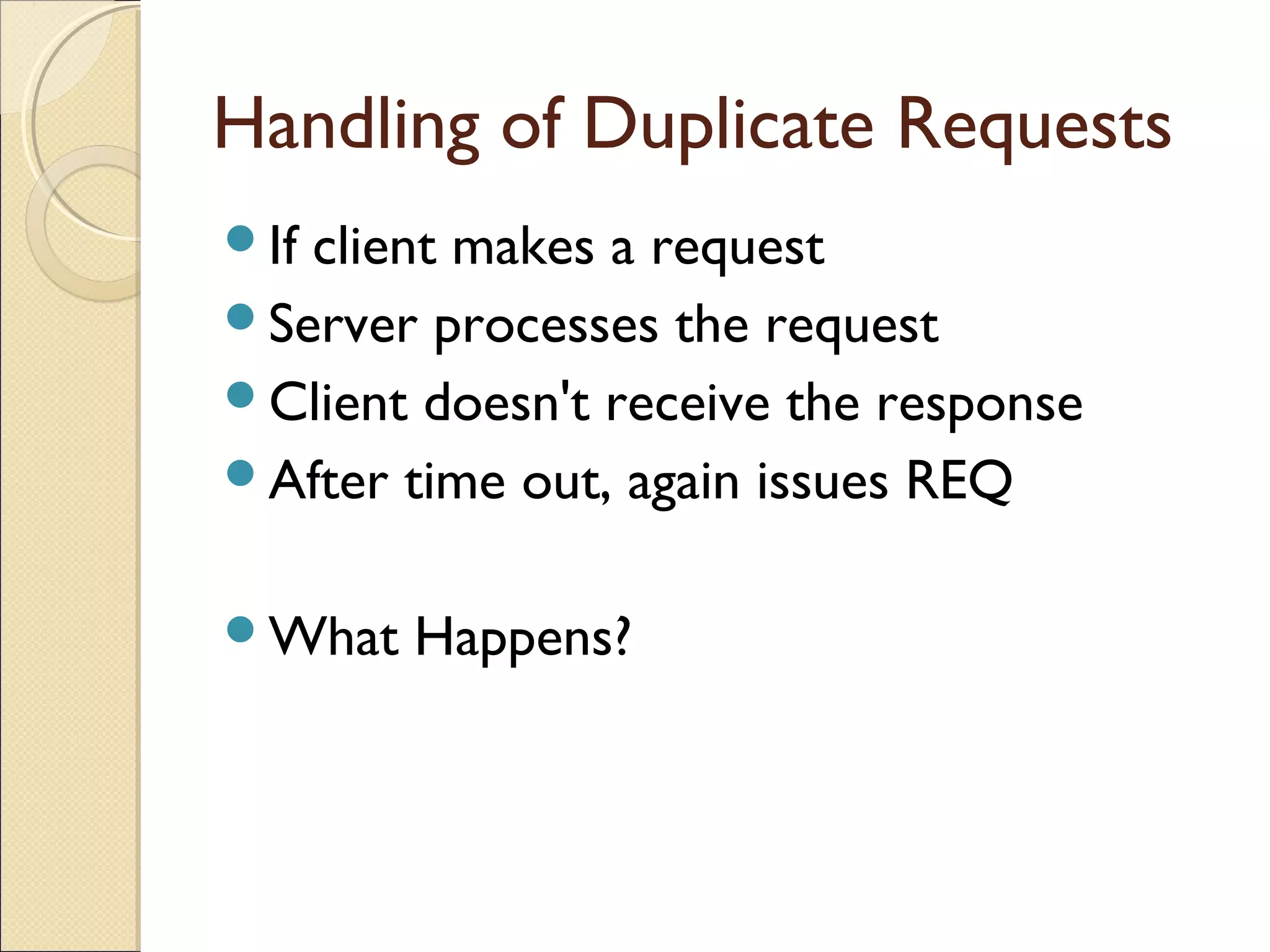
ISSUE : Duplicate Requests
Handling of Duplicate Requests
If client makes a request
Server processes the request
Client doesn't receive the response
After time out, again issues REQ
What Happens?
Handling of Duplicate Requests
Use unique id for every REQ
Kernel on the server maintains a reply
cache
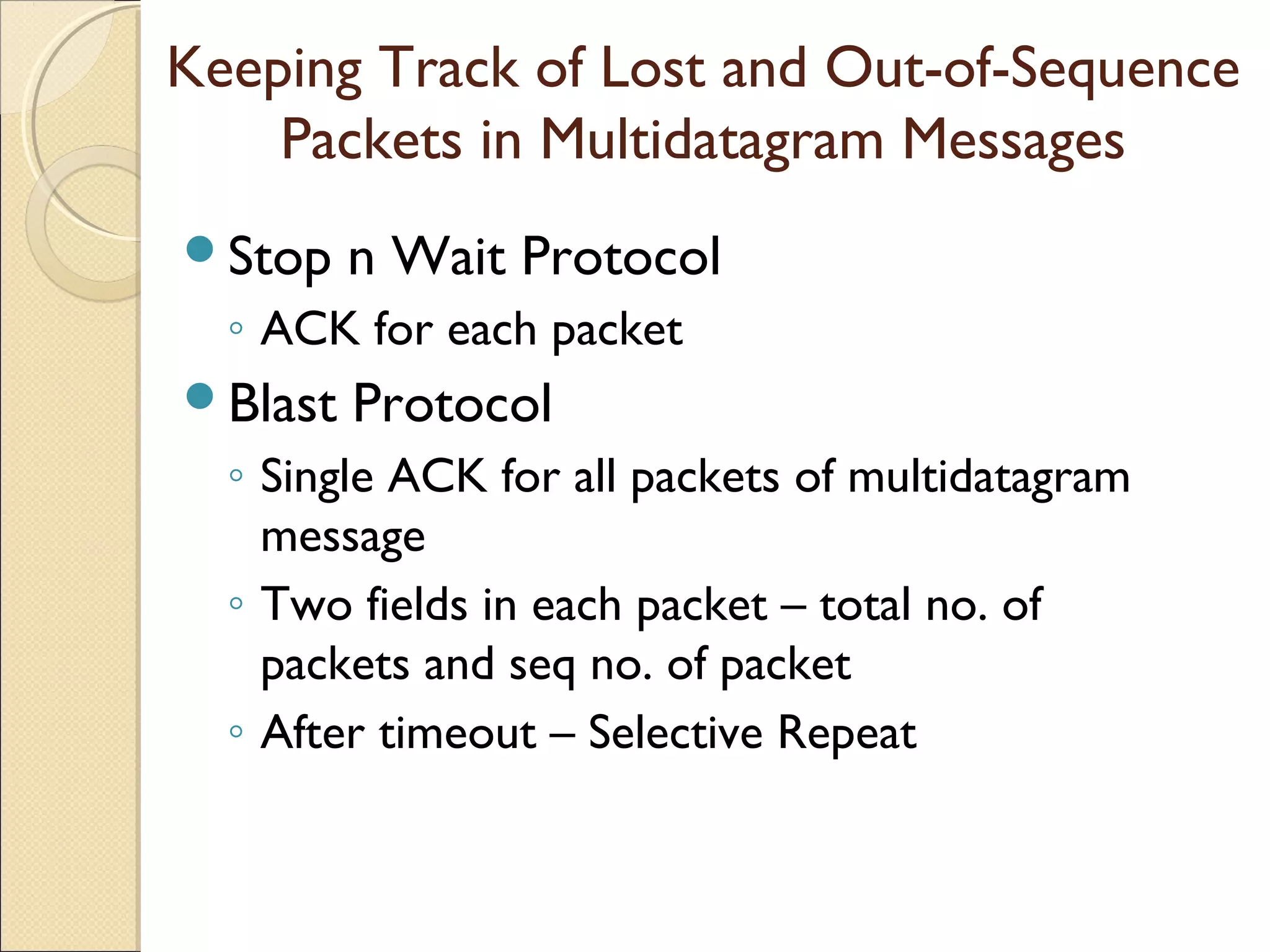
Keeping Track of Lost and Out-of-Sequence
Packets in Multidatagram Messages
Stop n Wait Protocol
◦ ACK for each packet
Blast Protocol
◦ Single ACK for all packets of multidatagram
message
◦ Two fields in each packet – total no. of
packets and seq no. of packet
◦ After timeout – Selective Repeat
Group Communication
 A group is a set of parties that, presumably, want
to exchange information in a reliable, consistent
manner.
 Group communication is a paradigm for multi-
party communication that is based on the notion of
groups as a main abstraction.
 For example:
• The participants of a message-based
conferencing tool may constitute a group.
• If one message is a response to another, the
original message should be delivered before the
response.
Group Communication
1. The set of replicas of a fault-tolerant database
server may constitute a group.
• Consider update messages to the server. Since the
contents of the database depend on the history of
all update messages received, all updates must be
delivered to all replicas. Furthermore, all updates
must be delivered in the same order. Otherwise,
inconsistencies may arise.
Group Communication
Following three types of group
communication are popular:
◦ One to Many
◦ Many to One
◦ Many to Many
Message Delivery to Receiver Process
User applications use high level group
names in programs
Centralized group server (GS) maintains
a mapping of high-level group names to
their low level names
Group server also maintains a list of
process identifier of all the processes for
each group
Message Delivery to Receiver Process
When a sender sends a message to a
group specifying its high level name
Kernel contacts the GS to obtain low
level name & p_id of processes belonging
to that group
This list of p_id is inserted in the message
Buffered / Unbuffered Multicast
Multicast is a Asynchronous operation?
So which one to use
◦ BUFFERED or UNBUFFERED?
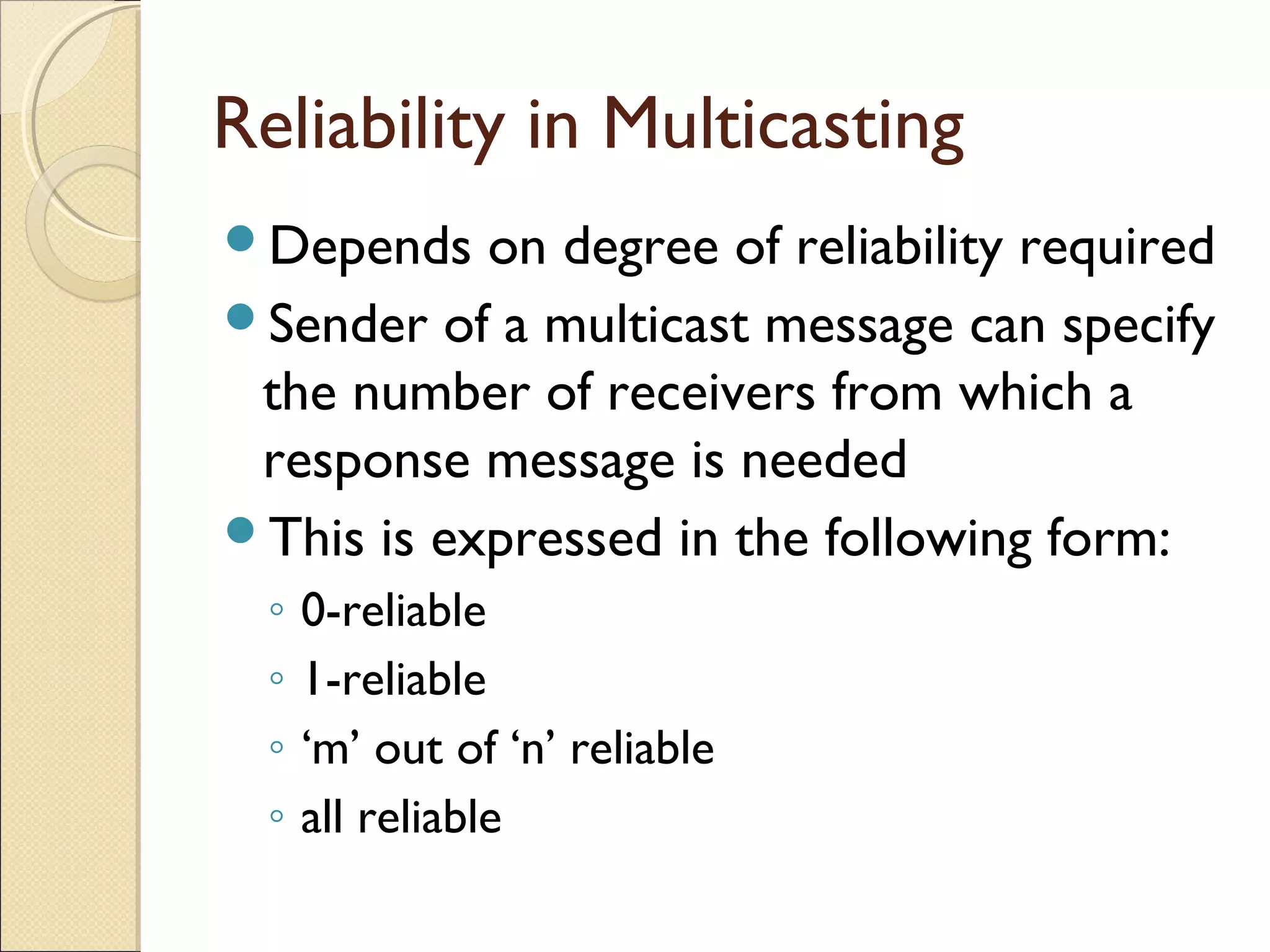
Reliability in Multicasting
Depends on degree of reliability required
Sender of a multicast message can specify
the number of receivers from which a
response message is needed
This is expressed in the following form:
◦ 0-reliable
◦ 1-reliable
◦ ‘m’ out of ‘n’ reliable
◦ all reliable
Atomic Multicast
This has all or nothing property i.e. when
a message is sent to a group, either all or
none receive it.
Only “all-reliable” kind of reliability needs
this strict paradigm
Group Communication Primitives
Group communication is implemented using middleware
that provides sets of primitives to the application.
◦ Multicast primitive (e.g., post): This primitive
allows a sender to post a message to the entire
group.
OR
send() / send_group(): for “1 – 1” and “1 - m”
semantic
Name Server or Group Server?
Group Communication Primitives
◦ Membership primitives
◦ e.g., join, leave, query_membership;
◦ These primitives allow a process to join or
leave a particular group, as well as to
query the group for the list of all current
participants.
Mnay to One Comm. Issues
The single receiver may be selective or
nonselective
◦ Selective – Deterministic
◦ Non-selective – Non-Deterministic
Many to Many Comm. Issues
One to many and many to one implicit in
this scheme
Issue of ordered message delivery
Semantics of ordered delivery are:
• Absolute Ordering
• Consistent Ordering
• Causal Ordering
Absolute OrderingAbsolute Ordering
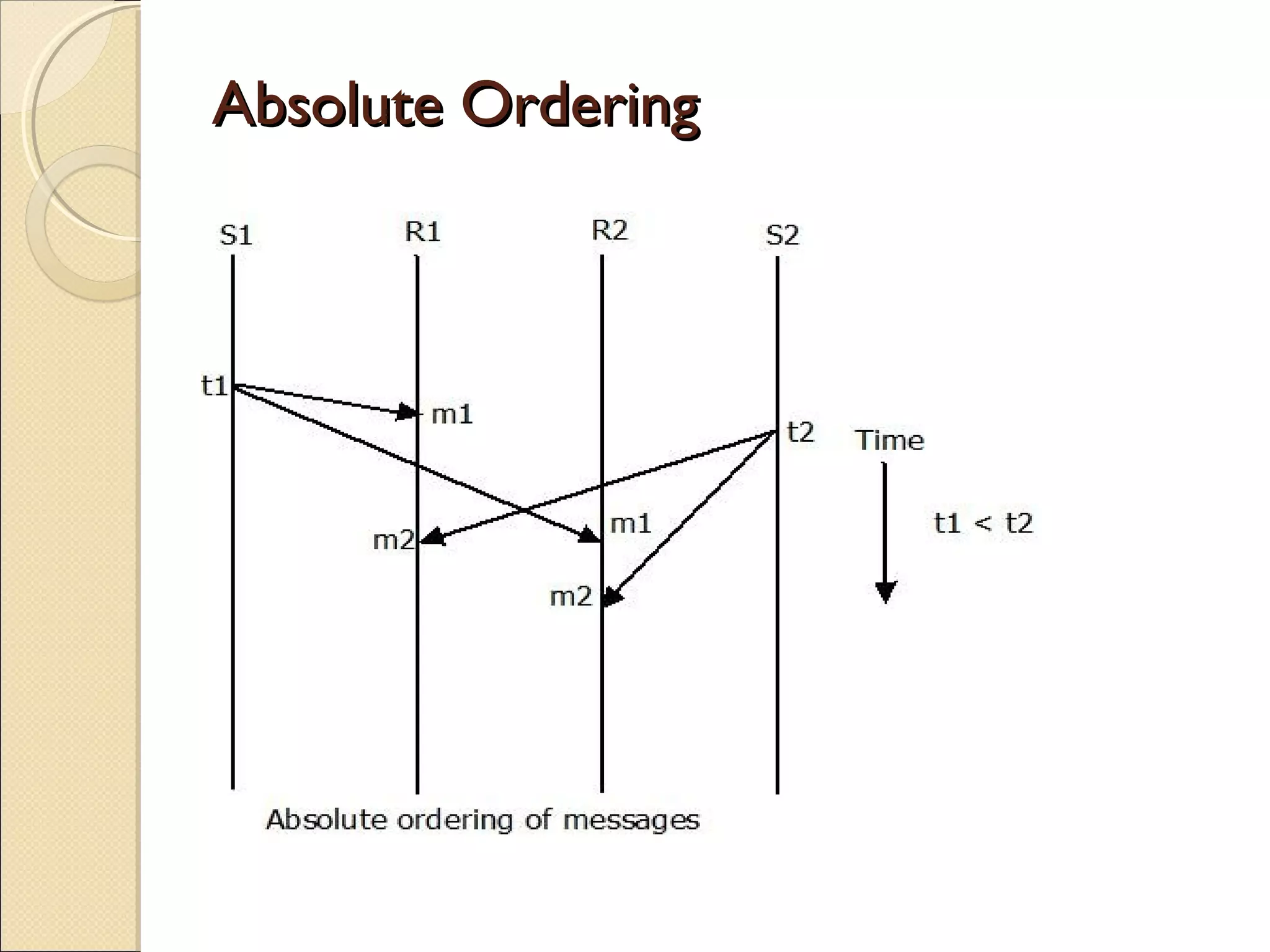
 All messages are delivered to all receiver processes in
the exact order in which they were sent
 System is assumed to have a clock at each machine and
all clocks are synchronized with each other
 Here clock value is taken as the identifier of the
message
Absolute OrderingAbsolute Ordering
Consistent OrderingConsistent Ordering
 Absolute ordering requires globally synchronized
clocks, which are not easy to implement
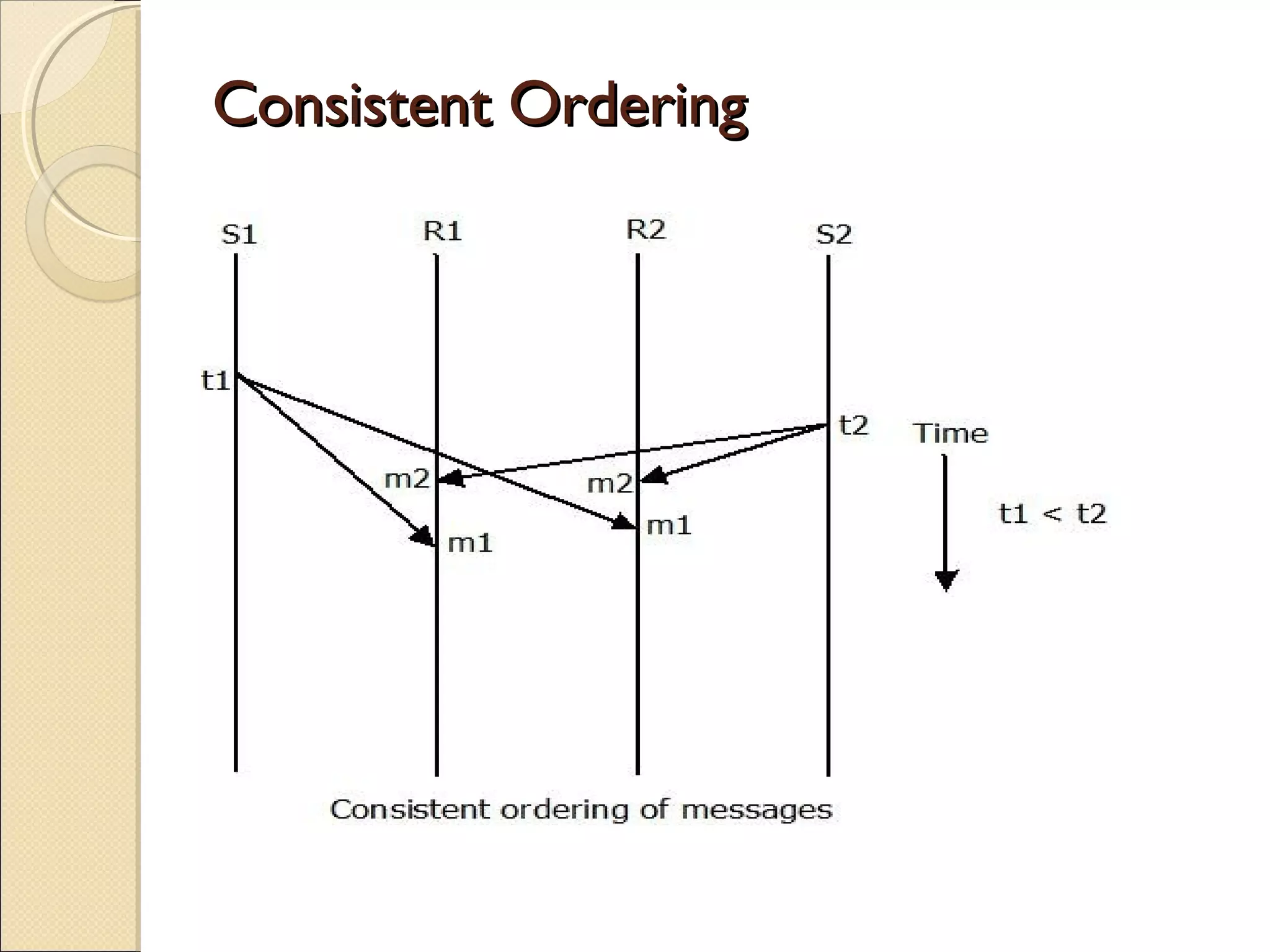
 Consistent ordering ensures that all messages are
delivered to all receiver processes in the same order
 Order may be different from the order in which
messages were sent
 Sending machines send messages to a single receiver
(sequencer) that assigns a sequence number to each
message and then multicasts it
 Subject to single point of failure and hence has poor
reliability
Consistent OrderingConsistent Ordering
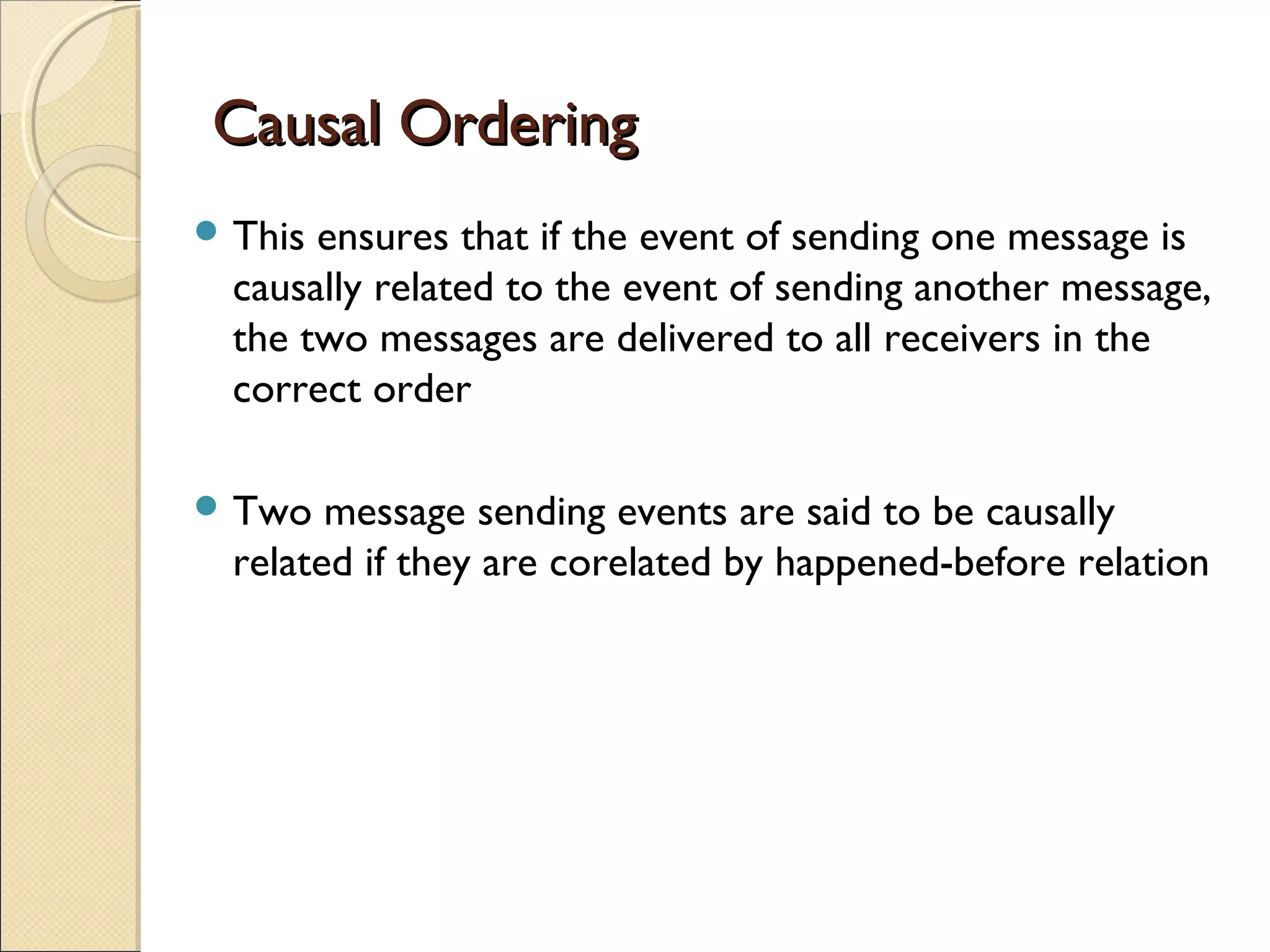
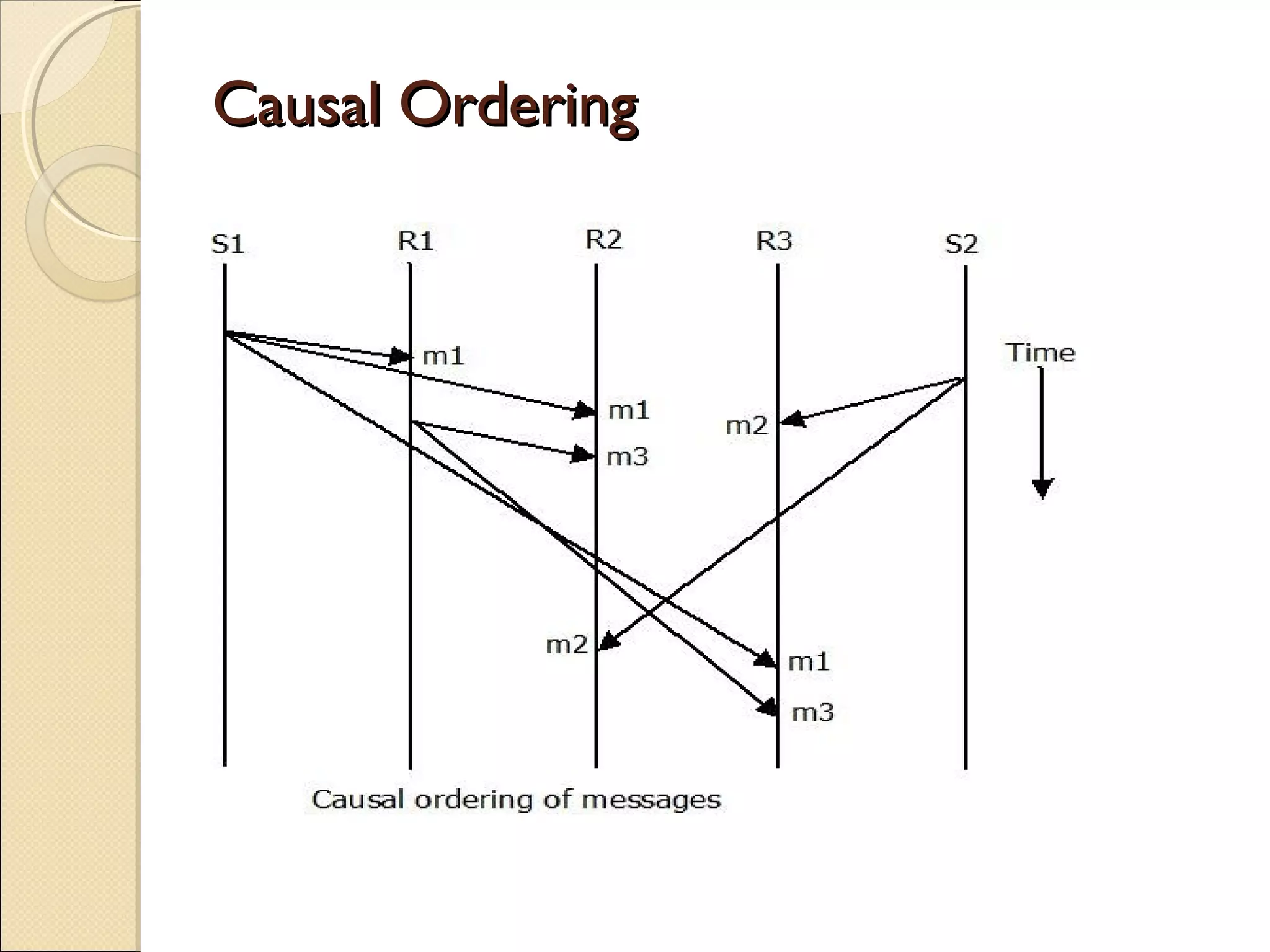
Causal OrderingCausal Ordering
 This ensures that if the event of sending one message is
causally related to the event of sending another message,
the two messages are delivered to all receivers in the
correct order
 Two message sending events are said to be causally
related if they are corelated by happened-before relation
Causal OrderingCausal Ordering

1 messagepassing-121015032028-phpapp01

  • 1.
  • 2.
    DESIGN ISSUES INIPC BY MESSAGEDESIGN ISSUES IN IPC BY MESSAGE PASSINGPASSING  SYNCHRONIZATION ◦ BLOCKING PRIMITIVE (SYNCHRONOUS) : If its invocation blocks execution of its invoker ◦ NON-BLOCKING (ASYNCHRONOUS) : Does not block execution  2 cases  1st case ◦ Blocking send ◦ Blocking Rec  2nd case ◦ Non-Blocking Send ◦ Non-Blocking Rec
  • 3.
    ISSUES IN BLOCKINGSENDISSUES IN BLOCKING SEND  Sending process could get blocked forever if receiving process crashes or message lost on the network due to communication failure  Hence it should use timeout values  It could be a parameter of “send” primitive
  • 4.
    ISSUES IN BLOCKINGRECEIVEISSUES IN BLOCKING RECEIVE  Receiver process could get blocked forever if sending process crashes or message lost on the network due to communication failure  Hence it should use timeout values
  • 5.
    ISSUES IN NON-BLOCKINGRECEIVEISSUES IN NON-BLOCKING RECEIVE  How the receiving process knows that the message has arrived in the message buffer?  Done by Polling or Interrupt ◦ POLLING: Receiver uses “test” primitive to allow it to check buffer status ◦ INTERRUPT : When message has arrived in the buffer, a s/w interrupt is used to notify the receiving process
  • 6.
    SYNCHRONOUS COMMUNICATIONSYNCHRONOUS COMMUNICATION Sender’sexecution Receiver’s execution Send(message); Receive(message); execution suspended message execution suspended execution resumed Send(acknowledgement) execution resumed acknowledgement Synchronous mode of communication with both send and receive primitives having blocking-type semantics
  • 7.
    IMPLEMENTATION EASEIMPLEMENTATION EASE •Synchronous communication is easy to implement • If message gets lost or is undelivered, no backward error recovery is required • Synchronous communication limits concurrency • Subject to communication deadlock
  • 8.
    BUFFERINGBUFFERING  Messages aretransmitted from one process to another by copying the body of the message from the address space of sending process to address space of receiver process (possibly via address space of kernels of sending and receiving computers)  In some cases, the receiver process may not be ready to receive a message but may want O.S. to save messages for later reception  Message buffering strategy related to synchronization strategy ◦ Synchronous Mode: Null /No Buffer ◦ Asynchronous Mode: Buffer with unbounded capacity
  • 9.
    Null BufferingNull Buffering It has two strategies 1st strategy – Message remains in SPAS (Sender Process Address Space) and the execution of send is delayed until the receiver executes the corresponding receive – After send, when ACK is received, it executes “send” again 2nd strategy – The message is simply discarded and the time out mechanism is used to resend message after a time out period – After executing send, sender process wait for an ACK
  • 10.
    Single-Message BufferSingle-Message Buffer If the receiver is not ready, a message has to be transferred two or more times hence null buffer strategy is generally not suitable for synchronous communication  Therefore, synchronous communication use a single- message buffer strategy  A buffer having a capacity to store a single message is used on the receiver’s node
  • 11.
    FINITE BOUND BUFFER A create-buffer system call is provided to the user.  This system call when executed by a receiver process creates a buffer of a size specified by receiver either in kernel AS. or receiver process AS. 11
  • 12.
    i. Null buffer:Sending Process Receiving Process ii. Single Message Buffer: iii. Multiple Message Buffer: Message Message 1 Message n 12
  • 13.
    ENCODING AND DECODINGOFENCODING AND DECODING OF MESSAGE DATAMESSAGE DATA Structure of program/object should be preserved while they are being transmitted from address space of sending process to RPAS. Difficult to achieve because  Absolute ptr losses its meaning when transferred from one process AS to another ◦ Requires flattening and shaping of objects  Receiver process should have a-priori knowledge of varying memory occupied by various data items Due to above problems, program object not transferred in their original form. First converted to stream form by encoding. 13
  • 14.
    Two representation maybe used for encoding and Decoding 1. Tagged Representation: Data object along with its type is encoded 2. Untagged Representation: No information regarding data type.  Untagged: SUN XDR (Extended Data Representation)  Tagged: A.S.N (CCITT 1985) 14
  • 15.
    PROCESS ADDRESSING  Processaddressing is naming of parties involved in interaction  Two types of process Addressing: 1. Explicit Addressing: The process with which communication is desired is explicitly named as a parameter ◦ Send (process-id, message) ◦ Receive (process-id, message) 15
  • 16.
    Implicit Addressing Does notexplicitly name a process for communication ◦ Send_any (service_id, message) ◦ Send a message to any process that provides the service of type “service_id” ◦ Receive_any (process_id, message) ◦ Receive a message from any process and returns the “process_id” of the process from which the message was received.
  • 17.
    PROCESS ADDRESSING (contd..) Simple method to identify a process is by a combination of machine-id and local-id such as machine-id@local-id.  Local-id can be process- id or port-id, that uniquely identifies a process on a machine.  Machine-id is used by sending machine kernel to send the message to the receiver process machine.  Eg: Berkely UNIX -32 bit Internet address for machine-id -16 bit for local-id  Drawback: It does not allow a process to migrate from one machine to another in the case of heavy load. 17
  • 18.
    I. To overcomethis limitation This type of adding is known as link based addressing. During Migration, a link Information (p-id + m/c id of new node) of the new node is left on previous node. Drawbacks: i. Overload of locating a process if process has migrated several times. ii. It may not be possible to locate a process if an intermediate node on which the process once residing during its lifetime is down. Node on which process created Id of the process Last known Node Location of the process Machine-id , Machine-id ,Local-id , Never Change This may 18
  • 19.
    TWO LEVEL NAMING SCHEMEFOR PROCESSES  Each process has two id: ◦ A high level name that is m/c independent (ASCII string) ◦ A low level name that is m/c dependent (m/c id@local id)  A name server is used to maintain a mapping table.  Now when a process wants to send a message to another process, it specifies high level name of the receiver process. 19
  • 20.
    TWO LEVEL NAMINGSCHEME FOR PROCESSES The kernel of the m/c first contacts the name server to get low level name Can also be used for FUNCTIONAL ADDRESSING High level name identifies a service instead of a process Precaution of Replicating Name Server.
  • 21.
    FAILURE HANDLING • Lossof Request message • Loss of Response Message • Unsuccessful execution of request To overcome these problems • A reliable IPC protocol of a message-passing system is designed. • It is based on the ideas of internal retransmission of messages after time out and • Return of an ACK to sending m/c kernel by receiver m/c kernel. 21
  • 22.
     The timefor which the sender waits is slightly more than the approximate round trip time + the average time required for executing the request 1. FOUR MESSAGE RELIABLE IPC Protocol 22 The four-message reliable IPC protocol for client-server communication between two processes.
  • 23.
    2.2. THREE MESSAGERELIABLE IPCTHREE MESSAGE RELIABLE IPC  What happens when request processing takes a long time?  Answer: Server sends a separate ACK to acknowledge request message The three-message reliable IPC protocol for client-server communication between two processes.
  • 24.
    3. TWO MESSAGERELIABLE IPCTWO MESSAGE RELIABLE IPC  When request received at servers machine, it starts a timer  If server finishes processing the req. before time expires, reply acts as ACK  Else a separate ACK is sent by kernel The two-message IPC protocol used in many systems for client- server communication between two processes.
  • 25.
    Idempotency Means repeatibility An Idempotentoperation produces the same result without any side effects, no matter how many times it is performed with the same argument. ISSUE : Duplicate Requests
  • 26.
    Handling of DuplicateRequests If client makes a request Server processes the request Client doesn't receive the response After time out, again issues REQ What Happens?
  • 27.
    Handling of DuplicateRequests Use unique id for every REQ Kernel on the server maintains a reply cache
  • 28.
    Keeping Track ofLost and Out-of-Sequence Packets in Multidatagram Messages Stop n Wait Protocol ◦ ACK for each packet Blast Protocol ◦ Single ACK for all packets of multidatagram message ◦ Two fields in each packet – total no. of packets and seq no. of packet ◦ After timeout – Selective Repeat
  • 29.
    Group Communication  Agroup is a set of parties that, presumably, want to exchange information in a reliable, consistent manner.  Group communication is a paradigm for multi- party communication that is based on the notion of groups as a main abstraction.  For example: • The participants of a message-based conferencing tool may constitute a group. • If one message is a response to another, the original message should be delivered before the response.
  • 30.
    Group Communication 1. Theset of replicas of a fault-tolerant database server may constitute a group. • Consider update messages to the server. Since the contents of the database depend on the history of all update messages received, all updates must be delivered to all replicas. Furthermore, all updates must be delivered in the same order. Otherwise, inconsistencies may arise.
  • 31.
    Group Communication Following threetypes of group communication are popular: ◦ One to Many ◦ Many to One ◦ Many to Many
  • 32.
    Message Delivery toReceiver Process User applications use high level group names in programs Centralized group server (GS) maintains a mapping of high-level group names to their low level names Group server also maintains a list of process identifier of all the processes for each group
  • 33.
    Message Delivery toReceiver Process When a sender sends a message to a group specifying its high level name Kernel contacts the GS to obtain low level name & p_id of processes belonging to that group This list of p_id is inserted in the message
  • 34.
    Buffered / UnbufferedMulticast Multicast is a Asynchronous operation? So which one to use ◦ BUFFERED or UNBUFFERED?
  • 35.
    Reliability in Multicasting Dependson degree of reliability required Sender of a multicast message can specify the number of receivers from which a response message is needed This is expressed in the following form: ◦ 0-reliable ◦ 1-reliable ◦ ‘m’ out of ‘n’ reliable ◦ all reliable
  • 36.
    Atomic Multicast This hasall or nothing property i.e. when a message is sent to a group, either all or none receive it. Only “all-reliable” kind of reliability needs this strict paradigm
  • 37.
    Group Communication Primitives Groupcommunication is implemented using middleware that provides sets of primitives to the application. ◦ Multicast primitive (e.g., post): This primitive allows a sender to post a message to the entire group. OR send() / send_group(): for “1 – 1” and “1 - m” semantic Name Server or Group Server?
  • 38.
    Group Communication Primitives ◦Membership primitives ◦ e.g., join, leave, query_membership; ◦ These primitives allow a process to join or leave a particular group, as well as to query the group for the list of all current participants.
  • 39.
    Mnay to OneComm. Issues The single receiver may be selective or nonselective ◦ Selective – Deterministic ◦ Non-selective – Non-Deterministic
  • 40.
    Many to ManyComm. Issues One to many and many to one implicit in this scheme Issue of ordered message delivery Semantics of ordered delivery are: • Absolute Ordering • Consistent Ordering • Causal Ordering
  • 41.
    Absolute OrderingAbsolute Ordering All messages are delivered to all receiver processes in the exact order in which they were sent  System is assumed to have a clock at each machine and all clocks are synchronized with each other  Here clock value is taken as the identifier of the message
  • 42.
  • 43.
    Consistent OrderingConsistent Ordering Absolute ordering requires globally synchronized clocks, which are not easy to implement  Consistent ordering ensures that all messages are delivered to all receiver processes in the same order  Order may be different from the order in which messages were sent  Sending machines send messages to a single receiver (sequencer) that assigns a sequence number to each message and then multicasts it  Subject to single point of failure and hence has poor reliability
  • 44.
  • 45.
    Causal OrderingCausal Ordering This ensures that if the event of sending one message is causally related to the event of sending another message, the two messages are delivered to all receivers in the correct order  Two message sending events are said to be causally related if they are corelated by happened-before relation
  • 46.