W E L C O M E ……..Our pleasure
Fault Tolerance  and  Disaster Recovery …… .A Project By   Chethan S.P. Manjunath prasad H.R. Under the guidance of Internal guide  External guides Ms.Saritha D.  Mr.shamanth kumar P.R. Babitha raghavan
What will be presented?   ….The contents PART-I Getting started Architecture System design Mirroring server Protocol Check pointing Rollback PART-II Dominance Hindrance Platform & language Climax Authoritative facts
Getting Started   ….The definition In case a component fails, a  backup  component  can immediately take its place with  no loss  of service.
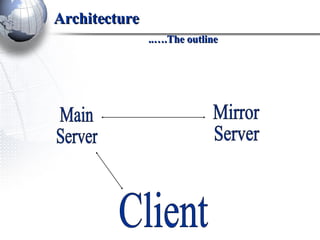
Architecture    ..….The outline Client Main  Server Mirror  Server
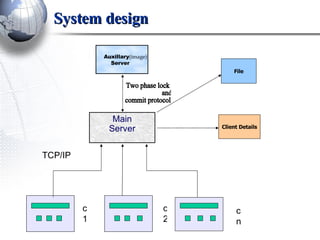
System design Main Server Auxillary (image)   Server  File Client Details Two phase lock  and  commit protocol c1 c2 cn TCP/IP
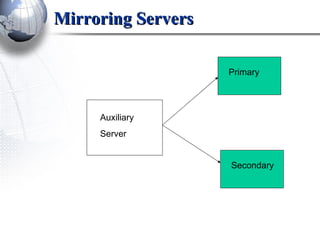
Mirroring Servers Auxiliary Server Primary Secondary
2 – Phase Commit Protocol Phase -1 Phase - 2
Check Pointing ? ? ? “ A Snapshot of a process”
Rollback  Mechanism ? “ The previous checkpoint to continue the process from the point.”
END OF PART-I
  PART-II
DOMINANCE   ……The Advantages No loss of any data. Performance doesn’t vary. Self healed.
HINDRANCE   …… The drawback Cost Overhead from EXE Installation complexity
Platform & Language Linux 2.6 Version ‘ C’ Programming Language
Climax   …….The conclusion Achieves total integrity of the whole system without interrupting the system performance, it is said to be fault tolerant and disaster recovery.
Authoritative facts   …....The References [1]Richard W Stevens, “Unix Network Programming”.  [2]Douglas V Comer, “Internetworking with TCP/IP”.  [3]Dennis M Ritchie et al, “‘C’ Programming language”.  [4]Maurice J Bash, “Unix operating system”.
 
End
Any Queries

Fault Tolerant And Disaster Recovery

  • 1.
    W E LC O M E ……..Our pleasure
  • 2.
    Fault Tolerance and Disaster Recovery …… .A Project By Chethan S.P. Manjunath prasad H.R. Under the guidance of Internal guide External guides Ms.Saritha D. Mr.shamanth kumar P.R. Babitha raghavan
  • 3.
    What will bepresented? ….The contents PART-I Getting started Architecture System design Mirroring server Protocol Check pointing Rollback PART-II Dominance Hindrance Platform & language Climax Authoritative facts
  • 4.
    Getting Started ….The definition In case a component fails, a backup component can immediately take its place with no loss of service.
  • 5.
    Architecture ..….The outline Client Main Server Mirror Server
  • 6.
    System design MainServer Auxillary (image) Server File Client Details Two phase lock and commit protocol c1 c2 cn TCP/IP
  • 7.
    Mirroring Servers AuxiliaryServer Primary Secondary
  • 8.
    2 – PhaseCommit Protocol Phase -1 Phase - 2
  • 9.
    Check Pointing ?? ? “ A Snapshot of a process”
  • 10.
    Rollback Mechanism? “ The previous checkpoint to continue the process from the point.”
  • 11.
  • 12.
  • 13.
    DOMINANCE ……The Advantages No loss of any data. Performance doesn’t vary. Self healed.
  • 14.
    HINDRANCE …… The drawback Cost Overhead from EXE Installation complexity
  • 15.
    Platform & LanguageLinux 2.6 Version ‘ C’ Programming Language
  • 16.
    Climax …….The conclusion Achieves total integrity of the whole system without interrupting the system performance, it is said to be fault tolerant and disaster recovery.
  • 17.
    Authoritative facts …....The References [1]Richard W Stevens, “Unix Network Programming”. [2]Douglas V Comer, “Internetworking with TCP/IP”. [3]Dennis M Ritchie et al, “‘C’ Programming language”. [4]Maurice J Bash, “Unix operating system”.
  • 18.
  • 19.
  • 20.