Introduction:
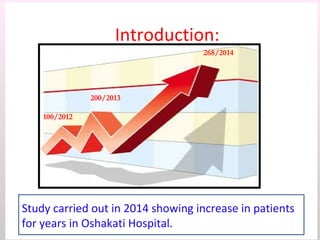
Study carried out in 2014 showing increase in patients
for years in Oshakati Hospital.
268/2014
200/2013
100/2012
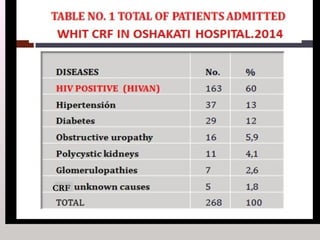
CRF
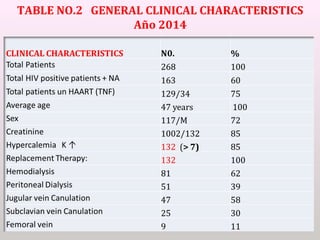
TABLE NO.2 GENERAL CLINICAL CHARACTERISTICS
Año 2014
Suggestions
• High mortality was found associated with late
referral of patients , They were referred to
nephrology belatedly.
• Strict control of patients CRF in the Local
Areas.
• Monitoring by CDC doctors and Specialists in
internal medicine to patients suffering from
HIV positive+ CKD.
Objective
• At the end of this session , all participants
should be able to:
• Define Chronic Renal Failure.
• Mention the main causes of Chronic Renal
Failure.
• Know the signs and symptoms of renal failure.
• Know the treatment options of CRF
• Know new definition of CKD
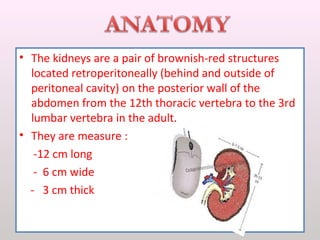
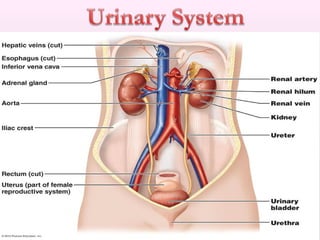
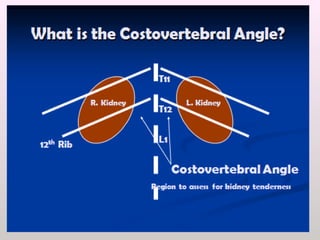
• The kidneys are a pair of brownish-red structures
located retroperitoneally (behind and outside of
peritoneal cavity) on the posterior wall of the
abdomen from the 12th thoracic vertebra to the 3rd
lumbar vertebra in the adult.
• They are measure :
-12 cm long
- 6 cm wide
- 3 cm thick
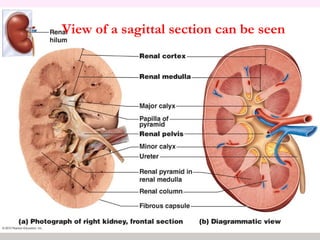
View of a sagittal section can be seen
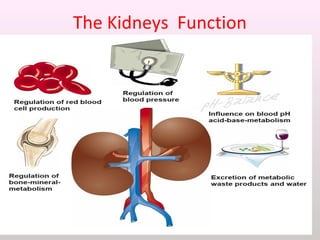
The Kidneys Function
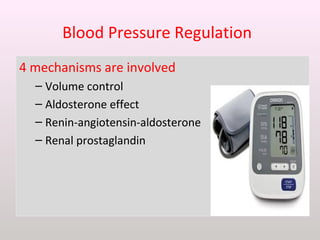
Blood Pressure Regulation
4 mechanisms are involved
– Volume control
– Aldosterone effect
– Renin-angiotensin-aldosterone
– Renal prostaglandin
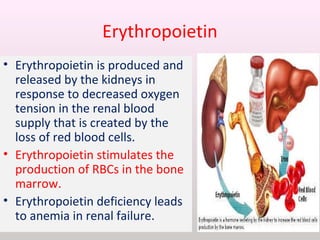
Erythropoietin
• Erythropoietin is produced and
released by the kidneys in
response to decreased oxygen
tension in the renal blood
supply that is created by the
loss of red blood cells.
• Erythropoietin stimulates the
production of RBCs in the bone
marrow.
• Erythropoietin deficiency leads
to anemia in renal failure.
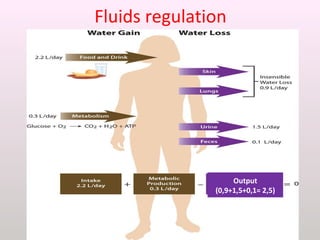
Fluids regulation
Output
(0,9+1,5+0,1= 2,5)
Diagnostic Tools for Assessing Renal
Failure
• Blood Tests
– BUN elevated (norm 10-20)
– Creatinine elevated (norm 85 - 132)
– K elevated
– PO4elevated
– Ca decreased
• Urinalysis
– Specific gravity
– Protein
– Creatinine clearance (GFR)
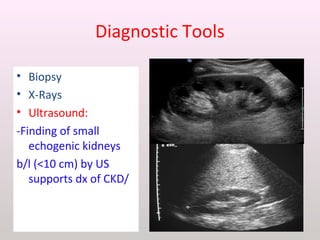
Diagnostic Tools
• Biopsy
• X-Rays
• Ultrasound:
-Finding of small
echogenic kidneys
b/l (<10 cm) by US
supports dx of CKD/
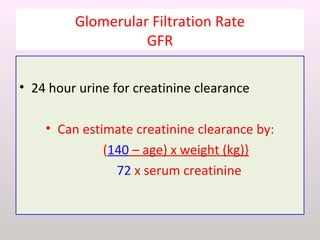
Glomerular Filtration Rate
GFR
• 24 hour urine for creatinine clearance
• Can estimate creatinine clearance by:
(140 – age) x weight (kg)}
72 x serum creatinine
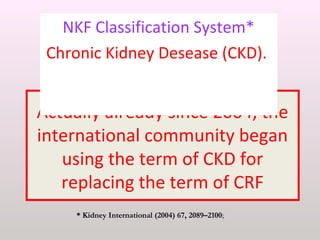
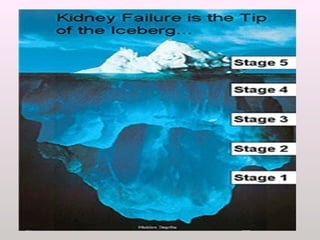
Actually already since 2004, the
international community began
using the term of CKD for
replacing the term of CRF
NKF Classification System*
Chronic Kidney Desease (CKD).
* Kidney International (2004) 67, 2089–2100;
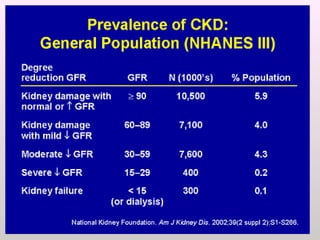
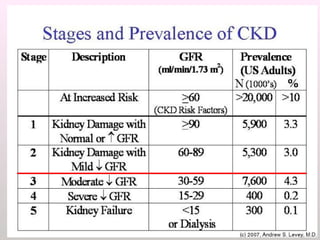
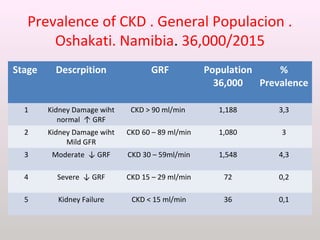
Prevalence of CKD . General Populacion .
Oshakati. Namibia. 36,000/2015
Stage Descrpition GRF Population
36,000
%
Prevalence
1 Kidney Damage wiht
normal ↑ GRF
CKD > 90 ml/min 1,188 3,3
2 Kidney Damage wiht
Mild GFR
CKD 60 – 89 ml/min 1,080 3
3 Moderate ↓ GRF CKD 30 – 59ml/min 1,548 4,3
4 Severe ↓ GRF CKD 15 – 29 ml/min 72 0,2
5 Kidney Failure CKD < 15 ml/min 36 0,1
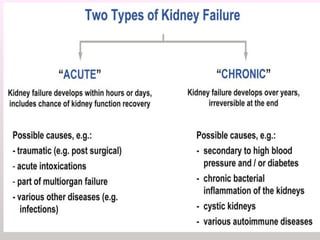
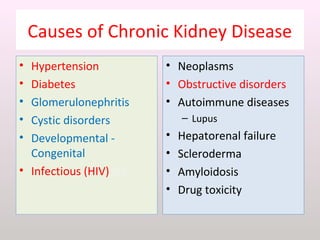
Causes of Chronic Kidney Disease
• Hypertension
• Diabetes
• Glomerulonephritis
• Cystic disorders
• Developmental -
Congenital
• Infectious (HIV)sea
• Neoplasms
• Obstructive disorders
• Autoimmune diseases
– Lupus
• Hepatorenal failure
• Scleroderma
• Amyloidosis
• Drug toxicity
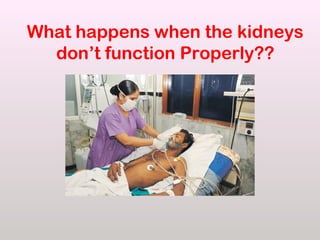
What happens when the kidneys
don’t function Properly??
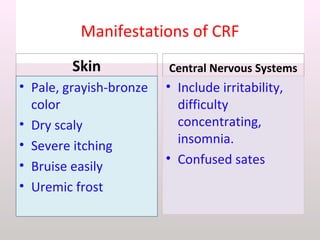
Manifestations of CRF
Skin
• Pale, grayish-bronze
color
• Dry scaly
• Severe itching
• Bruise easily
• Uremic frost
Central Nervous Systems
• Include irritability,
difficulty
concentrating,
insomnia.
• Confused sates
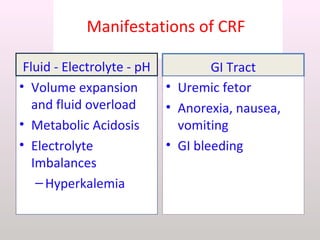
Manifestations of CRF
Fluid - Electrolyte - pH
• Volume expansion
and fluid overload
• Metabolic Acidosis
• Electrolyte
Imbalances
–Hyperkalemia
GI Tract
• Uremic fetor
• Anorexia, nausea,
vomiting
• GI bleeding
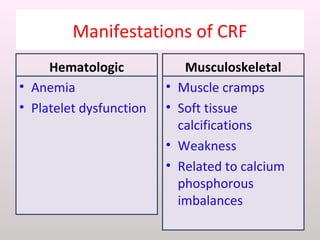
Manifestations of CRF
Hematologic
• Anemia
• Platelet dysfunction
Musculoskeletal
• Muscle cramps
• Soft tissue
calcifications
• Weakness
• Related to calcium
phosphorous
imbalances
Manifestations of CRF
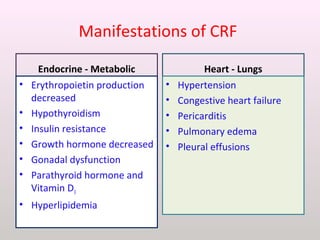
Endocrine - Metabolic
• Erythropoietin production
decreased
• Hypothyroidism
• Insulin resistance
• Growth hormone decreased
• Gonadal dysfunction
• Parathyroid hormone and
Vitamin D3
• Hyperlipidemia
Heart - Lungs
• Hypertension
• Congestive heart failure
• Pericarditis
• Pulmonary edema
• Pleural effusions
FAST FOOD
How To Avoid Kidney DiseaseFailure
THE FOLLOWING COULD CAUSE KIDNEY DISEASE:
• Delaying going to a toilet
Keeping your urine in
your bladder for too long
is a bad idea.
• A full bladder can cause
bladder damage. The
urine that stays in the
bladder multiplies
bacteria quickly.
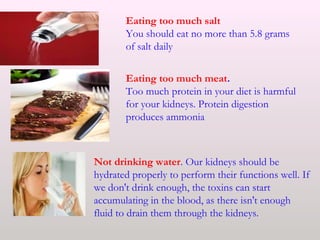
Eating too much salt
You should eat no more than 5.8 grams
of salt daily
Eating too much meat.
Too much protein in your diet is harmful
for your kidneys. Protein digestion
produces ammonia
Not drinking water. Our kidneys should be
hydrated properly to perform their functions well. If
we don't drink enough, the toxins can start
accumulating in the blood, as there isn't enough
fluid to drain them through the kidneys.
Lack of Medical Checks .
Treat all your health problems
properly and have your health
checked regularly.
Stop Smoking and Stop drinking
alcohol. You can reduce the strain
on your kidneys by cutting all
alcoholic drinks out of your lifestyle.
These drinks require that your
kidneys work very hard and not
drinking them can help prevent
kidney problems.
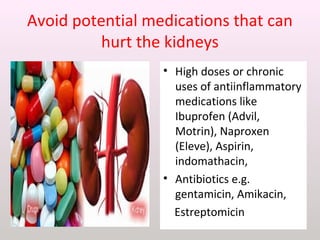
Avoid potential medications that can
hurt the kidneys
• High doses or chronic
uses of antiinflammatory
medications like
Ibuprofen (Advil,
Motrin), Naproxen
(Eleve), Aspirin,
indomathacin,
• Antibiotics e.g.
gentamicin, Amikacin,
Estreptomicin
Adolescent Health Education Programs
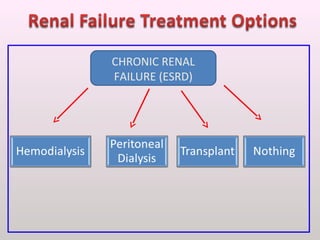
CHRONIC RENAL
FAILURE (ESRD)
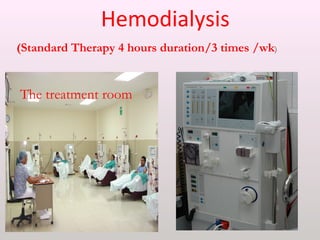
Hemodialysis
(Standard Therapy 4 hours duration/3 times /wk)
The treatment room
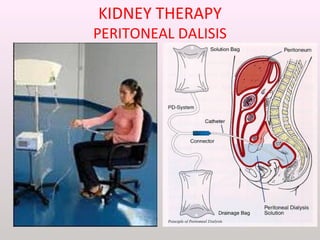
KIDNEY THERAPY
PERITONEAL DALISIS
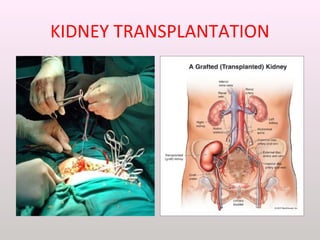
KIDNEY TRANSPLANTATION
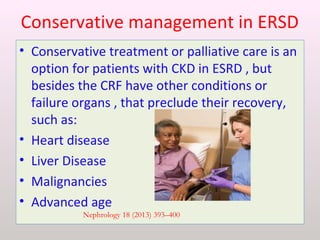
Conservative management in ERSD
• Conservative treatment or palliative care is an
option for patients with CKD in ESRD , but
besides the CRF have other conditions or
failure organs , that preclude their recovery,
such as:
• Heart disease
• Liver Disease
• Malignancies
• Advanced age
Nephrology 18 (2013) 393–400
Conservative Management
• Some people decide to have ‘conservative’
treatment (also called, palliative or supportive
care) rather than have dialysis or a transplant.
• The aim of conservative treatment is to
manage the symptoms of kidney failure
without using dialysis or transplantation.
• Conservative treatment includes medical,
emotional, social, spiritual and practical care
for both the person with kidney failure and
their family.
Conclusion
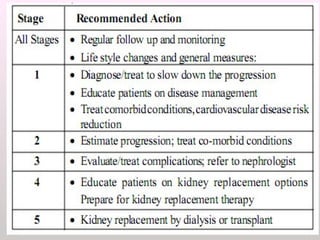
• Multiple risk-factor intervention strategy is
the best to adopt in patients with CKD
• Control of BP is of paramount importance in
slowing down the progression of CKD
• Control of BP is more important in slowing
the progression of CKD than control of blood
sugar in patients with type II diabetes and
proteinuria
• In patients with CKD, AII blockers give benefit
beyond BP control
Suggestions
• The country needs of a
National Prevention
Program of CKD .
 Prevent*
Detect
Treat
*Despite a lot of
advancement in the fields
of Medicine ,still there is
not
Permanent cure for Kidney
The Governments can not
support Dialysis Therapy
without National
Prevention Program of
CKD and a program of
Kidney Transplantation.
I am happy that
now you know
more about
me!!!
Chronic renal failure

Chronic renal failure

  • 2.
    Introduction: Study carried outin 2014 showing increase in patients for years in Oshakati Hospital. 268/2014 200/2013 100/2012
  • 3.
  • 4.
    TABLE NO.2 GENERALCLINICAL CHARACTERISTICS Año 2014
  • 5.
    Suggestions • High mortalitywas found associated with late referral of patients , They were referred to nephrology belatedly. • Strict control of patients CRF in the Local Areas. • Monitoring by CDC doctors and Specialists in internal medicine to patients suffering from HIV positive+ CKD.
  • 7.
    Objective • At theend of this session , all participants should be able to: • Define Chronic Renal Failure. • Mention the main causes of Chronic Renal Failure. • Know the signs and symptoms of renal failure. • Know the treatment options of CRF • Know new definition of CKD
  • 9.
    • The kidneysare a pair of brownish-red structures located retroperitoneally (behind and outside of peritoneal cavity) on the posterior wall of the abdomen from the 12th thoracic vertebra to the 3rd lumbar vertebra in the adult. • They are measure : -12 cm long - 6 cm wide - 3 cm thick
  • 12.
    View of asagittal section can be seen
  • 14.
  • 15.
    Blood Pressure Regulation 4mechanisms are involved – Volume control – Aldosterone effect – Renin-angiotensin-aldosterone – Renal prostaglandin
  • 16.
    Erythropoietin • Erythropoietin isproduced and released by the kidneys in response to decreased oxygen tension in the renal blood supply that is created by the loss of red blood cells. • Erythropoietin stimulates the production of RBCs in the bone marrow. • Erythropoietin deficiency leads to anemia in renal failure.
  • 17.
  • 18.
    Diagnostic Tools forAssessing Renal Failure • Blood Tests – BUN elevated (norm 10-20) – Creatinine elevated (norm 85 - 132) – K elevated – PO4elevated – Ca decreased • Urinalysis – Specific gravity – Protein – Creatinine clearance (GFR)
  • 19.
    Diagnostic Tools • Biopsy •X-Rays • Ultrasound: -Finding of small echogenic kidneys b/l (<10 cm) by US supports dx of CKD/
  • 20.
    Glomerular Filtration Rate GFR •24 hour urine for creatinine clearance • Can estimate creatinine clearance by: (140 – age) x weight (kg)} 72 x serum creatinine
  • 22.
    Actually already since2004, the international community began using the term of CKD for replacing the term of CRF NKF Classification System* Chronic Kidney Desease (CKD). * Kidney International (2004) 67, 2089–2100;
  • 27.
    Prevalence of CKD. General Populacion . Oshakati. Namibia. 36,000/2015 Stage Descrpition GRF Population 36,000 % Prevalence 1 Kidney Damage wiht normal ↑ GRF CKD > 90 ml/min 1,188 3,3 2 Kidney Damage wiht Mild GFR CKD 60 – 89 ml/min 1,080 3 3 Moderate ↓ GRF CKD 30 – 59ml/min 1,548 4,3 4 Severe ↓ GRF CKD 15 – 29 ml/min 72 0,2 5 Kidney Failure CKD < 15 ml/min 36 0,1
  • 28.
    Causes of ChronicKidney Disease • Hypertension • Diabetes • Glomerulonephritis • Cystic disorders • Developmental - Congenital • Infectious (HIV)sea • Neoplasms • Obstructive disorders • Autoimmune diseases – Lupus • Hepatorenal failure • Scleroderma • Amyloidosis • Drug toxicity
  • 30.
    What happens whenthe kidneys don’t function Properly??
  • 31.
    Manifestations of CRF Skin •Pale, grayish-bronze color • Dry scaly • Severe itching • Bruise easily • Uremic frost Central Nervous Systems • Include irritability, difficulty concentrating, insomnia. • Confused sates
  • 32.
    Manifestations of CRF Fluid- Electrolyte - pH • Volume expansion and fluid overload • Metabolic Acidosis • Electrolyte Imbalances –Hyperkalemia GI Tract • Uremic fetor • Anorexia, nausea, vomiting • GI bleeding
  • 33.
    Manifestations of CRF Hematologic •Anemia • Platelet dysfunction Musculoskeletal • Muscle cramps • Soft tissue calcifications • Weakness • Related to calcium phosphorous imbalances
  • 34.
    Manifestations of CRF Endocrine- Metabolic • Erythropoietin production decreased • Hypothyroidism • Insulin resistance • Growth hormone decreased • Gonadal dysfunction • Parathyroid hormone and Vitamin D3 • Hyperlipidemia Heart - Lungs • Hypertension • Congestive heart failure • Pericarditis • Pulmonary edema • Pleural effusions
  • 35.
  • 36.
    How To AvoidKidney DiseaseFailure THE FOLLOWING COULD CAUSE KIDNEY DISEASE: • Delaying going to a toilet Keeping your urine in your bladder for too long is a bad idea. • A full bladder can cause bladder damage. The urine that stays in the bladder multiplies bacteria quickly.
  • 38.
    Eating too muchsalt You should eat no more than 5.8 grams of salt daily Eating too much meat. Too much protein in your diet is harmful for your kidneys. Protein digestion produces ammonia Not drinking water. Our kidneys should be hydrated properly to perform their functions well. If we don't drink enough, the toxins can start accumulating in the blood, as there isn't enough fluid to drain them through the kidneys.
  • 39.
    Lack of MedicalChecks . Treat all your health problems properly and have your health checked regularly. Stop Smoking and Stop drinking alcohol. You can reduce the strain on your kidneys by cutting all alcoholic drinks out of your lifestyle. These drinks require that your kidneys work very hard and not drinking them can help prevent kidney problems.
  • 40.
    Avoid potential medicationsthat can hurt the kidneys • High doses or chronic uses of antiinflammatory medications like Ibuprofen (Advil, Motrin), Naproxen (Eleve), Aspirin, indomathacin, • Antibiotics e.g. gentamicin, Amikacin, Estreptomicin
  • 41.
  • 42.
  • 43.
    Hemodialysis (Standard Therapy 4hours duration/3 times /wk) The treatment room

  • 44.
  • 45.
  • 46.
    Conservative management inERSD • Conservative treatment or palliative care is an option for patients with CKD in ESRD , but besides the CRF have other conditions or failure organs , that preclude their recovery, such as: • Heart disease • Liver Disease • Malignancies • Advanced age Nephrology 18 (2013) 393–400

  • 47.
    Conservative Management • Somepeople decide to have ‘conservative’ treatment (also called, palliative or supportive care) rather than have dialysis or a transplant. • The aim of conservative treatment is to manage the symptoms of kidney failure without using dialysis or transplantation. • Conservative treatment includes medical, emotional, social, spiritual and practical care for both the person with kidney failure and their family.
  • 48.
    Conclusion • Multiple risk-factorintervention strategy is the best to adopt in patients with CKD • Control of BP is of paramount importance in slowing down the progression of CKD • Control of BP is more important in slowing the progression of CKD than control of blood sugar in patients with type II diabetes and proteinuria • In patients with CKD, AII blockers give benefit beyond BP control
  • 49.
    Suggestions • The countryneeds of a National Prevention Program of CKD .  Prevent* Detect Treat *Despite a lot of advancement in the fields of Medicine ,still there is not Permanent cure for Kidney The Governments can not support Dialysis Therapy without National Prevention Program of CKD and a program of Kidney Transplantation.
  • 50.
    I am happythat now you know more about me!!!