CROSS-CURRICULAR TEACHING
IN THE MFL CLASSROOM
by Magdalena Bobek, mag.
CROSS-CURRICULAR TEACHING IN THE MFL
CLASSROOM
 Cross-curricular teaching and learning has been interpreted by teachers who use it
in their lessons, in many different ways. One of the basic objectives in cross-
curricular teaching is to cover as many subject areas within the lessons of a
particular subject as possible to enable students to do activities that will access as
much knowledge from as many subject areas within the curriculum. It also enables
teachers to not stick so rigidly to their coursebooks, but rather expand the given
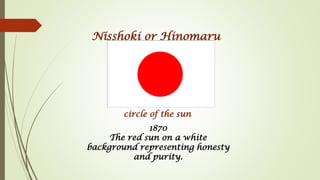
objectives being taught to other subject areas while keeping in mind the main
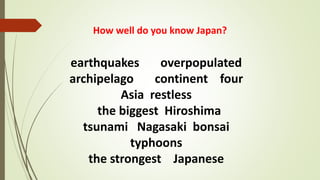
objectives within a certain unit.
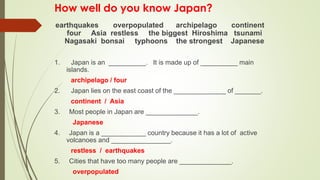
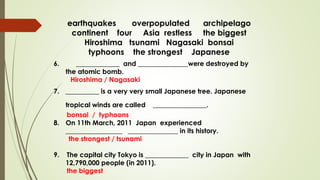
 Today's MFL coursebooks are often written by authors who are not natives of the
country where a particular coursebook is being used, and sometimes the reading
content presented in the books is not close to home for students who come from a
different cultural background from that of the author. This can have a negative
effect on them because they cannot identify themselves with that particular
content. With little or no prior knowledge of the content's background, learning
grammar from this perspective can be very difficult.
 However, if teachers can bring content, which has already been taught in another
subject area into the MFL classroom, even though foreign at first, it will serve as a
basis from which to build vocabulary as well as grammar, and make it easier for
students to understand.
 MFL can be incorporated into any subject area in the curriculum. In MFL the cross-
curricular approach can be used when introducing a new topic or grammar point,
when reviewing grammar and expanding it to another subject area, expanding
vocabulary as well as reading and writing skills.
 The cross-curricular sample of a lesson presented here shows how a geography
lesson on Japan can be used in the L2 language classroom when revising the use
of the degrees of the adjective and expanding vocabulary.
 https://www.youtube.com/watch?v=i-ZZwY5Q8ZA
 https://www.youtube.com/watch?v=2SYtynp-zg4
THE LESSON PLAN 1
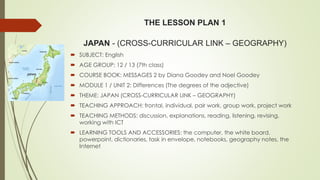
JAPAN - (CROSS-CURRICULAR LINK – GEOGRAPHY)
 SUBJECT: English
 AGE GROUP: 12 / 13 (7th class)
 COURSE BOOK: MESSAGES 2 by Diana Goodey and Noel Goodey
 MODULE 1 / UNIT 2: Differences (The degrees of the adjective)
 THEME: JAPAN (CROSS-CURRICULAR LINK – GEOGRAPHY)
 TEACHING APPROACH: frontal, individual, pair work, group work, project work
 TEACHING METHODS: discussion, explanations, reading, listening, revising,
working with ICT
 LEARNING TOOLS AND ACCESSORIES: the computer, the white board,
powerpoint, dictionaries, task in envelope, notebooks, geography notes, the
Internet
 LESSON OBJECTIVES:
a. Educational objectives:
 Reviewing and learning interesting facts about an unknown country – Japan
 completing a given text using English geographical names and other new
expressions
 searching for required information using Internet sources, books, notes from the
geography lesson
 writing new particularities using the new information obtained
b. Language content:
 English vocabulary linked to Japan
 Using the degrees of the adjective, primarily the comparative and superlative
degrees
 WORKING OBJECTIVES:
a. Listening and listening comprehension:
- listening and understanding the task instructions
- getting to know the vocabulary within the framework of the theme (Japan) and its
meaning and use in context
b. Speech and speech communication:
- Answering questions
- Using appropriate linguistic resources and vocabulary
c. Reading and reading comprehension:
- Developing reading skills and reading comprehension
- Learning the vocabulary within the framework of the given theme (Japan) and its use in
context
- Reading out loud
- Individual reading literature from the internet linked to the theme of the lesson (Japan)
d. Writing skills:
- Independent gap filling
- Independent writing of short texts
e. Mediation:
- Spoken and written mediation of answers
f. Developing digital competences:
- Responsible and safe use of ICT for acquiring, assessing and storing information
LESSON PROCEDURE
 English will be referred to as L2
 Slovenian (mother tongue) will be referred to as L1
 Step 1:
 Introduction for motivation purposes based on prior knowledge of Japan
from the geography lesson:
 - Using a power point presentation of the rising sun and the Japanese
anthem, the students are asked if they know why Japan is known as
*'the land of the rising sun'.
 - Looking at the Japanese flag with the red sun on a white background,
students discuss its symbolism*
 Step 2:
 New vocabulary linked to Japan:
- The teacher projects some English (L2) words (these are translations of newly-
acquired L1 words and expressions from their previous geography lesson on
Japan
- With the help of their geography notes, students are asked to read the words
projected silently to themselves and discuss their meanings with their neighbours
as well as help those students who have difficulty finding a link between the L2 and
L1 equivalents.
- Students are invited to explain the L2 word in L1 or give its L1 equivalent
 Step 3:
 Gap Fill:
- the students are then directed to individual L2 sentences containing known
information about Japan, but filled with gaps
- the students are asked to fill in the gaps using the newly-acquired L2
vocabulary already discussed in the first exercise
- the sentences are shown on the powerpoint one by one, so that everyone
concentrates on and/or discusses the same sentence.
 (Once an answer is given by a student, the correct answers appear under the given
sentence in yellow)
 Step 4:
 A revision of the degrees of the adjective:
- the new vocabulary is shown once again on the powerpoint
- students are asked to find adjectives among the projected words
 (= the biggest, the strongest, restless, overpopulated)
- with a raise of hands individual students give all three degrees of the adjectives found
and the L1 equivalent
- students are invited to check their geography notes and produce more L2 adjectives
with which they could describe Japan and its people, which the teacher randomly writes
on the board.
A revision of the expressions used with the degrees of the adjectives:
- the teacher projects and reviews L2 expressions used with adjectives
as ______ as
too ______
______ enough
_______ than
_______ in the world
- students add the appropriate degree:
as __1°___ as
too ___ 1°___
___1°__ enough
___2°__ than
___3°__ in the world
- this is followed by a short exercise again containing information of Japan, which the
students must complete with the correct degree of the given adjective and with the
help of the underlined words
 Step 5:
 PROJECT WORK:
- students are told that they are going to learn more about Japan
- each student is given an envelope containing material for project work:
 = one adjective, one thing/person/place that is linked to Japan, the
 name of another place with which to make a comparison; the
internet site
 where to look for information
 Instructions: (the instructions are explained and projected on the powerpoint as
well)
TASK:
- Write three sentences:
= in the first sentence use the superlative degree of the given adjective
to describe the thing/person/place in Japan
= in the second sentence find a fact, a piece of information to describe
the thing/person/place
= in the third sentence compare the thing/person/place with a similar
thing/person/place from a different country or place
= add a picture of the thing/person/place presented in your project
= prepare the material on A4 paper and print out
= exhibit in the L2 classroom
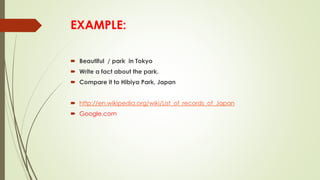
EXAMPLE:
Envelope material:
• Beautiful / park in Tokyo
• Write a fact about the park.
• Compare it to: Hibiya Park
• http://en.wikipedia.org/wiki/List_of_records_of_Japan
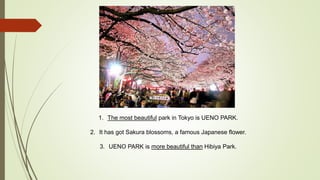
1. The most beautiful park in Tokyo is UENO PARK.
2. It has got Sakura blossoms, a famous Japanese flower.
3. UENO PARK is more beautiful than Hibiya Park.
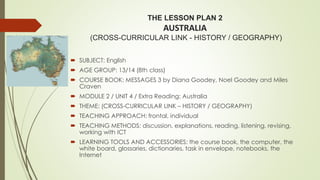
THE LESSON PLAN 2
AUSTRALIA
(CROSS-CURRICULAR LINK - HISTORY / GEOGRAPHY)
 SUBJECT: English
 AGE GROUP: 13/14 (8th class)
 COURSE BOOK: MESSAGES 3 by Diana Goodey, Noel Goodey and Miles
Craven
 MODULE 2 / UNIT 4 / Extra Reading: Australia
 THEME: (CROSS-CURRICULAR LINK – HISTORY / GEOGRAPHY)
 TEACHING APPROACH: frontal, individual
 TEACHING METHODS: discussion, explanations, reading, listening, revising,
working with ICT
 LEARNING TOOLS AND ACCESSORIES: the course book, the computer, the
white board, glossaries, dictionaries, task in envelope, notebooks, the
Internet
 LESSON OBJECTIVES:
a. Educational objectives:
- getting to know interesting facts about a less-known country – Australia
- reading about the given country
- analysing new words and expressions from the text and explaining them in L2
- searching for required information using Internet sources
- writing up particularities about other less-known countries using the new information
obtained
b. Language content:
- English vocabulary linked to Australia
- Learning to fill in a form
 WORKING OBJECTIVES:
a. Listening and listening comprehension:
- listening and understanding the task instructions
- reciprocal listening during pair work
b. Speech and speech communication:
- Answering questions
- Using appropriate linguistic resources and vocabulary
c. Reading and reading comprehension:
- Developing reading skills and reading comprehension
- Learning the vocabulary within the framework of the given theme (Australia) and its
use in context
- Reading silently and out loud
- Individual reading literature from the internet linked to the theme of the lesson
(Australia)
d. Writing and writing skills:
- Independent gap filling
e. Mediation:
- Spoken and written mediation of answers
f. Developing digital competences:
- Responsible and safe use of ICT for acquiring, assessing and storing information
LESSON PROCEDURE
 English will be referred to as L2
Slovenian (mother tonue) will be referred to as L1
Step 1:
 Introduction for motivation purposes based on any prior knowledge
of Australia
 Using the students' prior knowledge (from geography/history,
relatives), students are asked if they know anything about Australia
 Using the coursebook pictures and/or internet links as reference
they discuss and comment on what they see
 Step 2:
 Preparing for pair work / listening to instructions
- Students work in pairs using the text of Australia, the coursebook dictionary and
their glossaries
- The teacher projects words and expressions from the text and gives instructionas
for their task
 = students are to recopy the words and expressions into their glossaries
 = they search for the words and expressions in the text and try to guess at
 their meaning through the context of the text in which they are found
 = students write their meanings into their glossaries in L1 but also try to add
 an L2 explanation or find their synonyms
 = they are given a time limit, after which their work is discussed and
corrected by the students themselves
 Step 3:
 Pair work continued – Complete the Fact File about Australia
- Still working in pairs students recopy the fact file form for Australia into their
 exercise notebooks and fill in the required information from the text
- Their work in discussed and corrected
 Step 4:
 Learning about other unknown countries in the world
- Students work individually one per computer
- Each student is given an envelope in which there is the name of an unknown
country, an empty fact file and the internet site where to look for the required
information about the given country
- Each student searches the internet and having found the information, fills in the
fact file
 Step 5:
 A Poster of new countries
- Having filled in their fact file with facts of the unknown coutry, each student sticks
their fact file onto a poster entitled 'DID YOU KNOW...?'
 Step 6:
 A Collage of newly aquired countries
- After all the students have added their fact files to the poster, each student
presents their new country to the class.
END RESULT: A COLLAGE OF NEWLY ACQUIRED COUNTRIES
Expanding on the FACT FILE end product:
 = find the countries on the map of the world and signpost
them
 = expand the fact file with research on the
history/geography of the country (first settlers, wars fought,
trade, currency...)
 = using the fact file, make a simple travel brochure for a
tourist agency about what you can do and see there
 = pretend to be a tourist who has just arrived in that country
and describe your first impressions / expectations
 Create a dialogue or interview with one of the locals, where
you ask them questions about the country/region
 https://jhall128-integrate.weebly.com/key-elements.html
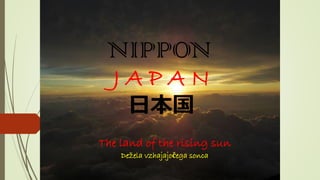
NIPPON
J A P A N
日本国
The land of the rising sun
Dežela vzhajajočega sonca
Nisshoki or Hinomaru
circle of the sun
1870
The red sun on a white
background representing honesty
and purity.
How well do you know Japan?
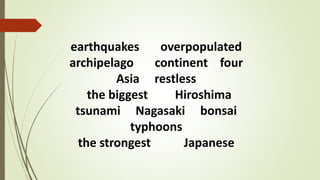
earthquakes overpopulated
archipelago continent four
Asia restless
the biggest Hiroshima
tsunami Nagasaki bonsai
typhoons
the strongest Japanese
How well do you know Japan?
earthquakes overpopulated archipelago continent
four Asia restless the biggest Hiroshima tsunami
Nagasaki bonsai typhoons the strongest Japanese
1. Japan is an __________. It is made up of __________ main
islands.
archipelago / four
2. Japan lies on the east coast of the ______________ of _______.
continent / Asia
3. Most people in Japan are ______________.
Japanese
4. Japan is a ____________ country because it has a lot of active
volcanoes and ________________.
restless / earthquakes
5. Cities that have too many people are ______________.
overpopulated
earthquakes overpopulated archipelago
continent four Asia restless the biggest
Hiroshima tsunami Nagasaki bonsai
typhoons the strongest Japanese
6. _____________ and _______________were destroyed by
the atomic bomb.
Hiroshima / Nagasaki
7. __________ is a very very small Japanese tree. Japanese
tropical winds are called ________________.
bonsai / typhoons
8. On 11th March, 2011 Japan experienced
_________________ _______________ in its history.
the strongest / tsunami
9. The capital city Tokyo is _____________ city in Japan with
12,790,000 people (in 2011).
the biggest
T O K Y O
earthquakes overpopulated
archipelago continent four
Asia restless
the biggest Hiroshima
tsunami Nagasaki bonsai
typhoons
the strongest Japanese
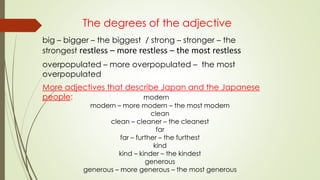
The degrees of the adjective
big – bigger – the biggest / strong – stronger – the
strongest restless – more restless – the most restless
overpopulated – more overpopulated – the most
overpopulated
More adjectives that describe Japan and the Japanese
people: modern
modern – more modern – the most modern
clean
clean – cleaner – the cleanest
far
far – further – the furthest
kind
kind – kinder – the kindest
generous
generous – more generous – the most generous
Using Adjectives
as ____ as
too ____
____ enough
____ than
____ car in Japan
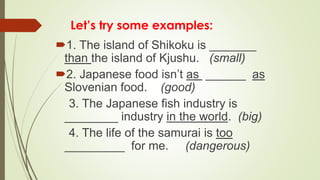
Let’s try some examples:
1. The island of Shikoku is _______
than the island of Kjushu. (small)
2. Japanese food isn’t as ______ as
Slovenian food. (good)
3. The Japanese fish industry is
________ industry in the world. (big)
4. The life of the samurai is too
_________ for me. (dangerous)
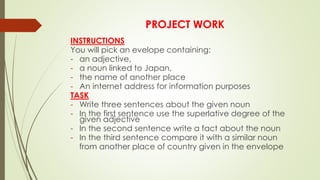
PROJECT WORK
INSTRUCTIONS
You will pick an evelope containing:
- an adjective,
- a noun linked to Japan,
- the name of another place
- An internet address for information purposes
TASK
- Write three sentences about the given noun
- In the first sentence use the superlative degree of the
given adjective
- In the second sentence write a fact about the noun
- In the third sentence compare it with a similar noun
from another place of country given in the envelope
EXAMPLE:
 Beautiful / park in Tokyo
 Write a fact about the park.
 Compare it to Hibiya Park, Japan
 http://en.wikipedia.org/wiki/List_of_records_of_Japan
 Google.com
 Na namizju boste odprli datoteko, v katero boste najdeno informacijo
sproti shranili v word doc.
 Po končanem iskanju boste povedi sestavili in napisali na A4 list ter dodali
eno sliko vašega primera
 Nato boste svoj izdelek natisnili, ga podpisali na nahrbtni strani in oddali.
 PRIMER……
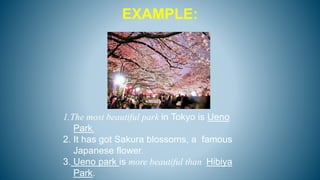
EXAMPLE:
1.The most beautiful park in Tokyo is Ueno
Park.
2. It has got Sakura blossoms, a famous
Japanese flower.
3. Ueno park is more beautiful than Hibiya
Park.
…Let’s begin…
http://en.wikipedia.org/wiki/List_of_records_of_Japan

Cross curricular teaching in the mfl classroom

  • 1.
    CROSS-CURRICULAR TEACHING IN THEMFL CLASSROOM by Magdalena Bobek, mag.
  • 2.
    CROSS-CURRICULAR TEACHING INTHE MFL CLASSROOM  Cross-curricular teaching and learning has been interpreted by teachers who use it in their lessons, in many different ways. One of the basic objectives in cross- curricular teaching is to cover as many subject areas within the lessons of a particular subject as possible to enable students to do activities that will access as much knowledge from as many subject areas within the curriculum. It also enables teachers to not stick so rigidly to their coursebooks, but rather expand the given objectives being taught to other subject areas while keeping in mind the main objectives within a certain unit.
  • 3.
     Today's MFLcoursebooks are often written by authors who are not natives of the country where a particular coursebook is being used, and sometimes the reading content presented in the books is not close to home for students who come from a different cultural background from that of the author. This can have a negative effect on them because they cannot identify themselves with that particular content. With little or no prior knowledge of the content's background, learning grammar from this perspective can be very difficult.
  • 4.
     However, ifteachers can bring content, which has already been taught in another subject area into the MFL classroom, even though foreign at first, it will serve as a basis from which to build vocabulary as well as grammar, and make it easier for students to understand.  MFL can be incorporated into any subject area in the curriculum. In MFL the cross- curricular approach can be used when introducing a new topic or grammar point, when reviewing grammar and expanding it to another subject area, expanding vocabulary as well as reading and writing skills.
  • 5.
     The cross-curricularsample of a lesson presented here shows how a geography lesson on Japan can be used in the L2 language classroom when revising the use of the degrees of the adjective and expanding vocabulary.  https://www.youtube.com/watch?v=i-ZZwY5Q8ZA  https://www.youtube.com/watch?v=2SYtynp-zg4
  • 6.
    THE LESSON PLAN1 JAPAN - (CROSS-CURRICULAR LINK – GEOGRAPHY)  SUBJECT: English  AGE GROUP: 12 / 13 (7th class)  COURSE BOOK: MESSAGES 2 by Diana Goodey and Noel Goodey  MODULE 1 / UNIT 2: Differences (The degrees of the adjective)  THEME: JAPAN (CROSS-CURRICULAR LINK – GEOGRAPHY)  TEACHING APPROACH: frontal, individual, pair work, group work, project work  TEACHING METHODS: discussion, explanations, reading, listening, revising, working with ICT  LEARNING TOOLS AND ACCESSORIES: the computer, the white board, powerpoint, dictionaries, task in envelope, notebooks, geography notes, the Internet
  • 7.
     LESSON OBJECTIVES: a.Educational objectives:  Reviewing and learning interesting facts about an unknown country – Japan  completing a given text using English geographical names and other new expressions  searching for required information using Internet sources, books, notes from the geography lesson  writing new particularities using the new information obtained b. Language content:  English vocabulary linked to Japan  Using the degrees of the adjective, primarily the comparative and superlative degrees
  • 8.
     WORKING OBJECTIVES: a.Listening and listening comprehension: - listening and understanding the task instructions - getting to know the vocabulary within the framework of the theme (Japan) and its meaning and use in context b. Speech and speech communication: - Answering questions - Using appropriate linguistic resources and vocabulary
  • 9.
    c. Reading andreading comprehension: - Developing reading skills and reading comprehension - Learning the vocabulary within the framework of the given theme (Japan) and its use in context - Reading out loud - Individual reading literature from the internet linked to the theme of the lesson (Japan) d. Writing skills: - Independent gap filling - Independent writing of short texts
  • 10.
    e. Mediation: - Spokenand written mediation of answers f. Developing digital competences: - Responsible and safe use of ICT for acquiring, assessing and storing information
  • 11.
    LESSON PROCEDURE  Englishwill be referred to as L2  Slovenian (mother tongue) will be referred to as L1  Step 1:  Introduction for motivation purposes based on prior knowledge of Japan from the geography lesson:  - Using a power point presentation of the rising sun and the Japanese anthem, the students are asked if they know why Japan is known as *'the land of the rising sun'.  - Looking at the Japanese flag with the red sun on a white background, students discuss its symbolism*
  • 12.
     Step 2: New vocabulary linked to Japan: - The teacher projects some English (L2) words (these are translations of newly- acquired L1 words and expressions from their previous geography lesson on Japan - With the help of their geography notes, students are asked to read the words projected silently to themselves and discuss their meanings with their neighbours as well as help those students who have difficulty finding a link between the L2 and L1 equivalents. - Students are invited to explain the L2 word in L1 or give its L1 equivalent
  • 13.
     Step 3: Gap Fill: - the students are then directed to individual L2 sentences containing known information about Japan, but filled with gaps - the students are asked to fill in the gaps using the newly-acquired L2 vocabulary already discussed in the first exercise - the sentences are shown on the powerpoint one by one, so that everyone concentrates on and/or discusses the same sentence.  (Once an answer is given by a student, the correct answers appear under the given sentence in yellow)
  • 14.
     Step 4: A revision of the degrees of the adjective: - the new vocabulary is shown once again on the powerpoint - students are asked to find adjectives among the projected words  (= the biggest, the strongest, restless, overpopulated) - with a raise of hands individual students give all three degrees of the adjectives found and the L1 equivalent - students are invited to check their geography notes and produce more L2 adjectives with which they could describe Japan and its people, which the teacher randomly writes on the board.
  • 15.
    A revision ofthe expressions used with the degrees of the adjectives: - the teacher projects and reviews L2 expressions used with adjectives as ______ as too ______ ______ enough _______ than _______ in the world - students add the appropriate degree: as __1°___ as too ___ 1°___ ___1°__ enough ___2°__ than ___3°__ in the world - this is followed by a short exercise again containing information of Japan, which the students must complete with the correct degree of the given adjective and with the help of the underlined words
  • 16.
     Step 5: PROJECT WORK: - students are told that they are going to learn more about Japan - each student is given an envelope containing material for project work:  = one adjective, one thing/person/place that is linked to Japan, the  name of another place with which to make a comparison; the internet site  where to look for information  Instructions: (the instructions are explained and projected on the powerpoint as well)
  • 17.
    TASK: - Write threesentences: = in the first sentence use the superlative degree of the given adjective to describe the thing/person/place in Japan = in the second sentence find a fact, a piece of information to describe the thing/person/place = in the third sentence compare the thing/person/place with a similar thing/person/place from a different country or place = add a picture of the thing/person/place presented in your project = prepare the material on A4 paper and print out = exhibit in the L2 classroom
  • 18.
    EXAMPLE: Envelope material: • Beautiful/ park in Tokyo • Write a fact about the park. • Compare it to: Hibiya Park • http://en.wikipedia.org/wiki/List_of_records_of_Japan
  • 19.
    1. The mostbeautiful park in Tokyo is UENO PARK. 2. It has got Sakura blossoms, a famous Japanese flower. 3. UENO PARK is more beautiful than Hibiya Park.
  • 20.
    THE LESSON PLAN2 AUSTRALIA (CROSS-CURRICULAR LINK - HISTORY / GEOGRAPHY)  SUBJECT: English  AGE GROUP: 13/14 (8th class)  COURSE BOOK: MESSAGES 3 by Diana Goodey, Noel Goodey and Miles Craven  MODULE 2 / UNIT 4 / Extra Reading: Australia  THEME: (CROSS-CURRICULAR LINK – HISTORY / GEOGRAPHY)  TEACHING APPROACH: frontal, individual  TEACHING METHODS: discussion, explanations, reading, listening, revising, working with ICT  LEARNING TOOLS AND ACCESSORIES: the course book, the computer, the white board, glossaries, dictionaries, task in envelope, notebooks, the Internet
  • 21.
     LESSON OBJECTIVES: a.Educational objectives: - getting to know interesting facts about a less-known country – Australia - reading about the given country - analysing new words and expressions from the text and explaining them in L2 - searching for required information using Internet sources - writing up particularities about other less-known countries using the new information obtained b. Language content: - English vocabulary linked to Australia - Learning to fill in a form
  • 22.
     WORKING OBJECTIVES: a.Listening and listening comprehension: - listening and understanding the task instructions - reciprocal listening during pair work b. Speech and speech communication: - Answering questions - Using appropriate linguistic resources and vocabulary
  • 23.
    c. Reading andreading comprehension: - Developing reading skills and reading comprehension - Learning the vocabulary within the framework of the given theme (Australia) and its use in context - Reading silently and out loud - Individual reading literature from the internet linked to the theme of the lesson (Australia)
  • 24.
    d. Writing andwriting skills: - Independent gap filling e. Mediation: - Spoken and written mediation of answers f. Developing digital competences: - Responsible and safe use of ICT for acquiring, assessing and storing information
  • 25.
    LESSON PROCEDURE  Englishwill be referred to as L2 Slovenian (mother tonue) will be referred to as L1 Step 1:  Introduction for motivation purposes based on any prior knowledge of Australia  Using the students' prior knowledge (from geography/history, relatives), students are asked if they know anything about Australia  Using the coursebook pictures and/or internet links as reference they discuss and comment on what they see
  • 26.
     Step 2: Preparing for pair work / listening to instructions - Students work in pairs using the text of Australia, the coursebook dictionary and their glossaries - The teacher projects words and expressions from the text and gives instructionas for their task  = students are to recopy the words and expressions into their glossaries  = they search for the words and expressions in the text and try to guess at  their meaning through the context of the text in which they are found  = students write their meanings into their glossaries in L1 but also try to add  an L2 explanation or find their synonyms
  • 27.
     = theyare given a time limit, after which their work is discussed and corrected by the students themselves  Step 3:  Pair work continued – Complete the Fact File about Australia - Still working in pairs students recopy the fact file form for Australia into their  exercise notebooks and fill in the required information from the text - Their work in discussed and corrected
  • 28.
     Step 4: Learning about other unknown countries in the world - Students work individually one per computer - Each student is given an envelope in which there is the name of an unknown country, an empty fact file and the internet site where to look for the required information about the given country - Each student searches the internet and having found the information, fills in the fact file
  • 29.
     Step 5: A Poster of new countries - Having filled in their fact file with facts of the unknown coutry, each student sticks their fact file onto a poster entitled 'DID YOU KNOW...?'  Step 6:  A Collage of newly aquired countries - After all the students have added their fact files to the poster, each student presents their new country to the class. END RESULT: A COLLAGE OF NEWLY ACQUIRED COUNTRIES
  • 30.
    Expanding on theFACT FILE end product:  = find the countries on the map of the world and signpost them  = expand the fact file with research on the history/geography of the country (first settlers, wars fought, trade, currency...)  = using the fact file, make a simple travel brochure for a tourist agency about what you can do and see there  = pretend to be a tourist who has just arrived in that country and describe your first impressions / expectations  Create a dialogue or interview with one of the locals, where you ask them questions about the country/region  https://jhall128-integrate.weebly.com/key-elements.html
  • 31.
    NIPPON J A PA N 日本国 The land of the rising sun Dežela vzhajajočega sonca
  • 32.
    Nisshoki or Hinomaru circleof the sun 1870 The red sun on a white background representing honesty and purity.
  • 33.
    How well doyou know Japan? earthquakes overpopulated archipelago continent four Asia restless the biggest Hiroshima tsunami Nagasaki bonsai typhoons the strongest Japanese
  • 34.
    How well doyou know Japan? earthquakes overpopulated archipelago continent four Asia restless the biggest Hiroshima tsunami Nagasaki bonsai typhoons the strongest Japanese 1. Japan is an __________. It is made up of __________ main islands. archipelago / four 2. Japan lies on the east coast of the ______________ of _______. continent / Asia 3. Most people in Japan are ______________. Japanese 4. Japan is a ____________ country because it has a lot of active volcanoes and ________________. restless / earthquakes 5. Cities that have too many people are ______________. overpopulated
  • 35.
    earthquakes overpopulated archipelago continentfour Asia restless the biggest Hiroshima tsunami Nagasaki bonsai typhoons the strongest Japanese 6. _____________ and _______________were destroyed by the atomic bomb. Hiroshima / Nagasaki 7. __________ is a very very small Japanese tree. Japanese tropical winds are called ________________. bonsai / typhoons 8. On 11th March, 2011 Japan experienced _________________ _______________ in its history. the strongest / tsunami 9. The capital city Tokyo is _____________ city in Japan with 12,790,000 people (in 2011). the biggest
  • 36.
    T O KY O
  • 37.
    earthquakes overpopulated archipelago continentfour Asia restless the biggest Hiroshima tsunami Nagasaki bonsai typhoons the strongest Japanese
  • 38.
    The degrees ofthe adjective big – bigger – the biggest / strong – stronger – the strongest restless – more restless – the most restless overpopulated – more overpopulated – the most overpopulated More adjectives that describe Japan and the Japanese people: modern modern – more modern – the most modern clean clean – cleaner – the cleanest far far – further – the furthest kind kind – kinder – the kindest generous generous – more generous – the most generous
  • 39.
    Using Adjectives as ____as too ____ ____ enough ____ than ____ car in Japan
  • 40.
    Let’s try someexamples: 1. The island of Shikoku is _______ than the island of Kjushu. (small) 2. Japanese food isn’t as ______ as Slovenian food. (good) 3. The Japanese fish industry is ________ industry in the world. (big) 4. The life of the samurai is too _________ for me. (dangerous)
  • 41.
    PROJECT WORK INSTRUCTIONS You willpick an evelope containing: - an adjective, - a noun linked to Japan, - the name of another place - An internet address for information purposes TASK - Write three sentences about the given noun - In the first sentence use the superlative degree of the given adjective - In the second sentence write a fact about the noun - In the third sentence compare it with a similar noun from another place of country given in the envelope
  • 42.
    EXAMPLE:  Beautiful /park in Tokyo  Write a fact about the park.  Compare it to Hibiya Park, Japan  http://en.wikipedia.org/wiki/List_of_records_of_Japan  Google.com
  • 43.
     Na namizjuboste odprli datoteko, v katero boste najdeno informacijo sproti shranili v word doc.  Po končanem iskanju boste povedi sestavili in napisali na A4 list ter dodali eno sliko vašega primera  Nato boste svoj izdelek natisnili, ga podpisali na nahrbtni strani in oddali.  PRIMER……
  • 44.
    EXAMPLE: 1.The most beautifulpark in Tokyo is Ueno Park. 2. It has got Sakura blossoms, a famous Japanese flower. 3. Ueno park is more beautiful than Hibiya Park.
  • 45.