Crop Insurance in India

1
The Agenda
Indian Agriculture & Risks
What’s Index Insurance?
Why Index Insurance?
Architecture of Indian Crop Insurance
Coverage: The Numbers
Index Insurance: Challenges
Weather Index: Recent Developments & Innovations
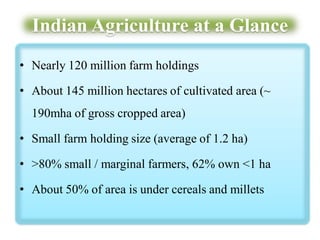
Indian Agriculture at a Glance
• Nearly 120 million farm holdings
• About 145 million hectares of cultivated area (~
190mha of gross cropped area)
• Small farm holding size (average of 1.2 ha)
• >80% small / marginal farmers, 62% own <1 ha
• About 50% of area is under cereals and millets
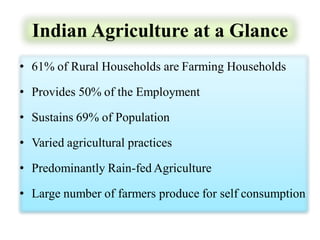
Indian Agriculture at a Glance
• 61% of Rural Households are Farming Households

• Provides 50% of the Employment
• Sustains 69% of Population
• Varied agricultural practices
• Predominantly Rain-fed Agriculture
• Large number of farmers produce for self consumption
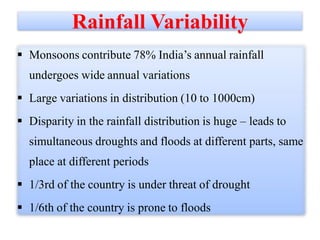
Rainfall Variability
 Monsoons contribute 78% India’s annual rainfall
undergoes wide annual variations
 Large variations in distribution (10 to 1000cm)
 Disparity in the rainfall distribution is huge – leads to
simultaneous droughts and floods at different parts, same
place at different periods

 1/3rd of the country is under threat of drought
 1/6th of the country is prone to floods
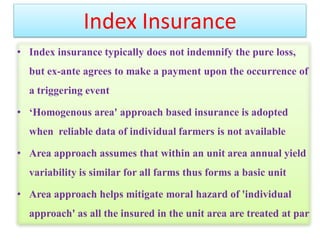
Index Insurance
• Index insurance typically does not indemnify the pure loss,
but ex-ante agrees to make a payment upon the occurrence of

a triggering event
• ‘Homogenous area' approach based insurance is adopted
when reliable data of individual farmers is not available
• Area approach assumes that within an unit area annual yield
variability is similar for all farms thus forms a basic unit
• Area approach helps mitigate moral hazard of 'individual

approach' as all the insured in the unit area are treated at par
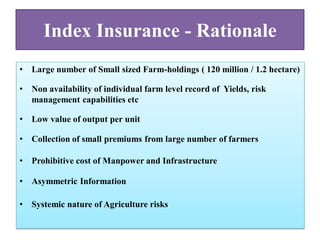
Index Insurance - Rationale
•

Large number of Small sized Farm-holdings ( 120 million / 1.2 hectare)

•

Non availability of individual farm level record of Yields, risk
management capabilities etc

•

Low value of output per unit

•

Collection of small premiums from large number of farmers

•

Prohibitive cost of Manpower and Infrastructure

•

Asymmetric Information

•

Systemic nature of Agriculture risks
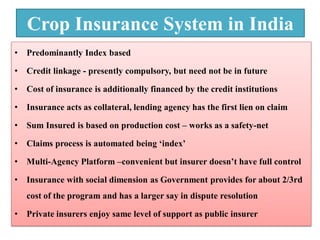
Crop Insurance System in India
•

Predominantly Index based

•

Credit linkage - presently compulsory, but need not be in future

•

Cost of insurance is additionally financed by the credit institutions

•

Insurance acts as collateral, lending agency has the first lien on claim

•

Sum Insured is based on production cost – works as a safety-net

•

Claims process is automated being ‘index’

•

Multi-Agency Platform –convenient but insurer doesn’t have full control

•

Insurance with social dimension as Government provides for about 2/3rd
cost of the program and has a larger say in dispute resolution

•

Private insurers enjoy same level of support as public insurer
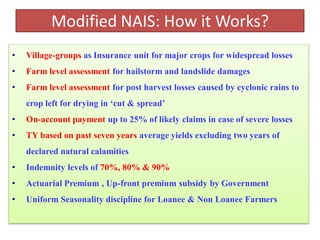
Modified NAIS: How it Works?
•

Village-groups as Insurance unit for major crops for widespread losses

•

Farm level assessment for hailstorm and landslide damages

•

Farm level assessment for post harvest losses caused by cyclonic rains to

crop left for drying in ‘cut & spread’
•

On-account payment up to 25% of likely claims in case of severe losses

•

TY based on past seven years average yields excluding two years of

declared natural calamities
•

Indemnity levels of 70%, 80% & 90%

•

Actuarial Premium , Up-front premium subsidy by Government

•

Uniform Seasonality discipline for Loanee & Non Loanee Farmers
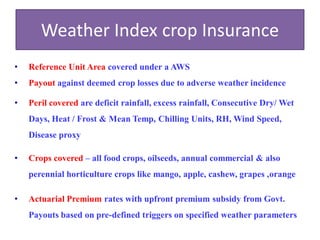
Weather Index crop Insurance
•

Reference Unit Area covered under a AWS

•

Payout against deemed crop losses due to adverse weather incidence

•

Peril covered are deficit rainfall, excess rainfall, Consecutive Dry/ Wet
Days, Heat / Frost & Mean Temp, Chilling Units, RH, Wind Speed,
Disease proxy

•

Crops covered – all food crops, oilseeds, annual commercial & also
perennial horticulture crops like mango, apple, cashew, grapes ,orange

•

Actuarial Premium rates with upfront premium subsidy from Govt.

Payouts based on pre-defined triggers on specified weather parameters
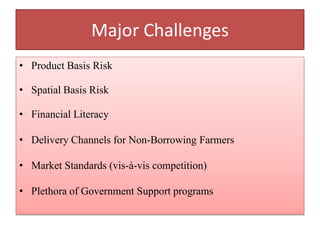
Major Challenges
• Product Basis Risk
• Spatial Basis Risk
• Financial Literacy
• Delivery Channels for Non-Borrowing Farmers
• Market Standards (vis-à-vis competition)
• Plethora of Government Support programs
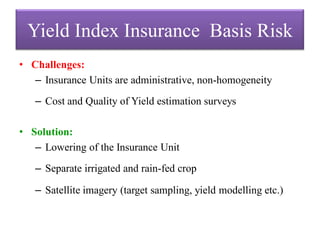
Yield Index Insurance Basis Risk
• Challenges:
– Insurance Units are administrative, non-homogeneity
– Cost and Quality of Yield estimation surveys
• Solution:
– Lowering of the Insurance Unit
– Separate irrigated and rain-fed crop

– Satellite imagery (target sampling, yield modelling etc.)
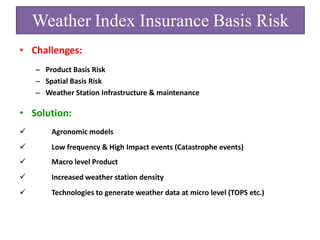
Weather Index Insurance Basis Risk
• Challenges:
– Product Basis Risk
– Spatial Basis Risk
– Weather Station Infrastructure & maintenance

• Solution:


Agronomic models



Low frequency & High Impact events (Catastrophe events)



Macro level Product



Increased weather station density



Technologies to generate weather data at micro level (TOPS etc.)
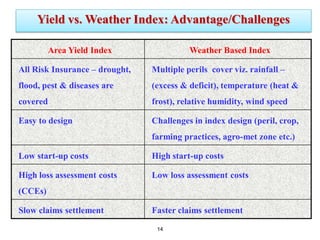
Yield vs. Weather Index: Advantage/Challenges
Area Yield Index

Weather Based Index

All Risk Insurance – drought,

Multiple perils cover viz. rainfall –

flood, pest & diseases are

(excess & deficit), temperature (heat &

covered

frost), relative humidity, wind speed

Easy to design

Challenges in index design (peril, crop,

farming practices, agro-met zone etc.)
Low start-up costs

High start-up costs

High loss assessment costs

Low loss assessment costs

(CCEs)
Slow claims settlement

Faster claims settlement
14
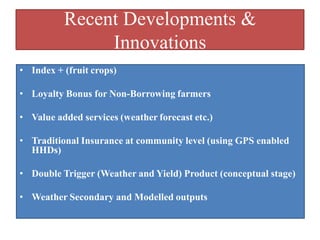
Recent Developments &
Innovations
• Index + (fruit crops)
• Loyalty Bonus for Non-Borrowing farmers
• Value added services (weather forecast etc.)
• Traditional Insurance at community level (using GPS enabled
HHDs)

• Double Trigger (Weather and Yield) Product (conceptual stage)
• Weather Secondary and Modelled outputs
Thanks!

Crop insurance in India

  • 1.
  • 2.
    The Agenda Indian Agriculture& Risks What’s Index Insurance? Why Index Insurance? Architecture of Indian Crop Insurance Coverage: The Numbers Index Insurance: Challenges Weather Index: Recent Developments & Innovations
  • 3.
    Indian Agriculture ata Glance • Nearly 120 million farm holdings • About 145 million hectares of cultivated area (~ 190mha of gross cropped area) • Small farm holding size (average of 1.2 ha) • >80% small / marginal farmers, 62% own <1 ha • About 50% of area is under cereals and millets
  • 4.
    Indian Agriculture ata Glance • 61% of Rural Households are Farming Households • Provides 50% of the Employment • Sustains 69% of Population • Varied agricultural practices • Predominantly Rain-fed Agriculture • Large number of farmers produce for self consumption
  • 5.
    Rainfall Variability  Monsoonscontribute 78% India’s annual rainfall undergoes wide annual variations  Large variations in distribution (10 to 1000cm)  Disparity in the rainfall distribution is huge – leads to simultaneous droughts and floods at different parts, same place at different periods  1/3rd of the country is under threat of drought  1/6th of the country is prone to floods
  • 6.
    Index Insurance • Indexinsurance typically does not indemnify the pure loss, but ex-ante agrees to make a payment upon the occurrence of a triggering event • ‘Homogenous area' approach based insurance is adopted when reliable data of individual farmers is not available • Area approach assumes that within an unit area annual yield variability is similar for all farms thus forms a basic unit • Area approach helps mitigate moral hazard of 'individual approach' as all the insured in the unit area are treated at par
  • 7.
    Index Insurance -Rationale • Large number of Small sized Farm-holdings ( 120 million / 1.2 hectare) • Non availability of individual farm level record of Yields, risk management capabilities etc • Low value of output per unit • Collection of small premiums from large number of farmers • Prohibitive cost of Manpower and Infrastructure • Asymmetric Information • Systemic nature of Agriculture risks
  • 8.
    Crop Insurance Systemin India • Predominantly Index based • Credit linkage - presently compulsory, but need not be in future • Cost of insurance is additionally financed by the credit institutions • Insurance acts as collateral, lending agency has the first lien on claim • Sum Insured is based on production cost – works as a safety-net • Claims process is automated being ‘index’ • Multi-Agency Platform –convenient but insurer doesn’t have full control • Insurance with social dimension as Government provides for about 2/3rd cost of the program and has a larger say in dispute resolution • Private insurers enjoy same level of support as public insurer
  • 9.
    Modified NAIS: Howit Works? • Village-groups as Insurance unit for major crops for widespread losses • Farm level assessment for hailstorm and landslide damages • Farm level assessment for post harvest losses caused by cyclonic rains to crop left for drying in ‘cut & spread’ • On-account payment up to 25% of likely claims in case of severe losses • TY based on past seven years average yields excluding two years of declared natural calamities • Indemnity levels of 70%, 80% & 90% • Actuarial Premium , Up-front premium subsidy by Government • Uniform Seasonality discipline for Loanee & Non Loanee Farmers
  • 10.
    Weather Index cropInsurance • Reference Unit Area covered under a AWS • Payout against deemed crop losses due to adverse weather incidence • Peril covered are deficit rainfall, excess rainfall, Consecutive Dry/ Wet Days, Heat / Frost & Mean Temp, Chilling Units, RH, Wind Speed, Disease proxy • Crops covered – all food crops, oilseeds, annual commercial & also perennial horticulture crops like mango, apple, cashew, grapes ,orange • Actuarial Premium rates with upfront premium subsidy from Govt. Payouts based on pre-defined triggers on specified weather parameters
  • 11.
    Major Challenges • ProductBasis Risk • Spatial Basis Risk • Financial Literacy • Delivery Channels for Non-Borrowing Farmers • Market Standards (vis-à-vis competition) • Plethora of Government Support programs
  • 12.
    Yield Index InsuranceBasis Risk • Challenges: – Insurance Units are administrative, non-homogeneity – Cost and Quality of Yield estimation surveys • Solution: – Lowering of the Insurance Unit – Separate irrigated and rain-fed crop – Satellite imagery (target sampling, yield modelling etc.)
  • 13.
    Weather Index InsuranceBasis Risk • Challenges: – Product Basis Risk – Spatial Basis Risk – Weather Station Infrastructure & maintenance • Solution:  Agronomic models  Low frequency & High Impact events (Catastrophe events)  Macro level Product  Increased weather station density  Technologies to generate weather data at micro level (TOPS etc.)
  • 14.
    Yield vs. WeatherIndex: Advantage/Challenges Area Yield Index Weather Based Index All Risk Insurance – drought, Multiple perils cover viz. rainfall – flood, pest & diseases are (excess & deficit), temperature (heat & covered frost), relative humidity, wind speed Easy to design Challenges in index design (peril, crop, farming practices, agro-met zone etc.) Low start-up costs High start-up costs High loss assessment costs Low loss assessment costs (CCEs) Slow claims settlement Faster claims settlement 14
  • 15.
    Recent Developments & Innovations •Index + (fruit crops) • Loyalty Bonus for Non-Borrowing farmers • Value added services (weather forecast etc.) • Traditional Insurance at community level (using GPS enabled HHDs) • Double Trigger (Weather and Yield) Product (conceptual stage) • Weather Secondary and Modelled outputs
  • 16.