Customer Relationship Management Introduction to Customer Relationship Management
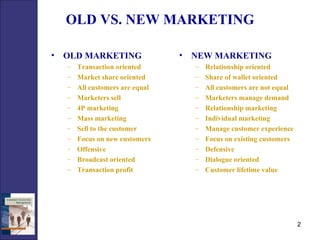
OLD VS. NEW MARKETING OLD MARKETING Transaction oriented Market share oriented All customers are equal Marketers sell 4P marketing Mass marketing Sell to the customer Focus on new customers Offensive Broadcast oriented Transaction profit NEW MARKETING Relationship oriented Share of wallet oriented All customers are not equal Marketers manage demand Relationship marketing Individual marketing Manage customer experience Focus on existing customers Defensive Dialogue oriented Customer lifetime value
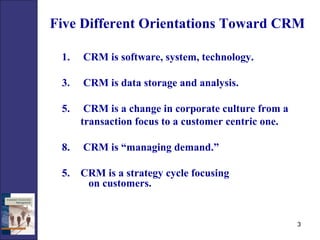
Five Different Orientations Toward CRM CRM is software, system, technology. CRM is data storage and analysis. CRM is a change in corporate culture from a  transaction focus to a customer centric one. CRM is “managing demand.” 5.  CRM is a strategy cycle focusing  on customers.
A CRM System Contains Four Components Data warehouse Analytical tools Campaign management tools Interfaces to maintain databases
CRM System Failure When CRM systems fail, it tends to be as a result of cultural as opposed to technological issues.
The Market Share Fallacy Increasing market share should not be a company’s goal. Rather, increasing share of the right kinds of customers should be the goal.
CRM is Founded on Four Tenets Customers should be managed as important assets. Not all customers are equally desirable. Customers vary in their needs, preferences, and buying behavior. By better understanding their customers, companies can tailor their offerings to maximize their overall value.
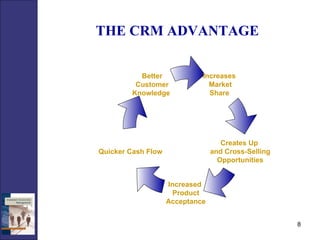
THE CRM ADVANTAGE Increases Market Share  Quicker Cash Flow  Better Customer Knowledge   Creates Up  and Cross-Selling Opportunities Increased  Product Acceptance
Definition   “ Customer Relationship Management is the initiation, enhancement, and maintenance of mutually beneficial customer and partner long-term relationships through business intelligence-generated strategies based on the capture, storing, and analysis of information gathered from all customer and partner touch points and transaction processing systems.” Baran, Galka, Strunk
Do You Want To Keep These Customers? Do not buy frequently Buy your products only when they are on sale Frequently return your merchandise Complain a lot Recommend your company to others just like them
Offensive vs. Defensive Marketing OM refers to increasing your customer base. DM refers to activities aimed at existing customers. Defensive marketing has become more profitable. “Mass and Blast” is being replaced by 1:1.
Why CRM Systems are Being Used   Identifying prospects Acquiring customers Developing customers Cross-selling and up-selling Managing migration Servicing Retaining Increasing loyalty Winning back defectors
Four Basic Steps in CRM ID your customers in detail. Differentiate the most and least profitable. Interact. Customize your offerings to fit each  customer’s needs.
CRM Systems   Allow companies to ID   and focus on their high-profit customers while enabling companies to transform low-value customers into higher-value ones.
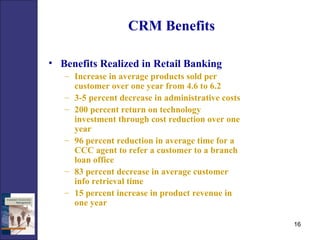
Retail Banks Have Realized the Following Benefits from CRM Benefits  Increase in average products sold per customer over one year from 4.6 to 6.2 3-5 percent decrease in administrative costs 200 percent return on technology investment through cost reduction over one year 96 percent reduction in average time for a CCC agent to refer a customer to a branch loan office 83 percent decrease in average customer info retrieval time 15 percent increase in product revenue in one year
CRM Benefits  Benefits Realized in Retail Banking Increase in average products sold per customer over one year from 4.6 to 6.2 3-5 percent decrease in administrative costs 200 percent return on technology investment through cost reduction over one year 96 percent reduction in average time for a CCC agent to refer a customer to a branch loan office 83 percent decrease in average customer info retrieval time 15 percent increase in product revenue in one year
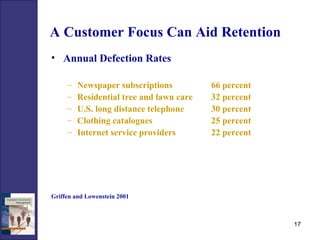
A Customer Focus Can Aid Retention Annual Defection Rates  Newspaper subscriptions 66 percent Residential tree and lawn care  32 percent U.S. long distance telephone 30 percent Clothing catalogues 25 percent Internet service providers 22 percent Griffen and Lowenstein 2001
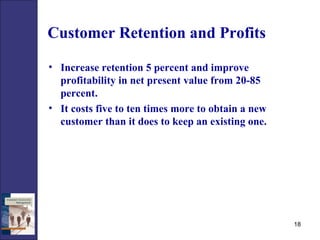
Customer Retention and Profits  Increase retention 5 percent and improve profitability in net present value from 20-85 percent. It costs five to ten times more to obtain a new customer than it does to keep an existing one.
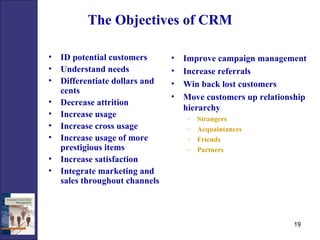
The Objectives of CRM ID potential customers Understand needs Differentiate dollars and cents Decrease attrition Increase usage Increase cross usage Increase usage of more prestigious items Increase satisfaction Integrate marketing and sales throughout channels Improve campaign management Increase referrals Win back lost customers Move customers up relationship hierarchy  Strangers Acquaintances Friends Partners
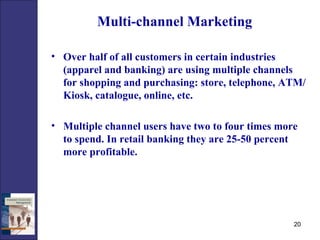
Multi-channel Marketing Over half of all customers in certain industries (apparel and banking) are using multiple channels for shopping and purchasing: store, telephone, ATM/Kiosk, catalogue, online, etc.  Multiple channel users have two to four times more to spend. In retail banking they are 25-50 percent more profitable.
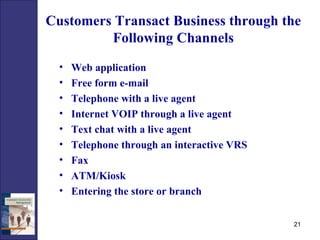
Customers Transact Business through the Following Channels Web application Free form e-mail Telephone with a live agent Internet VOIP through a live agent Text chat with a live agent Telephone through an interactive VRS Fax ATM/Kiosk Entering the store or branch
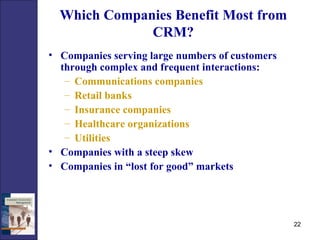
Which Companies Benefit Most from CRM? Companies serving large numbers of customers through complex and frequent interactions:  Communications companies Retail banks Insurance companies Healthcare organizations Utilities Companies with a steep skew Companies in “lost for good” markets
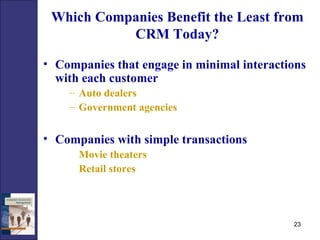
Which Companies Benefit the Least from CRM Today? Companies that engage in minimal interactions with each customer Auto dealers Government agencies Companies with simple transactions Movie theaters Retail stores

Crm

  • 1.
    Customer Relationship ManagementIntroduction to Customer Relationship Management
  • 2.
    OLD VS. NEWMARKETING OLD MARKETING Transaction oriented Market share oriented All customers are equal Marketers sell 4P marketing Mass marketing Sell to the customer Focus on new customers Offensive Broadcast oriented Transaction profit NEW MARKETING Relationship oriented Share of wallet oriented All customers are not equal Marketers manage demand Relationship marketing Individual marketing Manage customer experience Focus on existing customers Defensive Dialogue oriented Customer lifetime value
  • 3.
    Five Different OrientationsToward CRM CRM is software, system, technology. CRM is data storage and analysis. CRM is a change in corporate culture from a transaction focus to a customer centric one. CRM is “managing demand.” 5. CRM is a strategy cycle focusing on customers.
  • 4.
    A CRM SystemContains Four Components Data warehouse Analytical tools Campaign management tools Interfaces to maintain databases
  • 5.
    CRM System FailureWhen CRM systems fail, it tends to be as a result of cultural as opposed to technological issues.
  • 6.
    The Market ShareFallacy Increasing market share should not be a company’s goal. Rather, increasing share of the right kinds of customers should be the goal.
  • 7.
    CRM is Foundedon Four Tenets Customers should be managed as important assets. Not all customers are equally desirable. Customers vary in their needs, preferences, and buying behavior. By better understanding their customers, companies can tailor their offerings to maximize their overall value.
  • 8.
    THE CRM ADVANTAGEIncreases Market Share Quicker Cash Flow Better Customer Knowledge Creates Up and Cross-Selling Opportunities Increased Product Acceptance
  • 9.
    Definition “ Customer Relationship Management is the initiation, enhancement, and maintenance of mutually beneficial customer and partner long-term relationships through business intelligence-generated strategies based on the capture, storing, and analysis of information gathered from all customer and partner touch points and transaction processing systems.” Baran, Galka, Strunk
  • 10.
    Do You WantTo Keep These Customers? Do not buy frequently Buy your products only when they are on sale Frequently return your merchandise Complain a lot Recommend your company to others just like them
  • 11.
    Offensive vs. DefensiveMarketing OM refers to increasing your customer base. DM refers to activities aimed at existing customers. Defensive marketing has become more profitable. “Mass and Blast” is being replaced by 1:1.
  • 12.
    Why CRM Systemsare Being Used Identifying prospects Acquiring customers Developing customers Cross-selling and up-selling Managing migration Servicing Retaining Increasing loyalty Winning back defectors
  • 13.
    Four Basic Stepsin CRM ID your customers in detail. Differentiate the most and least profitable. Interact. Customize your offerings to fit each customer’s needs.
  • 14.
    CRM Systems Allow companies to ID and focus on their high-profit customers while enabling companies to transform low-value customers into higher-value ones.
  • 15.
    Retail Banks HaveRealized the Following Benefits from CRM Benefits Increase in average products sold per customer over one year from 4.6 to 6.2 3-5 percent decrease in administrative costs 200 percent return on technology investment through cost reduction over one year 96 percent reduction in average time for a CCC agent to refer a customer to a branch loan office 83 percent decrease in average customer info retrieval time 15 percent increase in product revenue in one year
  • 16.
    CRM Benefits Benefits Realized in Retail Banking Increase in average products sold per customer over one year from 4.6 to 6.2 3-5 percent decrease in administrative costs 200 percent return on technology investment through cost reduction over one year 96 percent reduction in average time for a CCC agent to refer a customer to a branch loan office 83 percent decrease in average customer info retrieval time 15 percent increase in product revenue in one year
  • 17.
    A Customer FocusCan Aid Retention Annual Defection Rates Newspaper subscriptions 66 percent Residential tree and lawn care 32 percent U.S. long distance telephone 30 percent Clothing catalogues 25 percent Internet service providers 22 percent Griffen and Lowenstein 2001
  • 18.
    Customer Retention andProfits Increase retention 5 percent and improve profitability in net present value from 20-85 percent. It costs five to ten times more to obtain a new customer than it does to keep an existing one.
  • 19.
    The Objectives ofCRM ID potential customers Understand needs Differentiate dollars and cents Decrease attrition Increase usage Increase cross usage Increase usage of more prestigious items Increase satisfaction Integrate marketing and sales throughout channels Improve campaign management Increase referrals Win back lost customers Move customers up relationship hierarchy Strangers Acquaintances Friends Partners
  • 20.
    Multi-channel Marketing Overhalf of all customers in certain industries (apparel and banking) are using multiple channels for shopping and purchasing: store, telephone, ATM/Kiosk, catalogue, online, etc. Multiple channel users have two to four times more to spend. In retail banking they are 25-50 percent more profitable.
  • 21.
    Customers Transact Businessthrough the Following Channels Web application Free form e-mail Telephone with a live agent Internet VOIP through a live agent Text chat with a live agent Telephone through an interactive VRS Fax ATM/Kiosk Entering the store or branch
  • 22.
    Which Companies BenefitMost from CRM? Companies serving large numbers of customers through complex and frequent interactions: Communications companies Retail banks Insurance companies Healthcare organizations Utilities Companies with a steep skew Companies in “lost for good” markets
  • 23.
    Which Companies Benefitthe Least from CRM Today? Companies that engage in minimal interactions with each customer Auto dealers Government agencies Companies with simple transactions Movie theaters Retail stores