THE INTERNATIONAL ENVIRONMENT  FOR PROMOTION and IMC 7.1
Cultural Communications Culture  - Total Way of a People, the Social Legacy the Individual Acquires from His or Her Group Culture is Typically Invisible to Those Who are Immersed In It, Making Communication Across Cultures Difficult 7.2
Importance of International Communication Complex Social, Political & Economic Changes Affect International Communications Environment.  International Developments Relevant to the Rise in International Commercial Communications: Development of Trading Blocs - May be Prelude to a Rise in Nationalism Loosening of Political and Economic Constraints 7.3
Importance and Rise of International Communication  (con’t) Liberalization of the Flow of Labor and Increase in movements of Peoples Across Borders Growing Size of Ethnic Groups From Elevated Birth Rates Rise of Cultural Borders and Barriers even as Economic Barriers Begin to Fall 7.4
Overcoming Cultural Barriers in International Promotion Barriers to Creating Successful International  Promotions Ethnocentrism Self-Reference Criterion 7.5
How Might This American Ad Be Viewed as Ethnocentric 7.6
Overcoming Cultural Barriers in  International Promotion  (con’t) Cross-Cultural Research Helps Overcome Barriers Secondary Data - Data Gathered by Someone Else  for Some Other Purpose Primary Data - Specific Data Collection Unique to a Promotional Situation Economic Conditions Demographics Characteristics Values  Custom & Ritual Product Use & Preference 7.7
Challenges in International Advertising Creative Challenge Media Challenge Media Availability & Coverage Media Costs & Pricing Regulatory Challenge 7.8
International Markets Prefer Different Creative Executions 7.9
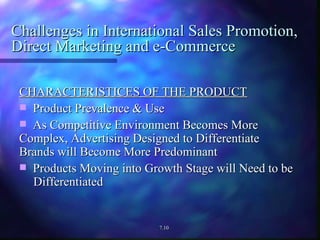
Challenges in International Sales Promotion, Direct Marketing and e-Commerce CHARACTERISTICES OF THE PRODUCT Product Prevalence & Use As Competitive Environment Becomes More  Complex, Advertising Designed to Differentiate  Brands will Become More Predominant Products Moving into Growth Stage will Need to be  Differentiated 7.10
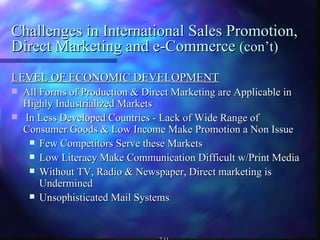
Challenges in International Sales Promotion, Direct Marketing and e-Commerce  (con’t) LEVEL OF ECONOMIC DEVELOPMENT All Forms of Production & Direct Marketing are Applicable in  Highly Industrialized Markets In Less Developed Countries - Lack of Wide Range of  Consumer Goods & Low Income Make Promotion a Non Issue Few Competitors Serve these Markets Low Literacy Make Communication Difficult w/Print Media Without TV, Radio & Newspaper, Direct marketing is Undermined Unsophisticated Mail Systems 7.11
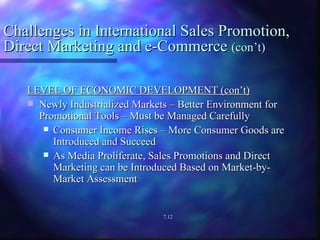
Challenges in International Sales Promotion, Direct Marketing and e-Commerce  (con’t) LEVEL OF ECONOMIC DEVELOPMENT (con’t) Newly Industrialized Markets – Better Environment for Promotional Tools – Must be Managed Carefully Consumer Income Rises – More Consumer Goods are Introduced and Succeed As Media Proliferate, Sales Promotions and Direct Marketing can be Introduced Based on Market-by-Market Assessment 7.12
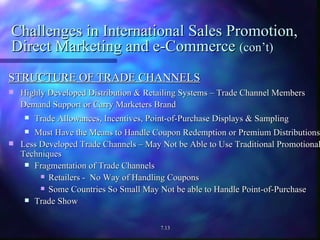
Challenges in International Sales Promotion, Direct Marketing and e-Commerce  (con’t) STRUCTURE OF TRADE CHANNELS Highly Developed Distribution & Retailing Systems – Trade Channel Members Demand Support or Carry Marketers Brand Trade Allowances, Incentives, Point-of-Purchase Displays & Sampling Must Have the Means to Handle Coupon Redemption or Premium Distributions Less Developed Trade Channels – May Not be Able to Use Traditional Promotional Techniques Fragmentation of Trade Channels Retailers -  No Way of Handling Coupons Some Countries So Small May Not be able to Handle Point-of-Purchase  Trade Show 7.13
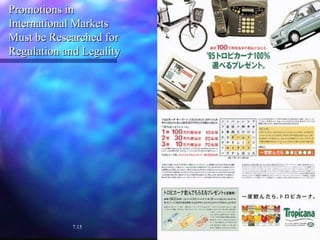
Challenges in International Sales Promotion, Direct Marketing and e-Commerce  (con’t) REGULATIONS Regulation of Promotion, Direct Marketing, and e-Commerce Varies Widely Market-to-Market Most Sales Promotion Tools are Legal Across Europe Sweepstakes are Either Heavily Banned or Regulated in All European Markets In Japan – Value of Premium Offered with a Product is Limited to 10% of the Value of the Original Price 7.14
Promotions in  International Markets Must be Researched for Regulation and Legality 7.15
Challenges in International Public Relations COMPANIES HAVE LESS CONTROL OVER GLOBAL PUBLICITY RELATIVE TO DOMESTIC SITUATIONS, AND NO CORPORATIONS ARE POWERFUL ENOUGH TO CONTROL A HOST COUNTRY’S MEDIA 7.16
Promotion Agencies Around the World GLOBAL AGENCY Will Know Marketer’s Products & Current Promotion Program Agency may then Either Adapt Domestic Campaigns or Launch New Ones Disadvantage is their Distance from Local Culture.  Exporting Meaning is Never Easy INTERNATIONAL AFFILIATE Set Up as  a joint Venture w/Local Agencies Join Networks or Take Minority Ownership Benefits in this Arrangement LOCAL AGENCY Knowledgeable about Culture/Local Market Have Well-Established Contacts One Problem-Less Standardization of Creative Effort 7.17
Standardized vs. Promotional Customized Campaigns STANDARDIZED CAMPAIGNS USE SAME APPEAL & CREATIVE EXECUTION ACROSS ALLINTERNATIONAL MARKETS CUSTOMIZED CAMPAIGNS INVOLVE PREPARING CREATIVE EXECUTIONS FOR EACH MARKET A FIRM HAS CREATED A BRAND IS WELL SUITED FOR A STANDARDIZED CAMPAIGN WHEN: Communication Primarily Uses Visual Appeal  Communication is “Culture-less” Brands that are Standardized Products have Global Reputation 7.18
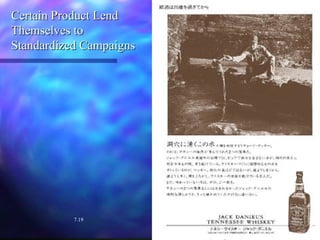
Certain Product Lend Themselves to  Standardized Campaigns 7.19
Standardized vs. Promotional Customized Campaigns  (con’t)   ENVIRONMENT FOR STANDARDIZED PROMOTION IS MORE FAVORABLE DUE TO: Expansion of Global Communications Media Emergence of Global Teenager Trend Towards Universal Demographic & Lifestyle  Trends Americanization of Consumption Values 7.20
Challenges in Developing & Managing  A Global Sales Force DEVELOPING A GLOBAL SALES FORCE CAN BE ACHIEVED WITH: Expatriate Personnel Local Nationals Third Country Nationals 7.22
Challenges in Developing & Managing  A Global Sales Force MANAGING THE GLOBAL SALES FORCE Training Expatriate Foreign National Personnel Training for Foreign Personnel Motivation & Compensation Companies Must Consider Culture Guidelines Include Examining the Way Firms are Compensating People High Tax-Rate Countries – Sales Personnel Push for Packages instead of Direct Taxable Income E.g., Cost of Living Allowances, Private School Tuition, etc. 7.23

International Imc

  • 1.
    THE INTERNATIONAL ENVIRONMENT FOR PROMOTION and IMC 7.1
  • 2.
    Cultural Communications Culture - Total Way of a People, the Social Legacy the Individual Acquires from His or Her Group Culture is Typically Invisible to Those Who are Immersed In It, Making Communication Across Cultures Difficult 7.2
  • 3.
    Importance of InternationalCommunication Complex Social, Political & Economic Changes Affect International Communications Environment. International Developments Relevant to the Rise in International Commercial Communications: Development of Trading Blocs - May be Prelude to a Rise in Nationalism Loosening of Political and Economic Constraints 7.3
  • 4.
    Importance and Riseof International Communication (con’t) Liberalization of the Flow of Labor and Increase in movements of Peoples Across Borders Growing Size of Ethnic Groups From Elevated Birth Rates Rise of Cultural Borders and Barriers even as Economic Barriers Begin to Fall 7.4
  • 5.
    Overcoming Cultural Barriersin International Promotion Barriers to Creating Successful International Promotions Ethnocentrism Self-Reference Criterion 7.5
  • 6.
    How Might ThisAmerican Ad Be Viewed as Ethnocentric 7.6
  • 7.
    Overcoming Cultural Barriersin International Promotion (con’t) Cross-Cultural Research Helps Overcome Barriers Secondary Data - Data Gathered by Someone Else for Some Other Purpose Primary Data - Specific Data Collection Unique to a Promotional Situation Economic Conditions Demographics Characteristics Values Custom & Ritual Product Use & Preference 7.7
  • 8.
    Challenges in InternationalAdvertising Creative Challenge Media Challenge Media Availability & Coverage Media Costs & Pricing Regulatory Challenge 7.8
  • 9.
    International Markets PreferDifferent Creative Executions 7.9
  • 10.
    Challenges in InternationalSales Promotion, Direct Marketing and e-Commerce CHARACTERISTICES OF THE PRODUCT Product Prevalence & Use As Competitive Environment Becomes More Complex, Advertising Designed to Differentiate Brands will Become More Predominant Products Moving into Growth Stage will Need to be Differentiated 7.10
  • 11.
    Challenges in InternationalSales Promotion, Direct Marketing and e-Commerce (con’t) LEVEL OF ECONOMIC DEVELOPMENT All Forms of Production & Direct Marketing are Applicable in Highly Industrialized Markets In Less Developed Countries - Lack of Wide Range of Consumer Goods & Low Income Make Promotion a Non Issue Few Competitors Serve these Markets Low Literacy Make Communication Difficult w/Print Media Without TV, Radio & Newspaper, Direct marketing is Undermined Unsophisticated Mail Systems 7.11
  • 12.
    Challenges in InternationalSales Promotion, Direct Marketing and e-Commerce (con’t) LEVEL OF ECONOMIC DEVELOPMENT (con’t) Newly Industrialized Markets – Better Environment for Promotional Tools – Must be Managed Carefully Consumer Income Rises – More Consumer Goods are Introduced and Succeed As Media Proliferate, Sales Promotions and Direct Marketing can be Introduced Based on Market-by-Market Assessment 7.12
  • 13.
    Challenges in InternationalSales Promotion, Direct Marketing and e-Commerce (con’t) STRUCTURE OF TRADE CHANNELS Highly Developed Distribution & Retailing Systems – Trade Channel Members Demand Support or Carry Marketers Brand Trade Allowances, Incentives, Point-of-Purchase Displays & Sampling Must Have the Means to Handle Coupon Redemption or Premium Distributions Less Developed Trade Channels – May Not be Able to Use Traditional Promotional Techniques Fragmentation of Trade Channels Retailers - No Way of Handling Coupons Some Countries So Small May Not be able to Handle Point-of-Purchase Trade Show 7.13
  • 14.
    Challenges in InternationalSales Promotion, Direct Marketing and e-Commerce (con’t) REGULATIONS Regulation of Promotion, Direct Marketing, and e-Commerce Varies Widely Market-to-Market Most Sales Promotion Tools are Legal Across Europe Sweepstakes are Either Heavily Banned or Regulated in All European Markets In Japan – Value of Premium Offered with a Product is Limited to 10% of the Value of the Original Price 7.14
  • 15.
    Promotions in International Markets Must be Researched for Regulation and Legality 7.15
  • 16.
    Challenges in InternationalPublic Relations COMPANIES HAVE LESS CONTROL OVER GLOBAL PUBLICITY RELATIVE TO DOMESTIC SITUATIONS, AND NO CORPORATIONS ARE POWERFUL ENOUGH TO CONTROL A HOST COUNTRY’S MEDIA 7.16
  • 17.
    Promotion Agencies Aroundthe World GLOBAL AGENCY Will Know Marketer’s Products & Current Promotion Program Agency may then Either Adapt Domestic Campaigns or Launch New Ones Disadvantage is their Distance from Local Culture. Exporting Meaning is Never Easy INTERNATIONAL AFFILIATE Set Up as a joint Venture w/Local Agencies Join Networks or Take Minority Ownership Benefits in this Arrangement LOCAL AGENCY Knowledgeable about Culture/Local Market Have Well-Established Contacts One Problem-Less Standardization of Creative Effort 7.17
  • 18.
    Standardized vs. PromotionalCustomized Campaigns STANDARDIZED CAMPAIGNS USE SAME APPEAL & CREATIVE EXECUTION ACROSS ALLINTERNATIONAL MARKETS CUSTOMIZED CAMPAIGNS INVOLVE PREPARING CREATIVE EXECUTIONS FOR EACH MARKET A FIRM HAS CREATED A BRAND IS WELL SUITED FOR A STANDARDIZED CAMPAIGN WHEN: Communication Primarily Uses Visual Appeal Communication is “Culture-less” Brands that are Standardized Products have Global Reputation 7.18
  • 19.
    Certain Product LendThemselves to Standardized Campaigns 7.19
  • 20.
    Standardized vs. PromotionalCustomized Campaigns (con’t) ENVIRONMENT FOR STANDARDIZED PROMOTION IS MORE FAVORABLE DUE TO: Expansion of Global Communications Media Emergence of Global Teenager Trend Towards Universal Demographic & Lifestyle Trends Americanization of Consumption Values 7.20
  • 21.
    Challenges in Developing& Managing A Global Sales Force DEVELOPING A GLOBAL SALES FORCE CAN BE ACHIEVED WITH: Expatriate Personnel Local Nationals Third Country Nationals 7.22
  • 22.
    Challenges in Developing& Managing A Global Sales Force MANAGING THE GLOBAL SALES FORCE Training Expatriate Foreign National Personnel Training for Foreign Personnel Motivation & Compensation Companies Must Consider Culture Guidelines Include Examining the Way Firms are Compensating People High Tax-Rate Countries – Sales Personnel Push for Packages instead of Direct Taxable Income E.g., Cost of Living Allowances, Private School Tuition, etc. 7.23