English 10
Quarter 3 – Week 4
Prepared by: JICEL C. DISBARRO
I Finally FoundYou!
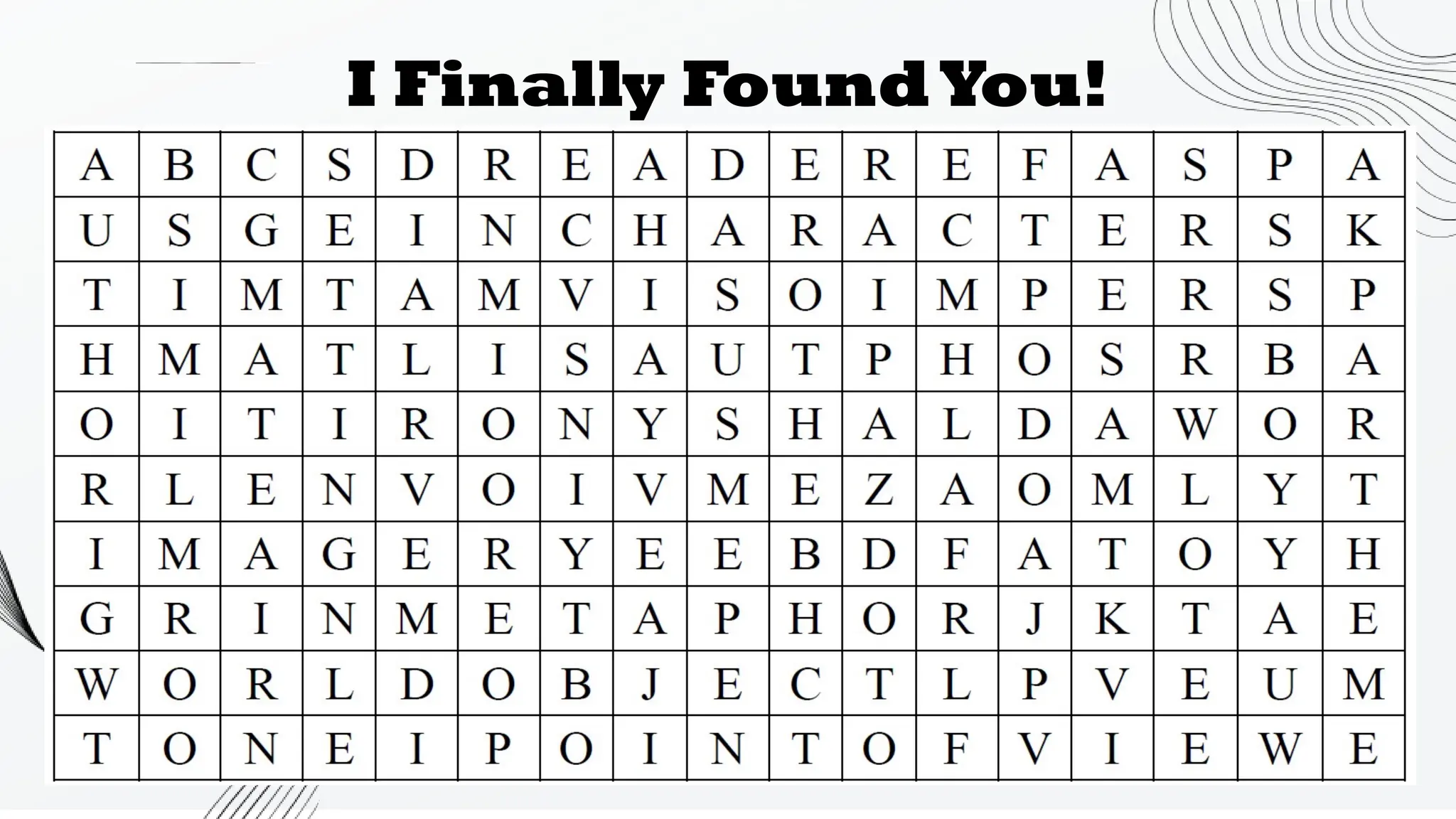
Directions: Search for the 10 literary devices
and elements analyzed in a narrative.
I Finally FoundYou!
I Finally FoundYou!
Directions: Read the story “The Two
brothers” by Leo Tolstoy. Identify the
key elements of the story, such as
theme, tone, and literary devices used.
CUSTOMERS
Process Questions
1.What literary devices did you identify
in the text?
2. How does Tolstoy’s ‘The Two Brothers
relate to life?
3. Why is it important to critically analyze
literature?
Critiquing a Literary
Selection:
Structuralist/Formalist
Approach
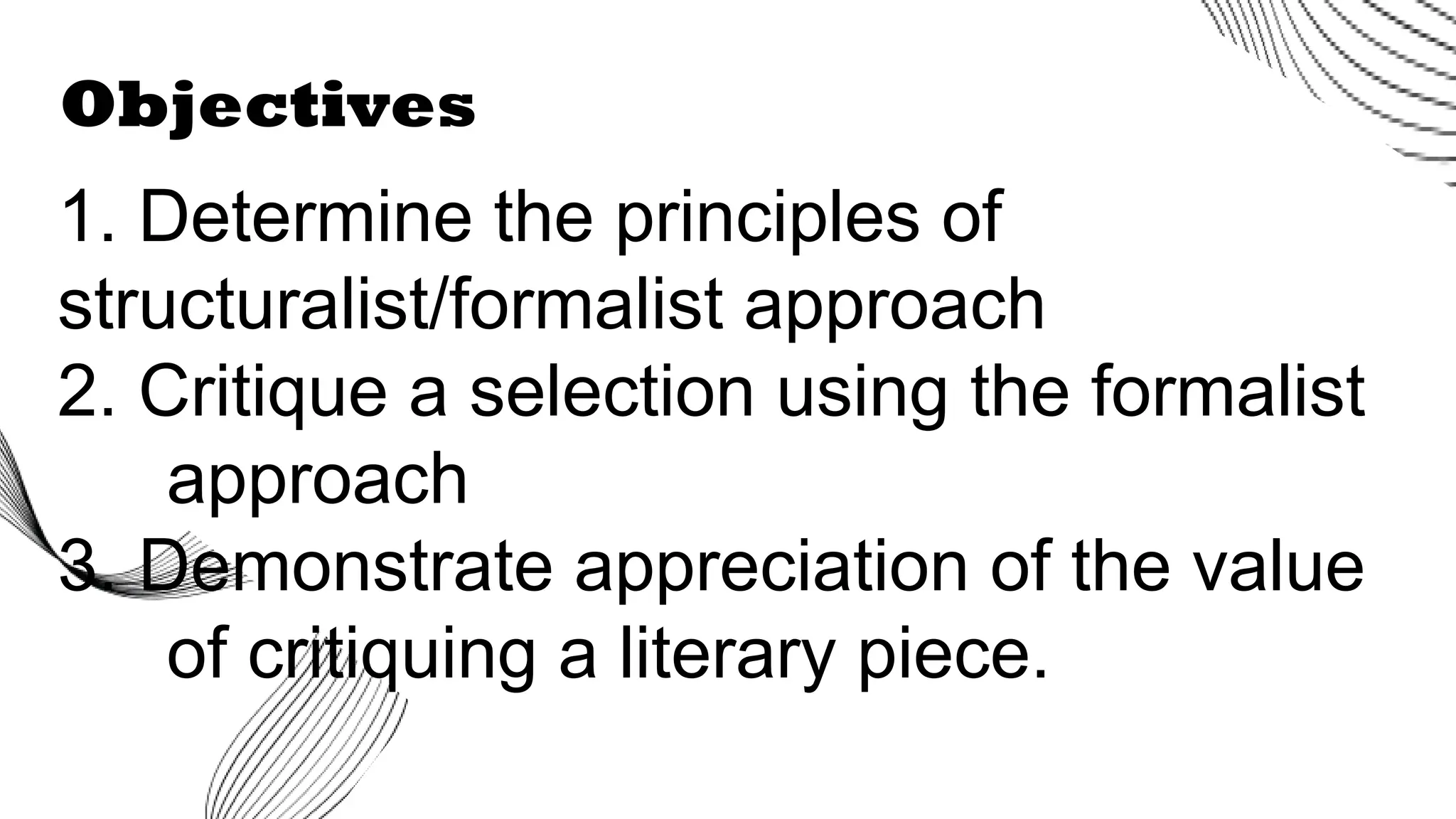
Objectives
1. Determine the principles of
structuralist/formalist approach
2. Critique a selection using the formalist
approach
3. Demonstrate appreciation of the value
of critiquing a literary piece.
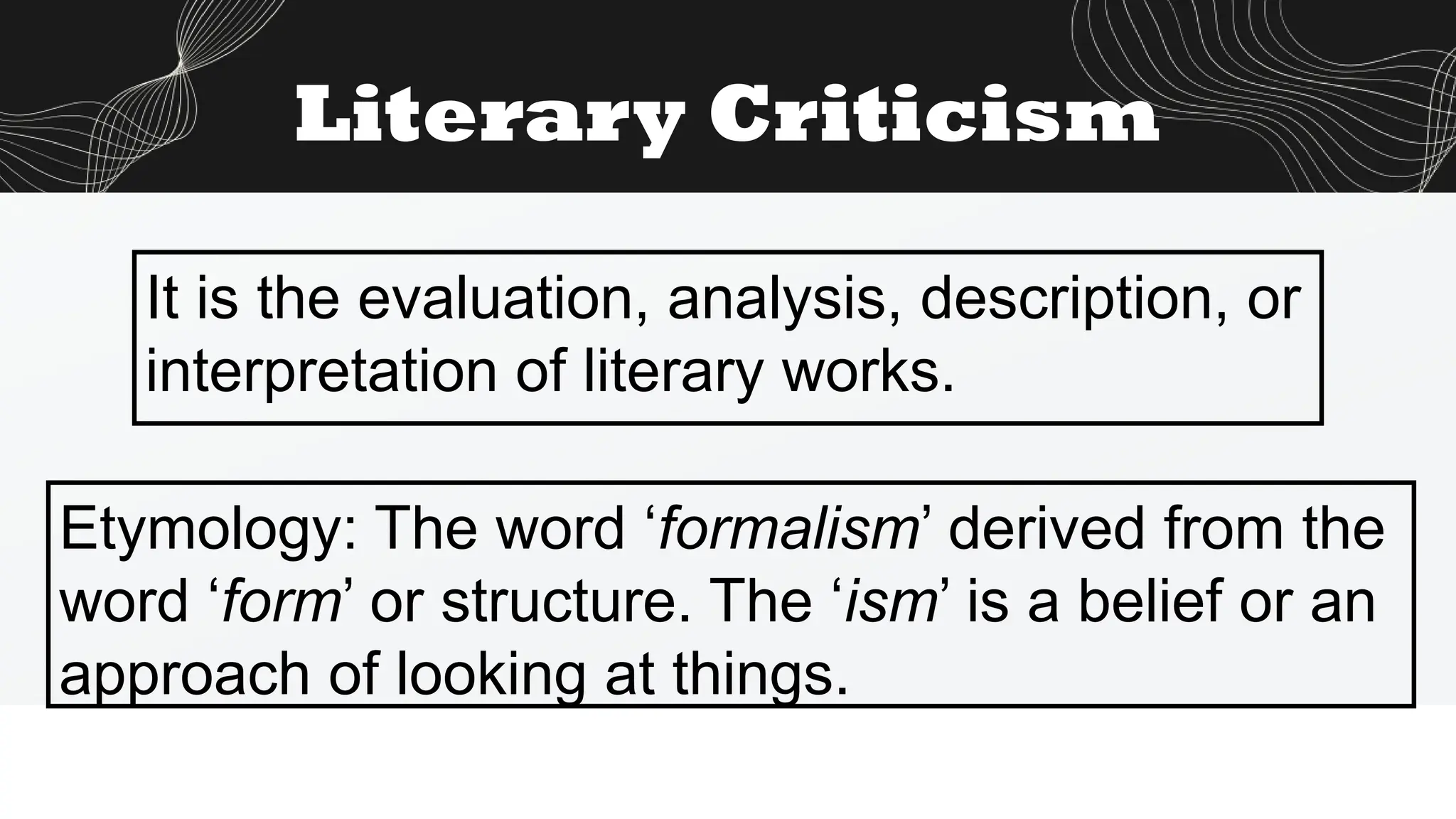
Literary Criticism
It is the evaluation, analysis, description, or
interpretation of literary works.
Etymology: The word ‘formalism’ derived from the
word ‘form’ or structure. The ‘ism’ is a belief or an
approach of looking at things.
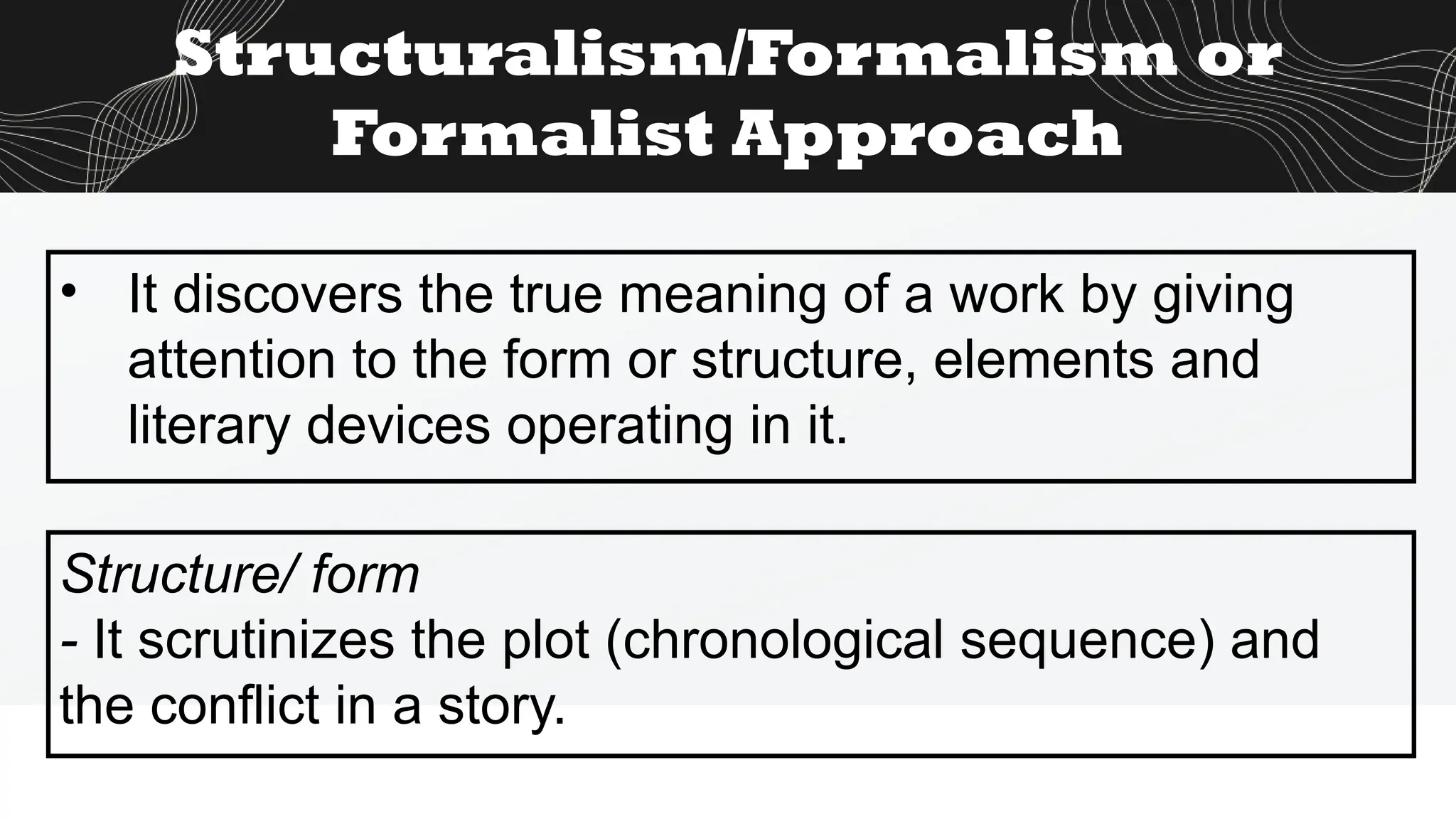
Structuralism/Formalism or
Formalist Approach
• It discovers the true meaning of a work by giving
attention to the form or structure, elements and
literary devices operating in it.
Structure/ form
- It scrutinizes the plot (chronological sequence) and
the conflict in a story.
Structuralism/Formalism or
Formalist Approach
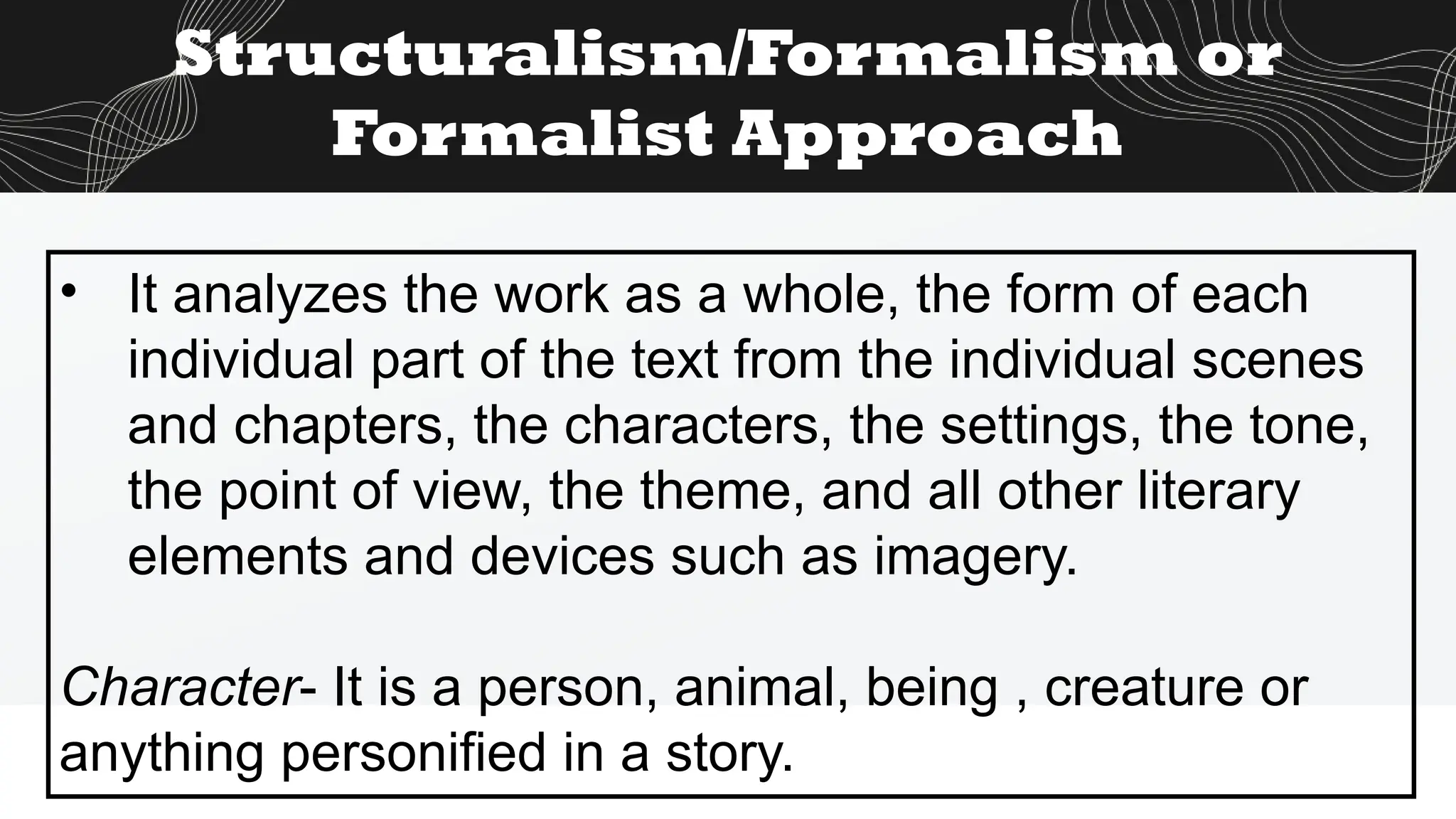
• It analyzes the work as a whole, the form of each
individual part of the text from the individual scenes
and chapters, the characters, the settings, the tone,
the point of view, the theme, and all other literary
elements and devices such as imagery.
Character- It is a person, animal, being , creature or
anything personified in a story.
Structuralism/Formalism or
Formalist Approach
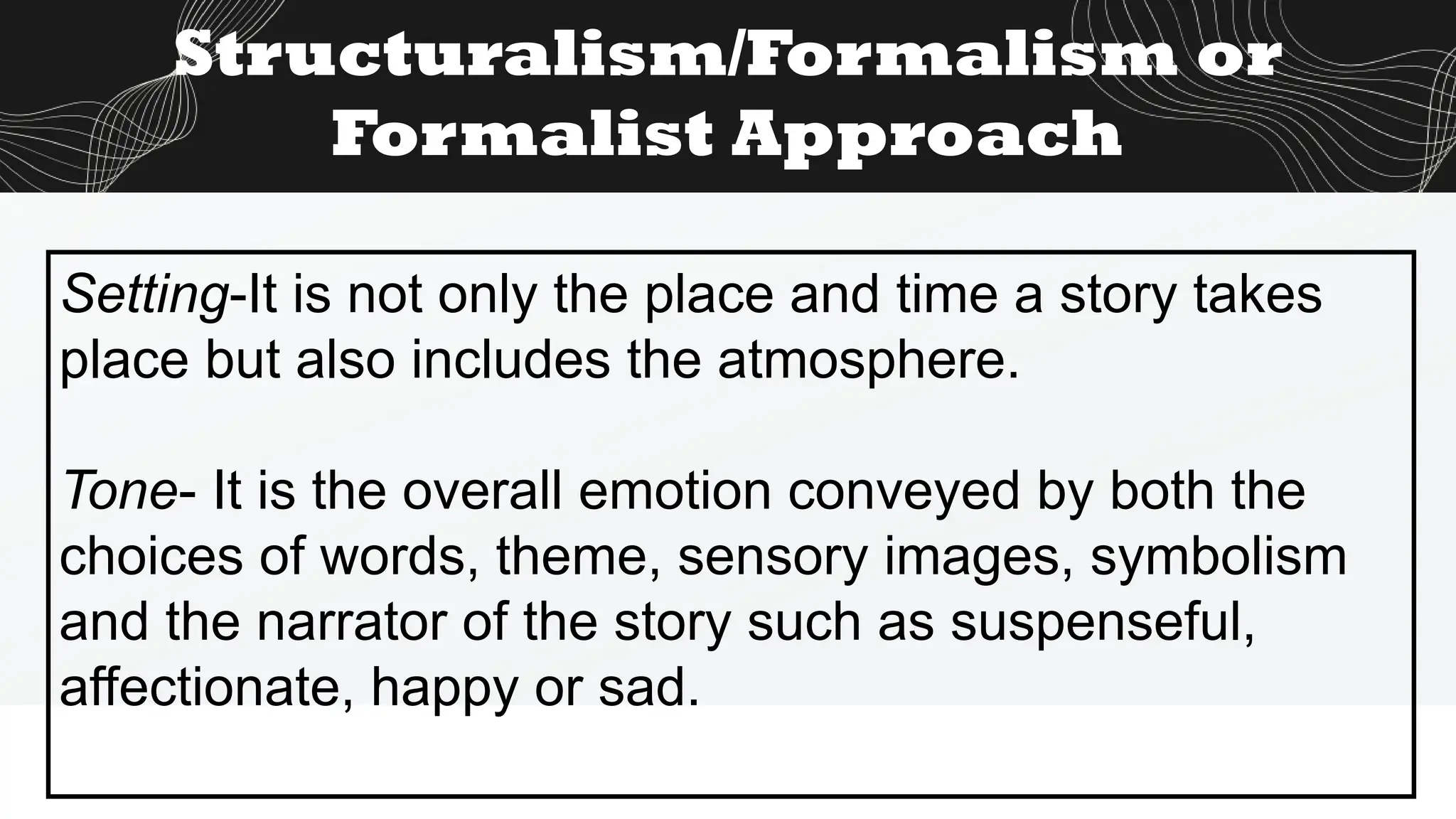
Setting-It is not only the place and time a story takes
place but also includes the atmosphere.
Tone- It is the overall emotion conveyed by both the
choices of words, theme, sensory images, symbolism
and the narrator of the story such as suspenseful,
affectionate, happy or sad.
Structuralism/Formalism or
Formalist Approach
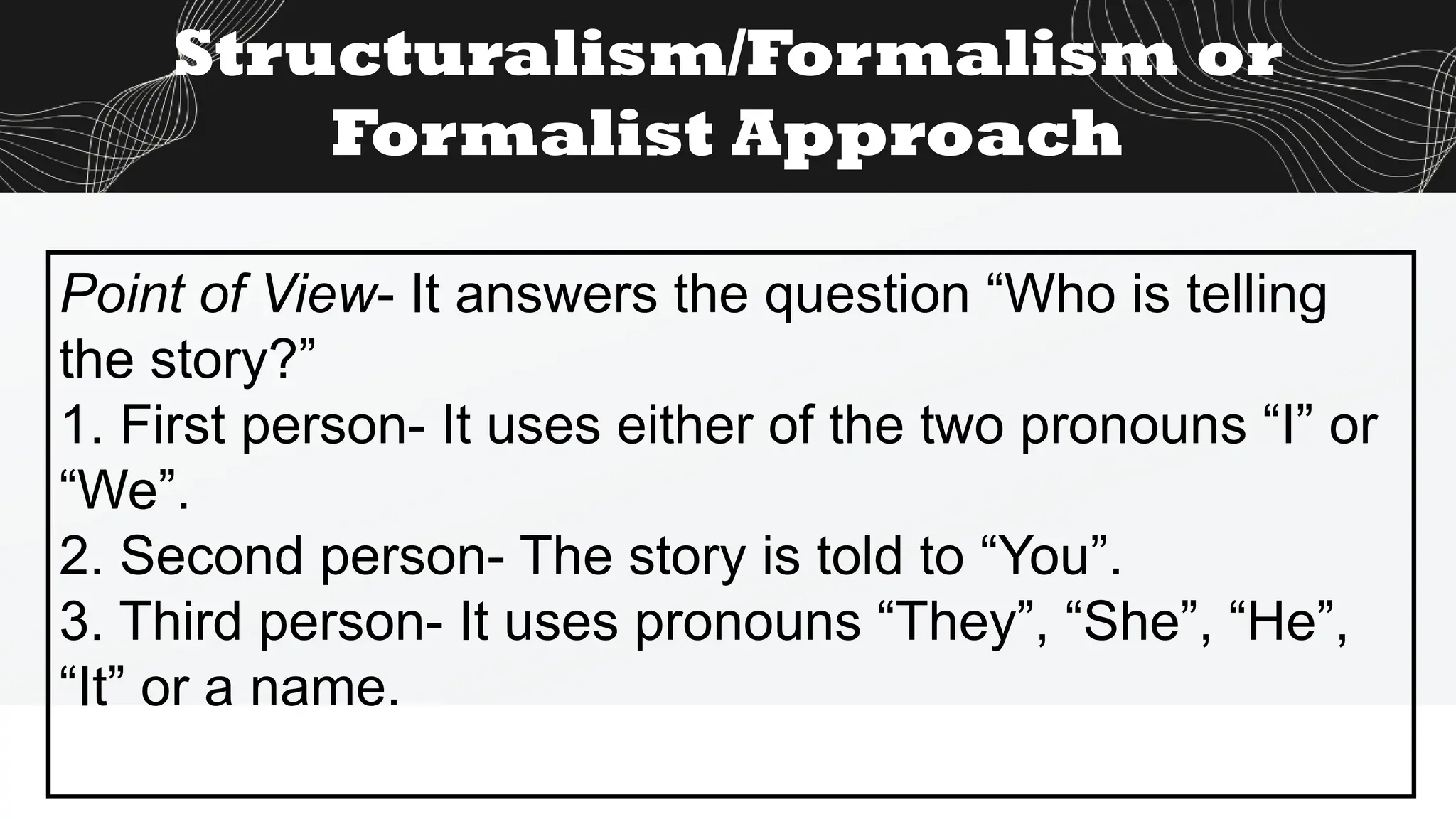
Point of View- It answers the question “Who is telling
the story?”
1. First person- It uses either of the two pronouns “I” or
“We”.
2. Second person- The story is told to “You”.
3. Third person- It uses pronouns “They”, “She”, “He”,
“It” or a name.
Structuralism/Formalism or
Formalist Approach
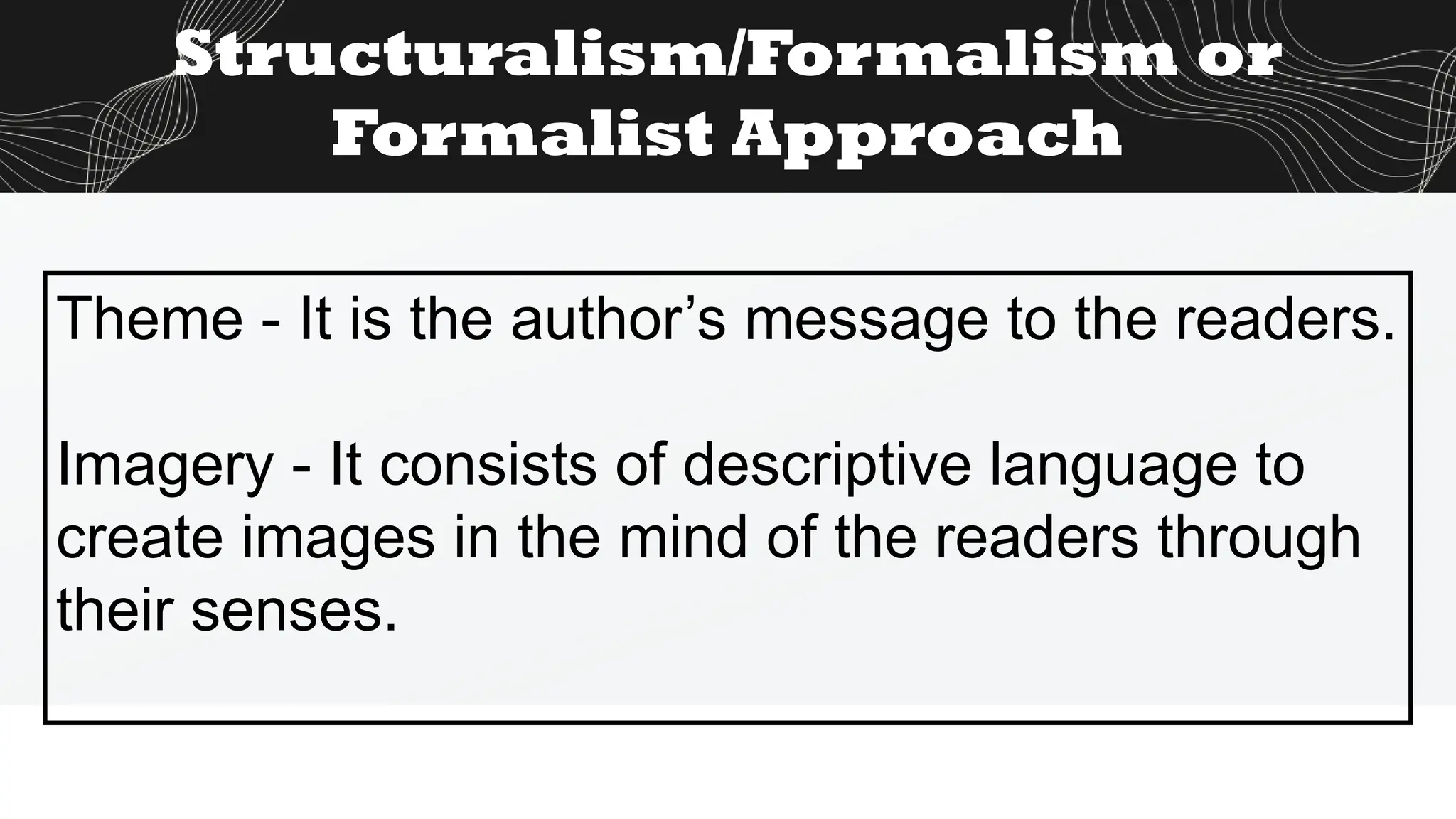
Theme - It is the author’s message to the readers.
Imagery - It consists of descriptive language to
create images in the mind of the readers through
their senses.
Structuralism/Formalism or
Formalist Approach
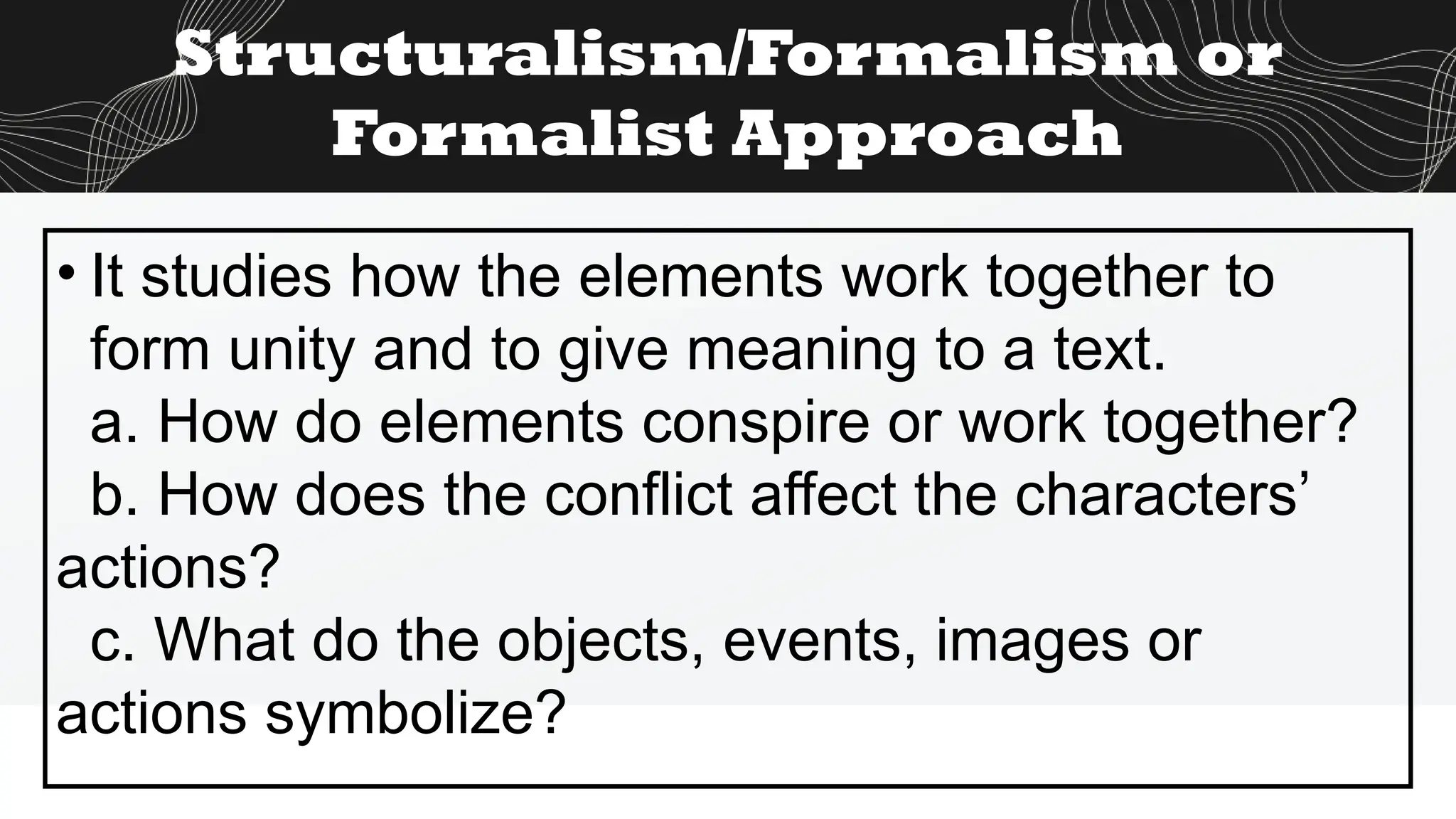
• It studies how the elements work together to
form unity and to give meaning to a text.
a. How do elements conspire or work together?
b. How does the conflict affect the characters’
actions?
c. What do the objects, events, images or
actions symbolize?
Structuralism/Formalism or
Formalist Approach
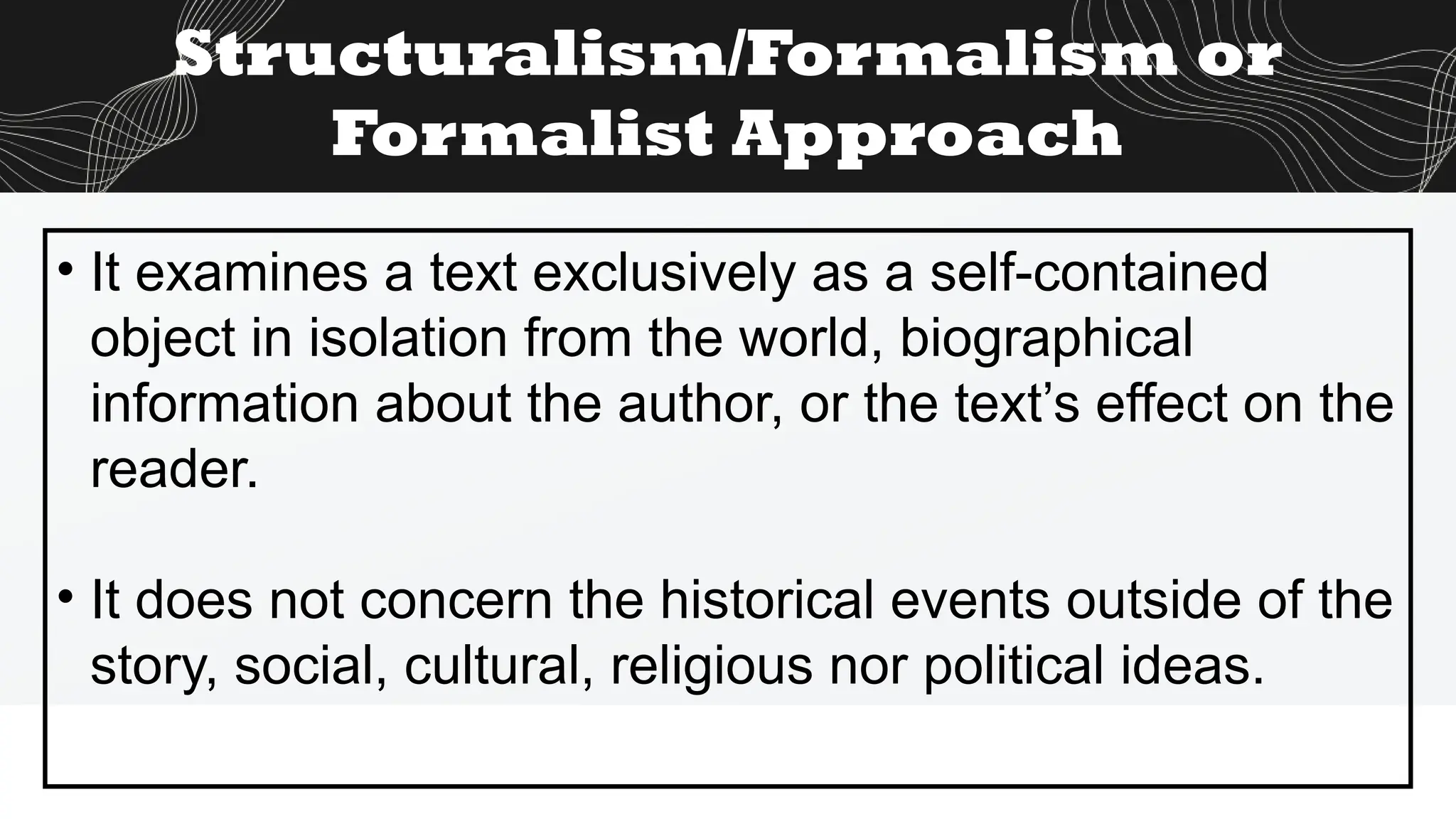
• It examines a text exclusively as a self-contained
object in isolation from the world, biographical
information about the author, or the text’s effect on the
reader.
• It does not concern the historical events outside of the
story, social, cultural, religious nor political ideas.
Structuralism/Formalism or
Formalist Approach
• It emphasizes the value of the text as an entity in
itself.
Read and Critique!
Directions: Read the story from Benguet and discover
the origin of rice and small streams. Do a simple
critique using the guide questions.
The Origin of Rice and
Streams
(Ibaloy Tale)
Guide Questions
1.Characters: Who are the characters in the story? How
are they related to one another? What are their
actions?
2.Setting: Where did the story happen? Describe the
environment/ atmosphere.
3.Conflict: What is the main problem in the story?
4.Plot: How did the story begin? What happened in the
story? How did it end?
Guide Questions
5. Tone: What was the author’s attitude towards the
subject? What kind of emotion or feeling did you get
after reading?
6. Point of view: Who is telling or narrating the story? Is
one character acting as a narrator (First Person), or
someone telling what is going on (Third Person)?
7. Theme: What lesson does the author want me to
learn from the story? What lesson does the author want
me to learn about life?
I’m the One!
Direction: Draw a happy face ( ) if the statement
describes a formalist critic. Otherwise, draw a sad face
( ).
A formalist critic…
____1. must be a close or careful reader who
examines all the elements of a text individually
to discover how they form an organic unity.
I’m the One!
Direction: Draw a happy face ( ) if the statement
describes a formalist critic. Otherwise, draw a sad face
( ).
A formalist critic…
____2. questions how they come together
to create a work of art.
I’m the One!
Direction: Draw a happy face ( ) if the statement
describes a formalist critic. Otherwise, draw a sad face
( ).
A formalist critic…
____3. looks beyond the work by reading
the author’s life, or literary style.
I’m the One!
Direction: Draw a happy face ( ) if the statement
describes a formalist critic. Otherwise, draw a sad face
( ).
A formalist critic…
____4. examines the work’s historical
background and condition of the society.
I’m the One!
Direction: Draw a happy face ( ) if the statement
describes a formalist critic. Otherwise, draw a sad face
( ).
A formalist critic…
____5. allows the text to reveal itself.
I’m the One!
Direction: Draw a happy face ( ) if the statement
describes a formalist critic. Otherwise, draw a sad face
( ).
A formalist critic…
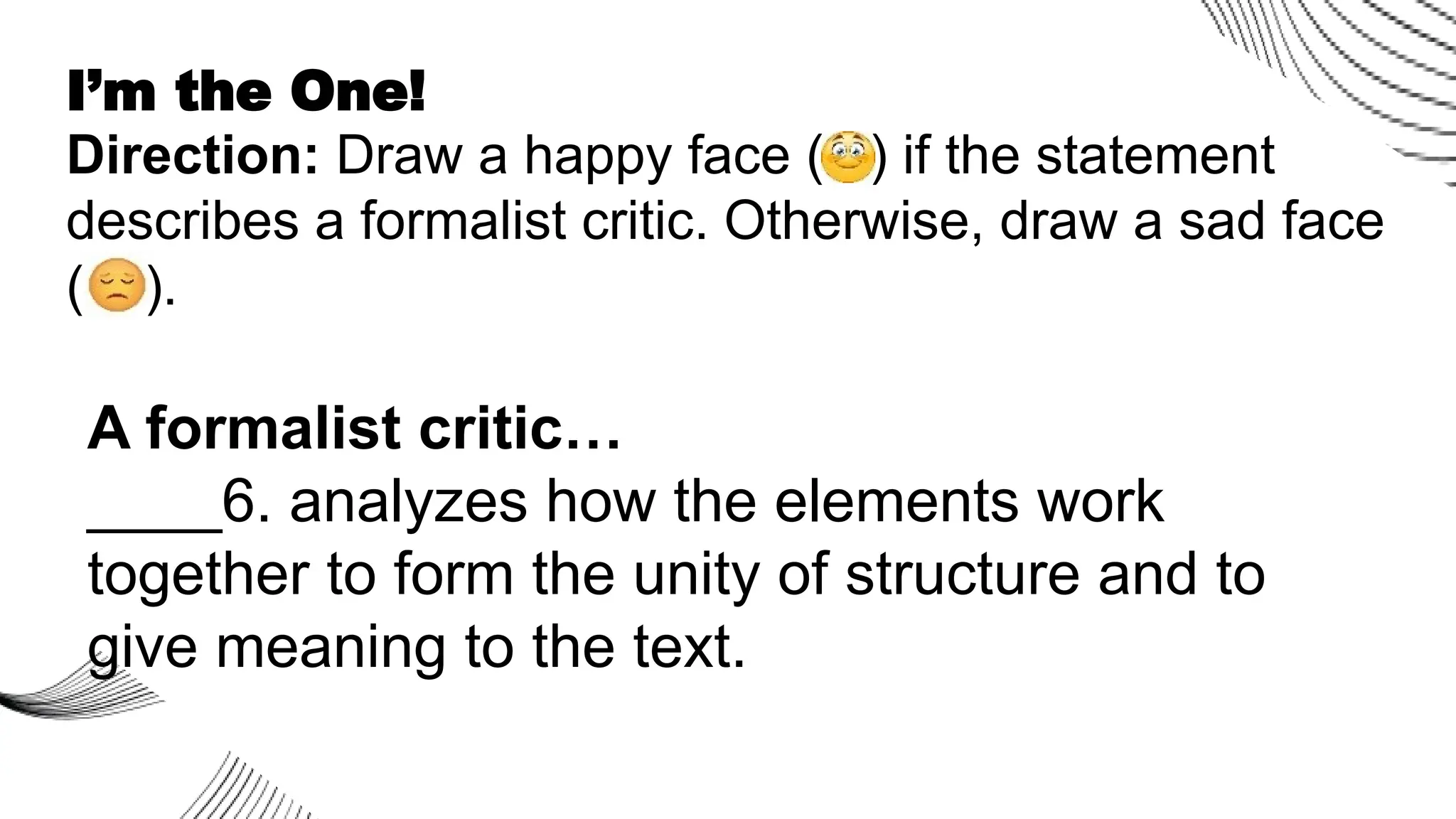
____6. analyzes how the elements work
together to form the unity of structure and to
give meaning to the text.
I’m the One!
Direction: Draw a happy face ( ) if the statement
describes a formalist critic. Otherwise, draw a sad face
( ).
A formalist critic…
____7. achieves understanding of the text
by looking inside it, not outside nor
beyond.
I’m the One!
Direction: Draw a happy face ( ) if the statement
describes a formalist critic. Otherwise, draw a sad face
( ).
A formalist critic…
____8. studies how the text’s influences or
figures out similarity with other works.
I’m the One!
Direction: Draw a happy face ( ) if the statement
describes a formalist critic. Otherwise, draw a sad face
( ).
A formalist critic…
____9. takes the elements distinct and
separate from each other.
I’m the One!
Direction: Draw a happy face ( ) if the statement
describes a formalist critic. Otherwise, draw a sad face
( ).
A formalist critic…
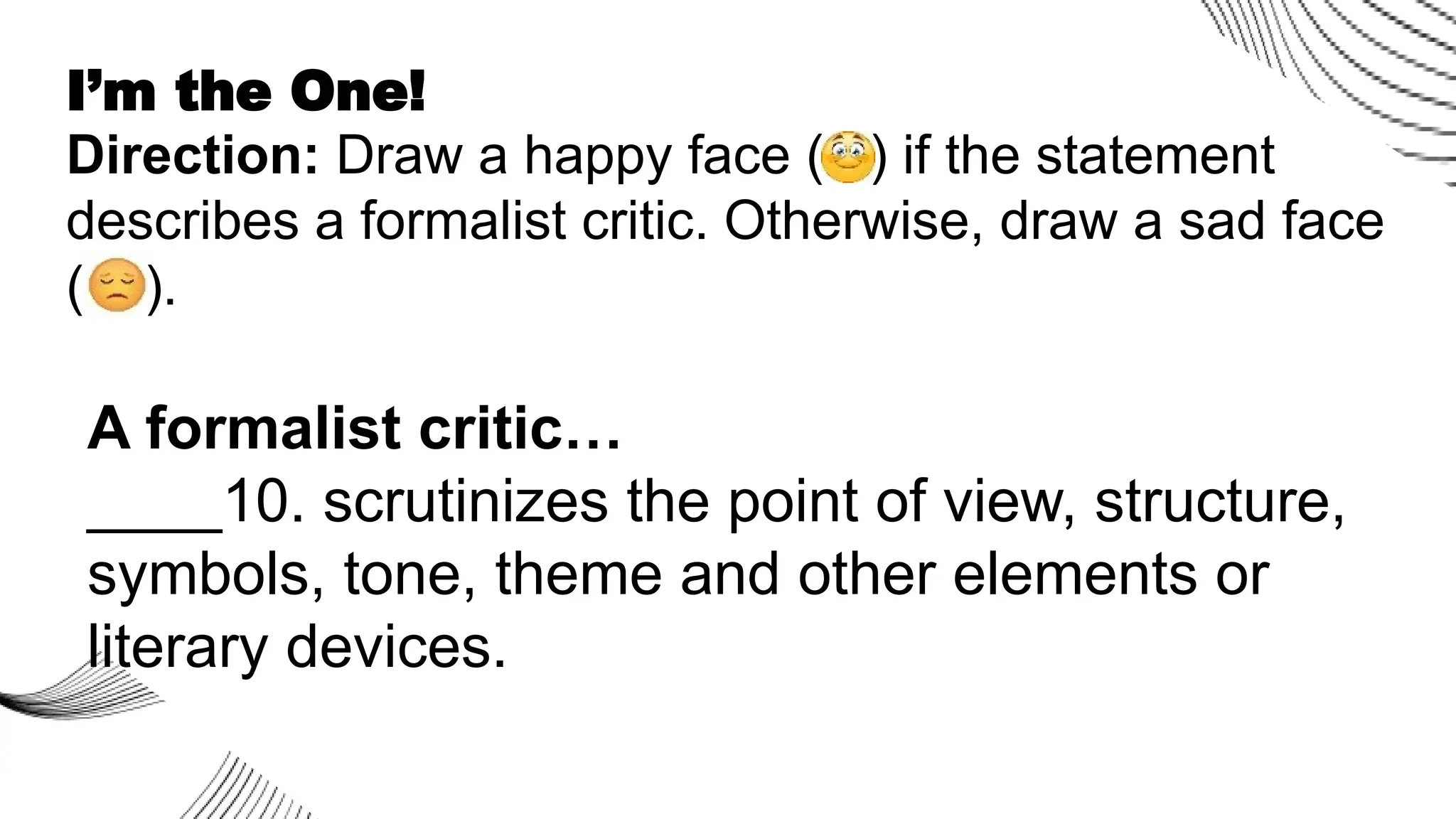
____10. scrutinizes the point of view, structure,
symbols, tone, theme and other elements or
literary devices.
Assignment:
Wrap it up and reflect!
Direction: Share what you have learned from the
lesson. Complete the following phrases.
My journey through this lesson enabled me to
learn___________________________________
_______________________________________.
It made me realize that____________________.

ENG10-WEEK 4-FORMALIST APPROACH - POWERPOINT

  • 1.
    English 10 Quarter 3– Week 4 Prepared by: JICEL C. DISBARRO
  • 2.
    I Finally FoundYou! Directions:Search for the 10 literary devices and elements analyzed in a narrative.
  • 3.
  • 4.
  • 5.
    Directions: Read thestory “The Two brothers” by Leo Tolstoy. Identify the key elements of the story, such as theme, tone, and literary devices used.
  • 6.
    CUSTOMERS Process Questions 1.What literarydevices did you identify in the text? 2. How does Tolstoy’s ‘The Two Brothers relate to life? 3. Why is it important to critically analyze literature?
  • 7.
  • 8.
    Objectives 1. Determine theprinciples of structuralist/formalist approach 2. Critique a selection using the formalist approach 3. Demonstrate appreciation of the value of critiquing a literary piece.
  • 9.
    Literary Criticism It isthe evaluation, analysis, description, or interpretation of literary works. Etymology: The word ‘formalism’ derived from the word ‘form’ or structure. The ‘ism’ is a belief or an approach of looking at things.
  • 10.
    Structuralism/Formalism or Formalist Approach •It discovers the true meaning of a work by giving attention to the form or structure, elements and literary devices operating in it. Structure/ form - It scrutinizes the plot (chronological sequence) and the conflict in a story.
  • 11.
    Structuralism/Formalism or Formalist Approach •It analyzes the work as a whole, the form of each individual part of the text from the individual scenes and chapters, the characters, the settings, the tone, the point of view, the theme, and all other literary elements and devices such as imagery. Character- It is a person, animal, being , creature or anything personified in a story.
  • 12.
    Structuralism/Formalism or Formalist Approach Setting-Itis not only the place and time a story takes place but also includes the atmosphere. Tone- It is the overall emotion conveyed by both the choices of words, theme, sensory images, symbolism and the narrator of the story such as suspenseful, affectionate, happy or sad.
  • 13.
    Structuralism/Formalism or Formalist Approach Pointof View- It answers the question “Who is telling the story?” 1. First person- It uses either of the two pronouns “I” or “We”. 2. Second person- The story is told to “You”. 3. Third person- It uses pronouns “They”, “She”, “He”, “It” or a name.
  • 14.
    Structuralism/Formalism or Formalist Approach Theme- It is the author’s message to the readers. Imagery - It consists of descriptive language to create images in the mind of the readers through their senses.
  • 15.
    Structuralism/Formalism or Formalist Approach •It studies how the elements work together to form unity and to give meaning to a text. a. How do elements conspire or work together? b. How does the conflict affect the characters’ actions? c. What do the objects, events, images or actions symbolize?
  • 16.
    Structuralism/Formalism or Formalist Approach •It examines a text exclusively as a self-contained object in isolation from the world, biographical information about the author, or the text’s effect on the reader. • It does not concern the historical events outside of the story, social, cultural, religious nor political ideas.
  • 17.
    Structuralism/Formalism or Formalist Approach •It emphasizes the value of the text as an entity in itself.
  • 18.
    Read and Critique! Directions:Read the story from Benguet and discover the origin of rice and small streams. Do a simple critique using the guide questions. The Origin of Rice and Streams (Ibaloy Tale)
  • 19.
    Guide Questions 1.Characters: Whoare the characters in the story? How are they related to one another? What are their actions? 2.Setting: Where did the story happen? Describe the environment/ atmosphere. 3.Conflict: What is the main problem in the story? 4.Plot: How did the story begin? What happened in the story? How did it end?
  • 20.
    Guide Questions 5. Tone:What was the author’s attitude towards the subject? What kind of emotion or feeling did you get after reading? 6. Point of view: Who is telling or narrating the story? Is one character acting as a narrator (First Person), or someone telling what is going on (Third Person)? 7. Theme: What lesson does the author want me to learn from the story? What lesson does the author want me to learn about life?
  • 21.
    I’m the One! Direction:Draw a happy face ( ) if the statement describes a formalist critic. Otherwise, draw a sad face ( ). A formalist critic… ____1. must be a close or careful reader who examines all the elements of a text individually to discover how they form an organic unity.
  • 22.
    I’m the One! Direction:Draw a happy face ( ) if the statement describes a formalist critic. Otherwise, draw a sad face ( ). A formalist critic… ____2. questions how they come together to create a work of art.
  • 23.
    I’m the One! Direction:Draw a happy face ( ) if the statement describes a formalist critic. Otherwise, draw a sad face ( ). A formalist critic… ____3. looks beyond the work by reading the author’s life, or literary style.
  • 24.
    I’m the One! Direction:Draw a happy face ( ) if the statement describes a formalist critic. Otherwise, draw a sad face ( ). A formalist critic… ____4. examines the work’s historical background and condition of the society.
  • 25.
    I’m the One! Direction:Draw a happy face ( ) if the statement describes a formalist critic. Otherwise, draw a sad face ( ). A formalist critic… ____5. allows the text to reveal itself.
  • 26.
    I’m the One! Direction:Draw a happy face ( ) if the statement describes a formalist critic. Otherwise, draw a sad face ( ). A formalist critic… ____6. analyzes how the elements work together to form the unity of structure and to give meaning to the text.
  • 27.
    I’m the One! Direction:Draw a happy face ( ) if the statement describes a formalist critic. Otherwise, draw a sad face ( ). A formalist critic… ____7. achieves understanding of the text by looking inside it, not outside nor beyond.
  • 28.
    I’m the One! Direction:Draw a happy face ( ) if the statement describes a formalist critic. Otherwise, draw a sad face ( ). A formalist critic… ____8. studies how the text’s influences or figures out similarity with other works.
  • 29.
    I’m the One! Direction:Draw a happy face ( ) if the statement describes a formalist critic. Otherwise, draw a sad face ( ). A formalist critic… ____9. takes the elements distinct and separate from each other.
  • 30.
    I’m the One! Direction:Draw a happy face ( ) if the statement describes a formalist critic. Otherwise, draw a sad face ( ). A formalist critic… ____10. scrutinizes the point of view, structure, symbols, tone, theme and other elements or literary devices.
  • 31.
    Assignment: Wrap it upand reflect! Direction: Share what you have learned from the lesson. Complete the following phrases. My journey through this lesson enabled me to learn___________________________________ _______________________________________. It made me realize that____________________.

Editor's Notes

  • #1 Two groups
  • #9 Evaluation of the structure
  • #13 First - The narrator is a participant in the story relating his or her own experiences directly or an observer. Third - The narrator may be omniscient (all- knowing) or has a full access to the thoughts and experiences of all characters in the story or may be a limited omniscient who usually cannot see into minds or know the future, etc.
  • #20 1. What is literary criticism? 2. What are the principles of structuralist/formalist approach? 3. Why is it important to critique a literary piece?
  • #21 happy
  • #22 happy
  • #23 Sad
  • #24 Sad
  • #25 Happy
  • #26 Happy
  • #27 Happy
  • #28 Sad
  • #29 Sad
  • #30 Happy