EN 403
Mrs. Hawk
Fall 2021
Critical Analysis Rubric
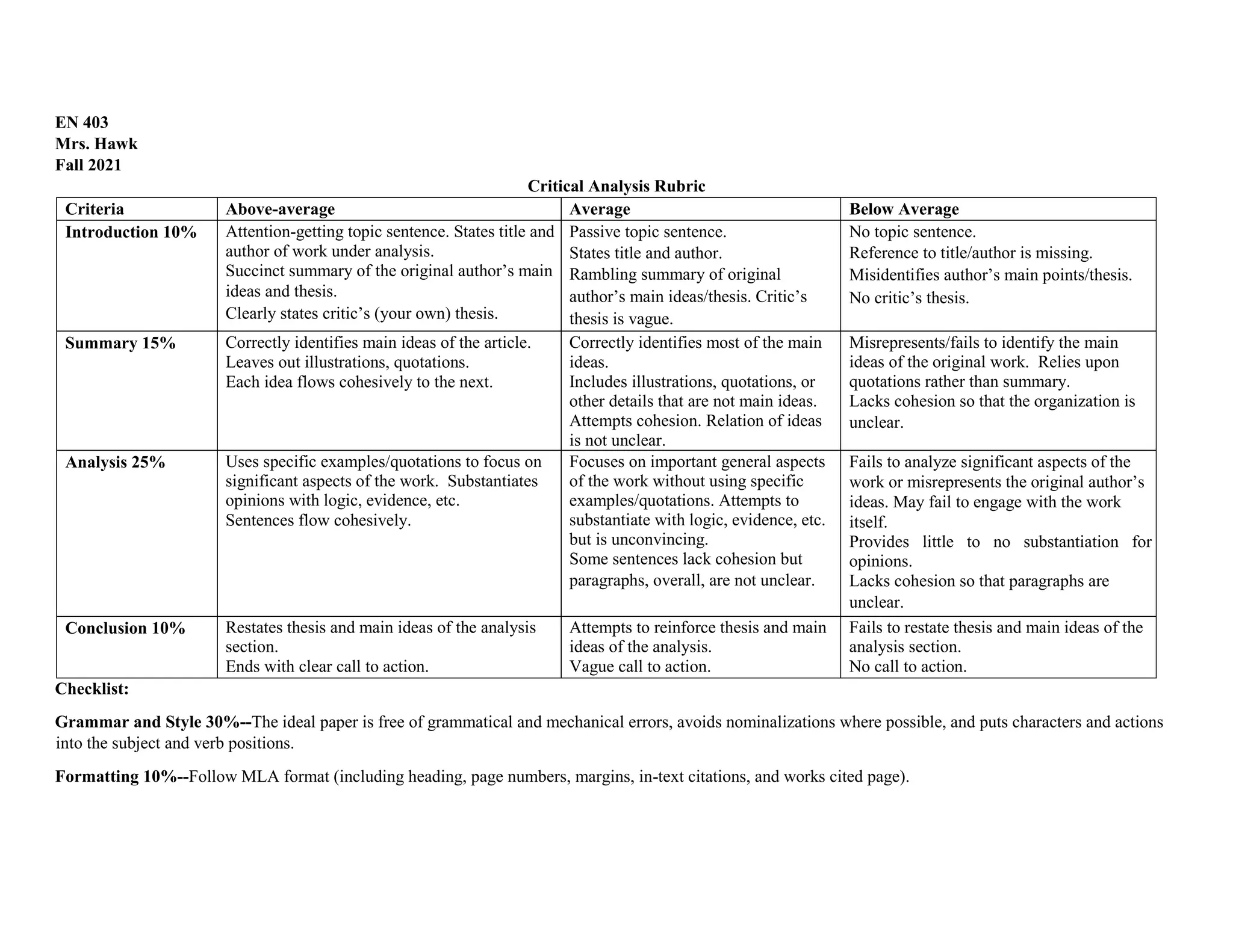
Criteria Above-average Average Below Average
Introduction 10% Attention-getting topic sentence. States title and
author of work under analysis.
Succinct summary of the original author’s main
ideas and thesis.
Clearly states critic’s (your own) thesis.
Passive topic sentence.
States title and author.
Rambling summary of original
author’s main ideas/thesis. Critic’s
thesis is vague.
No topic sentence.
Reference to title/author is missing.
Misidentifies author’s main points/thesis.
No critic’s thesis.
Summary 15% Correctly identifies main ideas of the article.
Leaves out illustrations, quotations.
Each idea flows cohesively to the next.
Correctly identifies most of the main
ideas.
Includes illustrations, quotations, or
other details that are not main ideas.
Attempts cohesion. Relation of ideas
is not unclear.
Misrepresents/fails to identify the main
ideas of the original work. Relies upon
quotations rather than summary.
Lacks cohesion so that the organization is
unclear.
Analysis 25% Uses specific examples/quotations to focus on
significant aspects of the work. Substantiates
opinions with logic, evidence, etc.
Sentences flow cohesively.
Focuses on important general aspects
of the work without using specific
examples/quotations. Attempts to
substantiate with logic, evidence, etc.
but is unconvincing.
Some sentences lack cohesion but
paragraphs, overall, are not unclear.
Fails to analyze significant aspects of the
work or misrepresents the original author’s
ideas. May fail to engage with the work
itself.
Provides little to no substantiation for
opinions.
Lacks cohesion so that paragraphs are
unclear.
Conclusion 10% Restates thesis and main ideas of the analysis
section.
Ends with clear call to action.
Attempts to reinforce thesis and main
ideas of the analysis.
Vague call to action.
Fails to restate thesis and main ideas of the
analysis section.
No call to action.
Checklist:
Grammar and Style 30%--The ideal paper is free of grammatical and mechanical errors, avoids nominalizations where possible, and puts characters and actions
into the subject and verb positions.
Formatting 10%--Follow MLA format (including heading, page numbers, margins, in-text citations, and works cited page).

Critical Analysis Rubric.docx

  • 1.
    EN 403 Mrs. Hawk Fall2021 Critical Analysis Rubric Criteria Above-average Average Below Average Introduction 10% Attention-getting topic sentence. States title and author of work under analysis. Succinct summary of the original author’s main ideas and thesis. Clearly states critic’s (your own) thesis. Passive topic sentence. States title and author. Rambling summary of original author’s main ideas/thesis. Critic’s thesis is vague. No topic sentence. Reference to title/author is missing. Misidentifies author’s main points/thesis. No critic’s thesis. Summary 15% Correctly identifies main ideas of the article. Leaves out illustrations, quotations. Each idea flows cohesively to the next. Correctly identifies most of the main ideas. Includes illustrations, quotations, or other details that are not main ideas. Attempts cohesion. Relation of ideas is not unclear. Misrepresents/fails to identify the main ideas of the original work. Relies upon quotations rather than summary. Lacks cohesion so that the organization is unclear. Analysis 25% Uses specific examples/quotations to focus on significant aspects of the work. Substantiates opinions with logic, evidence, etc. Sentences flow cohesively. Focuses on important general aspects of the work without using specific examples/quotations. Attempts to substantiate with logic, evidence, etc. but is unconvincing. Some sentences lack cohesion but paragraphs, overall, are not unclear. Fails to analyze significant aspects of the work or misrepresents the original author’s ideas. May fail to engage with the work itself. Provides little to no substantiation for opinions. Lacks cohesion so that paragraphs are unclear. Conclusion 10% Restates thesis and main ideas of the analysis section. Ends with clear call to action. Attempts to reinforce thesis and main ideas of the analysis. Vague call to action. Fails to restate thesis and main ideas of the analysis section. No call to action. Checklist: Grammar and Style 30%--The ideal paper is free of grammatical and mechanical errors, avoids nominalizations where possible, and puts characters and actions into the subject and verb positions. Formatting 10%--Follow MLA format (including heading, page numbers, margins, in-text citations, and works cited page).